HAL Id: hal-01891935
https://hal.archives-ouvertes.fr/hal-01891935
Submitted on 10 Oct 2018
HAL is a multi-disciplinary open access archive for the deposit and dissemination of sci-entific research documents, whether they are pub-lished or not. The documents may come from teaching and research institutions in France or abroad, or from public or private research centers.
L’archive ouverte pluridisciplinaire HAL, est destinée au dépôt et à la diffusion de documents scientifiques de niveau recherche, publiés ou non, émanant des établissements d’enseignement et de recherche français ou étrangers, des laboratoires publics ou privés.
Multilayer structures based on porous silicon for
photonic applications in the mid-infrared
Pauline Girault, Paul Azuelos, Nathalie Lorrain, Parastesh Pirasteh, M.
Guendouz, Gilles Lerondel, Joël Charrier
To cite this version:
Pauline Girault, Paul Azuelos, Nathalie Lorrain, Parastesh Pirasteh, M. Guendouz, et al.. Multilayer structures based on porous silicon for photonic applications in the mid-infrared. 11th Porous Semi-conductors - Science and Technology 2018 Conference (PSST 2018), Mar 2018, La Grande Motte, France. �hal-01891935�
PSST 2018
11-16 March 2018 La Grande Motte, France
MULTILAYER STRUCTURES BASED ON POROUS SILICON FOR PHOTONIC APPLICATIONS IN THE MID-INFRARED
P. GIRAULT1, P. AZUELOS1, N. LORRAIN1, P. PIRASTEH1, M. GUENDOUZ1*, G. LERONDEL2 AND J. CHARRIER1
1 Univ Rennes, CNRS, Institut FOTON - UMR 6082, France
2 LNIO, ICD-UMR 6281 CNRS, Université de Technologie de Troyes, France
*Corresponding author e-mail address: [email protected]
SUMMARY
In this work, the fabrication of porous silicon Bragg reflector and vertical micro-cavity on P+
silicon substrate is investigated for applications in spectroscopic sensing and environmental monitoring in the Mid Infra-Red field. These optical devices are characterized by FTIR spectrophotometer.
This work demonstrates for the first time to our knowledge, the use of an electrochemically prepared Bragg reflectors and vertical micro-resonators based on PSi operating at Mid-IR spectral region (up to 8 µm).
1. INTRODUCTION
The ability to tailor Porous Silicon (PSi) refractive index and layer thickness by controlling porosity and anodization time [1, 2] makes it especially attractive for optical applications. Optical multilayer devices such as Bragg reflectors or micro-cavities have already been formed from PSi layers notably for Visible and Near Infra-Red (NIR) wavelength ranges [3-10]. Two constant current densities are used for the high porosity (HP) and low porosity (LP) layers with low and high refractive
indices (nHP and nLP) respectively for the fabrication of these optical devices. The etching times are
adjusted to produce an optimized Bragg reflector or cavity with the resonant wavelength in the chosen spectral range.
Moreover, PSi is also biocompatible material and its functionalization by grafting molecules to detect is interesting for surfacic detection due to its high specific surface that is very important up to 800 m2/cm3.
The implementation of a Mid Infra-Red (Mid-IR) silicon photonics transducer with broad Mid-IR transparency (up to 8 µm) is a challenge that could find applications in spectroscopic sensing and environmental monitoring.
2. RESULTS AND DISCUSSIONS
The PSi layers were obtained by electrochemical anodization of p-type doped (100)-oriented
silicon wafer (4-6 m.cm) at low temperature. The electrolyte was composed of HF(50%):ethanol
(7-3). The refractive indices and porosities of single layers were studied by reflectometry in the near and mid infrared spectral range. The values of thicknesses were obtained by SEM measurements. The thickness of each porous layer was controlled by the anodization time.
The infrared transmittance and reflectance were measured by FTIR spectrophotometer Perkin Elmer
Spectrum 100 from 1,5 µm to 15 µm with resolution of 4 cm-1. The calibration is obtained by a
measurement using a gold mirror with a calibrated reflection equal to 97.5% between 1 and 25 µm. From the refractive index and the growth rate knowledge of the PSi layers, the design of vertical optical devices is performed in order to determine the best combination of parameters of reflectors
and cavities: reflection bandwidth , resonance wavelength and maximum reflectance.
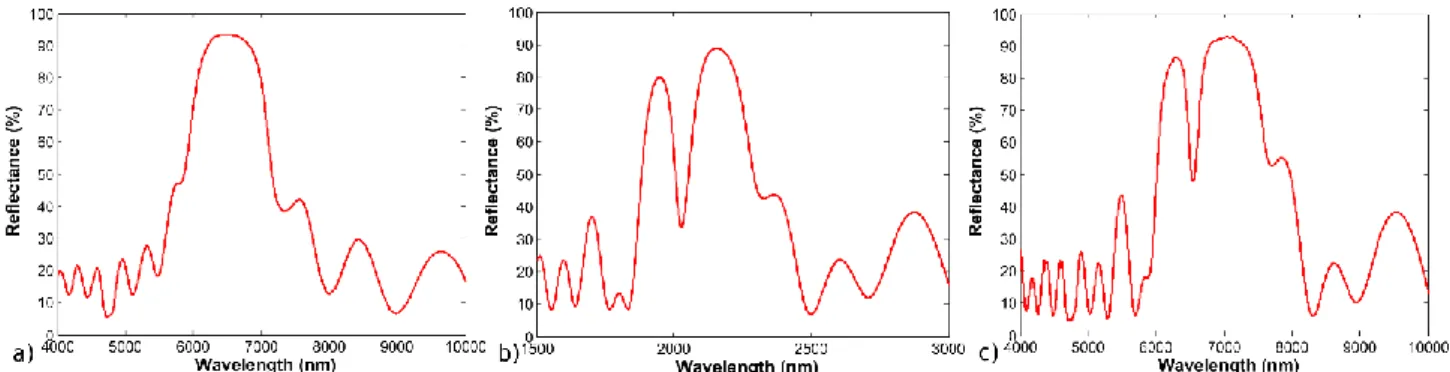
The experimental reflectivity spectra are shown in Figure 1 for Bragg reflector and micro-cavities centered at 2050 and 6500 nm.
PSST 2018
11-16 March 2018 La Grande Motte, France
Figure 1: Experimental reflectivity spectra of (a) PSi Bragg reflector centered at 6500 nm, (b) PSi vertical micro-cavity centered at 2050 nm and (c) PSi vertical micro-cavity centered at 6500 nm.
This study will be completed by testing these optical devices as transducers to detect molecules that are absorbing in the Mid-IR to determine their sensitivity and their limit of detection.
3. CONCLUSIONS
These optical devices will be used as transducer in the fields of sensors thanks to their opened pores and their wide internal surface. The first results obtained from PSi multilayer structures can now serve as a functionalized transducer by grafting biomolecules to develop spectroscopic sensing applications in the Mid-IR field (2-8 µm).
ACKNOWLEDGMENT
This work was funded by Lannion Trégor Communauté, Région Bretagne and the French government (N° ANR-17-CE09-0028-01).
REFERENCES
[1] C. Pickering, V. Bale, D. Robbins, P. Pearson and R. J. Greef, , J. Phys. C Solid State Phys. 17 (1984) 6535 [2] A. Halimaoui, “Porous silicon science”, Les Éditions de Physique, edited by J. C. Vial and J. Derrien, 33 (1995)
[3] V. Pellegrini, A. Tredicucci, C. Mazzoleni and L. Pavesi, Enhanced optical properties in porous silicon microcavities, Phys. Rev. B, 52 (1995) R14328
[4] V. Mulloni and L. Pavesi, Appl. Phys. Lett., 76 (2000) 2523
[5] A. Bruyant, G. Lerondel, P.J. Reece and M. Gal, Appl. Phys. Lett., 82 (2003) 3227
[6] M. Ghulinyan, C. J. Oton, G. Bonetti, Z. Gaburro and L. Pavesi, J. Appl. Phys., 93 (2003) 9724 [7] J. J. Saarinen, S. M. Weiss, P. M. Fauchet and J. E. Sipe, Optics Express 13 (2005) 3754 [8] G.A. Rodriguez, S. Hu, M. Weiss, OSA.. 23(6), (2015) 7111-7119.
[9] P. Girault, P. Azuelos, N. Lorrain, L. Poffo, J. Lemaitre, P. Pirasteh, I. Hardy, M. Thual, M. Guendouz, J. Charrier, Opt. Mat. 72
(2017) 596-601.