
HAL Id: hal-00731036
https://hal.archives-ouvertes.fr/hal-00731036
Submitted on 12 Sep 2012
HAL is a multi-disciplinary open access
archive for the deposit and dissemination of
sci-entific research documents, whether they are
pub-lished or not. The documents may come from
teaching and research institutions in France or
abroad, or from public or private research centers.
L’archive ouverte pluridisciplinaire HAL, est
destinée au dépôt et à la diffusion de documents
scientifiques de niveau recherche, publiés ou non,
émanant des établissements d’enseignement et de
recherche français ou étrangers, des laboratoires
publics ou privés.
Design and implementation of a near maximum
likelihood decoder for Cortex codes
Cédric Marchand, Mohamed Hammouda, Yvan Eustache, Laura
Conde-Canencia, Emmanuel Boutillon
To cite this version:
Cédric Marchand, Mohamed Hammouda, Yvan Eustache, Laura Conde-Canencia, Emmanuel
Boutil-lon. Design and implementation of a near maximum likelihood decoder for Cortex codes. 7th
Interna-tional Symposium on Turbo Codes & Iterative Information Processing, Aug 2012, Sweden. pp.26-30.
�hal-00731036�
Design and implementation of a near maximum
likelihood decoder for Cortex codes
C´edric Marchand, Mohamed Ben Hammouda, Yvan Eustache, Laura Conde-Canencia, Emmanuel Boutillon
Universit´e Europ´eenne de Bretagne, Lab-STICC, CNRS, UBS, BP 92116 56321 Lorient, France. Email: [email protected]
Abstract—The Cortex codes form an emerging family among
the rate-1/2 self-dual systematic linear block codes with good distance properties. This paper investigates the challenging issue of designing an efficient Maximum Likelihood (ML) decoder for Cortex codes. It first reviews a dedicated architecture that takes advantage of the particular structure of this code to simplify the decoding. Then, we propose a technique to improve the architecture by the generation of an optimal list of binary vectors. An optimal stopping criterion is also proposed. Simulation results show that the proposed architecture achieves an excellent performance/complexity trade-off for short Cortex codes. The proposed decoder architecture has been implemented on an FPGA device for the (24,12,8) Cortex code. This implementation supports an information throughput of 225 Mb/s. At a signal-to-noise ratio Eb/No=8 dB, the Bit Error Rate equals 2 × 10⁻¹⁰,
which is close to the performance of the Maximum Likelihood decoder.
Index Terms—Cortex codes, auto-dual codes, VLSI, ML
de-coding.
I. INTRODUCTION
Nowadays, modern Forward Error Correction (FEC) tech-niques such as Low-Density Parity-Check (LDPC) codes [1] approach the limit of the channel capacity, for long code length (thousands of bits). Nevertheless, a long FEC code may be not relevant for particular applications, such as mo-bile phone communications or internet protocols, because of latency constraints. For short block length (hundreds of bits or less), LDPC codes showed a low performance due to the increasing density of ’1’s in the Parity-Check matrices. Turbo-codes[2] achieve near optimal decoding performance for codes longer than a few hundreds bits but become less appropriate for shorter codes.
The emerging Cortex codes [3], [4] may offer a practical and efficient alternative to the best known iterative decoders, i.e. binary (or non-binary) LDPC and Turbo-Codes for very short frames. Cortex codes were initially proposed by Carlach in [3]. They are systematic rate-1/2 self-dual block codes with large minimum distance. A Cortex encoder combines a very short mother code with a sequence of permutations to produce the parity bits. If the mother code is self-dual, the resulting Cortex code inherits from this self-dual property [4]. Therefore, the (N = 2K, K) parity check matrix of a Cortex code can be written as H = [P, I], where I is the
The authors thank Orange Labs for the funding of the study, the ”R´egion Bretagne” and the ”European Funds for Regional Development” (FEDER) for funding materials used in the study.
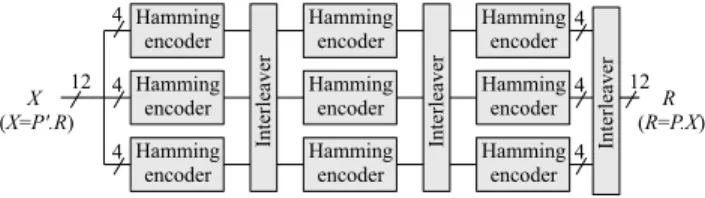
Fig. 1. Architecture of a Cortex encoder with N =24 built from (8,4,4) Hamming codes
K × K identity matrix and P a dense K × K sub-matrix satisfying P × P′ = I (P′
denotes the transpose matrix of P ). In particular, if X = (x1, x2, · · · , xK)′ is the information
vector andR = (r1, r2, · · · , rK)′ the redundancy vector, then
R = P.X and X = P′
.R.
Figure 1 shows an example of a three stage Cortex en-coder (24,12,8) also known as the Golay code. The code is based on extended (8,4,4) Hamming codes and interleavers as components. One can note that, thanks to the simple network structure, the calculation ofR from X (or X from R) requires only 7 × 9 = 63 2-input XOR operations (7 XOR for each extended Hamming code).
Efficient decoding of Cortex codes is a new challenge recently taken in [5], [6], [7], [8] and can be still developed to meet the performance of Maximum-Likelihood (ML) decoding at reasonable cost.
The remainder of the paper is organized as follows: Section II presents the construction of Cortex Codes and gives a reviews of the existing Cortex decoders. Section III depicts the proposed decoder architecture. Section IV first shows synthesis results and BER measurement for the Golay code, then, a stopping criteria is presented with results in terms of throughput increase.
II. CORTEX CODE DECODER
This section presents a brief state-of-the-art of Cortex code decoding. We particularly focus on the method presented in [7]. Then, we propose to modify this architecture in order to improve the decoder performance.
A. ML decoding
Let us consider a (N ,K) binary linear code C and let C = (c1, c2, · · · , cN) be a codeword of C. For BPSK
transmission, the codeword C is mapped into the bipolar sequence Y = (y1, y2, · · · , yN) with yi = (−1)ci ∈ {±1}.
the sampler in the demodulator is Z = (z1, z2, · · · , zN) with
zi = yi+ wi, where for 1 ≤ i ≤ N , wi’s are statistically
independent Gaussian random variables with zero mean and varianceσ2
= N0/2. The Log-Likelihood Ratio (LLR)
associ-ated to the binary symbolciis thusLLR(ci) = 2zσ2i. Assuming that the codewords are equally probable, the ML decoding is reduced to:
ˆ
C = arg min
C∈C
{P (Z/C)} (1)
Equation (1) can be transformed into: ˆ C = arg min C∈C { N X i=1 |zi|δ(ci, zi)} (2)
where|zi| is the absolute value of ziandδ(ci, zi) equals to
0 if the hard decisionHD(zi) on zigivesci (no transmission
error) and equals to 1 otherwise (transmission error).
Going back to the auto-dual code, we can separate the function cost due to the K received LLRs of informa-tion (LX(i)i=1..K) and K received LLRs of redundancy
(LR(i)i=1..K). LetCX= (X, R = P.X) be a codeword, then
the distance D(CX) between CX and the received LLRs is
defined as: D(CX) = D(X) + D(P.X), where:
D(X) =
K
X
i=1
|LX(i)|δ(xi, sign(LX(i))) (3)
D(P.X) = D(R) =
K
X
i=1
|LR(i)|δ(ri, sign(LR(i))) (4)
To reduce the complexity of the ML decoding (testing the2K
codewords), sub-optimal decoding methods have been proposed. The first family of sub-optimal algorithms is based on the exchange of information between processing nodes, such as the Belief Propagation (BP) algorithm. The second family exploits the reliability of the received symbols to search for the most likely codeword in a reduced set of codewords.
B. Iterative algorithm
BP decoding is a soft-input soft-output decoding algorithm relying on the exchange of soft information along the edges of a graph defined by the parity check matrix [9]. The BP algorithm is known to closely approximate the performance of optimal Maximum A Posteriori (MAP) decoding at reduced complexity for codes with sparse parity-check matrices. How-ever, it works poorly with Cortex codes because their parity-check matrices are not sparse.
Different techniques are then investigated. The first one consists in an analog Cortex decoder that replaces the discrete iterations with a continuous processing [5] and shows better performance than LDPC-like decoder. The second strategy uses a stochastic processing [6] to compute BP, leading to a decoding performance at 0.8 dB from the ML decoding for the (32,16,8) Cortex code.
C. Reduced search algorithms
Reduced search algorithms are based on the reduction of the space of search from C to a subset CZof codewords that could
be close to the received vectorZ. Several strategies could be applied: For example, modification of the value of the least reliable bits of the received codeword and perform a decoding algorithm to search for a codeword (the so called Chase’s algorithm [10]). Another method [11] performs modifications only on the information bits and generates a codeword by encoding the modified information bits. In [7] and [8], the authors exploit the auto-duality of Cortex codes to create two lists of codewords: the first list is generated from the least reliable information bitsX and the second one from the least reliable redundant bitsR. This method is very efficient since it adds diversity in the search of candidate codewords, leading to a very good decoding performance.
Since the error pattern generation is symmetrical for infor-mation and parity bits, the former only is presented. In [7], [8], the error patterns are generated by determining the firstλ bits of smallest reliability and by testing exhaustively the2λ
possible error patterns among theseλ bits (typical values of λ are 3, 4 or 5).
Note that the generated list of codewords is not optimal, since other pattern errors containing other bits can lead to information vectorsX of smaller distances (see eq. 2). For ex-ample, if|LX| = {|LX(i)|}i=1..5 = {0.35, 0.2, 0.1, 0.35, 0.3}
and λ = 3, the 8 pattern errors imply only the bits {x3, x2, x5}, with a maximum cost of 0.6 for the error pattern
”01101”. However, the error patterns ”10000” and ”00010”, which both lead to a cost of 0.35, are never tested.
In this paper, we propose to overcome this problem by generating the entire list of candidates with the firstρ smallest distances.
D. Word generator based on minimum distance
The idea is to generate the complete list of codewords sorted by increasing distance. By this way, we guarantee the generation of the good candidate. Also, we consider the possibility to stop the decoding process when it becomes useless (stopping criterion).
For the candidate codewords generation, different tech-niques have already been proposed [12] [13]. In [13] a systolic architecture generates binary vectors for Non-Binary LDPC Decoders. This architecture can be efficiently used as a code-word generator since it produces the codecode-words in increasing order (in terms of distance). This means that the ρ first half words generated are the closest to the received half word.
III. DECODER ARCHITECTURE
This Section describes the word generator architecture and its integration in the global decoder architecture.
A. Word generator architecture
The systolic architecture is based onK Processing Elements (PEs) that are serially connected. After propagating through the K PEs, every cycle, the word generator provides a new
2 3 4 5 6 7 8 9 10−10 10−8 10−6 10−4 10−2 100 Eb/No(dB) BER N=24, ρ=16, LLRmin N=24, ρ=16 N=32, ρ=64 N=40, ρ=128 N=48, ρ=512 N=56, ρ=2048
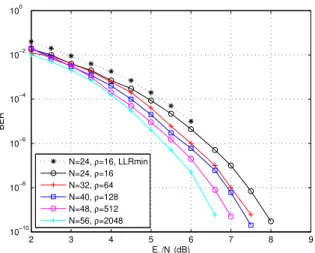
Fig. 3. Fixed point simulation results for N= 24, 32, 40, 48 and 56
wordXup(l) (or Rup(l)) and its associated increasing distance
D(Xup)(l) for l = 1 . . . ρ, i.e. l ≤ l′
⇒ D(Xup)(l) ≤
D(Xup)(l′
). The architecture of the word generator is de-scribed in [13].
B. Pipelined architecture
Figure 2 shows the decoder architecture which is pipelined for high throughput. The enable signalEninis used on rising
edge to indicate the start of the decoding of a new word. At the start of the decoding process, K LLRs are loaded in parallel at the two word generator entities. The falling edge indicates the end of the decoding of the current word. When the enable signal is forced to zero, a new word is fetched. The enable signal is propagated through the decoder so that the different elements are reset (FIFO, Memory) in one cycle for the decoding of the next word. During the distance calculation, the distance already computed in the word generator is added to the distance of the other half of the codeword. For reducing the complexity, the distance computation can be performed by adding only the channel LLRs of erroneous bits [10]. These LLRs are read from a FIFO to deal with the word generator delay.
IV. APPLICATION CASE
The Cortex decoder has been simulated and implemented on an FPGA platform for validation purposes.
A. Simulation results
Fig. 3 illustrates the BER performances of fixed point decoders forN = 24, 32, 40 and 56 bits. Thanks to hardware emulation on FPGA [14], very low BER values are obtained. The curve in dash line illustrates simulation with a com-bination of the λ = 4 minimal LLRs as in [7]. The number of words generated with the two methods are equal but the performance is improved with the minimum-distance-based word generation. Note that the number of generated words increase exponentially with N .
XQ5VLX85 REG LUT logic LUT RAM decoder 4650 5730 562 Word generator 1611 2450 248 PE1 154 236 16 PE11 156 243 36 Encoder 25 73 0 Distance 325 242 33 min 120 20 1 TABLE I
SYNTHESISRESULTS FORCORTEX(24,12,8)DECODER
N = 24 32 40 48 56 BER 1.10−4 5.10−5 2.10−5 1.10−5 7.10−7 ρ 16 64 128 512 2048 Ldec 61 121 192 594 2142 Mb/s 225 75 47 12 4 TABLE II
PERFORMANCE AND AIR THROUGHPUT FORN= 24, 32, 40, 48AND56
B. Synthesis
Table I shows the synthesis results of the implementation of the Cortex (24,12,8) decoder on an FPGA platform containing a Xilinx Virtex 5 XQ5VLX85. Note that the Word generator, Encoder and Distance entities are instantiated two times in the implementation. Most of the complexity of the decoder resides in the word generator. The maximum frequency, after place and route, is 300MHz. For comparison, the decoder implemented in [7] on a Virtex 5 FPGA requires 2905 slice registers and 1114 slice LUTs.
C. Air throughput without stopping criteria
Table II shows the performance in terms of BER at Eb/N0 = 5 dB for N = 24, 32, 40, 48 and 56. The table
also shows the number of words generated to reach a BER at 0.1 dB from the ML decoding. The decoding latency is expressed as Ldec = 3(K − 1) + log2(K) + 8 + ρ. For
high frequency, each PE is pipelined in 3 cycles. The word generator latency corresponds to the term3(K − 1). The term log2(K) corresponds to the distance calculation and the term 8
corresponds to the number of pipeline steps in the architecture. Finally, ρ represents the number of tested codewords. For comparison, the decoding latency in [7] is 80 cycles but maximum frequency is72 MHz. Thanks to pipelining, the air throughput is given byK × Fclk/ρ. The air throughput is 225
Mb/s forN = 24 and 75 Mb/s for N = 32. For comparison, air throughput in [7] is 36 Mb/s forN = 32, with a latency of 61 cycles.
The increasingρ value leads to a throughput reduction down to4 Mb/s for N = 56. For N > 32, a stopping criterion should be used to reduce the average number of generated words and thus increase the throughput.
D. Optimal stopping criteria
Figure 4 illustrates the average number of generated code-words before the ML codeword is found. Simulation results are
Fig. 2. Code Cortex decoder architecture 2.5 3 3.5 4 4.5 5 0 5 10 15 20 25 30 35 40 45 50 E b/No(dB) E[ ρ ] N=56, ρ=2048 N=48, ρ=512 N=40, ρ=128
Fig. 4. Average number of generated words before a ML codeword as a function of the signal-to-noise ratio
based on a ”genius” stopping criterion, i.e., the decoding stops as soon as one of the two word generators provides the ML codeword. For N = 56, at Eb/N0= 5 dB, a ML codeword is
found in average after testing 9 words instead of2048 (thus a 99.5% computation time saving is obtained).
In practice, the optimal stopping strategy is to stop the decoding process when no better codeword can be found. Let Dm(l) be the minimum distance found after testing the first
l codewords. If D(Xup(l)) + D(Rup(l)) > D
m(l) (stopping
criteria), then the decoding process can stop, since the next generated codewords lead to a distance greater than Dm(l).
proof by contradiction: Let us assume that a better codeword can be found for a valuel′
> l. This codeword can be either CX(l) (hypotheses H1) or CR(l) (hypotheses H2). Let us
consider first hypotheses H1. We have:
D(Xup(l′ )) + D(P.Xup(l′ )) < Dm(l) (5) 0 5 10 15 20 0 10 20 30 40 50 60 70 80 90 100 l Distance D(C X) D(CR) Dm D(Xup)+D(Rup) D(Xup) D(Rup)
Fig. 5. Distance evolution as a function of l
According to the stopping criterion: D(Xup(l′ )) + D(P.Xup(l′ )) < D(Xup(l)) + D(Rup(l)) (6) SinceD(Xup(l′)) ≥ D(Xup(l)), then D(P.Xup(l′ )) < D(Rup(l)) (7) This inequality implies that R = P.Xup(l′) has already
been tested for a value q ≤ l and thus, that Dm(l) ≤
D(CX(l′)), which is in contradiction with the initial
hypothe-sis H1. In the case of hypotheses H2, symmetrical arguments lead also to a contradiction, which achieves the proof.
Figure 5 illustrates the evolution of the distances as a function of l for N =40 and Eb/No = 3. In this simulation,
the stopping criterion stop the decoding process after 19 generated codewords while the ML codeword is found after 12 codewords.
Fig. 6 shows the average number of words before the stopping criterion detect that a ML codeword has been found. The main advantage of the proposed stopping criterion resides
2.5 3 3.5 4 4.5 5 0 50 100 150 200 250 Eb/No(dB) E[ ρ ] N=56, ρ=2048 N=48, ρ=512 N=40, ρ=128
Fig. 6. Average number of generated words using with the stopping criteria N = 24 32 40 48 56 ρ 16 64 128 512 2048 E[ρ] 1.5 2 3 5 9 Ldec 47 59 73 87 103 Mb/s 76 81 82 82 81 TABLE III
AIR THROUGHPUT FORN= 24,32,40,48AND56
in its implementation simplicity and the absence of BER performance loss.
Table III shows the air throughput performance atEb/No=
5 dB for N = 24, 32, 40, 48 and 56. The latency of decoding is given byLdec= 3(K −1)+log2(K)+8+E[ρ], where E[ρ] is
the average number of words. Because of the stopping criteria, the decoding of two consecutive words cannot be pipelined. The air throughput is replaced by K × Fclk/Ldec Mb/s.
Note that for N = 24, the air throughput is reduced compared to the pipelined implementation without stopping criterion (Table II) for which the air throughput reaches 225 Mb/s. For N = 40, 48 and 56, the stopping criteria allows to keep the air throughput above80 Mb/s.
V. CONCLUSION
In this paper we consider the design of efficient Cortex code decoders. An existing soft-decision decoding algorithm which exploite the code structure to achieve ML performance is improved. We add a word generator to the architecture and an optimal stopping criterion. We showed that the proposed
decoder architecture provides performance very close to ML decoding for a fraction of the ML decoding complexity. The implemented pipelined architecture achieves a throughput of 225M b/s with N = 24 bits. The implementation of a simple stopping criterion provides an efficient solution forN > 32. Future work will be dedicated to optimize the hardware implementation of the decoder (in terms of area and frequency) as well as the stopping criterion.
REFERENCES
[1] R. Gallager, Low-Density Parity-Check Codes. PhD thesis, Cambridge, 1963.
[2] C. Berrou, A. Glavieux, and P. Thitimajshima, “Near shannon limit error-correcting coding and decoding: Turbo-codes.,” in IEEE International
Conference on Communications, vol. 2, pp. 1064–1070, May 1993. [3] J. Carlach and C. Vervoux, “A new family of block turbo-codes,” in 13th
International Symposium on Applied Algebra, Algebraic Algorithms and Error-Correcting Codes, (Honolulu, USA), Nov. 1999.
[4] J. Carlach and A. Otamani, “A systematic construction of self-dual codes,” in IEEE Transactions on Information Theory, vol. 49, (Taichung, Taiwan), pp. 3005–3009, Nov. 2003.
[5] J. Perez-Chamorro, F. Sequin, C. Lahuec, M. Jezequel, and G. L. Mestre, “decoding a family of dense codes using the sum-product algorithm,” in
IEEE International Symposium on Circuit and Systems (ISCAS), (Taipei, Taiwan), pp. 2685–2688, June 2009.
[6] M. Arzel, C. Lahuec, C. Jego, W. Gross, and Y. Bruned, “Stochastic multiple stream decoding of cortex codes,” in IEEE Transaction on
Signal Processing, vol. 59, pp. 3486–3491, July 2011.
[7] P. Adde, C. J´ego, R. L. Bidan, and J. P. Chamorro, “Design and implementation of a soft-decision decoder for cortex codes,” in 17th
IEEE International Conference on Electronics, Circuits, and Systems (ICECS), pp. 663–666, Dec. 2010.
[8] P. Adde, C. J´ego, and R. L. Bidan, “Near maximun likelihood soft-decision decoding of a particular class of rate 1/2 systematic linear block codes,” in Electronic Letters, vol. 47, pp. 259–260, Feb. 2011. [9] F. Kschischang, B. Frey, and H.-A. Loeliger, “Factor graphs and the
sum-product algorithm,” IEEE Transaction on information theory, vol. 47, Feb. 2001.
[10] D. Chase, “A class of algorithms for decoding block codes with channel measurement information,” in IEEE Transactions on Information
The-ory, vol. 18, Jan. 1972.
[11] M. Fossorier and S. Lin, “Soft-decision decoding of linear block codes based on ordered statistics,” in IEEE Transaction on Information Theory, vol. 41, pp. 1379–1396, Sept. 1995.
[12] A. Valenbois and M. Fossorier, “An improved method to compute lists of binary vectors that optimize a given weight function with application to soft-decision decoding,” in IEEE Communication letters, vol. 5, pp. 456– 458, Nov. 2001.
[13] A. A. Ghouwayel and E. Boutillon, “A systolic llr generation architecture for non-binary ldpc decoder,” in IEEE communications letters, vol. 15, pp. 851–853, Aug. 2011.
[14] E. Boutillon, Y. Tang, C. Marchand, and P. Bomel, “Hardware discrete channel emulator,” in IEEE International Conference on High
Perfor-mance Computing and Simulation (HPCS), (Caen, France), pp. 452 – 458, June 2010.
![Fig. 2. Code Cortex decoder architecture 2.5 3 3.5 4 4.5 505101520253035404550 E b /N o (dB) E[ρ] N=56, ρ=2048N=48, ρ=512N=40, ρ=128](https://thumb-eu.123doks.com/thumbv2/123doknet/11641408.307222/5.918.121.806.85.330/fig-code-cortex-decoder-architecture-e-n-db.webp)
![Fig. 6. Average number of generated words using with the stopping criteria N= 24 32 40 48 56 ρ 16 64 128 512 2048 E[ρ] 1.5 2 3 5 9 L dec 47 59 73 87 103 Mb/s 76 81 82 82 81 TABLE III](https://thumb-eu.123doks.com/thumbv2/123doknet/11641408.307222/6.918.100.412.95.345/average-number-generated-words-using-stopping-criteria-table.webp)
