O
pen
A
rchive
T
OULOUSE
A
rchive
O
uverte (
OATAO
)
OATAO is an open access repository that collects the work of Toulouse researchers and makes it freely available over the web where possible.This is an author-deposited version published in : http://oatao.univ-toulouse.fr/ Eprints ID : 13051
The contribution was presented at ACL 2013 : http://acl2013.org/site/
To cite this version : Curiel Diaz, Arturo Tlacaelel and Collet, Christophe
Sign language lexical recognition with Propositional Dynamic Logic. (2013)
In: 51st Annual Meeting of the Association for Computational Linguistics (ACL), 4 August 2013 - 9 August 2013 (Sofia, Bulgaria).
Any correspondance concerning this service should be sent to the repository administrator: [email protected]
Sign Language Lexical Recognition With Propositional Dynamic
Logic
Arturo Curiel Université Paul Sabatier 118 route de Narbonne, IRIT,
31062, Toulouse, France [email protected]
Christophe Collet Université Paul Sabatier 118 route de Narbonne, IRIT,
31062, Toulouse, France [email protected]
Abstract
This paper explores the use of Proposi-tional Dynamic Logic (PDL) as a suit-able formal framework for describing Sign Language (SL), the language of deaf people, in the context of natu-ral language processing. SLs are vi-sual, complete, standalone languages which are just as expressive as oral lan-guages. Signs in SL usually correspond to sequences of highly specific body postures interleaved with movements, which make reference to real world ob-jects, characters or situations. Here we propose a formal representation of SL signs, that will help us with the analysis of automatically-collected hand track-ing data from French Sign Language (FSL) video corpora. We further show how such a representation could help us with the design of computer aided SL verification tools, which in turn would bring us closer to the development of an automatic recognition system for these languages.
1 Introduction
Sign languages (SL), the vernaculars of deaf people, are complete, rich, standalone commu-nication systems which have evolved in paral-lel with oral languages (Valli and Lucas, 2000). However, in contrast to the last ones, research in automatic SL processing has not yet man-aged to build a complete, formal definition ori-ented to their automatic recognition (Cuxac and Dalle, 2007). In SL, both hands and non-manual features (NMF), e.g. facial muscles, can convey information with their placements, configurations and movements. These particu-lar conditions can difficult the construction of
a formal description with common natural lan-guage processing (NLP) methods, since the ex-isting modeling techniques are mostly designed to work with one-channel sound productions inherent to oral languages, rather than with the multi-channel partially-synchronized infor-mation induced by SLs.
Our research strives to address the formal-ization problem by introducing a logical lan-guage that lets us represent SL from the lowest level, so as to render the recognition task more approachable. For this, we use an instance of a formal logic, specifically Propositional Dy-namic Logic (PDL), as a possible description language for SL signs.
For the rest of this section, we will present a brief introduction to current research efforts in the area. Section 2 presents a general descrip-tion of our formalism, while secdescrip-tion 3 shows how our work can be used when confronted with real world data. Finally, section 4 present our final observations and future work.
Images for the examples where taken from (DictaSign, 2012) corpus.
1.1 Current Sign Language Research Extensive efforts have been made to achieve efficient automatic capture and representation of the subtle nuances commonly present in sign language discourse (Ong and Ranganath, 2005). Research ranges from the development of hand and body trackers (Dreuw et al., 2009; Gianni and Dalle, 2009), to the design of high level SL representation models (Lejeune, 2004; Lenseigne and Dalle, 2006). Linguistic re-search in the area has focused on the character-ization of corporal expressions into meaning-ful transcriptions (Dreuw et al., 2010; Stokoe, 2005) or common patterns across SL (Aronoff et al., 2005; Meir et al., 2006; Wittmann, 1991), so as to gain understanding of the
un-derlying mechanisms of SL communication. Works like (Losson and Vannobel, 1998) deal with the creation of a lexical description ori-ented to computer-based sign animation. Re-port (Filhol, 2009) describes a lexical specifi-cation to address the same problem. Both pro-pose a thoroughly geometrical parametric en-coding of signs, thus leaving behind meaning-ful information necessary for recognition and introducing data beyond the scope of recog-nition. This complicates the reutilization of their formal descriptions. Besides, they don’t take in account the presence of partial informa-tion. Treating partiality is important for us, since it is often the case with automatic tools that incomplete or unrecognizable information arises. Finally, little to no work has been di-rected towards the unification of raw collected data from SL corpora with higher level descrip-tions (Dalle, 2006).
2 Propositional Dynamic Logic for
SL
Propositional Dynamic Logic (PDL) is a multi-modal logic, first defined by (Fischer and Lad-ner, 1979). It provides a language for describ-ing programs, their correctness and termina-tion, by allowing them to be modal operators. We work with our own variant of this logic, the Propositional Dynamic Logic for Sign Lan-guage (PDLSL), which is just an instantiation
of PDL where we take signers’ movements as programs.
Our sign formalization is based on the ap-proach of (Liddell and Johnson, 1989) and (Fil-hol, 2008). They describe signs as sequences of immutable key postures and movement transi-tions.
In general, each key posture will be charac-terized by the concurrent parametric state of each body articulator over a time-interval. For us, a body articulator is any relevant body part involved in signing. The parameters taken in account can vary from articulator to articula-tor, but most of the time they comprise their configurations, orientations and their place-ment within one or more places of articulation. Transitions will correspond to the movements executed between fixed postures.
2.1 Syntax
We need to define some primitive sets that will limit the domain of our logical language. Definition 2.1 (Sign Language primi-tives). Let BSL = {D, W, R, L} be the set of
relevant body articulators for SL, where D, W, R and L represent the dominant, weak, right and left hands, respectively. Both D and W can be aliases for the right or left hands, but they change depending on whether the signer is right-handed or left-handed, or even depend-ing on the context.
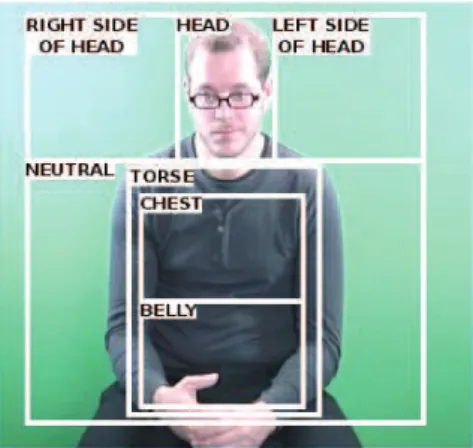
Let Ψ be the two-dimensional projection of a human body skeleton, seen by the front. We define the set of places of articulation for SL as ΛSL = {HEAD, CHEST, NEUTRAL, . . .}, such that
for each λ ∈ ΛSL, λ is a sub-plane of Ψ, as
shown graphically in figure 1.
Let CSL be the set of possible morphological
configurations for a hand.
Let ∆ = {↑, ր, →, ց, ↓, ւ, ←, տ} be the set of relative directions from the signer’s point of view, where each arrow represents one of eight possible two-dimensional direction vectors that share the same origin. For vector δ ∈ ∆, we define vector←−δ as the same as δ but with the inverted abscissa axis, such that ←−δ ∈ ∆. Let vector bδ indicate movement with respect to the dominant or weak hand in the following man-ner: b δ= ( δ if D ≡ R or W ≡ L ←− δ if D ≡ L or W ≡ R Finally, let −→v1 and −→v2 be any two vectors with the same origin. We denote the rotation angle between the two as θ(−→v1, −→v2).
Now we define the set of atomic propositions that we will use to characterize fixed states, and a set of atomic actions to describe move-ments.
Definition 2.2 (Atomic Propositions for SL Body Articulators ΦSL). The set of
atomic propositions for SL articulators (ΦSL)
is defined as: ΦSL= {β1δβ 2,Ξ β1 λ ,T β1 β2 ,F β1 c , ∠δβ1} where β1, β2 ∈ BSL, δ ∈ ∆, λ ∈ ΛSL and c∈ CSL.
Figure 1: Possible places of articulation in BSL.
Intuitively, β1δβ2 indicates that articulator β1
is placed in relative direction δ with respect to articulator β2. Let the current place of articulation of β2 be the origin point of β2’s
Cartesian system (Cβ2). Let vector
− → β1 de-scribe the current place of articulation of β1 in Cβ2. Proposition β1
δ
β2 holds when ∀−→v ∈ ∆,
θ(−→β1, δ) ≤ θ(−→β1, −→v). Ξβ1
λ asserts that articulator β1 is located in
λ. Tβ1
β2 is active whenever articulator β1
physi-cally touches articulator β2.
Fβ1
c indicates that c is the morphological
configuration of articulator β1. Finally, ∠δ
β1 means that an articulator β1 is
oriented towards direction δ ∈ ∆. For hands, ∠δβ1 will hold whenever the vector
perpendicu-lar to the plane of the palm has the smallest rotation angle with respect to δ.
Definition 2.3 (Atomic Actions for SL Body Articulators ΠSL). The atomic
ac-tions for SL articulators ( ΠSL) are given by
the following set:
ΠSL= {δβ1, !β1}
where δ ∈ ∆ and β1∈ BSL.
Let β1’s position before movement be the ori-gin of β1’s Cartesian system (Cβ1) and
− → β1 be the position vector of β1 in Cβ1 after moving.
Action δβ1 indicates that β1 moves in relative
direction δ in Cβ1 if ∀−
→v ∈ ∆, θ(−→β
1, δ) ≤
θ(−→β1, −→v).
Action !β1 occurs when articulator β1
moves rapidly and continuously (thrills)
with-out changing it’s current place of articulation. Definition 2.4 (Action Language for SL Body Articulators ASL). The action
lan-guage for body articulators (ASL) is given by
the following rule:
α::= π | α ∩ α | α ∪ α | α; α | α∗
where π ∈ ΠSL.
Intuitively, α ∩ α indicates the concurrent execution of two actions, while α ∪ α means that at least one of two actions will be non-deterministically executed. Action α; α de-scribes the sequential execution of two actions. Finally, action α∗
indicates the reflexive tran-sitive closure of α.
Definition 2.5 (Language PDLSL ). The
formulae ϕ of PDLSLare given by the following
rule:
ϕ::= ⊤ | p | ¬ϕ | ϕ ∧ ϕ | [α]ϕ where p ∈ ΦSL, α ∈ ASL.
2.2 Semantics
PDLSL formulas are interpreted over labeled
transition systems (LTS), in the spirit of the possible worlds model introduced by (Hin-tikka, 1962). Models correspond to connected graphs representing key postures and transi-tions: states are determined by the values of their propositions, while edges represent sets of executed movements. Here we present only a small extract of the logic semantics.
Definition 2.6 (Sign Language Utterance Model USL). A sign language utterance model
(USL), is a tuple USL = (S, R, J·KΠSL,J·KΦSL)
where:
• S is a non-empty set of states
• R is a transition relation R ⊆ S×S where, ∀s ∈ S, ∃s′
∈ S such that (s, s′
) ∈ R. • J·KΠSL : ΠSL → R, denotes the function
mapping actions to the set of binary rela-tions.
• J·KΦSL : S → 2Φ
SL, maps each state to a
We also need to define a structure over se-quences of states to model internal dependen-cies between them, nevertheless we decided to omit the rest of our semantics, alongside satis-faction conditions, for the sake of readability.
3 Use Case: Semi-Automatic Sign
Recognition
We now present an example of how we can use our formalism in a semi-automatic sign recog-nition system. Figure 2 shows a simple module diagram exemplifying information flow in the system’s architecture. We proceed to briefly describe each of our modules and how they work together. Corpus Tracking and Seg-mentation Module Key postures & transitions PDLSL Model Extraction Module PDLSL Verification Module PDLSL Graph Sign Formulæ User Input Sign Proposals
Figure 2: Information flow in a semi-automatic SL lexical recognition system.
3.1 Tracking and Segmentation Module
The process starts by capturing relevant infor-mation from video corpora. We use an exist-ing head and hand tracker expressly developed for SL research (Gonzalez and Collet, 2011). This tool analyses individual video instances, and returns the frame-by-frame positions of the tracked articulators. By using this infor-mation, the module can immediately calculate speeds and directions on the fly for each hand. The module further employs the method proposed by the authors in (Gonzalez and Collet, 2012) to achieve sub-lexical segmenta-tion from the previously calculated data. Like them, we use the relative velocity between hands to identify when hands either move at the same time, independently or don’t move at all. With these, we can produce a set of possi-ble key postures and transitions that will serve as input to the modeling module.
3.2 Model Extraction Module
This module calculates a propositional state for each static posture, where atomic PDLSL
formulas codify the information tracked in the previous part. Detected movements are inter-preted as PDLSL actions between states.
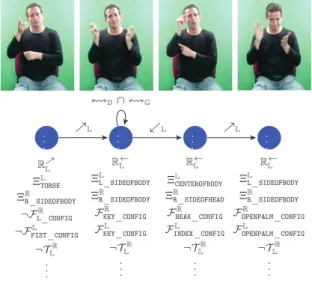
. . . RրL ΞL TORSE ΞRR_SIDEOFBODY ¬FLR_CONFIG ¬FFISTL _CONFIG ¬TR L . . . . . . R←L ΞL L_SIDEOFBODY ΞR R_SIDEOFBODY FR KEY_CONFIG FL KEY_CONFIG ¬TR L . . . րL !D∩ !G . . . R←L ΞLCENTEROFBODY ΞR R_SIDEOFHEAD FR BEAK_CONFIG FL INDEX_CONFIG ¬TR L . . . ւL . . . R←L ΞL L_SIDEOFBODY ΞR R_SIDEOFBODY FR OPENPALM_CONFIG FL OPENPALM_CONFIG ¬TR L . . . րL
Figure 3: Example of modeling over four auto-matically identified frames as possible key pos-tures.
Figure 3 shows an example of the process. Here, each key posture is codified into propo-sitions acknowledging the hand popropo-sitions with respect to each other (R←
L ), their place of
artic-ulation (e.g. “left hand floats over the torse” with ΞL
TORSE), their configuration (e.g. “right
hand is open” with FR
OPENPALM_CONFIG) and their
movements (e.g. “left hand moves to the up-left direction” with րL).
This module also checks that the generated graph is correct: it will discard simple track-ing errors to ensure that the resulttrack-ing LTS will remain consistent.
3.3 Verification Module
First of all, the verification module has to be loaded with a database of sign descriptions en-coded as PDLSL formulas. These will
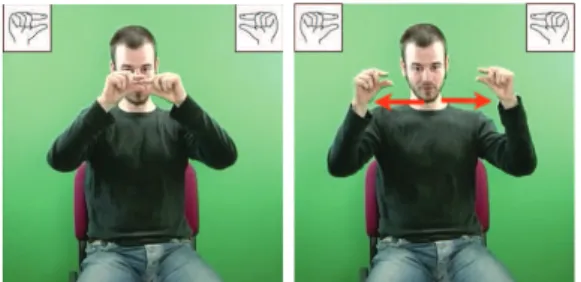
charac-terize the specific sequence of key postures that morphologically describe a sign. For exam-ple, let’s take the case for sign “route” in FSL, shown in figure 4, with the following PDLSL
formulation,
Example 3.1 (ROUTEFSL formula).
(ΞRFACE∧ Ξ L FACE∧ L → R ∧ F R CLAMP∧ F L CLAMP∧ T R L) → [←R∩ →L](L → R ∧ F R CLAMP∧ F L CLAMP∧ ¬T R L) (1)
Figure 4: ROUTEFSL production.
Formula (1) describes ROUTEFSL as a sign
with two key postures, connected by a two-hand simultaneous movement (represented with operator ∩). It also indicates the posi-tion of each hand, their orientaposi-tion, whether they touch and their respective configurations (in this example, both hold the same CLAMP configuration).
The module can then verify whether a sign formula in the lexical database holds in any sub-sequence of states of the graph generated in the previous step. Algorithm 1 sums up the process.
Algorithm 1 PDLSL Verification Algorithm
Require: SL model MSL
Require: connected graph GSL
Require: lexical database DBSL
1: Proposals_For[state_qty] 2: for state s ∈ GSL do
3: for sign ϕ ∈ DBSL where s ∈ ϕ do 4: if MSL, s|= ϕ then 5: Proposals_For[s].append(ϕ) 6: end if 7: end for 8: end for 9: return Proposals_For
For each state, the algorithm returns a set of possible signs. Expert users (or higher level algorithms) can further refine the process by introducing additional information previously missed by the tracker.
4 Conclusions and Future Work
We have shown how a logical language can be used to model SL signs for semi-automatic recognition, albeit with some restrictions. The traits we have chosen to represent were im-posed by the limits of the tracking tools we had to our disposition, most notably working
with 2D coordinates. With these in mind, we tried to design something flexible that could be easily adapted by computer scientists and linguists alike. Our primitive sets, were inten-tionally defined in a very general fashion due to the same reason: all of the perceived di-rections, articulators and places of articulation can easily change their domains, depending on the SL we are modeling or the technological constraints we have to deal with. Proposi-tions can also be changed, or even induced, by existing written sign representation languages such as Zebedee (Filhol, 2008) or HamNoSys (Hanke, 2004), mainly for the sake of extend-ability.
From the application side, we still need to create an extensive sign database codified in PDLSL and try recognition on other corpora,
with different tracking information. For ver-ification and model extraction, further opti-mizations are expected, including the handling of data inconsistencies and repairing broken queries when verifying the graph.
Regarding our theoretical issues, future work will be centered in improving our lan-guage to better comply with SL research. This includes adding new features, like incorpo-rating probability representation to improve recognition. We also expect to finish the defini-tion of our formal semantics, as well as proving correction and complexity of our algorithms.
References
Mark Aronoff, Irit Meir, and Wendy Sandler. 2005. The paradox of sign language morphology. Lan-guage, 81(2):301.
Christian Cuxac and Patrice Dalle. 2007. Problé-matique des chercheurs en traitement automa-tique des langues des signes, volume 48 of Traitement Automatique des Langues. Lavoisier, http://www.editions-hermes.fr/, October. Patrice Dalle. 2006. High level models for sign
lan-guage analysis by a vision system. In Workshop on the Representation and Processing of Sign Language: Lexicographic Matters and Didactic Scenarios (LREC), Italy, ELDA, page 17–20. DictaSign. 2012. http://www.dictasign.eu. Philippe Dreuw, Daniel Stein, and Hermann Ney.
2009. Enhancing a sign language transla-tion system with vision-based features. In Miguel Sales Dias, Sylvie Gibet, Marcelo M.
Wanderley, and Rafael Bastos, editors, Gesture-Based Human-Computer Interaction and Simu-lation, number 5085 in Lecture Notes in Com-puter Science, pages 108–113. Springer Berlin Heidelberg, January.
Philippe Dreuw, Hermann Ney, Gregorio Martinez, Onno Crasborn, Justus Piater, Jose Miguel Moya, and Mark Wheatley. 2010. The Sign-Speak project - bridging the gap between sign-ers and speaksign-ers. In Nicoletta Calzolari (Con-ference Chair), Khalid Choukri, and et. al., ed-itors, Proceedings of the Seventh International Conference on Language Resources and Evalu-ation (LREC’10), Valletta, Malta, May. Euro-pean Language Resources Association (ELRA). Michael Filhol. 2008. Modèle descriptif des signes pour un traitement automatique des langues des signes. Ph.D. thesis, Université Paris-sud (Paris 11).
Michael Filhol. 2009. Zebedee: a lexical descrip-tion model for sign language synthesis. Internal, LIMSI.
Michael J. Fischer and Richard E. Ladner. 1979. Propositional dynamic logic of regular pro-grams. Journal of Computer and System Sci-ences, 18(2):194–211, April.
Frédéric Gianni and Patrice Dalle. 2009. Ro-bust tracking for processing of videos of com-munication’s gestures. Gesture-Based Human-Computer Interaction and Simulation, page 93–101.
Matilde Gonzalez and Christophe Collet. 2011. Robust body parts tracking using particle fil-ter and dynamic template. In 2011 18th IEEE International Conference on Image Processing (ICIP), pages 529 –532, September.
Matilde Gonzalez and Christophe Collet. 2012. Sign segmentation using dynamics and hand configuration for semi-automatic annotation of sign language corpora. In Eleni Efthimiou, Georgios Kouroupetroglou, and Stavroula-Evita Fotinea, editors, Gesture and Sign Language in Human-Computer Interaction and Embodied Communication, number 7206 in Lecture Notes in Computer Science, pages 204–215. Springer Berlin Heidelberg, January.
Thomas Hanke. 2004. HamNoSys—Representing sign language data in language resources and language processing contexts. In Proceedings of the Workshop on the Representation and Pro-cessing of Sign Languages “From SignWriting to Image Processing. Information, Lisbon, Portu-gal, 30 May.
Jaakko Hintikka. 1962. Knowledge and Belief. Ithaca, N.Y.,Cornell University Press.
Fanch Lejeune. 2004. Analyse sémantico-cognitive d’énoncés en Langue des Signes Fran\ccaise pour une génération automatique de séquences gestuelles. Ph.D. thesis, PhD thesis, Orsay Uni-versity, France.
Boris Lenseigne and Patrice Dalle. 2006. Us-ing signUs-ing space as a representation for sign language processing. In Sylvie Gibet, Nicolas Courty, and Jean-François Kamp, editors, Ges-ture in Human-Computer Interaction and Sim-ulation, number 3881 in Lecture Notes in Com-puter Science, pages 25–36. Springer Berlin Hei-delberg, January.
S. K. Liddell and R. E. Johnson. 1989. American sign language: The phonological base. Gallaudet University Press, Washington. DC.
Olivier Losson and Jean-Marc Vannobel. 1998. Sign language formal description and synthe-sis. INT.JOURNAL OF VIRTUAL REALITY, 3:27—34.
Irit Meir, Carol Padden, Mark Aronoff, and Wendy Sandler. 2006. Re-thinking sign language verb classes: the body as subject. In Sign Languages: Spinning and Unraveling the Past, Present and Future. 9th Theoretical Issues in Sign Language Research Conference, Florianopolis, Brazil, vol-ume 382.
Sylvie C. W. Ong and Surendra Ranganath. 2005. Automatic sign language analysis: a survey and the future beyond lexical meaning. IEEE Trans-actions on Pattern Analysis and Machine Intel-ligence, 27(6):873 – 891, June.
William C. Stokoe. 2005. Sign language structure: An outline of the visual communication systems of the american deaf. Journal of Deaf Studies and Deaf Education, 10(1):3–37, January. Clayton Valli and Ceil Lucas. 2000. Linguistics of
American Sign Language Text, 3rd Edition: An Introduction. Gallaudet University Press. Henri Wittmann. 1991. Classification
linguis-tique des langues signées non vocalement. Revue québécoise de linguistique théorique et appliquée, 10(1):88.