Science Arts & Métiers (SAM)
is an open access repository that collects the work of Arts et Métiers Institute of Technology researchers and makes it freely available over the web where possible.
This is an author-deposited version published in: https://sam.ensam.eu Handle ID: .http://hdl.handle.net/10985/12614
To cite this version :
Guilhem GRIMAUD, Nicolas PERRY, Bertrand LARATTE - Decision Support Methodology for Designing Efficient and Sustainable Recycling Pathways - In: World Resources Forum, Suisse, 2017-10-24 - World Resources Forum 2017 - 2018
Any correspondence concerning this service should be sent to the repository Administrator : [email protected]
Decision Support Methodology for Designing Efficient and
Sustainable Recycling Pathways
Guilhem Grimaud1, 2, Nicolas Perry2 and Bertrand Laratte2, 3 1 MTB Recycling, FR-38460 Trept, France
2 Arts & Métiers ParisTech, I2M, FR-33405 Bordeaux, France 3 APESA-Innovation, FR-33000 Bordeaux, France
Speaker: Guilhem Grimaud
Corresponding author: Guilhem Grimaud, [email protected]
Abstract
As the end of life becoming more and more complex recycling systems encountered many difficulties in valuing all the materials contain in each product. This involves not only recovering a large number of materials but also doing so with the minimal environmental impact. Although the benefits of recycling are well established, the industrial processes need to be designed in regard with their environmental impacts. That why recyclers need robust assessment tools to make the right choices during the design of recycling processes. This evaluation work should enable them to choose the right recycling solutions for a wide range of end of life products. In this article, we present how we develop a methodology for evaluating the performance of recycling processes during their design phase. This methodology is our answer to help optimise the recycling of multi materials products based on the evaluation of the sustainability performance of the processes chosen.
Keywords: Evaluation; Industrial design; Environmental Technology Verification; ETV; LCA; LCC.
1
Introduction
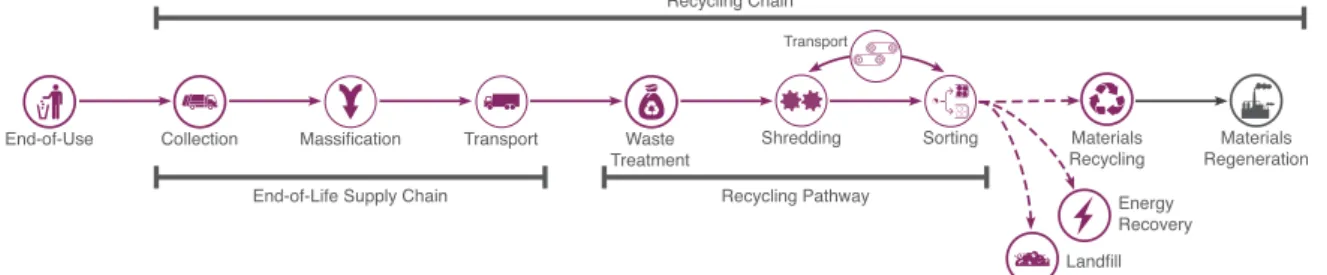
The rise of the world population and its life conditions go hand in hand with the growth of energy and raw material consumption as well as the steady growth of CO2 concentration in the atmosphere [1, 2]. The consumption growth comes with an increase in the amount of waste produced annually (EUROSTAT 2015). The demand for primary resources is not sustainable long term [4, 5]. It is therefore vital to find industrial solutions to maintain standards of living equivalent while also decoupling resource use and demand (Schandl 2015). The circular economy offers a partial answer to resource depletion (McDonough & Braungart 2012). Recycling is inherent in the circular economy strategies that why industrial companies look for stepping recycling rates up. To do so they implement product centric End-of-Life (EoL) solutions using closed loop recycling (Rebitzer et al. 2003). Those strategies show good environmental performance but a specific EoL requires a suitable and efficient supply chain to reach the recycling plant. The different steps of an EoL scenario are shown on the Figure 1. Also, as the motivation is mainly economy, the generalisation of closed loop recycling is slowed down (Butterworth et al. 2013; Gahleitner 2015; Lavery & Pennell 2014).
For waste that is not recycled in closed loop it is necessary to adapt the recycling pathway. Yet the recycling pathways are multiple and it is important to determine the best path according to different categories of indicators and not only financial performance.
Figure 1 Main steps of the End-of-Life chain including recycling pathway
MTB company, an international manufacturer of recycling technologies and a recycling operator in France, has launched a sustainability strategy. The aim of the strategy is to reduce the environmental impact of its industrial activities. To do so, MTB started to evaluate its environmental performance with evaluation tools such as Life Cycle Assessment (LCA) and Mass Flow Analysis (MFA). The first evaluation has been realised on an aluminium recycling process using only mechanical separation process instead of smelting. Results show the advantages of mechanical processes (Grimaud, Perry, et al. 2016a). Based on these results from environmental evaluations, MTB implemented corrective measures to increase its environmental performance level (Grimaud, Perry, et al. 2016b).
Beyond optimising recycling pathways in operation, these results also helped us to guide the research for new recycling processes which have been designed to be more sustainable (Grimaud, Laratte, et al. 2017). All these steps help to enrich the company’s own knowledge, but the evaluation process is long and requires strong stakeholder involvement at each assessment step. To systematise this new practice and provide data relevancy to decision makers, a methodology was needed to integrate the Life Cycle Management (LCM) approach in MTB design phase.
2
Methodological framework
2.1 Segmentation of recycling processes
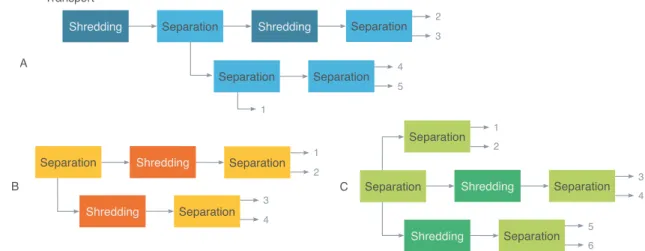
The recycling pathways are mostly based on common elementary technologies. The elementary technology selection and order have a strong influence on the overall performance of the recycling chain (UNEP 2011). This assembly achieves the targets of purity and quality specific to processed wastes, the performances largely depend on the pathway rather than technological innovations (Fisher 2012). So, the assembly choices of common sub-processes are one of the key points to design efficient recycling pathways. The Figure 2 shows different pathways for the same waste recycling pathway. The technologies used and the streams vary with recycling process choices. We have determined that recycling processes can be classified in 3 types (Heiskanen 2014): shredding, separation and transport. In addition to these 3 families of process unit, there is the flow unit family.
Figure 2 Presentation of pre-recycling processing alternatives for the same waste
2.2 Unit process database
To support the evaluation, we launched the construction of a database for recycling processes. This database includes technical, environmental and economic dataset. On the one hand, for each data a part of the values is fixed, they are invariant data regardless the type of transformation performed by the unit process. This is mainly the impact of manufacturing, its price without the options or the weight of the equipment. On the other hand, in addition to these fixed values, the engineering team can set value adjusting unit process to customer need. These are the operating variables. These actions will have a direct effect on the performance of the recycling pathway. Each unit process and its associate in/output flows can be modelling as shown on the Figure 3.
Figure 3 Modelling of a recycling pathway step with a separation unit process
To define the technical characterisation of each unit process, we have chosen to implement the Environmental Technology verification (ETV) protocol (European Commission 2014; European Commission 2016). The main steps of the ETV program are given on Figure 4. The whole ETV verification steps combine together last 8 to 18 months (European Commission 2012). In comparison, the average designing time for a recycling pathway is between 3 and 6 months. Although ETV verification time is too long for designers, the program provided general requirements, allowing to develop a self-assessment framework (Grimaud, Perry, et al. 2017).
Figure 4 Main steps of the European Environmental Technology Verification process
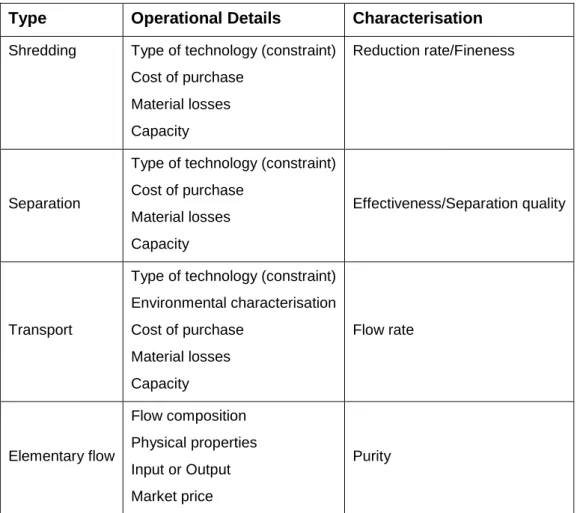
For the 3 families of unit process, the Table 1 gives the associate operational details and the technical characterisation define using the ETV program. For each specific unit process, technical characterisation will help to define the most suitable process for each purpose of the recycling pathway step.
Type Operational Details Characterisation
Shredding Type of technology (constraint) Cost of purchase
Material losses Capacity
Reduction rate/Fineness
Separation
Type of technology (constraint) Cost of purchase
Material losses Capacity
Effectiveness/Separation quality
Transport
Type of technology (constraint) Environmental characterisation Cost of purchase Material losses Capacity Flow rate Elementary flow Flow composition Physical properties Input or Output Market price Purity
Table 1 Variables and characterisation for recycling each unit process family
3
Results
3.1 Step by step evaluation methodology
To support our assessment methodology and provide a coarse result in early design phases to promote sustainable solutions. The methodology can be divided into several key steps. First, with the specifications and the customer need the general framework can be built. This step
Proposal Phase • Quick scan guide • 1 to 3 months Specific protocol • Verification budy defines verification parameters • 3 months Assessment Verification • Verification budy reviews the final set of data • 2 to 9 months Publication Phase • Report and statement of Verification • 1 to 3 monts
allows to determine the specific constraints, delays and costs of the project in order to draught the initial specifications. In the continuity, the customer provides his main orientations for the recycling process purpose. The customer defines purpose and objectives for the recycling pathway. And the engineering team validate or not main orientation of the recycling chain. From this orientation, the engineering team starts working on the recycling pathway proposal. The aim is to provide: treatment synoptic definition, selection of the main steps, choice of technological bricks.
According to the recycling chain synoptic, for each step of the recycling pathway, MTB commercial team needs to select the appropriate technology and thanks to the expertise from MTB engineering team the operating variables are selected. It is from this point that the database makes it possible to calculate the unit performances. This calculation is made according to the general settings, the specific flow information and the variables. At the end, a synthetic evaluation of the global process and unit steps is provided to allow discussion. 3.2 Unit process performance calculation
The technical performance indicators are oriented towards the capacity of the pathway to recycle the waste, so each unit process is described by 3 indicators. The calculation of these rates is made according to the standard(International Standard Organization 2002).
• Recycling rate • Recovery rate • Landfill rate
For the economic dataset, data is easily accessible through the information provided by manufacturers and recyclers feedback. The Life Cycle Cost (LCC) analysis is used to determine the economic performance of each unit process. The LCC methodology used to consider both the costs of each system in addition to the profit from recycled materials sales. But we do not include the costs of the environmental impact (Office of Acquisition and Project Management 2014). The economic performance is described by using 3 results:
• Initial investment costs
• Operating costs (cost per ton) • Profit from recycled materials sales
On the contrary, environmental data are rare and not available in the current LCA database (ELCD, Gabi, Ecoinvent). Inventory data remains to be collected and assessed to build a strong dataset. Our team has started to build an environmental database for recycling processes. In order to present the results of environmental performance with one inventory indicator and two impact factor indicators (using ILCD methodology (JRC - Institute for Environment and Sustainability 2012)):
• Total energy consumption • Climate change
• Non-renewable resource depletion
4
Discussion
The decision tool provides aims to help the design team to implement more sustainable recycling pathway. It is not a matter of providing a comprehensive assessment for each recycling pathway during the design phase, but it is to communicate to industrial customers
performance indicators in addition to economic indicators. These additional performance indicators should allow designers to propose optimisation on recycling pathways and give a quantified result of the improvements. With an iterative approach, designer could optimise flows and processes to limit impacts.
Although recycling lines are not new, industrial optimisation has not been fully conducted (Martínez Leal et al. 2016). The unconstructive approach, the complexity of waste and the lack of control over incoming flows limit the drafting of theoretical principles. The increasing interest in waste recycling and the evolving regulations in force steer the waste sector to adopt an increasingly industrial approach. To accompany this transition, it is a question of advancing the design methods with specific tools.
5
Conclusion
Even though plenty of technical options exist for developing products recycling, the recycling solutions selecting motivations are too often led by the pursuit of profit growth which leads to a greater inefficiency (Allwood et al. 2011). By communicating additional performance indicators, we are convinced that this approach can evolve. And that new issues will be introduced in trade negotiations for recycling pathway.
As a next step, we need to build a sufficiently complete and robust database to support the evaluation of recycling pathway. This approach must be enriched in the future. It is also required to facilitate the improvement of the quality of results during the refining process variables and input parameters.
Acknowledgments
The authors want to thank MTB Recycling and the French National Association for Technical Research (ANRT) for the funding of the PhD study (CIFRE Convention N° 2015/0226) of the first author.
References
Allwood, J.M. et al., 2011. Material efficiency: A white paper. Resources, Conservation and Recycling, 55(3), pp.362–381. Available at: http://dx.doi.org/10.1016/j.resconrec.2010.11.002.
Butterworth, J. et al., 2013. Towards the Circular Economy: Economic and Business Rationale for an Accelerated Transition. Ellen MacArthur Foundation, Vol. 1(1), p.98. Available at: http://www.thecirculareconomy.org. European Commission, 2012. A Comprehensive Guide for Proposers to the EU Environmental Technologies
Verification Pilot Programme Project Ad., Luxembourg: European Commission.
European Commission, 2016. EU Environmental Technology Verification. Environmental Technology Verification
Program, p.15. Available at: http://ec.europa.eu/environment/etv/ [Accessed July 13, 2016].
European Commission, 2014. General Verification Protocol for EU Environmental Technology Verification proragmme - Version 1.1. , p.74.
EUROSTAT, 2015. Statistics on Waste in Europe. Statistics Explained. Available at:
http://ec.europa.eu/eurostat/statistics-explained/index.php/Waste_statistics/fr [Accessed April 3, 2016]. Fisher, A., 2012. Functional versus Innovative Products. , p.8.
Gahleitner, A., 2015. Closing the loop: Next steps critical for Europe’s Circular Economy. European Aluminium
Association, 2(December), p.2.
Grimaud, G., Laratte, B. & Perry, N., 2017. To Transport Waste or Transport Recycling Plant: Insights from Life-Cycle Analysis. In Society And Materials International Conference (SAM 11). Trondheim: SOVAMAT, pp. 1– 18.
Process Based on ETV Standards. International Conference on Sustainable Materials Processing and
Manufacturing, SMPM 2017, 7(January), pp.72–78. Available at:
http://www.sciencedirect.com/science/article/pii/S2351978916301834.
Grimaud, G., Perry, N. & Laratte, B., 2016a. Life Cycle Assessment of Aluminium Recycling Process: Case of Shredder Cables. In Procedia CIRP. Berlin.
Grimaud, G., Perry, N. & Laratte, B., 2016b. Reducing Environmental Impacts of Aluminium Recycling Process Using Life Cycle Assessment. 12th Biennial International Conference on EcoBalance, October, p.7. Heiskanen, K., 2014. Theory and Tools of Physical Separation/Recycling. In Handbook of Recycling. Amsterdam:
Elsevier Inc., pp. 39–61. Available at: http://dx.doi.org/10.1016/B978-0-12-396459-5.00005-2.
International Standard Organization, 2002. ISO 22628:2002 - Road vehicles -- Recyclability and recoverability --
Calculation method, Available at: https://www.iso.org/standard/35061.html [Accessed May 31, 2017].
JRC - Institute for Environment and Sustainability, 2012. Characterisation factors of the ILCD Recommended Life
Cycle Impact Assessment methods - EUR 25167, Brussels: European Commission.
Lavery, G. & Pennell, N., 2014. Le Nouveau Modèle Industriel : Plus de bénéfices, plus d’emplois et moins d’impact sur l’environnement Interface.,
Markus Hametner et al., 2016. Sustainable development in the European Union - 2016 Edition M. Kotzeva, ed., Brussels: EUROSTAT. Available at: http://ec.europa.eu/eurostat/documents/3217494/7745644/KS-02-16-996-EN-N.pdf/eae6b7f9-d06c-4c83-b16f-c72b0779ad03.
Martínez Leal, J. et al., 2016. Recycling Chains: A proposal for an Exhaustive Definition. In 10th International
Conference on Society & Materials. Roma, p. 21.
McDonough, W. & Braungart, M., 2012. Cradle to cradle: Remaking the Way We Make Things Edition al., Paris: Manifesto.
Miehe, R. et al., 2016. Criticality of Material Resources in Industrial Enterprises – Structural Basics of an Operational Model. 23rd CIRP conference on Life Cycle Engineering, 48, pp.1–9. Available at: http://linkinghub.elsevier.com/retrieve/pii/S221282711630004X.
Office of Acquisition and Project Management, 2014. LIFE CYCLE COST HANDBOOK Guidance for Life Cycle Cost Estimation and Analysis. , (September), p.89. Available at:
http://energy.gov/sites/prod/files/2014/10/f18/LCC Handbook Final Version 9-30-14.pdf.
Rebitzer, G. et al., 2003. Recycling, Close-Loop Economy, Secondary Resources. In 10th LCA Case Study
Symposium. pp. 106–108.
Schandl, H., 2015. Decoupling global environmental pressure and economic growth: scenarios for energy use, materials use and carbon emissions. Journal of Cleaner Production, pp.1–12.
Stocker, T.F. et al., 2013. Climate change 2013: the physical science basis. Climate change 2013: the physical
science basis Cambridge., Cambridge: Intergovernmental Panel on Climate Change Thomas.
UNEP, 2011. Recycling Rates of Metals Internatio., Paris.
Yao, C., Feng, K. & Hubacek, K., 2015. Driving forces of CO2 emissions in the G20 countries: An index decomposition analysis from 1971 to 2010. Ecological Informatics, 26(P1), pp.93–100. Available at: http://dx.doi.org/10.1016/j.ecoinf.2014.02.003.