HAL Id: halshs-00598273
https://halshs.archives-ouvertes.fr/halshs-00598273
Submitted on 6 Jun 2011HAL is a multi-disciplinary open access
archive for the deposit and dissemination of sci-entific research documents, whether they are pub-lished or not. The documents may come from teaching and research institutions in France or abroad, or from public or private research centers.
L’archive ouverte pluridisciplinaire HAL, est destinée au dépôt et à la diffusion de documents scientifiques de niveau recherche, publiés ou non, émanant des établissements d’enseignement et de recherche français ou étrangers, des laboratoires publics ou privés.
Technology and the Quality of Public Deliberation.
Laurence Monnoyer-Smith, Stéphanie Wojcik
To cite this version:
Laurence Monnoyer-Smith, Stéphanie Wojcik. Technology and the Quality of Public Deliberation.: A Comparison Between On and Off-line Participation. 61st Conference of the International Communi-cation Association, May 2011, Boston, United States. �halshs-00598273�
1 Paper Proposal for ICA 2010
Technology and the Quality of Public Deliberation. A Comparison Between On and Off-line Participation
Laurence Monnoyer-Smith University of Technology, Compiègne
Stéphanie Wojcik University of Paris-Est Créteil
Abstract:
The empirical turn in deliberative democracy has recently generated a considerable amount of academic work. Scholars have tried to operationalize the theoretical dimensions of deliberative democracy into robust criteria in order to evaluate the quality of public discussion. Too few though have systematically compared on and off-line deliberation to analyze the link between the technological formats deployed in a deliberative procedure and the quality of the discussion. This is what this paper is aiming to do through a French case study of a national public debate. Drawing from a revised version of the Discourse Quality Index, we propose a coding scheme for quality analysis which rests on an enlarged definition of deliberation. Our results suggest an obvious link between the nature of the deliberation, its quality and the technological frame of the arrangement: some technical environments seem to be more suitable to deliberation than others.
Key words : deliberation, technology, coding, quality, evaluation
2 This paper presents the first results of a broader study financed by the French Ministry of Environment that aims at comparing the respective virtues of on-line and face-to-face (f2f) deliberation. Our general hypothesis (which will not be developed here) is that the power relations established through off line deliberative setups among stakeholders and lay participants is reconfigured online. Lines of flights described by Deleuze (Deleuze, Guattari, 1988; Rachjman, 2000) can conceptually frame this movement of escape from a prescriptive off-line set up (Foucault, 1977) where speech act is confiscated by elites (Verba, Schlozman E. Brady, 1995; Bourdieu, 1991). Online setups then offer an alternative arena for people to express themselves; nevertheless they also have to endure new technological constraints. (How) is power redistributed online and (how) is participation affected by the two technical scenes are our main concerns in this government-founded work.
Our objective in this paper is to evaluate the quality of public deliberation through a deliberative arrangement organized by a public authority, the French National Commission of Public Debate (CNDP) which mobilized both online and offline modalities of participation. Beyond the diversities of the settings, we aim at analyzing how citizens discuss and exchange online and offline, and how the technological configuration of the setting impacts the way people express themselves. In this perspective, as Stromer-Galley and Muhlberger (2009) put it, deliberative arrangement should be analyzed as a communication process, in which the context and the communication channels made available to participants‟ play an essential role. Design, moderation and deliberative practices are fundamentally part of the way power is distributed among participants and have an impact on the outcomes of the whole process. As Kadlec and Friedman have shown (2007), relations of power are intertwined with the construction of the deliberative setting and therefore structural inequalities might persist if an appropriate design is not carefully thought out.
Various authors have proposed coding schemes for measuring the quality of online deliberation (Dahlberg, 2001; Trénel, 2004; Janssen, Kies, 2004; Steiner & al., 2004; Stromer-Galley 2007;
3 Black, Burkhalter, Gastil, 2010), each trying to operationalize Habermas‟ model of ideal speech situation. Our option here is slightly different as our objective is not to compare online deliberation with an ideal situation but with an alternative one which is the off-line counterpart of the discussion. We posit that the ideal speech situation remains a normative horizon, a Weberian ideal type, to evaluate and compare various existing arrangements which can reveal other forms of argumentative exchanges than linguistic rational ones (Neblo, 2007; Monnoyer-Smith, 2009). Following previous academic work on the role played by the layout of deliberative devices on the shape of participation and its nature (Wright, Street, 2007; Monnoyer-Smith, 2007; Witschge, 2008; Coleman, 2008; Davies & Gangadharan, 2009), we investigate further how these mediating factors (Albrecht, 2006) are relevant in explaining, among other sociological factors, differences between on and off-line forms of participation. The two main results so far are the following: first, there is an obvious link between the nature of the deliberation, its quality and the technological frame of the arrangement. One can clearly see that the form of argumentation, type of justification and expression of agreement and disagreement vary according to the setting, showing differences even between different online settings. Second, the deliberation proves to be more informed, justified and sourced online than offline, whereas the offline setting permits more constructive discussion than the online one. More fundamentally, our results suggests that hybrid (online and off-line) arrangements allow a wider array of discourses to be heard, and therefore opens the discussion.
Evaluating the quality of deliberation
Recent years have been marked by a turning-point in the analysis of on-line deliberative processes. The rich academic literature that has developed over the last ten years has pursued a double objective: on one hand, to clarify the different definitions of the concept of deliberation and to reconcile the divergences (Stromer-Galley, 2007 ; Neblo, 2007, Bächtiger & al, 2009 ; Kies, 2009 ; Black, Burkhalter, Gastil, 2010); and other hand to propose modes of empirical
4 encoding which may help to apprehend the diversity of forms of expression that are generated by a diversity of deliberative procedures, in particular their advantages and disadvantages, all the while taking into account the temporality of the debates (Bächtiger & al., 2010). It is a fact that the diversity of measures used to measure the quality of deliberation, the diversity of methods employed and the diversity of contexts in which the deliberation occurs makes it particularly difficult to perform a thorough and precise scientific synthesis.
Recent work has privileged measures of deliberation around relatively stable criteria in order to improve the comparability of results. Grounded on a broader reflexion concerning different approaches to the question of deliberation in general, the large body of work of Bächtiger et al. proposes henceforth to distinguish two sorts of deliberation based on a re-reading of the work of Steenbergen et al. (2003) on an index of the quality of deliberation (DQI) (Bächtiger & al., 2009).
In their new version of the DQI, processes of deliberation can be submitted to two levels of analysis. Thus, type II deliberation answers the criticism formulated with respect to type I deliberation which corresponds to a narrow vision of the deliberative ideal as formulated by Habermas in the Theory of Communicative Action. Thus, whereas the criteria retained in type I capture the rational dimension of discursive exchanges, the criteria for type II envisage alternative forms of communication which may emerge during the course of deliberative exchanges. This effort to organize the emergent diversity in deliberative theory results in the elaboration of two ideal-type of deliberation: « type I deliberation is rooted in the Habermassian logic of communicative action, and embodies the idea of rational discourse, focuses on deliberative intent and the related distinction between communicative and strategic action, and has a strong procedural component. In this view, deliberation implies a systematic process wherein actors tell the truth, justify their positions extensively, and are willing to yield to the force of the better argument. The ultimate goal of type I deliberation is to reach understanding, or consensus.” (Bächtiger & al. 2010, 33). According to this conception,
5 deliberation is distinguished from simple conversation or exchange of information because the latter do not carry any guarantee of rational justification, and do not provide the conditions for the emergence of validity claims by means of the expression of disagreements on the norms whereby a consensus may be established while respecting an equal freedom of speech. This conception of deliberation, which is essentially procedural, aims at guaranteeing the conditions for a rational exchange, i.e. an exchange which is based on explicit arguments and justifications to which the participants can refer, including the possibility of refuting them. The effects of domination, of coercion or of manipulation which can be observed in certain contexts are rejected on the grounds that they involve strategic forms of communication which do not make it possible to obtain a genuine, free consensus on the results of the exchange.
The limits of this first conception of deliberation have been repeatedly pointed out, both by the “difference democrats” who advocate the respect of differences (Young 1996, 2001; Sanders 1997), and by the theoreticians of social choice (Dryzek, 2007); these criticisms should lead us to amend the criteria for the quality of a deliberation. The former criticize the incapacity of the Habermassian model to consider forms of expression other than the rational, objective discourse promoted by the procedural model. The point is that this model disqualifies not only certain communities with oral traditions which are directed towards the expression of self, such as storytelling or the narration of personal histories; it also disqualifies all those whose personal culture and education renders inapt for public expression and the presentation of a coherent, justified argument (Monnoyer-Smith, 2007). Thus, for Young, the promotion of a procedural model with a consensual vocation constitutes a form of repression of the differences between groups which structure modern societies, and which leads to mask the forms of exclusion of which they are victims (Young, 1999). By contrast, communicational modalities which valorise self-expression intrinsically bear in themselves a recognition of the importance and the legitimacy, in processes of discussion, of the expression of personal interests. Besides the contribution of information and viewpoints that they authorize on the part of populations
6 that are locally dominated, these expression of personal interest are the source of resentments which, if left unexpressed, would put in peril the whole of the deliberation (Mansbridge, 2009). In this sense, in the field, we regularly observe the importance of the cathartic dimension of deliberation. In our view, the expression of personal resentments constitutes an essential phase of the deliberation: it is only by starting from the recognition of the suffering of the other and his difficulties in living that it is possible to build the necessary confidence for continuing exchanges and the growing generality of normative preferences.
However, according to Neblo (2007) and Bächtiger & al. (2010), these criticisms do not fundamentally invalidate the theory of deliberation, to the extent that in his more recent work Habermas (1996) pleas for a softening of the criteria for the validity of rational expression, and transfers the responsibility for ensuring that they are respected to the institutions which are the basis for the deliberation1. Concerning forms of expression, Habermas admits that they have a
rightful place within the deliberative process, on condition that they are not limited to abuse and include justifications, thus serving a deepen the preconditions for an actual type I deliberation (inclusion, respect etc.). Nevertheless it remains true that we owe to the theoreticians of the difference a significant advance concerning the criteria for inclusion, by way of better taking into account the communicational context of the exchange and its impact on the expression of normative preferences. In addition, this criticism has shed light on the close link between the expression of validity claims described in the Theory of Communicative
Action and in Discourse Ethics, and the procedural setups within which this expression is
inscribed. As we have indicated in more detail elsewhere (Monnoyer-Smith, 2009) it is indeed the anchoring of the emergence of validity claims in a theory of language which, in Habermas, restricts the perimeter of modes of expression which are allowed in the deliberative process.
1
- For example, the judicial procedure takes sincerity in charge during debates with the penalization of perjury and the equality criteria can be partially solved with the instauration of quotas.
7 These strong criticisms have been taken into account in the most recent literature on the evaluation of the quality of deliberations.
On the side of social choice theorists, the criticism is more radical and would require a thorough discussion; here, we can only provide some of the main elements. These scholars (Austen-Smith, 1990, 1992; Austen-Smith & Riker, 1987) postulate that individuals have normative preferences that are related to their social position and their biographical trajectory; it follows that individuals are in the end reluctant to change these preferences, whatever arena of discussion they may become involved in. From then on, any deliberative procedure comes up against phenomena of negotiations which cannot arrive at a stable agreement because of the multiplicity of options offered to the participants (theorem of K. Arrow). In his analysis of the criticisms of social choice with respect to the theory of deliberation, Dryzek (2000) shows that certain endogenous aspects of mechanisms of deliberation are such that some of their postulates are refuted. Thus, on one hand, the instrumentalization of communication in the service of strategic interests of the authors of statements turns out to be difficult to maintain in the long term over the course of a prolonged deliberation. Unless one of the parties breaks off the discussion, for which it can be difficult to assume the responsibility, the participants confronted with contradictory values become conscious of the multiplicity of viewpoints and engage in a process of comparison which risks leading them to lose face or to lose any chance of making their viewpoint prevail. The criteria of access, of sincerity, of respect, of constructive discussion which are posited by Habermassian type I deliberation (we will return in the next section on the details of the criteria of evaluation) make it possible to limit this sort of behavior. On the other hand, this process of discussion also makes it possible to limit the domain of possible choices, the extreme openness of the possible choices being at the basis of the prediction of instability of aggregated voting decisions presented by Arrow in his theorem. The necessity of making preferences explicit which is imposed by the structure of the deliberation mechanism favors their ordering and limits their number, which authorizes a
8 decrease in the domains of discussion that can be envisaged and contributes to the emergence of agreements, at least partial ones, if not of complete consensus. The mechanism described by Elster (1998, p.12) as “the civilizing force of hypocrisy” contributes to this reduction of the domains of individual preferences. The actors do indeed perceive that it is more effective to base their arguments on an appeal to the general interest, whatever their initial strategic positions, rather than engage on a discussion of their personal interests which are difficult to get across in public audience2. This virtuous circle can also lead to the emergence of a
meta-consensus amongst the public. However, as pointed out by Mansbridge and Karpowitz (2005, 354): « In contexts that verge on unalterably zero-sum situations, the costs of trying to create consensus include not only time and the likelihood of emotional wear and tear but also the great danger of forced consensus or pseudo-consensus ».
Before concluding, it will be useful to return to a final post-modern criticism with respect to the external impact factors (outcomes) of deliberations. The point is that the internal approach, which focuses on the unfolding of the procedure and on the rationality of the arguments put forward, minimizes a more reflexive effect with respect to the relation that can exist between the quality of the discussion and the effective constraints imposed by the decisions which are supposed to be the result of this discussion. For certain authors (Janssen & Kies, 2004; Thompson, 2008; Kies, 2010), « if ordinary citizens believe what they write could have an impact on the decision-making process, they will be more motivated in adopting a deliberative attitude” (Kies, 2010, 96). Thompson (2008, 53) for his part proposes a contradictory reading: “participants may act more strategically, show less tolerance for opponents, and take more extreme positions.” Given these different readings, research on deliberation should, according to Warren (2007) be widened to include the actual effects (outcomes) of communication and not be restricted just to questions of sincerity: “Deliberative institutions should not depend upon, or be defined by, the deliberative intentions of participants. Rather, we should be
2
9 interested in deliberative functions of institutional norms, rules and constraints » (Warren, 2007, 278). In this sense, type I deliberation suffers from its overemphasis on the normative horizon of an ideal communication, to the detriment of taking into account the structuring effects of the procedure itself on the quality of the debate, and in particular the way in which it participates in motivating speaking and engagement in the deliberation. In fact, the studies carried out by Kies and Janssen demonstrate the influence of external impact factors on the quality of deliberative exchanges, in particular concerning the criteria of reciprocity, respect and reflexivity3 (Kies & Janssen, 2004).
In our view, this criticism bears less on the criteria of rationality in type I deliberation in themselves, but rather on disconnection of these criteria from a precise analysis of the empirical mechanisms which, possibly, may make it possible to achieve them. The whole difficulty then lies in the diversification of methods of analysis which are adopted by the investigators. Indeed, as emphasized by Black & al. (2010), studies which bear on political deliberation generally proceed by analysing the content of the discussions, applying a codebook which it should be possible to use independently of the context of implementation of the procedure – the aim being to facilitate comparisons (Krippendorff, 2004). The large number of case-studies which would be necessary to establish, in a scientifically satisfactory way, a link between the process and the quality of the exchanges makes this a difficult enterprise, and to our knowledge only Kies has managed to make a significant contribution in this direction. Nevertheless, it is one thing to recognize the difficulty of empirically measuring a criterion of the quality of the deliberation, and quite another to refuse to integrate this factor in an enlarged theoretical model of the concept of deliberation.
It is undeniably interesting to evaluate the impact of deliberation on the knowledge and the aptitude for political reasoning by the actors (Muhlberger & Weber, 2006; Fishkin & Luskin
3
- Reflexivity measures the extent to which debates have increased knowledge and influenced the initial options of its participants.
10 1999), on the extent of their repertoire of arguments (Capella, Price, Nir, 2002), on their changes in attitude (Gastil & al. 2008 ; Sturgis, Roberts & Allum, 2005), on their feeling of political effectiveness4 (Morell, 2005 ; Fishkin & Luskin 1999), or again on the perception of
their role as citizen, their political identity and their confidence in institutions (Mulhberger, 2005, 2007 ; Verba & al. 1995). Nevertheless, all these elements are effects induced by a good-quality deliberation; they are not intrinsic criteria for setting up a deliberation. In our view there is a risk of “concept stretching” for the scientist who, seeking to render operational the criteria for establishing a consensus, confuses them with a whole series of dimensions which can only ever be possible consequences5. We remain, nevertheless, with the central criticism,
which bears on the relevance of the criterion of sincerity as well as on the role of the procedure as it structures the quality of the deliberation; this criticism does seems us to be relevant. It would therefore be appropriate to take this criticism into account when establishing the criteria for the evaluation of the quality of the deliberation.
Thus, the criticisms formulated by the “difference” school and the proponents of the Theory of Social Choice thus encourage the introduction of other dimensions in the evaluation of the quality of the deliberations. Thus, type II deliberation enlarges the criteria of rationality established for type I deliberation: “Type II deliberation generally involves more flexible forms of discourse, more emphasis on outcomes versus process, and more attention to overcoming „real world‟ constraints on realizing normative ideals” (Bächtiger & al., 33). Beyond the possibility that this extensive conception of deliberation offers to take into account theoretical approaches which are sometimes rivals to those defended by Habermas, it also has the advantage of facing up better to the challenge of analysing field studies. Indeed, it is found empirically that the formulation of personal arguments, the existence of bargaining between the interested parties, or again the insincere reformulation of arguments in order to obtain the
4
- Meaning that citizens have the feeling that a concrete political action will emerge out of their deliberation, taking into account the various viewpoints.
5
- Except maybe for the change of preferences which operationalize the criteria of respect and constructive argument, see below.
11 adhesion of actors, are all a part of deliberative procedures and can favour a more consensual outcome.
In the end, the two dimension of deliberation make it possible to include the totality of the process, by insisting on its capacity for inclusion and on the structural role of the procedure for the quality of the deliberation. By comparing on-line and off-line setups, we can then gain a more exact idea of the influence of the communicational constraint that is exerted by the organisation of the setup on the participants during the course of the procedure. We shall now come back to take a more precise look at actually rendering these two dimensions operational, as well as the comparative methodology employed in our case study.
Choice of criteria in measuring the quality of deliberation
Our approach to deliberation takes up the conceptual criteria which define deliberation as the public expression of a reasoned opinion in the context of a disagreement, with a view to producing a legitimate collective decision (Thompson, 2008). Our approach also integrates the criticisms that have been brought towards the concept by including: the valorisation of alternative expressions to rational argument with general justifications; the requalification of sincerity as a normative horizon and not as a criterion of evaluation; and taking into account various effects of deliberation – changes in attitude, the effect on the decision – as all contributing to the definition of deliberation (Bächtiger, 2010).
The criteria of evaluation make it possible to measure the greater or lesser quality of the deliberation as a function of the contexts and the conditions of putting it into practice. They do not have the goal of measuring the discrepancy with respect to an ideal which would be that of rational deliberation; rather, they make it possible to gain a finer understanding of the
12 difficulties involved in empirically realising certain conditions for deliberation, or of the contradictions which can emerge between the criteria6 (Steiner & al. 2004).
Seven criteria pertain to type I deliberation according to the revised version of the DQI. These criteria are: equality; justification; orientation towards the common good; respect; interactivity; constructive exchanges and sincerity. On account of the criticisms brought by type-II deliberation, certain amendments have been made. Two other criteria derive directly from type-II deliberation: the possibility of alternative modes of expression (of the storytelling type), and deliberative negotiations. Since it can be particularly delicate to operationalize each of these criteria, and even impossible for the moment in some cases, we have tried to adapt for our case study the coding propositions that have been put forward by some researchers.
Equality. This criterion covers in reality at least two complementary dimensions. The first, minimalist dimension covers equality in access to speech (Dahlberg, 2001; Graham & Witschge, 2003; Chambers, 2003): all the participants should be put on an equal footing concerning the opportunity for speaking. The social status or other marks of domination should not authorize a monopolisation of public expression. This fundamental theoretical principle is thus recalled on the occasion of all the public debates organized by the National Commission of Public Debate in France, whose President proclaims at the opening of each public meeting that: “the word of Mrs Smith has as much weight for us as the word of Mr Prefect”. This first construal of equality is measured in various ways: the number of interruptions during a speech, the number of participants who intervene only once, the frequency of participation, the number of “non-active” participants (a passive audience, or a passive audience on-line) (Stromer-Galley, 2005).
However, according to some authors (Thompson, 2008 ; Cohen 2007), this conception of “equality” does not appear to make it possible to capture the logic of inclusion which seems to
6
- Some conflicts between criteria have already been stressed by scholars: between participation and justification for instance (Cohen & Fung, 2004) or between publicity and justification (Chambers, 2005).
13 be inherent to the idea of an enlarged deliberation, in particular when it is a case of attracting on-line members of the public who are rarely present at public meetings. Apart from the case of “mini-publics” who are more or less selected, the deliberative procedures have the vocation of addressing the whole sector of the population concerned by the theme under discussion. Equality in access to speech is thus conditioned upstream by an equal opportunity for access to the procedure itself in order to exert an influence on the decision-making process (Knight & Johnson, 1996). « The general standard of equality is applied both to the distribution of membership in the deliberative body and to the patterns of participation in the deliberation itself » (Thompson, 2008, 8). It can be delicate to render this criterion operational: it is more a question of measuring the diversity of the population (in terms of gender, social category, or membership of an ethnic community – Andersen & Hansen, 2007) who express themselves, rather than measuring the actual impact of their speech in the deliberative process. In our study, we coded the number of speech-acts by gender and socio-professional category. Our questionnaire also gives us some indications, but less precise, on the social status by measuring the proportion of property-owners and tenants, as well as the number of non-participants. Justification. The engagement in a process of reasoned exchange of arguments supposes that the participants justify the positions they hold. The evaluation of this criterion is regularly limited to its formal aspect: presence or not of justifications in the argumentation; or gradation in the link made by the participant between the justifications that are invoked and the conclusions which are drawn from them (Bächtiger & al., 2010). Other criteria have been envisaged which concern the nature of the justification itself (Gutmann & Thompson, 1996): certain racist arguments for example, or arguments which damage human dignity, should a
priori disqualify the deliberation. Indeed, as Neblo has noted, a reduction of this criterion to its
purely formal dimension « comes at significant cost in that the theory does not stipulate that the force of the better argument is a purely formal property » (Neblo 2007, 546). However, it seems to us that it is difficult to entrust the scientist alone with the task of identifying what
14 constitutes a “good” or a “bad” argument; this difficulty is compounded by the variability in time and space of the scales of the arguments (Dryzek, 2000); and also by the risk of an “essentialism” which considers that certain arguments are a priori contradictory with the very principle of deliberation7.
Notwithstanding, the possibility for the participants to assert the force of the better argument can be apprehended by examining the diversity of the principles of justification put forward in the course of the discussion (Kies, 2009). The greater the diversity of principles, the greater the chances for a better argument to prevail. We therefore decided to code the variety of principles of justification proposed by the participants in the deliberation. Using the work of Boltanski & Thevenot (1991), we have thus coded the reference domains of the beliefs or values to which the justifications of the participants belong. These references can thus be inscribed in seven different domains8: civic justification9, ecological justification10, industrial (or realist)
justification11; domestic justification12, solidarity justification13, justification of proximity14 and
aesthetic justification15.
This type of criterion presents the double advantage of evaluating both the diversity of modes of justification and thus the richness of the deliberation, but also of analyzing more finely the possible impact of the organisation of the deliberational setup on the orientation of the justification. Are some domains more audible than others according to the context? The public nature of the deliberation can constrain the nature of the justification which is evoked (Cohen, 1997 ; Elster, 1998 ; Goodin, 1992 ; Chambers, 2004), even though empirical studies in this
7
- We acknowledge the fact that this should be further discussed: see Bohman, 2003 and Neblo 2007.
8
- Boltanski and Thévenot use the terms « cities of justification », as coherent sets of beliefs and values.
9
- Arguments justified by the idea that citizen participation is a good thing in itself (for democracy) – inspired by the theories of classic republicanism or civic humanism.
10
- Arguments justified by reference to the necessity to defend the environment, considered as a good in itself.
11 - Arguments justified by an imperative for economic or practical efficiency. 12
- Arguments justified by the necessity to respect the private domain, the sphere of individual autonomy.
13
- Arguments justified by a principle of altruism or solidarity. The well-being of future generations belongs to this category.
14
- Arguments justified by the idea that the nearer it is, the better it is.
15
15 area emphasize the possibility of a conflict between the public nature of a deliberation and the rationality of the arguments involved (Chambers, 2005).
Orientation towards the common good, the place of general interest. The search for collective solutions towards a given problem supposes a restriction on preferences, as we have seen above. Theoreticians who are sensitive to the Rawlsian approach to deliberation have contributed, in the DQI, to proposing an evaluation of propensity towards an increase in the generality of the arguments over the course of the exchanges. Going beyond one‟s own preferences in order to inscribe oneself in a collective movement of searching for the common good reflects the efforts accomplished by a deliberative assembly. We have therefore coded this expression of the common good to the extent that it was present, as opposed to an alternative expression which expresses more personal interests.
Expression of respect. The expression of respect, the manifestation of empathy, and agreement on the important stages of the discussion, are symptomatic of the spirit that is necessary for the construction of a legitimate agreement which characterizes a high-quality deliberation. For J. Bohman (1997), this manifestation of respect corresponds to another construal of equality between individuals, to the extent that any argument should be considered with equal care and attention. Although important on a normative level, this criterion is nevertheless quite difficult to operationalize. J. Stromer-Galley apprehends it though with what she designates as « sourcing » i.e. the quality of the external information that is brought to support the arguments (2005, 19). The more this “sourcing” is thorough, balanced and reliable, the more the importance accorded to the collective engagement in the deliberation is manifest (Mucciaroni & Quirk, 2006). We have therefore followed Stromer-Galley in adopting this codification of “sourcing” in the support of arguments, as an indication of the respect accorded to the partners in the discussion.
This criterion of “public spiritedness” is also operationalized by Bächtiger & al. in terms of the respect accorded by the speaker to the questions and counter-arguments of the other
16 participants in the discussion. They code the linguistic markers of disrespect or, on the contrary, of esteem and agreement. This sort of criterion seems altogether relevant, even though it can be complex to put in operation since the markers of arrogance and disrespect are often para-verbal signals (posture, tonality, behaviour). Direct real-time observation in the field is thus a more reliable source of data than codification on the basis of verbatim transcriptions. We therefore opted for a different encoding based on the attention given to an argument by the manifestation of an agreement, or a disagreement, or the simple absence of reference. Without managing to fully give an account of the respect accorded to the other person, this criterion does nevertheless take into account another important dimension of the deliberation which is the existence of acknowledged, explicit disagreements between the partners (Stromer-Galley, 2005) and the absence of polarisation in the debates (Sunstein, 2001, 2003).
Interactivity. Here one measures the level of the exchanges and the involvement of the participants. If the participants express themselves mainly by monologues, it is difficult to consider that one really enters into a deliberative process. Empirically, the measure of interaction is difficult, and tends to be confounded with the criterion of the respect shown to partners or the constructive character of the exchanges (see below). We have therefore considered that the level of interactivity is best measured by the following criterion, that of the constructive character of the exchanges.
The constructive character of the exchanges. This translates the effort towards cooperation manifested by the participants. Scientists use the notion of reciprocity which is the proposal of alternative solutions (Steiner & al. 2004). Our encoding proposes to distinguish between different types of message, those that correspond to a proposition, to a personal opinion, to a factual statement, to a question, or yet again an appeal for mobilisation. These types of message correspond to forms of engagement in the debate which can be relatively turned towards collective elaboration (propositions, questions addressed to the assembly), towards
17 more sectorial interests (appeals for mobilisation), or finally towards personal interests (opinions, factual statements).
Sincerity. As we have seen, this criterion remains quite controversial. For Habermas, validity claims must be sincere to be legitimate. Both at the theoretical and empirical level, this criterion poses many problems. Should one focus on the personal sincerity of the individual, or on the nature of the argumentation and the extent to which this gives rise to fruitful discussion and makes it possible to reach a reasonable agreement, even if it is hypocritical (Neblo, 2007)? Even an insincere argument can produce a virtuous effect thanks to the “civilising force of hypocrisy” (Elster, 1998). We therefore consider that sincerity remains a normative horizon to evaluate the quality of the deliberation; although on an empirical level, it is not possible to measure of the effect of sincerity on the quality of the deliberation, since an insincere argument may nevertheless contribute to the emergence of a reasonable agreement.
Alternative expressions. This criterion belongs to type II deliberations. Storytelling in particular constitutes one of the main forms of expression alternative to rational argument (Poletta, 2006; Polletta & Lee, 2006). Individuals who have difficulty mobilising a complex set of concepts can manage to make their point in a more narrative style, relating their personal experience. Our encoding thus takes into account personal expression, which goes beyond the restrictive approach to equality and evaluates the inclusion of populations.
In order to complete this set of criteria, we should mention what Bächtiger et al. call the criterion of « deliberative negotiations », following the work of Mansbridge and Karpowitz (2005) and Mansbridge (2009), which values conflict as a cathartic element in deliberation. The presence of negotiations would thus be an indication of the quality of the deliberation. We disagree with this conceptual operationalization. It is one thing to say, at a theoretical level, that the objective of seeking a consensus should not ignore the productive dimension of open conflict in the deliberative process; it is quite another to elevate the existence of negotiations to
18 the level of a criterion of good deliberation. We follow here the distinction made by Thompson (2008) between conceptual criteria of deliberation, and criteria for evaluating that deliberation. Mansbridge and Karpowitz relativise the criterion of consensus, but they do not make of conflict and negotiation a criterion of the success of a deliberation. On a qualitative level, it would thus be interesting to study to what extent negotiations within conflictual procedures, allows the expression of justification in particularly tense contexts, and therefore do not necessarily constitute a fatal flaw for deliberation. But this is another approach than evaluating the quality of that same deliberation.
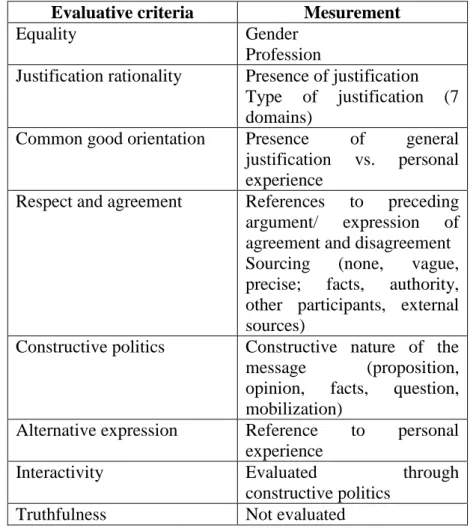
Table 1 summarizes the criteria that we have retained for the analysis of the quality of the deliberations in our case-studies.
[Insert table 1 about here]
Case study
The debate we have analyzed was organized by the French National Commission of Public Debate (CNDP) between September and December 2009, and was devoted to an old waste treatment facility which includes an incinerator16 operated by the SYCTOM, the local public
consortium for waste treatment. Citizens attended nine public meetings to discuss the appropriateness of transforming the industrial plant into a modern methanization unit which would produce gas along with heat. An innovative participatory website was set up including a blog which also offered filmed interviews, collaborative meeting reports and a Q&A system to prolong the debate online. Although they present two different on and off-line formats, these two debates offered two arenas of argumentation on the same topic with a circulation of actors from one scene to another.
The CNDP procedure was characterized by the intermingling of two formats (Bonaccorsi &
16
19 Julliard 2010). The articulation between on-line and off-line formats was planned so as to constitute a complete setup aimed at filling the two mains objectives of the procedure, informing the public and allowing the public to express itself.
Thus, besides its documentation function (archiving and downloading the documents and video-recordings of the meetings), the web portal displayed the public meetings, and allowed people to ask questions before and after them. Indeed, the week preceding each meeting, web users were invited to post on the blog all the questions they wished to see addressed, and the CNDP relayed them during the meetings. Then, after the public meetings, were available online: presentations of the speakers, the whole verbatim transcription with an executive summary of the meeting, and proceedings written up by the CNDP entitled “the lessons of the meeting”. This last document was submitted to comments online through the platform
co-ment.net. 62 comments were published between September and December. The CPDP then
integrated them into the final version of the report. The whole documentation (lecture-notes, reports, studies…) brought by participants could be freely uploaded from the website.
In order to compare the two arenas of public debate, we have encoded face-to-face discussions as well as on-line contributions. On one hand, we encoded the totality of 4 (out of the 9) public meetings spread over the whole period of the debate. On the other hand, we have encoded the entire online corpus: the 63 posts and the 107 comments on the blog, the 62 comments posted on the collaborative platform containing the minutes of the meeting, as well as the 280 questions posted on the Question-Answer system (Q&A). The overall on-line and off-line corpus adds up to 1212 observations.
This differentiated encoding allowed us to analyse the observable differences, including those between the various online setups which differed according to their interface, aim and functioning. The Q&A consisted of questions which are not allowed to be purely rhetorical and call for a genuine response. This is different from the blog which is principally aimed at allowing the expression of viewpoints. Comments on the collaborative platform, initially aimed
20 at discussing the minutes, were used by the citizens as a follow-up to the debate on-line, a point which appears in our analysis. All these interfaces were integrated in the website, but with different modalities of moderation and appropriation, which explains the diversity of the forms of argumentation that were observed.
Results.
As we shall see, almost all the variables provide evidence of the influence of the procedural context on the criteria retained for analysing the quality of the debates.
In the Tables which follow, we present the results of the codings for the discussions in public meetings and the for the on-line exchanges, the latter being divided into three categories: those which occurred with the Q&A, those which were held on the blog, and finally those which were held on the collaborative platform concerning the minutes of the meetings (co-ment).
Equality: a complementarity between on-line and off-line.
The interventions of men and women clearly vary according to the systems: in our data, women intervene much less frequently off-line than on-line, and certain forms of on-line participation suit them better than others.
[Insert table 2 about here]
Besides the Q&A, for which it is difficult to draw any conclusions due to the small rate of reply (the questions are posed anonymously), we see that women participate proportionally less than men. This result is fairly classic in the literature (Seyle & al., 2008) who explain this difference in terms of education involving an enculturation to taking the floor in public (Calla Carillo, de la Mata, 2004), and by a rhetorical preference of women for a mode of exposition of arguments oriented towards personal narration (Farell, 1979) which is less audible in off-line public debate. On-line, the interventions are more equal, even slightly favourable to women on the co-ment platform.
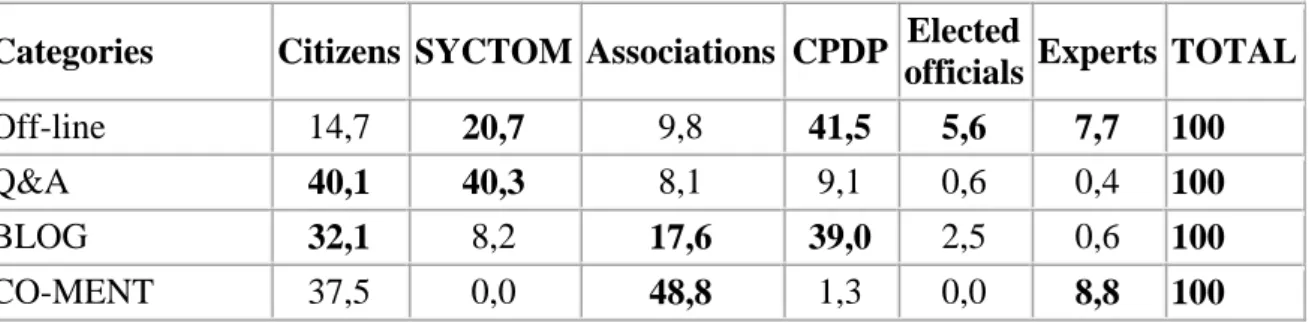
21 In terms of socio-professional origin of the participants, we see also that certain sites are massively invested by a few categories of participants, as shown in Table 3.
[Insert table 3 about here]
According to the arenas where the debate takes place, three categories of participants can be distinguished. Off-line, the discussions give an advantage to elected persons, experts, the CNDP and, to a lesser extent, the SYCTOM and citizens. We see that there is a strong inequality in interventions, although it is relatively balanced between companies on one hand, and association and citizens on the other, who are the two main groups in opposition. On-line on the blog, interventions are more frequent from citizens and associations, as a space of response to what may have been said off-line, the exchanges being moderated by the CNDP who plays its role of moderator and informer. Finally, on Co-ment, the associations clearly occupy the space which is reserved to exchanges, in particular to follow up on the discussions which may have left them unsatisfied off-line. This is also a place for experts, as the interface aims at discussing the minutes of the meetings, where they complete what they may have said orally. In spite of the weakness of the data we have on the Q&A, we can nevertheless see the role played by the citizens: the associations, who are better informed, use this function less often, except when they wish to have written confirmation of a controversial point. We see that equality is not constructed within each arena of discussion, but globally by allowing each participant to find a place which suits his needs and his strategic objectives.
Rational justification: more justification on-line
Almost 60% of the arguments put forward off-line are not supported by any justification: we are indeed in the context of a lively exchange, where participants take positions that are less supported than on-line. The verbal jousting and exchanges which are sometimes difficult, over a relatively limited period of time, are not always compatible with complex justifications. Therefore, arguments are more justified on-line. It is in the Q&A that the justification seems to
22 be strongest: the very object of this interface, which supposes that the answers contributed by the SYCTOM should be based on a solidly built argument17, explains this result. The two other
participatory modalities seem to allow a better justification and this in an equivalent fashion: the temporality of writing seems to suit the development of the argument. On this criterion of justification, the on-line interface seems better adapted for a debate that is rationally justified.
[Insert table 4 about here]
Concerning the types of justification employed, the following Table shows that the “realist” type of justification is dominant in all the spaces of debate. If this justification, which privileges reasons based on imperatives of economic efficiency, is the most salient in public discussions, justification of an ecological type is also important. The other types of justification seem to be less used, by contrast with what can be observed on-line where the ecological, domestic and solidarity justifications are more often expressed. In particular, the blog concentrates the greatest variety of justifications, and they are more homogeneous.
[Insert table 5 about here]
Common good orientation: better on line
As a consequence of what we saw previously (Table 4), the orientation towards the common good is more manifest on-line than off-line, where there are not only a small number of general justifications allowing an orientation towards the common good, but where the recourse to storytelling is also the highest.
Respect and responsiveness: a higher level of respect online
Respect, which is evaluated with a measure of agreement or disagreement with locutors by quoting one‟s sources and by building an understandable discourse, shows a greater quality
17
23 line than off-line. Nevertheless, a qualification is in order here: the Q&A has a particularly bad score on this criterion.
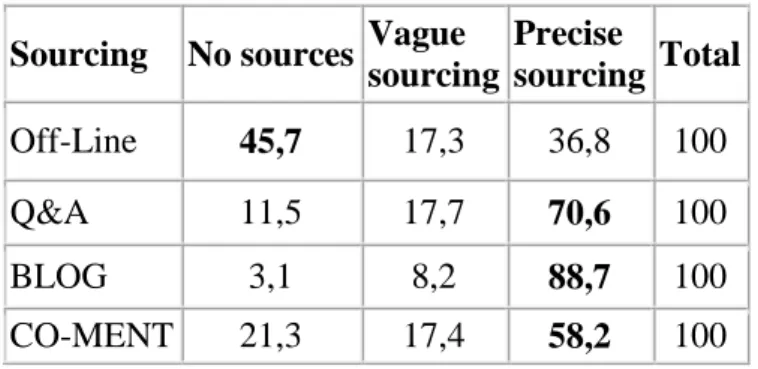
Thus, the off-line debates remain imprecise regarding sources, which can induce a feeling of confusion for the participants (Table 6). It is also an arena where agreements and disagreements are expressed only in limited fashion (Table 7), and where the thread of the discussion can be completely broken18. On the contrary, the references provided on-line are
more precise (particularly on the blog where 89% of the articles contain details concerning sources), and the expression of agreement or disagreement is frankly affirmed, in particular on the platform co-ment where one-third of the comments indicate a disagreement with the immediately preceding contribution. If the contributions to Q&A present precise sources because of the high level of justification required by the CNDP, this system induces monologue responses which show little interest for the locutors‟ viewpoint. In this sense, the Q&A cannot constitute by itself a site of debate, because of its lack of interactivity. On the other hand, its articulation with the blog and public meetings makes it possible to go deeper into the questions at stake.
[Insert table 6 and 7 about here]
Constructive politics: constructive propositions are mostly made off-line.
The majority of propositions put forward by the participants in the public debate are pronounced off-line (51%), the rest being divided almost equally between the blog and the Q&A (Table 8). One might think that the efforts towards a synthesis asked for by the CNDP, specially during thematic meetings and the final meeting, in order to find the terms of an agreement for the follow-up discussions after the debate, bear their fruits here. By contrast, the questions that are asked are mainly restricted to the Q&A and off-line. As for the blog, it is largely used to relay calls for mobilisation, rather like a social network.
18
24 [Insert table 8 about here]
We find that there is a certain specialisation of types of expression according to the system employed. Nevertheless, if we concentrate now on the internal organisation of each arena (Table 9), we can see that the place taken by constructive propositions is slightly greater on the blog than off-line. Thus, if a majority of propositions are formulated off-line, as a proportion of other types of statement, they are nevertheless clearly behind, and calls for mobilisation are quite marginal. Factual statements dominate all the others, even more on the blog where the reinterpretation of data which are controversial take a considerable place.
[Insert table 9 about here]
Regarding the quality of the debate, the blog constitutes therefore a modality of exchange just as interesting as the off-line discussion. From a quantitative point of view, the number of propositions made off-line is far greater than those that are made on-line.
Alternative expression: little differences between on and off-line
Table 4 provides indications with respect to alternative expression, and the recourse to storytelling. One might have thought, in conformity with the detailed literature presented in the first part of this text, that the on-line interface would constitute a refuge for this sort of expression which is not very audible in public. It appears however that the difference is negligible, hardly greater on-line than off-line. Nevertheless, the Table above shows that some interfaces are not at all amenable to these forms of expression: the Q&A and the platform of comments, which promote a high level of justification, leave little space for personal experience. The blog, more appropriate proportionally for women, seems better adapted to narration, a phenomenon that we have already observed in another similar public debate (Monnoyer-Smith, to be published).
25 The analysis of the quality of the debate as a function of the site of discussion shows that for almost all the criteria, the on-line discussion were of a superior quality to the off-line discussion. It is only the number of propositions which makes the off-line debate more constructive than the line debate. Nevertheless, the limited number of interventions of on-line participants compared with the richness of the off-on-line exchanges during the 9 public meetings limits to some extent the potential effects which may be expected from the debates which employ the various Web interfaces designed for this purpose.
As concerns the spaces for on-line discussion, the blog allow a better inclusion both of diverse populations and of alternative forms of expression. The sources are more precise, and the arguments of partners are better taken into account, than off-line. The Q&A turned out to be more favourable to justified rational argument, but it did not allow for genuine exchange because of its monologue structure without reference to the contents of the arguments of participants. The interface co-ment is a livelier site of debate where the expression of disagreement is clearer, without this managing to be constructive.
In fact, the articulation of the various spaces with each other in the framework of a common debate improves the general quality: the actors appropriate each space of expression both according to their competence and to their argumentative strategy. In order to go further in the analysis, it would be useful to characterize each type of discourse produced in the different arenas, in the manner of Bächtiger & al. (2009); this might make it possible to propose to the organizers the best possible arrangements for each given context.
On a more theoretical level, it can be seen that certain criteria can enter in conflict with each other. This is notably the case for the forms of alternative expression which favours inclusion in the debate, but which can also be interpreted negatively with respect to the criterion of general justification.
This case-study must of course be compared with the other field-studies that we have carried out in the framework of this research contract. It does however show that the technical context
26 of the deliberation does directly influence the quality of the debate, and thus invites the scientific community to address the question of the constraints which bear on the communicational context of the exchanges.
27
Tables
Table 1- Criteria retained for the evaluation of the quality of the deliberation
Evaluative criteria Mesurement
Equality Gender
Profession
Justification rationality Presence of justification Type of justification (7 domains)
Common good orientation Presence of general justification vs. personal experience
Respect and agreement References to preceding argument/ expression of agreement and disagreement Sourcing (none, vague, precise; facts, authority, other participants, external sources)
Constructive politics Constructive nature of the message (proposition, opinion, facts, question, mobilization)
Alternative expression Reference to personal experience
Interactivity Evaluated through
constructive politics
Truthfulness Not evaluated
Table 2- Distribution of men and women intervention in the participatory system No Answer Men Women
Off-line 0,0 58,3 38,9
Q&A 74,4 24,9 41,4
BLOG 24,7 9,0 7,2
CO-MENT 0,9 7,7 12,5
28 Table 3- Distribution of participants on and off-line
Categories Citizens SYCTOM Associations CPDP Elected
officials Experts TOTAL
Off-line 14,7 20,7 9,8 41,5 5,6 7,7 100
Q&A 40,1 40,3 8,1 9,1 0,6 0,4 100
BLOG 32,1 8,2 17,6 39,0 2,5 0,6 100
CO-MENT 37,5 0,0 48,8 1,3 0,0 8,8 100
Table 4- Justification on and off-line
Justification None General justification Personal experience TOTAL Off-line 58,1 39,5 4,1 100 Q&A 14,9 82,3 3,0 100 BLOG 30,2 68,6 4,4 100 CO-MENT 35,0 65,0 0,0 100
Table 5- Type of general justification
Type of general Justification
None Civic Ecological Realist Domestic Solidarity Proximity Aesthetic TOT AL
Off-line 58,1 12,4 18,2 22,7 4,9 9,0 6,6 0,6 100
Q&A 14,9 9,5 47,0 61,7 16,3 7,1 11,3 0,4 100
BLOG 30,2 12,6 52,2 53,5 34,6 20,8 14,5 1,3 100
29 Table 6- Sourcing on and off-line
Sourcing No sources Vague sourcing Precise sourcing Total Off-Line 45,7 17,3 36,8 100 Q&A 11,5 17,7 70,6 100 BLOG 3,1 8,2 88,7 100 CO-MENT 21,3 17,4 58,2 100
Table 7- Expression of agreement and disagreement
Expression of
consideration Agreement Disagreement None Both of them
Thread breaking TOTAL Off-Line 7,5 12,8 75,9 1,3 2,1 100 Q&A 2,0 2,2 94,6 1,2 0,0 100 BLOG 1,3 10,1 74,8 13,8 0,0 100 CO-MENT 2,5 32,5 62,5 2,5 0,0 100
Table 8- Distribution of the types of statements
Nature of the
statement Proposition Opinion Facts Question Mobilization TOTAL
Off-Line 51,0 53,5 33,4 30,5 25,0 38,6
Q&A 21,5 20,8 41,9 52,7 8,3 41,6
BLOG 19,5 15,0 17,8 12,1 50,0 13,1
CO-MENT 8,1 10,5 6,9 4,7 16,7 6,6
30 Table 9- Distribution of the types of statements in each arena
Nature of the statement Proposition Opinion Facts Question Mobilization TOTAL
Off-line 16,2 48,9 53,9 27,6 0,6 100
Q&A 6,4 17,7 62,7 44,3 0,2 100
BLOG 18,2 40,3 84,3 32,1 3,8 100
31 References
Albrecht, S. (2006). «Whose Voice is Heard in Online Deliberation? A Study of Participation and Representation in Political Debates on the Internet», Information, Communication & Society, 9(1): 62-82.
Andersen, V. N. & Hansen, K. M. (2007), “How deliberation makes better citizens: The Danish Deliberative Poll on the euro”, European Journal of Political Research, 46, 531–556.
Austen-Smith D., (1990), “Information Transmission in Debate”, American Journal of Political
Science, 34, 124-152.
Austen-Smith D. (1992), “Strategic Model of Talk in Political Decision-Making”, International
Political Science Review, 13, 45-58.
Austen-Smith D, & Riker W.H. (1987), “Asymetric Information and the Coherence of Legislation”,
American Political Science Review, 81, 897-918.
Bächtiger A., Shikano S., Pedrini S., Ryser M. (2009), “Measuring Deliberation 2.0: Standards, Discourse Types, and Sequenzialization”, Paper presented at ECPR General Conference, Postdam, sept. 2009.
Bächtiger, A., Niemeyer S., Neblo M., Steenbergen & Steiner J., (2010), “Disantangling Diversity in Deliberative Democracy: Competing Theories, Their Blind Spots and Complementarities”, The
Journal of Political Philosophy, 18:1, 32-63.
Benett W. L., Wells C., Freelon D. G. (2009) “Communicating Citizenship Online : Models of civic learning in the Youth Public Sphere”, Report for the Center for Communication and Civic Engagement. Available on line at : http://www.engagedyouth.org/blog/wp-content/uploads/2009/02/communicatingcitizeshiponlinecloreport.pdf [Accessed on October 25, 2010].
Benhabib, S. (1996) “Toward a Deliberative Model of Democratic Legitimacy” in Benhabib S. (Ed.)
Democracy and Difference, Contesting the Boundaries of the Political, Princeton: Princeton
University Press.
Black, L., Burkhalter, S., Gastil, J., and Stromer-Galley, J. (2010). Methods for analyzing and measuring group deliberation. In E. Bucy and R. L. Holbert (Eds.), Sourcebook for political communication research: Methods, measures, and analytical techniques. Mahwah, NJ: Routledge. Bohman J. (1997), “Deliberative Democracy and Effective Social Freedom: Capabilities, Resources,
and Opportunities”, in Bohman, J. & Rehg W. (ed), Deliberative Democracy. Essays on reason
and politics, 321- 339. Cambridge, MA: MIT Press..
Bohman, J. (2006), “Deliberative Democracy and the Epistemic Benefits of Diversity”, Episteme: A
Journal of Social Epistemology – Vol. 3, Issue 3, 175-191.
Bohman, J. & Rehg W. (ed), Deliberative Democracy. Essays on reason and politics., 67-91. Cambridge, MA: MIT Press..
Boltanski, L., Thévenot, L. (1991), De la Justification. Les économies de la grandeur, Paris :Gallimard. Bourdieu, P. (1991) [1982], Language and symbolic power. Cambridge, Mass.: Harvard University
Press.
Cala Carrillo, J.& de la Mata M., (2004), » Educational Background, Modes of Discourses and Argumentation : comparing Women and Men”, Argumentation 18, 403-26.
Cappella, J.N., Price, V., & Nir, L. (2002). Argument repertoire as a reliable and valid measure of opinion quality: Electronic dialogue during campaign 2000. Political Communication, 19, 73-93. Chambers, S. (2003), “Deliberative democratic theory”, Annual Review of Political Science, 6,
307-332.
Chambers, S. (2004), “Behind closed doors: publicity, secrecy and the quality of deliberation”, Journal
of Political Philosophy, 12, 389-410.
32 Cohen, J. (1997), “Deliberation and Democratic Legitimacy”, in J. Bohman & W. Rehg (ed),
Deliberative Democracy. Essays on reason and politics., 67-91. Cambridge, MA: MIT Press.
Cohen, J. (2007), “Deliberative Democracy”, in Rosenberg, S. (ed.), Deliberation, Participation and
Democracy: Can the People Govern? Basingstoke, UK: Palgrave Macmillan, 219-236.
Coleman, S. (2004), “Connecting Parliament to the Public via the Internet: Two Case Studies of Online Consultations”, Information, Communication and Society 7(1): 1-22.
Coleman, S. (2007), “Doing It For Themselves: Management versus Autonomy in Youth E-Citizenship”, in Bennett, W.L. (ed.) Digital Media and Youth Civic Engagement, Boston: MIT Press.
Coleman S. (2008), “Doing IT for Themselves: Management versus Autonomy in Youth E-Citizenship”, in L.W. Bennett (Ed.), Civic Life Online: Learning How Digital Media Can Engage Youth, The John D. and Catherine T. MacArthur Foundation Series on Digital Media and Learning. Cambridge, Mass.: The MIT Press, 189-206.
Conover, P., Searing, D., Crewe, I. (2002) “The Deliberative potential of Political Discussion”, British
Journal of Political Science, 32.
Dahlberg, L. (2001), “Computer-Mediated Communication and The Public Sphere: A Critical Analysis”, Journal of Computer-Mediated Communication, 7(1). Available on line at: http://jcmc.indiana.edu/vol7/issue1/dahlberg.html [Accessed on October 25, 2010].
Dahlberg, L. (2002). Net-Public Sphere Research: Beyond the 'First Phase'. Euricom Colloquium: Electronic Networks and Democracy. Nijmegen, The Netherlands: 14.
Davies, T., & Gangadharan S. P (Ed.) (2009), Online Deliberation : Design, Research and Practice, CSLI Publications.
Davis, R. (1999), “The web of politics: The Internet's impact on the American political system”. New York: Oxford University Press.
Delli Carpini, M. X. (2000) "Gen.Com: Youth, Civic Engagement and the New Information Environment."Political Communication 17, 341-349.
Deleuze, G. & Guattari, F., (1988) [1980] A Thousand Plateaus: Capitalism and Schizophrenia vol. 2, trans. Brian Massumi. London: Athlone.
Dryzek, J.S. (2000), Deliberative Democracy and Beyond. Oxford: Oxford University Press.
Dryzek, J.S. (2007), “Democratization as deliberative capacity building”, Paper presented at the annual meeting of the APSA 2008 Annual Meeting, Hynes Convention Center, Boston, Massachusetts, Aug 28, 2008. Available online :
http://deliberativedemocracy.anu.edu.au/documents/Dryzek2007_000.pdf
Dubrovsky, V. J., S. Kiesler, and B. N. Sethna (1991), “The Equalization Phenomenon: Status Effects in Computer-Mediated and Face-to-face Decision Making Groups”, Human-Computer Interaction 6: 119-146.
Eliasoph N. (1998) Avoiding politics. How Americans produce apathy in everyday life, Cambridge: Cambridge University Press.
Elster J. (ed) (1998), Deliberative Democracy. Cambridge: Cambridge University Press.
Estlund, D. (1997) “Beyond Fairness and Deliberation: The Epistemic Dimension of Democratic Authority”, in Bohman J., Rehg, W., 173-204.
Farrell, T. J. (1979), “ The Female and Male Modes of Rhetoric”, College English 40(8): 909-21. Fishkin, J. S. & Luskin R., (1999). “Bringing deliberation to the democratic dialogue”, in Maxwell
McCombs and Amy Reynolds eds., The Poll with a Human Face: The National Issues Convention
Experiment in Political Communication. Mahwah, NJ: Erlbaum.
Foucault, M. (1977). Discipline and Punish: the Birth of the Prison. New York: Random House.
Fung A. (2003), « Recipes for Public Sphere : Eight Institutional Design Choices and Their Consequences », The Journal of Political Philosophy, vol. 11, n° 3, pp. 338-367.
Gastil, J., Black L. W., Deess P., Leighter J. (2008), “From group member to democratic citizen: How deliberating with fellow jurors reshapes civic attitudes”, Human communication research, 38,