Any correspondence concerning this service should be sent
to the repository administrator:
[email protected]
This is an author’s version published in:
http://oatao.univ-toulouse.fr/22731
To cite this version:
El Zant, Samer and Jaffres-Runser, Katia and
Frahm, Klaus and Shepelyansky, Dima Interactions and influence of
world painters from the reduced Google matrix of Wikipedia networks.
(2018) IEEE Access, 6. 47735-47750. ISSN 2169-3536
Official URL
DOI :
https://doi.org/10.1109/ACCESS.2018.2867327
Open Archive Toulouse Archive Ouverte
OATAO is an open access repository that collects the work of Toulouse
researchers and makes it freely available over the web where possible
Digital Object Identifier 10.1109/ACCESS.2018.2867327
Interactions
and Influence of World Painters
From
the Reduced Google Matrix of
Wikipedia
Networks
SAMER EL ZANT 1, KATIA JAFFRÈS-RUNSER 1, KLAUS M. FRAHM2 AND DIMA L. SHEPELYANSKY 2
1Institut de Recherche en Informatique de Toulouse, Université de Toulouse, INPT, 31061 Toulouse, France 2Laboratoire de Physique Théorique, IRSAMC, Université de Toulouse, CNRS, UPS, 31062 Toulouse, France.
Corresponding author: Dima L. Shepelyansky ([email protected])
This work was supported in part by APR 2015 Call of the University of Toulouse and in part by the Région Occitanie (Project GOMOBILE), MASTODONS-2017 CNRS Project APLIGOOGLE, and EU CHIST-ERA MACACO Project ANR-13-CHR2-0002-06, and in part by the Pogramme Investissements d’Avenir under Grant ANR-11-IDEX-0002-02, in part by the Project THETRACOM under Grant ANR-10-LABX-0037-NEXT.
ABSTRACT This paper concentrates on extracting painting art history knowledge from the network
structure of Wikipedia. Therefore, we construct theoretical networks of webpages representing the hyper-linked structure of articles of seven Wikipedia language editions. These seven networks are analyzed to extract the most influential painters in each edition using Google matrix theory. Importance of webpages of over 3000 painters is measured using the PageRank algorithm. The most influential painters are enlisted and their ties are studied with the reduced Google matrix analysis. The reduced Google matrix is a powerful method that captures both direct and hidden interactions between a subset of selected nodes taking into account the indirect links between these nodes via the remaining part of large global network. This method originates from the scattering theory of nuclear and mesoscopic physics and field of quantum chaos. In this paper, we show that it is possible to extract from the components of the reduced Google matrix meaningful information on the ties between these painters. For instance, our analysis groups together painters that belong to the same painting movement and shows meaningful ties between painters of different movements. We also determine the influence of painters on world countries using link sensitivity between Wikipedia articles of painters and countries. The reduced Google matrix approach allows to obtain a balanced view of various cultural opinions of Wikipedia language editions. The world countries with the largest number of top painters of selected seven Wikipedia editions are found to be Italy, France, and Russia. We argue that this approach gives meaningful information about art and that it could be a part of extensive network analysis on human knowledge and cultures.
INDEX TERMS Big data, Google matrix, Markov chains, Wikipedia networks.
I. INTRODUCTION
‘‘The art is the expression or application of human creative skill and imagination, typically in a visual form such as painting or sculpture, producing works to be appreciated pri-marily for their beauty or emotional power’’ [1]. Artists use
different approaches and techniques to create emotions. Since the beginning of mankind, painters have offered masterpieces in the form of paintings and drawings to the world. Depending on historical periods, cultural context and available tech-niques, painters have followed different art movements. Art historians group painters into art movements to capture the
fact that they have worked in the same school of thought. But a painter could be placed in several movements as his works evolve with time and its individual intellectual path development [2]–[8].
The major finding of this paper is to show that it is pos-sible to automatically extract this common knowledge on art history by analyzing the hyper-linked network structure of the global and free online encyclopedia Wikipedia [9]. The analysis conducted in this work is solely based on a graph representation of the Wikipedia articles where vertices (nodes) represent the articles and the edges (links) provide the
hyperlinks linking these articles together. The actual content of articles is never processed in our developments.
Wikipedia has become the largest open source of knowl-edge being close to Encyclopædia Britannica [10] by the accuracy of its scientific entries [11] and overcoming the later by the enormous quantity of available information. A detailed analysis of strong and weak features of Wikipedia is given in [12] and [13]. Unique to Wikipedia is that arti-cles make citations to each other, providing a direct rela-tionship between webpages and topics. As such, Wikipedia generates a large directed network of article titles with a rather clear meaning. For these reasons, it is interesting to apply algorithms developed for search engines of World Wide Web (WWW), those like the PageRank algorithm [14] (see also [15], [16]), to analyze the ranking properties and relations between Wikipedia articles. For various language editions of Wikipedia it was shown that the PageRank vector produces a reliable ranking of historical figures over 35 cen-turies of human history [17]–[20] and a solid Wikipedia ranking of world universities (WRWU) [17], [21], [22]. It has been shown that the Wikipedia ranking of historical figures is in a good agreement with the well-known Hart ranking [23], while the WRWU is in a good agreement with the Shanghai Academic ranking of world universities [24].
At present, directed networks of real systems can be very large (about 4.2 million articles for the English Wikipedia edition in 2013 [16] or 3.5 billion web pages for a publicly accessible web crawl that was gathered by the Common Crawl Foundation in 2012 [25]). For some studies, one might be interested only in the particular interactions between a very small subset of nodes compared to the full network size. For instance, in this paper, we are interested in capturing the interactions of nodes using the networks extracted from 7 Wikipedia language editions (FrWiki, EnWiki, DeWiki, ItWiki, EsWiki, NlWiki and RuWiki). We use the network data sets of Wikipedia 2013 described in [20]. The selected nodes (their Wikipedia articles) are embedded in a huge com-plex directed network with millions of nodes. Thus, the inter-actions between these selected sets of nodes should be cor-rectly determined taking into account that there are many indirect links between the webpages via all other nodes of the network. In previous works, a solution to this general prob-lem has been proposed in [26]–[28] by defining the reduced Google matrix theory. Main elements of reduced Google matrix GR will be presented in Section II. This approach develops the ideas of scattering theory of nuclear and meso-scopic physics and quantum chaos adapted to Markov chains and Google matrix [26], [27].
In a few words, GR captures in a Nr-by-Nr1
Perron-Frobenius matrix the full contribution of both direct and indi-rect interactions existing in the regular Google matrix model of the network, but only for the reduced set of Nrnodes. The
number Nris in the order of a few tens of nodes, which is
con-siderably smaller that the size of the full Wikipedia network
1N
rrepresents the number of our selected nodes of interest.
which contains millions of nodes. Elements of reduced matrix
GR(i, j) can be interpreted as the probability for a random
surfer starting at webpage j to arrive in webpage i using direct and indirect interactions. Indirect interactions refer to paths composed in part of webpages different from the Nr ones of
interest. Even more interesting and unique to reduced Google matrix theory, we show here that intermediate computation steps of GR offer a decomposition of GRinto matrices that clearly distinguish direct from indirect interactions. As such, it is possible to extract a meaningful probability for an indirect interaction between two nodes to happen as shown in the results of [27] and [28]. Thus the reduced Google matrix theory is a perfect candidate for analyzing the direct and indirect interactions between the selected painters.
In this paper, we extract from GRand its decomposition into direct and indirect matrices a high-level reduced network
of Nrpainters. This high-level network is computed with both
direct and hidden (i. e. indirect) interactions. More specif-ically, we deduce from GR a fine-grained classification of painters that captures what we call the hidden friends of a given node. The structure of these graphs provides relevant information that offers new information compared to the direct network of relationships.
The aforementioned networks of direct and hidden inter-actions can be calculated for different Wikipedia language editions. In this paper, reduced Google matrix analysis is applied to the set of 30 painters and the set of 40 painters with 40 countries, from seven different Wikipedia language editions (English, French, German, Spanish, Russian, Italian and Dutch). We will refer to these editions using EnWiki, FrWiki, DeWiki, EsWiki, RuWiki, ItWiki and NlWiki in the remainder of this paper.2In total we analyzed the list of 3249 painters taken from [30], restricted to the ones that are present in all 7 language editions. Moreover, we provide hereafter, an analysis of the influence of top PageRank painters on world countries after constructing the reduced Google matrix composed of top 40 PageRank painters and the top 40 PageR-ank countries investigated in [28]. We present the full lists of painters, rank lists and additional figures at [31].
This paper introduces first the main elements of reduced Google matrix theory in Section II. Next, Section III presents the ranking and selection of painters based on the PageRank algorithm. In Section IV the reduced Google matrices are calculated and described for selected sets for seven different language editions. Specific emphasis is given to the very dif-ferent English, French and German editions. Then, networks of friendship from direct and hidden interaction matrices are created and discussed in Section V. We show that the networks of friends completely capture the well-established history of painting by i) interconnecting densely painters of the same movement and ii) showing reasonable links between painters of different movements. We also obtain the global
2The networks of EnWiki, FrWiki, RuWiki, DeWiki, ItWiki, EsWiki and
NlWiki contain 4.212, 1.353, 0.966, 1.533, 1.017, 0.974 and 1.14 millions of articles respectively.
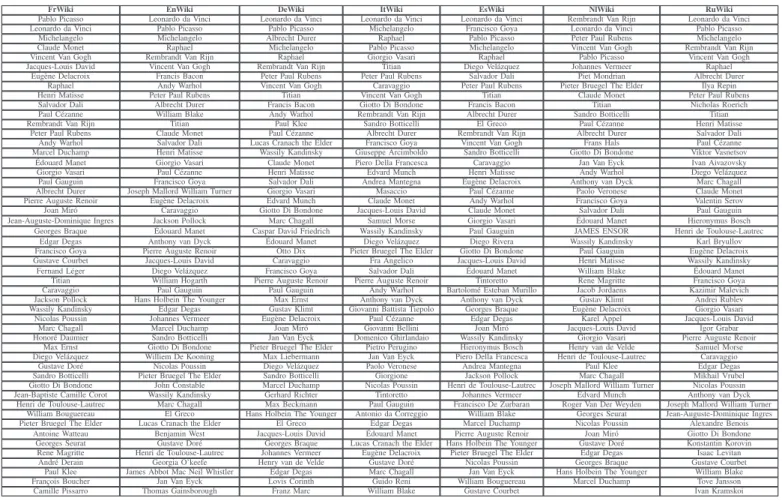
TABLE 1. List of 50 top painters from FrWiki, EnWiki, DeWiki, ItWiki, EsWiki, NlWiki and RuWiki by increasing PageRank index .
From the computational view point the damping factor α induces a gap between the largest eigenvalue λ = 1 of G and all other eigenvalues with |λ| ≤ α. Due to this the multipli-cation of an initial random vector by a matrix G converges exponentially to the PageRank vector with an accuracy about 10−15(about 150 multiplications are needed for α = 0.85). Each multiplication of a vector by G involves about 20 N multiplications since on average a Wikipedia network has about 20 links per node. In the range 0.5 < α < 0.9 the PageRank vector in not very sensitive to α. The usually used value is α = 0.85 [15]. The details of PageRank computations are given in [14]–[16] and [27].
Reduced Google matrix is constructed for a selected subset of nodes (articles) following the method described in [26]–[28] and based on concepts of scattering theory used in different fields including mesoscopic and nuclear physics, and quantum chaos. It captures in a Nr-by-Nr
Perron-Frobenius matrix the full contribution of direct and indirect interactions happening in the full Google matrix between the
Nr nodes of interest. In addition the PageRank probabilities
of selected Nr nodes are the same as for the global network
with N nodes, up to a constant multiplicative factor taking into account that the sum of PageRank probabilities over Nr
nodes is unity. Elements of reduced matrix GR(i, j) can be interpreted as the probability for a random surfer starting at web-page j to arrive in web-page i using direct and indirect ranking of painters averaged over all 7 Wikipedia editions
and analyze the interactions between them. The influence of painters on world countries is analyzed in Section VI. Finally, Section VII discusses featured results and concludes this paper.
II. REDUCED GOOGLE MATRIX THEORY
It is convenient to describe the network of N Wikipedia arti-cles by the Google matrix G constructed from the adjacency matrix Aijwith elements 1 if article (node) j points to article
(node) i and zero otherwise. Elements of the Google matrix take the standard form Gij = αSij+ (1 − α)/N [14]–[16],
where S is the matrix of Markov transitions with elements
Sij= Aij/kout(j), kout(j) = PiN=1Aij6= 0 being the node j
out-degree (number of outgoing links) and with Sij= 1/N if j has
no outgoing links (dangling node). The quantity 0 < α < 1 is the damping factor which for a random surfer determines the probability (1 −α) to jump to any node; below we use the standard value α = 0.85. The right eigenvector of G with the unit eigenvalue gives the PageRank probabilities P(j) to find a random surfer on a node j. We order nodes by decreasing probability P getting them ordered by the PageRank index
K = 1, 2, ...N with a maximal probability at K = 1. From
this global ranking we capture the top 50 painters mentioned in Tab. 1 for 7 editions.
FIGURE 1. Geographic birthplace distribution of the 223 painters that appear at least one time in the PageRank top 100 painters of one
of 7 language editions analyzed. Top panel represents 223 painters for all centuries till present, while bottom panel represents 88 painters having middle-age year less than year 1800; countries in gray have zero painters. The birth place is attributed to country borders of 2013.
interactions. Indirect interactions refer to paths composed in part of web-pages different from the Nrones of interest. Even
more interesting and unique to reduced Google matrix theory, we show here that intermediate computation steps of GRoffer a decomposition of GRinto matrices that clearly distinguish direct from indirect interactions: GR=Grr+Gpr+Gqr[27]. Here Grr is given by the direct links between selected Nr
nodes in the global G matrix with N nodes, Gpr is rather close to the matrix in which each column is given by the PageRank vector Pr, ensuring that PageRank probabilities
of GR are the same as for G (up to a constant multiplier). Therefore Gprdoesn’t provide much information about direct and indirect links between selected nodes. The one playing an interesting role is Gqr, which takes into account all indi-rect links between selected nodes appearing due to multiple paths via the global network nodes N (see [26]–[28]). The
matrix Gqr = Gqrd + Gqrnd has diagonal (Gqrd) and non-diagonal (Gqrnd) parts. Thus Gqrnd describes indirect interac-tions between nodes. The matrix elements of GR, Grr, Gqrnd
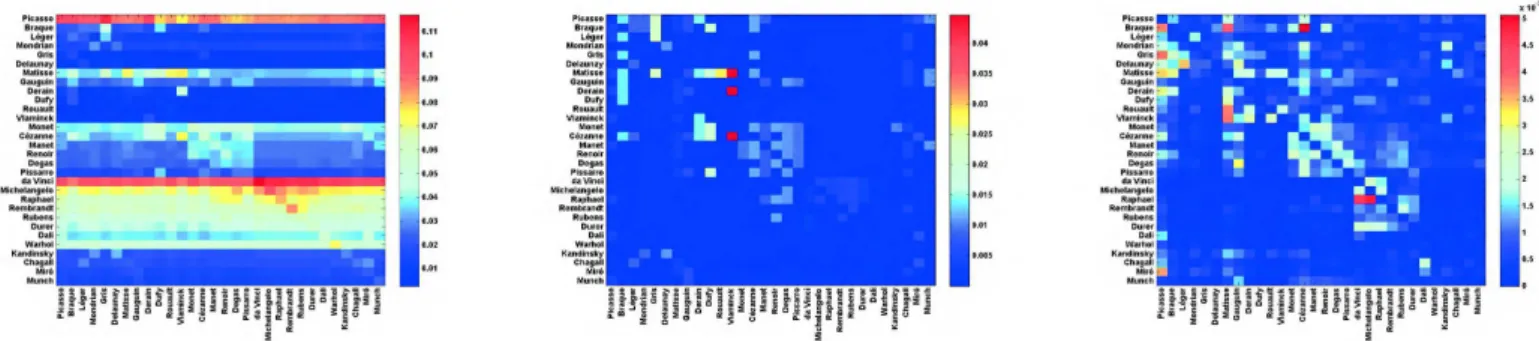
are represented in a two dimensional density plot in Fig. 2 for a group of 30 painters of EnWiki. The explicit formulas as well as the mathematical and numerical computation methods of all three components of GR are given in [26]–[28]. We discuss the properties of these matrix components below, but before that we introduce our painter selection process for the seven Wikipedia editions.
III. SELECTION OF PAINTERS
A. TOP PAGERANK PAINTERS
We are interested in this part in selecting the most influential painters representative of the seven investigated Wikipedia
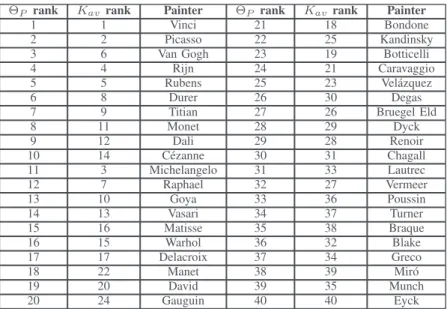
TABLE 2. Top 40 painters ranked by decreasing importance following 2P -score computed over 7 editions. The average PageRank Kav is given as well.
It derives from GRav , the matrix average of the individual GR of all 7 editions.
editions. Importance of nodes is measured in this selection process with the PageRank centrality.
A Matlab script has been written to retrieve all the painters’ names from the ‘‘List of painters by name’’ webpage [30] edited by Wikipedia that lists painters from all ages and various parts of the world. We have collected 3334 names. Next, we get their nodes’ number in our network represen-tation of each Wikipedia edition. Note that some names are not necessarily known for their painting art production (e.g. Hitler). Thus we have made a second check to remove such cases from our list of painters. This initial sorting leads to a group of 3249 distinct names for our 7 selected editions enlisted in [31].
A Google matrix is constructed for each Wikipedia edition following the standard rules described in Section II. From the Google matrix of a given edition, PageRank index K of all N nodes is determined. From this vector of N values, we extract PageRank nodes of identified painters and we reorder them by decreasing PageRank value getting local PageRank index of painters. Tab. 1 shows the list of the top 50 PageRank painters captured individually by the 7 selected Wikipedia editions. Not surprisingly, the order of top painters changes with respect to the editions due to cultural bias but there are some main trends, e.g.:
- Leonardo Da Vinci ranks first place in 5 out of 7 editions, - Michelangelo and Picasso belong to the top 4 in all
editions,
- Russian painters, like Viktor Vasnetsov and Ivan Aiva-zovsky, are in the top 20 of RuWiki but don’t appear before rank 50 in other editions.
countries for these 223 painters (country borders are taken for year 2013). There is a clear predominance of European painters in this selection with a strong part of Russian artists as well. Among these 223 painters, 88 were born before year 1800 and the distribution of these 88 painters over the world map demonstrates a clear dominance of Italy at these times as to be seen in the bottom panel of Fig. 1.
B. GLOBAL RANKING OF PAINTERS
The above results demonstrate different cultural views on the importance of painters in the different language edition of Wikipedia. To get a global, multi-cultural importance of painters we use the approach proposed in [19] and [20]. It defines a global rank 2Pwith:
2P=
X
E
(101 − RP,E). (1)
Here RP,E is the rank of the top 100 painters P in Wikipedia
edition E retrieved with PageRank algorithm. The painters with the largest 2P−score are the most important ones for E
Wikipedia editions. Based on 2Pscore, we have selected two
different sets of painters for our investigations.
1) TOP 40 PAINTERS
From the 2P−score calculated for the E = 7 Wikipedia
editions of interest (e.g. EnWiki, FrWiki, RuWiki, DeWiki, ItWiki, EsWiki and NlWiki), we have selected the top 40 painters enlisted in Tab. 2 by order of importance.
2) PAINTING CATEGORIES NETWORK
This second set has been chosen to illustrate the existence of painting movements and how the reduced Google matrix analysis captures them automatically. This set is composed of 30 painters that belong to the six following painting Using the PageRank of all 3249 painters computed for
7 language editions, we have extracted 223 painters by cre-ating the union set of top 100 painters of each language edition. The top panel of Fig. 1 illustrates the statistics of birth
FIGURE 2. Density plots of GR (left), Grr (middle) and Gqrnd (right) for the reduced network of 30 painters grouped by categories from Tab. 3 for EnWiki
network. Color scale represents maximum values in red, intermediate in green and minimum close to zero in blue; the absolute values of matrix elements are given by color bars (see also text for weights WR , Wrr , Wqr of matrix components).
TABLE 3. List of names of 30 selected painters in the Painting categories
network set. They are grouped by categories, and in each category they are ranked following the 2P -score obtained for FrWiki, EnWiki and DeWiki. Local PageRank order for FrWiki, EnWiki and DeWiki are given as well. A color is assigned to each category.
categories: Cubism, Impressionism, Fauvism, Great masters and Modern art (20th century).
Following an average ranking 2P−score calculated for
3 Wikipedia editions (EnWiki, FrWiki and DeWiki), we have selected the top 5 painters of each category. They are enlisted in Tab. 3 by order of appearance. This Table also lists local PageRank index for painters in the French, English and German Wikipedia editions. Painters that belong to the same movement or having a common piece of history may probably exhibit stronger interactions in Wikipedia. As such,
we have created a color code that groups together painters that either belong to the same movement (e.g. Fauvism, Cubism, Impressionists) or share a big part of history (e.g. Great Masters, Modern). Color code is as follows: Red, Blue, Green, Orange and Pink represents Cubism, Fauvism, Impressionists, Great masters and Modern (20-21st century), respectively.
IV. REDUCED GOOGLE MATRICES
To illustrate the matrices derived by the reduced Google matrix analysis, we plot GR, Grr and Gqrndin Fig. 2 for the
set of 30 painters composing the Painting categories network in Tab 3. The targeted edition is EnWiki.
Columns and lines are ordered with the order set in Tab 3. Following observations can be made. GRis per-column nor-malized and dominated by the projector Gpr contribution, which is proportional to the global PageRank probabilities (for more details see in [26] and [27]). As such, we clearly see that the density of each line of GRis proportional to the importance of the painter in the full network. The matrices are interpreted in the following way: painter of column j is linked with the probability of element (i, j) to the painter of line i.
As it was pointed in Section II the component Gprof the reduced Google matrix GRis essentially given by almost the same columns given by the PageRank vector of GR. Due to this reason they mainly represent the PageRank proba-bilities of Nr nodes while the interactions and direct and
indirect links between these nodes are described by Grr and Gqr. The contribution of each component is characterized by its weight WR, Wpr, Wrr, Wqr (Wqrnd) respectively for GR, Gpr, Grr, Gqr(Gqrnd). The weight is the sum of all matrix elements of a matrix component divided by Nr. By definition WR = 1, while for EnWiki we have Wpr = 0.913951, Wrr = 0.046369, Wqr = 0.03968 (Wqrnd = 0.0259). These
weights determine the absolute scale on matrix elements shown in Fig. 2. Similar values are obtained for DeWiki and FrWiki. Even if Wpr is significantly higher than Wrr and Wqr its columns are very close to the PageRank vector being
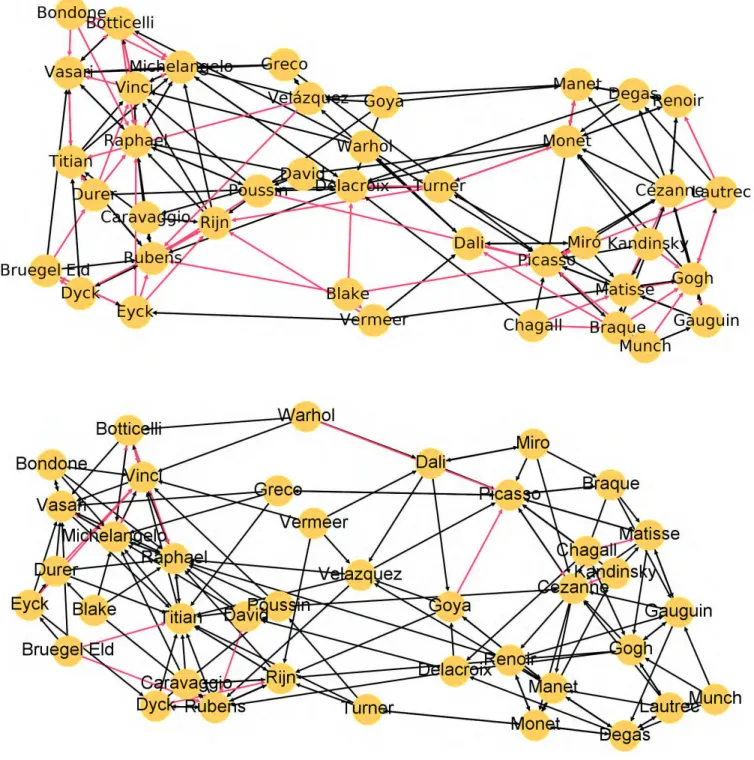
FIGURE 3. Friendship networks for the top 40 painters data set listed in Tab. 2. Top panel: Friendship network extracted from Grr + Gqrnd computed with FrWiki. Bottom panel: Friendship network extracted from the matrix Grr av + G
qrndav , where GRav is the average of the GR matrices obtained for all 7 Wikipedia editions. For each painter in the set, arrows are drawn to its top 4 friends. Arrows are colored in red if component Gqrnd is larger than component Grr , and in black otherwise. Both graphs are automatically plotted using Yifan Hu layout with Gephi [42].
offers a much more unified view of painters interactions as it captures more general indirect (or hidden) interactions via the N −Nrother nodes of the full Wikipedia network. In other
words, it represents the probability linking the painter of column j to the painter of line i related to all indirect paths linking article j to article i in the full network. An indirect path starts with a hyperlink linking the article of painter j to an article k that doesn’t belong to the Nrnodes and ends with
a hyperlink ending on the article of node i. the analysis on these two matrix components of GR. The
properties of GRcomponents had been discussed in detail in [27] and [28] and here we discuss mainly the most interesting contributions induced by Grr, Gqr.
The matrix Grr provides information only on direct links
between painters. In other words, it represents the probability for a random surfer to reach the painter of line i from the article of the painter of column j using a hyperlink linking article j to article i in Wikipedia. On the contrary, Gqrnd
FIGURE 4. Friendship networks for the painting categories data set listed of Tab. 3. Results are extracted from the Gqrnd matrix
derived from EnWiki (left), FrWiki (middle) and DeWiki (right). Red, Blue, Green, Orange and Pink nodes represents Cubism, Fauvism, Impressionists, Great masters and Modern(20-21) respectively. The top painter node points with a bold black arrow to its top 4 friends. Red arrows represent the friends of friends interactions computed until no new edges are added to the graph. All graphs are
automatically plotted using Yifan Hu layout with Gephi [42].
Reading Fig. 2, we can extract strong and meaningful interactions between painters. New links appearing in Gqrnd and being absent from Grr exist. As an example we list
the links between Picasso and Braque, Pissaro and Monet, Rouault and Matisse. These relationships are very well known in art history, but looking at the pure structure of the network (i. e. reading Grrmatrix), they are absent. They appear clearly
in the higher order mathematical analysis of the network using Gqrnd. For instance, it is common knowledge that since his visit to Picasso’s studio, Braque became impressed by Picasso’s paintings. They even became friends [32], which confirms our result. Pissaro and Monet are both impression-ists. Monet succeeded in reaching England after entrusting a number of his works to Pissaro [33]. Rouault and Matisse were both students of Gustave Moreau [34] and were deeply influenced by him throughout their life [35]. Their rela-tionship began in 1906 and lasted all their life. All these interactions can be extracted from the network of Wikipedia webpages using Gqrndmatrix.
In order to simplify the reading and interpretation of these matrices, we have introduced in [26]–[28] a set of tools that captures essential features of the reduced network. In Section V, we build the friendship networks for our sets of painters and in Section VI we analyze the influence of
painters on countries using the PageRank sensitivity analysis of GR.
V. FRIENDSHIP NETWORKS
A. FRIENDSHIP NETWORK CONSTRUCTION
It is possible to extract from Grr and Gqrnd a network of
friendship to conveniently illustrate direct and hidden links in the network, or a combination of both. Direct links are extracted from Grr while hidden (i. e. indirect) are extracted
from Gqrnd. The network of friends is built by considering larger matrix elements in a column j of a given painter as top friends (i. e. there is a high probability to end in node
i from node j). It is true that the word friend usually
rep-resents a symmetrical relationship. But we have chosen this denomination for its ease of use. Clearly, in this paper, a friend represents a node that is an attractor for the node of interest.
From the notion of friendship, we derive the networks of friends shown in Fig. 3 and Fig. 4. In Fig. 3, the set of top 40 painters is analyzed while in Fig. 4 the painting categories set is investigated. Both networks of friends have been derived in the following way:
• For Fig. 3, arrows representing 4 outlinks are drawn from each painter to its top 4 friends in the matrix Grr+ Gqrnd. In this figure, we mark arrows in red if the Gqrnd
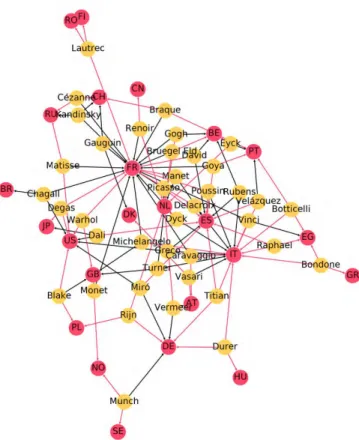
FIGURE 5. Network structure of top 3 country friends for top 40 painter
network for EnWiki Painters are selected from the global rank list of 7 Wikipedia editions from Table 2 for top 40 PageRank countries of EnWiki from Table 4. Arrows are showing links only from a painter to top 3 countries, they are given by links of matrix elements Grr + Gqrnd, red arrow mark links when an element Gqrnd is larger than element Grr , black arrows are drown in opposite case. Countries and shown by red circles and painters are shown by yellow circles.
component (i. e. indirect link probability) is larger than the Grr component (i. e. direct link probability). Black
arrows thus represent the opposite case. The graphs are automatically plotted with Gephi [42] using the Yifan Hu algorithm. In other words, for each painter j of Tab. 2, we extract from sum of both matrices the top 4 Friends given by the 4 strongest elements of column j. This figure represents two different views: i) a regional view (top panel) as Grr + Gqrnd are computed for FrWiki and ii) a unified view (bottom panel) as the friendship network is built from Grr av+Gqrndav which is defined
as the average of the corresponding matrices computed over all 7 Wikipedia editions.
• In Fig. 4, we capture for the Painting categories data set the sole indirect interactions provided by Gqrndbetween the 5 categories of painters. Therefore, we have selected the most influential painter in each category. This cate-gory leader is the one with the best (i. e. smallest) aver-age ranking score over all 6 selected Wikipedia editions. The top painters are Pablo Picasso for Cubism, Henri Matisse for Fauvism [36], Claude Monet for Impression-ists [37], [38], Leonardo Da Vinci for Great Masters and Dali for Modern. The networks of Fig. 4 are created by marking with black arrows the link between each leading
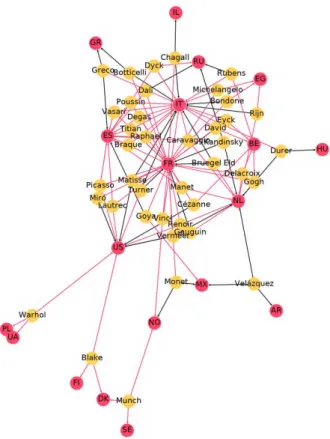
FIGURE 6. Network structure of top 3 country friends for top 40 painter
network for FrWiki Painters are selected from the global rank list of 7 Wikipedia editions from Table 2 for top 40 PageRank countries of EnWiki from Table 4.
painter and its top 4 friends in Gqrnd. Red arrows repre-sent the friends of friends interactions computed until no new edges are added to the graph. Three networks are plotted, originating from EnWiki, FrWiKi and EnWiki. We discuss next the interesting results observed for both networks of painters.
B. TOP 40 PAINTERS NETWORKS
This part discusses the friendship networks of Fig. 3. The point of our analysis is to underline the relative importance of direct and indirect interactions. For black arrows, the direct component Grris stronger than the indirect one Gqrnd. For red
arrows, the indirect component is the strongest.
The top panel presents the French Wikipedia view of this painter network. A large proportion of arrows are red, mean-ing that in this case the indirect interaction between nodes is contributing a lot to building the network. The graph has a clear structure of three main clusters: painters who worked in France (right part around Matisse-Picasso-Monet-Van Gogh), the ones that have worked in Italy (left top corner with Da Vinci-Titian-Botticelli) and the ones that have worked in the Netherlands and Belgium (bottom left corner with Rubens-Rembrandt Van Rijn-van Dyck). This shows that our network analysis captures realistic relations between painters.
However, the above presentation takes into account only the opinion of the FrWiki edition with a dominance of French
FIGURE 7. Network structure of top 3 country friends for top 40 painter
network for DeWiki Painters are selected from the global rank list of 7 Wikipedia editions from Table 2 for top 40 PageRank countries of EnWiki from Table 4.
culture linked to French language. It is interesting to have the network structure which takes into account the opinions of all 7 editions. In fact the approach of the reduced Google matrix is well suited for this. Indeed, to perform the average over different cultures we take GR for 40 painters (size 40) and its components and take the average of these 7 matrices with equal democratic weights getting in this way the average
GRav and its average 3 components. Of course, after
averag-ing GRav still belongs to the class of Google matrices. The network structure obtained from Grr av + Gqrndav is shown
in the bottom panel of Fig. 3. In global the two centers with painters worked in France (on the right) and in Italy (left) is similar to the case of FrWiki in the top panel. However, the number of indirect links (red arrows) is decreased. We attribute this to increased number of direct links present in all 7 editions.
We also note that GRav has now a new average PageRank vector Pav(Kav), which takes into account opinions of all
7 cultures (it is different from the simple averaged proba-bilities of 7 individual PageRank vectors). This average rank index Kav is shown in Tab. 2. The top two positions are the
same as for 2-rank, however, there is a noticeable change of order in positions 3-12 with more importance given to ancient Italian masters like Michelangelo, Raphael, Titian who moves to the top Kav positions while more recent painters such as
Van Gogh, Monet, Dali are getting larger Kav values. We
TABLE 4. List of PageRank of top 40 countries in EnWiki.
attribute this to the fact that the ancient historical figures are on average better reviewed in various cultures and Wikipedia editions.
C. PAINTINGS CATEGORIES NETWORK
Fig. 4 illustrates the indirect interactions provided by Gqrnd in the painting categories network. The 5 leading painters are connected with black arrows to the top 4 friends. And these friends are connected to their top 4 friends with red arrows.
Thus Gqrnd seems to emphasize finer-grained regional interactions and by looking at the interactions, we can see the strong relationship between Da Vinci, Michelangelo and Raphael which can be explained by the fact that they are the nucleus of fifteenth-century Florentine art [39]. Another strong relation could be snapped between Mirò and Dali, as both are inspired by Picasso [40], [41].
Impressionists, Fauvism, Cubism and Great masters create, in all editions, a cluster of nodes densely interconnected. The group of Modern painters plays a role by connecting the other categories:
1) Dali seems to be the common interconnection node between Fauvism and Cubism categories in EnWiki.
2) Kandinsky connects Fauvism and Cubism in FrWiki. 3) Munch connects Impressionists and Fauvism in
DeWiki. The networks of Gqrndend up almost spanning the full set of 30 painters.
These links show that the interactions between the painters groups are coherent. These graphs picture the essence of painting history by grouping together painters that belong to the same movement and by interconnecting them in a reasonable and close-to reality way.
For instance, our graphs are consistent with the history of modern art which starts with the Impressionists movement
FIGURE 8. Sensitivity D of 40 world countries to the link variation going from Picasso to Spain and Picasso to France. Top panel: Picasso
to Spain and bottom panel: Picasso to France. Data is averaged over 7 Wikipedia editions. For a better visibility, sensitivity of Spain (top) and France (bottom) are given in Figure 10. .
(1907- 1922) is pretty distinct from Impressionism, which is underlined as well in our graphs with only a few red links connecting these two clusters of nodes.
VI. INFLUENCE OF PAINTERS ON COUNTRIES
A. DATASETS
Another complementary study is presented here to visualize the influence of painters on countries. To analyze the relation between painters and countries of the world we construct a reduced Google matrix with Nr = 80 nodes composed of the
top 40 painters shown in Table 2 and the group of 40 coun-tries listed in Table 4. The painters are the ones having top 2P−score for E = 7: EnWiki, FrWiki, RuWiki, DeWiki,
ItWiki, EsWiki and NlWiki. Table 2 only lists short names, however, the full painter names together with their 2P−score,
birth country and life period are available as well in [31]. (1870-1890) that searched for the exact analysis of the effects
of color and light in nature. The painters we have selected are among the most important ones of the movement and they create a clear cluster of nodes in Fig. 4 (see green nodes) as they exhibit a tight relationship in GR. The Fauvism move-ment emerged after impressionist (1899-1908) [43]–[45]. Fauvist painters were concerned with the impression created with colors. This movement was inspired by different artists such as Matisse. The Fauves members were a loosely shaped group of artists with shared interests. Henri Matisse became later the leader of the group of artists [36]. He introduced unnatural and intense color into their paintings to describe light and space. The fauvism movement is the precursor of the Cubism movement [46]. Our result shows deep relation-ships between Fauvism and Cubism, noting that Braque is always the core of this interconnection. Cubism movement
FIGURE 9. Sensitivity D of 40 world countries to the link variation going from Van Gogh to the Netherlands and Da Vinci to France. Top
panel: Van Gogh-the Netherlands and bottom panel: Da Vinci-France. Data is averaged over 7 Wikipedia editions. For a better visibility, sensitivity of the Netherlands (top) and France (bottom) are given in Figure 10.
The top 40 countries of EnWiki are presented in Table 4. The names of countries are given by ISO 3166-1 alpha-2 code (see [47]).
B. NETWORKS OF PAINTERS AND COUNTRIES
The three painters with the largest 2P−score are:
1) Leonardo Da Vinci with 2 = 698, born in Italy, 2) Pablo Picasso with 2 = 688, born in Spain,
3) Vincent Van Gogh with 2 = 656, born in the Nether-lands.
The following painters are the most important one for their country of birth:
• Peter Paul Rubens for Germany with 2 = 651 (but worked mainly in Netherlands),
• Claude Monet for France with 2 = 605, • Wassily Kandinsky for Russia with 2 = 515,
• Joseph Mallord William Turner for United Kingdom (UK or GR) with 2 = 386.
The top 6 countries with the largest number of painters from the global list of 223 painters are Italy (50), France (45), Russia (27), Germany (26), USA (14), Spain (11) (note that the 223 other countries are listed as well in [31]).
The geopolitical relations between painters and countries has been analyzed more precisely for EnWiki, FrWiki and DeWiki data. Therefore, we have plotted a network of friend-ship between our 40 painters and their top 3 most friendly countries. This network has been calculated using Grr and Gqrndcalculated for the union of 40 painters and 40 countries. For each painter column, we select the top 3 countries in the sum matrix Grr+Gqrndto account for direct and indirect inter-actions and mitigate the effect of the projector component. Resulting networks are shown in Figure 5, 6 and 7 for EnWiki,
that, Picasso spent most of his life in France and died there at 92 years old. This could explain the results we have obtained from our sensitivity analysis, which underlines that France and Spain are the countries that are mostly affected for a Picasso-Spain and a Picasso-France link variation, respectively.
2) INFLUENCE OF VAN GOGH LINK TO NETHERLANDS AND DA VINCI LINK TO FRANCE
Figure 9 shows the sensitivity D of 40 world countries with respect to a link variation from Van Gogh to Netherlands and from da Vinci to France in top and bottom panels, respec-tively. Even though Van Gogh has only spent the last four years of his life in different places of France, these years were important to Van Gogh’s painting career. Van Gogh has built there strong relationships with leading French painters. He has worked at that time with Emile Bernard, Henri de Toulouse-Lautrec, Georges Seurat, Paul Signac and Gauguin. These relationships and the work achieved by Van Gogh in France explain our results in the top panel of Figure 9, which shows that France is strongly influenced by a link variation from Van Gogh to the Netherlands.
The Italian painter Leonardo Da Vinci learned painting in the workshop of Verrochio in Florence, and crafted there its first painting between 1472 and 1474. Da Vinci was based in Italy until 1516, when Francois I (King of France) invited him to join the Royal court as: ‘‘The King’s First Painter, Engineer and Architect’’. Da Vinci died in France four years after his arrival. Da Vinci’s works was highly noted by French statesmen. Louis XII and (later) Napoleon though to bring ‘‘The Last Supper’’ to France. ‘‘Madonna of the Yarnwinder’’ is a painting done by Da Vinci to respond the demand of the secretary of state of Louis XII of France. Leonardo brought a version of the ‘‘Virgin of the Rocks’’ to France. One of the most important painting of Da Vinci is ‘‘Mona Lisa’’, currently displayed at Louvre Museum in Paris, was finalized in the Royal court of Francois I. All these elements about the relations between Da Vinci, France and Italy, explain the fact that Italy is strongly influenced by a link variation from Da Vinci to France, as shown in the bottom panel of Figure 9.
3) DIAGONAL SENSITIVITY OF COUNTRIES
Finally in Figure 10 we present the diagonal sensitivity of countries to their links with painters. This measure is com-puted by calculating the 2-way sensitivity of Eq. (2) for each painter/country couple. It is the sum of the logarithmic PageRank sensitivity for the painter to country link and the one for the country to painter link. In Eq. (2), c is the index of a country and p of a painter.
D(p↔c)(c) = D(p→c)(c) + D(c→p)(c) (2) Also, in Figure 11, we represent the same diagonal sensitivity of countries to Da Vinci and Picasso influence using a world map. In other words, we color the countries with the intensi-ties found on the Da Vinci line (top panel) and the Picasso FIGURE 10. Diagonal sensitivity of the top 20 countries to bidirectional
link variations between painter/country pairs (i. e. painter to country and country to painter) Color bar shows the sensitivity values. Data is averaged over 7 Wikipedia editions and are shown for top 20 entries of Table 2 and Table 4.
FrWiki and DeWiki, respectively. In these figures, arrows are colored in red if Gqrnd(i, j) > Grr(i, j) and in black other
wise. The network structure is different for each edition due to different cultural views and preferences. However, the central role of France and Italy is well visible in all 3 editions.
C. INFLUENCE OF PAINTERS ON COUNTRIES
To analyze in a more direct way the world influence of painters we average GRmatrix and its three components Gpr,
Grr, Gqrover 7 Wikipedia editions that allows us to account
for different cultural views on selected 40 painters of Table 2 and 40 countries of Table 4. The reduced Google matrix GRav averaged over these 7 different editions allows us to obtain a balanced view of various cultural opinions of Wikipedia language editions for a selected group of nodes representing Wikipedia articles. We determine the PageRank probability of this averaged GR matrix and compute its logarithmic derivative (sensitivity) with respect to a weight variation of a selected link going from a specific painter to a specific coun-try. For instance, we vary the intensity in GRof the link going from Picasso to Spain, and observe the variation of PageRank for other countries. This PageRank probability variation is defined as the sensitivity D(i) of a node i to a link change. We refer the reader to [29] for a precise definition of D (D essentially is given by a logarithmic derivative of PareRank probability in respect to a relative link weight variation).
1) INFLUENCE OF PICASSO LINK TO SPAIN AND FRANCE
Figure 8 shows the sensitivity D of 40 world countries with respect to a link variation from Picasso to Spain (top panel) and from Picasso to France (bottom panel). Pablo Picasso, the son of the Spanish painter Don José Ruiz y Blanco, was born in Spain in 1881. Pablo began painting since he was eight, and in 1896, he has joined the art and design school of Barcelona ‘‘Escola de la Llotja’’. In 1904, Picasso married Fernande Olivier a French artist and model. Since
FIGURE 11. Map representation of the diagonal sensitivity of countries to influence of Da Vinci (top panel) and Picasso (bottom panel) . line (bottom panel) of the matrix of Figure 10. We have
previously discussed the relationship between Picasso and Spain and the relation between Da Vinci and Italy which are most sensitive countries in Figure 11 respectively. In this figure, we picture the secondly affected countries for each painter using the 2-way sensitivity metric for a the same bidirectional link variations. It is seen in Figure 11 (bottom) that Poland is greatly impacted by Picasso. The reason is that the Mermaid of Warsaw is a symbol of Warsaw represented on city’s coat as well as in a many imagery and statues. Picasso’s drawing of Warsaw Mermaid explains the weight of 2-way sensitivity between Picasso and Poland and clarify why Poland is highly linked to Picasso [49]. On the other hand, from Figure 11 (top) we find that the second most influenced country by Da Vinci is Switzerland, possibly due to the fact that a central masterpiece of Da Vinci is to be found in Switzerland: Isabella d’Este [50].
To finally conclude this analysis, we can underline that according to Figure 10 Da Vinci, Picasso and Michelangelo are the most influential painters for selected world countries.
VII. DISCUSSION
This paper shows that our sensitivity analysis captures the importance of relationships on network structure. This anal-ysis relies on the reduced Google matrix and leverages its capability of concentrating all Wikipedia knowledge in a small stochastic matrix. We stress that the friendship net-works and the sensitivity analysis of influence of painters on countries helped us extract valuable and realistic knowl-edge from a pure mathematical analysis without any direct appeal to arts, political, economical and social sciences. In a certain sense the reduced Google matrix approach pro-vides an artificial intelligence analysis (the authors have no specific education in arts) of interactions and influ-ence of top painters on world countries using Wikipedia networks.
ACKNOWLEDGMENT
The authors would like to thank Dr. Hanah Tout from Lebanese University for her valuable comments and data validation. It was granted access to the HPC
resources of CALMIP (Toulouse) under the allocation 2017-P0110. http://www.quantware.ups-tlse.fr/APLIGOOGLE/. http://macaco.inria.fr.
REFERENCES
[1] Oxford Dictionaries. Accessed: Feb. 2018. [Online]. Available: https://en.oxforddictionaries.com/definition/art
[2] M. Alexenberg, Future of Art in a Digital Age: From Hellenistic to Hebraic
Consciousness. London, U.K.: Intellect Ltd., 2008.
[3] J. Fandel, Pablo Picasso. Mankato, MN, USA: Creative Education, 2016. [4] J. Richardson, A Life of Picasso, vol. 1. New York, NY, USA:
Random House 1991.
[5] H. B. Chipp, Picasso’s Guernica: History, Tranformations, Meanings. Berkeley, CA, USA: Univ. of California Press 1988.
[6] J. Richardson, A Life of Picasso 1907–1917: The Painter of Modern Life, vol. 2. New York, NY, USA: Random House, 2009.
[7] N. Wolf, Expressionism. Cologne, Germany: Taschen 2004.
[8] T. O. Benson, L. Easton, C. Grammont, and F. Josenhans, Expressionism
in Germany and France: From Van Gogh to Kandinsky. Los Angeles, CA, USA: LACMA, 2014.
[9] Wikipedia. The Free Encyclopedia. Accessed: Feb. 2018. [Online]. Avail-able: http://www.wikipedia.org
[10] Encyclopedia Britannica. Accessed: Feb. 2018. [Online]. Available: http://www.britannica.com/
[11] J. Giles, ‘‘Internet encyclopaedias go head to head,’’ Nature, vol. 438, pp. 900–901, Dec. 2005.
[12] J. M. Reagle, Jr., Good Faith Collaboration: The Culture of Wikipedia. Cambridge, MA, USA: MIT Press, 2010.
[13] F. Å. Nielsen. (2012). Wikipedia Research and Tools: Review and
Comments. Accessed: Aug. 2018. [Online]. Available: https://papers. ssrn.com/sol3/papers.cfm?abstract_id=2129874
[14] S. Brin and L. Page, ‘‘The anatomy of a large-scale hypertextual Web search engine,’’ Comput. Netw. ISDN Syst., vol. 30, pp. 107–117, Apr. 1998.
[15] A. M. Langville and C. D. Meyer, Google’s PageRank and Beyond:
The Science of Search Engine Rankings. Princeton, NJ, USA: Princeton Univ. Press, 2006.
[16] L. Ermann, K. M. Frahm, and D. L. Shepelyansky, ‘‘Google matrix analysis of directed networks,’’ Rev. Mod. Phys., vol. 87, p. 1261, Nov. 2015. [17] A. O. Zhirov, O. V. Zhirov, and D. L. Shepelyansky, ‘‘Two-dimensional
ranking of Wikipedia articles,’’ Eur. Phys. J. B, vol. 77, no. 4, pp. 523–531, Oct. 2010.
[18] Y.-H. Eom, K. M. Frahm, A. Benczur, and D. L. Shepelyansky, ‘‘Time evolution of Wikipedia network ranking,’’ Eur. Phys. J. B, vol. 86, p. 492, Dec. 2013.
[19] Y.-H. Eom and D. L. Shepelyansky, ‘‘Highlighting entanglement of cul-tures via ranking of multilingual Wikipedia articles,’’ PLoS ONE, vol. 8, no. 10, p. e74554, 2013.
[20] Y.-H. Eom, P. Aragón, D. Laniado, A. Kaltenbrunner, S. Vigna, and D. L. Shepelyansky, ‘‘Interactions of cultures and top people of Wikipedia from ranking of 24 language editions,’’ PLoS ONE, vol. 10, no. 3, p. e0114825, 2015.
[21] J. Lages, A. Patt, and D. L. Shepelyansky, ‘‘Wikipedia ranking of world universities,’’ Eur. Phys. J. B, vol. 89, no. 69, pp. 69-1–69-12, 2016.[Online]. Available: http://www.quantware.ups-tlse.fr/dima/ myrefs/my238.pdf, doi: 10.1140/epjb/e2016-60922-0.
[22] G. Katz and L. Rokach, ‘‘Wikiometrics: A Wikipedia based ranking sys-tem,’’ World Wide Web, vol. 20, no. 6, pp. 1153–1177, 2017.
[23] M. H. Hart, The 100: Ranking of the Most Influential Persons in History. New York, NY, USA: Citadel Press, 1992.
[24] Academic Ranking of World Universities. Accessed: Feb. 2018. [Online]. Available: http://www.shanghairanking.com/
[25] R. Meusel, S. Vigna, O. Lehmberg, and C. Bizer, ‘‘The graph structure in the Web—Analyzed on different aggregation levels,’’ J. Web Sci., vol. 1, no. 1, pp. 33–47, 2015.
[26] K. M. Frahm and D. L. Shepelyansky. (2016). ‘‘Reduced Google matrix.’’ [Online]. Available: https://arxiv.org/abs/1602.02394 [27] K. M. Frahm, K. Jaffrès-Runser, and D. L. Shepelyansky,
‘‘Wikipedia mining of hidden links between political leaders,’’ Eur. Phys.
J. B, vol. 89,
p. 269, Dec. 2016.
[28] K. M. Frahm, S. El Zant, K. Jaffrès-Runser, and D. L. Shepelyansky, ‘‘Multi-cultural Wikipedia mining of geopolitics interactions leveraging reduced Google matrix analysis,’’ Phys. Lett. A, vol. 381, pp. 2677–2685, Sep. 2017.
[29] S. El Zant, K. Jaffrès-Runser, and D. L. Shepelyansky, ‘‘Geopolitical interactions from reduced Google matrix analysis of Wikipedia,’’ in Proc.
IEEE MENACOMM, Journieh, Lebannon, Apr. 2018, pp. 1–6.
[30] Wikipedia. List of Painters by Name. Accessed: Oct. 2017. [Online]. Available: https://en.wikipedia.org/wiki/List_of_painters_by_name [31] Wikipainternets. Accessed: Feb. 2018. [Online]. Available:
http://www.quantware.ups-tlse.fr/QWLIB/wikipainternets/
[32] Georges Braque and Pablo Picasso. Accessed: Feb. 2018. [Online]. Available: https://www.masterworksfineart.com/blog/georges-braque-and-pablo-picasso/
[33] Monet and Pissarro in London. Accessed: Feb. 2018. [Online]. Available: http://www.visual-arts-cork.com/history-of-art/claude-monet-camille-pissarro-in-london.htm
[34] Rouault/Matisse, Correspondances au musée d’Art Moderne de la Ville de Paris. Accessed: Feb. 2018. [Online]. Available:
http://lucileee.blog.lemonde.fr/2007/01/08/rouault-matisse-correspondances-au-musee-dart-moderne-de-la-ville-de-paris/
[35] Matisse-Rouault: Correspondance 1906–1953: Une Vive Sympathie
d’Art. Accessed: Feb. 2018. [Online]. Available: https://critiquedart. revues.org/13275
[36] P. Schneider, Matisse. Paris, France: Flammarion 2002.
[37] D. Wildenstein, Monet or the Triumph of Impressionism. Cologne, Germany: Taschen, 2014.
[38] P. Montebello, J. N. Wood, D. Wildenstein, and C. S. Moffett,
Monet’s Years at Giverny: Beyond Impressionism. New York, NY, USA:
Harry N.Abrams, INC, 1995.
[39] Michelangelo and Leonardo Da Vinci. Accessed: Feb. 2018. [Online]. Available: https://www.michelangelo.org/michelangelo-and-da-vinci.jsp [40] J. Berger, The Success and Failure of Picasso. New York, NY, USA:
Vintage 1993.
[41] Independent. Picasso, Miró, Dalí: The Birth of Modernity. Accessed: Feb. 2018. [Online]. Available: http://www.independent.co.uk/arts- entertainment/art/reviews/picasso-mir-dal-the-birth-of-modernity- palazzo-strozzi-florence-picasso-in-paris-van-gogh-museum-2254050.html
[42] M. Bastian, S. Heymann, and M. Jacomy, ‘‘Gephi: An open source soft-ware for exploring and manipulating networks,’’ in Proc. Int. AAAI Conf.
Weblogs Social Media, 2009, pp. 1–2.
[43] J.-L. Ferrier, The Fauves: The Reign of Colour. Paris, France: Terrail 1995. [44] N. V. Brodskaia, The Fauves: The Masters Who Shook the World of Art (Schools & Movements Series). Kingston upon Hull, U.K.: Parkstone Press, 1996.
[45] S. Whitfield, Fauvism (World of Art). London, U.K.: Thames & Hudson, 1996.
[46] M. Antliff, Cubism and Culture. London, U.K.: Thames & Hudson, 2001. [47] Wikipedia. ISO 3166-1 Alpha-2. Accessed: Feb. 2018. [Online]. Available:
https://en.wikipedia.org/wiki/ISO_3166-1_alpha-2
[48] S. El Zant, K. M. Frahm, K. Jaffrès-Runser, and D. L. Shepelyansky, ‘‘Analysis of world terror networks from the reduced Google matrix of Wikipedia,’’ Eur. Phys. J. B, vol. 91, p. 7, Jan. 2018.
[49] The Matador & the Mermaid: A Story of Picasso & World Peace. Accessed: May 2018. [Online]. Available: https://culture.pl/en/article/the-matador-the-mermaid-a-story-of-picasso-world-peace
[50] The Telegraph. Leonardo da Vinci Painting Lost for Centuries Found
in Swiss Bank Vault. Accessed: May 2018. [Online]. Available:
https://goo.gl/tLjrxC
SAMER EL ZANT received the B.E. degree in communications and electronics from Beirut University in 2014 and the M.E. degree in net-works and systems from the University of Ver-sailles in 2015. He is currently pursuing the Ph.D. degree with the Institut national poly-téchnique de Toulouse, Toulouse. He is cur-rently an Instructor with the École nationale supérieure d’électrotechnique, d’électronique, d’informatique, d’hydraulique et des télécommu-nications, Toulouse. His researches focus on reduced Google matrix analysis on Big data as Wikipedia, Twitter, and genetic networks.
KATIA JAFFRÈS-RUNSER received the Dipl.-Ing. (M.Sc.) degree in telecommunications and the DEA (M.Sc.) degree in medical imaging and the Ph.D. degree in computer science from the National Institute of Applied Sciences, Lyon, France, in 2002 and 2005, respectively. During her Ph.D. thesis, she was with INRIA, participating in the ARES Project from 2002 to 2005. In 2006, she as a Post-Doctoral Researcher joined the Stevens Institute of Technology, Hoboken, NJ, USA. She is currently a Maître de conférences (Associate Professor) with the University of Toulouse, Toulouse INP-ENSEEIHT. She is a member of the IRIT Laboratory. She is interested in the performance evaluation of networks in general. She was a recipient of a three-year Marie-Curie OIF Fellowship from the European Union to pursue her work from 2007 to 2010.
KLAUS M. FRAHM received a Diploma degree in physics and the Ph.D. degree from the Uni-versity of Cologne in 1989 and 1993, respec-tively, and the HDR degree from the University Paul Sabatier, Toulouse, in 1998. He was a Post-Doctoral Researcher with CEA, Saclay, and the University of Leiden. He has been a Full Profes-sor with the University Paul Sabatier since 2000. He is currently a member of the Laboratoire de Physique Théorique du CNRS (LPT, UMR 5152), Toulouse. His research focuses on random matrix theory with applications to chaotic scattering and quantum transport, localization and interactions, and Perron–Frobenius operators with applications to Google matrices of directed networks.
DIMA L. SHEPELYANSKY received a Diploma degree in physics from Novosibirsk State Uni-versity in 1978, the Ph.D. and Russian Doctor degrees from the Institute of Nuclear Physics of Russian Academy of Sciences, Novosibirsk, Rus-sia, in 1982 and 1989, respectively. He has been a Researcher with CNRS Toulouse, France, since 1991, and the Directeur de Recherche with the Laboratoire de Physique Théorique du CNRS, Toulouse, since 1994. His research fields include classical and quantum chaos, nonlinear waves, dark matter dynamics, atom ionization in strong fields, electronic transport, quantum computing, Markov chains, and Google matrix of directed networks.