^S-.ûS
us.
Pf5U
DÉPARTEMENT DE LETTRES ET COMMUNICATIONS Faculté des lettres et sciences humaines
UNIVERSITÉ DE
SHERBROOKE
EXAMINING HOW POST-SECONDARY L2 READERS MAKE USE OF BACKGROUND KNOWLEDGE WHEN READING LITERARY TEXTS: AN
EXPLORATORY STUDY
par
ALINE AGUIAR
MEMOIRE PRÉSENTÉ en vue de l'obtention du grade de
MAÎTRE ÈS ARTS
(LITTÉRATURE CANADIENNE COMPARÉE)
Octobre 2011
1-Comment les lecteurs de langue seconde niveau universitaire utilisent-ils leurs connaissances antérieures en interprétant des textes littéraires: une étude.
Aline Aguiar
Ce mémoire a été évalué par un jury composé des personnes suivantes:
Robert Edwards, directeur de recherché et membre du jury (Département des lettres et communications. Faculté des lettres et sciences humaines)
Marilyn Steinbach, membre du jury (Département de pédagogie, Faculté d'éducation) David Leahy, membre du jury (Département des lettres et communications. Faculté
ABSTRACT vi
ACKNOWLEDGEMENTS viii
CHAPTER 1 - INTRODUCTION AND STATEMENT OF THE PROBLEM 9
Why Use Literature in Second Language Classes? 11
Research Motivation 12
Research Interest 12
Statement of the Problem 15
CHAPTER 2 - CONCEPTUAL FRAMEWORK 17
2.1 Benefits of Reading Literary Texts in L2 Leaming Contexts 18 2.1.1 Difficulties Faced by L2 Leamers in the Literature Classroom 20 2.1.2 The Rôle of L1 Reading Skills when Reading L2 Literary Texts 23
2.1.3 Authentic Texts in L2 Contexts 25
2.2 Reading Compréhension 27
2.2.1 Bottom-Up and Top-Down Processes 26
2.2.2 Interactive Processing in Reading 28
2.3 Schéma Theory 32
2.3.1. Définition of Schéma or Schemata 33
2.3.2 Schemata versus Background Knowledge 34
2.3.3 Content Schemata 37
2.3.4 Content Schemata and Second Language Readers 38
2.3.5 Context and Activation of Schemata 42
2.4 Access to Background Knowledge 46
2.4.1 Lack of Background Knowledge 49
CHAPTER 3 - RESEARCH DESIGN AND METHODOLOGY 52
3.3 Text Sélection 55
3.4 Implications and Limitations 58
CHAPTER 4 - RESULTS AND ANALYSIS 59
4.1 Results of Participants 61
4.1.1. Overall analysis 62
CHAPTER 5- CONCLUSION 78
5.1 Findings of this study 79
5.2 Implications for Second Language Classroom 80
5.2.1. Teaching Reading Skills 80
5.2.2Teaching Background Knowledge 81
5.3 Future Research 82
5.3.1 Readers with lower proficiency 82
5.3.2 Cultural/ Content Schemata 82
5.4 Classroom Applications 83
5.5 Implications of the Study 84
5.6 Conclusion 85
REFERENCES 87
APPENDIX A - HILLOCKS' TAXONOMY (1984) 100
APPENDIX B - FOLLOW-UP QUESTIONS 105
APPENDIX C - ST.URBAIN'S HORSEMAN 107
APPENDIX D - CERTIFICATE OF ETHICAL APPROVAL 116
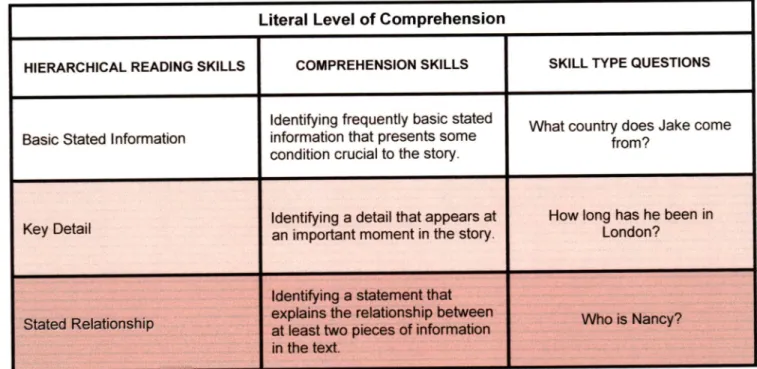
Figure 1 - HILLOCKS' TAXONOMY LEVEES 54
Table 1 - based on Hillocks' taxonomy 60
AI Artificial Intelligence
ESL English as a Second Language
PL Foreign Language
L1 First Language
L2 Second Language
SLA Second Language Acquisition
Literary texts offer rich opportunities for language leaming. However, can second
language (L2) leamers fully understand L2 literary texts? According to Bemhardt (2001); " the act of reading in a second language is extremely tricky — is even
trickier with literary texts that are inherently ambiguous, fiill of metaphor and
intertextual relations to texts to which the readers have no access" (p. 198). In other
words, L2 readers are often poorly equipped grammatically, linguistically and
culturally to cope with literary texts in which it might be difficult to recognize figurative language, to comprehend metaphors, to identify underlying cultural assumptions and above ail to think critically while navigating those complexities.
Therefore, during the reading process, L2 readers encounter gaps in the text which
necessarily compel them to use whatever background knowledge they possess in
order to create meaning.
The purpose of this research is to see exactly how post-secondary L2 readers use their existing background knowledge to understand literary texts and what they do
when confronted with text passages for which they lack such knowledge.
Key Words: background knowledge, literary texts, schéma theory
Les textes littéraires offrent de riches opportunités pour l'apprentissage d'une
langue. Toutefois, comment peuvent arriver les élèves de langue seconde à bien comprendre les textes littéraires qu'ils étudient ? Selon Bemhart (2001) : "la lecture d'une langue seconde est extrêmement confondante lorsque le texte est ambigu, doté de métaphores et de relations intertextuelles dont les élèves n'ont pas accès" (p. 198).
En d'autres mots, les lecteurs de classe dans une classe de langue seconde sont
souvent mal équipés en matière de connaissances grammaticales. Ce problème crée un obstacle à leur compréhension linguistique et culturelle. Par conséquent, puisque la langue n'est pas familière, ils ne peuvent pas comprendre les métaphores, les
propos culturels et avant tout, ils ne peuvent pas atteindre une pensée critique dans
toutes ces complexités. Pour ces diverses raisons, les lecteurs L2 rencontrent
régulièrement des passages incompréhensibles dans les textes littéraires, ce qui les pousse à analyser et à comprendre le text en se basant sur leurs propres
connaissances.
Le but de cette recherche est de comprendre comment les élèves post-secondaires L2, utilisent leur savoir afin de comprendre les textes littéraires et comment ils réagissent à des extraits de textes qui sont pour eux difficiles à comprendre.
Mots clés : textes littéraires, compréhension linguistique, langue seconde
I would like to express my profound gratitude to my advisor Ann Scowcroft, for
her tireless efforts and dedication during the writing of this thesis. I could not have
had a better mentor. Also, I wish to express my deep appréciation to Professor Robert Edwards for his constant involvement as my advisor during the stages of choosing the
research topic and while writing the last part of my thesis. His attitude played a crucial rôle in maintaining my enthusiasm for more writing and rewriting until
completion of the thesis.
Spécial thanks are also given to the readers on my thesis committee: Professor David Leahy and Marilyn Steinbach who were always ready to provide feedback on
the growing manuscript.
I would like to extend my appréciation to the students who performed research-related tasks and to their respective teachers who kindly allowed me to disturb their
regular class hours in order to collect data.
I also wish to extend my récognition to my colleagues and fiiends who in one way
or another have a stake in the development of this dissertation.
Ail I am, I owe to you, my mother and father. I would not achieve anything in this life, without you, your unconditional support and ceaseless prayers. You are the best. Paulo, my friend, my love, and my life-long partner: I could not fmish this thesis, without your valuable help. You almost wrote this acknowledgment. Thank you for
being so patient, understanding and supportive. I love you. viii
"The world in language ... becomes "one's own" only when the speaker populates it with his own intention, his own aceent,
when he appropriâtes the word, adapting it to his own semantic and expressive intention ... exists in other people's mouths, in other people's contexts, serving other people's intentions: it is
from there that one must take the word, and make it one's own" (Bakhtin, 1981, p. 293).
In the above quote, Bakhtin's ideas on how we appropriate text suggests that each person's inner world and experience is primordial for deriving meaning ffom and interacting with language. But Bakhtin was thinking about first languages (Ll) in that excerpt. How second language (L2) speakers and readers can and do appropriate languages beyond their first one is another question entirely. That they must "own" the language in order to use it fully, however, is elear. This seems especially true
when it comes to L2 readers interacting with and interpreting literary texts that
require understanding of unfamiliar content and eultural background information.
Goodman (1967) called the reading proeess a "psyeholinguistic guessing game" in which readers draw on their past expériences to make prédictions while reading a
text. In other words, Goodman's findings suggest that reading is a proeess which
begins with général information readers already have about a subject which allowsthem to grasp the meaning. These findings seem especially pertinent when
Several researchers have suggested that L2 reading compréhension can be enriched by literature (Bemhardt, 1991, 1995, 20001; Carrell, 1984, 1985, 1987,
1988, 1991; Davis, 1992; Kramsch, 1993, 1998, 2000; Rosenblatt, 1994, 1995; Carter
& McCarthy, 1995; Fecteau, 1999; Bredella & Delanoy, 1999; Brumfit, 2001;
Bredella, 2000a; Mantero, 2002 and Donato, 2004). First and foremost, literary texts are an abimdant resource for classroom activities that can prove very motivating for leamers. Second, literary texts might be useful in developing L2 linguistic knowledge. Finally, literary texts can provide opportunities for language leamers to leam and exercise pragmatic language (Scowcroft, Edwards and Jutras, 2007).
In other words, in différent language classrooms, teachers can use a variety of
pedagogical techniques to guide their students into enriching relationships with literature and the language of literature. These relationships may help leamers
become more involved readers and also improve their reading compréhension, their interpretive knowledge base, and their vocabulary.
Even with those acknowledged benefits, second language leamers apparently encounter major difficulties in attempting to comprehend texts, especially literary texts (Bemhardt, 1991, 1995, 2001; Carrell, 1991; Ali, 1995; Rosenblatt, 1994, 1995; Shanahan, 1997; Fecteau, 1999; Bredella & Delanoy, 1999; Mantero, 2002; Vizcaino, 2002 and Donato, 2004). These leamers not only have to deal with the linguistic issues the texts présent, but also with the unfamiliar concepts and cultural aspects presented in literary texts. According to Bemhardt (2001):
First, leamers will develop their interprétations within the context of
sociocultural knowledge that they carry with them. This knowledge is
net necessarily appropriate or relevant. It is, however, ail that they
generally have as an interprétative base. This is not a moral failing; it
is a background issue. Second, leamers' linguistic level will influence their interprétation. Leamers are not generic, but carry with them semideveloped arsenals of word knowledge, syntax, and morphology. Third, leamers' literacy level in their first language will aiso influence their interprétations. Some leamers will be better at analysis than others. That is separate from their relevant or irrelevant sociocultural
knowledge. (Bemhardt, 2001 p. 205)
In other words, L2 students often experience disappointment and fmstration when
reading literary texts because of their inability to access or use their own background
knowledge.
Why Use Literature in Second Language Classes?
Ail of the skills that might be acquired by L2 readers when reading literature can be transférable to L2 language use generally. According to Widdowson (1975) the
study of literature, because it requires a search for meaning, provides students with a
usefiil tool that is critical to language leaming: the ability to interpret discourse.
Interpretive procédures are valuable to leamers; they can be applied to "a range of language uses, both literary and non-literary, which they encounter inside and outside
the leaming situation" (Jbid p. 84). Widdowson suggests that rather than limiting the focus of literary study to either language usage or cultural content, we should view
literature as discourse and the study of literature as a way to develop multiple
expériences, for multiple purposes. In the field of second language acquisition (SLA), Davis (1992) suggests that the understanding of a literary text in a foreign language consists of at least four components. First, it requires the decoding of the literal meaning of single words combined in sentences. Second, the reading of literature requires awareness of historical-cultural referents of the written work. Third, "literary compétence," a concept posited by Culler (1983), might be acquired. That compétence consists of knowledge of a "set of conventions of reading literature" (Jbid p. 105). Fourth, understanding literature entails the reader's unique re-creation
or construction of the text.
Research Motivation
My experience as a second language leamer, as an English as a Second Language (ESL) and English as a Foreign Language (EFL) teacher, and as a graduate student in a literature program in Canada, inspired me to study the issue of reading literature in English as a second language. When 1 started my bilingual M.A. program in Québec, Canada, in English and in French, I realized that despite understanding literal and surface meanings in literary texts, I faced difficulties reaching deeper levels of interprétation. I did not bave any difficulties in grammar or conversation in either
language. I noticed, though, that even with advanced L2 knowledge, cognitive maturity and a fairly wide world experience, there was something missing in my ESL performance when presented with certain literary texts. There was definitely a gap
between me as a reader of foreign language literary texts and my colleagues who
were native language readers of the same texts. I particularly began to notice that I
lacked certain kinds of background knowledge or failed to properly aetivate that
knowledge in order to comprehend the deeper layers of some literary texts.
Several questions came to mind when reading literature in my bilingual Comparative Canadian Literature M.A. program. What is the task of a literature
instructor in a L2 context? What can be done to enahle L2 leamers to accomplish
their reading goals, especially their interpretive goals? Should I as an ESL instructor incorporate literature in the language classroom? What should I he doing to help leamers solve the prohlem of background knowledge when reading literary texts? How can background knowledge influence the way second language readers interpret
literary texts in a seeond language?
Research Interest
My interest carrying out this research comes from a desire to investigate ways to work with reading in ESL/EFL teaching. We often see that the practice of the
that this factor is partly due to difficulties in understanding certain aspects of reading
in a foreign language.
When teaching ESL or EFL groups I realize that one of the factors that impedes understanding of texts may be related to written ESL/EFL materials which often do not provide authentic texts. Aceording to Kramsch, the term 'authentic' bas been used "as a reaction against the prefabricated artificial language of texthooks and instructional dialogues; it refers to the way language is used in non-pedagogic, natural communication" (1993, p. 177). These materials do not always awaken in our students an interest to huild knowledge or to provide opportunities to expand or activate their hackground knowledge. As teachers we are usually worried ahout covering the material, ahout answering questions ahout the text correctly, without exploring other
questions that may relate to the students' hackground knowledge or lack thereof. In
other words, we fail to perceive and support students as readers who are ahle to use
their own ahilities to eonstruct meaning.
The eurrent study addresses the importance of access to hackgroimd knowledge for L2 readers of literary texts in post-secondary contexts. These are people who, like me, are often cognitively mature and linguistically advanced hut who still might struggle with the multiple layers of meaning in literary texts in a second language. More specifically, the influence of hackground knowledge when reading literary texts
Statement of the Problem
Literary texts offer rich opportunities for language leaming. However, can L2 leamers flilly understand L2 literary texts? According to Bemhardt (2001): " the act of reading in a second language is extremely tricky — is even trickier with literary texts that are inherently ambiguous, flill of metaphor and intertextual relations to texts
to which the readers have no access" (p. 198). In other words, L2 readers are often
poorly equipped grammatically, linguistically and culturally to cope with literary
texts in which it might be difficult to recognize figurative language, to comprehend
metaphors, to identify underlying cultural assumptions and above ail to think
critically while navigating those complexities. Therefore, during the reading process, L2 readers encounter gaps in the text which necessarily compel them to use whatever
background knowledge they possess in order to create meaning.
The explanations of the causes of compréhension failure have long heen of
interest to educational researchers (Bartlett, 1932; Schank & Abelson, 1977; Coady,
1979; Rumelhart, 1980; Hudson, 1982; Carrell, 1987; Kintsch, 1988; Carrell &
Eisterhold, 1988; Bemhardt, 1991; Graesser, Singer, &Trabasso, 1994; Lee, 1997; N.
C. Ellis, 2001; Nassaji, 2002, 2007; Al-Issa, 2006; Pulido, 2007 and Shen, 2008). Many of these researchers agree that the effect of the rôle of background knowledge in language compréhension is primordial for the understanding of a text. They suggest that the reader bas access to schemata based on bis or her own backgroimd
knowledge. From this perspective then, the existence of backgroimd knowledge will
enhance the possibilities for compréhension.
The process of acquiring new knowledge through reading compréhension may
vary depending on whether a leamer possesses, uses, and intégrâtes différent types of knowledge. Because of this, it is helpful to refer to aspects of schéma theory that
address the effects of the rôle of background knowledge on L2 reading.
A relatively significant amount of preliminary research on the existence, impact and use of background knowledge was conducted in the 1970s and 1980s. Since then,
there have been a handful of studies addressing the importance of background
knowledge in L2 reading. However, there has been relatively little research conducted on how L2 readers use, misuse or neglect to use background knowledge when reading literary texts, which arguably pose a greater reading challenge than information texts
do, even for advanced students.
The purpose of this research is to sec exactly how post-secondary L2 readers use their existing backgroimd knowledge to understand literary texts and what they do
when confronted with text passages for which they lack such knowledge.
In the following pages, a conceptual framework will explore spécifie research
that relates directly to and will frame the scope of this thesis. Features and conceptual principles that are critical to the understanding of this research will also be examined.
CHAPTER 2
CONCEPTUAL FRAMEWORK
The literature reviewed to form this conceptual framework is composed of studies that have examined the problem of literature in L2 contexts and studies that
have examined aspects of schéma theory that are related to the concept of background knowledge. The problem of compréhension of literary texts in second language
contexts has not been widely examined in the literature. With a few exceptions, these
studies tend to shed light on what L2 leamers do not understand, but not on why they
fmd it difficult to understand literary texts in their second language. The small body of research from the 1980s that examines the problem of background knowledge in
L2 reading does not specifically address the problem of reading literary texts. However, by examining the research from the 1980s as aspects of schéma theory related to the concept of background knowledge, this conceptual framework will
enable the researcher to formulate research questions and frame a study that will
examine the problem of background knowledge in the reading of literary texts in a second language. Furthermore, in the next section, a review of research on the benefits of reading literary texts in L2 leaming contexts, as well as reading compréhension processes and aspects of schéma theory related to the concept of background knowledge will provide illuminating insights into the issue of reading
literary texts in a second language.
Many undergraduate and graduate literature programmes welcome L2 students. There is a général assumption that literature is bénéficiai to L2 acquisition (e.g.,
Widdowson, 1981; Carter & McCarthy, 1995; Fecteau, 1999; Paran, 2006; Butler,
2006). The benefits of teaching literature to ESL students bave been widely discussed by a relatively small number of SLA researchers. Carter & McCarthy (1995) and Bredella (2000a) agree that literary texts help us develop linguistic competencies and also that they fumish knowledge about foreign cultures. These researchers emphasize
the usefulness of literature in language leaming, since it provides an authentic and
meaningful eontext for language leaming. It can foster varions language skills, such as vocabulary knowledge, grammar, and reading compréhension. Furthermore, it can facilitate intégration of language skills and can foster student motivation for leaming the second language. Carter & McCarthy (1995) point out that "literature is made fi-om language and that suitably selected literary texts can provide a motivating and stimulating source of content in the language classroom, serving as a basis for discussion and interprétation in which the response of the individual leamer is encouraged" (304). Indeed, literature has the power to transport readers into other
worlds and stimulate thinking (Lotman, 1972). Literary texts also help leamers
improve their language and compréhension abilities since they often contain metaphorical language, which makes L2 readers reach beyond literal meaning and potentially discover deep layers and stmctures of meaning that are not apparent on the
surface of a text. Thus, literature can enlarge language use awareness (Shanahan 1997; Kramsch & Kramsch, 2000; Donato & Brooks 2004; Kim 2004).
Mantero (2002), Donato & Brooks (2004) and Kim (2004) have examined the type of talk and the type of interaction generated in the language and literature
classroom and their contribution to L2 leaming. They have explored the interactions
of students and teachers in university classrooms in order to déterminé if discussions of literary texts in the classroom provide opportunities for leamers to practice their L2 at advanced levels. According to Mantero "classroom talk was more likely to extend
into discourse when students did not have to interpret the meaning of "Literature" and
relied on their own expériences and expertise to talk ahout a cultural topic" (p. 449). Mantero, Donato & Brooks and Kim's findings suggest that L2 literature classes
provide a rich compréhension exercise for L2 leamers, and a great possibility for
advanced interaction and language improvement.
Clark & Zyngier (2003) examined the possible benefïts of teaching contextualized stylistics in the L2 classroom. These authors suggest that it is not the
aim of activities within a pedagogical stylistics framework to achieve an
improvement in the leamers' linguistic compétence, but rather on literature and on
language. Their fmdings suggest that "this orientation is especially relevant to EFL
students as it allows attention to form, the building of meaning from context,
compensâtes for less shared assumptions and provides common ground for discussion and for substantiated analysis" (p. 376). Lin (2006) also descrihes bis initial effort at incorporating a stylistics/linguistics-based approach to teaching reading and interpreting literary texts in an ESL school in Singapore. Both studies suggest that a stylistic approach may contribute to the understanding of literary texts.
Butler (2006) attempted to intégrale the teaehing of language and iiterature in the first year of the English programme at North-West University, in South Africa. Aecording to him, Iiterature has a useful and important rôle to play in the teaehing of English in an ESL/EFL context, even when studying the language is purely
instrumental and students have little knowledge or experience of Iiterature in English.
The findings of his research suggest that respondents believed that L2 reading and literary study could contribute to the development of grammar and général language
skills, and that it eould also engage L2 leamers in ways that are less likely with other
kinds of texts. Aecording to Gordon, Zaleski and Goodman (2006), through Iiterature,
both teachers and leamers embark on a process of reconstructing and reorganizing their personal théories of language and literacy leaming.
2.1.1 Difficulties Faced by L2 Leamers in the Literature Classroom
As we have seen previously, literary texts can benefit L2 language leaming. However, many second language researchers are eoncemed at least in part with the problems L2 readers have understanding L2 literary texts. These concems are based on the premise that L2 readers have insufficient linguistic and cultural competencies to successfully comprehend much of the authentic material presented to them. Aecording to Bemhardt (1991, 1995, 2001); Carrell (1991); Ali (1995); Rosenblatt (1994, 1995); Shanahan (1997); Fecteau (1999); Bredella &. Delanoy (1999); Mantero (2002); Vizcaino (2002) and Donato (2004), second language leamers face major difficulties in trying to understand a text ffom a non-native perspective. Bemhardt (1995) argues that even upper-level leamers are still in the process of
developing their language skills, and are not proficient enough in their linguistic, cultural or literary knowledge to cope with the challenges that literature courses offer. However, to treat the cultural or linguistic unfamiliarity second language leamers experienee with literary texts as simply a linguistic deficiency, we are denying the fact that students' "eultural knowledge or problem-solving abilities need training"
(Swaffar & Bacon, 1993, p. 124). To be clear, second language leamers do read
literary texts with a eertain amount of prior or background knowledge and
interprétative skills and stratégies. But while this knowledge base can be usefiil, it
may not always be appropriate or sufficient for interpreting L2 literary texts.
The explanations of the causes of compréhension failure have long been of
interest to educational researchers. Rumelhart (1980), Carrell (1983,1984); Bemhardt
(1991); Miks (1991); Seowcroft, Edwards and Jutras (2007), Davis (1992); Lee
(1997) and Fecteau (1999) agree that second language readers try to activate their
schemata in order to understand texts. However, second language readers may fail to
successfiilly comprehend literary texts if they caimot properly activate their relevant existing baekgroimd knowledge while reading. Aeeording to Shen (2008):
If the students haven't enough relevant knowledge and compréhensible culture-based input to the text, they will fail to read and understand even the simplified text of a major field ... One possible way to help the students to a much deeper understanding is to enrich their baekground information, (p.
Rumelhart (1980); Carrell (1983, 1984); Lee (1997) and Shen (2008) suggest that it is clear that the reason why students fail to understand literary texts is not simply related to a lack of linguistic knowledge. The difficulties which ESL/EFL readers
encounter may be related to a lack of familiarity with culture-specifie content, a lack of knowledge of the world, or a failure to aetivate their background knowledge.
Therefore, if the content of a text is unfamiliar to the reader it has an effect on that reader's L2 reading compréhension.
Kim's research (1995) focused on the effects of voeabulary knowledge and prior
knowledge on EFL readers' compréhension of L2 texts. This study tried to identify
the différences in compréhension between reading a text with and without the
appropriate prior knowledge. There were two variables in the research design: 1) difficulty of voeabulary ("more difficult" vs. "casier voeabulary"), and 2) prereading instruction (with vs. without prereading instruction) which intended to provide prior knowledge about the content of the text. The types of problems commonly found in
the recalls were: omission, in which the readers did not recall a component that was in the text; addition, in which the reader added a component that was not in the text;
replacement, in which the reader replaced a word with another which did not exist in
the text; mixing, in whieh the reader mixed a part of the text with part(s) of another
sentence; and switching, in which the reader switehed the order of the words in
sentence. The sources of problems found in this study were: voeabulary difficulty, syntactic difficulty, lack of awareness of rhetorical structures, lack of background knowledge and misreading. The results showed that readers need help in a variety of
ways in order to improve their L2 compréhension. Kim concluded that readers'
difficulties with vocabulary often resulted not only from lack of understanding of meaning but also from an incomplète understanding of it.
2.1.2 The Rôle of L1 Reading Skills when Reading L2 Literary Texts
Bembardt (1991; 1995; 2001); Cummins (1991); Kramscb (2000); Miks (1991);
Carrell and Wallace (1983); Carreli (1983, 1991); Guarino and Perkins (1986);
Perkins and Brutten (1988) and Fecteau (1999) suggest tbat ESL/EFL leamers use tbeir L1 knowledge as a basis for interpreting L2 literary texts. Bembardt (2001)
believes tbat "readers will use tbeir knowledge base; bowever tbat knowledge base
does not always match tbe knowledge base necessary for tbe understanding of a particular text" (198). Fecteau (1999) investigated leamers' reading compréhension
and inferencing skills wben reading botb in L1 and L2 literary texts. Fecteau concluded tbat ber participants' ability "to identily literary features in a spécifie text was, at best, inconsistent" (p. 488). Sbe suggests tbat "miscomprebension also occurs in L1 and may be due to linguistic factors and non-linguistic factors, particularly lack
of prior knowledge or inability to activate appropriate scbemata needed to
comprebend a spécifie text" (p. 489). According to Fecteau, botb L1 and L2 readers
are influenced by tbeir past expériences of tbe world.
Miks (1991) compared tbe L1 and L2 compréhension and analytical skills of collège students enroUed in German literature courses. Sbe discovered tbat accessing
the underlying meaning of literary texts was less dépendent on students' L2
proficiency than on their ability to "think creatively ... and draw logical conclusions
from underlying implications within the text" (p.2). Carrell's research (1983b) indicates that non-native speakers do not process L2 texts in the same way native
speakers do. According to her, neither advanced nor high-intermediate ESL readers appear to utilize contextual or textual dues. They are not efficient top-down processors, making appropriate prédictions based on context (p. 199). Carrelfs (1984) fmdings conclude that non-native speakers fail to use background information
because they are "linguistically bound," which means second or foreign language readers usually do not bave satisfactory word skill récognition, or are not able to
effectively comprehend interprétative processes.
It seems apparent in some of the research literature that non-native reading
behaviour is, in some instances, significantly différent ffom that of native speakers
(Hudson, 1982; Adams, 1982; Perkins, 1983; Carrell, 1983a, 1983b; Carrell and Wallace 1983). Findings from these studies suggest that the reader's background knowledge influences the way that he or she responds to literary texts in second and
foreign language classrooms.
2.1.3 Authentic Texts in L2 Contexts
For the purposes of this study, authentic literary texts will be defined as unedited,
unsimplified, imaginative texts written for a native target population. There is général
contexts can be highly motivating for leamers. They give leamers a sense of
achievement when understood, and se encourage further reading.
Goodman (1976); Krashen (1981, 1985); Johnson (1982); Villegas Rogers &
Medley (1988); Baeon (1989); Shook (1997); Young (1999); Scowcroft, Edwards
and Jutras (2007) have favoured the use of authentic texts for various levels of L2
leamers. Proponents of this view believe that authentic texts offer L2 students opportunities to be introduced to real context and natural examples of language.
Goodman (1976) also stated that good readers take advantage of the natural redundancy found in authentic texts, using that redundancy to help them reconstruct the entire text even if they have leamed only a portion of the graphie material itself.
In other words, the normal redundancy within authentic texts can help L2 leamers come to understand unfamiliar words without too much dismption in their overall
understanding of the text. Some researchers (e.g., Kramsch, 1985; Davis, 1992),
however, believe that authentic materials are often too difficult for students with
limited language proficieney and, therefore, that leamers should be reading texts that have been created or modified to support the leamers' pedagogieal needs. Some of
the literature reveals that L2 readers can have too limited language proficieney and
insufficient linguistic and cultural competencies to successfully comprehend authentic literary texts (e.g., Davies and Widdowson, 1974; McLaughlin, 1987; Shook, 1997; Day & Bamford, 1998; Young, 1999). The négative aspect of authentic
materials is that they can be too culturally spécifie for L2 readers. Often good
grammatical structures appear in those texts and can cause lower level compréhension
problems when decoding the texts (Martinez, 2002).
According to Widdowson (1990) "language presented to leamers should be simplified in some way for easy access and acquisition" (p. 67). He believes that linguistic simplification is supposed to "bring the language of the original within the scope of the leamers' transitional linguistic compétence" (p. 185). However, Blau (1982) and Parker and Chaudron (1987) disagree on the usefiilness of linguistic simplification and suggest that by simplifying an authentic text, its real meaning may
be distorted. Parker and Chaudron suggest that linguistic simplification does not necessarily make a text easier to understand as a whole. Byrd (2000) has wamed of the danger of using inauthentic simplified materials, saying that "these materials can remain difficult because of the loss of connectors and other language used to guide the reader through the text" (p. 2). In other words, they ail suggest that the language in non-authentic texts is often artificial, concentrating only on something that has to be taught. By using simplified, non-authentic texts it is also very unlikely that L2 leamers will encounter these samples of language in the real world.
2.2 Reading Compréhension
Over the last décades, research into L1 reading processes has offered cognitive models that explain what is involved in the act of reading. Some research in L1 reading has suggested that reading cannot be explained as a process of recognizing words on the page in a linear sequence (Frederiksen, 1975, 1986). In other words, reading is not simply a linear act. Anderson, Reynolds, Schallert and Goetz (1977)
believe that "every act of compréhension involves one's knowiedge of the world as
well" (p. 369). They suggest that the more knowiedge of the world one brings to a
text greater the understanding of that text will be.
Many L2 researchers share the opinion that reading compréhension is crucial to
acquiring new linguistic Systems (Carrell, 1983; Chaudron, 1985; Tian, 1990; Davis,
1992; N. C. Ellis, 1994; 2001; R. Ellis, 1985; Gass, 1997; Gass Selinker, 2001; Chi, 2002; Vizcaino, 2002; Krashen, 1985; Lee & VanPatten, 2003; Long, 1985; Schmidt, 1990; 1995; VanPatten, 1996, 2003; Pulido, 2007; Nassaji, 2007 and Shen, 2008).
Findings ffom these studies suggest that language eomprehension goes heyond the knowiedge of language itself to include the knowiedge of the world as well. They suggest that acquiring a new language System requires not only syntactic knowiedge,
but also real world knowiedge.
2.2.1 Bottom-Up and Top-Down Processes
It is still not eompletely clear how texts beeome compréhensible to L2 readers or how L2 readers comprehend important information from L2 texts. It is generally accepted that readers process texts in two ways, top-down and bottom-up (Goodman, 1967; Rumelhart, 1976; Clarke and Silberstein, 1977; Coady, 1979; Stanovich, 1980; Smith, 1982; Carrell, 1983). The term bottom-up processing is used to describe the type of process in which the reader relies mostly on the decoding of individual words on the page without taking into account his or her hackground knowiedge or expectations. Top-down processing, on the other hand, goes from général to spécifie.
It starts in the mind of the reader, who sampies textual information only to confirm
his/her hypothèses and prédictions about the text. In other words, top-down processing is related to the reliance on other cognitive skiils such as the reader's existing knowledge or background knowledge about a topic. Thus, readers apply top-down processes in order to make texts understandable. The most comprehensive description of the reading process, however, can be found in interactive models which
combine éléments of both bottom-up and top down models.
2.2.3 Interactive Processing in Reading
Second language researchers currently view reading as an interactive process that
involves both bottom-up and top-down processing (Bamett, 1989; Carrell, Devine, &
Eskey, 1988). Proponents of this view think that the reader is an active processor who uses bottom-up processing to receive information from a text, and subsequently applies prior backgroimd knowledge in order to make sense both of the text and of the
words within the text (Horiba, 1993). In other words, the reader retrieves relevant information ffom his background knowledge about a topic, while simultaneously considering ail the text éléments présent to achieve compréhension.
Goodman's reseaxch (1967, 1970) was among some of the first to spark the recent interest in the possibility that reading is not simply linear, but rather involves interaction among différent levels of processing. In this conceptualization of reading, the process is viewed as one in which the reader makes use of higher-level knowledge in order to comprehend lower-level structures. According to this view, reading is
regarded as 'a psycholinguistic guessing game', in which readers identify most words
by making prédictions based on général knowledge and the preceding syntactic and
semantic eontext.
The reader is not eonfined to information he reçoives ffom a half inch of print in clear focus... The reader uses syntactic and semantic information
as well. He predicts and antieipates on the basis of this information,
sampling ffom the print just enough to confirm his guess of what's eoming, to eue more semantic and syntactic information. Redundancy and sequential constraints in language, which the reader reacts to, make this
prédiction possible. (Goodman, p. 131)
According to Goodman, what happens "behind the eye" is as important as what is on the printed page. Goodman focused on how the reader's syntactic and semantic knowledge assists in the process of reading compréhension. More recently, researchers have expanded this focus to include ways that both background knowledge and knowledge of discourse constraints assist compréhension (e.g.,
Carrell, 1983; Kintsch, 1988; Sanford & Garrod, 1998). Therefore, reading involves
the skill of identifying information in the text and the skill of such integrating
knowledge in the readers' mind.
Smith (1982) has been another strong and influential proponent of an interactional conceptualization of reading. Adding to Goodman's fmdings, he emphasized the rôle of what he referred to as "non-visual information." According to
Smith, non-visual information that does not come from the printed page, is related to
catégories of information such as background knowledge and linguistic knowledge.
These kinds of knowledge allow the reader to make prédictions about what will be
coming next, based on orthographie, syntactic, semantic, and background
information.
What we have in our heads is a theory of what the world is like, a
theory that is the basis of ail our perceptions and understanding of the
world. ... If we can make sense of the world at ail, it is by interpreting our interactions with the world in the light of our theory. ... Anything that I cannot make relate to the theory of the world in my head will not make sense to me.... The system of knowledge that is the theory of the world in our heads has a structure just like any other theory or system
of organization information. Information systems have three basic components: a set of catégories, some rules for specifying membership of the catégories, and a network of interrelations among catégories.
(Smith, 1982, p. 54-57)
Smith asserts that prédictions that readers make on varions levels help them avoid being overloaded by information from the printed page. Without some expectation
about what is coming, a reader could be overwhelmed with new information.
For English language leaming, the ability to read fluently has become an essential language skill that students need to acquire in order to address the différent
purposes of reading, especially in the ESL context. Smith suggests that the task of understanding written discourse dépends on the distribution of information in the printed text, on the reader's voluntary and automatic intégration of this information,
and on information or "schemata" in the reader's mind. Thus, what readers
comprehend of a given text may vary considerably. Such variation is a fimction of the
nature of the text itself and of the extent to which the reader possesses, uses, and
intégrâtes linguistic knowledge and background knowledge. In other words, the reading process combines elements such as the readers' reading abilities and prior expériences to comprehend the complex meanings of passages, to explore the writer's thoughts, and to actively construct new knowledge and reading expériences ffom
what they are reading.
2.3 Schéma Theory
Linguists, cognitive psychologists, and psycholinguists have used the concept of
schéma or schéma theory to explain that reading compréhension is an active process between the reader and the text during which the reader is required to fit the dues provided in the text to his or her own background knowledge. Today the daim that
background knowledge is an essential déterminer of reading compréhension is
generally agreed upon in the literature on L1 reading compréhension. Our knowledge and expériences of the world around us influence how a text is processed; this is known as schéma theory (Bartlett, 1932). According to Barlett, the reader's perception of a particular text involves one's prior expériences. In order to explain
and better understand the complexity involved in this process, Bartlett developed the
schéma theory. He believed that readers organized their perceptions into schemata, mental previously acquired information when reading an unfamiliar text. Subséquent researchers agree that schéma theory draws attention to the constructive nature of the
reading process and to the critical rôle of the reader and the interaction between the
text and the reader's background knowledge. (Adams and Collins, 1979; Rumelhart, 1980; Steffensen & Joag-Dev, 1984; Alderson & Urquhart, 1988; Roller & Matambo, 1992; Barry & Lazarte, 1995; Carrell, 1987, 1992; Carrell & Eisterhold, 1983; Carrell & Wise, 1998; Floyd & Carrell, 1987; Hudson, 1982; Lee, 1986; Peretz & Shoham,
1990,; and Tan, 1990)
In other words, we answer to most everyday situations more or less
automatically, in ternis of the knowledge that we already possess. Schéma theory takes that knowledge and applies it to reading, and to how readers interact with the
text for compréhension.
2.3.1 Définition of Schéma or Schemata
From the mid 1970's on, there have been attempts to specify and represent schéma or schemata. Rumelhart and Ortony (1976) define schemata as "data structures for
representing the generic concepts stored in memory" (p. 101). Rumelhart (1981)
states that schéma theory is essentially a theory conceming "how knowledge is
represented in mind and about how that représentation facilitâtes the use of the
knowledge in particular ways"(p. 4). According to Rumelhart (1982), schemata can be considered "the building blocks of cognition" because they are mechanisms used
to reinterpret the stored information to reconstruct the original interprétation. Anderson (1978) points ont that schéma allow the reader to make inferences and fill information not explicitly ineluded in the text. Sehallert (1982) believes that sehemata
are "abstract structures that represent what one holds to be generally truc about the world" (p. 20).
Minsky (1975); Schank & Abelson (1977) and Schank (1982) suggest that schéma theory was created to describe the rôle of knowledge in the mind. Smith (1994)
suggests that:
.. .everything we know and believe is organized in a theory of what the world is like, a theory that is the basis of ail our perceptions and understanding of the world, the root of ail leaming, the source of hopes and fears, motive and expectancies, reusing and creativity. And this theory is ail we have. If we make sense of the world at ail, it is by interpreting our interactions with the world in the light of our theory. The theory is our shield against bewilderment. (p. 8)
2.3.2 Sehemata versus Background Knowledge
Schéma theory is quite complex. For the purposes of the présent study, the concepts of "schéma" or "sehemata" and background knowledge will be examined. In L2 research, the two terms schéma theory and background knowledge have sometimes been equated or used interchangeably (Carrell, 1983, 1985; Carrell &
Eisterhold, 1983). Différent researchers use différent labels for the concept of
background knowledge. For the purposes of this research, the varions concepts of background knowledge will not be distinguished. These notions of background knowledge and schemata will be taken into considération to refer to readers' prior knowledge or expériences that may represent the diversity and also différent backgrounds that they bring to the reading task. (Schank & Abelson, 1977; Schank,
1977; Nassaji, 2007)
More recent L2 research on how knowledge is acquired, processed and retrieved in our minds such as that of Al-Issa (2006) agréés with Widdowson's fmdings (1983) that schéma or schemata are seen as mental structures that help us organize
information in our long-term memories. According to Al-Issa, understanding the rôle of schéma in SLA, is a useful way to explain to how L2 readers' adjust their
difficulties encountered in the text in order to go beyond the meaning of a text.
More recently, Nassaji (2007) investigated how knowledge is represented and
organized in the mind and also what rôle it plays in discourse compréhension and
interprétation. According to this researcher;
This preexisting mental représentation of ideas then acts as an advance
organizer during compréhension and helps the reader recognize,
arrange, and interpret the ideas accordingly. The utilization of the same schéma during recall allows readers to reconstruct the information
encoded in compréhension and helps them to recall these ideas in their
respective order or level of importance as well. (p.93)
Shen (2008) agréés with Nassaji (2007) that a text only provides directions for
listeners or readers as to how they should retrieve or construct meaning of their own
(p. 104-5). Shen suggests that this previously acquired knowledge is called "background knowledge" and that meaning is reconstructed or created during the reading process through the interaction of text and the reader's backgroimd
knowledge.
Our schemata is pre-established and supported in our previous expériences, prior
knowledge and sociocultural context environment. In our daily life, when we read, speak, Write or hear, we activate our prior knowledge spontaneously, without being
aware of what we are doing. Schéma or schemata are the organization of world
knowledge in blocks stored in mind. This knowledge involves concepts about events, people, objects, among other linguistic elements. According to Bartlett the
term schéma refers to "... an active organization of past reactions, or past experience." (cited in Anderson & Pearson, 1990:39)
Carrell & Eisterhold (1990) state that schemata are previously acquired knowledge
structures (p.76). Anderson & Pearson (1990) defined schemata as "...how the reader's schemata, or knowledge already stored in memory, function in the process of interpreting new information and allowing it to enter and become a part of the
represent the way experience and knowledge are organized in mind." (p. 167). To Meurer, compréhension dépends on the interaction between what is written and
the activation of voluntary and automatic schéma in the mind of the reader. Anderson
(1994) states that "...a reader's schéma, or organized knowledge of the world,
provides much of the bases for comprehending, leaming, and remembering the ideas
in stories and texts." (p. 469). Ail these authors agree that schemata are mental organizations that help the understanding of new incoming information.
According to Kozminsky & Kozminsky (2001) prior knowledge "encompasses
whatever readers already know about events, ideas or objects described to them, influences the meaning that they construct from the text [...] (p. 181) In other words,
prior knowledge involves our whole world knowledge throughout our life, and it is organized into structures called schémas. According to these authors prior
knowledge of a given topic increases the amount of information recalled on the
same topic. That is to say that the more prior knowledge a reader has about a
particular topic, the more information that can be retrieved.
2.3.3 Content Schemata
Bransford (1994) gives an example of a situation which occurs when a reader has no content schemata to establish an appropriate setting. For example, in the phrase "Jane decided not to wear her matching silver necklace, earrings, and belt because she
that Jane avoided using metals due to métal detector since they cause delays at the
airport. On the other hand, a reader who does not bave such content based knowledge
will not understand the text or give a différent interprétation of what the author intended.
Tyler (2001) states that knowledge of a topic facilitâtes the understanding of oral
interaction in every-day situations. According to this author, referring to the topic is a
way to activate prior knowledge. Results showed that among non-natives referring to the topic is a way to activate prior knowledge. Data analyses showed that a lack of
content schemata or familiar content-hased knowledge will affect reading compréhension.
Barry and Lazarte (1998) examined the inferences written in recall-protocols of English-speaking participants after they have read historical texts written in Spanish.
The results suggest that the interaction between prior knowledge and the reading
topic must be taken into account. The results indicate that readers with higher prior
knowledge were able to generate more inferences than low prior knowledge readers. In other words, this research suggests that when the reader is familiar with the topic
of text, he or she is more likely to grasp deeper meanings of the text.
Vizcaino (2002) investigated how previous content knowledge, cultural background and linguistic background influence the way native speakers of Spanish interpret literary texts in English. The fmdings in this study show that the
participants' past and présent expériences, as well as their future expectations,
influence the way they understand a literary text in a second language.
Keshavarz, Atai and Ahmadi's study (2007) investigated the effects of linguistic
simplification and content schemata on reading compréhension and recall. To collect
data, the study used two types of texts: content-familiar and content-unfamiliar.
Results of this study showed that language proficiency had a significant effect on
both reading compréhension and recall. However, the study results also suggest that linguistic simplification did not apparently improve a reader's ability to understand a
text when the content of the text was unfamiliar. Keshavarz, Atai and Ahmadi suggest
that these results may indicate that when the content of a text is familiar, readers can
more easily guess the meanings of unknown words. This is not true for texts in which
the content is unfamiliar since text simplification does not appear to help.
A number of studies have been donc in relation to reading and schéma theory,
using content schemata. The results of these studies are sometimes difficult to compare, because of the différences in participants, sets of variables, and techniques
used (Rumelhart, 1975, 1980; Anderson et al, 1977; Steffenson, Joag-Dev, and Anderson, 1979). However, they can hopefully shed some light on how and whether second language leamers make use of schemata in reading.
As with first language readers the traditional emphasis has been on the language to be comprehended and net on the person attempting compréhension.
In these essentially linguistic views of compréhension, each word, each well-formed sentence, and every well-formed text 'has' a
meaning. Meaning is conceived to be 'in' the text and to have a separate, independent existence from the reader. Failures to comprehend a nondefective text are viewed as being due to language spécifie déficits - perhaps a word as not in the reader's vocabulary, a rule of grammar was misapplied, an anaphoric cohesive tic was improperly coordinated, and so on. (Carrell, 1984, p. 332)
The recent interest in reading and schéma theory among first language reading
specialists has attracted the attention of second language teachers and researchers.
Second language theorists are coming to recognize that what the reader knows is as
important as what is on the page. (Nassaji, 2007)
A study by Steffensen, Joag-Dev and Anderson (1979) did not use language
specifically as a variable, since the participants were American native English speakers and Indians (natives of India) whose English proficieney was very high.
However, the study did address the issue of cultural différences in background knowledge and how this knowledge assists or interfères with compréhension.
The researchers had American and Indian participants read descriptions of
Members of both groups read the descriptions from the other culture more slowly than the one from their own. They not only remembered more détails of the weddings
of their own culture and remembered them more accurately; they were able to draw
correct inferences from the description of the wedding in their own culture. This would tend to indicate that readers were making use of schéma that is spécifie to their culture for weddings in storing the text in memory and in interpreting the meaning of
the text.
Participants tended to draw incorrect inferences from the descriptions of the
weddings fi-om the other culture based on the schéma of weddings in their own culture. For example, the description of the American wedding included a mention that the bride wore her grandmother's wedding gown. An Indian participant reported, in the recall protocol, that the dress was, unfortunately, old and out of fashion, a
comment which would fit the Indian view that it is important for the bride's family to
show their économie status by providing a new, fashionable wedding sari for the
bride to wear. American readers, in contrast, emphasized the aspect of family tradition involved in the bride wearing her grandmother's dress, which fits with the schéma for American weddings. Apparently when readers do have appropriate schemata (as the Indian readers did not have a schéma for American weddings) they
interpret input according to the most similar schéma that they do have (i.e., the
schéma for Indian weddings).
In addition, recall protocols were often vague in areas where readers did not have schemata. For example, the text on the Indian wedding contained détails about gifls
exchanged by the families. Indian respondents not only tended to remember what the gifts were, they commented on the significance of the gifts. In contrast, descriptions of the gifts by Americans were vague and did not include any information about the
significance of the gifts.
This study is an indication that, even in the native language or a string second
language, the reader's knowledge of the schematic background of a text might aid compréhension. In addition, lack of an appropriate schéma for a text hampers accurate compréhension. It is likely to be even a more serions problem for readers of
a second language who have less-than-adequate language proficiency.
One problem with this study is that the researchers did not measure the prior
knowledge that the participants had about weddings in other cultures. While most Americans probably do not know much about Indian wedding customs, Indians living
in the United States may have leamed about them from other sources. Participants who knew about weddings customs from the other culture may have produeed more accurate recall protocols than those who did not.
This issue raises an important question in the intercultural study of schemata and
compréhension. It is whether the process of comprehending is différent when making
use of schemata from one's own culture than when making use of schemata leamed from another culture. The question is complicated by the fact that schemata can overlap between cultures. Members of one culture do not necessarily share ail of the same schemata.
2.3.5 Context and Activation ofSchemata
Recent years have seen a growing awareness within text processing literature that
ail texts occur and are processed within contexts (e.g., Bransford and Johnson, 1972, 1975; Andersen, Reynolds, Schallert and Goetz, 1977; Hudson, 1982; Carrell, 1983; Carrel and Wallace, 1983; Balota, Pollastek, and Rayner, 1985; Perfetti, 1985; Duranti & Goodwin, 1992; van Dijk, 1997; Chen and Donin, 1997). These studies
suggest that the knowledge représentations that an individual possesses include représentations spécifie to contexts in which particular texts occur, and that the availability of a context significantly influences readers' understanding and recall of
written texts. Bransford and Johnson (1972, 1973) showed that placing a text in context, for example by using titles or pictures, through which readers could relate an ambiguous text to their prior background knowledge, enahled those readers to recall
the text. An important finding bas heen that while context bas a facilitating effect for
L1 readers, it bas apparently no such effect on L2 readers. For example, in the first
chapter of the novel St. Urbain 's Horseman, by Mordecai Richler, the narrator
suddenly changes register and begins describing Willie Mays' swing. A native language reader with appropriate background knowledge or schemata will understand that the sudden change in register is to a baseball announcer's voice, and that Willie is a legendary player - ail without ever reading the word "baseball" in Richler's description. Such reader bas the context to understand baseball and its referents that a non-native is unlikely to have. Therefore, context is not always helpful to L2 readers.
Carrell and Wallace (1983) investigated the influence of context and familiarity and the implications for L1 and L2 reading compréhension. Context or lack of it was
defmed by the presence or absence of a title and picture page. They found that native speakers utilize context as part of a processing strategy to make cognitive prédictions
of what a text is going to be about as it is being read. However, non-native speakers do not process a text in this way, they do not use context "as part of top-down
processing strategy to make cognitive prédictions based on context about the text's meaning" (p.305). The results suggest that unlike non-native speakers, native speakers use context as part of a processing strategy to make prédictions as they read.
Many researchers like Carrell (1983), Rumelhart and Ortony (1977), Al-Issa (2006) and Nassaji (2007) agree that readers are able to comprehend a text when they
activate their background knowledge, schéma or schemata. According to Carrell, what is understood from a text is a fonction of the particular schéma that is activated at the time of processing or reading the text (p. 556). Nassaji gives an example which
helps us imderstand how a reader is able to "fill in the slots" when reading:
For example, if in reading a text, a reader encounters a sentence such as "He pounded a nail into the wall," the word "hammer," which is one of the default values associated with the verb "pound," will be simultaneously activated and used to fill in the empty slot for the agent of the verb, leading to the inference that the pounding has been probably done with "a hammer."(p. 87)
Therefore, not only is it important for the reader to have background knowledge in order to read more efficiently, but also it is essential that they are able to activate such
knowledge. Carrell (1983) and Al-Issa (2006) agree that when L2 readers fail to activate an appropriate schéma or simply lack it, they automatically fail to
comprehend the text.
According to Rumelhart and Ortony (1977) there are two sources of activation
for sehemata:
Bottom up proeessing occurs when aspects of the input directly suggest or activate sehemata whieh correspond to them and when the sehemata themselves activate or suggest dominating sehemata of whieh they are constituents. ... Top down proeessing, on the other
hand, arises from sehemata activating their constituent subschemata. (p. 128)
In other words, one way to activate sehemata is via text data, for example, textual
features such as words, sentences, paragraphs, or grammar. The other is via the reader's existing knowledge.
Hudson (1982) looked at the effeets of différent prereading exercises intended to
activate sehemata within the reading performance of beginning, intermediate and
advanced students, primarily Iranians. In one condition, students were shown pietures
related to the text, whieh they discussed. Afterwards, students privately generated
a list of vocabulary words and définitions. Both of these groups answered questions about the content of the text. In the third condition, students read the text, answered questions about it, read the text again, and answered the same questions again. Scores
were significantly higher for the first condition for beginning and intermediate
students. There was no différence for advanced students. Hudson interpreted this to indicate that advanced readers were able to activate schemata without outside help, but at the lower levels, some help in activating schemata was necessary.
While this study does indicate that prereading exercises are of some use to
begiiming and intermediate students, it is not clear ffom the study what aspects of the prereading exercise were effective in activating the schéma. In the first condition, participants saw pictures related to the story, they discussed what was in the pictures,
and they generated prédictions. This raises a number of questions about the necessary and sufficient conditions for activating schemata using prereading exercises. Was it one of these three steps that activated the schéma, or an interaction of the three? Would, for example, studying the pictures without discussing them have produced the
same resuit? Was generating prédictions a necessary part of the process? Would generating prédictions have been sufficient alone? Further research to clarify the
answers to these questions would be useful. 2.4 Access to Background Knowledge
Although leaming how to décodé accurately and fluently is a necessary part of reading, most researchers recognize it is not sufficient to ensure compréhension. A
number of researchers agree that the effect of the rôle of background knowledge in language compréhension is primordial for the understanding of a text (Bartlett, 1932; Schank & Abelson, 1977; Coady, 1979; Rumelhart, 1980; Hudson, 1982; Anderson & Pearson, 1984; Block, 1986; Carrell, 1987; Carrell & Eisterhold, 1988; Bemhardt,
1991; Gamer, 1994;Graesser, Singer, & Trabasso, 1994; Lee, 1997; Kintsch, 1998; N. C. Ellis, 2001; Nassaji, 2002, 2007; Al-Issa, 2006; Pulido, 2007 and Shen, 2008). These researchers suggest that a main déterminant of the knowledge individuals can obtain ffom the act of reading is the knowledge that they already possess. The results of their varions studies indicate that prior background knowledge bas a significant impact on performance measures of reading compréhension. In other words, possession of background knowledge helps L2 readers understand L2 texts.
This concept of background knowledge is referred to by other différent names and expressions. Carrell & Eisterhold (1988) defme the readers' background knowledge as "previously acquired knowledge." Pulido (2007) refers to it as "the
knowledge that guides compréhension" (p. 161). Shen (2008) says that is "a bridge
Connecting input and output." Keshavarz & Atai (2007); Barry & Lazarte (1998); Pulido (2007); Keshavarz & Atai (2007) refer to it as "prior knowledge."
Background knowledge, also referred to as "world knowledge," can be defined as knowledge structures which contain generic information about aspects of the world, such as différent types of objects, people, situations and texts (Frederiksen & Donin, 1991; Kintsch, 1998; Sanford & Garrod, 1998). Background knowledge arises ffom repeated exposure to similar expériences. It is ail the knowledge that an
individual has stored in mind. Background knowledge or prier experience is the basis
for existing schemata and, therefore, the basis for deriving meaning from and making interprétations with new knowledge. Adams and Bruce (1980) suggest there are three forms of background knowledge important to the compréhension of text: conceptual
knowledge (language and meaning), social knowledge (intention and meaning, particularly the social relations among characters), and story knowledge (stéréotypé
characters, genre characteristics, and story structure). It is the interaction between
reader and text in each of these areas, separately and simultaneously, which facilitâtes
or impedes compréhension. From this perspective then, extending the range of these
knowledge structures will enhance the possibilities for compréhension. Therefore,
according to this aspect of schéma theory, it helps readers to comprehend texts that
are situated within a context.
Carrell (1982) investigated the effects of three components of background knowledge in reading compréhension: prior knowledge (familiar vs. novel), prior
eues to the content of the text (context vs. non context) and degree to which the lexical items in the text reveal the content area (transparent vs. opaque). Her
participants were undergraduate advanced and high-intermediate native speakers of
English. Carrell used variables of context (providing or not providing and title and picture), transparency (presence and absence of vocabulary) and familiarity (presence
and absence of prior knowledge about the content). The participants were asked to Write their recall protocols in the L2. Carrell reported that native speakers performed
better because of their access to background knowledge, whereas non-native readers
performed less well because of their lack of background knowledge.
Diana Pulido (2007) investigated second language adult readers attempt to understand unfamiliar vocabulary words when reading a L2 text. The texts used for
this study were two more familiar narrative passages and two less familiar ones. The results suggest that background knowledge did not influence the understanding of the text.
2.4.1 Lack ofBackground Knowledge
What happens when L2 students lack background knowledge? How do students solve the problem of lack of background knowledge? A number of studies have investigated what L2 readers do when confronted with text passages for which they
lack background knowledge. Carrell (1987); Johnson (1982); Barry and Lazarte (1998); Scowcroft, Edwards and Jutras (2007) found that participants had greater
compréhension success with a culturally familiar text than with a culturally
unfamiliar one. L2 readers attempt to understand a text by imposing meaning from their own background knowledge on the aspects of the text that is unfamiliar. Thus, when reading a culturally unfamiliar text, the students' interprétation could be hampered. Obah (1983) asserts that students face both a cultural and a concept gap when reading works from a différent culture. That is, there is a mismatch between the background knowledge presupposed by the text and the background knowledge