OATAO is an open access repository that collects the work of Toulouse
researchers and makes it freely available over the web where possible
Any correspondence concerning this service should be sent
to the repository administrator:
[email protected]
This is an author’s version published in:
https://oatao.univ-toulouse.fr/25894
To cite this version:
Evon, Philippe and Langalerie, Guyonne deand Ramaux, Thiébaud
and Labonne, Laurent and Ballas, Stéphane and Véronèse, Thierry
and Merah, Othmane and Talou, Thierry and Ouagne, Pierre
Amaranth, a model for the future biorefinery of whole plants. (2019)
In: Plant Fibres and Biopolymers for Biobased Materials and
Composites Applications Conference (SYMBIOSE-FLOWER
Conference), 24 April 2019 - 26 April 2019 (Nantes, France).
(Unpublished)
Open Archive Toulouse Archive Ouverte
SYMBIOSE-FLOWER CONFERENCE – NANTES - 24, 25, 26 APRIL 2019
1
AMARANTH, A MODEL FOR THE FUTURE BIOREFINERY OF WHOLE
PLANTS
Philippe Evon1(*), Guyonne de Langalerie1,2,3, Thiébaud Ramaux1,2, Laurent Labonne1, Stéphane
Ballas3, Thierry Véronèse3, Othmane Merah1, Thierry Talou1 and Pierre Ouagne2
1 Laboratoire de Chimie Agro-industrielle (LCA), Université de Toulouse, ENSIACET, INRA, INPT,
Toulouse, France
2 Laboratoire Génie de Production (LGP), Université de Toulouse, ENIT, INPT, Tarbes, France 3 Ovalie Innovation, Auch, France
(*)Email : [email protected]
ABSTRACT
Amaranth is an annual herb native to temperate and tropical regions. It is a promising raw material for the biorefinery of whole plants. Looking at the large amounts of starch, proteins and squalene inside its seeds, the latter could find applications in many fields like the food, cosmetics and material industries. This study specifically investigated the possible uses of stems for material applications. Stems are composed of a bark on their periphery (90% w/w) and a pith fraction in their middle (10%). A fractionation process was developed for separating mechanically and continuously these two fractions. Due to their low density (47 kg/m3), pith particles could be used as thermal insulating materials inside buildings. For
its part, grinded bark was successfully used for the manufacture of fiberboards using hot pressing. Looking at its usage properties, the optimal hardboard produced appeared as a viable option for replacing current commercial wood-based materials.
KEYWORDS
Amaranth, biorefinery, whole plant, stem, material applications
INTRODUCTION
Amaranth is an annual herb native to temperate and tropical regions. For a very long time, various amaranth species have been grown for food in Asia, Central and South America, and Africa. It was cultivated by Native Americans for the nutritional properties of its seeds, the latter being very digestible and also an interesting source of starch and proteins. For the future, amaranth appears as a promising raw material for the biorefinery of whole plants, all parts of the plant being potentially usable for different food and non-food applications.
Firstly, the seeds contain 7-8% lipids, this fraction being particularly rich in squalene of vegetal origin (5-6%), a triterpene acting as an essential intermediate in the biosynthesis of cholesterol, steroid hormones and vitamin D for humans. Squalene could be used as food supplement or in cosmetics (Ott et al., 2015). Proteins represent 15% of the amaranth seeds mass. Seeds could be a food source of first rank in the formulation of bread flours as a protein reinforcement. Amaranth proteins are also known for their biocidal activity and as antioxidants (Caselato-Sousa and Amaya-Farfán, 2012). In addition, they would be potentially usable for their emulsifying capacities (surfactants for food or in cosmetic creams) or for their adhesive properties in the panel industry. Amaranth seeds also contain a large amount of starch (up to 55%). After its plasticization/gelatinization (plus the denaturation of proteins) through a thermo-mechano-chemical pre-treatment using the twin-screw extrusion technology, amaranth seeds could thus be possibly transformed into thermoplastic granules for injection-moulding applications.
Secondly, stems are composed of a bark (i.e. a woody part or ligneous fraction) on their periphery and a pith fraction in their middle. This study especially aims to investigate the possible uses of stems for material applications.
SYMBIOSE-FLOWER CONFERENCE – NANTES - 24, 25, 26 APRIL 2019
2
RESULTS
Wild plants from the Amaranthus cruentus variety were manually harvested in November 2017 near Auch (Gers, France). Then, the structure of stems was studied from ten samples, and the pith fraction was estimated to 10% w/w. Due to the difference in density between bark and pith fractions, a fractionation process associating grinding and blowing steps made possible the continuous separation between bark and pith.
As for sunflower and corn, amaranth pith particles have an alveolar structure, and they reveal a very low bulk density (47 kg/m3 for 4-16 mm particle size), making them a promising raw material for the
thermal insulation of buildings. On the other hand, the chemical composition of amaranth bark was very close to that of sunflower bark. It revealed high cellulose content (44%), lignins, hemicelluloses and water-soluble compounds representing 20%, 18% and 15%, respectively, of its dry mass. Thus, it has a real potential in the field of composite materials, especially for the production of dense fiberboards, i.e. hardboards (HB), through hot pressing. The latter would be usable in furniture, lignins inside amaranth bark potentially contributing to the board water resistance.
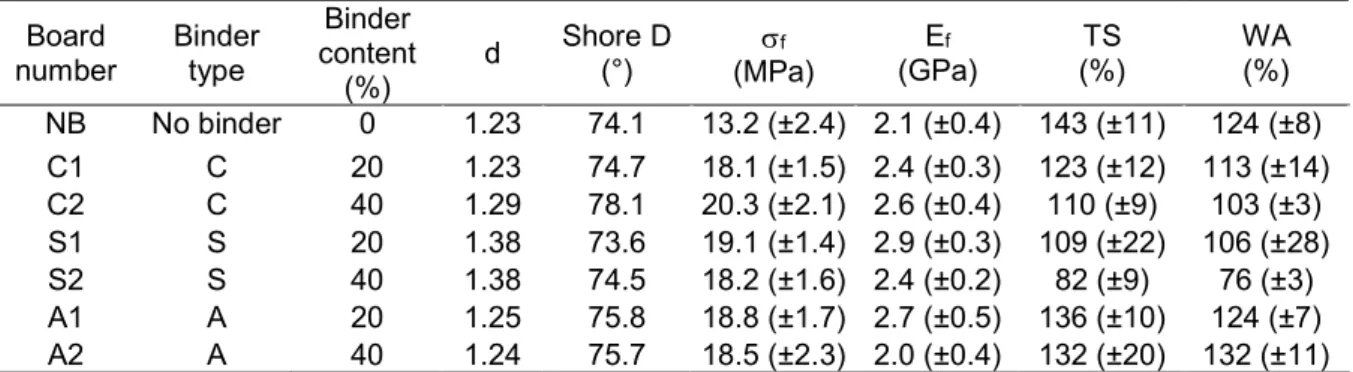
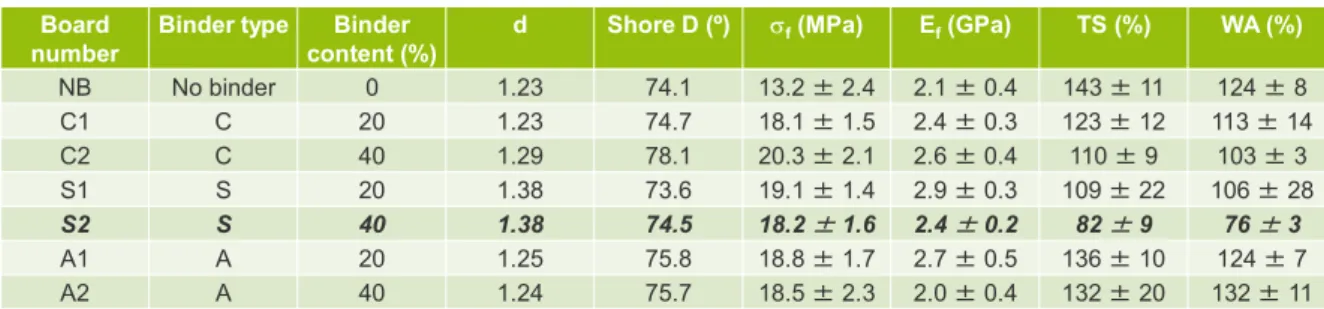
A cohesive HB was obtained with success from grinded amaranth bark (4 mm), using next conditions: 200 °C temperature, 19.6 MPa pressure, and 5 min moulding time. For such board, no external binder was added, thus illustrating the adhesive ability of some chemicals inside bark, especially free sugars, hemicelluloses and possibly lignins. Flexural strength at break, elastic modulus and thickness swelling were 13.2 MPa, 2.1 GPa and 143%, respectively (Table 1).
The usage properties of HB were much improved when adding an external binder. Three different natural binders were used successfully, with 20% and 40% addition: two protein-based binders (i.e. a deoiled coriander cake (C) and a protein isolate from sunflower cake (S)), and a starch-based one (i.e. deoiled amaranth seeds (A)). Best properties were obtained when adding 40% S: 18.2 MPa flexural strength (+38%), 2.4 GPa elastic modulus (+14%), and 82% thickness swelling (-42%) (Table 1). Such optimal board could present a viable, sustainable alternative for current commercial wood-based materials such as oriented strand board (OSB), particleboard (PB) and medium-density fiberboard (MDF), with high cost-effectiveness.
Table 1. Density, mechanical properties and water resistance of fiberboards produced from amaranth bark using hot pressing (200 °C temperature, 19.6 MPa pressure, and 5 min moulding time).
Board
number Binder type
Binder content (%) d Shore D (°) (MPa) f Ef (GPa) (%) TS WA (%) NB No binder 0 1.23 74.1 13.2 (±2.4) 2.1 (±0.4) 143 (±11) 124 (±8) C1 C 20 1.23 74.7 18.1 (±1.5) 2.4 (±0.3) 123 (±12) 113 (±14) C2 C 40 1.29 78.1 20.3 (±2.1) 2.6 (±0.4) 110 (±9) 103 (±3) S1 S 20 1.38 73.6 19.1 (±1.4) 2.9 (±0.3) 109 (±22) 106 (±28) S2 S 40 1.38 74.5 18.2 (±1.6) 2.4 (±0.2) 82 (±9) 76 (±3) A1 A 20 1.25 75.8 18.8 (±1.7) 2.7 (±0.5) 136 (±10) 124 (±7) A2 A 40 1.24 75.7 18.5 (±2.3) 2.0 (±0.4) 132 (±20) 132 (±11)
d, density; Shore D, surface hardness; σf, flexural strength at break; Ef, elastic modulus; TS, thickness swelling after 24 h
immersion in water; WA, water absorption after 24 h immersion in water.
ACKNOWLEDGMENTS
The authors would like to express their sincere gratitude to Ovalie Innovation (Auch, France) for supplying the batch of amaranth stems used for the purpose of this study, and for their financial support.
REFERENCES
Caselato-Sousa VM, Amaya-Farfán J. State of knowledge on amaranth grain: a comprehensive review. Journal of Food Science, 2012, 77, p. 93-104.
Ott C, Lacatusu I, Badea G, Grafu IA, Istrati D, Babeanu N, Stan R, Badea N, Meghea A. Exploitation of amaranth oil fractions enriched in squalene for dual delivery of hydrophilic and lipophilic actives. Industrial Crops and Products, 2015, 77, p. 342-352.
Amaranth, a model for the future biorefinery of whole plants
Amaranth, a model for the future biorefinery of whole plants
Ph. Evon
1(*
), G. de Langalerie
1,2,3, T. Ramaux
1,2, L. Labonne
1,
S. Ballas
3, T. Véronèse
3, O. Merah
1, T. Talou
1and P. Ouagne
2 1Laboratoire de Chimie Agro-industrielle (LCA), Université de Toulouse, ENSIACET, INRA, INPT, Toulouse, France2Laboratoire Génie de Production (LGP), Université de Toulouse, ENIT, INPT, Tarbes, France 3Ovalie Innovation, Auch, France
* e-Mail address (corresponding author): [email protected](Ph. Evon)
REFERENCES
[1] Ott C, Lacatusu I, Badea G, Grafu IA, Istrati D, Babeanu N, Stan R, Badea N, Meghea A. Exploitation of amaranth oil fractions enriched in squalene for dual delivery of hydrophilic and lipophilic actives. Industrial Crops and Products, 2015, 77, p. 342-352. [2] Caselato-Sousa VM, Amaya-Farfán J. State of knowledge on amaranth grain: a comprehensive review. Journal of Food Science, 2012, 77, p. 93-104.
Conclusion
►Amaranthus cruentus, a promising raw material for the biorefinery of whole plants!
►Large amounts of starch, proteins and squalene inside its seeds: possible applications in the food, cosmetics and material industries. ►Stems, composed of (i) a bark on their periphery (90% w/w), and (ii) a pith fraction in their middle (10%): usable for material applications. ►Possibility to separate mechanically and continuously these two fractions thanks to a fractionation process developed recently.
►Low density for pith particles: usable as thermal insulating materials inside buildings. ►Grinded bark successfully used for the manufacture of fiberboards using hot pressing.
►Optimal hardboard (S2) A viable option for replacing current commercial wood-based materials (usable in furniture, etc.)!
Component Cellulose Hemicelluloses Lignins Minerals Water-solubles
Content 43.6 ± 0.7 17.6 ± 0.4 20.3 ± 0.6 9.3 ± 0.3 14.8 ± 0.9
Results and discussion
►Structure of stems was studied from ten samples: pith fraction was estimated to 10% w/w.
►Difference in density between bark and pith fractions Continuous separation possible through (i) grinding and (i) blowing steps.
►Alveolar structure for the pith particles Very low bulk density (47 kg/m3for 4-16 mm particle size) Promising raw material for thermal insulation.
►High lignocellulose content for the bark particles (Table 1) Potential for the production of dense fiberboards, i.e. hardboards (HB), through hot pressing. ►A cohesive HB was obtained with no external binder added (NB) Adhesive ability of some chemicals inside bark (free sugars, hemicelluloses and lignins). ►Usage properties of HB much improved when adding an external binder: C, deoiled coriander cake; S, sunflower protein isolate; A, deoiled amaranth seeds. ►Best properties obtained when adding 40% S (S2) Viable, sustainable alternative for current commercial wood-based materials (OSB, MDF, etc.).
Tableau 1. Chemical composition of amaranth bark (% of dry matter). Amaranthus cruentus
Introduction
►This study especially aims to investigate the pos-sible uses of stems for material applications.
Board number
Binder type Binder
content (%)
d Shore D (º) sf(MPa) Ef(GPa) TS (%) WA (%)
NB No binder 0 1.23 74.1 13.2 ± 2.4 2.1 ± 0.4 143 ± 11 124 ± 8 C1 C 20 1.23 74.7 18.1 ± 1.5 2.4 ± 0.3 123 ± 12 113 ± 14 C2 C 40 1.29 78.1 20.3 ± 2.1 2.6 ± 0.4 110 ± 9 103 ± 3 S1 S 20 1.38 73.6 19.1 ± 1.4 2.9 ± 0.3 109 ± 22 106 ± 28 S2 S 40 1.38 74.5 18.2 ± 1.6 2.4 ± 0.2 82 ± 9 76 ± 3 A1 A 20 1.25 75.8 18.8 ± 1.7 2.7 ± 0.5 136 ± 10 124 ± 7 A2 A 40 1.24 75.7 18.5 ± 2.3 2.0 ± 0.4 132 ± 20 132 ± 11
d, density; Shore D, surface hardness; σf, flexural strength at break; Ef, elastic modulus; TS, thickness swelling after 24 h immersion in water; WA, water absorption after 24 h immersion in water.
►Amaranthus cruentus, an annual herb native to temperate and tropical regions (cultivated for the nutritional properties of its seeds). ► For the future, amaranth appears as a promising raw material for the biorefinery of whole plants, all parts of the plant being potentially usable for different food and non-food applications:
Tableau 2. Density, mechanical properties and water resistance of fiberboards produced from grinded amaranth bark (4 mm) using hot pressing (200 ºC temperature, 19.6 MPa pressure, and 5 min moulding time).
Seeds Whole
plant
Stems
Lipid fraction (7-8%), rich in squalene of vegetal origin (5-6%)
Proteins (15%)
Starch (up to 55%)
FOOD SUPPLEMENT
AND COSMETICS [1] - BREAD FLOURS- BIOCIDAL AND ANTIOXYDANT ACTIVITIES [2]
- EMULSIFYING CAPACITIES - ADHESIVE PROPERTIES
INJECTION-MOULDING APPLICATIONS
Bark( i.e. woody part or ligneous
fraction)on their periphery
Pith fraction in their middle
MATERIAL APPLICATIONS?
Pith Bark
Cross section of stem
Photographs of fiber-boards produced NB C1 A2 A1 S2 S1 C2 GRINDING + BLOWING