ISSUE 2015/17
NOVEMBER 2015
THE GROWING
INTERGENERATIONAL
DIVIDE IN EUROPE
PIA HÜTTL, KAREN WILSON AND GUNTRAM WOLFF
Highlights
• During the economic and financial crisis, the divide between young and old in the European Union increased in terms of economic well-being and allocation of resources by governments. As youth unemployment and youth poverty rates increased, government spending shifted away from education, families and chil-dren towards pensioners.
• To address the sustainability of pension systems, some countries implemented pension reforms. We analysed changes to benefit ratios, meaning the ratio of the income of pensioners to the income of the active working population, and found that reforms often favoured current over future pensioners, increasing the inter-generational divide.
• We recommend reforms in three areas to address the intergenerational divide: improving European macroeconomic management, restoring fairness in govern-ment spending so the young are not disadvantaged, and pension reforms that share the burden fairly between generations.
Pia Hüttl ([email protected]) is an Affiliate Fellow at Bruegel. Karen Wilson ([email protected]) is a Visiting Fellow at Bruegel. Guntram Wolff ([email protected]) is Director of Bruegel. The authors are grateful to Katharina Barié, Iain Begg, Elsa Fornero, Mario Gioannini, Matthew Oxenford, Mari Pantsar, Mariacristina Rossi, Eulalia Rubio and Eric Thode for comments and discussion in the framework of the Economics Aspects Working Group of the Vision Europe project. Telephone +32 2 227 4210 [email protected] www.bruegel.org
BRU EGE L
POLICY
CONTRIBUTION
THE GROWING INTERGENERATIONAL DIVIDE IN
EUROPE
PIA HÜTTL, KAREN WILSON AND GUNTRAM WOLFF, NOVEMBER 2015
02
BR U EGE LPOLICY CONTRIBUTION
1 THE EMERGENCE OF AN INTERGENERATIONAL DIVIDE
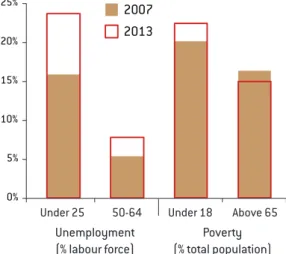
During seven years of economic crisis, the inter-generational income and wealth divide has increased in many European Union countries. In the bloc as a whole, young people on average have become significantly poorer, while poverty among pensioners has been reduced (Figure 1). Unemployment among the under-25s has risen notably while older workers (aged 50-64) have been less affected (Figure 2). While this pattern has been particularly pronounced in southern Europe, it can also be observed for the European Union as a whole.
In the EU as a whole, unemployment in the 15-24 age group increased by 7.8 percentage points between 2007 and 2013, peaking at 23.7 percent in 2013, while unemployment among older work-ers in the 50-64 age group increased somewhat less, by 2.4 percentage points to 7.8 percent in 2013. A more precise measure of forced inactivity of young people is the 'not in employment, edu-cation or training' (NEET) rate, which varies signif-icantly between countries. In the countries most hit by the crisis (Cyprus, Greece, Ireland, Italy and Spain), the NEET rate increased by more than 7 percentage points between 2007 and 2013,
peak-THE GROWING INTERGENERATIONAL DIVIDE IN EUROPE
ing at over 20 percent in Greece and Italy (Figure 2). By contrast, the NEET rate declined in Germany in the same period, from 8.9 to 6.3 percent. Material deprivation rates are typically higher for young people than for those aged 65 or over
0% 5% 10% 15% 20% 25% 2007 2013
Under 25 50-64 Under 18 Above 65 Unemployment
(% labour force)
Poverty (% total population)
Figure 1: Pre and post-crisis material deprivation rate and unemployment rate in the EU
Source: Bruegel based on Eurostat. Note: The material deprivation rate is defined as the enforced inability (rather than the choice not) to pay for at least three of: unexpected expenses; a one-week annual holiday away from home; a meal involving meat, chicken or fish every second day; adequate heating; durable goods such as washing machines, colour televisions, telephones or cars; or being confronted with payment arrears. 0 5 10 15 20 25 BG IT RO HR SK ES LV UK HU MT GR BE PT IE FR PL CY DE EE SE AT LT FI CZ SI LU DK NL 2007 2013
Figure 2: 15-24 year olds not in employment, education or training (%)
03
BR U EGE LPOLICY CONTRIBUTION
THE GROWING INTERGENERATIONAL DIVIDE IN EUROPE
(Figure 1). In 2007, 20 percent of young people below the age of 18 were materially deprived, compared to 16 percent of people aged over 65. As with the NEET rates, there are major differences between countries. While less than 10 percent of young people faced poverty in Denmark, Finland and Sweden in 2007 (the proportion is even smaller for older people), more than 20 percent of young and old people were materially deprived in Cyprus, Greece and Portugal. In Latvia, Hungary and Poland about 40 percent of young people were poor.
Figure 3 shows the percentage change per coun-try in the material deprivation rate during the crisis (2007-13). The rate increased substantially more for the young compared to the old, especially in the countries hit most by the crisis (except Ire-land), meaning that already high levels before the crisis in those countries were exacerbated. Only Italy and to a lesser extent the United Kingdom experienced deteriorating ratios for both the young and old. By contrast, Finland and Sweden, with low levels to start with, saw their respective material deprivation rates decline for both young and old people over the same period. The same is valid for Poland1.
Overall, a worrying picture emerges. First, poverty indicators have shown the emergence of an inter-generational divide, especially in crisis-hit south-ern Europe. Second, unemployment has become a major concern, with young people hit hardest during the crisis in the most stressed countries. Surges in youth unemployment and youth poverty are particularly worrying because they have long-lasting effects on productivity and
1. Poland was the only EU country with a growing economy during the crisis, which might explain this development.
potential growth, marking young people for their lifetimes, reducing their productivity and often excluding them from the labour market for an extended period of time (Bell and Blanchflower, 2010; Arulampalam, 2001; Gregg and Tominey, 2005). Youth unemployment and poverty also have negative effects on fertility rates and demo-graphics, possibly because of increased income uncertainty related to unemployment and subse-quent decisions to delay starting a family (Kreyenfeld and Andersson, 2014; Currie and Schwandt, 2014). The cost for the EU of a large proportion of NEETs is therefore much greater than the immediate short-term loss of foregone eco-nomic activity (Darvas and Wolff, 2014).
2 KEY DRIVERS OF THE INTERGENERATIONAL DIVIDE
The intergenerational divide that has emerged during the crisis has been driven by three impor-tant policy developments. The first is macroeco-nomic management. Unemployment responds to the business cycle, but youth unemployment reacts much more strongly to recessions than total unemployment. This is in part because younger workers disproportionately are on tem-porary contracts (Boeri, 2011). Other factors also matter, such as the difficulty for young people to prove their skills in recessionary periods when they are looking for work. Therefore, the intergen-erational divide typically grows in times of reces-sion. Second, structural changes to government spending are important. Fiscal consolidation measures in the EU during the crisis led to an increase in poverty rates (Darvas and Tschekassin, 2015). This raises the question of
-100 -50 0 50 100 150 200 IE GR ES UK IT CY EE NL PT HU SI DK LT AT FR LV FI DE BG CZ SE PL Under 18 Above 65
Figure 3: Change in material deprivation rate (2007-13, %)
2. As also highlighted by Begg, Mushövel and Niblett (2015).
THE GROWING INTERGENERATIONAL DIVIDE IN EUROPE
BR U EGE L
POLICY CONTRIBUTION
04
whether government spending has become less favourable for the young, increasing the share of materially deprived young people. Third, pension system reforms are hugely important for inter-generational equity. In the following, we deal with each of the three issues in turn.
Macroeconomic management
In times of crisis, generally speaking, the public sector steps in to smooth the impact of adverse developments, through automatic welfare policies (such as unemployment benefits), progressive taxation and discretionary policies such as invest-ment programmes. Automatic stabilisers were broadly at work in the EU during the financial crisis in 2008 and 2009. However, during the sovereign debt crisis, budgets became constrained in some countries and they arguably cut government spending more quickly than would have been advisable from a stabilisation point of view. This substantially aggravated the recessions in those countries and increased unemployment and youth unemployment (Darvas and Wolff, 2014). In terms of investment, Darvas and Barbiero (2014) found that gross public investment declined in the EU during the European debt crisis, and even collapsed in the most vulnerable coun-tries, exaggerating the output fall.
The composition of government spending
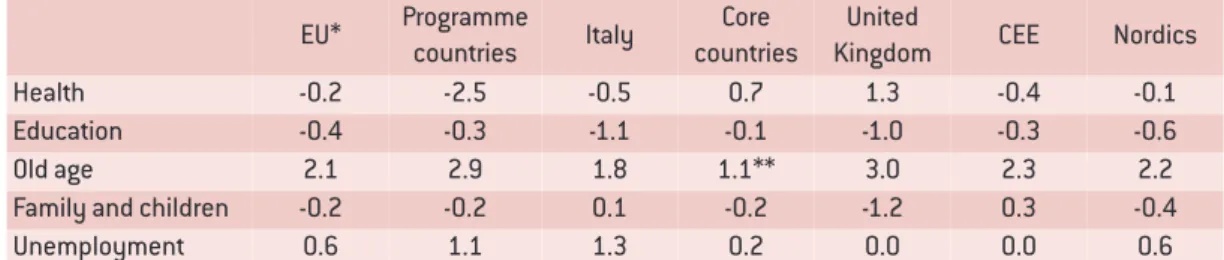
Table 1 shows the percentage point change in the composition of government spending in the EU from 2008 to 2013. Unsurprisingly, Greece, Ire-land and Portugal, which experienced the sharpest fiscal consolidation in the euro area, and Italy saw unemployment expenditure increase
substantially as a share of total expenditure as their unemployment rates soared. Spending on health grew in importance in the core countries (see Table 1 for definitions) and the United King-dom, while it fell substantially in the programme countries, on the back of fiscal consolidation measures. The share of spending on education decreased slightly in the EU overall and fell sub-stantially in the UK and Italy. The UK and the pro-gramme countries reduced their spending on families and children. By contrast, pensioners were the main beneficiaries of fiscal adjustments. Spending on this category increased in all coun-tries and exceeded the EU average in the UK, the programme countries and, to a lesser extent, cen-tral and eastern European countries2. The
compo-sition of government spending therefore shifted from families and children and education towards pensioners, entrenching the intergenerational divide.
Pension reforms
Government expenditure on pensions can increase because pensions are considered to be more difficult to change than other benefits from a political point of view. Several member states introduced pension reforms during the crisis. Such reforms can benefit current pensioners at the expense of future generations or vice versa. The most important pension reforms happened in the stressed countries, especially in Greece, Italy, Portugal and Spain, because the crisis highlighted that their pension systems were not sustainable. From an intergenerational perspective, these reforms typically aim at increasing the sustainability of pension systems by reducing implicit debt obligations, and should therefore
Table 1: General government expenditures by function, percentage point changes in composition, from 2008 to 2013 EU* Programme countries Italy Core countries United
Kingdom CEE Nordics
Health -0.2 -2.5 -0.5 0.7 1.3 -0.4 -0.1
Education -0.4 -0.3 -1.1 -0.1 -1.0 -0.3 -0.6
Old age 2.1 2.9 1.8 1.1** 3.0 2.3 2.2
Family and children -0.2 -0.2 0.1 -0.2 -1.2 0.3 -0.4
Unemployment 0.6 1.1 1.3 0.2 0.0 0.0 0.6
Source: Bruegel based on Eurostat gov_10a_exp database. Note: expenditure on family and children is defined as provision of social pro-tection in the form of cash or in-kind benefits to households with dependent children, cash benefits such as maternity allowances, parental leave, benefits geared towards child care. Education excludes spending on tertiary education. * EU refers to 27 member states excluding Romania (because of data limitations). ** excluding the Netherlands. Programme countries = GR, ES, PT; core countries = BE, DE, FR, NL, AT; CEE = BG, CZ, HU, PL, SI, SK; Nordics = DK, SE, FI.
THE GROWING INTERGENERATIONAL DIVIDE IN EUROPE
BR U EGE L POLICY CONTRIBUTION05
3. From an intergenerational perspective, the public-pri-vate mix in pension schemes is not an issue persé, if appropriate regulation
obliges the collectively pri-vately funded schemes to integrate an intergeneration risk-sharing element in their set-up (Schokkaert and van Parijs, 2003). 4. These numbers are taken from the European Commis-sion Ageing report (2015 and 2009); see Table 2 in the annex. 5. The information in this box draws on Schokkaert and Van Parijs (2003) and Myles (2002). Vandebrouke and Rinaldi (2015) discuss shortly the limits of the Musgrave principle.
favour the young and future generations. In general, a successful reform should increase sustainability while not compromising adequacy of future pensions.
Moreover, all of this has to be understood in the context of rising EU life expectancy and declining fertility, which represent major challenges to future pension and health systems. The European Commission's Ageing Report (2015) states that the EU will move from four working-age people per person over 65 today to about two working-age people in 2040. This will affect both revenue and spending: there will be less revenue because of the shrinking working-age population, and more spending because of higher costs for pensions, health and long-term care. To address these chal-lenges, several EU member states have enlarged the role of pre-funded, privately managed schemes as opposed to the prevailing statutory, public, pay-as-you-go schemes (OECD, 2014)3.
There are, however, clear limits to what such schemes can achieve.
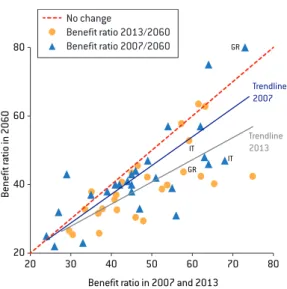
To see to what extent the intergenerational divide has been affected by reforms in the crisis years, we carried out an analysis of changes to benefit ratios, meaning the ratio of the income of pen-sioners to the income of the active working popu-lation (Box 1) Pension reforms that do not affect intergenerational equity should leave the benefit ratio unchanged. We considered (a) how the cur-rent benefit ratio changed over the crisis period, (b) how the 2060 benefit ratio changed over the same period and (c) how the relationship between the two ratios has changed. It is the latter that best captures the ongoing intergenerational changes in the pension system.
Figure 4 compares the benefit ratios in 2007 and forecasts for 2060 to their current counterparts, the 2013 benefit ratios and their respective 2060 forecasts4. In 2060, current 20-year olds will be
approaching or already in retirement, making it a useful year to discern the effect of current reforms on today’s young. A perfectly equitable pension scheme should safeguard the benefit ratio for
BOX 1: THE MUSGRAVE RULE AND THE BENEFIT RATIO
To address the generational divide, we need to identify a stable and equitable intergenerational con-tract that assures the well-being of the elderly, without crowding out resources for the young. The Musgrave rule helps in that respect, stating that efficient risk-sharing between different generations
means keeping invariant the ratio of the income of the retirees to the net income of the working pop-ulation (the so-called ‘benefit-ratio’). The example below illustrates this5.
Let’s assume a country has a pay-as-you-go system designed either with defined benefits (ie pre-determined pension payments) or a fixed contribution rate (ie pension payments are not guaranteed but are determined by the amount paid in). Imagine now an unpredictable shock affecting the younger generation. In a defined benefits set-up, the cost will fall on the younger generation, as con-tribution rates increase to keep the defined benefit level. In a fixed concon-tribution set-up, the cost will fall entirely on the older generation, as fewer contributions are paid in, reducing the benefits paid out to pensioners. In a system that reflects the Musgrave rule, both contributions and benefits are set so that they maintain a constant benefit ratio. Therefore, when a negative shock hits the younger generation, the contribution rates for the younger generation rise, but benefits for the older genera-tion must decrease too, to keep the benefit ratio constant. Both parties ‘lose’ at the same rate, allo-cating the burden in an equitable way.
The benefit ratio as provided by the European Commission is defined as the average pension bene-fit divided by an economy-wide average wage. It is crucial for the pension expenditure projection exercise as outlined in the Ageing Report (European Commission, 2015), which captures three impor-tant aspects of pension schemes: (a) the assumed increases in average pensions because of index-ation rules and longer contribution periods, (b) changes in the average wage driven by assumptions of labour productivity growth rates, and (c) changes in the structure of the respective population groups. Both the 2007/2060 benefit ratio and the 2013/2060 benefit ratio are based on European Commission estimates.
6. The benefit ratio also varies because of demo-graphics and labour market movements. Comparing the two projection exercises, the old-age dependency ratio assumed in 2013 for 2060 is lower than that assumed in 2007 for 2060, suggesting better-than-expected demographics. However, labour market developments worsened, especially in Greece.
THE GROWING INTERGENERATIONAL DIVIDE IN EUROPE
BR U EGE L
POLICY CONTRIBUTION
06
Germany reduced its 2013/2060 benefit ratio compared to 2007/2060 for both current and future pensioners, not changing the bias towards current pensioners significantly.
Denmark moved towards a more just intergenera-tional burden-sharing, by reducing the benefit ratio of future pensioners, while Sweden reduced entitlements for current and future pensioners, without improving its position. Romania and Hun-gary moved from balanced burden-sharing to sig-nificantly favouring current pensioners, while Bulgaria and Poland curtailed entitlements for both current and future pensioners, not affecting their intergenerational burden-sharing. A notable and important exception is Italy: compared to its 2007/2060 benefit ratio, its ratio for 2013/2060 marked the greatest shift among EU countries towards a more just intergenerational position. Italy achieved sustainability in its pension system not by cutting the future benefit ratio, but by reducing the current benefit ratio, thus improving intergenerational burden-sharing (see the Annex for more details).
This analysis suggests that overall entitlements have been curtailed in many countries to address sustainability questions, but the burden seems not to have been shared equally, favouring current over future pensioners, especially in crisis-hit southern Europe (Italy being an exception).
3 WAYS FORWARD: POLICIES TO ADDRESS THE INTERGENERATIONAL DIVIDE
Measures to address the intergenerational divide could include policies against youth unemploy-ment, rebalancing spending and more equal burden-sharing between generations in pension scheme designs.
One of the biggest legacies of the crisis is high youth unemployment. Bentolila et al (2010) and Boeri (2011) argue that the tw o-tier system with ultra-secure permanent workers and vulnerable temporary workers (who are often the young entering the labour market) is a major factor behind the high rate of job losses among younger workers during recessions. It also suggests a pos-sible solution: labour market reforms that allow for graded job security as workers acquire tenure. those that will retire in or around 2060, keeping it
the same as the current ratio.
In 2013, Denmark, most continental welfare states and the United Kingdom were close to the 45 degree line and can therefore be considered to have relatively equitable pension systems. All other countries were below the 45 degree line, indicating a bias towards today’s pensioners, resulting from a smaller future benefit ratio com-pared to today’s ratio.
Analysing how the ratio has changed during the crisis allows us to track the impact of pension reforms and other factors on the intergenerational justice of the pension system6. Compared to
2007/2060 benefit ratios, the countries most under stress from the crisis reduced their 2013/2060 benefit ratios. Greece moved from a benefit ratio biased towards future generations in 2007 towards a benefit ratio that favours current pensioners (also highlighted in Figure 4). Spain and Cyprus moved from a more-or-less balanced position in 2007 to a system biased in favour of current pensioners, while Portugal increased its benefit ratio for both current and future pensioners, not changing the burden-sharing between generations in a significant way. Meanwhile, Belgium did not change its position, while Austria curtailed entitlements for current pensioners, moving closer to the 45 degree line.
20 40 60 80 20 30 40 50 60 70 80 B e n e fi t ra ti o in 2 0 6 0
Benefit ratio in 2007 and 2013
GR GR IT IT Trendline 2007 Trendline 2013 No change Benefit ratio 2013/2060 Benefit ratio 2007/2060
Figure 4: All pensions benefit ratio, 2007/2060 and 2013/2060 (%)
Source: Bruegel based on European Commission Ageing
Report (2009 and 2015 edition). Note: the benefit ratios take
07
BR U EGE LPOLICY CONTRIBUTION
THE GROWING INTERGENERATIONAL DIVIDE IN EUROPE
7. In 2013, the European Commission called for giving all young people up to age 25 continuing educa-tion, an apprenticeship or a traineeship within four months of leaving formal education. This could foster the establishment of voca-tional training programmes and policies that help young people to find jobs, especially in countries which have not had such provisions before. See the Council recommendation establishing the Youth Guar-antee: http://eur-lex.europa.eu/legal-content /EN/TXT/PDF/?uri=CELEX:32 013H0426(01)&from=EN. 8. A March 2015 European Court of Auditors report questions the adequacy of the total funding (€12.7 bil-lion from 2014 to 2020) of the Youth Guarantee, how its target is defined and the way monitoring and imple-mentation are proceeding. See http://www.eca.europa.eu/ Lists/ECADocuments/INSR1 5_03/INSR15_03_EN.pdf. 9. As pointed out by Vandebrouke and Rinaldi (2015), Belgium is proposing a pension reform for 2020-2040 along the lines of the Musgrave rule.
while it should ensure that countries provide adequate stabilisation for the area as a whole. For countries outside the euro area, fiscal policy, monetary policy and the exchange-rate channel should play their full role in mitigating shocks. In terms of burden-sharing between generations, we have found that current pensioners have been protected compared to future pensioners (Italy being an exception). Safeguarding a constant ben-efit ratio over generations by adjusting contribu-tion rates for the working populacontribu-tion and benefit levels for pensioners would enable better inter-generational burden-sharing9. This would
coun-teract the limitations of existing fixed-contribution or defined-benefits schemes, under which adjust-ment would eventually fall only on the younger or on the older generation. Following a Musgrave rule, rising unemployment among the younger gener-ation would mean that the contribution rates for the younger generation rise, but benefits for the older generation would decrease too, to keep the benefit ratio constant. Therefore, both parties ‘lose’ at the same rate, allocating the burden in an equitable way.
However, it is not only pension reforms along the lines outlined above that are needed. As noted by Myles (2002), the aggregate well-being of future generations depends primarily on the quality and quantity of the stock of productive assets (includ-ing human and environmental capital) that they inherit or create, and not so much on the design of pension systems. We have shown that during the crisis, social spending on families and children, and on education, was preserved less in the UK and in Italy, and held constant in the countries that faced the highest youth unemployment rates. By contrast, policies aimed at education and child care, one of the pillars of the social investment strategy, could play a major role in addressing the intergenerational divide. Children are the future workforce, and investing in better education and affordable child care will lead to higher levels of productivity and employment (Hemerijck, 2013). However, such reforms are unlikely to yield
sig-nificant job benefits in a situation of depressed demand. Other measures to counteract youth unemployment, such as the Youth Guarantee7, are
a step in the right direction but are hardly ade-quate as a counterweight to national policies; in addition, the European Court of Auditors has ques-tioned the adequacy of such policies8.
Beyond such structural measures, adequate macroeconomic policies are important in order to prevent a significant increase in unemployment. In the context of the euro-area crisis, some sort of shock absorber on the euro-area level could have helped mitigate the adverse impact on the economices of member states. In the short term, we are sceptical about creating major European stabilisation functions such as a European unemployment insurance scheme (Claeys et al, 2014). Such measures, such as the euro-area unemployment insurance scheme proposed by former European commissioner Laszlo Andor, could prove effective but would require an extraordinary effort to create harmonised European labour market legislation.
Instead, for the euro area we would recommend an enhanced, symmetric and binding policy coordination framework for fiscal policy, as outlined in Sapir and Wolff (2015). The main reason we advocate this step is that 98 percent of EU government spending is national. Macroeconomic stabilisation therefore works through national budgets. It is of central importance that national public finance is cautiously managed in good times, in order to have enough fiscal leeway in bad times. However, a system relying exclusively on national policies would be inadequate for the monetary union for two reasons: Irresponsible fiscal policy can have substantial cross-border spillover effects; and the sum of national fiscal deficits does not add up to an adequate fiscal stance for the euro area as a whole. A deeper coordination framework that is binding in exceptional times should therefore be created, to prevent unsustainable fiscal policies,
‘Current pensioners have been protected compared to future pensioners. Safeguarding a constant benefit ratio by adjusting contribution rates for the working population and benefit
08
BR U EGE LPOLICY
CONTRIBUTION
THE GROWING INTERGENERATIONAL DIVIDE IN EUROPE
Education is also important as a policy measure to reduce income inequality. By increasing access to high-quality education, greater equality of opportunity is fostered, which in turn contributes positively to economic growth (OECD, 2015a). Also, as pointed out by Vandenbroucke and Rinaldi (2015), investing in education and child care can reduce intergenerational gaps.
Overall, we are concerned that the crisis has left a dangerous intergenerational legacy. Addressing this legacy by making the government spending mix fairer for the younger generation while re-establishing intergenerational equity in pension schemes, should be a priority for policymakers throughout much of the European Union.
REFERENCES
Arulampalam, W. (2001) ‘Is Unemployment Really Scarring? Effects of Unemployment Experiences on Wages’, Economic Journal, Vol. 11(475): 585-606
Begg, I., F. Mushövel and R. Niblett (2015) ‘The Welfare State in Europe: Visions for Reform’, Chatham House Europe Programme, September
Bell, D. and D. G. Blanchflower (2010) ‘Youth Unemployment: Déjà vu’, IZA Discussion Paper No. 4705
Bentolila, S., P. Cahuc, J. J. Dolado and T. Le Barbanchon (2010) ‘Two-tier Labor Markets in the Great Recession: France vs. Spain’, IZA Discussion Paper No. 5340
Boeri, T. (2011) ‘Reducing Youth Unemployment and Dualism’, Thematic Review Seminar on the Reduction of Labour Market Segmentation Addressing the Needs of Young People, Brussels, 27 June
Bonoli, G. and D. Natali (2012) The Politics of the New Welfare State, Oxford University Press Claeys, G., Z. Darvas and G. B. Wolff (2014) ‘Benefits and drawbacks of European unemployment insurance’, Policy Brief 2014/06, Bruegel
Currie, J. and H. Schwandt (2014) ‘Short- and Long-term Effects of Unemployment on Fertility’,
Proceedings of the National Academy of Sciences, Vol. 11 (41)
Darvas, Z. and F. Barbiero (2014) ‘In Sickness and in Health: Protecting and Supporting Public Investment in Europe’, Policy Contribution 2014/02, Bruegel
Darvas, Z. and G. Wolff (2014) ‘Europe’s Social Problem and Its Implications for Economic Growth’,
Policy Brief 2014/03, Bruegel
Esping-Andersen, G., D. Gallie, A. Hemerijck and J. Myles (2002) Why We Need a New Welfare State, Oxford University Press
European Commission (2009) ‘The 2009 Ageing Report – Economic and Budgetary Projections for the EU-27 Member States (2008-2060)’, European Economy 2/2009, Luxembourg: Publications Office of the European Union
European Commission (2015) ‘The 2015 Ageing Report – Economic and Budgetary Projections for the 28 EU Member States (2013-2060)’, European Economy 3/2015, Luxembourg: Publications Office of the European Union
Gregg, P. and E. Tominey (2005) ‘The Wage Scare from Male Youth Unemployment’, Labour
Economics, Vol. 12: 487-509
Hemerijck, A. (2013) Changing Welfare States, Oxford University Press
Hellström, E. and M. Kosonen (2015) ‘Governing the Welfare State and Beyond – Solutions for a Complex World and Uncertain Future’, Vision Europe Summit paper
Kreyenfeld, M. and G. Andersson (2014) ‘Socioeconomic Differences in the Unemployment and Fertility Nexus: Evidence from Denmark and Germany’, Advances in Life Course Research, Vol. 21: 59-73
Musgrave, R. (1986) ‘A Reappraisal of Financing Social Security’, in Musgrave, R. (ed) Public
Finance in a Demographic Society, Vol. II, Brighton: Wheatsheaf Books
Myles, J. (2002) ‘A New Social Contract for the Elderly’, in Esping-Andersen, G., D. Gallie, A. Hemerijck and J. Myles (eds) Why We Need a New Welfare State, Oxford University Press
09
BR U EGE LPOLICY CONTRIBUTION
THE GROWING INTERGENERATIONAL DIVIDE IN EUROPE
Myles, J. and P. Pierson (2001) ‘The Comparative Political Economy of Pension Reform’, in Pierson, P. (ed) The New Politics of the Welfare State, Oxford University Press
OECD (2013) Pensions at a Glance 2013: OECD and G20 Indicators, Paris: OECD Publishing OECD (2014) Education at a Glance 2014: OECD Indicators, Paris: OECD Publishing OECD (2015a) In It Together: Why Less Inequality Benefits All, Paris: OECD Publishing OECD (2015b) Social Impact Investment: Building the Evidence Base, Paris: OECD Publishing Sapir, A. and G. Wolff (2015) ‘Euro-area Governance: What to Reform and How to Do it’, Policy Brief 2015/01, Bruegel
Schokkaert, E. and P. Van Parijs (2003) ‘Debate on Social Justice and Pension Reform’, Journal of
European Social Policy, Vol. 13(3): 245-279
Thimann, C. (2015) ‘The Microeconomic Dimensions of the Eurozone Crisis and Why European Politics Cannot Solve Them’, Journal of Economic Perspectives, Vol. 29(3): 141-64
Vandenbroucke, F. and D. Rinaldi (2015) ‘Social Inequalities in Europe. The Challenge of Convergence and Cohesion’, Vision Europe Summit Paper
Wilson, K. (2014) ‘New Investment Approaches for Addressing Social and Economic Challenges’,
OECD Science, Technology and Industry Policy Papers No. 15
ANNEX I: An overview of Italy’s 2011 pension reform
By Elsa Fornero
In November 2011, Italian public finances were near collapse and the country’s political system was in a stalemate. Financial operators were turning their backs on Italian sovereign debt auctions and the few who took part were demanding exaggerated interest rates, so that the interest paid by Italy on its new 10-year bonds exceeded the interest paid by Germany on similar bonds by a spread of 500 basis points (more than three times the spread in July 2015). Italy had (and still has) to refinance on aver-age over €1 billion per day of its huge public debt and its well-tested system for doing so was under massive attack. The possibility that interest might not be paid and that expiring bonds might not be reimbursed was very real; pensions and civil service salaries were at risk, while central and local admin-istrations were already unable to pay suppliers.
The financial crisis came on top of a slow industrial decline that had been afflicting Italy for about 20 years. Italy had cut its research and development expenditures, got out of high-productivity sectors such as electronics, chemicals and pharmaceuticals and concentrated on labour-intensive fashion-oriented ‘made in Italy’ products, encountering increasingly stiff competition from developing countries. When the technocratic government of Mario Monti took office (16 November 2011), pension reform was a key priority. The reform had to be far-reaching enough to convince European partners and finan-cial markets that Italy deserved to be trusted as a debtor, but sensible enough to obtain the (albeit reluctant) approval of the parliament and the public. It had to realise immediate savings in pension expenditure and future savings in the coming decades, thus reducing the burden on the young and on subsequent generations. It had to eliminate or drastically reduce the distortions still embedded in the system after 20 years of reasonable but too-gradual reforms.
The reform (law 214/2011) speeded up the transition to the notional defined contribution (NDC) system by extending the DC method of benefit calculation to all workers (including members of Parliament) as of 1 January 2012. This was very important to restore credibility to the formula, still largely unfamiliar to the people and considered ‘too severe’ by politicians. The reform also significantly raised statutory retirement ages and largely eliminated so-called seniority pensions, which were based on the number of years worked, mostly irrespective of age; it aligned, as of 2018, the retirement ages of women to
10
BR U EGE LPOLICY
CONTRIBUTION
THE GROWING INTERGENERATIONAL DIVIDE IN EUROPE
those of men; and it indexed all retirement requisites to changes in life expectancy. To make things fair once again with respect to past ‘generous’ defined benefit pensions, the reform established a ‘solidar-ity contribution’ for people receiving very large pensions. It also froze for two years the indexing of pen-sions to prices, excluding only penpen-sions under €1,400 per month. These last two measures were later nullified by the Constitutional Court, but substantially re-established by the subsequent governments. As a result, according to international evaluations, the Italian pension system is now financially sus-tainable. Most families had to revise lifetime financial expectations downward to take into account the new situation. Because of the financial emergency, there was little time for social dialogue, parlia-mentary debate (the reform was presented to parliament as a government decree and approved in just a few weeks through a vote of confidence) or the transition period that is customary in pension reforms. The absence of a transition period caused problems for workers who were already displaced from their job, were in a mobility scheme, were expecting to retire within a few years or who had, at some point in their working life, voluntarily left their job, trusting that pension laws would remain unchanged. The reform established a safeguard clause for 65,000 workers, according to an estimate by the Istituto
Nazionale della Previdenza Sociale, the national pension office. It turned out later that the number was
much too small, since many individual and some collective agreements between workers and employ-ers had been concluded without any formal registration. The press and public opinion lumped all cases together, calling this group ‘Esodati’, referring to a forced exodus from the labour market, and consid-ered all of them as equally deserving of being safeguarded, irrespective of their different situations and, in particular, because many of them had voluntarily left their job, often in exchange for a lump sum to be added to their severance pay. In subsequent provisions, the government added another 65,000 workers to the safeguard clause, for a total of 130,000 safeguarded workers. The subsequent government further increased the number to almost 160,000.
Despite widespread protests, the trade unions did not call for a general strike. The reform reduced the implicit pension debt and also challenged the ‘lump of labour fallacy’, a basic premise of past pension legislation and a frequent assertion in public debate that such a reform would reduce the number of jobs available to the young by keeping older workers at work longer. Obviously, the extension of working life requires additional measures to stimulate the demand for older workers, something that is more dif-ficult in a period of recession.
The approval of the ‘Rescue Italy’ decree, of which the pension reform was a fundamental part, resulted in a marked reduction in the interest rate spread and was a fundamental factor behind the European Commission terminating in May 2012 the infringement procedure that had been started in 2009 against Italy for running an excessive deficit.
11
BR U EGE LPOLICY CONTRIBUTION
THE GROWING INTERGENERATIONAL DIVIDE IN EUROPE
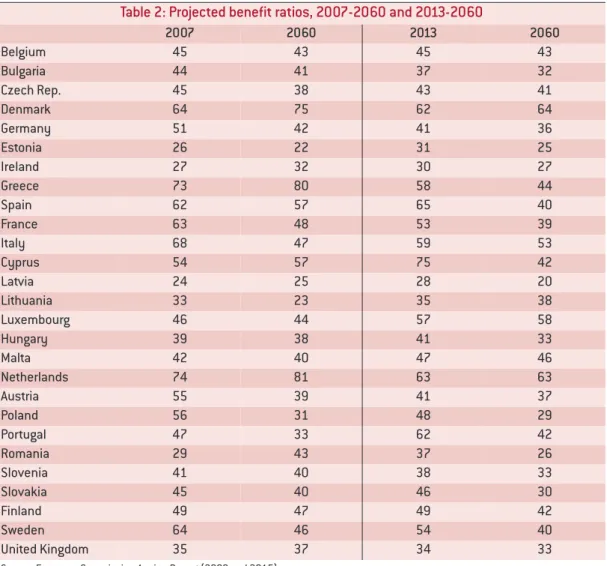
ANNEX II: projected benefit ratios
Table 2: Projected benefit ratios, 2007-2060 and 2013-2060
2007 2060 2013 2060 Belgium 45 43 45 43 Bulgaria 44 41 37 32 Czech Rep. 45 38 43 41 Denmark 64 75 62 64 Germany 51 42 41 36 Estonia 26 22 31 25 Ireland 27 32 30 27 Greece 73 80 58 44 Spain 62 57 65 40 France 63 48 53 39 Italy 68 47 59 53 Cyprus 54 57 75 42 Latvia 24 25 28 20 Lithuania 33 23 35 38 Luxembourg 46 44 57 58 Hungary 39 38 41 33 Malta 42 40 47 46 Netherlands 74 81 63 63 Austria 55 39 41 37 Poland 56 31 48 29 Portugal 47 33 62 42 Romania 29 43 37 26 Slovenia 41 40 38 33 Slovakia 45 40 46 30 Finland 49 47 49 42 Sweden 64 46 54 40 United Kingdom 35 37 34 33