Adequate and sustainable pensions
ADEQUATE AND SUSTAINABLE PENSIONS
SYNTHESIS REPORT 2006
European Commission
Directorate-General for Employment, Social Affairs and Equal Opportunities Unit E.4
sion's Directorate-General for Employment, Social Affairs and Equal Opportunities, please send an e-mail to [email protected]. The newsletter is published on a regular basis in English, French and German.
A great deal of additional information on the European Union is available on the Internet. It can be accessed through the Europa server (http://europa.eu).
Cataloguing data can be found at the end of this publication.
Luxembourg: Office for Official Publications of the European Communities, 2006 ISBN 92-79-01859-0
© European Communities, 2006
Reproduction is authorised provided the source is acknowledged.
Printed in Belgium
PRINTED ON WHITE CHLORINE-FREE PAPER
Europe Direct is a service to help you find answers to your questions about the European Union
Freephone number (*):
00 800 6 7 8 9 10 11
(*) Certain mobile telephone operators do not allow access to 00 800 numbers or these calls may be billed.
1 1 1 2 3 1: © Corbis 2: © Hollandse Hoogte 3: © EC/Nabir Utarbekov 1 3
This second Report on Adequate and Sustainable Pensions provides a synthesis of recent developments in the area of pension reform in the EU. It was prepared jointly by the European Commission's Directorate-General for Employment, Social Affairs and Equal Opportunities and the Directorate-General for Economic and Financial Affairs and analyses the second round of Member States' 2005 National Strategy Reports on pensions. The report's conclusions have also been taken on by the 2006 Joint Social Protection and Social Inclusion Report.
The fall in the EU's effective retirement age in the 1970s and 1980s goes against the significant rise in life expectan-cy for the same period. In short, the number of contribution years has decreased, while the number of years in receipt of pension benefits has grown, putting pressure on the sustainability of adequate pension systems. In response to this, Member States are pursuing policies to boost employment and many have already carried out reforms that have helped to push up the employment rates of older workers from 36% in 2000 to 43% in 2005. The main pension challenge for Europe's ageing society is to ensure that this rise in the effective retirement age continues.
This report shows that, since 2003, there has been substantial progress in reforming pension systems. Some Member States are still in the early stages of the reform process, but others have strengthened their reform efforts and several have made comprehensive reforms.
Recent reforms include automatic or semi-automatic review mechanisms which ensure the periodic monitoring of sources of pressure on pensions and, together with efforts to inform citizens about their pension rights, build pub-lic confidence. Other positive developments are the reduction of disincentives to work longer coupled with the strengthening of incentives to remain active. Links between contributions and benefits have been tightened and life expectancy is now more commonly taken into account when calculating pension formulae. Some Member States are increasing the level of guaranteed minimum pensions and many recognise care work when calculat-ing pension entitlements. In addition, the provision of supplementary pensions has been further developed and the relevant legislative framework strengthened. In many Member States, the contribution of privately-managed pensions to pensioners' living standards in retirement is expected to grow over the coming decades, even though public pay-as-you-go schemes will remain the main pension source.
At the same time, concerns over unequal access to private pensions have been raised and some Member States are working on policy responses. Reforms have led to a decrease in pensions generally, but this can be com-pensated for by longer working lives as well as by higher personal savings. All of this requires careful monitor-ing. Inadequate pensions are a serious threat to social cohesion and unless Europe develops an integrated approach which links adequacy and sustainability, the risk of poverty and social exclusion will grow. Unsustain-able pension systems jeopardise the security of adequate incomes in retirement. An insufficient accrual of pen-sions increases pressure on public finances and a rise in the demand for ad-hoc re-evaluations of penpen-sions, as well as additional pressures from other social benefits, means more public spending. So for reform strategies to succeed, adequacy, sustainability and modernisation must be considered as one.
This second Report on Adequate and Sustainable Pensions is a solid basis for deepening the review and policy exchange on pensions within the Open Method of Coordination on Social Protection and Inclusion. It also highlights policy issues which are vital to growth and employment, as well as to the sustainability of public finances.
I invite you to read about the recent developments in pension systems in the EU. I am confident that this analy-sis will serve as an inspiration to us all in tackling pension reform.
Vladimír Špidla European Commissioner for Employment, Social Affairs and Equal Opportunities
Part I – General synthesis
English
. . . 91. The pension challenge . . . 9
2. The open method of coordination in the field of pensions in the context of the Lisbon strategy . . . 10
3. Main lessons from the second round of open method of coordination in the field of pensions . . . 11
4. Conclusion . . . 18
Français
. . . 211. Le défi des retraites . . . 21
2. La méthode ouverte de coordination pour le domaine des retraites, dans le cadre de la stratégie de Lisbonne . . . 22
3. Principaux enseignements à tirer du deuxième cycle d’application de la méthode ouverte de coordination dans le domaine des retraites . . . 23
4. Conclusion . . . 31
Deutsch
. . . 341. Die Rentenherausforderung . . . 34
2. Die Offene Methode der Koordinierung im Bereich Renten im Kontext der Lissabon-Strategie . . . 35
3. Wichtigste Lehren aus der zweiten Phase der Anwendung der offenen Methode der Koordinierung im Bereich Renten . . . 36
4. Schlussfolgerung . . . 44
Part II – Horizontal analysis
. . . 47Methodological note – Background statistics for the Synthesis report on pensions . . . 47
Adequacy
. . . 53Objective 1 – Preventing social exclusion . . . 53
Objective 2 – Enabling people to maintain living standards . . . 66
Objective 3 – Promoting solidarity . . . 77
Sustainability
. . . 80Objective 4 – Raise employment levels . . . 80
Objective 5 – Extend working lives . . . 84
Objective 6 – Making pension systems sustainable in a context of sound public finances . . . 90
Objective 7 – Adjust benefits and contributions in a balanced way . . . .122
Objective 8 – Ensure adequate and financially sound private pensions . . . .126
Modernisation
. . . .136Objective 9 – Adapt to more flexible employment and career patterns . . . .136
Objective 10 – Meet the aspirations for greater equality between women and men . . . .140
Objective 11 – Demonstrate the ability of pension systems to meet the challenges . . . .145
Part III – Country summaries
. . . .151 Belgium . . . .151 Czech Republic . . . .156 Denmark . . . .161 Germany . . . .167 Estonia . . . .171 Greece . . . .175 Spain . . . .179 France . . . .184 Ireland . . . .188 Italy . . . .192 Cyprus . . . .197 Latvia . . . .201 Lithuania . . . .205 Luxembourg . . . .209 Hungary . . . .212 Malta . . . .217 The Netherlands . . . .221 Austria . . . .226 Poland . . . .230 Portugal . . . .235 Slovenia . . . .240 Slovak Republic . . . .244 Finland . . . .248 Sweden . . . .253 United Kingdom . . . .257 Table of contentsThe pension challenge
1
Part I – General synthesis
English
One of the main achievements of social policies in the second half of the last century is that being old is no longer synonymous with being poor or being dependent on the support of one's children. This success has mainly been achieved through the provision of public pensions.
While recognising the achievements of pension sys-tems, the challenges of the ageing populations, in par-ticular the financial strains on pension systems, have already long been high on the agenda of European policy-makers. Most recently, the informal European Council in Hampton Court asked Europe to reflect in more depth on the consequences of demographic trends on economic and social policies and the Com-mission's first annual progress report 'Time to move up a gear' of 25 January 2006 identifies responding to globalisation and ageing, and in particular reforming of public pension systems, as one of the main actions to be undertaken in Europe. As highlighted in the joint report by the Commission and the Council on ade-quate and sustainable pensions of 2003, the pension challenge in an ageing society is to continue the increase of effective retirement ages. While in the 1960s it was normal to retire well after 60, employ-ment of older workers declined in the 1970s and 1980s in many countries and has only recently started to increase: average ages of leaving the labour mar-ket are still below the levels of the late 1960s.
This decline in average effective retirement age (accompanied by an increase in the age of entering the labour market) runs contrary to the substantial increase in life expectancy in the same period. Life expectancy at 60 for EU-25 increased by 4 years from 1960 to 2000 (from 15.8 years to 19.3 years for men and from 19 years to 23.6 years for women). The most recent Eurostat projections see life expectancy in the EU-25 at 65 to increase by another four years from 2004 to 2050 (4.4 years for men and 3.9 years for women). Even in the context of a favourable demo-graphic situation where the active population was increasing, the increase of life expectancy over the second half of the 20th century would still need to be partly accommodated through increases in contribu-tion rates.
To sum up, contribution years have decreased while years in receipt of benefits have increased, putting pressure on the financing of pension systems. Reforms are now needed to ameliorate past reductions in the effective retirement age and increases in the dependen-cy ratio and to cope with the retiring of the baby-boom generation and future increases in life expectancy.
Pension reforms require long-term strategies. The process of reform itself is lengthy as pensions reforms are usually built on broad consensus as they are a fun-damental part of our social protection systems and of social cohesion. Furthermore, States dedicate signifi-cant amounts of public expenditure to old age provi-sion, which in light of demographic trends is set to grow significantly. Therefore reforms of pensions sys-tems should be seen both in the context of ensuring adequate and sustainable retirement provision, and in the context of sustainable public finances as a whole and sustainable growth across the EU.
The Stockholm European Council outlined a three-pronged strategy to tackle the budgetary implications of ageing populations:
• Member States should reduce public debt levels at a faster pace;
• Member States should undertake comprehensive labour market reforms, including tax and benefit sys-tems, in order to achieve higher employment rates, in particular among older workers and women;
• Member States should undertake appropriate reforms of pension systems in order to contain pres-sures on public finances, to place pension systems on a sound financial footing and ensure a fair inter-generational balance.
A dominant proportion of total pension provision in almost all Member States is organised within the gen-eral government sector and, thus, affects the public finances to a great extent. It is necessary to ensure that rising public spending on pensions due to the ageing of the population does not jeopardise sustainable
pub-The open method of coordination in the field of pensions
in the context of the Lisbon strategy
2
lic finances and that appropriate strategies are in place for ensuring that the long-term commitments of pension systems can be met. At the same time, sound management of public finances can provide room for manoeuvre as regards the budgetary pressures of age-ing populations.
There are strong grounds based on equity and efficien-cy for government involvement in pensions, be it provi-sion, financing or regulation. This is in particular linked to basic social objectives, such as securing ade-quate income in old-age. This requires making choices today for the long term, despite uncertainties resulting from the unpredictability of economic and social trends. At the individual level, such choices would be extremely difficult and are likely to lead to under-provi-sion for most people, in particular for people with low
incomes or with difficulties engaging in long-term financial planning. Private insurance also has great difficulties dealing with uncertainties involved in long-term commitments. Pension systems based on universal coverage have the largest ability to cover uncertainties related to long-term commitments to provide adequate old-age income.
Public provision plays a central role in national pen-sion systems, which are very diverse among EU-25, highlighting that there is no one-size-fits-all solution. While the basic goals of access, adequacy and finan-cial viability are universal to all systems, there is con-siderable degree of variation in design at national level, as a result of historical differences and reflecting differing preferences for redistribution or for leaving choices to individuals.
The Laeken European Council of December 2001 recognised that there could be significant benefits by enhancing dialogue and cooperation on issues related to the reform of pension systems. It endorsed common objectives of adequacy, financial sustainability, adapt-ability, and a working method based on the open method of coordination (hereafter OMC).
Subsequently, a first wave of National Strategy Reports (NSRs) described in 2002 how the 15 Mem-ber States intended to meet these objectives. On the basis of these NSRs the Commission and the Council adopted a Joint Report on adequate and sustainable pensions in March 2003.
The 2003 Joint Report concluded that “Most Member States see pension reform as a continuous process rather than a one-off, discreet event […] The momen-tum behind reform process to secure the sustainability of adequate pensions must be maintained.”
Responding to the Joint Report on Pensions, the European Council of March 2003 called on Member States to ensure the implementation of further reforms and for con-tinued application of the OMC in the field of pensions. The Council asked for progress to be presented in 2006, and for the new Member States to be included. This is presented in the Commission's proposal for the Joint Social Protection and Social Inclusion Report of 2006.
In 2005, the Commission proposed and the Council endorsed the revision of the Lisbon strategy for growth and jobs and revised Integrated Guidelines(1). It is
recognised that the OMCs on social protection and social inclusion feed into the Lisbon strategy. The Com-mission also intends to make the EU level coordination in the area of social protection more effective by stream-lining the OMCs on pensions, social inclusion and healthcare and long-term care starting in 2006. This aims to create a stronger, more visible OMC with a heightened focus on the modernisation of policies and
(1) See in particular Guideline 2: “Member States should […] reform pension and healthcare systems to ensure that they are financially viable while being socially adequate and accessible, and take measures to raise employment rates and labour supply”. And Integra-ted Guideline 18: “Promote a lifecycle approach to work through […] modern pension and healthcare systems, ensuring their adequacy, financial sustainability and responsiveness to changing needs, so as to support participation in employment and longer working lives, including appropriate incentives to work and discourage early retirement.”
Part I – General synthesis – English
Main lessons from the second round of open method of
coordination in the field of pensions
3
policy implementation and which will interact positively with the revised Lisbon strategy, while simplifying report-ing and expandreport-ing opportunities for policy exchange.
Separate reporting as part of the OMC will continue along Member States' national reform programmes that present an overall review of reforms contributing to the objectives of growth and employment. Similarly, report-ing at EU level via the Joint Report on Social Protection and Social Inclusion will feed into the EU annual progress report.
Within this framework, this document provides the nec-essary analysis as an input for the pension aspects of the Social Inclusion and Social Protection Report of 2006. To this end, Member States presented their sec-ond NSRs in the summer of 2005. The NSRs were dis-cussed in a peer review in mid-September 2005, involving the Social Protection Committee (hereafter SPC) and the Economic Policy Committee (hereafter EPC). This report presents a synthesis of this new wave of reports.
3.1.
Main developments in pension
reforms in the Member States
The 2003 Joint Report on Pensions underlined the interdependency between the financial sustainability and adequacy of pensions in the context of ageing societies and the need for comprehensive reforms with the aim of securing adequate, accessible and finan-cially sustainable pension systems. In particular, the Joint Report called on Member States to improve incen-tives for older workers to remain longer in the labour market, to strengthen the link between contributions and benefits and to increase public and private fund-ing, especially in light of the long-term implications for pension expenditures of increased life expectancy.
Europe’s population will be slightly smaller, but signifi-cantly older in 2050. There will be two workers per elderly citizen as opposed to the current ratio of four to one. Recent long-term projections show that pension costs will lead to significant increases in public spend-ing in most Member States by 2050. On the basis of current policies, public expenditure on pensions is pro-jected to increase on average by 2.2 percentage points for the EU-25, with a large dispersion among Member States.
There has been substantial progress in reforming pen-sion systems since the 2003 Joint Report. Member States have also reported on reforms to their pension systems in the context of the national reform pro-grammes, assessed in the Commission's annual progress report. Disincentives to work longer have
been reduced and incentives strengthened, links between contributions and benefits have been tight-ened and life expectancy has been further taken into account in pension systems. Moreover, the provision of supplementary pensions has been promoted and leg-islative frameworks improved. Furthermore, some Member States have also tackled old age poverty by increasing the levels of guaranteed minimum pensions. Reforms have made steps regarding all three key objectives: providing adequate retirement income, ensuring financial sustainability and adapting systems to changing labour market and societal conditions.
Some Member States have introduced major reform packages. Germany, in addition to 2001 reforms (which led to a lower increase of first-pillar pension lev-els and the creation of State supported, funded, volun-tary, second- and third-pillar pensions), undertook measures through the Sustainability Act of 2004, which are aimed at aligning the importance of the lev-els of contribution rates and the levlev-els of benefits paid out. It also introduced a sustainability factor to the pen-sion indexation formula, requiring additional adjust-ments if the ratio between contributors and beneficiar-ies worsens. In France, the 2003 reform improved long-term sustainability via an increase in the number of contribution years required for a full pension (this will be further increased in line with future increases in life expectancy), as well as via strengthened incentives to work longer. Members of the public and private schemes are now also treated more equitably. In Aus-tria, the 2004 and 2005 reforms make a major step towards a more sustainable pension scheme through
a stronger link between contributions and benefits as well as an increase of the contribution years needed for a full pension. Incentives to work longer were also increased and incentives to take up early pensions decreased through a so-called bonus/malus system. It also introduces a much more uniform pension system across the public and the private sector and introduces the indexation of pensions to prices as of 2006. The Finnish pension reform, implemented mainly in 2003–05, increased incentives to work by providing a higher accrual of pension rights for older workers and overhauling early retirement arrangements. It will also introduce a 'life-time coefficient' with the affect of adjusting future pensions to increases in life expectan-cy. Lithuania (in 2004) and Slovakia (in 2005) intro-duced a funded tier to their social security pension sys-tem, which will strengthen the sustainability of the statutory pay-as-you-go old-age pension scheme in the long run while allowing individuals to accrue additional pension rights through privately-managed funds.
Concerning occupational and private pension sche-mes, the legislative framework was improved notably by the Netherlands and the United Kingdom. In the Netherlands, the principles for a new Financial Assess-ment Framework for suppleAssess-mentary pensions were established in 2004. It sets tighter requirements, in particular for the size of reserves for collective private pension arrangements. It also sets requirements for the break-even contribution rate and consistency between commitments regarding indexation, financing and related communications. In the United Kingdom, the provision of private pensions has been promoted by a streamlined and simplified regulatory regime (over-seen by the new Pensions Regulator), a simplified tax regime for pension funds and greater protection for final salary schemes (by the establishment of the Pen-sion Protection Fund).
Other Member States have continued adapting their existing system. For example, Spain, Portugal, Belgium and Ireland increased the levels of their guaranteed minimum pensions beyond the statutory index adjust-ments, while the United Kingdom implemented Pension Credits. Portugal strengthened incentives to work longer and fostered more equitable treatment of mem-bers of different schemes. Incentives to work longer were also developed in a number of Member States including Luxembourg, the Netherlands (favourable tax conditions for the take-up of early pensions have been reduced and an innovative life course arrangement,
replacing early retirement arrangements, will be intro-duced in 2006) and Italy (the 2004 reform plans a gradual increase of the age requirements for seniority pensions). In Denmark collective agreements will see increases in contribution rates. Sweden further devel-oped information provision through a broad pension Internet portal established in 2004.
The new Member States were not covered in the 2003 Joint Report on Pensions. In most central and eastern European Member States pension systems were trans-formed substantially in the 1990s establishing a new architecture combining a public pay-as-you-go scheme and a mandatory private funded scheme for people below a certain age and voluntarily available to older persons while maintaining the old system for those who did not want or were not obliged to join the new system. Private schemes are mandatory for new entrants to the labour markets in Estonia, Latvia, Poland, Hungary and Slovakia and voluntary in Lithuania. Furthermore, in Latvia and Poland, the pub-lic pay-as-you-go scheme has been reformed into a notional defined-contribution (NDC) scheme. In a num-ber of Memnum-ber States a serious examination of the pension system has been commissioned by groups of experts or organised through social dialogue. Some pension laws provide for periodic reviews as a basis for next steps in the reform process. For example, Spain renewed the Toledo Pact underlining the impor-tance of dialogue with the social and economic play-ers involved, when it comes to monitoring present and future reform measures. The Parliament is reviewing progress and future reform measures every five years. Spain will create a Permanent Observatory to monitor the evolution of the social protection systems and is designed to carry out analysis and make proposals for necessary changes. The Pensions Commission (Chaired by Lord Turner) in the United Kingdom deliv-ered recommendations for reform in its second report at the end of November 2005. The government has committed to consider these and other recommenda-tions before bringing forward proposals in spring 2006. The Czech Republic reformed its existing system adapting some of the parameters such as retirement age and years of service but left several other elements untouched (retirement age in relation to number of chil-dren non-contributory periods). These features have been examined by a multi-party expert group that advocates further reforms. All major parties have com-mitted themselves to translate these recommendations into legislation before the next election campaign
starts in 2006. Malta adopted a 'White Paper' on a pension reform strategy, which is currently under dis-cussion. In Denmark, the government has set up a Wel-fare Commission charged with submitting specific pro-posals before the end of 2005 for reforming the Dan-ish welfare model, including pensions and in particu-lar early retirement provisions. In the light of the analy-sis from the Welfare Commission and with a view to maintaining the long-term economic targets, the gov-ernment will (in spring 2006) present a new econom-ic multi-year plan, covering at least the period up to 2015. In Ireland, the Pension Board is expected to submit its review on the pension system with proposals for measures for reform at the end of 2005. In partic-ular, proposals concerning the promotion of occupa-tional pensions are awaited. Regular reviews on the development of the pension system will also be carried out in Germany, France and Austria.
3.2.
Key issues emerging from
the National Strategy Reports
The OMC on pensions is based on 11 specific objec-tives grouped around the areas of adequacy, sustain-ability and modernisation. The detailed analysis of progress towards these objectives, as presented in the second round of NSRs, appears in the technical annex. The NSRs also report on the contribution made to pension sustainability by reducing public debt (BE, DK, NL) providing room for manoeuvre when making resources available to pension systems.
Four issues, already highlighted in the 2003 Joint Pen-sion Report still remain a priority:
• strengthening incentives for working longer;
• developing a life-cycle approach and strengthening the link between contributions and benefits while ensuring adequate income replacement and man-aging increasing longevity;
• making pension systems more adaptable to structur-al changes;
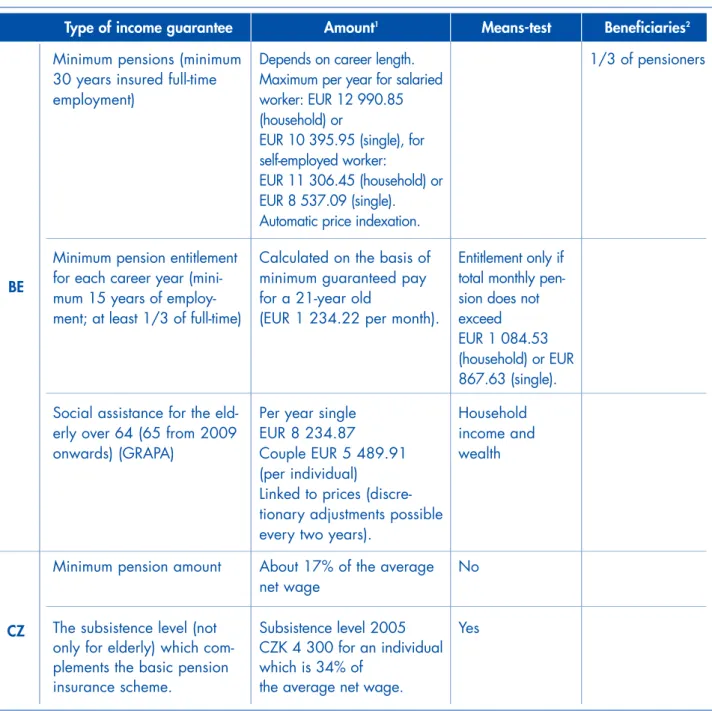
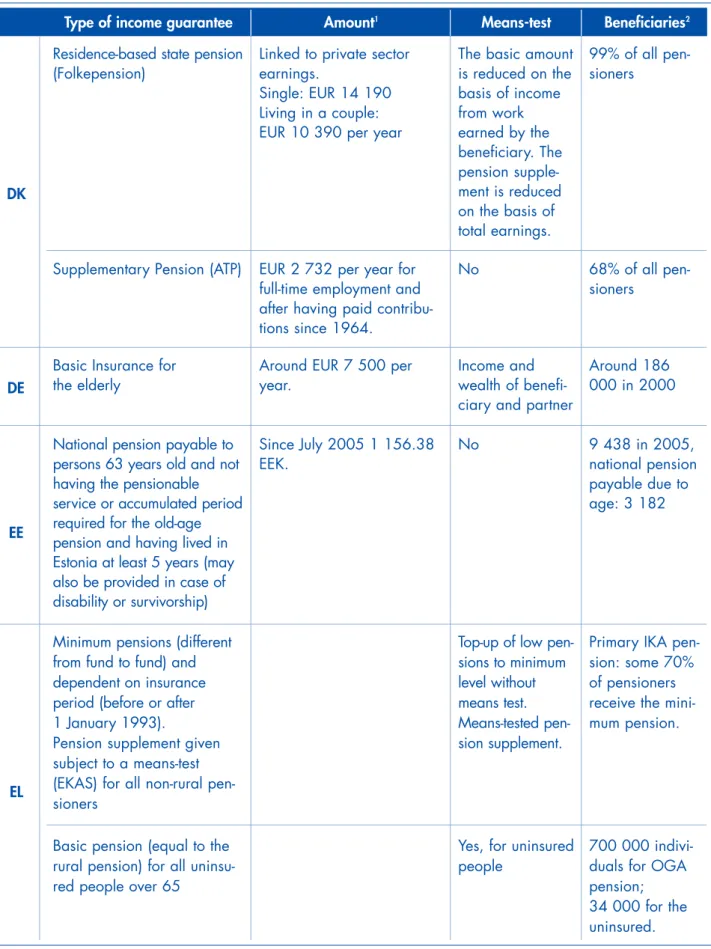
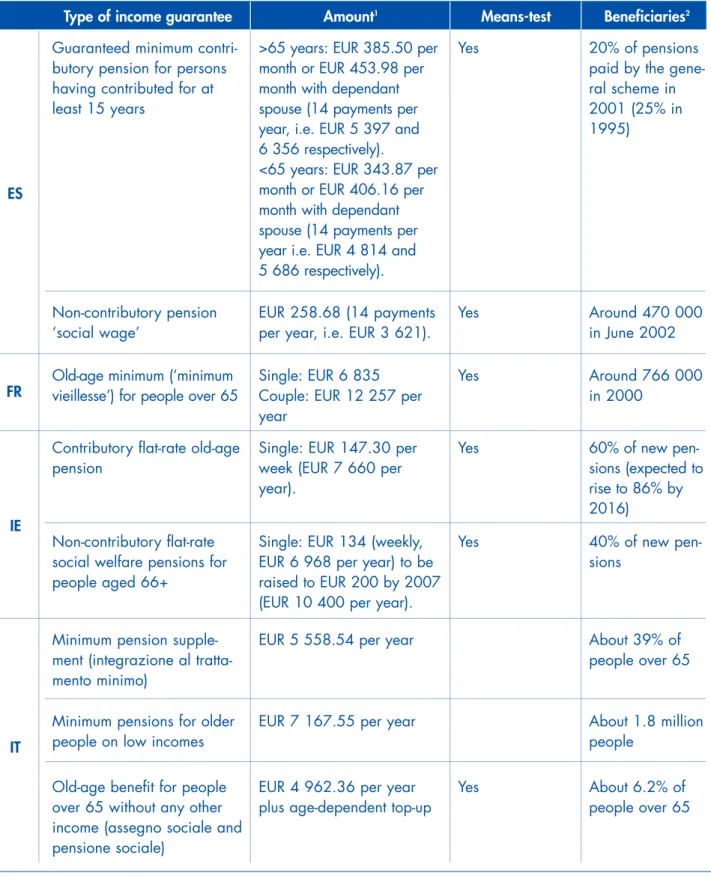
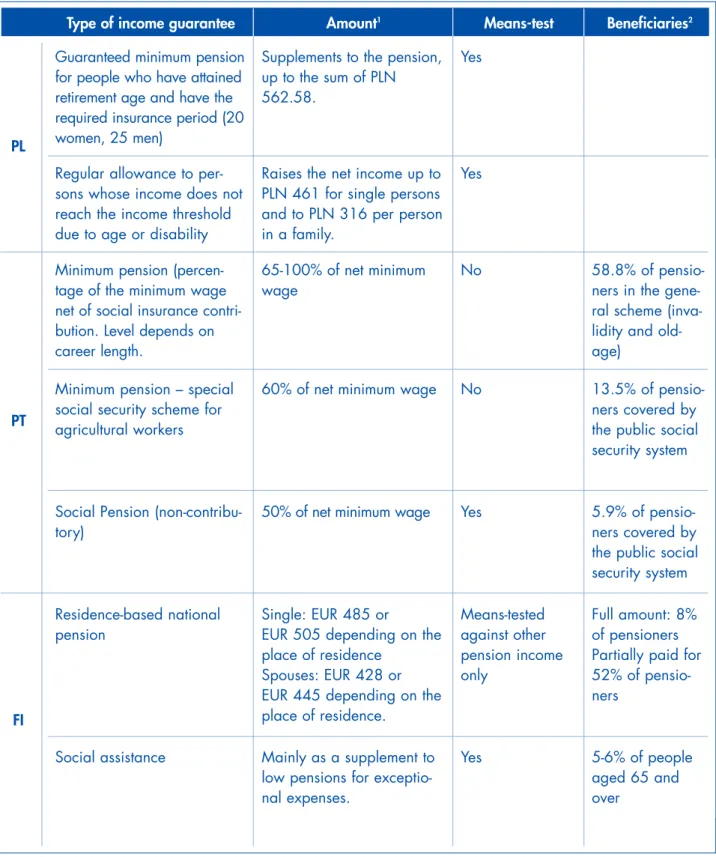
• strengthening the role of minimum pensions and of solidarity in pension systems.
Two other issues emerge more forcefully in the light of recent reforms:
• secure private pensions complementing and partial-ly replacing public pension provision;
• strengthening the governance of pension systems.
3.2.1. Strengthening incentives to extend working lives
As already highlighted in the 2003 Joint Report, it is crucial that people work longer, but in some countries starting work earlier is also important. Working longer is an explicit European target in the Lisbon context, both through the objective of increasing the employ-ment rate of older workers (aged 55–64) to 50% and through the objective of an increase of 5 years of the effective age of exit from the labour market. Longer working lives result in more contribution years and fewer benefit years, thus contributing directly to the adequacy and sustainability of the pension system. Pension systems are an important part of labour mar-ket institutions through the provision of benefits. There-fore, it is of utmost importance that the incentive struc-ture embedded in the pension system is supportive to employment.
Part I – General synthesis – English
According to the latest demographic projections, old-age dependency ratios (population aged 65 or more related to population aged 15–64) will more than double from 2005 to 2050 (from 24 to 51, an increase of around 110%).
The economic dependency ratio (population aged 65 and more related to the number of persons employed) is projected to increase by roughly 90%, (from 37 to 70) according to the Ageing Working Group 2005 projections, despite a pro-jected increase of the general employment rate from the current 63% to 71% in 2050. This would mean that while there are currently almost 3 work-ers per each pensioner, in 2050 there would be only 1.4 workers per pensioner.
Employment rates of young people (15–24) in the EU are on average 37%, but with variations between Member States of 20% to 60%. Although it is an explicit EU objective to increase participation rates in education, this difference suggests that greater efforts are needed to integrate young people into the labour market and to support them as they pursue 'nonlinear' careers alternating between employment and study. Earlier working contributes to longer working lives and a higher accrual of pension rights, thereby enhancing welfare both at society’s and individual level.
Employment rates of older workers have increased in recent years, reversing a long declining trend. Indeed, the employment rate of older workers has increased from 36% in 1995 to 42% in 2004 for EU-15, while the increase for EU-25 ranges from 36% in 2000 to 41% in 2004. In spite of recent improvements, in a number of Member States the employment rate of older workers lies below or around 30% (BE, IT, LU, HU, MT, AT, PL, SI, SK), or between 30% and 45% (CZ, DE, EL, ES, FR), while it lies between 45% and 55% in some others (LV, LT, NL, EE, IE, CY, PT, FI), and exceeds 55% only in a few (DK, SE and UK).
In nearly all Member States, recent reforms have strengthened incentives to extend working lives (espe-cially for statutory schemes), and reduced access to early retirement. Working longer is generally encour-aged by pension supplements and leaving earlier dis-couraged by actuarial reductions. Furthermore greater flexibility is provided in the timing of retirement, for example combining employment and partial retire-ment. In addition access to disability, sickness and incapacity schemes are being reviewed to eliminate other paths to early exit. While in defined contribution schemes, effective incentives are inherently imbedded. Some defined benefit schemes may require adaptation of eligibility rules and pension parameters (such as age limits of access to early or specific schemes, bonus/malus coefficients, etc.).
Moreover, as illustrated by the work carried out on replacement rates by the Indicator Sub-Group, reforms of statutory schemes have often led to a decrease of individual replacement rates, measured at the time of a given retirement age. However, many Member States have increased the accrual of pension rights if people work longer and these should act as incentives to work longer.
A key question for the future is whether the reforms car-ried out are sufficiently thorough to ensure efficient incentives to work longer so that the Lisbon targets for employment rates and the increase in effective retire-ment age can be achieved. Important differences can be observed among Member States according to the strength of incentives to work longer, depending on the design of the pension system. This suggests that the structure of incentives could be further revised in a number of Member States. In particular, attention still needs to be paid in a number of Member States to paths of early exit (before the standard retirement age) from the labour market.
Pension reforms give strong incentives to work longer and when well-designed they reward doing so with adequate pensions. However there is a need to ensure that people can work effectively longer as is under-lined in Integrated Guideline for growth and jobs 18 (promoting a life-cycle approach to work). As analysed in the First Commission Report on the Nation-al Reform Programmes opening up employment oppor-tunities for older workers through accelerating labour market reforms is essential (a reference to COM Annu-al Lisbon Progress Report). Pension systems can facili-tate later retirement, but without suitable access for older workers to appropriate employment they are unlikely to be particularly effective.
3.2.2. Developing a life-cycle approach and streng-thening the link between contributions and benefits, while ensuring adequate income replacement and managing
increasing longevity
The issue of the balance and the link between contribu-tions and benefits as well as the transparency of this link are important, both for defined-benefit pensions systems (that are common among statutory pay-as-you-go systems), and for defined-contribution schemes, for which it is inherent in the system. Pension reforms have to deal with demographic developments and in partic-ular increased longevity, which is a key driver for increasing pension expenditure in the future. This increase in a financially-balanced scheme would require either higher contributions by workers or lower benefits for pensioners, if the increase in life expectan-cy were spent in retirement. However, increases in life expectancy can be shared between the years in employment and retirement, thereby resulting in a bet-ter balance between lifetime contributions and benefits.
As a response to future increases in life expectancy, a number of reforms are designed to stabilise pension systems through automatic adjustment mechanisms (as in SE, FI, PL, LV or DE) or periodically required reviews and adjustments (like in AT, IT or FR). These adjustments will also promote a life-cycle approach.
Weak links between contributions made to pension schemes and benefits received may lead to inequitable and inefficient outcomes both within and between gen-erations. In particular, people may see contributions more as general taxation, rather than as a build-up of their own pension rights. Reforming such pension pro-vision together with other benefit systems may encour-age them to work longer or to move out of the black economy.
A number of recent reforms have strengthened the ben-efit/contribution link of pension systems. Funded and notional defined contribution schemes establish a strong link. Also in many defined-benefit schemes, links have been strengthened. This has occurred firstly, through the introduction of longer contribution periods required for a full pension. Secondly, by calculating full pensions on the basis of life-time earnings instead of final salary, thus reflecting more accurately contribu-tions over an entire career, rather than just wage pro-gression in later years. Thirdly, applying actuarial reductions/increases for early/deferred retirement also contributes to a culture in which early retirement is less prevalent (this has occurred in a number of Member States, like AT, FR, FI, ES, PT, NL or IT), while the link was strengthened by previous reforms in many Member States, such as DE, BE, or LU, HU, EE, LV, LT, PL, SK, SI or SE).
However, reinforcing the link between contributions and benefits has to be combined with a careful moni-toring of the accrual of pension rights during breaks in careers such as childcare, other caring responsibilities, unemployment, sickness or education leaves to ensure both adequacy and equity in retirement.
3.2.3. Modernising pension systems by making them more adaptable to structural change New labour supply structures require adaptable pen-sion systems. Due to increases in participation rates and societal changes more and more people do not follow the standard career of full-time, life-long
employ-ment. Career breaks and part-time work are becoming more frequent, and more and more people, at least for part of their professional career, are self-employed. These trends make adjustments of pension systems nec-essary in order to encourage activity and ensure ade-quate pension entitlements for all, even if this may make the system less transparent.
Member States have started to review pension provi-sion for workers with atypical careers and for the self-employed, with a view to easing access to statutory and supplementary pension schemes. For example, some Member States, in particular where the link between contributions and benefits have been strength-ened, allow people to acquire pension credits for peri-ods of short-term contracts, part-time and voluntary work as well as for some breaks in the work career such as child and old-age care, education and unem-ployment. The purpose of such provision is to ensure that working part-time or on fixed-term contracts com-bined with periods of other activities or unemployment should not harm pension entitlements disproportionally. Against the overall trend to reduce future pension ben-efits in the pay-as-you-go schemes, several Member States are improving credits for childcare and have introduced similar provisions for old-age care. Progress in this area of modernisation seems to be difficult to achieve and this may relate to tensions between incen-tives to accrue original pension rights through paid employment and recognising non-paid labour.
Most of the Member States are gradually phasing out differences in legal retirement ages between men and women. Other Member States appear to be retaining different retirement ages on gender grounds, at least for the next two decades. Some Member States still provide early retirement provisions for women with children. It is notable that the design of survivors' pen-sions is changing as the traditional widow’s pension will become less and less frequent, due to rapid increases in employment opportunities for women.
Generally, workers who change employers frequently are better served by statutory schemes, and many statutory schemes have moved towards accommodat-ing short-term contracts, while supplementary pension schemes (notably those which are linked to an individ-ual employer), can disadvantage mobile workers with regard to pension rights in comparison to long-term employees (notably due to waiting and vesting
ods). Given the rising importance of supplementary schemes some Member States (DK, DE, NL, UK) have improved the portability of supplementary pension rights which pose obstacles to worker's mobility – a growing feature in labour markets today and in the future. In order to improve the overall conditions of portability of supplementary pension rights and accompany the initiatives already taken by some Member States, the European Commission has recent-ly adopted proposals for a directive designed to improve portability.
3.2.4. Guaranteeing minimum retirement income provision and solidarity
In some Member States, in response to the need to pro-vide decent retirement income for older people, guar-anteed minimum pensions have been recently increased by more than statutory indexation require-ments (like in BE, ES, IE, IT or PT). In 2003, the UK implemented an improved income-related benefit 'pen-sion credit', in order to increase incentives to save for one's retirement.
An issue raised by these reforms of minimum pensions and more generally minimum benefits for older people is how they affect incentives for the accrual of pension rights. In this respect, the links between minimum ben-efits, indexation rules and incentives should be careful-ly considered.
Another issue is whether minimum pensions or mini-mum benefits are indexed differently from earnings-related pensions and whether this can have unintend-ed effects on the income distribution among pension-ers. Recent developments show that more and more countries have switched to price, or close to price, indexation both for earnings-related schemes and for minimum pension schemes. However, indexation of guaranteed minimum pensions on prices usually means that the income of those being dependent on minimum pensions lags behind the general evolution of income and may raise the risk of increased relative poverty among older pensioners even though it pre-serves their purchasing power. In order to prevent poverty increasing, governments are often required to take discretionary corrective measures (which is at
odds with the provision of a long-term, secure and sta-ble system, which individuals can have confidence in). Indeed, this issue should be considered in the broader context of promoting inclusion of older people. Some Member States address this by providing minimum income guarantees and others benefits in cash and kind, for example healthcare and care services, hous-ing and transport.
3.2.5. Secure private pensions complementing or replacing partially public pension provision Many Member States place greater emphasis on the contribution private funded provision can make in ensuring adequate retirement incomes, emphasising the positive role of diversification of the demographic risk between public and private schemes. Ageing pop-ulations, notably the retiring of the baby-boom gener-ation, means that the financial sustainability of pay-as-you-go systems requires close attention as the depend-ency ratio changes substantially. However, funded sys-tems will also be affected by population ageing.
The NSRs have captured much better than in the last exercise the issue of supplementary pensions. Several countries see a role for the private pension provision as part of the total pension provision. This has tradi-tionally been the case in some Member States (like DK, NL and UK). Moreover, the importance of private pen-sion provipen-sion has essentially been increased by the introduction of a funded tier of statutory schemes in a number of Member States like in SE, PL, HU, EE, LV, LT, and SK. Furthermore, a great number of countries have increased provisions for occupational or private schemes that complement public pensions (DE, IT, AT).
However, as underlined by the special study of the SPC on privately-managed pension provision, while the expected contribution of privately-managed pension schemes is projected to increase in the coming decades, in all but a few Member States, the public pay-as-you-go pension schemes are expected to remain the principal source of income of pensioners. This will allow Member States to maintain a degree of redistribution and solidar-ity that is necessary to provide fair incomes to all older people and to diversify risk at the individual level in an appropriate manner. In any case, the provision of
guar-anteed minimum pensions remains not only a State responsibility but is provided everywhere through public schemes. Moreover, the trend towards a broader use of privately-managed pension provision does not allow public policy to retreat from the area. Monitoring and regulating private pension provision is becoming an important and complex task for public policy. Moreover, transparency and competitive markets for financial inter-mediaries should be promoted.
If private pensions are to provide retirement incomes for people with lower incomes it is therefore essential that Member States invest in good governance struc-tures for them. Some Member States provide relatively favourable incentives for low-income people (DE, CZ) to participate in privately-managed pension provision, but this may not be sufficient. This also explains the debate in some Member States about making private savings mandatory, in particular if a major part of the pension provision should be based on private saving (as is the case in many new Member States). As far as private pensions are based on a wider use of volun-tary private pensions, they are generally used more frequently by higher income groups. This could exac-erbate the impact of reductions to the level of individ-ual replacement rates in statutory pension systems especially for older pensioners.
It is important for Member States to monitor whether the actual development of private pension provision matches needs, by assessing levels of coverage and benefits and their distribution by age and socio-eco-nomic status. Moreover, privately-managed schemes, as well as reserve funds of pay-as-you-go schemes have to operate at a sufficiently high level of security and efficiency. Rules on acceptable investment risks and prudent assumptions about future returns are important safeguards if their imple-mentation is well-enforced and monitored, while effi-ciency also means ensuring that administrative charges are kept low.
Finally, the translation of individual accounts into safe and secure annuities will become more and more
important, in particular for the regimes recently intro-duced that will begin to provide first, partial benefits in a few years and often before the end of the decade (like in PL, EE, HU, LV, LT or SK).
3.2.6. Strengthening the governance of pension systems
Periodic or ad-hoc reviews of pension systems, as well as automatic or semi-automatic adjustment mecha-nisms already mentioned in 3.2.2 contribute to a bet-ter governance of pension systems. In many cases they deal indeed with longevity but also with other changes in pension parameters such as employment and growth. NSRs outline developments of independent institutions responsible for monitoring pension systems. Such reviews make clear the need to balance the length of active life and of retirement, the income replacement and the total contribution required in view of the fundamental objectives of maintaining pension adequacy and sustainability. This is indeed an interest-ing trend as it increases the general transparency of pension systems and facilitates more consensual deci-sion-making.
The introduction of more flexibility for retirement ages in statutory pension schemes, the development of a closer link between contributions and benefits as well as the development of privately-managed provisions all imply greater and more complex choices for future beneficiaries.
As underlined in a number of Member States (like UK, IT, NL, DK, SE or IE), this trend should be accompanied by appropriate information on future pension levels and more generally by promotion of awareness of pen-sion issues and a better understanding of financial serv-ices. It is important to recognise the limits of information when expecting populations to make complex individ-ual decisions about retirement provision. Major efforts to provide information and to increase financial litera-cy are described in most reports and it is indeed impor-tant to define the rights of members and beneficiaries through high-quality information.
Conclusion
4
4.1.
Adequacy, sustainability and
modernisation should be considered
jointly
The second round of NSR confirms that the three main objectives of pensions adequacy, sustainability and modernisation are appropriate to guide the reform strategies necessary to address the pension challenge in Europe.
The NSRs highlight the interlinkages between the three broad objectives and the synergies and trade-offs between them. For reform strategies to be suc-cessful, all three elements must be present and con-sidered together.
If society does not develop an integrated approach linking adequacy and sustainability the risks are substantial. Unsustainable promises for future pen-sions jeopardise the possibility of adequate incomes in retirement. Inadequate accrual of pensions and delivery of low levels of income (or reducing pen-sion provipen-sion previously promised) would create unforeseen pressures for the sustainability of public finances, as an increasing demand for ad hoc reval-uations of pensions and possible unexpected demands for other (even means-tested) social bene-fits can result in higher public expenditure. These sit-uations could lead to sharp conflicts concerning the credibility of the pension system.
Increasing transparency in pension systems is impor-tant for both individuals (who need information and clarity in order to make long-term decisions) and governments (which need to develop monitoring tools for the long-term management of pension sys-tems). A particularly interesting new feature of recent pension reforms is the introduction of auto-matic or semi-autoauto-matic mechanisms that contribute to a periodic monitoring of various sources of uncer-tainties – in particular demographic trends – and promote the likelihood of proportionate and timely reforms.
4.2.
Contribution of pension reforms to
employment and growth
As underlined in many NSRs, pension reforms have to be considered in the broader context of society and the economy. The reform efforts outlined by Member States in their national reform programmes can be sup-ported by pension reforms, while stronger economies can also deliver better pensions. Increasing employ-ment opportunities for older people is vital for both achieving Lisbon employment goals and supporting sustainable growth, thereby allowing the maintenance of a high level of social protection in an ageing socie-ty. Pension reforms, employment and growth are there-fore interdependent.
Firstly, pensions constitute a major part of public expen-diture in almost all countries. A financially sound public pension system is essential to the sustainability of public finances as a whole, which in turn supports the overall growth and economic performance. Furthermore, a suc-cessful implementation of the Lisbon strategy leading to improved competitiveness and productivity can create room for manoeuvre for pension reform.
Secondly, pension systems and labour market perform-ance have close ties. Pension systems embed incen-tives that affect the labour supply of older workers, while a high level of employment also ensures high lev-els of contributions into the system. Contributions required for the financing of pension systems also affect labour costs and, consequently, labour demand. Higher contribution rates can result in reduced labour demand, while overly generous benefits can reduce labour supply, thereby aggravating labour market imbalances. Both benefits and contributions need to be considered in the context of their impact on the func-tioning of labour markets.
4.3.
Key issues to be monitored
Since 2003, many Member States have engaged in substantial pension reform, often against public opinion. Some Member States seem to have established compre-hensive reforms, others have strengthened their efforts, while some remain at an early stage of the reform process. While in the latter countries the momentum for reform needs to be accelerated, in most Member States the momentum should be maintained.
Across the NSRs the following points emerge as requir-ing careful monitorrequir-ing:
• Pension reforms need to continue to support the good functioning of labour markets by correcting and strengthening incentives for working longer and reviewing both the levels of contribution rates and benefits. Progress in labour market reform, including a culture shift among employers concerning retain-ing and re-employretain-ing older workers, is necessary.
• Pension reforms need to promote adjustment of sys-tems for the management of changes in life expectancy and the introduction of a life-cycle approach in their design.
• Modernisation needs to take better account of new forms of employment, flexible working, career breaks, care, and systems that allow women to build up their own pension rights.
• Measures to ensure future adequate minimum pen-sion gain importance but care must be taken over indexation rules and creating disincentives to work or save.
• The financial sustainability of public pensions sys-tems and their effect on government budgets need careful monitoring while taking into account the impact private pension systems may have on pub-lic finances. Furthermore, pubpub-lic debt should be reduced in order to make room for manoeuvre for expected increase in age related expenditure.
• Development of private provision can complement or partially replace public pension provision, and thus diversify risk at the individual level, but securi-ty and equisecuri-ty need to be ensured.
• Transparency and the promotion of better educa-tion and understanding of pension issues among the public needs to be enhanced.
• Regular review and adjustment mechanisms are important innovations not only to adapt systems over time but also to promote a better understand-ing of the need for reform in the face of demo-graphic challenges.
4.4.
Further steps within the open
method of coordination
The OMC on pensions has proved to be a good tool for the Union and Member States to advance their under-standing of pension reform by defining common objec-tives, reviewing progress and promoting a learning process. The new OMC as outlined in the Commission's Communication of 22 December 2005: 'Working togeth-er, working better: A new framework for the open coordi-nation of social protection and inclusion policies in the European Union' could, because of its integrated structure and its closer links to the Lisbon strategy for growth and jobs, enhance Member States' efforts to progress pensions reform. Future work should follow two methodologies:
• Continue the overall monitoring of progress made towards the common objectives without overbur-dening reporting requirements from Member States. As outlined in the Commissions' communica-tion, there will be alignment with the Lisbon three-year cycle (2005–08). Member States will not be required to deliver national strategies in intervening ('light') years. The OMC in light years will concen-trate on in-depth analyses of specific issues, on dis-seminating policy findings and on assessing indica-tors of progress towards the common objectives.
• Focus policy analysis and exchange of best practices on key issues. In addition to the ongoing work on replacement rates, in the light of the challenges iden-tified in this document, future horizontal work could focus on the following issues:
• the design of minimum income provisions for older people (including the link between pensions and other benefits provided to people in retirement);
• the strengthening of the link between contribu-tion and benefits (to be conciliated with non-contributory credits and taking into account gender issues);
• the link between the flexibility in the age of retirement and longer working lives;
• key issues in the development of private pen-sions (efficient legal framework, inequality in coverage, security, information, transition costs, contribution private pensions can make to financial sustainability);
• developing regular review and adjustment mechanisms.
This could be achieved via special studies and work-shops. The Peer Review methodology successfully used in the social inclusion strand could also be applied for some of the priority topics. The outcome of such work could be reported in an appropriate way to the SPC and EPC. The SPC may wish to consider submitting reports on some of the issues to the Commission and Council. Working methodologies, national reporting and horizontal studies provide important inputs into future joint reports on social protection and social inclusion and allow an effective con-tribution of the OMC to the Lisbon strategy for growth and jobs.
Part I – General synthesis – Français
Le défi des retraites
1
Français
Un des grands succès des politiques sociales de la seconde moitié du XXe siècle est que la vieillesse n’est plus synonyme de pauvreté ou de dépendance de la part des personnes âgées vis-à-vis de l’aide que leur apportent leurs enfants. Cette réussite est en grande partie celle des régimes publics de retraite.
Sans renier ces résultats, les décideurs européens se soucient depuis longtemps du problème du vieillisse-ment de la population et, notamvieillisse-ment, des contraintes financières qui en découlent pour les régimes de retraite. Tout récemment, le Conseil européen informel de Hampton Court a demandé à l’Europe une réflexion plus poussée sur les retombées des tendances démographiques sur les politiques socio-économiques; par ailleurs, la réponse à la mondialisation et le vieil-lissement de la population, avec en particulier la réforme des régimes publics de retraite, sont décrits dans le premier rapport de suivi annuel de la Commis-sion intitulé «Passons à la vitesse supérieure», en date du 25 janvier 2006, comme deux des principaux futurs champs d’action de l’Europe. Comme le souli-gnait le rapport conjoint du Conseil et de la Commis-sion de 2003 sur des penCommis-sions adéquates et viables, le défi, dans une société vieillissante, consiste à repousser encore l’âge effectif de départ à la retraite. Alors qu’il était normal, dans les années 60, de par-tir à la retraite bien au-delà de soixante ans, l’emploi des travailleurs âgés a décliné dans de nombreux pays au cours des années 70 et 80 — tendance qui n’a commencé à s’inverser qu’il y a peu. L’âge moyen de sortie du marché du travail demeure donc inférieur à celui observé à la fin des années 60.
Ce recul de l’âge moyen réel de départ à la retraite (combiné à une entrée plus tardive sur le marché de l’emploi) s’oppose à l’allongement significatif de l’es-pérance de vie enregistré au cours de la même période. De 1960 à 2000, l’espérance de vie à soixante ans a augmenté de quatre ans dans les vingt-cinq États membres de l’Union européenne (UE) (passant de 15,8 à 19,3 ans pour les hommes et de 19 à 23,6 ans pour les femmes). Selon les projec-tions les plus récentes d’Eurostat, l’espérance de vie à soixante-cinq ans dans l’Union devrait encore
augmenter de quatre ans entre 2004 et 2050 (4,4 ans pour les hommes et 3,9 ans pour les fem-mes). Même dans un contexte démographique favora-ble où la population active augmenterait, l’allongement de l’espérance de vie enregistré au cours de la seconde moitié du XXe siècle exigerait encore d’être en partie compensé par une hausse des taux de cotisation.
En résumé, la durée d’assurance diminue tandis qu’augmente le nombre d’années durant lesquelles les prestations doivent être payées, ce qui met à mal les finances des régimes de retraite. Des réformes sont désormais nécessaires pour contrer l’abaissement passé de l’âge réel de départ à la retraite, l’augmen-tation du rapport de dépendance, la sortie du marché du travail de la génération du «baby-boom» et les futu-res hausses de l’espérance de vie.
Toute réforme des retraites exige une stratégie à long terme. Le processus même de réforme est long, car il repose habituellement sur un vaste consensus, les régi-mes de retraite constituant l’une des composantes fon-damentales de nos systèmes de protection et de cohé-sion sociales. En outre, les États consacrent une part substantielle de leurs dépenses publiques à l’assu-rance «vieillesse» — part qui, au vu des tendances démographiques, ne manquera pas d’augmenter de manière significative. Par conséquent, la réforme des régimes de retraite relève aussi bien de la nécessité de garantir des pensions adéquates et viables que de la volonté de maintenir la pérennité de l’ensemble des finances publiques et de la croissance au sein de l’UE.
Le Conseil européen de Stockholm a défini les trois axes d’une stratégie visant à atténuer les répercussions budgétaires du vieillissement de la population. Les États membres devraient:
• réduire plus rapidement leur dette publique;
• réformer en profondeur leur marché du travail, dont les régimes d’imposition et de prestations sociales, afin de relever les taux d’emploi, notam-ment des travailleurs âgés et des femmes;
La méthode ouverte de coordination pour le domaine
des retraites, dans le cadre de la stratégie de Lisbonne
2
• réformer leurs régimes de retraite pour asseoir leur financement sur une base saine, atténuer la pres-sion sur les finances publiques et préserver un juste équilibre entre les générations.
Dans la quasi-totalité des États membres, l’organisa-tion des régimes de retraite relève en majeure partie de l’action générale de l’État et influe donc largement sur les finances publiques. Il faut veiller à ce que les dépenses de l’État consacrées aux retraites — en hausse sous l’effet du vieillissement de la population — ne menacent pas la viabilité des finances publiques et mettre en place des stratégies appropriées permet-tant de satisfaire aux engagements à long terme des régimes de retraite. Parallèlement, une gestion saine des finances publiques peut contribuer à atténuer les contraintes budgétaires engendrées par le vieillisse-ment de la population.
Il existe de solides arguments, fondés sur les principes de l’équité et de l’efficacité, justifiant l’action de l’État dans le domaine des retraites, que ce soit pour l’orga-nisation, le financement ou la réglementation des régi-mes. Ces arguments sont notamment liés à des objec-tifs sociaux fondamentaux, comme la nécessité de garantir un revenu adéquat aux personnes âgées.
Cette action nécessite de faire aujourd’hui des choix pour l’avenir, malgré les incertitudes résultant de l’im-prévisibilité des tendances socio-économiques. À l’échelon des individus, de tels choix seraient extrême-ment difficiles et conduiraient probableextrême-ment à une cou-verture insuffisante de la plupart des citoyens, notam-ment ceux disposant de faibles revenus ou pouvant dif-ficilement planifier à long terme leurs finances. De même, les assurances privées ont beaucoup de mal à gérer les incertitudes liées aux engagements à long terme. Ce sont donc les régimes de retraite reposant sur une couverture universelle qui sont les plus aptes à faire face à de tels engagements et à garantir un revenu adéquat aux personnes âgées.
La contribution de l’État joue un rôle crucial dans les régimes nationaux de retraite, très disparates au sein de l’Union des Vingt-cinq, ce qui montre bien qu’il n’existe pas de solution unique. Bien que les objectifs essentiels d’accès, de garantie de prestations adé-quates et de viabilité financière soient communs à tous les régimes des États membres, la conception de ces derniers varie considérablement, reflétant leur his-toire respective et les préférences données à une redistribution des revenus ou encore à la libre déci-sion des individus.
Lors du Conseil européen de Laeken, qui s’est tenu en décembre 2001, il a été reconnu qu’un dialogue et une coopération renforcés sur certaines questions liées à la réforme des régimes de retraite pourraient se révé-ler fort bénéfiques. Le Conseil européen a approuvé des objectifs communs — prestations adéquates, via-bilité financière, capacité d’adaptation — et une méthode de travail connue sous le nom de méthode ouverte de coordination (ci-après dénommée «MOC»).
En 2002, les États membres ont décrit, dans une pre-mière série de rapports stratégiques nationaux (RSN), comment ils comptaient atteindre ces objectifs. À par-tir de ces documents, le Conseil et la Commission ont adopté en mars 2003 un rapport conjoint sur des pensions adéquates et viables.
En conclusion, ce rapport précisait: «La plupart des États membres considèrent […] la réforme des retrai-tes comme un processus continu plutôt qu’un événe-ment isolé […]. Il faut maintenir l’élan de ce proces-sus de réforme qui vise à assurer la viabilité de pen-sions adéquates.»
En réponse au rapport conjoint sur les pensions, le Conseil européen de mars 2003 a appelé les États membres à garantir la poursuite des réformes et l’ap-plication constante de la MOC dans le domaine des retraites. Il a demandé à être informé en 2006 des progrès réalisés et souhaitait que les nouveaux États membres soient intégrés dans ce processus. Ces pro-grès sont présentés dans la proposition de rapport conjoint de 2006 de la Commission sur la protection et l’inclusion sociales.
Part I – General synthesis – Français
Principaux enseignements à tirer du deuxième cycle d’application
de la méthode ouverte de coordination dans le domaine des retraites
3
En 2005, la Commission a proposé — et le Conseil approuvé — une révision de la stratégie de Lisbonne pour la croissance et l’emploi et un remaniement des lignes directrices intégrées(2). Il est admis que les MOC
sur la protection et l’inclusion sociales alimentent le processus de Lisbonne. La Commission entend aussi rendre plus efficace la coordination communautaire de la protection sociale en harmonisant les MOC qui débuteront en 2006 dans le domaine des retraites, de l’inclusion sociale et des soins de santé et de longue durée. Créer une méthode ouverte de coordination plus percutante, plus visible et davantage axée sur la modernisation et l’application des politiques, générant des effets positifs sur la stratégie remaniée de Lis-bonne, tout en simplifiant le dispositif de présentation des rapports et en élargissant les possibilités d’échan-ges sur les mesures introduites, tel est le but recherché.
Dans le cadre de la MOC, des rapports séparés ren-dant compte des programmes nationaux de réforme
des États membres et brossant le tableau des réformes qui contribuent aux objectifs de croissance et d’emploi seront préparés. De même, les informations réunies à l’échelon de l’Union dans le rapport conjoint sur la protection et l’inclusion sociales alimenteront le rap-port de suivi annuel de l’UE.
Dans ce contexte, le présent document analyse la pro-blématique des retraites, préalable nécessaire au trai-tement de cette question dans le rapport de 2006 sur la protection et l’inclusion sociales. Les États membres ont à cette fin présenté leur deuxième rapport stratégi-que national (RSN) durant l’été 2005. Ces rapports ont fait l’objet, à la mi-septembre de la même année, d’un examen par des pairs associant le comité de pro-tection sociale (CPS) et le comité de politique économi-que (CPE). Le présent document fournit une synthèse de cette nouvelle série de rapports.
3.1.
Les grandes lignes de la réforme
des retraites dans les États
membres
Le rapport conjoint de 2003 sur les pensions soulignait l’étroite corrélation entre, d’une part, des régimes finan-cièrement viables et des niveaux de pension suffisants au vu du vieillissement de nos sociétés et, d’autre part, la nécessité d’introduire des réformes de fond garantissant des régimes adéquats, accessibles et financièrement pérennes. Il invitait notamment les États membres à amé-liorer les mesures incitant les travailleurs âgés à rester plus longtemps sur le marché du travail, à renforcer le lien entre cotisations et prestations et à accroître le finan-cement public et privé, compte tenu en particulier des répercussions à long terme de l’allongement de l’espé-rance de vie sur les dépenses des régimes de retraite.
En 2050, la population européenne, bien qu’un peu moins nombreuse, sera nettement plus âgée. On comptera alors deux travailleurs pour une personne âgée, au lieu de quatre pour une à l’heure actuelle. Les dernières projections à long terme montrent que, en 2050, le coût des retraites entraînera une hausse significative des dépenses publiques dans la plupart des États membres. Si l’on prend comme référence les politiques actuelles, les dépenses publiques consa-crées aux retraites devraient augmenter en moyenne de 2,2 points de pourcentage pour l’Union des Vingt-cinq, avec de fortes variations d’un État membre à l’autre.
Depuis le rapport conjoint de 2003, des progrès subs-tantiels ont été enregistrés dans la réforme des régimes de retraite. Les États membres ont également rendu compte de leurs résultats sur ce front dans leur
(2) Voir en particulier la ligne directrice n° 2: «Les États membres devraient […] réformer leurs systèmes de retraite et de soins de santé pour les rendre financièrement viables mais aussi socialement adaptés et accessibles, et […] prendre des mesures pour relever les taux d’emploi et augmenter l’offre de main-d’œuvre» et la ligne directrice intégrée n° 18: «Favoriser une approche fondée sur le cycle de vie à l’égard du travail au moyen des actions suivantes: […] moderniser les systèmes de retraite et de soins de santé pour assurer leur adéquation, leur viabilité financière et leur capacité d’adaptation à l’évolution des besoins, de manière à soutenir l’activité professionnelle et la prolonga-tion de la vie professionnelle par le biais, entre autres, de mesures appropriées favorisant le travail et décourageant la retraite anticipée.»