HAL Id: hal-02374828
https://hal.archives-ouvertes.fr/hal-02374828
Preprint submitted on 21 Nov 2019HAL is a multi-disciplinary open access archive for the deposit and dissemination of sci-entific research documents, whether they are pub-lished or not. The documents may come from teaching and research institutions in France or abroad, or from public or private research centers.
L’archive ouverte pluridisciplinaire HAL, est destinée au dépôt et à la diffusion de documents scientifiques de niveau recherche, publiés ou non, émanant des établissements d’enseignement et de recherche français ou étrangers, des laboratoires publics ou privés.
Sub-tree Pair Selection for Reconfiguration of a
Light-tree Pair
Amanvon Atta, Bernard Cousin, Joel Adepo, Souleymane Oumtanaga
To cite this version:
Amanvon Atta, Bernard Cousin, Joel Adepo, Souleymane Oumtanaga. Sub-tree Pair Selection for Reconfiguration of a Light-tree Pair. 2019. �hal-02374828�
Sub-tree Pair Selection for Reconfiguration of a Light-tree Pair
Amanvon Ferdinand Atta, Bernard Cousin, Joel Christian Adepo, Souleymane Oumtanaga
Abstract
Reconfiguration of unicast or multicast connections in an optical network is a critical task. Indeed, if it is not carried out correctly, it can lead to optical flow (also called flow) interruptions that can cause damage to the network operator. It is therefore common to perform the reconfigu-ration in several steps. In this study, we focused on multicast connection reconfigureconfigu-ration because multicast connection become more attractive and efficient technique to transmit flow of multicast applications. A Multicast connection in an optical network can be represented by a point-to-multipoint all-optical path called light-tree. In short, we explain how to select a pair of sub-trees (current sub-tree, new sub-tree) to be reconfigured at a given step of the reconfiguration process. Keywords—Light-tree; Sub-tree Pair Selection; Flow Migration; Routing Reconfiguration; Optical Network
1
Introduction
Light-tree [1] reconfiguration problem consists in migrating an optical flow from the initial light-tree
T0to the final light-tree Tf without interrupting the flow [2]. The initial tree and the final
light-tree share wavelength channels. Therefore, this reconfiguration requires intermediate steps [3]. An intermediate step is the result of reconfiguring (which can use a spare wavelength) a pair of sub-trees (current sub-tree, new sub-tree). A spare wavelength [4] is a wavelength not required by the current light-tree Tc and the final light-tree Tf. Note that initially, the initial light-tree refers to the current
light-tree. Since the spare wavelengths are scarce optical resources, these optical resources must be used parsimoniously. In the rest of this paper, the current sub-tree is denoted by STc( with STc⊆Tc) and the new sub-tree is denoted by STf (with STf ⊆Tf).
Depending on whether or not a reconfigurable pair of sub-trees requires the use of spare wave-lengths, there are two categories of reconfigurable pairs of sub-trees to consider here:
1. The category of sub-tree pairs with disjointed links: A pair of sub-trees (STc, STf) belongs to this category if STf does not share any link with STc. The establishment of STf does not require
a spare wavelength [2].
2. The category of sub-tree pairs with shared links: A pair of sub-trees (STc, STf) belongs to this category if STf shares links (but not all links) with STc. The establishment of STf requires a
spare wavelength [2].
In the following section, we describe how to select a sub-tree pair of each category.
2
Sub-tree pair with disjointed links
2.1 Selection of a sub-tree pair with disjointed links
A Sub-tree pair (a current sub-tree, a new sub-tree) with Disjointed Links (SDL) to be selected must be reconfigurable without flow interruption. Note that for such a sub-tree pair, the new sub-tree does not share links with the current sub -tree. This implies that the root node of such pair must be a divergent node. Also, all leaf nodes of each sub-tree constituting the pair to be selected must be convergent nodes. A divergent node belongs to the current light-tree Tc and the final light-tree
Algorithm 1Select_SDL
Input: Tc, Tf, n // Tc: The current light-tree; Tf : The new light-tree; n : a divergent node of (Tc, Tf) Output: STc, STf // STc: The current sub-tree; STf : The new sub-tree
1: CGn= set of convergent nodes which are descendant nodes of n on Tf and Tc;
2: Dis_CGn= {x \ x ∈ CGnand the segment from n to x on Tcis with disjointed links to the segment from n to x on Tf};
3: (STc, STf) = (null, null) ;
4: CG(STc, STf) = null ; // The set of convergent nodes of sub-tree pair (STc, STf) to be selected 5: OU T _LIN KS(Tc, n) = list of outgoing links emanating from n on Tc ;
6: whileCG(STc, STf) == null and OU T _LIN KS(Tc, n)) is not empty do
7: out_link = first element of OU T _LIN KS(Tc, n) ;
8: CG(STc, STf) = subset of Dis_CGnsuch that the paths (on Tc) from n to the different elements
of C share out_link ;
9: if ∃x ∈ CG(STc, STf) and is_interrupt(Tc, Tf, n, x) then
10: CG(STc, STf) = null ;
11: end if
12: OU T _LIN KS(Tc, n) = OU T _LIN KS(Tc, n) \ {out_link} ;
13: end while
14: ifCG(STc, STf) != null then
15: Dc= subset of CG(STc, STf) such as each element of this subset is not ancestor of any element
of CG(STc, STf) on Tc;
16: STc = sub-tree of Tcrooted at n and having Dc as set of leaf nodes ;
17: Df = subset of CG(STc, STf) such as each element of this subset is not ancestor of any element
of CG(STc, STf) on Tf;
18: STf = sub-tree of Tf rooted at n and having Df as set of leaf nodes ;
19: end if
20: Return (STc, STf) // The sub-tree pair with disjointed links;
Tf and has at least one child node on Tc that is different from its child nodes on Tf. A convergent node belongs to the current light-tree Tcand the final light-tree Tf and its parent node on the current
light-tree is different from its parent node on the final light-tree. Given a pair of light-trees (Tc, Tf)
and a divergent node n, Select_SDL (Algorithm 1) returns a sub-tree pair with disjointed links which can be reconfigurable without flow interruption.
The process of selecting such a sub-tree pair (STc, STf) starts by searching the set of
conver-gent nodes CG(STc, STf) which must belongs to the sub-tree pair (refer from line 5 to line 13). If
CG(STc, STf) is empty then Algorithm 1 returns the empty pair of sub-trees. Otherwise, the current
sub-tree STc is the sub-tree of the light-tree Tc which is rooted at n and covering CG(STc, STf)
(re-fer from line 15 to line 16). Also, the new sub-tree STf is the sub-tree of the light-tree Tf which is
rooted at n and covering CG(STc, STf) (refer from line 17 to line 18). When reconfiguring the
sub-tree pair (STc, STf), the new sub-tree STf is fed by the optical flow and the current sub-tree STc is
deleted. If this pair is not properly selected then a descendant node of n on Tcis deprived of the flow
after this reconfiguration: i.e. the reconfiguration of a sub-tree pair with disjointed links (STc, STf)
causes the flow interruption. To select properly the set of convergent nodes (STc, STf), the function
is_interrupt(Tc, Tf, n, x) (refer to line 9) returns T rue if one of the following conditions is fulfilled :
• Condition 1: The convergent node x has at least one ancestor y on Tc which is not belonging to
Tf and y is a descendant of the divergent node n on Tc. Morever, y has a descendant ny which
is not an ancestor of x and which is not a descendant of n on Tf.
• Condition 2: The convergent node x has at least one ancestor y on Tcwhich is also belonging to
• Condition 3: There is an ancestor y of convergent node x on the segment of Tf which connects
the divergent node n to x such that y is not an ancestor of x on the segment of Tcwhich connects
n to x.
2.2 Illustration of the selection of a sub-tree pair with disjointed links
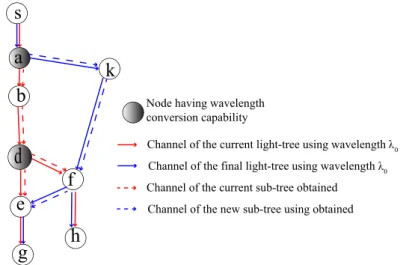
We illustrate here, the selection of a sub-tree pair with disjointed links in an instance of pair of light-trees to be reconfigured. Figure 1 shows a problem instance of a pair of light-light-trees to be reconfigured from a multicast connection (s, {g, h}, λ0). The set of solid red links forms the current light-tree Tc
rooted at the node s. The set of solid blue links forms the final light-tree Tf rooted at the node s.
For this instance, we have only one divergent node denoted by a. Indeed, the node a belongs to the current light-tree and the final light-tree and b is a child node of the node a on the current light-tree but b is not a child node of the node a on the final light-tree. Let’s apply Algorithm 1 with this pair of light-trees (Tc, Tf) and the divergent node a as input. e and f are convergent nodes descending from the divergent node a on both light-trees, i.e. CG_a = {e, f } (refer to line 1). The path from a to e on current light-tree is with disjointed links to the path which connects a to e on final light-tree. It is the same for node f . Therefore Dis_CGa= CG_a. Link a− > b is the single outgoing link emanating from a on Tc. Path on Tc from a to e and path on Tc from a to f share link a− > b. Also e and f do
not fulfil any condition 1, 2 and 3. In fact, the set of ancestors (on current light-tree) of e which are descendant nodes of a are {b, d}. Also, the nodes b and d are not belonging to the final light-tree. But each of these nodes do not have descendant node which is not ancestor of e and do not a descendant node of node a on final light-tree. Therefore, node e does not fulfil the condition 1. In addition, {b, d} are only on the current light-tree. Therefore, node e does not fulfil the condition 2. Similarly, f does not fulfil condition 1 and condition 2. The node e has no ancestor (belonging to both trees) on the segment (of Tf) from a to e which is not its ancestor on the segment (of Tc) from a to e: e does not
fulfil condition 3. Similarly, f does not fulfil condition 3. So, at the end of the set of convergent nodes searching step (refer to line 13), CG(STc, STf) = CG_a = {e, f }. Therefore, according to line 15
and line 16, the current sub-tree STc is equal to {a{b{d{e, f }}}}. The set of red dotted links forms STc.
Also, according to line 17 and line 18, the new sub-tree STf is equal to {a{k{f {e}}}}. The set of blue
dotted links forms STf. {a{k{f {e}}}} does not share links with the current light-tree. Algorithm 1 ends
and returns as pair of sub-trees (STc, STf) = ({a{b{d{e, f }}}}, {a{k{f {e}}}}) which is a sub-tree pair with
disjointed links and which does not interrupt flow.
s
a
d
f
e
b
k
h
g
Node having wavelength conversion capability
Channel of the current light-tree using wavelength 0
Channel of the final light-tree using wavelength 0
Channel of the current sub-tree obtained Channel of the new sub-tree using obtained
3
Sub-tree pair with shared links
3.1 Selection of a sub-tree pair with shared links
In order to select a Sub-tree pair with Shared Links (SSL), we propose the function called Select_SSL (see Algorithm 2). This function takes as input : the pair of light-trees (Tc, Tf) and a convergent node
m. In fact, The existence of a sub-tree pair with shared links from a pair of light-trees implies the
availability of at least one convergent node on the pair of light-trees. This function returns a sub-tree pair with shared links (STc, STf). The subset of destination nodes covered by STc and the subset of
destination nodes covered by STf must be the same in order not to cause a flow interruption when
reconfiguring this sub-tree pair with shared links.
The selection of a sub-tree pair with shared links (STc, STf) begins by the determination of the
root node r of the sub-tree pair to be selected. r must belong to both sub-trees in order to allow flow transfer from STc to STf without flow interruption. By construction, r must be an ancestor of m on
Tc and Tf . Also, (STc, STf) is a sub-tree pair with shared links, so the use of a spare wavelength
must be required. Therefore, if r is different from the root node of the light-tree pair (Tc, Tf) then
r belongs to set of nodes which has the wavelength conversion capability denoted by Vc (i.e. r ∈ Vc
). Let D(a, b, T ) be represents the set of destination nodes of the tree T that have an ancestor on the segment from the node a to the node b. In short, the root node of a sub-tree pair with shared links (STc, STf) is equal to the node n (with n ∈ Vc) which is the youngest common ancestor of m on Tcand
Tf such that D(n, m, Tc) = D(n, m, Tf) (refer to line 1 of Algorithm 2). Note that if such a node n does
not exist then the root node of the light-tree pair (Tc, Tf) is taken as the root node of the sub-trees
pair to be selected. Algorithm 2Select_SSL
Input: Tc, Tf, m // Tc: The current light-tree;Tf : The new light-tree;m : a convergent node of (Tc, Tf) Output: (STc, STf) // STc: The current sub-tree; STf : The new sub-tree
1: r = The node n of Vcwhich is the youngest ancestor on both Tcand Tf of m such that D(n, m, Tc) =
D(n, m, Tf) // Vc: The set of nodes which has the wavelength conversion capability ; 2: ifr == null then
3: r = Root(Tc, Tf) ; // Root(Tc, Tf): The root node of the light-tree pair (Tc, Tf)
4: end if
5: STc= The sub-tree of Tc rooted at r and having D(r, m, Tc) as set of leaf nodes ;
6: STf = The sub-tree of Tf rooted at r and having D(r, m, Tf) as set of leaf nodes ;
7: Return (STc, STf) ; // The sub-tree pair with shared links
After determining the root node and destination nodes of a sub-tree pair with shared links, the sub-trees can be selected. STc is the sub-tree of Tc rooted at the node r and having the elements of
D(r, m, Tc) as leaf nodes (refer to line 5). Similarly, STcis the sub-tree of Tf rooted at r and having as
leaf nodes, the elements of D(r, m, Tf) (refer to line 6).
3.2 Illustration of the selection of a sub-tree pair with shared links
In Figure 2, the set of solid red links forms the current light-tree Tcrooted at s. The set of solid blue links forms the final light-tree Tf rooted at s. a is a node having the wavelength conversion capability
that is an ancestor of the convergent node g on both the current light-tree Tc and the final light-tree
Tf. However, the set of destination nodes on the current light-tree Tc that have an ancestor on the segment from a to g is D(a, g, Tc) = {f , h, l} . The set of destination nodes on the final light-tree Tf
which have an ancestor on the segment from a to g is D(a, g, Tf) = {f , h} . As D(a, g, Tc) , D(a, g, Tf), we
are looking for another ascendant of g. k is also a node having the wavelength conversion capability that is an ancestor of the convergent node g both on the current light-tree and on the final light-tree. In addition, D(k, g, Tc) = D(k, g, Tf) = {f , h, l} . Therefore, the root of the pair of sub-trees to select is
node k. The current sub-tree STc is the sub-tree of Tc, rooted at k and covering the destinations l,
s
a
d
e
f
h
g
b
i
c
k
l
Channel of old light-tree using wavelength 0
Channel of new light-tree using wavelength 0
Node having wavelength conversion capability
Channel of the current sub-tree obtained Channel of the new sub-tree using obtained
Figure 2: Problem instance containing a sub-tree pair with shared links
f and h. The new sub-tree STf is the sub-tree of Tf, rooted at k and covering the destinations l, f and h. The pair of sub-trees with shared links ({k{a{b{l, c{d{h, e{g{f }}}}}}}}, {k{l, a{b{c{d{h, e{g{f }}}}}}}}) is then obtained as shown in Figure 2.a. The set of red dotted links forms the current sub-tree STc
and the set of blue dotted links forms the new sub-tree STf.
4
Conclusion
Light-tree reconfiguration problem consists to migrate an optical flow from the initial light-tree to the final light-tree without interrupting the flow and use spare wavelength as few time as possible. For do this, light-tree reconfiguration process must be performed in several steps. At each step, a sub-tree pair belongs to a category of sub-tree pair with disjointed links or a category of sub-tree pair with shared links must be properly selected. Our work described in detail, how to select a sub-tree pair (with disjointed links or with shared links). Note that our work can be easily adapted to any study requiring the selection of a pair of sub-trees sharing (or not) links in a network that is not necessarily optical network. This work does not discuss how a sub-tree pair should be reconfigured or in what order the sub-tree pairs should be reconfigured ? To solve the reconfiguration problem, future works could be based on the current work and provide answers to these questions.
References
[1] Sreenath N, Murthy CSR, Mohan G. Multicast Routing in WDM Optical Networks. In: Du DZ, Raghavendra C, Ruan L, Du DZ., eds.Optical Networks. 6. Boston, MA: Springer US. 2001 (pp.
205–270)
[2] Cousin B, Adépo JC, Oumtanaga S, Babri M. Tree reconfiguration without lightpath interrup-tion in WDM optical networks.International Journal of Internet Protocol Technology 2012; 7(2):
85–95.
[3] Adépo JC, Aka B, Babri M. Tree Reconfiguration with Network Resources Constraint. Interna-tional Journal of Computer Science and Telecommunications 2016; 7(1): 4.
[4] Li H, Wu J. Survey of WDM network reconfiguration: topology migrations and their impact on service disruptions. Telecommunication Systems 2015; 60(3): 349–366. http://dx.doi.org/10.1007/s11235-015-0050-5 doi: 10.1007/s11235-015-0050-5