HAL Id: hal-02103728
https://hal.univ-rennes2.fr/hal-02103728
Submitted on 18 Apr 2019
HAL is a multi-disciplinary open access
archive for the deposit and dissemination of
sci-entific research documents, whether they are
pub-lished or not. The documents may come from
teaching and research institutions in France or
abroad, or from public or private research centers.
L’archive ouverte pluridisciplinaire HAL, est
destinée au dépôt et à la diffusion de documents
scientifiques de niveau recherche, publiés ou non,
émanant des établissements d’enseignement et de
recherche français ou étrangers, des laboratoires
publics ou privés.
Cultures: The Case of 9gag
Albin Wagener
To cite this version:
Albin Wagener. Creating Identity and Building Bridges Between Cultures: The Case of 9gag.
Inter-national Journal of Communication, University of Southern California, Annenberg School for
Com-munication & Journalism, 2014, 8, pp.2488 - 2502. �hal-02103728�
Copyright © 2014 (Albin Wagener). Licensed under the Creative Commons Attribution Non-commercial No Derivatives (by-nc-nd). Available at http://ijoc.org.
Creating Identity and Building Bridges Between Cultures:
The Case of 9gag
ALBIN WAGENER
Université Catholique de l’Ouest, France Université de Nantes, France
The article presents a study of posts published on the online community 9gag and aims to look at the way users of this website negotiate diversity by using shared references. I posit that online discourses are not freed from social and cultural preconceptions and need to be investigated in order to reveal the issues hidden behind the curtains of the seemingly harmless gathering of people from every nation and social background. In this perspective, 9gag users often use jokes in order to bond, thus encouraging the perpetuation and discrimination of specific groups; this process shows how social mechanisms can be reproduced online and how difficult it is to change them.
Keywords: 9gag, prediscourses, culture, semantics, discrimination, social cognition, pragmatics
Created in 2008, the website 9gag gathers users from all over the world and allows its members to post pictures, movies, and brief stories that are accessible to everybody. Unlike social networks, 9gag is a community focusing on productions (or “posts”) only, not on individual profiles. These posts may contain pictures from all over the world, memes, or ragecomics and are almost always produced in English. Because of the emergence of cultural elements accessible to all 9gag users, this community is often considered a thrilling transnational experience; however, the reality is far more complex. Boundaries are crossed through the use of one single language and the use of Anglo-American cultural items. Posts produced in other languages are always criticized by 9gag users, and posts often make fun of specific countries, women, gender issues, and ethnic or national specificities. In fact, prediscourses (Paveau, 2006) and cultural items (Enfield & Levinson, 2006) are being constantly reproduced, thus making them relevant parts of preconstructed representations for every 9gag user. The present analysis of a corpus of 446 posts published on 9gag between August and September 2012 explores two main issues: (a) Is it possible to gather different symbolic universes without using common references and a common language? (Bucholz & Hall, 2005; Conein, 1998); (b) Would this gathering of different cultural backgrounds mean that what is called Anglo-American (or Western) no longer belongs to the Western world or its area of influence but is used and transformed in order to build new items of commonality? (Lemieux, 2009). While discussing these questions, I will keep in mind that culture, in this particular case, is used as an excuse to praise the fall of differences (Dervin, 2011; Wagener, 2012) and to erase them in
Albin Wagener: [email protected] Date submitted: 2013–08–27
order to build an imagined identity allowing users to escape from the trouble of the offline world (Boudon, 1995; Burke & Stets, 2009).
9gag: An Online Community Based on “Fun” Exchanges
According a text published on the website itself, 9gag has been defined since 2008 as “the funniest yet simplest platform for you to publish or collect internet humor” (9gag.com, 2014, para. 1). Year after year, 9gag has become one of the most popular communities where users are able to post images or videos. The site is one of many alternative communities where users are allowed or encouraged to create new types of publications, which can then be found on general forums or websites. Just like 4chan, Memebase, Rageshare, and IraffIruse, 9gag gathers Internet users from all over the world of various ages and social origins to share common and diverse interests. Unlike social networks, 9gag does not focus on individual profiles or bonding, but mainly (and almost solely) on online productions—or “posts.” Typical for websites such as 9gag are posts involving memes and ragecomics: While memes are an intellectual reduction of Dennett’s (1990) theory of memes implying the social reproduction and cultural transmission of ideas and concepts, ragecomics are very short stories inspired by comic strips and adapted to Internet standards—these comics are based on the use “ragefaces,” which represent precise emotions easily understandable by every Internet user. In other words, 9gag uses its own codes of communication in order to bring together an increasing community of users.
To achieve this goal, the use of the English language has become widespread among the creators and users of 9gag. In fact, posts published in English reach more people. Some users have tried to communicate in other languages (such as Spanish, German, or French), but this move to encourage diversity has completely failed, mainly due to a system in which publications are submitted to votes. Three different categories of pages exist to organize posts:
The first one is called “Hot” and shows the most popular posts, which means they gathered the most votes by 9gag users.
The second one is called “Trending” and gathers posts that are ahead in the voting process: These posts still need more votes to be published on the first page but have already gained some popularity.
The last type of page is called “Fresh” and presents posts that are directly published by 9gag users: This page truly is a kind of nursery for posts insofar as they are submitted to their first voting process.
Votes, thus popularity, divide posts into categories and often allow problematic publications (involving explicit content, for instance) to find their way onto the Hot page. In other words, it is always a majority of users that allows or does not allow cultural items that are specific to Internet communities to emerge or diffuse. In this perspective, the system supported by 9gag constitutes an interesting laboratory for exchanges and for the spread of specific cultural tendencies, with its own advantages and limits.
Prediscourses and the Display of Cultural Identities
One of the aims of 9gag seems to be to allow Internet users to cross borders and to bring them together, yet a thorough analysis of a corpus of online posts may shed light on the nuanced complexity of the real existence of this community. To strengthen the study of a corpus of 446 online publications, I chose to combine three fundamental principles into the theoretical framework. The first one is based on Paveau’s (2006) theory of prediscourses, insofar as I posit that 9gag users are indeed not freed from any cultural, educational, psychological, or social influence, which means that they might sometimes find themselves caught in forms of rampant discrimination. I believe that Paveau’s theory precisely defines the part played by prediscourses in the reproduction of cognitive categorizations and in the persistence of patterns claimed to be of cultural origin:
Prediscourses are indeed operators used when negotiating the transmission and circulation of meaning in social groups. I define them as a set of collective and prediscursive frames that represent an instructional mechanism used for the production and interpretation of meaning in discourse. Prediscourses in fact represent semantic content in the broad sense (be it cultural, ideological or encyclopedic), such as knowledge, beliefs and practices. (Paveau, 2006, p. 14, my translation)1
This definition of prediscourses allows us to assume that 9gag’s active community may produce publications as a result of a preconstructed semantic framework based on social or cultural reproduction, and this may trigger a shared interpretation of meaning for users, depending on the communicational constraints of the website. On 9gag, the persistent and powerful dynamics of prediscourses are directly linked to the use of culture as a modulator, as suggested by Enfield and Levinson (2006). According to their work, culture in itself is not the essence or the mediating device of interaction; it merely lends them contextual coloration. In this perspective, interactions are motivated by prediscourses, which are themselves modulated and adapted to and by cultural tendencies. However, cultural tendencies do not substantially modify basic human tendencies that Enfield and Levinson label “universal and default” (2006), such as the need to live in groups or to negotiate the proper organization of human society. This definition of culture is also close to what Kay called the “cultural toolbox” (1999, p. 110) insofar as people never use culture as a whole, not only because this whole does not exist but also because they need only certain cultural items or principles according to the situation and the context.
Moreover, trying to understand the way exchanges operate on 9gag would be useless without a proper definition of identity, as identity is displayed online within this context, triggered by numerous interactions between users posting from all over the world. In that sense, the theory of identity developed by Burke and Stets (2009) is useful for defining the specific characteristics of its social meaning, despite
1 From the original text in French: “Les prédiscours sont en effet des opérateurs dans la négociation du
partage, de la transmission et de la circulation du sens dans les groupes sociaux. Je les définis comme un ensemble de cadres prédiscursifs collectifs qui ont un rôle instructionnel pour la production et l’interprétation du sens en discours. J’entends par prédiscours des contenus sémantiques (au sens large de culturel, idéologique, encyclopédique), c’est-à-dire des savoirs, des croyances et des pratiques.”
that their fragmented and thus restraining definition of identity as a social agent seems helplessly disconnected from individual responsibility:
An identity is the set of meanings that define who one is when one is an occupant of a particular role in society, a member of a particular group, or claims particular characteristics that identify him or her as a unique person. . . . People possess multiple identities because they occupy multiple roles, are members of multiple groups, and claim multiple personal characteristics, yet the meanings of these identities are shared by members of society. (Burke & Stets, 2009, p. 3)
Since the meanings of identities are shared by members of society, or of defined communities, according to Burke and Stets, 9gag users also have a tendency to expect or reproduce them. Furthermore, I posit that this tendency is based on the social use of cognitively and emotionally driven prediscourses and on culture as a particular form of modulation (or coloration) and a tool for sharing— although this very tool is closely linked to power issues (Angouri & Glynos, 2009).
Questions and Methodology
The present study intends to answer two questions, both based on the theoretical framework and on the primary purposes of 9gag’s online community of users:
Is it possible to gather different symbolic universes without using common references and a common language, given that 9gag does not seem to achieve its goal without staying within these limits?
Do Anglo-American symbolic universes (i.e., those from Europe and North America) still belong to their own area of influence, or have they been emptied of their former significance to be used to build new items of commonality or even a new transnational semantic source?
To explore these problems, I chose to exclude the posts that would not appear on the Hot page, because these are not the most popular ones and have not gathered the most votes by 9gag users; instead, I only looked at posts that were clearly visible on the website and that were thus most accessible to both regular users and occasional visitors. I gathered a corpus of 446 posts published online between August 5 and September3, 2012. I proceeded to make four random sampling operations on August 5, August 11, August 23, and September 3. The sampling was done from midnight to midnight to gather all publications on the Hot page before analyzing the data and producing statistics based on the semantic content of the posts (including both language and images).
Furthermore, to analyze said samples, I constructed a research method by combining three distinct and fundamental principles that allow us to embrace the complexity of messages delivered by online publications:
The principle of shallow processing developed by Maillat & Oswald: This principle indicates that readers or receivers of a discourse mostly use cognitive shortcuts to save energy and to facilitate coherence of a specific message, to make comprehension an easier process. In this perspective, readers/receivers use ad hoc concepts when interpreting a message in a spirit of cognitive comfort that can be linked to the reproduction of memes on 9gag.
The semantics of argumentative possibilities (or SAP) model originally created by Galatanu (2003): This model explains the way readers use their semantic representations within a given topic cloud to recreate a coherent contextual environment. This topic cloud in return is fed with cognitive and social validations based on the verification of its representations, which links it closely to shallow processing and its implications.
The spatial/temporal/axiological (STA) model developed by Cap (2010), which is used primarily in political discourse analysis to measure the impressions left by spatial, temporal, and axiological proximity on the comprehension of political discourses by readers or receivers and on the attribution of particular semantic items.
In this perspective, 9gag posts will be analyzed to explore how Cap’s proximization model is heavily linked to the cognitive operation of shallow processing, which may lead 9gag users to reconstruct meaning through Galatanu’s SAP model and a reconstruction of argumentative possibilities drawing on pre-existing semantics and significant cultural items.
The combination of these three principles shows that 9gag users (even the ones who do not produce posts themselves) may re-create a coherent semantic environment that they may already know well based on the shallow processing of information and on the use of prediscourses as tools for the construction and the decoding of coherent environments. Moreover, this reconstruction might also be based on the measurable proximity of social or cultural elements that are immediately accessible to users. According to this theory, if users utilize and decode these elements, online publications featuring them may gather the most votes. I suggest that this process is applied for two main reasons:
To give meaning to online publications, allowing messages to be understood and codes used by the website to be assimilated and transmitted.
To reproduce meaning and impose it as a relatively shared entity based on the importance of votes.
The nuanced complexity of this process shows that 9gag works as a life-size laboratory insofar as it allows users to make codes and meaning evolve when they produce and use them. It also reveals the active part users play in the emergence and decline of social and cultural items.
Corpus Analysis
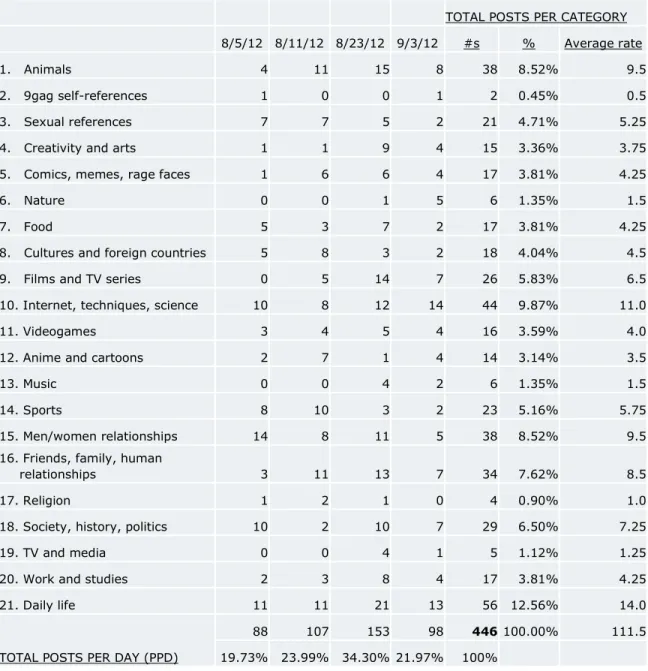
I classified the 446 publications published on the Hot page into distinct categories to conduct a precise analysis of their inherent complexity. Drawing on this process, it becomes easier to delimit the most shared meanings associated to each category and to investigate the way these meanings were emerging and shared. I isolated 21 specific categories derived from generic topics (such as “Films and TV Series” or “Men/Women relationships”), which shows the variety of topics addressed on the website; furthermore, I also managed to observe the frequency of occurrence of these categories during the four days I randomly chose to operate the sampling. This led to Table 1.
Table 1 clearly shows the variety of topics addressed but also indicates that some topics, such as daily life, human relationships, animals, and references to the Internet and science, are tackled far more often than others. Other topics such as religion, media, and references to 9gag seem rather unusual in the corpus. Moreover, the frequency of topics changed considerably depending on the day, which shows the importance of the input of users, productions, and votes. Another interesting fact is the high number of publications linked to sports due to the Olympic Games, which occurred in London during the summer of 2012.
When I brought the posts together without considering the date of publication, I was able to isolate an interesting phenomenon: The reproduction and diffusion of stereotypes seem to fuel the 9gag community. In other words, even on a website that claims to follow transnational objectives (by crossing borders between nations and even between social groups), the majority of users display their sense of belonging to the community by targeting specific social groups. To be more specific, bonding on 9gag would thus be possible by making fun of particular social categories of people. In this perspective, the mask of seemingly shared humor conceals the use of the Internet as an agent of discrimination.
Table 1. Total of Posts per Day by Category.
TOTAL POSTS PER CATEGORY
8/5/12 8/11/12 8/23/12 9/3/12 #s % Average rate
1. Animals 4 11 15 8 38 8.52% 9.5
2. 9gag self-references 1 0 0 1 2 0.45% 0.5
3. Sexual references 7 7 5 2 21 4.71% 5.25
4. Creativity and arts 1 1 9 4 15 3.36% 3.75
5. Comics, memes, rage faces 1 6 6 4 17 3.81% 4.25
6. Nature 0 0 1 5 6 1.35% 1.5
7. Food 5 3 7 2 17 3.81% 4.25
8. Cultures and foreign countries 5 8 3 2 18 4.04% 4.5
9. Films and TV series 0 5 14 7 26 5.83% 6.5
10. Internet, techniques, science 10 8 12 14 44 9.87% 11.0
11. Videogames 3 4 5 4 16 3.59% 4.0
12. Anime and cartoons 2 7 1 4 14 3.14% 3.5
13. Music 0 0 4 2 6 1.35% 1.5
14. Sports 8 10 3 2 23 5.16% 5.75
15. Men/women relationships 14 8 11 5 38 8.52% 9.5
16. Friends, family, human
relationships 3 11 13 7 34 7.62% 8.5
17. Religion 1 2 1 0 4 0.90% 1.0
18. Society, history, politics 10 2 10 7 29 6.50% 7.25
19. TV and media 0 0 4 1 5 1.12% 1.25
20. Work and studies 2 3 8 4 17 3.81% 4.25
21. Daily life 11 11 21 13 56 12.56% 14.0
TOTAL POSTS PER DAY (PPD)
88 107 153 98 446 100.00% 111.5 19.73% 23.99% 34.30% 21.97% 100%
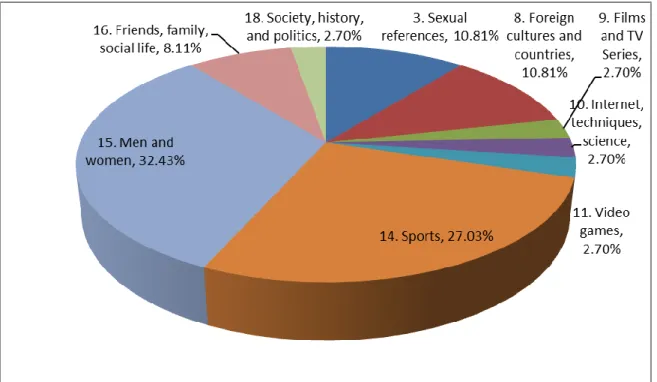
Figure 1. Stereotypical occurrences per category.
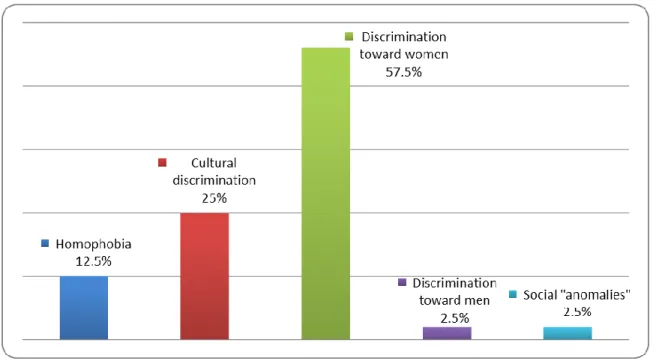
For instance, relationships between men and women are depicted on the basis of discrimination toward women. This phenomenon is even reinforced by the use of sports (in references to the London Olympic Games) as a means to mock some feminine sports such as synchronized swimming or to reduce the presence of women in certain sports to images of their bodies, which means that their performance in sports is overshadowed by the general contemplation of them as sexual objects. Five major categories can be delimited when studying the way discrimination is carried out on the website: homophobia, cultural discrimination, discrimination toward women, discrimination toward men, and social “anomalies.”
According to this analysis, 40 publications clearly operate as agents of discrimination, which means 11.15% of posts are targeted against specific groups. In this perspective, more than 1 in 10 publications on 9gag are based on easily visible discrimination, which shows the limits of bringing people together within an online community. The three following examples support the present theory by showing precisely how discrimination is displayed on the website, mostly through humor.
Figure 2. Types of stereotypical representations.
Illustration 1. Three examples of discriminatory publications.
These three examples illustrate the information suggested by Figure 2—the existence of a leading trio of categories of discrimination: discrimination toward women (although 9gag has as many registered female users as male users, according to the website), cultural discrimination, and what I qualify as “ordinary homophobia.” I posit that all three categories pinpoint the supremacy of the stereotype of Western/white heterosexual males. Although this discrimination does not represent the heart of 9gag, publications seem to lean toward the social confirmation of this imaginary stereotype.
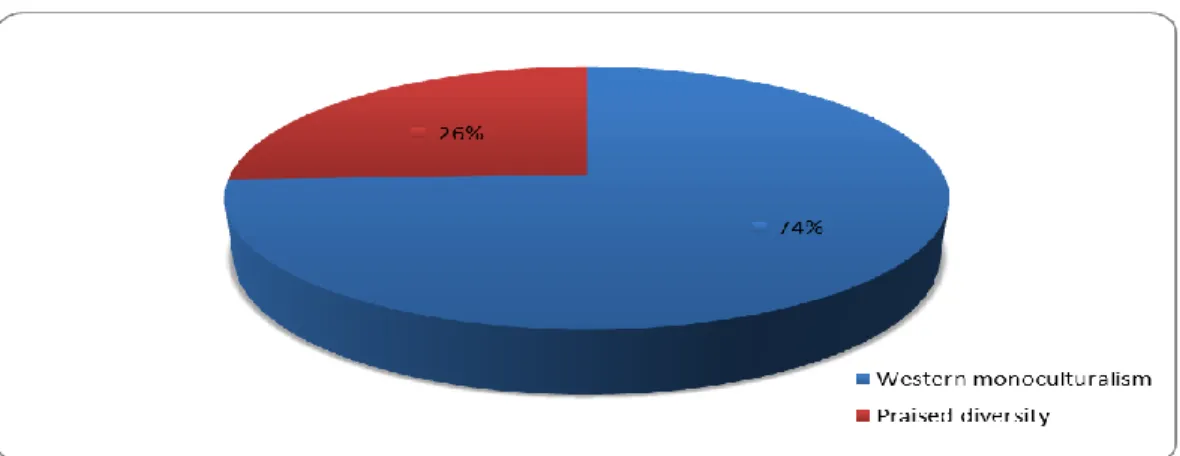
This hypothesis is strengthened by another analysis of 9gag publications that looks at the degree of cultural diversity encouraged by the community of users. The study of this specific question shows interesting results, as presented in Figure 4.
Figure 4. Monoculturalism and diversity as represented in publications.
Of the 446 publications analyzed, 160 posts, or 35.87% of all collected samples, directly highlight specific cultural references. Out of these 160 posts, 41 (25.62%) support a form a cultural diversity, while 119 (74.37%) strengthen the idea of Western monoculturalism through frequent references to successful movies and TV series. Movies and TV series are broadcasted in multiple countries and are easily accessible through the Internet; in this sense, they quickly and successfully become references that an ever-growing base of Internet users easily understand. Most of these productions are of Anglo-American origin (movies and series from countries such as India, France, and Mexico are hardly seen) and vehicles of a lack of cultural diversity on 9gag. Furthermore, images of these movies and series are sometimes used to back messages of discrimination. This tendency can be seen in illustrations.
In these examples, the image of Neil Patrick Harris (an openly gay American actor famous mainly for his role as Barney Stinson in the successful TV series How I Met Your Mother) is used to mock homosexuality, and a picture of Keanu Reeves is transformed into a joke about small-breasted Asian women. Even the image of the Olympic Games is used as a vehicle for racial stereotypes. Through these publications, 9gag users remain distant from the ideal of a transnational, transcultural, or even transsocial website.
Conclusion: Toward an Online Negation of Diversity?
Behind the convenient mask of humor, the 9gag website allows the highlighting and diffusion of messages specifically targeting certain social, cultural, or national categories that appear in the following forms:
Periodically making fun of certain countries (such as Romania and the Philippines) through images.
A downgraded representation of women in general. Women are valued if they share more “male” interests such as videogames, while they are still expected to remain active at home (backed by seemingly “harmless” jokes such as the catchphrase, “Bitch, make me a sandwich”).
The denigration of social questions linked to gay rights, as the term gay is itself used as a slight.
The promotion of racism and xenophobia through jokes, even if it is indirect in posts uploaded by users.
I wish to emphasize that the circulation of discourses is never free of implications and that it is always linked to markers of economic or political forces that people are not necessarily able to locate (Fairclough, 2009). This study thus leads to the following question: Could it be that 9gag is a website mainly dedicated to geeky white heterosexual males relying on what could be labeled the “Western symbolic universe” (if such a thing really exists)? Although this popular website claims to represent both alternative and border-crossing interests, the present analysis shows that any communication device or medium can be used to achieve less valuable goals. While 9gag does manage to bring people together, it does so through the use of masculine and heterosexual imagery, thus downgrading specific categories of people. In this perspective, the study of this website shows that even alternative media can remain distant from what Dervin calls “diverse diversities” (2011, p. 112); individuals indeed adapt their multiple roles and identities by playing with different contexts of expression:
It would be better to study the negotiation and co-construction of individuals’ diverse diversities, rather than to look for markers of “cultural,” “ethnic” or “linguistic” diversity through artifacts and alleged discourses of truth. . . . To sum it up: studying the processes, rather than the products. (Dervin, 2011, p. 112)
Analyzing 9gag has allowed me to analyze not only on products (online publications) but also the way individuals negotiate and display social processes. On this particular website, the importance of votes shows that discrimination and monoculturalism remain shared values and that they may even be encouraged. This study, however, also shows that it is hard to find a clear answer to the questions initially asked, based on the following limitations:
It seems very difficult to gather so many different individuals without using one single language and common cultural references, and these lead to the diffusion of the image of a society that revolves around masculine and heterosexual values based on the sharing of Anglo-American references, perhaps revealing who holds the economic and financial power.
The diversity of 9gag still shows a universal diffusion of Anglo-American references based on the sharing of cultural products through the Internet itself; moreover, it implies that Internet users would, in fact, identify with a universe that remains a component of dominant economic power.
The only notable exception is the mention of video games and anime, which are part of the Japanese cultural sphere of influence. However, they are heavily quoted because of their popularity in North America and Europe. In this perspective, this transnational website remains heavily influenced by Anglo-American references and seems to spread a Western symbolic universe because of economic and political power.
The present study shows that cultural references can be used to conceal important power issues (Sarangi, 1994), which always target minorities or weak social groups, such as women or gays. Wagener (2012) also shares this perspective and even suggests letting go of the very concept of culture (especially national culture) in order to look at the core explanatory devices of social behaviors and interactions:
The study of interactions and human behaviors and values is the study of life forms in action, which means that any satisfactory explanation should not depend on simplified categorizations. . . . In order to describe and study these expressions, the very concept of culture may even not be necessary at all. (para. 33)
Avoiding what Sarangi (1994) called the “culture card” would indeed conceal and delimit power issues and their messages carried through means of communication. The online community of 9gag is not an exception to the rule and invites us to remain vigilant when it comes to the wishes and aims of Internet users brought together on alternative forums and websites, as these may be used as platforms of free speech for any possible form of discrimination. To enhance the present study, it would be useful to establish a research program dedicated to the analysis of 9gag and similar online communities through three studies:
A synchronic study comparing the simultaneous production of different websites.
A diachronic study looking at the evolution of 9gag’s publications over a given period of time.
An analysis of reactions of users regarding 9gag publications.
Although Internet users may wish to cross boundaries between societies and nations while deeply transforming the means of communication used by individuals and social groups, a sometimes brutal management of diversity may arise from this process. This hypothesis should encourage the necessary emergence of what Lemieux (2009) calls a “grammar of social sciences” (p. 22) in order to represent and understand social interactions beyond the borders of simplifications and reduced categorizations used by individuals themselves to reproduce an intellectual tradition of discrimination as a scientific process of understanding social life. This ambitious project may avoid the intellectual traps described by Boudon (1995), including culturalism, which may inspire harmful policies and obfuscate the knowledge of individuals and societies.
References
9gag.com. (2014, August 7). Advertise. Retrieved from http://9gag.com/advertise
Angouri, J., & Glynos, J. (2009). Managing cultural difference and struggle in the context of multinational corporate workplace: Solution or symptom? Working Papers in Ideology and Discourse Analysis,
26. Retrieved from http://www.essex.ac.uk/idaworld/paper261209.pdf
Boudon, R. (1995). Le juste et le vrai [The true and right]. Paris, France: Fayard.
Bucholz, M., & Hall, K. (2005). Identity and interaction: A sociocultural linguistic approach. Discourse
Studies, 7(4–5), 585–614.
Burke, P. J., & Stets, J. E. (2009). Identity theory. Oxford, UK: Oxford University Press.
Cap, P. (2010). Legitimisation in political discourse. Newcastle upon Tyne, UK: Cambridge Scholars Publishing.
Conein, B. (1998). Les sens sociaux: Coordination de l’attention et interaction sociale [Social senses: Coordinating attention and social interaction]. Intellectica, 1/2 (26/27), 181–202.
Dennett, D. (1990). Memes and the exploitation of imagination. The Journal of Aesthetics and Art
Criticism, 48(2), 127–135.
Dervin, F. (2011). Impostures interculturelles [Intercultural impostures]. Paris, France: L’Harmattan. Enfield, N. J., & Levinson, S. C. (2006). Roots of human sociality. New York, NY: Berg.
Fairclough, N. (2009). A dialectical-relational approach to critical discourse analysis in social research. In R. Wodak & M. Meyer (Eds.), Methods of critical discourse analysis (pp. 162–183). London, UK: SAGE Publications.
Galatanu, O. (2003). La sémantique des possibles argumentatifs et ses enjeux pour l’analyse du discours [Semantics of argumentative possibilities and its impacts on discourse analysis]. In I. I. Las Heras & M. J. Salinero Cascante (Eds.), El texto como encrucijada: Estudios franceses y
francofonos II [Texts as crossroads: French and French-speaking studies II] (pp. 213–226).
Logrono, Spain: Publicaciones Universidad de La Rioja.
Kay, P. (1999). Intra-speakerrelativity. In J. J. Gumperz & S. C. Levinson (Eds.), Rethinking linguistic
relativity (pp. 97–114). Cambridge, UK: Cambridge University Press.
Maillat, D., & Oswald, S. (2009). Defining manipulative discourses: The pragmatics of cognitive illusions.
International Review of Pragmatics, 1(2), 348–370.
Paveau, M.-A. (2006). Les prédiscours: Sens, mémoire, cognition [Prediscourses: Meaning, memory, and cognition]. Paris, France: Presses Sorbonne Nouvelle.
Sarangi, S. (1994). Intercultural or not?: Beyond celebration of cultural differences in miscommunication analysis. Pragmatics, 4(3), 409–427.
Wagener, A. (2012). Deconstructing culture: Towards an interactional triad. Journal of Intercultural