OATAO is an open access repository that collects the work of Toulouse
researchers and makes it freely available over the web where possible
Any correspondence concerning this service should be sent
to the repository administrator:
[email protected]
This is an author’s version published in:
http://oatao.univ-toulouse.fr/23217
To cite this version:
Peydecastaing, Jérôme
and Vaca-Garcia, Carlos
and Borredon,
Marie-Elisabeth
Accurate determination of the degree of substitution of long chain
cellulose esters. (2009) Cellulose, 16 (2). 289-297. ISSN 0969-0239
DOi 10.1007/s10570-008-9267-8
Accurate determination of the degree of substitution of long
chain cellulose esters
J. Peydecastaing · C. Vaca-Garcia · E. Borredon
Abstract The determination of the degree of substi
tution (DS) of fatty acid cellulose esters with alkyl chain lengths from C8 to C 18 was performed by direct transesterification with trimethylsulphonium hydroxide (TMSH) using tert-butyl methyl ether (MTBE) as a solvent. Transesterification was demonstrated to be quantitative at 75 °C in 60 min. The quantification of the formed fatty acid methyl esters was performed by gas chromatography (GC). After the optimization of the method, long chain cellulose esters (LCCE) could be analyzed in a wide range of DS. The obtained values were compared to those given by other existing protocols. LCCE with DS-values in a range of 5 x 10⁻⁵ to 3 were analyzed with high accuracy.
Reproducibility is weakened for high DS values if the sample has a compact aspect limiting the accessibility of TMSH to the ester fonctions. This method can also be suitable for the analysis of mixed cellulose esters.
Keywords DS determination · TMSH ·
Very low DS · Transesterification · Methylation · Mixed cellulose esters · Elemental analysis · Titration
J. Peydecastaing (C8J) • C. Vaca-Garcia • E. Borredon INRA, ENSIACET, UMR 1010, 118 Route de Narbonne, 31077 Toulouse Cedex, France
e-mail: [email protected] J. Peydecastaing · C. Vaca-Garcia · E. Borredon INPT, Université de Toulouse, UMR 1010, Toulouse, France
Introduction
Long chain cellulose esters (LCCE) are known for their present and potential applications such as thermoplas tics (Sealey et al. 1996), selective lipophilic filters (Deschamps et al. 2003), or the preservation of wood (Magne et al. 2003). The accurate characterization of LCCE is necessary as their properties depend directly on the length of the grafted acyl chain and on the degree of substitution (DS). High DS-values (> 1.5) are required when working with soluble or thermoplastic biopolymers (Wang and Tao 1995; Edgar et al. 2001), but when the hydrophobie character is the sole property considered, low DS-values are enough to attain this property: 0.10 for lipophilic filters (Deschamps et al.
2003), 6 x 10⁻³ for fluorinated derivatives (Cunha et al. 2007), or as low as 3 x 10⁻⁴ for cellulose oleates (Peydecastaing et al. 2008).
Numerous techniques permit to characterize the DS of cellulose esters namely: saponification fol lowed by titration of the alkali excess (Wang and Tao
1994; Chauvelon et al. 1999), elemental analysis (Vaca-Garcia et al. 2001), NMR (Jandura et al. 2000), NIR (Peydecastaing et al. 2006), alkaline hydrolysis followed by the derivatization of the liquid products to be analyzed by gas chromatography (GC) (Freire et al. 2005), alkaline hydrolysis followed either by capillary electrophoresis (Tindall and Perry 1993) or by reversed-phase liquid chromatography (Tindall et al. 2002), and finally pyrrolidinolysis followed by GC analysis (Samaranayake and Glasser 1993).
Elemental (C, H, 0) analysis can be used for one or two different acyl substituents. For two or more different substituents, only the cleavage of the ester bonds and subsequent chromatographie analysis is useful. Among them, the pyrrolidinolysis in pyridine method (Samaranayake and Glasser 1993) is effective but the standards (1-acylpyrrolidines) are not com mercially available. Another method for mixed cellulose esters comprises alkaline hydrolysis, acid ification, extraction by an organic solvent of the fatty acids and derivatization prior to GC/MS analysis (Freire et al. 2005). Uncertainty is inherently increased due to the numerous steps, in particular the extraction, which needs to be quantitative. This is particularly difficult, especially in the case of LCCE with low DS. Finally, the methods consisting in the hydrolysis of the cellulose ester followed by acidifi cation and capillary electrophoresis (Tindall and Perry 1993), or by reversed phase HPLC (Tindall et al. 2002) present a limited number of steps but do not permit to analyze carboxylic acids with aliphatic chains superior to C4 because of their insolubility in acidified water. Moreover capillary electrophoresis and HPLC may cause significant uncertainties in the case of very low DS due to the detection threshold of classic detectors (Tindall and Perry 1993).
In this paper we report a new analytical method for LCCE, which is able to determine DS-values in the whole range. lt is accurate and easy to employ with a pre-settled chromatographie analysis. Our endeavor was focused to adapt a known method of lipids characterization (Schulte and Weber 1989; Muller et al. 1990). lt consists in the transesterification of the esters fonctions of LCCE with trimethylsulphonium hydroxide (TMSH) using tert-butyI methyl ether (MTBE) as a solvent followed by GC analysis of the transesterified acyl compounds.
Experimental
Chemicals and standards
Octanoic (C8:0), capric (ClO:0), lauric (C12:0), myris tic (C14:0), palmitic (C16:0), stearic (C18:0) and oleic acids (C18:l) 99% purity were all purchased from Sigma-Aldrich France. Pentadecanoic acid (Cl5:0) was used as internai standard (I·S.) and was obtained from Fluka France (99% purity). Alpha-cellulose from
Sigma-Aldrich France was the initial biopolymer (degree of polymerization of 960, 4% pentosans). Octanoyl, caproyl, lauroyl, myristoyl, palmitoyl, stea royl and oleoyl chlorides were purchased from Acros France with a purity of at least 95% (reagent grade). Anhydrous pyridine was purchased from Sigma Aldrich France and used as received. Trimethylsulpho nium hydroxide (TMSH) was obtained from Macherey N agel France as a 0.2 mol L -l solution in methanol.
Tert-butyI methyl ether (MTBE) HPLC grade was
purchased from Scharlau Spain. All the chemicals were stored at 4 °C.
Synthesis of model LCCE
Long chain cellulose esters with diff erent DS were synthesized by reaction with fatty acid chlorides in a pyridine medium according to a previously described method (Thiebaud and Borredon 1995). Cellulose (10 g) was stirred in excess pyridine (250 mL) at 20 °C for 30 min in order to swell cellulose and to increase its reactivity. The desired amount of fatty acid chloride was poured into the reactor and reflux was conducted at 130 °C with mechanical stirring. A dry nitrogen bubbling flow was used to withdraw from the reactor the HCI formed during the synthesis. In order to obtain LCCE with different DS-values, the reaction time and the quantity of fatty acid chlorides were varied. After cooling at around 80 °C, 250 mL of 50% aqueous ethanol were added to consume the residual acid chloride. The solid product was recov ered by filtration over sintered glass and then thoroughly washed with ethanol. Purification was carried out by Soxhlet extraction for 16 h with ethanol. The cellulose ester was dried at 70 °C under vacuum to constant weight and stored in a desiccator at room temperature. Fatty acid chlorides with chain lengths from C8 to C18 where used in order to obtain different kinds of LCCE samples.
Preparation of model standards of LCCE with very low DS
Standard samples of LCCE with very low DS were prepared by mixing unmodified cellulose and a known cellulose ester, prepared as explained below. With this solid-solid dilution procedure, it was possible to calculate DS', the apparent DS-value of the mixture. The principle of this dilution is
completely "transparent" to the DS determination. For instance, the method cannot distinguish a sample of cellulose ester with DS
=
0.1 from a sample consisting in a mixture of p grams of a sample withDS
=
1 accompanied by q grams of celluloseprovided that the total number of ester moles divided by the total number of anhydroglucose units be 0.1.
Cellulose and a LCCE with known DS were oven dried ovemight at 103 °C and cooled in a desiccator to ensure the preparation of mixtures on a dry weight basis.
Solid-solid dilution: mx grams of LCCE and m0 grams of cellulose, precisely weighed, were frozen with direct addition of liquid nitrogen to avoid aggregation. They were mixed in a high speed lab grinder. Calculation of the apparent DS (DS') of the diluted LCCE was done with the formula:
DS1 = ---162.14 X mx X DSi
162.14 X mx +m0 X [DSi X (Mi -18.02)
+
162.14]by (Vaca-Garcia et al. 2001) were applied to convert %C and % H in OS-values. Three replicates of each sample were analyzed and unmodified cellulose sample used as a blank.
DS determination by alkaline hydrolysis and titration
About 0.5 g of LCCE sample was stirred for 30 min in 40 ml of aqueous ethanol (70% ). 20 ml of a 0.5 N NaOH aqueous solution was added and the stirring was continued for 48 h at 60 °C. The unreacted NaOH was back-titrated with 0.5 N aqueous HCl. The solid was recovered by filtration over 0.45 µ PTFE membrane and thoroughly washed with deionized water and ethanol, then oven-dried at 50 °C for 48 h. The absence of ester fonctions in the saponified solid was confirmed by FTIR spec troscopy. The degree of substitution was then calculated as:
DS=--1 _6 _2 _.1 _4_x_[(V_N _s _-_V_N_B_ )_x_N_N_w_H_-_(V_H_ s_-_V_H _B _)_x_N_tt_c_t] __
m - [(VNs - VNB) X NNao H - (VH s - VHB) X Nttct] X (Mx - 18.02)
where, DSi: DS-value of the known LCCE, mx: mass of LCCE (in grams), Mi: molar mass of the RCOOH fatty acid, m0: mass of cellulose added to the
mixture (in grams). 1 62.14 is the molar mass of the anhydroglucose unit and 18.02 the molar mass of water.
Mixing/grinding was performed during 3 min and repeated 5 times with addition of fresh liquid nitrogen between each step. Since condensation of water undoubtedly occurred, the final powder was oven dried at 103 °C. The dilution process was repeated by using the most recently prepared standard as the known LCCE to be diluted with unmodified cellulose. By this manner, we could prepare standard mixtures with DS' ranging between 5 x 10⁻² and 5 x 10⁻⁵_
DS determination by elemental analysis
LCCE were vacuum dried during 48 h at 70 °C prior to elemental (C, H) analysis. The equations obtained
where VNs and VNB represent the accurate
volumes (mL) of NaOH solution added to the sample and to the blank respectively; NNaOH and Nttci are the normality of NaOH and HCl solutions;
VHs and VHB are the volumes (mL) of HCl
solution added to the sample and to the blank, respectively; Mx is the molar mass of the RCO grafted acyl residue and m is the mass of the dry sample in grams.
DS determination by transesterification with TMS H and GC analysis
Sample preparation
For samples with DS < 0.1, a precise quantity between 10 and 20 mg of LCCE was introduced into a 2 mL vial. About 500 µL of a 0.5 mmol L -l pentadecanoic acid (interna! standard) in MTBE and 200 µL of TMS H were added. For samples with
Fig. 1 Transesterification
of cellulose esters by trimethylsulfonium
hydroxide O,lR
Cellulose
OS-values between 0.1 and 3, a precise quantity of about 10 mg of LCCE was introduced into a 2 mL vial with 1,000 µL of a 5 mmol L -l pentadecanoic acid in MTBE and 400 µL of TMSH.
The vial was hot-stirred during 60 min in a VorTemp56 shaking incubator set at 1,200 rpm and 75 °C. The transesterification protocol yields fatty acid methyl esters (FAME), cellulose, water, meth anol and dimethylsulfide (Fig. 1). Once the sample was cooled down and the solid decanted, the super natant reaction mixture was analyzed by GC.
Gas chromatography
The GC analysis was carried out using a Varian 3900 gas chromatograph equipped with a Varian CP 8400 autosampler, a split/splitless injector and a flame ionization detector (FID). Separation was achieved in a CP-Select CB for FAME fused silica capillary column (CP7419, Varian) 50 m, 0.25 mm i.d., 0.25 µm film thickness. Helium was used as carrier gas at a flow rate of 1.2 mL min -l. Chromatographie parameters were optimized by using a model mixture of saturated fatty acids that underwent the same reaction protocol and subsequent analysis (Fig. 2) and resulted in the following conditions: The
6 2 5 7 8 4 3 1 - --3 5 7 9 11 13 15
retention time (min)
Fig. 2 GC chromatogram of the analysis of saturated fatty
acid standards methylated with TMSH in MTBE: (J) C8:0 (2) dimethylsulfide, (3) ClO:0, (4) C12:0, (5) C14:0, (6) C15:0 (intemal standard), (7) C16:0, (8) C18:0
► Cellulose-OH +
temperature of the injector used was set at 260 °C and the split ratio at 1 :20 for samples with DS inferior to 0.1 and at 1: 100 for samples presenting a DS between 0.1 and 3. The oven temperature was programmed as follows: 110 °C for 4 min, then rise to 230 °C at a rate of 15 °C min-1, then 230 °C for 7 min. This enabled the separation of the correspond ing FAME within 19 min. Gas flow rates in the detector were set at 25, 30, and 300 mL min-1 respectively for helium, hydrogen and air. The temperature of the FID detector was set at 260 °C. A syringe of 10 µL was used for 1 µL injection of each sample and standard solutions.
DS calculation:
DSi(TMSH/GC) = m - c162.14 XC X Vs
i x Vs x (Mi - 18.02) Ci: concentration of the FAME in MTBE after transesterification determined by GC in mol L-1, Vs: volume of internai standard solution added to the analyzed sample (in L), m: mass of the LCCE sample (in g), Mi: molar mass of the RCOOH fatty acid.
Results and discussion
Optimization of reaction parameters
Chromatographie conditions were optimized for the separation of FAME presenting aliphatic chain length equal or superior to CS. The protocol given in the experimental section is the result of the optimization (not discussed here ). Figure 2 shows the optimized chromatogram of the separation of the selected CS C 18 FAME and methyl pentanoate (coming from the internai standard). We also analyzed commercial mixtures of FAME used generally to calibrate GC columns and obtained a perfect separation of all the FAME, from CS to C22 with or without unsaturations. Based on state-of-the-art data, experimental con ditions were optimized for the DS determination of LCCE. The optimal stoichiometric ratio of TMSH reagent to the total ester fonctions has been reported
to be 2: 1 for the analysis of butter and fatty acids (Schulte and Weber 1989; Muller et al. 1990). We first investigated the effect of the quantity of TMSH added to analyze a fully substituted sample, i.e. cellulose trioctanoate with OS
=
2.9. W e added to 10 mg of LCCE sample 1,000 µL of pentadecanoic acid I-S. (5 mmol L -1) and various quantities of TMSH: 125 µL (molar ratio 1:1), 250 µL (ratio 2:1), and 500 µL (ratio 4:1). An internai standard calibra tion procedure was performed. Three replicates for each molar ratio and three GC injections for each sample were done to estimate respectively the reproducibility and repeatability. These two concepts will be discussed later. In the following tables, the average and standard deviation of the nine results will be presented. Transesterification was performed in the incubator set at 1,200 rpm and 75 °C during 180 min. For comparison, the OS of the sample was also determined by the elemental analysis, the titrimetry and the NMR methods.When TMSH was used in excess (2:1), the nine OS-values obtained by the transesterification method (three samples x three analyses) were sensibly iden tical (2.865
±
0.128 std deviation, i.e. 4.4%). Sirnilar values were obtained for the 4: 1 ratio. This robust ness has been reported for the analysis of lipid samples (Schulte and Weber 1989). The mean OS obtained for the cellulose trioctanoate was equivalent to the values obtained by elemental analysis and titrimetry (only 1.2 and 3% of relative variation respectively). On the contrary, 1H NMR analysis performed on a 500 MHz Bruker spectrometer did not permit to determine a reproducible (nor valid) OS-value from three analyses of one single sample (3.12±
0.652). The reason is a big uncertainty in the integration of the seven hydrogen atoms belonging to the anhydroglucose unit when 70% of the cellulose ester sample is represented by aliphatic side-chains.For the 1:1 molar ratio of TMSH/cellulose trioct anoate, we observed an under-evaluation of the OS of 20% (OS
=
2.3 instead of 2.9). The ratio of TMSH to acyl groups was therefore an important factor to assure the quantitative transesterification of the ester groups. It is important to keep its value superior to 2: 1. The temperature of the reaction was also fixed at 75 °C for all the analyses described in this paper. Higher temperatures would have permitted to accel erate analysis but regular lab vials may not resist the over-pressure caused by the solvent.The reaction time was also investigated. In the analysis of lipids described in the literature, few minutes are required at room temperature to complete the reaction. However, cellulose esters are not soluble in MTBE, making thus a solid/liquid reaction. W e observed that 1 h instead of 3 h gave the same OS results. Lower reaction times may still be possible but we decided to give priority to the robustness of the analytical method so that samples with different characteristics can be analyzed.
Finally, the stirring speed was investigated. When the stirring at 1,200 rpm was turned off, OS was under-estimated by 11 % compared to elemental analysis and titration techniques.
In conclusion, an excess of TMSH is recom
mended (see section "OS determination by
transesterification with TMSH and GC analysis" for exact quantities) reacted during 1 h at 75 °C with stirring set at 1,200 rpm. These were the conditions that have been chosen as optimal for the analysis of the LCCE described in this study.
Comparison with other techniques
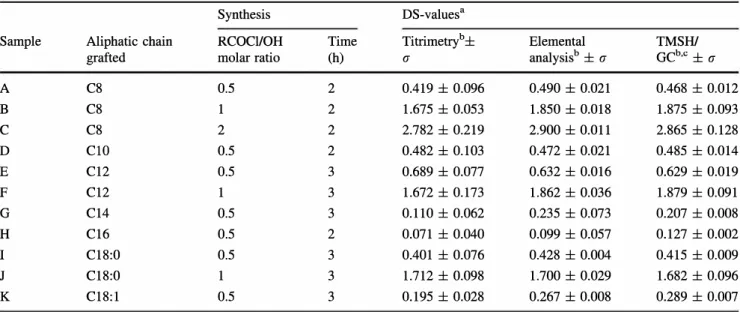
Samples of LCCE with various fatty chain lengths and degrees of substitution were synthesized and analyzed in order to evaluate the accuracy and efficiency of the TMSH/GC method over a wide range of parameters compared to other techniques. As indicated in Table 1, we synthesized LCCE with six different fatty chain lengths from C8 to C18:1 and characterized each sample using elemental analysis, titrimetry and TMSH/GC. NMR analysis was not utilized since the samples with medium and low OS are not soluble in classic solvents.
Titrimetry presented OS-values (Table 1) with important standard deviations (e.g. OS
=
2.782±
0.219) and especially when OS-values were low (e.g. OS=
0.071±
0.04, i.e. more than half of the value). The comparison of the results obtained by titrimetry and by TMSH/GC analysis is shown in Fig. 3. The coefficient of correlation (R2) was 0.9922. We
observed that OS-values obtained by titrimetry were often, but not systematically, lower than those obtained with the TMSH/GC method. In contrast, there was no significant difference between the results from TMSH/ GC and elemental analysis (R2
=
0.9995) in this range of OS, (Fig. 4 ). Nevertheless, according to the standard deviation values shown in Table 1, the TMSH/GCTable 1 Degrees of substitution determined by transesterification using titrimetry, elemental analysis, and TMSH/GC
Synthesis Sample Aliphatic chain RCOCl/OH
grafted molar ratio
A CS 0.5 B CS 1 C CS 2 D ClO 0.5 E C12 0.5 F C12 1 G C14 0.5 H C16 0.5 I C18:0 0.5 J C18:0 1 K C18:1 0.5
a Average and standard deviation values b Samples analyzed in triplicates c GC injections made in triplicates
� 2 r.t.l
!
...!
1 ,,:, r.t.l Q DS dttt.11nlntd by tttJ.1metl'y Time (h) 2 2 2 2 3 3 3 2 3 3 3Fig. 3 Comparison of the DS obtained by TMSH/GC and
titrimetry
method was less accurate than elemental analysis for the samples with DS superior to 1. For instance, sample
C shows DS
=
2.9±
0.128 with the TMSH/GCmethod and a standard deviation of only 0.011 when determined by elemental analysis. This could be due to the fact that for high OS-values, the relative proportion of cellulose backbone in the sample is low, for instance in the case of sample C it is only 30%. As this value is DS-valuesa Titrimetryb± Elemental TMSH/ (J analysisb ± Œ Gcb,c ± (J 0,419 ± 0,096 0,490 ± 0,021 0,468 ± 0.012 1.675 ± 0.053 1.850 ± 0.018 1.875 ± 0.093 2.782 ± 0.219 2.900 ± 0.011 2.865 ± 0.128 0,482 ± 0.103 0.472 ± 0.021 0.485 ± 0.014 0.689 ± 0.077 0.632 ± 0.016 0.629 ± 0.019 1.672 ± 0.173 1.862 ± 0.036 1.879 ± 0.091 0.110 ± 0.062 0.235 ± 0.073 0.207 ± 0.008 0.071 ± 0.040 0.099 ± 0.057 0.127 ± 0.002 0,401 ± 0.076 0.428 ± 0.004 0.415 ± 0.009 1.712 ± 0.098 1.700 ± 0.029 1.682 ± 0.096 0.195 ± 0.028 0.267 ± 0.008 0.289 ± 0.007
==
{Il 2 �...
-=
=
-�
� 1-=
{Il i::lDS 1letermined by elemental analysis
Fig. 4 Comparison of the DS obtained by TMSH/GC and
elemental analysis
represented by the denominator in the formula for the DS calculation, the uncertainty in the result of the calculation increases. Nevertheless, in a relative scale (standard deviation/mean value), it does not exceed 5%. We must also consider that in some cases, the aspect of the sample can play an important role in the accessibility of the reagent to the ester groups in the biopolymer. Highly substituted samples have a
rather plastic aspect and, in general, analytical tech niques based on hydrolysis of the ester groups are not appropriated for this kind of samples. This is the case for example of pyrrolidinolysis (Samaranayake and Glasser 1993).
Conversely, for the samples with low OS-values, the TMSH/GC method was more accurate than elemental analysis. For instance, sample H shows
OS
=
0.127±
0.002 with the TMSH/GC methodand a standard deviation of 0.057 when determined by elemental analysis. The reason is that the calculation of the OS based on elemental analysis is highly sensitive on the accuracy of the elemental analysis results. For very low OS, as indicated by Vaca-Garcia et al., a small divergence of the measure will have a big impact on the OS-value. Furthermore, we could demonstrate that elemental analysis is dependent on the material and the conditions of analysis. W e made two series of analyses with 1 week of interval of one control homogenous sample. The standard deviation of the three replicates of each series was much the same, but the two averages showed a difference of 4.5%. This is probably due to a presumed disparity on the calibration of the apparatus for each series. This clearly indicates that the analyses of the samples by elemental analysis are repeatable but lack of repro ducibility. A positive fact for the TMSH/GC determination is that the analysis of the same sample with two different GC calibrations and internai standard solutions showed a global differ ence of <2% for the 0.1 ::S OS ::S 1 range. The TMSH/GC is therefore repeatable and reproducible.
Accuracy for LCCE with very low OS
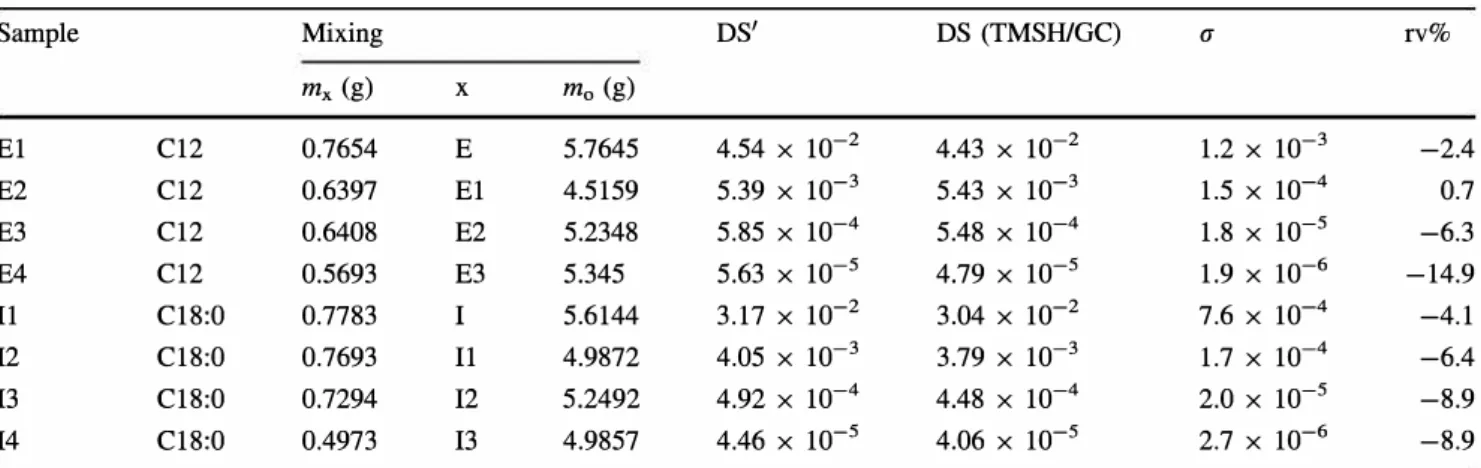
In order to assess the accuracy of the method on LCCE samples with low and very low OS, we performed the analysis of model mixtures prepared by solid/solid dilution as described in the experimen tal section. Calculated apparent OS from the dilutions (OS') and OS-values determined by TMSH/GC are indicated in Table 2. There was an excellent corre lation between the OS determined by TMSH/GC and those estimated by dilution (R2
=
0.9998). OS as low as 5 x 10⁻⁵ could thus been determined accurately.The comparison could not be done with elemental analysis for LCCE with OS-values lower than 0.1. The sensitivity to error was too high and some elemental analyses gave even negative OS-values. As it can be deducted from Table 2, TMSH/GC gave good reproducibility even if for very low OS-values, the relative variation tends to increase (e.g. sample E4 presented a relative variation of 14.9% ). Never theless, for all the four samples analyzed, the chromatogram was perfectly defined and the signal levels far from the detection threshold of the chro matograph integrator as it can be seen in Fig. 5 for the chromatogram obtained from sample E3 (OS
=
5.48 x 10⁻⁴). Therefore, it is believed that the uncertainty generated during the dilution steps (grinding, mixing ... ) may create heterogeneity. As this effect increases with the consecutive dilutions, there is an increase in the relative variation of the measured OS of the replicates.Figure 6 shows graphically the correlation
between the expected results of OS and those
Table 2 Degrees of substitution determined by transesterification using TMSH and gas chromatography analysis
Sample Mixing DS' DS (TMSH/GC) (J rv% mx (g) X mo (g) El C12 0.7654 E 5.7645 4.54 X 10⁻² 4.43 X 10⁻² 1.2 X 10⁻³ -2.4 E2 C12 0.6397 El 4.5159 5.39 X 10⁻³ 5.43 X 10⁻³ 1.5 X 10⁻⁴ 0.7 E3 C12 0.6408 E2 5.2348 5.85 X 10⁻⁴ 5.48 X 10⁻⁴ 1.8 X 10⁻⁵ -6.3 E4 C12 0.5693 E3 5.345 5.63 X 10⁻⁵ 4.79 X 10⁻⁵ 1.9 X 10⁻⁶ -14.9 Il C18:0 0.7783 I 5.6144 3.17 X 10⁻² 3.04 X 10⁻² 7.6 X 10⁻⁴ -4.1 12 C18:0 0.7693 Il 4.9872 4.05 X 10⁻³ 3.79 X 10⁻³ 1.7 X 10⁻⁴ -6.4 13 C18:0 0.7294 12 5.2492 4.92 X 10⁻⁴ 4.48 X 10⁻⁴ 2.0 X 10⁻⁵ -8.9 14 C18:0 0.4973 13 4.9857 4.46 X 10⁻⁵ 4.06 X 10⁻⁵ 2.7 X 10⁻⁶ -8.9
3
2
3
s
7 9 11 13 15retenti on tlme (min)
Fig. 5 GC chromatogram of the analysis of laurate cellulose
ester (sample E) in an intemal standard solution. (1) dimethylsulfide, (2) methyl myristate, (3) methyl pentadecan oate (intemal standard)
1 E-06 û C, :!!: 1-(/) 'c, .!2 1E+OO log10 (DS estimated)
Fig. 6 Comparison of the DS-values determined by TMSH/GC
and those calculated for solid/solid diluted mixtures for the samples E (squares) and I (circles)
determined by TMSH/GC analysis for the E and 1 samples (R2
=
0.99973). The high accuracy (low detection threshold) for the method on the analysis of cellulose esters with very low DS is thus demonstrated.The robustness of the TMSH/GC method was finally investigated by repeating the analysis several times taking a different mass of samples 13 and 14 for each analysis. Figure 7 shows the peak area of the FAME in the chromatogram (normalized to the internai standard) as a fonction of the mass of the analyzed sample. It is clearly observed that there is no influence of the quantity of the analyzed sample (provided that the molar ratio of TMSH is 2 or higher,
1.8 1.6 1.4 1.2
.,,
1 0.8 < 0.6 0.4 0.2 0 0 10 20 m(mg) 13 DS=4.48.10-4 14 DS=4.06.10·5 30 40Fig. 7 Relative area of the analyzed FAME peak in GC for
samples 13 and 14 as a function of the mass of LCCE analyzed
as demonstrated above). Therefore, the TMSH/GC method shows a good reproducibility as all the points stand along the line with a coefficient of correlation
R2 of 0.9997 for the sample 14 with a
DS
=
4.06 x 10⁻⁵ and R2=
0.9999 for sample 13 with DS=
4.48 x 10⁻⁴_Perspectives
The fact that the chromatographie analysis is able to evaluate the individual concentration of different FAME opens the possibility for the proposed method to analyze mixed cellulose esters of the studied fatty acids. Indeed, Fig. 2 shows the clear separation of all the chromatographie peaks, therefore any combina tian of them is possible to analyze. The calculation of the individual DS-values becomes in this case:
DSi (TMSH/GC) = 162� 14 x Ci x Vs
m- Vs X I::J=l Cj X (Mj-18.02)
q:
concentration of each FAME in MTBE aftertransesterification deterrnined by GC in mol L -l, n: number of fatty substituents on cellulose, Mf molar mass of each corresponding RCOOH fatty acid.
The analysis of other mixed esters (for instance acetic-stearic) is possible provided that the GC separation of the involved methyl fatty acid esters is good, which has not been the case with the present protocol because the chromatographie peak of short aliphatic chains has similar retention time with the solvent peak.
Conclusions
The TMSH/GC method, established in this study, constitute an easy and accurate method for the determination of the degree of substitution of long chain cellulose esters over a range of saturated fatty chain lengths from C8 to C18 and over the whole of DS. LCCE with higher fatty chain lengths can potentially be analyzed by this method, provided that the reaction time and the TMSH:acyl ratio is optimized. This method could also be interesting and efficient in the analysis of cellulose mixed esters presenting more than one acyl substituent. Compared to other methods, TMSH/GC is the only method permitting a complete analysis of a sample multi substituted in <2 h. For samples with high OS-values (superior to one), elemental analysis is more precise in terms of repeatability than the TMSH/GC tech nique but not in term of reproducibility. When DS is inferior to one, the TMSH/GC method is more accurate than elemental analysis. The key point of this method is the fact that LCCE esters with degrees of substitution inferior to 0.1 and up to 10-5 are able
to be analyzed with high accuracy and reproducibil ity. This is the first time that such cellulose esters have been analyzed with such precision.
Acknowledgment The authors thank LAPEYRE Company
(France) for research funding.
References
Chauvelon G, Saulnier L et al (1999) Acidic activation of cellulose and its esterification by long-chain fatty aeid. J Appl Polym Sei 74(8):1933-1940
Cunha AG, Freire CSR et al (2007) Bi-phobie cellulose fibers derivatives via surface trifluoropropanoylation. Langmuir 23(21):10801-10806
Deschamps G, Caruel H et al (2003) Oil removal from water by selective sorption on hydrophobie cotton fibers. 1. Study of sorption properties and comparison with other cotton fiber-based sorbents. Environ Sei Technol 37(5):1013-1015
Edgar KJ, Buchanan CM et al (2001) Advances in cellulose ester performance and application. Prog Polym Sei 26(9): 1605-1688
Freire CSR, Silvestre AJD et al (2005) An efficient method for determination of the degree of substitution of cellulose esters of long chain aliphatic aeids. Cellulose 12(5):449-458
Jandura P, Kokta BV et al (2000) Fibrous long-chain organic acid cellulose esters and their characterization by diffuse reflectance FTIR spectroscopy, solid-state CP/MAS C-13-NMR, and X-ray diffraction. J Appl Poly Sei 78(7):1354-1365
Magne M, El Kasmi S et al (2003) Method for treating lig nocellulosic materials, in particular wood and material obtained by said method. Lapeyre. World Patent WO 084 723
Muller KD, Husmann H et al (1990) A new and rapid method for the assay of bacterial fatty aeids using high resolution capillary gas chromatography and trimethylsulfonium hydroxide. Zentralbl Bakteriol 274(2):174-182
Peydecastaing J, Bras J et al (2006) NIR study of chemically modified cellulosic biopolymers. Mol Cryst and Liq Cryst 448:115-122
Peydecastaing J, Vaca-Gareia C et al (2008) Mixed acetic-fatty cellulose esters. Part II. Hydrophobicity. Cellulose (in review)
Samaranayake G, Glasser WG (1993) Cellulose derivatives with low DS.2. Analysis of alkanoates. Carbohydr Polym 22(2):79-86
Schulte E, Weber K (1989) Rapid preparation of fatty acid methyl esters from fats with trimethylsulfonium hydroxide or sodium methylate. Fett Wissenschaft Technologie 91(5): 181-183
Sealey JE, Samaranayake G et al (1996) Novel cellulose derivatives.4. Preparation and thermal analysis of waxy esters of cellulose. J Polym Sei Part B-Polym Phys 34(9):1613-1620
Thiebaud S, Borredon ME (1995) Solvent-free wood esterifi cation with fatty aeid chlorides. Bioresour Technol 52(2):169-173
Tindall GW, Boyd BW et al (2002) Determination of acid substituents and unesterified hydroxyl groups in cellulose esters. J Chromatogr A 977(2):247-250
Tindall GW, Perry RL (1993) Determination of ester substit uents in cellulose esters. J Chromatogr 633(1-2):227-233 Vaca-Garcia C, Borredon ME et al (2001) Determination of the degree of substitution (DS) of mixed cellulose esters by elemental analysis. Cellulose 8(3):225-231
Wang P, Tao BY (1994) Synthesis and characterization of long-chain fatty aeid cellulose ester (FACE). J Appl Polym Sei 52(6):755-761
Wang P, Tao BY (1995) Synthesis of cellulose-fatty acid esters for use as biodegradable plastics. J Environ Polym Degrad 3(2):115-119