Journal of Ecology 2009, 97, 548– 554 doi: 10.1111/j.1365-2745.2009.01500.x Blackwell Publishing Ltd
Resource and non-resource root competition effects of
grasses on early- versus late-successional trees
Christian Messier
1*, Lluis Coll
2, Amélie Poitras-Larivière
1, Nicolas Bélanger
3and
Jacques Brisson
41Centre d’étude de la forêt (CEF), Département des Sciences Biologiques, Université du Québec à Montréal, C.P. 8888,
Succ. Centre-Ville, Montréal, Québec H3C 3P8, Canada; 2Centre Tecnològic Forestal de Catalunya, Carretera St Llorenç
de Morunys, km 2, 25280 Solsona, Spain; 3Department of Soil Science, University of Saskatchewan, 51 Campus Drive,
Saskatoon, Saskatchewan S7N 5A8, Canada; and 4Centre d’étude de la forêt (CEF), Institut de recherche en biologie
végétale, Département de Sciences Biologiques, Université de Montréal. 4101 East, Sherbrooke St., Montréal, Québec H1X 2B2, Canada
Summary
1.
This study assessed the effects of resource (i.e. nutrients) and non-resource (i.e. interference for space)
competition from fine roots of competing grasses on the growth, morphology and architecture of
fine roots of four tree species of varying successional status:
Populus deltoides
×
P. balsamifera
(a
hybrid),
Betula papyrifera
,
Acer saccharum
and
Fraxinus americana
. We tested the general hypothesis
that tree fine-roots are affected by both below-ground resource and non-resource competition from
non-self plants, and the more specific hypothesis that this effect is stronger in early-successional tree
species.
2.
The experiment was conducted in split-containers where half of the roots of tree seedlings
expe-rienced either below-ground resource competition or non-resource competition, or both, by grasses
while the other half experienced no competition.
3.
The late-successional tree species
A. saccharum
and
F. americana
were mostly affected by
resource competition, whereas the early-successional
P. deltoides
×
balsamifera
and
B. papyrifera
were strongly affected by both resource and non-resource competition. Non-resource competition
reduced fine-root growth, root branching over root length (a measure of root architecture) and
specific root length (a measure of root morphology) of both early-successional species.
4.
Synthesis
. This study suggests that early-successional tree species have been selected for root
avoidance or segregation and late-successional tree species for root tolerance of competition as
mechanisms to improve below-ground resource uptake in their particular environments. It also
contradicts recent studies showing perennial and annual grasses tend to overproduce roots in the
presence of non-self conspecific plants. Woody plants, required to grow and develop for long periods
in the presence of other plants, may react differently to non-self root competition than perennial or
annual grasses that have much shorter lives.
Key-words:
fine-root competition, root architecture, root avoidance, root morphology, root
nutrition, root tolerance, successional tree species
Introduction
Living organisms compete for resources and non-resource factors (i.e. interference competition for space) in their struggle for survival. While this is true for both plants and animals, plants – due to their relative immobility – have developed special adaptations. Many studies have examined how these
plant adaptations improve uptake of above- and below-ground resources, but much fewer studies have focused on interfer-ence competition not mediated by resources underground. Above ground, plants modify their crown forms and overall architecture in relation to competition for space (Brisson et al. 2001; Purves et al. 2007). Detection mechanisms are diverse, but changes in light quality and quantity are known important environmental cues (Ballaré et al. 1990; Smith & Whiteman 1997). Below-ground competition for space has
Non-resource root competition in trees 549
been much more difficult to find or to demonstrate. Within the individual, plants use genetically determined architectural rules to decrease self-interference (Fitter et al. 1987). However, evidence is lacking regarding if and how plants respond to below-ground competition from conspecific plants or other species. Many studies in the last 15 years have indicated that detection of other roots and competition for below-ground space are probably much more prevalent than previously thought (Brisson & Reynolds 1994; Mahall & Callaway 1996; Schenk et al. 1999; Hess & de Kroon 2007; O’Brien & Brown 2008). Gersani et al. (2001) and O’Brien & Brown (2008) suggested that, all other things being equal, a plant should first produce new roots in unoccupied soil before doing so in soil occupied by other species or conspecifics. Further, other studies suggested roots possess discriminating mechanisms that allow them not only to detect whether roots from other plants are conspecific or interspecific (Aphalo & Ballaré 1995; Bruin et al. 1995; Huber-Sannwald et al. 1996; Schenk et al. 1999; Gersani et al. 2001; Gruntman & Novoplansky 2004), but also to determine the genetic relat-edness of roots of plants of the same species (Callaway & Mahall 2007; Dudley & File 2007). Root discrimination has also been shown to vary among species (Semchenko et al. 2007).
The importance of root discrimination in complex commu-nities such as forests is presumably important due to the great number of plant species having different functional adapta-tions. One important such adaptation relates to the ability of late successional plants to colonize, grow and develop in already established forest understorey (Messier et al. 1999; Humbert et al. 2007). Early-successional species require recent large gaps or totally disturbed sites to get established. There exist many known ecological and physiological dif-ferences between these two functional groups (review by Valladares & Niinemets 2008), but relatively little is known about the plants’ abilities to develop and grow roots in the presence of competing neighbours. Our aim in this study was to assess the effects of resource and non-resource below-ground competition by grasses on fine roots of four tree species varying in their successional status. Hybrid poplar (Populus deltoides
×
P. balsamifera) and white birch (Betula papyrifera Marsh.) are considered early-successional orpioneer tree species, whereas sugar maple (Acer saccharum Marsh.) and American ash (Fraxinus americana L.) are considered late-successional (Burns & Honkala 1990).
We tested the general hypothesis that the production, morphology and architecture of tree fine-roots are affected by both below-ground resource and non-resource competition from non-self plants. More specifically, we tested the hypoth-esis that fine-roots of early-successional tree species, such as poplar and birch, are more negatively affected by the presence of competing non-self fine roots than late-successional species, such as ash and maple, which are able to successfully establish and grow in already fully occupied below-ground environments. To differentiate between resource- and non-resource-based effects, we used a split-pot experiment and fertilized and non-fertilized half containers where the roots of individual trees were allowed to grow into two separate halves of the same container, with and without the roots of competing vegetation.
Methods
E X P E R I M E N T A L D E S I G N A N D T R E A T M E N T S
The experiment was set up in an open field at McGill University’s Macdonald Campus (45º25′ N, 73º56′ W), 30 km west of Montreal (Canada). In May 2005, 64 square containers (75 × 75 cm wide and 30 cm deep) were hand-constructed and their volumes divided into two equal parts by solid plywood planks (see Fig. 1). The containers were filled with a mixture of peat moss (20%), sand (30%) and com-mercial soil (50%), and were exposed to full-light conditions in eight rows (eight containers per row) spaced 2 m apart. Within each row, the containers were separated by 1.5 m. Half of each container was then heavily sown with a mixture of red fescue (Festuca rubra L.) and annual ryegrass (Lolium multiflorum Lam.) in late May (hereafter, the ‘vegetated half’) and the other half left unsown (the ‘non-vegetated half ’). We selected these two grasses because they have no known toxic effects on plants, so that root segregation would not be due to toxic or allelopathic effects (e.g. Israel et al. 1973; Nilsson 1994; Schenk et al. 1999). At the end of May, 16 one-year-old saplings of four different tree species, for a total sample size of 64, were randomly established in the containers. They included two early-successional species, hybrid poplar (Populus deltoides
×
P. balsamifera) and white birch (Betula papyrifera Marsh.), and two late-successional species, Fig. 1. Schematic of the experimental550 C. Messier et al.
white ash (Fraxinus americana L.) and sugar maple (Acer saccharum
Marsh.). We used saplings of similar sizes with a root system approx-imately symmetrically and homogeneously distributed around the stem axis. One sapling was carefully set in the middle of each container. The main root was inserted into a narrow (3 cm) opening carved into the plywood plank and we then arrayed half of the sapling’s lateral roots into each separated compartment.
To avoid water stress during the growing season, all containers on both sides were watered to full capacity at least every second day. From mid-July to mid-September, 7.5 g of NPK granular fertiliser (20 : 10 : 10) was applied every 10 days (five times throughout the growing season) to the sown vegetated side for half of the 64 containers (totalling 32 containers, i.e. eight per species). The unsown half was always left unfertilized for all 64 containers.
R O O T M E A S U R E M E N T S
At the beginning of October 2005, all seedlings were carefully har-vested by hand, taking care to maintain the integrity of their root systems. Roots were then separated from each seedling, washed and divided into two groups, depending on which compartment they had developed in. Fine root morphology and architecture were assessed on one root per plant and compartment (n = 128). Selected roots were carefully washed and their total length, surface area, number of root terminations (RT) and branching events (RB) calculated using WinRHIZO image analysis software (Régent instruments, Quebec, QC, Canada). From these measures, we determined root termination number over root surface (RTRS) and root branching events over root surface (RBRS). Specific root length (SRL, cm g–1) was
calcu-lated once the scanned roots were had been dried and weighed. The remaining seedling root system was washed, divided into two groups according to diameter (fine roots < 2 mm, other roots > 2 mm) and then dried and weighed for biomass computation.
For each seedling, K and P concentrations (mg g–1) of two fine-root
subsamples (one for each side of the container) and one aggregate sample of all leaves (one per container) were determined following digestion in boiling H2SO4–H2O2. Root and leaf concentrations of K
and P were quantified by atomic emission spectroscopy (Varian SpectrAA 220) and continuous-flow analyzer (Technicon, molybdenum blue method), respectively. Subsamples were also finely ground (< 60 μm) for determination of total N by high temperature combustion (1100 °C) and infrared detection using a Leco CNS-2000 Analyzer. Above-ground biomass of sown grasses was estimated in each container by clipping the shoots (leaves and sheaths) from a 10 × 10 cm square. A rectangular core (10 × 10 cm wide and 30 cm deep) was taken from the same location for below-ground root biomass estimation (dry mass basis). There were, on average, 0.105 g cm–2 of foliage and 0.006 g cm–3 of roots for grasses in the
non-fertilised containers and 0.599 g cm–2 and 0.020 g cm–3,
respec-tively, in the fertilised containers. Fertilisation increased foliage and root biomass almost six- and fourfold, respectively.
S T A T I S T I C A L A N A L Y S E S
The analysis of root responses of the four tree species to competing roots was performed using factorial analysis of variance (anova) for a randomised block design with tree species and fertilisation as factors. The root response was evaluated for each container using the ratio between the value of the different root variables on the vegetated half and the value on the non-vegetated half (e.g. RTRSratio = RTRSvegetated half/RTRSnon-vegetated half for root termination
over root surface ratio). Homogeneity of variances was verified using Bartlett’s test and log-anova test. The data were transformed when necessary using ln transformation to satisfy normality and homoscedasticity assumptions. We considered a species as being unaffected by either or both resource and non-resource root effects when the ratio was not significantly different from 1. On the oppo-site, tree species were considered to suffer negatively from either or both resource and non-resource root effects when the ratio was significantly lower than 1 in the non-fertilized containers, and from only non-resource root effects in the fertilized containers.
This difference was analysed using a t-test based on the comparison of confidence intervals of our data with those assigned to a small sample (n < 30) following a Student’s t-distribution. Again, ln trans-formation was performed when necessary.
Results
N U T R I E N T A N A L Y S E S
Foliar N, P and K concentrations did not differ significantly between fertilized and non-fertilized containers for all four tree species (results not shown). However, N concentrations of fine roots were significantly lower in the vegetated-half than the non-vegetated half (i.e. ratio lower than 1) of the non-fertilized compared to the fertilized containers (Table 1, Fig. 2). No significant differences were found between the vegetated and non-vegetated halves when the vegetated half was fertilized (i.e. ratio not different from 1). P concentrations of fine roots were significantly lower in the vegetated half of the non-fertilized containers for both maple and ash, but no differences were found for the fertilized containers (Table 1, Fig. 2). Finally, no difference in root K concentration was found between fertilized and non-fertilized containers and vegetated and non-vegetated halves (Table 1, Fig. 2). The elimination of fine-root nutrient differences between vege-tated and non-vegevege-tated halves with fertilisation indicated that tree fine roots from both halves were exposed to similar amounts of nutrients. Fine-root nutrient concentration in the non-vegetated half did not differ significantly between the fertilized and non-fertilized treatments, indicating that no retranslocation of nutrients occurred between roots within single trees.
T R E E R O O T B I O M A S S
Total- and fine-root biomass ranged from low values of 2.6 and 1.5 g for maple to high values of 109.4 and 19.3 g for poplar in the vegetated halves of the fertilized containers, respec-tively. Competition with grasses resulted in some root-system asymmetry (i.e. lower biomass on the vegetated half or ratios lower than 1) in both fertilized and non-fertilized containers (Fig. 3). For the non-fertilized containers, only birch and maple had significantly lower total root biomass in the vegetated half (i.e. ratios lower than 1), while all species in the non-fertilized containers had significantly lower fine-root biomass in the vegetated half (Fig. 3). When the vegetated halves were fertilized, tree total root and fine-root biomass were not significantly different between vegetated and non-vegetated
Non-resource root competition in trees 551
halves (i.e. ratios were not significantly different from 1), except for birch which had a lower total and fine-root biomass in the vegetated half (i.e. ratios below 1; Fig. 3). Birch had significantly lower total biomass ratios compared to poplar and ash and lower fine-root biomass ratios compared to all three other tree species for both fertilized and non-fertilized treatments. Fertilization applied to the vegetation halves significantly increased absolute total tree fine-root biomass for both poplar and birch, while no significant difference was apparent for ash and maple (results not shown). It also greatly increased fine root biomass of grasses in the vegetated half, so that fine-roots of trees experienced an even greater presence of competing non-self roots compared to the non-fertilized containers, despite similar nutrient and water availability in both halves.
T R E E A B O V E
-
G R O U N D G R O W T HFertilization did not affect tree growth above ground (height and diameter growth), except for birch which showed a slight, but significant, positive effect (data not shown).
F I N E
-
R O O T M O R P H O L O G Y A N D A R C H I T E C T U R E O F T R E E SRoot terminations over root surface (RTRS) and branching events over root surface (RBRS) ranged from low values of 14.3 and 32.3 cm–2 for ash to high values of 69.2 and 136.5 cm–2
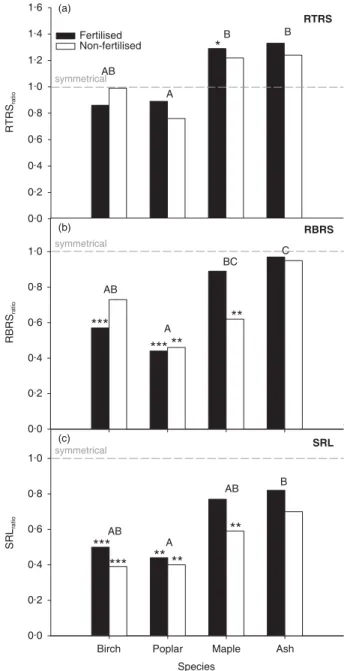
for poplar in the non-vegetated halves of the non-fertilized containers, respectively. We calculated the ratios of root terminations and branching events over the root surface (RTRSratio, RBRSratio) and specific root length (SRLratio)
between the vegetated and non-vegetated halves of the containers as indicators of changes in root morphology and architecture. Maple showed a significantly and ash a non-significantly higher RTRSratio (RTRSratio > 1) for the fertilized
treatment, whereas no significant differences were found for
the non-fertilized treatment (Fig. 4). The opposite, but not statistically significant, trend was found for birch and poplar (Fig. 4). Among trees, maple and ash had significantly higher RTRSratio values than poplar (Fig. 4). RBRSratio varied in a
fashion similar to RTRSratio among the tree species, i.e. maple
and ash had significantly higher values than poplar. The presence of grass roots induced significantly lower RBRSratio
values in birch for the fertilised treatment, poplar for both fertilized and non-fertilized treatments and maple for the non-fertilized treatment (Fig. 4). No effect was found for ash. SRL ranged from a low value of 626.5 cm g–1 for poplar in
the vegetated halves of the fertilized containers to a high value of 2994.7 cm g–1 for maple in the non-vegetated halves of the
non-fertilized containers. Both shade-tolerant maple and ash had higher SRLratio values than shade-intolerant birch and
poplar, but it was significantly higher only for ash compared to poplar (Fig. 4). Birch and poplar had significantly lower SRLratio values for both fertilized and non-fertilized
treat-ments, whereas maple had a significant lower SRLratio for only
the non-fertilized treatment (Fig. 4). The presence of grasses had no significant effect on ash SLRratio values in either
fertilized or non-fertilized treatments, although the values were lower than 1 in both cases.
Discussion
We used a split-pot experiment with fertilized and non-fertilized half containers to test the general hypothesis that tree fine-roots are affected by both resource (nutrients) and non-resource (interference for space) competition by other plants, and that these effects are more prevalent in early-successional species. The ability of tree species to detect the presence of non-self competing roots and to maximize fine-root establishment in unoccupied below-ground environ-ments would provide an advantage for early-successional fast-growing tree species that require high levels of resources to grow and develop. Any asymmetry found in root production, Table 1. Summary of anova F-ratios and P-values for effects of fertilisation (FERT), species (SP) and FERT × SP interactions on root biomass, morphology and architecture, and nutrient concentration. Each variable is expressed as the ratio between its value in the vegetated half to that in the non-vegetated half. Abbreviations – RTRS, root termination number : root surface; RBRS, root branching events : root surface; SRL, specific root length (cm g–1); and root nitrogen (N), phosphorus (P) and potassium (K) (mg g–1). Bold P-values indicate significant values at
α < 5%
Root variable
FERT SP FERT × SP
F-ratio P-value F-ratio P-value F-ratio P-value
Biomass
Total rootratio 10.776 0.002 5.991 0.001 0.616 0.607
Fine-rootratio 15.936 < 0.001 5.839 0.002 0.113 0.952
Morphology and architecture
RTRSratio 0.031 0.862 4.902 0.004 0.406 0.749 RBRSratio 0.038 0.847 9.016 < 0.001 0.979 0.410 SRLratio 2.187 0.146 4.341 0.009 0.161 0.922 Nutrient concentration Nratio 18.715 < 0.001 0.622 0.604 0.757 0.523 Pratio 3.457 0.069 2.499 0.069 1.443 0.241 Kratio 0.154 0.696 0.732 0.538 1.920 0.138
552 C. Messier et al.
morphology or architecture in the non-fertilized containers was attributed to both resource (nutrients) and non-resource (interference for space) competition, while in the fertilized containers the asymmetry was attributed to non-resource competition.
Consistent with many previous studies done on herbs and shrubs (Atkinson et al. 1976; Mahall & Callaway 1991; McConnaughay & Bazzaz 1991; Brisson & Reynolds 1994; Huber-Sannwald et al. 1997; Dudley & File 2007; O’Brien & Brown 2008), we showed that fine roots of trees were nega-tively affected (i.e. ratio lower than 1) by competing non-self fine roots through both resource and non-resource competition.
This finding confirms our main hypothesis and demonstrated for the first time that the effects of both resource and non-resource competition on fine-root growth, morphology and architecture occurred in tree species. Ash was affected by neither resource nor non-resource competitive mechanisms, which likely reflects the fact this shade-tolerant tree species did not experience any nutrient deficiencies, even in the non-fertilized treatment. Indeed, we found no difference in shoot height and diameter growth for this species attributable to fertilization. For maple, however, fine-root growth and specific root length were negatively affected by the possible reduction in nutrient availability induced by grasses in the non-fertilized treatment. This is a resource effect because all significant dif-ferences disappeared when fertilization eliminated nutrient differences between container halves, despite the fact that fine root biomass of grasses increased almost fourfold. We conclude that, for the late-successional tree species in our study, no indication was present of non-resource competition (or root segregation). This finding is contrary to many recent studies using non-woody species (Falik et al. 2003; Gruntman & Novoplansky 2004; O’Brien & Brown 2008). On the other hand, for the early-successional species in our study, most fine root indicators showed strong negative effects from resource Fig. 2. Asymmetry in root systems expressed as ‘vegetated
half : non-vegetated half ’ ratio of (a) N, (b) P and (c) K concentration in root systems. Letters indicate species differences (Tukey tests, following anova). Asymmetrical nutrient concentrations (i.e. ratios significantly different from 1.0) are indicated above the columns (**P < 0.05, *P < 0.10).
Fig. 3. Asymmetry in (a) total root and (b) fine root biomass expressed as the ratio ‘vegetated half : non-vegetated half ’ of the containers. Letters indicate species differences (Tukey tests, following anova). Asymmetrical root biomass (i.e. ratios significantly different from 1.0) are indicated above the columns (**P < 0.05, *P < 0.10).
Non-resource root competition in trees 553
and non-resource below-ground competition (i.e. ratios lower than 1 in both fertilised and non-fertilised containers; Figs 3 and 4). Again, this finding does not corroborate recent studies showing some plants produce more roots in the presence of non-self plants (Falik et al. 2003; Gruntman & Novoplansky 2004; O’Brien & Brown 2008). Woody plants, required to grow and develop for long periods in the presence of other plants, may react differently to non-self root competition than perennial or annual grasses that have much shorter lives. Interestingly, the most sensitive fine-root indicator of both resource and non-resource competition for the two
early-successional tree species was specific root length, a morpho-logical indicator (Fig. 4). This finding shows specific root length reduction, observed in many species in the face of fine-root competition (Fitter 1986; Crabtree & Berntson 1994; Fitter 1994; Bauhus & Messier 1999), is induced not only by resource depletion but also by the physical presence of non-self root competitors (this study) or physical obstructions (Semchenko et al. 2008).
The specific hypothesis that early-successional trees are more negatively affected by the presence of competing roots than late successional trees (i.e. ratios lower than 1) was supported by our results. This helps to explain why many early-successional species have difficulties establishing and competing on sites where the below-ground environment is already fully occupied by fine roots (Richardson 1993; Balandier et al. 2006; Coll et al. 2007). This result provides an explanation why we observe spectacular growth of hybrid poplar when competing vegetation is removed early after tree establishment, even on fertile and mesic sites where nutrients and water are not limiting (Coll et al. 2007). Our results strongly suggest that fine-root avoidance or segregation have evolved in early-successional trees as a strategy to optimise uptake of below-ground resources for fast and aggressive early growth (Casper & Jackson 1977; Reader et al. 1992; Brisson & Reynolds 1997). For species that cannot tolerate deep shade, rapid growth is crucial; any energy allocation to fine roots incapable of absorbing sufficient water and nutri-ents to sustain the fast growth necessary to ensure long-term survival may have a lower fitness value. The opposite is true for late-successional trees, as these species must establish in already fully occupied below-ground environments to ensure long-term success. Root segregation was detected here but it was not dependent on resource levels. This result differs from a previous study by Schenk et al. (1999) who suggested that root segregation strategies occur mainly in stressful environ-ments such as in arid or semi-arid climatic zones.
While we did not investigate the possible mechanisms behind this root segregation, several explanations are plausible (see review by Schenk et al. 1999). Some authors have even incorporated root segregation into a general chemical signal-ling mechanism among plants (Aphalo & Ballaré 1995; Bruin et al. 1995). Evidence is accumulating that roots of different species or different genotypes do indeed ‘talk’ to one another (Callaway & Mahall 2007; Dudley & File 2007). It would be interesting to evaluate in a future study, as Brisson & Reynolds (1997) showed with desert shrubs, whether root-segregation strategies in early-successional trees are prevalent and increase competitive ability in recently disturbed sites where competing vegetation is patchy.
Acknowledgements
This research was supported primarily by a NSERC discovery grant to C.M. The article was written during a stay of C.M. in the CTFC (Spain) funded by the PIV program of the Generalitat de Catalunya (2006PIV00021). Thanks to B. Fontaine for help with the statistical analyses and Bill Parsons and Ronnie Drever for revision of the English. Thanks also to B. Goetz and R. de Freitas at the University of Saskatchewan laboratories for their help.
Fig. 4. Asymmetry in root system morphology and architecture expressed as the ratio ‘vegetated half: non-vegetated half ’ for : (a) root terminations/root surface (RTRSratio); (b) branching events/root
surface (RBRSratio); and (c) specific root length (SRLratio). Letters
indicate species differences (Tukey tests, following anova). Asymmetrical root morphology and architecture (i.e. ratios significantly different from 1.0) are indicated above the columns (**P < 0.05, *P < 0.10).
554 C. Messier et al.
References
Aphalo, P.J. & Ballaré, C.L. (1995) On the importance of information-acquiring systems in plant-plant interactions. Functional Ecology, 9, 5–14. Atkinson, D., Naylor, D. & Coldrick, G.A. (1976) The effect of tree spacing on
the apple root system. Horticulture Research, 16, 89–105.
Balandier, P., Collet, C., Miller, J.H., Reynolds, P.E. & Zedaker, S.M. (2006) Designing forest vegetation management strategies based on the mechan-isms and dynamics of crop tree competition by neighbouring vegetation. Forestry, 79, 3–27.
Ballaré, C.L., Scopel, A.L. & Sánchez, R.A. (1990) Far-red radiation reflected from adjacent leaves: an early signal of competition in plant canopies. Science, 247, 329–332.
Bauhus, J. & Messier, C. (1999) Soil exploitation strategies of fine roots in dif-ferent tree species of the southern boreal forest of eastern Canada. Canadian Journal of Forest Research, 29, 260–273.
Brisson, J. & Reynolds, J.F. (1994) The effect of neighbors on root distribution in a creosotebush (Larrea tridentate) population. Ecology, 75 (6), 1693–1702. Brisson, J. & Reynolds, J.F. (1997) Effects of compensatory growth on population
processes: a simulation study. Ecology, 78, 2378–2384.
Brisson, J. (2001) Neighborhood competition and crown asymmetry in Acer saccharum. Canadian Journal of Forest Research, 31, 2151–2159. Bruin, J, Sabelis, M.W. & Dicke, M. (1995) Do plants tap SOS signals from
their infested neighbors? Trends in Ecology and Evolution, 10, 167–170. Burns, R.M. & Honkala, B.H. (Technical Coordinators). (1990) Silvics of
North America. Vol. 2. Hardwoods. Agriculture Handbook 654. USDA Forest Service, Washington, DC.
Callaway, R.M. & Mahall, B.E. (2007) Family roots. Nature, 448, 145–147. Casper, B.B. & Jackson, R.B. (1997) Plant competition underground. Annual
Review of Ecology and Systematics, 28, 545–570.
Coll, L., Messier, C., Delagrange, S. & Berninger, F. (2007) Growth, allocation and leaf gas exchanges of hybrid poplar plants in their establishment phase on previously forested sites: effect of different vegetation management techniques. Annual of Forest Science, 64, 275–285.
Crabtree, R.C. & Bernston, G.M. (1994) Root architecture response of Betula lenta to spatially heterogeneous ammonium and nitrate. Plant Soil, 158, 129–134. Dudley, S.A. & File, A.L. (2007) Kin recognition in an annual plant. Biology
Letter, 3, 435–438.
Falik, O., Reides, P., Gersani, M. & Novoplansky, A. (2003) Self/non-self discrimination in roots. Journal of Ecology, 525–531.
Fitter, A.H. (1986) Spatial and temporal patterns of root activity in a species-rich alluvial grassland. Oecologia, 69, 594–599.
Fitter, A.H. (1987) An architectural approach to the comparative ecology of plant root systems. New Phytologist, 106, 61–77.
Fitter, A.H. (1994) Architecture and biomass allocation as components of the plastic response of root systems to soil heterogeneity. Exploitation of Environmental Heterogeneity by Plants: Ecophysiological Processes above and Belowground (eds M.M. Caldwell & R.W. Pearcy), pp. 305–323. Academic Press, San Diego, CA.
Gersani, M., Brown, J.S., O’Brien, E.E., Maina, G.M. & Abramsky, Z. (2001) Tragedy of the commons as a result of root competiton. Journal of Ecology, 89, 660–669.
Gruntman, M. & Novoplansky, A. (2004) Physiologically mediated self/non-self discrimination in roots. PNAS, 101, 3863–3867.
Hess, L. & de Kroon, H. (2007) Effects of rooting volume and nutrient avail-ability as an alternative explanation for root self/non-self discrimination. Journal of Ecology, 95, 241–251.
Huber-Sannwald, E., Pyke, D.A. & Caldwell, M.M. (1996) Morphological plasticity following species-specific recognition and competition in two perennial grasses. American Journal of Botany, 83, 919–931.
Humbert, L., Gagnon, D., Kneeshaw, D.D. & Messier, C. (2007) A shade tolerance index for common understory species of northeastern North America. Ecology Indicators, 7, 195–207.
Israel, D.W., Giddens, J.E. & Powell, W.W. (1973) The toxicity of peach tree roots. Plant Soil, 39, 103–112.
Mahall, B.E. & Callaway, R.M. (1991) Root communication among desert shrubs. Proceedings of the National Academy of Science USA, 88, 874–876. Mahall, B.E. & Callaway, R.M. (1996) Effects of regional origin and genotype on intraspecific root communication in the desert shrub Ambrosia dumosa (Asteraceae). American Journal of Botany, 83, 93–98.
McConnaughay, K.D.M. & Bazzaz, F.A. (1991) Is physical space a soil resource? Ecology, 72(1), 94–103.
Messier, C., Doucet, R., Ruel, J.-C., Claveau, Y., Kelly, C. & Lechowicz, M. (1999) Functional ecology of advance regeneration in relation to light in boreal forests. Can J For Res, 29, 812–823.
Nilsson, M.C. (1994) Separation of allelopathy and resource competition by the boreal dwarf shrub Empetrum hermaphroditum Hagerup. Oecologia 98, 1–7.
O’Brien, E. & Brown, J.S. (2008) Games roots play; effects of soil volume and nutrients. Journal of Ecology, 96, 438–446.
Purves, D.W., Lichstein, J.W. & Pacala, S.W. (2007) Crown plasticity and competition for canopy space: a new spatially implicit model parameterized for 250 North American tree species. PLoS-ONE, 2 (9), e870. doi:10.1371/ journal.pone.0000870 [article].
Reader, R.J., Jalili, A., Grime, J.P., Spencer, R.E. & Matthews, N. (1992) A comparative study of plasticity in seedling rooting depth in drying soil. Journal of Ecology, 81, 543–550.
Richardson, B. (1993) Vegetation management practices in plantation forests of Australia and New Zealand. Canadian Journal of Forest Research, 23, 1989–2005.
Schenk, H.J., Callaway, R.M. & Mahall, B.E. (1999) Spatial root segregation: are plants territorial? Advanced Ecology Research, 28, 145–180.
Semchenko, M., John, E.A. & Hutchings, M.J. (2007) Effects of physical connection and genetic identity of neighbouring ramets on root-placement patterns in two clonal species. New Phytologist, 176, 644–654.
Semchenko, M., Zobel, K., Heinemeyer, A. & Hutchings, M.J. (2008) Foraging for space and avoidance of physical obstructions by plants roots: a com-parative study of grasses from contrasting habitats. New Phytologist, 179, 1162–1170.
Smith, H. & Whitelam, G.C. (1997) The shade avoidance syndrome: multiple responses mediated by multiple phytochromes. Plant Cell Environment, 20, 840–844.
Valladares, F. & Niinemets, U. (2008) Shade tolerance, a key plant feature of complex nature and consequences. Annual Review of Ecology and System-atics, 39, 237–257.
Received 10 September 2008; accepted 17 February 2009 Handling Editor: Christopher Lortie