SPECULOOS
S
earch for habitable
P
lanets
EC
lipsing
UL
tra-c
OO
l
S
tars
Transiting planets: treasures in the sky
Among the hundreds of planets detected outside our solar system, the ones that transit their parent star are genuine Rosetta Stones for the study of exoplanets, because they can be studied in greatest detail. Indeed, their orbital parameters, mass and radius can be precisely measured, and their atmosphere can be probed during and outside eclipses, bringing strong constraints on their actual nature (Winn 2010). Within the last two decades, more than three hundred transiting exoplanets have been detected. This large harvest includes many gas giants, but also a steeply growing fraction of terrestrial planets. In parallel to this galore of detections, many projects aiming to characterize giant exoplanets have been successful, bringing notably a Eirst glimpse at their atmospheric properties (Seager & Deming 2010).
Fig. 1. Illustration of the techniques for studying the atmosphere of transiting exoplanets. During the transit, the wavelength dependence of the fraction of starlight absorbed gives information about atmospheric composition. When the planet passes behind the star (occultation), its emission is hidden, giving information about composition and temperature. Variations in the brightness of the planet as it revolves around the star constrains its atmospheric circulation. From Knutson (2013).
To export the techniques developed in these pioneering studies of giant planets to terrestrial worlds is the next step to put our Earth in a galactic perspective and to search for life around
other stars.
M. Gillon ([email protected]), E. Jehin, L. Delrez, P. Magain, C. Opitom, S. Sohy
Department of Astrophysics, Geophysics and Oceanography (AGO), University of Liège, Belgium
TRAPPIST/UCDTS : the prototype
No existing transit survey is optimized for detecting Earth-‐size planets transiting the nearest ultra-‐cool stars. Extensive simulations show us that robotic 1m-‐class telescopes equipped with modern CCD cameras highly sensitive in near-‐IR, operating from an exquisite astronomical site, and monitoring individually nearby ultra-‐cool stars, should be able to probe efEiciently their habitable zone for terrestrial planets.
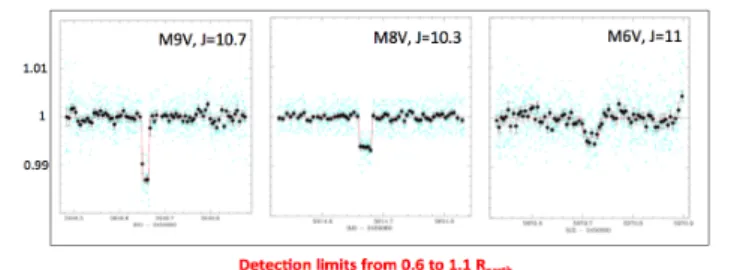
Fig. 3. Actual TRAPPIST/UCDTS light curves for three ultra-‐cool stars, a?er injecBon of a fake transit of an habitable Earth-‐size planet. The best-‐fit transit models are overimposed in red.
Validating this concept was mandatory, notably because the latest M-‐dwarfs often show some variability (e.g. Reid & Hawley 2005) that could preclude the detection of low-‐amplitude transits. We have thus initiated in 2011 a mini-‐survey called UCDTS (Ultra-‐Cool Dwarfs Transit Survey), using the TRAPPIST telescope (Jehin et al. 2011) at ESO La Silla Observatory to monitor the 50 brightest Southern ultra-‐cool stars. The partial results acquired so far for ~30 stars validate unambiguously the survey concept (Fig. 3), and demonstrate that the variability of ultra-‐cool stars does not preclude the detection of planets of Earth-‐size and below (Gillon et al. 2013).
References
Charbonneau, D., et al. 2009, Nature, 462, 89 Gillon, M. et al. 2013, EPJWC 47, 03001 Jehin, E., Gillon, M. et al. 2011, The Messenger, 145, 2 Kaltenegger, L. & Traub, W. A. 2009, ApJ, 698, 519 Knutson, H. 2013, Physics Today, 66, 54
Montgomery, R. & Laughlin, G. 2009, Icarus, 2009, 202, 1 Raymond, S. N., Scalo, J., Meadows, V. S. 2007, ApJ, 669, 606 Seager, S. & Deming D., 2010, ARA&A, 48, 631 Snellen, I. A. G., et al. 2013, ApJ, 764, 182 Winn, J. N. 2010, Exoplanets, UAP, 55 Credit images: ESO, Astelco, NASA/JPL-‐Caltech
The nearby ultra-‐cool stars opportunity
So far, only gas planets much larger than Earth could be characterized in detail. The smallest of them is GJ1214b, a 2.7 Earth radii planet transiting a nearby M4 red dwarf (Charbonneau et al. 2009). The most powerful future telescopes like the James Webb Space Telescope (JWST) or the European Extremely Large Telescope (E-‐ELT) should be able to study the atmosphere of Earth-‐size exoplanets, but only if they transit one of the nearest ultra-‐cool stars
(Kaltenegger & Traub 2009; Snellen et al. 2013).
Fig. 2. From le? to right, dependance to the stellar mass of the orbital period, geometric transit probability, transit depth, and signal-‐to-‐noise raBo for three spectroscopic biosignatures, assuming an Earth-‐twin planet transiBng a M-‐ dwarf at 10pc observed during 200h with a 6.5m space-‐telescope similar to JWST. For each panel, the stellar mass range of ultra-‐cool stars is outlined in pale green. Derived from Kaltenegger & Traub (2009).
These stars at the extreme bottom of the main-‐sequence are at least two times cooler than the Sun, and have sizes similar to Jupiter’s. They are very frequent in the Galaxy. Their small mass, size, and temperature, make transits of habitable planets much more frequent and probable, and maximize the amplitude of the atmospheric signatures detectable with the transit techniques.
Ultra-‐cool stars and planets
No transiting planet has yet been detected around ultra-‐cool stars. Still, theory predicts for them a large population of close-‐in terrestrial planets (Raymond et al. 2007, Montgomery & Laughlin 2009),
forming packed planetary systems very reminiscent of the Jovian moons system. If this predicBon is correct, then a few dozens terrestrial planets should transit ultra-‐cool stars nearby enough to make possible a thorough characteriza9on with future giant telescopes. Each of these stars is thus an opportunity to make exoplanetology enter the realm of terrestrial planets.