ASSESSING THE QUALITY OF ORIGIN-DESTINATION MATRICES DERIVED FROM ACTIVITY/TRAVEL SURVEYS:
RESULTS FROM A MONTE CARLO EXPERIMENT
Mario Cools, Elke Moons, Geert Wets* Transportation Research Institute
Hasselt University Wetenschapspark 5, bus 6 BE-3590 Diepenbeek Belgium Fax.:+32(0)11 26 91 99 Tel.:+32(0)11 26 91{31, 26, 58}
Email: {mario.cools, elke.moons, geert.wets}@uhasselt.be
* Corresponding author
Number of words = 4,342 Number of Figures = 8
Number of Tables = 4
Words counted: 4,342 + 12*250 = 7,342 words Revised paper submitted: March 2, 2010
ABSTRACT
To support policy makers combating travel-related externalities, quality data is required for the design and management of transportation systems and policies. To this end, large amounts of money have been spent on collecting household and person-based data. The main objective of this paper is to assess the quality of origin-destination matrices derived from household activity/travel surveys. To this purpose, a Monte Carlo experiment is set up to estimate the precision of OD-matrices given different sampling rates. The Belgian 2001 census data, containing work/school-related travel information for all 10,296,350 residents, are used for the experiment. For different sampling rates, 2000 random stratified samples are drawn. For each sample, three origin-destination-matrices are composed: one at municipality level, one at district level, and one at provincial level. The correspondence between the samples and the population is assessed by using the Mean Absolute Percentage Error (MAPE) and a censored version of the MAPE (MCAPE). The results show that no accurate OD-matrices can be directly derived from these surveys. Only when half of the population is queried, an acceptable OD-matrix is obtained at provincial level. Therefore, it is recommended to use additional information to better grasp the behavioral realism underlying destination choices and to collect information about particular origin-destination pairs by means of vehicle intercept surveys. In addition, the results suggest using the MCAPE next to traditional criteria to examine dissimilarities between different OD-matrices. An important avenue for further research is the investigation of the effect of sampling proportions on travel demand model outcomes.
1 BACKGROUND
In the modern cosmopolite society, travel is a cornerstone for human development, both for personal and commercial reasons: travel is not only regarded as one of the boosting forces behind economic growth, but is also seen as a social need providing people the opportunity for self-fulfillment and relaxation. As a result of the continuous evolution of modern society (e.g. urban sprawl, increasing female participation in labor, decline in traditional household structures), transportation challenges have accrued and have become more complex (1). Consequently, combating environmental (e.g. greenhouse-emissions such as CO2, methane, NOx; noise, odor annoyance and acid precipitation), economic (e.g. use of nonrenewable energy sources; and time lost due to congestion) and societal (e.g. health problems such as cardiovascular and respiratory diseases; traffic casualties; community severance and loss of community space) repercussions is a tremendous task (2).
To support policy makers in addressing these externalities, quality data are required for the design and management of transportation systems and policies (3). To this end, during the last four decades, large amounts of money have been spent on collecting household and person-based data. For most metropolitan areas, the largest part of planning budgets (an estimated $7.4 million per year) was devoted to the conduct of household and person travel surveys (4). The data collected by these surveys are used for a wide variety of applications, including traffic forecasting, transportation planning and policy, and system monitoring (3).
The main objective of this paper is to assess the quality of origin-destination matrices derived from travel surveys. Mark that origin-destination matrices are core components in both traditional four-step and modern activity-based travel demand models. A sample size experiment is set up to estimate the precision of the OD-matrices given different sampling rates. Thus, an assessment of the appropriateness of travel surveys for deriving origin-destination relations can be made. Note that different types of travel surveys exist: Cambridge Systematics (5) distinguished seven different commonly used types of surveys (household activity/travel surveys; vehicle intercept and external surveys; transit onboard surveys; commercial vehicle surveys; workplace and establishment surveys; hotel/visitor surveys; and parking surveys). Each of these survey types provides a unique perspective for input into travel demand models. In this paper, the term ‘travel survey’ is confined to the first category, namely the household activity/travel surveys.
In a household activity/travel survey, respondents are queried about their household characteristics, the personal characteristics of the members of the household, and about recent activity/travel experiences of some or all household members. For most regions, household activity/travel surveys remain the best source of trip generation and distribution data, and therefore, are an important building block for travel demand models. In addition to model building purposes, these surveys are also used to poll specific target populations (such as transit users and non-users), to assess the potential demand and level of public support for major infrastructural projects, and to create a deeper understanding of travel behavior in the region (5). For a more elaborate discussion concerning travel surveys the reader is referred to (3,5,6). Recent trends in household travel surveys are discussed by Stopher and Greaves (7).
The remainder of this paper is organized as follows. Section 2 provides an extended discussion on the set-up of the sample size experiment. The relationship between sampling rates and the precision of a general statistic (i.e. the proportion of the commuting population) is highlighted in the first part of Section 3. The second part of Section 3 provides the results and
corresponding discussion of the statistical analysis of the main sample size experiment. Finally, some general conclusions will be formulated and avenues for further research indicated.
2 SET-UP OF THE SAMPLE SIZE EXPERIMENT
As mentioned in the introduction, the main goal of this paper is the assessment of the quality of origin-destination matrices derived from household activity/travel surveys and, consequently, providing an answer to the question of how large a sample size should be to provide accurate OD-information in a region. To this end a Monte Carlo experiment is set up to estimate the precision of the OD-matrices given different sampling rates. A Monte Carlo experiment involves the use of random sampling techniques and computer simulation to obtain approximate solutions to mathematical problems. It involves repeating a simulation process, using in each simulation a particular set of values of random variables generated in accordance with their corresponding probability distribution functions (8). A Monte Carlo experiment is a viable approach for obtaining information about the sampling distribution of a statistic (in this study the precision of an origin-destination matrix) of which a theoretical sampling distribution may not be available due to the complexity. Monte Carlo simulation is generally suitable for addressing questions related to sampling distribution, especially when a) the theoretical assumptions of the statistical theory are violated; b) the theory about the statistic of interest is weak; or c) no theory exists about the statistic of interest (9). The latter is the case in this study (i.e. the precision of OD-matrices given different sampling rates).
The Monte Carlo experiment reported in this paper focuses on commuting (i.e. work and school related) trips made in Belgium. The 2001 census data will be used for the experiment. In particular, the census queried information about the departure and arrival times and locations of work/school trips (when applicable) for all 10,296,350 residents. For different sampling rates, ranging from one (the full population) to a millionth, 2,000 random stratified samples were drawn (2,000 for each sampling rate). Note that this number of samples is common in transportation oriented simulation experiments (e.g. 10,11). To ensure that the persons in the samples were geographically distributed in the country, the sample was stratified by geographical area: three nested stratification levels were taken into account, namely province, district and municipality. The sample was proportionately allocated to the strata. In other words, the sample in each stratum was selected with the same probabilities of selection (12).
For each sample, the proportion of persons making commuting trips was calculated, and three corresponding (morning commute) origin-destination-matrices (OD-matrices) were composed: one OD-matrix on municipality level (589 by 589 matrix), one OD-matrix on district level (43 by 43 matrix), and one on provincial level (11 by 11 matrix). A side-note has to be made for the latter OD-matrix: actually there are only 10 provinces in Belgium, but the Brussels metropolitan capital area (accounting for about 1/10 of the entire population) was treated as a separate province. The correspondence of the sample proportion and sample OD-matrices with the population (census) proportion and OD-matrices was then tabulated.
The correspondence between the sample and the population is assessed by using the Mean Absolute Percentage Error (MAPE) and an accommodated version of the MAPE. The MAPE is the mean of the Absolute Percentage Errors (APE) and is calculated by:
ij ij
i j
MAPE APE N , with ij ij ij 100
ij
A E
APE
where Aij is the population count for the morning commute from origin i to destination j, Eij the
sample count (scaled up to population level) for this morning commute, and N the total number of origin-destination cells. Despite its widespread use, the MAPE has several disadvantages. Armstrong and Collopy (13) for instance, argued that the MAPE is bounded on the low side by an error of 100% (origin-destination counts are all positive integers), but there is no bound on the high side. In response to this comment, Makridakis (14) proposed a modified MAPE (MDAPE), which is often referred to as SAPE (smoothed absolute percentage error) or SMAPE (symmetric mean absolute percentage error). This modified MAPE (MDMAPE) is given by:
ij ij
i j
MDMAPE MDAPE N , where 100
2 ij ij ij ij ij A E MDAPE A E .
Although this modification accommodates the above described problem, it treats large positive and negative errors very differently (15). Therefore, in this paper, a new modification of the MAPE is proposed, named the Mean Censored Absolute Percentage Error (MCAPE). This new statistic takes into account the above described comments by limiting the positive values to a maximum of 100. Mathematically, the MCAPE is given by the following formula:
ij ij
i j
MCAPE CAPE N , where ij min 100, ij ij 100
ij
A E
CAPE
A .
When Aij in the above formulae would be equal to zero, the different criteria would be undefined. This has been remedied by equalizing the APEij, MDAPEij and CAPEij to zero in these occasions. After all, when the true population count equals zero (no person in the full population corresponds to the considered origin-destination pair) the up-scaled sample count also equals zero, and thus the true zero is correctly estimated.
The correspondence between the sample proportion (p) of persons making commuting trips and population proportion ( ) is calculated by simply calculating the Absolute Percentage Error (APE):
100
p
APE .
No accommodation of this APE was required, as the population proportion ( ) was equal to 62.59 percent, and consequentially the APE could not exceed 100.
To recapitulate, for each sampling rate, 2000 MAPE values and MCAPE values are calculated for the OD-matrix on municipality level, for the OD-matrix on district level, and for the OD-matrix on province level. In addition 2000 APE values are computed for the commuting proportion. For each of these sets of 2000 values, the 2.5th percentile, the 5th percentile, the 95th percentile and the 97.5th percentile was calculated. The kth percentile is that value x such that the probability that an observation drawn at random from the population is smaller than x, equals k percent (16). The 2.5th percentile and 97.5th percentile are used to construct the 95% percentile interval which will be illustrated graphically as lower and upper bounds for the median. The 5th percentile and 95th percentile will be displayed in the corresponding tables because one is most often only interested in the one-sided alternative. In addition, the median (the 50th percentile) and the arithmetic mean are also computed.
To guarantee that the Monte Carlo experiment is really estimating the precision of the OD-matrices in function of different sample rates, rather than in function of other (unobserved) effects, one could take a look at the different sources of errors and biases in surveys. Groves (17) distinguished different sources of inaccuracy in surveys, of which an overview is given in Figure
1. Since in this experiment the true population values are known, and samples are drawn under ideal circumstances (no response bias, no selection bias, no observation errors, no non-response and perfect coverage), the resulting variations in the experiment are only a consequence of the sampling variance (indicated with a gray box, framed with a tick black line in Figure 1). Thus, as intended, the relationship between different sample sizes and the precision/accuracy (sample variance) of the quantities under study are investigated.
3 RESULTS
3.1 Proportion of the Commuting Population
Before elaborating on the quality of OD-matrices in the second part of this Section, in this first part, an assessment of the appropriateness of travel surveys for deriving traditional indices, such as the mean number of trips made or the mean number of activities performed by individuals/households, or the proportion of the population making work/school-related trips, the latter being subject of the Monte Carlo experiment, is made. For traditional indices such as the mean number of trips made / activities performed by individuals/households, classical sample size calculations can be used to determine optimal sample sizes. Cools et al. (18), for instance, calculated the required number of households for a household activity survey using the following formula: 2 2 1 z p p n md ,
where n equals the sample size, p the sample (survey) proportion, md the maximal deviation and
z the z-value of the desired confidence interval. For the ‘safest’ case (i.e. p = 0.5), a maximal
deviation of 2% and a confidence level of 95% would require a minimum of at least 2,401 households. This example illustrates that for aggregate indices, such as the proportion of the commuting population, a clear theory exists and Monte Carlo simulation is not per se required. Notwithstanding, an investigation of the relationship between sampling rates and precision (sample variance) is still valuable, and especially contributes to the literature when the focus is turned to the different percentiles that are examined.
Results from the Monte Carlo experiment for the proportion of commuters in the population are graphically displayed in Figure 2 and numerically represented in Table 1.
Figure 2 shows a clear relationship between the Absolute Percentage Error (APE) and the sampling proportion. As expected, the additional improvement in precision decreases as the sampling rate increases: for instance the increase in precision (decrease in APE) from a sampling rate of one millionth (base-10 logarithm of the sampling proportion equals minus 6) to one hundred-thousandth (base-10 logarithm equals minus 5) is considerably larger than the increase in precision from a sampling rate of one thousand to one hundred. This is especially so for the upper bound of the 95% percentile interval (97.5th percentile).
The results also show that when the full population is sampled, an absolute precision is obtained (absence of all variation). By definition this result should be obtained. When an average deviation of 5 percent is considered acceptable, a sample rate between 1 and 2 hundred-thousandth is required (5 percent lies between the mean values 4.293 and 6.083). On the other hand, from the median value one could conclude that in 50% of the cases the maximal deviation (APE) is smaller than 5.192 percent. A more cautions approach entails the use of the 95th percentiles. Suppose that only 5% of the cases the APE was allowed to exceed 2, then a
sampling rate of about 5 ten-thousandth would be required, which roughly corresponds to sampling 5000 persons.
3.2 Precision of Origin-Destination Matrices
In this part of the result section, an assessment of the appropriateness of household activity/travel surveys for deriving OD-matrices is made. Recall that a Monte Carlo simulation is particularly suitable for addressing the questions concerning the distribution of the precision of these OD-matrices, as no real theoretical background of this distribution exists. First, attention will be paid to OD-matrices at municipality level. Afterwards, the focus is laid on OD-matrices at district and provincial level.
3.2.1 OD-Matrices at Municipality Level
Before expanding on the results of the Monte Carlo experiment, it is important to mention that the true OD-matrix (OD-matrix composed from the full population) is a very large and sparse matrix: of the 346,921 origin-destination pairs (589 times 589), 77.8% are cells. As zero-cells in the full population are by definition correctly predicted by taking a sample from this population, the actual overall precision is significantly boosted by the sparseness of the true OD-matrix. Therefore, the decision was made to present the results based on the 76,882 non-zero-cells. To derive the values that include the zero-cells, one only needs to divide the MAPE and MCAPE values by 4.512 (= all cells / (all cells – zero-cells)).
Inspection of Table 2 immediately reveals that no accurate OD-matrices are obtained at municipality level, even if zero-cells are taken into account: a survey that would query half of the population still would have an average absolute percentage error of 11.99 percent when zero-cells are included and correspondingly of 54.11 % when only the actual predictions (non-zero-cells) are taken into account. This clearly indicates that the direct derivation of origin-destination matrices from household activity/travel surveys should be avoided. Notwithstanding, origin-destination matrices derived from household activity/travel surveys are very valuable: even a simple gravity model with the inverse squared distance as deterrence function, taking into account the productions and attractions derived from the surveys, already results in a clear improvement of the OD-matrices. This is certainly a plea for travel demand models that incorporate the behavioral underpinnings of destination choices (activity location choices) given a certain origin, like for instance models that make use of space-time prisms, e.g. (19), and models that combine data from different sources, such as data integration tools, e.g. (20). In addition, OD-matrices derived from travel surveys form a good basis for OD-matrices derived from traffic counts: as multiple OD-matrices can be derived from the same set of traffic counts, OD-matrices derived from travel surveys provide a good basis for constraining the matrices derived from traffic counts (21). A thorough look at Table 2 also reveals that when half the population is sampled, the values for the MAPE and MCAPE are the same. This can be explained by the fact that when using half of the population none of the 2000 samples has a MAPE higher than 1.
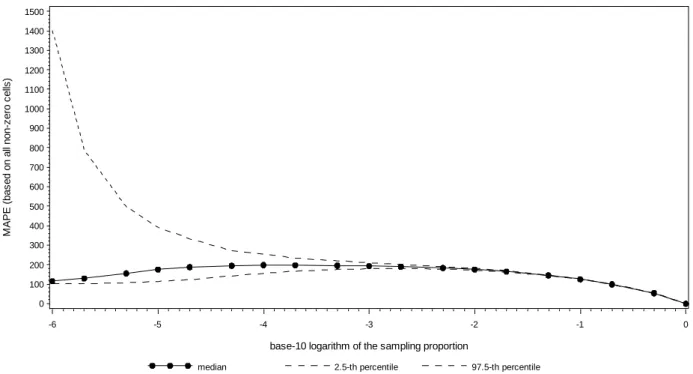
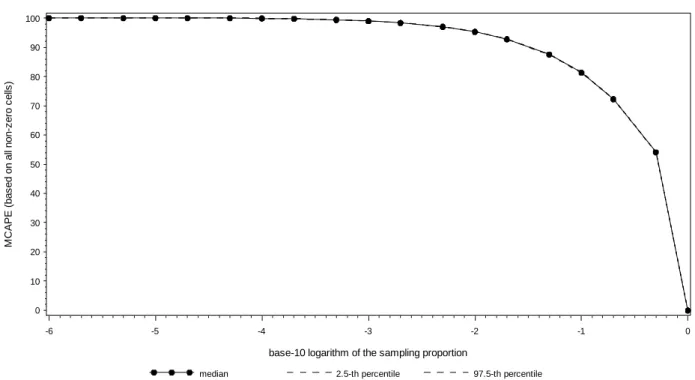
When the general tendency of the precision of the OD-matrices derived from travel surveys is discussed, Figures 3 and 4 provide a clear insight in the relationship between the precision and the sampling rate. From Figure 3 one can clearly see that the median MAPE first increases when samples are becoming larger, and then starts to decrease. The increase in median
MAPE for the smallest sampling rates can be accounted for by the fact that on average more cells are seriously overestimated, whereas the maximum underestimations are bounded by 100%. This effect is filtered out by using the MCAPE, as can be seen from Figure 4; a clear decreasing relationship is visible here. Next to the difference in relationships between the MAPE and MCAPE, one could also observe a clear difference between the percentile interval for the MAPE and the percentile interval for the MCAPE. By condensing the APE to a maximum of one (i.e. the CAPE), almost all variability around the median value is filtered out: the 2.5th and 97.5th percentiles almost coincide with the median values in case of the MCAPE.
When this decreasing pattern of the MCAPE (Figure 4) is compared to the one of the proportions (Figure 2), a clear contrast in the tendency can be seen: while the pattern for proportion is a convex decreasing function, for the OD-matrices this is a concave decreasing function. This difference in pattern, as well as the difference in precision, can be explained by the fact that proportions are aggregate indices, and that surveys are extremely suitable for capturing these aggregate figures, while in OD-matrices all individual information is used.
3.2.2 OD-Matrices at District Level
Similar to the true OD-matrix at municipality level, the true OD-matrix at district level (43 by 43) comprises a non-negligible amount of zero-cells. Nonetheless, the number of non-zero-cells is considerably smaller: 10.4% of the 1,849 origin-destination pairs are zero-cells. Recall that zero-cells in the full population are by definition correctly predicted by taking a sample from this population. Therefore, similar to the previous paragraph, the results are based on the 1,657 non-zero-cells. The values that include the zero-cells can be calculated by dividing the MAPE and MCAPE values by 1.116.
A thorough look at Table 3 shows that also at district level no accurate OD-matrices can be derived. Even if zero-cells are included in the calculations, surveying half of the population would result in an average absolute percentage error of 22.25 percent (24.832 divided by 1.116). When compared to the results of OD-matrices derived at municipality level, the results including the zero-cells are worse at district level than at municipality level (an average MAPE of 22.25 percent versus one of 11.99 percent). This is due to the fact that at municipality level a much larger share (77.8 percent versus 10.4 percent) of zero-cells is automatically correctly predicted. In contrast, when the results of only the non-zero-cells are compared, the precision of the OD-matrices derived at district level is higher than the precision of the OD-OD-matrices derived at municipality level. This result confirms that predictions on a more aggregate level are more precise.
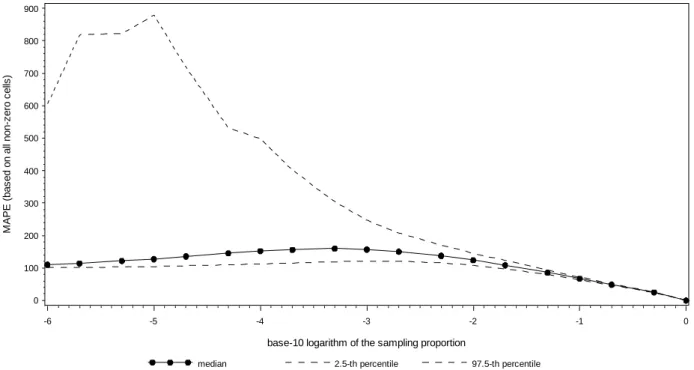
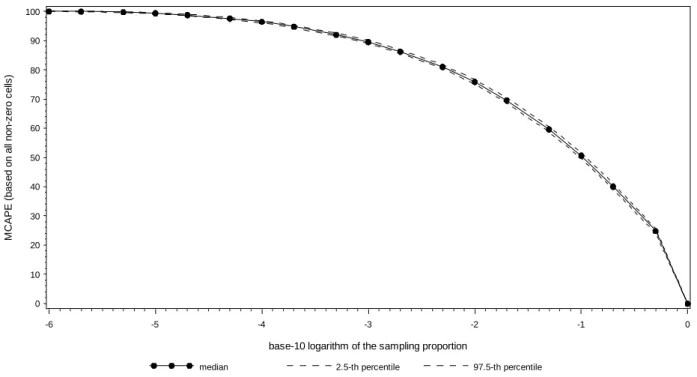
A visual representation of the relationship between the precision of the OD-matrices derived at district level and the sampling rate is provided in Figures 5 and 6. Inspection of Figure 5 reveals a pattern very similar to the one observed in Figure 3: the MAPE first increases when samples are becoming larger, and then starts to decrease. Recall that the increase in median MAPE for the smallest sampling rates can be accounted for by the fact that more cells are seriously overestimated on average, while the maximum underestimations are bounded by 100%. By analogy with the results at municipality level, this effect is filtered out by using the MCAPE, as could be noticed from Figure 6. Moreover, the relationship between the MCAPE and sampling proportion is a concave decreasing function, similar to the relationship between the MCAPE and sampling rate at municipality level.
3.2.3 OD-Matrices at Provincial Level
In contrast to the true OD-matrices at municipality and district level, the true OD-matrix at provincial level (11 by 11) only comprises non-zero-cells. Examination of Table 4 reveals that at provincial level, barely any accurate OD-matrices can be derived. Nonetheless, in contrast to the results at municipality and district level, for the largest sample sizes acceptable results are obtained: sampling half of the population would result in an average absolute percentage error of 3.4 percent, and surveying one fifth of the population results in an average absolute percentage error of 7.4%. Results from Table 4, also confirm that predictions related with a more aggregate level are more precise. Notwithstanding, results at provincial level confirm the finding unraveled at the lower levels (municipality and district) that the direct derivation of origin-destination matrices from household activity/travel surveys should be avoided.
The visualization of the relationship between the precision of the OD-matrices derived at provincial level and the sampling proportion is shown in Figures 7 and 8. Analogous to the relationships between the sample rate and the precision of the OD-matrices at municipality and district level, the MAPE first increases when samples are becoming larger, and then starts to decrease (Figure 7). Again, the use of the MCAPE filters out this effect. In contrast to the results at municipality and district level, the relationship between the precision and the MCAPE reveals an s-shaped decreasing function: for the smallest sampling rates the relationship is concavely decreasing, similar to the OD-matrices at municipality and district level; but for the larger sampling rates the relationship is a convex decreasing function. Moreover, the 95 percentile interval is much wider than for the OD-matrices at less aggregated levels. The most important reasons for this are the degree of sparseness and size of the matrix: for the less aggregate levels (municipality and district level), a lot of the variability of the precision is taken away by the large amounts of (zero-)cells.
4 CONCLUSIONS
In this paper, an assessment of the quality of origin-destination matrices derived from household activity/travel surveys was made. The results showed that no accurate OD-matrices can be directly derived from these surveys. Only when half of the population is queried, an acceptable OD-matrix is obtained at provincial level. Therefore, it is recommended to use additional information to better grasp the behavioral realism underlying destination choices. This is certainly a plea for travel demand models that incorporate the behavioral underpinnings of destination choices (activity location choices) given a certain origin. Moreover, matrix calibration techniques could seriously improve the quality of the matrices derived from these household activity/travel surveys. In addition, it is recommended to collect information about particular origin-destination pairs by means of vehicle intercept surveys rather than household activity/travel surveys, as these vehicle intercept surveys are tailored for collecting specific origin-destination data. Mark that the results presented in this paper do not negate the value of travel surveys as was shown in the example of deriving the commuting population, but indicate that sophistication is needed in the manner in which the data are employed.
A second important finding in this paper is that traditional methods to assess the comparability of two origin-destination matrices could be enhanced: the MCAPE index that was proposed has clear advantages over the traditional indices. The most important advantage being
the fact that the MCAPE filters out the noise created by the asymmetry of the traditional criteria. Therefore, when dissimilarities between different OD-matrices are investigated, the use of the MCAPE index next to traditional criteria is highly recommended.
An important avenue for further research is the investigation of the relationship between the variability in the outcomes of travel demand models and underlying survey data. Triangulation of both travel demand modeling and small area estimation models could prove to a pathway for success. An empirical investigation of the effect of sampling proportions in household activity/travel surveys on final model outcomes would further illuminate the quest for optimal sample sizes. A thorough examination of the minimum required sampling rate of a household travel survey such that trip distribution models (e.g. a gravity model) could help fill in the full trip table certainly is an important step in further analyses. Model complexity and computability will certainly be key challenges in this pursuit.
5 ACKNOWLEDGEMENTS
The authors would like to thank Katrien Declerq for her advice on the implementation of the experiment.
6 REFERENCES
(1) Haustein, S., and M. Hunecke. Reduced use of environmentally friendly modes of transportation caused by perceived mobility necessities: an extension of the theory of planned behavior. Journal of Applied Social Psychology, Vol. 37, No. 8, 2007, pp. 1856-1883.
(2) Steg, L. Can public transport compete with the private car. IATSS Research, Vol. 27, No. 2, 2003, pp. 27-35.
(3) TRB Committee on Travel Survey Methods. The On-Line Travel Survey Manual: A
Dynamic Document for Transportation Professionals. Provided by the Members and
Friends of the Transportation Research Board’s Travel Survey Methods Committee (ABJ40), Washington, D.C., 2009. http://trbtsm.wiki.zoho.com. Accessed July 22, 2009. (4) Stopher, P., R. Alsnih, C. Wilmot, C. Stecher, J. Pratt, J. Zmud, W. Mix, M. Freedman, K.
Axhausen, M. Lee-Gosselin, A. Pisarski, and W. Brög. Standardized Procedures for
Personal Travel Surveys. National Cooperative Highway Research Program Report 571.
Transportation Research Board, Washington, 2008.
(5) Cambridge Systematics. Travel Survey Manual. Prepared for U.S. Department of Transportation and the U.S. Environmental Protection Agency. Travel Model Improvement Program (TMIP), Washington, D.C., 1996.
(6) Tourangeau, R., M. Zimowski, and R. Ghadialy. An Introduction to Panel Surveys in Transportation Studies. Report DOT-T-84, Prepared for the Federal Highway Administration. National Opinion Research Center, Chicago, I.L., 1997.
(7) Stopher, P.R., and S.P. Greaves. Household travel surveys: Where are we going?
Transportation Research Part A: Policy and Practice, Vol. 41, No. 5, 2007, pp. 33-40.
(8) Rubinstein, R.Y. Simulation and the Monte Carlo Method. John Wiley and Sons, Inc., New York, 1981.
(9) Fan, X., A. Felsővályi, S.A. Sivo, and S.C. Keenan. SAS® for Monte Carlo Studies: A Guide for Quantitative Researchers. SAS Institute. Cary, N.C., 2000.
(10) Patel, A., and M. Thompson. Consideration and Characterization of Pavement Construction Variability. In Transportation Research Record: Journal of the
Transportation Research Board, No. 1632, Transportation Research Board of the National
Academies, Washington, D.C., 1998, pp. 40-50.
(11) Awasthi, A., S.S. Chauhan, S.K. Goyal, and J.-M. Proth. Supplier selection problem for a single manufacturing unit under stochastic demand. International Journal of Production
Economics, Vol. 117, No. 1, 2009, pp. 229-233.
(12) Groves, R.M., F.J. Fowler, M. Couper, J.M. Lepkowski, E. Singer, and R. Tourangeau. Survey Methodology. John Wiley and Sons, Inc., Hoboken, N.J., 2004.
(13) Armstrong, J.S., and F. Collopy. Error measures for generalizing about forecasting methods: empirical comparisons. International Journal of Forecasting, Vol. 8, No. 1, 1992, pp. 69–80.
(14) Makridakis, S. Accuracy measures: theoretical and practical concerns. International
Journal of Forecasting, Vol. 9, No. 4, 1993, pp. 527-529.
(15) Goodwin, P., and R. Lawton. On the asymmetry of the symmetric MAPE. International
Journal of Forecasting, Vol. 15, No. 4., 1999, pp. 405-408.
(16) Good, P.I. Resampling Methods: A Practical Guide to Data Analysis, Third Edition. Brikhäuser, Boston, 2006.
(17) Groves, R.M. Survey Errors and Survey Costs. John Wiley and Sons, Inc., Hoboken, N.J., 1989.
(18) Cools, M., E. Moons, T. Bellemans, D. Janssens, and G. Wets. Surveying activity-travel behavior in Flanders: assessing the impact of the survey design. In Macharis, C., and L. Turcksin (eds.), Proceedings of the BIVEC-GIBET Transport Research Day 2009, Part II. VUBPRESS, Brussels, 2009, pp. 727-741.
(19) Pendyala, R.M., T. Yamamoto, and R. Kitamura. On the formulation of time-space prisms to model constraints on personal activity-travel engagement. Transportation, Vol. 29, No. 1, 2002, pp. 73-94.
(20) Nakamya, J., E. Moons, S. Koelet, and G. Wets. Impact of Data Integration on Some Important Travel Behavior Indicators. In Transportation Research Record: Journal of the
Transportation Research Board, No. 1993, Transportation Research Board of the National
Academies, Washington, D.C., 2007, pp. 89-94.
(21) Abrahamsson, T. Estimation of Origin-Destination Matrices Using Traffic Counts: A
LIST OF TABLES AND FIGURES
TABLE 1 APE-Statistics for the Commuting Proportion given Different Sampling Rates TABLE 2 MAPE and MCAPE for OD-Matrices Derived at Municipality Level
TABLE 3 MAPE and MCAPE for OD-Matrices Derived at District Level TABLE 4 MAPE and MCAPE for OD-Matrices Derived at Provincial Level FIGURE 1 Potential sources of the total survey error.
FIGURE 2 Relationship between absolute percentage error and sampling rate for commuting proportion.
FIGURE 3 Relationship between MAPE and base-10 logarithm of the sampling rate. FIGURE 4 Relationship between MCAPE and base-10 logarithm of the sampling rate. FIGURE 5 Relationship between MAPE and base-10 logarithm of the sampling rate. FIGURE 6 Relationship between MCAPE and base-10 logarithm of the sampling rate. FIGURE 7 Relationship between MAPE and base-10 logarithm of the sampling rate. FIGURE 8 Relationship between MCAPE and base-10 logarithm of the sampling rate.
TABLE 1 APE-Statistics for the Commuting Proportion given Different Sampling Rates1 Sampling Rate (SR) Log10 SR Mean P5 Median P95
0.000001 -6.00 20.270 1.670 19.826 46.744 0.000002 -5.70 13.915 1.096 11.684 34.377 0.000005 -5.30 8.642 0.659 7.412 21.509 0.000010 -5.00 6.083 0.474 5.192 14.849 0.000020 -4.70 4.293 0.343 3.671 10.618 0.000050 -4.30 2.741 0.213 2.317 6.793 0.000100 -4.00 1.879 0.137 1.574 4.586 0.000200 -3.70 1.330 0.097 1.140 3.219 0.000500 -3.30 0.853 0.072 0.723 2.097 0.001000 -3.00 0.602 0.052 0.508 1.485 0.002000 -2.70 0.430 0.040 0.362 1.054 0.005000 -2.30 0.269 0.022 0.227 0.659 0.010000 -2.00 0.190 0.015 0.160 0.462 0.020000 -1.70 0.129 0.010 0.109 0.313 0.050000 -1.30 0.080 0.007 0.067 0.197 0.100000 -1.00 0.053 0.004 0.045 0.132 0.200000 -0.70 0.034 0.003 0.029 0.082 0.500000 -0.30 0.016 0.001 0.013 0.038 1.000000 0.00 0.000 0.000 0.000 0.000 1
TABLE 2 MAPE and MCAPE for OD-Matrices Derived at Municipality Level Sampling Rate
(SR) Log10 SR
MAPE MCAPE
Mean P5 Median P95 Mean P5 Median P95
0.000001 -6.00 205.996 100.902 115.559 753.493 100.000 100.000 100.000 100.000 0.000002 -5.70 200.992 102.528 129.575 754.266 100.000 100.000 100.000 100.000 0.000050 -5.30 199.861 109.279 155.540 431.119 99.999 99.998 99.999 100.000 0.000010 -5.00 199.089 116.768 175.588 352.896 99.997 99.995 99.997 99.999 0.000020 -4.70 198.647 127.682 187.707 304.125 99.994 99.992 99.994 99.996 0.000050 -4.30 198.338 148.261 194.723 259.440 99.977 99.972 99.977 99.981 0.000100 -4.00 199.452 160.661 198.325 243.313 99.927 99.919 99.927 99.936 0.000200 -3.70 197.459 170.778 196.746 226.279 99.784 99.769 99.784 99.798 0.000500 -3.30 195.930 178.611 195.344 215.156 99.414 99.391 99.414 99.437 0.001000 -3.00 193.624 181.284 193.511 206.508 98.999 98.973 98.999 99.026 0.002000 -2.70 190.182 181.664 189.982 199.411 98.393 98.360 98.392 98.427 0.005000 -2.30 183.425 177.916 183.465 188.907 97.033 96.990 97.033 97.077 0.010000 -2.00 175.654 171.907 175.659 179.551 95.352 95.298 95.353 95.407 0.020000 -1.70 164.993 162.373 165.044 167.739 92.797 92.730 92.798 92.865 0.050000 -1.30 145.263 143.745 145.271 146.836 87.514 87.424 87.515 87.598 0.100000 -1.00 124.970 124.078 124.960 125.866 81.369 81.273 81.369 81.469 0.200000 -0.70 99.172 98.724 99.169 99.631 72.293 72.193 72.294 72.392 0.500000 -0.30 54.108 54.089 54.108 54.128 54.108 54.089 54.108 54.128 1.000000 0.00 0.000 0.000 0.000 0.000 0.000 0.000 0.000 0.000
TABLE 3 MAPE and MCAPE for OD-Matrices Derived at District Level Sampling Rate
(SR) Log10 SR
MAPE MCAPE
Mean P5 Median P95 Mean P5 Median P95
0.000001 -6.00 171.196 100.978 110.178 299.050 99.996 99.987 99.993 100.000 0.000002 -5.70 206.097 101.875 113.822 385.419 99.937 99.869 99.937 100.000 0.000050 -5.30 197.675 104.054 121.673 442.676 99.716 99.589 99.717 99.841 0.000010 -5.00 200.483 105.752 127.559 481.848 99.352 99.174 99.351 99.535 0.000020 -4.70 191.212 108.363 136.036 417.340 98.750 98.524 98.749 98.970 0.000050 -4.30 186.436 111.940 145.249 383.240 97.578 97.331 97.572 97.860 0.000100 -4.00 187.614 114.861 152.048 359.850 96.444 96.145 96.449 96.738 0.000200 -3.70 177.715 118.461 156.391 307.348 94.788 94.416 94.791 95.131 0.000500 -3.30 172.565 122.683 160.022 274.422 92.023 91.596 92.027 92.443 0.001000 -3.00 164.271 124.944 157.032 230.024 89.557 89.113 89.557 90.004 0.002000 -2.70 154.307 123.783 150.441 196.883 86.232 85.711 86.228 86.753 0.005000 -2.30 138.952 118.396 137.611 164.985 81.028 80.476 81.014 81.605 0.010000 -2.00 124.538 110.153 123.828 141.608 75.874 75.224 75.874 76.529 0.020000 -1.70 109.048 99.198 108.610 120.450 69.540 68.823 69.548 70.242 0.050000 -1.30 85.890 80.198 85.743 92.146 59.623 58.825 59.617 60.407 0.100000 -1.00 67.276 63.761 67.238 70.863 50.649 49.818 50.645 51.482 0.200000 -0.70 48.653 46.789 48.640 50.602 40.040 39.253 40.042 40.890 0.500000 -0.30 24.832 24.110 24.826 25.529 24.832 24.110 24.826 25.529 1.000000 0.00 0.000 0.000 0.000 0.000 0.000 0.000 0.000 0.000
TABLE 4 MAPE and MCAPE for OD-Matrices Derived at Provincial Level Sampling Rate
(SR) Log10 SR
MAPE MCAPE
Mean P5 Median P95 Mean P5 Median P95
0.000001 -6.00 176.769 99.263 107.557 394.608 99.063 98.121 99.098 100.000 0.000002 -5.70 203.155 97.373 116.674 433.429 97.457 96.026 97.482 98.892 0.000050 -5.30 181.113 96.627 126.086 350.822 95.265 93.815 95.268 96.704 0.000010 -5.00 168.445 98.339 127.604 348.163 93.433 92.038 93.444 94.797 0.000020 -4.70 168.536 99.464 128.362 360.363 91.485 90.201 91.460 92.835 0.000050 -4.30 151.833 95.531 121.858 311.175 86.839 84.890 86.849 88.801 0.000100 -4.00 139.293 89.910 117.180 260.735 81.456 78.907 81.492 83.867 0.000200 -3.70 122.260 83.171 109.350 199.592 75.496 72.706 75.491 78.216 0.000500 -3.30 102.579 73.950 95.857 153.082 66.131 63.291 66.100 68.976 0.001000 -3.00 86.550 65.717 82.586 121.220 58.695 55.863 58.703 61.425 0.002000 -2.70 70.179 55.819 67.913 91.566 50.581 47.480 50.567 53.506 0.005000 -2.30 50.419 42.091 49.683 61.219 40.069 37.270 40.045 42.948 0.010000 -2.00 37.062 31.187 36.759 44.062 31.583 28.460 31.522 34.604 0.020000 -1.70 26.160 22.031 25.987 30.902 23.833 20.970 23.816 26.754 0.050000 -1.30 16.138 13.530 16.044 19.084 15.566 13.331 15.566 17.840 0.100000 -1.00 11.165 9.297 11.150 13.148 11.018 9.271 11.021 12.841 0.200000 -0.70 7.417 6.252 7.374 8.784 7.404 6.243 7.370 8.721 0.500000 -0.30 3.449 2.903 3.440 4.050 3.449 2.903 3.440 4.050 1.000000 0.00 0.000 0.000 0.000 0.000 0.000 0.000 0.000 0.000
Total Survey Error Mean Square Error
Accuracy Variance Precision Errors of Non-observation Coverage Non-response Sampling Sampling Variance Observational Errors Interviewer Respondent Error Variance Instrument Criterion Validity Mode Coverage Coverage Bias Non-response Non-response Bias Sampling Sampling Bias Interviewer Respondent Instrument Mode Errors of Non-observation Selection Bias Observational Errors Response Bias Bias
FIGURE 2 Relationship between absolute percentage error and sampling rate for commuting proportion.
M AP E (b a s e d o n a ll n o n -z e ro c e lls ) 0 100 200 300 400 500 600 700 800 900 1000 1100 1200 1300 1400 1500
base-10 logarithm of the sampling proportion
-6 -5 -4 -3 -2 -1 0
median 2.5-th percentile 97.5-th percentile
M C AP E (b a s e d o n a ll n o n -z e ro c e lls ) 0 10 20 30 40 50 60 70 80 90 100
base-10 logarithm of the sampling proportion
-6 -5 -4 -3 -2 -1 0
median 2.5-th percentile 97.5-th percentile
M AP E (b a s e d o n a ll n o n -z e ro c e lls ) 0 100 200 300 400 500 600 700 800 900
base-10 logarithm of the sampling proportion
-6 -5 -4 -3 -2 -1 0
median 2.5-th percentile 97.5-th percentile
M C AP E (b a s e d o n a ll n o n -z e ro c e lls ) 0 10 20 30 40 50 60 70 80 90 100
base-10 logarithm of the sampling proportion
-6 -5 -4 -3 -2 -1 0
median 2.5-th percentile 97.5-th percentile
M AP E (b a s e d o n a ll c e lls ) 0 100 200 300 400 500 600 700 800
base-10 logarithm of the sampling proportion
-6 -5 -4 -3 -2 -1 0
median 2.5-th percentile 97.5-th percentile
M C AP E (b a s e d o n a ll c e lls ) 0 10 20 30 40 50 60 70 80 90 100
base-10 logarithm of the sampling proportion
-6 -5 -4 -3 -2 -1 0
median 2.5-th percentile 97.5-th percentile