arXiv:1005.0986v1 [astro-ph.SR] 6 May 2010
Astron. Nachr. / AN 999, No. 88, 789 – 792 (2006) / DOI please set DOI!
Asteroseismology of Solar-type stars with Kepler III. Ground-based
Data
J. Molenda- ˙Zakowicz1,⋆, H. Bruntt2, S. Sousa3, A. Frasca4, K. Biazzo5, D. Huber6, M. Ireland6, T.
Bedding6, D. Stello6, K. Uytterhoeven7, S. Dreizler8, P. De Cat9, M. Briquet10, G. Catanzaro4, C.
Karoff11,12, S. Frandsen12, L. Spezzi13, and C. Catala2
1
Instytut Astronomiczny Universytetu Wrocławskiego, ul. Kopernika 11, 51-622 Wrocław, Poland
2
LESIA, UMR 8109, Universit´e Pierre et Marie Curie, Universit´e Denis Diderot, Observatoire de Paris, 92195 Meudon, France
3
Centro de Astrof´ısica, Universidade do Porto, Rua das Estrelas, 4150-762, Portugal
4
INAF–Osservatorio Astrofisico di Catania, Via Sofia 78, 95123 Catania, Italy
5
INAF–Osservatorio Astrofisico di Arcetri, Largo E. Fermi 5, 50125 Firenze, Italy
6
Sydney Institute for Astronomy (SIfA), School of Physics, University of Sydney, NSW 2006, Australia
7
Laboratoire AIM, CEA/DSM-CNRS-Universit Paris Diderot-IRFU/SAp, 91191 Gif-sur-Yvette Cedex, France
8
Georg-August Universit¨at, Institut f¨ur Astrophysik, Friedrich-Hund-Platz 1, D-37077 G¨ottingen, Germany
9
Royal Observatory of Belgium, Ringlaan 3, B-1180 Brussels, Belgium
10
Instituut voor Sterrenkunde, KU Leuven, Celestijnenlaan 200D, B-3001 Leuven, Belgium
11
School of Physics and Astronomy, University of Birmingham, Edgbaston, Birmingham B15 2TT, UK
12
Department of Physics and Astronomy, Aarhus University, Ny Munkegade 120, DK-8000 Aarhus C, Denmark
13
European Space Agency (ESTEC), P.O. Box 299, 2200 AG Noordwijk, The Netherlands
Received 1 April 2010, accepted — Published online later
Key words space vehicles: Kepler – stars: fundamental parameters – stars: oscillations
We report on the ground-based follow-up program of spectroscopic and photometric observations of solar-like asteroseis-mic targets for the Kepler space mission. These stars constitute a large group of more than thousand objects which are the subject of an intensive study of the Kepler Asteroseismic Science Consortium Working Group 1 (KASC WG-1). The main goal of this coordinated research is the determination of the fundamental stellar atmospheric parameters, which are used for the computing of their asteroseismic models, as well as for the verification of the Kepler Input Catalogue (KIC).
c
2006 WILEY-VCH Verlag GmbH & Co. KGaA, Weinheim
1 Introduction
The Kepler Asteroseismic Science Consortium KASC1has been established with the aim of making a full exploitation of the Kepler time-series space photometry. The main goal of KASC is the study of stellar interiors by means of aster-oseismic methods.
The largest group of stars selected for asteroseismic tar-gets for Kepler are those which are expected to show solar-like oscillations. Unfortunately, the Kepler data do not pro-vide information on the effective temperature(Teff) surface
gravity,(log g), metallicity, and projected rotational veloc-ity,(v sin i), of these stars, which are crucial data for aster-oseismic modeling. Only a small fraction of Kepler astero-seismic targets has been studied in the literature. The effec-tive temperature has been derived either from spectroscopy
⋆ e-mail: [email protected]
1 Kepler Asteroseismic Science Consortium (KASC) is a group of
col-laborating scientists established to accomplish the activities of the Kepler Asteroseismic Investigation (KAI), represented by Ronald Gilliland (see http://astro.phys.au.dk/KASC).
or photometry only for 15% of the solar-like Kepler astero-seismic targets, the surface gravity, for 10%, and 5% have a measured metallicity.
The Kepler Input Catalog2 (KIC) (Latham et al. 2005) provides values of Teff,log g and [Fe/H] derived from Sloan
photometry for many Kepler targets. However, the uncer-tainties of Teff,log g and [Fe/H] in the KIC are too large
for asteroseismic modeling since they reach ±200 K in Teff,
and ±0.5 dex, both in log g and [Fe/H].
In Fig. 1 we show the differences between Teff,log g
and [Fe/H] of the solar-like oscillators in the KIC and in the literature. As can be seen from the figure, the discrepancies can be as high as 1000 K, especially for stars hotter than 5500 K. The agreement inlog g and [Fe/H] is slightly better but still poor. Their values agree to within the error bars, but the latter are so large that they do not allow any meaningful comparison.
Moreover, we note that there is a trend in the differences between [Fe/H] in the KIC and in the literature, which ex-ists both for the spectroscopic and photometric derivations,
2 http://archive.stsci.edu/kepler/kepler fov/search.php
c
790 J. Molenda- ˙Zakowicz et al.: Characteristics of 100+ Kepler Asteroseismic Targets from Ground-Based Observations
and which shows that the metal-deficient stars are found to be more poor, and the rich stars, more metal-abundant in the KIC than in the literature.
2 Programmes of Ground-Based
Observations
For the reasons outlined in the previous section, the KASC WG-1 Sub-Group 9 (SG-9) organized a large coordinated programme of ground-based observations which aims at the determination of Teff,log g, [Fe/H], and v sin i of all the
solar-like asteroseismic targets. This includes multi-colour photoelectric CCD photometry, high and medium-resolu-tion spectroscopic observamedium-resolu-tions, and interferometric mea-surements.
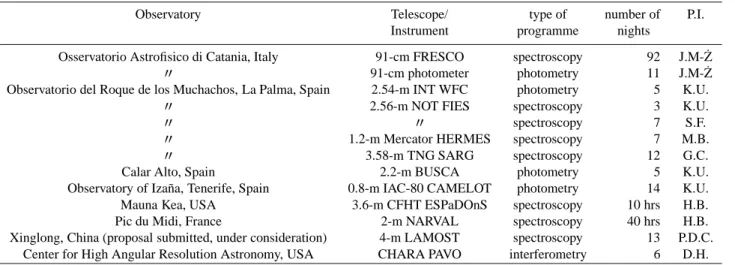
In Table 1, we list the on-going programmes of ground-based observations of solar-like Kepler asteroseismic tar-gets, including the information on the observatory at which the programmes are realized, the telescope and the instru-ment used, the type of the observing programme (spectro-scopy, photometry or interferometry), the number of the ni-ghts, and the initials of the principal investigator of the pro-posal.
We note that many of the listed research programmes in-clude targets of different KASC working groups. For the ad-ditional information, we refer to Uytterhoeven et al. (2010).
2.1 Spectroscopy
The spectroscopic investigation of the Kepler asteroseismic targets aims at derivation of the atmospheric parameters of the stars and the value of the micro-turbulence in their atmo-spheres, as well as the projected rotational velocity and the radial velocity (see Molenda- ˙Zakowicz et al. 2007, 2008, 2010; Catanzaro et al. 2010; Frasca et al. 2010.)
The observatories involved in this research include the Osservatorio Astrofisico di Catania (OACt) in Italy, the Ob-servatorio del Roque de los Muchachos in Spain, the Mauna Kea Observatory in the USA, the Pic du Midi Observa-tory in France, and the Xinglong ObservaObserva-tory in China. We note that the observing proposal submitted by P.D.C. for the multi-fiber, multi-object spectrograph LAMOST at the 4-m telescope at Xinglong is particularly interesting because, if accepted, it will allow to acquire low and/or medium-resolution spectra of 95% of all the Kepler asteroseismic targets.
A separate spectroscopic investigation of late-type main sequence stars selected for being observed by Kepler for the entire life-time of the mission is carried out by C.K. (Karoff et al. 2009). The aim of the research of these au-thors is to understand the relation between the changes in the chromospheric activity of the stars and the changes in the eigenmodes of their oscillations, which can lead to the improvement of the models of stellar evolution.
An investigation of giant stars from the Kepler field of view is conducted by S.F., D.S. and H.B. who have been
-1000 -800 -600 -400 -200 0 200 400 3000 3750 4500 5250 6000 6750 7500
T
eff(KIC) - T
eff(lit.)
T
eff(KIC)
-0.9 -0.6 -0.3 0 0.3 0.6 1.5 2 2.5 3 3.5 4 4.5 5log g (KIC) - log g (lit.)
log g (KIC)
-1.2 -0.9 -0.6 -0.3 0 0.3 0.6 0.9 -0.8 -0.6 -0.4 -0.2 0 0.2 0.4[Fe/H] (KIC) - [Fe/H] (lit.)
[Fe/H] (KIC)
Fig. 1 The differences between Teff, log g and [Fe/H]
given in the KIC and in the literature. Solid and open sym-bols indicate literature values from photometry and spec-troscopy, respectively. The1σ uncertainty ranges of the de-terminations provided in the KIC are indicated with solid lines.
awarded time to acquire high resolution spectra (R=60 000) of these stars with FIES at the NOT. The aim is to get a signal-to-noise ratio (S/N) of 100 for about 60-80 giant stars. C.C and H.B. have been awarded time to observe 300 solar-type stars at Pic du Midi and CFHT. Their aim is to get S/N = 100-200 with a resolution of R=80 000. With these data, they will be able to derive Teff,log g, and [Fe/H] of the
tar-gets with a 1 σ uncertainty of 100K in Teff, and 0.1 dex in both log g and [Fe/H].
c
Astron. Nachr. / AN (2006) 791
Table 1 A summary of the programmes of ground-based observations of solar-like Kepler asteroseismic targets.
Observatory Telescope/ type of number of P.I. Instrument programme nights
Osservatorio Astrofisico di Catania, Italy 91-cm FRESCO spectroscopy 92 J.M- ˙Z
′′ 91-cm photometer photometry 11 J.M- ˙Z Observatorio del Roque de los Muchachos, La Palma, Spain 2.54-m INT WFC photometry 5 K.U.
′′ 2.56-m NOT FIES spectroscopy 3 K.U.
′′ ′′ spectroscopy 7 S.F.
′′ 1.2-m Mercator HERMES spectroscopy 7 M.B.
′′ 3.58-m TNG SARG spectroscopy 12 G.C.
Calar Alto, Spain 2.2-m BUSCA photometry 5 K.U. Observatory of Iza˜na, Tenerife, Spain 0.8-m IAC-80 CAMELOT photometry 14 K.U. Mauna Kea, USA 3.6-m CFHT ESPaDOnS spectroscopy 10 hrs H.B. Pic du Midi, France 2-m NARVAL spectroscopy 40 hrs H.B. Xinglong, China (proposal submitted, under consideration) 4-m LAMOST spectroscopy 13 P.D.C.
Center for High Angular Resolution Astronomy, USA CHARA PAVO interferometry 6 D.H.
2.2 Photometry
The photometric research realized at the OACt in Italy, the Observatory of Iza˜na and Calar Alto Observatory in Spain also allows to determine the stellar atmospheric parameters from the Johnson and Str¨omgren magnitudes. These data, when combined with 2MASS JHK magnitudes (Cutri et al. 2003), can be used for computing the spectral energy dis-tribution of the stars and deriving their atmospheric param-eters. Additionally, photometric observations allow to mea-sure the reddening of the stars and their absolute magni-tude (see Molenda- ˙Zakowicz, Jerzykiewicz & Frasca 2009; Frasca et al. 2009; Kupka & Bruntt 2001.)
2.3 Interferometry
The interferometric measurements performed by M.I., D.H., T.B., and D.S. using the Center for High Angular Resolu-tion Astronomy (CHARA, ten Brummelaar et al. 2005) ar-ray at Mt. Wilson Observatory, California, USA, aim at de-riving the angular diameters, θ, of the brightest Kepler stars (V=7-9 mag). Observations are performed at visible wave-lengths using the Precision Astronomical Visible Observa-tions (PAVO) beam combiner (Ireland et al. 2008).
Using the longest CHARA baselines (330m) at a cen-tral wavelength of 0.75 µm, PAVO is able to resolve stars as small as 0.3 mas, which will allow precise angular diameter measurements of main-sequence stars observed by Kepler. Combining θ with the parallax yields a measurement of the linear radius, while a combination of θ with the bolometric flux yields a direct measurement of the effective tempera-ture.
Fig. 2 shows an example of preliminary PAVO data ob-tained in July 2009 (Huber et al. in preparation) of a metal-poor sub-giant observed by Kepler.
Fig. 2 Squared visibility versus spatial frequency of a metal-poor sub-giant in the Kepler target list obtained using the PAVO beam combiner at the CHARA array. The solid line shows a uniform-disc diameter fit with 1-sigma uncer-tainties (dashed lines).
3 Atmospheric parameters
The atmospheric parameters of solar-like Kepler asteroseis-mic targets are the most important result of the research con-ducted by KASC WG-1 SG-9 since their values are crucial for asteroseismic modeling. In order to find precise values of these parameters and to estimate their external errors we use different analysis methods applied to the same data, as well as to the data acquired by various instruments or by different methods, i.e., spectroscopic or photometric.
For the derivation of the atmospheric parameters of stars from spectroscopic observations, we use the VWA3 soft-ware developed by H.B. (see Bruntt et al. 2004, 2010), the ARES4software developed by S.S. (Sousa et al. 2007), the MOOG code developed by Sneden (1973)5, the ROTFIT
3 http://physics.usyd.edu.au/ bruntt/vwa/
4 http://www.astro.up.pt/ sousasag/ares/
5 http://verdi.as.utexas.edu/
792 J. Molenda- ˙Zakowicz et al.: Characteristics of 100+ Kepler Asteroseismic Targets from Ground-Based Observations
code developed by A.F. (Frasca et al. 2003, 2006), and the TLUSTY/SYNSPEC developed by Hubeny (1995).
As shown by Metcalfe et al. (in preparation) who dis-cuss KIC 11026764 observed at the NOT with the FIES in-strument, the atmospheric parameters derived by means of the methods listed above agree well to within 1σ of their er-ror bars. Nevertheless, the external uncertainty of the deriva-tion of Teffremains ±200 K while for log g and [Fe/H] it has
been reduced to ±0.25 and ±0.1 dex, respectively.
Another kind of disagreement in Teffderived from
spec-troscopy and from Str¨omgren photometry has been noticed by Molenda- ˙Zakowicz et al. (2009) who show that stars from the temperture range 6500 – 7500 K in photometry are found systematically cooler by about 300 K in spectroscopy. This effect is of particular significance since it affects the process of the asteroseismic modeling of the stars, and as such should be explained. This will be done when more spectroscopic and photometric observations of Kepler as-teroseismic targets are acquired.
4 Future observations
In the future, we will not restrict the ground-based spec-troscopic and photometric follow-up observations to large telescopes, but we intend to additionally include small and medium-size telescopes because many Kepler targets that are bright enough for such instruments. Additionally, at the sites hosting these instruments it is often possible to per-form long and dedicated observing runs that our observing program requires.
For these reasons, we strongly encourage the astronom-ical community to use the small and medium-size Northern telescopes for the photometric and spectroscopic research of Kepler asteroseismic targets. We stress that the participa-tion in this programme will be beneficial also for the sites hosting small telescopes.
Acknowledgements. This work was supported by MNiSW grant
N203 014 31/2650 and the University of Wrocław grants No 2646 /W/IA/06 and 2793/W/IA/07. M.B. is a Postdoctoral Fellow of the Fund for Scientific Research, Flanders.
References
Bruntt H., Bedding T.R., Quirion P.-O., Lo Curto G., Carrier F., Smalley B., Dall T.H., Arentoft T., et al.: 2010, arXiv 1002.4268
Bruntt H., Bikmaev I.F., Catala C., Solano E., Gillon M., Magain P., Van’t Veer-Menneret C., St¨utz C., et al.: 2004, A&A 425, 683
Catanzaro, G., Frasca, A., Molenda- ˙Zakowicz, J., Marilli, E.: 2010, A&A in press
Cutri R.M., Skrutskie M.F., Van Dyk S., Beichman C.A., Car-penter J.M., Chester T., Cambresy L., Evans T., et al.: 2003, The 2MASS All-Sky Catalog of Point Sources, University of Massachusetts and Infrared Processing and Analysis Center (IPAC/California Institute of Technology)
Frasca, A., Alcal`a, J. M., Covino, E., Catalano, S., Marilli, E., and Paladino, R.: 2003 A&A 405, 149
Frasca, A., Covino, E., Spezzi, L., Alcal´a, J.M., Marilli, E., F˙zr´esz, G., Gandolfi, D.: 2009 A&A 508, 1313
Frasca, A., Guillout, P., Marilli, E., Freire Ferrero, R., Biazzo, K., and Klutsch, A.: 2006 A&A 454, 301
Frasca, A., Molenda- ˙Zakowicz, J., Catanzaro, G.: 2010, in prepa-ration
Hubeny I., Lanz T.: 1995 ApJ 439, 875
Ireland, M.J., M´erand, A., ten Brummelaar, T.A., Tuthill, P.G., Schaefer, G.H., Turner, N.H., Sturmann, J., Sturmann, L., et al.: 2008, Optical and Infrared Interferometry, eds. M. Sch¨oller, W.C. Danchi, and F. Delplancke. Proc. of the SPIE, Vol. 7013, pp. 701324-701324-10
Karoff, C., Metcalfe, T.S., Chaplin, W.J., Elsworth, Y., Kjeldsen, H., Arentoft, T., Buzasi, D.: 2009, MNRAS 399, 914 Kupka, F., & Bruntt, H.: 2001, in First COROT/MONS/MOST
Ground Support Workshop, ed. C. Sterken (Brussels: Vrije Univ.), 39
Latham, D. W.; Brown, T. M.; Monet, D. G.; Everett, M.; Es-querdo, G. A.; Hergenrother, C. W.: 2005, AAS 20711013 Molenda- ˙Zakowicz, J., Frasca, A., Latham, D.W.: 2008, AcA 58,
419
Molenda- ˙Zakowicz, J., Frasca, A., Latham, D.W., Jerzykiewicz J.: 2007, AcA 57, 301
Molenda- ˙Zakowicz, J., Jerzykiewicz, M., Frasca, A.: 2009, AcA 59, 213
Molenda- ˙Zakowicz, J., Latham, D.W., Catanzaro, G., Frasca, A.: 2010, A&A in preparation
Sousa S.G., Santos N.C., Israelian G., Mayor, M., Monteiro M.J.P.F.G., 2007 A&A 469, 783
ten Brummelaar, T.A., McAlister, H.A., Ridgway, S.T., Bagnuolo, W.G. Jr., Turner, N.H., Sturmann, L., Sturmann, J., Berger, D.H., et al.: 2005, ApJ 628, 453
Uytterhoeven, K., Briquet, M., Bruntt, H., et al.: 2010, this pro-ceedings
c
![Fig. 1 The differences between T eff , log g and [Fe/H]](https://thumb-eu.123doks.com/thumbv2/123doknet/5866337.142796/2.918.445.782.104.732/fig-differences-t-eff-log-g-fe-h.webp)