
VISUAL OBJECT TRACKING USING DEEP SIMILARITY NETWORKS
ZHENXI LI
DÉPARTEMENT DE GÉNIE INFORMATIQUE ET GÉNIE LOGICIEL ÉCOLE POLYTECHNIQUE DE MONTRÉAL
MÉMOIRE PRÉSENTÉ EN VUE DE L’OBTENTION DU DIPLÔME DE MAÎTRISE ÈS SCIENCES APPLIQUÉES
(GÉNIE INFORMATIQUE) AVRIL 2019
c
ÉCOLE POLYTECHNIQUE DE MONTRÉAL
Ce mémoire intitulé :
VISUAL OBJECT TRACKING USING DEEP SIMILARITY NETWORKS
présenté par: LI Zhenxi
en vue de l’obtention du diplôme de: Maîtrise ès sciences appliquées a été dûment accepté par le jury d’examen constitué de :
M. DESMARAIS Michel, Ph. D., président
M. BILODEAU Guillaume-Alexandre, Ph. D., membre et directeur de recherche M. BOUACHIR Wassim, Ph. D., membre et codirecteur de recherche
DEDICATION
To my dear father and mother, the best in the world. . .
ACKNOWLEDGEMENTS
I would first like to thank my research advisors, Prof. Guillaume-Alexandre Bilodeau, and Prof. Wassim Bouachir earnestly, for giving me the precious opportunity to do research un-der their guidance. It is their guidance that made me able to discover the unknown step by step.
I also sincerely appreciate The Fonds de recherche du Québec - Nature et technologies (FRQNT) and Mitacs, for providing me with research funding which helped me more fo-cus on my research.
I also want to express my heartfelt thanks to my colleagues at LITIV lab and my friends at Polytechnique, thanking them for the pleasure of their company.
I want to thank my parents, they are always been there for me. It is their support that enables me to go further and further.
Finally, I sincerely thank members of the jury for taking time to review my thesis and give valuable comments.
RÉSUMÉ
Le suivi d’objets est une des tâches fondamentales de la vision par ordinateur. Étant donné une cible initiale dans la première trame, l’objectif du suivi est de trouver la nouvelle position de la cible dans les trames subséquentes. Les filtres de corrélation est une technique largement utilisée dans les applications de reconnaissance de formes pour mettre en correspondance des objets. Ainsi, de nombreuses méthodes de suivi sont basées sur les filtres de corrélation. Bien que ces méthodes de suivi atteignent un bon compromis entre la précision et la vitesse de suivi, leurs performances sont limitées par l’utilisation de caractéristiques d’apparence définies manuellement. Récemment, les méthodes d’apprentissage profond ont démontré des résultats impressionnants dans diverses tâches de vision par ordinateur. De ce fait, un grand nombre de méthodes de suivi basées sur l’apprentissage profond ont été proposées pour améliorer la robustesse et la capacité à discriminer les objets durant le suivi. Cependant, la représentation des caractéristiques de la cible par un seul réseau neuronal convolutif (RNC) n’est souvent pas assez discriminante. De plus, l’architecture du RNC doit être choisie avec soins pour réduire le temps de calcul lors du suivi. Dans notre travail, nous avons exploré différentes méthodes pour améliorer le pouvoir discriminant d’un RNC pour le suivi d’un objet. Nous avons proposé deux méthodes de suivi, MBST (Multi-Branch Siamese Tracker ) et MFST (Multiple Features-Siamese Tracker ). Les deux méthodes sont basées sur des RNC avec une architecture siamoise. Cette architecture définit le suivi comme un problème d’apprentissage par similarité.
L’algorithme MBST utilise plusieurs branches convolutives pour extraire des représentations diverses sur l’objet à suivre, notamment des branches dépendantes du contexte et une branche sémantique. Les branches dépendantes du contexte sont entrainées pour représenter plusieurs catégories spécifiques d’apparence d’objets, codant ainsi plus d’informations de contexte pour le suivi. La branche sémantique est entrainée pour résoudre la tâche de classification des images, ce qui permet de mieux utiliser les informations sémantiques, c’est-à-dire les car-actéristiques propres à une catégorie d’objets. Afin de mieux utiliser ces branches, nous avons proposé un mécanisme de sélection en ligne, qui sélectionne de manière dynamique la meilleure branche en fonction du pouvoir de discrimination calculé à partir de cartes de corrélation. Basée sur une architecture multibranche et un mécanisme de sélection en ligne, la méthode MBST obtient des performances supérieures par rapport aux méthodes standards basées sur l’architecture siamoise.
d’un RNC intègrent différents niveaux d’abstraction de la cible, et que les différents canaux des cartes de caractéristiques du RNC jouent différents rôles dans le suivi, nous avons proposé la méthode MFST. Pour intégrer les différents niveaux d’abstraction, notre méthode utilise de façon hiérarchique des cartes de caractéristiques de convolution issues de deux modèles de réseaux neuronaux convolutifs. Ces cartes de caractéristiques sont aussi recalibrées pour utiliser les canaux les plus appropriés pour décrire l’objet. Nous proposons également une nouvelle stratégie de combinaison de caractéristiques afin de fusionner les diverses représen-tations de la cible, ce qui génère un modèle d’apparence plus riche et robuste. Basée sur une représentation plus riche de la cible, la méthode MFST permet d’obtenir une précision de suivi plus élevée et surpassent plusieurs méthodes récentes de l’état de l’art.
ABSTRACT
In this thesis, we study visual object tracking using deep similarity networks. Visual object tracking is a fundamental task in computer vision. Many approaches based on correla-tion filters and deep learning have been proposed to solve this problem. Inspired by deep learning-based methods, we exploit the siamese network model to address object tracking, by formulating tracking as a similarity learning problem.
Most deep learning methods only use features extracted from the last convolutional layer of a single model which lead their tracker to be prone to fail when target appearance changes significantly. Different features extracted from different convolutional models encode the target object in different ways. Trackers with diverse feature representations can be adapted more easily to challenging scenarios. Besides, the discriminative power of features from the last convolutional layer is very limited. Since convolutional features from different layers contain different levels of abstraction of the target object, discovering an appropriate scheme to fuse hierarchical features is also beneficial for tracking.
Based on these observations, we proposed two trackers, MBST (Multi-Branch Siamese Tracker) and MFST (Multiple Features-Siamese Tracker). Both trackers are built on the siamese ar-chitecture, addressing tracking as a similarity learning problem. The Multi-Branch Siamese Tracker employs multiple convolutional models to extract diverse feature representations for the target object. It consists of context-aware branches, which are trained to track for sev-eral specific appearance categories, and a semantic branch, which is trained to solve image classification task and is used to extract semantic information and diversify feature represen-tation. To make better use of each branch, we propose an online branch selection mechanism to dynamically select the optimal branch according to their discriminative power. The sec-ond tracker Multiple Features-Siamese Tracker utilizes convolutional features from multiple layers of two convolutional models with a feature recalibration mechanism. With diverse features from different layers and different models, the combined representation embeds not only the high-level abstraction of the target object but also its detailed representation. We also propose a feature recalibration mechanism to apply channel-wise weights on the feature maps, in order to enhance discriminative channels. Both of these two trackers demonstrate improved performance compared to standard Siamese trackers.
TABLE OF CONTENTS
DEDICATION . . . iii
ACKNOWLEDGEMENTS . . . iv
RÉSUMÉ . . . v
ABSTRACT . . . vii
TABLE OF CONTENTS . . . viii
LIST OF TABLES . . . xi
LIST OF FIGURES . . . xii
LIST OF SYMBOLS AND ACRONYMS . . . xv
LIST OF APPENDICES . . . xvi
CHAPTER 1 INTRODUCTION . . . 1
1.1 Motivation . . . 1
1.2 Basic Concepts . . . 4
1.2.1 Kernelized Correlation Filter . . . 4
1.2.2 Convolutional Neural Networks . . . 5
1.2.3 Deep CNN Models . . . 5
1.2.4 Siamese Networks . . . 8
1.3 Research Objectives . . . 8
1.4 Thesis Outline . . . 9
CHAPTER 2 LITERATURE REVIEW . . . 10
2.1 Visual Object Tracking . . . 10
2.2 Feature Descriptors . . . 11
2.3 Tracking based on Correlation filter . . . 13
2.3.1 Kernelized Correlation Filters . . . 14
2.3.2 MOSSE Filters . . . 16
2.4 Tracking based on CNNs . . . 16
2.4.2 Tracking by siamese networks . . . 18
2.4.3 Representation learning for correlation filter . . . 19
2.4.4 Tracking with Visual Attention . . . 20
2.5 Evaluation Metrics . . . 21
2.6 Discussion . . . 22
CHAPTER 3 OVERVIEW . . . 23
3.1 Multi-Branch Siamese Networks with Online Selection . . . 23
3.2 Multiple Features of Siamese Networks . . . 24
3.3 Experimentation . . . 24
CHAPTER 4 ARTICLE 1: MULTI-BRANCH SIAMESE NETWORKS WITH ON-LINE SELECTION FOR OBJECT TRACKING . . . 25
4.1 Abstract . . . 25
4.2 Introduction . . . 26
4.3 Related Work . . . 27
4.4 Multi-Branch Siamese Tracker . . . 28
4.4.1 Network Architecture . . . 28
4.4.2 Online Branch Selection Mechanism . . . 30
4.5 Experiments . . . 31
4.5.1 Implementation Details . . . 31
4.5.2 Dataset and Evaluation Metrics . . . 32
4.5.3 Ablation Analysis . . . 33
4.5.4 Comparison with State-of-the Art Trackers . . . 34
4.6 Conclusion . . . 34
CHAPTER 5 ARTICLE 2: MULTIPLE CONVOLUTIONAL FEATURES IN SIAMESE NETWORKS FOR OBJECT TRACKING . . . 37
5.1 Abstract . . . 37
5.2 Introduction . . . 38
5.3 Related Work . . . 39
5.4 Multiple Features-Siamese Tracker . . . 41
5.4.1 Network Architecture . . . 41
5.4.2 Feature Extraction . . . 42
5.4.3 Response Maps Combination Mechanism . . . 44
5.5 Experiments . . . 44
5.5.2 Dataset and Evaluation Metrics . . . 46
5.5.3 Ablation Analysis . . . 46
5.5.4 Comparisons . . . 48
5.6 Conclusion . . . 49
5.7 Acknowledgments . . . 49
CHAPTER 6 GENERAL DISCUSSION . . . 51
CHAPTER 7 CONCLUSION . . . 53
7.1 Summary of Works and Contributions . . . 53
7.2 Fulfillment of Objectives . . . 53
7.3 Limitations of the proposed approaches . . . 54
7.4 Future Research . . . 55
BIBLIOGRAPHY . . . 56
LIST OF TABLES
Table 1.1 Unstable attributes in the frame sequences in visual object tracking. (This table is adapted [reprinted] from [1] c 2015 IEEE) . . . 2 Table 1.2 The network configuration of VGG [2] networks. (This table is adapted
[reprinted] from [2] c 2015 ICLR) . . . 7 Table 4.1 Ablation study of MBST on OTB benchmarks. Various combinations
of general siamese branch, context-dependent branches and AlexNet branch are evaluated. . . 32 Table 5.1 Experiments with several variations of our method, where A and S
denote using the AlexNet as the basic model or using the SiamFC as the basic model. . . 47 Table 5.2 Experiments on combining response maps from the two CNN
mod-els. Aconv5 is only taking features from the last convolutional layer of AlexNet network, Sconv5 is only taking features from the last convolu-tional layer of SiamFC network. Acom is the combined response maps from AlexNet network by soft weight combining, Scom is the combined response maps from SiamFC network by hard weight combining. . . . 48 Table B.1 Evaluation results of our trackers and some recent the state of the art
trackers on VOT2018 benchmark. Red: best, blue: second best, green: third best. . . 70 Table B.2 The tracking speed of our trackers and some recent the state of the art
LIST OF FIGURES
Figure 1.1 The model update strategy proposed in [3]. The target object is oc-cluded in the second frame, which lead to more peak values in the cor-responding response map. In the corcor-responding map, although Rmax remains large, the PNR value significantly decreases. Considering the two constraints, the unexpected model updating is avoided. (This im-age is adapted [reprinted] from [3] c 2017 IEEE) . . . 3 Figure 1.2 An example of 2D convolution without kernel flipping. . . 6 Figure 1.3 An illustration of the architecture of AlexNet. . . 6 Figure 1.4 The structure of siamese networks. It contains two identical networks,
each of them takes one of the inputs and their outputs are fed to the loss function. . . 8 Figure 2.1 The illustration of visual object tracking process. It includes target
initialization, appearance model, motion prediction and target posi-tioning. Appearance model is updated by new target appearance. . . 11 Figure 2.2 Illustration of HOG descriptor. (This image is adapted [reprinted]
from [4] c 2014 ELSEVIER) . . . 12 Figure 2.3 An example of translating 1D signal to generate a circular matrix.
The rows are cyclic shifts of the base sample. (This image is adapted [reprinted] from [5] c 2015 IEEE) . . . 15 Figure 2.4 Illustration of vertical cyclic shifts of a base sample. (This image is
adapted [reprinted] from [5] c 2015 IEEE) . . . 15 Figure 2.5 The CNN architecture of DeepTrack with multiple image cues. The
gray dashed blocks are the independent CNN channels for different image cues, the green dashed block is the fusion layer where a linear mapping is learned. (This image is adapted [reprinted] from [6] c 2016 IEEE) . . . 17 Figure 2.6 The network architecture of GOTURN [7]. It first extracts features
of target object and searches region by a set of convolutional layers. Features are then fed through the fully connected layers to estimate the movement of the target object. (This image is adapted [reprinted] from [7] c 2016 Springer) . . . 17
Figure 2.7 The architecture of SiamFC [8]. The inputs are the exemplar image and the search image. Then, two identical branches made up of fully convolutional neural networks, extract feature representations for in-puts. The output is a score map produced by correlation using feature representation of exemplar image on search image. In this example, the value of red and blue pixels indicate the similarities for the corre-sponding sub-windows. (This image is adapted [reprinted] from [8] c 2016 Springer) . . . 18 Figure 2.8 The network architecture of CFNet. The first part is two identical
branches made up of fully convolutional neural networks like SiamFC [8]. The difference between CFNet [9] and SiamFC [8] is that CFNet employs an additional correlation filter learner layer to learn filter on the feature representation of the exemplar image. (This image is adapted [reprinted] from [9] c 2017 IEEE) . . . 19 Figure 2.9 Visualization of deep hierarchical feature. Features from earlier
lay-ers contain more low-level information similar to the response map of Gabor filters [10]. On the contrary, features from deeper layers cap-ture more semantic information and less spatial details. (This image is adapted [reprinted] from [11] c 2018 IEEE) . . . 20 Figure 2.10 The spatial weight maps learned in DSiamM [12], the left map is
learned for the shallower layer of AlexNet, the right map is learned for the deeper layer of AlexNet. (This image is adapted [reprinted] from [12] c 2017 IEEE) . . . 21 Figure 4.1 The architecture of our MBST tracker. Context-dependent branches
are indicated by green blocks and AlexNet branch is indicated by purple blocks. . . 29 Figure 4.2 Online branch Selection mechanism and response map example. . . . 30 Figure 4.3 Curve for the branch selection interval T on OTB2013 benchmark [13]. 33 Figure 4.4 The success plots and precision plots on OTB benchmarks. Curves and
numbers are generated with Python implemented OTB toolkit. . . . 35 Figure 4.5 The Success plot on OTB50 for eight challenge attributes: deformation,
fast motion, in-plane rotation, motion blur, occlusion, out-of-plane ro-tation, out-of-view, scale variation. . . 36
Figure 5.1 The architecture of our MFST tracker. Two CNN models are utilized as feature extractors and their features are calibrated by Squeeze-and-Excitation (SE) blocks. Then, correlations are applied over the features of the search region with the features of the exemplar patch and the output response maps are fused to calculate the new position of the target. Bright orange: SiamFC (S) and dark orange: AlexNet (A). . . 41 Figure 5.2 The illustration of SE-block. It consists of two step, squeeze step and
excitation step. The squeeze step uses average pooling operation to generate the channel descriptor, the excitation step uses a two layers MLP to capture the channel-wise dependencies. . . 43 Figure 5.3 The evaluation results on OTB benchmarks. The plots are generated
by the Python implemented OTB toolkit. . . 50 Figure A.1 The clustering results on VOC dataset, each row is the top 10 results
of each cluster. . . 66 Figure A.2 Tracking performance of TRACA [14] with different numbers of the
contextual clusters on OTB2013 benchmark [13]. (This image is adapted [reprinted] from [14] c 2018 IEEE) . . . 67 Figure B.1 Visualization of the response maps generated by deep features,
shal-low features and the combined response map. (This image is adapted [reprinted] from [15] c 2018 Springer) . . . 68
LIST OF SYMBOLS AND ACRONYMS
AUC Area Under Curve CN Color Name
CNN Convolutional Neural Network DCF Discriminative Correlation Filter DFT Discrete Fourier Transform FFT Fast Fourier Transform FPS Frame Per Second
HOG Histogram of Oriented Gradients IoU Intersection over Union
KCF Kernelized Correlation Filter MBST Multi-Branch Siamese Tracker MFST Multiple Features-Siamese Tracker PNR Peak-versus-Noise Ratio
ReLU Rectified Linear Units SE Squeeze-and-Excitation SSE Sum of Squared Error VOT Visual Object Tracking
LIST OF APPENDICES
Appendix A SUPPLEMENTARY DETAILS OF ARTICLE 1 . . . 62 Appendix B SUPPLEMENTARY DETAILS OF ARTICLE 2. . . 68
CHAPTER 1 INTRODUCTION
As a fundamental task in computer vision, visual object tracking plays an important role in many modern applications. For example, in autonomous driving, sensors must track sur-rounding obstacles to estimate how those obstacles are moving and predict their trajectories in the future. With the help of tracking technology, autonomous driving gets much safer. In video surveillance, different type of targets need to be monitored. Once a target is labeled, the tracking algorithm focuses on it. Based on this, the surveillance system is able to keep watch on the target and analyses where the target is and what the target is doing. Besides, many face beauty camera applications locate and track users’ face using such technologies. With the known face area, these applications focus on the face and edit this area to ob-tain better-looking pictures. Furthermore, with visual object tracking technology, unmanned aerial vehicles get much more intelligent. Once the target is assigned, they track and follow targets to perform more tasks.
1.1 Motivation
Despite significant progress in recent decades, large appearance changes that arise from oc-clusion, deformation, illumination variation, abrupt motion, and background clutter are still challenging for visual object tracking. These obstacles result in an error-prone target repre-sentation. We summarize them as three main problems, 1) object appearance variations, 2) appearance model update and drift and 3) target scale variation.
Object appearance variations In the problem of object appearance variations, there are two vital appearance changes that cause significant difficulties. The first one is, for different tracking tasks, the target objects may be different. The target objects we need to track can be a car, a face, a human body or anything else assigned. Different objects have different appearance which leads to varied input for the object tracking algorithm. The other one is that after we know the target object, there are still some unstable visual attributes in the frame sequences as illustrated in Table 1.1.
All these unstable factors may happen in any video sequence in the tracking scenario. There-fore, the feature representation used in tracking should be robust enough to handle these challenges.
Table 1.1 Unstable attributes in the frame sequences in visual object tracking. (This table is adapted [reprinted] from [1] c 2015 IEEE)
Attr Description
IV Illumination Variation—The illumination in the target region is significantly changed
SV Scale Variation—The size of the object changes over different frames
OCC Occlusion—The target is partially or fully occluded DEF Deformation—Non-rigid object deformation
MB Motion Blur—The target region is blurred due to the motion of target or camera
FM Fast Motion—The motion of the target is large
IPR In-Plane Rotation—The target rotates in the image plane OPR Out-of-Plane Rotation—The target rotates out of the image
plane
OV Out of-View—Some portion of the target leaves the view
BC Background Clutter—The background near the target has the similar color or texture as the target
LR Low Resolution—The target region has only a few pixels
Appearance model update and drift Either in discriminative correlation filter-based (DCF) tracking (Section 2.3) or in convolutional neural networks-based (CNNs) tracking (Section 2.4), most of tracking approaches keep and update an appearance model for tracking. Using the appearance model, the target is detected in video sequences. In many trackers [5, 16, 17], the image patch assigned in the first frame is used to train the appearance model. This image patch not only contains the target but also includes some context to be more discriminative. After the target position is detected in the next frame, the appearance model is updated at the new position. Thus, these tracking approaches use an appearance model updating strategy that detects and updates for every frame. If a tracking error happens, the appearance model drifts away from the visual appearance of the target.
Rather than updating the model every frame, ECO [18] uses a sparser updating scheme which is commonly used in non-DCF trackers. The sparser updating scheme updates the model at a fixed interval. However, an optimal updating mechanism should update the model once sufficient changes in the target have occurred and when the target is tracked correctly. In ECO [18], the model is updated at a fixed interval Ns. The model is optimized every Ns frames. When Ns is 1, the optimization process would be performed in every frame, as in standard DCF trackers. Through experiments, they found an empirical interval Ns ≈ 5, which achieved better tracking performance on average.
Regardless of updating the model every frame or at a fixed interval, when the tracking is inaccurate, the output result may introduce negative background information to the appear-ance model. In the worst case, the appearappear-ance model may stop representing the target object since the target object gets lost gradually, which is called model drift.
To solve this problem, another model updating strategy is proposed in [3]. The model updating is determined by two criterions which are based on the value of the peak-versus-noise ratio (PNR) and the maximum value of the response map. Ideally, the response map generated by DCF trackers should only contain one peak value which should correspond to the ground truth position of the target object. However, the response may fluctuate and contain more peak values when the target is occluded as shown in Figure 1.1. In the meantime, the PNR value decreases significantly. Thus, considering the peak value of the response map and the PNR value at the same time can avoid unexpected updating when the occlusion happens. Otherwise, negative background information will be introduced into the appearance model which lead to model drifting gradually.
Figure 1.1 The model update strategy proposed in [3]. The target object is occluded in the second frame, which lead to more peak values in the corresponding response map. In the corresponding map, although Rmax remains large, the PNR value significantly decreases. Considering the two constraints, the unexpected model updating is avoided. (This image is adapted [reprinted] from [3] c 2017 IEEE)
Target scale variations Generally, the target scale changes significantly during tracking which is not only caused by the target itself, but can also result from camera’s movement.
The size of target can get larger or smaller at any time. However, the tracking system is only given the initial bounding box in the first frame. If the tracking system keeps using a bounding box with the same size to locate the target, the labeled area located by the tracking system could contain many other neighboring areas and the tracking accuracy will decrease a lot. Thus, another challenge is to learn to adapt the bounding box against target scale variations.
The key to solving these problems is to find expressive features and corresponding trackers that maintains a robust appearance model. The feature representation should allow the tracker to differentiate the target object from the deceptive background and also tolerate the appearance changes of the target object. Therefore, the goal of our work is to explore different ways to represent the target object. Besides, our work also includes finding a robust model update strategy to deal with the drifting problem and target scale variation.
1.2 Basic Concepts
To obtain a robust and effective feature representation, some works [5, 19] use correla-tion filters to model the appearance of objects. With the kernel trick employed in these work [5, 19, 20], these methods achieve almost real-time speed while keeping high accuracy. At the same time, as the neural networks are getting more and more popular in the last decade, they show outstanding performance on many computer vision tasks. Convolutional neural network models have also been used in many approaches [7, 8, 21, 22] to obtain ro-bust object appearance description. To understand visual object tracking more clearly, we introduce some basic concepts in this section including kernelized correlation filters, convolu-tion neural networks (CNN), siamese networks and some frequently-used deep convoluconvolu-tional neural network models.
1.2.1 Kernelized Correlation Filter
The Kernelized Correlation Filter (KCF) is a well-known single target tracking method, which has been used in many works [5, 19, 20]. Due to the fact that training examples can be represented as a circulant matrix, correlation filter methods are very efficient.
Correlation with an example template is a common way to detect patterns in images. Cor-relation filter-based trackers first model the appearance of target using filters trained on the template image. Then they detect the object in the next frame by correlation with the filter inside a search window. The position of maximum value in the output response indicates the position of the target. An online update is performed based on the detection result.
Considering that there is a large number of samples to train, a circulant matrix is used to store samples since circulant matrix can be diagonalized by Discrete Fourier Transform (DFT). The off-diagonal elements of the circulant matrix are zero while the diagonal elements represent eigenvalues which are equal to the DFT transformation of the sample (x). Therefore, the KCF employs kernel to x transforming data to a feature domain. The kernelized x is shifted and forms the circulant matrix. Such kernelization operation lead to O(n log(n)) complexity rather than O(n2) or even higher complexities in other kernel algorithms. Thus, the process
can be formulated as a ridge regression problem:
Eh = min h 1 2 k y − C X c=1 hc∗ xc||2+ λ 2 C X c=1 ||hc||2 (1.1)
where the objective is to minimize Eh given the training sample x and the desired response y, h is the learned filter. More details are presented in [19].
1.2.2 Convolutional Neural Networks
Convolutional Neural Networks (CNNs) represent a class of feedforward neural networks containing convolutional calculations with a deep structure. Generally, the CNN architecture consists of an input layer, output layer, and multiple hidden layers. The hidden layers contain convolutional layers, pooling layers, activation layers, fully connected layers, and normalization layers.
The convolution operation includes two functions of a real-value argument. With x as an input, the convolution operation is denoted as:
s(t) = (x ∗ w)(t) (1.2)
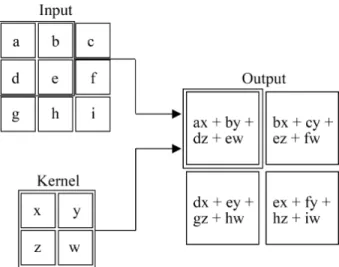
where the function w is referred to as the kernel, the output is typically referred to as the feature map. An example of 2D convolution is shown as Figure 1.2.
1.2.3 Deep CNN Models
Since the pioneering work of AlexNet [23] that proposed to address the ImageNet [24] classi-fication task, a large number of follow-up deep CNN models [2, 25–27] were proposed. Many experiments show that deep CNNs are able to handle most kinds of computer vision tasks very well. Here we present two deep CNN models that are frequently used in object tracking.
Figure 1.2 An example of 2D convolution without kernel flipping.
AlexNet The original AlexNet [23] was proposed to solve a classification task, which clas-sifies high-resolution images into 1000 classes. It consists of five convolutional layers, three fully-connected layers and a number of max-pooling layers following the convolutional lay-ers. The final classification result is produced by a 1000-way softmax. Due to its efficient feature representation ability, many works take the first five convolutional layers of AlexNet to extract feature representations while ignoring the fully-connected layers. The architecture of AlexNet [23] is shown as Figure 1.3.
Figure 1.3 An illustration of the architecture of AlexNet.
VGG To investigate the effect of the convolutional network depth on its accuracy in the large-scale image recognition setting, Simonyan et al. [2] proposed an architecture with very small (3 × 3) convolution filters, VGG networks. The proposed VGG networks show a sig-nificant improvement and pushes the depth of networks to 16-19 weight layers as shown in Table 1.2. It is remarkable that by stacking 3 × 3 conv. filter layers, 7 × 7 and 5 × 5 conv.
filter layers can be superseded, and fewer parameters are required. Besides, more non-linear layers can be incorporated, which makes the decision function more discriminative.
Table 1.2 The network configuration of VGG [2] networks. (This table is adapted [reprinted] from [2] c 2015 ICLR)
ConvNet Configuration
A A-LRN B C D E
11 weight 11 weight 13 weight 16 weight 16 weight 19 weight
layers layers layers layers layers layers
input(224 × 224 RGB image)
conv3-64 conv3-64 conv3-64 conv3-64 conv3-64 conv3-64 LRN conv3-64 conv3-64 conv3-64 conv3-64
maxpool
conv3-128 conv3-128 conv3-128 conv3-128 conv3-128 conv3-128 conv3-128 conv3-128 conv3-128 conv3-128
maxpool
conv3-256 conv3-256 conv3-256 conv3-256 conv3-256 conv3-256 conv3-256 conv3-256 conv3-256 conv3-256 conv3-256 conv3-256 conv1-256 conv3-256 conv3-256 conv3-512 maxpool
conv3-512 conv3-512 conv3-512 conv3-512 conv3-512 conv3-512 conv3-512 conv3-512 conv3-512 conv3-512 conv3-512 conv3-512 conv1-512 conv3-512 conv3-512 conv3-512 maxpool
conv3-512 conv3-512 conv3-512 conv3-512 conv3-512 conv3-512 conv3-512 conv3-512 conv3-512 conv3-512 conv3-512 conv3-512 conv1-512 conv3-512 conv3-512 conv3-512 maxpool FC-4096 FC-4096 FC-1000 soft-max
1.2.4 Siamese Networks
Nowadays, many deep learning-based trackers use siamese networks as basic framework. The siamese networks are a special type of network structure. It consists of two identical neural networks, each taking one of two input images. The last layers of the two networks are then fed to the loss function. The structure of the siamese network is as shown in Figure 1.4. Intuitively, we can put the exemplar image and the search image into the network to extract feature representations for them. Taking the feature representation of the exemplar image as a filter, a cross-correlation can be performed on the feature representation of the search image to generate a response map. Each value of pixels in the response map indicates the possibility to be the new location of the target. To train the network, the loss is defined to be the mean of the individual difference between the response map and a ground truth map.
Figure 1.4 The structure of siamese networks. It contains two identical networks, each of them takes one of the inputs and their outputs are fed to the loss function.
1.3 Research Objectives
The main objective of this thesis is to discover a robust and efficient feature representation for visual object tracking, which is able to deal with appearance variations. Furthermore, our work aims at solving the model drifting problem and scale variation problems. Therefore, the research objectives of this work can be summarized as follows:
• To discover a robust and efficient feature representation for visual object tracking, which can handle appearance variations.
• To investigate the combination of various features which can make full use of feature representation extracted by our system.
• To develop a model update strategy that addresses the model drifting problem and is aware of object scale variations.
1.4 Thesis Outline
Our thesis is organized as follows. We first introduce some related work and the evaluation metrics in Chapter 2. Then, we give an overview of the approaches we proposed in Chapter 3. Our approaches are described in Chapter 4 and Chapter 5. Chapter 6 presents general discussion and Chapter 7 concludes the thesis.
CHAPTER 2 LITERATURE REVIEW
In this chapter, we define and discuss the visual object tracking (VOT) problem and some related concepts. We also introduce the main state-of-the-art approaches in VOT.
2.1 Visual Object Tracking
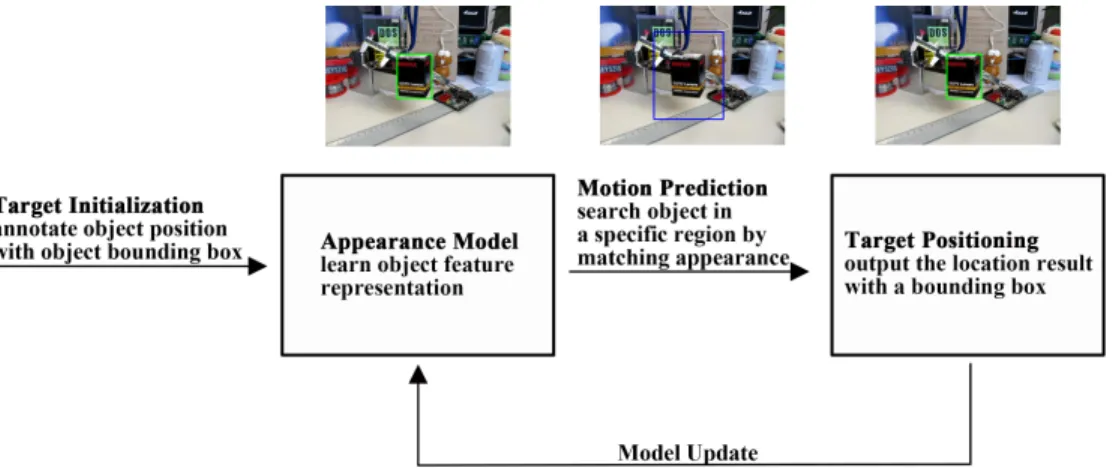
Visual object tracking (VOT) can be defined as the process of locating a region of interest in a video sequence, which contains four steps: target initialization, appearance modeling, motion prediction, and target positioning [28]. The first step, target initialization, is to annotate the target object with any of the following representations: centroid, ellipse, object bounding box, object contour or object skeleton. Usually, the target object is annotated in the first frame of the video sequence with a bounding box, and the trackers locate the target object in the following frames.
Appearance modeling consists of extracting visual features for a better representation of the target object, and in constructing mathematical models which are used for object detection with learning approaches. Then, the position of the target is predicted in the motion pre-diction step for subsequent frames. The target positioning step outputs the location of the target by greedy search or maximum posterior prediction. The VOT process is challenging due to many real-world difficulties:
• loss of information in image projection; • low image quality;
• uncertainties of target object; • movements of target object; • illumination variation; • object occlusion;
• real-time tracking constraints.
Tracking problems can be simplified by applying constraints on the appearance and motion models. For example, we can assume that there are no significant appearance changes in sequential frames and the motion of the target object is smooth. Furthermore, we can also
assume that the velocity of the moving target is constant or accelerates constantly. The visual object tracking process is illustrated as Figure 2.1.
Figure 2.1 The illustration of visual object tracking process. It includes target initialization, appearance model, motion prediction and target positioning. Appearance model is updated by new target appearance.
Several works have been conducted on object tracking. The main differences between these works come from different object representation, image features and the model they used. To represent the tracked object, three types of methods can be used, hand-crafted features, correlation filters, and deep features. Our review focuses on different object representations and two types of methods are described in Section 2.3 and Section 2.4.
2.2 Feature Descriptors
To distinguish between the target and the surrounding environment, different feature descrip-tors can be used to represent them. In this section, we introduce three popular handcrafted feature descriptors: Color Histogram, Color Name (CN) and Histogram of Oriented Gradi-ents (HOG), which are the most frequently used in visual object tracking in the last few years for methods that are not based on deep learning.
Color Histogram and Color Name Color is one of the important characteristics of our world. As such, it is also a significant feature in computer vision to describe images and objects. However, its description is complicated since there are lots of uncertainties in many tasks. To understand visual data better, it is crucial to make better use of color information. Color histogram is a summarization of the color distribution in an image, it can be built from images in various color spaces, like RGB or HSV. To collect the color distribution, we
can divide the color values into several bins. The number of pixels in each bin will be used as the value of the corresponding histogram. The color histogram represents the statistics of different types of color, which is typically used in appearance modeling in visual object tracking.
Color names (CN), which are linguistic color labels representing colors, showed excellent results for computer vision tasks. The work [29] concludes that there are eleven basic color terms: red, orange, yellow, green, blue, purple, grey, black, pink, white and brown. Thus, color naming is associating RGB observations with color labels. Weijier et al. [30] proposed an approach mapping RGB values with color names, which are automatically learned from real-world image. Danelljan et al. [31] investigated the color contribution in a tracking-by-detection framework with a color mapping. The adaptive color names-based approach shows superior performance for object tracking.
Histogram of Oriented Gradients In computer vision, the histogram of oriented gra-dients (HOG) is a texture descriptor based on shape and edge, which can be used to detect objects. The basic idea of HOG is to use gradient information to reflect the edge information of the target image and to characterize the local appearance and shape of the image through the value of the local gradient. Bhat et al. [15] used HOG features and other features in object tracking and obtained good results.
Figure 2.2 Illustration of HOG descriptor. (This image is adapted [reprinted] from [4] c 2014 ELSEVIER)
the color space to reduce the influence of illumination and background, (2) divide the detec-tion windows into cells of the same size and extract corresponding gradient informadetec-tion, (3) combine adjacent cells into large overlapping blocks, which can effectively utilize overlapping edges information and be used to build the histogram statistics of the whole block, (4) the gradient histogram in each block is normalized to further reduce the influence of background and noise, (5) the HOG features of all blocks in the whole window are collected and the feature vectors are used to represent the features. In this process, the parameters template of different scale, the selection of gradient direction, the size of overlapping blocks and cells, as well as the normalization factor, will affect the final results.
2.3 Tracking based on Correlation filter
Correlation is a common measure in pattern recognition. In spite of much known weakness, its efficiency and simplicity have attracted continuous research on it. A common way to use correlation is the correlation filter-based tracking approaches. Given the target object in the first frame, the correlation filter-based trackers train filters on the specific region to encode the target appearance. From this point on, the trackers detect the target object in the subsequent frames and update the filters based on the newly detected object. The tracking process starts from correlating the filter over a sub-window in the next frame and generate a response map. The value of each pixel indicates the possibility of being the new position of the target. Thus, the location of the maximum value is regarded as the result. The filter is updated on the new location then.
To speed up tracking, correlation is employed in the Fourier domain with the Fast Fourier Transform (FFT). First, the input image f and the filter h are transformed:
F = F (f ) H = F (h).
(2.1)
It is known that correlation is an element-wise multiplication in the Fourier domain, which can be a form of:
G = F H∗ (2.2)
where denotes the element-wise multiplication operation and ∗ indicates the complex conjugate. Afterward, the output G is transformed back into the spatial domain by the inverse FFT. With the use of FFT, correlation filters-based approaches obtain high computational efficiency. The performance of correlation filters has been greatly extended in object tracking. The following subsections discuss in detail about kernelized correlation filters and MOSSE [16]
filters.
2.3.1 Kernelized Correlation Filters
Most correlation filter trackers are discriminative classifiers, whose purpose are to classify the target and surrounding environment. Considering that these trackers are trained with translated and scaled sample patches, Henriques et al. [5] proposed kernelized correlation filters which shift training samples into circulant matrix and use kernelized regression for detection.
Cyclically shifted samples Since discriminative classifiers are trained online with sam-ples collected during tracking, the tracking speed is seriously affected by the potentially large number of samples. Whereas, limiting the training samples may be at the cost of discrimi-nation performance. Henriques et al. [32] observed that this problem can be solved by using circulant structure.
The circulant structure consists of a base sample and several virtual samples by translating the base sample. Regarding an n × 1 vector v as the target patch, using a cyclic shift operator can model 1D translations:
C = 0 0 0 . . . 1 1 0 0 . . . 0 0 1 0 . . . 0 .. . ... . .. ... ... 0 0 . . . 1 0 (2.3)
The product C(v) = [vn, v1, v2, . . . , vn−1]T shifts v by one element, modeling a small trans-lation. A larger translation can be obtained by chaining u shifts as Cuv. A negative u shifts in the reverse direction. Examples are shown in Figure 2.3 and Figure 2.4.
The circulant structure used can encode the convolution of vectors, which is close to what we do when evaluating a classifier at many different subwindows. Due to the properties of circulant matrices, they can be computed in the Fourier domain, which makes the learning extremely fast while the detection still performs well.
Ridge regression with shifted samples Since the ridge regression admits a close-form solution and can achieve outstanding performance, it can be used to train correlation filters. The objective of training is to find a correlation function f (v) = wTv that minimizes the
Figure 2.3 An example of translating 1D signal to generate a circular matrix. The rows are cyclic shifts of the base sample. (This image is adapted [reprinted] from [5] c 2015 IEEE)
Figure 2.4 Illustration of vertical cyclic shifts of a base sample. (This image is adapted [reprinted] from [5] c 2015 IEEE)
Euclidean distance between the samples v and the expected outputs y with a regularization term:
min w
X
(f (v) − y)2+ λ||w||2 (2.4)
To solve the regression problem, all possible cyclic shifts can be used as a circulant matrix V : V = C(v) = v1 v2 v3 . . . vn vn v1 v2 . . . vn−1 vn−1 vn v1 . . . vn−2 .. . ... ... . .. ... v2 v3 v4 . . . v1 (2.5)
The first row is the base sample v, then each row is shifted one element to the right as Figure 2.3 illustrates. With the circulant matrix, the training process is much more efficient by diagonalizing. Besides, the "kernel trick" can be used to advance the training. Since the optimization problem is linear, the complexity of evaluating the regression function is linearly associated with the number of samples. However, with kernel trick, the inputs of a linear problem can be mapped to a non-linear feature-space.
2.3.2 MOSSE Filters
The core idea of Minimum Output Sum of Squared Error (MOSSE) [16] is to produce cor-relation filters with fewer training images. Taking a set of training images fi and expected outputs gi, typically, gi is generated from ground truth which has a compact 2D Gaussian shaped peak in the training image fi centered on the target object. By applying the training in the Fourier domain, a simple element-wise relationship can be built for the input and the output as shown in Equation 2.6.
Hi∗ = Gi Fi
(2.6) where Fi, Gi are the Fourier transform of fi and gi, H is the correlation filter to be trained. To find the optimal filter that maps the training inputs to the expected outputs, MOOSE proceeds by minimizing the Sum of Squared Errors (SSE) to solve this problem, as shown in Equation 2.7. min H∗ X i |Fi· H∗− Gi|2 (2.7)
The idea of using SSE to find the correlation filter has been used many correlation filters-based tracking methods. Whereas, rather than assuming that the target was always centered in the input and the output was fixed. MOSSE customize every output gi. Since the target is not always centered in the tracking problem, the Gaussian shaped peak moves following the target in the input, the idea of customizing every output gi is more reasonable.
2.4 Tracking based on CNNs
Nowadays, many computer vision tasks have benefited from convolutional neural networks (CNNs), such as image classification, object detection, semantic segmentation, and many others. Visual object tracking also takes advantage of CNNs due to its feature representation ability. In this section, we introduce CNN-based tracking approaches, including tracking by regression networks, tracking by siamese networks, tracking with the combination of representation learning and correlation filter and tracking with visual attention.
2.4.1 Tracking by regression networks
Li et al. [6] proposed DeepTrack, using a complex Convolutional Neural Network model for learning effective feature representations of multiple input cues. The CNN model consists of two convolutional layers and two fully-connected layers. The ReLU (Rectified Linear Unit) is adopted as the activation function, and max-pooling operators are used for
dimension-Figure 2.5 The CNN architecture of DeepTrack with multiple image cues. The gray dashed blocks are the independent CNN channels for different image cues, the green dashed block is the fusion layer where a linear mapping is learned. (This image is adapted [reprinted] from [6] c 2016 IEEE)
reduction. They use locally normalized image patches as input, which draws a balance between the representation power and computational load. After convolutional layers, a 72-dimensional feature vector is generated. Then, fully connected layers map the 72-D feature vector into a 2-D confidence vector which corresponds to the positive score and negative score for the image patch. The CNN architecture of DeepTrack is shown in Figure 2.5.
Even though DeepTrack [6] has achieved remarkable performance improvement over correla-tion filter-based trackers, the tracking speed of those trackers [6,33] trained online are limited. Held et al. [7] proposed a regression network-based method GOTURN, which is trained of-fline, tracking objects at 100 fps. Without online training, the GOTURN tracker learns a generic relationship between object motion and appearance. The network architecture of GOTURN is shown in Figure 2.6.
Figure 2.6 The network architecture of GOTURN [7]. It first extracts features of target object and searches region by a set of convolutional layers. Features are then fed through the fully connected layers to estimate the movement of the target object. (This image is adapted [reprinted] from [7] c 2016 Springer)
com-parison problem. It employs a sequence of convolutional layers to extract the deep feature of the target object and the search region. Then, the outputs are fed through three fully con-nected layers. The fully concon-nected layers compare the features of the target object and the features of the search region in the current frame to find the movement of the target object. Since the networks are fully trained offline on a collection of videos and no online training is needed in tracking, it tracks novel objects in a fast and accurate and robust manner.
2.4.2 Tracking by siamese networks
Trackers based on regression networks [6, 7, 33] predict the bounding box of the target object directly. Unlike regression networks-based trackers [6, 7, 33], siamese networks-based trackers [8,34,35] address tracking as a similarity learning problem. The pioneering work, SiamFC [8], takes two identical branches to extract deep features from the exemplar image and the search image. The identical feature extraction branches are fully convolutional layers. After that, the feature map extracted from the exemplar image is regarded as the filter to perform correlation on the feature map extracted from the search image. By computing the similarity of all translated sub-window effectively, the position of maximum value in the output response map is the location of the target object. The architecture of SiamFC [8] is as shown in Figure 2.7.
Figure 2.7 The architecture of SiamFC [8]. The inputs are the exemplar image and the search image. Then, two identical branches made up of fully convolutional neural networks, extract feature representations for inputs. The output is a score map produced by correlation using feature representation of exemplar image on search image. In this example, the value of red and blue pixels indicate the similarities for the corresponding sub-windows. (This image is adapted [reprinted] from [8] c 2016 Springer)
2.4.3 Representation learning for correlation filter
Correlation Filter trains a linear template to classify the target and surrounding environment. These correlation filter based trackers [5, 19, 20] adopt features that are either manually designed or trained for a different task. While on the other hand, deep features which are learned from data show robust representation to describe objects. SiamFC [8] focuses on learning a similarity function to discriminate whether two images patches contain the same object or not, by exploiting deep features. However, a fixed metric learned offline prevents the tracker from utilizing any video-specifies cues which may be helpful for discrimination. In light of these limitations, Valmadre et al. [9] incorporates a Correlation Filter into a siamese network. Instead of using the convolutional feature of the target object directly, they employ a correlation filter learner in the network which enables learning features coupled to the correlation filter. The architecture of CFNet is shown as Figure 2.8.
Figure 2.8 The network architecture of CFNet. The first part is two identical branches made up of fully convolutional neural networks like SiamFC [8]. The difference between CFNet [9] and SiamFC [8] is that CFNet employs an additional correlation filter learner layer to learn filter on the feature representation of the exemplar image. (This image is adapted [reprinted] from [9] c 2017 IEEE)
After incorporating a correlation filter layer into the similarity network during training, it enables shallow networks to rival their slower, deeper counterparts. CFNet [9] can achieve the same tracking accuracy as the basic siamese tracker SiamFC [8].
CFNet [9] learns correlation filter on the feature from the last convolutional layer. Different from CFNet [9], Ma et al. [21] utilize features from different convolution layers to learn the correlation filters. They observed that features from different levels of convolution layers contain different information, which is complementary. The last layers of CNNs are efficient to capture semantics. However, they are insufficient for capturing details. On the contrary, the earlier layers, are precise in localization since more details are kept, while they are unable to capture semantics as illustrated in Figure 2.9. Based on this observation, they adaptively
learn correlation filters on each convolution layer to encode target appearance.
Figure 2.9 Visualization of deep hierarchical feature. Features from earlier layers contain more low-level information similar to the response map of Gabor filters [10]. On the contrary, features from deeper layers capture more semantic information and less spatial details. (This image is adapted [reprinted] from [11] c 2018 IEEE)
2.4.4 Tracking with Visual Attention
The visual attention scheme has been widely exploited for many computer vision applications, including image classification, image captioning, pose estimation, etc. SAGAN [36] utilizes the self-attention module presented in [37], to capture long-range dependencies. With this attention mechanism, the long-range dependencies are embedded in the feature maps. It is complementary to the convolutions, whose advantage lies in modeling local dependencies. Different from the self-attention module used in SAGAN [36], DSiamM [12] learns a spatial weight maps to fuse multi-level deep features. More specifically, when the target is near the center of the search region, the shallower layer features get more weight at the center region while the background region gets less weight. The weight of the deeper layer is the opposite as illustrated in Figure 2.10. Owing to the fact that features from the deeper layer help to remove the background interference while features from the shallower layer can get precise localization of the target, the complementary role of response maps from different layers is reflected in the attention maps. It is helpful to obtain a better tracking performance. Besides, another way to take advantage of visual attention is exploited in [38]. They regard object tracking as a two-stage problem, drawing some samples in the search image first and classifying these samples as target or background. The attention maps they used are the partial derivative output of the first layer, which indicates the importance of each pixel in the input sample to affect the classification accuracy. Through a reciprocative learning scheme, the attention maps cover the whole target region gradually, and the tracking performance is improved even if target objects undergo large movements.
Figure 2.10 The spatial weight maps learned in DSiamM [12], the left map is learned for the shallower layer of AlexNet, the right map is learned for the deeper layer of AlexNet. (This image is adapted [reprinted] from [12] c 2017 IEEE)
2.5 Evaluation Metrics
Wu et al. [1] proposed the OTB benchmark, which has been widely used to evaluate state-of-the-art trackers. It consists of three datasets, 2013, 50 and 100. The OTB-2013 dataset contains sequences with 51 target objects, the OTB-50 and the OTB-100 include sequences with 50 target objects and 100 target objects, respectively. All sequences are categorized according to 11 attributes as illustrated in Table 1.1. The benchmark considers two evaluation metrics, the center location error and the overlap score.
The center location error is known as the Precision plot, which computes the average squared error between the center locations of the ground-truth labels and the tracked targets of all the frames. Since the average error is prone to be affected by bias results, it does not measure the tracking performance with much accuracy. Thus, the percentage of frames in which the precision is within a given threshold is reported. The precision at the threshold of 20 pixels is typically used to rank trackers.
The overlap score is known as the Success plot, which computes intersection over union (IoU) between the ground-truth labels and the tracked targets. Given a score threshold, the overlap scores demonstrate whether a tracker successfully tracks the target object in one frame. As the threshold varies between 0 and 1, the corresponding success rates are drawn as the Success plot. The area under curve (AUC) of each success plot is usually used to rank trackers, which corresponds to the average success rates for all sampled overlap thresholds.
2.6 Discussion
In this chapter, we introduced the process of VOT and the background knowledge. In addi-tion, we also discussed some the state-of-the-art approaches from two perspective, correlation filter-based trackers and deep learning-based trackers. Finally, we presented the standard evaluation metrics used for VOT.
Correlation with an example template is a common way to detect target object in VOT. Be-sides, with the help of kernel trick, the tracking speed of most KCF-based trackers [5, 19, 20] has been increased by an order of magnitude. The correlation filter works well if the appear-ance of the tracking target does not change a lot. Whereas, in most visual object tracking scenario, the target object undergoes significant appearance changes. To improve the robust-ness of tracking, many works [6–8] train convolutional neural networks to represent features. In the meantime, some works [9, 21] combine CNNs with correlation filters, alleviating the depth and the number of parameters of CNNs. However, their performances are still limited when target objects undergo large movements. Since there are lots of uncertainties in the tracking objects, only a single pretrained networks can not generate discriminative enough feature representations. To optimize the representation ability of CNNs in VOT, we explore strategies including multiple branches, online selection, and hierarchical feature fusing, in our work. By using multiple branches, diverse representations can be generated. For dif-ferent tracking situations, we can choose the optimal representation via our online selection mechanism against the target appearance changes. In addition, combining hierarchical con-volutional features to encode the target can enhance the representation power comparing with features from the only last convolutional layer.
CHAPTER 3 OVERVIEW
In this thesis, we propose approaches to address challenges in visual object tracking. Specifi-cally speaking, in visual object tracking scenarios, target object appearance can be affected by object motion, changes in viewpoint, lighting variation, and other disturbing factors. In our work, we employ a more robust and efficient feature representation against those disturbing factors. The proposed methods are described in Chapter 4 and Chapter 5.
3.1 Multi-Branch Siamese Networks with Online Selection
In our first article, we present MBST, a multi-branch Siamese tracker. Considering that the feature representation ability is not robust enough especially when facing those disturbing factors mentioned above, our goal is to explore strategies to enrich the feature representation of neural networks-based trackers. Hence, we proposed two strategies to improve the discrim-inative ability of pretrained models. The first one is training the network in different contexts, corresponding to different context-dependent branches. Since each branch is fine-tuned in a different context, they can have different performance in different tracking scenarios. The second strategy is to add networks designed and trained for different tasks. In our approach, we utilize the pretrained AlexNet [23], which is designed for image classification task and trained in ImageNet [24] dataset.
After we get multiple branches, different branches have different performance in different tracking scenarios. Combining these different branches can diversify the feature represen-tation of our approach. Thus, we need to find a way to ensemble these branches together and maximize the tracking performance of the whole network. Given more discriminative response maps usually generate more accurate tracking results, we proposed an online branch selection mechanism to select branches when tracking. The online branch selection mech-anism selects the branch to be used in tracking according to the response maps which are calculated by the feature representations generated in these branches. Besides, to deal with the problem of target scale variations, we input the target object over three scales and update the size of the bounding box by the scale obtaining the maximum response value.
With our multiple branches architecture and online branch selection mechanism, our tracker obtains improved performance compared to standard Siamese network trackers on object tracking benchmarks [1, 13].
3.2 Multiple Features of Siamese Networks
In the second paper, we improve the discriminative power of feature representations by utilizing features from different convolutional layers and two CNN models and using a feature recalibration mechanism. A Multiple Features-siamese Tracker (MFST) is proposed in this paper. It is well known that deep features from the last convolutional layer embed semantic information of the target, which is invariant to appearance changes. However, since the receptive field of the convolutional features from the deeper layer is large, it cannot get a precise spatial localization which is very important in object tracking. On the contrary, features from shallower layers contain more details and can get more precise localization but they are prone to fail when appearance changes. Besides, as we observed from multi-branch tracking methods, the combination of multiple CNN models can diversify the feature representation, to ensure a more efficient and robust tracking. To make better use of features extracted from the CNN models, we combine multiple features from different convolutional layers and different CNN models. To combine these features appropriately, we exploit three types of combination schemes, hard weight, soft mean and soft weight. The optimal strategy is used in our tracker to obtain the best feature representation of the target object.
In addition, we employ a feature recalibration mechanism in our approach, the Squeeze-and-Excitation block. It extracts the channel descriptor first and then applies a two layers MLP to learn the channel-wise dependencies. Since different channels of the features play different roles in tracking, by using the feature recalibration mechanism, the discriminative channels of the features are enhanced while the others are weakened.
With the combination of hierarchical features from different models and the feature recal-ibration mechanism, a much-improved feature representation is obtained with our method. The MFST achieves comparable performance among some recent state-of-the-art tracker on the OTB benchmarks [1, 13].
3.3 Experimentation
To validate the robustness of feature representation proposed in both of our trackers, we evaluated our methods on the visual object tracking benchmarks OTB2013 [13], OTB50 [13] and OTB100 [1]. After training our models offline, the learned models are used for tracking. The evaluation experiments were executed multiple times, which ensures the reliability of results. We also did an ablation study to assess the contribution of each module in our method. In addition, our method was evaluated in different tracking scenarios with different challenges. More details are presented in Chapter 4 and Chapter 5.
CHAPTER 4 ARTICLE 1: MULTI-BRANCH SIAMESE NETWORKS WITH ONLINE SELECTION FOR OBJECT TRACKING
Authors
Zhenxi Li, Guillaume-Alexandre Bilodeau, LITIV lab, Polytechnique Montreal
Wassim Bouachir, TELUQ University
E-mail: {zhenxi.li, guillaume-alexandre.bilodeau}@polymtl.ca,[email protected]
Published in International Symposium on Visual Computing, ISVC, November, 2018
Reference as Li, Z., Bilodeau, G.-A., Bouachir, W., Multi-Branch Siamese Networks with Online Selection for Object Tracking. International Symposium on Visual Computing (ISVC), Las Vegas, NV, USA, November 19-21, 2018, pp. 309-319
4.1 Abstract
In this paper, we propose a robust object tracking algorithm based on a branch selection mechanism to choose the most efficient object representations from multi-branch siamese networks. While most deep learning trackers use a single CNN for target representation, the proposed Multi-Branch Siamese Tracker (MBST) employs multiple branches of CNNs pre-trained for different tasks, and used for various target representations in our tracking method. With our branch selection mechanism, the appropriate CNN branch is selected de-pending on the target characteristics in an online manner. By using the most adequate target representation with respect to the tracked object, our method achieves real-time tracking, while obtaining improved performance compared to standard Siamese network trackers on object tracking benchmarks.
4.2 Introduction
Model-free visual object tracking is one of the most fundamental problems in computer vision. Given the object of interest marked in the first video frame, the objective is to localize the target in subsequent frames, despite object motion, changes in viewpoint, lighting variation, among other disturbing factors. One of the most challenging difficulties with model-free tracking is the lack of prior knowledge on the target object appearance. Since any arbitrary object may be tracked, it is impossible to train a fully specialized tracker.
Recently, convolutional neural networks (CNNs) have demonstrated strong power in learning feature representations. To fully exploit the representation power of CNNs in visual tracking, it is desirable to train them on large datasets specialized for visual tracking, and covering a wide range of variations in the combination of target and background. However, it is truly challenging to learn a unified representation based on videos that have completely different characteristics. Some trackers [7] train regression networks for tracking in an entirely offline manner. Other works [8, 9, 34] propose to train deep CNNs to address the general similarity learning problem in an offline phase and evaluate the similarity online during tracking. However, since these works have no online adaptation, the representations they learned offline are general but not always discriminative.
Rather than applying a single fixed network for feature extraction, we propose to use multiple network branches with an online branch selection mechanism. It is well known that different networks designed and trained for different tasks have diverse feature representations. With the online branch selection mechanism, our tracker dynamically selects the most efficient and robust branch for target representation, even if the target appearance changes. Our goal is to improve the generalization capability with multiple networks.
The main contributions of our work are summarized as follows. First, we propose a multi-branch framework based on a siamese network for object tracking. The proposed architec-ture is designed to extract appearance representation robust against target variations and changing contrast with background scene elements. Second, to make the full use of the different branches, we propose an effective and generic branch selection mechanism to dy-namically select branches according to their discriminative power. Third, on the basis of multiple branches and branch selection mechanism, we present a novel deep learning tracker achieving real-time and improved tracking performance. Our extensive experiments compare the proposed Multi-Branch Siamese Tracker (MBST) with state-of-the-art trackers on OTB benchmarks [1, 13].
4.3 Related Work
Siamese Network Based Trackers. Object tracking can be addressed using similarity learning. By learning a deep embedding function, we can evaluate the similarity between an exemplar image patch and a candidate patch in a search region. These procedures allow to track the target to the location that obtains the highest similarity score. Inspired by this idea, the pioneering work of SiamFC [8] proposed a fully-convolutional Siamese Network in which the similarity learning with deep CNNs is addressed using a Siamese architecture. Since this approach does not need online training, it can easily achieve real-time tracking. Due to the robustness and real-time performance of the SiamFC [8] approach, several subse-quent works proceeded along this direction to address the tracking problem. In this context, EAST [39] employs an early-stopping agent to speed up tracking where easy frames are processed with cheap features, while challenging frames are processed with deep features. CFNet [9] incorporates a Correlation Filter into a shallow siamese network, which can speed up tracking without accuracy drop comparing to a deep Siamese network. TRACA [14] applies context-aware feature compression before tracking to achieve high tracking perfor-mance. SA-Siam [34] utilizes the combination of semantic features and appearance features to improve generalization capability. In our work, we use the Siamese Network as embedding function to extract feature representations. All branches use the Siamese architecture to apply identical transformation on target patch and search region.
Multi-Branch Tracking Frameworks. The diversity of target representation from a single fixed network is limited. The learned features may not be discriminative in all tracking situations. There are many works using diverse features with context-aware or domain-aware scheme.
TRACA [14] is a multi-branch tracker, which utilizes multiple expert auto-encoders to ro-bustly compress raw deep convolutional features. Since each of expert auto-encoders is trained according to a different context, it performs context-dependent compression. MD-Net [33] is composed of shared layers and multiple branches of domain-specific layers. Bran-chOut [40] employs a CNN for target representation, with a common convolutional layers and multiple branches of fully connected layers. It allows different number of layers in each branch to maintain variable abstraction levels of target appearances.
A common insight of these multi-branch trackers is the possibility to make a robust tracker by utilizing different feature representations. Our method shares some insights and design principles with other multi-branch trackers. Our network architecture is composed of multiple branches separately trained offline and focusing on different types of CNN features. In
![Figure 1.1 The model update strategy proposed in [3]. The target object is occluded in the second frame, which lead to more peak values in the corresponding response map](https://thumb-eu.123doks.com/thumbv2/123doknet/2337283.33060/19.918.188.730.514.840/figure-update-strategy-proposed-target-occluded-corresponding-response.webp)
![Table 1.2 The network configuration of VGG [2] networks. (This table is adapted [reprinted] from [2] c
2015 ICLR)](https://thumb-eu.123doks.com/thumbv2/123doknet/2337283.33060/23.918.146.767.244.916/table-network-configuration-networks-table-adapted-reprinted-iclr.webp)
![Figure 2.2 Illustration of HOG descriptor. (This image is adapted [reprinted] from [4] c
2014 ELSEVIER)](https://thumb-eu.123doks.com/thumbv2/123doknet/2337283.33060/28.918.325.595.646.952/figure-illustration-hog-descriptor-image-adapted-reprinted-elsevier.webp)
![Figure 2.4 Illustration of vertical cyclic shifts of a base sample. (This image is adapted [reprinted] from [5] c
2015 IEEE)](https://thumb-eu.123doks.com/thumbv2/123doknet/2337283.33060/31.918.174.749.357.505/figure-illustration-vertical-cyclic-shifts-sample-adapted-reprinted.webp)
![Figure 2.6 The network architecture of GOTURN [7]. It first extracts features of target object and searches region by a set of convolutional layers](https://thumb-eu.123doks.com/thumbv2/123doknet/2337283.33060/33.918.253.654.735.917/figure-network-architecture-goturn-extracts-features-searches-convolutional.webp)
![Figure 2.7 The architecture of SiamFC [8]. The inputs are the exemplar image and the search image](https://thumb-eu.123doks.com/thumbv2/123doknet/2337283.33060/34.918.240.674.619.816/figure-architecture-siamfc-inputs-exemplar-image-search-image.webp)
![Figure 2.8 The network architecture of CFNet. The first part is two identical branches made up of fully convolutional neural networks like SiamFC [8]](https://thumb-eu.123doks.com/thumbv2/123doknet/2337283.33060/35.918.245.675.465.635/figure-network-architecture-identical-branches-convolutional-networks-siamfc.webp)
![Figure 2.9 Visualization of deep hierarchical feature. Features from earlier layers contain more low-level information similar to the response map of Gabor filters [10]](https://thumb-eu.123doks.com/thumbv2/123doknet/2337283.33060/36.918.185.726.154.298/figure-visualization-hierarchical-feature-features-earlier-information-response.webp)