Making nothing or something:
corporate Fab Labs seen through their objects
as they cross organizational boundaries
Matt Fuller, Albert David Université Paris-Dauphine, PSL Research University, CNRS, DRM, M-Lab 75016 Paris, FranceAbstract
As large firms pursue their quest to support NPD and fuzzy front-end activities within their organizations, some have recently opted to create “corporate Fab Labs”. These spaces, which regroup an innovation-oriented community and provide any employee with a physical setting and open access to digital fabrication tools are also the birthplace of objects. A lingering and recurring question among practitioners and decision makers is: what do these objects represent? In terms of innovation, are they something, or nothing? This paper is an initial response to these reactions and develops a theoretical and empirical study of objects made in corporate Fab Labs. Building upon empirical data collected from a series of photos, we contribute a rudimentary tool for identifying the maturity of corporate Fab Labs as their objects cross three organizational knowledge boundaries: syntax, semantic, and pragmatic.
Introduction
Fab Labs describe a type of small-scale “digital factories” that strive to promote learning and enable creativity by bringing together tools, machines, and people (Gershenfeld, 2005; Walter-Herrmann, 2013). Created as an educational outreach program 2001 by MIT, activities in Fab Labs are centered around fabrication of various objects and the ability to “make (almost) anything” (Mikhak, et al. 2002). The Fab Lab concept was recently adapted to corporate settings in over twenty large multi-national organizations, often as a means of stimulating innovation and creativity within firms (Fuller, 2017).
In most organizations, it is anticipated that some unique or original objects initially created in a corporate Fab Lab could be further developed through a firm’s product development processes. Corporate Fab Labs are described by their creators as a different approach to the initial stages or fuzzy front-end (FFE) of new product development (NPD) that “breaks down silos” or “creates neutral ground.” Creators of Fab Labs distinguish their initiatives from traditional configurations for front-end product development (Khurana & Rosenthal, 1998) by eliminating at least two types of organizational boundaries. First, from an individual standpoint, Fab Labs are intended as places where individuals temporarily put aside their traditional organizational roles to collaborate with others to create innovative objects. In this sense, individuals traverse a knowledge boundary (Carlile, 2002) as they are exposed to and can resolve issues that typically fall outside the bounds of their functional expertise. Second, from an organizational standpoint, Fab Labs differ from most corporate functions that are composed of a group of individuals with specialized knowledge in one area to operate efficiently.
To identify to what degree corporate Fab Labs are boundary-crossing agents in a NPD context, the present article builds upon a basic research question: do the objects made in Fab Labs reflect, encourage, and create that boundary-crossing agency?
To answer this question, this paper presents an exploratory study of objects produced in four different corporate Fab Labs, and is structured in five sections. The first section presents relevant literature surrounding objects, organizational boundaries, boundary objects and the position of Fab Labs in a NPD context. The following sections then present the methodology used for this study, followed by a presentation and discussion of the empirical results. Finally, the concluding section suggests future research paths and managerial implications.
Literature review
Although Fab Labs are beginning to gain attention from various research fields, proposals of a theoretical framework for analyzing objects made within Fab Labs are absent from scientific literature. This section of the paper contributes a modest, preliminary proposal for an object-oriented theory structured in three main parts. The first portion briefly
describes objects in general, and builds a case for the validity of interpreting the organizational impact of Fab Lab-like structures through object analysis with a general theory of the existence of technical objects. The second portion of the review describes objects in a NPD context as they traverse three types of organizational boundaries. The final portion examines the state of extant Fab Lab literature, identifying descriptions of types of objects. A conclusion summarizes the previous three sections and details the framework used in the empirical analysis section of this paper.
Studying objects in a NPD context
For the purposes of this study, objects are broadly considered as artefacts that are manipulated to achieve a result. Examples of common objects in corporate settings could include tools, machines, raw materials, databases, production schedules, and financial reports. Gilbert Simondon’s (2012) general theory of technical objects describes the ability of objects to continuously change state to reflect their surroundings or “milieu” . As such, the state of objects changes as they are created, made, manipulated, used, and abandoned as they progress towards a specific result.
Objects are made unique through a series of events that take place in a given milieu and vice-versa. This holds true, even in situations where objects are materially identical but found in different settings. Given the context of front-end product development, objects become interesting when they are associated with novel or expansive properties (Hatchuel & Weil, 2003) or increase in sophistication. The notion of sophistication does not speak to the technical complexity of an object, but rather the way in which objects evolve as they are introduced to new actors (Simondon, 2012). Put differently, sophistication comes as an object shapes and is shaped new knowledge.
Studies of objects can focus on both singular objects and collections of objects. In the former instance, studies of a specific objects may become “textbook cases” in which both an object and its milieu are examined in great detail. These studies frequently build on a single case to illustrate particular situations of success or failure, such as the collapse of the Tacoma Narrows Bridge (Billah & Scanlan, 1998) or the commercialization of an innovative product by Sony (Wood & Brown, 1998). In the latter case, studies of collections or types of objects can indicate processes used in a local setting, such as von Hippel’s (1976) study of 111 innovations produced by a single firm.
Some objects found in NPD literature are similar to objects typically made in Fab Labs, most notably prototypes (Ben Mahmoud-Jouini, et al., 2014). In addition to physical properties used in testing, prototypes help construct a dialogue between multiple actors around a single object (Bogers & Horst, 2013; von Hippel, 1976). Not only is this dialogue a crucial part of the construction of a sophisticated milieu surrounding a prototype, it also signals a situation in which organizational boundaries may be crossed.
Organizational boundaries & boundary objects
Organizational boundaries exist as a means of handling complexity within organizations (Nonaka, 1994) by creating smaller groups. Each group has a certain level of autonomy, influence, resources, and identity in relationship to the organisation to accomplish their role (Santos & Eisenhardt, 2005). One natural consequence of boundaries is that various competencies develop their own specialized way of discussing, approaching, and resolving problems with objects. Despite these fundamental differences between each functional entity, some objects within organizations can be structured to cross boundaries and efficiently communicate information to all parties concerned. A single object, such as a production planning schedule, can be used across functions for employee scheduling, payroll, purchasing, and sales (Carlile, 2002).
However, organizational boundaries are a significant hurdle in NPD. Developing novel objects stretches existing knowledge (Reid & de Brentani, 2004; Le Masson, Weil, & Hatchuel, 2010), representing a type of organizational curveball that each function must apprehend and interpret. In his empirical study of over 106 cross-functional events in a NPD context, Carlile (2002) identifies three types of boundaries that must be overcome: syntax, semantic, and pragmatic. Each of the three boundaries are briefly presented and serves as the foundation of the theoretical framework used in the analysis section.
Syntax boundaries originate from theories of digital communication. They describe the ability to reliably transmit and receive information using symbols—a type of common language (Shannon, 1949). Although effective communication is considered a determining success factor in organizational innovation (Damanpour, 1991) and in NPD activities (Katz & Tushman, 1981), the ability to communicate may break down as new objects are introduced (Carlile, 2002). Objects crossing syntax boundaries help create a common language, such as a prototype that initiates dialogue between organizational functions (Bogers & Horst, 2013).
Semantic boundaries describe situations in which different meanings are derived by objects, despite the existence of an established language or syntax. Successfully crossing this boundary implies that both parties are capable of using commonly understood terms to discuss objects (syntax) but also interpret objects (semantics). In other terms, successfully crossing this boundary instills a sense of “mutual understanding” (Nonaka, 1994). In this sense, a prototype can help identify respective challenges for future production processes, intellectual property protection, or creating effective sales materials.
The last type of boundary—pragmatic boundaries— are crossed as specific problems introduced by novel objects are resolved. Reaching this point in boundary-crossing requires identifying and overcoming syntax and semantic boundaries (Carlile, 2002). Objects that overcome pragmatic boundaries provide a substrate that can be collectively
altered and reshaped in a problem solving process while incorporating specific knowledge held by each organizational function.
Creating objects that effectively cross organizational boundaries is not the only solution. Several established management practices are intended to reconcile the firm’s dependence on organizational functions while mitigating the effects of boundaries in the fuzzy front-end, including the use of autonomous task forces (Wheelwright & Clark, 1992) or cross-functional project teams (Fredericks, 2005). Empirical evidence underscores the utility of these approaches in NPD settings (Patanakul, Chen, & Lynn, 2012), they do not necessarily eliminate organizational boundaries. Often, the effects of such boundaries are simply felt later on. In the case of autonomous project teams, functional boundaries are transformed into project-team boundaries. In the case of autonomous project teams, team members retain their role as a representative of a specific function. To the best of our knowledge, management practices in scientific literature do not describe configurations that temporarily blur out organizational functions.
Crossing boundaries in Fab Labs
Little research exists regarding Fab Labs in a corporate context, leading us to rely upon descriptions given by practitioners in over ten corporate Fab Labs. This data was obtained during the same period as the data collected for the present research (Fuller, 2017). In most cases, Corporate Fab Labs are positioned on the edge of traditional organizational boundaries and core functions. They also sit on the edge of individual boundaries, in the sense that all Labs studied encourage using available resources for personal projects. This position is voluntary, and builds upon similar values presented in Fab Labs such as the Fab Charter (MIT Center for Bits & Atoms, 2007).
Unlike most cross-functional activities in firms where each stakeholder remains distinctly associated with an organizational function (e.g. Tina from corporate communications), “using a Fab Lab” is not a functional responsibility. In addition, although Fab Labs provide the technical means to “make (almost) anything” (Gershenfeld, 2005), corporate Fab Lab managers all underline the importance of getting objects to mature outside the Lab using a portion of the firm’s existing NPD methods and resources. As such, using corporate Fab Labs can result in a bi-directional boundary-crossing process: employees first cross organizational boundaries as they temporarily put aside their functional responsibilities and discover and use the Fab Lab. As they return to their workspace, they are able to bring objects back from the Fab Lab, and vice-versa. The following section analyses to what extent objects made in Fab Labs reflect and promote boundary crossing.
Methodology
The present study builds upon a visual analysis of over 500 photos taken over the course of multiple visits in 2015 and 2016 to four corporate Fab Labs in four different
multinational corporations. While Fab Labs are relatively recent, the sample contains one lab created each year between 2013 and 2016. Two labs studied are located in France, while the other two are in Japan.
Photos taken during these visits were sorted to eliminate duplicates, and individual objects created in the Fab Lab were then systematically identified and verified using N’Vivo data analysis software. This process resulted in a sample of 137 objects created by various individuals within Fab Labs. Each object was attributed a unique identifier, accompanied by a brief text describing the object and, where possible, the names of individuals that made the object. A number of descriptive properties were coded in relation to each object: the Lab in which it was created, the machines used, whether the object was intended for personal or professional use, whether it was designed by an individual or a group, and whether the object was made by it’s designer.
With these descriptive variables established, we set out to analyze each object and determine the types of boundaries they crossed. To do this, we used notes taken when object makers described their creations and wrote a short phrase summarizing the individual’s underlying objectives when creating each object. Syntax boundaries represent a common language, or the creation of this common language. Objects that reflect or communicate the first steps of using a Fab Lab are indicative of a syntax object, where examples of descriptions by creators include “Can I really just come and use this machine?” and “Hey look at what I made!”. Semantic boundaries build upon this common language as individuals try to learn how they can effectively use the resources Fab Labs provide. These types of boundaries are reflected by descriptions such as “There's a new machine, so I'm going to try to work and see what it can help me make,” or “How are we all going to work together on this?” Pragmatic boundaries are crossed when both the Lab and another organizational function work together to solve problems. Descriptions reflecting these types of objects include “we have a problem to solve and know how to solve it here.”, and “I'd like to see what my drawing looks like for real, then use it to work with others”.
While aggregating this descriptive data, a latent variable emerged that describes the direction in which boundaries are crossed: a type of pull dynamic where organizational functions turn towards the Lab to create objects, in contrast to a push dynamic in which objects are created in the Lab and then presented to an organizational function. This division appears based on the fundamental differences in knowledge required between working in a Fab Lab and working in a specific department of a large firm. In other words, the knowledge necessary to create objects in a Fab Lab and participate in a Fab community is not necessarily the same when working as a mechanical engineer or systems analyst. Recent theoretical lenses from other disciplines such as marketing appear to support this viewpoint (Moreau, Bonney, & Herd, 2011; Mochon, Norton, & Ariely, 2012), however the exploration and use of these alternative frameworks falls outside of the scope of the present study. These directional variables are respectively
labeled throughout the rest of this paper in relationship to the Fab Lab as “inbound” and “outbound” for simplicity.
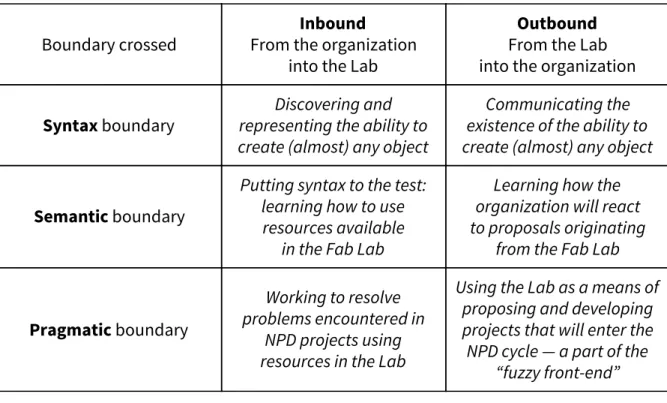
The two variables—boundary type and direction—were crossed, and each object was systematically categorized in terms of each variable. The framework used to classify objects both in terms of which boundaries are crossed and in what direction is summarized in Table 1.
Table 1: object coding framework (based on Carlile, 2002)
Boundary crossed From the organization Inbound into the Lab
Outbound
From the Lab into the organization
Syntax boundary representing the ability to Discovering and create (almost) any object Communicating the existence of the ability to create (almost) any object Semantic boundary Putting syntax to the test: learning how to use resources available in the Fab Lab Learning how the organization will react to proposals originating from the Fab Lab Pragmatic boundary Working to resolve problems encountered in NPD projects using resources in the Lab Using the Lab as a means of proposing and developing projects that will enter the NPD cycle — a part of the “fuzzy front-end”
Finally, we controlled for differences between types of objects within each category by comparing the other descriptive variables, resulting in the creation of two additional, complementary categories: objects created exclusively by Lab workers for use within a Lab and objects crossing boundaries in multiple directions. Objects created for use within the Lab were set aside from the core dataset and described separately, as they are not specifically intended to cross an organizational boundary. This resulted in a total of 103 individual objects. Representative objects of each category are presented and discussed in the following section.
Results
Results are presented generally in this section, followed by specific descriptions based on the type of boundary crossed: syntax, semantic, pragmatic. These boundaries are considered successive and increasingly complex in terms of their surrounding milieu (Simondon, 2012). In other words a semantic boundary cannot be crossed without common syntax, and a pragmatic boundary cannot be crossed unless there are shared
semantics (Carlile, 2002). Table 2 resumes the number of objects identified by boundary type and direction.
While there is a relatively even distribution between the three boundary types as a whole, the majority of objects are created by crossing from an organizational function into the Fab Lab. Although fewer objects originating from corporate Fab Labs across boundaries into other organizational functions, outbound objects are generally more complex in nature. In the following sections, we discuss objects surrounding each boundary type. A representative sample of objects—including images—are presented, starting with inbound boundary objects and followed by outbound boundary objects. Additional relief is provided by reintegrating some descriptions drawn from interviews of the object’s creators. We then present two subsets of specific boundary objects: round trip objects which originate from an organizational function, enter the Lab, and return to an organizational function, and observations drawn from non-boundary objects created for use within the Lab. Finally, we present a general discussion regarding all objects studied. Table 2 : Distribution of objects by boundary and direction of boundary crossing Inbound From the organization into the Lab Outbound From the Lab into the organization “Round trip” objects Total Syntax boundary 28 7 0 35 Semantic boundary 28 1 0 29 Pragmatic boundary 12 14 13 39 Total 65 22 13 103 Syntax boundary objects
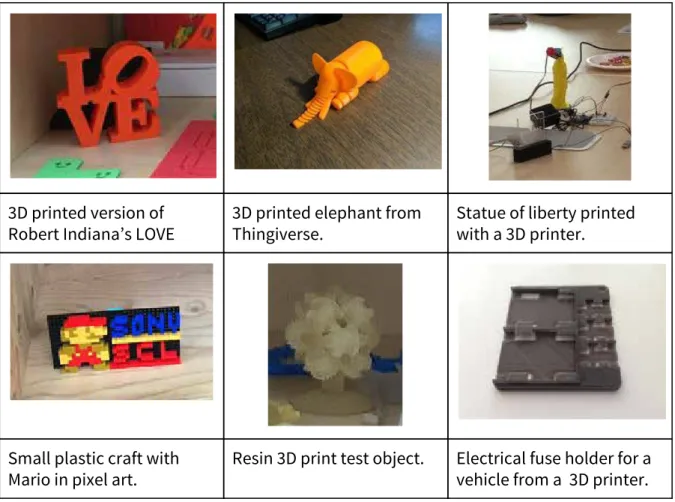
Syntax boundary objects help establish a common language across boundaries. Inbound boundary objects are used to understand the potential uses offered by Fab Labs. Although some objects created are imagined wholly by the individuals using the Lab, most are replicas created using CAD models available to download on the internet. The examples found in figure 1 are a representative sample of these types of objects. Inbound objects stay primarily within the Lab, acting as a material attestation to knowledge created as individuals adopt the Lab’s syntax centered around fabrication—a means for showing oneself that creating an object is possible.
Most inbound syntax objects are relatively simple objects based on common NPD performance criteria of quality, cost, and time (Karagozoglu & Brown, 1993). In other words, they are basic, quick, and inexpensive to produce. Notwithstanding, these objects
appear to suffice as a means of crossing initial syntax boundaries, as individuals either quickly move on create more sophisticated boundary crossing objects or simply do not return to the Lab. In the latter case, one could legitimately question whether the individuals in question truly crossed a syntax boundary or simply went on the organizational equivalent of a visit to a foreign language speaking country returning home with little more than a souvenir.
Figure 1: sample of inbound syntax boundary objects
3D printed version of
Robert Indiana’s LOVE 3D printed elephant from Thingiverse. Statue of liberty printed with a 3D printer.
Small plastic craft with
Mario in pixel art. Resin 3D print test object. Electrical fuse holder for a vehicle from a 3D printer.
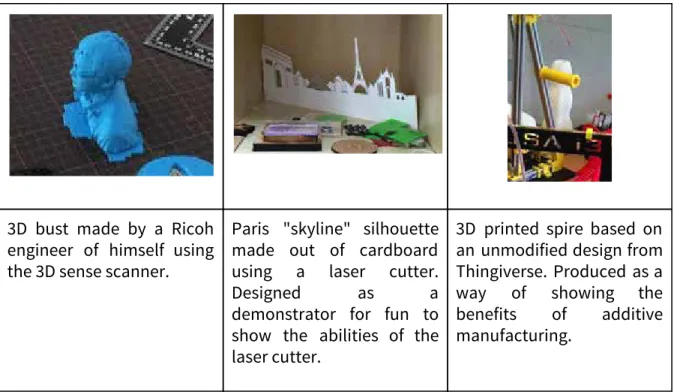
Nearly 80% of syntax-boundary objects are inbound-oriented. Outbound-directed syntax objects appear to be a bit different in nature. They are more costly and time consuming to produce, and of a noticeably higher finished quality. This may be because they are frequently used to communicate the creative potential afforded by a corporate Fab Lab throughout the organization. Figure 2 provides an example of these types of objects.
Figure 2: sample of outbound syntax boundary objects
3D bust made by a Ricoh engineer of himself using the 3D sense scanner.
Paris "skyline" silhouette made out of cardboard using a laser cutter.
Designed as a
demonstrator for fun to show the abilities of the laser cutter.
3D printed spire based on an unmodified design from Thingiverse. Produced as a way of showing the benefits of additive manufacturing.
Outbound syntax boundary objects appear to only carry a limited subset of Fab Lab syntax to the organization. These types of objects tend to be more complex and detailed than inbound syntax objects, typically involving some form of design work undertaken by the object’s creator. Instead of representing the acquisition of a new organizational language or grammar, as is the case with inbound syntax objects, they convey a type of result or “ends” (Carlile, 2002) that is possible to obtain through using a corporate Fab Lab. One object creator described this as demonstrating to colleagues “the existence of the possibility to do things differently.”
Semantic boundary objects
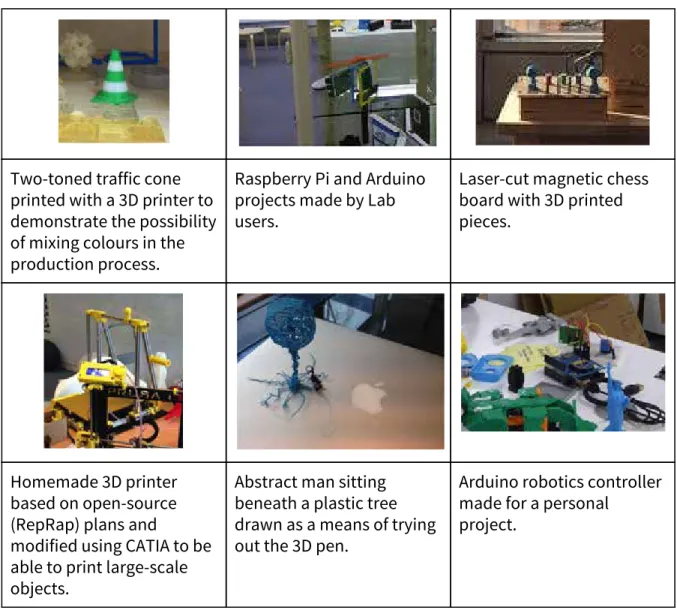
Once common syntax is established, objects can begin to cross semantic boundaries. Although Fab Lab’s basic syntax suggests that anyone can come and try to make an object, semantic boundary objects are the emerging result as individuals put that syntax to the test. Figure 3 presents an examples of common inbound semantic boundary objects. Inbound-directed objects are a common result of experimenting with and learning how to use available resources, representing 43% of all inbound-oriented objects in the study.
Figure 3: sample of inbound semantic boundary objects Two-toned traffic cone printed with a 3D printer to demonstrate the possibility of mixing colours in the production process. Raspberry Pi and Arduino projects made by Lab users. Laser-cut magnetic chess board with 3D printed pieces. Homemade 3D printer based on open-source (RepRap) plans and modified using CATIA to be able to print large-scale objects. Abstract man sitting beneath a plastic tree drawn as a means of trying out the 3D pen. Arduino robotics controller made for a personal project.
Inbound objects used to learn how resources available in corporate Fab Labs can be used are relatively common. However, objects used to learn how the organization outside of the lab would react to proposals made from the Lab were uncommon, with a single occurrence identified pictured in figure 4. Figure 4: lone outbound semantic boundary object identified in the dataset A set of goggles made as a low-cost 3D virtual reality headset that could be paired with the spherical photos taken the company’s 360° digital camera.
This singular object was created by a group of engineers and designers in the Fab Lab as a means of testing how various organizational functions would react to a new proposition stemming from what they described as a “marginal entity”. As the VR goggles circulated amongst sales, marketing, and various engineering teams the team described feeling a noticeable increase in legitimacy and the ability to move on to new, more sophisticated proposals.
Other factors may explain the absence of outbound semantic objects, namely the existence of prior knowledge and the presence of defined cross-functional processes involving the Lab. The first case recognizes that individuals that use corporate Fab Labs are full time employees of other organizational functions. As such, they may feel that they possess sufficient knowledge to introduce an object originating from the Lab to any given organizational function, allowing such individuals to directly work with pragmatic boundary objects. In the second case, one Lab decided to put in place a program that helps object creators bring their proposals to various organizational functions. Finally, in some instances individuals crossing organizational borders to come into the Lab may not want their work to cross back into an organizational context. This position was suggested by at least three object creators working at one company.
Pragmatic boundary objects
Pragmatic boundary objects provide a means of solving problems across various organizational boundaries. Pragmatic boundaries are the closest to professional applications. The objects in figure 5 provides a representative sample of inbound-oriented pragmatic boundary objects. Figure 5: sample of inbound pragmatic boundary objects Display system from a vehicle. Small pieces and hardware have been added for mounting points. Later on, the engineer hopes to adapt the software for a more interactive experience. Mounting stand for a selfie stick, drawn in 3D modelling software and made with a 3D printer. Wall of concepts/ideas produced in a Lab competition.
Inbound pragmatic boundary objects appear to be the result of individuals looking for an alternative solution to problems identified in their day-to-day work. For instance, the vehicle display system example is the result of an engineer trying to test new applications who wanted to fully understand the user experience by mounting the display in a car, but unable to do so using the tools available at his workstation. Once the experiments using the prototype were concluded, the system was left on display in the Fab Lab, while the results were carried back into the employee’s day-to-day work.
Outbound pragmatic boundary objects vary substantially in degree of complexity in terms of the surroundings or milieu that contributed to their realization. The sample presented in Figure 6 shows objects that become progressively more complex, ranging from a suggested object sent back to an engineering team to a full-scale product launched in the Japanese market.
Outbound pragmatic objects are rarely the result of a single person. Generally, they are proposed by a small team to corporate decision makers who provide resources to continue developing the object within the firm’s existing NPD processes. While the objects created in the Lab may be little more than a preliminary version of a basic concept, they are the seeds of discussion that germinate and take root in other organizational functions. The nature of these objects leads us to consider corporate Fab Labs as entities capable of meaningfully contributing to a firm’s front-end innovation processes. Figure 6: sample of outbound pragmatic boundary objects Mounting plate from a vehicle used for acoustics testing. Prototype feedback surface. The 360° flashlight concept is revisited to interpret the beacons on which the image is shined on to project specific content. Sony FES smartwatch on display in a central Tokyo train station, the result of a nearly identical outbound object a product developed in the company Fab Lab and now commercialized as a company product.
Internal Lab objects
A specific object that technically does not cross organizational boundaries are objects created in the Lab, for the Lab. A total of 34 objects in our sample of 137 identified fit this criteria. These internal objects, which can be seen in Figure 7, are often created by the individuals that manage the Lab. Figure 7: sample of objects created for the Lab Custom workbenches constructed using supplies purchased at the store. RFID badge access used to open the Creative Lab for trained individuals. Custom brand stamp "Fabriqué au 3e Lieu" made with a laser cutter.
Although these objects are reserved for internal use, they can cross rhetorical and ideological boundaries and help bridge the gap between the Lab and other organizational functions. One of the creators of the benches explained that “showing that everything is made here, by us, makes us appear more legitimate for other areas of the company.” These objects are also frequently used for demonstration and training purposes, allowing individuals arriving in a Lab for the first time to begin crossing inbound syntax barriers for themselves.
Round trip objects
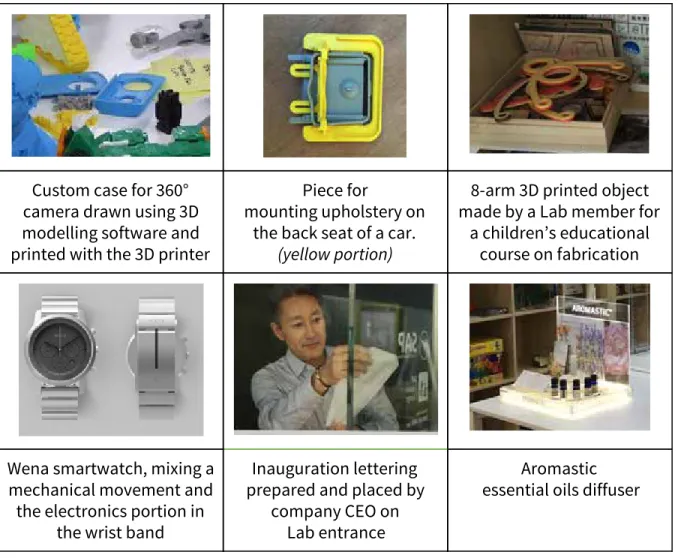
Some objects crossed multiple boundaries, originating from the organization towards the Lab and then emerging and returning back to organizational functions to continue development and progress. These are some of the most sophisticated objects because their existence depends heavily upon a rich network of individuals and organizational functions, as displayed in Figure 8.
Figure 8: sample of round trip objects created using the Lab Custom case for 360° camera drawn using 3D modelling software and printed with the 3D printer Piece for mounting upholstery on the back seat of a car. (yellow portion) 8-arm 3D printed object made by a Lab member for a children’s educational course on fabrication Wena smartwatch, mixing a mechanical movement and the electronics portion in the wrist band Inauguration lettering prepared and placed by company CEO on Lab entrance Aromastic essential oils diffuser
Two primary types of use cases for round trip boundary crossing objects emerge: using the Lab to complement existing NPD processes, and using the Lab as a major component of the firm’s fuzzy front-end strategy.
Corporate Fab Labs are in some ways able to complement existing NPD processes, granting individuals the ability to test their designs and in some cases obtain alternative resources. This approach is identified in two of the four Labs studied, and includes the camera case and upholstery clip examples in Figure 8. In the case of the latter object, a company engineer identified that one half of the upholstery mounting mechanism frequently broke during assembly that he had designed a year prior. This individual recognized the source of the error had an idea for a more solid mechanism. However, despite repeated requests, his superiors would not adjust his workload to grant him the time needed to redraw the piece, claiming the relative gains would be marginal. Upon discovering the Lab, the engineer decided to find the time to draw up his new proposed mechanism and take the finished prototype made with a 3D printer to his boss. With the piece in hand, his boss was convinced and the new part was sent to production, resulting in several thousands of euros worth of savings. Such examples become more frequent as
individuals are aware of a Lab, learn its syntax and understand its semantics, and finally arrive with specific problems to resolve from their day-to-day workload.
In the case of one firm, the Lab opened up the company’s fuzzy front-end processes by using the Lab as an open entity for idea genesis, selection, opportunity identification and analysis (Koen, et al., 2001) under one roof. While it is not the exclusive channel used by the company for front-end development, it constitutes a significant portion of new ventures within the company. As one Lab observer noted: “This is not about turning any single startup idea like [Lab project name] into a gigantic business, but a gigantic business learning how to come up with lots of new, promising ideas.” This type of Lab functionality is arguably more complex to initiate than the prior configuration that simply supports existing NPD processes, as it involves creating new tools for idea selection and tight integration with other organizational functions.
Additional examples from our sample underlined two unique cases: creating a symbolic object and an external boundary object. The first case stems from the preparations that took place prior to the inauguration of one corporate Fab Lab. The company CEO, who was instrumental in the creation of this space, wanted to take the time to use some of the tools that would soon be available to all employees and create a tangible object that would communicate the importance of the Lab. He decided to create the vinyl lettering with the Lab name and operating hours that he would place on the windows just barely outside the Lab. This serves as a highly visible reminder that individuals should break down their own organizational barriers to come down to the Lab and create objects. The second case involves boundaries found outside the firm through a children’s educational outreach program. A company engineer wanted to share his passion for engineering with local youth, and decided to use the Fab Lab to create a kit that would interest school teachers around the area. After several months of testing the idea, it became a company sponsored program aimed at promoting educational studies in science and robotics. As boundary objects step out of their corporate surroundings and into a series of innovation-oriented communities, the object will progressively increase in complexity and integrate potentially innovative aspects.
Boundary crossing entities
While a core finding of this research is that objects created in Fab Labs are capable of crossing all three types of knowledge boundaries, our data indicates that the types of objects created in each Lab aren’t evenly distributed. While all Labs have the technical ability to create boundary objects in each direction, their milieu (Simondon, 2012) must also support the existence of such objects. In other words, the types of objects created can indicate the maturity and sophistication of each Lab. The following section explores the possibility of using objects as a gauge of Lab performance and the research perspectives opened by this view.
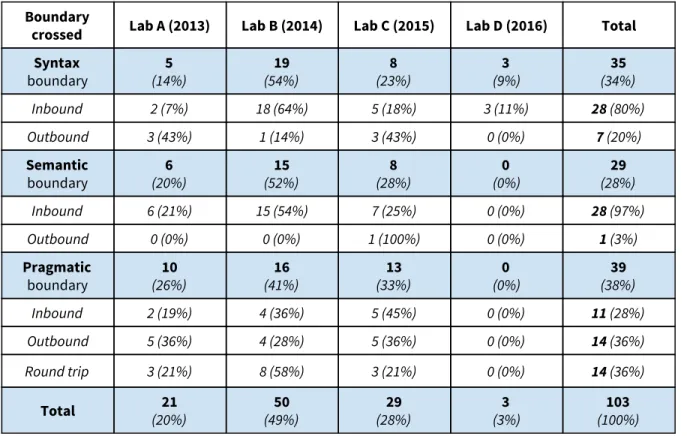
Multiple factors contribute to the maturity of a milieu , with time being a significant contributing factor to an organizational maturity and development life cycle in general (Mintzberg, 1984; Maier, Moultrie, & Clarkson, 2012). Time allows a Fab Lab manager to create deeper organizational ties; it can also create a sense of stability and resilience. However, it may not be the only factor in the relative maturity of each Lab. Table 3 resumes the distribution of boundary crossing objects on a per-Lab basis, including the year in which each Lab was inaugurated or first opened to employees.
Table 3 : distribution of boundary crossing objects per Lab
Boundary
crossed Lab A (2013) Lab B (2014) Lab C (2015) Lab D (2016) Total Syntax boundary (14%) 5 (54%) 19 (23%) 8 (9%) 3 (34%) 35 Inbound 2 (7%) 18 (64%) 5 (18%) 3 (11%) 28 (80%) Outbound 3 (43%) 1 (14%) 3 (43%) 0 (0%) 7 (20%) Semantic boundary (20%) 6 (52%) 15 (28%) 8 (0%) 0 (28%) 29 Inbound 6 (21%) 15 (54%) 7 (25%) 0 (0%) 28 (97%) Outbound 0 (0%) 0 (0%) 1 (100%) 0 (0%) 1 (3%) Pragmatic boundary (26%) 10 (41%) 16 (33%) 13 (0%) 0 (38%) 39 Inbound 2 (19%) 4 (36%) 5 (45%) 0 (0%) 11 (28%) Outbound 5 (36%) 4 (28%) 5 (36%) 0 (0%) 14 (36%) Round trip 3 (21%) 8 (58%) 3 (21%) 0 (0%) 14 (36%) Total (20%) 21 (49%) 50 (28%) 29 (3%) 3 (100%) 103
While the three principal labs studied created a roughly equal number of pragmatic boundary-crossing objects, the nature of those objects varied across each setting. Lab A, the oldest Lab studied, created a proportionally larger number of outbound objects, suggesting the ability of Lab members to create unique proposals and submit them to other organizational functions for selection and further development. Lab B produced a substantially greater number of round trip objects (58% of all round trip objects identified), primarily facilitated by the presence of a formal idea selection process that allows employees to come to the Lab with their own ideas and progressively transform those ideas into a new position within the company. Lab C demonstrated a relatively even distribution between all three pragmatic boundary types, including a recurring use of the Lab as an extension for tools that were otherwise unavailable at individual workstations. Lab D was inaugurated just a month prior to studies conducted at the end of this field-research phase of this study. Of the 12 objects identified in this Lab, only 3 were boundary crossing objects whereas the remaining 9 were “internal objects” intended for
use within the Lab. Secondary data obtained via follow-up conversations with and social media posts from members of Lab D indicate that their objects are able to cross all three organizational boundaries in all directions.
These results suggest that time alone is not sufficient to provoke increased sophistication, and that objects created in Fab Labs vary based on a Lab’s capacity to have increased ties and associations with other areas of the organization. In this sense, the Fab Lab as an entity may be considered an organizational boundary object that permanently crosses multiple boundaries. This interpretation resonates with existing descriptions of Fab Labs in literature (Gershenfeld, 2005; Mikhak, et al. 2002) as a “third place” that sits on the edge of traditional entities. Based on this view, the objects produced in each Lab could be used as an indicator of the Lab’s own capacity to cross syntax, semantic, and pragmatic boundaries. As it matures, it can be used more effectively to solve problems, interact with, and evolve to support other organizational functions. The notion of an organizational entity as a boundary object is not yet explored in present literature (Carlile, 2012).
Managerial implications & research perspectives
In addition to the theoretical and empirical construct used to analyze objects created in Fab Labs, this paper also contributes a rudimentary tool for managers of corporate Fab Labs to objectively evaluate and position their Fab Labs. This evaluation, which considers the complexity of boundaries crossed, underlines the individual contributions of each object created in the Lab.
This type of evaluation can be useful both inside the Lab and across the organizational boundaries. Within the Lab, it can guide efforts used to promote the creation of specific types of objects, such as training sessions that encourage individuals to bring their professional projects into a Lab to resolve problems with the help of a vibrant community. Across other organizational functions, these evaluations can help decision makers identify the types of contributions Labs make to NPD activities, including front-end innovation activities.
While these contributions are immediately applicable in practice, one limit to the methods used in this research is the absence of alternative types boundary “objects”. Examples of these include creativity methods, training programs, and events created in and around corporate Fab Labs that are difficult to identify through photo analysis. Complementary qualitative data collection and analysis could help refine and better describe the boundary-crossing capabilities created through corporate Fab Labs.
References
Ben Mahmoud-Jouini, S., Midler, C., Cruz, V., & Gaudron, N. 2014. How Physical Artefacts Contribute to Design Processes? Academy of Management Proceedings, 2014(1): 14113–14113.
Billah, K. Y., & Scanlan, R. H. 1998. Resonance, Tacoma Narrows bridge failure, and undergraduate physics textbooks. American Journal of Physics, 59(2): 118–124.
Bogers, M., & Horst, W. 2013. Collaborative Prototyping: Cross-Fertilization of Knowledge in Prototype-Driven Problem Solving. Journal of Product Innovation Management, 31(4): 744–764.
Carlile, P. R. 2002. A pragmatic view of knowledge boundaries: Boundary objects in new product development, (4): 558–568.
Damanpour, F. 1991. Organizational Innovation: A Meta-Analysis Of Effects Of Determinants and Moderators, 34(3): 555–590.
Fredericks, E. 2005. Cross-functional involvement in new product development. Qualitative Market
Research: an International Journal, 8(3): 327–341.
Fuller, M. 2017. Fitting squares into round holes: enabling innovation, creativity, and entrepreneurship through corporate Fab Labs. Presented at the st International Conference on Engineering Design, Vancouver, BC.
Gershenfeld, N. A. 2005. Fab: the coming revolution on your desktop—from personal computers to personal fabrication. New York: Basic Books.
Hatchuel, A., & Weil, B. 2003. A New Approach of Innovative Design: an Introduction to C-K Theory. DS 31:
Proceedings of ICED 03, the 14th International Conference on Engineering Design, Stockholm.
Hippel, Von, E. A. 1976. The dominant role of users in the scientific instrument innovation process. Research
Policy, 5(3): 212–239.
Karagozoglu, N., & Brown, W. B. 1993. Time-Based Management of the New Product Development Process.
Journal of Product Innovation Management, 10(3): 204–215.
Katz, R., & Tushman, M. 1981. An investigation into the managerial roles and career paths of gatekeepers and project supervisors in a major R & D facility. R&D Management, 11(3): 103–110.
Khurana, A., & Rosenthal, S. R. 1998. Towards Holistic “Front Ends” In New Product Development. Journal of
Product Innovation Management, 15(1): 57–74.
Koen, P., Ajamian, G., Burkart, R., & Clamen, A. 2001. Providing clarity and a common language to the “fuzzy front end.” Research • Technology Management http://doi.org/10.1080/urtm20.v044.i02
Le Masson, P., Weil, B., & Hatchuel, A. 2010. Strategic Management of Innovation and Design . Cambridge University Press.
Maier, A. M., Moultrie, J., & Clarkson, P. J. 2012. Assessing Organizational Capabilities: Reviewing and Guiding the Development of Maturity Grids. IEEE Transactions on …, 59(1): 138–159.
Mikhak, B., Lyon, C., Gorton, T., Gershenfeld, N., McEnnis, C., et al. 2002. Fab Lab: an alternate model of ICT
for development . Presented at the 2nd international conference on open collaborative design for
sustainable innovation.
Mintzberg, H. 1984. Power and Organization Life Cycles. Academy of Management Review, 9(2): 207–224. MIT Center for Bits & Atoms. 2007. The Fab Charter.
Mochon, D., Norton, M. I., & Ariely, D. 2012. Bolstering and restoring feelings of competence via the IKEA effect. International Journal of Research in Marketing, 29(4): 363–369.
Moreau, C. P., Bonney, L., & Herd, K. B. 2011. It's the Thought (and the Effort) That Counts: How Customizing for Others Differs from Customizing for Oneself. Journal of Marketing, 75(5): 120–133.
Nonaka, I. 1994. A Dynamic Theory of Organizational Knowledge Creation. Organization Science , 5(1): 14–37.
Patanakul, P., Chen, J., & Lynn, G. S. 2012. Autonomous Teams and New Product Development. Journal of
Product Innovation Management, 29(5): 734–750.
Reid, S. E., & de Brentani, U. 2004. The Fuzzy Front End of New Product Development for Discontinuous Innovations: A Theoretical Model. Journal of Product Innovation Management, 21(3): 170–184.
Santos, F. M., & Eisenhardt, K. M. 2005. Organizational Boundaries and Theories of Organization.
Organization Science, 16(5): 491–508.
Shannon, C. E. 1949. Communication in the Presence of Noise. Proceedings of the IRE, 37(1): 10–21. Simondon, G. 2012. Du mode d'existence des objets techniques. Editions Aubier.
Walter-Herrmann, W. H. 2013. FabLabs-a global social movement? FabLab: of Machines.
Wheelwright, S. C., & Clark, K. B. 1992. Revolutionizing Product Development. Simon and Schuster.
Wood, S. C., & Brown, G. S. 1998. Commercializing nascent technology: The case of laser diodes at Sony.