THÈSE DE DOCTORAT
de l’Université de recherche Paris Sciences et Lettres
PSL Research University
Préparée à l’Université Paris-Dauphine
COMPOSITION DU JURY :
Soutenue le
par
!cole Doctorale de Dauphine — ED 543
Spécialité
Dirigée par
Microfinance and Gender Issues:
Reducing or Reproducing Inequalities ?
Achievements and Challenges in the Tunisian Case
07.12.2017
Mathilde BAUWIN
Philippe DE VREYER
Université Paris Dauphine Philippe DE VREYER
nstitut de Recherche pour le Développement Isabelle GUERIN
Ariane SZAFARZ
Université Libre de Bruxelles
Catherine GUIRKINGER Université de Namur
Benoît RAPOPORT
Institut National d'Etudes Démographiques
Baptiste VENET
Université Paris Dauphine Sciences économiques Directeur de thèse Présidente du jury Rapporteure Rapporteure Membre du jury Membre du jury
L’Université Paris-Dauphine n'entend donner aucune approbation ni improbation aux opinions émises dans les thèses ; ces opinions doivent être considérées comme propres à leurs auteurs.
i
R
EMERCIEMENTS/
A
CKNOWLEDGEMENTSOn imagine souvent la thèse comme un temps de travail long et solitaire, passé à se poser beaucoup de questions pour ne répondre (partiellement) qu’à quelques-unes. C’est plutôt vrai. En revanche, on imagine aussi souvent le doctorant comme un être esseulé travaillant tantôt depuis chez lui tel un ermite, tantôt croulant sous les livres d’une bibliothèque déserte. Heureusement pour moi, cela n’a pas été mon cas : j’ai en effet bénéficié d’excellentes conditions d’accueil et de travail, que ce soit en Tunisie chez Enda ou en France à l’Ined, et du soutien d’encadrants et de collègues bienveillants et à l’écoute. Loin de moi, donc, la vie d’ermite ou de rat de bibliothèque…
En premier lieu, je tiens à remercier mon directeur, Philippe De Vreyer, qui fut le premier à me faire confiance pour la réalisation de cette thèse malgré une première année sans financement passée à l’étranger loin du monde universitaire. Philippe m’a laissé la liberté de mener mes recherches en autonomie et de travailler sur les thématiques de mon choix, tout en se montrant disponible et réactif lorsque j’en avais besoin. Nos discussions m’ont amenée à prendre du recul et de la hauteur sur les thèmes d’intérêt à creuser et les questions pertinentes à poser : merci de m’avoir permis de mettre mieux les choses en perspective.
Je remercie également particulièrement mon tuteur à l’Ined, Benoît Rapoport, tout d’abord d’avoir accepté de m’encadrer malgré ma thématique bien particulière, et ensuite pour sa patience, sa disponibilité et son expertise: Benoît s’est toujours montré très réactif et de très bon conseil lorsque j’avais des questions à poser, qui étaient bien souvent très précises et techniques, et m’a permis d’avancer rapidement lorsque mes conditions de travail n’étaient pas idéales, notamment en raison de contraintes de temps lors de déplacements en Tunisie. Merci pour les réponses rapides et tous les conseils économétriques et Stata, j’aurai beaucoup progressé grâce à cela !
Je souhaite aussi remercier Baptiste Venet, mon référent microfinance. Baptiste fut d’abord mon directeur de mémoire, et a continué à me conseiller (et à m’écouter) tout au long de la thèse. En tant que fin connaisseur du secteur, de son fonctionnement, de ses enjeux et de ses acteurs, Baptiste m’a apporté un précieux soutien pour les choix thématiques. C’était un plaisir de discuter microfinance, et un de mes regrets sera de ne pas avoir pu travailler sur un modèle théorique sous tes conseils. Il a fallu faire des choix étant donné le temps imparti, mais je ne manquerai pas de lire tes prochains travaux !
ii Plus généralement, merci à mes trois encadrants pour leur bienveillance, leur gentillesse, leur confiance, qui sont plus qu’appréciables pour une doctorante dans le doute.
D’autre part, je suis très reconnaissante à Catherine Guirkinger et Ariane Szafarz d’avoir accepté d’être rapporteures de cette thèse. Les remarques et conseils pertinents de Catherine lors de la pré-soutenance m’ont permis (j’espère) d’aller un peu plus loin, d’améliorer la présentation du cadre contextuel des différents articles, et de mettre en valeur mon expérience. Les travaux d’Ariane, quant à eux, ont été la source initiale d’inspiration pour la réalisation de cette thèse, et je remercie Ariane d’avoir pris le temps de répondre aux quelques questions que je lui ai posées lors de mes deux premières années de travail. Je suis ravie qu’Ariane puisse prendre connaissance aujourd’hui du résultat final.
Merci également à Isabelle Guérin d’avoir accepté de faire partie du jury : ses travaux ont également été une grande source d’inspiration et m’ont beaucoup apporté, que ce soit en termes de connaissances, de regard critique, de grilles de lecture à adopter, ou encore de références.
Merci aux personnes que j’aurai croisées lors de séminaires, conférences ou réunions et dont les remarques et conseils m’auront permis d’améliorer mon travail, je pense notamment à Carlo D’Ippoliti à Gênes, Pascale Petit et Yannick L’Horty à Aussois, Sylvie Lambert, François-Charles Wolff, Dominique Meurs à l’Ined, Sandrine Mesplé-Somps et Eric Bonsang à Dauphine. Merci à l’EAEPE d’avoir valorisé mon premier article avec un prix et m’avoir donné confiance pour la suite, et merci à Luca Giacopelli et Positive Planet de m’avoir offert l’opportunité de participer à la Semaine Africaine de la Microfinance à Dakar en 2015, qui aura été un moment déterminant pour la poursuite de ma thèse.
Merci à toute l’unité Démo-Eco de l’Ined pour les réunions et séminaires enrichissants, avec un merci particulier à la responsable d’unité Carole Bonnet, à Delphine Remillon pour ses conseils post-thèse, à Marion Leturcq pour ses conseils techniques, et à Bénédicte Driard pour la gestion de la logistique !
Et pour ce qui est du monde universitaire, le dernier merci revient à Denis Anne, professeur de sciences sociales en classe préparatoire, qui aura changé mon regard sur le monde avec ses cours passionnés d’économie et sociologie, et qui est sans doute quelque part à l’origine de tout cela.
J’aurais peut-être dû commencer par-là : cette thèse n’aurait jamais vu le jour sans Enda inter-arabe et ceux qui y travaillent ! Avant tout, merci à Essma Ben Hamida et Michael Cracknell de m’avoir fait confiance au départ et d’avoir accepté que je vienne réaliser un premier stage avant de m’offrir
iii l’opportunité de rester une année de plus en tant que chargée d’études. Grâce à cela, j’ai pu être immergée dans le quotidien d’une institution de microfinance renommée et de grande envergure, côtoyer toutes les personnes contribuant à cette aventure quelle que soit leur fonction, et m’imprégner petit à petit de la culture tunisienne, de travail ou non, et des problématiques socio-économiques rencontrées par les bénéficiaires auxquelles l’organisation tente de répondre. Cette plongée dans la Tunisie (en particulier dans le Tunis) de tous les jours aura définitivement été une expérience humaine déterminante pour bien davantage que cette thèse.
Chez Enda, je remercie en particulier Walid Jbili, collègue et coauteur de certains articles, sans qui je n’aurai pas pu réaliser tous ces travaux ; Walid a en particulier défendu mes idées d’études face aux décisionnaires et m’a permis d’aller jusqu’au bout de ce que je voulais accomplir. Son expertise statistique m’aura fait progresser et nos grilles de lecture complémentaires nous auront permis d’aboutir à des résultats qui me semblent pertinents. Je remercie également Bahija, Hannen et Khereddine pour leur confiance et toutes les informations données sur leur domaines de spécialité respectifs; merci aux collègues du marketing, Mehdi, Yassine, Bilel, pour avoir répondu à mes nombreuses questions, et surtout merci Aymen pour ta bonne humeur quotidienne, ta disponibilité et ta gentillesse.
Les autres personnes chez Enda sans qui tout cela n’aurait pu être accompli sont bien sûr les membres du service informatique : avant tout, un immense merci à Lassâad Ben Hadj qui m’a fourni toutes les bases de données nécessaires et a été d’une grande patience pour répondre à toutes mes requêtes, et merci à Grand Tarek, Petit Tarek, Walid Rouissi et Ramzi pour leur soutien technique et tous les ordinateurs qu’ils ont dû préparer pour moi !
Merci à Bilel et Fathi du service formation pour leur patience et la transmission de leurs connaissances, et merci à Lassâad Bousbiaa, Hajer, Anissa et Ines pour leur bonne humeur au quotidien et leur confiance !
Bien sûr, cette expérience en Tunisie, et par conséquent de la thèse, n’aurait pas été la même sans les personnes qui ont partagé mon quotidien en dehors d’Enda, qui m’ont apporté joie, chaleur, rires, écoute, partage d’expériences, soutien dans les moments difficiles, et avec qui on aura vécu week-ends, plages, canoë, randos sous le soleil, randos sous la pluie, randos de 15 - non 25 - km, couscous, kafteji, lablebi, raclettes, carbo, tartes au citron, charlottes, glaces, suées au sport, cours de tunisien, problèmes de voiture, problèmes de papiers, problèmes de douane, problèmes d’avion, problèmes tout court, Bella Celtia, etc… Alors Aïchek barcha barcha barcha à Anaïs, Aline, Alex, Imed, Ricardo d’avoir fait de la Soukra puis des villas de la Marsa le meilleur chez moi possible en Tunisie, et d’être devenus la familia tounsia ! Aïchek Germain, Giulia, Aurore, Özlem, Florence,
iv Shane, Tommaso, Rached, Charlotte, Audrey, Chiara d’avoir participé et égayé toutes ces aventures, merci à tous ceux que j’aurai croisés et qui auront fait qu’il y a désormais un avant et un après Tunisie !
Merci aux doctorants qui ont partagé mon quotidien à partir de la deuxième année et m’auront aidée à mieux supporter le choc du retour Tunis-Paris… En particulier à l’Ined, je remercie Louise Caron, avec qui on aura pu discuter économétrie, Stata, monde de la recherche, et avec qui on aura partagé expérience des premiers cours donnés, angoisse de l’après-thèse, doutes, mais aussi raclettes et mauvaises planches. Un merci particulier à Sandrine Juin qui s’est montrée très disponible, ouverte et à l’écoute dès le début et m’a aidée, entre autres choses, à me dépêtrer des méandres de Stata ! Merci aux personnes du bureau 519, Amélie, Marie, Jenny, Anika et Linh, pour leur ouverture d’esprit, leur bonne humeur et leur amour des chats, qui auront fait de ce bureau féminin, international et vert un super espace de travail, efficace et détendu ! Merci aussi à Morgan, Matthias, et Benjamin pour leur bonne humeur et merci à tous les autres doctorants avec qui j’aurai eu l’occasion de partager repas et séminaires, et discuter thèse et cantine ! A Dauphine, même si j’aurai été peu présente, merci à Marine pour tous ses conseils et son partage d’expérience, merci à Raphaël, Zied, Leslie, Virginie, Homero, Sandra pour les discussions données, thèse, pré-soutenance, post-thèse, etc., et merci aux autres doctorants avec qui on aura partagé séminaires, (AG et) pots.
Enfin, merci aux proches d’avoir été là, de s’être intéressé, et de ne pas avoir trop demandé « mais pourquoi tout ça ?? ». Merci à Marine d’avoir subi l’expérience thèse de sa coloc au quotidien, un gros merci à Ariane d’avoir posé beaucoup de questions sur mon travail et de m’avoir poussée à en faire de même, merci à Julie, Pauline, Marianne et Mélanie d’être venues partager un peu de vie en Tunisie, merci à Sarah et Tamara pour leur intérêt et leurs encouragements, et surtout merci à Yazid de m’avoir attendue, soutenue, supportée, et de m’avoir donné l’envie d’aller au bout pour avancer. A vous tous, merci pour les moments détente, folie, et bons vivants, et de me rappeler au quotidien ce qui compte !
v
T
ABLE OF CONTENTSREMERCIEMENTS /ACKNOWLEDGEMENTS ... I LIST OF TABLES ... VIII LIST OF FIGURES ... XI
GENERAL INTRODUCTION ... 1
I. The microfinance model today: same objectives, new stakes ... 2
II. Microfinance in the “gender and development” approach ... 6
III. Research questions and field of application ... 9
IV. Context ... 12
1. The potential of microfinance in MENA and Tunisia ... 12
2. Women in Tunisia ... 14
3. Enda inter-arabe... 15
V. Carrying out this research work ... 17
VI. Outline ... 20
CHAPTER 1:DEFEATING THE PURPOSE: TARGETING VERSUS FAVORING WOMEN IN MICROFINANCE ... 25
I. Introduction ... 26
II. Literature review on the gender perspective in microfinance ... 27
III. Data ... 29
1. Data source ... 29
2. Data description ... 32
2.1 Loan-quantity and loan-size rationing ...32
2.2 Socio-demographic profile of new applicants ...34
2.3 Project characteristics ...38
2.4 Denied versus successful applications ...40
2.5 Additional characteristics of successful applicants’ projects ...41
2.6 Risk aversion ...43
2.7 Credit officers ...44
IV. Models and results ... 46
1. Requests: do women have different risk preferences? ... 46
2. Access to credit: is there a gender bias in selection? ... 54
3. Loan size: do men and women receive fair credit amounts? ... 59
3.1 Base model ...59
3.2 A glass ceiling effect? ...67
3.3 A gender bias among officers? ...69
3.4 Robustness checks ...71
V. Discussion ... 72
1. Loan-size rationing and statistical discrimination ... 72
2. Heterogeneity of results across countries ... 75
VI. Conclusion ... 76
APPENDIXI.A:THE HECKMAN SELECTION MODEL ... 78
APPENDIXI.B:DEALING WITH THE ENDOGENEITY ISSUE ... 83
vi
CHAPTER 2: GENDER REPRESENTATIONS IN MICROFINANCE: AN EXPERIMENTAL
STUDY ... 89
I. Introduction ... 90
II. Literature review on discrimination and experimental economics ... 91
III. Experimental Design ... 94
1. Definition ... 94 2. Objective ... 95 3. Conception ... 98 4. Implementation ... 103 IV. Data ... 103 1. Loan officers... 103
2. Requests and amounts granted ... 105
V. Empirical method and main results ... 109
1. All cases considering all risk factors ... 109
2. Distinguishing between agricultural and non-agricultural cases using a risk score ... 113
VI. Discussion ... 120
VII. Conclusion ... 124
APPENDIX II.A: Output of the SAS procedure to conceive the D-OPtimal Design ... 126
APPENDIX II.B: Fictitious cases (Translation from French) ... 127
CHAPTER 3: GOOD PAYERS, SMALL BORROWERS: ARE WOMEN BETTER CLIENTS FOR A MICROFINANCE INSTITUTION ? ... 137
I. Introduction ... 138
II. Client retention, repayment behavior and gender in practice and in literature ... 139
1. Gender and financial performance ... 139
2. Client retention ... 141
3. Repayment behavior ... 144
III. Data ... 145
1. Data preparation and management ... 145
2. Descriptive statistics ... 146
2.1 Clients’ socio-demographic profiles ... 146
2.2 Activity sector ... 146
2.3 Loan amounts ... 147
2.4 First risk factor for MFIs: dropouts ... 148
2.5 Second risk factor for MFIs: clients’ repayment behavior ... 152
IV. Method and results ... 155
1. To stay or not to stay: the probability of renewing a loan ... 155
2. Dropping out, but not any way: the various types of exit ... 162
3. Who are the bad payers? The determinants of late repayment ... 167
V. Discussion ... 172
vii
CHAPTER 4:RELATIONSHIP LENDING: DO WOMEN BENEFIT AS MUCH AS MEN ? ... 175
I. Introduction ... 176
II. Progressive lending in practice and in the literature ... 178
1. Progressive lending in microfinance ... 178
2. Progressive lending in the literature ... 179
III. Data ... 181
1. Data preparation and management ... 181
2. Descriptive statistics ... 181
2.1 Evolution of clients’ projects ... 181
2.2 Evolution of clients’ financial situations ... 187
2.3 Loan amounts over credit cycles ... 190
IV. Methods and results ... 193
1. The amounts granted after the first credit cycle ... 194
2. The evolution of amounts from a credit cycle to the next one ... 201
3. The evolution of amounts from the first credit cycle ... 208
V. Discussion of initial hypotheses ... 213
VI. Conclusion ... 215
CHAPTER 5: PROMOTING GENDER-FAIR PRACTICES IN MICROFINANCE: DOES TRAINING WORK? ... 217
I. Introduction ... 218
II. Literature review on change in social and gender norms ... 220
III. Context and objectives of the training ... 222
IV. Data ... 224
V. Evaluation technique and results ... 230
1. The parallel-trend assumption ... 230
2. The main effects of the training ... 233
3. The effects over time ... 244
4. Spill-over effects ... 246
VI. Discussion ... 250
VII. Conclusion ... 253
Appendix IV.A: Training Program ... 255
Appendix IV.B: Parallel trend between treated and controls from treated branches only ... 256
GENERAL CONCLUSION ... 257
RÉSUMÉ ... 263
viii
L
IST OFT
ABLESTable 1. Socio-demographic characteristics of male and female new applicants ... 35
Table 2. Socio-demographic characteristics of men and women in Tunisia ... 36
Table 3. Project characteristics of new applicants ... 39
Table 4. Repartition of employed population aged 15 ... 40
Table 5. Differences between denied and successful applications ... 41
Table 6. Additional characteristics of successful applicants’ projects... 42
Table 7. Requests and loan size by gender ... 43
Table 8. Specialization of officers by gender ... 45
Table 9. Estimation of amounts requested for all requests (OLS) ... 49
Table 10. Estimation of amounts requested for successful applications (OLS) ... 53
Table 11. Probability of being selected (marginal effects from a probit model) ... 57
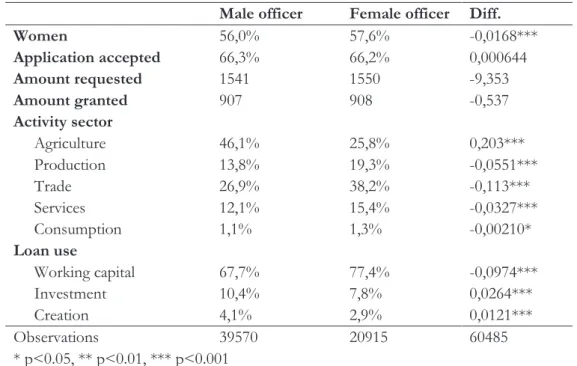
Table 12. Probability of being selected with interactions (marginal effects from a probit model) 58 Table 13. Estimation of loan size for non-agricultural credits (OLS) ... 64
Table 14. Estimation of loan size for agricultural credits (OLS) ... 65
Table 15. Gender bias in loan size according to region ... 66
Table 16. Gender bias in loan size according to amounts requested ... 67
Table 17. Gender bias in loan size according to project size ... 67
Table 18. The effect of officer gender ... 70
Table 19. Model A1 : Estimation of loan size with Heckman selection correction (All credits) ... 80
Table 20. Model A2a : Estimation of loan size with Heckman selection correction (non-agri) ... 81
Table 21. Model A2b : Estimation of loan size with Heckman selection correction (agri) ... 82
Table 22. Estimation of loan size by 2SLS and tests of the instrument ... 84
Table 23. Estimation of loan size, selection and request for non-agricultural credits ... 86
Table 24. Estimation of loan size, selection and request for agricultural credits ... 87
Table 25. Differences between applicants with low and high requests ... 88
Table 26. Criteria used to create fictitious cases ... 99
Table 27: Socio-economic information about male and female new applicants and clients in 2014 ... 101
Table 28. Repartition of sampled loan officers by region and gender ... 104
Table 29. Experience, post-bac studies and age among loan officers in the MFI and in the sample ... 104
Table 30. Differences between amounts granted for first loans by officers in the sample and the others ... 105
ix
Table 31. Amounts granted to non-agricultural cases ... 106
Table 32. Amounts granted to agricultural cases ... 106
Table 33. Proportions of ratios of 100% ... 107
Table 34. Ratios between amounts requested and granted by case ... 108
Table 35. Estimation of amounts granted to all cases ... 111
Table 36. Risk score by case ... 114
Table 37. Estimation of amounts using risk scores (FE model) ... 115
Table 38. Estimation of amounts granted to non-agricultural cases ... 118
Table 39. Estimation of amounts granted to agricultural cases ... 119
Table 40. Activity sector by gender (in%) ... 147
Table 41. Repartition of clients by the number of credit cycles over the period ... 148
Table 42. Average number of days overdue by client status and account status ... 154
Table 43. Probability of renewing a loan at the end of a cycle (marginal effects) ... 157
Table 44. Relative probabilities of the different types of exits, compared to renewal ... 164
Table 45. Estimation of the number of days overdue (pooled OLS) ... 171
Table 46. Activity sector by gender (in%) ... 182
Table 47. Financial product by gender (in %) ... 183
Table 48. Transitions from a financial product to another (men) ... 184
Table 49. Transitions from a financial product to another (women) ... 184
Table 50. Transitions between informal and formal sectors over credit cycles by gender ... 185
Table 51. Activity location at first credit cycle by gender ... 185
Table 52. Transitions of location over credit cycles (men) ... 185
Table 53. Transitions of location over credit cycles (women) ... 185
Table 54. Transitions between agricultural project size over credit cycles by gender ... 186
Table 55. Type of collateral by gender (in %) ... 188
Table 56. Median financial indicators by gender, all credit cycles combined ... 188
Table 57. Average loan amount by credit cycle and by gender ... 191
Table 58. Estimation of amounts granted from cycle 2 (all loans) ... 196
Table 59. Estimation of amounts granted from cycle 2 (non-agri. and agri.loans separately) ... 199
Table 60. Growth rate of loan amount from one credit cycle to another (in ratio) ... 205
Table 61. Growth rate of loan amount from the first credit cycle (in ratio) ... 210
Table 62. Distribution of participants to the training sessions ... 225
Table 63. Number of officers by date and group ... 226
x Table 65. Parallel trend assumption between treated and controls in not-treated branches ... 231 Table 66. Parallel trend assumption between treated and all controls ... 232 Table 67. Estimation of the treatment effect on the average amount granted to women (FE) ... 235 Table 68. Estimation of the treatment effect on the average amount granted to women (FE with controls) ... 236 Table 69. Estimation of the treatment effect on the average amount granted to women’s first loans (FE)... 237 Table 70. Estimation of the treatment effect on the average first amount requested by women (FE) ... 238 Table 71. Estimation of the treatment effect on the average ratio granted/requested amount for women (FE) ... 238 Table 72. Estimation of the treatment effect on the share of women in portfolio (FE) ... 238 Table 73. Estimation of the treatment effect on the average amount granted to men (FE with controls) ... 241 Table 74. Estimation of the treatment effect on the average granted amount to men’s first loans (FE)... 242 Table 75. Estimation of the treatment effect on the average first requested amount by men (FE) ... 242 Table 76. Estimation of the treatment effect on the average ratio granted/requested amount for men (FE) ... 243 Table 77. Treatment effects over time ... 245 Table 78. Overall evaluation grade of the training given by officers, ... 245 Table 79. Spill-over effects on control officers in treated branches: average amount granted to women ... 247 Table 80. Spill-over effects on control officers in treated branches: ... 247 Table 81. Spill-over effects on control officers in treated branches: average amount requested by women ... 248 Table 82. Spill-over effects on control officers in treated branches: ... 248 Table 83. Spill-over effects on control officers in treated branches: share of women in portfolio ... 249 Table 84. Parallel trend assumption between treated and controls in treated branches ... 256
xi
L
IST OFF
IGURESFigure 1. Evolution of the share of female borrowers ... 4
Figure 2. Repartition of the financial inclusion sector by type of provider in 2014 ... 5
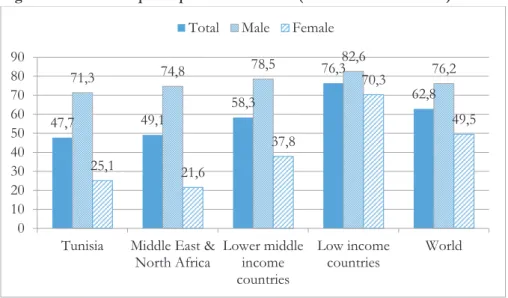
Figure 3. Labor force participation rate in 2016 (modeled ILO estimate)... 13
Figure 4. Proportions of women among new requests, successful new requests and clients in 2014 ... 33
Figure 5. Repartition of branches by rate of rural areas ... 38
Figure 6. Average loan size according to request and gender ... 44
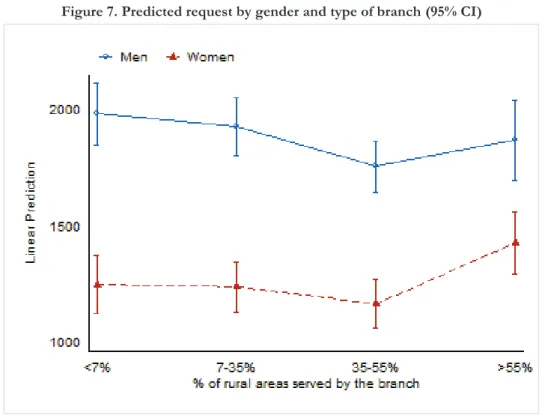
Figure 7. Predicted request by gender and type of branch (95% CI) ... 50
Figure 8. Amounts requested by gender and by region (descriptive statistics) ... 50
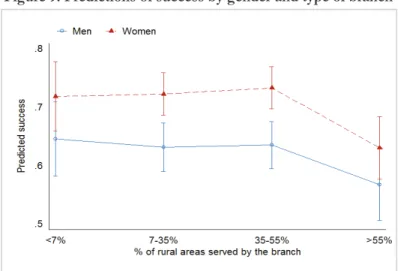
Figure 9. Predictions of success by gender and type of branch ... 56
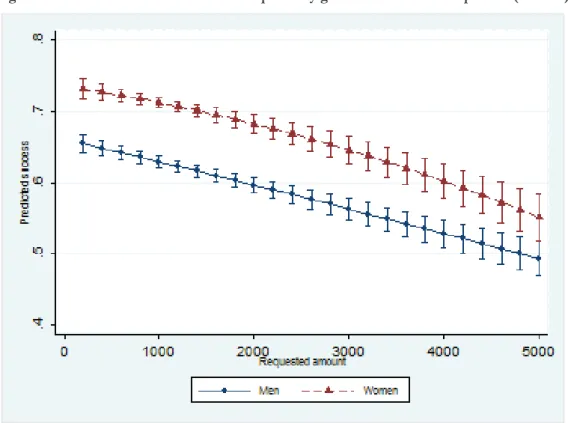
Figure 10. Predictions of success for all requests by gender and amount requested (95% CI) ... 59
Figure 11. Predictions of loan size by gender and region (95% CI) ... 66
Figure 12. Predictions of loan size for non-agricultural credits ... 68
Figure 13. Predictions of loan size for agricultural credits ... 69
Figure 14. Ratios between amounts requested and granted ... 107
Figure 15. Average loan amounts and interest rates over credit cycles, by gender ... 148
Figure 16: Proportion of dropouts according to the number of days overdue by loan ... 151
Figure 17. Type of exit by sex (in %) ... 152
Figure 18. Late repayment by sex (in %) ... 152
Figure 19. Number of days overdue by credit cycle and by sex ... 153
Figure 20. Average cost, revenue and profit by client, by gender ... 173
Figure 21. Project size according to activity and gender ... 186
Figure 22. Evolution of financial indicators, in value and ratio (medians) ... 189
Figure 23. Average amounts granted over credit cycles by gender ... 191
Figure 24. Evolution of loan amounts from one credit cycle to another by gender ... 192
Figure 25. Evolution of loan amounts over credit cycles by gender ... 192
Figure 26. Predictions of amounts granted from cycle 2... 200
Figure 27. Predictions of growth rates of loan amounts from a cycle to another (in ratio) ... 207
Figure 28. Predictions of growth rates of loan amounts from the first credit cycle (in ratio) ... 212
1
2
I.
T
HE MICROFINANCE MODEL TODAY:
SAME OBJECTIVES,
NEWSTAKES
In 2006, the Nobel Peace Prize was awarded to Muhammad Yunus, the founder of the Grameen Bank in Bangladesh: this event reminded the huge hopes and expectations aroused by microfinance, which had been considered for a long time as a cure for poverty. It also consecrated the Grameen Bank as the embodiment of the microfinance model, based on ambitious objectives on the one hand, and on specific means to fulfil them on the other hand. The core idea is that access to credit, or financial inclusion in more recent versions of the model, “would support entrepreneurship and economic development, empower women, and alleviate poverty by generating higher incomes and employment” (Ledgerwood, Earne, Nelson, & World Bank, 2013, p. 6). Such a project has to be carried out by specific organizations that are commonly called microfinance institutions (hereinafter MFIs): the emblematic MFI has a non-governmental organization status and targets vulnerable people excluded from the traditional banking system because of their lack of resources and collateral. Because women have been particularly poor, vulnerable and excluded from financial services on the one hand (Narayan-Parker, 2002), but tend to show better repayment rates than men on the other hand, they have become the exclusive targets of the pioneering MFIs such as the Grameen Bank, as well as Pro Mujer and BancoSol in Bolivia. Whether the original justifications were social or financial, middle-age women running income generating activities have quickly embodied the typical targets of MFIs. In accordance with the original main principle of microfinance, such vulnerable clients are supposed to be granted microcredits without any individual guarantee being required; to make it work, MFIs rely on group lending instead: a credit is granted to a group of borrowers, whose members are responsible for making the other members repay.
Indeed, as any credit organization, microfinance institutions face information asymmetries which can take the form of adverse selection (hidden information ex-ante leads MFIs to select riskier borrowers) or moral hazard (hidden action by the borrower ex-post results in default), as theoretically developed by Stiglitz & Weiss (1981). Even though such information asymmetries may be hard to identify and disentangle in practice (Karlan & Zinman, 2009), they may lead to inefficiency, and solutions to circumvent the problem must be found. Whereas traditional banks use individual collateral as an incentive for borrowers to repay to avoid moral hazard, the typical model of microfinance uses the threat of social sanctions (Bond & Rai, 2002) and group pressure: in lending groups, joint-liability may be a way to reduce adverse selection and moral hazard issues (Ghatak, 1999), since social capital and social norms play the role of traditional loan officers, and
3 hence reduce screening, monitoring and enforcement costs for lenders (Karlan, 2007). However, these costs remain substantial because of low loan amounts, which leads MFIs to charge higher interest rates than traditional banks; an additional difference is that these rates are fixed by by-product, and do not differ according to individual clients, contrary to the traditional banking system.
Nonetheless, today, the Grameen Bank does not represent the typical microfinance institution any longer, as microfinance has become much more complex and diverse: first, MFIs have started to move from group lending to individual lending, possibly because of the too time-consuming weekly repayment meetings and too strong social pressure involved by joint-liability (Attanasio, Augsburg, De Haas, Fitzsimons, & Harmgart, 2015). Thus, even the emblematic MFIs started to grant individual credits, such as ASA in Bangladesh, BancoSol in Bolivia, or even Grameen Bank II which has been created in this respect. As a consequence, collateral has come back as a main incentive to repay.
Additionally, if women represent 84% of MFIs’ clients in 2015, this average number hides huge disparities worldwide: women are almost the exclusive target of MFIs in South Asia (92%), and East Asia and the Pacific (94%), but it is not the case everywhere, as the share is of 66% in Africa as well as in Latin America and the Caribbean, 60% in Middle East and North Africa (MENA), and 46% in Eastern Europe and Central Asia (Khamar, 2017). These numbers show that the high global average is pulled up by South and East Asia, which represents a substantial share of the market; however, the microfinance model in South Asia seems specific to the region, and is not representative of microfinance in the world. Elsewhere, women remain a priority target (except in Eastern Europe and Central Asia) but obviously not the exclusive one.
Furthermore, if the share of female borrowers has been constantly increasing since MFIs report to the MIX Market1, so has the number of MFIs reporting to the MIX (figure 1); as a
consequence, it remains difficult to know whether the evolution in reported numbers corresponds to an actual evolution in the field or is due to the annual changes in the sample of reporting MFIs. Additionally, the first MIX report dates back to 19982; before this date, the global average share of
female borrowers remains unknown.
1 The MIX Market is a non-profit organization based in the United States collecting information from MFIs worldwide
to provide key insight on the financial inclusion sector. MFIs are free to decide to report to the MIX Market. However, MIX is one of the main information sources for professionals, policy makers, and investors in the microfinance sector, and MFIs do have a real interest to report their information to MIX
4 Figure 1. Evolution of the share of female borrowers
and number of MFIs reporting to the MIX Market since 1998
Note: all data come from annual reports by the MIX Market, the first one available dating back to 1998. The data from 2002 and 2008 are missing (only median values were reported in annual benchmarks).
With regard to legal status, the NGO status is far from being the only one among the organizations providing financial inclusion services. The MIX Market distinguishes between five different statuses: non-bank financial institutions (NBFIs) are the more numerous, since they represent 37% of financial service providers in 2014 (figure 2); they are private but licensed under a different category from banks and usually submitted to another legislation; NGOs come in second position (30,5%), followed by credit unions or cooperatives (18%), banks (10,6%) and rural banks3 (1,4%). However, banks come in third position in terms of number of active borrowers,
and even in first position in terms of gross portfolio. This reflects the different targeting policies of the various types of providers, with NGOs probably targeting poorer clients and banks less vulnerable clients able to repay higher amounts.
3 Rural banks are banking institutions that target clients who live and work in non-urban areas and who are generally
involved in agricultural-related activities.
64,6 64,6 60,5 62,4 60,2 66,3 65,1 66,5 66,4 63,3 64,3 73 78,7 81 81 84 45 1033 0 200 400 600 800 1000 1200 1400 1600 0 10 20 30 40 50 60 70 80 90 100 Nu mb er o f MFI s Shar e of fe ma le b or ro w er s
5 Figure 2. Repartition of the financial inclusion sector by type of provider in 2014
Source: author’s calculations using data from the 2014 MIX Market report by Khamar (2016).
Finally, since NGOs represent a decreasing part of financial service providers, also because some of them turned into private companies after a few years, the funding system of MFIs has also changed: whereas NGOs were mainly funded with government subsidies, non-bank financial institutions rather follow a commercial approach and work under the financial system principles, so do banks. Such commercialization led to the booming of interest rates within some MFIs, which has been particularly illustrated by the Compartamos Banco scandal, a Mexican MFI charging its clients with 100% interest rates while generating returns on equity of 53%4. The financial pressure
endured by MFIs also pushed some of them to apply aggressive credit selling and/or recovery policies, sometimes resulting in over-indebtedness crises such as the highly publicized one which broke out in 2010 in Andhra Pradesh and ended up in a wave of suicides. These salient cases gave insight into the possible bad consequences of commercialization, which led observers and scholars to wonder about the possible “mission drift” of microfinance for the 2000s (Christen, 2001; Dichter, Harper, & Practical Action (Organization), 2007; Mersland & Strøm, 2010; Rhyne, 1998). They also highlighted the need for more rigorous impact analyses, in order to go beyond the ideological debate (Mersland & Strøm, 2010).
As a consequence, the last two decades were marked by an increasing number of impact studies: a recent review of peer journal articles on microfinance impacts, sustainability and outreach counted more than 300 articles on this topic between 1997 and 2011, half of which being strictly identified as “impact studies” (M. Rahman, Luo, Hafeez, & Sun, 2015). The review concludes that
4 In 2014, average return on equity of the MFIs reporting to the MIX Market was 14,1% (Khamar, 2017).
37,0% 43,0% 29,8% 30,5% 27,5% 10,3% 10,6% 26,7% 51,0% 18,0% 1,7% 8,2% 1,4% 0,9% 0,6% 0% 10% 20% 30% 40% 50% 60% 70% 80% 90% 100%
Share among all providers Share of active borrowers Share of gross loan portfolio NBFI NGO Bank Credit union Rural Bank
6 results of these impact studies are still mixed: some works find positive effects of microfinance (Dunford, 2001; Morduch, 1999; Nawaz, 2010) whereas others find no impact or negative ones (Kondo, Orbeta, Dingcong, & Infantado, 2009; Simanowitz, 2000; Weiss & Montgomery, 2005). These mixed results contributed to the disillusionment with regard to microfinance, leading sometimes to clear skepticism as voiced by Bateman with his book entitled Why doesn’t microfinance
work? (Bateman, 2010).
Therefore, the media coverage of these impact studies has rather given a negative slant to their results, implying that microfinance fails to fulfil its initial objectives. Even though some researchers complained about the oversimplifications and inaccurate negative interpretations of their works that can be found in the press (O’Dell, 2010), the diversity of results does tend to show that the potential positive effects of microfinance are not automatic. This may be due at least partly to the fact that microfinance is a collection of different tools, implemented by diverse types of organizations, in a multiplicity of different contexts where various rules and regulations are enforced.
For this reason, the question “does microfinance work?” does not make much sense and should rather be reformulated this way: “what are the conditions under which microfinance better works?” If one rather wants to understand the absence of positive outcomes or even the existence of negatives ones, an alternative perspective could be: “what hinders microfinance from fulfilling its objectives?” This research work takes this perspective, by focusing on one specific objective of microfinance, which is the reduction of gender inequalities.
II.
M
ICROFINANCE IN THE“
GENDER AND DEVELOPMENT”
APPROACHOne of the main aims of microfinance is indeed to contribute to women’s empowerment. However, the first issue arising is that there is no clear and consensual conception of the notion of “empowerment”. According to the World Bank’s book Empowerment and Poverty Reduction: a
Sourcebook, the poor lack power, and a way to fight against poverty would be to give them back
some power (Narayan-Parker, 2002). Hence, “empowerment is the expansion of assets and capabilities of poor people to participate in, negotiate with, influence, control, and hold accountable institutions that affect their lives” (Narayan-Parker, 2002, p. vi). If there is no real debate about the objectives, there is no clear-cut view of how to fulfil them (Guérin, Palier, & Prévost, 2009). In particular, a well-known typology developed by Csaszar (2005) distinguishes between four categories making up empowerment: “power with”, “power to”, “power within”, and “power
7 over”. The fourth category reflects a conflictual dimension of empowerment, since it implies to include some people in decisional processes from which they were previously excluded. In other words, if the social and economic dimensions of empowerment are usually not discussed, the political one implies a change in power relationships, which may be more conflictual and hence less consensual. Since all dimensions of empowerment are linked, achieving empowerment may finally create more conflicts (Woolcock, 2005).
With regard to women’s empowerment, the same issues apply but require referring first to the notion of “gender”. Ann Oakley is often considered as the one who introduced this notion into social sciences; in her book Sex, Gender and Society (Oakley, 1972), she states that sex roles and identities are linked to social stereotypes and family models, and are therefore for a major part produced by culture. To that extent, gender is different from sex, sex being considered as biological and gender as social, cultural and psychological. Social stereotypes relative to gender are descriptive and prescriptive, meaning that they refer to how men and women are but also to how they are expected to be (Heilman, Wallen, Fuchs, & Tamkins, 2004) or what they are expected to “do” (West & Zimmerman, 1987). These gender stereotypes would be assimilated by women as well, transmitted from a generation to another and would contribute to maintain and reproduce inequalities between men and women, such as sexual division of labor or sex segregation in employment, as also found by some economists (Becker, 1993; Farré & Vella, 2013; Fernández, Fogli, & Olivetti, 2004).
The consideration of these gender issues are at the core of the “Gender and Development” approach developed by Moser (1993), which has inspired the agenda of international institutions about gender issues over the last two decades. Indeed, a “Gender Empowerment Measure” was introduced in the United Nations Development Program (UNDP) in 1995; in 1994, the World Bank published a policy paper on Gender and Development, focusing on the institutional constraints maintaining disparities between genders; it then adopted in 2007 a Gender Action Plan for three years, followed by the “Three Year Road Map for Gender Mainstreaming” for 2010-2013, and finally published a report entitled “World Development Report 2012: Gender Equality and Development” in 2012. Finally, the promotion of gender equality and women’s empowerment was set as the third Millennium Development Goal in 2000, and as the fifth Sustainable Development Goal in 2015. All these initiatives illustrate the growing interest of international institutions into the role of women in economic development and fight against poverty: the idea is that more investment in women and gender equality would result in higher returns of investment in development. However, to be fully able to play this role, women have to be empowered. For this reason, the promotion of gender equality and women’s empowerment became a priority objective.
8 Microfinance is one of the development tools expected to contribute to women’s empowerment: by giving more economic power to women, the latter should also gain in autonomy, responsibility and decision power, and possibly make their whole households and especially their children benefit from these gains. Thus, women’s economic empowerment is one of the main objectives of microfinance also because it is supposed to be a main channel of development. Nonetheless, just as for the other objectives such as poverty reduction, the impact studies about microfinance show that the effects on women are mixed. Guérin (2009) even quotes several studies ending up in negative results: after benefiting from microcredits, women’s specialization in low-productivity sectors may be strengthened (Fernando, 2004); the additional activity may result in heavier responsibilities, workload and more fatigue for women (Ackerly, 1995); domestic violence and patriarchal domination by loan officers may be worsened (A. Rahman, 1999); women’s enterprises may be misappropriated once they become profitable (Grasmuck & Espinal, 2000); inequalities between women may be worsened as well (Guérin & Palier, 2005; Mayoux, 2001).
Because of these mixed results on women’s empowerment, attention has also been paid in the literature to the mechanisms hampering the emergence of more positive effects: for instance, basing on the Indian case, Guérin (2009) mentions the fact that financial products are not always adapted to the local demand, that the structural organization of markets is not favorable to small entrepreneurs, and that consequently financial services should be completed with non-financial services to strengthen clients’ entrepreneurial capacities and provide them with the necessary resources. With regard to women’s specific issues, Kabeer (1997) reminds that if microfinance may lead to more financial autonomy for women and therefore may give them more leeway, it does so within a social framework which does evolve very slowly. This social framework consists of social and gender norms regulating men’s and women’s actions and behaviors in a specific society, on which microfinance can have little impact only. This would account for the little impact of microfinance on women’s empowerment and the possible negative externalities. In the same way, Mayoux (2000) claims that microfinance mainly focuses on the economic dimension of empowerment, as if it was supposed to drag the other aspects along with it, whereas neglecting the political dimension leads to forgetting that giving more economic power to women may shake other power relationships and result in conflicts, backlash and resistance. In other words, microfinance would miss the structural causes of gender inequalities, and consequently fails to fulfil its objectives.
9
III. R
ESEARCH QUESTIONS AND FIELD OF APPLICATIONThis research work is in keeping with this part of literature: instead of critically analyzing microfinance impacts, it focuses on the mechanisms supposed to foster or possibly preventing MFIs from fulfilling their objectives in terms of women’s economic empowerment. Whereas the examples of mechanisms previously mentioned rather concern the external context in which microfinance is implemented, this work focuses on MFIs’ procedures and their possible contribution to the reduction of gender inequalities. More precisely, it analyses to what extent the way MFIs treat women in the microcredit allocation process helps reducing existing inequalities between male and female applicants and clients. To do so, while these pre-existing inequalities have to be examined, loan officers are at the core of the analysis.
Indeed, as already stated, the microfinance model today does not make women the exclusive target of MFIs: men represent an increasing share of MFIs’ clients. Many poor men are also excluded from the traditional financial system, and it seems relevant to include them in microfinance programs as well. However, as acknowledged by the Gender and Development approach, women still face specific issues, especially in developing countries where they do not always have the same rights as men; consequently, the way MFIs deal with this complex reality deserves attention. Including men could result in positive externalities, by fostering exchanges between male and female clients within MFIs and thus contributing to make gender relationships and representations evolve; but if MFIs do not take into account the specific problematics faced by women, they could also miss their initial target.
Therefore, the first point of interest in this research work is the identification of the initial differences between male and female applicants and clients. This includes their socio-demographic profiles and economic resources as well as project characteristics when they request their first loans, whether they get them or not. These differences may represent existing inequalities between men and women in the society under study, as well as the targeting policies of MFIs, to the extent that MFIs may choose to target different profiles of potential male and female clients. This also includes the differences in terms of project evolutions, which can be revealed by the evolution of specific operational and financial indicators observed from a credit cycle to another, such as the value of assets, monthly benefit, number of employees, etc. Finally, a last determining difference to take into account, if existing, concerns clients’ behavior towards MFIs, in terms of repayment, default and renewal. Indeed, if male and female clients do not behave the same way as clients, MFIs may treat them differently in return.
10 All these differences taken into account, the second point of interest is the way male and female clients are treated in the microcredit allocation process. This means focusing on the selection process when applicants request their first loans, which is supposed to give insight into how MFIs deal with the issue of access to credit. Indeed, one of the main aims of MFIs is to facilitate access to credit to those who are excluded from the traditional banking system. Since women are supposed to be particularly excluded from banks because of their lack of resources, MFIs are supposed to especially foster women’s access to credit. One of the objectives of this research work is to analyze to what extent MFIs facilitate women’s access to credit, and the possible differences of treatment between male and female applicants in the selection process.
However, access to credit is only a first step. It is also necessary to examine the loan conditions granted to male and female clients once their requests were accepted. A specificity of microfinance is that interest rates are fixed by by-product, which means that at equal by-product, MFIs cannot grant credits with different rates. For this reason, the conditions examined in this research work are loan amounts only. A third objective of this research work is therefore to examine the amounts granted to male and female clients, to check if at equal characteristics, male and female clients are treated at least equally. Indeed, equality of treatment between men and women appears as the minimum expected result from MFIs targeting both male and female clients. Because the asymmetry of information between loan officers and clients is not of the same nature and magnitude when applicants request their first loans and when they renew them, it seems necessary to distinguish between the amounts granted for first loans and those granted for renewals. Indeed, in the second case, loan officers know their clients better than in the first one, and project evolution has to be taken into account.
Finally, a last point of interest is gender representations; indeed, since other above-mentioned studies have already pointed out that representations of men’s and women’s roles in society could limit the positive effects of microfinance on women’s empowerment, one of the hypotheses in this work is that representations of male and female clients are also likely to influence loan officers’ behaviors. In particular, the idea that female clients face specific difficulties may have negative effects by confining them in such an image instead of fostering their empowerment. The objective is to examine to what extent MFIs and especially loan officers’ work may be affected by gender representations, and how MFIs may deal with this issue. An attempt to make loan officers’ gender representations evolve and to raise awareness on gender issues is analyzed in terms of impact on their work.
11 Obviously, these research questions are relevant only for a specific model of microfinance, all the more so as microfinance is today highly diverse in terms of providers, clients, products, funding models, etc. Therefore, these research questions particularly apply to MFIs which target both men and women; however, analyzing to what extent MFIs contribute to reduce gender inequalities and how gender representations may hamper the fulfillment of this objective requires focusing on MFIs which claim a policy in favor of women. Indeed, today some MFIs look more like traditional banks than organizations with specific development goals, and such MFIs do not necessarily aim at reducing gender inequalities in terms of access to financial services, possibly because such gender inequalities are not especially salient where they operate.
Moreover, microfinance has been particularly studied in some regions and countries, such as India, Bangladesh, Bolivia, Morocco, and so forth, and it seems more useful to focus on a new context, all the more so as the context is determining in the way MFIs work, whether in terms of law and regulation or of social, cultural and economic aspects. Consequently, this research work focuses on the MENA region: apart from Morocco, few countries have been subjected to studies on microfinance so far, probably because microfinance has not developed so much in the region as detailed in the next section; however, this is changing, with a growth rate of the region’s portfolio of 9,6% in 2015 (Convergences, 2017).
Additionally, in order to ensure some coherence in the research work, it focuses on a unique microfinance institution for all the analyses, with a sufficient size in terms of clients, portfolio and market share. This institution is Enda inter-arabe, the main Tunisian microfinance institution. Enda inter-arabe fulfils the research requirements since it targets men and women and has always claimed acting in favor of women. Furthermore, Tunisia was a relevant context to study for several reasons: first, the microfinance sector has boomed since the Revolution thanks to a high potential of development and recent regulatory changes as detailed below, and has not been much studied so far; second, the country is peculiar in that women’s rights and gender equalities are particularly well-protected by the law, especially concerning work. Yet, the labor force participation rate remains very low among women (25% in 2015) and has almost not increased for 20 years (23% in 1996)5. The origins of this paradox may lie at another level than public policies only, such as gender
norms and representations, which is one of the points of interest in this research work.
As a result, this research work does not pretend to apply to microfinance in general: such an aim would be vain and doomed to failure given the complexity and diversity of microfinance today. Instead of aiming at drawing general conclusions on microfinance, it rather intends to
12 identify some parameters and circumstances likely to facilitate or conversely hamper the fulfillment of microfinance objectives. This implies nonetheless that the results are supposed to be useful for other current and future professionals, regulators and researchers in their work, given their specific objectives and contexts. To that extent, it is rather in keeping with the practical and pragmatic perspective adopted in the recent literature than with the more ideological one of the previous decades.
IV. C
ONTEXT1. The potential of microfinance in MENA and Tunisia
The MENA region is the one where microfinance is the least developed in the world, with only 1,8% of adults getting a loan from an MFI6, 30 microfinance institutions reporting to the MIX
Market, and a total portfolio of 1,4 billion US dollars in 2016, against 8,7 for Sub-Saharan Africa or 9,3 for Eastern Europe and Central Asia (Convergences, 2017): the MENA region accounted for only 1,4% of the global portfolio and 1,8% of borrowers that year (Khamar, 2017). Yet, this region is characterized by high unemployment rates, especially among young people, and weak female labor force participation, hence the potential of development of microfinance should be significant, which may explain the very recent increase in the sector’s growth rate for the year 2015. It is also the region where financial inclusion makes the slowest progress: according to The Global Findex Database 2014 (World Bank Group, 2014), if 62% of adults reported having an account worldwide (against 51% in 2011), this average rate hides huge disparities across geographical areas, including across developing regions. Thus, account penetration reaches 69% in East Asia in 2014, but the rate is only of 18% in the MENA region (13% for women).
Tunisia stands at a lower middle position in the MENA region in terms of account penetration, with a rate of 27%7 in 2014, against 50% in Algeria, 47% in Lebanon, 33% in Morocco
(2011), 90% in Israel, and above 65% in all Gulf countries, but only 14% in Egypt, 24% in West Bank and Gaza, and 6% in Yemen (World Bank Group, 2014). These numbers show that even within the MENA region, there are high disparities across countries in terms of financial inclusion. It is also worth noticing that Tunisia is less advanced than its North African neighbors on this point. Regarding the gender gap in account penetration, it remained stable between 2011 and 2014
6 Data from Sanabel network, the microfinance network of the MENA region.
7 A study on financial inclusion achieved by ADA found slightly higher numbers for Tunisia, with 34% of adults having
13 in developing countries, with a gap of 9 percentage points between men and women, but is even higher in Tunisia, with 20,7%8 of women having an account in 2014 against 34,2% of men. People
living in rural areas are also less likely to hold an account (22,4%) than the average as well as young people under 25 (18,8%).
Currently, Tunisia is also facing economic difficulties especially in terms of employment. The labor force participation rate as defined by ILO (i.e. including the informal sector) was 47,7%9
in 2016, but hides a significant gender gap, with rates of 71,3% for men and 25,1% for women. This gender gap is higher in Tunisia than in lower middle income countries, which Tunisia belongs to, but slightly smaller than the average in the MENA region (figure 3). Besides, the total unemployment rate at the same period was 15,6% but higher for women (23,5% against 12,4% for men).
Figure 3. Labor force participation rate in 2016 (modeled ILO estimate)
Source: World Bank data portal
As a consequence, the development potential of the microfinance sector is huge in Tunisia, since microfinance targets vulnerable people excluded from the official banking sector but also from the formal job market, which is especially the case of women and young people in the country.
Therefore, after the Jasmine Revolution in 2011, Tunisian authorities have undergone deep regulatory changes, aiming to foster microfinance development. Indeed, before 2011, microfinance activities were led by two types of organizations: the NGO Enda inter-arabe on the one hand, and the “associations of microcredit” (AMC) on the other hand, funded by a public bank, the Tunisian Bank of Solidarity (BTS), which were offering subsidized microcredit at a very low cost. Some of
8 ADA found 25% of women having a bank account (ADA, 2014).
9 Numbers from National Institute of Statistics, Tunisia, and from the World Bank Data Portal for other countries or
regions. 47,7 49,1 58,3 76,3 62,8 71,3 74,8 78,5 82,6 76,2 25,1 21,6 37,8 70,3 49,5 0 10 20 30 40 50 60 70 80 90
Tunisia Middle East & North Africa Lower middle income countries Low income countries World
14 them interrupted their activity after the Revolution, in particular because of financial unsustainability and organizational issues. New regulations weredesigned in 2011 and implemented in 2013, the new law especially allowing private companies to operate and deliver microcredits. As a result, new actors have entered the sector since 2014 and several international organizations have started their activities. This has deeply transformed the microfinance landscape in the country, all the more so as the law has also enforced a specific credit ceiling for private companies, which is 20 000 Tunisian Dinars (TND), whereas the ceiling for NGOs was and still is 5 000 TND.
2. Women in Tunisia
The numbers concerning the position of Tunisian women in the economic sphere are all the more surprising as Tunisia has enforced a progressive legislation regarding women’s rights: the Code of Personal Status established in 1956 abolished polygamy and repudiation, allowed women to ask for divorce, set a minimum age and imposed mutual consent for marriage. In 1957, women got the right to vote; after the Independence in 1962, they also got the right to work, move and open a bank account without their husbands’ permission. In 1965, abortion was legalized, and in 1968, the country ratified ILO convention number 100, which instituted equality of treatment in employment of men and women for work of equal value.
Furthermore, over the last decades, huge progress has been made in girls’ education, so that in 2013, the progression to secondary school was higher for girls (93,2%) than for boys (88,7%)10, and the share of women among students aged between 19 and 24 enrolled in higher
education was of 55,6% in 201411.
However, Tunisian legislation has not immediately gone all the way with gender equality: in 1980, the Tunisian government signed the Convention on the Elimination of all Forms of Discrimination Against Women (CEDAW)12 “with reservations”. These reservations were
officially withdrawn in April 2014 only. In the same way, the Code of Personal Status still makes discrimination against women legal at some levels, especially within family: first, inheritance law remains unequal, as Tunisian daughters are still denied an equal share of inheritance with brothers, and sometimes with other male family members; then, although a woman may be granted custody of her children, the father still remains the legal guardian. The recent controversy about gender in the Constitution has also highlighted the ambiguity around women’s role the Tunisian society is
10 Source: World Bank data portal.
11 Source: Tunisian National Institute of Statistics.
15 ready to acknowledge: in the draft Constitution dating from 2012, article 28 entitled “Women’s rights” asserted that women’s roles in the family were “complementary” to that of men. This sparked huge protests from the Tunisian civil society, and the final version of the Constitution dating from 2014 eventually guarantees gender equality with article 21:
“All citizens, male and female, have equal rights and duties, and are equal
before the law without any discrimination”13.
Revising laws to ensure their complying with the Constitution still remains to be done. Therefore, despite this progressive legislation, including concerning work, which makes Tunisia so special in the region, law does not guarantee perfect equality between men and women yet. Such ambiguity at the legal level might maintain or encourage equivalent ambiguity in other social strata, which may hamper deeper women’s economic empowerment in the country.
The question is whether this is also the case in microfinance.
3.
Enda inter-arabe
Enda inter-arabe (hereinafter Enda) was created in 1990 in Tunis by its current executive director and general secretary14 as an NGO working in favor of environmental protection and
socio-professional integration of vulnerable people from disadvantaged urban areas. Enda started offering microcredit services in 1995 and decided in 2000 to entirely commit to supporting micro-entrepreneurs, mainly through financial but also non-financial services (such as collective trainings, individual coaching, etc.). Whereas collecting deposits was and is still not legally authorized for non-banking institutions in Tunisia, Enda managed to become financially autonomous in 2003, as its operating revenues covered its expenses. Since then, it has kept growing steadily, until reaching cumulative numbers of 600 000 clients served between 1995 and 2015, which represents 2 008 300 credits granted for a total of 1 952 millions TND (~ USD 803 millions)15. Enda is thus active on
the whole Tunisian territory, with 79 branches spread over the 24 governorates16 and in more than
200 delegations out of 264 in 2016.
13 Article retrieved from http://www.legislation.tn/sites/default/files/news/constitution-b-a-t.pdf, accessed on
24/05/2017.
14 Enda i-a’s general secretary became the president of Enda tamweel’s board of directors in 2016. Enda tamweel is
Enda i-a’s private subsidiary created the same year.
15 Enda inter-arabe (2016), Annual Report 2015.
16 If Enda started its activities in urban areas, today it covers rural areas as well, with 42% of its clients living in a rural area in late 2015. Enda serves clients working in all activity sectors: trade, handicraft, food production, breeding, agriculture, and so forth. There is no exact symmetry between rural areas and agriculture, since many clients lead projects in other sectors in rural areas while some others lead agricultural projects in urban areas, especially breeding. To meet the needs of this wide variety of clients, Enda offers different financial products: for instance, some of them were specifically conceived for agricultural projects, with irregular instalment schedules, grace periods, and prime rates, supposed to be adequate for seasonal activities. The interest rates do not vary by client but depend on by-product characteristics; as usually in the microfinance sector, they are higher for products corresponding to lower amounts and smaller for products enabling to grant greater amounts. Thus, Enda serves very diverse clients from the whole Tunisia, ensuring some representativeness of potential clients of microfinance.
According to the activity report of 2015, in December 2015, Enda was serving 271 000 active clients (+10% since 2014) and had disbursed 278 300 loans (+5%). Its portfolio-at-risk at 30 days was of 1,07% in 2015, which is very low compared to the global average in the sector (3,7% in 201417), and the default rate was of 0,68%, which is also very low, even though default rates are
usually inferior to 2% in microfinance. These good numbers are in keeping with the various awards and global recognitions the Tunisian MFI got over the last years, for both its financial and social performances: indeed, Enda received a Transparency Certificate with the highest mark by the MIX Market and Sanabel Network in 2009; it was recognized as the second best MFI in the world in terms of social performances in 2015 by Planet Rating, and was the first MFI in the MENA region to get the Smart Campaign Certification, which acknowledges commitment to client protection, in 2015 as well.
From 2000 until 2014, Enda was the main microfinance institution in Tunisia, as it held the greatest market share despite the existence of AMCs. Since 2014 though, thanks to the new regulation, four foreign private companies acting in the microfinance sector worldwide as well as one Tunisian Islamic microfinance institution have launched their activities in the country, and Enda has had to face actual competition for the first time in its history. Even though this competition remained marginal in 2015 as the other MFIs took time to organize, its effects could quickly emerge. As the law sets different credit limits for not-for-profit organizations and private companies, Enda decided to create a subsidiary under private status, in order to be able to meet its clients’ needs. The processing was effective at the beginning of 2016, and the organization split
17 into two distinct structures: Enda tamweelis now the private company delivering financial services whereas Enda inter-arabe still exists as an NGO and is responsible for non-financial services.
Since the very beginning, Enda has always made a point of supporting vulnerable people and especially women, and its targeting policy towards women has always been made clear. Nevertheless, in order to avoid some negative effects such as the use of women by male members of the household to get access to credit, Enda changed its policy in 2008 and chose to give priority only to women instead of exclusivity18. For at least this reason, the number of women among clients
has regularly decreased over the last years, since 80,4% of clients were women in 2007 against only 65% in 2015. Given the transformation of Enda into a private company in 2016, which allows the MFI to grant higher amounts, the share of men could keep increasing until becoming the majority, since men usually request higher amounts.
Consequently, some questions started being raised about internal objectives: although there was still a quantified target of 65% of women among clients in 2015, the relevance of maintaining this objective has been discussed since then. In particular, given the currently increasing social and economic difficulties in Tunisia, Enda decided to extend its priority targets to youth and rural people in addition to women, in order to consider all kinds of vulnerable people. Nonetheless, so far, women have remained a priority target, and fostering women’s empowerment is still one of the main official objectives. In order to feed thoughts on that question, Enda started to develop its research activities, some of them aiming at examining gender issues.
V.
C
ARRYING OUT THIS RESEARCH WORKIn the meanwhile, in early 2014, I had decided to work on microfinance in Tunisia for my Master thesis, especially because I was interested in this development tool on the one hand and in the MENA region on the other hand, and because the development of microfinance in Tunisia at that time was making this country an exciting field research. I first got in touch with the international organizations with French headquarters which had started investing in Tunisia to launch their activity there, given the new regulation. I had decided to work with the professionals in the field to get original data, first to be as close as possible to actors, clients and context, and second because there was no other data anyway. I chose the French actors thinking it would be easier to convince them to cooperate. Despite interesting discussions on possible collaborations with two of them, our respective schedules were not matching, as in 2014, these organizations did