1
Effort or Circumstances:
Which one matters in health inequality?
FlorenceJUSOTa,SandyTUBEUFb,AlainTRANNOYc
April 2010
a
[email protected] – LEDa-LEGOS (Université Paris-Dauphine) and IRDES (Institut de Recherche et de Documentation en Economie de la Santé), Paris, France.
b [email protected] –Institute of Health Sciences (University of Leeds), Leeds, United Kingdom. c
[email protected] – EHESS (Ecole des Hautes Etudes en Sciences Sociales) and GREQAM-IDEP (Institut d‟Economie Publique), Marseille, France.
Abstract
This paper attempts to quantify the contribution of inequalities of opportunities and inequalities due to differences in effort to be in good health to overall health inequality in France. It examines three alternative specifications of legitimate and illegitimate inequalities drawing on Roemer, Barry and Swift‟s considerations of circumstances and effort. The issue at stake is how to treat the correlation between circumstances and effort. Using a representative French health survey undertaken in 2006 and partly designed for this purpose, and the natural decomposition of the variance, the contribution of circumstances to inequalities in health ranges between 44.5% and up to 46.4% according to the scenario, whereas the contribution of efforts is not beyond 10%. The remaining part is due to the impact of age and sex.
Keywords: equality of opportunity; inequality decomposition; health; effort; circumstances; variance, France Codes JEL: D63; I12.
Acknowledgements
We gratefully acknowledge the financial support of the Risk Foundation (Health, Risk and Insurance Chair, AGF). This paper is part of the research program “Inégalités sociales de santé”, supported by DREES-MiRe, Inserm, DGS, InVS, INCa and CANAM. Part of this work was carried out while Sandy Tubeuf was visiting the LEDa-LEGOS at Université Paris-Dauphine in 2009. We are very grateful to Damien Bricard for his research assistance and to Christopher McCabe for his comments and suggestions on a previous version of that paper. We thank Paul Contoyannis, Brigitte Dormont, Marc Fleurbaey, Michel Grignon, Christine Le Clainche, John Roemer, Erik Schokkaert, and all participants to the IRDES seminar on inequalities in health and health care (Paris, France), to the 2009 Health, inequalities, risk and public policy workshop (CERSES, Paris, France), to the 2009 CHEPA Health Equity workshop (McMaster University, Hamilton, Canada), to the Joint Economics-HEDS seminar (University of Sheffield, UK), to PSE Health Economics Seminar (Paris, France) and to the Health Economics Seminar Series of Erasmus University (Rotterdam, The Netherlands) for their helpful comments.
1. Introduction
Recent developments in the philosophical literature regarding fairness and social justice identify some types of inequality as more objectionable than others. A number of authors (Dworkin 1981; Arneson 1989; Cohen 1989; Roemer 1998; Fleurbaey 2008) have argued that the most obvious justification for making a distinction between “legitimate” and “illegitimate” differences in outcomes
2
is that the former differences can be attributed to factors for which the individual is responsible, whilst the latter differences can be attributed to factors which the individual is not responsible. Following Roemer‟s framework (1998), the determinants of any outcome can be separated into two components: “circumstances”, which are exogenous to the person, such as family background, and “effort”, which can be influenced by the person. This divide may be illustrated by recent debates in the United Kingdom about whether smokers and alcoholics should be candidates for lung and liver transplants. The issue at stake was whether such patients should be considered to have caused their own illness and therefore denied access to transplants (Webb and Neuberger 2004; Bramstedt and Jabbour 2006). The debate was triggered by George Best‟s controversial liver transplant1
. In the Guardian on the 5th of October 20052, Professor Nigel Heaton, who heads the liver unit at King's College hospital in London and carried out the former Manchester United footballer's operation in 2002, said "livers are in short supply and the waiting list has grown over the past two to three years. If you knew someone was going to be recidivist you wouldn't take them on for a transplant. The problem is there's just no way of spotting who those people are". The shortage of liver donors increases pressure on surgeons to pick patients who are likely to benefit most from transplant operations and so, many hospitals within the National Health Service have incorporated a six month alcohol abstinence criterion before organs are transplanted, called the “six month rule” in an effort to select optimal candidates. The rule has two purposes: allowing the liver to recover in the absence of alcohol and observation of the patient to verify that he remains alcohol free with the hope of reducing the risk of relapse after transplantations. It is likely that another motivation is that the acute shortage of organs, requires a fair allocation criterion, and maintenance of an unhealthy lifestyle can be considered as a voluntary choice carrying with it individual responsibility. This rule illustrates the respect of the “principle of natural reward”, i.e. the respect of the impact of effort variables on individual outcome in the health sphere, while the “principle of compensation”, which proposes to compensate individuals for inequalities linked to circumstances characteristics would be exemplified by the full coverage of the cost of the transplantation.
Despite the growing interest of policymakers as well as economists in equality of opportunity in health (see for instance Sen 2002; Phillips 2006; Fleurbaey 2006; Dias and Jones 2007; Fleurbaey and Schokkaert 2009) empirical applications remain scarce (Dias 2009; Jusot et al. 2009; Trannoy et al. 2009; Dias 2010). The main reason is that implementation of equal-opportunity policies requires the identification of the contribution of circumstances and effort to observed inequality. This paper proposes a tentative answer to this question by quantifying inequality of opportunity in health inequality in France using a survey from 2006 (Allonier et al. 2008).
1
The soccer legend George Best was given a liver transplant in 2002 after battling with alcoholism for all his adult life. After receiving his liver transplant, he was seen out drinking more than once. He had been warned repeatedly that drinking would kill him, even after his transplant. He died three years later.
2
Alcohol abusers should not get transplants, says Best surgeon, Ian Sample, science correspondent, The Guardian, Wednesday 5 October 2005.
3
Effort is particularly difficult to specify, as it is hard to observe and measure. However, it can be argued that efforts which are done to invest in health capital are easier to observe than efforts in other fields, such as human capital. Lifestyles, such as doing exercise, having a balanced diet, sleeping well, not smoking or not drinking too much, are widely accepted as examples of effort in relation to health, representing individual choices. On this basis, health appears to be a good candidate for an empirical exercise to quantify inequalities of opportunities, that is, inequalities of outcomes that are explained by circumstances not by effort.
Although the description of effort is likely to be less opened to criticism in the health field than in other fields, the precise definitions of the effort to be rewarded and of the circumstances to be compensated for is an open debate in the philosophical literature, mainly because these two determinants cannot be assumed to be independent.
The challenge in defining effort is illustrated by the debate between Roemer and Barry, considering the case of an Asian student. Roemer observes that “Asian children generally work hard in school and thereby do well because parents press them to do so. The familial pressure is clearly an aspect of their environment outside their control.” (Roemer 1998, p.22). According to Roemer, an equal-opportunity policy must respect the individual effort in an approach where “we could somehow disembody individuals from their circumstances” (Roemer 1998, p. 15). As a consequence, the extra effort of the Asian student must not be rewarded because it is determined by a characteristic outside his control. Barry responds that nevertheless, “the fact that their generally high levels of effort were due to familial pressure does not make their having expended high levels of effort less admirable and less deserving than it would have been absent such pressure” (transcription of Barry‟s position according to Roemer 1998, p.21). From this point of view, which is the mainstream view in the literature on incentives, the extra effort of the Asian student should be entirely rewarded and the lack of familial pressure on other types of students should not be compensated.
This debate can easily be transposed in the field of health. For instance, is it legitimate to hold the sons of smokers who smoke, less responsible than the sons of non-smokers who smoke? For Barry, this distinction is irrelevant. For Roemer the part of smoking which can be attributed to family background is a circumstance and not an effort.
A second issue arises because of the impossibility of respecting the principles of compensation and natural reward for all generations. If we consider that family pressure to educate children is a parental effort, the definition of circumstances to be compensated is less obvious. The transmission of values through parental effort may result in what is seen as effort exerted by the next generation. For instance, eating vegetable and fruits when you were a child makes you more prone to adopt such a diet as an adult. If you give precedence to the young generation in the application of the principle of compensation, then you should consider that the whole initial background represents circumstances, including parental effort despite the link with children‟s effort. Conversely, if you give precedence to
4
the past generation in the application of the principle of natural reward, then that parental effort must be respected whatever its consequences to the next generation. This latter position corresponds to Swift‟s viewpoint (Swift 2005; Sorensen 2006; Brighouse and Swift 2009) which argues that “To the extent that the reproduction of inequality across generations occurs through the transmission of cultural traits, it does so substantially (though not exclusively) through intimate familial interactions that we have reason to value and protect. Preventing those interactions would violate the autonomy of the family in a way that stopping parents spending their money on, or bequeathing money to their kids would not.” (Swift 2005, p. 271). In effect, from Swift‟s point of view, the family is an association and in Rawls‟ justice theory, the „basic liberties‟ – among them freedom of association – have lexical priority over fair equality of opportunity and the principle of difference (Rawls 1999).
This leads to three possible divides between circumstances and effort. In what we call Barry‟s view, circumstances are past variables and efforts are the variables which reflect the free will of the present generation. In Roemer‟s view, the vector of circumstances includes all past variables and the descendant‟s effort must be cleaned from any contamination coming from circumstances. In Swift‟s view, the vector of circumstances only includes past variables which have no consequences on children effort. In other terms the vector of circumstances must be cleaned from any correlation with child‟s effort3
.
The goal of this paper is not to discuss the ethical relevance of these views and even less to choose among them. Our purpose is to assess if, empirically, it matters which view is adopted in the measurement of inequalities of opportunity in health. We can observe a priori that Roemer‟s view minimises the magnitude of legitimate inequality in health, whereas Swift‟s view minimises the magnitude of illegitimate inequality. Our question is to what extent it makes a difference in our appraisal of the respective contribution of circumstances and effort in overall inequality. We propose a simple method to measure the contribution of circumstances and effort of inequalities in health for each view and provide an empirical evaluation in France, based on a representative health survey in 2006. This method relies on the decomposition of variance which has a nice interpretation in the context of equality of opportunity.
The following section describes the methodology. Section 3 describes the data and in particular, the additional questionnaire which we designed to obtain a comprehensive description of effort in health and the circumstances that impact upon health. Section 4 presents the analysis results as well as several robustness checks supporting our findings. A discussion and concluding remarks form the final section.
3 An asymmetric version may be more palatable for those who find this recipe too extreme. Swift‟s view will
only apply to parents who had exerted a better or higher effort than the average parents. Having “bad parents” will continue to appear as a circumstance. Descendants who are enough unlucky to have bad parents will be compensated but descendants coming from “good parents” will not be penalised by the redistribution system.
5
2. Method
The method we propose consists of two steps. In the first step, we rely on a reduced model to estimate the association between health status and respectively circumstances and effort. In the second step we measure the magnitude of inequalities in health and the respective contributions of circumstances and effort.
2.1 Estimation strategy
Let us assume that individual health status H is a function of a vector of circumstances C, a vector of effort variables E, age and sex captured by the vector of demographic variables D and an error term u: ) , , , (C E D u f H (Eq. 1)
The vector of circumstances consists of a set of variables beyond individual control which may be related to health status. The health determinants literature suggests an influence of childhood conditions and family background on health status in adulthood (see for example Currie and Stabile 2003; Case et al. 2005; Dias 2009; Lindeboom et al. 2009; Trannoy et al. 2009). Therefore parental health status, parental lifestyles, parental education, parent‟s socioeconomic status, financial situation during childhood and place of birth are candidate circumstance variables in our analyses. The vector of effort variables capture individual decisions to invest in health capital, such as lifestyles (see for example Balia and Jones 2008; Contoyannis and Jones 2004; Dias 2009). Age and sex are included to capture biological determinants of health status and the error term denotes pure luck and others random factors. Of course, these biological determinants are circumstances in the very sense of the word. Nevertheless, we consider it is meaningful to distinguish their impact from the impact of usual circumstances.
In contrast to Fleurbaey and Schokkaert (2009) who focused on a structural model to distinguish the role played by circumstances from the role played by effort on health status, we are primarily interested in capturing correlations between health, effort and circumstances respectively. We are not aiming to understand the causal links existing between determinants. Therefore, we can consider a reduced model which is straightforward to estimate as there are only three possible groups of determinants of inequalities in health: circumstances, effort and demographic characteristics. Other outcomes variables such as individual‟s income, education level or socioeconomic status are not included among the regressors because they probably are endogenous variables and may be correlated with past health (see for example Adams et al. 2003 and Adda et al. 2003 for discussion on this issue). In addition, they are also partly determined by circumstances and it has been shown that the influence of circumstances on health status is mainly indirect through the influence on health status of education and socioeconomic status (Trannoy et al. 2009). At this stage, we are less interested in knowing the
6
pathways through which a factor has an impact on the health outcome. Nevertheless, since we are interested in the respective effects of C, E and D on H, the estimated coefficients will partially reflect the effects of these variables on income, education and SES.
In this framework, systematic differences in health explained by circumstances will be considered as inequalities of opportunities in health, whereas differences in health explained by effort will be recognised as legitimate. In addition, probably a lot of the health differences related to biological factors are recognised are inescapable at a certain point. Whether differences in health due to biological factors are legitimate or illegitimate are normative matters. We will not enter in this debate.
The analysis of equality of opportunities becomes more difficult when we recognise that circumstance and effort are not independent. For example, smoking initiation has been found to be related to mother‟s education, and parents‟ smoking behaviour (Dias 2009; Göhlmann et al. 2009; Power et al. 2005). Living with a lone mother during childhood seems to be also associated with greater risks of smoking among young adults (Francesconi et al. 2009). Alcohol consumption among young adult has also been related to father‟s alcohol consumption (Zhang et al. 1999) and alcoholism in adulthood is also more frequent among individuals who have known adverse childhood circumstances and whose parents were alcohol addicts (Anda et al. 2002). As regard to adult obesity, it is associated with economic conditions in childhood (Power et al. 2005) and to mother‟s obesity before pregnancy (Laitinen et al. 2001). Furthermore, the timing of maternal employment significantly affects the child‟s overweight status in later adulthood (von Hinke Kessler Scholder 2008). In France, tobacco smoking, alcohol consumption and regular exercise are more frequent among young adults from lower social origins (Etilé 2007) and obesity in adulthood has been found related to parents‟ socioeconomic status and episodes of financial hardships during childhood, in particular among women (Khlat et al. 2009).
Considering the interdependence between family background and health related behaviours, there are different views in literature with respect to what belongs to effort and circumstances and we will on focus on three of them which have been exposed in the introduction. We introduce hereafter the estimation framework to test empirically each of those views and highlight their different impacts on the measurement of inequalities of opportunities in health.
According to Barry, descendant‟s effort has to be fully respected whatever the influence of past circumstances on effort decisions. It allows regressing directly circumstances and efforts variables on health status to measure the correlation between health status and individual efforts in health capital investment on the one hand, and the correlation between health status and circumstances on the other. The health status HiB of individual i can then be written as follows in Barry‟s context:
i i B i B i B B i C E D u H
(Eq. 2)7
Equation (Eq. 2) allows us to test the condition of equality of opportunity in Barry‟s view by testing the equality of
ˆB to zero. Independence between Ci and Ei is not required.Roemer‟s definition of equality of opportunity requires the descendant‟s effort to be purged of any contamination coming from circumstances. This concept leads to estimate an auxiliary equation which regresses Ei, the effort of individual i, against Ci, the circumstances. It allows isolation of a
residual term ei, the relative effort, which represents individual effort purged from circumstances and
demographics:
i i i C e
E
(Eq. 3)We then substitute the vector of effort Ei for the estimated relative effort
eˆ
i in the equation ofhealth status. The health status HiR of individual i can be written in Roemer perspective‟s as follows:
i i R i R i R R i C e D u H
ˆ
(Eq. 4)Equation (Eq. 4) allows testing the condition of equality of opportunity in Roemer‟s view by testing the equality of
ˆR to zero, since Ci and ei are independent.From Swift‟s viewpoint, parents‟ own efforts have to be fully respected in the application of the principle of natural reward in order to encourage parents to transmit a value on effort to their children. In this perspective, the principle of compensation requires including in the vector of circumstances only past characteristics variables purged of their consequences for children effort. As a consequence, the vector of circumstances4 must be cleaned from any correlations with effort.
Therefore it is necessary to estimate an auxiliary equation which aims at isolating a residual term, which represents circumstances purged from descendant effort. We regress circumstances Ci
according to effort Ei as follows 5 : i i i E c C
(Eq. 5)We then substitute the vector of circumstances Ci for the estimated relative circumstances
cˆ
i inthe equation for health status. The health status HiS of individual i in Swift‟s framework can then be
decomposed as follows: i i S i S i S S i c E D u H
ˆ
(Eq. 6)4 As a matter of fact, a strict version of this principle should only require purging the educational parental effort
from its consequences on children destiny. However in many contexts, we will not dispose the full description of educational parental effort. Hence, to deal with this imperfection of information, it will be more acute to embrace the full set of circumstances and to clean them from descendant‟s effort.
5 We consider that controlling demographic variables in Swift‟s auxiliary equations is not ethically justified. For
instance, controlling gender could lead to justify different parental effort in the transmission of healthy lifestyles according to the sex of their child.
8
Equation (Eq. 6) allows us to test the condition of equality of opportunity in Swift‟s framework by testing the equality of
ˆ
S to zero, sincecˆ
iand Ei are independent.2.2 Inequality measurement
The previous framework permits the calculation of the predicted health status6 in each of the three frameworks as follows:
in Barry‟s context,
H
ˆ
iB
ˆ
BC
ij
ˆ
BE
i
ˆ
BD
i (Eq. 7a) in Roemer‟s context,H
ˆ
iR
ˆ
RC
i
ˆ
Re
ˆ
i
ˆ
RD
i (Eq. 7b) in Swift‟s context,H
ˆ
iS
ˆ
Sc
ˆ
i
ˆ
SE
i
ˆ
SD
i (Eq. 7c)It appears that there are three different sources of health inequality: circumstances, effort and demographics.
Let us note
Hˆ
Cthe circumstances-related source of inequalities, HˆE the effort-related source andD
Hˆ , the demographic-related one.
Hˆ
Ccorresponds to the first terms of the right-hand side, HˆEcorresponds to the second terms, and HˆD corresponds to the last terms.
We are interested in quantifying the magnitude of health inequality related to each of these sources. We need to measure inequality using an index which is decomposable by sources and whose decomposition has certain properties, (symmetry; independence of the level of disaggregation; consistent decomposition; population symmetry). We argue in favor of the variance if we are interested in an absolute index and the square of the coefficient of variation if we are interested in a relative index. Shorrocks (1982) showed that if we are interested in an absolute measure of inequality, i.e. a measure invariant to a translation, the variance is a good index and the natural decomposition of the variance is the only one with the desired properties. The same is true for the square of the coefficient of variation, if we are interested in a relative measure of inequality, i.e. a scale invariant measure. Its decomposition by sources is the same as that of the variance. This index belongs to the entropy class.
The same relative decomposition7 for both indices applies. Therefore it does not matter whether we choose an absolute or relative inequality coefficient. The contribution of a source in the natural decomposition of variance is simply given by the covariance between each source of health and the outcome.
6 Since the health status is assessed by a qualitative binary variable, the equations are estimated using Probit
regressions. As a consequence, we can use the predicted latent health status as a linearly decomposable measure of health status.
9
In each context j=B, R, S, the decomposition of the variance of health status
2(Hˆ j) is given by: ) ˆ , ˆ cov( ) ˆ , ˆ cov( ) ˆ , ˆ cov( ) ˆ ( 2 j D j E j C j H H H H H H H (Eq. 8)The contribution of circumstances-related health source is given for Roemer and Swift with j=R, S by
) ˆ ( ) ˆ ( ) ˆ ( ) ˆ , ˆ cov( 2 C CD C D j C H H H H H (Eq. 9)
with
CD the correlation coefficient between circumstances and demographics variables,
(
H
ˆ
C)
the standard error of circumstances-related source of inequalities and
(HˆD) the standard error ofdemographics-related source of inequalities.
Analogously, for the effort-related source, we have for Roemer and Swift with j=R, S:
) ˆ ( ) ˆ ( ) ˆ ( ) ˆ , ˆ cov( 2 D E ED E j E H H H H H (Eq. 10)
with
ED the correlation coefficient between effort and demographics variables,
(HˆE) the standard error of effort-related source of inequalities and
(HˆD) the standard error of demographics-relatedsource of inequalities.For Barry, the right hand side of Eq. 9 and Eq. 10 contains an additional term relative to the correlation between effort and circumstances.
It should be noticed that the contribution of circumstances to health inequality in the natural decomposition of the variance has then a nice interpretation in the equality of opportunity context. Indeed, Fleurbaey and Schokkaert (2009) propose two approaches for measuring unfair inequalities. The first one, called inequality direct unfairness, measures the inequality in health that remains when we have removed all legitimate inequalities, i.e. the share of health inequalities due to effort and demographic characteristics. One can easily shows that the inequality direct unfairness
DU can be written as follows when the variance is used for measuring inequalities:) 1 )) ˆ ( ) ˆ ( ( ˆ ( 2 C j C DU
H
H
H (Eq. 11)with
1
the unit vector, ( ˆ j) H
the mean of health status and
(
H
ˆ
C)
the mean of circumstances-related source of inequalities.The second one, called fairness gap, measures the difference between total inequality in health and inequality in health that remains when we have removed illegitimate inequalities, i.e; the share of health inequalities due to circumstances. One can easily show that the fairness gap
FG can be written as follows when the variance is used for measuring inequalities:) 1 ) ˆ ( ) ˆ ˆ (( ) ˆ ( 2 2 C C j j FG
H
H H
H (Eq. 12)10
It can be readily established that the contribution of circumstances-related source of health inequality with the natural decomposition of the variance is just half of the two above interpretations for the three views:
) ˆ , ˆ cov( ) ( 2 1 j C FG DU H H (Eq. 13)
3. Data
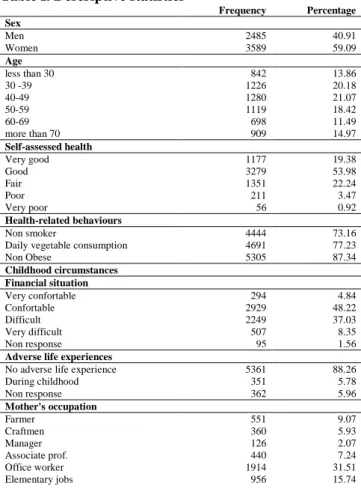
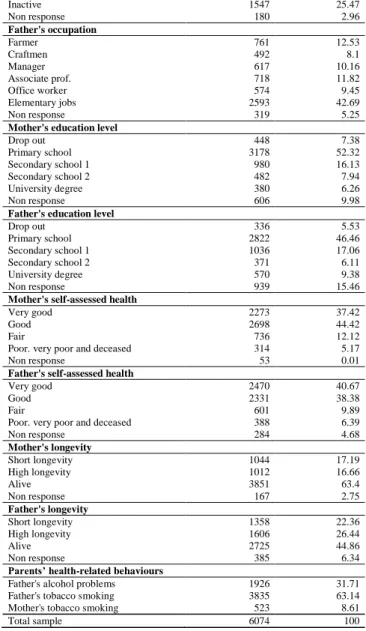
The French Health, Health Care and Insurance Survey (ESPS survey) is a general population survey carried out by the Institute for research and information in health economics (IRDES) since 1988 (Allonier et al. 2008). It gathers data on health status, access to health care services, health insurance and economic and social status of individuals aged 16 years and above. The 2006 survey included questions on living conditions during childhood and parent‟s health status and health-related behaviours when the respondent was 12 years old. This set of retrospective questions was answered by the main respondent in each household. The sample contains 6,074 individuals (2,485 men and 3,589 women). The advantage of the ESPS is that it contains information on both parents and adult descendants on a nationally representative sample of the French population.
The variable of interest is health in adulthood as measured by self-assessed health (SAH). Individuals were asked to evaluate their health answering the question “In general would you say that your health is…very good, good, fair, poor, or very poor?” SAH is widely used in health economics and has been shown to predict mortality (Idler and Benyamini 1997) as well as health-care utilisation (DeSalvo et al. 2005). In the context of ESPS, SAH has been found to be highly correlated with reported disability and number of chronic diseases (Tubeuf and Perronnin 2008). More than 70% of the respondents reported that they had good or very good health.
Three sets of independent variables are considered in the model: circumstances, effort as measured by individual behaviour influencing health, and demographic characteristics. For the sake of sample size and because missing values for parental characteristics may come, in addition from usual causes of non response in interview surveys, from weakened family bonds or from a non nuclear family structure which have been found as a determinant a health status (Montgomery et al. 1996), an „non response‟ category has been generated whenever a characteristic was unknown for a share of respondents. The summary statistics of the main variables used in the paper are shown in Table I.
11
3.1 The vector of circumstances
Due to the specific questions on childhood conditions, circumstances are measured by a large set of variables. Four types of circumstances variables are considered: parents‟ socioeconomic status, parents‟ health status, parents‟ lifestyles and family economic situation during childhood.
Parents‟ socioeconomic status is measured by both professional status and education level and is available for both parents. Professional status is measured in six categories for the father, namely farmer, craftsman, manager, associate professional, office worker and elementary occupations. A seventh category is added for mothers, homemakers. Five levels are available for education: dropped out, primary school, secondary school 1, secondary school 2, and university degree.
Parents‟ health is measured in two different ways. On one hand, the descendant retrospectively self-assesses the health status of his parents when he was 12 years old, answering the question: “When you were 12 years old, how was your father/mother/carer’s health status in general? Very good, good, fair, poor, very poor, or deceased”. The three latter categories are summarised in a single category in the model estimation. In addition, the respondent reports parents‟ date of birth, whether they are still alive at the time of the survey and their date of death, if applicable. Using these variables, we can identify parents with high longevity (i.e. parents who died older than the median age at death of their generation) and parents with a short longevity (i.e those who died younger or same age as the median age at death of their generation). The second parents‟ health variable is composed of three different categories: being alive, having had a high longevity and, having had a short longevity. The proportion of alive parents is 63.4% for mothers and 44.9% for fathers.
Two parental health-related behaviours are available in the survey: smoking and alcohol consumption. The descendant reports whether the father, mother or someone else was smoking in the household when they were 12 years old and whether the father, mother or someone else was having problems with alcohol in the household. Three binary indicators are used in the analysis measuring father‟s smoking, mother‟s smoking and father‟s alcohol problems. Respondents reported more unhealthy lifestyles for fathers than mothers: over 30% of fathers had problems with alcohol and more than 60% were smoking, whereas less than 10% of mothers are reported as smokers.
Finally, the descendant retrospectively reports whether they considered the financial situation of the family to be very comfortable, comfortable, difficult, or very difficult when he was 12. More than 50% of the respondents report that the financial situation of their family was comfortable or very comfortable. Economic hardships and isolation experienced during childhood are also considered8. The respondent reports whether they ever required help from friends or association for accommodation because of financial difficulties or were homeless during childhood. They are then asked whether they
8 The 5% non response rate for this indicator is explained by the fact that questions on adverse life experiences
during childhood were asked during an other stage of the survey and were not asked to all individuals included in this study.
12
have suffered sustained social isolation because of adverse life events happened to them or their relatives (war, migration, incarceration….) during childhood. The analysis includes a single indicator identifying whether the individual has experienced economic hardships or/and isolation during childhood. This was positive in 6% of the study sample.
3.2 The vector of effort
Three types of individual efforts are considered: health-related behaviours toward smoking, obesity and vegetables consumption; each of which is considered as a binary variable.
The first effort variable categorises people as currently a non-smoker and a regular smoker; the second effort variable categorises people as non-obese or obese – body mass index (BMI) greater than or equal to 309. BMI was calculated using self-reported height and weight. The last effort variable categorises people as eating vegetables every day or not eating vegetables every day.
A substantial majority of the sample report healthy lifestyles; 73% are currently non smoker, 87% are non obese and 77% report that they eat vegetables every day.
3.3 Econometric strategy
In the first set of analyses, we follow Barry‟s view and estimate a model describing the correlations between health and a comprehensive set of childhood and family circumstances as well as three individual effort variables.
In the second set of analyses, three independent equations corresponding to the three individual effort variables are first estimated in order to explain the association between, circumstances and effort in Roemer‟s framework.
In the third set of analyses, we consider Swift‟s framework of circumstances and effort. Prior to the measuring the influence of circumstances and efforts on health, we estimate a set of 14 circumstances independent equations according to the three individual effort variables.
Finally, we identify and measure the magnitude of inequalities of opportunity in health in the three alternative viewpoints.
The health status variables as well as the three effort variables are qualitative binary variables and so the equations are estimated using Probit regression. The equation of main interest analyses the marginal effects of circumstances and efforts on the probability of reporting a “very good” or a “good” health status versus a “fair”, a “poor”, or a “very poor” health status10
. Multinomial logit models are used for the circumstances, excepted for parental health-related behaviours for which Probit models are used. Therefore the equations presented in the previous section correspond to the latent variables
9
BMI in kg/m2= weight/height²
13
underlying the binary indicators of self-assessed health status, tobacco nonsmoking, avoidance of obesity and daily vegetable consumption, and each circumstance categories.
The non linear specification used does not allow us to undertake a direct estimation of the relative effort
eˆ
i and the relative circumstancescˆ
i. We thus compute generalised residuals, whichcorrespond to the conditional expected value of the residuals given the outcomes (Dubin and McFadden, 1984 ; Gourieroux et al., 1987).
4. Results and discussion
4.1 Health, circumstances and efforts: a reduced-form model
Table II shows the marginal effects of effort and circumstances on the probability of reporting good or very good health, computed at the means of the independent variables for each scenario. The second column of Table II shows the result of the estimation of equation (Eq. 2) corresponding to Barry‟s framework. The results corresponding to Roemer‟s framework (Eq. 4) are presented in the third column of Table II. They have been obtained by introducing relative effort in the place of actual effort variables. The relative efforts correspond to the generalised residual terms of the three auxiliary equations regressing efforts variables by circumstances (Eq. 3) whose results are presented in Table III. The results corresponding to Swift‟s framework (Eq. 6) are presented in the fourth column of Table II. They have been obtained introducing relative circumstances in the place of actual circumstances (Eq. 5). The relative circumstances correspond to the generalised residuals of 3 Probit models and 11 Multinomial Logit regression models of each type of circumstances on the vector of effort variables. The results of these models are presented in Table IV.
When looking quickly at Table II, it is fascinating to note that it is almost the same variables that appear significant and at the same degree in the first two scenarios in spite of a different statistical treatment. However the magnitude of the marginal effects depends on the scenario. The difference was expected for effort variables given the non comparability of marginal effects associated to binary variables (in Barry‟s scenario) with those associated to generalised residuals (in Roemer‟s scenario), due to scale difference. Conversely, the marginal effects associated to circumstances are directly comparable and the differences across scenarios show a sensibility to the precise specification of efforts and circumstances. The number of significant relative circumstances is strongly reduced in Swift‟s scenario. However, it is important to keep in mind that generalised residuals are now introduced for each category, including the reference category itself, therefore each generalised residual indicates the propensity to belong to a specific category versus all the others. As a consequence, the marginal effects associated to circumstances in Swift‟s scenario are not directly comparable to the marginal effects of circumstances in the two other scenarios. However the signs of the marginal effects associated to the relative circumstances in Swift‟s scenario indicate that the
14
positive or negative determinants of self-assessed health remain the same in the third framework. It is probably one of the main messages of the paper and it was not completely anticipated. Now we turn to more specific comments.
As expected, consistent across the scenario the probability of having a good or very good SAH reduces with age and is higher for men than for women.
All three individual effort variables are positively and significantly associated with good health in all contexts. When the individual is a non smoker, non obese or eats vegetables daily then he is likely to report a better health status. However, only marginal effects associated to effort variables in Barry and Swift‟s scenarios are comparable. The marginal effects of avoidance of obesity are particularly striking comparing with other effort variables. In comparison with obese people, non obese people are 13.4 percentage points more likely to report very good or good health in Barry‟s context and this effect reaches 16.4 in Swift‟s context. Similarly, the absence of smoking is an important determinant of reporting better health; but the marginal effect is considerably smaller than the one associated with avoidance of obesity, with a magnitude of 7.1 percentage points in both contexts. Finally, eating vegetables daily is significantly associated with an increase of 5.1 percentage points in the probability of being in good health in both contexts.
A large set of circumstances are also significantly associated with good health. As underlined before, the sign of marginal effects as well as their significance level are quite similar in all scenarios for most of circumstances but the magnitude often differs according to the scenario accordingly with the modeling specifications. We shall thus only consider marginal effects associated to circumstances in both Barry and Roemer‟s framework.
In line with previous empirical studies (Ahlburg 1998; Cournil and Kirkwood 2001; Case et al. 2005; Llena-Nozal 2007; Trannoy et al. 2009), parents‟ health as well as their relative longevity positively and significantly influences health. Any descendant, whose mother was assessed as being in less than very good health when the descendant was 12, is less likely to report good / better health and the percentage points associated with the mother‟s level of health increase with a worsening of the mother‟s reported health. However, for the father, results are only significant for fair health: individuals whose father was assessed as fair health when they were 12 are less likely to report good health, with a marginal effect equal to 6.5 percentage points in Barry‟s scenario. Regarding the longevity, having deceased parents is a statistically significant determinant of worse health. Differences between a short and a high longevity are not very relevant when we consider fathers but more interesting regarding mothers. Compared to alive mothers, having a mother who died at old age is associated with a 6.9 percentage points lower probability of good health in Barry‟s scenario whereas having a mother who died at a young age is associated with a 3.9 percentage points lower probability (5.9 and 4.2 in Roemer‟s). It seems indeed that having an alive mother is a better signal for one‟s
15
longevity than having a deceased mother. What is striking is that this positive correlation is also true for SAH11.
Among parent‟s health-related behaviours, father‟s alcohol problems are the main determinant of descendant‟s SAH. Individuals who report that their father was having problems with alcohol when they were 12 years old are more likely to report a less than good health status, with a marginal effect varying from 3.5 percentage points to 3.7 according to the context. Furthermore, the father‟s smoking behaviour also reduces the probability of reporting good health from 1.7 to 2.5 percentage points however this is only significant at the 10% level in the Roemerian framework. As for mother‟s smoking, it never is significant.
Adverse events during childhood are statistically significant determinants of health deterioration: spells of economic hardships or social isolation show an 8.0 (resp. 8.7) percentage point lower probability of reporting good health in Barry‟s scenario (resp. in Roemer‟s scenario). This is in line with previous work showing that past adverse life experiences is associated with a poorer health status independently of current socioeconomic position (Shaw et al. 1999; Kahn et al. 2006 ; Cambois and Jusot 2010). Similarly, as compared to individuals who reported very difficult family financial situation during their childhood, those reporting difficult, comfortable or very comfortable situations are strongly more likely to be in better health. We can notice a breaking point between reporting a very difficult financial situation as compared to other categories. Compared to a very difficult situation, reporting a difficult situation corresponds to 4.7 percentage point higher probability of reporting good or very good health in Barry scenario.
The education level of the mother is significantly associated with good health regardless of the scenario and the higher the diploma, the higher the marginal effect on health: compared to descendants of dropped-out mothers, having a mother who went to primary school (respectively university) is associated with a 8.8 (respectively 11.9) percentage points higher probability of good health in Barry‟s framework. This finding is consistent across the frameworks and displays higher marginal effects in Roemer‟s scenario. Paternal education is however significant only for secondary school diploma. It is associated with approximately an 8.5 percent higher probability of reporting good health in Barry‟s context. This is consistent results using the UK National Child Development Study (Dias, 2009) which found that the education of the mother had a larger effect than the education of the father.
Unlike father‟s occupation which was not statistically significant in the model, being born to a mother who was a farmer increased the probability of reporting good health by approximately 4.7 percent compared to being born to a mother in elementary occupations. However, this finding is significant in Roemer‟s framework only. Individuals who did not know the occupation of their mother or did not have a mother are more likely to report a poorer health status (non response category).
11
16
The birth region, as measured by territorial development and planning zones (ZEAT), describes significant effects on health reports. Compared to individuals born in “Bassin Parisien”, those born in overseas regions or in foreign countries have a 9 percent lower probability of reporting good health in both frameworks and the difference in probability is lowered by 4.0 to 5.1 percentage points for those born in the East region, the South West region, and in the East centre region.
4.2 Understanding the correlation between circumstances and efforts
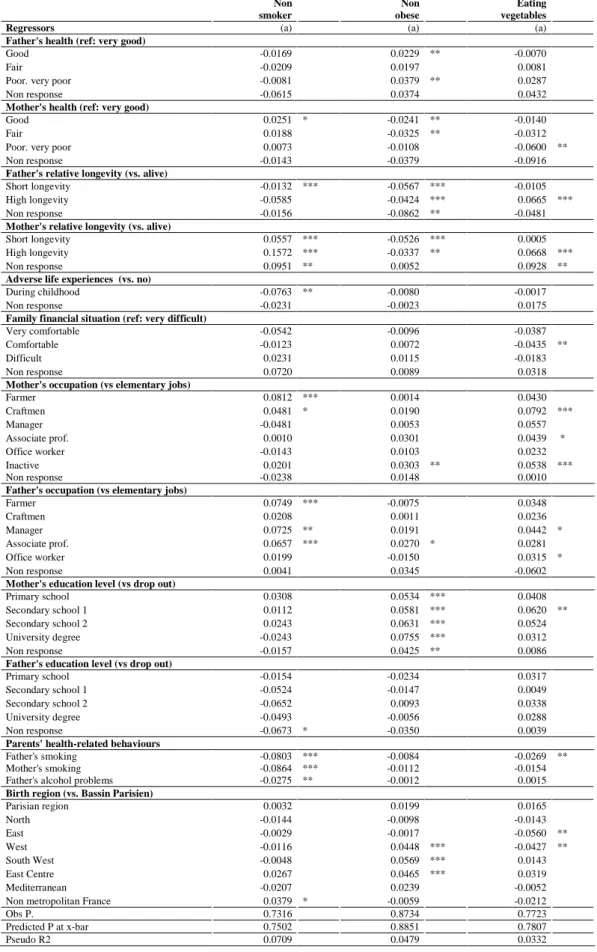
In Roemer‟s framework, the low marginal effects associated with the generalised residual terms of the three effort variables are explained by the significant influence of several circumstances on effort variables, as suggested by the results of the three Probit regressions of effort characteristics presented in Table III. The absence of smoking, the absence of obesity and vegetables intakes are strongly correlated to parents‟ longevity, parents‟ health-related behaviours towards smoking and alcohol, parents‟ occupation, mother‟s education level, and birth regions, and less significantly correlated to parents‟ health and adverse life experiences. Furthermore, since the marginal effects associated with efforts variables are purged from any contamination by circumstances when we put the analysis within Roemer‟s perspective, the effect of circumstances on health is increased in terms of significance and magnitude (Table II). We illustrate with some examples to which extent the results we observe in Roemer‟s context can be explained by this purge.
The marginal effect associated with the fact of having a mother who was farmer increases from an insignificant 4.1 percentage points in Barry‟s scenario to a significant 4.7 percentage points in Roemer‟s scenario (Table II). This change in significance comes from the high correlation linking the fact of having a mother farmer and being non smoker: in Table III, sons of mothers who were farmers have a highly significant 8.1 percentage point higher probability of being non smoker. Similarly, the marginal effects associated with all the categories of mother‟s education increase by at least 1 percentage point in Roemer‟s framework compared to Barry‟s framework (Table II) and this is due to the strong association between mother‟s education and individual‟s avoidance of obesity (Table III). Finally, the higher negative marginal effect on health of being born in East region in Roemer‟s scenario than in Barry‟s (Table II) comes from the 5.6 percentage points lower probability of vegetable daily consumption associated with this specific region (Table III).
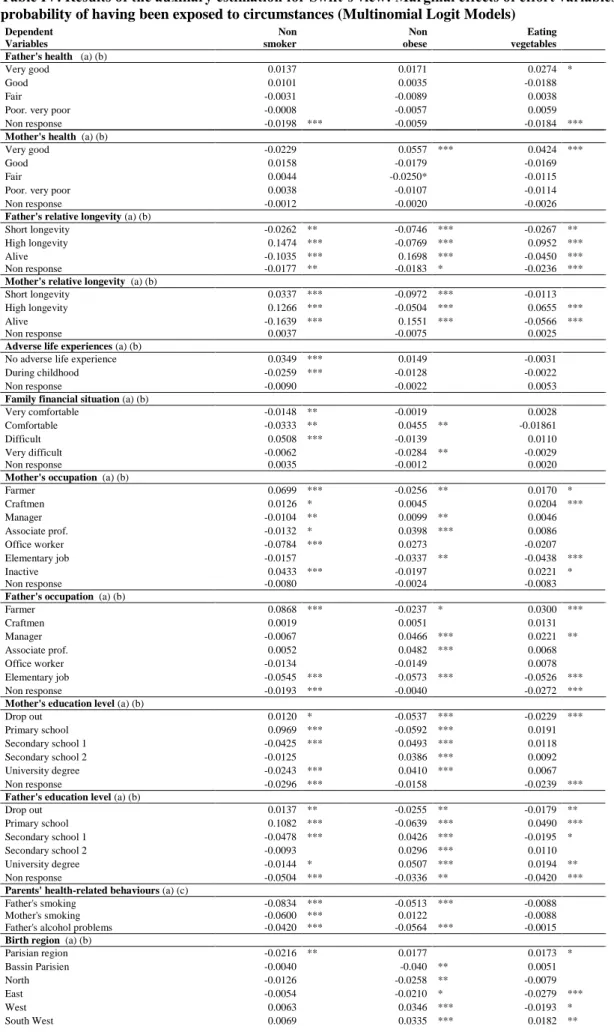
The impact of effort in Swift‟s framework is very similar than in Barry‟s framework. However, the marginal effect associated with non-smoker is slightly lower in Swift‟s framework whereas the marginal effect associated to non obese is clearly larger. Regarding non smoking, it is explained by several circumstances having a strong protective effect on smoking but being less protective for health status, such as having parents who were farmers, or having a mother who was inactive (Tables III and IV). Whereas for non obesity, the associated marginal effect is larger in Swift‟s scenario and this difference may be due to the strong correlation between father‟s alcohol problems, parents‟ longevity
17
and risk of obesity as suggested by the findings in Table IV: being non obese is associated with a 5.6 lower probability of having a father who had alcohol problems and with a lower propensity of having parents with short logevity . The low marginal effects associated with circumstances are explained by the inclusion of the generalised residuals of each circumstance and its correlation with parents‟ health related behaviours as suggested by the results of the 3 Probit models and 11 Multinomial Logit regression models in Table IV. For example, the marginal effect associated to the fact of having a father who had alcohol problems represents a 3.5 percent lower probability of good health status in Barry‟s framework but 2.1 percent in Swift‟s scenario. Another example is the magnitude of the marginal effects of parents‟ longevity on health which is reduced by half (Table II) due to the strong correlation with the three effort variables (Table IV). Likewise, the marginal effect of experience of adverse events during childhood on health, which is strongly correlated with current smoking status, is also lower: spells of economic hardships or social isolation show a 3.5 percentage points lower probability of reporting good health in Swift‟s framework against 8 percentage points probability in Barry‟s framework.
4.3 The relative contribution of each source to inequalities in health.
Using the estimated coefficients of the previous Probit models of the Table II, we can assess how the magnitude of inequalities of opportunity in health changes with the three alternative views.
The last column of Table V gives the magnitude of inequalities in health in the three different scenarios, which is assessed using the variance of the predicted latent health status (Eq. 8). We notice that the magnitude of inequalities in health is very similar across scenarios.
The second, third and fourth columns of Table V recapitulate the share of sources of inequalities in health from one framework to the other. The contribution of circumstances to inequalities in health ranges between 44.5% and up to 46.4% according to the scenario, whereas the contribution of efforts ranges between 6.1% to 8.1%. The findings show the impressive contribution of inequalities of opportunities to overall inequalities in health in France. It is comparable to the contribution of demographic variables which represents almost half of inequalities in health.
The results show also a clear difference in the appraisal of the respective contributions of circumstances and effort in overall inequality if we rely on one framework or another.
Inequalities of opportunities are the highest in the Roemer framework and represents 46.4% of inequalities in health. In the Roemerian case, the contribution of circumstances to inequalities in health incorporates both the direct effect of circumstances on health and the effect of circumstances going through individual efforts in health whereas Barry‟s framework ignores this latter component. Therefore, the contribution of circumstances to inequalities in health lower than the same contribution to inequalities in health in Roemer‟s framework. As for Swift‟s framework, the share of inequalities that can be judged as illegitimate is minimised and represents 44.5% of overall inequalities.
18
Regarding efforts, Swift‟s framework exhibits the highest contribution of effort-related characteristics: it is almost equal to 8.1%. The contribution of effort to health inequalities in this framework12 is 2 percentage points higher than in Roemer‟s framework.
Finally, the share represented by demographic variables is around half of inequalities in health in the three scenarios.
The robustness of our contribution results has been tested within five other specifications presented in Table VI. What is striking at first is that the contribution of efforts never is beyond 11.5% regardless of the specifications.
More precisely, we firstly ignore all unsignificant circumstances (their value is replaced by zero in the estimate of the latent predicted health status) in the calculation of the contribution to the variance. The variance is therefore lower than in the full model and the contribution of circumstances in Swift‟s scenario is reduced to 38.9% and 44.6% in Romer‟s scenario whereas the contribution of efforts is much higher in Swift‟s scenario and represents 11.5%.
Secondly, considering that we have a larger set of circumstances than the set of effort variables, we only focus on the three most significant circumstances in the full model, namely mother‟s health, father‟s longevity and mother‟s education and calculate the variance under those conditions. The total inequality is reduced to 0.38 and the contribution of demographics variables represent almost two thirds of it. The contributions of efforts to health inequality in the three scenarios are very similar to the contributions of efforts in the full model (8.4% in Swift‟s framework and 6.9% in Roemer‟s scenario). As circumstances are less numerous then the contribution of circumstances is lower than in the full model but a 2 percentage points difference is still observed between Roemer and Swift‟s scenarios, which supports our full model findings.
If we only consider both parents‟ health status, longevity and health-related behaviors, the differences between contributions within the three scenarios are less marked but the similar pattern applies: the contribution of effort is maximised in Swift‟s scenario representing 9% of total inequality (8.4% in Roemer‟s scenario) and the contribution of circumstances is higher in Roemer‟s scenario with 35% of total inequality.
We then calculate total inequality focusing on parents‟ socioeconomic status (occupation and education level) and economic conditions during childhood. Health inequality is thus explained in Swift‟s scenario at 9.1% by efforts (7.2% in Roemer‟s scenario) and 23.1% by circumstances (25.2% in Roemer‟s scenario). It appears thus that parents‟ health-related circumstances explain a larger part of health inequalities than parents‟ socioeconomic status and this may come from the intergenerational transmission of health showed in Trannoy et al. (2009).
12 A maximal version of Swift‟s concept is considered in Eq. 6, but we have attempted different variations (see
footnotes 3 and 5) around Swift‟s position. Nevertheless, in view of the small fraction represented by the inequality due to differences of effort, we have decided not to pursue in this direction.
19
We finally calculate total health inequality with only mothers‟ characteristics and then only fathers‟ characteristics. The level of health inequalities is higher when we only consider mothers‟ characteristics, which suggests that mother‟s characteristics explain more health heterogeneity than father‟s characteristics. Despite this difference, the contribution of circumstances is much higher than the contribution of effort in all scenarios.
5. Conclusion
This paper sought to quantify the respective share of inequalities of opportunities and legitimate inequalities in overall inequality in health in France. It also discusses the cut-point between legitimate and illegitimate inequalities according to three viewpoints from the literature on social justice on what should be considered as circumstances and as effort. We used a simple method firstly to measure the contributions of circumstances and effort to inequalities in health and secondly to compare the findings obtained under those different conceptions within one general framework. The empirical evaluation, based on a representative French Health Survey in 2006, shows that the share of inequalities of opportunities in health inequalities varies from 44.5% to 46.4% according to the adopted definition of individual effort and circumstances. As expected, Roemer‟s view minimises the magnitude of legitimate inequality in health disparities whereas the Swift‟s conservative view minimises the magnitude of illegitimate inequality; Barry‟s view leads to an intermediary contribution of inequality of opportunities to overall inequalities. Compared to Roemer‟s conception, Swift‟s conception leads to a 75% increase in the share of legitimate inequalities. However, regardless of the viewpoint, the share of circumstances remains very large in comparison to the share of inequalities explained by effort.
This study provides evidence on the existence of inequalities of opportunities in health using an original and particularly comprehensive set of childhood circumstances. Adult health is significantly determined by parents‟ social background, as measured by their education level and their professional status, financial situation during childhood, parents‟ health status, as measured by both longevity and self-perceived health status, and finally parents‟ smoking and alcohol problems. The analysis of the association between effort and circumstances has also emphasised intergenerational transmission of lifestyles in relation to smoking and diet.
However, our approach has some drawbacks. Firstly, analogously to any non linear regression-based inequality analyses, we only decompose the contribution of effort and circumstances within the explained part of health inequality. We can suspect that there is an unexplained part in these regression based inequality measures due to the presence of unobserved heterogeneity in econometric models for cross sectional data. Indeed, Van Doorslaer and Jones (2002), using the Canadian National Population Health Survey of 1994, shows that while a regression model for health explains up to a 96% of the concentration index, only 48% of total inequality in health, as measured by the Gini index, can be
20
explained by the same model. Secondly, self-assessed health has been found to suffer from individual reporting heterogeneity (Bago d‟Uva et al., 2007). Nevertheless, a French study shows that SAH is the least biased health indicator as compared to several other indicators (Devaux et al., 2008). Finally, it would have been preferred to have some extra/added measures for individual effort, such as exercise.
These considerations open the debate on the determinants to be tackled for the reduction of health inequalities: health-related behaviours or poor effects of past conditions. Nevertheless, causality analyses are still needed to establish the appropriate public policies to tackle or compensate for those inequalities.
6. References
Adams P, Hurd M, Mc Fadden D, Merril A, Ribeiro T. Healthy, Wealthy, and Wise ? Tests for direct causal paths between health and socioeconomic status. Journal of Econometrics 2003; 112 (1); 3-56.
Adda J, Chandola T, Marmot M. Socioeconomic status and health : causality and pathways. Journal of Econometrics 2003; 112; 57-63.
Ahlburg D. Intergenerational transmission of health. American Economic Review 1998; 88 (2); 265-270.
Allonier C, Dourgnon P, Rochereau T. The 2006 Health, Health Care and Insurance Survey, a panel for health policies analysis, public health and health economics research”, Questions d‟économie de la santé 2008; 131.
Anda R.F, Whitfield C.L, Felitti V.J, Chapman D, Edwards V.J, Dube S.R, Williamson D.F. Adverse childhood experiences, alcoholic parents, and later risk of alcoholism and depression. Psychiatric Services 2002; 53(8); 1001-9.
Arneson R. J. Equality and equal opportunity of welfare. Philosophical Studies 1989; 56; 77-93.
Bago d‟Uva T, van Doorslaer E, Lindeboom M, O‟Donnell O. 2008. Does heterogeneity bias the measurement of health disparities. Health Economics 17(3):351–375.
Balia S, Jones A. Mortality, lifestyle and socio-economic status. Journal of Health Economics 2008; 27(1); 1-26. Barry B. Why Social Justice Matters. Cambridge: Polity Press; 2005.
Bramstedt K. A, Jabbour N. When alcohol abstinence criteria create ethical dilemmas for the liver transplant team, Journal of Medical Ethics 2006; 32; 263-265.
Brighouse H, Swift A. Legitimate Parental Partiality, Philosophy and public affairs 2009; 37 (1); 43-80.
Cambois E, Jusot F. Monitoring Health Inequalities in France: A Short Tool for Routine Health Survey to Account for LifeLong Adverse Experiences. IRDES working paper 2010; DT30.
Case A, Fertig A, Paxson C. The lasting impact of childhood health and circumstance. Journal of Health Economics 2005; 24; 365-389.
Cohen G.A. On the Currency of Egalitarian Justice. Ethics 1989; 99; 906-944.
Contoyannis P, Jones A. Socio-Economic Status, Health and Lifestyle. Journal of Health Economics 2004; 23 (5); 965-995.
Cournil A, Kirkwood T. B. L. If you would live long, choose your parents well. TRENDS in Genetics 2001; 17(5); 233-235.
Currie J, Stabile M. Socioeconomic status and child health: why is the relationship stronger for older children. American Economic Review 2003; 93; 1813-1823.
DeSalvo K, Fan V. S, McDonnell M. B, Fihn S. D. Predicting mortality and healthcare utilization with a single question. Health Services Research 2005; 40(4); 1234-1246.
21
Devaux M, Jusot F, Sermet C, Tubeuf S. Hétérogénéité sociale de déclaration de l‟état de santé et mesure des inégalités de santé. Revue Française des Affaires Sociales 2009;1:29-47Dias P. R. Inequality of Opportunity in Health: evidence from the UK cohort study. Health Economics 2009; 18(9); 1057-1074.
Dias P. R. Modelling opportunity in health under partial observability of circumstances. Health Economics 2010; 19(3); 252-264.
Dias P. R, Jones A. Giving equality of opportunity a fair innings. Health Economics 2007; 16; 109-112.
Dubin J. A. McFadden, D.L. (1984), An econometric analysis of residential electric appliance holding and consumption. Econometrica 52 : 345-362.
Dworkin R. What is equality? Part I: Equality of Welfare. Philosophy and Public Affairs 1981 ; 10 ; 185-246. Etilé F. Modes de vie et santé des jeunes. In Cohen D. (Eds.) Une jeunesse difficile. Portrait économique et social de la jeunesse française. Editions Rue d‟Ulm/Presses de l‟Ecole Normale Supérieure. Paris ; 2007.
Fleurbaey M. Health, Equity, and Social Welfare. Annales d‟Économie et de Statistique 2006; 83/84; 21-59. Fleurbaey M. Fairness, Responsibility, and Welfare. Oxford University Press. Oxford; 2008.
Fleurbaey M, Schokkaert E. Unfair inequalities in health and health care. Journal of Health Economics 2009; 28(1); 73-90.
Francesconi M, Jenkins S, Siedler T. The effect of lone motherhood on the smoking behaviour of young adults. IZA Discussion Papers 2009; 4392.
Göhlmann S, Schmidt C.M, Tauchmann H. Smoking initiation in Germany: the role of intergenerational transmission. Health Economics 2009; doi: 10.1002/hec.1470.
Gourieroux C, Monfort A, Renault E, Trognon A. Generalised residuals. Journal of Econometrics 1987; 34(1-2); 5-32.
Idler E. L, Benyamini Y. Self-rated health and mortality: a review of twenty-seven community studies. Journal of Health and Social Behaviour 1997; 38; 21-37.
Jusot F, Tubeuf S, Trannoy A. Tel père, tel fils : l‟influence de l'origine sociale et familiale sur la santé des descendants en Europe. Retraite et Société 2009 ; 58(2) ; 63-85.
Kahn JR, Pearlin LI. Financial strain over the life course and health among older adults. Journal of Health and Social Behavior 2006; 47; 17-31.
Khlat M, Jusot F, Ville I. Social origins, early hardship and obesity: A strong association in women, but not in men? Social Science and Medicine 2009; 68(9); 1692–1699.
Laitinen J, Power C, Marjo-Riitta J. Family social class, maternal body mass index, childhood body mass index, and age at menarche as predictors of adult obesity. American Journal of Clinical Nutrition 2001; 74; 287-294.
Lindeboom M, Llena-Nozal A, van der Klaauw B. Parental education and child health: Evidence from a schooling reform. Journal of Health Economics 2009; 28(1); 109-131,
Llena-Nozal A. On the dynamics of health, work and socioeconomic status. Vrije Univertiteit Amsterdam; 2007. Montgomery L.E, Kiely J.L, Pappas G. The effects of poverty, race, and family structure on US children's health: data from the NHIS, 1978 through 1980 and 1989 through 1991. American Journal of Public Health 1996; 86(10); 1401– 1405.
Parsons T.J, Power C, Logan S, Summerbell C.D. Childhood predictors of adult obesity: a systematic review. International Journal of Obesity 1999; 23 (Suppl 8); S1-S107.
Phillips A. Really equal: opportunities and autonomy. The Journal of Political Philosophy 2006; 14(1); 18-32. Power C, Graham H, Due P, Hallqvist J, Joung I, Kuh D, et al. The contribution of childhood and adult socioeconomic position to adult obesity and smoking behaviour: An international comparison. International Journal of Epidemiology 2005; 34; 335-344.