HAL Id: tel-03102396
https://tel.archives-ouvertes.fr/tel-03102396
Submitted on 7 Jan 2021
HAL is a multi-disciplinary open access
archive for the deposit and dissemination of
sci-entific research documents, whether they are
pub-lished or not. The documents may come from
teaching and research institutions in France or
abroad, or from public or private research centers.
L’archive ouverte pluridisciplinaire HAL, est
destinée au dépôt et à la diffusion de documents
scientifiques de niveau recherche, publiés ou non,
émanant des établissements d’enseignement et de
recherche français ou étrangers, des laboratoires
publics ou privés.
Misbehavior detection for cooperative intelligent
transport systems (C-ITS)
Joseph Kamel
To cite this version:
Joseph Kamel. Misbehavior detection for cooperative intelligent transport systems (C-ITS). Artificial
Intelligence [cs.AI]. Institut Polytechnique de Paris, 2020. English. �NNT : 2020IPPAT024�.
�tel-03102396�
.
NNT
:
2020IPP
A
T024
Misbehavior Detection for Cooperative
Intelligent Transport Systems (C-ITS)
Th `ese de doctorat de l’Institut Polytechnique de Paris pr ´epar ´ee `a T ´el ´ecom Paris ´
Ecole doctorale n◦626 l’Institut Polytechnique de Paris (ED IP Paris) Sp ´ecialit ´e de doctorat: Informatique, donn ´ees et intelligence artificielle
Th `ese pr ´esent ´ee et soutenue `a Palaiseau, le 21/07/2020, par
J
OSEPH
K
AMEL
Composition du Jury :
Sidi Mohammed Senouci
Directeur du laboratoire DRIVE, ISAT Pr ´esident du jury Isabelle Chrisment
Professeur `a TELECOM Nancy, Universit ´e de Lorraine Rapporteur Oyunchimeg Shagdar
Chef d’ ´equipe de recherche REVECOM, VEDECOM Examinateur Frank Kargl
Directeur de l’Institut des syst `emes distribu ´es, Universit ´e d’Ulm Examinateur Jonathan Petit
Directeur de l’ing ´enierie, Qualcomm Technologies Inc. Examinateur Pascal Urien
Professor, INFRES, T ´el ´ecom Paris Directeur de th `ese Ines Ben Jemaa
Ing ´enieur de recherche, SCA, IRT SystemX Co-encadrement Arnaud Kaiser
Chef de Projet, SCA, IRT SystemX Invit ´e Brigitte Lonc
Chef de Projet, Innovation Multim ´edia et Connectivit ´e, Renault Invit ´e Pierpaolo Cincilla
Cybercriminal activity is one of the biggest challenges that humanity will face in the next two decades. - Steve Morgan, Editor-in-Chief, Cybersecurity Ventures
Acknowledgements
I would like to take the opportunity to thank all those who supported me during this experience.
First, I would like to thank my PhD director, Professor Pascal Urien, for his consistent guidance and valuable discussions. I would like to thank my PhD supervisors, Doctor Arnaud Kaiser and Doctor Ines Ben Jemaa, for shar-ing their invaluable knowledge, experience and advice. My director and supervisors were the key to the successful completion of my thesis. I would like to thank Professor Frank Kargl for hosting my internship in Ulm, it broadened my horizons on various scientific subjects and gave me an alternative view of my thesis. I would like to thank Pro-fessor Jonathan Petit for his help in one of the most valuable and fruitful collaborations. I would like to thank Doctor Pierpaolo Cincilla for initially encouraging me to pursue the scientific domain and take on the challenge of a PhD.
I would like to extend my gratitude to the reviewers, Professor Sidi Mohammed Senouci and Professor Isabelle Chrisment for accepting to evaluate my thesis. My earnest thanks are also due to Professor Aline Viana, Doctor Brigitte Lonc and Professor Oyunchimeg Shagdar for accepting to be a member of the jury.
Thanks to all of my colleagues in IRT SystemX, especially Loic for his valuable help and technical discussions. Thanks to all my colleagues in the SCA team, especially Farah, Nabil, Hafeda, Reda, Francesca, Hassane, Marios and Michel for creating a great work atmosphere.
I would also like to thank my friends Marie, Oceane and Alex for their support and all our happy get-togethers and for uplifting my spirit during the challenging times faced during this thesis. I am also grateful to my cousins Michel, Rima, Nour and Sami, and to my friends, Reza, Imane, Alexis, Nathalie and Alex for their priceless friendship and precious support, and for continuously giving me the courage to make this thesis better.
Last but definitely not least, I am forever indebted to my awesomely supportive parents and my wonderful sister Sarah for inspiring and guiding me throughout the course of my life, and hence this thesis.
Contents
1 Introduction 9
1.1 Problem statement . . . 11
1.2 Contributions . . . 11
1.2.1 State of the art evaluation . . . 11
1.2.2 Contributions to the local misbehavior detection . . . 12
1.2.3 Contributions to the misbehavior reporting . . . 12
1.2.4 Contributions to the global misbehavior detection . . . 13
1.3 Work environment . . . 14
2 State of The Art 15 2.1 C-ITS model . . . 15
2.2 Pre-deployment projects . . . 17
2.3 Communications architecture . . . 19
2.4 C-ITS security . . . 20
2.4.1 Vehicular PKI system . . . 20
2.4.2 Misbehavior in C-ITS . . . 22
2.4.3 Misbehavior detection protocol . . . 23
2.4.4 General security architecture . . . 24
2.5 Attacker model . . . 25
2.6 Related works . . . 26
2.6.1 Detection of Sybil attacks . . . 27
2.6.2 Detection of bogus information attacks . . . 28
2.7 Feasibility study . . . 34
2.7.1 Feasibility of detection mechanisms for Sybil attacks . . . 34
2.7.2 Feasibility of detection mechanisms for bogus information attacks . . . 35
3 Framework for Misbehavior Detection Simulation and Evaluation 41
3.1 Motivations . . . 41
3.2 Related works . . . 42
3.3 Framework features . . . 43
3.3.1 General framework characteristics . . . 43
3.3.2 Framework input data . . . 43
3.3.3 Misbehavior mechanisms . . . 47
3.3.4 Framework local detection . . . 49
3.3.5 Reporting Protocol . . . 54
3.3.6 Global misbehavior detection . . . 55
3.3.7 Privacy . . . 56
3.3.8 Evaluation metrics . . . 56
3.3.9 Visualization . . . 58
3.4 Examples . . . 58
3.4.1 Plausibility detectors example . . . 61
3.4.2 Local fusion application example . . . 62
3.4.3 Attacks example . . . 63
3.4.4 Reporting and global detection example . . . 64
3.5 Conclusion . . . 65
4 Local Misbehavior Detection 67 4.1 CaTch detectors . . . 67
4.1.1 Local detectors and mobility data uncertainty . . . 67
4.1.2 Misbehavior fusion applications . . . 75
4.1.3 Evaluation . . . 77
4.1.4 Summary . . . 79
4.2 Evaluation of local detection mechanisms . . . 80
4.2.1 Attacker model . . . 80
4.2.2 Detection mechanisms . . . 80
4.2.3 Evaluation results . . . 82
4.2.4 Summary . . . 86
4.3 VeReMi dataset extension . . . 87
4.3.1 Related works . . . 87
4.3.3 Results . . . 92
4.3.4 Summary . . . 92
4.3.5 Conclusion . . . 93
5 Misbehavior Reporting 95 5.1 Misbehavior reporting protocol . . . 95
5.1.1 Misbehavior reporting scenario and requirements . . . 96
5.1.2 Proposed misbehavior reporting approach . . . 96
5.1.3 Conclusion . . . 101
5.2 Misbehavior reports dataset . . . 102
5.2.1 Related works . . . 102
5.2.2 System model . . . 103
5.2.3 Proposed dataset description . . . 103
5.2.4 Conclusion . . . 106
6 Global Misbehavior Detection 107 6.1 Machine learning based misbehavior authority . . . 107
6.1.1 Simulation settings and scenarios . . . 108
6.1.2 Model Development . . . 108
6.1.3 Summary . . . 113
6.2 Misbehavior authority for Sybil attack detection . . . 114
6.2.1 The Sybil attack . . . 114
6.2.2 Misbehavior authority investigation process . . . 116
6.2.3 Simulation settings and scenarios . . . 120
6.2.4 Results and analysis . . . 120
6.2.5 Conclusion . . . 122 7 Conclusion 123 7.1 Summary . . . 123 7.2 Perspectives . . . 124 7.3 Lessons learned . . . 125 8 List of Publications 127 9 Annex 129 9.1 Annex 1: Misbehavior Report in ASN.1 Format . . . 129
List of Figures
2.1 C–ITS model . . . 16
2.2 ETSI ITS station reference architecture . . . 19
2.3 ETSI Vehicular PKI system . . . 21
2.4 Misbehavior detection process . . . 23
2.5 C-ITS security architecture . . . 24
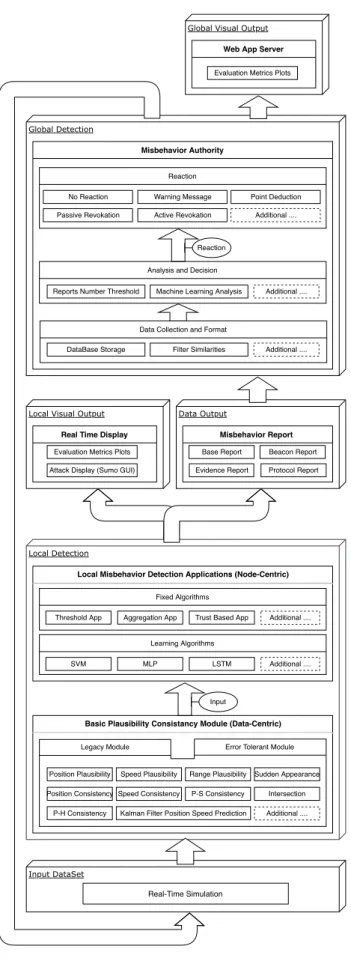
3.1 F2MD diagram representation of the main modules . . . 44
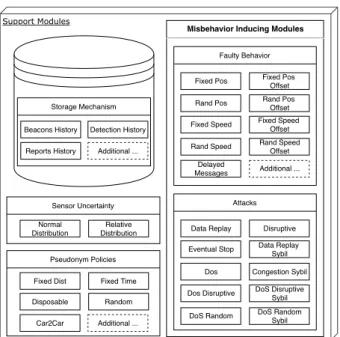
3.2 F2MD diagram representation of the secondary modules . . . 45
3.3 F2MD Paris-Saclay scenario . . . 45
3.4 F2MD Luxembourg scenarios . . . 46
3.5 The exponential variation of the trust level function of the plausibility value . . . 52
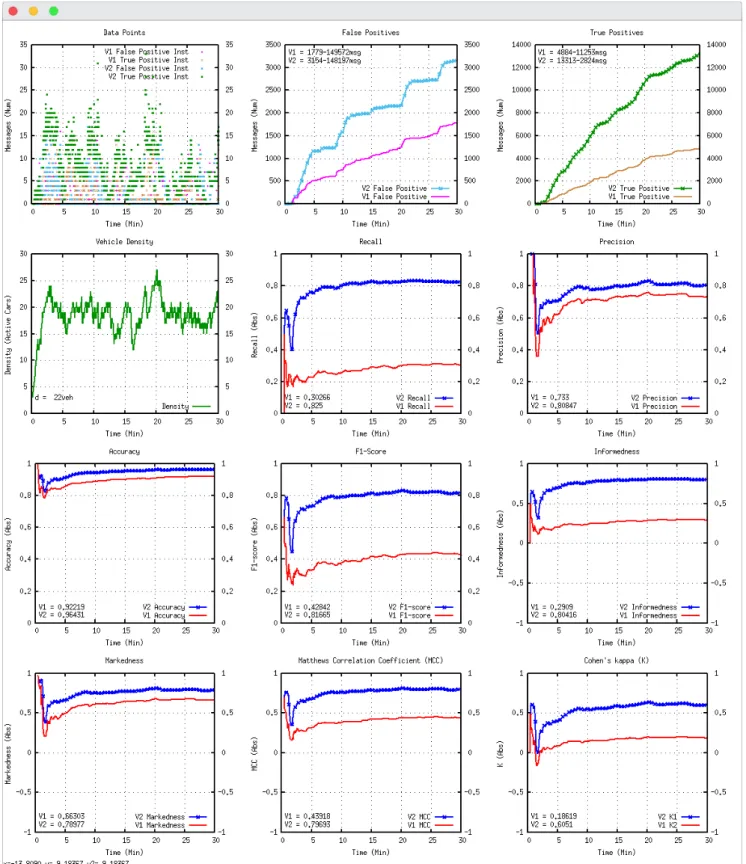
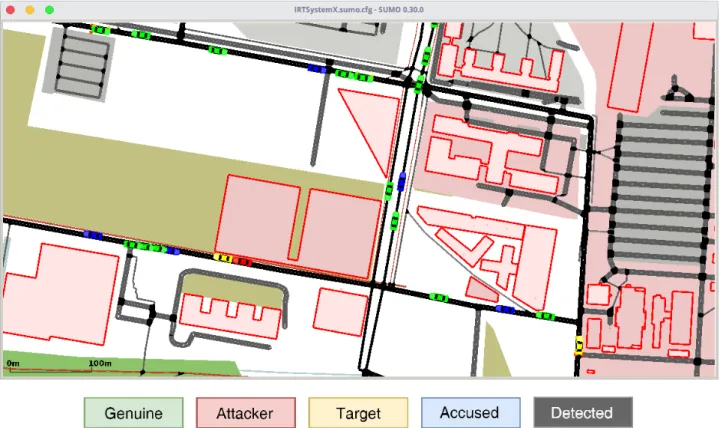
3.6 F2MD GUI: Real-Time Evaluation Metrics Plots (Data Points, TP, FP, Density, Recall, Precision, Ac-curacy, F1score, BM, MK, MCC, K) . . . 59
3.7 F2MD GUI: Vehicle Color Profiles with SUMO . . . 60
3.8 F2MD GUI: MA web interface . . . 60
3.9 F2MD results: variable checks threshold evaluation plot . . . 61
3.10 F2MD results: local fusion application evaluation plot . . . 62
3.11 F2MD results: detection evaluation by attack . . . 63
3.12 F2MD results: average number of reports by pseudonym received by the MA for different pseudonym change period . . . 64
4.1 Local check: range plausibility . . . 69
4.2 Local check: position plausibility . . . 69
4.3 Local check: speed plausibility . . . 70
4.4 Local check: position consistency . . . 71
4.5 Local check: speed consistency . . . 71
4.7 Local check: position heading consistency . . . 73
4.8 Local check: intersection . . . 74
4.9 Local check: sudden appearance . . . 75
4.10 CaTch example: illustrating its advantage . . . 76
4.11 Local detection: t-SNE: Genuine (Gray) and Misbehaving (Red) . . . 83
4.12 Local detection: XGBoost feature importance . . . 83
4.13 Local detection: evaluation metrics by tested fusion application . . . 84
5.1 Reporting protocol: flowchart description . . . 100
6.1 Sybil attack: Traffic congestion . . . 114
6.2 Sybil attack: Data replay . . . 115
6.3 Sybil attack: DoS Random . . . 115
6.4 Sybil attack: DoS disruptive . . . 115
6.5 Sybil attack: global detection system architecture . . . 117
6.6 Sybil attack: detection accuracy by type of linkage . . . 120
List of Tables
2.1 Summary of the feasibility challenges. . . 39
3.1 Detection output partition . . . 56
3.2 Average report size comparison . . . 64
4.1 Common Notations . . . 68
4.2 Simulation Results . . . 78
4.3 Mean processing time of the Binary and CaTch detectors . . . 78
4.4 datasets information per described scenario . . . 90
4.5 Testing results . . . 91
5.1 securityDetectionErrorCode Description . . . 98
5.2 semanticDetectionErrorCodeCAM Description . . . 98
5.3 Misbehavior Detectors For Cooperative Awareness Messages (CAMs) . . . 99
5.4 Dataset scenarios local detection . . . 105
6.1 Prediction results for the weighted random predictor . . . 109
6.2 Prediction results for the single check feature set . . . 109
6.3 Prediction results for the checks average feature set . . . 110
6.4 Prediction results for the beacon data feature set . . . 111
6.5 Prediction results for the combined data feature set . . . 111
6.6 Prediction results for the Random Forests (RF) . . . 112
6.7 Prediction results for the Multi-Layer Perceptron (MLP) . . . 112
6.8 Prediction results for the Long Short-Term Memory (LSTM) . . . 113
Chapter 1
Introduction
Road transportation is the most used mode of travel in the world. However, the resulting road accidents remain a major issue causing huge economic and human losses. According to the National Highway Traffic Safety Admin-istration (NHTSA) and the Directorate-General for Mobility and Transport (DGMT), more than three million people are injured each year due to traffic accidents in the United States and the European Union [1] [2]. To combat this problem, manufacturers are adding more safety features in their vehicles.
Modern safety features are often technologically advanced embedded electronic systems. For instance, blind spot monitor increases the drivers’ awareness by issuing a warning when a vehicle approaches the driver’s sides or rear. An area notoriously tricky to check using traditional side mirrors. Lane keep assist systems prevent over-steering and helps keep the vehicle centered. It works by alerting the driver when needed and could even take automatic measures to keep the vehicle in the lane. Collision avoidance systems aims to prevent or reduce the severity of a collision. These systems rely on sensors like radars, lasers and cameras to detect dangerous situations in the surrounding environment. They warn the driver of incoming threats or act automatically on the vehicle with actions like emergency braking or swerving.
The outcomes of these vehicular safety systems, from timely alerts to swift measures, are often life saving for the driver and passengers of a vehicle. To quantify their added value, Haus et al. [3] estimated the benefits of automated emergency braking in the United States. Their results show a decreased fatality risk between 84% and 87% and injury risk between 83% and 87%. Given their great advantage on high-stakes use cases, that involve human lives, safety systems are becoming less of a commodity and more of a necessity. However, because of their critical use-case, the cyber-security mechanisms that ensures the functionality of these safety systems need to be on par with the high risk in case of failure. After all, these safety systems could assume control of the vehicle. Sensors could fail and embedded electronics of a vehicle could malfunction. Moreover, malicious actors could target safety systems with cyber-attacks which would have catastrophic results on unsecured vehicles.
They use the integrated controller area network or CAN bus to modify the vehicle’s displays, control the breaks or even stop the engine completely. Checkoway et al. [5], working with the same research group, were able to prove that some of these cyber-attacks could be done over-the-air without the need for a wired connection. Miller et al. [6] demonstrated to journalists some of these cyber-attacks on a 2014 Jeep Cherokee. A story that went viral on social and traditional media outlets. The journalists were surprised and frightened when the attackers were able to remotely kill the engine while the vehicle was cruising on the highway.
In this thesis, our goal is to ensure the cyber-security of a new vehicular safety system. Cooperative Intelligent Transport Systems (ITS) (C–ITS) is a new technology that aims to reduce traffic accidents and improve road safety in general. The technology is based on inter-vehicle communications in the form of safety messages. These messages can contain information about the vehicle like the position and the current speed or various warnings about the current traffic condition. This exchanged information could prove critical for the vehicle to insure the safety of the passengers or surrounding pedestrians. For instance, safety applications can use the received data to warn the driver about upcoming road works or about the need for an imminent emergency brake. Furthermore, C–ITS could be used to improve the overall traffic conditions through applications like the cooperative adaptive cruise control. C–ITS could even reduce traffic jams and contribute to shockwave damping on the highway by providing the driver with speed advice.
Safety mechanisms in C–ITS are cooperative in nature. Therefore, it is essential to establish interoperability be-tween different vehicle manufacturers. For instance, vehicles from different brand should use the same communica-tion technologies and communicacommunica-tion formats to ensure the largest possible benefits. Likewise, safety applicacommunica-tions like cooperative adaptive cruise control require a common protocol to function properly. Standardization bodies could provide a common solution to this problem. The European Telecommunications Standards Institute (ETSI) in Europe and the Institute of Electrical and Electronics Engineers (IEEE) in the US are pushing unified standards for common communication protocols and formats. These formats include the type of transmitted messages and their general modes of operation. Currently, the ETSI and IEEE provide different standards in Europe and the US. Even though the formats are different, interoperability between the two platform is still possible in the future.
For instance, the ETSI published the Cooperative Awareness Message (CAM) [7] to enable vehicles to share kinematic information and the Decentralized Environmental Notification Message (DENM) [8] to share warnings. Whilst the IEEE published the Basic Safety Message (BSM) [9] providing similar functionalities to users. Both these systems are currently being tested through pre-deployment projects in Europe and the US. As a result, users could start to benefit soon from C–ITS functionalities.
1.1
Problem statement
The reliable operation of the C–ITS-based safety applications require secure Vehicle–to–Everything (V2X) mes-sages. To this end, the IEEE and the ETSI created and standardized the Vehicular Public Key Infrastructure (PKI) [10] [11]. The PKI issues digital certificates to the different actors of the C–ITS system, called ITS Stations (ITS–Ss). The certificates are used by the ITS–S to sign each transmitted message thus ensuring its authenticity, integrity and non-repudiation. Furthermore, the adoption of such systems requires, especially in our current global environment, the protection of the users’ privacy. For this reason, the ITS–S are allowed to regularly change their signatures using temporary digital certificates. These temporary certificates are called pseudonyms and they would allow the user to avoid being tracked [12].
Nevertheless, despite the protections provided by the PKI infrastructure, security challenges still exist in the current C–ITS system. In particular, digital signatures do not ensure the accuracy and validity of a message. For instance, a malicious vehicle with a valid certificate could send inaccurate or false data over the V2X network. Consequently, a misbehavior detection mechanism is needed to protect the system and mitigate the effects of these malicious or otherwise faulty ITS–Ss. Although Misbehavior Detection is a well-researched topic and despite the large number of published studies, many research challenges still exist in the misbehavior detection domain. C–ITS is an ever evolving system with different developing components both on the technical and regulatory side. In this thesis, our goal is to identify the remaining challenges that need to be addressed and propose solutions to the various components of the misbehavior detection system.
1.2
Contributions
In this section we cite and summarize all the contributions of this thesis. We start with a state of the art evaluation section. Then the following contributions are divided into sections corresponding to the misbehavior detection process: local, reporting and global detection. Finally, we also add a general section for contributions spanning the entire detection process.
1.2.1
State of the art evaluation
Feasibility Study [13]: We started our work with a feasibility study of the different misbehavior detection mecha-nisms in C–ITS. In this study, we extract and classify the mechamecha-nisms used in the published works on misbehavior detection. We then analyze the feasibility of such mechanisms in the current European ETSI and American IEEE ecosystems. Then, we discuss the remaining challenges that need to be addressed by the community. Some of these challenges were addressed in the course of the thesis.
1.2.2
Contributions to the local misbehavior detection
CaTch Detectors [14]: This contribution to the local detection component concerns the plausibility and consis-tency checks. We notice that both the ETSI CAM and the IEEE BSM messages integrate a field called confidence range for each mobility parameter. This field is included based on the fact that sensor measurements could be inaccurate due to physical limitations or environmental characteristics. However, this information was not taken into consideration during the misbehavior detection checks computation. This may result in a high number of false positives in a realistic scenario. Therefore, we created CaTch (Confidence range Tolerant misbehavior detection approach), a misbehavior detection library which takes into consideration the confidence range. We implement the CaTch detectors in a simulator and show that taking into consideration the sensors’ inaccuracy during the checks computation process increases the detection quality.
Fusion Applications Comparative [15]: This contribution to the local detection component concerns the fusion application of the plausibility checks. We notice that many fusion application proposals already exist in the literature. However, the various published detection results are often difficult to compare since it’s done on different data and with different scenarios. To this end, we re-implement the complete detection process along with the different detection applications in an extension of the Vehicles in Network Simulation (VEINS) simulator [16]. Our comparative results show a trade-off between the accuracy of the detection mechanisms and the calculation latency.
VeReMi Dataset Extension [17]: This contribution concerns the complete local detection process. A large num-ber of studies are aimed at providing local misbehavior detection solutions. However, the results of these studies are still difficult to compare, reproduce and validate. This is due to the lack of a common reference dataset. For this reason, the original Vehicular Reference Misbehavior Dataset (VeReMi) was created. The goal of VeReMi is to allow for comparable evaluation of misbehavior detection in C–ITS. It is the first public misbehavior detection dataset allowing anyone to reproduce and compare different results. VeReMi is used in a number of studies and is currently the only dataset in its field. We extend the dataset by adding realistic a sensor error model, a new set of attacks and larger number of data points. Additionally, we provide benchmark detection metrics using a set of local detectors and a simple misbehavior detection mechanism.
1.2.3
Contributions to the misbehavior reporting
Misbehavior Reporting Protocol [18]: Despite the consensus on a need for a unified communication protocol between the ITS–S and the Misbehavior Authority (MA), a misbehavior reporting protocol is still missing. In this work, we propose a Misbehavior Report (MBR) message format and identify the relevant information that the report should include. For each detected misbehavior type we propose the corresponding proofs to be included in the
report as well as an assigned confidence level. The latter is an indication that enables to differentiate non-forged proofs and self-forged proofs (i.e. if a proof could be forged by the reporting entity).
Misbehavior Reports Dataset [19]: Following our misbehavior reports proposal, we need to propose a simple method for researchers to use this protocol within their systems. To this end, we publish a dataset of misbehavior reports derived from the local embedded detection of misbehaving entities. This dataset can be used to further develop and evaluate the MA detection component. The sets include different road topology, varying attacker rates and attack scenarios.
1.2.4
Contributions to the global misbehavior detection
Machine Learning Based MA [20]: The MA is responsible for protecting the ITS system by mitigating the effects of an attack. Accordingly, the MA must first identify the type of attack. We believe that the MA will benefit from using Artificial Intelligence (AI) solutions such as Machine Learning (ML) to perform this task. To this end, we implement the complete misbehavior detection process in an extension of VEINS simulator [16]. Then we evaluate different ML approaches for the MA. Our results show that the use of ML enables the MA to precisely classify the reported ITS–S and identify the different types of misbehavior.
Global Sybil Attack Detection [21]: We believe that an attacker performing a Sybil attack (i.e. using multiple fake identities) is better detected at the global level. Therefore, we propose a misbehavior detection process at the MA, which is able to identify and detect both Sybil and other types of attacks. It is based on advanced ML algorithms. In addition, we evaluate our solution by integrating it in both ETSI and IEEE C–ITS standard architecture.
Release of an Open Source Framework for Misbehavior Detection (F2MD) [22]: In order to test all our pre-viously proposed solutions, we implemented F2MD. It is a complete misbehavior detection solution that includes a real time simulation of the whole misbehavior detection process from local to global detection. F2MD is a VEINS module. VEINS is a well-known an open source framework for running vehicular network simulations [23]. VEINS is based on the Objective Modular Network Testbed in C++ (OMNeT++) [24] for network simulation and the Simulation of Urban MObility (SUMO) [25] for road traffic simulation. F2MD is also open source and could be found and used freely on GitHub [26].
Transfer to ETSI standardization body [27]: Because of its cooperative nature, interoperability is essential for the correct functionality of the C–ITS systems. Therefore, the ETSI and IEEE standardization bodies have already standardized large functions of the system. Misbehavior detection is a security layer for C–ITS. As a result, some standard functionalities are required. Specifically, the operation of the cloud component, the connection between
the MA and the PKI and the misbehavior reporting process. To this end, throughout the course of this thesis, we participated in the ETSI ITS-W5 and contributed to the TR-103-460: Pre-standardization Study on Misbehavior Detection.
1.3
Work environment
This research work has been carried out in the Secure Cooperative Autonomous systems (SCA) Project in the Technological Research Institute SystemX. SCA is research project with both industrial and academic partners. The industrial partners include vehicle manufacturers, automotive suppliers and cybersecurity services providers: Atos (IDnomic), Oppida, Groupe PSA, Groupe Renault, Transdev, Trialog, Valeo and YoGoKo. The academic partner is the Institut Mines-T ´el ´ecom, specifically T ´el ´ecom Paris, amongst the top public higher education and research engineering establishments in France.
In addition to the work in SCA, this thesis included a research visiting hosted by the Institute of Distributed Systems at Ulm University. The visiting was under the supervision of Professor Frank Kargl and focused mainly on misbehavior detection in Cooperative Adaptive Cruise Control (CACC). However, with the help of their privacy experts, we were additionally able to analyze the privacy aspect of the CAMs within the current ETSI C–ITS system. Finally, we also jointly published the extension to the VeReMi dataset.
Chapter 2
State of The Art
This chapter includes a state of the art description of the various systems related to misbehavior detection, that are referred to in this thesis. First, we present the C–ITS model and current security architecture. Next, we discuss some of the current C–ITS pre-deployment projects. Then, we detail the insider attacker model that is common in this domain. After that, we cite and describe the published related works. Last, we end this section with a feasibility study on the different misbehavior detection mechanisms in C–ITS.
2.1
C-ITS model
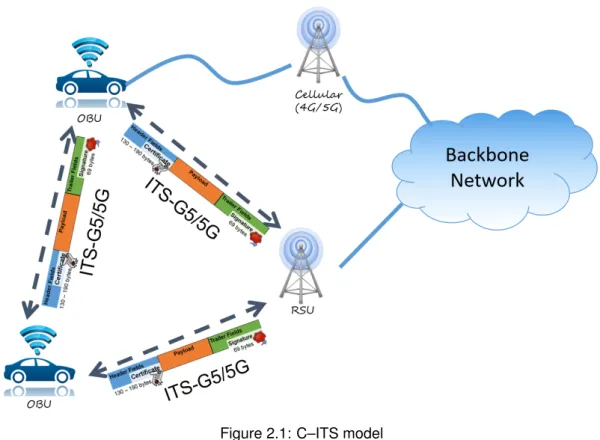
Figure 2.1 shows the current C–ITS system structure. In C–ITS vehicles should exchange safety messages with a cost-efficient and low-latency communication system. However, this communication system is not yet agreed upon and two possible technologies currently exist:
• IEEE 802.11p is an amendment to the IEEE 802.11 (the common Wi-Fi standard) that enables wireless
communications in a vehicular environment [28]. The IEEE 802.11p is the base technology for the European ITS-G5 and the American WAVE. ITS-G5 stands for Intelligent Transport Systems operating at the 5.9 GHz frequency band. It is specified in the ETSI EN 302 571 and the ITS Directive 2010/40/EU [29]. WAVE stands for Wireless Access in Vehicular Environments. It is specified in IEEE 1609 family of standards [30]. WAVE enables the Dedicated Short-Range Communications (DSRC) standards and its family of safety applications. Both ITS-G5 and WAVE have been tested in pre-deployment projects in the US and Europe.
• 3GPP Release 14 introduced cellular LTE support for V2X services [31]. In this standard, the 3rd Generation
Partnership Project (3GPP) also introduced an optimized LTE Direct technology for automotive applications. It is commonly referred to as Cellular-V2X or C-V2X. Additionally, 3GPP Release 15 introduces 5G support for C-V2X. In C-V2X, two modes of operations are available: (1) in range communication or mode 3 where the
Figure 2.1: C–ITS model
transmission is assisted by a base station (eNodeB) on the LTE-Uu interface, (2) out of range communication or mode 4 where direct Device to Device (D2D) transmission occurs without edge or back-end interference over the PC5 or Sidelink interface. C-V2X is also being tested in various pre-deployment projects.
In April 2019, the European Commission proposed the Delegated Act on C-ITS that would push to the adoption of ITS-G5 in the European member states. However, the European Parliament voted against this proposal, adopting a technology neutral approach instead. Regardless of the communication technology however, the C–ITS safety protocols have been well developed and standards have already been released.
In Europe, the ETSI ITS Working Groups proposed and published several safety messages formats. Coop-erative Awareness Message (CAM) is a periodically transmitted beacon message [7]. The CAM contains status and attribute information about the ITS–S. The status includes information like the position, motion state, time and activated systems. The attribute includes information like the dimensions, vehicle type and role in the road traffic. Decentralized Environmental Notification Message (DENM) is another type of message that contains information and warnings related to the current traffic and road conditions. This information is then presented to the driver of the receiving ITS–S who is able to react and potentially avoid dangerous situations. In the US, the IEEE also published safety messages formats. The Basic Safety Message (BSM) is the IEEE periodic beacon equivalent to the CAM message. However, unlike the ETSI system, warnings could also be appended to BSMs. Therefore, the BSM also replicates the functionalities of the DENMs without the need for a different specific message.
several safety applications. Even though most safety applications are currently still in the pre-standardization phase and not readily available, a lot of progress has already been made. As a result, some road-safety and traffic-efficiency applications are well developed. Here are some examples:
• Road safety applications:
– Collision Avoidance Systems [32] [33] [34]: These systems are considered primary road safety
applica-tions. The C–ITS CAM and DENM services are utilized to broadcast specific warnings to neighboring ITS–Ss to prevent collisions. These warning include Intersection Collision Risk Warning (ICRW), Road Hazard Signaling (RHS) and Longitudinal Collision Risk Warning (LCRW).
– Collective Perception Service (CPS) [35] [36]: CPS enables different ITS–Ss to share data of their
sur-rounding environment. This data is acquired by physical sensors such as radars, lidars and cameras. CPS also defines a specific type of message called the Collective Perception Message (CPM). CPMs in-clude specific containers that allows a ITS–S to efficiently encode perceived objects that could be quickly and securely transmitted and decoded by neighboring ITS–Ss.
• Traffic efficiency applications:
– Cooperative Adaptive Cruise Control (CACC) [37]: CACC is an extension of the in-vehicle Adaptive
Cruise Control (ACC) system. CACC uses the Vehicle–to–Vehicle communication (V2V), specifically a CAM container, to broadcast specific information such as the target speed, acceleration control and breaking capacity. This information allows for safer and more efficient cruising with a shorter time gap with respect to the preceding vehicle.
– Platooning [38]: Platooning is a similar application to CACC with more advanced functionalities.
Specifi-cally, platooning considers lateral and longitudinal control of the vehicle, whereas only longitudinal control is considered with CACC.
– Electronic Payment Applications [39]: Electronic payment is a C–ITS application that allows payment
over V2X messages. This application enables seamless Electronic Toll Collection (ETC) for highways and Electronic Fee Collection (EFC) for parking spaces or access to city centers.
2.2
Pre-deployment projects
Various V2X pre-deployment projects are planned, ongoing or have been completed in the United States and Eu-rope. Pre-deployment projects for connected vehicles started as early as 2012. In this section, we discuss some of these projects.
Safety Pilot Model Deployment (SPMD) - 2012 Is an early pilot program started by the U.S. Department of Trans-portation (USDOT) National Highway Traffic Safety Administration (NHTSA) and is conducted by the University of Michigan Transportation Research Institute (UMTRI). Its main objective was to demonstrate connected vehicle tech-nologies in a real-world environment. The deployment took place in Ann Arbor, Michigan and spanned over 100 kilometers. It included approximately 2800 vehicles including 2305 cars, 60 trucks and 85 transit buses as well as 29 Road–Side Units (RSUs). The deployment was based on the DSRC technology and the exchange of BSM mes-sages. It included the following safety applications: Forward Collision Warning (FCW), Lane Change Warning/Blind Spot Warning (LCW/BSW), Emergency Electric Brake Light Warning (EEBL) and Intersection Movement Assist (IMA). The deployment also included Signal phase and timing (SPaT) information on 21 different intersections.
Cooperative Mobility Pilot on Safety and Sustainability Services for Deployment (COMPASS4D) - 2013 Is an early deployment project funded by the European Union. It included a total of 31 partners from 10 countries and was coordinated by the European Road Transport Telematics Implementation Coordination (ERTICO). It took place in many European cites: Bordeaux (France), Copenhagen (Denmark), Helmond (Netherlands), Newcastle (UK), Verona (Italy), Vigo (Spain) and Thessaloniki (Greece). This deployment included 344 equipped vehicles and 111 RSUs. The deployment was based on ITS-G5 and included the following safety applications: Red Light Violation Warning (RLVW) service, Road Hazard Warning (RHW) service and Energy Efficient Intersection (EEI) service.
Tampa Hillsborough Expressway Authority (THEA) - 2016 is pilot program that assembles a large implemen-tation team including the University of South Florida Center for Urban Transporimplemen-tation Research and Siemens. The project also has a number of key partners including the Florida Department of Transportation and the Hillsborough Area Regional Transit Authority. This project includes more than 1000 privately owned vehicles, 10 buses, 8 trolleys equipped with On–Board Units (OBUs) as well as 47 RSUs. It provides various V2V and Vehicle–to–Infrastructure communication (V2I) based safety features including: Emergency Electronic Brake Lights (EEBL), Forward Collision Warning (FCW), End of Ramp Deceleration Warning (ERDW), Wrong Way Entry (WWE), Intelligent Traffic Signal System (I-SIG) and Vehicle Turning Right in Front of a Transit Vehicle (VTRFTV).
Syst `eme COOp ´erative Pilote En France (SCOOP@F) - 2016 is a pilot project for the deployment of C–ITS systems in France and is co-funded by the European Commission. IT involves 19 partners including road operators (SANEF, LD38), car manufacturers (Renault, PSA), research institutes (CEREMA, FSTTAR, LAB, ITS Bretagne) and security and telecommunication experts (IDnomic, Orange). The project aimed to include 3000 vehicles and RSUs over 2000 km of roads with five test sites in: Ile-de-France, Paris-Strasbourg highway, Is `ere, Bordeaux and Bretagne. This project successfully tested the PKI access verification and the ETSI Plugtests. It was based on a combination of wireless access technologies ITS-G5, Cellular (3G, 4G) and Bluetooth. It includes the ETSI standard CAM and
DENM messages that are signed with pseudonyms delivered from the PKI. It provides various alert services like the road works warning, information about current interventions, slippery road or emergency brakes.
Many more V2X projects are currently being deployed or are planned for the future. For instance, the European Union is putting in place a Connected Roads (C-Roads) Platform for the deployment of harmonized and interopera-ble C–ITS services in Europe. Additionally, on the US side, a large C-V2X deployment supported by Qualcomm is planned on the roads of Colorado by Ford and in Virginia by Audi.
2.3
Communications architecture
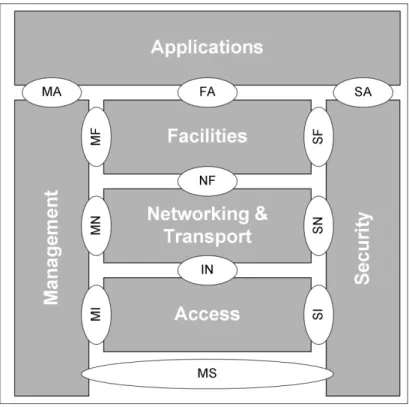
In this section, we describe the communications architecture of the ITS station. As an example, we follow the ETSI architecture of communications in ITS (ITSC) described in detail the ETSI EN 302 665 [40]. Figure 2.2 shows the ITS station reference architecture. It is an extended version of the Open Systems Interconnection (OSI) model [41] with included ITS applications.
Figure 2.2: ETSI ITS station reference architecture
Here is a brief description of the functionalities of each ITSC block:
• Applications: This block contains the classes of applications described in section 2.1. Different classes of
ap-plication have different requirements depending on their reliance on the communication. These requirements could vary with respect to reliability, latency and security.
• Management: This block contains all the management entities necessary for the ITS functionalities like the
regulatory information management, cross layer management, station management and application manage-ment. It is common to the all the protocol stack layers.
• ITSC OSI protocol stack: In the current ITSC ITS architecture, multiple layers of the OSI communication
protocol stack are combined into one block:
– Access: The ITSC access block includes the functionality of the OSI physical and datalink layers, usually
separated into layers 1 and 2. This block contains the communication technologies described in section 2.1, the IEEE 802.11p and 3GPP PC5 interface.
– Networking: The ITSC Networking & Transport are combined into one layer whilst they are depicted by
layers 3 and 4 in the OSI representation. The Networking protocols includes the IPv6 and GeoNetworking [42]. The Transport protocols include UDP/TCP and other dedicated ITSC protocols.
– Facilities: The ITSC Facilities layer combines the OSI session, presentation and application layers,
usually layers 5, 6 and 7. This layer includes generic functions and requirements which could be shared between different ITS applications. For instance, this layer manages the services like the cooperative awareness which could be used by various safety applications.
• Security: This block contains the functionalities relating to the communication security. It includes the
fire-wall and intrusion management, authentication and profile management as well as crypto key and certificate management. These functionalities are used in the vehicular PKI system described in section 2.4.1.
2.4
C-ITS security
In the current C–ITS system, ITS Stations (ITS–Ss) like vehicles and RSUs cooperate by exchanging messages. These messages are used a in large number of security applications (see Section 2.1). Therefore, any errors in these messages could cause the safety applications to malfunction, which in turn could lead to catastrophic results. Consequently, the messages and their contents must be secured. As a result, the ETSI and IEEE created and stan-dardized the vehicular PKI. However, the PKI is not enough to protect the system, specifically from internal attackers. The scientific community proposed misbehavior detection as a mitigation technique against these types of attacks. Currently, misbehavior detection is starting to be integrated in the latest ETSI and IEEE security architectures.
2.4.1
Vehicular PKI system
In this section, we describe the vehicular PKI system. The PKI is a form of asymmetric or public-key cryptography where every user owns at least one pair of keys, one public and one private. It is based on the mathematical one-way
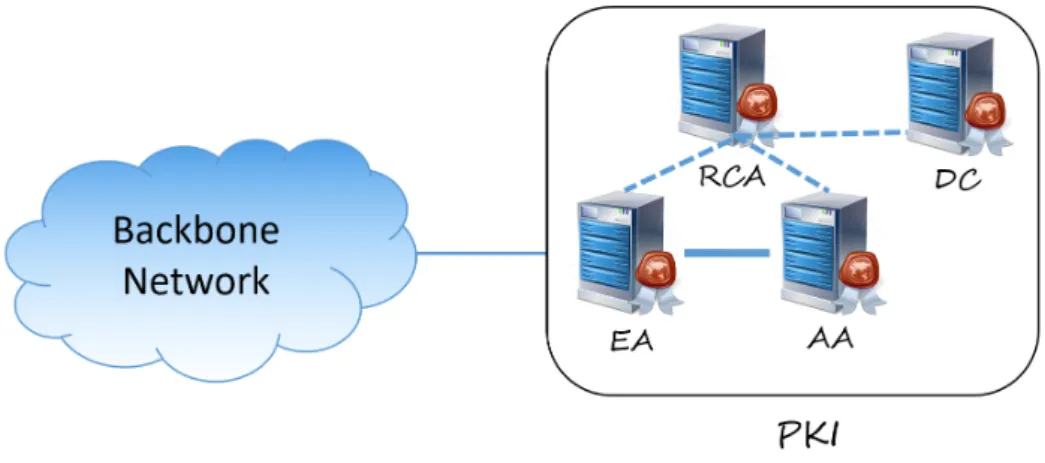
Figure 2.3: ETSI Vehicular PKI system
functions. The private key is used to encrypt data which could only be decrypted using the public key and vice-versa. Basically speaking, the sender encrypts the hashed message using his private key, this is called the signature. The receiver then uses the sender public key to decrypted the signature, then checks if it matches the hash of the received message. This enables the receiver to verify that the message was not altered during transmission. The vehicular PKI mainly updates the traditional PKI system with privacy protection and key distribution mechanisms.
As an example, we describe the ETSI Security Credential Management System (SCMS) for V2X communica-tions. The ETSI SCMS implements a PKI published in three technical specification standards. The ETSI TS 102 940 [11] includes a high level description of the security requirements and adopted architecture. The ETSI TS 102 941 [43] includes a more detailed description of the protocol and the exchanged messages. The ETSI TS 103 097 [44] contains the Abstract Syntax Notation One (ASN.1) description of the certificates and messages formats.
For the purpose of this thesis, we provide a brief general description of the functionalities the ETSI PKI illustrated in Figure 2.3. It includes four main components:
Authorization Authority (AA): The AA is the only security management entity with a direct communication with the enrolled ITS–S. The role of this entity is to issue and monitor the use of Authorization Tickets (ATs). An AT enables an ITS–S to send authentic V2X and to use specific C–ITS services.
Enrolment Authority (EA): The EA has only one direct contact with the ITS–S upon enrolment. The role of this entity is to manages the Enrolment Credentials (ECs) of ITS–S. The ECs are not used to sign messages sent to neighboring ITS–Ss. Instead, they enable the vehicle to request more ATs.
Root Certificate Authority (RCA): The RCA is the highest authority in the security management hierarchy. The role of this entity is to provide the EA and the AA with the certificates needed to be trusted by the ITS–S. These certificates allow then to issue valid ECs and ATs.
Distribution Center (DC): The DC provides the Certificate Trust List (CTL) and the Certificate Revocation List (CRL) to the local ITS–Ss. These lists enable the ITS–Ss verify the legitimacy of the certificate authorities.
In short, a new ITS–S should first find the address of an EA included in the CTL and verify that its certificate is signed by a valid RCA. Then, the ITS–S proceeds to request one EC, also called the long term identity, from the EA. This step is generally carried out in the factory. The ITS–S then acquires the address of an AA from the CTL and verifies its certificate. The ITS–S sends a request to this AA including the public key of the EC that is encrypted with the public key of the EA. Upon receiving this request, the AA will send the encrypted EC to the EA, which is able to decrypt it and verify that the vehicle is indeed enrolled. If so, the AA will issue new a AT to the ITS–S. These ATs, also called Pseudonyms, are used to sign V2X messages. An ITS–S station should regularly change its used Pseudonyms to hide its identity and avoid tracking by passive attackers.
The ETSI PKI enables local ITS–S to verify the authenticity and integrity, authorization of incoming messages from legitimate users. The certificates could also include different levels of authentication. For instance, an ambu-lance or a police vehicle could obtain a higher road priority. Additionally, the PKI protects the users’ privacy. The users’ privacy is protected on the local level through the use of Pseudonyms. The privacy is also protected on the global level. This is due to the mechanism used to request ATs. The EA and the AA are unable to track the real identities of ITS–Ss without cooperating. Finally, the PKI has been thoroughly tested by researchers for performance evaluation [45] [46] and for scalability [47]. These studies concluded that current state the ETSI PKI is feasible in a realistic environment.
Similarly to the ETSI version, the IEEE ITS–S acquire a long term identity equivalent to the EC and pseudonym identities equivalent to the ATs. Even though the IEEE version of the SCMS is not described here, it provides similar privacy and authenticity benefits to the ETSI version.
2.4.2
Misbehavior in C-ITS
Currently, neither the IEEE nor the ETSI versions of the SCMS provide protections that ensure the validity of the contents of a V2X message. An ITS–S with a valid set of ATs could send erroneous messages, all while having a valid signature. These errors are due to sensor fault, on-board unit malfunctions or even hacking. The physical sensors responsible for acquiring environmental data (e.g. GPS, Radar, etc. . . ) could return incorrect information. The connection between the sensor and the on-board unit could be unreliable, leading to a number of bad readings. The on-board unit of a vehicle responsible for the transmission of V2X messages may contain bugs in its software. Even if we design a secure system where we minimize the possibility of the former issues, an on-board unit could still be hacked by a user with malicious intentions.
A hacker with control of an on-board unit is able to send V2X messages containing strategic information to serve a selfish purpose. For instance, an attacker could fake a traffic congestion warning on a specific road segment
to deter other vehicle from choosing it. An attacker could also fake an emergency break warning to cause other vehicles to needlessly decelerate. An attacker could even manipulate information to cause multiple vehicles to crash in a platoon. Furthermore, an attacker could use the multiple ATs in his collection to simulate the existence of multiple fake vehicles on the road. These fake vehicles could be cleverly used to take advantage of the V2X services. For instance, an attacker could fake the existence of a large number of vehicles waiting on a smart traffic light in order to gain priority at an intersection. Finally, the privacy protections provided by the vehicular PKI would make a malicious ITS–S less detectable. The attacker could perform an attack and then change his AT to regain the trust of his neighboring ITS–S. This type of potential abuse of the C–ITS services renders a misbehavior detection protocol essential to the system deployment.
2.4.3
Misbehavior detection protocol
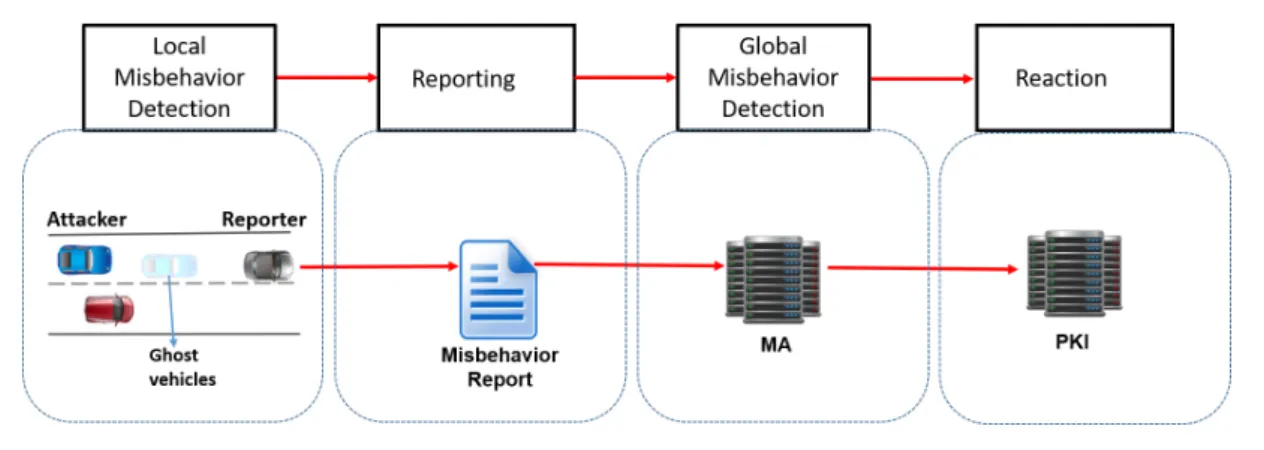
Figure 2.4: Misbehavior detection process
In this section, we describe the misbehavior detection process shown in figure 2.4. This process is divided into four steps:
Local detection: The local misbehavior detection is performed by the embedded component in every ITS–S (i.e. RSUs and Vehicle’s OBUs). The misbehavior detection system is a security layer on top of the cryptography PKI component. Upon the reception of a new message and the verification of its signature, the ITS–S relays the message to the local misbehavior detection process. The message should then pass a set of simple and fast security checks to estimate the plausibility and consistency of the received data. The results of these checks are then fused using a local fusion application. The fusion application should then decide if an ITS–S is misbehaving and if a misbehavior report should be issued.
Misbehavior reporting: The misbehavior reporting process begins when the local fusion application determines that a misbehavior report should be issued. This process consists of building a Misbehavior Report (MBR) message with a set of relevant information confirming the misbehavior of the reported vehicle. More precisely, vehicles are
required to provide evidences proving the type of the detected misbehavior to the MA. This evidence consists mostly of the messages used in the detection process. After collecting enough evidence, the MBR is then sent to the global MA. The report could be transmitted to the MA via a trusted RSU or by direct cellular communication.
Global Misbehavior detection: The global misbehavior detection process begins by collecting the received MBRs. This operation is performed by the MA which is localized in the back-end security management system. Using the evidence in the MBRs, the MA should be able to recreate the local events to verify, if possible, the validity of the report. The MA then proceeds to analyze the collected MBRs to identify if a misbehavior has occurred and then precisely define the type of this misbehavior. The severity and the type of misbehavior determines the suitable reaction required to protect the system.
Misbehavior reaction: Once the detection results are obtained, the MA informs the authority in charge of enforc-ing the appropriate misbehavior reaction. Currently, the only discussed reaction type is the certificate revocation enforced by the PKI. In figure 2.4, we just provide an example where the PKI is in charge of proceeding to the appropriate reaction. As this is not yet standardized, the revocation and reaction procedure is still not well defined and other authorities may be in charge of the misbehavior reaction in the future.
2.4.4
General security architecture
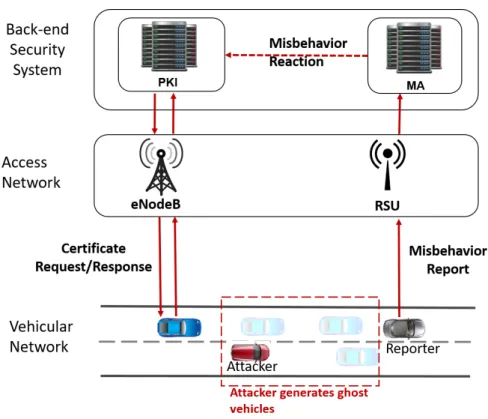
In this section, we recap the overall system architecture in the case of a presence of an attacker as illustrated in figure 2.5. We describe what occurs in different sections of the system.
• Vehicular Network consist of communicating ITS–Ss. Vehicles with valid certificates exchange signed sages that serve various purposes in ensuring road safety. For instance, a vehicle could send beacon mes-sages, such as CAMs or BSMs, which contains kinematic information (position, heading, velocity etc...) to inform other vehicles of its presence on the road. However, an attacker could send these messages with fake information. The attack could be performed by one or multiple collaborating vehicles. Many use cases of attacks exist with different motivations and capabilities.
• Access Network is the layer used to relay local information to the back-end system in the cloud. This informa-tion includes certificate requests to the PKI and misbehavior reports to the MA. The communicainforma-tion could be done over a cellular connectivity (eNodeB) or the ITS-G5 (RSU).
• Back-end Security System is currently composed of the Public Key Infrastructure (PKI) and the Misbehavior Authority (MA). The PKI delivers digital certificates to the vehicles. The MA collects the MBRs form local vehicles then investigates and issues the suitable reaction.
2.5
Attacker model
In this research domain, we consider misbehavior in the use of the C–ITS communication infrastructure. A misbe-havior could be the result of a faulty on-board system or physical sensors or a result of malicious intentions. The misbehaving ITS–S transmits signed messages with a modified payload. Generally, the attacker model has the following characteristics:
1. Insider: The attacker has the required cryptographic credentials to communicate on the C–ITS network. The
attacker possesses a valid set of ECs and is able to request valid ATs from the AA. These ATs are used to sign the misbehaving messages.
2. Active: The attacker actively participates in the C–ITS communication and sends bogus data over the V2X
network. Unlike the passive attacker whose main role is data collection and who therefore operates without transmitting any messages.
3. Message payload modification: The attacker can modify any field in its outgoing V2X messages. This is
possible if an attacker has complete access to his vehicle’s CAN bus. The attacker could also have changed the software of his vehicle’s OBU. The attacker could also mount a man-in-the-middle attack and modify any sensor data. For instance, this should allow the attacker to modify location data received from a GPS module.
It should also allow the attacker to modify speed and acceleration information from a Telematics Control Unit (TCU). As the vehicle’s OBU (V2X Unit) is connected to the CAN bus, it would consider this data genuine.
4. Transmission rate modification: We assume that the attacker can modify the transmission rate of his OBU.
The attacker can alter the OBU in his vehicle, allowing faster or slower transmission rate depending on the type of the attack. For instance, the attacker could greatly increase his transmission rate to perform a Denial-of-Service (DoS) attack. The attacker could also double his transmission rate to pretend to be two vehicles, thus creating a ghost vehicle.
5. Pseudonym certificates access: The attacker has complete access over the usage of his previously acquired
pseudonym certificates. We use the same premise as above, that the attacker has modified his OBU. This modification should give the attacker an unrestricted usage of his pseudonym certificates. This would enable the mounting of Sybil attacks. For example, to create four other ghost vehicles in addition to his own, the attacker would use five simultaneous certificates and increase the transmission frequency by five times. The attacker would be able to transmit signed beacons for all four Sybil ghost vehicles and his own, all while honoring required standard transmission rate.
2.6
Related works
Misbehavior Detection is a well-researched topic with studies spanning the last two decades. Golle et al. first published in 2004 a paper on detecting and correcting malicious data in the vehicular networks [48]. Their work is regarded as one of the first to introduce the research axis. They highlight the possibility of vehicles transmitting fraudulent data such as a road congestion or an erroneous vehicle position. They also emphasize the damaging effects of such attacks. Since then, this topic has been studied in much further detail. Van der Heijden et al. published in 2019 a well written and complete recent survey on the different misbehavior detection studies [49]. The survey includes a large number of well-known works and detection mechanisms. They classify the studies into two families of detection mechanisms: data-centric and node-centric. A study could make use of a combination of mechanisms but every mechanism fits under one of these families. Data-centric mechanisms rely purely on the contents of the message to estimate its plausibility and consistency. Node-centric mechanisms rely on the behavior of a node and generally assign a trust value to every neighboring ITS–S.
In this section, we examine the published studies related to all the contributions of this thesis. The studies will be sorted by the detected attack and by the family of detection mechanism.
2.6.1
Detection of Sybil attacks
With the current ETSI and IEEE C–ITS model, the PKI infrastructure provides the vehicle with multiple valid certifi-cates. The vehicle proceeds to regularly change its identity in order to prevent easy remote tracking. An attacker could take advantage of this system to launch a Sybil attack. Sybil attacks were first introduced by Douceur in [50]. In V2X networks, a sybil attack occurs when an ITS–S actively uses multiple pseudonyms at the same time to sim-ulate one or several ghost vehicles. Due to the important damages it may cause in C–ITS systems, researchers introduced several approaches for Sybil detection.
Pouyan et al. [51] propose three methods for local Sybil attack detection. The resource testing method assumes that a radio network entity cannot send and receive on the same channel at the same time. This detection method is not valid in the current state of vehicular networks because attackers may have multiple channels to send and receive messages. The Position verification method assumes that a vehicle can be localized at only one position at the same time. This method proposes the use of physical signal properties (i.e. Received Signal Strength Indicator (RSSI), Time Of Arrival (TOA) and Time Difference Of Arrival (TDOA)) to verify the true position. The feasibility of this method in a real scenario remains to be assessed. Last, they propose the encryption and authentication based methods, which assume that using a PKI is enough to detect Sybil attack. In the current C–ITS system, a vehicle could obtain multiple pseudonym identities at the same time. Therefore, a legitimate entity with valid key materials can still perform a Sybil attack.
Chen et al. [52] and Park et al. [53] both propose Sybil detection mechanisms where a vehicle with an OBU collects signed time stamps from RSUs. The theory is that these stamps act as proof that a vehicle had passed by a certain RSU. Each vehicle is required to broadcast collected stamps. Since a Sybil attacker can only have one physical path, a group of vehicle with a similar collection of stamps is considered a suspect of a Sybil attack. Chang et al. [54] propose a similar mechanism they call Footprint. Footprint works similarly to the previous mechanisms as vehicles also collects signatures from RSUs. However, their model uses cryptography mechanisms to hide the real vehicles trajectories. Therefore, this model is more privacy friendly. Nevertheless, all these detection mechanisms assume a Sybil attacker is moving through the system and is not performing a localized attack (i.e. fake congestion). Additionally, a Sybil attacker that refrains from broadcasting the collected time stamps would have a similar status to an ITS–Ss that had just started a new trip.
Hao et al. [55] propose a protocol that detects Sybil nodes in a cooperative way by examining the consistency between the vehicles positions and those of their neighbors. The idea is based on detecting the sudden appearance of a vehicle or of multiple vehicles as well as on evaluating the number of neighbors. When a vehicle locally detects that a neighbor is potentially malicious, it broadcasts a warning message to have the confirmation of other neighbors that an attack is occurring. When the number of vehicles that confirm that an attack is occurring is greater than a predefined threshold, the identified vehicle may be quarantined for a certain period of time or reported to
the authority. We believe that cooperative detection systems are not reliable because the attacker takes part of the community and could distort the detection procedure. Moreover, it requires an honest majority to work properly. Xiao et al. [56] propose a similar protocol that also relies on vehicles broadcasting a list of neighbors. The broadcasted list should include unique identifiers for neighbors such as the hash of the last beacon. Additionally, the neighbors list should include the RSSI. Afterwards, specific calculation determines the legitimacy of each node according to the neighbors list and the range of each vehicle. Sybil attackers could then be reported or excluded from the network.
Zhou et al. [57] introduced Privacy-Preserving Detection of Abuses of Pseudonyms (P2DAP), a method which enables the ITS–S to verify its neighbors’ pseudonym identities through edge computing. In P2DAP, they consider edge computing through the use of RSUs, however this functionality could also be attributed to an eNodeB. In their system, the RSUs are considered a trusted entity. Accordingly, the RSU has the ability to link different pseudonyms. This linkage is done by pseudonyms which hash a common value. Linking pseudonyms would enable the detection of a Sybil attacker using the certificates issued for the same vehicle. In the current C–ITS system, the linkability of pseudonyms is not available even at the PKI level without the cooperation of the AA and the EA. Similarly, Lee et al. [58] propose Detection Technique against a Sybil Attack (DTSA), a method that is also enabled through the edge computation. DTSA suggest a different kind of pseudonyms where vehicles obtain a session key from a Vehicular Ad hoc NETwork (VANET) server to use within a limited time frame. Afterwards, each vehicle verifies the identity of neighboring vehicles with the help of the same VANET server.
Granted that the Sybil attack is ultimately a special kind of bogus information attack, it could also be detected by some types of methods designed for bogus information detection. In particular, those based on physical-layer and data-centric false beacon information detection mechanisms. This is addressed in detail in the following section.
2.6.2
Detection of bogus information attacks
Broadcasting bogus information sent on the V2X network is at the essence of misbehavior in C–ITS. Bogus in-formation could have different implications varying from minor issues, like deteriorating the quality of infotainment services, to dramatic problems like causing accidents and potentially victims. In this section, we describe some of the bogus information detection methods that have been proposed in the literature.
2.6.2.1 Bogus beacon messages detection mechanisms
Vora et al. [59] propose a method of verification of the position in the broadcasted beacons. Their method is edge-assisted and based on a total coverage of an area by RSUs or eNodeBs. They assume a broadcasted message is received by multiple RSUs. The RSUs then uses the received signal strength to estimate the distance. Using the distance from multiple RSUs, the misbehavior detection system is able to approximate an area where the message was generated. The position included in this message should coincide within this area. Hubaux et al. [60] propose another location verification scheme for broadcasted beacons. They discuss two mechanisms: tamper-proof Global
Positioning System (GPS) and verifiable multilateration. They argue that tamper-proof GPS is not an adequate solution. They state that tamper-resistant hardware has well known weaknesses and GPS in general is vulnerable to attacks such as spoofing and jamming. Therefore, they then argue that verifiable multilateration is the more robust method to achieve position verification. Verifiable multilateration is an edge assisted method that requires the total coverage of an area by base stations (e.g. RSUs). It uses distance bounding to verify that the messages could be physically received by a certain station. Afterwards, a back-end system verifies that the claimed position is within the intersection area of all the base stations.
Sun et al. [61] proposed several physical layer features to verify a vehicle’s location and mobility. In their attacker model, the attacker transmits false positions inside the beacon messages. This attacker can be independent or can collude with other attackers who will corroborate the false data. The authors consider a straight highway scenario with at least one honest vehicle in the communication range of the ego vehicle. They verify the attacker’s location and mobility information using Angle of Arrival (AoA) estimation, Doppler Speed (DS) measurement, extended Kalman filter (EKF) and input from neighboring vehicles.
Schmidt at al. [62] propose VEhicle Behavior Analysis and Evaluation Scheme (VEBAS). Their mechanism uses the semantics of the messages to determine its authenticity. This includes the use of multiple data-centric mech-anisms such as: Acceptance Range Threshold (ART), Minimum Distance Moved (MDM), Map-Proofed Position (MPP) and Sudden Appearance Warning (SAW). ART is based on the fact that the transmission range is physically limited. MDM supposes that a stationary vehicle should not transmit messages in order to prevent a roadside at-tacker. MPP is the verification that a vehicle is moving with valid trajectory with respect to the road. SAW is the monitoring of newly appearing vehicles, specifically targeting ghost vehicles. Finally, results of all these methods are combined using an Exponentially Weighted Moving Average (EWMA). Bißmeyer et al. [63], propose a method that combines the data-centric mechanism of VEBAS and a plausibility model to check for position intersections between multiple vehicles.
Leinm ¨uller et al. [64] propose a detection scheme that combines mechanisms from VEBAS with a new data exchange based detector. They introduce a node-centric detector called Pro-Active Neighbor Exchange. This detector is based on the vehicles broadcasting a table of their neighbors. The vehicles use this information to cross-check the general claimed positions of the neighbors. Van der Heijden et al. [65] propose a subjective logic based fusion of multiple misbehavior detection schemes. They propose an improved version of the ART detector that they call enhanced Acceptance Range Threshold (eART). eART improves on the ART by setting the acceptance transmission range to a Gaussian curve instead of a fixed threshold. They claim the Gaussian approach is better for combining eART with other mechanisms. Additionally, they use the Pro-Active Neighbor Exchange detector. Finally, they combine both detectors using subjective logic. Subjective logic [66] a probabilistic approach that takes into account the uncertainty and the trust in the source of the information.
neigh-bors. In this model the vehicle broadcasts a flow parameter for their vehicles in their neighboring region. The flow parameter is calculated based on the density and speed of vehicles in a fixed range. Therefore, the flow for neigh-boring vehicles has to be within a certain threshold. Consequently, using a statistical model, vehicles could calculate the plausibility of the neighbors’ information and detect misbehaving vehicles.
2.6.2.2 Bogus warning messages detection mechanisms
Ruj et al. [68] propose a data-centric scheme of misbehavior detection in vehicular networks. Similarly to the previously discussed studies, they use an edge assisted mechanism for position verification. Their method relies on distance bounding, but additionally on the speed of light and the message timestamp to verify the distance from the source of the transmitted signal. Furthermore, they propose a data-centric verification scheme for warning messages. Their method for warning verification relies on the assumption that a vehicle emitting a warning event should behave accordingly. Ghosh et al. [69] also propose a similar scheme for the detection of fake warning messages. Their method is based on integrated root-cause analysis. For example, a vehicle issuing a blocked road warning needs to be on a proximity of the event and needs to change its path accordingly to avoid the obstacle. A vehicle issuing a warning event is thus monitored by the neighboring vehicles to determine the message authenticity and therefore the validity of the warning.
Cao et al. [70] propose a voting based validation scheme for warning messages. The validation of an event depends on the number of signatures it receives from neighboring vehicles. In this work, they created an efficient and secure protocol to collect and distribute signatures. Their protocol relies on growth codes introduced by Kamra et al. [71]. Growth codes are initially introduced to enhance efficiency and data persistence in an unreliable or failing sensor networks. They are used here to ensure that transmitted signatures arrive to their respective destinations. Hsiao et al. [72] propose a similar voting based warning validation. They consider a system where an event becomes valid if the number of witnesses exceeds a certain threshold, then proceeds to evaluate multiple threshold-based event validation algorithms.
2.6.2.3 Trust based detection mechanisms
Kim et al. [73] propose a misbehavior detection mechanism based on a Certainty of Event (CoE) curve. The CoE is calculated using a combination of six different sources: Cryptographic Authentication, Source Location, Local Sensors, Responses from Other Vehicles, Infrastructure Validation and Reputation. Cryptographic Authentication is the validation of the PKI certificates and the message signature. They consider that this authentication is enough to prevent Sybil attacks, which is no longer true in the presence of pseudonyms. Source Location is check if a vehicle geographic location is in the area of relevance of the event. Local Sensors is an on-board validation when the recipient vehicle is in direct line of sight of the event. Responses from Other Vehicles is a voting based integrity check that relies on the support or contradiction of neighbors of a certain event. Infrastructure Validation is based on