
HAL Id: hal-00725707
https://hal.archives-ouvertes.fr/hal-00725707
Submitted on 27 Aug 2012HAL is a multi-disciplinary open access archive for the deposit and dissemination of sci-entific research documents, whether they are pub-lished or not. The documents may come from teaching and research institutions in France or abroad, or from public or private research centers.
L’archive ouverte pluridisciplinaire HAL, est destinée au dépôt et à la diffusion de documents scientifiques de niveau recherche, publiés ou non, émanant des établissements d’enseignement et de recherche français ou étrangers, des laboratoires publics ou privés.
Non-linear electro-elastic coupling in
non-centrosymmetric materials
Jacky Even, Laurent Pedesseau, Chahira Hajlaoui, Claudine Katan,
Jean-Marc Jancu
To cite this version:
Jacky Even, Laurent Pedesseau, Chahira Hajlaoui, Claudine Katan, Jean-Marc Jancu. Non-linear electro-elastic coupling in non-centrosymmetric materials. 3rd Workshop on Theory, Modelling and Computational Methods for Semiconductors (TMCSIII), Jan 2012, Leeds, United Kingdom. pp.012005, �10.1088/1742-6596/367/1/012005�. �hal-00725707�
Non-linear electro-elastic coupling in non-centrosymmetric materials
This article has been downloaded from IOPscience. Please scroll down to see the full text article. 2012 J. Phys.: Conf. Ser. 367 012005
(http://iopscience.iop.org/1742-6596/367/1/012005)
Download details:
IP Address: 193.52.94.40
The article was downloaded on 24/05/2012 at 14:21
Please note that terms and conditions apply.
Non-linear electro-elastic coupling in non-centrosymmetric
materials
J Even1, L Pedesseau1, C Hajlaoui1, C Katan1,2and J-M Jancu1 1
Université Européenne de Bretagne, INSA, FOTON, UMR 6082, F-35708 Rennes, France
2
CNRS, Institut des Sciences Chimiques de Rennes, UMR 6226, 35042 Rennes, France
E-mail: [email protected]
Abstract. We propose an extended symmetry-based thermodynamical model of third-order
electro-elastic coupling. The entanglement of electrostriction non-linear piezoelectricity and other non-linear phenomena, is studied in details at the same level of theory. Symmetry properties of materials and nanostructures are taken into account. Density Functional Theory (DFT) is used to calculate the complete set of linear and non-linear coefficients. Electrostriction dominates for nitride compounds in the Würtzite structure, but non-linear elasticity and piezoelectricity must be taken into account for strain and electric field evaluation.
1. Introduction
A complete model of third-order electro-elastic coupling has recently been proposed [1]. It is an extension of a previous thermodynamical approach [2] (quoted as ATK model in this paper). The latter seems to be almost ignored up to now, although a number of misinterpretation or errors could have been avoided recently in the literature. In this work, the ATK model is combined systematically with symmetry analyses and DFT calculations to evaluate consistently the various linear and non-linear coefficients, especially in non centrosymmetric materials. Symmetry properties of third-order elastic constants are well known [3], but have been extensively studied for third-order coupled constants only more recently [4]. In this paper, third-order coefficients are mostly determined from finite difference studies of material’s polarisation or stress tensor under various electrical or strain conditions. We show in section 2. that the non-linear tensors can be strongly entangled. Actually, in the same theoretical model, coefficients defined for a specific thermodynamical potential should not be mixed with others without caution. Experimental determination of piezoelectric and electrostrictive entangled components must also rely on careful definitions of experimental conditions which makes such measurements very tedious and tricky [5]. The direction of the applied field and the frequency behaviour are useful tools to separate the strains which are arising from piezoelectricity and electrostriction.
2. Thermodynamic potentials and derivatives
2.1. Thermodynamic potentials and first order derivatives
Thermodynamic potentials are introduced using standard definitions for the free energy and enthalpy, TS
U
F and GU
i
i TS, and the transformed free energy and enthalpy3rd Workshop on Theory, Modelling and Computational Methods for Semiconductors IOP Publishing Journal of Physics: Conference Series 367 (2012) 012005 doi:10.1088/1742-6596/367/1/012005
l l e U TS ED
F and Ge U
i
i TSElDl. TheDl,El vectors and the
i,
i strain-stress tensors (in Voigt notation) are associated respectively to the l,m,n,u,v,o and i, j,k,p,q,r indices varying between 1-3 and 1-6 respectively.The first order derivatives of the thermodynamic potentials are: dG SdT
id
iEldDl dGe SdT
id
i DldEl dFe SdT
id
i DldEl dF SdT
id
i EldDlIn the following, most expressions are related to Fe, G and Ge.
2.2. Second order derivatives
Three second-order derivatives in relation to Dl,El,
i and
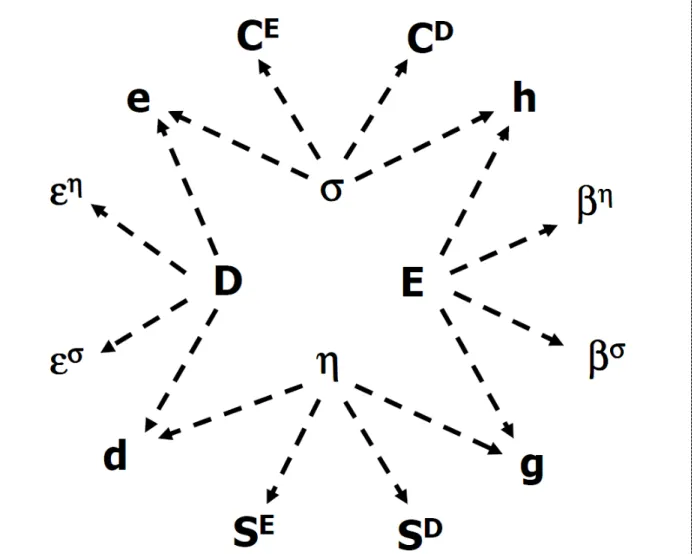
i are defined for each of the thermodynamic potentials.Figure 1. Schematic representation of the relations between thermodynamic variables (inner variables) and second order derivatives of the thermodynamic potentials (outer variables). For clarity,
minus signs are not shown.
Figure 1 is a schematic representation of the relations between thermodynamic variables and second order derivatives of the thermodynamic potentials (for the clarity of the figure minus signs are not shown) : ij j il l E i
C
d
e
dE
d
and dDl elid
i
lmdEm for Fe ij j il l E iS
d
d
dE
d
and dDl dlid
i
lmdEm for Ge ij j il l D iS
d
g
dD
d
and dEl glid
i
lmdDm for GThe second-order derivatives of the thermodynamic potentials are related to each other by exact expressions: ji im E lj lm lm
e
S
e
ij jl E ilC
d
e
ij il lj D ij Ed
g
S
S
2.3. Third order derivatives
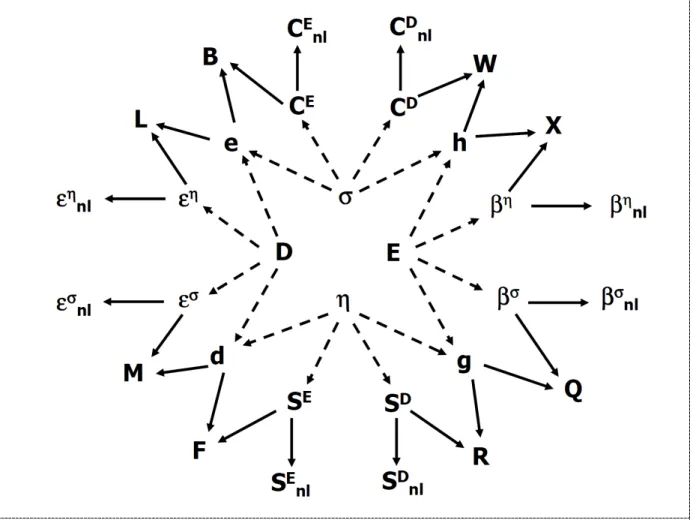
Four third-order derivatives are defined for each of the thermodynamic potentials. Figure 2 is a schematic representation of the relations between thermodynamic variables and third order derivatives of the thermodynamic potentials (minus signs are not shown). Some of these derivatives are common to different thermodynamic variables, for example :
l j i e T E j i l l j i T l ij ijl T E j li lij E F D E E C B e B
3 , 2 2 , ,The third order derivatives are also connected to second order derivatives :
ijk k ijl l E ij E
dE
B
d
C
dC
, deli Blijd
j LlimdEmand d
lm Llmid
i
lmndEn ijk k ijl l E ij E
dE
F
d
S
dS
, ddli Flijd
j MlimdEmand d
lm Mlmid
i
lmndEn ijk k ijl l D ij D
dD
R
d
S
dS
, dgli Rlijd
j QlmidDmand d
lm Qlmid
i
lmndDnMost of these quantities are already used in various papers [5-7], but we will focus on the non-linear piezoelectric tensors Blij,Flij ,Rlij and the electrostrictive tensors Llmi,Mlmiand Qlmi. The third-order derivatives of the thermodynamic potentials are also related to each other by various exact expressions:
F
lij
S
EikB
lkpS
Epj
e
lkS
Ekij
R
lij lmF
mij lm nvM
mnid
vjM
mnjd
vi lmnd
mid
nj
(
)
Qlmi lmndni mn lvMvni
M
lmi
(
B
lkpd
mp
B
mkpd
lp)
S
Eki
L
lmjS
Eji
e
lke
mjS
Ekji.3rd Workshop on Theory, Modelling and Computational Methods for Semiconductors IOP Publishing Journal of Physics: Conference Series 367 (2012) 012005 doi:10.1088/1742-6596/367/1/012005
Figure 2. Schematic representation of the relations between thermodynamic variables, second derivatives and third order derivatives (outer variables) of the thermodynamic potentials. For clarity,
minus signs are not shown. 3. Symmetry analysis
It has been shown in section 2. that the non-linear tensors can be strongly entangled. For instance, in the case of non-centrosymmetric materials, an additional term related to the linear piezoelectricity and the non-linear susceptibility must be added to the commonly used relation Qlmi
mn
lvMvni [5].It is necessary to use symmetry properties of the materials in order to check whether or not the entanglement has to be taken into account. In order to get a first insight into the influence of lattice symmetry, we may compare materials which crystallise in a cubic lattice associated either to the m3m (e.g. diamond or undistorted perovskite lattices) and 432 point groups. In both cases, the linear piezoelectric tensors and non-linear susceptibilities are vanishing: eli dli gli 0
and
lmn
lmn
lmn 0. Only six independent non-linear elastic constants and compliancesexist: CEijk , SEijk SDijk. Qlmi, Mlmi and Llmi tensors related to electrostriction are simply
connected, like in isotropic materials: Qlmi
mn
lvMvni andM
lmi
L
lmjS
Eji, although thenumber of independent coefficients is larger. The only difference between the m3m and 432 point groups comes from the non-linear piezoelectricity phenomenon which appears only in the 432 case. Among the thirty-two crystal classes, eleven are centrosymmetric (m3m case) and twenty-one are non-centrosymmetric, but of these, 432 is a special case. For point group 432, non-linear piezoelectricity
and electrostriction, are indeed disentangled. The various non-linear piezoelectric tensors are simply connected and only one independent component
B
124 has to be determined:124 44 124 12 11 124 (S S )B S R
F E E E
. Ten of the non-centrosymmetric crystal classes represent the polar crystal classes, which show a spontaneous polarization. For all this crystal classes, the entanglement of non linear piezoelectricity, non linear dielectric susceptibility and electrostriction is very strong. The hexagonal 6mm polar crystal class corresponds to a number of important materials in the wurtzite structure. The tensors describing non-linear piezoelectricity have 8 independent components : B311, B312, B313, B333, B344, B115, B125, B135 whereas the tensor describing electrostriction has 6 components :L
11,L
12, L13, L31, L33,L
44. Using relationkji E mj lk ji E lmj ki E lp mkp mp lkp lmi
B
d
B
d
S
L
S
e
e
S
M
(
)
, we can compare the non-linear piezoelectric,electrostrictive and elastic contributions. In the case of nitride compounds like GaN, the electrostrictive contribution is the most important, but non-linear piezoelectric effect can not be ignored [1].
4. Determination of non-linear coefficients using density functional theory
The methods of density-functional perturbation theory (DFPT) may be used to calculate various physical responses. In fact the efficient use of the "2n+1" theorem [8], using only by-products of a first-order perturbation calculation, in principle gives the second and third-order derivatives of the total energy at the level of the ATK model, if the atomic-displacement variables are eliminated. Second-order derivatives may be used with an existing DFPT implementation [9] to calculate various physical response properties of insulating crystals, including elastic constants, linear piezoelectric tensors, linear dielectric susceptibility, as well as tensor properties related to internal atomic displacements like Born charges. Third-order derivatives of the total energy are related to a number of physical properties described in this work, like the non-linear electrical susceptibility, the non-linear elasticity, the photo-elastic and electrostrictive effects. However, most practical implementations of the DFPT are restricted to some quantities related to internal atomic displacements. DFT simulations are performed using a state of the art DFT implementation [9] within the local density approximation (LDA). Plane wave basis sets were used with a kinetic energy cutoff of 950 eV after convergence studies. The sets of k-points were generated following the procedure of Pack and Monkhorst and Pack [10] namely 10 10 10. Polarisation and stress tensor components can be studied as a function of the electric field and strain tensor components. We applied various electrical or strain conditions for the DFT determination of all the coefficients in the case of the GaN and AlN crystals [1]. In figure 3, the variations of
3 and P3 are reported as a function of
3 for AlN.3rd Workshop on Theory, Modelling and Computational Methods for Semiconductors IOP Publishing Journal of Physics: Conference Series 367 (2012) 012005 doi:10.1088/1742-6596/367/1/012005
Figure 3. Variations of
3 and P3 calculated using a state of the art DFT implementation [9] are reported as a function of
3 for AlN.Acknowledgement.
This work was performed using HPC resources from GENCI-CINES (Grant 2010-[c2010096472]) and French ANR Project INSCOOP (no ANR-11-NANO-012)
References
[1] Pedesseau L, Katan C and Even J 2012 Appl. Phys. Lett. 100 031903 [2] Adam W, Tichy J and Kittinger E 1988 J. Appl. Phys. 84 2556 [3] Brugger K 1965 J. Appl. Phys. 36 759
[4] Grimmer H 2007 Acta Cryst A63 441
[5] Newnham R E, Sundar V, Yimnirun R, Su J and Zhang Q M 1997 J. Phys. Chem. B101 10141 [6] Bester G, Wu X, Vanderbilt D and Zunger A 2006 Phys. Rev. Lett. 96 187602
[7] Gerlich D and Breazeale M A 1990 J. Appl. Phys. 68 5119
[8] Hamann D R, Wu X, Rabe K M and Vanderbilt D 2005 Phys. Rev. B71 035117
[9] Gonze X, Amadon B, Anglade P M, Beuken J M, Bottin F, Boulanger P, Bruneval F, Caliste D, Caracas R, Cote M, Deutsch T, Genovese L, Ghosez Ph, Giantomassi M, Goedecker S, Hamann D R, Hermet P, Jollet F, Jomard G, Leroux S, Mancini M, Mazevet S, Oliveira M J T, Onida G, Pouillon Y, Rangel T, Rignanese G M, Sangalli D, Shaltaf R, Torrent M, Verstraete M J, Zerah G, Zwanziger J W, 2009 Computer Phys. Commun. 180 2582
[10] Monkhorst H J and Pack J D, 1976 Phys. Rev. B13, 5188
![Figure 3. Variations of 3 and P 3 calculated using a state of the art DFT implementation [9] are reported as a function of 3 for AlN.](https://thumb-eu.123doks.com/thumbv2/123doknet/11621139.304438/8.892.100.796.169.644/figure-variations-calculated-using-state-implementation-reported-function.webp)
