
Pépite | Réactivité chimique des aérosols d'iode en conditions accidentelles dans un réacteur nucléaire
162
0
0
Texte intégral
(2) Thèse de Houssam Hijazi, Lille 1, 2017. © 2017 Tous droits réservés.. lilliad.univ-lille.fr.
(3) Thèse de Houssam Hijazi, Lille 1, 2017. © 2017 Tous droits réservés.. lilliad.univ-lille.fr.
(4) Thèse de Houssam Hijazi, Lille 1, 2017. © 2017 Tous droits réservés.. lilliad.univ-lille.fr.
(5) Thèse de Houssam Hijazi, Lille 1, 2017. Remerciement Dans cette petite page, je voudrais consacrer ce manuscrit à toutes les personnes qui m'ont aidé et soutenu pendant les trois années de mon doctorat. Je remercie sincèrement M. Laurent Cantrel, directeur de recherche chez IRSN, pour m'avoir confié pour intégrer son domaine de recherche. Je suis très reconnaissant à M. Jean-François Paul, mon directeur de thèse, de m'avoir accueilli dans le laboratoire UCCS. MM. J-F et Laurent, j'ai profité de votre connaissance approfondie du domaine qui a avancé le travail rapidement à côté de votre patience et votre gentillesse, vous avez montré en répondant à mes questions et en résolvant les problèmes auxquels je suis confronté. Je tiens à remercier l'équipe avec laquelle j'ai travaillé, Dimitri, Mireille, Eric, Siwar et Fatah. J'aimerais également remercier tous mes collègues de mon bureau au cours de mes trois années, Soraya, Marine, Marie, Ayman, Shreya, Gorge, Camilla, Renata, Carlos, Francisco, Leila et Claudia. Un merci spécial à ma famille. Je suis très reconnaissant à ma mère Zeinab et à mon père Dib pour leurs sacrifices qu'ils ont faits en mon nom. Aussi, je tiens à remercier mes sœurs Lina, Wafaa et mes frères Youssef, Ali, Khalil, Imad, Hassan, Hussein, Mohamad et Hadi. Enfin, je tiens à remercier tous mes amis en France et au Liban, Aude, Rachad, Hammoud, Najib, Daoud, Krayem et Ali Deeb en dehors de mon travail qui m'a soutenu et m'a encouragé à accomplir ce travail aussi bien que possible.. © 2017 Tous droits réservés.. lilliad.univ-lille.fr.
(6) Thèse de Houssam Hijazi, Lille 1, 2017. © 2017 Tous droits réservés.. lilliad.univ-lille.fr.
(7) Thèse de Houssam Hijazi, Lille 1, 2017. Acknowledgements In this small page, I would like to dedicate this manuscript to all persons who have helped and supported me during the three years of my PhD. I sincerely thank Mr. Laurent Cantrel, research director at IRSN, for giving me confidence to integrate his research field. I am very grateful to Mr. Jean-François Paul, my thesis director, for welcoming me in the laboratory UCCS. Messrs. J-F and Laurent I have benefited from your deep knowledge of the field which advanced the work fast beside your patience and kindness you showed in answering my questions and solving the problems I faced. I would like to thank the team I worked with, Dimitri, Mireille, Eric, Siwar and Fatah. I would like to thank also all my office colleagues during my three years, Soraya, Marine, Marie, Ayman, Shreya, Gorge, Gillium, Camilla, Renata, Carlos, Francisco, Leila and Claudia. A special thanks to my family. I am very grateful to my mother Zeinab and my father Dib for their sacrifices that they have made on my behalf. Also I would like to thank my sisters Lina, Wafaa, and my brothers Youssef, Ali, Khalil, Imad, Hassan, Hussein, Mohamad and Hadi. Finally, I want to thank all my friends in France and Lebanon, Aude, Rachad, Hammoud, Najib, Daoud, Krayem and Ali Deeb outside my work who supported and encouraged me to accomplish this work as good as possible.. © 2017 Tous droits réservés.. lilliad.univ-lille.fr.
(8) Thèse de Houssam Hijazi, Lille 1, 2017. © 2017 Tous droits réservés.. lilliad.univ-lille.fr.
(9) Thèse de Houssam Hijazi, Lille 1, 2017. Résumé Lors d’un accident nucléaire grave, plusieurs produits de fission peuvent être libérés dans l'environnement si des fissures apparaissent l’enceinte de confinement du réacteur nucléaire. Parmi ces produits, l'iode radioactif (131I) est un des produits les plus dangereux en raison de ses conséquences radiologiques élevées durant les premières semaines suivant l'accident. Cet iode radioactif va principalement former des aérosols (CsI et AgI) dans le système de refroidissement du réacteur. Ils pourront ensuite réagir dans une atmosphère oxydante et humide, résultant de la radiolyse de la vapeur d’eau entrainant la formation d'iode moléculaire gazeux I2. L'objectif de ce travail est d'étudier la réactivité des aérosols d'iodure afin de comprendre et identifier des voies chimiques possibles conduisant à la formation d'espèces d'iode volatiles. Nous avons mené une étude théorique basée sur la théorie fonctionnelle de la densité (DFT), comprenant les corrections de Van Der Waals, pour définir, à l'échelle moléculaire, les mécanismes des réactions chimiques se produisant à la surface des aérosols. Des corrections thermodynamiques ont également été utilisées pour déterminer l'effet de la température et de la pression sur cette réactivité. Les résultats montrent que l'adsorption de l'eau sur les particules CsI et AgI n'est possible qu’a basse des températures et pour des taux d’humidité élevées, non représentatives des conditions présentes dans l’enceinte de confinement mais pouvant être rencontrées à l’extérieur de cette même enceinte. Plusieurs voies de réaction conduisant à la formation d'espèces d'iode volatiles (I2, IOH et IH) ont été explorées. Ces travaux montrent que la formation de ces espèces nécessite une double oxydation de la surface pour libérer une espèce volatile. L’oxydant le plus réactif est OH°, résultant de la radiolyse à la vapeur. Dans ce cas, l'énergie d'activation pour formation d'I2 est respectivement de 1,2 eV et 1,0 eV pour CsI et du AgI. Mots clés: Iodure de césium, iodure d'argent, DFT, énergie d'activation, terme source, d'iode, accident nucléaire.. 1. © 2017 Tous droits réservés.. lilliad.univ-lille.fr.
(10) Thèse de Houssam Hijazi, Lille 1, 2017. 2. © 2017 Tous droits réservés.. lilliad.univ-lille.fr.
(11) Thèse de Houssam Hijazi, Lille 1, 2017. Abstract If a nuclear severe accident happens to a nuclear power plant, fission products can be released in the environment by some leakages of the nuclear containment building. Among them radioactive iodine is one of the most dangerous species due to its high radiological consequences during the first weeks after the accident, mainly due to. 131. I isotope. Some iodide aerosols, formed in the. reactor coolant system, are expected to reach the containment, typically CsI and AgI, and next can react in moist oxidizing atmosphere resulting from steam/oxygen radiolysis to form gaseous molecular iodine, I2. The aim of this work is to study the reactivity of iodide aerosols, it means understand/identify possible chemical pathways leading to the formation of volatile iodine species. Theoretical study based on density functional theory (DFT) including Van Der Waals corrections were performed to study at the molecular scale the chemical reactivity at the aerosol surfaces. Thermodynamic model was used also to determine the effect of temperature and pressure on the reactivity. The results show that adsorption of water on the CsI and AgI particles is only possible at low temperatures, not representative of severe accident conditions. Several reaction pathways leading to the formation of volatile iodine species (I2, IOH and IH) were explored. These works show that formation of these species requires the oxidation the surface twice. One type of oxidant were tested which is OH°, resulting from steam radiolysis and initially present in the containment after radiolysis of water. The activation energy of I2 formation using OH° oxidants is respectively 1.2 and 1.0 eV for CsI and AgI oxidation processes. Keywords: cesium iodide, silver iodide, DFT, activation energy, iodine source term, nuclear accident.. 3. © 2017 Tous droits réservés.. lilliad.univ-lille.fr.
(12) Thèse de Houssam Hijazi, Lille 1, 2017. 4. © 2017 Tous droits réservés.. lilliad.univ-lille.fr.
(13) Thèse de Houssam Hijazi, Lille 1, 2017. Table of contents Abstract…………….. ......................................................................................................................... 1 General Introduction .......................................................................................................................... 9 Chapter I: General Context ......................................................................................................... 13 I.1. Severe accident in Pressurized Water Reactor (PWR) and its impacts............................... 15. I.2. Severe accident scenario ........................................................................................................ 15. I.3. Radiological effects of iodine and cesium ............................................................................ 17. I.4. Physical properties of CsI ...................................................................................................... 18. I.5. Literature review on iodine properties .................................................................................. 19. I.5.1. General properties of iodine ........................................................................................ 19. I.5.2. Interaction of iodine with cesium................................................................................ 19. I.6. Formation of other iodine species ......................................................................................... 20. I.7. Effect of temperature on the formation of iodine species .................................................... 20. I.8. OECD/STEM Project ............................................................................................................. 21. I.9. Iodine Aerosol behavior in the containment ......................................................................... 22. I.10. Chemistry of Iodine ............................................................................................................. 23. I.10.1. Aqueous phase chemistry of iodine ............................................................................ 25. I.10.2. Gas phase chemistry of iodine..................................................................................... 26. I.11. Chemical reactivity of CsI aerosol ..................................................................................... 28. I.12. Chemistry of NaCl ............................................................................................................... 29. I.12.1. Surface energy .............................................................................................................. 29. I.12.2. Water adsorption and hygroscopicity ......................................................................... 30. I.12.3. Formation of Cl-containing compounds ..................................................................... 31. I.13. Conclusion............................................................................................................................ 33. I.14. Bibliography......................................................................................................................... 34 5. © 2017 Tous droits réservés.. lilliad.univ-lille.fr.
(14) Thèse de Houssam Hijazi, Lille 1, 2017. I.15. Appendix .............................................................................................................................. 40. Chapter II: Methodology................................................................................................................ 43 II.1. Theoretical background ....................................................................................................... 45. II.1.1. Hamiltonian of many body system ............................................................................. 45. II.1.2. Born-Oppenheimer approximation ............................................................................. 48. II.2. Density Functional Theory .................................................................................................. 48. II.2.1. Hohenberg-Kohn theorems ......................................................................................... 49. II.2.2. Kohn-Sham approach................................................................................................... 50. II.2.3. Approximations to exchange correlation potential .................................................... 52. II.2.4. Van der Waals interactions .......................................................................................... 54. II.3. Bloch’s theorem ................................................................................................................... 55. II.4. Pseudopotential .................................................................................................................... 56. II.5. Molecular dynamics ............................................................................................................ 57. II.5.1. Classical MD formalism .............................................................................................. 57. II.5.2. Born-Oppenheimer MD ............................................................................................... 59. II.5.3. Thermostat .................................................................................................................... 59. II.6. Nudged Elastic Band (NEB) ............................................................................................... 61. II.7. Application in VASP ........................................................................................................... 63. II.8. Cutoff Energy ....................................................................................................................... 65. II.9. Conclusion............................................................................................................................ 66. II.10. References ........................................................................................................................ 66. Chapter III: Reactivity of CsI aerosols .......................................................................................... 69 III.1. Introduction .......................................................................................................................... 71. III.2. CsI surfaces reactivity: A DFT study (submitted article) ................................................. 72. III.2.1. Introduction .................................................................................................................. 72 6. © 2017 Tous droits réservés.. lilliad.univ-lille.fr.
(15) Thèse de Houssam Hijazi, Lille 1, 2017. III.2.2. Theoretical methods ..................................................................................................... 74. III.2.3. Results and discussion ................................................................................................. 77. III.2.4. Conclusion .................................................................................................................... 90. III.3. Supplementary data corresponding to the paper ................................................................ 92. III.3.1. KPOINTS as function of energy ................................................................................. 92. III.3.2. Lattice constant and bulk volume ............................................................................... 92. III.3.3. Formation of I2 starting by optimized and experimental lattice constant ................. 93. III.3.4. Formation of I2 on a doubled cell in two directions ................................................... 94. III.3.5. Adsorption of one monolayer of water using different geometries .......................... 95. III.3.6. Effect of temperature and pressure on the adsorption of one water monolayer....... 96. III.3.7. Adsorption of more than one water monolayer on (011) CsI surface....................... 97. III.4. Reactivity of defected surfaces ........................................................................................... 98. III.4.1. Oxidation by one OH° ................................................................................................. 99. III.4.2. Oxidation by two OH° ............................................................................................... 100. III.5. Conclusion.......................................................................................................................... 103. III.6. References .......................................................................................................................... 104. Chapter IV: Chapter 4: Reactivity of Silver Iodide (AgI) ........................................................ 109 IV.1 Introduction ........................................................................................................................ 110 IV.2 Theoretical parameters of AgI .......................................................................................... 111 IV.3 Surface energy.................................................................................................................... 112 IV.4 Water adsorption on AgI surfaces. ................................................................................... 116 IV.4.1. Associative adsorption of one water molecule on AgI surfaces ............................. 117. IV.4.2. Dissociative adsorption of one water molecule on AgI surfaces ............................ 118. IV.4.3. Temperature and pressure dependence on the associative adsorption of water on. AgI surfaces ............................................................................................................................... 119. 7. © 2017 Tous droits réservés.. lilliad.univ-lille.fr.
(16) Thèse de Houssam Hijazi, Lille 1, 2017. IV.4.4. Half and one monolayer adsorption of water on AgI surfaces ................................ 120. IV.4.5. Conclusion concerning adsorption of water on AgI surfaces.................................. 122. IV.5 Reactivity of AgI ............................................................................................................... 122 IV.5.1. Reactivity without oxidant......................................................................................... 122. IV.5.2. Reactivity with oxidants ............................................................................................ 124. IV.6 Conclusion.......................................................................................................................... 131 IV.7 Bibliography: ..................................................................................................................... 132 Chapter V: Reactivity in liquid phase ........................................................................................ 135 V.1. Introduction ........................................................................................................................ 136. V.2. Classical molecular dynamics ........................................................................................... 136. V.3. Implicit solvent model ....................................................................................................... 137. V.4. Ab initio molecular dynamics ........................................................................................... 138. V.4.1. Free energy diagram and dynamics evolution .......................................................... 140. V.4.2. Pair correlation function and coordination number ................................................. 142. V.4.3. Diffusion coefficient of water ................................................................................... 145. V.4.4. Iodide reactivity in liquid phase ................................................................................ 146. V.5. Conclusion.......................................................................................................................... 146. V.6. References: ......................................................................................................................... 147. Chapter VI: General conclusion and perspectives .................................................................... 149. 8. © 2017 Tous droits réservés.. lilliad.univ-lille.fr.
(17) Thèse de Houssam Hijazi, Lille 1, 2017. General Introduction. 9. © 2017 Tous droits réservés.. lilliad.univ-lille.fr.
(18) Thèse de Houssam Hijazi, Lille 1, 2017. 10. © 2017 Tous droits réservés.. lilliad.univ-lille.fr.
(19) Thèse de Houssam Hijazi, Lille 1, 2017. General Introduction Motivation. Electricity is one of the most important needs in our daily life beside its. importance for developing artificial activities. Different sources were used to produce electricity like solar, thermal, chemical, etc. One of the modern methods is to convert nuclear energy to electricity in nuclear power plants by chain reactions. However, controlling the safety of these nuclear plants is of prime importance to prevent any non-controlled outside releases of volatile radioactive compounds. For safety reasons, nuclear power plants are secured by number of safety systems to control the chain reaction and consequently to cool down the fuel. Beside all safety procedures, some LOss of Coolant Accidents (LOCA) leading to severe accident were happened like Three Mile Island in 1979, Tchernobyl in 1986 and more recently Fukushima in 2011 in which an important amount of radioactive contamination were released into the environment. Number of experimental projects on nuclear safety were launched to understand the physical and chemical processes in the contamination after a severe accident. PHEBUS-FP program took place from 1988 to 2010 with some integral tests. Its purpose was to improve the understanding of the phenomena occurring during a core meltdown accident in a light water reactor and to validate the computational software used to represent these phenomena in reactor safety evaluations. Tests have shown/confirmed that during a severe accident, elements composed of caesium, boron and iodine were released in significant amounts and released in the primary circuit in gas or aerosol form and that which interacts between each other. The radiolytic reactions governs the chemical reactivity after fission products reached the nuclear containment building. Recently, experimental study done. in. the. frame. of OECD/STEM. project. (2011-2015,. https://www.oecd-. nea.org/jointproj/stem.html) examined the release of volatile iodine species from caesium iodide (CsI) aerosols under irradiation for long time (30 hours). To predict the radiological consequences of a severe accident on population, the French Institute of radioprotection and nuclear safety (IRSN) is developing modelling codes called ASTEC (‘Accidental Source Term Evaluation Code) which models the scenario of severe accidents in different types of reactors. This code is composed of many modules which take into account the. 11. © 2017 Tous droits réservés.. lilliad.univ-lille.fr.
(20) Thèse de Houssam Hijazi, Lille 1, 2017. phenomena that happen in different parts of pressurized water reactor in each stage of the accident Objectives. In our project, we will perform a theoretical study to discover the reactional. mechanism leading to the formation of iodine containing species especially I2 starting by some possible iodide metallic aerosols that may exist in the nuclear containment building after a severe accident like CsI and AgI. Approach. This manuscript is composed of five chapters:. Chapter I is constituted by the bibliography and presents wide range of experimental and theoretical data on aerosols and the context of the work carried out in this thesis. We present also the released species after a severe accident and its chemical properties. Later we present the liquid and gas phase chemistry of aerosols and at the end we showed chemistry of NaCl aerosols since its chemistry is quiet similar to that of CsI. Chapter II presents briefly the methods and techniques used in our calculation. Small description of many body theory is given. Next, we showed density functional theory (DFT) and its approximations and finally we presented briefly the used code (VASP). Chapter III shows all studies on CsI surface. Chapter IV shows all studies on AgI surface. Chapter V is constituted of conclusion and perspectives.. 12. © 2017 Tous droits réservés.. lilliad.univ-lille.fr.
(21) Thèse de Houssam Hijazi, Lille 1, 2017. Chapter I:. General Context. 13. © 2017 Tous droits réservés.. lilliad.univ-lille.fr.
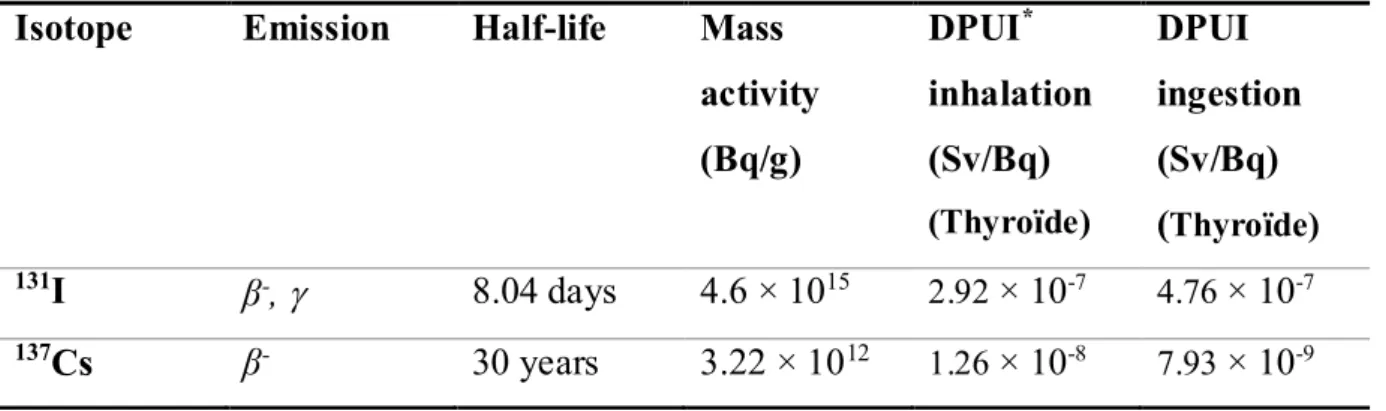
(22) Thèse de Houssam Hijazi, Lille 1, 2017. 14. © 2017 Tous droits réservés.. lilliad.univ-lille.fr.
(23) Thèse de Houssam Hijazi, Lille 1, 2017. I.1 Severe accident in Pressurized Water Reactor (PWR) and its impacts Nuclear reactor is a facility used to produce electricity basing on fission chain reactions. The heat produced from this reaction is used to heat pressurized water which flow through the fuel rods surrounded by a zirconium alloy cladding. This pressurized water circulates in the reactor coolant system (RCS) and via a heat exchanger (called steam generator) heats the water secondary system which is at saturation. The secondary-side steam is delivered to the turbines to make electricity. The steam is subsequently condensed via cooled water from a tertiary loop and returned to the steam generator to be heated once again (see Figure I-1). Fission of heavy nucleus like uranium or plutonium, gives new fragments. Generally, at least one of these two daughter nuclei is radioactive, which will still disintegrate until it reaches a stable nucleus. All fission fragments and their daughters present in the fuel are called fission products (FP), which they constitute the major part of the nuclear wastes.. Figure I-1: Schematic presentation of PWR1.. I.2 Severe accident scenario One of the important issues during the normal functioning is the safety procedures. Three basic functions of nuclear safety must be ensured in all circumstances to have safe reactor: 15. © 2017 Tous droits réservés.. lilliad.univ-lille.fr.
(24) Thèse de Houssam Hijazi, Lille 1, 2017. . Control of the chain reactions, and thus the power produced by the fissions; This control is ensured by control rods and boric acid in the water. Both can capture neutrons.. . Discharge of the energy released by the fuel elements after stopping the chain reaction (residual power). The residual power is evacuated by water cooling of the fuel rods ;. . Confinement of the radioactive fission products.. Confinement of radioactive materials is therefore a key element for the safety of the reactor. To ensure the confinement, the reactor has three containment barriers. The fuel pellets are first placed in sealed sheaths zirconium alloy, which prevents the release of radioactive products in the primary circuit. Next, the RCS as a whole is a sealed circuit which may retain the radioactive products. Finally, the entire primary circuit is placed in a sealed chamber formed of concrete, which can withstand high internal pressure, called the nuclear containment building. Thus, the radioactive products can only be released into the environment if all three containment barriers are broken. A severe accident can occur when the core is no longer cooled enough. Several scenarios can lead to partial or total loss of cooling systems. The fusion of the core leads to the formation of a complex mixture based on uranium dioxide UO 2 (PuO2 for MOX fuels) and also consisting of all the materials present in the vessel (Fe and control rod materials for instance), this mixture is called corium. The non-submerged parts of the core undergo significant temperature rise (more than 1200°C), causing the occurrence of physicochemical phenomena leading core degradation until its merger. Since the beginning of the civilian usage of nuclear energy, three serious accidents industrial nuclear reactors took place. The first, March 28, 1979, on the second nuclear reactor of the Three Mile Island (TMI-2) generating station in the US; the second, April 26, 1986 on the fourth reactor of the Chernobyl plant in Ukraine, and the last one, March 11, 2011, three of the six reactors at the Fukushima Daiichi plant in Japan. Chernobyl and Fukushima accidents were classified on level 7 the INES scale (Figure I-2), the TMI accident was classified at level 5.. 16. © 2017 Tous droits réservés.. lilliad.univ-lille.fr.
(25) Thèse de Houssam Hijazi, Lille 1, 2017. Figure I-2. International Nuclear Events Scale (INES) (www.irsn.com). Severe nuclear accident can lead to significant radioactive elements and FP release into the environment. The main radiological significant FP are iodine, cesium and tellurium, strontium and to a lesser measurement, ruthenium, barium, molybdenum and the lanthanides. Among them, radioactive airborne iodine is of particular interest since it is produced in important amounts in air/steam in the presence of radiation. In the case of Chernobyl accident, the activity ratio of relative to. 131. I. 137. Cs in air is 7 2. However, the activity of 131I measured on dry soil from Fukushima. Daiichi facility during the first 20 days after the accident is between 10 and 629 relative to 137Cs, and iodine has the highest activity of all other radioactive elements 3.. I.3 Radiological effects of iodine and cesium Radiotoxic parameters of 131I and 137Cs presented in Table I-1. These two elements were reported to be of high toxicity4, also considered as the sources of the most important dose received by the human beings 5.. 17. © 2017 Tous droits réservés.. lilliad.univ-lille.fr.
(26) Thèse de Houssam Hijazi, Lille 1, 2017. Table I-1: Physical and radiological properties of radionuclide Unit Intake (radiation). Isotope. Emission. Half-life. 131. I and. 137. Cs 6.. *. Dose Per. Mass. DPUI *. DPUI. activity. inhalation. ingestion. (Bq/g). (Sv/Bq). (Sv/Bq). (Thyroïde). (Thyroïde). 131. β-, . 8.04 days. 4.6 × 10¹⁵. 2.92 × 10⁻⁷. 4.76 × 10⁻⁷. 137. β-. 30 years. 3.22 × 10 12. 1.26 × 10⁻⁸. 7.93 × 10⁻⁹. I Cs. The danger of these elements originates from its deposition ability to the lungs and all other body part. 131I releases in gaseous form which can travel at relatively low altitudes (400 – 1200 m)7, in which it will affect more the environment due to higher dispersion and some possibilities to react with the atmospheric species 8. All these facts give an important motivation to understand deeply chemical and physical properties of concerning CsI particles.. I.4 Physical properties of CsI CsI is of interest in our study because of its existence after an accident, also it’s volatile and reported to be the source of many iodine-containing volatile species. Some of its properties are presented in Table I-2. Table I-2. Physical properties of CsI 9. Melting point. 894.15 K. Boiling point. 1553.15 K. Density at room T. 4.51 g.cm-3. Solubility. 44 g/100 g H2O at 0°C. ∆Hf at 25°C*. -80.5 kcal/mol. ∆Hdisso*. 100.0 kcal/mol. ∆Hvap (298)C*. 46.7 kcal/mol. *. JANAF Thermochemical Tables.. 18. © 2017 Tous droits réservés.. lilliad.univ-lille.fr.
(27) Thèse de Houssam Hijazi, Lille 1, 2017. I.5 Literature review on iodine properties I.5.1 General properties of iodine General properties of iodine element are presented in Table I-3. It’s widely used for treating thyroid cancer since it is adsorbed easily by the human organs, also it’s used for manufacturing some acids and polymers. The Iodine isotope with mass number 131 (molar masse of 130.906 g.mol-1) was discovered in 1938 by Glenn Seaborg and John Livingood. 10. and is used mainly for. medical purposes. It is one of the major fission products of 235U and 239Pu. Table I-3. Physical and chemical properties of Iodine element. Electron configuration. [ Kr ] 4d10 5s25p5. Atomic number. 53. Melting point. 386.85 K. Boiling point. 457.4 K. Density at room T. 4.933 g.cm-3. Electronegativity (Pauling scale). 2.66. Atomic radius. 140 pm. Van der Waals radius. 198 pm. Covalent radius. 139±3 pm. Triple point. 386.65 K, 12.1 kPa. Heat of vaporization (I 2). 41.57kJ/mol. I.5.2 Interaction of iodine with cesium Both aqueous and gas behavior should be studied to follow the evolution of iodine chemical speciation in the containment. Iodine can form some volatile species (organic and inorganic) during a severe accident, it can behave as airborne or it can interact and be deposited on containment surfaces (steels, concrete and paints) while some will be transferred to liquid phase, mainly by settling of the metallic iodide aerosol coming from the RCS. In addition, aqueous iodine forms can be considered after several chemical reactions as a source of gaseous iodine due to molecular iodine (I2) formation by radiolytic oxidation of iodides (I-). 19. © 2017 Tous droits réservés.. lilliad.univ-lille.fr.
(28) Thèse de Houssam Hijazi, Lille 1, 2017. US studies11 assumed that, after a sever accident, 95% of the iodine released into the containment from the reactor coolant system are in the form of cesium iodide aerosol (CsI) due to its high thermochemistry stability, while the rest are in the form of vapor species. Formation of bulk CsI is favored even in a steam environment due to the large amount of cesium released comparing to iodine (amount of iodine formed in the fuel during normal operation of power plant is 10 times less than the amount of cesium)12. So CsI will be formed by diatomic recombination: Cs + I CsI The behavior of Cesium is more complex. experimental studies. I-1 13–15. claims that Cs released. mainly in the forms of cesium hydroxide which, in a second step, interacts in gas phase with boric acid 15,16 to form cesium borate according to the following equation: CsOH + H3BO3 CsBO2 + 2H2O. I-2. In reductive conditions, Cesium hydroxide can also react with iodine and hydrogen to form CsI12,17 according to the following reaction: CsOH + ½ H2 + I CsI + H2O. I-3. Understanding the long term evolution of CsI is a major challenge to be able of model correctly the possible outside releases.. I.6 Formation of other iodine species In addition to formation of CsI aerosols, PHEBUS FP 18 program showed the formation of other iodine species, possible candidates are for instance: silver iodide (AgI), rubidium iodide (RbI), indium iodide (InIx) and cadmium iodide (CdI2). Some of these chemical species may be formed after the interaction between silver indium cadmium control rod and the fuel.. I.7 Effect of temperature on the formation of iodine species Several studies19–21 have showed the effect of fuel properties (temperature, pressure, power, surrounding environment) on the amount and rate of the released fission products. Thermodynamic equilibrium calculations predict that CsI is the most stable iodine species at low temperatures (< 1000K), while volatile forms of iodine such as HI, I2 and I are important at 20. © 2017 Tous droits réservés.. lilliad.univ-lille.fr.
(29) Thèse de Houssam Hijazi, Lille 1, 2017. higher temperatures. Calculations were done on three-node temperature system for 1500 K, 1000 K and 750 K22. The results show a very quick formation of CsI and CsOH at 1500 K and 1000 K (time required to reach equilibrium about 10-3 sec for high concentrations while it’s about 10 -2 sec for lower ones), while at 750 K, the system takes more than 1000 sec to reach equilibrium. Whatever the condition, CsI will be formed in less than 1 hours and may such be in important sources of iodine releases.. I.8 OECD/STEM Project Recent. experimental. study. 23. done. in. the. frame. of. OECD/STEM. project. (https://gforge.irsn.fr/gf/project/stem/) examined volatilization of iodine species released from CsI under irradiation. In this study, the tests were done on three different surfaces which are stainless steel, quartz and EPOXY painted surfaces. The samples consisted in deposited CsI aerosols on the surfaces and next are irradiated for long time (30 hours). Schematic diagram of the setup (EPICUR) used is presented in Figure I-3. EPICUR is a -cell with a vessel of about 4.5 L where are deposited the surfaces with CsI.. Figure I-3. Schematic diagram of EPICUR setup. Figure I-4 shows the amount of iodine species released from CsI aerosols deposited on stainless steel irradiated at 50% relative humidity. The results shows early and fast release of I2 (pink 21. © 2017 Tous droits réservés.. lilliad.univ-lille.fr.
(30) Thèse de Houssam Hijazi, Lille 1, 2017. curve) during the first stages of irradiation (between 10 and 15 hours), while the release kinetics is slower after this time. Some other releases under aerosol for (grey curve) and organic iodides (blue curve) are observed but in a smaller extent. Aerosol can be attributed to iodine oxides whereas organic iodides are formed by reaction between I2 and organic pollutants present. Moreover, at relative humidity close to the deliquescence point of CsI (about 57%), the release of molecular iodine, I2, is high Two tests were made at 80 °C and 120 °C to study the effect of temperature on the kinetics, the results show that effect of the temperature on the quantity of I2 released is small.. Figure I-4. Quantity of iodine species transferred from the sample to the gas phase for AER6 test performed at 80°C, a stainless steel coupon and a dose rate of 3.7 kGy/h.. I.9 Iodine Aerosol behavior in the containment Fission products reaching the containment can be characterized in terms of aerosol deposition and agglomeration. processes.. Reactor. safety. study. (1985-1987)24. determined. important. physiochemical processes in the containment, and its effects on the transport of fission products 22. © 2017 Tous droits réservés.. lilliad.univ-lille.fr.
(31) Thèse de Houssam Hijazi, Lille 1, 2017. and aerosols. For the homogenous nucleation of CsI, they claim that aerosol particles will be smaller as temperature of the vapor decreased, also that liquid droplets are formed above 1150K. More recent study25 have been published on behavior of aerosol particles produced during a severe accident of nuclear reactor. The particle shape appeared to be spherical droplet in the presence of steam condensation, also it has been shown that aerosols in the containment are constituted by primary circuit particles and their agglomerates. It is worth noticing that Adachi et al.26 reported the release of radioactive Cs-bearing particles at early stages of the Fukushima nuclear accident. The aerosol composition is made in addition of Cs of Fe, Zn and other possible elements. The aerosols diameter are approximately 2µm and aerosols are insoluble in water.. I.10 Chemistry of Iodine Wren et al.27 and Bosland et al.28 reviewed the literature on iodine chemistry in containment and showed its chemical reaction pathways (Figure I-5). Volatile molecular iodine I2 formed from oxidation by radiolysis of nonvolatile iodine I- under severe accident conditions, may oxidized again to form iodine oxides or reduced to return back to nonvolatile iodine I -. Presence of silver in aqueous allows the trapping of iodine under non soluble form AgI. Molecular iodine could also interact with some organic compounds either in the liquid phase or in the gas phase to form volatile organic iodides, noted RI. In the following section we will present aqueous and gas phase chemistry of iodine. Molecular iodine is also adsorbed by painted inner wall and iodine adsorbed can be partially released under RI(g) form.. 23. © 2017 Tous droits réservés.. lilliad.univ-lille.fr.
(32) Thèse de Houssam Hijazi, Lille 1, 2017. Figure I-5. Simplified chemical reaction pathways for iodine in containment (Wren et al.). 24. © 2017 Tous droits réservés.. lilliad.univ-lille.fr.
(33) Thèse de Houssam Hijazi, Lille 1, 2017. I.10.1. Aqueous phase chemistry of iodine. Figure I-6: Formation of iodine at low doses (Burns et al. 1990). CsI is hygroscopic, so it will be easily dissolved in water droplets. In saturated steam atmosphere, this will lead to condensation droplets and forming Cs+ and I- in solutions. For that, large number of studies, iodine is supposed to be initially present in the containment as I- 29, after metallic iodide aerosols settling, and after to be oxidized to form to I2(aq). Some experiments (Program PHEBUS FP) have shown that a part of iodine coming from the RCS can be under volatile formed, probably I2(g) due to some kinetic limitations. Number of studies have been performed on the effect water radiolysis of iodine chemistry30–32. Burns et al.32 measured experimentally yields of the radiolysis I2 and IO3- production, starting by solutions of CsI and CsIO3 irradiated under varying factors like temperature, concentration and pH. In the Burns’s works, many tests were performed to investigate the molecular iodine formation as a function of experimental parameters. For instance, the results obtained for dose parameter with a initial iodide concentration fixed at 10 -4 mol.l-1, are presented in Figure I-6. It shows initial formation of I2 till it stays in steady state between dose about 50 and 100 Gy value. 25. © 2017 Tous droits réservés.. lilliad.univ-lille.fr.
(34) Thèse de Houssam Hijazi, Lille 1, 2017. which is referred by the authors to the following oxidizing (rxn. 4-7) and reducing (rxn. 8) reactions: . +. I-4. +. + +. I-5. . +. I-6. +. I-7. +. +. . +. I-8. +. . +. I-9. with the complementary reactions: I2 + H2O ↔ HOI + I2 +. +. I-10. ↔. HOI ↔. I-11 + H+. I-12. The concentration of H2O2 is enhanced by the radiolysis of water, this leads to the formation of large quantities of OH according to the following equation: e- + H2O2 OH +. I-13. Then it proportionally decreases the amount of e- and increases the amount of oxidation of I- to I2. Temperature dependent investigations are also performed in this study, the conclusion drawn is that the initial rate of formation of I2 is independent on temperature, while the final steady state does. With respect to the pH effect on the iodine yield, it has been showed that iodine formation will decrease greatly as the pH increases slightly.. I.10.2. Gas phase chemistry of iodine. Beside liquid chemistry of iodine, gas phase chemistry was also studied widely for atmospheric and nuclear safety topics. Canneaux at al.33 presented reaction rate and transition state geometries of gas phase reactions of iodine atoms with H2, H2O, HI and OH using wide number of theoretical chemistry levels. Kanniche et al.34 reported theoretical study of iodine oxides chemistry where they concentrated on the gas phase reaction between pentoxide iodine and water vapor: 26. © 2017 Tous droits réservés.. lilliad.univ-lille.fr.
(35) Thèse de Houssam Hijazi, Lille 1, 2017. I2O5 + H2O 2 HOIO2. I-14. Transition state of this reaction was discovered (Figure I-7b) in which we have water molecule dissociation into one OH and one Hydrogen, each one connected to different iodine atom as displayed in Figure I-7.. Figure I-7. Molecular complex structures of the reactant(a), transition state(b) and product(c)(distances in Å) 34 By transition state theory, forward and reverse rate constants were measured as function of T to be respectively: 3.61 × 10 −22 × T2.05 exp (−32.3 (kJ mol−1)/RT) and 6.73 × 10 −27 × T2.90 exp (−24.5 (kJ mol−1)/RT), respectively, k in cm3 molecule−1 s−1. Very recent publication for the same authors35 reported chemical properties of HIO3 isomers and claimed that iodic acid isomer (HOIO2) is the most stable one. Mono and di-hydration of HOIO2 also were studied in details including lots of isomers/geometries. Iodine monoxide (IO) is also of great interest since it is produced after reaction between iodine atoms and ozone 35–38. Reaction of IO with HO2 has been studied by many references experimentally. Major product of this reaction is HIO as mentioned by 39–41. Then the studied reaction is IO + HO2 HOI + O2. I-15. Methods used, temperatures, references and the rate constants are sum-up in Table I-4. Moreover, temperature dependence rate constant was obtained by experiments done by Cronkhite et al.42, it was established that k (274-373 K) = 9.3 × 10 -12 exp (680/T) in cm3 molecule -1 s-1. Other possible products may exist for this reaction such as OIO + OH and HOIO2.. 27. © 2017 Tous droits réservés.. lilliad.univ-lille.fr.
(36) Thèse de Houssam Hijazi, Lille 1, 2017. Reactant. method. T ( K). Rate constant K. reference. ( cm3 molecule−1 s−1) (6.4 ± 0.7) × 10 -11. 39. (1.03 ± 0.13) × 10-10. 41. 296. (7.1 ± 1.6) × 10 -11. 40. flash photolysis/Vis-UV 298. (9.7 ± 2.9) × 10 -11. 42. 8.42 × 10⁻¹¹. 43. molecular. modulation 298. technique/UV-visible spectroscopy discharge IO + HO2. flow/mass 298. spectrometry discharged-flow tube/resonance fluorescence. and. chemiluminescence absorption discharge-flow/mass. 298. spectrometry Table I-4. Kinetic parameters for the (IO + HO2) reactant. I.11 Chemical reactivity of CsI aerosol Behavior of CsI aerosols in water vapor-gas phase was studied by44. The CsI aerosols particles were produced by sublimation process from metallic surface and exposed to different gas mixture argon, air and water vapor-air mixture at 900-1570 K. Oxidative hydrolysis reaction of CsI were proposed in the presence of H2O and O2: 4CsI + 2 H2O + O2 4CsOH + 2I2. 15. This reaction is promoted by high temperature. The results show formation of large amounts of CsOH and I2 after vaporization in air. However, the ratio of Cs/I species formed in water vaporair mixture is greater by ~25% from that formed in air. This increase in ratio was attributed to the hydrolysis of CsI in water which forms CsOH aerosols.. 28. © 2017 Tous droits réservés.. lilliad.univ-lille.fr.
(37) Thèse de Houssam Hijazi, Lille 1, 2017. Moreover, recent works by nks45 aimed to study the reactivity of iodine containing aerosols (CsI and IOx). These aerosols were deposited on different surface materials (paint films and metal surfaces such as Cu, Zn, Al and SS) and analysis with various methods. The aerosols were revaporized from the surfaces in the presence of humidity, with and without irradiation but irradiation increases the oxidative kinetics. XPS analysis shows that the deposited IOx particles were in the form of HIO 3 on metallic and painted surfaces. However, CsI solid particles were observed on the metallic surfaces while nothing is observed on the painted ones which seems that they are dissolved in presence of moist atmosphere. Revaporisation process seems to be affected by the heat and irradiation. The painted surfaces reacts more with the iodine from CsI that that of the IOx. On the other hand, Lin et al46 investigated the effect of gamma radiation on the potassium iodine (KI) aerosols. They have shown that some iodine species like I2, HIO and organic additives can be produced after oxidization of iodide ions (I-) present in aerosols.. I.12 Chemistry of NaCl Since literature about chemistry surface of CsI is scarce, it is relevant to look for other types of aerosols which they have similar chemistry like NaCl. Atmospheric aerosols are composed of chemical mixture with a great amount of salt47. For example, marine aerosols containing important amounts of chlorides and bromides 48interact with NO2 and NO3. NaCl aerosol has been widely studied experimentally and theoretically since it is the major component of sea salt 49,50, can be a good system to compare it with CsI since their chemistry will be quiet similar.. I.12.1. Surface energy. Sodium chloride is formed after interaction between sodium and chlorine atoms according to the following formula: Na + + Cl- NaCl. I-16. NaCl solid has a simple cubic structure 51 with lattice parameter around 5.64 Å52 at room temperature, such that each chlorine atom has one type of neighbors which is sodium and vice versa. Bruno et al.51,52 studied surface energy and relaxation of (100), (110) and (111) planes of 29. © 2017 Tous droits réservés.. lilliad.univ-lille.fr.
(38) Thèse de Houssam Hijazi, Lille 1, 2017. NaCl. The two first are nonpolar surfaces which terminate with Na+ and Cl- ions, while the last is polar that ends up with only one type of ions. Among all low indices planes of NaCl, (100) plane seems to be the most stable one. The surface energies (calculated at T=0 K) is 160 mJ/m2. The (100) surface is formed of neutral layers each one contains alternating Na+ and Cl- ions. Surface energies were also calculated at T > 0, the calculations show that only (100) plane forms the equilibrium shape of crystal.. I.12.2. Water adsorption and hygroscopicity. Ab initio calculation were done by Yong et al. 53 to study water adsorption on NaCl (100) surface. They mentioned that adsorption of water molecules is due to two kinds of interaction, covalent and electrostatic. For the most favorable adsorption geometry, the oxygen located near Na + while the hydrogen near Cl- such that O-Na+ interaction is dominant one (O-Na+ ≈ 2.4Å, H-Cl- ≈ 2.2Å and Eads = 0.37 eV) , in contrast to Meyer et al.54 which found that the most important contribution to adsorption energy is H-Cl- interaction. (Eads =0.44 eV) For the adsorption of more than one water molecule, other factors play a role in determining the favorable adsorption geometries which are inter molecules adsorption/repulsion and the attraction between molecules and the underlying substrate. Water molecules try to displace in a way to reduce water-water repulsion between neighboring molecules and to create hydrogen bonds. Pepa et al.55 studied adsorption of one monolayer water coverage over NaCl (100) substrate. Adsorption energy per molecule for the most stable geometry was calculated to be 0.41 eV with H-H bond about 3.1Å. They concluded that once we increase H-H bond distance between neighbor molecules, adsorption energy will be higher due to the decrease in water-water repulsion. Repulsion between adsorbed water molecules reduced by directing the hydrogen atom of one water toward the oxygen of the neighbor one, while the water surface attraction optimized when O is near Na and H pointed toward Cl on the surface54. After one monolayer adsorption, water molecules become close to each other resulting in hydrogen bonds thus the intermolecular interaction becomes more important than interaction with surface 53. One of the interesting properties for aerosols is hygroscopic behavior after exposure to humidity. Deliquescence is a main property of aerosols since it calls for the solid-liquid phase transition once the relative humidity overcomes a threshold value which is proper for each salt[15], [16], 29. Hygroscopicity is larger for lower deliquescence relative humidity values [14]. Ewing et al.56–58 30. © 2017 Tous droits réservés.. lilliad.univ-lille.fr.
(39) Thèse de Houssam Hijazi, Lille 1, 2017. expressed adsorption of water on NaCl single crystal face considering different coverage regions; for low coverage case (less than half monolayer) they noticed formation of isolated islands of water on the surface interacting by hydrogen bonds, while in the transition region (between half and 2.5 monolayers) they reported the formation of isolated islands and multilayer thin films. Further at the high coverage (between 2.5 and 3.5 monolayers), multilayers thin-film formed little by little, while at very high coverage, we got NaCl salt solution. These results agree with many references56,59–61 which say that deliquescence takes place at ~75% relative humidity. This relative humidity corresponds to an adsorption of 3 monolayers of water. On the other hand, polycrystalline NaCl contains defects such as edges, corners, and steps which may be active sites and more sensitive to water adsorption 62. Adsorption of water on NaCl polycrystalline at 298K was investigated by Barraclough and Hall[30], they reported that solution of NaCl was obtained only after adsorption of two monolayers of water.. I.12.3. Formation of Cl-containing compounds. Furthermore, Cabrera-Sanfelix et al.64 have studied possible release of Cl- from NaCl (100) crystal at low humidity (less than 40%). Chlorine anion supposed to move 2.4Å perpendicularly from the surface to a water monolayer that already exists on the surface. The dissolution of one chlorine is athermic and implies 0.12 eV which is almost negligible; same reaction on dry NaCl (100) is very endothermic and requires ~1.75 eV, it reflects the important role of water monolayer in the process (they refer this low energetic cost to the screening provided by the highly polarized water monolayer). Wide number of studies65–98 demonstrated heterogeneous reactions of NaCl for atmospheric chemistry interest. Some of these reactions produce chlorine containing compounds like: HNO3 + NaCl NaNO3 + HCl N2O5 + NaCl NaNO3 + ClNO2 ClONO2 + NaCl NaNO3 + Cl2 Sea salt aerosols show chlorine deficits. 99–105. I-17 I-18 I-19. which has been referred to the interaction with. strong acids. Reaction HNO3 + NaCl NaNO3 + HCl. I-17 seems to be very. important due to the large amounts of HCl formed 73,74,78,92,106.. 31. © 2017 Tous droits réservés.. lilliad.univ-lille.fr.
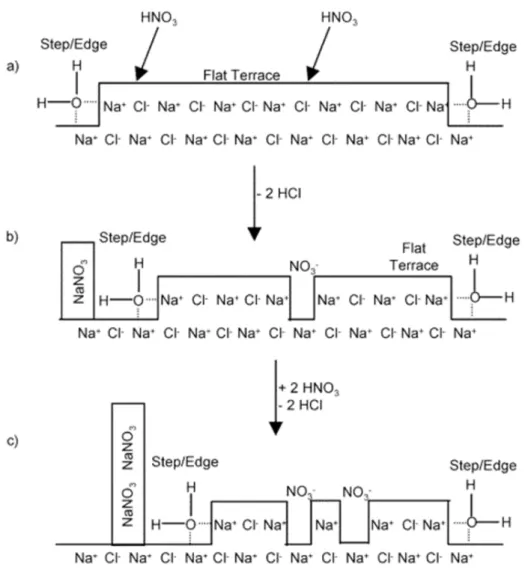
(40) Thèse de Houssam Hijazi, Lille 1, 2017. HCl produces atomic chlorine after interaction with OH radicals according to the following reaction: OH + HCl H2O + Cl. I-20. Reaction of HNO3 has been studied with NaCl single crystals and with NaCl powders, it is much faster in the latter case than the former one. This difference results from water which is more favorably adsorbed in defects and steps more present in powders, their amounts control the reaction extent49. Moreover, Rachel107 has proposed a mechanism for reaction of HNO3 with NaCl crystal at two different sites, one on dry terrace while second one on water associated edge as shown in Figure I-8. HNO3 adsorbed beside edges forms HCl while NO3- crystallizes to form NaNO3, so a new NaCl step is formed (see Figure I-8b). This reaction goes on and the surface will not be saturated since new steps are formed. However, on flat terrace HNO 3 adsorbed leads to formation of HCl while chloride anion is replaced by NO3-, this reaction doesn’t form NaNO3 since NO3- takes place of the released Cl anion (Figure I-8c). Terrace surface will be saturated as soon as all chlorine ions are released then the reaction will stop after that.. 32. © 2017 Tous droits réservés.. lilliad.univ-lille.fr.
(41) Thèse de Houssam Hijazi, Lille 1, 2017. Figure I-8. Schematic diagram for reaction of HNO3 and NaCl crystal107. I.13 Conclusion As detailed in this short literature review, metallic iodide aerosols (CsI, AgI etc) are important contamination products that may be released inside the nuclear containment building in case of severe accident and next potentially in the environment via containment leakages with high radiological consequences due to iodine and cesium radioactive isotopes. Before being released outside, these aerosols can chemically react in the containment, leading to gaseous iodine as recently shown by IRSN and NKS experiments. Few studies in the literature are available concerning the reactivity of iodine aerosols. It is therefore essential to study the reactivity of 33. © 2017 Tous droits réservés.. lilliad.univ-lille.fr.
(42) Thèse de Houssam Hijazi, Lille 1, 2017. these aerosols to first understand potential mechanism of oxidation and next be able to extrapolate experimental results to a wide range of boundary conditions as well as to extend the results to other iodide metallic aerosols. In this PhD, we will study potential oxidation mechanism by theoretical chemistry, it means at the molecular scale and we will focus on their behavior after interacting with the existing chemical species in gas phase, mainly steam and radicals coming from steam radiolysis. However, some of these aerosols (CsI) are well known to be hygroscopic in the presence of water. In order to ensure this, we will extend the study to the behavior of CsI in liquid phase.. I.14 Bibliography (1) (2). (3). (4) (5) (6). (7) (8) (9) (10). art-students-reactors-1-lg.gif (2680×1512) https://www.nrc.gov/admin/img/art-studentsreactors-1-lg.gif (accessed Apr 10, 2017). DENSCHLAG, Η. O.; DIEL, A.; GLÄSEL, Κ.-Η.; HEIMANN, R.; KAFFRELL, Ν.; KNITZ, U.; MENKE, H.; TRAUTMANN, Ν.; WEBER, M.; HERRMANN, G. Fallout in the Mainz Area from the Chernobyl Reactor Accident. Radiochim. Acta 1987, 41 (4), 163–172. Schwantes, J. M.; Orton, C. R.; Clark, R. A. Analysis of a Nuclear Accident: Fission and Activation Product Releases from the Fukushima Daiichi Nuclear Facility as Remote Indicators of Source Identification, Extent of Release, and State of Damaged Spent Nuclear Fuel. Environ. Sci. Technol. 2012, 46 (16), 8621–8627. Clefs CEA n°48 http://www.lyc-hoche-versailles.acversailles.fr/wwwmanuel/physique/Revues/ClefsCEA/Clefs48/Clefs48_sommaire.html (accessed Apr 11, 2017). Saenko, V.; Ivanov, V.; Tsyb, A.; Bogdanova, T.; Tronko, M.; Demidchik, Y.; Yamashita, S. The Chernobyl Accident and Its Consequences. Clin. Oncol. 2011, 23 (4), 234–243. US EPA, O. Federal Guidance Report No. 11: Limiting Values Of Radionuclide Intake And Air Concentration And Dose Conversion Factors For Inhalation, Submersion, And Ingestion https://www.epa.gov/radiation/federal-guidance-report-no-11-limiting-valuesradionuclide-intake-and-air-concentration (accessed Apr 11, 2017). Pöllänen, R.; Valkama, I.; Toivonen, H. Transport of Radioactive Particles from the Chernobyl Accident. Atmos. Environ. 1997, 31 (21), 3575–3590. Julien Trincal. Mosélisation du comportement de l’iode dans l’atmosphere, Lille 1, 2015. R. A. Lorenz; M. F. Osborne; J. L. Collins; S. R. Manning; A. P. Malinauskas; R. A. Lorenz. Behavior of Iodine, Methyl Iodide, Cesium Oxide, and Cesium Iodide in Steam and Argon; ORNL/NUREG/TM-25 NRC-3; Oak ridge national laboratory, 1976. Livingood, J. J.; Seaborg, G. T. Radioactive Iodine Isotopes. Phys. Rev. 1938, 53 (12), 1015–1015.. 34. © 2017 Tous droits réservés.. lilliad.univ-lille.fr.
(43) Thèse de Houssam Hijazi, Lille 1, 2017. (11) (12) (13) (14) (15) (16) (17). (18). (19) (20). (21) (22) (23) (24) (25) (26) (27) (28). Soffer, L.; Burson, S. B.; Ferrell, C. M.; Lee, R. Y.; Ridgely, J. N. Accident Source Terms for Light-Water Nuclear Power Plants. NUREG-1465 1995, 6. OECD NEA/CSNI/R. State-of the Art Report on Iodine Chemistry. 2007. Lemire, R. J.; Paquette, J.; Torgerson, D. F.; Wren, D. J.; Fletcher, J. W. Assessment of Iodine Behaviour in Reactor Containment Buildings from a Chemical Perspective; AECL--6812; Atomic Energy of Canada Ltd., 1981. Garisto, F. Thermodynamics of Iodine, Cesium and Tellurium in the Primary HeatTransport System under Accident Conditions; AECL--7782; Atomic Energy of Canada Ltd., 1982. Bowsher, B. R. Fission-Product Chemistry and Aerosol Behaviour in the Primary Circuit of a Pressurized Water Reactor under Severe Accident Conditions. Prog. Nucl. Energy 1987, 20 (3), 199–233. Mellor, J. W. A Comprehensive Treatise on Inorganic and Theoretical Chemistry: Vol. 5, Supplement. Boron. Boron - Oxygen Compounds; Longmans, 1980. Elrick, R. M.; Sallach, R. A.; Ouellette, A. L.; Douglas, S. C. Reaction Between Some Cesium-Iodine Compounds and the Reactor Materials 304 Stainless Steel, Inconel 600 and Silver. Volume 1: Cesium Hydroxide Reactions; NUREG/CR-3197-Vol.1; SAND-830395-Vol.1; Sandia National Labs., Albuquerque, NM (USA), 1984. Clément, B.; Hanniet-Girault, N.; Repetto, G.; Jacquemain, D.; Jones, A. V.; Kissane, M. P.; von der Hardt, P. LWR Severe Accident Simulation: Synthesis of the Results and Interpretation of the First Phebus FP Experiment FPT0. Nucl. Eng. Des. 2003, 226 (1), 5– 82. Burns, P. C.; Ewing, R. C.; Navrotsky, A. Nuclear Fuel in a Reactor Accident. Science 2012, 335 (6073), 1184–1188. Badawi, M.; Xerri, B.; Canneaux, S.; Cantrel, L.; Louis, F. Molecular Structures and Thermodynamic Properties of 12 Gaseous Cesium-Containing Species of Nuclear Safety Interest: Cs2, CsH, CsO, Cs2O, CsX, and Cs2X2 (X=OH, Cl, Br, and I). J. Nucl. Mater. 2012, 420 (1–3), 452–462. Paquette, J.; Torgerson, D. F.; Wren, J. C.; Wren, D. J. Volatility of Fission Products during Reactor Accidents. J. Nucl. Mater. 1985, 130, 129–138. Wren D.J. KINETICS OF IODINE AND CESIUM REACTIONS IN THE CANDU REACTOR PRIMARY HEAT TRANSPORT SYSTEM UNDER ACCIDENT CONDITIONS; Report AECL-7781; Atomic Energy of Canada Ltd, 1983. J.Colombani, C.Pascal, L.Martinet, C.Duffieux, O.Leroy. AER-CsI STEM/EPICUR Tests Synthesis Report. Juillet 2015. Beard, A. M.; Commission of the European Communities; Joint Research Centre; Ispra Establishment. Fission Product and Aerosol Behaviour within the Containment.; Commission of the European Communities, 1990. Kissane, M. P. On the Nature of Aerosols Produced during a Severe Accident of a WaterCooled Nuclear Reactor. Nucl. Eng. Des. 2008, 238 (10), 2792–2800. Adachi, K.; Kajino, M.; Zaizen, Y.; Igarashi, Y. Emission of Spherical Cesium-Bearing Particles from an Early Stage of the Fukushima Nuclear Accident. Sci. Rep. 2013, 3. Wren, J. C.; Ball, J. M.; Glowa, G. A. The Chemistry of Iodine in Containment. Nucl. Technol. 2000, 129 (3), 297–325. Bosland, L.; Cantrel, L.; Girault, N.; Clement, B. Modeling of Iodine Radiochemistry in the ASTEC Severe Accident Code: Description and Application to FPT-2 Phébus Test. Nucl. Technol. 2010, 171 (1), 88–107. 35. © 2017 Tous droits réservés.. lilliad.univ-lille.fr.
(44) Thèse de Houssam Hijazi, Lille 1, 2017. (29) (30) (31) (32) (33) (34) (35) (36) (37) (38). (39) (40) (41) (42) (43) (44) (45) (46). Dutton, L. M. C.; Grindon, E.; Handy, B. J.; Sutherland, L.; Burns, W. G.; Dickinson, S.; Sims, H. E.; Hueber, C.; Jacquemain, D. Iodine Behaviour in Severe Accidents. In WORKSHOP ON THE CHEMISTRY OF IODINE IN REACTOR SAFETY; 1996; p 615. Sellers, R. M. Reaction Kinetics of Iodine Compounds in Aqueous Solution; CEGBTPRD/B--0688/R85; Central Electricity Generating Board, 1985. Sawai, T.; Shinozaki, Y.; Meshitsuka, G. The Radiolysis of Aqueous Solutions of Potassium Iodide. Bull. Chem. Soc. Jpn. 1966, 39 (5), 951–955. W G Burns, M C Kent, W R Marsh and H E Sims. The Radiolysis of Aqueous Solutions of Caesium Iodide and Caesium Iodate. March 1990. Canneaux, S.; Xerri, B.; Louis, F.; Cantrel, L. Theoretical Study of the Gas-Phase Reactions of Iodine Atoms ( 2 P 3/2 ) with H 2 , H 2 O, HI, and OH. J. Phys. Chem. A 2010, 114 (34), 9270–9288. Khanniche, S.; Louis, F.; Cantrel, L.; Černušák, I. Computational Study of the I2O5 + H2O = 2 HOIO2 Gas-Phase Reaction. Chem. Phys. Lett. 2016, 662, 114–119. Khanniche, S.; Louis, F.; Cantrel, L.; Černušák, I. A Theoretical Study of the Microhydration of Iodic Acid (HOIO2). Comput. Theor. Chem. 2016, 1094, 98–107. Alicke, B.; Hebestreit, K.; Stutz, J.; Platt, U. Iodine Oxide in the Marine Boundary Layer. Nature 1999, 397 (6720), 572–573. Allan, B. J.; McFiggans, G.; Plane, J. M. C.; Coe, H. Observations of Iodine Monoxide in the Remote Marine Boundary Layer. J. Geophys. Res. Atmospheres 2000, 105 (D11), 14363–14369. Whalley, L. K.; Furneaux, K. L.; Gravestock, T.; Atkinson, H. M.; Bale, C. S. E.; Ingham, T.; Bloss, W. J.; Heard, D. E. Detection of Iodine Monoxide Radicals in the Marine Boundary Layer Using Laser Induced Fluorescence Spectroscopy. J. Atmospheric Chem. 2007, 58 (1), 19–39. Jenkin, M. E.; Cox, R. A.; Hayman, G. D. Kinetics of the Reaction of IO Radicals with HO2 Radicals at 298 K. Chem. Phys. Lett. 1991, 177 (3), 272–278. Canosa-mas, C. E.; Flugge, M. L.; Shah, D.; Vipond, A.; Wayne, R. P. Kinetics of the Reactions of IO with HO2 and O(3P). J. Atmospheric Chem. 34 (1), 153–162. Maguin, F.; Laverdet, G.; Le Bras, G.; Poulet, G. Kinetic Study of the Reactions Iodine Monoxide + Hydroperoxo and Iodine Monoxide + Nitrogen Dioxide at 298 K. J. Phys. Chem. 1992, 96 (4), 1775–1780. Cronkhite, J. M.; Stickel, R. E.; Nicovich, J. M.; Wine, P. H. Laser Flash Photolysis Studies of Radical−Radical Reaction Kinetics: The HO2 + IO Reaction. J. Phys. Chem. A 1999, 103 (17), 3228–3236. Knight, G. P.; Crowley, J. N. The Reactions of IO with HO2, NO and CH3SCH3: Flow Tube Studies of Kinetics and Product Formation. Phys. Chem. Chem. Phys. 2001, 3 (3), 393–401. Kulyukhin, S. A.; Mikheev, N. B.; Kamenskaya, A. N.; Rumer, I. A.; Konovalova, N. A.; Novichenko, V. L. Oxidative Hydrolysis in Water Vapor-Air Phase of CsI Radioaerosols Produced by CsI Sublimation from Metallic Surface. Radiochemistry 2004, 46 (1), 63–66. Tietze, S.; Foreman, M.; Ekberg, C.; Kaerkelae, T.; Auvinen, A.; Tapper, U.; Jokiniemi, J. Adsorption and Revaporisation Studies of Thin Iodine Oxide and CsI Aerosol Deposits from Containment Surface Materials in LWRs; Nordisk Kernesikkerhedsforskning, 2013. Lin, C. C.; Wang, C. F.; Sun, Y. C.; Chao, J. H.; Tseng, C. L. Radiation Effects on Gaseous Iodine at Very Low Concentrations</P> </P> J. Radioanal. Nucl. Chem. 2006, 268 (2), 419–424. 36. © 2017 Tous droits réservés.. lilliad.univ-lille.fr.
(45) Thèse de Houssam Hijazi, Lille 1, 2017. (47) (48). (49) (50) (51) (52) (53) (54) (55) (56) (57) (58) (59) (60) (61) (62) (63) (64) (65) (66). Buseck, P. R.; POsfai, Miha. Airborne Minerals and Related Aerosol Particles: Effects on Climate and the Environment. Proc. Natl. Acad. Sci. 1999, 96 (7), 3372–3379. Chemistry of the Natural Atmosphere (International Geophysics, Vol 41) by P. Warneck: Academic Press Inc 9780127356303 Anybook Ltd. http://www.abebooks.com/servlet/BookDetailsPL?bi=17026454242&searchurl=isbn%3D 0127356304%26sortby%3D17 (accessed Oct 20, 2016). Rossi, M. J. Heterogeneous Reactions on Salts. Chem. Rev. 2003, 103 (12), 4823–4882. Finlayson-Pitts, B. J. The Tropospheric Chemistry of Sea Salt: A Molecular-Level View of the Chemistry of NaCl and NaBr. Chem. Rev. 2003, 103 (12), 4801–4822. Bruno, M.; Aquilano, D.; Pastero, L.; Prencipe, M. Structures and Surface Energies of (100) and Octopolar (111) Faces of Halite (NaCl): An Ab Initio Quantum-Mechanical and Thermodynamical Study. Cryst. Growth Des. 2008, 8 (7), 2163–2170. Bruno, M.; Aquilano, D.; Prencipe, M. Quantum-Mechanical and Thermodynamical Study on the (110) and Reconstructed (111) Faces of NaCl Crystals. Cryst. Growth Des. 2009, 9 (4), 1912–1916. Yang, Y.; Meng, S.; Wang, E. G. Water Adsorption on a NaCl (001) Surface: A Density Functional Theory Study. Phys. Rev. B 2006, 74 (24). Meyer, H.; Entel, P.; Hafner, J. Physisorption of Water on Salt Surfaces. Surf. Sci. 2001, 488 (1–2), 177–192. Cabrera-Sanfelix, P.; Holloway, S.; Darling, G. R. Monolayer Adsorption of Water on NaCl(100). Appl. Surf. Sci. 2007, 254 (1), 87–91. Foster, M. C.; Ewing, G. E. Adsorption of Water on the NaCl(001) Surface. II. An Infrared Study at Ambient Temperatures. J. Chem. Phys. 2000, 112 (15), 6817–6826. Peters, S. J.; Ewing, G. E. Thin Film Water on NaCl (100) under Ambient Conditions: An Infrared Study. Langmuir 1997, 13 (24), 6345–6348. Cantrell, W.; McCrory, C.; Ewing, G. E. Nucleated Deliquescence of Salt. J. Chem. Phys. 2002, 116 (5), 2116–2120. National Research Council (U.S.); Washburn, E. W.; West, C. J. International Critical Tables of Numerical Data, Physics, Chemistry and Technology,; Pub. for the National research council by the McGraw-Hill Book Company, Inc.: New York, 1926. Peters, S. J.; Ewing, G. E. Water on Salt: An Infrared Study of Adsorbed H2O on NaCl(100) under Ambient Conditions. J. Phys. Chem. B 1997, 101 (50), 10880–10886. Xu, L.; Lio, A.; Hu, J.; Ogletree, D. F.; Salmeron, M. Wetting and Capillary Phenomena of Water on Mica. J. Phys. Chem. B 1998, 102 (3), 540–548. Somorjai, G. A.; Mujumdar, A. S. Introduction to Surface Chemistry and Catalysis. Dry. Technol. 1995, 13 (1–2), 507–508. Barraclough, P. B.; Hall, P. G. The Adsorption of Water Vapour by Lithium Fluoride, Sodium Fluoride and Sodium Chloride. Surf. Sci. 1974, 46 (2), 393–417. Cabrera-Sanfelix, P.; Sanchez Portal, D.; Verdaguer, A.; Darling, G. R.; Salmeron, M.; Arnau, A. Spontaneous Emergence of Cl - Anions from NaCl(100) at Low Relative Humidity. J. Phys. Chem. C 2007, 111 (22), 8000–8004. Behnke, W.; Scheer, V.; Zetzsch, C. 16 O 04 Formation of ClNO2 and HNO3 in the Presence of N2O5 and Wet Pure NaCl- and Wet Mixed NaCl/Na2SO4- Aerosol. J. Aerosol Sci. 1993, 24, S115–S116. Vogt, R.; Finlayson-Pitts, B. J. A Diffuse Reflectance Infrared Fourier Transform Spectroscopic (DRIFTS) Study of the Surface Reaction of NaCl with Gaseous NO2 and 37. © 2017 Tous droits réservés.. lilliad.univ-lille.fr.
(46) Thèse de Houssam Hijazi, Lille 1, 2017. (67) (68) (69) (70) (71) (72) (73) (74) (75) (76) (77) (78) (79) (80) (81) (82) (83). HNO3. [Erratum to Document Cited in CA120:228408]. J. Phys. Chem. 1995, 99 (34), 13052–13052. Vogt, R.; Finlayson-Pitts, B. J. A Diffuse Reflectance Infrared Fourier Transform Spectroscopic Study of the Surface Reaction of NaCl with Gaseous NO2 and HNO3. J. Phys. Chem. 1994, 98 (14), 3747–3755. Koch, T. G.; Bergh, H. van den; Rossi, M. J. A Molecular Diffusion Tube Study of N2O5 and HONO2 Interacting with NaCl and KBr at Ambient Temperature. Phys. Chem. Chem. Phys. 1999, 1 (11), 2687–2694. Andreae, M. O.; Crutzen, P. J. Atmospheric Aerosols: Biogeochemical Sources and Role in Atmospheric Chemistry. Science 1997, 276 (5315), 1052–1058. Msibi, I. M.; Li, Y.; Shi, J. P.; Harrison, R. M. Determination of Heterogeneous Reaction Probability Using Deposition Profile Measurement in an Annular Reactor: Application to the N2O5/H2O Reaction. J. Atmospheric Chem. 18 (3), 291–300. Ghosal, S.; Hemminger, J. C. Effect of Water on the HNO3 Pressure Dependence of the Reaction between Gas-Phase HNO3 and NaCl Surfaces. J. Phys. Chem. A 1999, 103 (25), 4777–4781. Behnke, W.; Krüger, H.-U.; Scheer, V.; Zetzsch, C. Formation of Atomic Ci from Sea Spray via Photolysis Ofnitryl Chloride: Determination of the Sticking Coefficient of N205 on NaCl Aerosol. J. Aerosol Sci. 1991, 22, S609–S612. Finlayson-Pitts, B. J.; Ezell, M. J.; Pitts, J. N. Formation of Chemically Active Chlorine Compounds by Reactions of Atmospheric NaCl Particles with Gaseous N2O5 and ClONO2. Nature 1989, 337 (6204), 241–244. Ravishankara, A. R. Heterogeneous and Multiphase Chemistry in the Troposphere. Science 1997, 276 (5315), 1058–1065. Hemminger, J. C. Heterogeneous Chemistry in the Troposphere: A Modern Surface Chemistry Approach to the Study of Fundamental Processes. Int. Rev. Phys. Chem. 1999, 18 (3), 387–417. Abbatt, J. P. D.; Waschewsky, G. C. G. Heterogeneous Interactions of HOBr, HNO3, O3, and NO2 with Deliquescent NaCl Aerosols at Room Temperature. J. Phys. Chem. A 1998, 102 (21), 3719–3725. Fenter, F. F.; Caloz, F.; Rossi, M. J. Heterogeneous Kinetics of N2O5 Uptake on Salt, with a Systematic Study of the Role of Surface Presentation (for N2O5 and HNO3). J. Phys. Chem. 1996, 100 (3), 1008–1019. Behnke, W.; Zetzsch, C. Heterogeneous Photochemical Formation of Cl Atoms from NaCl Aerosol, NOx and Ozone. J. Aerosol Sci. 1990, 21, S229–S232. Timonen, R. S.; Chu, L. T.; Leu, M.-T.; Keyser, L. F. Heterogeneous Reaction of ClONO2(g) + NaCl(s) .fwdarw. Cl2(g) + NaNO3(s). J. Phys. Chem. 1994, 98 (38), 9509– 9517. Leu, M.-T.; Timonen, R. S.; Keyser, L. F.; Yung, Y. L. Heterogeneous Reactions of HNO3(g) + NaCl(s) .fwdarw. HCl(g) + NaNO3(s) and N2O5(g) + NaCl(s) .fwdarw. ClNO2(g) + NaNO3(s). J. Phys. Chem. 1995, 99 (35), 13203–13212. Sporleder, D.; Ewing, G. E. Infrared Spectroscopic Investigation of the Heterogeneous Reaction of HNO3 and NaCl(100). J. Phys. Chem. A 2001, 105 (10), 1838–1846. Fenter, F. F.; Caloz, F.; Rossi, M. J. Kinetics of Nitric Acid Uptake by Salt. J. Phys. Chem. 1994, 98 (39), 9801–9810. Davies, J. A.; Cox, R. A. Kinetics of the Heterogeneous Reaction of HNO3 with NaCl: Effect of Water Vapor. J. Phys. Chem. A 1998, 102 (39), 7631–7642. 38. © 2017 Tous droits réservés.. lilliad.univ-lille.fr.
Figure
![Figure II-3. Schematic diagram of the nudged elastic band theory [16].](https://thumb-eu.123doks.com/thumbv2/123doknet/3676737.108891/69.892.275.600.619.969/figure-ii-schematic-diagram-nudged-elastic-band-theory.webp)
+7

Documents relatifs