This is an author-deposited version published in:
http://oatao.univ-toulouse.fr/
Eprints ID: 4115
To cite this document: CAUSSE Mickaël, DEHAIS Frédéric, PASTOR Josette.
Flight experience and executive functions predict unlike professional pilots who are
limited by the FAA's age rule, no age limit is defined in general aviation (GA). In:
4th International Conference on Research in Air Transportation - ICRAT 2010,
01-04 June 2010, Budapest, Hungary.
Any correspondence concerning this service should be sent to the repository
administrator:
[email protected]
Flight experience and executive functions predict
flight simulator performance in general aviation pilots
Mickaël Causse
1,2, Frédéric Dehais
11Centre Aéronautique et Spatial ISAE-SUPAERO ; Université de Toulouse, France
2
Inserm ; Imagerie cérébrale et handicaps neurologiques UMR 825; F-31059 Toulouse, France
Université de Toulouse ; UPS ; Imagerie cérébrale et handicaps neurologiques UMR 825; CHU Purpan, Place du
Dr Baylac, F-31059 Toulouse Cedex 9, France
Josette Pastor
Inserm ; Imagerie cérébrale et handicaps neurologiques UMR 825; F-31059 Toulouse, France
Université de Toulouse ; UPS ; Imagerie cérébrale et handicaps neurologiques UMR 825; CHU Purpan, Place du
Dr Baylac, F-31059 Toulouse Cedex 9, France
Abstract— Unlike professional pilots who are limited by the FAA's age rule, no age limit is defined in general aviation (GA). Some studies revealed significant aging issues on accident rates but these results are criticized. Our overall goal is to study how the effect of age on executive functions (EFs), high level cognitive abilities, impacts on the flying performance in GA pilots. This study relies on three components: EFs assessment, pilot characteristics (age, flight experience), and the navigation performance on a flight simulator. The results showed that contrary to age, reasoning, working memory (WM) and total flight experience were predictive of the flight performance. These results suggest that “cognitive age”, derived in this study by the cognitive evaluation, is a better mean than “chronological age” consideration to predict the ability to pilot, in particular because of the inter-individual variability of aging impact and the beneficial effect of the flight experience.
Keywords: piloting performance, executive functions, flight experience, decision making, normal aging.
I. INTRODUCTION
The population of GA pilots is getting older in the USA [1] and in European countries like France where forty one percent of private pilots are more than fifty (BEA1, 2008). Unlike professional pilots who are limited by the FAA's age 65 rule, no such restriction exists for GA pilots. Moreover, contrary to commercial aviation (CA) pilots, GA pilots have not necessarily experienced a professional training, fly mostly on their own, without any co-pilot and very few assistance systems, have less support from the air traffic control and are more affected by weather conditions. Not surprisingly, in GA, the accident rate is considerably higher than in CA [2].
Several studies have revealed significant aging issues on accident rates in GA [3] [4] [5], though these results are called into question [6] [7]. The assessment of the cognitive functioning is a key issue in pilot’s aging as long as its decline represents a much higher risk of accidents than sudden physical incapacitation [8]. A substantial literature focuses on the
1 French Accident Investigation Bureau.
evaluation of the cognitive state of pilots but its conclusions remain contradictory. Several reasons may explain the difficulty to draw a definitive conclusion on the effects of aging on flight performance in GA pilots. There is a great inter-individual variability in the deleterious effects of aging on cognition [9]; the evaluations performed in classical human factors studies are rather nonspecific in terms of explored cognitive functions and do not necessarily focus on the ones that are the most impacted by aging; very few researches attempt to link, in the same population, the cognitive performances to the flight abilities; the greatest part of the studies is interested on safety aspects like communications [10], or decision making during landing [11]; few researches are exclusively related to the GA population; finally, another source of complexity arises from the suspected compensative role on aging effects of the flight experience [12].
II. COGNITIVE FUNCTIONS AND PILOTING
Numerous studies have been conducted to attempt to link the cognitive functioning with the flight performance. Different measurements of cognitive efficiency have been identified as crucial to the piloting ability, for example: time-sharing [13], speed of processing [14], attention [15] or problem solving [16]. Cogscreen-AE [17] is among the most widely used cognitive tests batteries in pilots aging studies. It consists of a series of computerized cognitive tasks that evaluate a large set of cognitive functions. This battery has been shown to be able to successfully discriminate between neurologically impaired and cognitively intact pilots [18]. Some Cogscreen-AE variables were predictive of flight parameter violation in Russian CA pilots [19]. Furthermore, Taylor and colleagues [20] were able to predict 45% of the variance of the flight simulator performance with four Cogscreen-AE predictors (speed/WM, visual associative memory, motor coordination and tracking) in a cohort of 100 aviators (aged 50-69 years). Contrary to this latter study that involved Cogscreen-AE, a rather generalist battery in terms of explored cognitive functions, we propose to focus specifically on EFs. Indeed, these functions are the earliest ones to be impacted by aging [21] and represent excellent clues of aging effects on the
cognitive performance. The study of EFs has appeared recently in aeronautics, for instance, Hardy [22] found significant age-related differences in pilots’ executive functioning (e.g. inhibition, set-shifting) and Taylor [23] established a relationship between interference control and the ability to follow air traffic instructions.
III. EXECUTIVE FUNCTIONS AND PILOTING
EFs underlie goal-directed behavior and adaptation to novel and complex situations [24]. They allow the inhibition of automatic responses in favor of controlled and regulated behavior, in particular when automatic responses are no more adapted to the environment. Three major low level EFs are moderately correlated with one another, but clearly separable [25]: set-shifting between tasks or mental sets (“shifting”), inhibition of dominant or prepotent responses (“inhibition”), and updating and monitoring of WM representations (“updating”). The prefrontal cortex (PFC) plays a dominant role in the implementation of EFs that also encompass decision-making [26] or reasoning abilities [27]. According to our hypotheses, EFs are crucial to piloting. Indeed, this activity takes place in a dynamical and changing context where new information must be integrated and updated continuously. We assume that flying light aircraft with no autopilot and very few assistant systems (like the TCAS2 or weather radar) presupposes a strong involvement of the EFs for handling the flight, to monitor the engine parameters, to plan the navigation, to maintain and update situation awareness and to correctly adapt to traffic and environmental changes and perform accurate decision-making by inhibiting wrong behavioral responses.
IV. EXECUTIVE FUNCTIONS AND NORMAL AGING Functional neuroimaging brings evidence that the brain is subject to anatomical and physiological modifications in normal aging [28]. The prefrontal lobes appear to be the earliest cerebral regions to be affected [29] and may account for a great part to age-related cognitive changes [31]. Because the prefrontal lobes mainly implement EFs, aging is suspected to provokes a selective alteration of these latter, for example the reasoning [30], inhibition [31] or updating [32] abilities. However, the executive changes vary considerably across people. The complex interactions between the cerebral structures underlying EFs [9], sociocultural factors and genetic factors [33] may explain the heterogeneity of this decline.
In this experiment, we proposed to evaluate specifically the EFs, high level cognitive abilities that present a strong vulnerability to aging effects [21]. More precisely, we assessed three low levels EFs (shifting, inhibition and updating) and a more established general ability: the reasoning. The reasoning performance reflects fluid intelligence, that support processes relevant for many kinds of abilities (verbal, spatial, mathematical, problem solving etc.) and adaptation to novelty. It is a concept very close to the executive functioning [34] [35]. The speed of processing was also collected because it represents a reliable measure of general cognitive decline during aging. Finally, we have also taken into account age and
2 Traffic Collision Avoidance System.
the total flight experience to assess their respective participation to the flight performance variation. Our hypothesis is that the “chronological age” is not a sufficient criterion to predict the piloting performance and that the “cognitive age”, evaluated by the cognitive functioning, is a more relevant criterion.
V. METHODS
A. Participants
The participants were 24 private licensed pilots (mean age = 43.3 years, SD = 13.6) rated for visual flight conditions. The pilots that had no longer flown during the past two years were excluded because of the potential impact on flight simulator performance. Inclusion criteria were male, right handed, as evaluated by the Edinburgh handedness inventory [36], native French speakers, under or postgraduate. Non-inclusion criteria were expertise in logics, airline pilots and sensorial deficits, neurological, psychiatric or emotional disorders and/or being under the influence of any substance capable of affecting the central nervous system. All subjects received complete information on the study’s goal and experimental conditions and gave their informed consent. Given that flight experience may moderate age related deficits in the performance of domain relevant task [12], we attempted to homogenize the flight experience distribution across the life span of our sample.
B. Flight performance
1) Navigation
The flight scenario has been setup in collaboration with flight instructors to reach a satisfying level of difficulty and realism. To familiarize the participants with the PC-based flight simulator and minimize learning effects in order to obtain reliable flight simulator performances, each volunteer underwent a training session. Before the navigation, they received the instructions, a flight plan and various technical information related to the aircraft (e.g. aircraft's crosswind limit). Basically, the scenario implied to take off, reached a waypoint with the help of the aircraft radio navigation system and finally, land on a given airport. The pilots were instructed that they were in charge of all the decisions and that they could only received an informative weather report before landing. In order to increase the subject’s workload, the pilots had to perform a mental arithmetic calculation of the ground speed (thanks to the embedded chronometer). Moreover, a failure of the compass was scheduled. After this failure, the pilots had to navigate thanks to the magnetic compass, which presents the particularity to be difficult to use as it is anti-directional. The flight scenario lasted approximately 45 min. The performance assessment was exclusively founded on the flight path deviations (FPD), expressed in terms of amount of angular deviation in the horizontal axe from the ideal flight path.
C. Neuropsychological battery
1) Target hitting
This test provides a basic psychomotor reaction time [37]. The instruction is to click as fast as possible on each target. The performance is measured by a velocity index inspired by the Fitts’ law [38]. The index is the average ratio of the base 10
logarithm of the distance in pixels between two targets, divided by the time in seconds to go from the first target to the second.
2) The 2-back test.
The 2-back test aims at assessing working memory (WM), in particular maintenance and updating abilities [39]. Subjects view a continuous stream of stimuli and have to determine whether the current stimulus matches in a specific dimension (shape for our test) the stimulus 2-back in the sequence (Figure 1). For each condition, the percentage of correct responses was collected.
Figure 1. The 2-back test. The participant stated if the current shape match to the 2-back shape in the sequence thanks to the response box.
3) Deductive reasoning
The logical reasoning test has been used in a previous study to assess executive functioning [40]. The goal of the task is to solve syllogisms by choosing, among three suggested solutions, the one that allows concluding logically. Syllogisms are based on a logical argument in which one proposition (the conclusion) is inferred from a rule and another proposition (the premise). We used four existing forms of syllogisms: modus
ponendo ponens, modus tollendo tollens, setting the consequent to true and denying the antecedent. Each participant had to
solve 24 randomly displayed syllogisms. The measurement was the percentage of correct responses.
4) The computerized Wisconsin Card Sorting test
The Wisconsin Card Sorting test (WCST) [41] gives information on the subject’s abstract reasoning, discrimination learning and shifting abilities [42]. The test version here was a computer implementation very similar to the clinical version of the WCST [43]. The participant must sort cards according to three different unknown categories (color, shape, number); an audio feedback indicated whether the response is correct or not (yes/no). When the participant categorized successfully ten cards, the target category was automatically changed. The task ended when six categories was achieved (color, shape, number, color, shape, number) or when the deck of 128 cards was used. The total numbers of perseverative errors (at least two unsuccessful sorting on the same category) was derived from the individual cards’ records (Figure 2).
Figure 2. The Wisconsin card sorting test. The participant sorted the cards according to a specific dimension. An audio feedback informed if the sorting was correct or no.
5) Spatial stroop
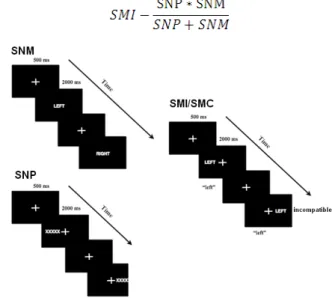
Spatial Stroop tests generally assess the conflict between the meaning of a word naming a location (e.g. “below”) and the location where the word is displayed. The ability to restrain a response according to the localization of the word gives information on inhibition efficiency. This conflict appears to be provoked by the simultaneous activation of both motor cortices [44]. Our test encompasses four control conditions (Figure 3). “Stroop neutral meaning” (SNM): a motor answer is given with the appropriate hand according to the word meaning; “Stroop neutral position” (SNP): the response is given according to the location of a string of XXXXX, displayed at the left or the right of the screen; “Stroop meaning incompatible/compatible” (SMI/SMC): the response is given according to the meaning of the word, compatible or incompatible with its location at the screen. In order to get the pure effects of inhibition, the interference score was calculated to control reading and localization effects by:
Figure 3. The four conditions of the spatial stroop. On the left: SNM, the participant pressed on the left/right button according to the meaning of the word; SNP, the participant pressed the left/right button of the response box according to the location at the screen of the pattern of XXXXX. On the right: SMC/SMI, the participant pressed the left/right button according to the meaning of the word, congruent or incongruent with its location at the screen.
D. Pilots caracteristics
Age and total flight experience in hours were collected to assess their effects on the flight performance. We attempted to homogenize the flight experience distribution across the life span of our sample in order to minimize the perturbation of this parameter on the flight performance measurement.
VI. RESULTS
A. Statistical analysis
All data were analyzed with Statistica 7.1 (© StatSoft). The relationship between age and the total flight experience was examined thanks to Bravais-Pearson correlation. The ability of our control variables to predict the piloting performance was tested using exhaustive regression (ER) that searches for the best possible fit between a dependent variable and a set of potential explanatory variables. Contrary to classical stepwise approach, ER searches the entire space of potential models and returns those for which all parameter estimates are statistically significant. Thus, ER results are not affected by the order in which the variables are introduced in the model. The goodness of fit of the models was evaluated by the adjusted coefficient of determination r².
B. Age and experience relationships
The mean total experience of our sample was of 1676 hours of flight (Range = 57-13000). The Bravais-Pearson correlation revealed that there was no relationship between age and total flight experience. However, in particular because of three aged pilots that owned a large total flight experience (respectively 61 and 13000 hours; 61 and 5000 hours; 58 and 6700 hours), the correlation was close to reach the significance (p = .0561, r = +.39).
C. Explanatory variables of the piloting performance
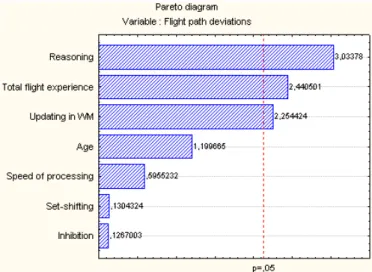
The mean FPD amplitude was 27.69 (SD = 10.38). The ER revealed that the performances of two cognitive abilities were predictive of the FPD: the reasoning and the WM (respectively,
p = .0083, F(1,15) = 9.20, p = .0395, F(1.15) = 5.08. Moreover,
the total flight experience was also a significant explanatory variable (p = .0275, F(1,15) = 5.95, see Figure 4.
The most the reasoning (see Figure 5 and Figure 6) and the WM abilities were efficient, the smaller was the FPD. In the same way, the most the pilots were experienced, the smaller was the FPD. The adjusted r² showed that this model explained 44.51% of the FPD.
As expected, the ER did not revealed any significant effect of age on the piloting performance (p = .2488, F(1,15) = 5.95). In the same way, the speed of processing and the two others
low level EFs, set-shifting and inhibition, were not predictive of the flight performance (respectively, p = .5603, F(1,15) = 0.35; p = .8979, F(1,15) = 0.17; p = .9008, F(1,15) = 0.16, see Figure 4.
It is interesting to note that the worst piloting performance (FPD = 52.01) has been done by a rather old pilot (62) with a very small total flight experience (90 hours) whereas two others aged pilots (both 61) with a high experience (13000 and 5000 hours) demonstrated correct flight performances (respectively FPD = 21.08 and 32.30).
Figure 4. Synthesis of the ER. The Pareto diagram shows the three predictive variables of the flight performance: the reasoning abilities, the updating and the total flight performance.
Figure 5. FPD as a function of the reasoning performances. The ER revealed that the reasoning performance predicts significantly the FPD.
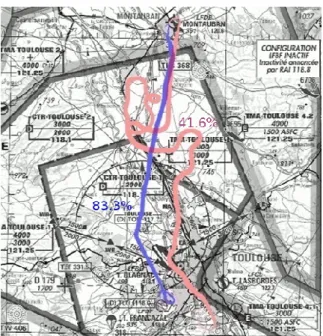
Figure 6. Flight path of two pilots and their respective reasoning performances. In blue, the pilot had a small flight path deviation and a good reasoning performance (83.3% of correct answers). In pink, the pilot had a large flight path deviation, he lost himself and flew by mistake above the Blagnac airport. His flight path deviation was very important and his reasoning performances were very low (41.6% of correct answers). Flight path are rendered with FromDady [45], the width of the line codes the altitude.
VII. DISCUSSION
A. Aging and piloting performance
According to our hypotheses and other authors [6] [7], the chronological age was not a relevant variable to predicts the piloting performance. However, although the total flight experience was not correlated with age, it may have played a beneficial effect on some aged pilots. It is interesting to note that the worst piloting performance has been performed by a rather old pilot with a weak experience, whereas two others aged pilots, with a high experience, demonstrated quite good flight performances. In spite of these observations, our results raised the limitation of using the chronological age as a single criterion to decide if a given pilot is able to fly or not. In accordance with such statement, Schroeder [46] have pointed out the necessity to use neuropsychological tests rather than relying on chronological age.
B. Neuropsychological tests and piloting performance
The pilots performed a neuropsychological battery that taped three crucial low-level executive functions [25] plus reasoning and speed of processing. Finally, as revealed by the ER, reasoning performance was the variable the most predictive of the ability to pilot in our study. This result is not surprising, the reasoning abilities were strongly involved in our scenario. The pilots ought to perform numerous observations during the navigation to estimate their position and they had to use the radio navigation systems to reach a waypoint. Moreover, the scheduled compass failure required pilots to use the anti-directional magnetic compass as a backup. The utilization of this instrument is complex and could be a source
of difficulty. Although we did not assess precisely the errors associated with the use of this instrument, it seems likely that it has participated to increase the path deviation of some pilots. These results concerning the reasoning are in line with Wiggins and O’Hare [47] that have highlighted the links between reasoning performance, evaluated by a syllogism resolution (duncker’s candle problem), and piloting performance. The reasoning performances reflect fluid reasoning, central cognitive ability linked with various types of mental activity (mental calculation, problem solving etc.) and essential to the adaptation to novel problems. Complex and novel problems cannot be solved directly by referring to a store of long-term knowledge but require analytic or fluid reasoning. The complexity of our scenario with unexpected event like the compass failure appears to have contributed to a strong involvement of reasoning abilities.
The total flight experience was also predictive of the FPD. In accordance with other studies [12], this data has confirmed the beneficial impact of experience on flight performance. This is coherent with Taylor’s results [5] that showed that more expert pilots demonstrated better flight summary scores, especially in the communication and approach-to-landing. Moreover, this 3- year longitudinal study showed that aviation expertise was associated with less declines in flight simulator performance over time.
Finally, updating ability was also linked with the pilot’s performances. This is coherent with our expectation. Indeed, the pilot’s activity takes place in a dynamical and changing context where new information must be integrated and updated continuously. The updating performances are crucial in this context. Another study of Taylor et al. [20] found that the WM and the speed of processing were predictive of the piloting performance. We are partially in line with these results. We did not retrieve a significant effect of the speed of processing. The mean age of our sample was relatively low (43.3, SD = 13.6) and only seven participants of more than fifty were involved in the experiment. We may argue that more severe aging effects on speed of processing occur later in life, the sample of Taylor was more extreme and included participants from fifty to sixty-nine, these latter probably demonstrated more pronounced variations of speed of processing. Moreover, the task that we used to assess the speed of processing had a strong motor component that could have been less relevant to flight performance assessment.
Our overall results suggest that “cognitive age” is a better criterion than “chronological age” to predict the ability to fly and that reasoning and updating are good candidate to assess the cognitive age. The design of such neuropsychological batteries of tests that could be administrated during the pilot’s periodic physical examinations could help to detect cognitive impairment associated with increased risk of accidents. Further research will include a larger sample of pilots and will be conducted on a more realistic flight simulator.
ACKNOWLEDGMENT
The authors wish to thank the Lasbordes Airfield ISAE staff. The study was supported by a “Gis Longévité” grant, by the DGA grant 0434019004707565 and the Midi-Pyrenees Regional Council grants 03012000 and 05006110.
REFERENCES
[1] D. J. Hardy and R. Parasuraman (1997). Cognition and flight performance in older pilots. Journal of experimental psychology applied, 3, 313-348.
[2] G. Li, and S. Baker (2007). Crash risk in general aviation. Jama, 297(14), 1596.
[3] J. A. Y. Harkey (1996). Age-related changes in selected status variables in general aviation pilots. Transportation Research Record: Journal of the Transportation Research Board, 1517(-1), 37-43.
[4] G. Kay (2001). Effects of aging on aviation-related cognitive function in commercial airline pilots. Paper presented at the In Proceedings of the 72nd Meeting of the Aerospace Medical Association, Aviat Space Environ Med 2001; 72 :241.
[5] J. Taylor, Q. Kennedy, A. Noda, J. Yesavage (2007). Pilot age and expertise predict flight simulator performance: A 3-year longitudinal study. Neurology, 68(9), 648.
[6] G. Li, S. Baker, J. Grabowski, Y. Qiang, M. McCarthy, G. Rebok (2003). Age, flight experience, and risk of crash involvement in a cohort of professional pilots. American journal of epidemiology, 157(10), 874-880.
[7] G. Li, S. Baker, M. Lamb, J. Grabowski, G. Rebok (2002). Human factors in aviation crashes involving older pilots. Aviation, space, and environmental medicine, 73(2), 134-138.
[8] D. Schroeder, H. Harris, D. Broach (2000). Pilot age and performance: an annotated bibliography. Oklahoma City, OK: Federal Aviation Administration, Civil Aeromedical Institute. Human Resources Research Division.
[9] R. L. Buckner (2004). Memory and Executive Function in Aging and AD Multiple Factors that Cause Decline and Reserve Factors that Compensate. Neuron, 44(1), 195-208.
[10] D. Morrow, W. Menard, H. Ridolfo, E. Stine-Morrow, T. Teller, D. Bryant (2003). Expertise, cognitive ability, and age effects on pilot communication. The International Journal of Aviation Psychology, 13(4), 345-371.
[11] M. Wiggins and D. O’Hare (1995). Expertise in aeronautical weather-related decision making: A cross-sectional analysis of general aviation pilots. Journal of Experimental Psychology: Applied, 1(4), 305-320. [12] D. Morrow, W. Menard, E. Stine-Morrow, T. Teller, D. Bryant (2001).
The influence of expertise and task factors on age differences in pilot communication. Psychology and Aging, 16(1), 31-46.
[13] P. Tsang and T. Shaner (1998). Age, attention, expertise, and time-sharing performance. Psychology and Aging, 13, 323-347.
[14] J. Taylor, J. Yesavage, D. Morrow, N. Dolhert, J. Brooks III, L. Poon (1994). The effects of information load and speech rate on younger and older aircraft pilots' ability to execute simulated air-traffic controller instructions. The Journal of Gerontology, 49(5), P191.
[15] C. Knapp, R. Johnson (1996). F-16 Class A mishaps in the US Air Force, 1975-93. Aviation, space, and environmental medicine, 67(8), 777.
[16] D. O'Hare, M. Wiggins, R. Batt, D. Morrison (1994). Cognitive failure analysis for aircraft accident investigation. Ergonomics, 37(11), 1855-1869.
[17] R. Horst and G. Kay (1991). COGSCREEN- Personal computer-based tests of cognitive function for occupational medical certification. [18] G. Kay (1995). CogScreen: Aeromedical Edition. Odessa, Florida:
Psychological Assessment Resources: Inc.
[19] N. Yakimovitch, G. Strongin, V. Go'orushenko, D. Schroeder, G. Kay (1994). Flight performance and CogScreen test battery in Russian pilots. [20] J. Taylor, R. O'Hara, M. Mumenthaler, J. Yesavage (2000). Relationship
of CogScreen-AE to flight simulator performance and pilot age. Aviation, space, and environmental medicine, 71(4), 373.
[21] N. Raz (2000). Aging of the Brain and Its Impact on Cognitive Performance: Integration of Structural and Functional Findings. The handbook of aging and cognition.
[22] D. Hardy, P. Satz, L.F. D’Elia, C.L. Uchiyama (2007). Age-Related Group and Individual Differences in Aircraft Pilot Cognition. The International Journal of Aviation Psychology, 17(1), 77-90.
[23] J. Taylor, R. O’Hara, M. Mumenthaler, A. Rosen, J. Yesavage (2005). Cognitive ability, expertise, and age differences in following air-traffic control instructions. Psychology and Aging, 20(1), 117-133.
[24] D.R. Royall, E.C Lauterbach, J.L. Cummings, A. Reeve, T.A Rummans, D.I. Kaufer et al. (2002). Executive Control Function A Review of Its Promise and Challenges for Clinical Research. A Report From the Committee on Research of the American Neuropsychiatric Association (Vol. 14, pp. 377-405): Am Neuropsych Assoc.
[25] A. Miyake, N.P. Friedman, M.J. Emerson, A.H. Witzki, A. Howerter, T.D. Wager (2000). The unity and diversity of executive functions and their contributions to complex “frontal lobe” tasks: A latent variable analysis. Cognitive Psychology, 41(1), 49-100.
[26] A.G. Sanfey, R. Hastie, M.K. Colvin, J. Grafman (2003). Phineas gauged: decision-making and the human prefrontal cortex. Neuropsychologia, 41(9), 1218-1229.
[27] R. Colom, V. Rubio, P. Shih, J. Santacreu (2006). Fluid intelligence, working memory and executive functioning. PSICOTHEMA-OVIEDO-, 18(4), 816.
[28] R. Cabeza, N.D. Anderson, J.K. Locantore, A.R. McIntosh (2002). Aging gracefully: compensatory brain activity in high-performing older adults. Neuroimage, 17(3), 1394-1402.
[29] D.J. Tisserand, J. Jolles (2003). Special issue on the involvement of prefrontal networks in cognitive ageing. Cortex, 39, 1107-1128. [30] W. De Neys, E. Van Gelder (2009). Logic and belief across the lifespan:
the rise and fall of belief inhibition during syllogistic reasoning. Developmental Science, 12(1), 123-130.
[31] R. West, G.C. Baylis (1998). Effects of increased response dominance and contextual disintegration on the Stroop interference effect in older adults. Psychology and Aging, 13, 206-217.
[32] M. Van der Linden, S. Bredart, A. Beerten (1994). Age-related differences in updating working memory. British journal of psychology(1953), 85(1), 145-152.
[33] I.E. Nagel, C. Chicherio, S.C. Li, T. von Oertzen, T. Sander, A. Villringer, et al. (2008). Human aging magnifies genetic effects on executive functioning and working memory. Frontiers in Human Neuroscience, 2.
[34] S.L. Decker, S.K. Hill, R.S. Dean (2007). Evidence of construct similarity in executive functions and fluid reasoning abilities. International Journal of Neuroscience, 117(6), 735-748.
[35] M. Roca, A. Parr, R. Thompson, A. Woolgar, T. Torralva, N. Antoun et al. (2009). Executive function and fluid intelligence after frontal lobe lesions. Brain.
[36] R. Oldfield (1971). The assessment and analysis of handedness: the Edinburgh inventory. Neuropsychologia, 9(1), 97.
[37] I. Loubinoux, D. Tombari, J. Pariente, A. Gerdelat-Mas, X. Franceries, E. Cassol et al. (2005). Modulation of behavior and cortical motor activity in healthy subjects by a chronic administration of a serotonin enhancer. Neuroimage, 27(2), 299-313.
[38] P. Fitts (1954). The information capacity of the human motor system in controlling the amplitude of movement. Journal of Experimental Psychology, 47, 381–391.
[39] Y. Chen, S. Mitra, F. Schlaghecken (2008). Sub-processes of working memory in the N-back task: an investigation using ERPs. Clinical Neurophysiology, 119(7), 1546-1559.
[40] M. Causse, J-M. Sénard, J-F. Démonet, J. Pastor (2009). Monitoring cognitive and emotional processes through pupil and cardiac response during dynamic vs. logical task. Applied Psychophysiology and Biofeedback. DOI 10.1007/s10484-009-9115-0.
[41] E.A. Berg (1948). A simple objective technique for measuring flexibility in thinking. The Journal of general psychology, 39, 15.
[42] P. Eling, K. Derckx, R. Maes (2008). On the historical and conceptual background of the Wisconsin Card Sorting Test. Brain and Cognition. [43] R.K. Heaton (1981). A MANUAL for the Wisconsin Card Sorting Test.
Odessa, Florida 33556: Psychological Assessment Resources, Inc. [44] M. DeSoto, M. Fabiani, D. Geary, G. Gratton (2001). When in doubt, do
it both ways: Brain evidence of the simultaneous activation of conflicting motor responses in a spatial Stroop task. Journal of Cognitive Neuroscience, 13(4), 523-536.
[45] C. Hurter, B. Tissoires, S. Conversy (2009). FromDaDy: spreading data across views to support iterative exploration of aircraft trajectories. IEEE Transactions on Visualization and Computer Graphics.
[46] D. Schroeder, H. Harris, D. Broach (1999). Pilot age and performance: An annotated bibliography (1990-1999).
[47] M. Wiggins, D. O’Hare (1995). Expertise in aeronautical weather-related decision making: A cross-sectional analysis of general aviation pilots. Journal of Experimental Psychology: Applied, 1(4), 305-320.