THÈSE
THÈSE
En vue de l’obtention du
DOCTORAT DE L’UNIVERSITÉ DE TOULOUSE
Délivré par l’Institut National Polytechnique de Toulouse Spécialité : Hydrologie, Hydrochimie, Sol, Environnement
Présentée et soutenue par Le JURY M. Quintard B. Goyeau F. Delay S. Sauvage R. Escudié E. Paul
Ecole doctorale : Sciences de l'Univers, de l'Environnement et de l'Espace Unités de recherche :
Directeurs de Thèse : G. Debenest, M. Gerino Yohan Davit
M. Gerino Directeur de thèse
G. Debenest Professeur d'Université, ECOLABMaître de conférences, IMFT Professeur d'Université, LISBP
Ingénieur de Recherche, ECOLAB Professeur d'Université, HYDRASA Professeur d'Université, EM2C Directeur de Recherche, IMFT
Examinateur Rapporteur Rapporteur Examinateur Examinateur Président du jury
Institut de Mécanique des Fluides de Toulouse, ECOLAB Chargé de Recherche, LBE
Directeur de thèse 3 décembre 2010
Sujet de la thèse :
Multiple-scale analysis of transport phenomena in porous media with biofilms Analyse multi-échelles des phénomènes de transport dans des milieux poreux
Yohan Davit: Multiple-scale analysis of transport phenomena in porous media with
A B S T R A C T
This dissertation examines transport phenomena within porous media colonized by biofilms. These sessile communities of microbes can develop within subsurface soils or rocks, or the riverine hyporheic zone and can induce substantial modification to mass and momentum transport dynamics. Biofilms also extensively alter the chemical speciation within freshwater ecosystems, leading to the biodegradation of many pollutants. Consequently, such systems have received a considerable amount of attention from the ecological engineering point of view. Yet, research has been severely limited by our incapacity to (1) directly observe the microorganisms within real opaque porous structures and (2) assess for the complex multiple-scale behavior of the phenomena. This thesis presents theoretical and experimental breakthroughs that can be used to overcome these two difficulties.
An innovative strategy, based on X-ray computed microtomography, is devised to obtain three-dimensional images of the spatial distribution of biofilms within porous structures. This topological information can be used to study the response of the biological entity to various physical, chemical and biological parameters at the pore-scale. In addition, these images are obtained from relatively large volumes and, hence, can also be used to determine the influence of biofilms on the solute transport on a larger scale. For this purpose, the boundary-value-problems that describe the pore-scale mass transport are volume averaged to obtain homogenized Darcy-scale equations. Various models, along with their domains of validity, are presented in the cases of passive and reactive transport. This thesis uses the volume averaging technique, in conjunction with spatial moments analyses, to provide a comprehensive macrotransport theory as well as a thorough study of the relationship between the different models, especially between the two-equation and one-equation models. A non-standard average plus perturbation decomposition is also presented to obtain a one-equation model in the case of multiphasic transport with linear reaction rates. Eventually, the connection between the three-dimensional images and the theoretical multiple-scale analysis is established. This thesis also briefly illustrates how the permeability can be calculated numerically by solving the so-called closure problems from the three-dimensional X-ray images.
R É S U M É
Cette thèse se propose d’examiner les phénomènes de transport dans des milieux poreux colonisés par des biofilms. Ces communautés sessiles se développent dans les sols ou les roches souterraines, ou dans la zone hyporhéique des rivières et peuvent influencer significativement le transport de masse et de quantité de mouvement. Les biofilms modifient également très largement la spéciation chimique des éléments présents dans le milieu, menant à la biodégradation de nombreux polluants. Par conséquent, ces systèmes ont reçu une attention considérable en ingénierie environ-nementale. Pourtant, la recherche dans ce domaine a été très fortement limitée par notre incapacité à (1) observer directement les microorganismes dans des milieux poreux opaques réels et (2) prendre en compte la complexité multi-échelles des dif-férents phénomènes. Cette thèse présente des avancées théoriques et expérimentales permettant de surmonter ces deux difficultés.
Une nouvelle stratégie, basée sur la microtomographie à rayons X assistée par ordi-nateur, a été utilisée pour obtenir des images en trois dimensions de la distribution spatiale du biofilm dans la structure poreuse. Ces informations topologiques peuvent être utilisées pour étudier la réponse de l’entité biologique à différents paramètres physiques, chimiques et biologiques à l’échelle du pore. De plus, ces images sont obtenues sur des volumes relativement importants et peuvent donc être utilisées pour étudier l’influence du biofilm sur le transport de solutés à plus grande échelle. Pour cela, les problèmes aux conditions limites décrivant le transport de matière à l’échelle du pore peuvent être moyennés en volume pour obtenir des équations homogénéisées à l’échelle de Darcy. Différents modèles, ainsi que leurs domaines de validité, sont présentés dans les cas réactifs et non-réactifs. Cette thèse se base sur la technique de prise de moyenne volumique, en conjonction avec des analyses utilisant les moments spatiaux, pour présenter une théorie complète de transport macro-scopique ainsi qu’une analyse détaillée des relations entre les différents modèles, tout particulièrement entre les modèles à une et deux équations. Une décomposition non standard en terme de moyenne plus perturbation est présentée dans le but d’obtenir un modèle à une équation dans le cas du transport multiphasique avec des taux de réactions linéaires en fonction de la concentration. Finalement, la connexion entre l’analyse théorique et l’imagerie en trois dimensions est établie. Cette thèse illustre aussi brièvement comment la perméabilité peut être calculée numériquement en résolvant des problèmes de fermeture à partir des images en trois dimensions.
R E M E R C I E M E N T S
Ce travail s’est déroulé en grande partie à l’institut de mécanique des fluides de Toulouse (IMFT) dans le groupe d’étude des milieux poreux (GEMP), ainsi qu’au laboratoire d’écologie fonctionnelle de Toulouse (ECOLAB). J’ai également eu la chance de collaborer avec des chercheurs des universités de l’Oregon et du Montana. J’aimerais saluer tous ceux qui, de près ou de loin, ont participé à l’élaboration et à la réussite de ce projet.
En particulier, je tiens à remercier Michel Quintard, qui a été pour moi un modèle d’excellence dans bien des domaines. Il fait partie de ces quelques personnes qui ont marqué ma vie. Je n’oublierai pas les longues heures passées à griffonner des moyennes volumiques, à discuter de la vie ou à explorer les gouffres de l’Aveyron. Merci également à Guilhem et Brigitte Quintard pour leur amitié lors de ces week-end spéléo, qui je l’espère vont pouvoir continuer.
Je voudrais exprimer mes plus sincères remerciements à Gérald Debenest pour m’avoir toujours soutenu et pour avoir été parfait dans son rôle de directeur de thèse, surtout dans les moments difficiles. Gérald m’a permis de m’épanouir scientifique-ment, m’a fait confiance et n’a pas hésité a m’envoyer aux quatres coins du monde. Merci!
I would like to thank Brian Wood for teaching me so much about science, for making my trips to Corvallis so amazing and, more than anything, for his friendship. I also want to emphasize how much I liked working with Gabriel Iltis, Ryan Armstrong, Dorthe Wildenschild, James Connolly and Robin Guerlach. I hope our collaborations will be long and fruitful. I was very lucky to work with such brilliant scientists. Toujours dans les collaborations, j’ai eu énormément de plaisir à travailler avec Yoan Pechaud et Etienne Paul au LISBP à l’INSA de Toulouse. Merci de m’avoir accueuilli dans votre laboratoire, et pour tous les échanges que l’on a pu avoir.
Je tiens à exprimer toute ma gratitude à Frédéric Delay, Benoît Goyeau, Etienne Paul, Renaud Escudié, Sabine Sauvage, Gérald Debenest, Michel Quintard et Magali Gerino, pour avoir accepté de faire partie de mon jury de thèse et d’évaluer mon travail.
Pour continuer, je vais faire un tour rapide de mes compagnons de route à ECOLAB et à l’IMFT. Un énorme merci à tous mes amis GEMPiens: Stéphanie Veran, Alexandre Lapene, Arnaud Pujol, Cyprien Soulaine, Yohann Le Gac, Marion Musielak, Florent Hénon, Clément Louriou, Antoine Mallet, Pelforth et Ian Billanou. Je tiens également à remercier Suzy Bernard, Marc Prat, Manuel Marcoux, Sylvie Lorthois, Rachid Ababou et Lionel Lefur parce-que c’est un véritable plaisir de les croiser tous les jours. Je salue également Sabine Sauvage, Karine Dedieu, Yvan Aspa, Frédéric Julien et Franck
vi
Gilbert que j’ai eu le plaisir de cotoyer à ECOLAB. C’est aussi l’occasion de remercier tous mes amis et toute ma famille, qui ont participé à mon bien être en dehors du laboratoire, en particulier Julia, Philippe, Sophie, Mij et évidemment mon père, ma mère et Jean-Claude.
J’aimerais finir par la plus importante de tous, Janna. Merci pour ton amour, pour ta patience et pour ton soutien.
C O N T E N T S
I MICROORGANISMS IN POROUS MEDIA: A COMPLEX AND HIGHLY HETEROGE
-NEOUS FRAMEWORK 1
1 CONTEXT: BIODEGRADATION IN POROUS MEDIA 3
2 BIOFILMS 5
2.1 A bit of history . . . 5
2.2 Insights into the world of microbes: a picture tour . . . 7
2.3 The microbial modes of growth . . . 10
2.4 Dynamics of biofilm formation . . . 13
2.4.1 Cell transport and initial attachment . . . 13
2.4.2 Growth and maturation . . . 15
2.4.3 Detachment . . . 16
2.5 Biofilm structure and composition . . . 17
2.5.1 General composition . . . 18
2.5.2 Extracellular polymeric substances (EPS) . . . 19
2.5.3 Biofilm cells and their metabolism . . . 20
2.5.4 Water channels . . . 21
2.6 Why do bacteria form biofilms ? . . . 22
2.7 Modeling biofilms . . . 24
2.7.1 Cellular-scale direct numerical simulations (DNS) . . . 26
2.7.2 Biofilm-scale empirical analysis . . . 27
2.7.3 Upscaling from the cell-scale to the biofilm-scale . . . 27
2.7.4 Advantages and disadvantages . . . 28
3 BIOFILMS IN POROUS MEDIA 31 3.1 The significance of biofilms in porous media . . . 31
3.2 Multiple-scale analysis of solute transport in porous media . . . 32
4 SCOPE AND STRUCTURE OF THE THESIS 37
II THREE-DIMENSIONAL IMAGING OF BIOFILMS IN POROUS MEDIA USINGX-RAY
COMPUTED MICROTOMOGRAPHY 41
1 INTRODUCTION- IMPORTANCE OF DIRECT OBSERVATIONS 43
2 MATERIAL AND METHODS 45
viii Contents
2.1 The porous models . . . 45
2.2 Growing biofilms . . . 46 2.3 Contrast agent . . . 47 2.4 Imaging protocols . . . 49 2.4.1 Two-dimensional imaging . . . 49 2.4.2 Three-dimensional imaging . . . 49 2.5 Data analysis . . . 50
2.5.1 Two-dimensional image analysis . . . 50
2.5.2 Three-dimensional tomography . . . 50
3 RESULTS 51 3.1 Two-dimensional experiments . . . 51
3.2 Results of the 3-D tomography and discussion . . . 53
3.2.1 Single polyamide bead . . . 53
3.2.2 Results for the polydisperse expanded polystyrene beads . . . 55
4 CONCLUSION AND DISCUSSION 59 III MODELING NON-REACTIVE NON-EQUILIBRIUM MASS TRANSPORT IN POROUS MEDIA 61 1 INTRODUCTION 63 1.1 Microscopic description of the problem . . . 65
1.2 Fully non-local models . . . 66
1.3 Volume average definitions for this work . . . 69
1.4 Two-equation models . . . 70
1.5 One-equation models . . . 72
1.6 Scope of this part . . . 74
2 MATHEMATICAL DEVELOPMENTS FOR THE MACROTRANSPORT THEORY 79 2.1 Two-equation (MODELS B AND C) . . . 79
2.1.1 Volume averaging . . . 79
2.1.2 Fluctuations equations . . . 80
2.1.3 Closure problems . . . 82
2.1.4 Macroscopic equations Model B . . . 85
2.1.5 Local Model C and conditions for time-locality . . . 86
2.2 One-equation long-time behavior (MODEL D) . . . 93
2.2.1 Raw moments analysis . . . 96
2.2.2 First centered moments and convergence . . . 100
2.2.3 Centered moments for the weighted average . . . 102
2.2.4 Standardized moments, skewness and kurtosis . . . 104
Contents ix
2.2.6 Numerical simulations . . . 108
2.2.7 Discussion . . . 109
2.3 Peculiar perturbation decomposition (MODELE) . . . 110
2.4 Local mass equilibrium (MODELF) . . . 111
3 FORMAL EQUIVALENCE BETWEENModel D and E 113 3.1 Reminder of the expressions for the dispersion tensors . . . 113
3.1.1 One-equation time-asymptotic non-equilibrium model . . . 113
3.1.2 One-equation special perturbation decomposition . . . 115
3.2 Mathematical development . . . 116
3.3 Discussion . . . 118
4 NUMERICAL SIMULATIONS ON A SIMPLE EXAMPLE AND DOMAINS OF VALIDITY 121 5 CONCLUSION 127 IV MODELING BIOLOGICALLY REACTIVE NON-EQUILIBRIUM MASS TRANSPORT IN POROUS MEDIA WITH BIOFILMS 129 1 INTRODUCTION 131 1.1 Abstract . . . 131
1.2 Context . . . 132
1.2.1 One-equation local mass equilibrium model . . . 132
1.2.2 Multiple-continua models . . . 134
1.2.3 A one-equation, non-equilibrium model . . . 135
2 UPSCALING 139 2.1 Microscopic equations . . . 139
2.2 Averages definitions . . . 140
2.3 Averaging equations . . . 142
2.4 The macroscopic concentration in a multiphase system . . . 143
2.5 Reaction term . . . 145
2.6 Non-closed macroscopic formulation . . . 145
3 CLOSURE 147 3.1 Deviation equations . . . 147
3.2 Representation of the closure solution . . . 149
3.3 Closed macroscopic equation . . . 151
4 NUMERICAL RESULTS 153 4.1 Dispersion, velocity and reactive behavior . . . 156
4.2 Relationship with the local mass equilibrium model . . . 160
x Contents
4.3.1 Stationary analysis . . . 162
4.3.2 Transient analysis . . . 164
4.4 Conclusions concerning the numerical simulations . . . 167
5 DISCUSSION AND CONCLUSIONS 171 5.1 Relation to other works . . . 171
5.2 General conclusions . . . 172
V CONCLUSIONS,ONGOING WORK AND PERSPECTIVES 173 1 CONCLUSIONS 175 2 ONGOING WORK AND PERSPECTIVES 177 2.1 Numerical perspectives . . . 177
2.1.1 Calculation of effective properties . . . 177
2.1.2 Pore-network modeling ? . . . 179
2.1.3 Adaptative macrotransport calculations . . . 180
2.2 Experimental perspectives . . . 180
2.2.1 Controlling the microbial species in order to study responses to various environmental stresses . . . 180
2.2.2 Imaging . . . 181
2.2.3 Darcy-scale experiments . . . 181
2.3 Theoretical perspectives . . . 184
2.3.1 Non-linearity . . . 184
2.3.2 Adaptative macrotransport theory . . . 184
2.3.3 Mobile interfaces and growth/transport coupling . . . 185
2.3.4 And the other scales ? . . . 185
VI REFEREED PUBLICATIONS BY THE AUTHOR 187
VII A P P E N D I X 193
A MATHEMATICAL DEVELOPMENT FOR THE TWO-EQUATION NON-REACTIVE
MODEL 195
B MATHEMATICAL DEVELOPMENT FOR THE TWO-EQUATION NON-CLOSED REAC
-TIVE MODEL 199
C MATHEMATICAL DEVELOPMENT FOR THE ONE-EQUATION PECULIAR DECOM
C O N T E N T S xi
D INTRODUCTION ET CONCLUSION EN FRANÇAIS 207
D.1 Contexte - Biodégradation en milieux poreux . . . 207 D.2 Conclusions générales . . . 209
Part I
M I C R O O R G A N I S M S I N P O R O U S M E D I A : A C O M P L E X
A N D H I G H LY H E T E R O G E N E O U S F R A M E W O R K
1
C O N T E X T: B I O D E G R A D AT I O N I N P O R O U S M E D I A
Freshwater is a key component to life in general, and to human beings in particular. Human activities already require a considerable amount of water and, obviously, the consumption has the tendency to increase with population growth. Unfortunately, unfrozen freshwater is relatively rare on Earth (about 1% of the total water) and the quantity of contaminants released within aquatic ecosystems is also positively correlated with human growth. Examples of one such pollution include:
• Agriculture which releases considerable quantities of organic and inorganic pollutants such as insecticides, herbicides, nitrates or phosphates.
• Chemicals, such as solvents, detergents, heavy metals, oils which are present on (unauthorized) dumping sites and can reach groundwater resources. For instance, a huge quantity of European and American used electronic devices end up in African countries [228,185]. These are rarely treated and release considerable amounts of extremely toxic compounds (lead, mercury, arsenic and others). This electronic waste (e-waste) represents a significant pollution and is a direct threat to human health [102].
• Medications are found in high concentrations within freshwater ecosystems. For example, hormones present in birth-control pills, in particular estrogens, deeply affect fish leading to feminization and intersex species [136].
As a direct consequence, water resources management requires specific attention. Knowledge regarding the behavior of pollutants within these freshwater ecosystems has become a matter of utmost importance. The contaminated area, that is, the origi-nal pollution site and the area that has been polluted through transport phenomena must be clearly identified because they require special treatments. To this end, it is fundamental to
1. understand the principal processes that are involved in these transport phe-nomena. One may think of this pollution as toxic molecules flowing through rivers and lakes, but this is a very inaccurate picture. Freshwater is mostly hidden within soil and subsurface zones. The transport of pollutants through these geological formations involves complex phenomena including molecular diffusion, convection, sorption, heterogeneous reactions and dispersion.
4 C O N T E X T: B I O D E G R A D AT I O N I N P O R O U S M E D I A
2. design and optimize techniques for the removal of the pollutants. For example, organic pollutants can be degraded by a number of endogenous or exogenous microorganisms. This phenomenon, usually termed biodegradation, refers to the ability of microbes, especially bacteria, to modify the chemical speciation of the elements present in the medium. Minute organisms can break toxic com-pounds to produce different chemical species. When the resulting chemicals are inert or less toxic, the microbes can be directly used to purify the water. For example, petroleum oils, containing toxic aromatic compounds, can be degraded by hydrocarbonoclastic bacteria (HCB) [292]. On the other hand, the biodegradation can also produce extremely toxic compounds and this must be considered very carefully. For example, anaerobic biodegradation of per-chloroethylene (PCE) can lead to a substantial production of trichloroethene (TCE), dichloroethene (DCE) and vinyl chloride (VC).
To succeed in this, the transport processes require a quantitative description in terms of mathematical modeling. Some basic approximations are often made in order to undertake this description of the transport processes. In this thesis, pollutants are treated as solutes. In essence, this means that they are always water-miscible, albeit slightly and that the significant processes, in terms of transport, are those associated with the miscible portion. For example, dense non-aqueous phase liquids (NAPLs) form persistent blobs, trapped within the porous media, that dissolve slowly into the water-phase. In addition, the solutes will be considered as tracers, potentially non-conservative. This means that the contaminant is present in relatively small concentrations and thus, does not significantly modify the density or the viscosity of the fluid. This is generally the case for a large proportion of pollutants (for example the NAPLs).
One also needs to characterize the aquifers themselves. For example, this can be performed using specific non-reactive tracers. This solute can be introduced within the aquatic medium, and breakthrough curves can be observed in wells spatially distributed around the initial introduction area. The information collected from these experiments can help in determining the direction of the flow and the general organi-zation of the medium. However, proper interpretation of these data and theoretical development of models often require topological information on a lower scale. For example, X-ray computed microtomography can been used for this purpose, that is, one can obtain a 3-D image of the porous structure at the microscale for a relatively large volume.
The remainder of this part is organized as follows. First, we introduce the concept of biofilm. This section, without being fully exhaustive, provides an up-to-date descrip-tion of the biological entity and an overview of the fundamental principles regarding the biofilm mode of growth. Secondly, we describe the significance of biofilms in the context of porous media and particularly focus on the multiscale analysis of such media. Finally, we describe the scope of this thesis, the global strategy and develop its structure.
2
B I O F I L M S
2.1 A B I T O F H I S T O R Y
Microorganisms have been known to exist for centuries and yet, these are still trigger-ing our scientific minds. Antoni van Leeuwenhoek (1632-1723) Fig (1a) was the first to directly observe microbes through a homemade microscope Fig (1b). In 1674, he describes, in letters to the Royal Society, the freshwater alga Spirogyra, and various ciliated protozoa. In 1676, following the same line, he discusses the behavior of di-verse “little animals by him observed in rain-well-sea and snow-water” [157]. He also analyzed plaque bacteria collected from the surface of his teeth, in 1683. These were the first insights into the world of microbes, and the first rebuttals against the theory of spontaneous generation, synthesized by Aristotle and ultimately dismantled by Louis Pasteur’s experiments in the 19th century. Antoni van Leeuwenhoek is now widely referred to as the father of microbiology and bacteriology for his contribution to our collective knowledge in these branches of science.
Global interest in microorganisms started later on, in the 19th century, in the “fetid fever hospitals of Europe in the mid-1880s [...] when millions were dying of plague and children were suffocating with diphtheria” [60]. In these morbid times, the science of microbes imposed itself as a necessity and research focused on methodical eradication more than on a general understanding of their behavior. Specific rules, known as Koch’s postulates, were devised to establish a systematic causal connection between a given microbe and a disease. The picture that one may formerly have had of microbes was probably quite simple: weird shaped, free-floating minute organisms that need to be eradicated.
One must wait until late 1920’s to early 1930’s to get a glimpse of the actual complex-ity and intricacy of these microorganisms. Pioneering works by Hilen [127], Hentschel [126], Thomasson [253], Zobell [296], Winogradsky [281], Cholodny [50], Conn [56] and Henrici [125] showed that microbes can grow together attached on surfaces. They also noticed that, when attached, they seem to differ from their free-floating planktonic form. Hilen (1923) described ”slimes on ships”, Hentschel (1925) and Thomasson (1925) reported algae and diatoms behaviors on surfaces. The work un-dertaken by Zobell to describe sessile communities of bacteria was the real first step toward a comprehensive description of their collective behavior on surfaces. His
6 B I O FI L M S
(a) (b)
Figure 1: (a) Antoni van Leeuwenhoek (1632-1723) and (b) Leeuwenhoek’s microscope.
contributions are detailed by Hilary M. Lappin-Scott in [152]. At the same time, en-gineers in wastewater treatment also realized that most of the microorganisms that removed organic pollutants from water formed “slime” but also that, interestingly, mixed species “show an obvious virility by far superior to that of pure culture” [15]. While the use of the word “virility” is opened to debate, the idea that these commu-nities were in fact complex interacting consortia of microorganisms is a reality that started to be encountered. After marine and freshwater organisms, the microbes of the dental plaque have also received a lot of early attention [110,60,26,267]. In the 1980s, the “slime” concept was put forth with the work by Characklis in [42] and by Costerton in [132]. Characklis showed that “cities of microbes” colonizing surfaces are extremely tenacious and resistant to biocides. Along this path, Geesey et al. in [106] proved that most of the microorganisms in rivers live attached on rocks and Costerton [132] unified the different researches. He proposed a comprehensive “biofilm” frame-work regarding the ability of microbes to adhere to surfaces and the advantages of this ecological niche. Nowadays, biofilms have been shown to be extremely versatile and found virtually everywhere a minimal amount of water and nutrients is available, from your shower head to Yellowstone’s springs.
Further understanding of these sessile communities has come with two major technical breakthroughs within the last decades:
• Knowledge regarding biofilms architecture has considerably improved with the arrival of 3-D optical sectioning [155], that is, confocal laser scanning mi-croscopy (CLSM is a depth selective mimi-croscopy technique, that can be used
to obtain three-dimensional information within non-opaque biological speci-mens, by scanning the medium point-by-point and then reconstructing it with a computer). Previously, most studies used light microscopy to resolve spatially
cells embedded into a sticky matrix, which was still a fuzzy concept. Unfortu-nately, biofilm examinations based on light micrographs were found to be of limited use because of their resolution and the two-dimensional projection
2.2 I N S I G H T S I N T O T H E W O R L D O F M I C R O B E S: A P I C T U R E T O U R 7
analysis. Some early attempts were performed using transmission electron microscopy (TEM) and scanning electron microscopy (SEM) but the matrix was severely affected by the process leading to dehydration artifacts [60,156]. Nowadays, significant improvements have been made regarding the prepara-tion of biofilms samples, for example using environmental scanning electron microscopy, but CLSM remains the preferred technique, probably because it captures a three-dimensional information and can measure a relatively large volume.
• The development of molecular biology, proteomics and gene-sequence-based analysis has also revolutionized our understanding of biofilms at the molecular level. For example, various genes associated with the expression of the biofilm phenotype can be functionally identified. In addition, microbes can be forced to express a variety of exogenous proteins, through the incorporation of a specific plasmid, to trigger different behaviors, or to improve imaging, for example, using green fluorescent proteins (GFPs) [25,214,146].
All this collected information has lead to the realization that biofilms have a huge sanitary, ecological and economic impact. Effects can be desirable (wastewater pro-cesses, bioremediation, industrial and drinking water treatment, sequestration of CO2) or undesirable and, potentially, harmful (paper manufacture, contamination
in the food industry, medical infections, diseases, sustainability of water supply net-works, microbially influenced corrosion (MIC) in pipelines, within heat exchangers or on ships). The following are examples:
• Biofilms are responsible for approximately 65% of infections treated in the developed world [117].
• 20% of corrosion inside heat exchangers is generated or influenced by biofilms [99]. MIC can generate deeper corrosion and faster propagation than other abiotic causes. In the United States, the daily cost of nuclear plants being idled for maintenance of MIC within pipes is estimated at a million dollar a day [34,162].
• More than 99% of microbes cells in freshwater ecosystems live within biofilms [59].
2.2 I N S I G H T S I N T O T H E W O R L D O F M I C R O B E S: A P I C T U R E T O U R
The true naturalists among us have already explored the surfaces of our day-to-day life objects, spending hours in contemplation of the animalcules that live there. These explorations, using a simple camera, optical microscopy or more sophisticated imaging techniques, are the cornerstone of the conception we have developed of microorganisms. Hence, we start this introduction on biofilms with a picture tour,
8 B I O FI L M S
which aimes to demonstrate at least a glimpse of their intricacy, their diversity and even their beauty.
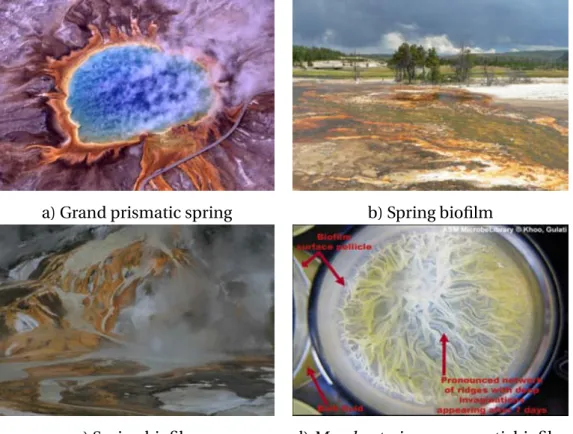
a) Grand prismatic spring b) Spring biofilm
c) Spring biofilm d) Mycobacterium smegmatis biofilm
Figure 2: Macroscopic manifestations of biofilms. Figure a) and b) sourcewww.wikipedia. com. Figure c) courtesy of S. Veran. Figure d) sourcewww.microbelibrary.org.
Figure2shows examples of different manifestations of biofilms visible with the naked eye. Figure (2a,bandc) illustrate the presence of biofilms around springs where hot water and high concentrations of nutrients favorable the development of microorganisms. In Figure (2a), the bacterial and algal mat, in the grand prismatic spring in Yellowstone’s park (USA), is responsible for the beautiful orange, red and yellow colors during summer (low chlorophyll concentrations). Figure (2b) was taken near the grand prismatic spring and shows an outstanding amount of biofilms within the water, green colored in the middle, where phototrophic organisms are in high con-centration. Figure (2c) exhibits the same color range, but was taken in the geothermal sources in Orakei Korako (New Zealand). In Figure (2d), mature Mycobacterium
smeg-matis biofilm (7 days old), a pellicle of microorganisms developing at the fluid-air
interface and primarily constituted of mycolic acids (waxes), makes strange patterns. Figure3shows various scanning electron micrographs, exhibiting amazing details on a nanometer scale. Figure (3a) is a colored scanning electron micrograph of an acidophilic bacterial biofilm from a sample collected in a 75-m-deep borehole located at the Kempton Mine complex in Maryland. In Figure (3b), Bacillus subtilis cells grow
2.2 I N S I G H T S I N T O T H E W O R L D O F M I C R O B E S: A P I C T U R E T O U R 9
a) Acidophilic bacterial biofilm b) Bacillus subtilis
c) Bacterial biofilm d) Salmonella typhimurium (red)
Figure 3: Microscale images (scanning electron micrographs). Image a) (G. Bowles, P. Piccoli, P. Candela, M. Seufer, and S. K. Lower), cover photograph (2008) of Applied and environmental microbiology. Image b) (B. Hatton and J. Aizenberg) source Wyss Institute website. Image c) (P. Gunning, Smith and Nephew) sourcewww.fei.com. Image d) sourcewww.ozonefreshsystems.com.
closely packed in parallel chains. In Figure (3c), various channels are visible within the bacterial biofilm structure, growing on a micro-fibrous material and Figure (3d) shows Salmonella typhimurium invading cultured human cells.
Figure4shows a strain of Shewanella oneidensis forming a biofilm under different nutrient conditions. Confocal laser scanning microscopy is, nowadays, the most utilized, and probably the most powerful, method to image biofilms on plane surfaces, as it reveals fundamental structural details such as mushroom like colonies Figure (4a).
Figure5represents a biofilm of Streptococcus mutans growing on a plane surface, imaged using a new confocal technique (CRM) with an acquisition every 12 hours. Such images give a really good idea of the heterogeneities inherent to the biofilm lifestyle and make it possible to collect non-destructive precise dynamic information about the growth of biofilms within microfluidic devices.
Very different types of microorganisms (bacteria, fungi, algae, archaea in inter-action with protists) are known to produce biofilms. For instance, fungal biofilms can develop on medical implants and can cause severe complications. However,
10 B I O FI L M S
Shewanella oneidensis
Figure 4: Confocal microscopy images of biofilms growth in different environmental condi-tions [169].
one may have noticed that most of the above microscopic figures focus on bacterial biofilms. In a more general way, scientific interest has mainly focused on bacterial biofilms. The reasons this are diverse. First, bacteria are the most abundant organisms on Earth, meaning that, most of the time, they are the predominant species within natural and engineered biofilms. Secondly, bacteria are probably the most versatile microorganisms, and, hence, are particularly interesting for engineering applications or biomimicry. Finally, bacteria are very ancient organisms that appeared on Earth approximately 3.25 billion years ago (in comparison to Earth’s formation 4.6 billion years ago) and thus, have played a very special role in the evolution of life.
2.3 T H E M I C R O B I A L M O D E S O F G R O W T H
Historically, the planktonic (lifestyle 1), or free-floating, phenotype has been the most studied vegetative mode of bacterial development. For example, Escherichia Coli, a Gram-negative bacterium (Gram staining is a procedure used to discriminate between
structural differences of bacterial cell walls. Gram-positive cell walls typically lack the outer membrane found in Gram-negative bacteria) usually part of the mammals
in-testinal biota, has received a lot of attention and often serves as a model of flagellated bacteria. Planktonic microbes play a crucial role in the elaboration of antibiotics and biocides, as these are usually designed to be effective against the free-floating phenotype.
As a a dormant non-reproductive response to tough environmental conditions, some Gram-positive bacteria can also exhibit the bacterial spore, or endospore
phe-2.3 T H E M I C R O B I A L M O D E S O F G R O W T H 11
Streptococcus mutans
Figure 5: Microscale three-dimensional image obtained using confocal reflection microscopy (CRM) [293].
notype (lifestyle 2). The cell coats itself with a thick protective outer wall, and goes back to its normal vegetative state when conditions are favorable.
Even though lifestyles 1 and 2 have been examined for decades, the ultramicrobac-terial or starvation form (lifestyle 3) is much less known. The realization that bacteria could express such a phenotype is a recent discovery [141], their extremely small sizes leading to difficulties of observation. Nowadays, ultramicrobacteria (UMB) are recog-nized as a fundamental dormant bacterial state and have been found in groundwater as deep as 1500 m below the Earth’s surface and in the abyssal areas of the oceans [60]. Similarly to lifestyle 2, it activates in response to a variety of environmental stresses, such as starvation. Bacteria exhibit a huge amount of physiological
mod-12 B I O FI L M S
ifications and can become significantly smaller, with a diameter of approximately 0.2 micrometer and a volume of about 0.02 cubic micrometer, than their normal size (not to be confused with nanobacteria or nanobes which have an even smaller normal vegetative size, i.e., 0.02 to 0.128 micrometer in diameter [265]). Remarkably, when exposed to favorable conditions and nutrients, the UMB can also return to their normal vegetative state [66]. Engineers have used these properties to develop biobarriers technology that can contain pollutants within a restricted area (see Figure 6adapted from [60]) [90].
Figure 6: Biobarrier process.
Biofilm (lifestyle 4) is the predominant mode of growth of bacteria. Evidence that biofilm formation is an extremely ancient mechanism, that is, ~3.25 billions years ago, has been reported in [217,272,215]. One may have trouble finding a consensus
2.4 D Y N A M I C S O F B I O FI L M F O R M AT I O N 13
of how to define biofilms as our conception of them is changing on a daily basis. Here, we will adopt the definition given by Donlan and Costerton in [213], “the new definition of biofilm is a microbially derived sessile community characterized by cells that are irreversibly attached to a substratum or interface or to each other, are embedded in a matrix of extracellular polymeric substances that they have produced, and exhibit an altered phenotype with respect to growth rate and gene transcription”. In addition to the “simple” definition, that is, microbes aggregated on a surface that live embedded within extracellular polymeric substances (EPS), Donlan and Costerton also consider the physiological and genetic modifications associated with the biofilm phenotype [108,109]. The proteins produced (genes expressed) by cells within biofilms differ fundamentally from those produced by planktonic cells of the same strain [225,226,3]. A very important consequence, discussed in Section2.5.3, of these profound modifications is that biofilms cells develop resistance to antibiotics and biocides [239].
2.4 D Y N A M I C S O F B I O FI L M F O R M AT I O N
The formation of biofilms can be broken down into five different steps that are summarized in Figure7. This section proposes to follow the path of a free-floating microorganism cell drifting within a fluid (e.g. water in a river) and to qualitatively describe the physical, chemical and biological processes that lead to the formation of a biofilm.
2.4.1 Cell transport and initial attachment
The journey of our minute organism can start within the water column of the Garonne, a French river crossing Toulouse near the Institut de Mécanique des Fluides. The cell will invariably exhibit a certain amount of movement that can look pretty chaotic, if the cell is small and the river is quiet, or will follow the flow, especially during spring when the flow rates are relatively large. Various processes are responsible for these transport phenomena; which can be broken down into
1. a passive component: effects of local hydrodynamics, Brownian movements and sedimentation [112].
2. an active component: motility of the cells. For example, microbes can get away from toxic solutes or head toward nutrients. These motile behaviors include chemotaxis, phototaxis and magnetotaxis [164,101]. The mechanisms respon-sible for this movement are species-specific. Bacteria can use flagella for swim-ming through water; bacterial gliding and twitching for crossing surfaces; and buoyancy modifications for vertical motion [16].
14 B I O FI L M S
Figure 7: Schematics of biofilm formation.
At some point along its path, the cell will eventually reach the vicinities of the sed-iments bed that delineates the river channel. When it is close enough, the cell can undertake reversible adsorption, often described in terms of DLVO theory (DLVO
[Derjaguin-Landau-Verwey-Overbeek] theory describes surface interactions of charged colloidal particles (nanometer to micrometer sized) by taking into account van der Waals attraction and electrostatic, double layer, repulsion forces), to a solid surface.
2.4 D Y N A M I C S O F B I O FI L M F O R M AT I O N 15
surface microtopography, flow rates, local pressures, substrate hydrophobicity and electric charge, pH, salt concentration, type of organic compounds, time and temper-ature contact [135,236,297,128,61,38,261]. However, part of the process remains biological, that is, a “decision” of the cell is involved. For example, initial attachment can trigger specific membrane proteins [20,32], especially for adherence to other living organisms, or direct planktonic production of “sticky” exopolysacharides.
Eventually, the second step of biofilms formation occurs. Some attached bacte-ria undergo physiological modifications (expression of the biofilm phenotype) that initiate the formation of microcolonies; the other cells can still exhibit detachment mechanisms (described in section2.4.3). This expression of the biofilm is fundamen-tal but yet, not fully understood. The stimuli involved in this decision making are barely tackled [60,168]. Several fundamental questions have no definitive response:
1. How do bacteria sense the surface ? A current hypothesis is that signal molecules secreted by the microorganisms are in higher concentration in the vicinities of the solid surface (because, on the surface, the normal component of the flux is zero [204]).
2. How do other planktonic species interact with the microcolonies ? It is expected that other species will join the biofilm to form mixed bacterial consortia, specif-ically at this early stage of the biofilm formation. The first reason is that it is easier for the other cells to attach to the matrix than to the abiotic surface. In addition, a well established mature biofilm might not be inclined to accept new species, that is, mixing organisms after the initial stage is arguably more and more difficult [60].
3. Biological attachment and detachment are known to be closely related to quo-rum sensing phenomena (e.g. : [75,291]) (Quorum sensing designates a
fun-damental ability of microbes to communicate with each other by molecular signaling) but what are the molecular mechanisms involved ?
2.4.2 Growth and maturation
This step corresponds to the cells’ multiplication and biofilm expansion on the basis of the first microcolonies. Three-dimensional structures develop [267] and the matrix starts to interact strongly with the fluid. Then comes the maturation step. During this stage, variations of the biovolume and of the biomass are relatively small as compared to the growth step, but important structural modifications are triggered regarding interspecies relationships
Various parameters influence the kinetics of growth and maturation. These in-clude biological (such as which species is involved or predation) or physico-chemical factors (such as local hydrodynamics [37], nutrient conditions [6], pH, presence of biocides). There is a continuing debate within the scientific community regarding
16 B I O FI L M S
the relative importance of the biological and the physical factors. One must keep in mind that all aspects of the problem, even though they can seem very different, are closely connected. Biofilms are in fact dynamic systems that continuously modify the local physical, chemical and biological conditions surrounding them. These trigger dynamic retroaction processes between the biota and the environmental conditions. For example, Picioreanu (1998) [197] shows that local flux limitations can explain the biological and physical heterogeneities within biofilms. Metabolically active cells, initially chaotically distributed, consume and create various solutes and polymers, modifying the chemical speciation of the elements present in the medium as well as local hydrodynamics. Hence, gradients in concentrations and spatial heterogeneities of the shear stress appear, influencing the development of ecological niches favorable to different organisms [279,289,262,94].
Figure 8: Modeling the formation of a two-species biofilm on a sphere in a mass transfer limited regime using cellular automata. Source C. Picioreanu [195,196].
2.4.3 Detachment
Detachment refers to the liberation of flocs or individual organisms from the biofilm. There are various physical, biological and chemical processes responsible for these detachments. It can occur when forces applied to the matrix exceed its internal cohesion. This class of phenomena includes sloughing [213,238], abrasion, predation (see in Figure9) or reduction of the cohesion by chemical attacks or enzymes. Erosion refers to detachment induced by shear stress of the fluid on the matrix. Abrasion occurs when solid particles flowing within the bulk fluid collide with the biofilm, tearing off small flocs. An important feature of biofilms is that they display various layers corresponding to different degrees of cohesion [105,189]. Internal layers are less exposed to hydrodynamics constraints, more dense and consequently more difficult to remove than external layers.
The second class of detachment phenomena deals with active remobilization of biofilms’ cells to colonize new niches [226] by “swarming/seeding dispersal” strate-gies or “clumping dispersal” [122]. Seeding dispersal corresponds to the release of individual cells while clumping dispersal refers to the detachment of relatively large
2.5 B I O FI L M S T R U C T U R E A N D C O M P O S I T I O N 17
Figure 9: Example of protozoan (stentor) grazing biofilm [193].
aggregations of cells and extracellular polymeric substances. Hence, detachment is a fundamental mechanism [262,263] as (1) it partly controls the architecture of biofilms, (2) it modifies the shape of the fluid/biofilm interface inducing changes in mass and momentum transfer [238] and modifications of the adhesion properties, rugosity for example, that facilitate the recruitment of new species [251] and (3) it interferes with the proportions of the different species and their spatial distribution [49,176,95,85].
Even though the dynamics of biofilms formation are usually classified as in Figure7, there is actually no clear boundary between the different stages and this breakdown is only a schematic description. For example, detachment phenomena are concomitant to all other formation steps. For this reason, the artwork Figure10is outstanding as, in a less schematic manner, it captures simultaneously the complexity of the phenomena and the coexistence of all the processes.
2.5 B I O FI L M S T R U C T U R E A N D C O M P O S I T I O N
The architecture and the composition of biofilms are highly complex and diverse. For example:
• It has been shown that the marine organism Serratia liquefaciens forms biofilms in which the organism’s cells are “arranged into vertical stalks that bear rosettes
18 B I O FI L M S
Figure 10: “Realistic” biofilm dynamics from [122].
of cells connected to other rosettes by long chains of cells and that each feature of this architectural marvel is controlled by specific genes [149]” (from [60]).
• One clone of Pseudomonas aeruginosa (Pseudomonas aeruginosa is a
Gram-negative, aerobic, rod-shaped bacterium and an opportunistic human pathogen)
forms “stumplike pedestals on colonized surfaces and that mobile cells of a second clone crawl up the pedestals and form the ’caps’ of the mushrooms that are such a prominent feature of biofilms formed by this organism [258]” (from [60]).
The composition and the architecture of biofilms can significantly change from one biofilm to another. However, some aspects of their global composition and some patterns are specific to the biofilm phenotype. For example, well-fed biofilms are often flat and poorly structured whereas low nutrient concentrations lead to highly structured communities. The goal of this section of the thesis is to present the common composition and the key structural elements of biofilms.
2.5 B I O FI L M S T R U C T U R E A N D C O M P O S I T I O N 19
Component % (mass) of matrix
Water up to 97%
Microbial cells 2-5% Polysaccharides 1-2% Proteins <1-2% DNA and RNA <1-2%
Ions ?
Inorganic ?
Table 1: General composition of biofilms, adapted from [246].
Following Sutherland (2001) [246], the general composition of biofilms can be described as in Table1. Most of the biofilm matrix (97% of the total mass) is actually water. The water can be bound within the capsules of microbial cells or can exist as a solvent whose physical properties such as viscosity are determined by the solutes dissolved in it [246]. Extracellular polysaccharides, proteins, DNA and RNA can be integrated into the notion of extracellular polymeric substance that is described in the next section. Inorganic compounds such as minerals or clay particles can get immobilized on the biofilm, depending on the environmental conditions.
2.5.2 Extracellular polymeric substances (EPS)
The EPS definition is in constant evolution, as new constituents, processes and func-tions are frequently discovered. Old definifunc-tions include: organic polymers that are often responsible for the cohesion of the cells within biofilms and for their adhe-sion to substrates [72]. One significant further step has come with the unification of the different concepts that are used to describe this matrix [154]. Nowadays, the EPS is known to be composed of a complex mixture of macromolecules including exopolysaccharides, proteins, DNA, RNA [245, 246] in addition to peptidoglycan, lipids, phospholipids and other cell components. They (1) are usually thought as the principal structuring component of the matrix, that is, the cement that holds the microorganisms together and to the surface and also (2) play other functional roles (Table2). For example, alginate is a polyanion polysaccharide that is supposed to be involved in Pseudomonas aeruginosa’s resistance to antibiotics [122].
The extracellular DNA present in biofilms has been thought for many years to be only the result of cell lysis. However, it has been observed that DNA can be produced and sent outside the cell in small membranes [182,137]. More recently, it has been shown that absence of this DNA can inhibit the biofilm growth [275] and that it can exhibit a very specific structural organization [27]. The intricacy and functionality of EPS remain to be fully understood, especially in natural environments. Most of the
20 B I O FI L M S
EPS component Role in biofilm
Neutral polysaccharides, amyloids Structural components Charged or hydrophobic polysaccharides Ion exchange, sorption Extracellular enzymes Polymer degradation Amphiphilic molecules Interface interactions
Membrane vesicles Export from cell Sorption Lectins, nucleic acids Specificity, recognition
Genetic information Structure
Bacterial refractory polymers Electron donor or acceptor? Various polymers Source of C, N, P
Table 2: The EPS defined, adapted from [100].
work has focused on Pseudomonas aeruginosa, or on other laboratory species, but natural biofilms seem particularly different [60,100]. For instance, the production of EPS in natural biofilms is dynamic and can follow cyclic patterns as demonstrated in marine stromatolites [84] or can form honeycomb structures [89,167,252].
2.5.3 Biofilm cells and their metabolism
Bacterial metabolism englobes the ensemble of biochemical reactions that produce the energy and solutes that are necessary for the cell to function. There is an incredi-ble diversity of cells belonging to various classes. Presenting all these metabolisms is far beyond the scope of this introduction. Here, we will focus on some impor-tant characteristics of bacteria and the modifications associated with the biofilm phenotype.
B A C T E R I A L M E TA B O L I S M Bacteria can be classified by their nutritional groups following the carbon source, the kind of energy source, the electron donor and the electron acceptor used for their development. Phototroph organisms take their energy from sunlight, by photosynthesis, while chemotrophs use chemical reactions that produce energy, mostly oxidation of electron donor at the expense of an electron acceptor such as dioxygen or nitrates. Among chemotrophs, there are lithotrophs that oxide inorganic compounds and organotrophs that use organic molecules. Eventually, during the catabolism, adenosine triphosphate (ATP) is synthesized as the energy source for the cell.
On the basis of the carbon source, bacteria are divided into heterotrophs, which use organic carbon and autotrophs, which feed on inorganic carbon sources, mostly onCO2. Organisms can be further separated into aeroby if they use oxygen as the
2.5 B I O FI L M S T R U C T U R E A N D C O M P O S I T I O N 21
is often utilized. For example, bacteria also need nitrogen, potassium, oxygen and minerals to form the amino-acids required to synthesized proteins; some bacteria can be heterotrophs with respect to the carbon source but autotrophs in relation to other basic compounds such as nitrogen.
S P E C I FI C I T Y O F B I O FI L M S Cells exhibit fundamental phenotypic modifications associated with the biofilm lifestyle. The pattern of genes expression has been found to differ by between 20% and 70% as compared to the corresponding planktonic cell [22,60]. A direct consequence of these modifications is that biofilm cells are more resilient and exhibit resistance to antibiotics and biocides. It was first suggested that biofilm acts as a barrier which prevents harmful components from reaching the cells. However, while it certainly slows down the diffusion, there has been a substantial amount of evidences that antibiotics can penetrate hundreds of micrometers into the matrix within seconds [183,243]. Another hypothesis is that biofilms’ cells lack the enzymes that are usually targeted by antibiotics [111,240,3,225,226].
In addition, within biofilms, the microbial cells, whether from the same species or from different species, are in close proximity to one another. This has various direct consequences:
• Metabolic symbiosis can appear. For example, some species can use solutes produced by other species [5,96] or different cells can exchange genetic ma-terial [103,124]; specialization through stratification can occur in response to various environmental conditions. For example, in aerobic conditions, aerobic bacteria develop in surface of the biofilms while anaerobic ones tend to form deeper within the biofilm, where oxygen has been already consumed by surface organisms [165].
• On the contrary, competition for available nutrients is intense; antimicrobial substances released by some cells, such as bacteriocins, microcins, antibiotics or phage, have a good chance of successfully attacking and possibly destroying neighboring heterologous cell types [133]; predator-prey dynamic relationships affect organisms within the matrix [180,187].
Complex networks of relationships develop between the cells, that eventually end up forming evolutive microbial consortia, that continuously change.
2.5.4 Water channels
In many natural environments, biofilms form mushroom-like structures sprinkled with water channels [179] in which convective flows have been identified [160,241]. The channels act as nutrient suppliers for the deepest microorganisms [158,82]. To get a clear picture of these channels, one may imagine the way oxygen is carried out in the human body. For example, brain cells cannot live more than a few seconds
22 B I O FI L M S
without oxygen, that is, the time forO2 to diffuse through several millimeters of
flesh. If the oxygen were to diffuse all the way from the lungs to our brain, it would take hours, and cells would die. Hence, in multicellular organisms larger than a few millimeters, veins convey the oxygen toward the cells until the critical millimeter length scale is reached. In the biofilms, the situation is similar. In thick biofilms, if the deepest cells were to wait for the nutrients to diffuse all the way through the biofilm, most of them would die. Nutrient channels are thus necessary. To what extent the formation of these channels is the result of an evolution of the microorganisms toward that end or a consequence of the transport processes on a shorter time-scale remains to be fully understood.
2.6 W H Y D O B A C T E R I A F O R M B I O FI L M S ?
Figure 11: Artistic interpretation of the four driving forces behind bacterial biofilm formation [134].
The forces that drive bacteria to produce biofilms are closely connected to the the-ory of evolution. Bacteria tend to develop embedded within extracellular polymeric substances because this lifestyle promotes survival and growth of the population. That being said, the real question becomes: What are the physical, chemical and biological phenomena that make the biofilm mode better than the planktonic one?
2.6 W H Y D O B A C T E R I A F O R M B I O FI L M S ? 23
Following Jefferson’s work [134], these phenomena can be classified according to four different classes, as illustrated on Figure11.
First of all, the biofilm form can develop as a defense mechanism in response to various environmental stresses such as mechanical stress (shear or osmotic), UV exposure, metal toxicity, acid exposure, dehydration and salinity, phagocytosis, iron deprivation and several antibiotics and antimicrobial agents [122]. EPS is thought to play a crucial role in the protection of the cells. For example, it might protect organisms from being crushed by important mechanical stresses, reduce the quantity of several toxic compounds that diffuse through the matrix and reach the deepest organisms or simply slow down the diffusion allowing the bacterial immune system to mount a specific attack. Evidence for such mechanisms includes the expression of specific proteins that trigger the expression of EPS in response to environmental stresses such as the upregulation of proU in E. Coli to adapt to transport or osmotic stresses [204]. Another example is the creation of starved, stationary dormant zones that seem to induce resistance in biofilm populations to antimicrobial agents. Ar-guably all biocides or antibiotics need at least some degree of metabolic activity in order to be efficient and, hence, might not kill dormant bacteria [122].
The second class of phenomena deals with fighting host immune systems in order to stay in a favorable habitat. For example, the human body, because of its adequate temperature and high concentrations of nutrients, represents an extremely appealing habitat for microorganisms. The counterpart is obviously that they will have to de-velop either in symbiosis with the host or to constantly struggle against its immune system. From this perspective, the biofilm mode of growth is an excellent strategy to remain fixed to the host. Specific microbial surface component recognizing adhesive matrix molecules (MSCRAMMs) are often expressed and play a key role in initial adherence of bacteria to host surfaces [194].
There are also various advantages associated with life in community
• A division of labor can develop. As previously discussed, some symbiotic re-lationships might occur. For example, myxobacteria can produce extra diges-tive enzymes as a community and, potentially, break down complex food sub-stances. Communication is realized through the expression of auto-inducing molecular signals, that is, as previously discussed, quorum sensing.
• Because of their proximity, biofilms cells can perform genes transfer. These pro-cesses may directly benefit to the bacteria, for example by exchanging antibiotic resistance determinants [134].
• Some microorganisms might exhibit programmed cells death mechanisms, in order to reduce to metabolic activity in low nutrients conditions, that is, the biofilm might behave like a multicellular organism, although this is still a matter of debate [134].
24 B I O FI L M S
• There are also evidences that the biofilm formation is the default mode of growth of microorganisms. When bacteria sense an adequate surface, that is, a free ecological niche, they develop the biofilm phenotype. For example, algC, a gene required for alginate synthesis, in Pseudomonas aeruginosa is upregulated within minutes of attachment [74]. Jefferson (2004) suggests that one may have to wonder more about what drives bacteria to develop the planktonic phenotype.
John Tyler Bonner would probably argue that size increase is the meaningful evolu-tionary concept that regroups all these advantages. In [28], he discusses the impor-tance of size and scales on the evolution of Earth’s organisms and states that “size is a prime mover in evolution”. Bonner also says that “there has been a selection for larger organisms; under some circumstances size increase can confer advantages and promote reproductive success [...]. If there is an advantage to increased size, one of the simplest ways to achieve it is to become larger by becoming multicellular”. The idea behind that is an ecological principle based on Darwinian evolution. There is a perpetual competition for survival in natural habitats. All size levels, except for the largest one, are occupied by some organisms. Biofilm could have developed origi-nally as a result of cells aggregation (due to passive and maybe active phenomena) and have survived as the top-size free niche promotes survival and growth of the population.
2.7 M O D E L I N G B I O FI L M S
Developing mathematical models has become a matter of utmost importance in scientific research in general. Direct observations are the cornerstone of scientific knowledge. Yet, quantifiable understanding regarding the processes at play as well as quantitative predictions cannot be achieved without mathematical analysis. This is particularly true within the context of biofilms where numerous extremely com-plex processes are at play simultaneously. B. E. Rittmann (2007) [221] states that mathematical modeling provides a quantitative relationship between the biofilm components and the processes. “The components include the various microbial types, extracellular polymeric substances (EPS), inert or dead biomass, the metabolic substrates for all the microbial species, metabolic products from the reactions they carry out, alkalinity, they hydrogen ion (for pH), and more. Processes include the metabolic reactions, transport of solutes and biomass, acid/base reaction, precipita-tion/dissolution, and physical deformations due to forces acting on the biofilm. Many of the processes, particularly the metabolic ones, are the services that the community provides human society”. In a more general framework, mathematical modeling can help in identifying pertinent physical, biological and chemical parameters as well as discerning irrelevant ones. It also represents a unique predictive technique that can provide informations regarding future behaviors. Hence, models have become a key
2.7 M O D E L I N G B I O FI L M S 25
component to provide responses to specific engineering applications or are used as a research tool.
Along with the realization of this modeling necessity, a substantial amount of theoretical works have been developed within the last decades. One critical aspect of the problem, which is particularly important in this work, is that biofilms are extremely heterogeneous. According to Bishop and Rittmann (1995), heterogeneity may be defined as "spatial differences in any parameters we think is important". An adapted list from Bishop and Rittmann (1995) [24], summarizes a few examples of possible biofilm heterogeneities:
1. Geometrical heterogeneity: biofilm thickness, biofilm surface roughness, biofilm porosity, substratum surface coverage with microbial biofilms.
2. Chemical heterogeneity: diversity of chemical solutes (nutrients, metabolic products, inhibitors), pH variations, diversity of reactions (aerobic/anaerobic, etc.).
3. Biological heterogeneity: microbial diversity of species and their spatial distri-bution, differences in activity (growing cells, EPS producing, dead cells, etc.).
4. Physical heterogeneity: biofilm density, biofilm permeability, biofilm visco-elasticity, viscosity, EPS properties, biofilm strength, solute concentration, so-lute diffusivity, presence of abiotic solids.
Length scales that are involved vary from nanometers (EPS polysaccharides) to mil-limeters or even centimeters (biofilm thickness) with an intermediate size of about several micrometers (cells) (Figure12). All of these spatial scales are pertinent when working with biofilms. For example, let us consider the path of a nutrient molecule that originally is in the bulk fluid. It might be submitted to diffusion and convection within the water, then goes through the millimeters of EPS and eventually reaches the membrane of a cell. Once there, it has to cross the interface using specific transmem-brane proteins such as porins.
These heterogeneities are extremely difficult to model because of the broad range of scales that are involved. One usually tries to avoid a purely multiscale description of the various processes. The primary reason for this is that our computational re-sources are limited and molecular modeling over centimeters is nearly impossible. Secondly, such models would contain an enormous amount of information that is mostly irrelevant at the macroscale. Various strategies have emerged to model the macroscopic behavior of biofilms, that is, to describe the phenomena in some av-eraged sense. Microscale modeling strategies as well as upscaling techniques and empirical formulations are presented and compared within the next sections.
26 B I O FI L M S
Figure 12: Multiscale representation of biofilms (adapted from [138]).
2.7.1 Cellular-scale direct numerical simulations (DNS)
C E L L U L A R A U T O M ATA A cellular automaton (CA) model consists in an array of small compartments, each in one of a finite number of states. For each time step t+dt, a new generation is created as a function of the generation at time t, following a given set of rules. For example, the creation of a new microorganism cell requires that the set of rules specifies where to place it, as a function of the neighborhood of the mother cell. The rules typically take into account processes such as substrate uptake, metabolism, maintenance, cell division, transport and death. Although the main idea is the same, the set of rules that govern the spreading of the biomass differs from model to model [153]. Examples of early CA models include [104] and [280].
I N D I V I D U A L-B A S E D M O D E L S Individual-based models simulate individual cells, rather than the behavior of a predefined grid (such as CA). All other aspects of the simulation, and the processes that are modeled, are very similar to those of the cellular automata. Advantages, disadvantages and problems that need to be tackled are thoroughly discussed in [153].
2.7 M O D E L I N G B I O FI L M S 27
2.7.2 Biofilm-scale empirical analysis
Empirical analysis remains the most common technique. The macroscopic laws are guessed on the basis of the mathematical structure of the problem at the microscale, in conjunction with experimental data. As an example of one such technique, we will describe how cells transport is commonly described within the fluid phase. One usually cannot follow the Lagrangian trajectory of every single cell in the medium, but rather, assumes that these can be followed in terms of an homogenized concentration. In addition, cells transport within the bulk fluid is usually described in terms of a mass balanced equation in which it is assumed that fluxes are convective and diffusive. This is based on the assumption that the attachment mechanisms can be uncoupled from the transport processes, that is, that the characteristic times for attachment are much longer than those associated to diffusive and convective transport. If such an hypothesis is valid, then the mass-balance equation takes the form (e.g. [112])
∂wγ
∂t +∇· {(vγ+ ζvs) wγ} = ∇ · {kγ∇wγ} (2.1) which is an heuristic formulation of the Fokker-Planck equations for particles (see discussion in [212]). In Eq (2.1),wγ refers to the concentration of cells within the
waterγ − phase, vγis the pointwise Eulerian velocity field (solution of the
Navier-Stokes equation) within theγ − phaseandkγis the diffusion coefficient of the cells
within the water. vsis the maximum theoretical velocity for the sedimentation of a
spherical particle in an infinite medium, that is,
vs=
(ρp− ρ)gd2p
18µ (2.2)
whereρpis the buoyant density of the particle andρthe one of the bulk fluid.dpis
the diameter of the sphere,µthe viscosity of the bulk fluid and g is the gravitational acceleration.ζis an empirical parameter such as06 ζ 6 1, that takes into account, among others, the grain surface rugosity and the sphericity of the particles (see discussions in [123]).
2.7.3 Upscaling from the cell-scale to the biofilm-scale
The idea that biofilm models should be upscaled directly from the microscopic scale has been brought forth previously by Wanner and Gujer (1986) [271]. One can adopt the suggestions of Wanner et al. (1995) [269] by starting at the cellular level, where the biofilm is a discontinuous multiphase medium [285,286]. B. D. Wood an co-workers performed such an analysis using the volume averaging with closure techniques [287,284]. These include upscaling reactive solute transport within the
28 B I O FI L M S
matrix, cellular growth and multispecies diffusion. In general, most of the work with volume averaging has focused on local mass equilibrium conditions, that is, when the gradients of concentrations within each phase are relatively small, the continuity conditions at the interfaces can be extended to the bulk phases. Hence, all intrinsic concentrations are equal and the mass transport can be described in terms of a single mass transport equation.
2.7.4 Advantages and disadvantages
Advantages Disadvantages
DNS Realistic models Time-consuming
Large amount of information Limited to small sized volumes No microscale validation Empirical analysis Simple laws No connection macro/micro
No domain of validity Upscaling Connection macro/micro Non-equilibrium conditions
Domains of validity Non-linearity Description of large volumes Dynamic interfaces
Table 3: Advantages and disadvantages of the different models.
DNS (Direct Numerical Simulation) has been used to explore some physics of biofilm formation. In particular, cellular automata represent a very particular frame-work, that has recently met a great success. It can be used for different purposes, for example to study the influence of nutrient flux limitations within biofilms. It models biofilms starting at the cellular-scale, and hence, is quite realistic and captures a lot of information. On the other hand, these are often time-consuming simulations, that are limited to a relatively small total volume. In addition, each cell receives a set of basic rules that change from one model to another. The biofilm growth is obviously very sensible to these rules, and validation is not easy to perform.
Empirical development of macroscopic laws often ends up with relatively simple macroscopic equations that are convenient for data interpretation. However, upscal-ing techniques in general (for instance, homogenization, volume averagupscal-ing, moments matching techniques), and volume averaging in particular, (1) relates the microscopic parameters to the observable macroscopic ones. As part of the process of volume av-eraging, the microscopic parameters that apply to these small scales can be explicitly linked to their macroscopic counterparts and (2) volume averaging indicates under what conditions the conservation equations are valid. The counterpart is the diffi-culty to treat non-equilibrium situations, non-linearity or dynamics of the interfaces
2.7 M O D E L I N G B I O FI L M S 29
such as biofilm growth coupled with mass transfer. However, one must remember that these disadvantages are purely technical and can be overcome. If an averaged behavior exists, then upscaling techniques should be able to capture it. If it does not, then one needs to use DNS.

![Figure 4: Confocal microscopy images of biofilms growth in different environmental condi- condi-tions [169].](https://thumb-eu.123doks.com/thumbv2/123doknet/3708782.110352/22.892.224.677.162.462/figure-confocal-microscopy-images-biofilms-growth-different-environmental.webp)
![Figure 5: Microscale three-dimensional image obtained using confocal reflection microscopy (CRM) [293].](https://thumb-eu.123doks.com/thumbv2/123doknet/3708782.110352/23.892.219.671.155.760/figure-microscale-dimensional-image-obtained-confocal-reflection-microscopy.webp)

![Figure 11: Artistic interpretation of the four driving forces behind bacterial biofilm formation [134].](https://thumb-eu.123doks.com/thumbv2/123doknet/3708782.110352/34.892.226.673.478.920/figure-artistic-interpretation-driving-forces-bacterial-biofilm-formation.webp)

![Figure 15: Temporal scales [270].](https://thumb-eu.123doks.com/thumbv2/123doknet/3708782.110352/48.892.230.676.357.686/figure-temporal-scales.webp)