Understanding the Egyptian
Lexicon with(out) Comparison
Jean Winand (University of Liège)
Rethinking the Origins
Captatio benevolentiae
•
I have been dealing with Egyptian lexicon for
some time, but with two important caveat’s
–
my choice field of expertise is Late Egyptian,
which is not attested before the 18
thdyn. (ca.
1550 BC), with some occasional interest in earlier
periods
–
I have never been really preoccupied by Afro-Asiatic (hence AA) comparison
Prolegomenon
Proto-AA Egyptian Proto-AA-Eg Proto-y Egyptian Proto-Sem. Proto-Berb. Proto-Cush. … Proto-AA Proto-Sem. Proto-Berb. Proto-Cush. … Egyptian Proto-AA-Eg Proto-AA Proto-Sem. Proto-Berb. Proto-Cush. … Model A(AA Hypothesis) Model B Model C
Prolegomenon
(Proto-)Sem. (Proto-)Berb. Egyptian (Proto-)Cush. Model D (Proto-)Tchad. (Proto-)Omot.AA
EEG Coptic
Major differences in phonology, morphology, lexicon
3000-2000 BC 300-1000 AD 1800-present
EEG Coptic Major differences in phonology, morphology, lexicon
Phonology
• drastic reduction in plosives • elimination of the emphatics, laryngals 3000-2000 BC 300-1000 AD 1800-present
Some basic facts
EEG Coptic
Morphology
• from more than 20 suffix conjugation patterns to (almost) zero in Coptic • neutralisation of the inflections of the PsP • nominal endings : Hm.t=f > tAj=f s-hme • … 3000-2000 BC 300-1000 AD 1800-present
LEg sequential form (jw=f Hr tm
sDm
)
•
innovation of LEg
•
disappeared around 700 BC
Major differences in phonology, morphology, lexiconSome basic facts
EEG Coptic
Lexicon
• Major changes in the lexicon (mAA > ptr > nw; pr > a.wj) • Major changes in the semantic organisation of the verbal lexemes • … 3000-2000 BC 300-1000 AD 1800-present Major differences in phonology, morphology, lexicon
Some basic facts
wxA [motion] [abstract] [intellect] [psych feeling] ⓵ ⓶
EEG Coptic Chadic Cushitic 3000-2000 BC 300-1000 AD 1800-present - 1500 y. - 3500 y.
Some basic facts
Methodology
1. select languages one suspects they are related (assumed subjectivity), 2. select words that a priori seem to be connected semantically and
phonologically,
3. eliminate loanwords,
4. give the priority to the oldest forms,
5. isolate the core/original meaning, which will be subsequently used for comparison,
6. make evident the semantic links that connect words coming from different languages,
7. explain how the meaning attached to the reconstructed AA proto-lexemes has been identified,
8. finally, assess plainly the phonological correspondences.
Methodology
1. select languages one suspects they are related (assumed subjectivity), 2. select words that a priori seem to be connected semantically and
phonologically,
3. eliminate loanwords,
4. give the priority to the oldest forms,
5. isolate the core/original meaning, which will be subsequently used for
comparison,
6. make evident the semantic links that connect words coming from
different languages,
7. explain how the meaning attached to the reconstructed AA
proto-lexemes has been identified,
8. finally, assess plainly the phonological correspondences.
• For the majority of the verbs listed, one of the alleged use is late, rare or non-existent! • As regards Egyptian, these lists are mostly based on old fashioned dictionaries without any philological insight • There are differences in the actionality of the verbs listed: o verbs of motion (telic or atelic) o verbs of state o verbs of quality • These differences can explain particular behaviours, esp. changes in the core argumental structure (addition, deletion, syntactic modifications …), … which can of course affect the verbal diathesis.
Bi- or tri-radicalism?
•
Since the last quarter of the last century, attempts have been made to
reconstruct the basic root consonantal system (esp. in Semitic) with a bi-consonantal primary cluster, eventually extended to a third consonant.
– Ehret (1989) suggests that the 3rd consonant is semantically motivated, • the systematic attribution of semantic features to the third extended consonant makes the system incredibly complex – according to Bohas (1991, 1999), the Semitic (at least Arabic) lexicon is organized in a three-level system: a matrix, an etymon (always bi-consonantal), and a root – these views against original tri-consonantal roots are not universally accepted (Zanned 2005) – unfortunately, the issue is rarely discussed in recent general presentations (see e.g. Frajzyngier & Shay 2012)Bi- or tri-radicalism?
•
The Egyptian data support the hypothesis that a number of
tri-radical stems can be analysed as basically two-consonantal
roots with an expansion (e.g. Breyer, Winand 1985):
–
P + R [split] : prs
prd
prD
prS
prt
…
Envoi !
•
the collection of data
(but should be refined, be more reliable)
•
the reconstruction of some phonological correspondences
(but far from a
general agreement)
•
the reconstruction of root patterns
(but with problems: bi-, tr-radicalism)
•
proposals on how to organise the languages families in some genetic way,
and how to fix an absolute chronology
(but no agreement between
“schools”)
•
the production of more or less extensive lists: dictionaries of AA roots,
etymological dictionaries, etc.
(but much criticism on what has been
produced so far)
•
attempts at reconstructing the cultural and societal background by using
the lexicon: Militarev 2009, Ehret 2011
(but seems premature)
•
attempts at reconstructing larger entities: Nostratic
(from proto-something to Ur-proto-something ?)
Is there anything like Afro-Asiatic?
How to place Ancient Egyptian?
“Are these question legitimate?”
YES
“Can we handle this
properly
now
?”
Probably, NO
The Semantic Trail exemplified by the verb ptr “see” (Polis & Winand 2015).
taking advantage of the Egyptian graphic system (hieroglyphs)
words mean nothing when considered in isolation
jwj
Hsj Thn wHa xnr xntj Ab xam jfd swtwt dwn jwd Hpt tfj wnj xnd sxn sxsx pD bsj bs sSmj swAj jsq wsTn saqXn
dgs
wsf
wDA
naj
As
sTA
tkn
sbj
Sms
mSa
HH(j)
war
sTA
ms
saHa
pXr
wAj
thj
Tzj
wDj
Hn
snj
rwj
wxA
hAj
pH
aq
spr
prj
aHa
Sm
verbs with
≥ 10 occurrences
hAb
wD jnjxAa
jwj
Hsj Thn wHa xnr xntj Ab xam jfd swtwt dwn jwd Hpt tfj wnj xnd sxn sxsx pD bsj bs sSmj swAj jsq wsTn saqXn
dgs
wsf
wDA
naj
As
sTA
tkn
sbj
Sms
mSa
HH(j)
war
sTA
ms
saHa
pXr
wAj
thj
Tzj
wDj
Hn
snj
rwj
wxA
hAj
pH
aq
spr
prj
aHa
Sm
verbs with
≥ 10 occurrences
hAb
wD jnjxAa
Motio
n
Tran
sfer
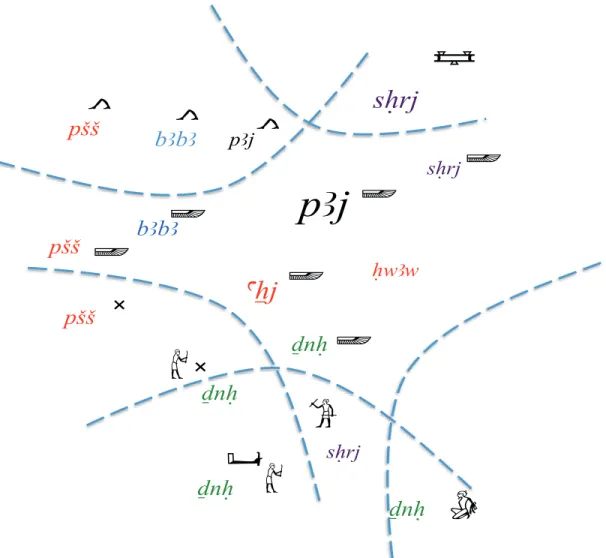
pSS bAbA pAj bAbA pSS pSS aXj DnH DnH DnH DnH HwAw
pAj
sHrj sHrj sHrjjwj wsTn rdj hAb aHa Hmsj, sDr nbj
∅
[POSITION] [TRANSFER] TELIC MOTION pSS pSS [TRANSFORMATION] ATELIC MOTION
What can we really do with this kind
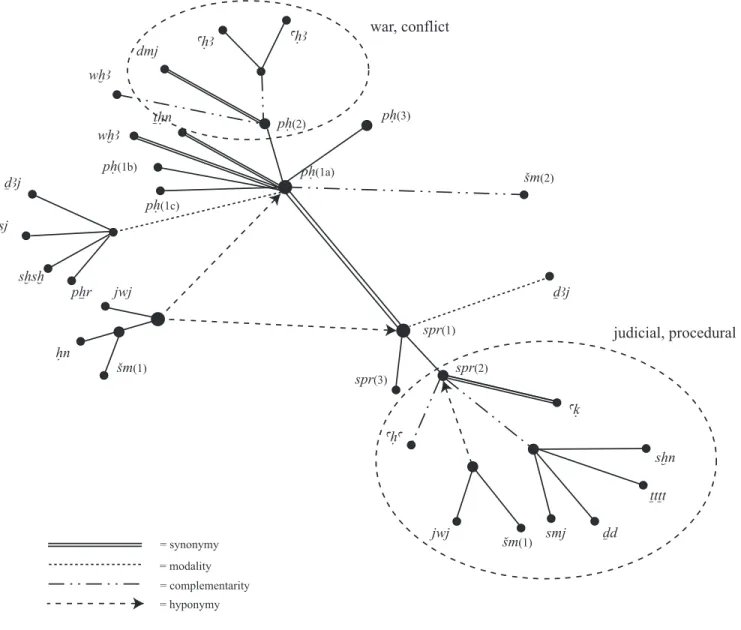
The semantic organisation of pHwj (after Polis-Winand 2015 : 1510) • work with LexUnits • semantic bridges • take into account a semantic field (synonyms, antonyms, meronyms, etc) • semantic typology?
aHA aHA dmj pH(3) pH(2) wxA THn wxA pH(1a) pH(1c) pH(1b) Sm(2) pXr sxsx Tsj DAj Sm(1) Hn jwj DAj spr(2) spr(1) spr(3) aHa jwj Sm(1) smj Dd TtTt sxn aq = synonymy = modality = complementarity = hyponymy war, conflict judicial, procedural
Graphic representation of the semantic relations connecting the LexUnits of pH and spr to other verbs
Semantic maps involving some verbs of cognition (Winand 2016)
• basically synchronic
“One of the greatest hindrances to the reconstruction of Proto-Afro-Asiatic has been the difficulty of establishing clear cognate sets across the vocabularies of the several branches (this has also, of course, impeded efforts to establish sound correspondences across the branches and to reconstruct Proto-Afro-Asiatic phonology). Essentially, this must await the working out of reconstructed proto-vocabularies for the individual branches, which is still in its beginning stages, except for Semitic.” (J. Huehnergard) “Pour le comparatisme dans le domaine des langues afro-asiatiques, la conclusion semble être qu’en ce qui concerne le lexique, la comparaison doit s’effectuer sur les étymons et les matrices et non pas sur les racines triconsonantiques. En d’autres termes, qu’avant de comparer, il faut commencer par dégager les étymons et les matrices dans chaque langue.” (G. Bohas)
“EDAL (Etymological Dictionary of the Altaic Languages ) is a full scale demonstration that the Altaic hypothesis has failed, although the main goal of this grandiose publication was just the opposite: to prove to the outside world that the Altaic language family exists and that five language families included into this tentative stock are all genetically related. I really feel indebted to EDAL' s authors for their massive effort to provide such a bulk of non-evidence for Altaic conveniently collected in one place for those of us who humbly disagree with the authors' main premise”. (A. Vovin 2005: 72-73)
Si on prend le mot "JOURNAL", et qu'on remplace le J par un C, le O par un H, le U par un A, le R par un T, et qu'on supprime le N, le A et le L, on obtient le mot "CHAT"