HAL Id: hal-00463711
https://hal.archives-ouvertes.fr/hal-00463711
Submitted on 14 Mar 2010
HAL is a multi-disciplinary open access
archive for the deposit and dissemination of sci-entific research documents, whether they are pub-lished or not. The documents may come from
L’archive ouverte pluridisciplinaire HAL, est destinée au dépôt et à la diffusion de documents scientifiques de niveau recherche, publiés ou non, émanant des établissements d’enseignement et de
Positioning Manipulators
Stéphane Caro, Philippe Wenger, Fouad Bennis
To cite this version:
Stéphane Caro, Philippe Wenger, Fouad Bennis. Robustness Study of Generic and Non-Generic 3R Positioning Manipulators. Journal IFToMM Problems of Applied Mechanics, 2006, 22 (1), pp.9-23. �hal-00463711�
robustness concepts. It turns out that the farther a manipulator is from non-generic ones, the more robust it is with respect to homotopy class and number of cusps. Besides, we state that the proximity of a manipulator to non-generic frontiers may severely affect its robustness with respect to path-feasibility. Finally, we notice that the dexterity and the accuracy of 3R manipulators do not depend on genericity.
Keywords—Robust design, genericity, path-feasibility, singularity, cuspidality, homotopy class, serial manipulator.
I. INTRODUCTION
The performance functions of a manipulator are numerous. Its dexterity and accuracy, the shape and the size of its workspace are some criteria that can be used during its design stage.
This paper deals with a robustness study of 3R manipulators, which are serial manipulators and composed of three actuated revolute joints. A detailed analysis of 3R manipulator singularities is presented in [1] and the notion of genericity is introduced in [2]. A manipulator is generic if its singularities are generic (they do not intersect in the joint space). Non-generic manipulators form hyper-surfaces dividing the space of manipulators into different sets of generic ones. Consequently, most manipulators are generic.
The concept of robust design was introduced by G.Taguchi. He proposed the concept of parameter design to improve the quality of a product whose manufacturing process involves significant variability and noise [3]. As a matter of fact, robust design aims at minimizing the sensitivity of performances to variations without controlling the causes of these variations that can arise from a variety of sources, including manufacturing operations, variations in material properties, and the operating environment [4].
Here, the main issue is to know whether generic manipulators are more robust than non-generic manipulators or not. This issue is critical because the majority of industrial robots are supposed to be non-generic. In fact, they are usually non-generic due to the simplification of their geometric parameters. On the one hand, some authors [1, 5] claimed that non-generic manipulators should be less robust than their generic counterparts. On the other hand, assuming
First, some properties specific to 3R manipulators and useful for the comprehension of the study are presented. The geometry of a 3R manipulator is described and some notions such as singularities, cuspidality, genericity, homotopy classes, and path feasibility are mentioned. Then, robustness of generic and non-generic manipulators are compared with respect to their homotopy class and to the path-feasibility. Finally, the influence of the genericity (non-genericity) of a manipulator on its dexterity and accuracy is analyzed.
II. PRELIMINARIES
A. Geometry of 3R Manipulators
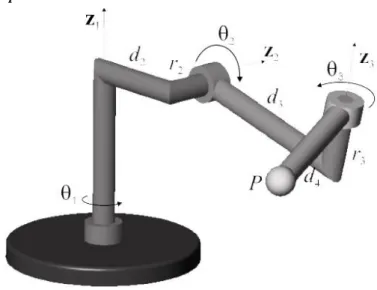
Figure 1 : An Orthogonal 3R Manipulator
Figure 1 depicts an orthogonal 3R manipulator. It is a serial manipulator and is made up of three actuated revolute joints. Modified D-H parameters [6] are used:
d2, d3, d4, r2, r3, 2 = (z1, z2), and 3 = (z2, z3) are the geometric parameters of the
manipulator;
1, 2, and 3 are the actuated joint angles.
This manipulator is orthogonal because 2 = -90° and 3 = 90°. Most industrial robots are
composed of a positioning structure and a wrist. Usually, the positioning structure is a 3R manipulator and the wrist is composed of three revolute joints with convergent axes. For example, the positioning structure of PUMA robots is a 3R manipulator, with geometric parameters kinematically equivalent to: d2 = 0, r2 = 0, r3 = 0, 2 = 90°, and 2 = 180°.
For a 3R manipulator, the joint space has the structure of a 3-dimensional torus. The singularities can be studied on the 2-dimensional (2, 3)-torus because they do not depend on 1.
C. Cuspidal Manipulators
A cuspidal manipulator can change posture without meeting any singularity. The existence of such manipulators was discovered simultaneously in [9] and [10]. In [11], a theory and methodology were introduced to characterize new uniqueness domains in the joint space of cuspidal manipulators. The only possible region of the workspace where a cuspidal manipulator can change posture without meeting singularity is a region with four inverse kinematic solutions. Characterization of cuspidal manipulators is difficult. Obviously, observation of several examples of manipulators gave rise to some conjectures by authors. In fact, some of them state that manipulators with simplifying geometric conditions like intersecting, orthogonal or parallel joint axes cannot avoid singularities when changing posture [8, 12]. Others claim that manipulators with arbitrary kinematic parameters are cuspidal [1, 9]. Neither the first, nor the second idea can be stated in a general way. In [13], a new characterization of cuspidal manipulators was done: a 3-DOF positioning manipulator can change posture without meeting a singularity if and only if there exists at least one point in its workspace with exactly three coincident inverse kinematic solutions and such a point is called a cusp point.
Figure 2 shows the critical value surfaces for a cuspidal manipulator, d2 = 1, d3 = 2, d4 = 1.5,
r2 = 1, r3 = 0, 2 = -90° and 3 = 90°, in a cross-section of its workspace. There are four cusp
points and two regions with four and two possible postures, respectively. Numerical and graphical methods are used to check the conditions of existence of a cusp point. Consequently, it provides a useful tool for the purpose of manipulator design. In general, it is not possible to write the conditions of existence of cusp points in an explicit expression of the DH-parameters [5]. However, for a family of 3R manipulators with orthogonal axes, Baili et al. [14] found an explicit condition of the existence of cusp points, which depends only on DH-parameters.
D. Generic Manipulators
According toBurdick [1], a generic manipulator has to respect the two following conditions:
its Jacobian matrix has rank 2 at all the critical points;
all singular points, S, must satisfy the following condition:
0 ))] ( [det( i s J
for i equal to 1 or/and 2
Pai [2] claimed that a generic manipulator is defined as one having no intersection of its smooth singularity surfaces in the joint space, and showed that the two foregoing conditions are equivalent for a 3R manipulator.
Simplifications in manipulator geometry, like intersecting or parallel joint axes, often lead to non-genericity. In fact, a major part of industrial manipulators are non-generic. However, many non-generic manipulators have complicated DH-parameters [1, 12]. Besides, generic manipulators have usually stable global kinematic properties under small changes in their design parameters.
E. Homotopy Classes
Homotopy classes were defined in [15] only for generic, quaternary manipulators. A quaternary manipulator is defined as one having four inverse kinematic solutions. A binary manipulator has only two solutions. Two quaternary generic manipulators are homotopic if the singularity surfaces of one manipulator can be smoothly deformed to the singularity surfaces of the other. Burdick [1] showed that two homotopic manipulators have the same multiplicity of their kinematic maps. So, homotopic manipulators have the same maximum number of inverse kinematic solutions per aspect. Therefore, all the manipulators homotopic to a cuspidal (resp. non-cuspidal) manipulator are cuspidal (resp. non-cuspidal).
Figure 3: Some Loops of Homotopy Classes on the Torus
A singularity surface forms a loop when projected onto the surface of (2, 3)-torus. Therefore,
there are as many homotopy classes as ways of encircling two generators of torus. Figure 3 shows three different homotopy classes. Lines L1 and L2 plotted in the square
(- 2, - 3) tally with the circles plotted along 2-generator and 3-generator of
the torus, respectively. On the contrary, L3 does not encircle any of the two torus generators.
Thus, L3 is homotopic to a point.
The homotopy class of a singularity surface can be defined by a set of two integers (n2, n3).
Integer n2 (resp. n3) characterizes the number of times the loop associated with the singularity
surface encircles the 2-generator (resp. 3-generator) of (2, 3)-torus. Accordingly, the
homotopy class of a generic manipulator is characterized by a series of couples (n2, n3), which
define the homotopy classes of each of its singular surfaces.
The way to determine the homotopy class of a given generic manipulator is to track each branch, and to count for the number of "jumps" between two opposite sides of the square representation. At each jump, n2 and n3 are either increased or decreased, according to whether the jump occurs
from - to or from to -, respectively.
For example, the homotopy class of L1 (resp. L2, L3) is (1,0), (resp. (0,1), (0,0)). The number and
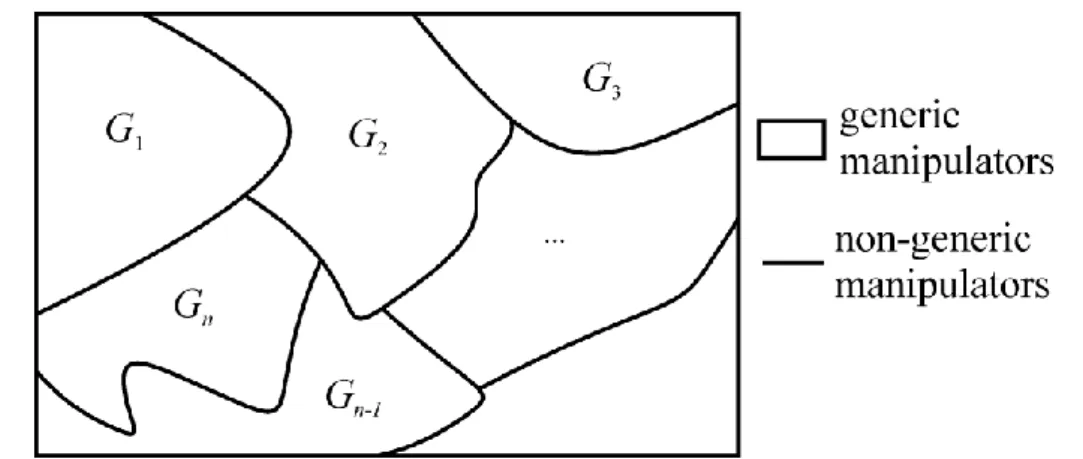
the homotopy class of the singularity surfaces define a set of homotopic generic manipulators. The set of all the 3R positioning manipulators is divided into subsets of homotopic generic manipulators split by subsets of non-generic manipulators [15], as shown in Fig.4.
F. Path-feasibility
In many cases, such as in welding tasks, the end-effector has to follow a path in the workspace. For a non-cuspidal manipulator, a path is feasible if it can be followed in one single aspect, i.e., without meeting singularities or joint limits. The images of the aspects in the workspace define the regions of feasible paths [16].
III. ROBUSTNESS STUDY OF 3RMANIPULATORS
To the best of our knowledge, there is no thorough study on robustness of generic and non-generic manipulators in the literature. As mentioned before, non-generic manipulators have stable global kinematic properties under small changes in their design parameters. However, the question remains, is it enough to claim that generic manipulators are more robust than non-generic manipulators?
In order to answer this question, we study the robustness of 3R manipulators with respect to their homotopy class. Then, we focus on their robustness with respect to path feasibility. Finally, we study the sensitivity of the pose of their end-effector to variations in their geometric parameters.
A. Robustness with respect to Homotopy Classes
Figure 5: Joint Space of the Non-Generic 3R Manipulator defined by: d2 = 1, d3 = 2, d4 = 2.5,
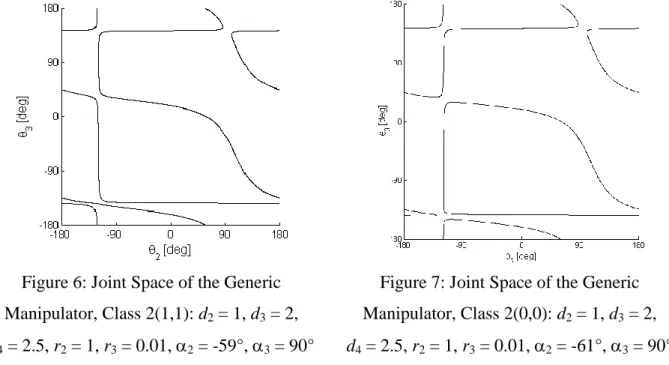
Figure 6: Joint Space of the Generic Manipulator, Class 2(1,1): d2 = 1, d3 = 2,
d4 = 2.5, r2 = 1, r3 = 0.01, 2 = -59°, 3 = 90°
Figure 7: Joint Space of the Generic Manipulator, Class 2(0,0): d2 = 1, d3 = 2,
d4 = 2.5, r2 = 1, r3 = 0.01, 2 = -61°, 3 = 90°
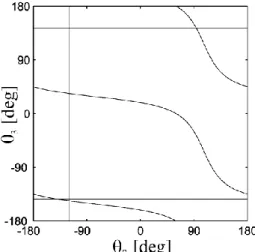
Figures 5, 6, and 7 depict the joint space of a non-generic manipulator and those of two generic manipulators close to the non-generic manipulator, respectively. Indeed, only r3 and 2 change
from one manipulator to the other and they vary a little.
The homotopy class of the first generic manipulator is 2(1,1) because its two singularity surfaces encircle 2-generator and 3-generator. However, the homotopy class of the second generic
manipulator is 2(0,0) due to the fact that its joint space includes only one singularity surface, which encircles neither the 2-generator, nor the 3-generator (this can be more easily seen by
"gluing" the opposite sides of the square).
We can conclude from this example that a non-generic manipulator faced with small geometric variations becomes a generic manipulator, of which the homotopy class is either 2(1,1) or 2(0,0). The topology of the singularity surfaces of a manipulator depends on its homotopy class. Therefore, non-generic manipulators and their adjoined generic-manipulators are not robust with respect to homotopy classes and the topology of the singularity surfaces.
According to section II-E, all the manipulators homotopic to a cuspidal (resp. non-cuspidal) manipulator are cuspidal (resp. non-cuspidal). Therefore, a manipulator that is supposed to be cuspidal can become non-cuspidal when faced with geometric variations. Such a manipulator not necessarily will be able to execute a non singular change of posture.
B. Robustness with respect to Path Feasibility
First, we introduce the definition of the robustness of a manipulator with respect to Path Feasibility.
Definition: Robustness of a Manipulator with respect to Path Feasibility
A manipulator is robust with respect to Path Feasibility if all the paths feasible with its nominal geometric parameters are still feasible with its real geometric parameters, i.e., when faced to geometric variations.
Here, we compare some pairs of manipulators in order to study the influence of the genericity and the non-genericity of a manipulator on the path feasibility.
1) First example
Let us consider the 3R manipulator with nominal geometric parameters: d2 = 1, d3 = 0.6, d4 = 2,
r2 = 1, r3 = 0.1, 2 = -90°, and 3 = 90°.
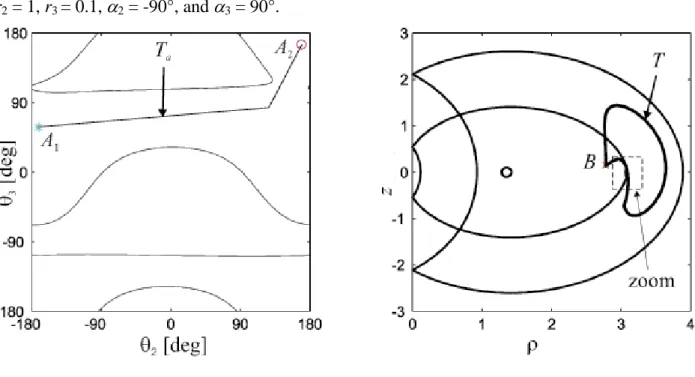
Figure 8: T is Path Feasible
Figure 8 depicts its joint space and workspace. By following Ta from point A1 to point A2 in the
joint space, the end-effector P of the manipulator follows a closed path T from B to B with a change of posture. Indeed, points A1 and A2 of the joint space are two distinct pre-images of B
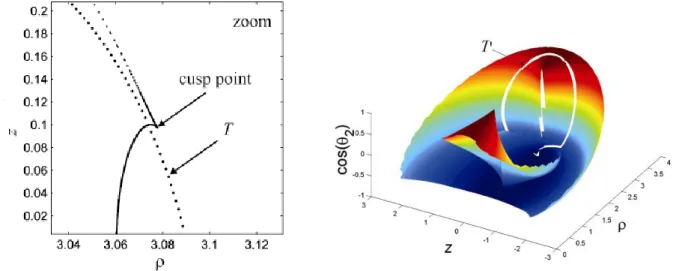
Figure 9: Zoom on T around the Cusp Point Figure 10: T lies in a Region of Feasible Paths As mentioned in section II-C, only cuspidal manipulators can change posture without meeting any singularity. According to Fig.9, path T passes near a cusp point. Fig. 10 depicts the region of feasible paths, which includes T.
Figure 11: T is not Path Feasible
Let us assume that r3 changed a little and becomes zero. Figure 11 depicts the joint space and the
workspace of the new manipulator.
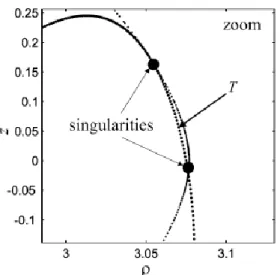
In this case, we can notice that the manipulator cannot follow T without meeting any singularity. Indeed, Ta, the image of T under the inverse geometric operator of the manipulator, cuts a
singularity surface twice in the joint space.
Figure 12: Zoom on T and Singular Points Figure 13: T1 lies in a Region of Feasible Paths
Figure 14: T2 lies in a Region of Feasible Paths Figure 15: T3 lies in a Region of Feasible Paths
As a matter of fact, T is the union of T1, T2, and T3, which are all feasible. Their corresponding
regions of feasible paths are depicted by Figs. 13, 14, and 15, respectively.
Furthermore, we can notice that the two previous manipulators are generic but do not belong to the same homotopy class. Indeed, the homotopy class of the first manipulator is 2(1,0) + 1(0,0) whereas the one of the second manipulator is 4(1,0). Accordingly, a small variation in geometric parameter r3 can change substantially the topology of the singularity surfaces of the manipulator.
Likewise, the number of cusp points changes because the first manipulator has two cusp points whereas the second one is not cuspidal. Therefore, these two manipulators do not belong to the same set of generic manipulators but „„adjoin‟‟ the same non-generic manipulator.
2) Second example
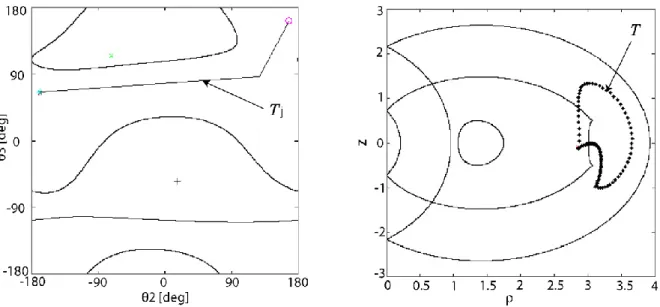
Figure 16: Manipulator d2 = 1, d3 = 0.6, d4 = 2, r2 = 1, r3 = 0.5, 2 = -90°, and 3 = 90°: T is Path
Feasible
Figure 16 depicts the joint space and the workspace of the 3R manipulator of which the geometric parameters are d2 = 1, d3 = 0.6, d4 = 2, r2 = 1, r3 = 0.5, 2 = -90°, and 3 = 90°. Tj is
the image of path T into the joint space of the manipulator and does not meet any singularity branch. Consequently, T is path feasible.
Figure 17: Manipulator d2 = 1, d3 = 0.6, d4 = 2, r2 = 1, r3 = 0.4, 2 = -90°, and 3 = 90°: T is still
Path Feasible
Figure 17 depicts the joint space and the workspace of the 3R manipulator of which the geometric parameters are d2 = 1, d3 = 0.6, d4 = 2, r2 = 1, r3 = 0.4, 2 = -90°, and 3 = 90°.
Likewise, Tj is the image of path T into the joint space of the manipulator and does not meet any singularity branch. It means that T is still path feasible.
3) Third example
Let us consider the 3R manipulator defined with the following nominal parameters are d2 = 0,
Figure 19: Image of aspect A1: Region 1 of
Feasible Paths
Figure 20: Image of aspect A2: Region 2 of
Feasible Paths
Figure 21: Image of aspect A3: Region 3 of
Feasible Paths
Figure 22: Image of aspect A4: Region 4 of
Feasible Paths
Figures 19, 20, 21, and 22 depict the regions of feasible paths of the manipulator, i.e.: the images of aspects A1, A2, A3 and A4 under the geometric operator of the manipulator.
The horizontal plane of these figures depicts the workspace of the manipulator, defined by ( = (x2+y2)1/2) and z coordinates. The vertical axis, which is the cosine of joint angle 2, is used
to distinguish the regions of feasible paths in the workspace of the manipulator. This representation is particularly interesting to visualize the regions of feasible paths of cuspidal manipulators, [16].
We can notice that path AB lies in all the regions of feasible paths. It means that AB is feasible with this non-generic manipulator. However, is AB still feasible when geometric parameters of the manipulator vary a bit?
Let us consider the 3R manipulator with geometric parameters: d2 = 0.1, d3 = 2, d4 = 1.5, r2 = 1,
r3 = 0, 2 = -90°, and 3 = 90°. This manipulator differs from the previous one by d2, which is
slightly perturbed.
Figure 23: AB is not Path Feasible
Figure 23 depicts the joint space and the workspace of this manipulator. We can notice that it is generic because its singularity surfaces do not intersect in the joint space.
Figure 24: Image of aspect B1: Region 1 of
Feasible Paths
Figure 25: Image of aspect B2: Region 2 of
In this paper, we do not claim that all generic manipulators are robust with respect to path feasibility. However, we noticed through some examples that the feasibility of a path can be very sensitive to the variations in geometric parameters when the manipulator is non-generic or close to a non-generic manipulator in the set of geometric parameters. Consequently, we state that the proximity of a manipulator to non-generic frontiers may severely affect its robustness with respect to path-feasibility.
C. Robustness with respect to the accuracy of the end-effector
Some properties of 3R non-generic manipulators and adjoined generic manipulators can be very sensitive to variations in geometric parameters, as explained in section III-B.
However, does it mean that these manipulators are less accurate? In order to answer this question, we compared the accuracy of many pairs of adjoined generic/non-generic manipulators.
Let us assume that the dimensional tolerances of the geometric parameters are known and are identical from one manipulator to the other: d2 = d3 = d4 = r2 = r3 = 0.1 mm,
2 = 3 = 5.10-4 rad, 2 = 3 = 3.10-4 rad. Then, we can compute the maximum positioning
Figure 26: Maximum Positioning Error of the End-Effector of the Non-Generic (resp. Generic) Manipulator defined by d2 = 0, (resp. d2 = 0.1), d3= 2, d4 = 1.5, r2 = 1, r3 = 0, 2 = -90°, 3 = 90°
The first row of Fig. 26 shows the maximum positioning error of the end-effector of two adjoined non-generic and generic 3R manipulators (only d2 changes from the non-generic
manipulator to the generic one) computed at five points of their workspace. The second row depicts the iso-contours of the maximum positioning error of the end-effector of the manipulators. We plotted these graphs for many pairs of adjoined generic/non-generic manipulators. For each pair, we noticed that there are very few differences between the column related to the non-generic manipulator and the one related to the generic manipulator. Therefore,
Figure 27: Kinematic Performances and Sensitivity Analysis of the Non-Generic (resp. Generic) Manipulator defined by: d2 = 1, d3 = 2, d4 = 2.5, r2 = 1, r3 = 0.2, 2 = -60° (resp. 2 = -58°),
3 = 90°
For instance, the first row of Fig.27 depicts the iso-contours of the inverse condition number of the Jacobian matrix of two non-generic and generic 3R manipulators close to each other in the set of geometric parameters. They are plotted in the joint space of the manipulators and are identical. Actually, they are the same for all the pairs of adjoined generic/non-generic manipulators that we studied.
Moreover, we analyzed and compared the sensitivity to length and angular variations of these manipulators. In order to evaluate this sensitivity, we used the optimal robustness index presented in [4], i.e., the 2-norm of the sensitivity Jacobian matrix of the manipulators, which maps the set of variations in the geometric parameters of the manipulators into the set of variations in their performances. Consequently, the second row of Fig.27 shows the iso-contours of the 2-norm of the sensitivity Jacobian matrix to length variations, of two adjoined non-generic and generic 3R manipulators, respectively. Likewise, the third row of Fig.27 shows the iso-contours of the 2-norm of the sensitivity Jacobian matrix to angular variations of the corresponding manipulators.
We can notice that the plots corresponding to the non-generic and generic manipulators are similar. As a matter of fact, it occurs with all the pairs of adjoined generic/non-generic manipulators that we studied. It means that the sensitivity of a manipulator to its length and
manipulators. V. CONCLUSION
In this paper, a robustness study of 3R manipulators was presented in order to know whether generic manipulators are more robust than their non-generic companions. Firstly, some properties specific to 3R manipulators were introduced, such as singularities, cuspidality, genericity, homotopy classes, and path feasibility.
It turns out that the farther a manipulator is from non-generic ones, the more robust it is with respect to homotopy class and number of cusps. Moreover, we noticed through some examples that the feasibility of a path can be very sensitive to the variations in geometric parameters when the manipulator is non-generic or close to a non-generic manipulator in the set of geometric parameters. Consequently, we state that the proximity of a manipulator to non-generic frontiers may severely affect its robustness with respect to path-feasibility.
Besides, we noticed through several examples that the accuracy and dexterity of generic and non-generic manipulators are similar. Finally, we pointed out that the joint configurations corresponding to a good accuracy of the manipulators do not necessarily tally with those corresponding to a good dexterity.
References
[1] Burdick, J.W., 1995, A Classification of 3R Positioning Manipulator Singularities and Geometries, Journal of Mechanisms and Machine Theory, Vol.30, pp. 71-89.
[2] Pai, D.K., 1992, Genericity and Singularities of Robot Manipulators, IEEE Transactions on Robotics and Automation, Vol.8, October, pp. 545-559.
[3] Taguchi, G., 1993, On Robust Technology Development, Bringing Quality Engineering Upstream, ASME Press.
[4] Caro, S., Bennis, F. and Wenger, P., 2005, Tolerance Synthesis of Mechanisms: A Robust Design Approach, ASME Journal of Mechanical Design, Vol.127, No. 5, pp. 86-94.
[5] El Omri, J., 1996, Kinematic Analysis of Robot Manipulator, (in french), Ph.D. Dissertation, Université de Nantes, Ecole Centrale de Nantes, France.
[6] Khalil, W., Kleinfinger, J.F., 1986, A New Geometric Notation for Open and Closed Loop Robots, Proc. IEEE Int. Conf. Rob. And Aut., pp 1174-1179.
[7] Borrel, P., and Liegeois, A., 1986, A Study of Manipulator Inverse Kinematic Solutions With Application to Trajectory Planning and Workspace Determination, Proc. IEEE Int. Conf. Rob. and Aut., pp. 1180-1185.
[8] Tsai, K.Y., 1990, Admissible Motion in Manipulator's Workspace, Ph.D. Dissertation, Univ. Wisconsin.
[9] Burdick, J. W., 1988, Kinematic Analysis and Design of Redundant Manipulators," Ph.D. Dissertation, Stanford.
[10] Parenti, C. V., and Innocenti, C., 1988, Spatial Open Kinematic Chains: Singularities, Regions and Subregions, Proc. 7th CISM-IFTOMM Romansy, Udine, Italy, September, pp. 400-407.
[11] Wenger, P., 1992, A New General Formalism for the Kinematic Analysis of all Non-Redundant Manipulators, IEEE Int. Conf. Rob. and Aut., Nice, France, pp. 442-447.
[12] Smith, D.R., 1991, Design of Solvable 6 R manipulators, Ph.D. Thesis, Georgia, Inst. Of Tech., Atlanta.
[13] Wenger, P. and El Omri, J., 1995, How to Recognize Simply a Non-Singular Posture Changing 3-DOF Manipulator, Proc. 7th Int. Conf. on Advanced Robotics (ICAR), San Feliu de Glixol, Espagne, September.
[14] Baili, M, Wenger, P, Chablat, D., 2004, Classification of One Family of 3R Positioning Manipulators, Proceedings of the ICRA conference, New-Orleans, USA, April.
[15] Wenger, P., 1998, Classification of 3R Positioning Manipulators, ASME Journal of Mechanical Design, Vol.120, June, pp. 327-332.
[16] Wenger, P., 2004, Uniqueness Domains and Regions of Feasible Paths for Cuspidal Manipulators, IEEE Transactions on Robotics, Vol. 20(4), August, pp. 745-750.
[17] Gosselin, C.M., Angeles, J., 1991, A Global Performance Index for the Kinematic Optimization of Robotic Manipulators, ASME Journal of Mechanical Design, Vol.113, September, pp. 220-226.
Robustness Study of Generic and Non-Generic 3R Positioning Manipulators
Stephane Caro, Philippe Wenger, and Fouad Bennis
Institut de Recherche en Communications et Cybernétique de Nantes, U.M.R. C.N.R.S. 6597 1, rue de la Noë, BP 92101, 44321 Nantes Cedex 03 France
Abstract— This paper presents a robustness study of 3R manipulators and aims at answering the following question: are generic manipulators more robust than their non-generic counterparts? We exploit several properties specific to 3R manipulators such as singularities, cuspidality, homotopy classes, and path feasibility, in order to find some correlations between genericity and robustness concepts. It turns out that the farther a manipulator is from non-generic ones, the more robust it is with respect to homotopy class and number of cusps. Besides, we state that the proximity of a manipulator to non-generic frontiers may severely affect its robustness with respect to path-feasibility. Finally, we notice that the dexterity and the accuracy of 3R manipulators do not depend on genericity.
Keywords—Robust design, genericity, path-feasibility, singularity, cuspidality, homotopy class, serial manipulator.