HAL Id: sic_01335482
https://archivesic.ccsd.cnrs.fr/sic_01335482
Submitted on 21 Jun 2016HAL is a multi-disciplinary open access archive for the deposit and dissemination of sci-entific research documents, whether they are pub-lished or not. The documents may come from teaching and research institutions in France or abroad, or from public or private research centers.
L’archive ouverte pluridisciplinaire HAL, est destinée au dépôt et à la diffusion de documents scientifiques de niveau recherche, publiés ou non, émanant des établissements d’enseignement et de recherche français ou étrangers, des laboratoires publics ou privés.
Satisfaction of cybernautes in virtual communities: An
integrated model of experiential value
Dorra Bouattour, Franck Debos, Tarek Abdellatif
To cite this version:
Dorra Bouattour, Franck Debos, Tarek Abdellatif. Satisfaction of cybernautes in virtual communi-ties: An integrated model of experiential value. 5th International Research Meeting in Business and Management (IRMBAM), Jul 2014, NICE, France. �sic_01335482�
Satisfaction of cybernautes in virtual communities: An integrated model of
experiential value
Dorra Bouattour
Phd Student IHEC Carthage (Tunisie)
Tarek Abdellatif Franck DEBOS
Expert Consultant E-Marketing Strategy A senior lecturer
A.2.W.M Vanves (France) Université de Nice Sophia-Antipolis
Satisfaction of cybernautes in virtual communities: An integrated model of experiential value
Abstract:
Although virtual worlds and in particular virtual communities attract more users and contributing members, few studies have focused on what meets the members of these online communities. Studies on Satisfaction was addressed only to the environments of the Internet and neglect satisfaction in virtual communities (eg, Szymanski and Hise 2000; Reibstein 2002; Wolfinbarger and Gilly, 2002; Zeithaml , Parasuraman and Malhotra, 2002). In this work, we have defined and tested an integrated value of the experiential system and the satisfaction of the virtual world and virtual communities’ model. Based on a quantitative study of 564 volunteers used the web and virtual communities. A principal component analysis and regression was used to validate the assumptions made and to meet the objectives of our research by measuring the relationship between the different variables.
1 -Introduction:
The dramatic growth in the use of information technology has revolutionized the behavior of individuals. These continue to gather in homogeneous groups forming online communities. (Wind and Mahajan,2002). Thus, these virtual communities are considered according Michail.K (2004), as an essential component of modern society whether in the privacy of individuals or even in the activities of organizations. Michail.K (2004), defines theses communities as an aggregation that emerges in cyberspace, when there is a combination of a sufficient number of members capable of performing discussions, share feelings to form personal relationships. Another definition, more recent, is given by Mata and Quesada (2014) who consider virtual communities as groups of individuals sharing common goals and interests and interact and communicate through the Internet. We can also bring these reflections process “retribalization” developed by Marshall McLuhan (1911-1980) before the development of ICT and resulting unification of "nervous system of humanity" and the gradual creation of a global village. The explosion of Internet and virtual communities including social networks brought up to date reflection model (Douglas Coupland / trad. Jean Paré, Marshall McLuhan, Montreal, Boréal, 2010). However, the rapid development of these communities continues to influence user behavior through the acquisition of relevant information. Previous studies on virtual communities have focused primarily on understanding the nature and motivations of its members (Lee et al 2003. Ridings et al 2004). A better understanding the factors inducted satisfaction for users of virtual communities becomes necessary, knowing that satisfaction stimulates user loyalty and behavior of recommendation. In this study, we will ask questions about the factors influencing the satisfaction of members of virtual communities in order to verify the improvement of the quality of services of these communities. This problem requires answering to the following central question: Satisfaction of Internet users toward virtual communities is it important? And how can we assess the satisfaction based on the experiential value of virtual consumers? The main objective of this paper is to determine the factors that influence the satisfaction of the members of these online communities. To this end, we have adopted a perspective of experiential value, in which according Mathwick, Malhotra, Ridgon (2001), experiential values are perceived by the user, either directly or indirectly through their use by the achievement of stated objectives during use.
The versatility of virtual communities provides value and hedonic utility by creating a concept of experiential value that can provide insight into the experiences that drive satisfaction user
experience. By using the expectancy value and cognitive evaluation as theoretical basis, we proposed a model integrating experiential value and satisfaction. The model focused on four sources of value: two intrinsic (escapisme and entertainment), and two extrinsic (economic and ease of use). These four sources of value tap into the interactive and multi-purpose character of virtual communities to ensure user satisfaction. We hoped to answer two intermediate questions:
- Which experiential value elements are relevant drivers of user satisfaction with virtual communities?
- How and to what extent do these drivers explain virtual communities’ satisfaction?
2 - Theoretical and conceptual framework of research:
The theoretical context of our study was essentially built on the experiential value and satisfaction. We will, first of all, focus on values as determinants of user satisfaction, and secondly, to their effective satisfaction. We will also focus on the values of the experiential system and their influence on user satisfaction.
2.1 virtual communities:
The development of virtual communities continues to influence the behavior of users on the internet. These communities have reduced the distance between people (Wind and Mahajan, 2002), which encouraged their interactions and ongoing sharing of information. They have become essential components of modern society whose influence extends to the privacy of individuals and organizations' activities. Thus, the virtual community is defined as an aggregation that emerges in cyberspace, when there is a combination of a sufficient number of members capable of performing discussions, share feelings to form webs of personal relationships (Rheingold, 1993). For their part, Balasubramanian and Mahajan (2001) define this concept as a cyberspace for communication and interaction among participants. This definition is confirmed by that of Lee et al, (2003), which it is presented as a group of individuals or business partners who interact around a shared interest, where the interaction is partially or completely made by electronic means and guided by some protocols or standards.
A virtual community can also be a new means of communicating commercial for a company to interact with its connected customers. (Hsiu -Fen, 2007).
2.2 The values as a determinant of user satisfaction:
We relied on the basics of the theory of the hope value, which is a paradigm widely used by theorists value of consumption to explain the satisfaction of an individual with an object or behavior. Indeed, an individual will be more satisfied with an object or if behavior is perceived as being more likely to have a value. This theory has mainly been applied to model the direct influence of perceived value on satisfaction. Which support our central hypothesis: value determines satisfaction.
2.3 User satisfaction
Lately, the marketing literature has focused on e- satisfaction which shows the consumer satisfaction in an online context and the importance of which can be correlated with the development of E -commerce. As in traditional commerce, consumer satisfaction is not only an essential outcome of the performance, but it is also a major predictor of customer loyalty (Evanschitzky H. et al, 2004). According to Anderson and Srinivasan (2003), e- satisfaction is a feeling of contentment consumer in respect of an eating experience lived online. Similarly, Cyr, Kindra and Dash (2008), emphasize that e- satisfaction is an overall assessment of the site's ability to meet the needs and expectations of users online. To this end, Wicks & Roethlein, (2009), consider that e- satisfaction is formed by an emotional and experiential evaluation process. Prompting us to investigate in this experiential component to identify factors of satisfaction in the virtual world in general and in virtual communities in particular.
2.4 Value of the experiential system
In recent years, the experiential consumption has grown considerably among members of virtual communities. Valuation experiments navigation has become increasingly a priority vector of web designers and service provider’s lines. These aim to optimize the virtual environment through the establishment of a set of devices, capable of stimulating the users and generate positive feelings. In our study, we focused on the system of experiential values, providing an overview of explaining the perceived user satisfaction. The latter is defined as a collection, a relativistic preference mode or the system performance resulting from the use of the latter to achieve the objectives of the user. Using the expectancy theory of value and that of cognitive evaluation as a theoretical foundation, we have proposed a model integrating the experiential value and satisfaction. The characteristics of the value of experiential system can thus be derived directly from experience or a compromise between the users who receive and
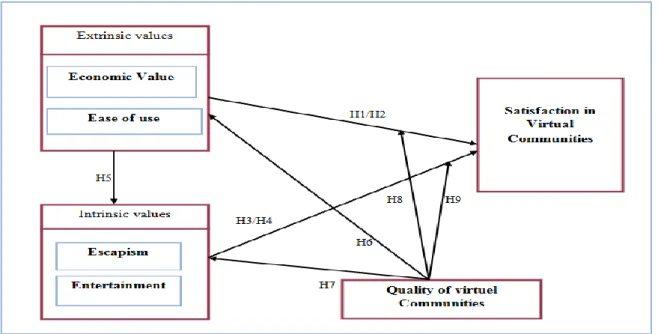
invest in the use of the latter called extrinsic values. These values are linked to tangible benefits. On the other hand, may be dependent on interaction with the system itself and thus be reactive or active depending on the kind of the experiment with the experiential system. This is called the intrinsic values . This model focused on four sources of value: two intrinsic (escapism and entertainment), and two extrinsic (economic value and ease of use). These four sources of value derive their interactive and multi- use within the virtual community.
3 - The conceptual model and assumptions:
In this research, we study the model of experiential value system and more particularly the four sources of value of this system which can have a particularly utilities in virtual communities: two sources of intrinsic value (escapism and entertainment), and two sources of extrinsic value (economic value and ease of use), and their complementarities in value creation. Also, we are going to focus on the roles of the qualities of virtual communities in the satisfaction of its members.
3.1 The values of the experiential system
The four concepts of value property is an integrated model with a direct effect, an indirect effect involving several assumptions: These concepts are divided into two categories:
3.1.1 Extrinsic values :
Extrinsic values in experiential system are the tangible benefits derived directly from experience or a compromise between the users who receive and invest in the use of the information. According to the theory of cognitive development, these benefits tend to improve the intrinsic values in order to achieve user satisfaction.
The extrinsic values are composed by:
- The economic value according to Pénard (2002), who represents the gain of buyers in a purchase of a product or service, which is clearly an extrinsic value related to commercial activities. It is thus related to the expected return. Given the growing importance of economic activity in virtual communities, this may be an important driver of user satisfaction, which can justify empirical research on its role. Based on these findings, we can issue the following hypothesis:
H1: The economic value positively influences the satisfaction of members of virtual communities.
- Ease of use is the belief of a user on the fact that learning to navigate the system is stress free. The concept is extrinsic, related to the expectation of the effort required to invest a user to use the system. According to Brown, Fuller and Vician, (2004), it is fundamental to participation in virtual communities. Where the user is can be a driver for the user satisfaction. Thus, we can issue the following hypothesis:
H2: The ease of use positively affects the satisfaction of members of virtual communities. 3.1.2 The intrinsic values :
The intrinsic values can be dependent on interaction with the system. Active or reactive, it is manifested by the feelings that they can cause when using virtual communities. According to the theory of cognitive evaluation, these are not controllable and are stimulated by extrinsic values. The intrinsic values consist of two components.
- Escape: escapism reflects the fact that the user becomes so absorbed and completed by his desire to "get carried away" by the virtual reality in a cognitive and emotional ways ( Henning, Vorderer2001 ) . According Mathwick et al, escape is an intrinsic value, since it reflects elements of social gaming; she is also an active source of intrinsic value since the user needs to be actively involved in the system to escape from reality. In environments of virtual communities, users can use their avatars to participate in further discussion, advise of their choice and share their experiences of everyday life (Algeshmeimer Dholakia , 2009). Based on these findings, we can issue the following hypothesis:
H3: The feeling of escape positively influences satisfaction in virtual communities.
- Entertainment: The entertainment value is presented by the perceived degree to which the use of an information system becomes fun and enjoyable. This is according to Hagel and Armstrong (1997), who consider entertainment as an intrinsic value because it provides instant pleasure, regardless of the tasks. In addition, there is also a reactive source of intrinsic value, because the entertainment allows members to share experiences, which enthrall the user and lead to the enthusiasm and appreciation. In this sense, virtual communities offer many fun experiences in persistent worlds that exist in parallel to reality. Thus, we can issue the following hypothesis:
H4: The feeling of entertainment value has a positive influence on satisfaction in virtual communities.
3.2 The relationship between the values of the experiential system
Away from the current cognitive thinking, several researchers such as Holbrook & Hirschman (1982), Arnould and Price (1999), Celsi et al. (1993) and Sherry (1998) showed the importance of the experiential dimension in the act of consumption. The basic assumption is that the value lies not only in the product purchased, the brand chosen, and the object possessed, used the service but also in the experience of purchasing and consumption that the individual lives on this occasion, Holbrook (1999). The authors admit that the consumption of a product or service can contribute to a memorable and enjoyable experience for the consumer changing time consumption within an experiential universe. Indeed, beyond the act of purchase, or the consumer, the individual sees him flourish in various emotions. This method of consumption is the new communication technologies in general and virtual communities in particular. These have evolved into an experiential environment where hedonic and utilitarian values showed added value to their users. This revealed the existence of an interrelationship between the extrinsic and intrinsic elements of the experiential system. This interrelationship is explained using the theory of cognitive evaluation, according Darpy and Volle (2003), contributes to the immediate satisfaction of users, supporting intrinsic motivation. This theory focusing on sensation seeking was applied according Graillot (2008) successfully in different forms of behavior whose purpose is directed towards leisure. It says that this theory has a particular interest in situations where the reasons for both extrinsic and intrinsic exist. Its central proposal states that contextual cues or events that induce feelings of autonomy and competence are likely to improve the intrinsic motivation of an action. The sense of autonomy for voluntary and uncontrolled engagement in an activity, conduct the feeling of competence relates effectively to the challenges of an activity (Ryan and Deci 2000). In situations where extrinsic motives are perceived as uncontrollable transmitting positive information about the competence of an individual, intrinsic motivation is likely to be stimulated. It seems plausible to assume that such situations exist in the context of virtual communities of systems where ease of use reflects the experiences of autonomy, while the economic value reflects the experiences of competence. The extrinsic values deliver positive information about the ability of the individual to control the environment, which is likely to have a positive effect on the intrinsic structures such as the value of entertainment and escape (Bruner and Kumar 2005).
So, buying online is it an entertaining experience offering the opportunity to escape reality. So we proposed the following assumptions and hypotheses:
H5: Extrinsic values affect positively intrinsic values.
H5.1 The economic value influences positively the escapism.
H5.2 The economic value affects positively the entertainment value.
On the other hand, Bruner and Kumar (2005), emphasize the accessibility of the Internet, which is designed to be easy to use. It is therefore likely to give the user a sense of control, which increases the pleasure to use. This led to the following hypothesis:
H5.3 The ease of use positively affects the entertainment value.
Similarly, according to Brown, Fuller, and Vician, (2004), an easy to use suggests that the user is freed from negative mental reactions, such as anxiety, relative to the handling system. Therefore, the user can induce a positive influence on the ability of the user to immerse into the system, which leads us to make the following hypothesis:
H5.4 The ease of use affects positively the escapism. 3.3 The role of the quality of virtual communities
The definition of Bagozzi and Dholakia (2002), states that virtual communities are an «aggregations of collective expertise whose content is managed by its members." This definition refers to the power of members of virtual communities to manage the content of the communities and their contributions to its success. One of the main characteristics of virtual communities is the fact that the content is generated by users who participate to enrich their knowledge, share experiences and exchange or solve their problems (Hsua et al 2007). This underlines the importance of the influence of these virtual communities on different experiential values inducing satisfaction of these users. The characteristics of virtual communities present different dimensions namely the quality of the members forming the community, the quality of its content, the popularity of the virtual community, interactivity and security. From these findings we may issue the assumptions presented in the following table:
of experiential system.
H6.1 The quality of virtual communities positively influences the value economic.
H6.2 The quality of virtual communities positively influences ease of use.
H7 The quality of virtual communities positively influences on the intrinsic values of experiential system.
H7.1 The quality of virtual communities positively influences the feeling of escape.
H7.2 The quality of virtual communities positively influences the feeling of entertainment.
H8 The quality of virtual communities moderates the relationship between extrinsic values and satisfaction in these communities.
H8.1 The quality of virtual communities moderates the relationship between economic value and satisfaction in these communities.
H8.2 The quality of virtual communities moderates the relationship between ease of use and satisfaction in these communities.
H9 The quality of virtual communities moderate the relationship between intrinsic values and satisfaction in these communities
H9.1 The quality of virtual communities moderates the relationship between the sense of escape and satisfaction in these communities
H9.2 The quality of virtual communities moderates the relationship between the sense of fun and satisfaction in these communities.
Figure 1: Conceptual model of research.
4- Research Methodology 4.1 Measurement of variables
To measure different variables in our model, we have used different scales, including that of Malhotra and Rigdon (2001) for the economic value of services within the virtual community, Matwich and Rigdon (2003) for the ease of use of virtual communities, Mathwick , Malhotra and Rigdon (2001 ) for the feeling of entertainment within the community, Rigdon (2004 ) for the feeling of escape and Plichon (1999) for user satisfaction . Quality virtual communities, we used scales for measuring dimensions proposed by S. Kim, H. Park, (2013). (See Annex3). Questionnaire items were measured using Likert scales to five points from 1 "Not at all agree" to 5 "strongly agree" with a midpoint neutral category.
4.2 Survey questionnaire:
Data collection was carried out necessary electronically through a remotely administered web questionnaire. This collection was made with users of different ages, who have accounts on social networks (Facebook). These are self - selected in the proposed survey of different groups of Facebook. During this period, 564 questionnaires were completed with our assistance on Skype by means of screen sharing, and in order to limit the non- understanding of the questionnaire. A principal components analysis was used to analyze the factors that
build the model. These results were used in the analysis of correlations between variables and regression analysis to predict factors influencing the satisfaction of members in virtual communities. 63.8 % of the sample is composed of women. 57.4 % of the members are aged between [20, 30].
5 - Data analysis and presentation of results:
Two types of analysis have been made in this research. A principal component analysis for the performance and reliability of measurement scales and a regression analysis in order to determine the relationship between different variables and subsequently confirm or refute the research hypotheses proposed.
5.1 Principal Component Analysis:
A Principal Component Analysis was performed on the different scales we used with an audit of the reliability with Cronbach's alpha (see Appendix 4).
Measurement scale
Result
Economic Value
The results of this ACP are good: KMO = 0.500, Bartlett's test is significant. The reliability of this scale is average with a Cronbach's alpha of 0.556 and an explained variance of 69.24 %.
Ease of use The results of this ACP are good: KMO = 0.689, Bartlett's test is significant. The reliability of this scale was good with a Cronbach's alpha of 0.77et an explained variance of 69.35 %.
Sense of escape
The results of this ACP are good: KMO = 0.677, Bartlett's test is significant. The reliability of this scale was good with a Cronbach's alpha of 0.81et an explained variance of 73.02 %.
Feeling entertainment
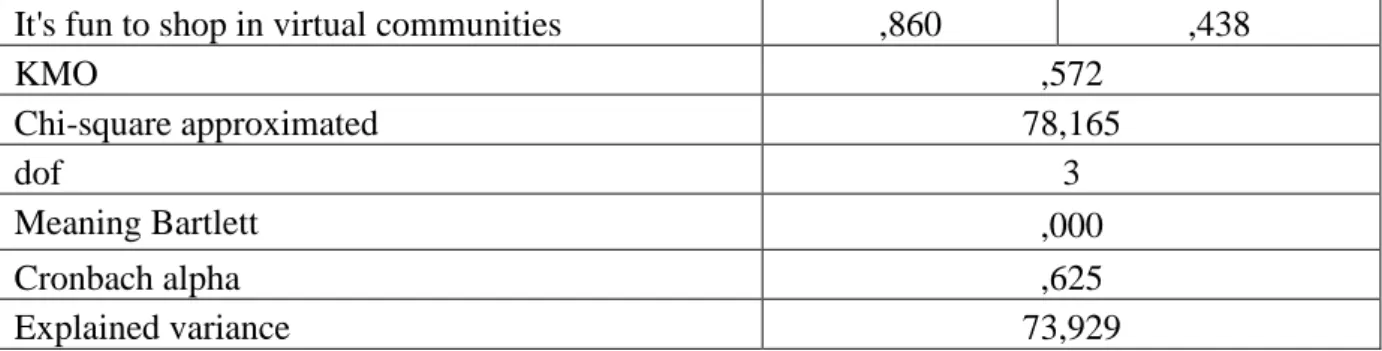
The results of this ACP are good: KMO = 0.500, Bartlett's test is significant. The reliability of this scale was good with a Cronbach's alpha of 0.62 and a variance explained 73.92 %.
Quality of virtual communities
The results of this ACP are good: KMO = 0.782, Bartlett's test is significant. The reliability of this scale was good with a Cronbach's alpha of 0.716 and an explained variance of 60.48 %.
User satisfaction
The results of this ACP are good: KMO = 0.848, Bartlett's test is significant. The reliability of this scale is very good with a Cronbach's alpha
of 0.907et an explained variance of 78.49 %.
5.2 Regression Analysis
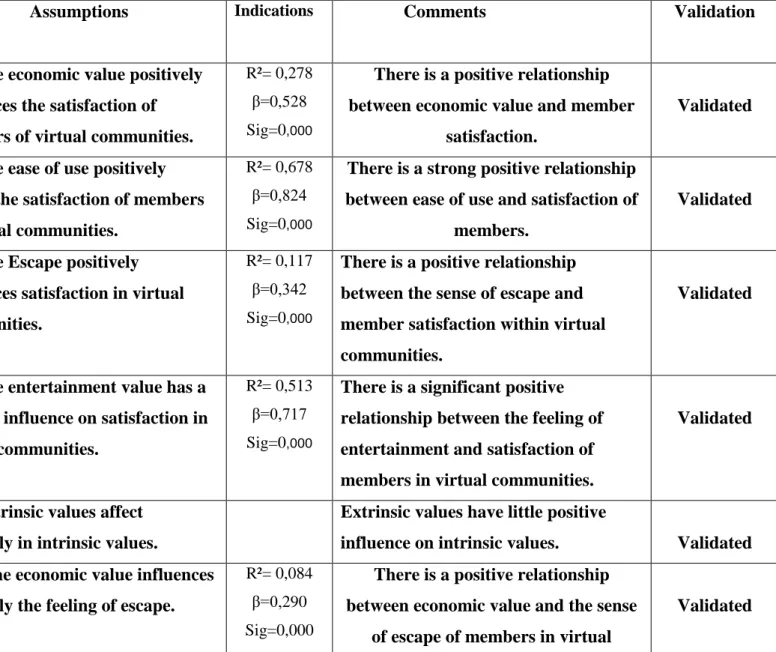
Factors obtained by Principal Component Analysis have been used as inputs in the first analysis of the correlations between variables and then in the regression analysis to identify factors causing the satisfaction of individuals in communities virtual and confirm or refute the hypotheses proposed research. After checking the correlations between variables, we used the linear regression analysis to test most relationships. The results show that the five assumptions have been accepted since their test is significant (p <0.05). ( See Appendix 5).
Table 1: Results of linear regression assumptions
Assumptions Indications Comments Validation
H1: The economic value positively influences the satisfaction of members of virtual communities.
R²= 0,278 β=0,528 Sig=0,000
There is a positive relationship between economic value and member
satisfaction.
Validated
H2: The ease of use positively affects the satisfaction of members of virtual communities.
R²= 0,678 β=0,824 Sig=0,000
There is a strong positive relationship between ease of use and satisfaction of
members.
Validated
H3: The Escape positively influences satisfaction in virtual communities.
R²= 0,117 β=0,342 Sig=0,000
There is a positive relationship between the sense of escape and member satisfaction within virtual communities.
Validated
H4: The entertainment value has a positive influence on satisfaction in virtual communities.
R²= 0,513 β=0,717 Sig=0,000
There is a significant positive relationship between the feeling of entertainment and satisfaction of members in virtual communities.
Validated
H5: Extrinsic values affect positively in intrinsic values.
Extrinsic values have little positive
influence on intrinsic values. Validated H5.1 The economic value influences
positively the feeling of escape.
R²= 0,084 β=0,290 Sig=0,000
There is a positive relationship between economic value and the sense
of escape of members in virtual
communities. H5.2 The economic value influences
positively the sense of entertainment.
R²= 0,285 β=0,534 Sig=0,000
There is a weak positive relationship between economic value and sense of entertainment members in virtual
communities.
Validated
H5.3 The ease of use affects positively the sense of entertainment.
R²= 0,059 β=0,243 Sig=0,000
There is a positive relationship between usability and the sense of fun
of members in virtual communities
Validated
H5.4: The ease of use affects positively the sens of escape.
R²= 0,444 β=0,666 Sig=0,000
There is a positive relationship between ease of use and the feeling of
escape of members in virtual communities.
Validated
H6: The quality of virtual communities has a positive
influence on the extrinsic values of the experiential system.
There is a positive relationship between the quality of communities
and extrinsic values of experiential system in virtual communities.
Validated
H6.1: The quality of virtual communities positively influences the economic value.
R²=0,052 β=0,228 Sig=0,000
There is a positive relationship between the quality of communities and the economic value of benefits within virtual communities.
Validated
H6.2: The quality of virtual communities positively influences ease of use.
R²=0,173 β=0,415 Sig=0,000
There is a positive relationship between the quality of communities and ease of use of virtual communities.
Validated
H7: The quality of virtual communities has a positive
influence on the intrinsic values of the experiential system.
The quality of virtual communities positively influences on the intrinsic values of experiential system.
Validated
H7.1: The quality of virtual communities has a positive influence on the sense of escape.
R²= 0,669 β=0,262 Sig=0,000
Quality communities have a direct effect on the feeling of escape experienced by those members.
Validated
H7.2: The quality of virtual communities influences positively the feeling of entertainment.
R²= 0,096 β=0,310 Sig=0,000
Quality communities has a direct effect on the feeling of entertainment
experienced by those members
5.3 Study of the moderation of the quality of virtual communities
According RMBaron and DAKenny, 1986: "A moderator variable is a qualitative or
quantitative variable that affects the direction and / or strength of the relationship between an independent variable and a dependent or predictive or criterion variable."
In our research, the quality of virtual communities is the moderating variable which intervenes to moderate the relationship between the satisfaction of members of virtual
communities and various extrinsic and intrinsic values of the experiential system. An analysis of the moderation process of F.Hayes Andrew was used by means of SPSS 20 to measure these relationships. The analysis of moderation is based on the "p" index that measures the significance of the relationship, the value will be accepted if its value is less than 0.05 and the index "t" which measures the effect of the relationship between variables, is significant.
We present the results of the moderation of the quality of virtual communities in the table below:
Table2: Results of the effect of moderating the quality of virtual communities between the values of experiential system and user satisfaction.
Assumptions Indications Comments Validation H8: The quality of virtual
communities moderates the relationship between extrinsic values and satisfaction in these communities.
The quality of virtual communities moderates the relationship between extrinsic values and satisfaction of its members.
Validated
H8.1: The quality of virtual communities moderates the relationship between economic value and satisfaction in these communities.
R²=0,543 P=0.000
t=13,29
The quality of virtual communities moderates the relationship between economic value and satisfaction of its members.
Validated
H8.2: The quality of virtual communities moderates the relationship between ease of use
R²=0,811 P=0.000
t=29,77
The quality of virtual communities moderates the relationship between
and satisfaction in these communities.
members.
H9: The quality of virtual communities moderates the relationship between intrinsic values and satisfaction in these communities.
The quality of virtual communities moderate the relationship between intrinsic values and satisfaction of its members
Validated
H9.1: The quality of virtual communities moderates the relationship between the sense of escape and satisfaction in these communities.
R²=0,281
P=0.000 t=6,255
The quality of virtual communities moderates the relationship between the sense of escape and satisfaction in these communities.
Validated
H9.2: The quality of virtual communities moderates the relationship between the sense of fun and satisfaction in these communities.
R²=0,731
P=0.000 t=22.00
The quality of virtual communities moderates the relationship between
the sense of fun and satisfaction Validated
.
6 - Discussion and contributions:
This research has addressed several points very little discussed in previous research
Among these points, we find the concept of e- satisfaction was mainly discussed in the context of the virtual world in general and has been neglected in the context of virtual communities. For example the work of Bansal et al (2004), Jin, Park and Kim (2008), Anderson and Srinivasan (2003), Cyr, Kindra and Dash (2008) and Wicks & Roethlein, (2009), which are mostly focused on e- satisfaction in web sites. In our context, the results show us the influence of experiential values on user satisfaction in virtual communities. These users derive satisfaction from a mixture of intrinsic and extrinsic values. This supports studies of J. Shen, LB Eder, 2009, and Shin, 2009, which emphasize the influence of multi -purpose these values in user satisfaction characteristics.
On the other hand, our study has paid particular attention to the interactions between extrinsic and intrinsic values of the experiential system. For this, we have shown that extrinsic experiential values associated with autonomy (ease of use) and competence (economic value)
affect satisfaction, through the intrinsic values of experiential value (entertainment and escape). This result provided us with evidence of the applicability of the theory of cognitive evaluation tested by Verhagen et al. (2011) in virtual communities, which helped to improve research on the factors inducing satisfaction in these communities.
Our study also helps to demonstrate the influence of the quality of virtual communities on satisfaction of its members. Quality communities have a direct and positive effect on the different values of extrinsic and intrinsic experiential system, as well as the satisfaction of its members. Our results also show the existence of a relationship of moderation, where, quality of virtual communities moderates the relationship between the values of system and experiential satisfaction in these communities.
7 - Conclusion:
This article is essential to explain the satisfaction of Internet users based on their experiential value within virtual communities and aims to determine the influence of the quality of these communities on the various existing relationships. Confirmation of its relationship has been demonstrated through the study of relationships between variables. In this context, we opted for a quantitative questionnaire survey. This survey was administered online for 564 respondents with 57.4 % of women are having an account in various social networks and member in virtual communities. A principal component analysis was performed initially to test the reliability and validity of the measures scales used. An analysis of correlation and regression in a second time, has allowed us to validate the assumptions described below and meet our research objectives. In addition, the analysis shows that the five factors found after the regression analysis are good predictors of user satisfaction in virtual communities.
Two contributions have been deducted from this research. The first , theoretical, presents the contribution of this paper to marketing research as well as information science and communication, and this by clarifying the intrinsic and extrinsic values influencing user satisfaction communities virtual , the operation of the interdependence of these experiential values to ensure this satisfaction and less influence on the quality of virtual communities in this process. The second with managerial nature, this research could be beneficial for traders and administrators of virtual communities who should take into account the different experiential values and ensure the quality of the communities in their marketing strategies in order to meet these members and guarantee their loyalty.
This study suffers from a number of limitations; this is the reason why the results should be treated with caution. The data were in fact collected from several online communities that are not necessarily representative of all of them, so that the generalizability of the results may not be sufficient. On the other hand , the method of data analysis by means of regressions must be supplemented by other analysis tools, including discourse analysis software (such as Tropes or Alceste), but also consider a semiotic analysis pictures of members of virtual communities studied (drawings, videos, etc. . ) to test the conceptual model presented and is relatively complex.
References:
1. A. Finn, L. Wang, T. Frank, “Attribute perceptions, customer satisfaction and intention to recommend e-services”, Journal of Interactive Marketing 23 (3), 2009, pp. 209–220.
2. Anderson, R. E., Srinivasan, S. 2003. “E-satisfaction and e-loyalty: A contingency framework”. Psychology and Marketing, 20 (2), 123-138.
3. Arnould E.J., Price L.P. (1993), “River magic: extraordinary experience and the extended service encounter”, Journal of Consumer Research, 20, 24-45.
4. Bagozzi, R. P. et Dholakia, U. M. (2002). “Intentional social action in virtual communities”, Journal of Interactive Marketing, 16 (2), p 2‑21.
5. Bansal, H.S., McDougall, G.H.G., Dikolli, S.S., and Sedatole, K.L. (2004). “Relating e-satisfaction to behavioral outcomes: An empirical study”, Journal of Services Marketing, 18(4), 290–302.
6. Baron and Kenny. (1956) “The Moderator-Mediator Variable Distinction in Social Psychological Research: Conceptual, Strategic, and Statistical Considerations”, Journal of Personality and Social Psychology .Vol. 51, No. 6, 1173-1182.
7. Brown, Susan A.; Fuller, Robert M.; and Vician, Chelley (2004) "Who’s afraid of the virtual world?”, Anxiety and Computer-Mediated Communication, Journal of the Association for Information Systems: Vol. 5: Iss. 2, Article 2.
8. Cyr D., Kindra G.S. and Dash S. (2008), Web site design, trust, satisfaction and e loyalty: The Indian experience, Online Information Review, 32, 6, 773-790.
9. Darpy D. and P. Volle (2003), Consumer Behaviour. Concept and tools, Dunod, Paris. 10. Dholakia, U. et R. Algesheimer, (2009),Brand Community, SSRN Working Pape Series, p.
1-18.
11. Franck DEBOS, Lecturer HDR University of Nice Sophia-Antipolis Laboratory Researcher I3M, mail: Franck.debos @ unice.fr.
12. Finn, L. Wang, T. Frank, “Attribute perceptions, customer satisfaction and intention to recommend e-services”, Journal of Interactive Marketing 23 (3), 2009, pp. 209–220.
13. G.C. Bruner II, A. Kumar, “Explaining consumer acceptance of handheld Internet devices”, Journal of Business Research 58 (5), 2005, pp. 553–558.
14. Giese J.L.et Cote J.A. (2000), “Defining consumer satisfaction”, Academy of Marketing Science Review, 1, 1-24.
15. Graillot L. (1998), « Emotions et comportement du consommateur », Recherche et Applications en Marketing, 13, 1, 5-23.
16. Hagel, John and Arthur G. Armstrong (1997), “Net gain: expanding markets through virtual communities”, The McKinsey Quarterly, n° 1, p. 140-153.
17. Holbrook Morris. B. (1999), “Consumer Value: A framework for analysis and research”, London and New York, Collection Routledge Interpretive Market Research Series.
18. Holbrook, M.et E. C. Hirschman (1982), « Hedonic consumption: Emerging concepts, methods and propositions », Journal of Marketing, 46(3), p. 92-101.
19. Hsiu-Fen Lin, (2007) "The role of online and offline features in sustaining virtual communities: an empirical study", Internet Research, Vol. 17 Iss: 2, pp.119 – 138.
20. H.-Y. Kim, Y.-K. Kim, Escapism, consumer lock in, attitude, and purchase: an illustration from an online shopping context, Journal of Shopping Center Research12 (2), 2005, pp. 103–115.
21. Lee, F. S., Vogel, D., & Moez, L. (2003). Virtual community informatics: A review and research agenda. Journal of Information Technology Theory and Application, 5 (1), 47–61. 22. Mata FJ, Quesada A – (2014 ) Web 2.0, Social Networks and E-commerce as Marketing. 23. Mathwick, C et Rigdon, E. (2004). Flow, Play and the On-Line Search Experience, Journal
of Consumer Research, 31,2, 324-332.
24. Mathwick, C., Malhotra N. et Rigdon, E. (2001). Experiential Value: Conceptualization, Measurement and Application in the Catalog and Internet Shopping Environment, Journal of Retailing, 77, 1, 39-56.
25. Mathwick, C., Malhotra N. et Rigdon, E. (2002), The effect of dynamic retail experiences on experiential perceptions of value: an Internet and catalog comparison, Journal of Retailing, 78, 1, 51-60.
26. Mhaya.I; Najjar H Jannet.I and Ben (2013). "Effect of the online experience on the site fidelity social network: The mediating role of satisfaction users", Journal of Global Management Research.
27. Othmani, L. & Bouslama, N. (2014). “Exploratory study of the dimensions of the quality of a virtual community.” Journal of Internet Social Networking and Virtual Communities May 2014.
28. Penard, T. (2002), “Strategies and Competition in the Net Economy” Oxford University Press, p. 13-49.
29. Rheingold, H. (1993), “The virtual community: on the electronic frontier”. Reading, MA : Addison-Wesley.
30. Ridings, C. and Gefen, D. (2004). “Virtual community attraction: Why people hang out online,”Journal of Computer-Mediated Communications, 10(1).
31. Sanghyun Kim, Hyunsun Park (2013). “Effects of various characteristics of social commerce (s-commerce) on consumers’ trust and trust performance”, International Journal of Information Management 33 (2013) 318–332.
32. Shen, J. & Eder, L. B. (2009). “Exploring intentions to use virtual worlds for business,” Journal of Electronic Commerce Research, 10(2), 94-103.
33. Wicks, A. M., & Roethlein, C. J. (2009). “A Satisfaction-Based Definition of Quality” Journal of Business & Economic Studies, 15(1) 82-97.
34. Wind, Yoram and Vijay Mahajan 2002. “Convergence marketing”, Journal of Interactive Marketing, Spring, 16 (2), 64-79.W.M.
35. Van Dolen, P.A. Dabholkar, K. De Ruyter, “Satisfaction with online commercial group chat: the influence of perceived technology attributes, char group characteristics, and advisor communication style,” Journal of Retailing 83 (3), 2007, pp. 339–358.
Annexes
Appendix 1: Summary of variables:Factors Components
Economic values Individuals were asked about the perceived economic value of the services in the virtual community.
Ease of use Individuals were asked about their facilities in handling the technological tool in virtual communities.
Sense of escape The questions were related to feelings of escape
experienced during navigation within virtual communities. Feeling
entertainment
The questions were related to feelings of entertainment experienced during navigation within virtual communities. Quality of virtual
communities
The questions were related to the qualities of virtual communities in which the respondent belongs
Satisfaction The questions were related to the satisfaction experienced by members of virtual communities.
Appendix 2: Measuring range
Items of economic value (Malhotra and Rigdon, 2001)
Benefits presented in virtual communities have a good economic value.
Overall, I am pleased (se) with the cost of services provided in virtual communities.
Items of ease of use (Matwich and Rigdon, 2003)
In virtual communities, I know how to find what I'm looking for I feel very comfortable in the use of virtual communities
I use these virtual communities from my home
Items of escape (Rigdon, 2003)
At times, research in this virtual community made me forget the surrounding reality. When I'm on this virtual community, I feel immersed (e) in another world.
While viewing the virtual community, I was so absorbed (e) what I was doing that I had lost track of time.
Items of entertainment (Malhotra, Mathotra and Rigdon, 2001)
I think see this virtual community is a pleasant pastime.
Virtual community does not just sell me products: it also entertains me. It's fun to shop in virtual communities.
Items of the quality of virtual communities (S. Kim, H. Park, 2013)
A good virtual community is represented by experts, serious, helpful, present and known. A good virtual community provides useful and reliable information.
A good virtual community has rarely spam or unwanted messages. A good virtual community contains a large number of friends.
Items of satisfaction (Plichon, 1999)
I think having attended this space was a good decision. I am satisfied (e) of my visit in this space.
I think I had a good idea when I decided to go in this space. I'm glad (e) to have been in this space
Dimensions Items References
Quality members A good virtual community is represented by experts, serious, helpful, present and known
Sempé 2000 McMillan & Interactivity A good virtual community is characterized by interaction
between its members
Hwang, 2002
The quality of the information
A good virtual community provides useful and reliable information
Huizingh,
2000 Security A good virtual community has rarely spam or unsolicited
messages
Eleonora et Di Pietro 2012 Popularity A good virtual community contains a large number of
friends.
Freud, 1921
Appendix 4: Reliability analysis and purification of scales Scale of economic value:
Items Components Communalités
Benefits presented in virtual communities have a
good economic value ,832 ,692 Overall, I am pleased (se) with the cost of services
provided in virtual communities ,832 ,692
KMO ,500 Chi-square approximated 59,866 dof 1 Meaning Bartlett ,000 Cronbach alpha ,556 Explained variance 69,242
Scale ease of use:
Items Components Communalités
In virtual communities, I know how to find what
I'm looking for ,791 ,625
I feel very comfortable in the use of virtual
communities ,859 ,738
I use these virtual communities from my home ,847 ,718
KMO ,689
Chi-square approximated 157,598
dof 3
Cronbach alpha ,776
Explained variance 69,358
Scale Quality communities:
Items Components Communalités
A good virtual community includes experts,
serious, helpful, present and known ,792 ,627 A good virtual community is characterized by
interaction between its members ,778 ,606 A good virtual community provides useful and
reliable information ,824 ,680 A good virtual community has rarely spam or
unsolicited messages ,712 ,507 KMO ,758 Chi-square approximated 223,324 dof 10 Meaning Bartlett ,000 Cronbach alpha ,716 Explained variance 50,234
Scale: Sense of escape
Items Components Communalités
At some point, research in this virtual community
makes me forget the surrounding reality ,875 ,766 When I'm on this virtual community, I feel
immersed (e) in another world ,897 ,805 While viewing the virtual community, I am so
absorbed (s) that I do that I lost track of time ,787 ,619
KMO ,677 Chi-square approximated 210,234 dof 3 Meaning Bartlett ,000 Cronbach alpha ,814 Explained variance 73,023 Scale entertainment:
Items Components Communalités
I think see this virtual community is a pleasant
It's fun to shop in virtual communities ,860 ,438 KMO ,572 Chi-square approximated 78,165 dof 3 Meaning Bartlett ,000 Cronbach alpha ,625 Explained variance 73,929 Scale: satisfaction
Items Components Communalités
I think having attended this space was a good
decision ,849 ,721
I am satisfied (e) I visited this space ,896 ,803 I think I had a good idea when I decided to go in
this space ,882 ,777
I'm glad (e) to have been in this space ,916 ,838
KMO ,848 Chi-square approximated 494,665 dof 6 Meaning Bartlett ,000 Cronbach alpha ,907 Explained variance 78,494
Appendix 5: Regression Results
Table 1: Results of the regression analysis between the extrinsic value and satisfaction
Satisfaction (dependent variable)
T β significance
The Economic value
14,722 ,528 ,000
Ease of use
34,460 ,824 ,000
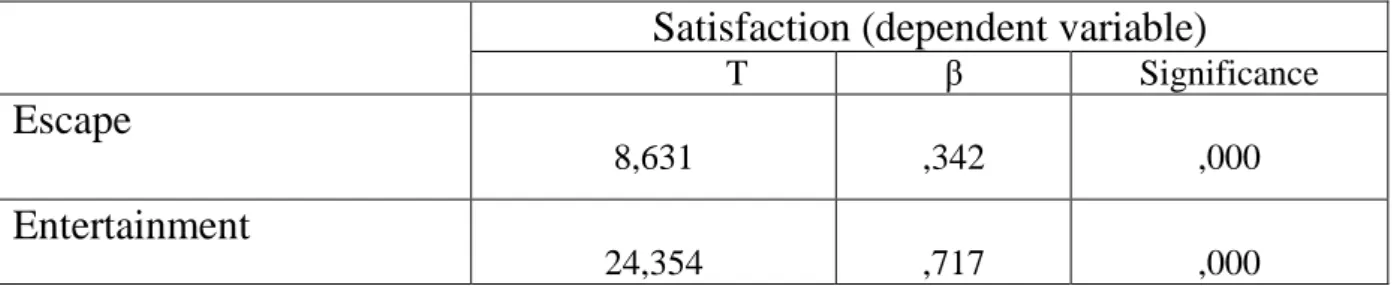
Satisfaction (dependent variable)
T β SignificanceEscape
8,631 ,342 ,000Entertainment
24,354 ,717 ,000Table 3: Results of regression analysis between the economic value and intrinsic values.
Economic value (dependent variable)
T β Significance
Escape
7,173 ,290 ,000
Entertainment
14,984 ,534 ,000
Table 4: Results of regression analysis between ease of use and intrinsic values.
Ease of use (dependent variable)
T β Significance
Escape
5,930 ,243 ,000
Entertainment
21,185 ,666 ,000
Table 5: Results of regression analysis of the quality of virtual communities.
The quality of virtual communities (dependent variable)
T β Significance Economic value 5,551 ,228 ,000 Ease of use 10,826 ,415 ,000 Escape 6,443 ,262 ,000 Entertainment 7,740 ,310 ,000 Satisfaction 12,988 ,480 ,000