HAL Id: tel-01610096
https://tel.archives-ouvertes.fr/tel-01610096
Submitted on 5 Oct 2017
HAL is a multi-disciplinary open access
archive for the deposit and dissemination of
sci-entific research documents, whether they are
pub-lished or not. The documents may come from
teaching and research institutions in France or
abroad, or from public or private research centers.
L’archive ouverte pluridisciplinaire HAL, est
destinée au dépôt et à la diffusion de documents
scientifiques de niveau recherche, publiés ou non,
émanant des établissements d’enseignement et de
recherche français ou étrangers, des laboratoires
publics ou privés.
Productivity Gap of Embedded Signal Processing
Systems
Maxime Pelcat
To cite this version:
Maxime Pelcat. Models, Methods and Tools for Bridging the Design Productivity Gap of Embedded
Signal Processing Systems. Signal and Image processing. Université Clermont Auvergne, 2017.
�tel-01610096�
M O D E L S , M E T H O D S A N D T O O L S
F O R B R I D G I N G T H E D E S I G N
P R O D U C T I V I T Y G A P O F
E M B E D D E D S I G N A L P R O C E S S I N G
S Y S T E M S
S o u t e n u e l e 1 0 j u i l l e t 2 0 1 7 d e v a n t u n j u r y c o m p o s é d e
R A P P O R T E U R S :
M I C H E L A U G U I N, D R C N R S
J E A N - P I E R R E TA L P I N , D R I N R I A
C H R I S T O P H E J É G O , P R O F. E N S E I R B - M AT M E C A
E X A M I N A T E U R S :
J O C E LY N S É R O T, P R O F. U C A
F R A N Ç O I S B E R R Y, M C F H D R U C A
J E A N - F R A N Ç O I S N E Z A N , P R O F. I N S A R E N N E S / I E T R
D A N I E L M É N A R D , P R O F. I N S A R E N N E S / I E T R
S H U V R A S . B H AT TA C H A R Y YA , P R O F. U M D / T U T
H A B I L I TAT I O N À D I R I G E R D E S R E C H E R C H E S
List of Personal Publications
5Foreword
9Abstract
111 Design Productivity
13A
Using Dataflow MoCs for Raising Design Productivity
19
2 Improving Design Efficiency
213 Improving Implementation Quality
414 Evaluating Design Productivity
51B
Introducing MoAs for Raising Design Productivity
71
5 Models of Architecture: A New Design Abstraction
736 State of the Art of Models of Architecture
857 Models of Architecture in Practice
1058 Research Perspectives
121[1] Carlo Sau, Francesca Palumbo, Maxime Pelcat, Julien Heulot, Erwan Nogues, Daniel Ménard, Paolo Meloni, and Luigi Raffo. Challenging the best HEVC fractional pixel FPGA interpolators with reconfigurable and multi-frequency approximate computing. IEEE Embedded Systems Letters, 2017. IEEE, to appear.
[2] Alexandre Mercat, Florian Arrestier, Wassim Hamidouche, Maxime Pelcat, and Daniel Menard. Energy reduction opportunities in an HEVC real-time encoder. In Proceedings of the ICASSP conference. IEEE, 2017.
[3] Alexandre Mercat, Florian Arrestier, Wassim Hamidouche, Maxime Pelcat, and Daniel Menard. Constrain the docile CTUs: an in-frame complexity allocator for HEVC intra encoders. In Proceedings of the ICASSP conference. IEEE, 2017.
[4] Michael Masin, Francesca Palumbo, Hans Myrhaug, Julio de Oliveira Filho, Max Pastena, Maxime Pelcat, Luigi Raffo, Francesco Regazzoni, Angel Sanchez, Antonella Toffetti, Eduardo de la Torre, and Katiuscia Zedda. Cross-layer design of reconfigurable cyber-physical systems. In Proceedings of the DATE Conference. IEEE ACM, 2017. [5] Erwan Raffin, Wassim Hamidouche, Erwan Nogues, Maxime Pelcat, and Daniel Menard. Scalable HEVC De-coder for Mobile Devices: Trade-offs between Energy Consumption and Quality. In Proceedings of the DASIP conference. IEEE, 2016.
[6] Alexandre Mercat, Wassim Hamidouche, Maxime Pelcat, and Daniel Menard. Estimating encoding complexity of a real-time embedded software hevc codec. In Proceedings of the DASIP conference. IEEE, 2016.
[7] Raquel Lazcano, Daniel Madroñal, Karol Desnos, Maxime Pelcat, Raúl Guerra, Sebastián López, Eduardo Juarez, and César Sanz. Parallelism Exploitation of a Dimensionality Reduction Algorithm Applied to Hyperspectral Images. In Proceedings of the DASIP Conference. IEEE, 2016.
[8] Kamel Abdelouahab, Cédric Bourrasset, Maxime Pelcat, François Berry, Jean-Charles Quinton, and Jocelyn Serot. A holistic approach for optimizing DSP block utilization of a CNN implementation on FPGA. In Proceedings of the ICDSC Conference. ACM, 2016.
[9] Maxime Pelcat, Karol Desnos, Luca Maggiani, Yanzhou Liu, Julien Heulot, Jean-François Nezan, and Shuvra S. Bhattacharyya. Models of Architecture: Reproducible Efficiency Evaluation for Signal Processing Systems. In Proceedings of the SiPS Workshop. IEEE, 2016.
[10] Karol Desnos, Maxime Pelcat, Jean-François Nezan, and Slaheddine Aridhi. Distributed memory allocation tech-nique for synchronous dataflow graphs. In Proceedings of the SiPS Workshop. IEEE, 2016.
[11] Francesca Palumbo, Carlo Sau, Davide Evangelista, Paolo Meloni, Maxime Pelcat, and Luigi Raffo. Runtime Energy versus Quality Tuning in Motion Compensation Filters for HEVC. In Proceedings of PDeS. IEEE, 2016. [12] Maxime Pelcat, Cédric Bourrasset, Luca Maggiani, and François Berry. Design productivity of a high level
synthesis compiler versus HDL. In Proceedings of the IC-SAMOS Workshop. IEEE, 2016.
[13] Erwan Nogues, Daniel Menard, and Maxime Pelcat. Algorithmic-level approximate computing applied to energy efficient HEVC decoding. IEEE Transactions on Emerging Topics in Computing, 2016. IEEE.
[14] Erwan Nogues, Julien Heulot, Glenn Herrou, Ladislas Robin, Maxime Pelcat, Daniel Menard, Erwan Raffin, and Wassim Hamidouche. Efficient DVFS for low power HEVC software decoder. Journal of Real-Time Image Processing, 2016. Springer Verlag.
[15] John McAllister, Maire O’neill, and Maxime Pelcat. Guest editorial: New frontiers in signal processing applica-tions and embedded processing technologies. Journal of VLSI Signal Processing Systems for Signal, Image, and Video Technology (JSPS), 2016. Springer Verlag.
[16] Erwan Nogues, Maxime Pelcat, Daniel Menard, and Alexandre Mercat. Energy efficient scheduling of real time signal processing applications through combined DVFS and DPM. In Proceedings of the PDP conference. IEEE, 2016.
[17] Manel Ammar, Mouna Baklouti, Maxime Pelcat, Karol Desnos, and Mohamed Abid. On Exploiting Energy-Aware Scheduling Algorithms for MDE-Based Design Space Exploration of MP2SoC. In Proceedings of the PDP Conference. IEEE, 2016.
[18] Miguel Chavarrias, Fernando Pescador, Matias Garrido, Maxime Pelcat, and Eduardo Juarez. Design of Multicore HEVC Decoders Using Actor-based Dataflow Models and OpenMP. In Proceedings of the ICCE Conference. IEEE, 2016.
[19] Karol Desnos, Maxime Pelcat, Jean François Nezan, and Slaheddine Aridhi. On Memory Reuse Between Inputs and Outputs of Dataflow Actors. ACM Transactions on Embedded Computing Systems (TECS), 2016. ACM. [20] Simon Holmbacka, Erwan Nogues, Maxime Pelcat, Sébastien Lafond, Daniel Menard, and Johan Lilius.
Energy-awareness and performance management with parallel dataflow applications. Journal of VLSI Signal Processing Systems for Signal, Image, and Video Technology (JSPS), 2015. Springer Verlag.
[21] Erwan Raffin, Erwan Nogues, Wassim Hamidouche, Seppo Tomperi, Maxime Pelcat, and Daniel Menard. Low power HEVC software decoder for mobile devices. Journal of Real-Time Image Processing, 2015. Springer Verlag. [22] Erwan Nogues, Erwan Raffin, Maxime Pelcat, and Daniel Menard. A modified HEVC decoder for low power
decoding. In Proceedings of the Computing Frontiers Conference. ACM, 2015.
[23] Erwan Raffin, Wassim Hamidouche, Erwan Nogues, Maxime Pelcat, Daniel Menard, and Tomperi Seppo. En-ergy Efficiency of a Parallel HEVC Software Decoder for Embedded Devices. In Proceedings of the Computing Frontiers Conference. ACM, 2015.
[24] Karol Desnos, Maxime Pelcat, Jean-François Nezan, and Slaheddine Aridhi. Buffer Merging Technique for Min-imizing Memory Footprints of Synchronous Dataflow Specifications. In Proceedings of the ICASSP Conference. IEEE, 2015.
[25] Manel Ammar, Mouna Baklouti, Maxime Pelcat, Karol Desnos, and Mohamed Abid. Automatic generation of S-LAM descriptions from UML/MARTE for the DSE of massively parallel embedded systems. In Software Engineering, Artificial Intelligence, Networking and Parallel/Distributed Computing. 2015. Springer Verlag. [26] Erwan Nogues, Berrada Romain, Maxime Pelcat, Daniel Menard, and Erwan Raffin. A DVFS based HEVC
decoder for energy-efficient software implementation on embedded processors. In Proceedings of the ICME con-ference. IEEE, 2015.
[27] Karol Desnos, Maxime Pelcat, Jean-François Nezan, and Slaheddine Aridhi. Memory Analysis and Optimized Allocation of Dataflow Applications on Shared-Memory MPSoCs. Journal of VLSI Signal Processing Systems for Signal, Image, and Video Technology (JSPS), 2014. Springer Verlag.
[28] Julien Heulot, Maxime Pelcat, Jean-François Nezan, Yaset Oliva, Slaheddine Aridhi, and Shuvra S Bhattacharyya. Just-in-time scheduling techniques for multicore signal processing systems. In Proceedings of the GlobalSIP con-ference. IEEE, 2014.
[29] Karol Desnos, Safwan El Assad, Aurore Arlicot, Maxime Pelcat, and Daniel Menard. Efficient multicore imple-mentation of an advanced generator of discrete chaotic sequences. In Proceedings of the ICITST conference. IEEE, 2014.
[30] Zheng Zhou, William Plishker, Shuvra S Bhattacharyya, Karol Desnos, Maxime Pelcat, and Jean-François Nezan. Scheduling of parallelized synchronous dataflow actors for multicore signal processing. Journal of VLSI Signal Processing Systems for Signal, Image, and Video Technology (JSPS), 2014. Springer Verlag.
[31] Julien Heulot, Maxime Pelcat, Karol Desnos, Jean François Nezan, Slaheddine Aridhi, et al. SPIDER: A syn-chronous parameterized and interfaced dataflow-based RTOS for multicore DSPs. Proceedings of the EDERC Conference, 2014.
[32] Manel Ammar, Mouna Baklouti, Maxime Pelcat, Karol Desnos, and Mohamed Abid. MARTE toπSDF
transfor-mation for data-intensive applications analysis. In Proceedings of the DASIP Conference. IEEE, 2014.
[33] Simon Holmbacka, Erwan Nogues, Maxime Pelcat, Sébastien Lafond, and Johan Lilius. Energy efficiency and performance management of parallel dataflow applications. In Proceedings of the DASIP conference. IEEE, 2014. [34] Erwan Nogues, Simon Holmbacka, Maxime Pelcat, Daniel Menard, and Johan Lilius. Power-aware HEVC
de-coding with tunable image quality. In Proceedings of the SiPS Workshop. IEEE, 2014.
[35] Maxime Pelcat, Karol Desnos, Julien Heulot, Clément Guy, Jean-François Nezan, and Slaheddine Aridhi. PREESM: A dataflow-based rapid prototyping framework for simplifying multicore dsp programming. In Pro-ceedings of the EDERC Conference, 2014.
[36] Jinglin Zhang, Jean-François Nezan, Maxime Pelcat, and Jean-Gabriel Cousin. Real-time GPU-based local stereo matching method. In Proceedings of the DASIP Conference. IEEE, 2013.
[37] Zheng Zhou, Karol Desnos, Maxime Pelcat, Jean-François Nezan, William Plishker, and Shuvra S Bhattacharyya. Scheduling of parallelized synchronous dataflow actors. In Proceedings of the SoC Conference. IEEE, 2013. [38] Karol Desnos, Maxime Pelcat, Jean François Nezan, Shuvra S. Bhattacharyya, and Slaheddine Aridhi. PiMM:
Parameterized and interfaced dataflow meta-model for MPSoCs runtime reconfiguration. In Proceedings of the IC-SAMOS Workshop. IEEE, 2013.
[39] Julien Heulot, Jani Boutellier, Maxime Pelcat, Jean François Nezan, and Slaheddine Aridhi. Applying the Adaptive Hybrid Flow-Shop Scheduling Method to Schedule a 3GPP LTE Physical Layer Algorithm onto Many-Core Digital Signal Processors. In Proceedings of the AHS conference, NASA/ESA, 2013.
[40] Karol Desnos, Maxime Pelcat, Jean François Nezan, and Slaheddine Aridhi. Pre- and post-scheduling memory allocation strategies on MPSoCs. In Proceedings of the ESLsyn conference. IEEE, 2013.
[41] Julien Heulot, Karol Desnos, Jean François Nezan, Maxime Pelcat, Mickaël Raulet, Hervé Yviquel, Pierre-Laurent Lagalaye, and Jean-Christophe Le Lann. An Experimental Toolchain Based on High-Level Dataflow Models of Computation For Heterogeneous MPSoC. In Proceedings of the DASIP Conference. IEEE, 2012.
[42] Karol Desnos, Maxime Pelcat, Jean François Nezan, and Slaheddine Aridhi. Memory Bounds for the Distributed Execution of a Hierarchical Synchronous Data-Flow Graph. In Proceedings of the IC-SAMOS Workshop. IEEE, 2012.
[43] Maxime Pelcat, Slaheddine Aridhi, Jonathan Piat, and Jean-François Nezan. Physical Layer Multi-Core Prototyp-ing: A Dataflow-Based Approach for LTE eNodeB. Springer Verlag, 2012.
[44] Yaset Oliva, Maxime Pelcat, Jean-François Nezan, Jean-Christophe Prevotet, and Slaheddine Aridhi. Building a RTOS for MPSoC dataflow programming. In Proceedings of the SoC Conference. IEEE, 2011.
The regularly updated list of my publications is available on :
This Habilitation à Diriger des Recherches (HDR) report presents past and future research directions resulting from the work I conducted since 2010 to-gether with colleagues at IETR/INSA Rennes and more recently at Institut Pascal in Clermont-Ferrand, as well as with researchers from University of Maryland, Tampere University of Technology, Texas Instruments, ENIS, Abo Akademi, Scuola Sant’ Anna, Università degli studi di Cagliari, Università degli Studi di Sassari, Universidad Politécnica de Madrid and Queen’s Univer-sity Belfast.
I am very grateful for all the enriching discussions I had the chance to partic-ipate in during laboratory and project meetings, research stays and seminars. A special thank you to the doctors I co-advised: Karol Desnos, Julien Heulot and Erwan Nogues, as well as to the PhD students I currently co-advise: Alexan-dre Mercat, El Mehdi Abdali, Jonathan Bonnard, and Kamel Abdelouahab. I would like to thank the colleagues with whom I had the chance to closely col-laborate, and in particular Daniel Ménard, Jean-François Nezan, Karol Desnos, and François Berry who have helped many ideas to ripen that now appear in this document. Thanks also to all my colleagues at the VAADER team of IETR and DREAM team of Institut Pascal. Finally, I am grateful to Jocelyn Sérot for accepting to direct this Habilitation à Diriger la Recherche (HDR) and for helping with the creation of this report.
The complexity of systems is currently growing faster than the productivity of system designers and programmers. This phenomenon is called Design Pro-ductivity Gap and results in inflating design costs. This Habilitation à Diriger des Recherches (HDR)report present models, methods and tool for improving the Design Productivity (DP) of embedded Digital Signal Processing (DSP) systems and reducing this Design Productivity Gap. The notion of Design Productivity (DP) is commonly used without defining it. This report starts by precisely defining DP before presenting different methods to improve and evaluate it.
In a first part, methods based on Models of Computation (MoCs) are ex-plored. They constitute our past and present work on the subject. Dataflow MoCs are used to study application properties (liveness, schedulability, paral-lelism, etc.) at a high level of abstraction, often before implementation details are known. We have over the last seven years explored how dataflow MoCs can influence the performance and design efforts of modern multicore Digital Signal Processing (DSP) systems.
In the second part of this report, the focus is shifted on the notion of Model of Architecture (MoA) we recently introduced. Parallel and heterogeneous platforms are becoming ever more complex. MoAs have the potential to coun-teract the DP reduction caused by this rising complexity and constitute the main subject I intend to continue studying in the next years.
MoAs, and in general Model-Based Design, can have a great impact on future design methods. Together with the concepts of Cyber-Physical Systems (CPS), Approximate Computing and Rapid Prototyping, they represent new opportunities for reducing the Design Productivity Gap of future DSP systems.
Design Productivity
1.1
Chapter Abstract
In this introductory chapter, the concept of DP is defined in the context of DSP system design. DP a ratio between the quality of a system — in terms of Non-Functional Properties (NFPs) — and the efforts spent to build the system, expressed as Non-Recurring Engineering (NRE) costs. This definition allows for evaluations and comparisons of the DPs from several methods.
My work over the last 7 years is then overviewed under the perspective of DP reduction for DSP embedded systems. DP improvements are finally argued to be necessary in the long run to follow the upward trend of embedded system exposed complexity.
1.2
Design Productivity
The concept of DP is often evoked in literature but we only recently proposed
a definition1. Design Productivity (DP) relates to a compromise between the 1Maxime Pelcat, Cédric Bourrasset, Luca
Maggiani, and François Berry. Design pro-ductivity of a high level synthesis compiler versus HDL. In Proceedings of IC-SAMOS, 2016
efforts spent to build a system and the quality of the system resulting from these design efforts. A generic representation of system DP is proposed in Figure1.1. DP may be augmented by two factors:
• when design effort is reduced. This corresponds to augmenting design effi-ciency,
• when, for a fixed effort, implementation quality is increased.
Design effort can be measured by Non-Recurring Engineering (NRE) cost metrics such as design time, test and validation time, the number of lines of code to write, the NRE monetary expenses, etc. Implementation quality can be measured by Non-Functional Property (NFP) costs such as the energy con-sumption of the system, its latency, throughput, production cost, silicon area, etc. A DSP system can be considered functional when it produces, for a given input data stream, the corresponding correct output data stream. NFPs cor-respond to all the properties, except functional behavior, that may participate
to make a system conform to its specification. For a given design, DP can be characterized by the area under the radar chart curve of Figure1.1. The smaller this area is, the more DP the design process offers.
NRE cost 1 NFP cost 1 Design efficiency Implementation quality NFP cost 2
NRE cost 2 NRE cost 3
NRE cost 4 NFP cost 3 NFP cost 4
De
si
gn
Produc
tiv
ity
Figure 1.1: Design Productivity represen-tation as a combination of Non-Recurring Engineering (NRE) costs and system Non-Functional Property (NFP) costs.
The NRE and NFP cost metrics chosen to appear in the chart strongly im-pact how the Design Productivity is measured. They should be chosen accord-ing to the most important design constraints and the most important features of the built system. As a consequence, a unique scalar value can not alone quantify DP. However, if two design methods are compared on the same use case, in the same conditions and with the same NRE and NFP metrics, a fair DP ratio can be measured, provided that the conditions for producing this ratio are explained. A fair DP comparison will be demonstrated in Chapter4.
DP fair assessment is a promising tool to promote new system design prac-tices. We recently prototyped such a system DP fair assessment[1] to demon-strate its feasibility. Platform technologies and architectures currently evolve at a tremendous pace but design practices clearly evolve at a more leisurely pace. Fair DP studies have the potential to boost design practices and foster new tools, languages and methods.
The next section illustrates my research activities under the prism of DP augmentation.
1.3
Research Activities on Design Productivity
Figure1.2illustrates my carrier as maître de conférences over the last 7 years. Dots represent personal publications, ordered by their main subjects.
The research subjects we have tackled over these years are diverse. They however have in common a long term objective of DP enhancement.
In the context of the 3 PhD thesis of Karol Desnos (2011-2013), Julien Heulot (2012-2014) and Erwan Nogues (2013-2015), we have studied dif-ferent aspects of DP, with a particular focus on application modeling with dataflow MoCs. Playing with a DSP application representation to enhance its performance and portability is possible using dataflow MoCs that represent the high-level aspects (e.g. parallelism, exchanged data, triggering events, etc.) of
Dataflow compilation DSP applications Memory allocation System adaptivity Energy reduction Approximate Computing Design Productivity Cyber-Physical Systems Models of Architecture professional carrier publication co-advised PhDs projects 2010 2011 2012 2013 2014 2015 2016 2017
PhD ATER MCF IETR/INSA Rennes MCF IETR/Institut Pascal/INSA
PhD Karol Desnos PhD Julien Heulot PhD Erwan Nogues PhD Alexandre Mercat PhD Kamel Abdelouahab PhD El Mehdi Abdali PhD Jonathan Bonnard ANR Compa FUI GreenVideo ANR HPeC ANR ARTEFaCT H2020 CERBERO
Figure 1.2: Research timeline from 2010 to today.
an application while hiding its detailed implementation. We have tackled the subjects of representing complex systems with predictable models, automating memory allocation, automating energy reduction and adapting the execution of a multicore system to hardware and software states. Alongside this work on design methods, we have built several DSP designs to test and demonstrate the methods. This MoC-based design approach is described in Chapters2and
3 and illustrated in Figure 1.3that represents our main past and current re-search subjects and the NFPs and NREs they address. In the figure, latency corresponds to the real-time response time of the system, energy is the en-ergy consumption due to processing and memory is the memory footprint of the application. New architecture porting time corresponds to the design time necessary to port and application to a new architecture.
Our focus is currently shifting, motivated by the continuous augmentation of the number of cores in systems and their rising heterogeneity. In particular, the complexity of embedded processors is ever more exposed. An exposed architecture is a set of hardware features that a designer must know to exploit the potential performance of a platform. We oppose to exposed architectures the hidden architectures that are hardware- or software-managed and can be ignored by the designer while still getting acceptable performance. Our focus
Design time Latency Energy New architecture porting time Test time Memory Dataflow compilation
DSP applications Memory allocation System adaptivity Energy reduction Design time Latency Energy New architecture porting time Test time Memory Design efficiency Implementation quality Research subjects NRE and NFP costs
De
si
gn
Produc
tiv
ity
Figure 1.3: Relating the main research sub-jects addressed by our past and current work (Figure1.2) and their influence on the ad-dressed DP-related metrics.
is now set on a new notion we recently proposed2: Models of Architecture
2Maxime Pelcat, Karol Desnos, Luca
Maggiani, Yanzhou Liu, Julien Heulot, Jean-François Nezan, and Shuvra S Bhattacharyya. Models of architecture: Reproducible efficiency evaluation for signal processing systems. In Proceedings of the SiPS Workshop. IEEE, 2016
(MoAs).
Equivalently to MoCs on the application side, Models of Architecture (MoAs) can be used on the architectural side to extract the fundamental elements af-fecting efficiency. An MoA is a model abstracting away details of a hardware platform but producing, when combined with an application model, a repro-ducible evaluation of a system’s Non-Functional Property (NFP). The notion of MoA will be defined in Chapter5. Related works and an example use of an MoA are respectively presented in Chapters6and7.
New ideas are currently emerging into our research: Cyber-Physical Sys-tems (CPS), adaptable hardware, approximate computing, and hardware/soft-ware High-Level Synthesis (HLS). All of them can benefit from the concept of MoAs. These starting research directions will be presented in Chapter8, together with perspectives.
1.4
Why Addressing Embedded Systems’ DP?
In computer science, system performance is often used as a synonym for real-time performance, i.e. adequate processing speed. However, most DSP sys-tems must, to fit their market, meet at the same time several NFPs, including high performance, low cost, and low power consumption.
Observing the available processing systems, three categories can be distin-guished, based on their power consumption, as displayed in Figure1.4. Em-bedded systems are often battery powered and characterized by a processing power dissipation below 20W. Between 20W and 20kW are either conventional processing, including personal computers, and dedicated systems such as cel-lular base stations or large medical devices. Over 20kW and below 20MW are High Performance Computing (HPC) systems, 20MW being a common upper bound of processing power consumption for future exascale facilities. One data center facility can require even more than 20MW (up to around 200MW) but a data center is constantly shared between millions of independent applications
and thus cannot be considered as one processing system. 0W embedded systems 20W 20kW 20MW conventional systems dedicated systems high performance computing 2W 7W need a fan need a dissipator high performance embedded systems
Figure 1.4: Categories of processing systems based on their power consumption.
A great variety of processors is available for the embedded processing do-main and embedded processors have a great influence on all dodo-mains of processing as a consequence of their high energy efficiency. For instance, the influence of embedded systems on HPC is visible in the Mont-Blanc Eu-ropean projects [3] that design ARM-based HPC platforms. Moreover, mobile devices, built around embedded processors, have become the main driver of processing innovation and future systems, either in the Internet of Things (IoT) or in the CPS domain, are predicted to continue this trend.
The energy efficiency of embedded processors comes at the price of very complex design and programming procedures due to considerable exposed complexities. As an example, porting complex applications to an FPGA or a many-core processor can easily take several tens or hundreds of men-months to exploit an acceptable share of platform performances and a large set of hard-ware skills is expected from the design teams. The 2011 ITRS report warns that “design implementation productivity must be improved to the same de-gree as design complexity is scaled” for design costs to remain sustainable[4]. The examples of processors studied in this document have a limited number of cores: for example the Exynos 5410 and 5422 processors, each composed of 4 energy-efficient ARM Cortex-A7 cores and 4 high-performance ARM Cortex-A15 cores, and the Texas Instruments TMS320C6678 processor com-posed of 8 c66x DSP cores interconnected by a Network-on-Chip (NoC) with access to an internal shared memory. However, both these processors already require hardware knowledge to properly program them. For instance, com-municating between cores through the shared memory of the TMS320C6678 processor necessitates manual data cache coherency management, taking ac-count of the cache line size of 128Bytes to avoid invalidating or writing back the wrong data in memory.
This kind of programming is difficult to maintain for the currently released many-core processors. The upward trend currently followed by platforms’ ex-posed complexity is likely to continue in the next years and the number of cores in mobile systems is forecast to grow at least until the end of the 2020s [5]. In this context, one major challenge of electronic system design is the growing Design Productivity Gap referring to a faster increase in the complex-ity of systems than in the productivcomplex-ity of system designers. As a consequence, Design Productivity (DP) is at the heart of system costs and should be carefully
addressed in future research, especially for the cost and performance-critical DSP applications exploiting embedded processors.
This report is organized into two Parts. PartAcovers our previous work on augmenting and measuring the DP of DSP embedded systems using dataflow MoCs while partBproposes the new concept of MoAs to further improve DP in the next years.
In PartA, Chapter2 presents our work on augmenting the DP of embed-ded processing systems by raising the design efficiency while Chapter3 fo-cuses on the improvement of the implementation quality. Chapter4overviews the use cases leveraged on to assess our models and methods and shows on a High-Level Synthesis (HLS) example how DP can be measured in practice. In PartB, Chapters5,6and7respectively concentrate on the definition, state-of-the-art and applicability of Models of Architecture (MoAs) as a new direction to explore. Finally, Chapter8presents some research perspectives I intend to follow in the next years.
Using Dataflow MoCs for Raising Design
Productivity
Improving Design Efficiency
Non
-Rec
urring Engineering (NRE ) c
osts Design
efficiency
Figure 2.1: Improving design efficiency on the DP chart.
2.1
Chapter Abstract
This chapter highlights our contributions on Design Productivity (DP) with a particular focus on the design efficiency of DSP systems. These contributions are based on the PiMM dataflow metamodel we introduced in 2013. They aim at automating design phases and hiding parts of the system complexity.
The PiMM metamodel is first presented. PiMM can be used in conjunction with any dataflow MoC. When combining the PiMM metamodel together with the Synchronous Dataflow (SDF) MoC, a hierachical, predictible, composi-tional and parameterized model of computation is obtained called PiSDF. The benefits offered by the PiSDF dataflow MoC on design efficiency come from the portable nature of a PiSDF algorithm representation. Indeed, PiSDF, inher-iting properties from the formerly existing parameterized dataflow and IBSDF models, represents both the parallelism of the application, and the data com-municated between computational actors, while supporting dynamic applica-tion reconfigurability.
Then, a scheduling method called JIT-MS is introduced. The objective of Just-In-Time Multicore Scheduling (JIT-MS) is to find a balance between a static scheduling that has no runtime overhead but does not take into account the application and architecture modifications, and dynamic scheduling that costs time and resources to take decisions. JIT-MS exploits the information of a PiSDF application representation to adapt a dynamic application execution to potentially dynamic platform resources. JIT-MS maintains a graph of the current application state and optimizes the application execution as soon as its parameters are resolved. It splits the scheduling of a PiSDF dataflow graph into steps to identify locally static regions. It also provides efficient assignment and ordering of actors into Processing Elements (PEs), leveraging on dataflow information.
When compared to the current programming methods for parallel systems based on manual parallelization and imperative languages such as C and ex-tension such as OpenMP or OpenCL, PiMM and JIT-MS aim to foster a shift
in the programming paradigm of DSP embedded systems from state-machine-based languages to parallelism-aware dataflow representations.
2.2
Building the PiMM Metamodel to improve
De-sign Efficiency
Currently available high performance DSP platforms all have multiple cores. They sometimes also bring together programmable cores and programmable hardware. The procedure to design systems for these platforms is complex and specific to each architecture. Our work on design efficiency consists of designing models, methods and tools to decouple the application model from the architecture model.
On the application side, the parameters of applications (e.g. the size of a processed image, the bandwidth of a telecommunication algorithm„ the size of a cryptographic key to generate, etc.) impact their parallelism and the effi-ciency of their execution. If this impact is extensive, a runtime management of the system is necessary to migrate processing tasks, manage data movements and handle external event. If on the contrary the impact of parameters on con-currency is limited, it is desirable to take as many code and memory locality decisions at compile time, avoiding runtime management overheads.
A common method to design a DSP system today is to first build a versatile simulation model of the application algorithms using Matlab, Scilab or Python. Then, this model is used as a golden reference to separately build the hardware and software subparts of the system and then verify the functional properties of the system. The hardware is written in VHDL or Verilog to be ported for instance on an Field-Programmable Gate Array (FPGA) or to be implemented as an ASIC IP. The software is written is imperative code, usually in C code, and must be adapted to the number of of available cores, their performance, their communication facilities, their memory, and the interfaces they use to communicate with the their environment.
There are several ways to reduce the efforts necessary to build a system in this context, and thus increase its design efficiency:
• The design time can be reduced, corresponding to the time needed to rep-resent the application in a language or model serving as an input for the compilation/synthesis process. This reduction can come from a more user friendly language, a Domain specific language (DSL) making language se-mantics fitting closely the applicative needs and automating some repetitive procedures, an Integrated Development Environment (IDE) with advanced language semantics analysis, etc. Another possibility is for the golden ref-erence code to be made executable for the designer to write application functionalities only once and infer the total system.
• The test time can be reduced, for instance by setting correct-by-design con-structs in the input language or automating the construction of test benches.
• The porting time to another platform can be shortened. A processor is currently commercialized only for a few years before being replaced by a new one, often with a very different architecture. Porting applications between architectures of different types is currently very time consuming. During the last years and particularly as part of the PhD thesis of Karol Desnos and Julien Heulot, we have developed a new dataflow metamodel named Parameterized and Interfaced Dataflow Meta-Model (PiMM) and com-bined it with the SDF MoC to form a hierachical, predictible and parameterized model named Parameterized and Interfaced Synchronous Dataflow (PiSDF).
We have also built the compilation and runtime tools PREESM1and Spider2 1M. Pelcat, K. Desnos, J. Heulot, C. Guy,
J.-F. Nezan, and S. Aridhi. PREESM: A dataflow-based rapid prototyping framework for simplifying multicore dsp programming. In Proceedings of the EDERC Conference, Sept 2014
2Julien Heulot, Maxime Pelcat, Karol
Desnos, Jean François Nezan, Slaheddine Aridhi, et al. SPIDER: A synchronous parameterized and interfaced dataflow-based rtos for multicore dsps. Proceedings of the EDERC Conference, 2014
to generate multicore software from PiSDF. In a partnership with the Poly-technic University of Madrid (UPM), we are currently extending PiSDF to hardware design.
Our work on dataflow compilation has focused on enhancing the predictabil-ity of algorithm modeling because a predictable model is compulsory when a DSP processing algorithm is to be mapped onto a multicore system with a de-gree of guaranteed efficiency. In particular, the added value of an embedded system lies in the possibility to ensure properties such as real-time and
en-ergy consumption. The PiMM metamodel, published in IC-SAMOS 20133 3K. Desnos, M. Pelcat, J.-F. Nezan, S. S.
Bhattacharyya, and S. Aridhi. PiMM: Pa-rameterized and interfaced dataflow meta-model for MPSoCs runtime reconfiguration. In SAMOS XIII, 2013
complements previous work on Interface-Based SDF (IBSDF) from Jonathan Piat[9]. It favors the design of highly-efficient heterogeneous multicore sys-tems, specifying algorithms with customizable trade-offs among predictability and exploitation of both static and adaptive task, data and pipeline parallelism. Next sections discuss a selection of our contributions on PiSDF and JIT-MS.
2.3
Dataflow Compilation: The PiMM Meta-Model
and PiSDF MoC
2.3.1
State of the Art of Dataflow MoCs
Dataflow MoCs can be used to specify a wide range of DSP applications such
as video decoding [10], telecommunication4, and computer vision [12] appli- 4Maxime Pelcat, Slaheddine Aridhi,
Jonathan Piat, and Jean-François Nezan. Physical Layer Multi-Core Prototyping: A Dataflow-Based Approach for LTE eNodeB. Springer, 2012
cations. The popularity of dataflow MoCs is due to their great analysability and their natural expressivity of the parallelism of a DSP application which make them particularly suitable to exploit the parallelism offered by heterogeneous Multiprocessor Systems-on-Chips (MPSoCs). The increasing complexity of applications leads to the continuing introduction of new dataflow MoCs, and the extension of previously developed MoCs for different types of modeling contexts. Dataflow MoCs are differentiated by their capacity to either describe dynamic application behaviors (expressive models) or to feed a behaviour pre-diction process efficiently (predictible models).
Representing an application with a Dataflow Process Network (DPN) [13] consists of dividing this application into persistent processing entities, named
actors, connected by First In, First Out data queues (FIFOs). An actor per-forms processing (it “fires”) when its incoming FIFOs contain enough data tokens. The number of data tokens consumed and produced by an actor for each firing is given by a set of firing rules [14]. Firing rules can be static or they can depend on data, as in the CAPH language, or on parameters, as in the Parameterized Synchronous Dataflow (PSDF) MoC [15].
Static Dataflow MoCs Synchronous Dataflow (SDF) [16] is a static DPN
MoC. Production and consumption token rates set by firing rules are fixed scalars in an SDF graph. A static analysis of an SDF graph ensures consistency and schedulability properties that imply deadlock-free execution and bounded FIFO memory needs.
An SDF graph G= (A, F)(Figure2.2) contains a set of actors A that are interconnected by a set of FIFOs F. An actor a∈ A comprises a set of data ports
(Pdatain , Pdataout)where Pdatain and Pdataout respectively refer to a set of data input and output ports, used as anchors for FIFO connections. Functions src : F→ Pout
data
and snk : F→ Pin
data associate source and sink ports to a given FIFO and a
data rate is specified for each port by the function rate : Pdatain ∪ Pout data→ N
corresponding to the fixed firing rules of an SDF actor. A delay d : F→ N is set for each FIFO, corresponding to a number of tokens initially present in the FIFO. A Actor FIFO Port name and rate A B d: 1 d: 1 di: 2 fi: 4 fo: 4 C do: 6 d: 3 *4
*4 Delay andnumber of tokens
Figure 2.2: Example of an SDF Graph
If an SDF graph is consistent and schedulable, a fixed sequence of actor firings can be repeated indefinitely to execute the graph, and there is a well defined concept of a minimal sequence for achieving an indefinite execution with bounded memory. Such a minimal sequence is called graph iteration and the number of firings of each actor in this sequence is given by the graph Repetition Vector (RV).
Graph consistency means that no FIFO accumulates tokens indefinitely when the graph is executed (preventing FIFO overflow). Consistency can be proved by verifying that the graph topology matrix has a non-zero vector in its null space [16]. When such a vector exists, it gives the RV for the graph. The topology of an SDF graph characterizes actor interconnections as well as to-ken production and consumption rates on each FIFO. A graph is schedulable if and only if it is consistent and has enough initial tokens to execute the first graph iteration (preventing deadlocks by FIFO underflow).
Research on dataflow modeling leads to the continuing introduction of new dataflow models. Static extensions of the SDF model such as the Cyclo-Static Dataflow (CSDF) [17], the multidimensional SDF [18], the IBSDF [9], and the Affine Dataflow (ADF) [19] have been proposed to enhance its expressiveness
and conciseness while preserving its predictability.
The Compositional Temporal Analysis (CTA) model is a non-executable timed abstraction of the SDF MoC that can be used to analyze efficiently the schedulability and the temporal properties of applications [20]. The IBSDF and the CTA models both enforce the compositionality of applications. A model is compositional if the properties (schedulability, deadlock freeness, ...) of an application graph composed of several sub-graphs are independent from the internal specifications of these sub-graphs [21].
Interface-Based Synchronous Dataflow MoC Interface-Based SDF (IBSDF)
[9] is a hierarchical extension of the SDF model interpreting hierarchy levels as code closures. IBSDF fosters subgraph composition, making subgraph exe-cutions equivalent to imperative language function calls. IBSDF has proved to be an efficient way to model dataflow applications [11]. IBSDF interfaces are inherited by the PiMM proposed meta-model (Section2.3.2).
In addition to the SDF semantics, IBSDF adds interface elements to insulate levels of hierarchy in terms of schedulability analysis. An IBSDF graph G= (A, F, I)contains a set of interfaces I= (Idatain , Idataout )(Figure2.3).
A data input interface iindata∈ Iin
data in a subgraph is a vertex transmitting
to the subgraph the tokens received by its corresponding data input port. If more tokens are consumed on a data input interface than the number of tokens received on the corresponding data input port, the data input interface behaves as a circular buffer, producing the same tokens several times.
A data output interface iout
data∈ Idataout in a subgraph is a vertex transmitting
tokens received from the subgraph to its corresponding data output port. If a data output interface receives too many tokens, it will behave like a circular buffer and output only the last pushed tokens.
A d: 1 B di: 2 fi: 4 fo: 4 C do: 6 d: 3 src snk data input interface data output interface B1 di1: 1 di2: 4 do2: 4 do1: 3 di fi do fo 2 4 6 4 *4
Figure 2.3: Example of an IBSDF Graph
[9] details the behavior of IBSDF data input and output interfaces as well as the IBSDF properties in terms of compositionality and schedulability check-ing. Through PiMM, interface-based hierarchy can be applied to other dataflow models than SDF with less restrictive firing rules.
Parameterized Dataflow MoCs Parameterized dataflowis a meta-modeling
framework introduced in [15] that is applicable to all dataflow MoCs that present graph iterations. When this meta-model is applied, it extends the tar-geted MoC semantics by adding dynamically reconfigurable hierarchical ac-tors. A reconfiguration occurs when values are dynamically assigned to the
parameters of a reconfigurable actor, causing changes in the actor computation and in the production and consumption rates of its data ports. As presented in [22], reconfigurations can only occur at certain points, namely quiescent points, during the execution of a graph in order to ensure the runtime integrity of the application.
An objective of PiMM is to further improve parameterization compared to parameterized dataflowby introducing an explicit parameter dependency tree and by enhancing graph compositionality. Indeed, in a PSDF graph, ports are simple connectors between data FIFOs that do not insulate levels of hierarchy (Section2.3.1). Other parameterized dataflow MoCs were previously devel-oped such as the Scenario-Aware Dataflow (SADF) [10], an analysis-oriented model based on a probabilistic description of the dynamic firing rules of ac-tors; or the Compaan generated KPN (CPN) [12], a parameterized extension of the Kahn Process Network (KPN) MoC. In these models, the complexity of the parameterization mechanism is handled by actors that can reconfigure the firing rules of other actors (or their own) via “control channels”. This recon-figuration mechanism differs from that of PiMM in that the latter relies on the explicit definition of parameters and their dependencies which allows for a pre-cise specification of what is influenced by a parameter, even in multiple levels of hierarchy, leading to an enhanced predictability and quasi-static scheduling potential for the model.
2.3.2
Our Contribution on Parameterized and Interfaced Dataflow
Meta-Modeling
Most of the following discussion is borrowed from our publication on PiMM [8]. PiMM can be used similarly to the parameterized dataflow to extend the semantics of all dataflow MoCs implementing the concept of graph iteration. PiMM adds both interface-based hierarchy and an explicit parameter depen-dency tree to the semantics of the extended MoC. In this section, we formally present PiMM through its application to the SDF MoC, composing the PiSDF model. The pictograms associated to the different elements of the PiSDF se-mantics are presented in Figures2.4and2.5.
A PiSDF graph G= (A, F, I, Π, ∆)contains, in addition to the SDF actor set A and FIFO set F, a set of hierarchical interfaces I, a set of parameters Π, and a set of parameter dependencies ∆.
Parameterization semantics
A parameterπ ∈ Π is a vertex of the graph associated to a parameter value v∈ N that is used to configure elements of the graph. For a better analyzability of the model, a parameter can be restricted to take only values of a finite subset of N. A configuration of a graph is the assignation of parameter values to all parameters in Π.
An actor a∈ A is now associated to a set of ports (Pin
where Pcfgin and Pcfgout are a set of configuration input and output ports respec-tively. A configuration input port pincfg∈ Pin
cfgof an actor a∈ A is an input port
that depends on a parameterπ ∈ Π and can influence the computation of a and the production/consumption rates on the dataflow ports of a. A configuration output port pout
cfg∈ Pcfgoutof an actor a∈ A is an output port that can dynamically
set the value of a parameterπ ∈ Π of the graph (Section2.3.2).
A parameter dependencyδ ∈ ∆ is a directed edge of the graph that links
a parameter π ∈ Π to a graph element influenced by this parameter.
For-mally a parameter dependencyδ is associated to the two functions setter : ∆→ Π ∪ Pout
cfg and getter : ∆→ Π ∪ Pcfgin∪ F which respectively give the source
and the target ofδ . A parameter dependency set by a configuration output port poutcfg∈ Pout
cfg of an actor a∈ A can only be received by a parameter vertex of the
graph that will dispatch the parameter value to other graph elements, building a parameter dependency tree. Dynamism in PiMM relies on parameters whose values can be used to influence one or several of the following properties: the computation of an actor, the production/consumption rates on the ports of an actor, the value of another parameter, and the delay of a FIFO (Section2.3.1). In PiMM, if an actor has all its production/consumption rates set to 0, it will not be executed.
A parameter dependency tree T= (Π, ∆)is formed by the set of parameters Π and the set of parameter dependencies ∆. The parameter dependency tree T is similar to a set of combinational relations where the value of each parameter is resolved virtually instantly as a function of the parameters it depends on. This parameter dependency tree is in contrast to the precedence graph(A, F)
where the firing of the actors is enabled by the data tokens flowing on the FIFOs.
π
SDF hierarchy semanticsThe hierarchy semantics used in PiSDF inherits from the interface-based dataflow introduced in [9] and presented in Section2.3.1. In PiSDF, a hierarchical actor is associated to a unique PiSDF subgraph. The set of interfaces I of a sub-graph is extended as follows: I= (Iin
data, Idataout, Icfgin, Icfgout) where Icfgin is a set of
configuration input interfacesand Icfgouta set of configuration output interfaces. Configuration input and output interfaces of a hierarchical actor are respec-tively seen as a configuration input port pincfg∈ Pin
cfgand a configuration output
port poutcfg∈ Pout
cfg from the upper level of hierarchy (Section2.3.2).
From the subgraph perspective, a configuration input interface is seen as a locally static parameter whose value is left undefined.
A configuration output interface enables the transmission of a parameter value from the subgraph of a hierarchical actor to upper levels of hierarchy. In the subgraph, this parameter value is provided by a FIFO linked to a data output port pout
dataof an actor that produces data tokens with values v∈ N. In
cases where several values are produced during an iteration of the subgraph, the configuration output interface behaves like a data output interface of size 1 and
only the last value written will be produced on the corresponding configuration output port of the enclosing hierarchical actor (Section2.3.1).
Figure2.4presents an example of a static PiSDF description. Compared to Figure2.3, it introduces parameters and parameter dependencies that com-pose a PiMM parameter dependency tree. The modeled example illustrates the modeling of a test bench for an image processing algorithm. In the example, one token corresponds to a single pixel in an image. Images are read, pixel by pixel, by actor A and stored, pixel by pixel, by actor C. A whole image is processed by one firing of actor B. A feedback edge with a delay stores the previous image for comparison with the current one. Actor B is refined by an actor B1processing one Nth of the image. In Figure2.4, the size of the image
picsizeand the parameter N are locally static.
N
di: picsize/N do: picsize/N
A B d: 1 picsize C picsize d: 1 B1 di fi do fo picsize
size locally staticparameter parameter dependency configuration input port
*picsize
picsize fi: picsize/N fo: picsize/N picsize
configuration input interface
Figure 2.4: Example of a PiSDF Graph with Static Parameters
π
SDF Reconfiguration As introduced in [22], the frequency with which the value of a parameter is changed influences the predictability of the applica-tion. A constant value will result in a high predictability while a value which changes at each iteration of a graph will cause many reconfigurations, thus lowering the predictability.There are two types of parametersπ ∈ Π in PiSDF: configurable parameters and locally static parameters. Both restrict how often the value of the parameter can change. Regardless of the type, a parameter must have a constant value during an iteration of the graph to which it belongs.
Configurable parameters
A configurable parameterπcfg∈ Π is a parameter whose value is dynamically
set once at the beginning of each iteration of the graph to which it belongs. Configurable parameters can influence all elements of their subgraph except the production/consumption rates on the data interfaces Idatain and Idataout. As ex-plained in [15], this restriction is essential to ensure that, as in IBSDF, a parent graph has a consistent view of its actors throughout an iteration, even if the topology may change between iterations.
The value of a configurable parameter can either be set through a param-eter dependency coming from an other configurable paramparam-eter or through a
parameter dependency coming from a configuration output port poutcfgof a con-figuration actor(Section2.3.2). In Figure2.5, N is a configurable parameter.
Locally static parameters
A locally static parameterπstat∈ Π of a graph has a value that is set before the
beginning of the graph execution and which remains constant over one or sev-eral iterations of this graph. In addition to the properties listed in Section2.3.2, a locally static parameter belonging to a subgraph can also be used to influence the production and consumption rates on the Idatain and Idataout interfaces of its hi-erarchical actor.
The value of a locally static parameter can be statically set at compile time, or it can be dynamically set by configurable parameters of upper levels of hi-erarchy via parameter dependencies. For example, a subgraph sees a config-uration input interface as a locally static parameter but this interface can take different values at runtime if its corresponding configuration input port is con-nected to a configurable parameter. In Figure 2.5, picsize is a locally static parameter both in main graph and in subgraph B.
A partial configuration state of a graph is reached when the parameter val-ues of all its locally static parameters are set. Hierarchy traversal of a hierar-chical actor is possible only when the corresponding subgraph has reached a partial configuration state.
A complete configuration state of a graph is reached when the values of all its parameters (locally static and configurable) are set. If a graph does not contain any configurable parameter, its partial and complete configurations are equivalent. Only when a graph is completely configured is it possible to check its consistency, compute a schedule, and execute it.
Configuration Actors
A firing of an actor a with a configuration output port poutcfg produces a pa-rameter value that can be used via a papa-rameter dependencyδ to dynamically set a configurable parameter π (Section2.3.2), provoking a reconfiguration of the graph elements depending onπ. In PiMM, such an actor is called a configuration actor. The execution of a configuration actor is the cause of a reconfiguration and must consequently happen only at quiescent points during the graph execution, as explained in [22]. To ensure the correct behavior of PiSDF graphs, a configuration actor acfg∈ A of a subgraph G is subject to the
following restrictions:
R1. acfgmust be fired exactly once per iteration of G before the firing of any
non-configuration actor. Indeed, G reaches a complete configuration only when all its configuration actors have fired.
R2. acfgmust consume data tokens only from hierarchical interfaces of G and must consume all available tokens during its unique firing.
R3. The production/consumption rates of a acfg can only depend on locally
static parameters of G.
R4. Data tokens produced by acfgare seen as a data input interface by other
actors of G. (i.e. they are made available using a ring-buffer and can be consumed more than once).
These restrictions naturally enforce the local synchrony conditions of parame-terized dataflowdefined in [15] and reminded in Section2.3.2.
The firing of all configuration actors of a graph is needed to obtain a com-plete configuration of this graph. Consequently, configuration actors will al-ways be executed before other (non-configuration) actors of the graph to which they belong. Configuration actors are the only actors whose firing is not data-driven but data-driven by hierarchy traversal.
The sets of configuration and non-configuration actors of a graph are respec-tively equivalent to the subinitφsand the bodyφbsubgraphs of parameterized
dataflow[15]. Nevertheless, configuration actors provide more flexibility than subinit graphs as they can produce data tokens that will be consumed by non-configuration actors of their graph. The init subgraphφi has no equivalent
in PiMM as its responsibility, namely the configuration of the production/-consumption rates on the actor interfaces, is performed by configuration input interfaces and parameter dependencies.
Figure2.5presents an example of a PiSDF description with reconfiguration. It is a modified version of the example in Figure2.4presented in Section2.3.2. In Figure2.5, the parameter N is a configurable parameter of subgraph B, while the parameter picsize is a locally static parameter. The number of firings of ac-tor B1for each firing of actor B is dynamically configured by the configuration
actor setN. In this example, the dynamic reconfiguration dynamically adapts the number N of firings of B1to the number of cores available to perform the
computation of B. Indeed, since B1has no self-loop FIFO, the N firings of B1
can be executed concurrently.
configuration output port
A configurationactor
di: picsize/N do: picsize/N
A B d: 1 picsize C picsize d: 1 B1 di fi do fo picsize *picsize
picsize fi: picsize/N fo: picsize/N picsize
setN di: picsize N configurable
parameter N
Figure 2.5: Example of a PiSDF Graph with Reconfiguration
Model Analysis and Behavior The PiSDF MoC presented in Section2.3.2
parameterizations. This dual degree of dynamism implies a two-step analysis of the behavior of applications described in PiSDF: a compile time analysis and a runtime analysis. In each step a set of properties of the application can be checked, such as the consistency, the deadlock freeness, and the boundedness. Other operations can be performed during one or both steps of the analysis such as the computation of a schedule or the application of graph transformation to enhance the performance of the application.
Compile Time Schedulability Analysis PiSDF inherits its schedulability prop-erties both from the interface-based dataflow modeling and the parameterized dataflowmodeling.
In interface-based dataflow modeling, as proved in [9], a (sub)graph is schedulable if its precedence SDF graph(A, F)(excluding interfaces) is con-sistent and deadlock-free. When a PiSDF graph reaches a complete tion, it becomes equivalent to an IBSDF graph. Given a complete configura-tion, the schedulability of a PiSDF graph can thus be checked using the same conditions as in interface-based dataflow.
In parameterized dataflow, the schedulability of a graph can be guaranteed at compile time for certain applications by checking their local synchrony [15]. A PSDF (sub)graph is locally synchronous if it is schedulable for all reachable configurations and if all its hierarchical children are locally synchronous. As presented in [15], a PSDF hierarchical actor composed of three subgraphsφi,
φs andφbmust satisfy the 5 following conditions in order to be locally
syn-chronous:
1. φi,φsandφbmust be locally synchronous, i.e. they must be schedulable for
all reachable configurations.
2. Each invocation ofφi must give a unique value to parameter set by this
subgraph.
3. Each invocation ofφs must give a unique value to parameter set by this
subgraph.
4. Consumption rates ofφson interfaces of the hierarchical actor cannot
de-pend on parameters set byφs.
5. Production/consumption rates ofφbon interfaces of the hierarchical actor
cannot depend on parameters set byφs.
The last four of these conditions are naturally enforced by the PiSDF seman-tics presented in Section2.3.2. However, the schedulability condition number 1., which states that all subgraphs must be schedulable for all reachable con-figurations, cannot always be checked at compile time. Indeed, since values of the parameters are freely chosen by the application developer, non-schedulable graphs can be described. It is the responsibility of the developer to make sure
that an application will always satisfy the schedulability condition; this respon-sibility is similar to that of writing non-infinite loops in imperative languages. PiSDF inherits from PSDF the possibility to derive quasi-static schedules at compile time for some applications. A quasi-static schedule is a schedule that statically defines part of the scheduling decisions but also contains parameter-ized parts that will be resolved at runtime.
2.3.3
Comparison or PiMM with other MoCs
Table2.1presents a comparison of dataflow MoCs based on a set of common MoC features. The compared MoCs include the static SDF [16], ADF [19], and IBSDF [9]. Also compared are the dynamic PSDF [15], SADF [10], DPN [13], and PiSDF.
In Table 2.1, a black dot indicates that the feature is implemented by a MoC, an absence of dot means that the feature is not implemented, and an empty dot indicates that the feature may be available for some applications described with this MoC. It is important to note that the full semantics of the compared MoCs is considered here. Indeed, some features can be obtained by using only a restricted semantics of other MoCs. For example, all MoCs can be restricted to describe a SDF, thus benefiting from the static schedulability and the decidability but losing all reconfigurability.
Feature SDF ADFIBSDFPSDFPiSDFSADFDPN
Hierarchy • • • Compositional • • Reconfigurable • • • • Configuration dependency • • Statically schedulable • • • Decidability • • • ◦ ◦ • Variable rates • • • • • Non-determinism • •
Table 2.1: Features comparison of different dataflow MoCs
The features compared in Table2.1are the following: Hierarchy: compos-ability can be achieved by associating a subgraph to an actor. Compositional: graph properties are independent from the internal specifications of the sub-graphs that compose it [21]. Reconfigurable: actors firing rules can be recon-figured dynamically. Configuration dependency: the MoC semantics includes an element dedicated to the transmission of configuration parameters. Stati-cally schedulable: a fully static schedule can be derived at compile time [16]. Decidability: the schedulability is provable at compile time. Variable rates: production/consumption rates are not a fixed scalar. Non-determinism: output of an algorithm does not solely depends on inputs, but also on external factors (e.g. time, randomness).
PiSDF model to efficiently use the resources of a system even in the case of highly variable application, and this without requiring additional design effort.
2.4
System Adaptivity
A system is qualified as adaptive when it can use variations on application loads to save resources and optimize Non-Functional Properties. Adaptivity also refers to the capacity to receive, at runtime, a new application, adapt to it and resume execution. We have started in the PhD thesis of El Mehdi Ab-dali a study of adaptive systems for hardware-defined applications using the Dynamic and Partial Reconfiguration (DPR) capabilities of modern FPGAs. In the former PhD thesis of Julien Heulot, we have targeted software-defined systems over heterogeneous multi-core architectures and a dynamic schedul-ing method has been developed for the PiSDF MoC. The followschedul-ing discussion
has been published in the Proceedings of the GlobalSIP 2014 conference5. 5Julien Heulot, Maxime Pelcat,
Jean-François Nezan, Yaset Oliva, Slaheddine Aridhi, and Shuvra S Bhattacharyya. Just-in-time scheduling techniques for multicore signal processing systems. In Proceedings of the GlobalSIP conference. IEEE, 2014
The proposed scheduling method, named JIT-MS, aims to efficiently sched-ule PiSDF graphs on multicore architectures. This method exploits features of PiSDF to find locally static regions that exhibit predictable communications.
As evoked in the introduction of this report, embedded processors contain an increasingly number of cores [24,25,26]. This trend is mainly due to limi-tations in the processing power of individual PEs as a result of power consump-tion consideraconsump-tions. Concurrently, signal processing applicaconsump-tions are becoming increasingly dynamic in terms of hardware resource requirements. For exam-ple, the Scalable High Efficiency Video Coding (SHVC) standard provides a mechanism to temporarily reduce the resolution of a transmitted video in order to match the instantaneous bandwidth of a network [27].
One of the main challenges of the design of multicore signal processing systems is to distribute computational tasks efficiently onto the available PEs while taking into account dynamic application and architecture changes. The process of assigning, ordering and timing actors on PEs in this context is re-ferred to as multicore scheduling. Inefficient use of the PEs affects latency and energy consumption, making multicore scheduling an important challenge [28]. JIT-MS addresses this challenge. JIT-MS is a flexible scheduling method that determines scheduling decisions at run-time to optimize the mapping of an ap-plication onto multicore processing resources. In relation to the scheduling taxonomy defined by Lee and Ha [29], JIT-MS is a fully dynamic schedul-ing strategy. In the context of the taxonomy used in Sschedul-ingh’s survey [30], our method can be classified as “On-the-fly” mapping, targeting heterogeneous platforms with a centralized resource management strategy.
JIT-MS exploits the fact that between two quiescent points[22], the applica-tion can be considered static. Decisions are taken Just-In-Time, immediately after the quiescent points are reached, unveiling new application parallelism.
Various competing frameworks based on OpenMP [31] and OpenCL [32] language extensions are currently proposed to address the multicore
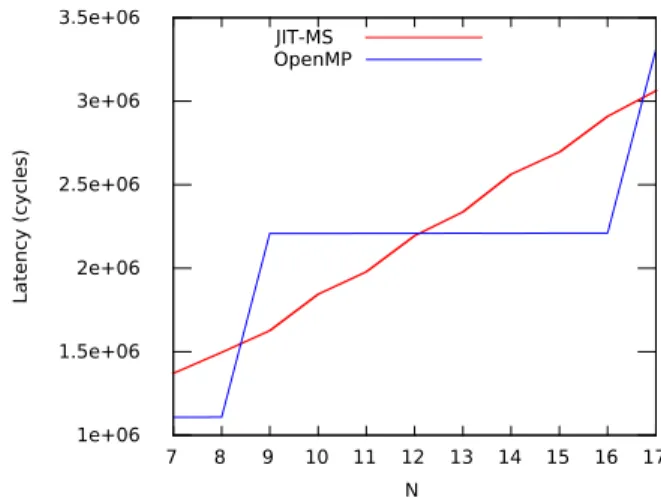
schedul-ing challenge. However, these extensions are based on imperative languages (e.g., C, C++, Fortran) that do not provide mechanisms to model specific signal flow graph topologies. In the experimental results on this section we demon-strate that JIT-MS is capable of challenging, on an 8-core DSP processor, an OpenMP implementation provided by Texas Instruments. Latency improve-ments of up to 26% are observed, obtained because advanced information is known by the runtime manager on the application. The next sections detail JIT-MS.
2.4.1
Context
Runtime Architecture JIT-MS is applicable to heterogeneous platforms. On such platforms, a locally optimal decision to fire an actor (e.g., based on the availability of its input data) can be inefficient when considering the system globally. In order to take effective decisions globally, a Master/Slave execution scheme is chosen for the system.
Scheduling Element Processing Element Processing Element Parameters Jobs Jobs Parameters Data Tokens
Figure 2.6: JIT-MS Runtime execution scheme.
The JIT-MS method relies on multiple software or hardware Processing Elements (PEs) that are slave components responsible for processing actors (Figure2.6). PEs can be of multiple types, such as General Purpose Processors (GPPs), DSPs, or hardware accelerators. The master processor of the JIT-MS system is called Scheduling Element (SE). This is the only component that has access to the general algorithm topology. Jobs are used to communicate between the SE and PEs. Each PE has a job queue from which it pops jobs out prior to their execution. Parameters influence dataflow graph topology or execution timing of actors. When a parameter value is set by a configuration actor, its value is sent to the SE via a parameter queue. Finally, Data FIFOs are used by the PEs to exchange data tokens. A data FIFO can be implemented either over a shared memory or over network-on-chip communication. Benchmark We illustrate the JIT-MS scheduling algorithm in this report by the scheduling of a benchmark application. This benchmark is an extension of
the MP-sched benchmark [33]. The MP-sched benchmark can be viewed as
a two-dimensional grid involving N channels, where each branch consists of Mcascaded Finite Impulse Response (FIR) filters of NbS samples. We extend
the MP-sched benchmark by allowing the M parameter to vary across different branches, as illustrated in Figure 2.7. We refer to this extended version of the MP-sched benchmark as heterogeneous-chain-length MP-sched (HCLM-sched).
Figure 2.7: Description of the HCLM-Shed benchmark used to test JIT-MS scheduling.
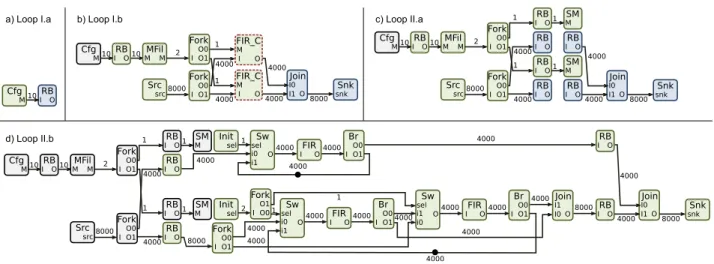
A PiSDF representation of the HCLM-sched benchmark is shown in Fig-ure2.8. To represent the channels in the HCLM-sched benchmark, a hierar-chical actor called FIR_Chan is introduced. The top level graph is designed to repeat N times this actor. In the subgraph describing the behavior of the FIR_Chan actor, M pipelined FIR filter repetitions in the branches are handled by a feedback loop and specific control actors (Init, Switch and Broadcast).
N FIR_Chan in out M Src src N Snk N snk config N M NbS N*NbS N*NbS Nbs In Out M M 1 Nmax MFilter M N M N Nmax NbS NbS NbS NbS NbS NbS NbS NbS NbS NbS NbS
Figure 2.8: A PiSDF model of the HCLM-sched benchmark.
Notations To describe JIT-MS, the following notation is used. CA represents the set of configuration actors of the given PiSDF graphand CA represents all actors in the given PiSDF graph that are not configuration actors.
2.4.2
Just-In-Time Multicore Scheduling (JIT-MS)
Multicore Scheduling of Static Subgraphs JIT-MS involves decomposing the scheduling of a given PiSDF graph into the scheduling of a sequence X1, X2, . . .
of SDF graphs. Different executions (with different sets of input data) can result in different sequences of SDF graphs for the same PiSDF graph. For a given execution, we refer to each Xi as a step of the JIT-MS scheduling