HAL Id: tel-01668561
https://tel.archives-ouvertes.fr/tel-01668561
Submitted on 20 Dec 2017
HAL is a multi-disciplinary open access
archive for the deposit and dissemination of sci-entific research documents, whether they are pub-lished or not. The documents may come from teaching and research institutions in France or abroad, or from public or private research centers.
L’archive ouverte pluridisciplinaire HAL, est destinée au dépôt et à la diffusion de documents scientifiques de niveau recherche, publiés ou non, émanant des établissements d’enseignement et de recherche français ou étrangers, des laboratoires publics ou privés.
models
Gwendal Daniel
To cite this version:
Gwendal Daniel. Efficient persistence, query, and transformation of large models. Programming Languages [cs.PL]. Ecole nationale supérieure Mines-Télécom Atlantique, 2017. English. �NNT : 2017IMTA0049�. �tel-01668561�
Thèse de Doctorat
Gwendal DANIEL
Mémoire présenté en vue de l’obtention du
grade de Docteur de l’École nationale supérieure des Mines-Télécom Atlantique Bretagne Pays de la Loire
sous le sceau de l’Université Bretagne Loire
École doctorale : Mathématiques et STIC
Discipline : Informatique et applications, section CNU 27
Unité de recherche : Laboratoire des sciences du numérique de Nantes (LS2N) Soutenue le 14 Novembre 2017
Thèse n°: 2017IMTA0049
Efficient Persistence, Query, and
Transformation of Large Models
JURY
Rapporteurs : MmeMarie-Pierre GERVAIS, Professeur des Universités, Université Paris Nanterre
M. Jean-Michel BRUEL, Professeur des Universités, Université Toulouse 2 Jean Jaurès Examinateurs : M. Sébastien GÉRARD, Directeur de Recherche, CEA-LIST
M. Jean-Claude ROYER, Professeur des Grandes Écoles, IMT Atlantique Invité : M. Massimo TISI, Maître Assistant, IMT Atlantique
Directeur de thèse : M. Jordi CABOT, Professeur des Universités, Open University of Catalonia Co-directeur de thèse : M. Gerson SUNYÉ, Maitre de Conférence HDR, Université de Nantes
Acknowledgement
Foremost, I would like to express my sincere gratitude to my advisors Prof. Jordi Cabot, Dr. Gerson Sunyé, and Dr. Massimo Tisi. Their support, patience, and guidance helped me in all the steps of this thesis, and made me feel that our work was always going in the right direction.
Besides my advisors, I would like to thank the rest of my thesis committee: Prof. Jean-Claude Royer, Prof. Jean-Michel Bruel, Prof. Marie-Pierre Gervais, Dr. Sébastien Gérard for their insightful comments on the present manuscript, as well as for the interesting questions and discussions that followed my thesis defense.
I thank my fellow team-mates for the stimulating discussions, the coffee-breaks, and all the fun we have had in the last three years.
Finally, I would like to thank Dr. Amine Benelallam together with Robin Boncorps for the joyful working moments as well as the friendly nightly discussions. You inspired me way more than you think!
To the Meat Boy Team To my Friends To my Family To Malo To You
Résumé Français
Introduction
Dans tous les domaines scientifiques, la modélisation est une activité commune qui vise à construire une vue abstraite simplifiant un système complexe de la réalité. Les modèles sont utilisés dans différents domaines d’études, tels que la biologie [1], le génie civil [2], ou la description de lignes de produits [91], et sont reconus comme une so-lution efficace pour appréhender des problèmes complexes et résoudre des questions spécifiques. Dans le domaine de l’ingénierie et du développement logiciel, les mod-èles sont utilisés pour décrire un système à développer, en représentant sa structure, ses composants, et sa logique. Ces modèles sont typiquement définis à l’aide de langages de modélisation, qui fournissent un ensemble règles permettant le partage de l’information entre les différents intervenants. Le langage UML (Unified Modeling Language) est un example de langage de modélisation largement adapté par l’académie et l’industrie, et qui a été standardisé par l’OMG (Object Management Group).
L’Ingénierie Dirigée par les Modèles (IDM) est une méthode de développement logi-cielle qui place les techniques de modélisations au centre du processus de développement. Les modèles deviennent des artefacts de premier ordre utilisés dans toutes les activités d’ingénierie, telles que le développement logiciel, mais également son évolution, ou la modélisation des exigences fonctionnelles et non fonctionnelles. Les modèles sont au-tomatiquement traités par des transformations de modèles qui permettent de les rafiner afin de fournir différentes vues du système, générer des modèles d’implémentation spé-cifiques à des plateformes de déploiement, de la documentation, etc. L’IDM définit en général une dernière étape basée sur un transformation modèle vers texte, qui génère le code applicatif, les schemas des bases de données, ainsi que l’implémentation des invari-ants et règles métier.
La génération et l’extraction automatique de modèles sont des domaines particuliers de l’IDM permettant de construire des modèles à partir d’artefacts existants (code source [19], API web [56], etc). Les modèles obtenus sont ensuite utilisés pour assister le modeleur dans sa compréhension du système étudié, construire des vues précises, générer de la documentation, ou évaluer la qualité du système considéré. Ces techniques ont été pop-ularisée par les techniques de rétro-ingénierie dirigée par les modèles, qui permettent de construire automatiquement un ensemble de modèle à partir d’une base de code. Ces modèles sont ensuite utilisés dans des processus complexes tels que l’évolution logicielle ou la restructuration de code source, qui sont typiquement exprimés par des langage de requêtage et de transformation de modèles.
Ces dernières années, l’IDM a été appliquée avec succès dans plusieurs scenario industriels. En effet, les études existantes [76, 54] reportent qu’utiliser les techniques
d’IDM améliore la productivité et la maintenabilité des logiciels créés, tout en dimin-uant leurs coûts ainsi que les efforts nécessaires à leur construction. Cette intégration industrielle a notamment débouché sur la création de plusieurs plateformes de modéli-sations telles qu’EMF (Eclipse Modeling Framework) [102] et Papyrus [70], fournissant de solides bases pour construire, stocker, et requêter des modèles. Dans la communauté scientifique, l’IDM est reconnue comme un des sujets importants dans les conférences d’ingénierie logicielle majeures telles qu’ICSE1et ASE2, et est le sujet principal de con-férences et journaux reconnus tels que MoDELS3et SoSym4.
Description de la problématique
Bien que l’IDM ait montré ses atouts pour améliorer les processus de développement logiciels, l’usage de plus en plus important de grands modèles complexes (en particulier dans des contextes industriels) a montré de claires limitations entravant son adoption [55, 68]. Les évaluations empiriques en situations industriels [117] ont en effet montré que l’une des principales raisons d’échec de l’intégration des techniques d’IDM est liée au manque de support pour le passage à l’échelle des outils existants.
En effet, les outils de modélisation développés ces 15 dernières années ont été conçus pour traiter des activités de modélisation basiques et mono-utilisateur, et n’ont pas été pensés pour supporter les modèles de grandes tailles utilisés de nos jours. Par exemple, le métamodèle BIM [2] définit un ensemble riche de concepts (environ 800) permet-tant de décrire précisément différents aspects d’un bâtiment ou d’une infrastructure. Les instances de ce métamodèle contiennent typiquement plusieurs millions d’éléments inter-connectés, et habituellement stockés dans de larges fichiers monolithiques de plusieurs gigabytes.
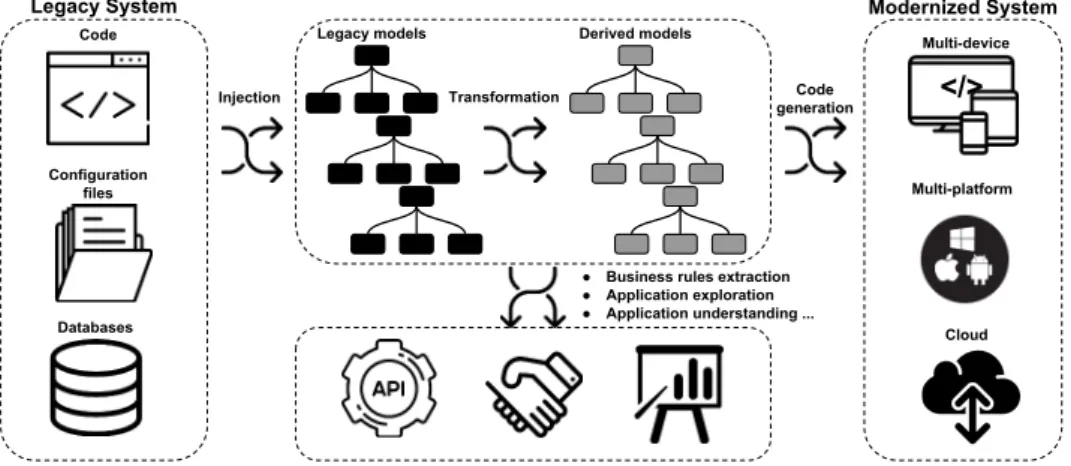
Un exemple typique de problèmes de passage à l’échelle concerne la modernisa-tion automatique de logiciels patrimoniaux basée sur des techniques de rétro-ingénierie dirigée par les modèles. Comme le montre la Figure1.1, un processus de modernisation d’application dirigée par les modèles est définie comme une séquence d’opérations ayant pour but d’extraire un modèle représentant le logiciel existant (tels que son code source, ses fichiers de configurations, ou ses schémas de bases de données), puis effectuant une série de requêtes et de transformations dans le but de rafiner l’application existante. En-fin, une étape de génération (en général définie par une transformation de modèles) est utilisée pour créer —une partie de— la plateforme modernisée. Dans cet exemple, la taille de l’application à migrer peut être de taille arbitraire, et le passage à l’échelle des solutions techniques peut être une limitation majeure lorsque le processus est appliqué à de grandes bases de codes (contenant plusieurs millions de lignes de codes), et avoir des impacts à plusieurs étapes du processus: (i) l’environnement de modélisation doit permettre de stocker efficacement le modèle représentant l’application existante, (ii) les requêtes doivent être calculées sur les modèles créés efficacement, et (iii) les transfor-mations doivent être effectuées de manière performante pour rafiner (potentiellement de manière répétée) les modèles existants vers l’application modernisée. Ainsi, un ensemble
1. http://www.icse-conferences.org/
2. http://ase-conferences.org/
3. https://www.cs.utexas.edu/models2017/home
7 de solutions de modélisation prenant en charge les modèles de grande taille est nécessaire pour permettre d’appliquer les techniques de rétro-ingénierie dirigée par les modèles sur des applications patrimoniales de grande taille.
Figure 1 – Legacy System Modernization using MDRE Techniques
Dans cette thèse, nous nous concentrons sur deux problèmes majeurs afin d’améliorer la mise à l’échelle des solutions techniques existantes et permettre l’utilisation des tech-niques d’IDM dans des contextes industriels impliquant de larges modèles.
Mise à l’échelle des techniques de persistance de modèles Historiquement, la séri-alisation sous forme de fichiers XML (eXtensible Markup Language) a été la solution privilégiée pour stocker et partager des modèles. Cependant, ce format a été conçu pour supporter des activités de modélisation simples telles que la création manuelle de mod-èles, et a montré ses limites dans le cadre de scénarios industrial actuels [48,87] manip-ulant de larges modèles, potentiellement générés automatiquement [19]. En particulier, la représentation XML présente deux inconvénients majeurs limitant son efficacité dans le cadre de l’utilisation de grands modèles: (i) elle repose généralement sur de lourds fichiers nécessitant d’être intégralement chargés en mémoire pour être navigables, et (ii) elle offre un support limité au (dé)charger de fragments d’un modèle. Plusieurs solutions basées sur des bases de données relationnelles ou NoSQL [43,87] ont été proposées pour résoudre ces limitations, mais elles se limitent généralement à fournir des améliorations génériques (comme des stratégies de chargements paresseux), et le choix de la base de données est totalement découplé de l’utilisation attendue du modèle. De fait, une so-lution donnée peut être appropriée à une tâche de modélisation spécifique, et inadaptée à une autre. De plus, les solutions de persistance actuelles manque en général de solu-tions avancées de mise en cache et de préchargement, qui pourraient être intégrées pour améliorer leurs performances.
Mise à l’échelle des techniques de requêtage et de transformation de modèles Le re-quêtage et la transformation de modèles sont les deux pierres angulaires des outils d’IDM, et plusieurs approches ont été conçues pour permettre leur définition et exploitation sur les platformes de modélisation existantes. Les infrastructures de requêtage et de trans-formation fournissent en général un langage de haut niveau (tel que le standard OCL
(Object Constraint Language)) qui est interprété en traduit en une séquence d’opérations déléguée à la plateforme de modélisation et finalement calculé par la base de données stockant le modèle. Bien que cette technique soit efficace lorsqu’elle est appliqué à des modèles sérialisés en XML, elle présente deux inconvénients majeurs lorsqu’elle est ap-pliquée aux plateformes de modélisation actuelles: (i) les APIs de modélisations ne sont pas alignées avec les capacités de manipulation de données des solutions de stockage actuelles, limitant leur utilité, et (ii) un temps et une consommation mémoire importants sont nécessaire pour construire les objets intermédiaires qui peuvent être manipulés par ces APIs. De plus, les solutions de requêtage et de transformations actuelles sont en général implémentées en mémoire, et stockent des informations additionnelles (telles que les traces de transformation) qui posent des problèmes de consommation mémoire sur de grands modèles.
Pour résumer, dans cette thèse, nous soutenons que la taille et la complexité croissante des modèles est un problème majeur qui empêche l’adoption des techniques d’IDM dans l’industrie, et que de nouvelles approches permettant de stocker, requêter, et transformer ces grands modèles efficacement sont nécessaires. En particulier, l’alignement entre les solutions de stockage et les outils de modélisation doit être amélioré afin de permettre d’utiliser à leur plein potentiel les nouvelles générations de bases de données et leurs capacités de requêtage avancées.
Contributions
Pour pallier ces problématiques, nous proposont une nouvelle infrastructure de mod-élisation basée sur l’utilisation de base de données NoSQL et de leurs languages de re-quêtes avancés. La Figure1.2 présente l’ensemble de nos contributions et montre com-ment ils interagissent entre eux pour créer un écosystème visant à stocker, requêter, et transformer efficacement de grands modèles.
Les prototypes développés à partir des approches présentées dans cette thèse sont construits sur l’infrastructure EMF, l’ecosystem standard de-facto pour la construction de langage dédiés et d’outils de modélisation dans l’environnement Eclipse. Des informa-tions complémentaires sur l’intégration de nos soluinforma-tions dans des soluinforma-tions alternatives de modélisations sont fournis dans les chapitres correspondants.
— NEOEMF est notre solution pour améliorer le stockage et la manipulation de grands modèles. Notre approche définit une nouvelle plateforme de modélisation, intégrée de manière transparent aux outils EMF, et fournit un ensemble de base de données NoSQL qui peuvent être sélectionnées en fonction du scénario de mod-élisation attendu. NEOEMF est basé sur une architecture modulaire qui permet de facilement intégrer de nouvelles solutions de stockage, et fournit des mécanismes d’extensions réutilisés dans nos différentes approches afin d’améliorer l’efficacité du requêtage et des transformations de grands modèles.
— PREFETCHML est un langage dédié à la définition de règles de mise en cache et de pré-chargement sur un modèle. Ces règles sont combinées dans des plans qui peuvent être appliqués à des tâches de modélisation spécifiques. Les plans sont ensuite traités par un moteur responsable du chargement et déchargement des éléments du modèle, améliorant les performances lors des accès et le calcul de requêtes sur le modèle.
9 — MOGWAÏest une nouvelle approche d’évaluation de requêtes basée sur un généra-teur de requêtes NoSQL à partir d’expressions définies en OCL. Notre solution se base sur les capacités de requêtage avancées des bases de données NOSQL (en particulier les bases de données en graphes) pour contourner les limitations des APIs des plateformes de modélisation actuelles. MOGWAÏest intégré à NEOEMF , et nos expérimentation montrent des gains significatifs en terme de temps d’exécution et de consommation mémoire comparé aux solutions existantes.
— GREMLIN-ATL est une extension de notre approche de requêtage ayant pour ob-jectif de supporter le calcul de transformations de modèles. Notre approche four-nit un nouvel environement d’exécution de transformation qui peut être paramétré afin de supporter de grands modèles en stockant les informations de transforma-tion dans une base de données dédiée, et fournit un ensemble de connecteurs per-mettant d’interfacer notre moteur sur différentes sources de données.
NeoEMF Mogwaï GremlinATL PrefetchML Efficient Model Persistence Model Query Model Transformation
Figure 2 – NeoEMF Modeling Ecosystem
Outils et Résulats
Les approches présentées dans ce manuscrit sont implémentées sous forme de plugins Eclipse sous licence libre, et disponibles en ligne5. La documentation des différents outils ainsi que des tutoriels, guides d’utilisations, et ressources pour les développeurs sont disponibles sur les dépôts Github correspondants6.
Dans ce manuscrit, nous évaluons la mise à l’échelle de nos solutions sur un ensemble de cas d’études reconnus dans les domaines de la rétro-ingénierie [19] et de l’industrie féroviaire [103]. Nous montrons qu’utiliser une base de données optimisée pour une
5. www.neoemf.com
activité de modélisation donnée permet d’augmenter significativement les performances en terme de temps d’exécution de consommation mémoire. De plus, nous démontrons l’intérêt des techniques de mise en cache et de préchargement et montrons qu’utiliser un plan adapté de préchargement permet d’améliorer les performances d’un scénario de modélisation jusqu’à✾✺✪.
Nous évaluons également nos techniques de requêtage et de transformation en nous basant sur des exemples industriels de rétro-ingénierie, et mettons en évidence qu’utiliser une traduction des languages de modélisation hauts niveaux (tels qu’OCL ou ATL) vers les languages de requêtage spécifiques aux bases de données permet d’améliorer signi-ficativement le temps d’exécution et la consommation mémoire.
Enfin, nous illustrons dans ce manuscrit comment nos approches peuvents être com-binées afin de créer une solution permettant de réduire le fossé entre les techniques de modélisation conceptuelles et les bases de données NoSQL. Concrêtement, notre ap-proche permet de générer une brique logicielle permettant d’accéder à une base de don-nées en graphe et de vérifier automatiquement un certain nombre de contraintes d’intégrité à partir d’un schema conceptuel défini en UML et OCL. Pour cela, nous réutilisons le schema implicite défini dans NEOEMF permettant de sérialiser un modèle dans une base de données particulière, ainsi que notre approche de requêtage afin de générer des re-quêtes bas niveau permettant de vérifier les contraintes d’intégrité et d’exprimer les règles métier au niveau base de données.
Abstract
The Model Driven Engineering (MDE) paradigm is a software development method that aims to improve productivity and software quality by using models as primary arti-facts in all the aspects of software engineering processes. In this approach, models are typically used to represent abstract views of a system, manipulate data, validate proper-ties, and are finally transformed to application artifacts (code, documentation, tests, etc).
Among other MDE-based approaches, automatic model generation processes such as Model Driven Reverse Engineering are a family of approaches that rely on existing mod-eling techniques and languages to automatically create and validate models representing existing artifact. Model extraction tasks are typically performed by a modeler, and pro-duce a set of views that ease the understanding of the system under study.
While MDE techniques have shown positive results when integrated in industrial pro-cesses, the existing studies also report that scalability of current solutions is one of the key issues that prevent a wider adoption of MDE techniques in the industry. This is par-ticularly true in the context of generative approaches, that require efficient techniques to store, query, and transform very large models typically built in a single-user context.
Several persistence, query, and transformation solutions based on relational and NoSQL databases have been proposed to achieve scalability, but they often rely on a single model-to-database mapping, which suits a specific modeling activity, but may not be optimized for other use cases. For example a graph-based representation is optimized to compute complex navigation paths, but may not be the best solution for repeated atomic accesses. In addition, low-level modeling framework were originally developed to handle simple modeling activities (such as manual model edition), and their APIs have not evolved to handle large models, limiting the benefits of advance storage mechanisms.
In this thesis we present a novel modeling infrastructure that aims to tackle scalability issues by providing (i) a new persistence framework that allows to choose the appropriate model-to-database mapping according to a given modeling scenario, (ii) an efficient query approach that delegates complex computation to the underlying database, benefiting of its native optimization and reducing drastically memory consumption and execution time, and (iii) a model transformation solution that directly computes transformations in the database. Our solutions are built on top of OMG standards such as UML and OCL, and are integrated with the de-facto standard modeling solutions such as EMF and ATL.
1
Context
1.1
Introduction
Modeling is a common activity in all scientific disciplines that aims to build sim-plified and abstract views of a real-world situation for its systematic study. Models are used in various domains such as biology [1], civil engineering [2], product lines [91], and are recognized as a sound solution to understand complex problems and address specific questions. In the field of software engineering, they are widely used to describe a system under development, and can represent its structure, components, and logic. Software en-gineering models are typically expressed using modeling languages, defining a common set of rules that enables to share models between stakeholders. The Unified Modeling
Language (UML) [95] is an example of such a modeling language that has been
stan-dardized by theObject Management Group (OMG).
The Model-Driven Engineering (MDE)is a software development method that puts
modeling techniques in the center of the development process. Models become primary artifacts that drive all software engineering activities, including software development itself, but also evolution tasks and requirement modeling. Models are automatically pro-cessed using model transformations that refines them in order to provide views of the system, generate platform-specific models, or documentation. MDEprocesses typically define a final generation step relying on a model-to-text transformation that creates the final software artifacts, such as the application code, database schema, and constraints implementations.
Automatic model generation and extraction are particular fields inMDEthat are used to construct models from existing artifacts (source code [19], web API [56], etc). The ob-tained models are used to help the modeler understand the system under study, build fine-grained views, generate documentation, or compute quality metrics. These techniques have been popularized byModel Driven Reverse Engineering (MDRE) approaches, that automatically build models representing an existing code base. The generated models
constitute the input of complex processes such as software evolution tasks and source code refactoring which are typically expressed using model query and transformation languages.
In the last decade,MDEtechniques has been successfully applied to several industrial scenario. As reported in existing studies [76, 54], using MDEtechniques increases the productivity of software development compared to traditional methods, and improves the maintainability of the created software while decreasing the cost and effort to build it. This industrial adoption has leveraged the creation of several modeling platforms such as
the Eclipse Modeling Framework (EMF)[102] and Papyrus [70] aiming at providing a
strong foundation for building, storing, and querying models. In the scientific community, MDE is recognized as an important research topic in the major software engineering conferences such as ICSE1 and ASE2, and is the main topic of recognized conferences and journals such as MoDELS3and SoSym4.
1.2
Problem Statement
While MDE pretended to be the silver bullet for software engineering, the growing use of large and complex models in industrial contexts has clearly emphasized serious limitations hampering its adoption [55, 68]. Existing empirical assessments from indus-trial companies adoptingMDE[117] have shown that the limited support for large model management in existing technical solutions is one of the main factor in the failure of industrialMDEprocesses.
Indeed, modeling tools were primarily designed to handle simple modeling activities, and existing technical solutions are not designed to scale to large models commonly used and automatically constructed nowadays. As an example the BIM [2] metamodel defines a rich set of concepts (around 800) that describes different aspect of physical facilities and infrastructures. Instances of this metamodel are typically composed of millions of elements densely interconnected. The resulting models are stored in large monolitical files of several gigabytes, and cannot be processed efficiently by the current modeling infrastructures.
A typical example where scalability issues arise is the automatic modernization of legacy systems using MDREtechniques. As shown in Figure1.1, a model-driven soft-ware modernization process is defined as a sequence of operations that first extract a model representing an existing software (such as its code base, configuration files, and database schemas), then defines a set of model queries and transformations aiming at refining the current application. Finally, a generation step (usually defined as a model transformation) is designed to create —part of— the modernized platform. In this exam-ple, the input software artifact to migrate can be of an arbitrary size, and the scalability of existing technical solutions can be a major limitation when the process is applied to sys-tems involving very large code bases (such as several million lines of code), and impact multiple steps of the process: (i) the modeling framework needs to efficiently store the model representing the existing application, (ii) model queries should be computed
effi-1. http://www.icse-conferences.org/
2. http://ase-conferences.org/
3. https://www.cs.utexas.edu/models2017/home
1.2. PROBLEM STATEMENT 15 ciently to allow interactive querying, and (iii) model transformations should be computed efficiently to refine (potentially multiple times) existing models towards their modernized representation. Thus, a set of scalable modeling techniques is required to enable such refactoring operation when applied to large software artifacts.
Figure 1.1 – Legacy System Modernization using MDRE Techniques
In this thesis, we focus on two major issues that have to be addressed in order to improve the scalability of existing technical solutions and enable industrial usage ofMDE techniques applied to large models.
Model Storage Scalability In the last decade, filed-based EXtensible Markup
Lan-guage (XML)serialization has been the preferred format for storing and sharing models.
While this format was a good fit to support simple modeling activities such as human model sketching, it has shown clear limitations when applied to nowadays industrial use cases [48, 87], that typically manipulate large models, potentially automatically gener-ated [19]. Indeed, XML-like representation usually rely on large monolithic files that require to be entirely parsed to be navigable, and provides limited support to partial load-ing and unloadload-ing of model fragments. Several solutions based on relational and NoSQL databases [43,87] have been proposed to address this issue, but they often focus on pro-viding generic scalability improvements (e. g. lazy-loading strategies), and the choice of the data-store is totally decoupled of the expected model usage. As a result, a given solu-tion can fit a specific modeling scenario, and be unadapted for another one. Furthermore, existing model persistence frameworks typically lack advanced caching and prefetching mechanisms that could be integrated to improve their performance.
Model Query and Transformation Scalability Model queries and transformations are the cornerstones ofMDEprocesses, and multiple approaches have been designed to com-pute them on top of existing modeling platforms. Model query and transformation frame-works typically provide a high-level language (such as theObject Constraint Language
(OCL) OMG standard [83]) that is translated into sequences of modeling framework’s
API calls and computed by the underlying data-store. While this query computation tech-nique is efficient on top ofXML-based serialization platforms (because the entire model has to be loaded in memory), it presents two major drawbacks when applied to current
scalable persistence solutions: (i) the modeling framework APIs are not aligned with the query capabilities of the data-store, limiting its benefits, and (ii) an important time and memory overhead is necessary to reify intermediate objects that can be manipulated using these APIs. In addition, current query and transformation solution typically store addi-tional informations in-memory (such as transformation traces), that grow accordingly to the model size and limit their performances when applied to large models.
To summarize, in this thesis, we argue that the increasing size and complexity of models that is being experienced by the industry is an important issue that prevents the adoption ofMDEtechniques, and thus a novel generation of scalable approaches to per-sist, query, and transform large models is required. Specifically, the alignment between current data-storage solutions and existing modeling frameworks should be improved in order to fully benefit from the novel generation of databases and their advanced query capabilities.
1.3
Approach
One way to improve the support of existing modeling frameworks for large models is to rely on advanced storage mechanisms designed to handle large amount of highly in-terconnected data. The NoSQL movement is a family of storage techniques that aims to overcomes classicalRelational Database Management System (RDBMS)issues (such as horizontal scaling and support for semi and unstructured data) by providing task-specific databases highly optimized for particular data processings. Our model persistence ap-proach aims to benefit from NoSQL implementation specificities by integrating multiple data storage solutions designed to fit specific modeling tasks.
In order to improve the scalability of existing model persistence solution, we propose an approach based on existing prefetching and caching techniques that have been inte-grated for decades in relational database and file systems. We argue that bringing these low-level concepts at the modeling level can significantly improve the performances of I/O intensive applications, such as model validation and model transformation, and com-plements existing NoSQL storage solutions that typically lack such components.
Finally, to cope with scalability issues of model transformations and queries, we pro-pose a novel approach based on a translation from high-level modeling languages into NoSQL-specific languages. Our model query and transformation environment relies on the advanced capabilities of NoSQL data-stores by generating efficient queries that are directly computed by the database, bypassing the modeling framework limitations and improving performances both in terms of execution time and memory consumption.
1.4
Contributions
Figure1.2 summarizes the contributions of this thesis and shows how they are com-bined into an ecosystem designed to efficiently handle the storage, query, and transfor-mation of large models. Note that all the presented contributions are open source and available online through the NEOEMF website5, and additional links to code
1.5. OUTLINE OF THESIS 17 ries and tutorials are provided in the corresponding chapters. The prototypes developed from the approaches presented in this thesis are built on top of theEMF infrastructure, the de-facto standard framework to buildDomain Specific Language (DSL)s and mod-eling tools in the Eclipse ecosystem. Additional information on the integration of our techniques into alternative modeling solutions are provided in the related chapters.
— NEOEMF is our solution to improve the storage and access of large models. It is defined as a generic modeling framework that can be transparently plugged into the EMFplatform, and provides a set of NoSQL database implementations that can be selected to suit a given modeling activity. NEOEMF is based on a modular architecture that can be complemented with additional model storage techniques, and provides extension mechanisms that are reused along this thesis to further improve performances of model query and transformation computations.
— PREFETCHML is a DSLthat allows modelers to define prefetching and caching instructions over a model. The resulting PREFETCHML plan is processed by an execution engine that takes care of loading and unloading elements, speeding-up model accesses and query computation. Our approach aims to be generic, and can be applied on any persistence solution that provides anEMFcompatible interface, and an advanced integration in NEOEMF has been proposed to further improve performances.
— MOGWAÏ is a novel model query approach that generates NoSQL database in-structions from high-level model queries expressed inOCL. Our solution relies on the rich database query languages that are provided by NoSQL databases (in par-ticular graph implementations) to bypass the modeling stack limitations. MOG-WAÏ is natively integrated in NEOEMF , and our experiments show a significant improvement in terms of execution time and memory consumption when com-pared to state of the art solutions.
— GREMLIN-ATL is an extension of the MOGWAÏ approach that supports model transformation expressed in theAtlanMod Transformation Language (ATL). Our approach embeds a novel transformation execution engine that can be parameter-ized to scale to large models by storing transformation information in a dedicated data-store, and provides a set of low-level connectors that allow to compute trans-formations on heterogeneous data-sources.
1.5
Outline of thesis
The rest of this thesis is structured as follow:
Chapter2introduce the basic concepts that are required to grasp the remaining of the thesis. We start by presenting theMDEparadigm and its main components and standard languages. Then, we introduce NoSQL databases, their data representation strategies, and the query languages they embed to access stored information.
Chapter3presents our conceptual solution to store large models in NoSQL databases. We introduce the different model-to-database mapping we have defined, and discuss their benefits and drawbacks. The chapter also provides guidelines on which data-store to choose according to a specific modeling task to execute. Finally, we present the imple-mentation of these concepts in the NEOEMF model persistence framework, and evaluate it on a set of industrial case studies.
NeoEMF Mogwaï GremlinATL PrefetchML Efficient Model Persistence Model Query Model Transformation
Figure 1.2 – NeoEMF Modeling Ecosystem
Chapter4presents our approach to enhance the efficiency of model persistence solu-tions by applying prefetching and caching techniques at the metamodel-level. We intro-duce a novelDSLthat allows to express fine-grained prefetching and caching rules based on modeling events, and an execution environment that computes the rules according to the model usage. We introduce the PREFETCHML framework that implements our ap-proach and show how it can be integrated in existing modeling applications. Finally, we evaluate our solution on top of well-known model queries and discuss its benefits and trade-offs.
Chapter 5 details MOGWAÏ , our scalable query approach relying on an OCL -to-Gremlin transformation that takes as its input an OCL expression and generates a low-level graph database query. We evaluate the efficiency of our approach on a set of well-knownMDREqueries and show that our solution can drastically improve query execution performances on top of large models.
Chapter6extends the work presented in Chapter5with support for model-to-model transformations. We show how model transformation language constructs are integrated in our query generation process. The chapter also introduce our novel scalable mation engine, and a set of data-store connectors that allow to perform model transfor-mations on top of various persistence solution.
Chapter 7 presents an example that integrates our solutions to build a framework aiming at generating NoSQL application code from conceptual schemas. We show how the implicit model-to-database mappings defined in NEOEMF can be reused to translate schema structure into database access code, and how the OCL-to-Gremlin transformation embedded in MOGWAÏcan be used to generate code that dynamically checks constraints and invariants in the generated application.
Finally, Chapter8concludes this thesis by summarizing the key points and contribu-tions, and describes our perspectives and future work.
1.6. SCIENTIFIC PRODUCTION 19
1.6
Scientific Production
During this thesis, we have produced 9 articles (8 are currently published, 1 under review): 4 international conferences, 3 international workshops, and 2 journals
— Journals
1. Daniel, G., Sunyé, G., Benelallam, A., Tisi, M., Vernageau, Y., Gómez, A., & Cabot, J. NeoEMF: a Multi-database Model Persistence Framework for Very Large Models. In Science of Computer Programming (SCP), 2017. Elsevier Publishing.
2. Daniel, G., Sunyé, G., Cabot, J. Advanced Prefetching and Caching of Mod-els with PrefetchML. Submitted to Software and Systems Modeling (SoSym), 2017. Springer Publishing.
— International Conferences
1. Daniel, G., Sunyé, G., & Cabot, J. (2016, June). Mogwaï: a Framework to Handle Complex Queries on Large Models. In Proceedings of the IEEE Tenth International Conference on Research Challenges in Information Sci-ence (RCIS) (pp. 1-12). IEEE Publishing.
2. Daniel, G., Sunyé, G., & Cabot, J. (2016, October). PrefetchML: a Frame-work for Prefetching and Caching models. (distinguished paper award) In Proceedings of the ACM/IEEE 19th International Conference on Model Driven Engineering Languages and Systems (MoDELS) (pp. 318-328). ACM Pub-lishing.
3. Daniel, G., Sunyé, G., & Cabot, J. (2016, November). UMLtoGraphDB: Mapping Conceptual Schemas to Graph Databases. In Proceeding of the 35th International Conference on Conceptual Modeling (ER) (pp. 430-444). Springer International Publishing.
4. Daniel, G., Sunyé, G., Jouault, F., Cabot, J. (2017). Gremlin-ATL: a Scalable Model Transformation Framework. In Proceedings of the 32nd IEEE/ACM International Conference on Automated Software Engineering (ASE), 2017. ACM Publishing.
— International Workshops
1. Daniel, G., Sunyé, G., Benelallam, A., Tisi, M., Vernageau, Y., Gómez, A., & Cabot, J. NeoEMF: a Multi-database Model Persistence Framework for Very Large Models. In Proceedings of the MoDELS 2016 Demo and Poster Ses-sions co-located with ACM/IEEE 19th International Conference on Model Driven Engineering Languages and Systems (MoDELS) (pp. 1-7). CEUR-WS.
2. Brucker, A. D., Cabot, J., Daniel, G., Gogolla, M., Herrera, A. S., Hilken, F., Tuong, F., Willink, E., & Wolff, B. Recent Developments in OCL and Textual Modelling. In Proceedings of International Workshop on OCL and Textual Modeling (OCL 2016) (pp. 157-165). CEUR-WS.
3. Daniel, G. Efficient Persistence and Query Techniques for Very Large Mod-els. In Proceedings of the ACM Student Research Competition (3rd place) co-located with ACM/IEEE 19th International Conference on Model Driven Engineering Languages and Systems (MoDELS) (pp. 17-23). CEUR-WS.
1.7
Awards
1. Distinguished paper award at MoDELS 2016 for PrefetchML: a Framework for Prefetching and Caching models.
2. 3rd place at the ACM Student Research Competition (co-located with MoDELS 2016) for Efficient Persistence and Query Techniques for Very Large Models.
2
Background
In this chapter we introduce the background and the main concepts that constitute the basis of the contributions presented in this manuscript. We first present the basis ofMDE approach and its core concepts, then we review the standard languages and technologies we use to build ourMDEsolutions. Finally, we introduce the NoSQL movement and the main database families it contains.
2.1
Model-Driven Engineering
Traditionally, models were used as initial design sketches mainly aimed for commu-nicating ideas among engineers. On the contrary, the MDE approach has emerged as a generalization of the Model Driven Architecture (MDA)[61] standard defined by the OMG[80] that promotes the use of models as a primary artifacts that drive all software engineering activities (i. e. not only software development but also also evolution, non-functional requirements modeling, traceability). These models are then refined to create specific views of the system to construct, generate platform-dependent software artifacts, and can be used in a final refinement step that produces (part of) the application code.
MDEhas proven to be a powerful systems engineering approach in many different ar-chitecture domains, and existing studies have reported its benefits in terms of productivity and maintainability compared to traditional development processes [55]. As a result, the MDEmethodology is progressively adopted as a valuable software development method-ology in several companies, such as Sony Ericsson and Thales [117,14].
A typical example of the successful application ofMDEprinciples is the model-based modernization of legacy systems (exemplified in Figure2.1). A software modernization process follows a systematic approach that starts by automatically building high-level abstraction models from source code (injection). This initial task is usually performed in a single-user context, where a modeler define the system to study and setup a set of modeling tools to store and access the created models. The injection frameworks analyzes
Code
Configuration files
Legacy System
Legacy models Derived models
</>
Databases
● Business rules extraction ● Application exploration ● Application understanding ... Transformation generationCode
Modernized System
Injection
Multi-device
Cloud Multi-platform
Figure 2.1 – Modernization process of legacy applications
the configured system, creates a set of –potentially large– models, and stores them in the preset modeling environment. Thanks to these models, engineers are able to understand, evaluate, and refactor legacy enterprise architectures. Using these intermediate models, engineers are able to partially generate modernized code for a specific platform (code generation).
TheMDEmethodology relies on three fundamental concepts: metamodels that repre-sent how a model is structured and what are the possible interactions between its elements, modelsthat conforms to a given metamodel, and represent a particular instance of it, and model transformations, which constitute the operational part ofMDEprocesses that are used to refine models and generate code. In the following we detail these core MDE concepts.
2.1.1
Models, Metamodels, Model Transformations
Models A model is a (partial) representation of a system/domain that captures some of its characteristics into an abstraction that can be easily understood and manipulated by designers. Models are defined using a formal or semi-formal modeling language (such as theUML [86]) that provides a common vocabulary to ease communication between modelers. Models are used in various engineering fields, such as civil engineering [2], automotive industry [11], or biology [1], and are usually designed for a specific purpose (analysis, refactoring, maintenance, etc). In the context ofMDE, models are used to drive all software engineering activities and are considered as the unifying concept between technologies and languages [13].
Metamodels A metamodel defines the set of concepts, relationships, and semantic rules regulating how models can be denoted in a particular language definition. A model which conforms toa given metamodel is an instance of it that satisfies all these rules. Metamod-els are themselves described as modMetamod-els, easing the exchange of user modMetamod-els between different modeling tools by providing a detailed specification of its content. Note that a metamodel can also be seen as an abstract syntax, that can be complemented with one or more concrete syntaxes (the graphical or textual representations that designers use to express models in that language) to provide a complete modeling language.
2.2. MDE STANDARDS AND TECHNOLOGIES 23 Models and metamodels are organized in multiple levels (also referred as the meta-modeling stack) that are related by the conformance relationship. In theMDEapproach, this stack contains three levels, with a self-reflective metamodel level on top, called meta-metamodel level, that describes the concepts and rules of every metamodel. The
MetaObject Facility (MOF)[82] is the standard meta-modeling architecture proposed by
theOMG, that is built around a set of modeling standard, namely OCL[83] for specify-ing constraints onMOF-based models, and XML Metadata Interchange (XMI)[84] for storing and interchangingMOF-based models inXML.
Model Transformations A model transformation is a modeling operation that consists of the automatic production of one or more output models from one or more input models according to a transformation specification. Model transformations are specified at the metamodel level, and are executed by transformation engines on models conforming to these metamodels. They have been standardized through theQuery/View/Transformation
(QVT) OMGspecification [85], that formally describes model transformations, and has
been implemented in a plethora of model transformation languages and frameworks [67, 58,118].
Model transformations can be expressed through various technologies, from general purpose programming languages such as Java to dedicated transformationDSLs like the ATL [58], and can either define a declarative, imperative, or hybrid language. In the declarative style, only relationships between source and target model elements are spec-ified, and no explicit execution order is given. The declarative style relies on rules to specify these relationships. In contrast, the imperative style explicitly specifies the execu-tion steps. Finally, the hybrid style extends the declarative rules with opexecu-tional imperative bodies. These three variants are defined in theQVTstandard.
2.2
MDE Standards and Technologies
In the following we introduce an overview of the main standards and technologies that are used along this manuscript. Note that additional details on technologies and imple-mentations related to a specific contribution are provided in the corresponding chapter.
2.2.1
UML/OCL
UML[86] is a standard language for object oriented modeling mainly used for soft-ware engineering. The first version ofUML(0.9) has been defined in 1996 by theOMG as a standard aiming at the unification of existing modeling methodologies [95], such as Booch, OMT [94], and OOSE [57]. The latest version of the specification (UML2.5) de-fines 14 diagrams which can be categorized in two families: (i) static views representing the structure of a system, including Class, Package, and Object Diagrams, and (ii) dynam-ical views emphasizing on the interaction between the system parts, inluding Sequence and Activity Diagrams, as well as State Machines.
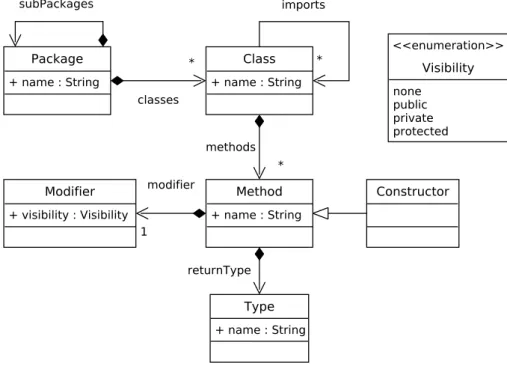
UMLclass diagram has been widely adopted as the standard solution to define mod-els, metamodmod-els, and conceptual schemas. As an example, Figure 6.2 shows a class diagram representing an excerpt of a simple Java metamodel aiming to represent Java
programs at a low-level of abstraction1. A Package is a named container that can re-cursively contain other Packages through its subPackages composition. A Package also contains several Classes, which define a name attribute and an imports association repre-senting its imported Classes. Each Class contains a set of Methods. A Method is linked to a Modifier describing its Visibility (public, private, or protected), and a returnType that represents the Type that is returned by the method. Finally, a Constructor is a specializa-tion of Method.
Figure 2.2 – A Simple Java Metamodel
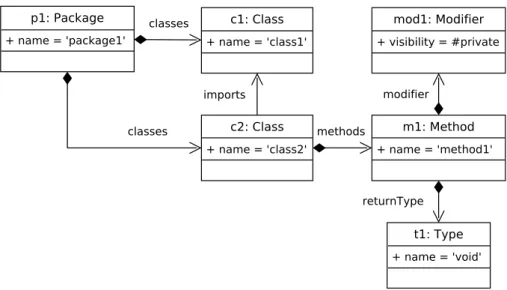
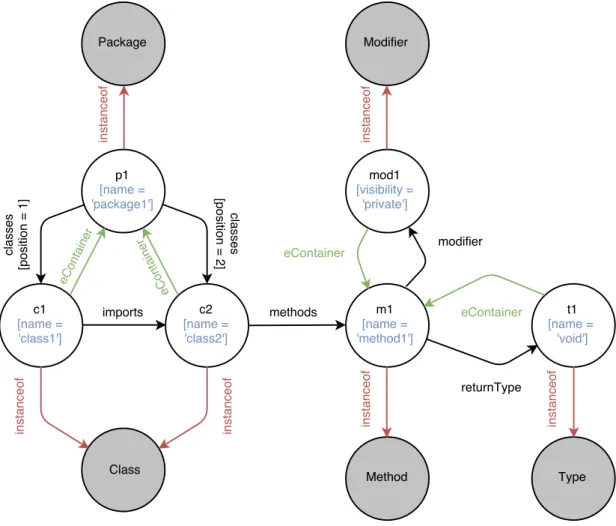
Figure2.3shows anUMLobject diagram representing an instance of this metamodel. It contains a single Package instance p1 named package1 composed of two Classes c1 and c2, respectively named class1 and class2. The Class c2 imports c1, and contains a single Method m1 named method1. This Method is linked to a private Modifier (mod1) and the void ReturnType (t1). Note that these two examples will be used in the different chapters of this manuscript as running examples to illustrate our solutions to efficiently store, query, and transform large models.
UMLdiagrams can be complemented withOCL[83] expressions, anOMGstandard allowing to define textual descriptions of invariants, operation contracts, derivation rules, and query expressions over models and metamodels. OCL is a declarative, side-effect free language that is used to extend UML diagrams — and any MOF model since the release of OCL 2.0 — with constraints and precise semantic that cannot otherwise be expressed by diagrammatic notation.
EachOCLexpression is written in the context of an instance of a specific type, and de-fines the reserved keyword self to refer to the contextual instance currently manipulated. In addition, the language offers advanced support for collection operations, model navi-gations, and attribute value analysis. The complete reference of the language constructs 1. The complete metamodel is available on MoDisco git repository at http://git.eclipse. org/c/modisco/org.eclipse.modisco.git/tree/org.eclipse.gmt.modisco. java
2.2. MDE STANDARDS AND TECHNOLOGIES 25
Figure 2.3 – A Simple Instance is available online2.
As an example, Listing 1 presents three OCL invariants that can be defined on our example metamodel presented in Figure6.2. The first one, validClassName is a typical OCLconstraint that ensures that a Class name is not empty. The second invariant (pack-ageHierarchyCycle) is applied on Package instances, and checks that a Package does not contain itself in its subPackages association. Note that UMLassociations can be navi-gated inOCLusing their label, and multi-valued expressions can be filtered according to the select operation that returns the elements of a collection satisfying a given condition. Finally, the third invariant (invalidConstructorReturnType) checks that a Constructor al-ways returns a Type that has the same name as its containing Class. These expressions can be provided to anOCL evaluation environment such as Model Development Tools
(MDT)-OCL[42] that takes care of the validation of a given model and returns the results
to the modeler.
Listing 1 – Sample OCL Invariants
c o n t e x t C l a s s i n v v a l i d C l a s s N a m e : s e l f . name <> ’ ’ c o n t e x t P a c k a g e i n v p a c k a g e H i e r a r c h y C y c l e : s e l f . s u b P a c k a g e s > s e l e c t ( p | p = s e l f ) >isEmpty ( ) c o n t e x t C o n s t r u c t o r i n v i n v a l i d C o n s t r u c t o r R e t u r n T y p e : s e l f . r e t u r n T y p e . name = s e l f . c l a s s . name
2.2.2
Modeling Frameworks
Modeling frameworks are development platforms that offer technical solutions to cre-ate, manipulcre-ate, and persist (meta) models. They usually provide a low-level program-ming interface that allows to interact with models, and a set of high-level graphical tools that ease (meta) model definitions, constraint specifications, or model element creations. In addition, current modeling frameworks typically embeds a code generator that creates
a set of software artifacts representing a given model that can be easily integrated in client applications.
In the last decade,EMF[102] has become the de-facto standard baseline framework to buildDSLs and modeling tools within the Eclipse ecosystem. The growing popularity of EMF is attested by the large number of available EMF-based tools on the Eclipse marketplace [104], coming from both industry and academia.
EMF embeds Ecore as its own metamodeling language which consist of a subset of theUMLclass diagram, and thus, can be considered as the reference implementation of
the Essential MOF language —a subset of MOF that closely corresponds to the
facil-ities found in object oriented programming languages— proposed by the OMG. In the EMF environment, an Ecore model is a model of the classes of a software application (i.e. the structural description), and is used to generate Java code that allows to manipu-late conceptual elements at the application level. This straightforward mapping between Ecore and Java allows to bring several benefits of modeling in standard Java develop-ment environdevelop-ment: part of the application code is generated by the framework, reducing development costs, and Ecore model updates can be safely propagated to the Java side thanks to the efficient code generation algorithm, improving maintainability of existing applications.
Alternative implementations of theMOFmodeling stack have been proposed, such as Epsilon [65] or theKevoree Modeling Framework (KMF)[46], that provide similar tool-ing to define, manipulate, and query models. While these approaches differ on specific features (multi-language integration for Epsilon and native model distribution forKMF), they are all based on a similar architecture, that provides a low-level, element-centered API to manipulate models, and compute queries and transformation by expressing them as sequences of atomic calls.
2.3
NoSQL Databases
The increasing popularity of web-based services, open API initiatives, and distributed cloud-based applications has emphasized the need to provide solutions to efficiently store and query the renowned Big Data [114], that describes large volume of heterogeneous data that are frequently updated and queried [120]. Practically, applications have to han-dle huge amounts of structured, semi-structured, and unstructured data that is fastly pro-duced and updated, and does not have a fixed schema.
In the last decades,RDBMShave been the preferred solutions to store and query infor-mation. However, the strict relational schema has not been designed to handle efficiently this amount of data. Indeed, processing huge volume of unstructured information (such as
JavaScript Object Notation (JSON)documents,Resource Description Framework (RDF)
triples, etc) coupled with the frequent update and concurrent access operations has em-phasized the limitations ofRDBMS, that are not flexible enough to handle both reactivity and scalability required by Big Data applications. In addition, the distributed nature of current (cloud-based) applications requires high availability and concurrent read/write operations that are typically limitingRDBMSscalability.
These limitations has led to the popularization of the NoSQL movement that provides task-specific databases to overcome RDBMSissues in specific data processing contexts
2.3. NOSQL DATABASES 27 (such as querying highly interconnected data or semi-structured information). Compared to traditional relational databases that rely on the ACID consistency model that ensures database consistency using a sophisticated locking mechanism, NoSQL databases often rely on the BASE consistency model, that relaxes ACID properties (in particular full consistency at any time) to support other properties such as horizontal scaling, fault tol-erance, or massive concurrency. This has lead to the development of several NoSQL database implementations, dedicated to specific tasks. They are usually classified into four categories based on their data model [77,60]: document databases, key-value stores, graphdatabases, and wide-column stores. In the following, we introduce these categories by highlighting their specificities and the workflow they are designed to handle.
2.3.1
Key-Value Stores
Key-value stores such as Redis3 and Amazon DynamoDB4 rely on a simple data model that represent information using associative arrays. In a key-value store, a record is accessed using a unique identifier (the key). Store values can hold any kind of in-formation, usually serialized as a byte array. This low-level representation makes the information opaque to the database system, meaning that no metadata or internal struc-tures are maintained. The serialization/deserialization of the information is delegated to the application level.
Since values can contain any arbitrary information, key-value stores are by definition able to handle unstructured data, and are highly optimized to retrieve elements given their unique identifier. This simple data model also allows key-value stores to support high distribution features such as database partitioning, replication, and fault tolerance.
Compared to most of the RDBMS, key-value stores does not represent optional val-ues with placeholders, limiting the memory required to store the same information, and improving input/output operations in data intensive workflows.
2.3.2
Document Databases
Document databases are a subclass of key-value stores that adds the concept of doc-umentto structure data on top of the raw key-value pairs representation. A document is stored as a first-class citizen in the database, and contains a set of key-value pairs defining its attribute. An attribute can be a primitive type supported by the database (e. g.integers, strings, or arrays), or a nested document, allowing to represent composition association between documents. Documents are organized in collections, that groups related infor-mation in order to reduce I/O operations and optimize query execution.
Most document databases implementations (such as Apache CouchDB5 and Mon-goDB6) rely on a JSON-like data model, that easily supports data evolution such as the addition of new concepts, property updates, and multiple versions of the same concept. This data model is particularly popular in web-based applications, that are subject to data model changes among time, and where the speed of deployment is an important issue.
3. https://redis.io/
4. https://aws.amazon.com/dynamodb/
5. http://couchdb.apache.org/
2.3.3
Column Databases
Wide column databases are another subclass of key-value stores that organize records in tables handling dynamic column definition. Originally designed by Google’s Bigtable project [27], this database family is designed to store huge amount of structured data in a highly distributed environment. Wide column databases can be seen as bi-dimensional key-value stores: records are organized in tables, where each line is defined by a unique identifier, and specific attributes can be accessed using its containing column name. Columns are grouped into column families that are used to structure the database and im-prove access performance on columns frequently queries together, and support dynamic updates such as the addition or deletion of a specific column.
The distributed nature of wide column database makes them promising candidates for parallel and cloud-based data computation. They are used as the low-level persistence solutions of MapReduce [38] processings, a distributed programming model designed to compute queries on semi-structured data stored in large clusters.
Wide column databases (such as Facebook’s Cassandra7 and Apache HBase8, the open source implementation of Bigtable) are used in social networks and large scale cloud-based applications, that typically require to store and process large amount of data efficiently. Some implementations, such as Cassandra, provide a high-level, Structured
Query Language (SQL)-like query language that allows to query and update the store
efficiently.
2.3.4
Graph Databases
Graph databases are a different kind of NoSQL database that provide graph primitives to store and structure information. In a graph database, records are stored as nodes and connected together using edges. Most of the current implementations (such as Neo4j9and Titan10) rely on a property graph data model which allows to store additional attributes as key-value pairs in nodes and edges. Graph databases are designed to handle complex hierarchy structures and highly interconnected data: the database engine is optimized to navigate efficiently from one node to another, and to compute complex navigation patterns involving large volume of nodes.
These complex navigation queries are expressed using dedicated query languages, that provide constructs to navigate a graph, match specific node and edge patterns, filter properties, etc. Cypher and Gremlin are two popular graph query languages: the former expresses graph queries using a sophisticated pattern matching language, the later de-scribes finely graph traversals using navigation steps that can be combined into complex processings.
Note that graph databases and their query languages constitute the cornerstone of the model query and transformation approaches we present in this manuscript (Chapters 5 and6), and additional details of their structure and language constructs are provided in the corresponding chapters.
7. http://cassandra.apache.org/
8. https://hbase.apache.org/
9. https://neo4j.com/
2.4. CONCLUSION 29
2.4
Conclusion
In this chapter we have introduced the main concepts and standards that constitute the basis of our work. We first introduced theMDEmethod, and we have shown that it has been succesfully applied in several industrial contexts with positive results in terms of productivity and maintainability.
Then, we have explored the core components ofMDEtechniques (models, metamod-els, and model transformations), and we have shown how these concepts are articulated into a global process. Note that these components are defined at the same level of ab-straction as the solutions proposed along this manuscript.
We have presented a set of standards and tooling approaches that are widely used in the community to represent model, constrain them, and query them. Among other solutions, we presented an overview of modeling frameworks, that constitute the basic component of nowadaysMDEtools, and are also the core component of the solutions pre-sented in this thesis. Note that the solutions prepre-sented in the remaining of this manuscript are largely based onEMF, the de-facto modeling framework in the Eclipse environment. Finally, we have introduced the NoSQL database environment, and detailed the dif-ferent data representation approaches they use. Note that this chapter introduce the four main families of NoSQL database, whereas the solutions detailed in the remaining of this manuscript only focus on three of them: graph, key-value, and wide-column databases. Further details on the selected database families can be found in Chapter3.
Note that additional details related to the proposed contributions can also be found in the corresponding chapters, as well as the state of the art sections that explore, for each contribution, the existing work and extract a set of problematic and research challenges to tackle.
3
Scalable Model Persistence
Model persistence is one of the cornerstone in MDE processes: input models are loaded in memory from an existing source, navigated and updated using model queries and transformations, and stored into a dedicated format to be accessed later on by client applications or shared between modelers.
In the last decades, the progressive adoption of MDE techniques in the industry [117, 55] has emphasized the need to provide persistence solutions that are able to address scal-ability issues to store, query, and transform large and complex models. Indeed, existing modeling frameworks were first designed to handle simple modeling activities, and often relied on anXMLserialization to store models. While this format is a good fit for small models, it has shown clear limitations when scaling to large ones [88].
To overcome these limitations, several persistence frameworks based on relational and NoSQL databases have been proposed [43, 88]. These solutions typically provide a intermediate mechanism to serialize in-memory models into an on-disk representation by describing a model mapping that allows to save and access model elements from a dedicated persistence solution (file,RDBMS, NoSQL databases, etc).
Most of the existing approaches rely on a lazy-loading mechanism, which reduces memory consumption by loading only accessed objects. While persistence framework have globally improved the support for large models in existing MDE toolchains, they are often tailored to a specific data-store implementation, and their integration usually implies to update the code base to integrate their advanced modeling API.
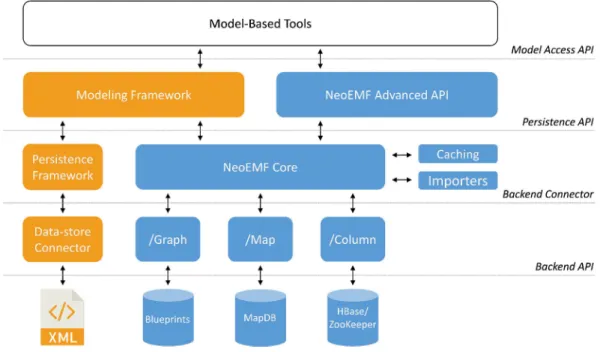
In this chapter we introduce NEOEMF , the first brick of our scalable modeling ecosystem (introduced in Section 1.4) that is able to store very large models in multi-ple databases, allowing designers to choose the one that fits a given modeling scenario. Our approach is based on a modular architecture allowing model storage into multiple data stores. NEOEMF provides three new model-to-database mappings that complement existing persistence solutions and enable model persistence in graph, key-value, and col-umn databases, each one optimized for a specific modeling task. The framework provides
two APIs, one strictly compatible with theEMFAPI, easing its integration into existing modeling applications, and an advanced API that provides specific features complement-ing the standard EMF API to further improve scalability of particular modelcomplement-ing scenarios. The rest of this chapter is structured as follows: Section 3.1 provides an overview of existing model persistence solutions and emphasizes the existing issues we aim to ad-dress. Section3.2presents an overview of our solution’s architecture and its core features. Section3.3introduces the datastores that are currently supported by our approach and the model-to-database mappings we have defined. Section3.4 and 3.5 presents our imple-mentation and evaluates it against state of the art solutions. Finally, Section3.6wraps up this chapter, draws conclusions, and discusses the benefit and drawbacks of our solution.
3.1
State of the Art
Since the publication of theXMIstandard [84], file-based XML serialization has been the preferred format for storing and sharing models and metamodels. This choice was driven by the fact that modeling frameworks were originally designed to handle human-produced models, whose size does not cause significant performance concerns. However, the adoption of MDE practices in the industry [117] as well as the development of gener-ative framework such asMDREapproaches [19] has popularized the need to handle large and complex (potentially generated) models, emphasizingXMI’s limitations.
Indeed, XML-based serialization presents two drawbacks: (i) it sacrifices compact-ness in favor of human-readability and (ii) XML files need to be completely parsed and loaded in memory to obtain a navigational model of their contents. The former reduces efficiency of I/O accesses, while the later increases the memory required to load and query models, and limits the use of proxies and partial loading to inter-document relationships. In addition,XMIpersistence layers do not provide advanced features such as transactions or collaborative edition, and large monolithic model files are challenging to integrate in existing versioning systems [3].
As a result, scalability of model persistence framework has been an active field of research in the last decade [68], and several approaches have been proposed to reduce their memory consumption and enable support for very large models. They can be clas-sified into two categories based on their low-level model representations: (i) RDBMS -based solutions that store models in relational tables, and (ii) NoSQL solutions that uses structured databases. Existing approaches usually expose an interface that is semi-compliant with the de-facto standard modeling APIs, and provide a lazy-loading mecha-nism which reduces the memory consumption by loading model elements from the data-store only when they are accessed.
3.1.1
Relational Persistence Layers
Historically, RDBMShave been the preferred solution to store large models. Exist-ing approaches derive a relational schema from an existExist-ing metamodel, for example by creating tables to store the instances of each metamodel’s class and columns for every class attribute. This schema is then used to store model elements, access attributes, or navigate associations using low-level query languages such asSQL. Existing frameworks