Université de Montréal
Internationalisation des services génétiques : Perspectives légales et éthiques
Par
Anne Marie Tassé
Département de médecine sociale et préventive Faculté de médecine
Mémoire présenté à la Faculté des études supérieures et postdoctorales en vue de l’obtention du grade de M.A.
en bioéthique
Août, 2008
Université de Montréal
Faculté des études supérieures et postdoctorales
Ce mémoire intitulé :
Internationalisation des services génétiques : Perspectives légales et éthiques
Présenté par : Anne Marie Tassé
A été évalué par un jury composé des personnes suivantes :
Bartha Maria Knoppers président-rapporteur
Béatrice Godard directeur de recherche
Ingeborg Blancquaert membre du jury
RÉSUMÉ
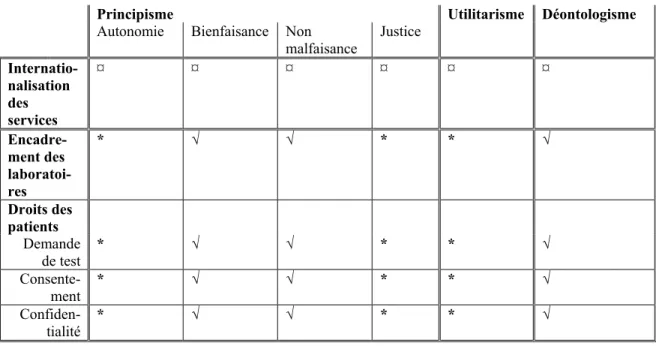
L’internationalisation des services génétiques s’explique à la fois par la rareté de certains troubles génétiques et par le nombre restreint de laboratoires effectuant des tests spécialisés. Par leur nature même, les tests génétiques comportent des risques et doivent faire l’objet d’un contrôle serré. L’absence de contrôle international des laboratoires génétiques soulève d’importantes questions juridiques et éthiques. Le présent mémoire démontre, dans un premier article, les normes d’encadrement des laboratoires génétiques canadiens. Un second article compare des normes d’encadrement des laboratoires génétiques dans quatre pays membres de l’OCDE : la France, les États-Unis, l’Australie et le Royaume-Uni. Dans troisième article, les principaux droits des patients des services génétiques au Canada, aux États-Unis, en Australie et au Royaume-Uni sont comparés. Finalement, un quatrième article analyse les implications éthiques de la coexistence de différentes normes d’encadrement des laboratoires et des droits des patients, dans le contexte actuel d’internationalisation des services génétiques. Cette analyse éthique est effectuée selon trois perspectives reconnues : le principisme, l’utilitarisme et le déontologisme. L’hétérogénéité des normes régissant les laboratoires génétiques soulève des questions éthiques et démontre la nécessité d’ouvrir un dialogue international afin d’uniformiser les normes d’encadrement des laboratoires génétiques.
MOTS CLÉS
SUMMARY
The internationalization of clinical genetic services can be explained both by the rarity of certain genetic disorders and by the limited number of laboratories performing specialized tests. By its very nature, genetic testing carries risk and must be strictly controlled. The absence of international control over genetic laboratories raises important legal and ethical issues. In the first article, this paper looks at the testing standards for Canadian genetic laboratories. A second article compares genetic laboratory testing standards in four OECD member countries, namely: France, the United States, Australia and United Kingdom. In the third article, the key rights of genetic patients in Canada, the United States, Australia and United Kingdom are compared. Finally, a fourth article studies the ethical implications of the heterogeneousness of genetic laboratory control standards and patient rights against the prevailing backdrop of the internationalization of genetic services. This ethical study is based on three recognized theories: principlism, utilitarianism and deontologism. The heterogeneous articulation of standards governing genetic laboratories raises ethical issues and demonstrates the need to harmonize international standards.
KEYWORDS
TABLE DES MATIÈRES
Résumé ... i
Mots clés... i
Summary ...ii
Keywords...ii
Liste des tableaux ... iv
Remerciements ... v
Introduction ... 1
Première partie : Le cadre théorique ... 4
1.1 La recension de la littérature ... 4
1.2 La problématique, la question et les objectifs de recherche... 7
Seconde partie : La méthodologie de recherche... 10
2.1 La méthodologie de recherche juridique ... 10
2.2 La méthodologie de recherche éthique... 11
Troisième partie : L’analyse documentaire ... 14
3.1 L’encadrement normatif des laboratoires génétiques au Canada... 14
3.2 L’encadrement normatif des laboratoires génétiques au Royaume-Uni, aux États-Unis, en Australie et en France ... 34
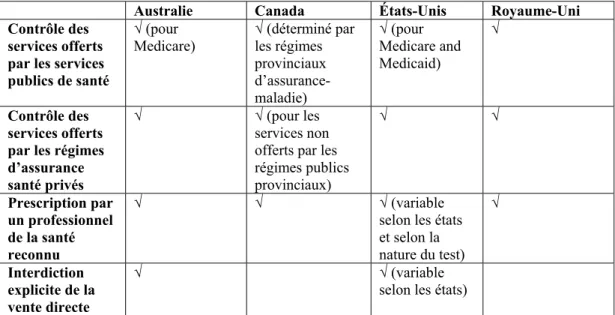
3.3 L’encadrement des droits de patients des services génétiques au Canada, au Royaume-Uni, aux États-Unis et en Australie ... 56
Quatrième partie : La discussion générale des résultats... 80
4.1 La discussion des résultats de l’analyse documentaire ... 81
4.2 Les limites de l’étude ... 101
Conclusion... 102
LISTE DES TABLEAUX
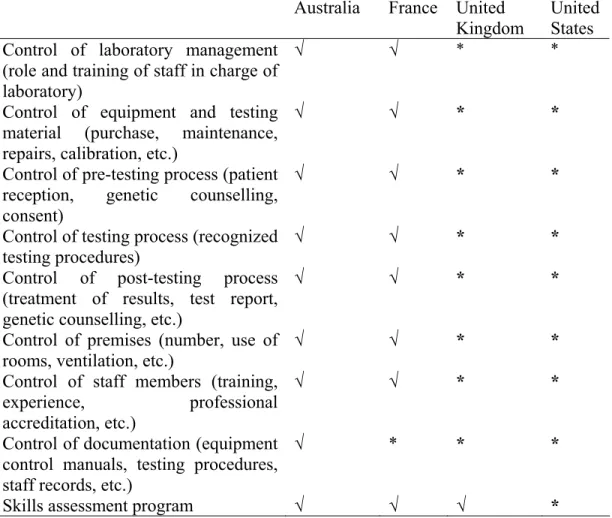
Table 1: Comparison of Legal Frameworks………..……….54
Table 2: Comparison of Quality Control Standards………55
Tableau 1 : Demande de test génétique………..77
Tableau 2 : Consentement aux tests génétiques……….….78
Tableau 3 : Confidentialité et divulgation aux tiers apparentés……….…….79
REMERCIEMENTS
L’auteure de ce mémoire adresse ses plus sincères remerciements à Béatrice Godard pour sa grande disponibilité et ses précieux conseils. Elle remercie également Éric LeBel et Madeleine Pérusse pour leur support.
Ce mémoire a pu être complété grâce au financement des Instituts de Recherche en Santé du Canada pour le consortium CanGeneTest. Ce dernier réunit 17 chercheurs, 21 collaborateurs et 5 partenaires (inter)nationaux.
INTRODUCTION
En 1953, la découverte de la structure à double hélice de l’ADN1 par Crick et Watson marquait le début d’une course effrénée pour le développement des connaissances en matière de génétique2. Plus récemment, le décryptage du génome humain pavait la voie à l’intégration des services génétiques dans les systèmes de soins de santé.
À ce jour, le Online Mendelian Inheritance in Man (OMIM) catalogue plus de 10 000 types de désordres génétiques, dont environ 1 700 liés à des mutations spécifiques du génome humain3. Bien qu’ils n’affectent environ que 5 % de la population, ces désordres entraînent souvent une morbidité prématurée4. Toutefois, de récentes recherches semblent démontrer l’importance sous-jacente de facteurs génétiques dans le développement de maladies plus courantes, telles le cancer, le diabète et les maladies cardiaques5. Il est actuellement estimé que six personnes sur dix développeront, avant l’âge de 60 ans, une maladie liée à des facteurs génétiques6.
En moins de 50 ans, les services génétiques sont passés du domaine exclusif de la recherche à leur mise en oeuvre à des fins cliniques. Un citoyen peut désormais
1
Santé Canada, « La politique de la santé et le génome humain » (2001) 1 :2 Bulletin : Recherche sur les politiques de santé : Nouvelles frontières 1 à la p. 2 : « ADN (acide désoxyribonucléique) – unité biochimique de l’hérédité et élément constituant tous les gènes ».
2
J.D. Watson, F.H.C. Crick, « A Structure for Deoxyribose Nucleic Acid » (1953) 171 Nature 737. 3
V.A. McKusick, Mendelian Inheritance in Man: Catalogs of Human Genes and Genetic
Disorders, Baltimore, Johns Hopkins Univ. Press, 1998 et OECD Biotechology Division, Quality Assurance and Profiency Testing for Molecular Genetic Testing : Summary Results of a survey of 18 OECD member countries, Paris, OECD, 2005 à la p. 12.
4
Department of Health, Our Inheritance, Our Future : Realising the potential of genetics in the
NHS, Norwich, The Stationnary Office, 2003 à la p. 12.
5 Ibid. 6
avoir accès à plus de 200 tests génétiques cliniques7. Toutefois, la rareté de certains troubles génétiques et le nombre restreint de laboratoires effectuant des tests spécialisés imposent le transfert d’échantillons à des laboratoires situés dans d’autres pays8.
Depuis quelques années, plusieurs pays ont entrepris un processus de réflexion sur l’encadrement des laboratoires9 de services génétiques10. Les solutions adoptées par ces pays sont cependant hétérogènes11. En parallèle, un récent sondage de l’Organisation de coopération et de développement économiques (OCDE) fait état de l’internationalisation exponentielle des services des laboratoires génétiques12. Dans ce contexte, l’OCDE souligne que l’hétérogénéité des normes de contrôle nationales soulève d’importantes questions à la fois éthiques et juridiques13.
Le présent mémoire vise, dans un premier temps, à déterminer si les différences entre les structures nationales d’encadrement des services génétiques sont susceptibles de préjudicier le patient et freiner l’essor des échanges internationaux d’échantillons génétiques à des fins cliniques. Dans un second temps, ce mémoire vise à déterminer le caractère éthique de ces échanges internationaux dans un contexte d’hétérogénéité normative. Plus particulièrement, il vise à déterminer le caractère éthique de l’hétérogénéité des normes nationales de contrôle des laboratoires, dans le contexte actuel d’internationalisation des services génétiques. 7 Ibid., à la p. 12. 8 Ibid., à la p. 13. 9
Veuillez noter que le présent document utilise le terme « laboratoire génétique » afin d’identifier les laboratoires de services diagnostiques en génétiques, ce qui exclu les laboratoires de recherche et autres laboratoires n’offrant pas de services à des fins diagnostiques ou de traitement.
10
S.M. Cox, W.A. Faucett, B. Chen et al., « International genetic testing » (2003) 5:3 Genetics IN Medicine 176.
11 À cet effet, voir notamment : Secretary’s Advisory Committee on Genetics, Health, and Society,
U.S. System of Oversight of Genetic Testing : A Response to the Charge of the Secretary of Health and Human Services, Bethesda, Department of Health and Human Services, 2008; Australian Law
Reform Commission, ALRC Report 96 : Essentially Yours : The Protection of Human Genetic
Information in Australia, Canberra, Commonwealth of Australia, 2003 et Department of Health, supra note 4.
12
OECD Biotechology Division, supra note 3, à la p. 13. 13
La première partie de ce mémoire présente une recension de la littérature sur les implications juridiques et éthiques de l’internationalisation des services génétiques (1.1). Cette partie présente également la problématique, les questions et les objectifs de la recherche (1.2). La seconde partie de ce mémoire porte sur les aspects méthodologiques de la recherche juridique (2.1) et sur le choix des trois perspectives utilisées dans le cadre de cette recherche : le principisme, l’utilitarisme et le déontologisme (2.2). La troisième partie fait état des résultats de l’analyse comparative des normes d’encadrement et les droits des patients des laboratoires génétiques au Canada, en France, en Australie, aux États-Unis et au Royaume-Uni. Cette comparaison est composée de trois articles de périodiques (3.1 à 3.3). Finalement, la quatrième partie de ce mémoire fait état des résultats de l’analyse du caractère éthique des échanges internationaux d’échantillons génétiques, malgré la coexistence de différentes normes d’encadrement des laboratoires et des droits des patients. Cette analyse qualitative fait l’objet d’un quatrième article.
Ce mémoire a donc pour objectif de dresser un portrait exhaustif de différentes normes d’encadrement des services génétiques et afin d’évaluer le caractère éthique d’échanges internationaux d’échantillons génétiques en raison de ces différences.
PREMIÈRE PARTIE : LE CADRE THÉORIQUE
Un important corpus de littérature traite des aspects éthiques liés à l’émergence de nouveaux tests génétiques14. Un ensemble de littérature différent traite de manière exhaustive des mesures d’encadrement des laboratoires génétiques, dans une perspective nationale15. Cependant, la littérature traitant des implications éthiques de l’hétérogénéité des normes nationales de contrôle des laboratoires génétiques, dans le contexte de l’internationalisation des services génétiques, est quasi-inexistante.
1.1 La recension de la littérature
Peu d’auteurs ont traité des problématiques liées à l’internationalisation des services génétiques. Les quelques auteurs ayant abordé ce sujet constatent plutôt l’hétérogénéité des normes nationales de contrôle des laboratoires génétiques sans en évaluer l’impact sur l’offre internationale des services génétiques.
Une étude américaine de 2003 démontre d’importantes distinctions entre les systèmes de contrôle des services génétiques16. Alors que certains pays imposent
14
À ce sujet, voir notamment : M.K. Pelias, « Genetic Testing of Children for Adult-Onset Diseases : Is Testing in the Child’s Best Interest » (2006) 73 :3 The Mount Sinai Journal of Medicine 605; B. Almond, « Genetic profiling of newborns : ethical and social issues » (2005) 7 :1 Nature Reviews 67; B.M. Knoppers, éd., Genomics and Public Health: Legal and Socio-Ethical
Perspectives, Leiden/Boston, Martinus Nijhoff Publishers, 2006; B.M. Knoppers, S. Bordet et
R.M. Isasi, « Preimplantation Genetic Diagnosis : An Overview of Socio-Ethical and Legal Considerations » (2006) 7 Annual Review of Genomics and Human Genetics 201.
15
À ce sujet, voir notamment : P. Borry, J.P. Fryns, P. Schotmans et al., « Carrier Testing in Minors : a Systematic Review of Guidelines and Position Papers » (2006) 14 European Journal of Human Genetics 133; É. Lévesque, B.M. Knoppers et D. Avard, « La protection de l’information génétique dans le domaine médical au Québec : Principe général de confidentialité et questions soulevées par les dispositions d’exception » (2005-2006) Revue de droit de l’Université de Sherbrooke 101.
16
des exigences réglementaires exhaustives, d’autres favorisent le recours aux recommandations de bonnes pratiques professionnelles17. De plus, le contrôle externe de la qualité, la validité clinique, la conservation des dossiers et les rapports de tests ne sont pas traités de manière uniforme18.
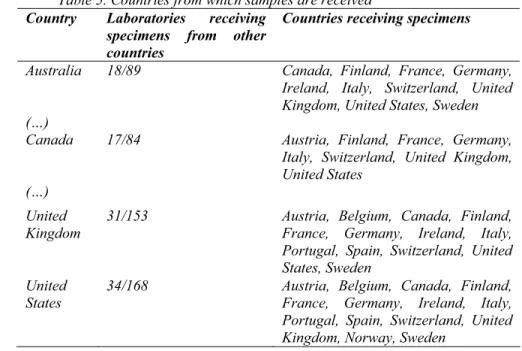
L’OCDE19 fait également état de cet internationalisation des services génétiques. Un sondage effectué auprès de 18 pays membres de l’OCDE, révèle que l’utilisation de tests génétiques ne cesse de croître, passant de 874 608 en 2000, à 1 401 536 en 200220. De plus, 64 % des 529 laboratoires répondants affirment recevoir des échantillons d’autres pays, alors de 60 % d’entre eux réfèrent des échantillons à des laboratoires situés à l’extérieur du pays. Ainsi, en 2001, il est estimé que 18 000 échantillons ont franchit les frontières des pays membres de l’OCDE21, dont l’Australie, le Canada, le Royaume-Uni et les États-Unis :
«
Table 5. Countries from which samples are received
Country Laboratories receiving specimens from other countries
Countries receiving specimens
Australia 18/89 Canada, Finland, France, Germany, Ireland, Italy, Switzerland, United Kingdom, United States, Sweden (…)
Canada 17/84 Austria, Finland, France, Germany, Italy, Switzerland, United Kingdom, United States
(…) United Kingdom
31/153 Austria, Belgium, Canada, Finland, France, Germany, Ireland, Italy, Portugal, Spain, Switzerland, United States, Sweden
United States
34/168 Austria, Belgium, Canada, Finland, France, Germany, Ireland, Italy, Portugal, Spain, Switzerland, United Kingdom, Norway, Sweden
»22 17 Ibid., à la p.180. 18 Ibid. 19
OECD Biotechology Division, supra note 3. 20 Ibid., à la p. 5. 21 Ibid., à la p. 13. 22 Ibid., aux pp. 13 et 14.
Outre ces données, le sondage de l’OCDE démontre qu’aucun état ne semble réglementer la référence de tests génétiques outre frontières, bien que dans certains cas, un contrôle est effectué par les réseaux formels ou informels des professionnels de la santé23.
À titre d’exemple, bien que tous les pays sondés par l’OCDE24 ont des directives ou des procédures en matière de consentement, seulement 50% d’entre eux ont des guides spécifiques au consentement aux tests génétiques25. De plus, 72% de ces états conservent les données génétiques de manière indéfinie26 et seulement 63% des laboratoires interrogés ont des politiques écrites en matière de confidentialité27. Finalement, ce sondage ne révèle aucune différence significative entre les laboratoires qui reçoivent ou non des spécimens d’outre frontières28.
À cet effet, l’OCDE conclut que les échanges d’échantillons entre les pays, liés au nombre restreint de laboratoires offrant des services spécialisés, mène inévitablement à l’internationalisation des examens génétiques29 :
« However, the capacity to access genetic testing on an international scale both increases the availability of testing and raises signifiant policy issues. The issues of greatest concern is the lack of internationally agreed good practices for quality assurance in MGT, including protection of the privacy of individuals’ genetic information and specimen handling and processing… »30
L’internationalisation des services génétiques constitue une réalité indéniable comportant des enjeux importants pour les professionnels de la santé appelés à référer des échantillons à l’extérieur de leurs frontières. La multiplication des tests 23 Ibid., à la p. 15. 24 Sauf l’Irelande. 25
OECD Biotechology Division, supra note 3, à la p. 16. 26 Ibid. 27 Ibid. 28 Ibid., à la p. 17. 29 Ibid., à la p. 15. 30 Ibid.
génétiques contribue à accroître la demande en faveur de mécanismes de réglementation et de contrôle de la qualité31. Cependant, aucune littérature ne traite des aspects éthiques de tels échanges internationaux.
1.2 La problématique, la question et les objectifs de recherche
L’intérêt de l’étude des aspects éthiques de la coexistence de différentes normes d’encadrement des laboratoires génétiques se manifeste dans le constat même de l’internationalisation des services génétiques :
« Testing is offered internationally, through both public and private sector genetic testing services, and there is evidence that human samples and related data are being exchanged across borders. This expanded use and « internationalisation » of genetic testing raises novel issues and is challenging current regulatory frameworks governing genetic services. »32
Les pays réglementent de manière parfois très différente la mise en œuvre des tests génétiques à l’intérieur de leurs frontières. Cette hétérogénéité ne comporte aucune conséquence négative pour le patient ayant recours à des services génétiques dans son propre pays. Cependant, dans le contexte actuel d’internationalisation des services génétiques, il importe de questionner le caractère éthique de tels échanges. En effet, la prestation de tests génétiques soulève plusieurs questions, notamment sur33 :
x La protection des renseignements génétiques ;
x La confidentialité des informations à caractère familial ; x La discrimination génétique ;
31
Santé Canada, supra note 1, à la p. 1. 32
OECD Biotechology Division, supra note 3, à la p. 4. 33
Gouvernement du Canada, Les biofondations : La science et les enjeux : Les tests génétiques, disponible à l’adresse suivante http://www.biofondations.gc.ca/francais/view.asp?x=780.
x Le rôle des tests génétiques dans le domaine de l’emploi ou de l’assurance;
x Le consentement libre et éclairé ; x Les services de conseil génétique ; x Le contrôle de la qualité ;
x La certification des laboratoires ; x Le dépistage anténatal et l’eugénisme.
Ces questions ont une influence directe sur la pratique actuelle des laboratoires génétiques et un traitement différent de ces questions, selon le pays, est susceptible de préjudicier le patient dont les échantillons biologiques sont exportés à des fins d’analyse génétique. En 2000, les états participant à un colloque de l’OCDE ont conclu :
« that international frameworks needed to be established to apply genetic testing
meaningfully, to assure its analytical and clinical validity, to protect the security, privacy and confidentiality of stored genetic information and to develop a level playing field in international trade of genetic services and products »34
Parmi les recommandations issues de ce colloque, notons que les participants ont proposé de développer des politiques reconnues internationalement en matière de validation analytique et clinique des tests génétiques, incluant notamment l’agrément des services génétiques35. Mais dans l’intervalle, les échanges internationaux d’échantillons génétiques à des fins d’analyses cliniques peuvent-ils être considérés éthiques ?
Afin de répondre à cette question, il est avant tout nécessaire de déterminer si la coexistence de normes différentes en matière d’encadrement des laboratoires génétiques et des droits des patients est susceptible de préjudicier les patients. Le cas échéant, de tels échanges internationaux peuvent-ils être considérés éthiques ?
34
OECD Biotechology Division, supra note 3, à la p.4. 35
La présente recherche comporte donc deux objectifs :
1) Déterminer si la coexistence de normes différentes en matière d’encadrement des laboratoires génétiques et des droits des patients est susceptible de préjudicier le patient;
2) Évaluer le caractère éthique des échanges internationaux d’échantillons biologiques à des fins d’analyse génétique.
Cette étude est importante puisqu’il est actuellement difficile de connaître les bases juridiques ou éthiques d’acceptabilité des échantillons par les laboratoires génétiques étrangers et, par conséquent, de juger de l’encadrement éthique des services génétiques requis d’autres pays.
SECONDE PARTIE : LA MÉTHODOLOGIE DE RECHERCHE
Le choix de la méthodologie de recherche varie selon l’objectif poursuivi. Ainsi, deux méthodologies distinctes ont été utilisées. Il importe également de souligner que la méthodologie générale présentée ici est précisée dans les quatre articles présentés dans la troisième et la quatrième partie de ce mémoire.
2.1 La méthodologie de recherche juridique
L’analyse comparative des normes d’encadrement des laboratoires génétiques et des droits des patients exige une analyse documentaire de nature qualitative.
À cette fin, nous avons effectué une analyse structurée de la législation et de la réglementation canadienne, britannique, américaine, australienne et française disponible sur les sites Internet suivants : Site Web des Lois du Canada36 (Canada), OPSI37 (Royaume-Uni), FirstGov38 (États-Unis), ComLaw39 (Australie), LegiFrance40 (France). Nous avons également recherché les normes et directives émises par des associations professionnelles et des organismes d’agrément reconnus. Les articles comparant les normes nationales de contrôle des laboratoires génétiques ont également été recherchés dans les moteurs de recherche PUBMED, MEDLINK et GOOGLE Scholar.
36
Ministère de la justice-Canada, Lois du Canada, disponible à l’adresse suivante
www.lois.justice.gc.ca.
37
National Archives: Office of Public Sector Information (OPSI), disponible à l’adresse suivante
http://www.opsi.gov.uk. 38
U.S. Governemnt: USA.Gov - Government Made Easy, disponible à l’adresse suivante
http://www.usa.gov/Topics/Reference_Shelf/Laws.shtml. 39
Australian Government – Attorney-General’s Department: COMLAW Commonwealth of
Australia Law, disponible à l’adresse suivante http://www.comlaw.gov.au. 40
République Française : Le service public de la diffusion du droit, disponible à l’adresse suivante
L’analyse comparative de ces documents a été effectuée conformément à la méthode développée par Contantinesco41. Selon cette méthode, l’analyse de droit comparé doit être effectuée de manière rationnelle et détaillée, selon un processus en trois étapes, nommée “règle des trois C” : connaître, comprendre et comparer42.
2.2 La méthodologie de recherche éthique
L’analyse des aspects éthiques de l’internationalisation des services génétiques a été effectuée grâce aux données obtenues suite à l’étude de l’hétérogénéité des normes d’encadrement des laboratoires et des droits des patients. Trois perspectives éthiques reconnues ont été utilisées : le principisme, l’utilitarisme et le déontologisme.
L’école du principisme domine l’éthique de la recherche depuis son articulation par le rapport Belmont43 et sa spécification par Beauchamp et Childress44 Cette perspective analytique détermine le caractère éthique d’un acte en fonction de différents principes fondamentaux, entre autres l’autonomie, la bienfaisance, la non-malfaisance et la justice, pour ne citer que les plus utilisés45. Bien que développés dans le contexte de l’éthique de la recherche, les principes énoncés dans le rapport Belmont ont rapidement été utilisés en éthique clinique46. La mise en œuvre de ces principes dans le domaine de la génétique constitue une extension
41
L.-J. Constantinesco, Traité de droit comparé, Paris, Economica, 1974. 42
Ibid. 43
The National Commission for the Protection of Human Subjects of Biomedical and Behavioral Research, Belmont Report, April 18, 1979, disponible à l’adresse suivante http://www.hhs.gov/ohrp/humansubjects/guidance/belmont.htm .
44
T.L. Beauchamp, J.F. Childress, Principles of Biomedical Ethics, 6e éd., Oxford, Oxford University Press, 2008.
45
G. Durand, Introduction générale à la bioéthique : Histoire, concepts et outils, Montréal, Édition Fides, 1999, à la p. 187; Australian Law Reform Commission, ALRC Report 96 : Essentially Yours
: The Protection of Human Genetic Information in Australia Part B. Regulatory Framework 6. Ethical Considerations, Canberra, Commonwealth of Australia, 2003 à la p. 7.
46
de leur application dans le domaine de la recherche et de la pratique médicale. Cependant, le principisme est souvent associé aux décisions individuelles, notamment en matière professionnelle, ce qui en limite grandement la portée lors d’analyses à caractère sociétal47. Dans le cadre d’une approche comparative, il importe de souligner que les principes développés aux États-Unis ont trouvé peu d’échos dans plusieurs états d’Europe. Les principes proposés sont considérés peu représentatifs des valeurs européennes, donc peu pertinents dans le cadre d’une analyse comparative. Certains auteurs ont cependant proposé des principes alternatifs davantage représentatifs des valeurs européennes : la dignité, le principe de précaution, la solidarité et la subsidiarité48, constituant une adaptation locale des principes énoncés aux États-Unis49.
Alors que le principisme évalue la valeur d’un acte en fonction, entre autres, du respect d’un certain nombre de principes éthiques, l’éthique utilitariste évalue plutôt cette valeur en fonction des conséquences de cet acte50. Cette perspective est fréquemment utilisée afin de justifier des choix de santé publique, puisqu’elle permet d’évaluer l’impact de ces choix sur la communauté51. L’utilitarisme énonce la manière d’agir afin de maximiser le bien du plus grand nombre de personnes. Cette manière d’agir est déterminée par l’évaluation des conséquences de l’acte sur le bien-être des individus. Elle dissocie complètement la cause ou la raison morale de l’action, afin de n’en évaluer que les conséquences.
L’éthique déontologique se distingue de l’utilitarisme en ce qu’elle évalue la pertinence d’un acte en fonction de sa valeur intrinsèque et non en fonction de ses conséquences. Pour le déontologisme, chaque action doit être évaluée selon sa conformité, ou non-conformité, à certains devoirs inhérents à tout être humain.
47
Australian Law Reform Commission, supra note 45, à la p. 8. 48
M. Häyry, R. Chadwick, V. Árnason et al., The Ethics and Governance of Human Genetic
Databases : European Perspectives, Cambridge, Cambridge University Press, 2007 aux p. 28 et s.
49 Ibid. 50
Australian Law Reform Commission, supra note 45, à la p. 8. 51
L’éthique déontologique professionnelle est particulière en ce qu’elle se concentre sur la relation entre le professionnel et son patient52. Le pouvoir attribué aux professionnels de la santé, appelés à soigner les individus, est lié de manière inhérente à l’acceptation de leurs devoirs professionnels.
52
TROISIÈME PARTIE : L’ANALYSE DOCUMENTAIRE
Afin de déterminer les implications éthiques de la coexistence de différentes normes d’encadrement des laboratoires génétiques, il s’avère essentiel, dans un premier temps, d’évaluer la nature de ces différences. À cette fin, trois articles de périodiques ont été rédigés et soumis à différentes revues.
Ces articles proposent une analyse structurée de la législation et de la réglementation canadienne, britannique, américaine, australienne et française en matière d’encadrement des laboratoires et de droits des patients de services génétiques.
3.1 L’encadrement normatif des laboratoires génétiques au Canada
L’étude comparative des normes d’encadrement des laboratoires génétiques dans différents pays constitue une étape préalable essentielle à l’analyse du caractère éthique de l’internationalisation des services génétiques.
Dans un premier temps, nous avons effectué une analyse exhaustive des normes d’encadrement des laboratoires génétiques dans chacune des provinces canadiennes.
Bien que Anne Marie Tassé ne soit pas l’auteure principale de cet article, l’inclusion de cet article au présent mémoire est nécessaire afin d’assurer la cohérence de l’ensemble du document. Madame Élodie Petit est l’auteure principale de cet article. Madame Anne Marie Tassé a assisté madame Petit lors de la recherche et de la rédaction. De son côté, madame Béatrice Godard a
contribué à la supervision et la vérification de l’article. Les coauteurs ont apporté une contribution importante ayant eu un impact sur le contenu du texte. Cet article a été publié dans le Health Law Review. Les autorisations des coauteurs et de l’éditeur ont été obtenues conformément aux exigences de la Faculté des études supérieures et post-doctorales de l’Université de Montréal.
An Empirical Analysis of the Legal Frameworks
Governing Genetic Services Labs
in Canadian Provinces
Élodie Petit, Anne Marie Tassé, Béatrice Godard
Introduction
In Canada, the regulatory framework governing genetic tests is complex and is not systematically harmonized across the Canadian provinces or between different legal jurisdictions. For example, when genetic tests are sold as diagnostic in vitro kits, they primarily fall under the purview of the Health Canada pre-market launch requirements regarding their safety and effectiveness. By contrast, when such tests are offered as a service in a laboratory setting they do not fall under federal jurisdiction, but rather provincial jurisdiction. The proliferation of genetic tests available to the public as well as the importance of the information they contain about the life and health of patients, especially when they are of the presymptomatic or predictive kind, warrant a systematic enquiry into similarities and differences in the regulatory environment surrounding lab-based genetic test services in Canadian provinces. Is a governmental operating license always necessary? Is the peer-delivered accreditation process similar? An empirical study of the regulatory themes put forward by the provinces would allow for a greater understanding of the legal frameworks governing genetic test services offered in Canadian labs. This information is also essential to lay the groundwork for future regulatory harmonization of genetic tests across the Canadian provinces as well as internationally between Canada and other countries. Using qualitative research and document analysis methods, we herein present the results of an empirical thematic study of the regulatory measures over genetic test services in Canadian provinces.
Materials and Methods
In order to identify and compare the legal frameworks governing genetic services labs across Canadian provinces, we undertook a systematic empirical study for each province of the legal documents, both statutes and regulations, retrieved from the Canadian legal electronic database Canadian Legal Information Institute (CanLII) and the published literature obtained from a search of the Pubmed and Index to Canadian Legal Literature (LawSource) databases. The Canadian territories were not included in the present analysis. Selective keywords were used for the literature searches: ‘laboratory’, ‘genetics’, ‘diagnostic facility’, ‘accreditation’, ‘quality’, ‘hospital’, ‘health’ and ‘license’. Only provisions at the provincial level and not lower jurisdictions, such as regional health authorities, were searched. The documents were then organized by jurisdiction and themes. For completeness, we consulted numerous websites including the College of Physicians and Surgeons website for each province and the Canadian Council on Health Services Accreditation (CCHSA) website. When necessary, some of these institutions were contacted by e-mail to obtain further detailed information. All documents were analyzed for their contents independently by each investigator and coded for accuracy. After independent content analysis, investigators conferred to reach a consensus on identified themes and regulatory frameworks.
Results
We identified six emergent themes pertinent to regulation of genetic tests in Canada.
1. A Fragmented Legal Framework Between the Federal and Provincial Jurisdictions
The Canadian regulatory framework governing genetic tests is fragmented as a result of the constitutional division of powers between the federal and provincial levels of government. This institutional arrangement gives rise to two categories of genetic tests control, depending upon the jurisdiction.
First, genetic tests marketed as in vitro diagnostic devices are mostly subject to federal control by virtue of its authority in criminal matters. The Medical Devices
Regulations1, under the Food and Drugs Act2, covers genetic tests and provides a series of measures meant to assess their safety, as well as their effectiveness, prior to their commercialization. Aside from the basic requirements that medical device manufacturers must meet (e.g. obligation of identifying the inherent risks associated with a device and either eliminating these or reducing them, the requirement that the product performs as intended, etc.)3, categorizing genetic tests as Class III devices (corresponding to a high individual health risk or a moderate collective health risk) requires that a license be issued by the Medical Devices Bureau of Health Canada’s Therapeutic Products Directorate.4 To obtain this license, the genetic test manufacturer must provide a summary of all studies relied upon to ensure that the device meets safety and effectiveness requirements. In addition, a summary of investigational testing conducted on the device using human subjects representative of the intended users (and under conditions similar to the conditions of use), as well as a copy of the certificate on quality management system certifying that the system under which the device is designed and manufactured satisfies the National Standard of Canada CAN/CSA-ISO
13485:03, entitled Medical devices – Quality management systems – Requirements for regulatory purposes must be provided.5 All Class III and IV medical devices
must undergo a scientific and medical review of submitted evidence of safety and effectiveness before their licence applications can be finalized.6
Second, when the tests are offered as a service by a laboratory they are outside the scope of the Medical Devices Regulations and fall under the provincial jurisdiction.7 The Constitution Act of 1867 accords legislative powers relating to property and civil rights to the provinces, including services offered within a province.8 Echoing the framework existing in countries such as Australia, France and the US9, three main elements are recurrent, but are not always combined when it comes to regulating genetic services labs in Canadian provinces. As we shall present in more detail below, they include the requirement: (1) to hold a government-issued license, (2) to obtain a peer-delivered accreditation, and (3) the presence of established internal and external quality controls.10
2. What Role Does the Law Play in the Regulation of Genetic Services Labs?
It is interesting to note that there is no specific law regulating labs offering genetic test services in any of the ten Canadian provinces. It seems as if provinces have avoided drawing a clear distinction between genetic tests and other medical tests. Thus, genetic tests fall under the general provisions that regulate medical labs in each province.
Opting for the law as an instrument with which to regulate medical labs is not the rule. Only six provinces have preferred this normative strategy, with varying degrees of interventionism. While Quebec, Ontario and Saskatchewan each have enacted a specific law to regulate medical labs11, Newfoundland has integrated a provision including labs into its regulations made under its Public Health Act.12 British Columbia and Manitoba have preferred to regulate labs through the coverage of diagnostic tests provided by their provincial health insurance plan.13 This distinction is important: while the standards in the first two categories apply
to all labs covered by the law or regulations, in the third only those labs wanting publicly funded coverage for the diagnostic tests they offer are submitted to the provincial legal requirements. It would be erroneous to conclude, however, that there exists a regulatory vacuum in the provinces having eschewed the legislative model. We shall see below that the self-regulation strategy is very widely accepted.
3. The Obligation for Labs to Obtain a Government-issued License
In provinces where legislative strategies are preferred, labs must obtain an operating license from the provincial Minister of Health. The issuance of such a permit is thus a necessary first step. However, this obligation is not uniformly applied to all laboratories in a province. In fact, Quebec and Newfoundland only impose this prerequisite on private labs.14 Ontario, British Columbia, Manitoba, and Saskatchewan do not draw such a private/public distinction. While no relevant statutory obligation exists in New-Brunswick, the Hospital Services Branch of the Department of Health and Wellness is responsible for approving new hospital services. Thus, one could understand that departmental approval would need to be obtained for a new hospital lab service.15 Among the categories of licenses issued, only two provinces have specifically considered genetic tests. Indeed, Ontario has created a “cytogenetic” category16, while Saskatchewan limits the provision of cytogenetic test to labs holding a category 6 license (the one allowing the widest variety of medical tests).17 Although, it is noteworthy that most provinces issue an operating license with a list of tests each lab is authorized to run.
Few laws mention the duration of the licenses. In Quebec and Ontario, an annual renewal of the license is necessary18, implying the recurrent fulfillment of administrative formalities. Alternatively, Saskatchewan issues a license for a maximum duration of three years.19 The motivation behind requiring labs to obtain a license lies in the government’s ability to exercise control over the dispensing of
medical services in the province. Aside from safety and professional qualification requirements, that will be elaborated further in the paper, the issuance of a license is linked to the needs of a given population, the geographic distribution of labs and the capacity of existing ones to actually dispense the proposed tests. The proper management of provincial resources thus represents a key component of processing licensing requests.
4. The Accreditation Requirement
Unlike the license issued by public authorities, an accreditation is the official recognition, by a governing body, of a competent laboratory. An external assessment procedure is carried out by independent professionals who examine every aspect of a lab’s operations and practices. Accreditation is meant to ensure the safety and the quality of tests while promoting a culture of continuous quality improvement within labs. This self-regulation mechanism is the most widely used for labs in Canada. It can either be established as a condition to the issuance of a government-operating license20, or more generally, as a requirement by provincial medical laws.21 All provinces require this specific lab accreditation mechanism except for the four Atlantic provinces. The latter have a joint accreditation program, the Atlantic Provinces Medical Peer Review Program that assesses the practices of physicians but not those of laboratories.22 Beyond these provincial mandatory accreditation requirements for laboratories, labs can participate in other accreditation programs or be assessed as a component of the entire health care organization accreditation program (e.g. the one offered by CCHSA).
The strength of this mechanism lies mostly in that it is applied, in almost all provinces, by self-regulated local bodies representing the medical profession. In Alberta, British Columbia, Manitoba, and Saskatchewan it is the College of Physicians and Surgeons within each province that is responsible for accrediting labs. However in Ontario, it is the Ontario Medical Association that is
responsible.23 The accreditation process generally falls under a specific program within relevant bodies.24 Ontario25 and British Columbia26 have, in addition, established a specific division regarding genetics in theirs.
Accreditation is generally mandatory for all labs, regardless of their private or public status, the same governing body being responsible for both. However, Quebec makes such a distinction. Section 107.1 of the Act Respecting Health
Services and Social Services27 stipulates that every three years public laboratories must have the health services and social services they provide accredited by a recognized accreditation body. However, the section does not refer to a specific accreditation body. The assessment of public labs is integrated into the general accreditation process for health care institutions.28 The Circular 2005-007 released by the Minister of Health defines a recognized accreditation body as an independent, not-for-profit organization, that has obtained national and international recognition in the health care field.29 Two accreditation bodies share this task, the CCHSA and the Conseil québécois d’agrément (CQA). The choice of which to use is left to the discretion of each institution.30 Notably, the private sector has no mention of such an accreditation requirement within the Act
Respecting Medical Laboratories. Thus, for the moment, Quebec’s private labs are
not required to obtain any accreditation. An upcoming revision of this act should correct this loophole.31
The duration of the accreditation is usually longer than that of a license. In Ontario, British Columbia, Manitoba and Saskatchewan, an accreditation lasts for a maximum of five years32, four in Alberta.33
Certain accreditation bodies have elaborated specific categories for labs offering genetic tests. In British Columbia, an “Anatomic Pathology and Cytogenetic Facility” category was created.34 In Alberta, labs willing to perform genetic tests, whether they be biochemical, cytogenetic or molecular, must obtain one of two
following classifications: Major Laboratory (labs allowed to perform all laboratory pathology tests) or Specialized Laboratory (in case of labs specialized exclusively in genetic testing).35 Likewise in Manitoba, only a Major Laboratory can offer genetic tests.36
In general, while the lab accreditation process differs between provinces, they take similar elements into consideration. Overall, they aim to exercise quality control over a lab’s equipment, technical operating conditions and safety, as well as the proficiency of its personnel. The process is closely linked to the internal and external quality control procedures to which a lab is submitted. Different assessment techniques that typically consist of a self-assessment and an on-site inspection are usually combined. While procedures and aims are shared, reference standards for lab accreditation are specific to each province even if they are all inspired by the ISO 15189 standard and its Canadian version CAN/CSA Z15189-03.37 Unfortunately, there is no harmonization of the applicable reference standards.
5. Personnel Qualification
The legal provisions concerning personnel qualifi cation are more varied. There is, however, a noticeable trend favouring physicians as lab directors and, more specifi cally, the ones who are specialists in a branch of laboratory medicine. Some provinces explicitly mention the opportunity of a specialization in genetics (Manitoba, Saskatchewan and Alberta).38 Quebec (private sector), Ontario and Manitoba are open to directors that are experienced clinical scientists.39 The director is responsible for the supervision of routine laboratory procedures, as well as the establishment and compliance with standards and quality control procedures. Que bec has adopted a rather surprising position in that the statutory qualification requirements for the public sector are, at least on paper, less stringent than those for the private sector. The only relevant passage stipulates that any
clinical department formed in a hospital centre must be directed by a physician, a dentist or a pharmacist.40 However, in a short-term care hospital centre, a clinical department of medical biological laboratories has to be set up and headed by a medical specialist.41
Moreover, most provinces require the presence of medical laboratory technologists among the laboratory staff.42 For these technologists, clinical genetics training programs accredited by the Conjoint Committee for Accreditation of Educational Programs in Medical Laboratory Technology are available in Ontario and British Columbia.43 Quebec requires that at least one out of three technical staff members working in a private lab is a medical laboratory technologist.44
6. Quality Control in Labs
The establishment of a quality assurance program aims to guarantee the best possible quality of the data produced by a lab. This means the data are entirely reliable and suitable for the purpose for which they are destined. Internal and external quality controls are the cornerstone of the licensing and accreditation processes in Canadian provinces. They are legally mandatory in all provinces.45
Internal quality control must generally be established by laboratory directors. Labs offering genetic tests cannot avoid this and are required to establish procedures in order to control the quality of the tests rendered. These procedures have to be clearly defined and directors have the responsibility to assess all quality control data and evaluate their lab’s performance. Tolerance limits must be defined, and corrective actions must be taken when necessary. These are some of the measures that constitute good laboratory practices and maintain an ongoing quality control within laboratories.
External quality control is an independent and external assessment of the accuracy of regular results that allows for an impartial review of the quality of a lab’s analyses. These performance evaluations are designed to assess the precision of the results produced by the lab when performing different tests, and not only to ensure that any inaccurate result be flagged. It also promotes the standardization of lab practices. In the Canadian provinces, external quality controls programs are usually managed by the same body responsible for lab accreditation.46 To our knowledge, only Ontario has an external quality control program specific to cytogenetics and molecular diagnostics of inherited diseases.47 Other provinces generally require laboratories performing genetic tests to turn to specialized external quality control programs of their choice48, such as the one offered by the College of American Pathologists or the program set up in Ontario.
Discussion
The legal frameworks surrounding genetic services labs differ between provinces. On one hand, there is a lack of binding rules in the three Maritime provinces (Prince Edward Island, Nova Scotia and New Brunswick), while on the other hand, Ontario, Manitoba, Saskatchewan, Alberta and British Columbia have very elaborated ones. Importantly, no province has wanted to separate the legal framework surrounding the offer of genetic tests from other biological tests. A functional approach as opposed to one based on “genetic specificity” was ultimately adopted. Genetic tests thus fall under the purview of the general provisions that deal with medical lab practices in each province, with the occasional minor specific adaptations made for genetics.
Provinces have based their normative strategy on genetic test services largely on self-regulation by means of lab accreditation programs, most of which are managed by the College of Physicians and Surgeons in each province. Whether accompanied by a governmental operating license or not, many procedures and
aims are shared among the provinces regarding the use of standard operating procedures, external performance evaluations and staff qualifi cations which collectively allow an assessment of the quality of the work performed by the labs, as well as the reliability of the scientific tests they offer. However, the thresholds for reference standards in these aims and procedures across the Canadian provinces differ from each other without harmonization. Moreover, this functional strategy adopted by each province is not the equivalent to the kind of control exercised by the federal government of Canada. While genetic tests are directly targeted by federal regulations, provincial mechanisms aim to ensure the reliability and proper functioning of the labs, rather than the tests per se. The importance of the information that genetic tests can reveal would certainly justify setting up, at the interprovincial level, a formal assessment mechanism of genetic tests prior to their first clinical use in provincial labs.49 Insofar as the governance of laboratories offering genetic test services is concerned, it would be advisable to appoint directors familiar with the interdisciplinary scope of information provided by genetic tests. As the emphasis in medicine and biosciences increasingly shifts towards treatment of future disease liabilities instead of existing disease symptoms, genetic tests impact not only patients but also presently healthy populations with marked socio-ethical implications. This may require amendments to the organizational structure of labs offering genetic test services by appointing staff who are cognizant of both social and biomedical dimensions of genetic testing services.
References
1. Medical Devices Regulations, S.O.R./98-282.
2. Food and Drugs Act, R.S.C. 1985, c. F-27.
4. Ibid. s. 26
5. Ibid. s. 32(3). Quoted in M. Deschênes, Réflexion sur L’encadrement Normatif
de la Mise en Marché des Tests Génétiques (Montreal: Thémis, 2005) at 65.
6. Health Canada, Preparation of a Premarket Review Document for Class III and
Class IV Device Licence Applications (Guidance document) (Ottawa: Health
Canada, 1998), online: Health Canada <http://www.hc-sc.gc.ca/dhp-mps/alt_formats/hpfb-dgpsa/pdf/md-im/prmkt2_precomm2_e.pdf> at 4. Deschênes, ibid.
7. Deschênes, ibid. at 75.
8. Constitution Act, 1867 (U.K.), 30 & 31 Vict., c. 3, reprinted in R.S.C. 1985, App. II, No. 5 at ss. 92 (7), 92 (13) and 92 (16). Deschênes, ibid. at 52.
9. This is the case for instance in the United States, Australia and France. For more details, see A.M. Tassé, E.P. Petit, B. Godard, “Comparative analysis of control structures for genetic laboratories in the United Kingdom, the United States, Australia and France” (2007) European Journal of Human Genetics 2007
(Submitted)
10. Ibid.
11. An Act respecting medical laboratories, organ, tissue, gamete and embryo
conservation, and the disposal of human bodies, R.S.Q. c. L-0.2 [An Act respecting medical laboratories]; Laboratory and Specimen Collection Centre Licensing Act, R.S.O. 1990, c. L.1; Medical Laboratory Licensing Act, 1994, S.S.
12. Diagnostic and Public Health Laboratories Regulations, C.N.L.R. 789/96.
13. Medicare Protection Act R.S.B.C. 1996, c. 286 at s. 33(1); Health Services
Insurance Act, C.C.S.M. c. H35 at s. 121(1).
14. An Act respecting medical laboratories, supra note 11 at s. 1(b); Diagnostic
and Public Health Laboratories Regulations, supra note 12 at s. 3.
15. New-Brunswick, Hospital Services Branch of the Department of Health and Wellness, online: <http://www.gnb.ca/0051/0217/index-e.asp>.
16. Laboratories, R.R.O. 1990, Reg. 682 at s. 2.
17. Medical Laboratory Licensing Regulations, R.R.S. 1995, c. M-9.2 Reg. 1 at s. 5(f).
18. An Act respecting medical laboratories, supra note 11 at s. 37; Laboratory and
Specimen Collection Centre Licensing Act, supra note 11 at s. 9(11).
19. Medical Laboratory Licensing Act, supra note 11 at s. 9(2).
20. It is the case in Manitoba’s Diagnostic Laboratories Regulation, Man. Reg. 16/95 at s. 5, Saskatchewan’s Medical Laboratory Licensing Act, supra note 11 at s. 8(b), and Ontario’s Laboratory and Specimen Collection Centre Licensing Act, supra note 11 at s. 9 (14), as a component of the mandatory quality management program for labs.
21. Medical Profession Act, R.S.A. 2000, c. M-11 at s. 103, for private labs. The accreditation of public labs is covered by a contract concluded with Alberta Health
& Wellness; Rules Made Under the Medical Practitioners Act, R.S.B.C. 1996, c. 285 at 121; The Medical Act, C.C.S.M. c. M90 at s. 40(2) and College of Physicians and Surgeons of Manitoba, By-Law 3a – Laboratory Facilities
(Winnipeg: CPSM, 2002), online: CPSM <http://www.cpsm.mb.ca/1_3_1_bylaw_3a.php>.
22. See the Atlantic Provinces Medical Peer Review website at: <http://www.apmpr.ca/>.
23. Ontario Medical Association, Ontario Laboratory Accreditation (OLA)
Program Information (Toronto: Ontario Laboratory Accreditation Division, 2006),
online: OMA <http://www.qmpls.org/ola/Master%20-%20OLA%20Program%20Information%20Ontario.pdf > at 4.
24. Ontario Medical Association, Quality Management Program - Laboratory Services, Ontario Laboratory Accreditation; College of Physicians and Surgeons of Alberta, Medical Facility Assessment Committee and particularly, Advisory Committee on Laboratory Medicine; College of Physicians and Surgeons of British-Columbia, diagnostic accreditation program; College of Physicians and Surgeons of Manitoba, The Manitoba Quality Assurance Program; College of Physicians and Surgeons of Saskatchewan, Laboratory Quality Assurance Program.
25. Ontario Laboratory Accreditation, Scientific Committee: Genetics (Cytogenetics and Molecular Diagnostics of Inherited Diseases).
26. College of Physicians and Surgeons of BC, Diagnostic Accreditation Program, Anatomic Pathology and Cytogenetics Division.
28. Minstère de la Santé et des Services Sociaux, Conformité des laboratoires de
biologie médicale à la norme CAN/CSA-15189 “Laboratoire d’analyses de biologie médicale – Exigences particulières concernant la qualité et la compétence”, Circulaire numéro 2005007 (Quebec: Minstère de la Santé et des
Services Sociaux, 2005).
29. Ibid.
30. Information confirmed by the Quebec Ministry of Health and Social Services.
31. Ibid.
32. Ontario Medical Association, supra note 23 at 13; Rules Made Under the
Medical Practitioners Act, supra note 21 at s. 125(f); By-Law 3a - Laboratory Facilities, supra note 21 at s. 2.8(b); College of Physicians and Surgeons of
Saskatchewan, Laboratory Quality Assurance Program, online: CPSS <http://www.quadrant.net/cpss/guide/lqapc.html>.
33. See College of Physicians and Surgeons of Alberta, Major Laboratory -
Standards and Guidelines (Edmonton: CPSA, 2005), online: CPSA
<http://www.cpsa.ab.ca/facilitiesaccreditation/attachments/Standards_Major%20L aboratory.pdf> at s. 2.1.14.
34. Rules Made Under the Medical Practitioners Act, supra note 21 at s. 119(vi).
35. Major Laboratory - Standards and Guidelines, supra note 35; College of Physicians and Surgeons of Alberta, Laboratory Classifications (Edmonton:
<http://www.cpsa.ab.ca/facilitiesaccreditation/attachments/Laboratory%20Classifi cations.doc>.
36. Information obtained from the College of Physicians and Surgeons of Manitoba.
37. For the sake of illustration, see, in Ontario, Ontario Medical Association,
Accreditation Process – Accreditation Requirements and Guidance Information,
online: OMA <http://www.qmpls.org/ola/ola_process3.html> and in Quebec, Minstère de la Santé et des Services Sociaux, supra note 28. For the other provinces information is confirmed by the relevant accreditation bodies.
38. By-Law 3a - Laboratory Facilities, supra note 21 at s. 4.3(a); Medical
Laboratory Licensing Regulations, supra note 17 at s. 2(1)(d); Major Laboratory – Standards and Guidelines, supra note 35 at 80.
39. Regulation respecting the application of the Public Health Protection Act, R.Q. c. L0.2, r.1 at s. 132; Laboratories, supra note 16 at s. 6(1); ByLaw 3a
-Laboratory Facilities, supra note 21 at s. 6.1.
40. An Act respecting health services and social services, supra note 27 at s. 188. With the exception of clinical biochemistry departments, which can be headed by a clinical biochemist.
41. Organization and Management of Institutions Regulation, R.Q. c. S-5, r.3.01 at ss. 70, 72. When a biochemistry or a microbiology department is set up, its director can be either a physician or a professional with a diploma in one of the fields of medical biology, at s. 70.
42. Regulation respecting the application of the Public Health Protection Act,
supra note 39 at s. 133; Laboratories, supra note 16 at s. 6(3); College of the
Physicians and Surgeons of Alberta, Bylaws of the College of Physicians and
Surgeons of Alberta – Part B (Edmonton: CPSA, 2006) at 92(1); Bylaw 3a – Laboratory Facilities, supra note 21 at s. 5.2; Medical Laboratory Licensing Regulations, supra note 8 at s. 9.
43. Canadian Society for Medical Laboratory Science, Training Programs, online: CSMLS <http://www.csmls.org/english/career/programs.htm>.
44. Regulation respecting the application of the Public Health Protection Act,
supra note 39 at s. 133.
45. Internal Quality Control: Regulation respecting the application of the Public
Health Protection Act, supra note 39 at ss. 139, 140; Laboratory and Specimen Collection Centre Licensing Act, supra note 21 at s. 9 (14)(a); Bylaws of the College of Physicians and Surgeons of Alberta - Part B, supra note 42 at 73 (1)(d); Rules Made Under the Medical Practitioners Act, supra note 21 at ss. 126, 128; Medical and Health Care Services Regulation, B.C. Reg. 426/97 at s. 39(1)(i); Bylaw 3a – Laboratory Facilities, supra note 21 at s. 8.1(a ); Medical Laboratory Licensing Regulations, supra note 17 at s. 3 (2)(f). External Quality Control: For
private laboratories, Regulation respecting the application of the Public Health
Protection Act, supra note 39 at s. 140.1; Laboratory and Specimen Collection Centre Licensing Act, supra note 11 at s. 9(14)(b); Bylaws of the College of Physicians and Surgeons of Alberta - Part B, supra note 42 at 73(1)(i); Rules Made Under the Medical Practitioners Act, supra note 21 at s. 128; Medical and Health Care Services Regulation, B.C. Reg. 426/97 at s. 39(1)(i); Bylaw 3a - Laboratory Facilities, supra note 21 at s. 8.1(b); Medical Laboratory Licensing Regulations, supra note 17 s. 3 (2)(g). Note: in the four Atlantic provinces, we
46. Ontario Medical Association, Quality Management Program – Laboratory Services, External Quality Assessment; College of Physicians and Surgeons of Alberta, Alberta Laboratory Quality Enhancement Program; College of Physicians and Surgeons of British-Columbia, Diagnostic Accreditation Program; College of Physicians and Surgeons of Manitoba, The Manitoba Quality Assurance Program; College of Physicians and Surgeons of Saskatchewan, Laboratory Quality Assurance Program. External quality control in private Quebec labs is administered by the Laboratoire de santé publique du Québec. See the Regulation
respecting the application of the Public Health Protection Act, supra note 39 at s.
140.1.
47. Ontario Medical Association, Quality Management Program – Laboratory Services External Quality Assessment, Genetics (Toronto: OMA, 2006), online: OMA <http://www.qmpls.org/eqa/eqa_gene.html>.
48. Information obtained from officials in charge of external assurance programs for labs in various provinces. Quebec’s Public Health Laboratory, however, requires the use of the quality assurance program set up by the College of American Pathologists.
49. I. Blancquaert et al., “Oversight Mechanisms for Technology Transfer in Molecular Genetics – Meeting the Challenge” (2001) 2:3 Isuma, online: Isuma <http://www.isuma.net/v02n03/blancquaert/blancquaert_e.shtml>.
3.2 L’encadrement normatif des laboratoires génétiques au Royaume-Uni, aux États-Unis, en Australie et en France
Dans un second temps, nous avons effectué une analyse exhaustive des normes d’encadrement des laboratoires génétiques dans quatre pays membres de l’OCDE, soit le Royaume-Uni, les États-Unis, l’Australie et la France. Ces pays ont été choisis puisqu’ils démontrent un éventail de différentes structures d’encadrement des laboratoires génétiques.
Cet article compare ces structures et en analyse les principales composantes. Une telle analyse est nécessaire afin de déterminer si l’hétérogénéité des normes d’encadrement des laboratoires génétiques soulève des dilemmes éthiques.
Anne Marie Tassé a rédigé la majeure partie de cet article. Madame Élodie Petit a rédigé la section portant sur l’encadrement normatif des laboratoires génétiques français (environ 10% de l’article). Elle a également vérifié la cohérence de l’ensemble du document. De son côté, madame Béatrice Godard a contribué à la vérification de l’article. Son expertise et ses commentaires ont permis de soumettre cet article dans le Journal of Law, Medicine and Ethics. L’autorisation des coauteurs a été obtenue conformément aux exigences de la Faculté des études supérieures et post-doctorales de l’Université de Montréal.
Differences in Regulatory Structures
Governing Genetic Laboratories in Four Countries
(Comparative Analysis of Regulatory Structures Governing Genetic Laboratories)
Anne Marie Tassé, Élodie Petit and Béatrice Godard
Introduction
A recent OECD survey reported on the internationalisation of genetic laboratory services1, notably due to the rarity of certain genetic abnormalities and the few laboratories that perform specialized testing.2 It appears that when DNA samples cross national boundaries for genetic testing services to be performed in another country, the heterogeneity of national legal frameworks raises important questions regarding quality of genetic services available internationally.3
Some aspects of the control of the genetic laboratories are abundantly discussed by the literature, among which quality control standards and the patients’ rights. A 2003 study identified key distinctions between legal frameworks for genetic services.4 While some countries impose exhaustive regulatory requirements, others favour recommendations for good practices in the profession.5 Moreover, proficiency assessment, clinical validity, retention of laboratory records and test reports are not dealt with uniformly.6
A number of international laboratory accreditation standards, including ISO 170257 and 151898 play an essential role in the standardization of practices. The same holds true with regard to external quality assessment, including the United Kingdom National External Quality Assessment Service (UK NEQAS), the European Molecular Genetics Quality Network and the College of American Pathologists. Furthermore, the professional associations play an important role in
the area of supervising the activities of professionals working in genetics. Various standardization attempts run parallel to one another. In order to clarify the situation, the OECD recently published an exhaustive set of guidelines for quality assurance in molecular genetic testing.9 These guidelines aim to standardize quality assurance practices in order to foster mutual recognition of the various national supervision methods for genetic laboratories. However, the implementation of these standards is not mandatory, but quite optional.
A third aspect also influences the international exchange of the genetic samples: the variety of national legislation overseeing the medical laboratories. This aspect is rarely considered by the literature, although it can affect the international exchange of genetic samples. Despite these attempts to bring together the laboratories’ quality control standards, no literature notes the impact of the variety of national standards governing genetic laboratories on the internationalization of genetic services. For example, American legislation requires all laboratories wishing to analyze samples from US citizens to have CLIA certification. These types of regulations curb access to certain laboratories located outside the country, particularly the smaller laboratories. This situation is likely to limit access to certain tests, particularly those for rare diseases or concerning specific, particularly immigrant populations.
This qualitative research aims to compare the differences in national standards governing genetic laboratories and examine their key components. Such an analysis is necessary to determine whether the heterogeneity of control structures hinder the internationalization of genetic services.
Materials and methods
This comparative research studies the legislation regulating genetic laboratory services in four countries: Australia, France, the United Kingdom and the United
States. These countries were selected because they illustrate a range of structures governing genetic laboratories.
We conducted a structured analysis of American, Australian, British and French legislation and regulation in force by September 30, 2007, and available on the following official web sites: ComLaw10 (Australia), LegiFrance11 (France), OPSI12 (United Kingdom), and FirstGov13 (United States). Articles comparing national control standards for genetic laboratories, published from 1987 to December 2007, were also researched in PUBMED14 using the following key words: (certificate OR license OR accreditation OR quality) AND (laboratory OR genetic) AND (legislation OR regulation OR control). We also searched the standards and guidelines of professional associations and recognized accreditation bodies, listed in legislation, regulation, standards, guidelines or statements emanating from national or international organizations.
Documents were eligible if they were national legislation or regulation, or if they were standards, guidelines or statements emanating from national or international organizations and professional associations. We included in our research only documents written, or translated in English or French.
The comparative analysis of these documents was performed in accordance with the comparative procedure developed by Constantinesco.15 According to this procedure, the analysis of comparative law must be performed rationally and in detail, following a three-step process called the Three Cs Rule.
Results
In order to determine how the heterogeneity of the different regulatory frameworks governing genetic laboratories in the four countries studied might affect the