O
pen
A
rchive
T
OULOUSE
A
rchive
O
uverte (
OATAO
)
OATAO is an open access repository that collects the work of Toulouse researchers and
makes it freely available over the web where possible.
This is an author-deposited version published in :
http://oatao.univ-toulouse.fr/
Eprints ID : 16578
To link to this article : DOI:10.1016/j.carbon.2014.06.051
URL :
http://dx.doi.org/10.1016/j.carbon.2014.06.051
To cite this version : Bortolamiol, Tifania and Lukanov, Petar and
Galibert, Anne-Marie and Soula, Brigitte and Lonchambon, Pierre and
Datas, Lucien and Flahaut, Emmanuel Double-walled carbon
nanotubes: Quantitative purification assessment, balance between
purification and degradation and solution filling as an evidence of
opening. (2014) Carbon, vol. 78. pp. 79-90. ISSN 0008-6223
Any correspondence concerning this service should be sent to the repository
administrator:
[email protected]
Double-walled carbon nanotubes: Quantitative
purification assessment, balance between
purification and degradation and solution filling
as an evidence of opening
Tifania Bortolamiol
a, Petar Lukanov
a, Anne-Marie Galibert
a, Brigitte Soula
a,
Pierre Lonchambon
a, Lucien Datas
a,b, Emmanuel Flahaut
a,b,*a
Universite´ de Toulouse, INP, UPS, Institut Carnot CIRIMAT, UMR CNRS 5085, 31062, France
bCNRS, Institut Carnot CIRIMAT, F-31062 Toulouse, France
A B S T R A C T
We compared the effect of different oxidizing agents on purification, functionalization and opening of double-walled carbon nanotubes. The oxidative treatments were realized in nitric acid solutions at different concentrations (3 M or 15 M), in a mixture of two oxoacids (conc. HNO3/conc. H2SO4) or in sulphuric acid solutions of KMnO4or K2Cr2O7.Most of these
treatments were very efficient for purification (removal of residual catalytic metal nanopar-ticles and/or of disorganized carbon) but also caused secondary reactions such as shorten-ing of the nanotubes, creation of functionalized amorphous carbon deposits and covalent functionalization of the outer wall. Secondary treatments were undertaken in order to remove functionalized carbon deposit by washing with sodium hydroxide solutions or by heat treatment in air. A partial filling in solution was obtained with uranyl nitrate, in order to evidence the opening of carbon nanotubes. Effects of purification and filling treatments were characterized both qualitatively by TEM and HRTEM, AFM and Raman spectroscopy, and quantitatively by elemental chemical analysis and chemical titrations.
1.
Introduction
Because of their outstanding chemical and physical proper-ties, carbon nanotubes (CNTs) have found applications in many fields, from materials science to nanoelectronics [1], and even nanomedicine, where their ability to encapsulate materials inside their cylindrical cavity and/or to fix mole-cules on their outer wall has been exploited to elaborate bio-sensors, sensors for MRI imaging or drug delivery systems especially for cancer therapy[2–4].
Double-Walled CNTs (DWNTs) represent a special case with a morphology very close to single-walled CNTs (SWNTs) but with the advantage of the outer wall that can offer some protection from external aggressive conditions. Of key inter-est is the possibility of functionalizing their outer wall, which will ensure the connections with the external environment, without altering the properties of the inner nanotube and thus maintaining their physical properties as demonstrated in the case of fluorination reactions [5–7]. Highly selective gram-scale CCVD synthesis of DWNTs has been reported by
* Corresponding author.
our group using a Mg1 xCoxO solid solution containing
addi-tions of Mo oxide as catalyst[8,9].
CNTs are never synthesized as pure samples and the first studies about their purification started shortly after the first reports of their synthesis. The main impurities can be classi-fied in 2 categories: carbon by-products (soot, disorganized carbon, amorphous deposits, graphitic fragments – depend-ing on the synthesis method), and catalytic residues. Most of the purification techniques involve oxidation treatments in solution. The state of the art treatments used by most researchers are usually either HNO3 alone, or mixed with
H2SO4using a 1:3 HNO3/H2SO4vol. ratio, using concentrated
acids. Treatments with HNO3solutions eliminate metal
cata-lyst nanoparticles from SWNTs[10,11]. Haddon[12]reported an evaluation of the use of HNO3as a purification treatment
for SWNTs: by increasing the concentration of HNO3to 16 M
and the treatment time to 12 h, the metal content was decreased from 28.1 wt.% to 0.2 wt.%, but the yield only was 14%. Concentrated HNO3/H2SO4 (1:3) mixture was shown to
be efficient on MWNTs for removing amorphous carbon impurities and catalyst particles [13]. Other oxidizing mix-tures such as permanganate solutions in H2SO4 were also
used to obtain amorphous carbon-free MWNTs[14,15]as well as to reduce the quantity of residual cobalt nanoparticles[16]. However, it has been shown that all the oxidation treatments used for purification of the tubes also lead to the generation of small oxidized polycyclic aromatic fragments, coined as carboxylated carbon(aceous) fragments (CCFs) (or more recently as nanographene oxide) coating the nanotubes
[17,18]. Another evidenced effect of these treatments is the modification of the walls by grafting of oxygenated functional groups: mainly carboxylic [19–21], hydroxyl[22] or sulfonic (SO3H) groups have been reported after treatment of SWNTs
by a mixture of H2SO4and HNO3[23]. These functions were
usually characterized by FT-IR spectroscopy[17,21,23,24] or by XPS[20,25]. SEM and TEM can be also used in order to study visually the structural changes after the oxidative treatments but a quantitative estimation of the functionalization requires the use of thermogravimetric analysis[21,23], poten-tiometric titration[26]or acid-base titration[27,28]. As these groups are located on the tips of the tubes (on pentagonal car-bon structures) and on defective parts of the walls but also on CCFs [17,20], this should be taken into account when the acidic treatment of CNTs is aiming at further functionaliza-tion, as the number of active –COOH groups really on CNTs may be much lower than expected.
The effective removal of the CCFs from acid purified sam-ples using NaOH washing treatments has been proposed for SWNTs and MWNTs [17,29–32], the deprotonation of the functional groups on the CCFs making them more soluble in aqueous solution. The question of the actual functionaliza-tion of CNTs or of the carbon debris following the purificafunctionaliza-tion step is very relevant. Green and co-workers have shown using IR spectroscopy that the filtrate obtained after NaOH treat-ment of oxidized SWNTs initially contained carboxylate groups [17]. However, Haddon and co-workers [21] have shown that nitric acid purified samples exhaustively washed with aqueous base nevertheless contained a sufficient num-ber of carboxylic acid groups to prepare high quality cova-lently functionalized nanotubes.
These oxidation treatments lead to CNTs opening and may thus be used for filling. Green and co-workers developed the first one-step filling of CNTs (MWNTs) in aqueous solutions, refluxing nanotubes in concentrated nitric acid containing precursor salts of iron, cobalt, nickel, uranium or f-block met-als with a filling yield estimated up to 70% [33] and Ref. therein. A two-step method was also explored[33–35], sepa-rating the opening step from the filling, which may be useful for filling with sensitive materials [36]. The mixture of con-centrated nitric and sulphuric acids (1:3) was also used in order to both open and shorten SWNTs, leading to samples (several hundred nanometers) well dispersed in water [37]. This mixture of acids was also used for cutting MWNTs[38]. DWNTs have been opened in 2 M HNO3 (milder conditions
than for MWNTs) and filled with ferromagnetic Fe from a con-centrated Fe(III) chloride solution[39]. It has also been shown that, at least in the case of SWNTs, most chemical or even simple mechanical treatments are able to open CNTs and allow them to be filled with solvent[40]. This still has to be verified for MWNTs (including DWNTs).
This work presents for the first time a comprehensive and quantitative evaluation of the modifications induced in DWNTs samples (purification, functionalization, opening) by different treatments of oxidation in solution. Results are com-pared to those obtained after thermal treatment (30 min in air, 500 °C), this treatment being able to remove both residual metallic particles and amorphous carbon present in the sam-ples (although it destroys 90% of the sample). In order to clearly evidence by TEM if opening is effective, control solu-tion filling tests were carried out with uranyl nitrate. These results should be widely extrapolated to SWNTs and to most few-walled MWNTs.
2.
Experimental section
DWNTs were synthesized at 1000 °C by catalytic chemical vapor deposition (CCVD) of a mixture of CH4(18 mol.%) and
H2on a Co:Mo MgO-based catalyst with the elemental
compo-sition Mg0.99Co0.0075Mo0.0025. The complete procedure of
syn-thesis of DWNTs was reported earlier [8,9]. The inner and outer diameters ranged from 0.5 to 2.5 nm and from 1.2 to 3.2 nm, respectively. The median inner diameter was 1.3 nm and the median outer diameter was 2.0 nm. After the CCVD, the obtained composite powder was treated with an aqueous HCl solution, which is an established method for the removal of the oxides and of non-protected residual catalyst nanopar-ticles without degrading CNTs. Finally, the sample was fil-tered (cellulose nitrate, pore size: 0.45 lm) and washed with deionized water until neutrality. The metal content of the samples was obtained by Atomic Absorption Spectroscopy (Central Analysis Service, CNRS). Raman spectroscopy was performed on a confocal Raman microscope Labram HR800 Horiba Yvon Jobin, k = 633 nm. Transmission Electronic Microscopy observations were performed on JEOL TEM 1400 and 2100 (operated at 120 kV). Acidic functions titrations were performed on a Metrohm 808 Titrando. Magnetic properties were investigated using a Quantum Design SQUID-VSM (superconducting quantum interference device-vibrating sample magnetometer). The samples were used as dry
powders (0.5 mg). The field dependence of the static (DC) magnetization M(H) was measured at room temperature in magnetic fields up to 1 T.
3.
Results and discussion
3.1. Treatments in solution
We compared six different oxidizing treatments in solution in order to purify DWNTs, most of these processes being widely used in the literature. For each one, 200 mg of raw DWNTs were placed in 200 mL of the oxidizing solution, sonicated for 15 min and treated using the following methods:
– Method 1: Reflux at 130 °C in 3 M HNO3;
– Method 2: Reflux at 130 °C in conc. (15 M) HNO3;
– Method 3: Treatment at 70 °C in 1:3 vol. solution of [conc. (15 M) HNO3/conc. (18 M) H2SO4];
– Method 4: Reflux at 130 °C in a 0.012 M solution of KMnO4in 1 M H2SO4;
– Method 5: Reflux at 60 °C in a 0.38 M solution of K2Cr2O7
in 4.5 M H2SO4;
– Method 6: Method 1 (24 h) followed by method 3 (5 h) (called double oxidation).
For methods 1 to 5, after 3, 6, 9 or 24 h of treatment, an homogeneous sample of 50 mL of the obtained black suspen-sion was taken, filtered, and the solid was washed three times with 100 mL of deionized water before drying in air at 80 °C overnight (oven) or freeze-drying.
Fig. 1shows typical TEM images of individual closed raw DWNTs obtained after treatment of the CCVD nanocomposite powder with hydrochloric acid. Samples contained both some disorganized carbon material that we call here ‘‘diaphanous carbon’’ (white arrows onFig. 1a) and residual carbon-encap-sulated catalytic metallic particles (black arrows onFig. 1b). The diameter of the carbon-encapsulated metal nanoparti-cles was mainly between 2 and 5 nm. Diaphanous carbon is formed during the CCVD synthesis of DWNTs, being always present in raw samples as large agglomerates in which nano-tubes are entangled. It can be compared to crumpled graph-ene and is formed by the unwanted direct catalytic decomposition of CH4on MgO oxide.
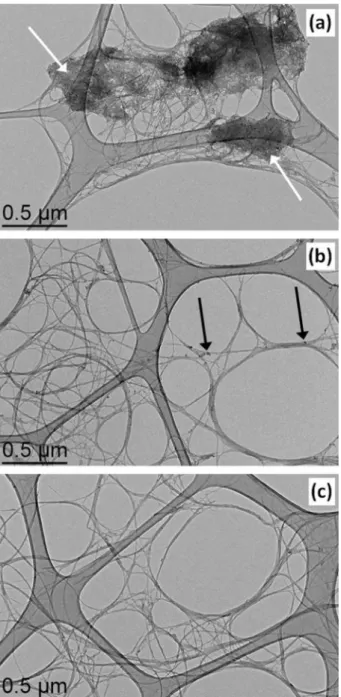
OnFig. 2, a few examples of low magnification TEM images obtained after different treatments show that, depending on the applied protocol, either the metallic particles were selec-tively removed with limited elimination of the diaphanous carbon (method 1, Fig. 2a), or the diaphanous carbon was removed, but the elimination of metal was not total (method 3,Fig. 2b), or both diaphanous carbon and metallic particles were removed together as shown onFig. 2c after treatment by method 6. This will be detailed thereafter.
3.1.1. Removal of the residual metal nanoparticles
Samples of raw DWNTs obtained by extraction of the compos-ite powder still contain residual cobalt (3.5 wt.%) and molyb-denum (1.0 wt.%) mainly in the form of nanoparticles tightly encapsulated in concentric carbon shells. When oxidation treatments are applied to the DWNTs, these carbon shells
are also attacked, thus allowing acids to get inside. The rates of metal elimination, obtained by chemical elemental analy-sis, depend on the method used and are listed inTable 1. After 24 h of treatment, the elimination of metal was of 90 wt.% for 3 M HNO3(method 1). With method 2, the same efficiency was
already obtained after only 6 h at the same temperature. Using method 3, only 78 wt.% of the metal was eliminated after 24 h but when this method was improved using micro-wave treatment in solution at 130 °C, 98% of elimination was reached within 30 min.
Removal of catalytic residues was accompanied by destruction of some CNTs and by a variable weight loss (Table 1). After 24 h of treatment by method 1,the sample
yield was 82 wt.% instead of 63 wt.% for SWNTs in the same conditions [12]. Method 3 was more destructive, leading to 18 wt.% for the sample yield. The elimination of metal nano-particles was also confirmed by magnetic measurements. The magnetization saturation (Ms) measured for raw DWNTs was 5.3 emu/g, due to the presence of cobalt nanoparticles. After treatment by 3 M HNO3 for 24 h (method 1) this value
decreased to 0.15 emu/g, but only to 0.3 emu/g after treatment with method 3 for 24 h. The metal elimination after 24 h was 72 wt.% when using KMnO4/H2SO4solution (8% weight loss)
and was 97 wt.% with K2Cr2O7/H2SO4 solution (99% weight
loss), with very different consequences in terms of sample destruction.
Fig. 1 – TEM pictures of raw DWNTs showing (a) diaphanous carbon (white arrows) and (b) metal nanoparticles (black arrows).
For comparison, after heating at 500 °C of a dry DWNTs sample during 30 min followed by washing with HCl (37%), the quantity of metal nanoparticles was reduced to 342 ppm for Co and 200 ppm for Mo (ca 99% of elimination) which
was confirmed by the magnetic measurements results, with Ms. decreasing to 0.004 emu/g. The metal removal in these conditions was very efficient but the sample yield was only c.a. 10 wt.%. Method 1 allowed a quantitative purification of the samples from metallic impurities with a low impact on the carbon material yield. Samples of better purity were obtained with method 6, leading to a low yield but enough to be acceptable.
3.1.2. Modifications of the DWNTs walls after treatment, and presence of CCFs
Fig. 3a–c show TEM and HRTEM images of DWNTs after 24 h of treatment with respectively 3 M HNO3(method 1), conc.
HNO3(method 2) and conc. HNO3/conc. H2SO4(method 3). If
we focus on the DWNTs walls, we see that, in all cases, the opening was evidenced at the tips of the nanotubes. The cre-ation of defects (holes) in the tubes walls could not be observed by TEM, but the walls and/or the tips were covered by a sticky coating of CCFs coming probably mainly from the decomposition of the diaphanous carbon agglomerates present in raw samples, but also from the degradation of CNTs tips as observed earlier in both SWNTs[11]and MWNTs
[34].
The production of CCFs is linked to the concentration of HNO3: in the case of conc. HNO3(method 3,Fig. 3b), the
coat-ing was not only observed at the tips but also on the outer wall of DWNTs. For potassium permanganate oxidation (method 4), we used a concentration of 0.012 M of KMnO4in
1 M H2SO4due to the lower resistance of DWNTs compared
to MWNTs (0.2 M KMnO4solutions were used to open MWNTs [41]). After 24 h of oxidation (Fig. 3d), the tubes tips seemed to have been opened and then covered by CCFs. Similar results of amorphous-like carbon coating were observed by Satishku-mar et al. on MWNTs after the same treatment[34]. While no opening could be evidenced with a 0.2 M solution of K2CrO7in
10% H2SO4in the case of MWNTs[41], the tips of the DWNTs
were opened in our conditions (method 5), but also coated by a large amount of CCFs, while a large amount of amorphous carbon was still present (Fig. 3e). Using method 6 (Fig. 3f), diaphanous carbon was eliminated, showing cleaner nano-tubes, even if a thin layer of amorphous-like material could be observed on the outer wall of DWNTs, and seemed to stick DWNTs together. Comparing the six treatments used, meth-ods 3 and 6 seemed to generate the cleanest samples.
Raman spectroscopy is a valuable tool for the characteriza-tion of carbon-based nanostructures, the D-band being usu-ally attributed to sp3-defects in the structure of carbon
nanotubes while the G-band originates from in-plane tangen-tial stretching of the carbon-carbon bonds in graphene. The ID/IG ratio values were calculated from Raman spectra
obtained on DWNTs samples after different oxidation treat-ments (Fig. S1) and are gathered inTable 2. As described ear-lier [42,43], in most cases the presence of defects led to an increase in the ID/IGratio. Raw DWNTs have rather low ID/IG
(0.20 ± 0.05) due to the low level of defects in the carbon nano-structures. After treatment by method 1, ID/IG remained
almost unchanged until 6 h of treatment but grew up to 0.40 after 24 h. With conc. HNO3(method 2), DWNTs seemed to
be more damaged and faster (ID/IG value of 0.66 reached
already from 9 h). DWNTs treated during 3 h in KMnO4/
Fig. 2 – TEM pictures of treated DWNTs using (a) method 1 during 24 h; (b) method 3 during 24 h and (c) method 6. Diaphanous carbon (white arrows) and metal nanoparticles (black arrows) are indicated.
Table 1 – Compared sample metal losses and yields for the different oxidation methods (24 h treatment except for method 6).
Oxidation method 1 2 3 4 5 6 Metal loss (wt.%) 90 90 78 72 97 96 Sample Yield (wt.%) 82 50 18 92 1 16
H2SO4solution exhibited a lower ID/IGratio (0.09) than in the
raw DWNTs and a value of 0.24 was obtained after 24 h of treatment, this low value being in agreement with the low quantity of debris that could be observed in the sample (Fig. 3d). The mixture K2Cr2O7/H2SO4is a very strong oxidant
and after 24 h of treatment, the nanotubes, fully covered by sticky debris observed onFig. 3e, corresponded to a ID/IGratio
of 0.80. For methods 3 and 6, leading to the cleanest samples (Fig. 3c and f), the ID/IGvalues were lower after treatment than
in raw tubes (respectively 0.05 and 0.08), these treatments probably attacking preferentially the diaphanous carbon. We observed that the lower the ID/IGvalues, the more
homoge-neous the samples from the Raman point of view (both for a given sample when observed at different locations, or from a sample to another). It must be added that the question of the Raman signature of CCFs is still in debate, although it is quite established now that true amorphous carbon should exhibit no D band in Raman[44].
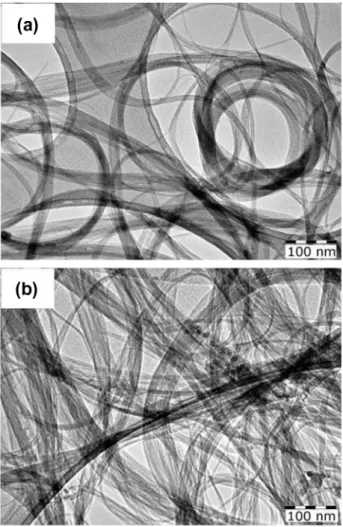
It is important to note that the usual creation of CCFs observed after nitric oxidation of raw DWNTs was not observed when purified tubes were used.Fig. 4a shows a typ-ical TEM picture of purified DWNTs obtained after thermal treatment in air for 30 min at 500 °C followed by washing with
HCl. After oxidation with 3 M HNO3for 24 h (Fig. 4b),
nano-tubes had clean surfaces and no CCF could be evidenced. The ID/IGratio of the sample (0.020) was almost unchanged
after nitric oxidation (0.047). So the creation of CCFs coating the walls should come mainly from the HNO3attack of the
diaphanous carbon initially present in the raw samples, and thus not so much from the degradation of the CNTs themselves.
3.1.3. Creation of functional groups
There is a general agreement that treatments by oxoacids cre-ate oxygencre-ated functional groups (mainly –COOH) loccre-ated on the tips and defects on the sidewalls of the tubes[21,24]. The functionalization of DWNTs was evidenced by IR spectros-copy (Fig. 5). After treatment by method 1 during 3 h (Fig. 5b), new functional groups were obtained: C@O at 1728 cm 1; C@C and C@O at 1586 cm 1; OH at 1384 cm 1;
C–O–O at 1215 cm 1.
After oxidation of the DWNTs, the titration of the acidic functions was performed as following: 10 mg samples of oxi-dized DWNTs were stirred during 72 h in the presence of an excess of NaOH (10 mL of 10 2M solution) under N
2
atmosphere and the suspension was then titrated by a Fig. 3 – HRTEM (insets) and TEM pictures of DWNTs treated during 24 h using: (a) method 1; (b) method 2; (c) method 3; (d) method 4; (e) method 5 and (f) method 6.
10 2M solution of HCl. A control experiment was done by assaying a NaOH solution in the absence of DWNTs and the
result was used in the calculations in order to correct the effect of possible carbonatation of the soda solution during the experiment. The titration of the raw tubes was also real-ized as a control. Results are presented inTable 2.
Raw DWNTs samples contain a small amount of acidic functions estimated by titration to be less than 0.5 mmol/g. After 24 h of treatment by the different methods, the quantity of carboxylic groups ranged from 1.2 to 4.4 mmol/g of nano-tubes, which is more than observed on MWNTs after treat-ment by conc. HNO3(0.4 mmol/g)[34]. These functions may
be located on the DWNTs walls but also on CCFs. In the case of air oxidized DWNTs (500 °C, 30 min), which are free of diaphanous carbon, the number of functional groups was only of 0.2 to 0.6 mmol/g, similar to the values found for raw DWNTs. When this purification treatment was followed by oxidation by 3 M HNO3 for 24 h at reflux (method 1), it
increased to 1.00 mmol/g, which was much lower than the result obtained when method 1 was applied on raw DWNTs. So, the formation of –COOH groups may occur not only on the DWNTs walls, but also on diaphanous carbon and other carbon species present in the samples.
3.1.4. Removal of the CCFs after oxidation treatment
After oxidation treatment in solution, the key to achieving high-purity DWNTs is a subsequent process for removing the CCFs that remain in the sample and coat the CNTs.
Washing treatments with NaOH solutions were performed as follows: after 24 h of reflux in 3 M HNO3and washing with
water (method 1),wet material corresponding to 20 mg of dry
oxidized DWNTs were cleaned using three different methods: (A) transfer into 40 mL of 4 M NaOH solution, ultrasonica-tion (bath) for 7 min at RT and then reflux for 24 h;
(B) transfer into 50 mL of 0.01 M, 4 M or 10 M NaOH solu-tion and ultrasonicasolu-tion (bath) from 30 min to 3 h;
(C) transfer into 20 mL of 1:3 conc. HNO3/conc. H2SO4
mix-ture during 5 h at 70 °C followed by a washing in 4 M NaOH solution and ultrasonication (bath) for 1 h.
Table 2 – Number of functional groups from titration after oxidation treatments and washings and ID/IGvalues measured from
Raman spectra.
Oxidation treatment (method used)
Treatment duration (h)
Washing with NaOH solution method A, B or C
Functional groups (mmol/g) ID/IGintensity ratio
Raw DWNTs 0.0–0.5 0.20 ± 0.05 1 24 2.0–2.2 0.4 ± 0.1 1 24 A 0.0 0.20 ± 0.05 1 24 B 0.8 (0.01 M NaOH, 30 min) 0 (4 M NaOH, 30 min) 0 (10 M NaOH, 3 h) 0.11 ± 0.04 0.17 ± 0.03 0.16 ± 0.07 2 24 2.7 0.66 ± 0.05 3 24 4.4 0.050 ± 0.001 3 6.5 3.3 0.06 ± 0.02 4 24 1.2 0.24 ± 0.06 5 24 2.4 0.8 ± 0.2 6 24 + 5 3.7 0.08 ± 0.01 6 24 + 5 C 0.5 0.030 ± 0.001 Thermal treatment at 500 °C 0.5 0.2–0.6 0.020 ± 0.001 Thermal treatment at 500 °C followed by HNO3reflux (24 h)
0.5 1.0 0.047 ± 0.007
Fig. 4 – TEM picture of DWNTs (a) treated at 500 °C in air (30 min); (b) after additional treatment with HNO33 M
The use of basic solutions to remove the functionalized amorphous carbon debris was first proposed by Rinzler et al. [45]and widely used [17,20,29,43]. They showed that the brown filtrate obtained after base washing contains COO groups, and concluded that the neutralization of carboxylic groups located on CCFs helped to solubilize carbon species in water.Fig. 6shows the TEM images of oxidized samples before and after the different cleaning treatments (A, B, C). The purification appeared incomplete after the washing treat-ment (A) (Fig. 6b), but no more functional groups could be detected by titration (from 2.2 mmol/g before washing to 0.0 after) and the IR spectra showed the disappearance of the characteristic bands of oxygenated functions. Nanotubes oxi-dized by 3 M HNO3for 24 h exhibited an ID/IGratio of 0.40 (see Table 2). After washing by method (A), the ID/IG ratio
decreased to 0.20.
With method (B), three NaOH concentrations were used with three times of reaction: 0.01 or 4 M solutions with 30 min of sonication (Fig. 6c and d), or 10 M solution with 3 h of sonication (Fig. 6e). Titration data showed that the number of functional groups decreased by 60% after washing with 0.01 M NaOH (from 2.0 to 0.8 mmol/g) and 100% after washing with 4 or 10 M NaOH, although TEM observations revealed no significant difference between washed and unwashed samples. ID/IGintensity ratio decreased to 0.15 on
average.
The aim of the washing treatment (C) was to eliminate the sticky amorphous carbon that remained on the outer wall of DWNTs even after the double oxidation (method 6). Doubly oxidized DWNTs were transferred in a 4 M NaOH solution and ultrasonicated during 1 h at room temperature (bath). TEM pictures showed DWNTs with clean outer walls (Fig. 6f). The ID/IG ratio slightly decreased from 0.08 before
NaOH washing to 0.03 after (with highly homogeneous sam-ples). The titration results indicated that the number of func-tional groups decreased from 3.7 to 0.5 mmol/g.
In all cases, NaOH washing caused a decrease in both the number of titrated functions and the ID/IGvalues and at the
same time TEM pictures showed in most cases a decreasing amount of the CCFs coating the DWNTs. So, the dark filtrate removed after washing may contain highly soluble oxidized CCFs (CCF–COO ). Before NaOH washing, about 3.5 mmol/g of oxygenated functions were present in the sample, most of them being located on CCFs, since after washing, more than 85% of the functions were removed (0.5 mmol/g). This value of 0.5 mmol/g was also confirmed by another indirect method, which is the reaction of carboxylic functions with amines: DWNTs initially treated by method C and then trea-ted with 1,4-diaminobutane quantitatively reactrea-ted with 0.5 mmol of 1,4-diaminobutane per gram of nanotubes (quan-tified by Kaiser test).
3.1.5. Shortening and dispersion
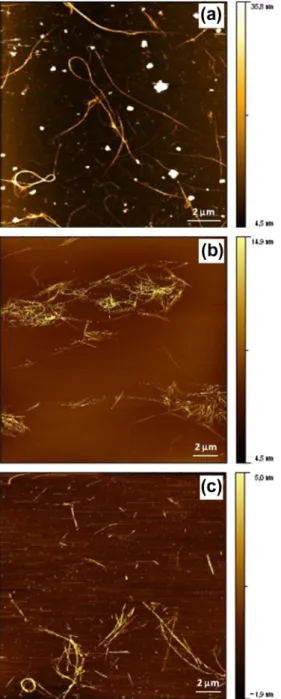
Some of these chemical treatments have also an effect on dis-persion and shortening of DWNTs.Fig. 7a shows an AFM pic-ture of raw DWNTs, the length of which mainly ranged from 2 to 15 lm. After treatment by method 3 (Fig. 7b), agglomerated short nanotubes were obtained along with isolated nanotubes shortened to 2–3 lm. The oxidation with K2Cr2O7/H2SO4
seemed to be much stronger according to the AFM pictures (Fig. 7c): the longest tubes observed were 5–6 lm and ca. 30% of the tubes were only 100 nm-long.
The level of functionalization of the DWNTs is important to obtain stable water suspensions. For each oxidation method, 10 mg of dry oxidized DWNTs were placed into 100 mL of water, sonicated for 15 min using a bath sonicator (80 W), then sonicated for 10 min by tip-sonication (500 W, 20% amplitude) and finally a mechanical homogenization was applied (Ultraturax DI 25 basic, 50/60 Hz, 600 W) with a rotation speed of 8000 rpm for a few minutes. The aim of these successive treatments is to individualize the CNTs as much as possible while playing either on agglomerates or Fig. 5 – Infra-red spectra of (a) raw DWNTs; (b) treated by method 1 (3 h).
on bundles, or both. During this mechanical homogenization procedure, 1 mL of the suspension was sampled and diluted to 10 mL in water for measurement of the zeta potential (10 mg/L solution). For decantation, the suspensions were not diluted after treatment (Fig. 8, 100 mg/L suspensions). After 24 h of sedimentation at room temperature, raw DWNTs fell at the bottom of the flask and only few agglomerates remained in the supernatant. After treatment of the DWNTs by oxidation, the suspensions were stable and no sedimenta-tion was visually observed after 24 h, except for method 4 (Fig. 8).
The dispersibility of DWNTs is related to the ionization of carboxylic acid groups introduced by acidic treatments (DWNT–COOH + H2O = DWNT–COO + H3O+) and to the
adsorption of ions such as H+or OH-from the aqueous
sus-pension which leads to the presence of a net charge on the surface of DWNTs. After oxidizing treatments, DWNTs form small bundles from 1 to 6 nm in diameter, that behave as col-loidal particles. The measure of the Zeta potential of the aqueous suspensions gives an estimation of the surface charge of these particles and may be related to the rate of
functionalization and to the dispersibility. A low value of 0.4 mV was measured for suspensions of non-functionalized (and forming unstable suspensions) raw DWNTs. The Zeta potential value of 40 mV (corresponding to the highest abso-lute value) was obtained with samples oxidized by conc. HNO3(method 2), which visually gave the most stable
aque-ous suspension after 24 h, and the highest level of functional-ization. It has to be compared to the value of 53 mV found by Haddon et al. after oxidation of SWNTs by 7 M HNO3(in this
sample, the functionalization was estimated at 9.2 mmol/g)
[46]. The value of 16 mV for KMnO4treatment (method 4),
which was the lowest in absolute value among all oxidized samples, corresponded to the lowest functionalization rate.
Opening of DWNTs due to oxidation treatments is also possible and has been evidenced in different cases by filling experiments, as detailed below.
3.2. Filling of DWNTs
Oxidized DWNTs were impregnated with uranyl nitrate solution in order to fill the carbon nanotubes. Thanks to the Fig. 6 – TEM pictures of (a) DWNTs oxidized with 3 M HNO3for 24 h; (b) ox-DWNTs washed with 4 M NaOH in reflux conditions
(washing treatment A); (c) ox-DWNTs washed with 0.01 M NaOH solution (washing treatment B); (d) ox-DWNTs washed with 4 M NaOH solution (washing treatment B); (e) ox-DWNTs washed with 10 M NaOH solution (washing treatment B); (f) doubly oxidized DWNTs followed by 1 h of sonication in a 4 M NaOH solution (washing treatment C).
contrast obtained during HRTEM observations due to the high electronic density of uranium, this experiment is suitable as a control for filling of carbon nanotubes, and thus as a visual evidence of opening following oxidation treatments.
The filling was tested on four kinds of DWNTs oxidized by: – Method 1 (24 h) followed by alkaline washing (method
(A): reflux at 130 °C for 24 h in 4 M NaOH);
– Method 1 (24 h) followed by thermal treatment at 500 °C in air for 30 min and by conc. HCl washing;
– Method 3 (24 h);
– Thermal treatment at 500 °C in air for 30 min followed by conc. HCl washing.
Each sample (20 mg) of oxidized DWNTs was transferred into 7 mL of 0.25 M uranyl nitrate solution prepared in situ by dissolution of (depleted) UO2in conc. HNO3(68%). The
sus-pensions were ultra-sonicated (sonication probe) for 20 min at 50% amplitude and then stirred for 3 days at 80 °C. Each suspension was then filtered and the solid was rapidly washed with 20 mL of deionized water, and finally dried in vacuum overnight. From chemical analysis of uranium (Table 3) and TEM observations (Fig. 9), partial filling of DWNTs was evidenced in all conditions.
Whatever the method of opening of DWNTs, their filling with the uranium (VI) remained relatively low (U wt.% <3%). The best amount of metal in the sample was obtained for sample F3 (2.2 wt.%) when the DWNTs were opened by method 3, even if this value is not so different from the other ones. Solution filling can thus be used as a clear evidence of CNT opening, but is obviously not quantitative enough to allow some comparison between samples opened by different techniques.
HRTEM images of samples F1 (Fig. 9a) and F3 (Fig. 9b) were rather similar although the filling rate was twice as much in sample F3. Tubes were filled with very small uranium clusters of 1 to 2 nm in length, clearly located inside the DWNTs.
When DWNTs were purified by dry treatment at 500 °C in air for 30 min (sample F4), the filling yield was low (U = 1.34 wt.%), probably due to the formation of large bundles (Fig. 4a) which probably disturbed the filling by limiting the access to the tips.
The low filling yield obtained for all the samples can be explained by the fact that when the filling is performed in solution, the nanotubes are in fact mainly filled with solvent. Fig. 7 – AFM pictures of (a) raw DWNTs; (b) DWNTs treated by
method 3 for 24 h; (c) DWNTs treated by method 5 for 24 h. (A colour version of this figure can be viewed online.)
Fig. 8 – Picture of water suspensions (100 mg/L) after 24 h of sedimentation containing (a) raw DWNTs treated by (b) method 2; (c) method 1; (d) method 3; (e) method 4 and (f) method 5. (A colour version of this figure can be viewed online.)
As a comparison, a better filling yield was obtained earlier with the same raw DWNTs using molten iron iodide: based on the visual inspection of HRTEM images, the filling yield was estimated to be higher than ca. 60%, while elemental analysis indicated 12.3 wt.% of iron in the sample[47]. Finally, due to the differences in the experimental conditions used for the oxidation of the CNTs and their influence on both the packing of the CNTs when they are dried and the possible plugging by CCFs, it is difficult to use this approach for a true quantitative comparison of the different extent of opening. However, this method is still valid for assessing whether
CNTs are opened or not. Gas adsorption methods comparing different gases (Ar, Kr, Xe, N2) could be another way to assess
the opening of CNTs, although these kinds of measurements are rather complex and require to be performed in perfectly controlled conditions[48].
4.
Conclusion
Oxidation treatments are widely used for the purification of carbon nanotubes. We have shown in this work, based on quantitative data, that different oxidizing conditions lead to different degrees of purification, and that some selectivity towards a given impurity (disorganized carbon or residual cat-alysts) is possible, even if this is usually at the cost of impor-tant sample losses. This work also allowed to identify conditions in which a good compromise between high purity and acceptable sample loss can be obtained. Our results also show that most CCFs deposited on CNTs after oxidizing treat-ments are likely to originate from carbon impurities in the CNTs samples and not from the CNTs themselves.
We have also shown that parallel reactions take place dur-ing purification treatments, such as functionalization and opening of the carbon nanotubes. These reactions cannot be avoided, and this should be taken into account as purification techniques thus lead to modifications of the surface chemis-try (and sometimes of their length as well), with important consequences in most fields or research or application (com-posite materials, electronic properties, toxicity and environ-mental impact, etc.).
Opening of the CNTs was assessed by filling from a solu-tion of uranyl nitrate and is shown to occur in all the tested conditions, although it is difficult to get proper quantitative data due to some differences between the different oxidation procedures leading either to strong agglomeration of the CNTs or their likely plugging by deposits of CCFs.
Acknowledgments
We are grateful to financial support provided by the French ANR (National Research Agency, Grant ANR 2011 CESA 007 03) and by the FP6 Marie Curie RTN CARBIO.
Appendix A. Supplementary data
Supplementary data associated with this article can be found, in the online version, at http://dx.doi.org/10.1016/j.carbon. 2014.06.051.
Table 3 – Rate of filling (measured from chemical analysis of uranium) according to the method of opening.
Filled sample Method of opening U filling rate (wt.%)
F1 Method 1 (24 h) followed by 4 M NaOH washing 1.22 ± 0.03 F2 Method 1 (24 h) followed by thermal treatment
(500 °C in air, 30 min.) and conc. HCl washing
1.85 ± 0.04
F3 Method 3 (24 h) 2.22 ± 0.05
F4 Thermal treatment (500 °C in air, 30 min.) and conc. HCl washing
1.34 ± 0.03
Fig. 9 – HRTEM pictures of DWNTs prepared and filled with uranyl nitrate in solution: (a) sample F1; (b) sample F3.
R E F E R E N C E S
[1]Monthioux M, Serp P, Flahaut E, Razafinimanana M, Laurent Ch, Peigney A, et al. Introduction to carbon nanotubes. In: Bhushan B, editor. Springer handbook of
nanotechnology. New York: Springer; 2010. p. 47–118. [2]Lu F, Gu L, Meziani M, Wang X, Luo PG, Veca LM, et al.
Advances in bioapplications of carbon nanotubes. Adv Mater 2009;21:139–52.
[3]Liu Z, Chen K, Davis C, Sherlock S, Cao Q, Chen X, et al. Drug delivery with carbon nanotubes for in vivo cancer treatment. Cancer Res 2008;68:6652–60.
[4]Klingeler R, Hampel S, Bu¨chner B. Carbon nanotube based biomedical agents for heating, temperature sensoring and drug delivery. Int J Hyperther 2008;24:496–508.
[5]Bulusheva LG, Gevko PN, Okotrub AV, Lavskaya YV, Yudanov NF, Yudanova LI, et al. Thermal behavior of the fluorinated double-walled carbon nanotubes. Chem Mater
2006;18:4967–71.
[6]Bulusheva LG, Fedoseeva YV, Okotrub AV, Flahaut E, Asanov IP, Koroteev VO, et al. Stability of fluorinated double-walled carbon nanotubes produced by different fluorination techniques. Chem Mater 2010;22:4197–203.
[7]Hayashi T, Shimamoto D, Kim YA, Muramatsu H, Okino F, Touhara H, et al. Selective optical property modification of double walled carbon nanotubes by fluorination. ACS Nano 2008;2:485.
[8]Flahaut E, Peigney A, Bacsa R, Laurent C. Gram-scale CCVD synthesis of double-walled carbon nanotubes. Chem Commun 2003:1442–3.
[9]Flahaut E, Peigney A, Bacsa WS, Bacsa RR, Laurent C. CCVD synthesis of carbon nanotubes from (Mg Co, Mo)O catalysts: influence of the proportions of cobalt and molybdenum. J Mater Chem 2004;14:646–53.
[10]Dillon AC, Gennett T, Jones KM, Alleman JL, Parilla PA, Heben MJ. A simple and complete purification of single-walled carbon nanotube materials. Adv Mater 1999;11:1354–8. [11]Monthioux M, Smith BW, Burteaux B, Claye A, Fischer JE,
Luzzi DE. Sensitivity of single-wall carbon nanotubes to chemical processing: an electron microscopy investigation. Carbon 2001;39:1251–72.
[12]Hu H, Zhao B, Itkis ME, Haddon RC. Nitric acid purification of single-walled carbon nanotubes. J Phys Chem B
2003;107:13838–42.
[13]Zhang XX, Deng CF, Xu R, Wang DZ. Oxidation resistance of multi-walled carbon nanotubes purified with sulphuric and nitric acids. J Mater Sci 2007;42:8377–80.
[14]Hernadi K, Siska A, Thieˆn-Nga L, Forro´ L, Kiricsi I. Reactivity of different kinds of carbon during oxidative purification of catalytically prepared carbon nanotubes. Solid State Ionics 2001;141:203–9.
[15]Aitchison TJ, Ginic-Markovic M, Matisons JG, Simon GP, Fredericks PM. Purification, cutting, and sidewall functionalization of multiwalled carbon nanotubes using potassium permanganate solutions. J Phys Chem C 2007;111:2440–6.
[16]Biro LP, Khanh NQ, Vertesy Z, Horvath ZE, Osvath Z, Koos A, et al. Catalyst traces and other impurities in chemically purified carbon nanotubes grown by CCVD. Mater Sci Eng C 2002;19:9–13.
[17]Salzmann CG, Llewellyn SA, Tobias G, Ward MAH, Huh Y, Green MLH. The role of carboxylated carbonaceous fragments in the functionalization and spectroscopy of a single-walled carbon-nanotube material. Adv Mater 2007;19:883–7.
[18]Hou PX, Liu C, Cheng HM. Purification of carbon nanotubes. Carbon 2008;46:2003–25.
[19] Kuzmany H, Kukovecz A, Simon F, Holzweber M, Kramberger C, Pichler T. Functionalization of carbon nanotubes. Synth Met 2004;141:113–22.
[20] Yu H, Jin Y, Peng F, Wang H, Yang J. Kinetically controlled side-wall functionalization of carbon nanotubes by nitric acid oxidation. J Phys Chem C 2008;112:6758–63.
[21] Worsley KA, Kalinina I, Bekyarova E, Haddon RC. Functionalization and dissolution of nitric acid treated single-walled carbon nanotubes. J Am Chem Soc 2009;131:18153–8.
[22] Wang J, Liang G, Yan H, He S. Mechanical and thermal properties of functionalized multiwalled carbon nanotubes/ cyanate ester composite. Polym Eng Sci 2009:680–4. [23] Wang Y, Iqbal Z, Mitra S. Rapidly functionalized,
water-dispersed carbon nanotubes at high concentration. J Am Chem Soc 2006;128:95–9.
[24] Zhang J, Zou H, Qing Q, Yang Y, Li Q, Liu Z, et al. Effect of chemical oxidation on the structure of single-walled carbon nanotubes. J Phys Chem B 2003;107:3712–8.
[25] Musso S, Porro S, Vinante M, Vanzetti L, Ploeger R, Giorcelli M, et al. Modification of MWNTs obtained by thermal-CVD. Diamond Relat Mater 2007;16:1183–7.
[26] Samori C, Sainz R, Menard-Moyon C, Toma FM, Venturelli E, Singh P, et al. Potentiometric titration as a straightforward method to assess the number of functional groups on shortened carbon nanotubes. Carbon 2010;48:2447–55. [27] Goertzen SL, The´riault KD, Oickle AM, Tarasuk AC, Andreas
HA. Standardization of the Boehm titration. PartI. CO2
expulsion and endpoint determination. Carbon 2010;48:1252–61.
[28] Kim YS, Yang SJ, Lim HJ, Kim T, Lee K, Park CR. Effects of carbon dioxide and acidic carbon compounds on the analysis of Boehm titration curves. Carbon 2012;50:1510–6.
[29] Shao L, Tobias G, Salzmann CG, Ballesteros B, Hong SY, Crossley A, et al. Removal of amorphous carbon for the efficient sidewall functionalization of single-walled carbon nanotubes. Chem Commun 2007:5090–2.
[30] Verdejo R, Lamoriniere S, Cottam B, Bismarck A, Shaffer M. Removal of oxidation debris from multi-walled carbon nanotubes. Chem Commun 2007:513–5.
[31] Price BK, Lomeda JR, Tour JM. Aggressively oxidized ultra-short single-walled carbon nanotubes having oxidized sidewalls. Chem Mater 2009;21:3917–23.
[32] Flavin K, Kopf I, Del Canto E, Navio C, Bittencourt C, Giordani S. Controlled carboxylic acid introduction: a route to highly purified oxidised single-walled carbon nanotubes. J Mater Chem 2011;21:17881–7.
[33] Chen YK, Chu A, Cook J, Green MLH, Harris PJF, Heesom R, et al. Synthesis of carbon nanotubes containing metal oxides and metals of the d-block and f-block transition metals and related studies. J Mater Chem 1997;7:545–9.
[34] Satishkumar BC, Govindaraj A, Mofokeng J, Subbanna GN, Raoy CNR. Novel experiments with carbon nanotubes: opening, filling, closing and functionalizing nanotubes. J Phys B 1996;29:4925–34.
[35] Zhao L, Gao L. Filling of multi-walled carbon nanotubes with tin(IV) oxide. Carbon 2004;42:3269–72.
[36] Davis JJ, Green MLH, Hill HA, Leung YC, Sadler PJ, Sloan J, et al. The immobilisation of proteins in carbon nanotubes. Inorg Chim Acta 1998;272:261–6.
[37] Chen Q, Saltiel C, Manickavasagam S, Schadler LS, Siegel RW, Yang H. Aggregation behavior of single-walled carbon nanotubes in dilute aqueous suspension. J Colloid Interface Sci 2004;280:91–7.
[38] Li J, Zhang Y. Cutting of multi walled carbon nanotubes. Appl Surf Sci 2006;252:2944–8.
[39] Jorge J, Flahaut E, Gonzalez-Jimenez F, Gonzalez G, Gonzalez J, Belandria E, et al. Preparation and characterization of a-Fe
nanowires located inside double wall carbon nanotubes. Chem Phys Lett 2008;457:347–51.
[40]Wenseleers W, Cambre S, Culin J, Bouwen A, Goovaerts E. Effect of water filling on the electronic and vibrational resonances of carbon nanotubes: characterizing tube opening by Raman spectroscopy. Adv Mater
2007;19(17):2274–8.
[41]Hwang KC. Efficient cleavage of carbon grapheme layers by oxidants. J Chem Soc Chem Commun 1995:173–4.
[42]Osswald S, Flahaut E, Ye H, Gogotsi Y. Elimination of D-band in Raman spectra of double-wall carbon nanotubes by oxidation. Chem Phys Lett 2005;402:422–7.
[43]Del Canto E, Flavin K, Movia D, Navio C, Bittencourt C, Giordani S. Critical investigation of defect site
functionalization on single-walled carbon nanotubes. Chem Mater 2011;23:67–74.
[44]Ferrari AC, Robertson J. Interpretation of Raman spectra of disordered and amorphous carbon. Phys Rev B
2000;61(20):14095–107.
[45]Rinzler AG, Liu J, Dai H, Nikolaev P, Huffman CB, Rodriguez-Macias FJ, et al. Large-scale purification of single-wall carbon nanotubes: process, product, and characterization. Appl Phys A 1998;67:29–37.
[46]Hu H, Yu A, Kim E, Zhao B, Itkis ME, Bekyarova E, et al. Influence of the zeta potential on the dispersability and purification of single-walled carbon nanotubes. J Phys Chem B 2005;109:11520–4.
[47]Tıˆlmaciu CM, Soula B, Galibert AM, Lukanov P, Datas L, Gonzalez J, et al. Synthesis of superparamagnetic iron(III) oxide nanowires in double-walled carbon nanotubes. Chem Commun 2009;43:6664–6.
[48]Arab M, Picaud F, Ramseyer C, Babaa MR, Valsaque F, McRae E. Characterization of single wall carbon nanotubes by means of rare gas adsorption. J Chem Phys