To cite this document: Vidal, Oriol and Alberty, Eric and Inigo, Patricia and Lacan, Jérôme and Radzik, José Linear Precoding performance analysis in a Broadband satellite system with a 2-color dual-polarization reuse scheme. (2013) In: 31st AIAA International Communications Satellite Systems Conference (ICSSC), 14 October 2013 - 17 October 2013 (Florence, Italy).
O
pen
A
rchive
T
oulouse
A
rchive
O
uverte (
OATAO
)
OATAO is an open access repository that collects the work of Toulouse researchers and makes it freely available over the web where possible.
This is an author-deposited version published in: http://oatao.univ-toulouse.fr/ Eprints ID: 9712
Any correspondence concerning this service should be sent to the repository administrator: [email protected]
Linear Precoding performance analysis in a Broadband
satellite system with a 2-color dual-polarization reuse
scheme
O. Vidal1 E. Alberty2 and P. Iñigo3
ASTRIUM SAS, Toulouse, France
J. Lacan4 and J. Radzik5
Université de Toulouse/ISAE, Toulouse, France
The potential of Joint Multiuser Processing in multi-beam satellite systems is assessed in this paper and proved to be a potential attractive alternative to current systems. The present contribution aims at investigating linear precoding techniques over an accurate multi-beam architecture modeling and system characterization. Power and precoder design problems are approached through well-known linear precoding techniques such as Zero Forcing (ZF) and Regularized-ZF. A dual-polarization 2-color reutilization scheme is considered in combination with precoding techniques. Results show a total throughput improvement of +22% achieved by ZF and +38% considering R-ZF, with respect to a conventional 4-color reuse scheme scenario.
I. Introduction
Current broadband satellite system are employing multiple spot beams, allowing dividing coverage into small cells and thus, exploiting more efficiently satellite resources. This multi-beam architecture has led to a significant boost in overall system capacity by reusing the available spectrum several times in the coverage area. The 2nd generation Ka-band satellites (i.e. Ka-Sat, Viasat-1) is a good example of that, reaching total capacities from 90Gbps to 140Gbps thanks to higher Frequency Reuse (FR) factors and higher spectral efficiency modulation and coding schemes. The trend continues with the so-called next generation High Throughput Satellites (HTS), pushing forward evolved architectures with an even increased number of beams aiming at reaching Terabit/s like performances [1]. Despite the lately achievements, new techniques still need to be explored to overcome two of the main significant show-stoppers: the high level of
1
System engineer (PhD), Telecom System Department, [email protected], Not a member
2
Head of telecom system engineering, Telecom System Department, [email protected], Not a member
3
Head of Broadband/Broadcast team, Telecom System Department, [email protected], Not a member
4
Professor, Head of “Networks” team, [email protected], Not a member
5
beam interferences and the overwhelming number of beams needed to reach such high performances.
Current research work has recently been focused on studying interference mitigation techniques (IMTs) as a way to tackle the increasing degradation of inter-beam isolation. One of the most interesting IMT applications for that matter is the possibility to consider denser FR schemes (w.r.t typical 4-FR pattern) leading to innovative frequency plans and significant increase of total system spectral resources. Joint multiuser processing techniques are, in this context, considered well-suited for that purpose. Indeed, the analogy between Multi User MIMO –Broadcast channel (MIMO-BC) and the forward (FWD) link in multi-beam Fixed Satellite Services (FSS) system allows the transposition of these IMTs to a satellite broadband framework, in the form of precoding at the gateway stations.
In this paper, the focus is set on assessing linear precoding (LP) techniques applied to the FWD link of a HTS system scenario over a European coverage. Power and precoder design problems are approached through well-known linear channel inversion techniques such as Zero Forcing (ZF) and Regularized-ZF, already assessed on the satellite context in [2-4]. In contrast to a large part of existing literature, the present contribution considers a Single-feed-per-beam (SFPB) antenna configuration with a per beam power constraint, i.e. single High Power Amplifier (HPA) per beam. This configuration, also assessed in [4], is considered more realistic than a sum-power constraint, assuming full power allocation flexibility on-board the satellite, and more common than multi-feed-per-beam (MFPB).
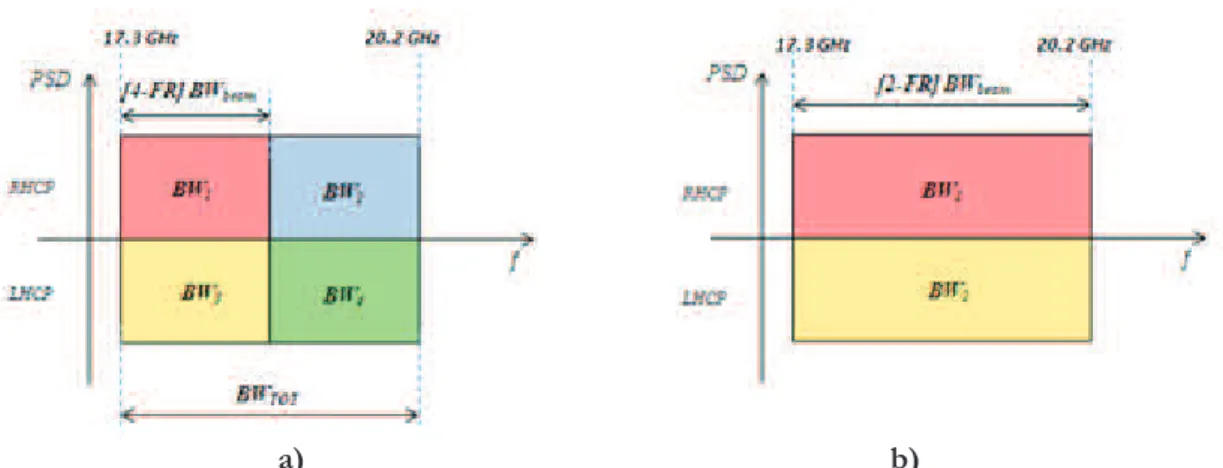
Another interesting aspect is the use of a 2-color FR scheme (Fig. 2 b)) combined with precoding instead of a single polarization full frequency reuse pattern as often considered in related literature. The exploitation of dual polarization for MU-MIMO processing in multibeam FS services was studied in [5] concluding that dual-polarization can only serve as an additional degree of isolation. Indeed, the 2-color FR pattern allows a higher isolation (which leads to improving precoding performances, as proved in this paper) but also allows fully exploiting all available bandwidth in both polarizations, taking into account the single HPA per beam configuration and assuming typical user terminals (UT) demodulating in a single polar mode.
The paper is organized as follows: Section II presents the system scenario assumptions. System modeling is tackled in section III followed by the simulation assumptions, the performances results and its analysis, presented in section IV. Finally, conclusions are provided in section V.
Notation: Boldface uppercase letters denote matrices and boldface lowercase letters
refers to vectors. We denote by (.)^ the hermitian trasnpose. The identity matrix is denoted by I.
II. System scenario assumptions
The improvements that IMTs can provide depends on system assumptions and scenario characterization and their effects can be more or less significant in function of that choice. Once that said, system parameters considered in the study are presented in Fig.1 as well as the reference scenario beam layout. A European-like coverage
illuminated by 60 beams and a beam width of 0.3° is assumed (~200km of beam diameter).
As stated previously, the assessment is focused on the FWD link, considering a large number of fixed UTs uniformly distributed over the coverage. A transparent payload is assumed with a time division multiple (TDM) access at the user link such that, in the carrier of interest, at each time instant a total of K users are simultaneously served. As SFPB antenna configuration is considered, K also corresponds to the number of beams. The proposed analysis assumes a single Gateway (GW) to serve all user beams. It should be stressed that this assumption is not fully realistic in current systems. Nevertheless, as high capacity links between GW are already required to implement smart diversity
a) b)
Figure 1. Reference scenario a) 60 beams @0.3° beam layout b) system assumptions
a) b)
strategies, it is considered reasonable to assume that joint coding could be extended thanks to the cooperative joint processing among all GW.
Conventional 4-FR scheme (Fig.2 a)) performances are derived and used to assess the potential gain when LP is applied. System parameters have been carefully chosen to have a balanced interference and thermal budget in 4-FR mode. An ideal feeder link contribution has been considered in both reference and precoding performance analysis.
In terms of Output Back-off (OBO) and intermodulation products, the same level of OBO has been kept for 4-FR reference scenario and precoding cases as well as the intermodulation products. A quite conservative hypothesis has been considered, assuming the Noise Power Ratio (NPR) level in both scenarios.
III. System model
Generally speaking, the received signal at user k of a multibeam system can be expressed as follows: k K k j j j jk j k kk k k p h x p h x n y = +
å
+ ¹ = ,1 (1)where xiis the signal transmitted from antenna feed i, nkcorresponds to independent and identically (i.d.d.) zero-mean Gaussian random noise (with power density No) at
reception and
k j
h are the channel coefficients which model each transmission path from
the GW to user k. The HPA RF power at saturation associated to beam i is represented by
pi and, in this case, it is externalized from channel coefficients.
The received SNIR for a user k for any given FR scheme without linear precoding is then: c o K k j j jk j kk k k BW N h p h p SNIR + =
å
¹ = ,1 2 2 (2)where No is the noise power density and BWc the carrier bandwidth.
Focusing on channel characterization, channel coefficients of user k, ( j1 1k) k
j h h
h = L ,
include all attenuation and gain contributions present in the transmission path between the GW station and the UT, except for the HPA power contribution. As stated in section II, feeder link contribution is considered ideal and thus, is not taken into account on channel coefficients.
Looking closely to a generic channel coefficient
k j
h (from feed j to beam k), it can be expressed as follows: Rx atten FSL Tx Rx CX CO Tx jk L L L L G G h × × × × = _ / 2 (3)
where LTxcorresponds to aggregate on-board losses (OBO, antenna and output losses and repeater uncertainties), LFSL and Latten represent user k Free Space losses and Clear Sky attenuation respectively and LRx symbolizes UT reception losses (input and pointing losses). Finally, GTx_CO/CX and GRx correspond to the on-board antenna directivity and UT antenna gain respectively.
It should be noted that, in addition to co-channel gain, cross-polarization contribution is taken into account when analyzing the performance of both 4-FR and 2-FR precoding scenarios. In both cases, the frequency plan considered makes use of both circular polarizations which should be reflected in the computation of channel coefficients.
In terms of propagation attenuation, Clear sky atmospheric attenuation is considered in order to assess throughput performances. It is computed taking into account gases (oxygen and water vapour) and scintillation at 95% of the time. Propagation losses are derived via the ITU-R-P618-9 recommendation [6].
A. Linear precoding: ZF and Regularized-ZF
When precoding is applied, the transmitted signals x can be expressed as:
Ts
x = (4)
being T the (KxK) precoding matrix and s the (Kx1) symbol vector. The kth entry of s
vector is the constellation symbol addressed to the kth user. Independent unit energy
constellation symbols are assumed, i.e. E
{ }
sk 2 =1.As stated in section 1, a per beam power constraint is considered. For the transmitted signal xi it can be expressed as:
{ }
xi piE 2 £ (5)
For the design of the linear precoders, channel inversion techniques are considered herein focusing on ZF and Regularized-ZF.
ZF aims at the complete cancellation of intrasystem interferences via precoding of the pseudo-inverse of the channel matrix. In the scenario previously described this is directly the inverse of the channel matrix as SFPB is assumed (K feeds generate K beams). ZF is a simple but suboptimal linear precoding strategy as its design only depends on the channel regardless of the noise. The precoding matrix can be expressed as described in Eq. (6), where
b
ZF corresponds to the normalization factor such as to comply Eq. (5).
1
ZF H
T =
b
ZF - (6)Not taking into account the noise variance and imposing a zero interference constraint at each UT leads to performance degradation in a low SNR regime. By relaxing this constraint, it was proved in [7] that a regularized inversion of the channel, this time taking into account the noise variance, can significantly improve the system’s performance. The corresponding precoding matrix can be expressed as:
^ -^ + = H H I H TRZF
b
RZF(a
) 1 with p BW No c RZF =a
(7)where
b
RZF corresponds once again to the normalization factor such as to comply Eq. (5) anda
RZFis defined based on the large system analysis given by [8] which derived the optimal regularization coefficient to maximize the SNIR.
The proposed precoding analysis for both techniques will be analytically supported under perfect channel state information (CSI), implying all channel intra-system contributions are well-known by the GW.
IV. Simulation and performance results
In order to assess the linear precoding techniques presented in previous section, Monte Carlo simulations are carried out according to the scenario described in Fig. 1 b).
As described in section II, the UTs are assumed to be uniformly distributed over the coverage region. It is assumed that each of the K simultaneously served users is located in a different beam.
The numerical results will provide system performance measures averaged out on the fading and UTs locations statistics (by considering ten thousand fading/locations realizations). The throughput (bit/s), which is defiend as the number of useful bits transmitted by the GW to the users, is the performance metric considered. It is deduced from a modcod table based on DVB-S2 standard which provides the association between the required received SNIR and the spectral efficiency (bits/symbol) achieved by the different adaptive coding and modulation (ACM) for a packet error rate (PER) of 10−7. It should be noted that the computed throughput is the raw throughput at physical layer level: i.e. it does not include any generic stream encapsulation overhead nor any IP overhead. Within a beam, the same volume of symbols is transmitted to/from each user. This computation leads to an average spectral efficiency per beam, which is translated in
a) b)
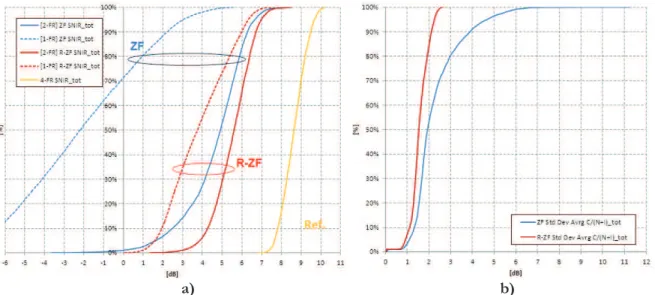
Figure 3. a) Total SNIR performances per carrier of ZF, R-ZF (1-FR vs 2-FR) and 4-FR reference scenario b) Standard Deviation of the Average total C/(N+I) per user (ZF and R-ZF)
throughput per beam. Then it is summed over all beams to get the total system throughput.
Figure 3 a) illustrates by means of a Cumulative Distribution Function (CDF) the total link budget performances per carrier of 4-FR reference scenario and ZF and R-ZF with a 2-FR scheme (continuous line). As observed, the regularized channel inversion achieves quite better performances than ZF above all in low SNIR regime, where ZF clearly underperforms, presenting in clear sky an unavailability of 0.45%. In dashed lines, for comparison purposes, ZF and R-ZF performances have ben plotted considering a 1-FR, i.e. same bandwidth per beam than 2-FR case but only a single polarization considered, leading to a full frequency reuse scenario. In this case, inter-beam isolation is highly degraded and ZF, even suppressing all co-channel interferences, is not able to cope with thermal budget degradation. On the contrary, even if penalized by the increase of interferences, R-ZF shows less total link budget degradation due to the introduction of the noise component in the regularized channel inversion.
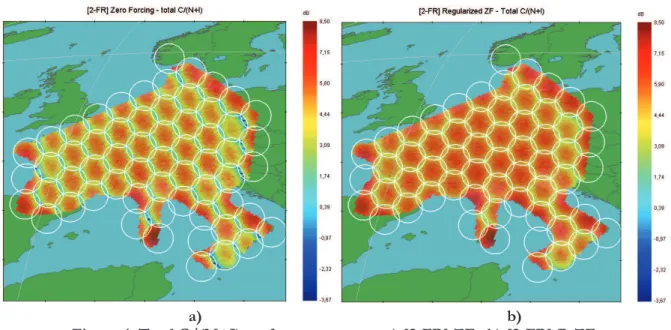
Figure 4 depicts total C/(N+I) geographically distributed over the coverage for ZF and R-ZF combined with 2-FR (same color scale considered). As it can be observed, R-ZF achieves better C/(N+I) values than ZF at the edge of beams where isolation is poorer due to adjacent beams re-using the same polarization.
Interesting results are obtained in Fig.3 b) when plotting the standard deviation of the average C/(N+I) values per user in a CDF, obtained through all channel realizations. This plot allows assessing the dispersion in SNIR values obtain for each user and shows the impact of the scheduling strategy. In this case, a scheduler based on a uniform distribution has been considered, i.e. equal probability to be chosen in a given beam. Observing the results, ZF is far more impacted by scheduling than R-ZF as 47% of C/(N+I) values are beyond 2dB of dispersion for a 15.5% for R-ZF.
In terms of total throughput, results for the reference 4-FR case and for the LP techniques combined with the 2-FR scheme are shown in Table 1. A significant gain is obtained by R-ZF with an increase of 38.4% of throughput w.r.t. 4-FR reference scenario and 100% availability in clear Sky conditions. Concerning ZF, a 22.3% gain is obtain but with an availability in clear sky of 99.5%.
a) b)
V. Conclusion
In this paper linear precoding techniques such as ZF and R-ZF have been assessed in multibeam satellite system architecture with narrow spot beams (0.3°) covering a European region. The performances of a conventional 4-FR scheme have been compared to a 2-FR scheme using LP, adding the particularity that in both schemes dual-circular polarizations have been taken into account, thus considering both channel and co-polar contributions. This allows for a full reutilization of the available bandwidth in each beam adding an extra level of isolation by means of polarization reuse pattern. Results are derived considering clear sky fading, ideal CSI and ideal feeder link contribution by a single GW which serves all user beams. Results show significant improvement in total system throughput, being R-ZF the LP technique with better performances. Further work will assess the impact of scheduling strategies in order to improve system throughput, the impact of beam width over precoding performance, the introduction of attenuation margins in rainy conditions to compute availability as well as the characterization of a realistic V-band feeder link contribution.
References
[1] D. Mignolo, P. Angeletti, E. Re, A. Alamanac, M. Harverson, A. Ginesi, “Approaching Terabit/s Satellite: a
System Analysis”, 17th Ka and Broadband Communications, Navigation and Earth Observation Conference, 3-5
October 2011.
[2] L.Cottatelluci, M.Debbah, E.Casini, R.Rinaldo, R.Mueller, M.Neri, G.Gallinaro, “Interference Mitigation
Techniques for broadband satellite systems”, Proceedings of 24th AIAA International Communication Satellite Systems Conference (ICSSC 2006), San Diego, California,1, pp. 1-13(2006)
[3] B. Devillers, A;Perez-Neira, c. Mosquera, ” Joint Linear Precoding and Beamforming for the Forward Link of Multi-Beam
Broadband Satellite Systems”, Proceedings of the IEEE Global Communications Conference, GLOBECOM, Houston, Texas, 1,pp 1-6, (2011)
[4] Christopoulos, S.Chatzinotas, G? Zheng, J.Grotz, B.Ottersen “Linear and non-linear techniques for multibeam
joint processing in satellite communications” EURASIP journal on wireless communications and networking 2012
2012:162
[5] N.Zorba, M.Realp, M.A.Lagunas, A.I.Perez-Neira,”Dual polarization for MIMO processing in multibeam satellite systems” in 10th Int. Work. Signal. Process. Space Commun.SPSC Oct.( 2008)
[6] ITU-R Recomenadtion P618-9,”Propagation data and prediction methods required for the design of Earth-Space communications systems. (2009)
[7] C. Peel, B. Hochwald, and A. Swindlehurst, “A vector-perturbation technique for near-capacity multiantenna
multiuser communication - partI: channel inversion and regularization,” IEEE Trans. Commun., vol. 53,no. 1, pp.
195 – 202, Jan. 2005
[8] R Muharar, J Evans, Downlink Beamforming with Transmit-Side Channel Correlation: A Large System Analysis, in Communications (ICC), 2011 IEEE International Conference on, Kyoto, Japan, pp. 1–5 (2011)