« Preferences for Redistribution : Normative Rationality, Self-Interest and Social Identification »
Christine LE CLAINCHE Jérôme WITTWER
Christine Le Clainche
, Jérôme Wittwer
!Preferences for Redistribution : Normative Rationality,
Self-Interest and Social Identification
September 2012
Abstract:
This article studies the formation of preferences regarding redistribution. Its aim is to demonstrate how preferences for redistribution are influenced by individual beliefs on the origins of social inequality and public values. The first section shows, through a microeconomic model, how preferences on redistribution can be understood as the outcome of “normative rationality” depended on beliefs concerning individual responsibility in the creation of inequality. This model is then confronted with empirical field data demonstrating the link between individuals’ normative beliefs and judgments and their preferences for redistribution.
We find that these normative variables used partially explain the preferences for redistribution. This illustrates how individuals use rational ethics to justify partisan preferences since these judgments are in part determined by economic variables reflecting self-interest. We particularly observe that, opinions about the level of effort everyone has to do in the production task or the opinions concerning the fair remuneration of talents or skills may change through individual experiences relative to social or prospects of upward mobility and then affect preferences for redistribution. We also find a strong effect of social identification on preferences for redistribution through public values.
Key words: inequality, beliefs, responsibility, preferences for redistribution, social identification.
JEL code: D63
ENS Cachan, Lameta Umr Cnrs 5474. Centre d’Etudes de l’Emploi (CEE), 29 Promenade Michel Simon, Le Descartes I, 93166 Noisy Le Grand Cedex.
e-mail :[email protected] [email protected].
!Université Paris-Dauphine, LEDa-LEGOS. Place du Maréchal de Lattre de Tassigny 75775 Paris cedex 16.
Introduction
This paper has for main objective to deepen the understanding of the fairness determinants of preferences for redistribution, considering together the role played by the beliefs concerning luck and effort to get ahead in life and the role played by the public values. The latter are considered as social norms integrated by the individual which may challenge the former in explaining the individual determinants of preferences for redistribution.
Over last ten years an extensive economic literature shed light on the various factors determining preferences for redistribution. Until recently such studies were associated either to theoretical models (and/) or empirical evidence stemming from survey data analysis. The literature, now, begins to be supplemented by an increasing experimental evidence (see e.g. Checci and Filippin (2003), Durante and Putterman (2007), Krawkcyk (2010), Klor and Shayo (2010)) showing the importance of such a research field. In a recent paper, Alesina and Giulano (2009) review the theoretical and empirical literature concerning what determines the individual’s preferences for redistribution and provide a framework to include in a coherent way various factors that have been previously mostly studied separately and new ones as well.
They particularly put in advance how to depart from Meltzer and Richard (1981) median voter model which do not recognize other regarding preferences than self-interested ones. The determinants they insist on are the following ones : 1/ As Meltzer and Richard model shows, income matters so that richer people are found to be averse to redistribution1 ; 2/ The personal story is important as illustrated by
Piketty (1995) or in a certain manner by Benabou, Ok (2001)2 but personal history
may also meet History so that people, during recession or depression, may be more risk adverse and less optimistic concerning their future. Indeed, during such periods they may be more encline to equalize incomes among individuals (Giulano, Spilimbergo, 2009). 3/ The different social or cultural contexts may lead to social norms about what is acceptable concerning the degree of inequality in the society (Alesina, Glaeser, 2004) ; 4/ The political regime, and particularly the indoctrination during communist period may influence the personal views concerning redistribution (Alesina, Fuchs Schundeln, 2007). 5/ The parental transmission about the reality of social inequality and about the power of social mobility may be skewed in order to guide the children’s responses to incentives (Benabou, Tirole, 2006). In this framework, the cognitive dissonance and the need to believe that people always are ending up getting what they deserve (Lerner, (1980)) matter so that individuals may act through temporal incoherence which explains the different representations of reality concerning income variations. The resulting redistributive policies account for these different views. 6/ The structure and the organization of the family, as mentioned by Esping Andersen (1999) may also influence the views concerning the importance of welfare state. Cultures where the family ties are particularly strong are found to be less confident in the power of government in order to improve the living conditions of people (see also Alesina, Giulano, 2007, 2011).7/The need or the desire to behave correspondingly with public values or the importance given to high prestige occupations taking account for social rivalry effect, according to Corneo, Grüner (2000, 2002), also influence the preferences for redistribution. 8/ Lastly,
1
Notice however that impact of income is not found with strong significance in all studies, maybe depending of specificities of countries (see e.g. Fong (2001); Boarini, Le Clainche (2009)).
2See also Fong (2006) and Checci, Filippin (2003) for a test of the so-called Poum hypothesis proposed
fairness perceptions3are of great importance as shown by the literature. People seem
to make a difference between what is due to luck and what is brought by hard work and their beliefs concerning the role of each of these factors matter (e.g.Piketty, 1995; Fong, 2001 ; Alesina, La Ferrara, 2002 ; Alesina, Angeletos 2005 ; see also Boarini, Le Clainche, 2009 ; Isaksson, Lindskog, 2009 ; Krawczyk, 2010) ; the values of reciprocity or of desert per se seem to be of importance as well to explain preferences for redistribution. For example, in a voting framework with imperfect information about the relative combination of skills and effort hold by individuals, Luttens, Valfort (2010) show that desert-sensitive preferences for redistribution lead to lower levels of redistribution when the median voter has a high taste for work. Their empirical tests emphasize that Americans hold more desert-sensitive preferences for redistribution than Europeans. In part of such a literature links are made between positive literature and normative literature about social justice (concerning the latter, see eg. Dworkin (1981), Roemer (1993), Arneson (2007), Fleurbaey (1995, 2008)).
These potential various determinants through their existence or magnitude and possible combination may have contradictory influences on the individual’s preferences for redistribution. Trade-offs may also appear between different factors which may be difficult to disentangle in empirical investigations. Concerning the latter, evidence obtained for ten years now tend to show that Americans are less in favour of redistribution than Europeans and the understanding of the reasons why it is so is progressing. In the literature concerning fairness determinants of preferences for redistribution, however, individual beliefs regarding luck and effort in explaining success in life are considered in separate frameworks from those which deal with general inequality aversion. Nevertheless, we may think that the individual beliefs about determinants of success in life and fairness may be challenged by the general inequality aversion that emerges from historical and cultural processes in society. In this paper we want to fill the gap that exists in the literature due to the fact that these factors are generally examined in separate models.
In doing so, through an original theoretical microeconomic model then confronted to French data, we not only take into account the individual beliefs concerning the importance of effort or luck to get ahead in life, but we also highlight how public values including general aversion to inequality that emerges in society plays a role in the determination of individual preferences for redistribution. Considering preferences for redistribution as resulting from normative rationality does not prevent from an actual link between self-interest and preferences for redistribution. As we supposed, this is mediated through public values and beliefs related to the origins of inequality4. Actually, people may have difficulties to reveal pure
self-interested objectives and the mention of normative judgments may appear to them as being a more acceptable way to account for their self-interest motives5.
To summarize, in our model, the preferences for redistribution are the results of the maximization of a social welfare function that permits the confrontation between beliefs about origins of inequality, public values and self-interest.
3
Notice that the notion of public value considered by Corneo, Grüner (2002) is close to fairness perceptions as mentioned by other authors. However Corneo and Grüner consider that public values play a double role : one regarding fairness and one regarding efficiency and incentives. In our study, we consider that public values rather reflect both a norm of disutility of effort that is judged as acceptable in the society and a norm of aversion of inequality that apply in such a society.
4Indeed, in our imperfect information framework model, contrary to the model developed by Piketty
(1995) for example, the beliefs about the origin of inequality are not fully determined by the information hold by the individual.
5
Even if this information is “inherited” or “interiorized” as a part of the socio-cultural learning process, we suppose that these beliefs are also a means of rationalizing or legitimizing preferences on redistribution that are in fact related to self-interest.
We test it on French data, part from International Social Survey Panel 1999-2000 survey. In this article we make the choice to consider a homogenous institutional and historical context insofar the different ways to answer the questions studied could depend on the institutional context related to each country and compromise the robustness of the econometric estimations.
In the empirical part of this study, we test the extent to which preferences for redistribution can be explained by public values and beliefs considering the obvious endogeneity of these subjective variables. We then estimate simultaneously preferences for redistribution, beliefs on the origins of inequality and public values with a set of control variables. As exogenous variables we particularly retain individual path and belonging variables (social and upward mobility and religious or social class belonging feelings) that may influence beliefs and public values. Among others, the hypothesis claiming the existence of self-interested determinants in the shaping of the belief can thus be tested through income variables. In that respect, the empirical research developed here deepens most of empirical research carried out on the subject.
As expected, we find that the normative variables used explain the preferences for redistribution. In addition, we show that public values and beliefs are in part determined by economic variables reflecting self-interest and by individual path variables.. Lastly a strong effect of social identification on preferences for redistribution through public values is found.
Our paper is organized as follows : section II presents the theoretical model, Section III presents the data and the estimation strategy we used. The results are presented and discussed in section V, after which we reach the conclusion.
2 A simple “normative rationality” model
We consider each individual as being subject to an imperative rationality that acts as a constraint in establishing a coherent relationship between PFR and the individual’s representation of the origins of inequality combined with ethical motivations; in other words, the inherent value attributed to redistribution. This point will be taken up again further. We begin from the idea that each individual adopts the same fundamental explicative model in the sense that each individual considers income as being the outcome of productivity, or more broadly speaking, the freedom to choose one’s input level in terms of effort combined with the circumstances to which he is confronted. These circumstances should be understood in the broadest sense of the term to include talent, handicap or life’s “accidents”. They are assumed to be beyond the individual’s control (Fleurbaey 1995; Roemer 1993).
For practical reasons we adopt a current formalism common to all individuals relative to a income-effort trade off. The informational hypothesis is the following one: each individual perfectly observes the distribution of incomes but only observes personal effort. As we will see later, this framework of incomplete information allows for the coexistence of many possible interpretations about the origin of inequalities. To elude confusion, we will designate the individuals by w (w=1,..,n) when we describe their rank in the distribution of incomes6and by i (i=1,…,n), when
we describe their beliefs on the origins of inequality.
Thus, each one considers that the pre-tax income yiw of an individual
w
is the product of the expected effort eiw and a parameter"
wi (>0) that the individual i6
assigns to the individual w7. This parameter accounts for circumstances encountered,
beyond the control of the individual and that we will simply call the return of the effort provided: i w i w i w e y #
"
(1)For each individual, the effort put into acquiring an income is the result of maximizing a utility function composed of disposable income zand efforte :
2 ) . ( 2 1 ) , (z e z e Uwi # %
$
wi (2) i w$
(>0)must be interpreted as a parameter of tastes measuring the disutility of effortassigned to w by i. The disposable income is the income after tax defined as an affine function of the pre-tax income:
z ay
z# & with (3)
Then, according to i, the effort of w is written as a taxation function of a and depends of
"
wi and$
wi assigned to w by i : 2 ) ( . ) ( i w i w i w a a e$
"
# (4)by deduction, the income yiw expected by i for w is also a function of a and depends
of
"
wi and$
wi assigned to w by i: 2 . ) ( '' ( ) ** + , # i w i w i w a a y$
"
(5)The beliefs formed by the individuals on
"
wi and$
wiare naturally constrained by observable reality, i.e. by hypothesis by the income distribution observed for each level a of taxation. The beliefs of the individual i are also weakly constrained by the observation of her own effort level.We then note yw(a) as being the current observable income for the individual w and ei (a) the effort level effectively realized by i for a taxation a. It is then possible to designate rational beliefs for i as being those which permit i to take into account the distributions of incomes and to take into account personal effort levels for any taxation a :
Definition:
"
wi and$
wi are rational if for alla
and allw
: ywi (a)# yw(a) and) ( ) (a e a ei i i # .
If we make the hypothesis according to which yiw(a)# yw(a)is realized for all
w w w k
$
"
# where
"
w and$
w are the true parameters, it is easy to demonstrate that a great number of rational beliefs exist. In fact, we observe from (2) that income distribution, for eacha
, is entirely determined by the distribution of the relation7
. If the observation of personal effort and of income distribution allows i determining his own parameters
"
ii #"
i and$
ii #$
i , an individual’s beliefs regarding the distribution of the parameters"
wi and$
wi are free. Thus, an individual could consider that the income distribution can be totally explained by the diversity in tastes for effort, the$
wi, whereas another individual could believe that the diversity of circumstances, the"
wi , provides the entire explanation.Of course, the possibility of observing optimal effort distribution would allow undetermined factors to be eliminated. This hypothesis however appears too strong and it is more reasonable to think that each individual’s representation of distribution relative to effort (taste for effort) and circumstance is founded on a very partial observation of the reality governing individual behaviour. The aim of this model is thus not to account for the formation of beliefs but on the contrary to underline their indeterminate nature. We would thus like to emphasize that belief determinants are almost certainly idiosyncratic and that it would not be realistic to think that observing reality will lead them to converge into one or several states of equilibria even if it is important to observe and understand the regularities encountered in a given population. It appears that the formation of beliefs is not solely the result of a learning process based on a priori beliefs, but that they must also be included as a means of rationalizing and legitimizing preferences regarding the redistribution of wealth. To a certain extent, perceiving PFR as the logical outcome of beliefs on the origins of inequality appears somewhat reductionist and naive. One must keep in mind the PFR in themselves have ‘functions’; an ideological resource legitimizing political standpoints and instrumental in the socialization of individuals in a given family history or belonging to a particular social group. ‘Normative rationality’ simply imposes some coherence between beliefs and PFR. If reality acts as a constraint to beliefs, it also constrains the PFR but we can equally imagine that opinions, from the moment observable reality does not totally determine them, are simultaneously determined together with the PFR. The following section will deal with the formation of PFR and the representations at the origin of beliefs from an empirical point of view.
Prior to that, we must finish illustrating individuals’ ‘normative rationality’ by explaining the relationship between beliefs on the origins of inequality, that is to say, on the distribution of parameters
"
wi and$
wi, and PFR.We work from the idea that PFR are the result of a confrontation of public values and beliefs on the origins of inequality. It remains for us to define, within our framework, individuals’ public values.
In the scenario outlined previously, public values are formalized within a defined context of social well-being for a given set of beliefs. We will assume more specifically that social preferences express each individual’s aversion to inequality in terms of income distribution at individual level. They can thus differ in two ways: the way in which individual situations are assessed and the degree of aversion to inequality. We will more specifically assume that public values express an individual’s aversion to inequality in terms of how income is distributed in individual situations.
We suppose that each one holds the following point of view: individuals have to be compensated for the circumstances beyond their control (
"
wi) and not for their choice, i.e. within our framework, for their tastes ($
wi). We will work from the principle that individual situations are fundamentally assessed in the same manner: individuals assess their fellow citizens in terms of opportunity open to them. Within the stylized framework adopted here, the opportunities available to w, for the viewpoint of i, are a function of the parameter"
wi that measures the return on effort. We suppose that these opportunities are evaluated by i through the maximum utility that can be achieved by w. Naturally, each individual can have a diverging opinion on the fairest way of carrying out this instrumental valorisation. Individuals who consider effort as low cost will consider that lower productivity is less penalising. We assume that each individual i uses the following utility function to assess fellow citizens’ opportunities: 8 2 ) . ( 2 1 ) , (z e z e Ui # %$
i (6)The differences in the valorisation of opportunities are thus formalised in the equation as the parameter
$
i expressing the ‘normal’ disutility of effort for the individuali.Thus, i valorises the opportunities of w by the maximum utility level Ui that w
can achieve given an individual’s return
"
iw, that is to say:z a w U i i w i '' & ( ) ** + , # 2 2 2 1 ) (
$
"
(7) with z #( %1 a)ak and -# # n w w k n k 1 2 1 .We note that this valorisation of the opportunities is an increasing function of
"
wiand a decreasing function of$
i.Keeping in mind that the
"
wi are ranked in ascending order, we consider that the individual i uses a social welfare function to assess the taxation: -# # n w i i w i a U w W 1 ) ( ) (.
with -# # n w i w 1 1.
(8)where
.
wi defines the weight attributed by i to the utility of the individual w in the social welfare function. The propensity to redistribute resources in favour of the worst off (those who hold resources expected to be low (due to"
wi )) is as high as the weight which is given to them is high.Here, a second dimension of public values appears which is directly linked to the redistributive goals of the individuals9.
8
A similar way to reason would have been (Fleurbaey 2008) to assume that each agent considers the income distribution for given preferences (a given
$
i) to fix an individual’s preferred tax rate.9
The individuals who affect identical weights
.
wi to everybody judge that the"
wi takes into account the individual talents and that income has not to be redistributed. Those who affect high weights to theWe deduce from the maximisation of the function Wi(a)the optimal value ai for i of the tax parameter a10:
-# % # n w i w i w i i k k a 1 2 2 ( ) 1 2.
"
$
(9)Without surprise, ai diminishes with the disutility of the effort taken as the norm byi; in other words, if i considers the effort to cost little he will be less inclined to support redistributive tax policies. Equally very logically, ai diminishes when the weight attributed to poorer individuals, those whose return on the effort is lowest, is high. The differences in preferences for redistribution according to this model have thus two sources, the public values - the norm
$
i and the weighting.
wi - and the beliefs on the origin of inequality - the distribution of the"
wi. Concerning this last point, we note that if i considers that the returns on effort are common to all ("
wi ="
w'i for all w et w’) then the weights no longer have any effects since i considers then that the opportunities are common to all.This representation of the formation of PFR is not in contradiction with the stylized model that makes wealthy individuals less inclined to be in favour of redistributive policies. In fact, the formalization adopted here does not exclude the possibility that public values and beliefs coincide with individuals’ egotistical interests: a Rawlsian individual who only takes into account a person’s utility in the most unfavourable circumstances, who valorises opportunity in view of his own disutility in terms of effort and who considers that the circumstances he benefits from are amongst the most unfavourable are amongst those that will support a redistributive policy maximizing his own utility. In this case, the moral argument is nothing more than putting an objective veil over self- interest.
The only aim of the formal illustration presented in this section was to schematically expose the logical constraints imposed by ‘normative rationality’ and to act as support for the empirical analysis that follows and whose aim is not only to better understand the formation of PFR but also the beliefs and public values expressed by individuals. The empirical validation of the model would imply that the influence of any explicative variable acts through a normative variable. The estimations ran in the following sections will permit us to check, to this extent, the adequacy of the model to the data.
worst off tend to consider that the
"
wi reflect circumstances which have nothing to do with talents or consider that even the income due to talents has to be redistributed. This latter opinion may be linked to the fundamental aversion to the inequality people may demand in a given society.10For the sake of simplicity, we assume that first order condition is sufficient and that a
i belongs to
3 The formation or preferences for redistribution:
an econometric estimation on the basis of the
ISSP survey data
The aim of this section is to propose an empirical demonstration of the ‘normative rationality’ model presented in the previous section. It consists in explaining the PFR expressed in survey data by individuals’ public values and beliefs as they can be captured on the same data by what we will refer to as ‘normative’ variables11. It
would, however be naive and insufficient to estimate the PFR directly by these variables; insufficient because what we need to update are the determinants of public values and beliefs; naive because a direct estimation risks leading to fallacious estimations because of the endogenous nature of these variables. It is in fact probable that the unobserved variables influence both the PFR and the ‘normative’ variables that can lead to biasing the influence of these variables on the PFR. It is for this reason that in this section we propose estimating the PFR, public values and beliefs on the origins of inequality conjointly. Before detailing the estimated model, however, it is important to present the data used and the ‘normative’ variables selected.
3.1 The data
The data used here are issued from the 1999 ISSP12 survey for France “Social
Inequalities II”. It has the advantage of assembling information from several countries concerning opinions on social justice and provides a vast quantity of socio-economic data on each individual. The survey was conducted by questionnaire sent through the post; for France, of the 11 000+ questionnaires sent, 1889 were returned completed13. The size of the sample used is thus very small compared with the size
of the sample targeted. The selection is undoubtedly made up of individuals with the particular profile of having time to answer this type of survey and/or being particularly sensitive to the questions broached. Knowing that our goal is to estimate a behavioral model we prefer not to use weights proposed in the data base considering that the weighting procedure cannot be fully convincing with such a small response rate. One must therefore keep in mind that the results presented hereafter are obtained for self-selected individuals and cannot be extended to the French population as a whole without precaution.
On the basis of this data, it involves building-up dependent variables of the econometric model, in other words, the variables account for the preferences for redistribution, the underlying public values and beliefs on the origins of inequality. Due to the difficulty in estimating multivariable polynomial models, we have chosen to build dichotomous variables even if the survey questions chosen to define these variables offer more than two items.
We first detail the way we define the dependant variables before presenting the independent variables we used in the estimation.
11When we will refer jointly to public values and beliefs about origin of inequality, we will use the
term “normative variables”.
12
International Social Survey Program; for the questionnaire, see the Internet site: www.issp.org.
13
Concerning the frequencies of answers associated to the variables of interest explained below, note that the missing values are not reported. So the total answers to the questions associated to each variable do not systematically reach 1889.
3.1.1 The dependant variables
As already mentioned, and as the econometric model developed below specifies, we consider three dependant variables: the PFR naturally but also the “normative” variables accounting for public values and beliefs about the origin of inequalities. The preferences for redistribution
The preferences concerning redistribution will be captured by the following question:
“In your opinion, should income tax and taxes be higher, the same or lower for people with higher disposable incomes? They should be:
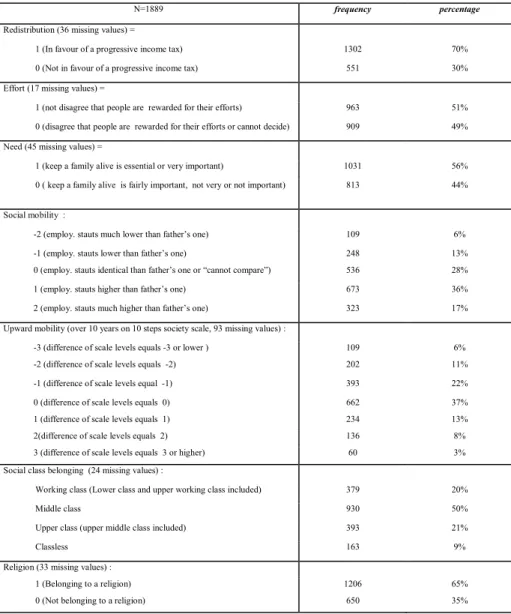
- Much higher (444 ind., 24%)
- Higher (858 ind., 46%)
- The same for everybody (386 ind., 21%)
- Lower (83 ind., 4%)
- Much lower (32 ind., 2%)
- Cannot decide” (50 ind., 3%)
The binary variable redistribution takes the value of 1 if the individual replies “much higher” or “higher” (1302 individuals, 70% of the respondents14) and
otherwise 0 (551 individuals, 30% of the respondents). This question interrogates individuals on progressive tax rates and thus has the advantage of correctly apprehending the reality of a redistributive policy. Naturally, the answer to this question is not a response concerning the opportunity of redistributing wealth but on the opportunity of redistributing wealth by a fiscal intermediary: it reveals an opinion not only regarding the necessity of redistributing but also the means of achieving it. It is, of course, an embarrassingly confusing factor but the question nevertheless has the advantage of leading to a considerable dispersion of responses compared to naively interrogating individuals on the necessity of redistributing wealth.
The public values
The aim is to find a question that allows one to measure the more or less redistributive nature of public values animating individuals (for a given representation of the origins of inequality); that, in other words, allows the effects of the parameters
$
i and.
wi to be taken into account in the choice of a more or less redistributive tax system. As this is difficult, we have opted for a question that asks respondents on the importance they attach to need, independently of any reference to the efforts supplied or the circumstances encountered. One could think that, everything being otherwise equal, an individual who attaches a great deal of importance to satisfying needs is inclined to support a redistributive tax system. The question retained was formulated as follows:“In your opinion, in deciding what an individual should earn, what importance should each of the following factors be given?
(Several items (responsibility, education…) including:) Factors necessary to keep a family alive:
- It is essential (501 ind., 27%)
- It is very important (530 ind., 29%)
- It is fairly important (546 ind., 30%) - It is not very important (126 ind., 7%) - It has no importance whatsoever (104 ind., 5%)
- Cannot decide’ (37 ind., 2%)
14
The binary variable need will take the value of 1 if the individual answers “It is essential” or “It is very important” (1031 individuals, 56% of the respondents15) and
otherwise 0 (813 individuals, 44% of the respondents).16The individuals who attach
a great deal of importance to the satisfaction of needs forge their preferences for redistribution on a largely egalitarian principle: in reference to the model, they will attach a great deal of weight to the pure redistributive term z of the normal utility
i
U . A priori, they are opposed to those who would tend to privilege rewarding effort (which would give a higher weighting to the revenue of effort in
U
i) or talent (whowould opt for a less egalitarian principle than that of maximising all the opportunities of the less well-off).
In relation to our model the preferences regarding redistribution do not only depend on the ethical principles put into play but also on the beliefs each individual forges on the efforts consented upon by his fellow citizens.
Beliefs on the origins of inequality
To apprehend the ‘beliefs regarding effort’, that is to say the beliefs on the origins of inequality, we use the question that interrogates individuals on whether, according to them, the French are justly rewarded for their efforts:
“In France, people are rewarded for their efforts:
- Strongly agree (44 ind., 2%)
- Agree (386 ind., 21%)
- Neither agree nor disagree (522 ind., 28%) - Somewhat disagree (723 ind., 39%) - Totally disagree (186 ind., 10%)
- Cannot decide” (11 ind.)
The binary variable effort is worth 1 if the individual replies “Totally agree”, “agree” or “neither agree nor disagree” (963 individuals, 51% of the respondents17)
and otherwise 0 (909 individuals, 49% of the respondents). It is certainly awkward to dichotomise this variable and it would be preferable to build a specific category for individuals responding “neither agree nor disagree”; one can nevertheless say that the variable effort distinguishes individuals who disagree with the statement from all the others. Grouping “neither agree nor disagree” with “disagree” items conducts to weaker statistical results without modifying the qualitative main conclusions.
This variable creates difficulties in interpretation for the individuals who disagree with this statement since it may correspond to individuals who consider that individuals with low disposable incomes deserve better, but also to individuals who consider that individuals with high disposable incomes deserve to earn more; it is probable that both these types of individual do not hold the same preferences regarding redistributive policy, all things being otherwise equal. This limits the interpretation of this variable on which we will come back. We nonetheless anticipate that the individuals for whom the variable effort takes the value 1 will less willingly defend a progressive tax system than the others.
Concerning the explicative variables of these opinion variables, we use the traditional socio-economic variables (age, gender, household size, income,
1545 missing values. 16
Any other grouping of items (“essential” alone and “fairly important” with “very important” for instance) leads to less convincing results (weaker correlation between dependant and independent variables).
17
educational level, professional status, home owner status) but also variables accounting for individuals’ social mobility and social class.
3.1.2 The independent variables
In the aim to introduce variables which could explain normative variables we have constructed variables characterizing individuals’ social mobility and two variables of subjective sentiment of class and religion belonging.18
Social mobility
The aim of this variable is to measure the respondent’s social mobility in relation to the father’s social status. The following question was used:
“Now please think about your current or last employment. If you compare this employment to the one your father had when you were 15, would you say that the level or status of your employment was:
- Much higher than your father’s 1 (323 ind., 17%)
- Higher 2 (673 ind., 36%)
- Approximately identical 3 (383 ind., 20%)
- Lower 4 (248 ind., 13%)
- Much lower than your father’s 5 (109 ind., 6%) - Has never been employed or cannot compare (father deceased or father has never been employed and no answer etc.) 0 (153 ind., 8%)” As we observed a roughly linear impact of these items on the dependant variables we choose to set up a quantitative variable from this question. The variable social
mobility is a
that takes the value 0 for the individuals classed in the items 3, the value –2 for item 5, -1 for item 4, 1 for item 2 and 2 for item 1. This variable thus measures respondent individuals’ social mobility. So as not to lose too many observations, the value 0 is attributed to individuals classed in the item 0 assuming that we do not make systematic errors in this way.
Upward mobility
We also deemed it useful to construct a variable accounting for the individual’s recent mobility. The following questions helped us achieve this:
“In our society there are groups that are situated at the top end of the scale, and others that are situated towards the bottom end of the scale. Here is a scale that goes from top to bottom. Where would you situate yourself on this scale?
Top 1 / 2 / 3 / 4 / 5 / 6 / 7 / 8 / 9 / Bottom 10 /
And ten years ago, where would you have classed yourself?
18
Top 1 / 2 / 3 / 4 / 5 / 6 / 7 / 8 / 9 / Bottom 10 /
The upward variable is a quantitative variable defined by the difference between the figure corresponding to the reply to the first question and that corresponding to the second question (“ten years ago”). The higher the variable, the higher the mobility: it takes the following values –3 and less (109 ind, 6% of the respondents19.), -2 (202
ind., 11%), -1 (393 ind., 22%), 0 (662 ind., 37%), 1 (234 ind., 13%), 2 (136 ind., 8%) and 3 and over (60 ind.,3%).
We equally constructed two ‘belonging’ variables: belonging to a social class and religion.
Social class
This variable is built-up from the following question:
“Certain individuals consider themselves as belonging to a social class. In which class would you position yourself?
- Lower class, the excluded 1 (11 ind.)
- the working class 2 (215 ind.)
- upper working-class 3 (153 ind.)
- middle class 4 (930 ind.)
- upper middle-class 5 (350 ind.)
- upper class 6 (43 ind.)
- do not belong to a class 7 (163 ind.)
Items 1, 2 and 3 were grouped together as were items 5 and 6. Finally, we get 4 classes: working class (379 ind., 20% of the respondents20), middle class (930 ind.,
50%), upper class (393 ind, 21%) and classless (163 ind., 9%). Religion
The religion variable takes the value of 1 if the answer to the following question was “yes”, otherwise 0.
“Do you consider yourself as belonging to a religion?
- Yes (1206 individuals, 65% of the respondents21)
- No (650 individuals, 35% of the respondents)
Before presenting the models estimated and the results of the estimations let us begin by exploring the data with some descriptive analysis.
19
93 missing values.
2024 missing values. 21
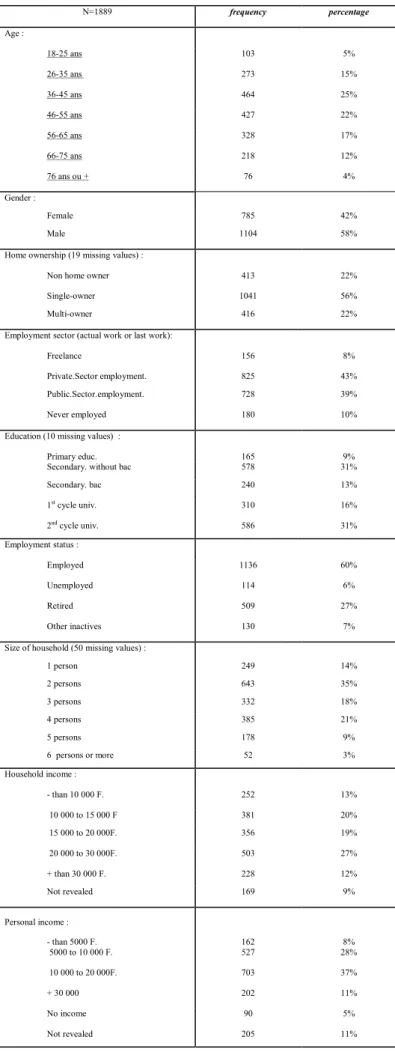
3.2 Descriptive statistics22
The first step we can take is to have a look at descriptive statistics to underline the potential links between beliefs in effort, demands regarding the satisfaction of needs and support to redistribution. We can also highlight the correlations between social or upward mobility and support to redistribution as well as between the feelings of belonging (to a religion or to a social class) and support to redistribution. Concerning this last question, it is considered that in France, belonging to a religion has decreased over three decades with the transformations of the family and the increase of the employment rate of women. Catholicism however, remains a religion with significant influence on certain social policy spheres (redistributive policies towards family for example). The question of class belonging is more complex because, it is argued, that the context of economic growth after the Second World War with the development of the welfare state, the advent of the post-fordist era and the fall of communism have contributed to the fading of social classes, and particularly of the blue collar class. But it seems that the evolution of social inequalities since the eighties has challenged this tendency.
When we cross the support to redistribution with the beliefs according to which the effort is rewarded in France, we do not obtain any evidence concerning a link between the propensity to be against redistribution when people believe that effort is rewarded in France (table III)23. As we noted previously, the interpretation of this
question, however, poses some problem. Otherwise, there is a link, although slight, between the fact of agreeing with the determination of an individual’s earnings in accordance with meeting the needs of that individual’s family and the increase of redistribution (table IV).
In other respects, we observe a mitigated link between the belonging to a religion and the preferences for redistribution: those who consider that they do not belong to a religion, however, are more in favour of redistribution that those who hold the opposite view, undoubtedly because the latter believe more in charity than the former (table V).
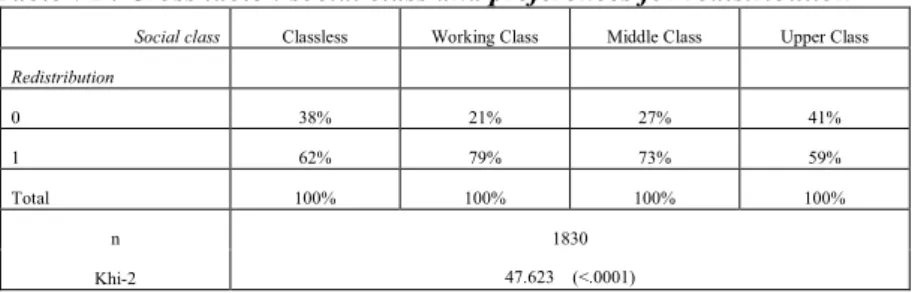
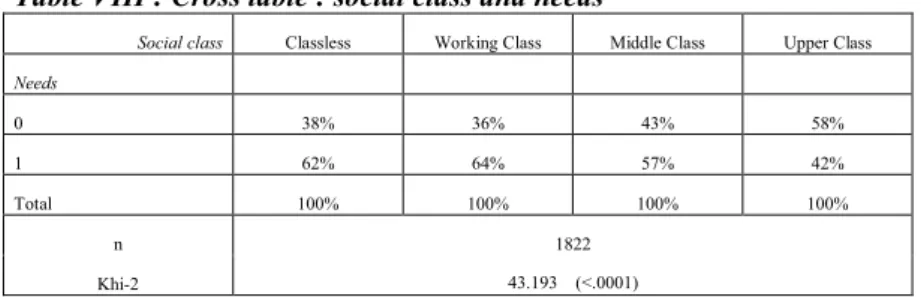
The clearest link which is obtained is between feelings of belonging to a social class and preferences for redistribution on the one hand and the normative variables on the other hand. Concerning the link with preferences for redistribution, we note that those who say they belong to the lower class or to the middle class (the most numerous one) particularly consider that redistribution through taxation is legitimate (table VI). Concerning the normative variables, we do not observe a significant link between the feelings of belonging to a class and the opinion according to which the effort is rewarded (table VII). In the contrary, a slight link is obtained concerning the feelings of belonging to class and the opinion according to which the earnings of an individual have to include satisfying the needs of the family. Those who consider that they belong to the lower class, as well as those who consider they do not belong to any particular class, have a higher propensity to agree with the fact that meeting needs should be a determinant of earnings than those who declare belonging to the other social classes (table VIII).
Lastly the belief in effort, although not linked to preferences for redistribution, appears to be weakly dependent of the opinions concerning social or upward
22In Appendix Tables I and II summarize descriptive statistics of the unweighted data base. 23
The khi2 test rejects the hypothesis according to which there is a dependence between the two variables. In what follows, we only comment the crossing between variables for which the khi 2 tests do not reject the hypothesis of dependence between the variables. We note that the variable reflecting upward mobility in particular is not linked to preferences for redistribution however there is a link between upward mobility and the belief in effort.
mobility: those who have experienced social mobility less often agree with the fact that effort is rewarded in France (table IX), a rather unexpected result. Concerning the link between beliefs in effort and upward mobility, the result is easier to explain, those who say they experienced a backward mobility are less numerous to think that effort is rewarded than the others (table X).
To conclude this sub section, it effectively seems that the link between preferences for redistribution and normative variables is not straightforward but is potentially driven by other variables, notably the “belonging variables”. In what follows, the estimations will allow us to clarify these links.
3.3 The estimated model
Beyond descriptive statistics, the estimated model must explain the link between preferences for redistribution on the one hand, and public values and beliefs on effort on the other. We thus expect that an individual defending a highly egalitarian ethical principle (like the satisfaction of needs) would generally tend to be in favour of redistributive policies whereas an individual who thinks that the poor are also the ones who make less effort are more rarely so. The basic ethical rationality of the model presented above supposes that preferences concerning redistribution can be plainly explained by normative variables ; nevertheless, from an empirical point of view, we cannot exclude that these preferences may also be directly correlated to individuals’ economic interests or other socio-economic factors.
Furthermore, we would simultaneously like to explain the public values and beliefs on effort so as to measure the weight of economic interests and other economic and social determinants. The normative rationality model must therefore permit us to define whether ethical convictions are used to mask objective interests or if they are more largely determined by social class or individual and family experiences. The underlying model is thus a simultaneous equation model that explains at the same time the preferences for redistribution, public values and beliefs on the origins of inequality based on the hypothesis that the first will be explained by the two others and not the other way round.
On this hypothesis, the model will be more precisely written as follows:
(eq.1): y1* #a1&
$
.y2 &.
.y3 &!
1.X1 &0
1 avec if and otherwise 0 (eq.2): y*2 #a2 &!
2.X2 &0
2 avec if and otherwise 0 (eq.3): y3* #a3 &!
3.X3 &0
3 avec y3 #1if y3* 10and otherwise 0 with E2 3
0
i #0and Cov2
0
i,0
j3
#rhoij.represents the redistribution variable, the effort variable andd the need variable; defines the independent variables axis and the parameters axis. The model is estimated by the maximisation of the simulated probability assuming a normal residual24.
The estimation involves the parameters , and and also the covariants of the residuals. This simultaneous estimation aims at dealing with the question of the endogenous nature of dependent variables in the equation explaining the redistribution variable (eq. 1), in other words, the endogenous nature of variables andd . More concretely, it enables taking into account the fact that an unobservable variable can simultaneously influence several : in this case, a
24
The estimation is effectuated by the Stata software mvprobit procedure that uses the GHK (Geweke-Hajivassiliou-Keane) probability simulator; see Green (2003).
“separated” estimation (rhoij#0 for all i,j) of the preceding equations risk biasing the estimations. Thus, if an unobservable variable is positively correlated to and , an estimation “separated” from equation 1 will lead to a biased estimation towards the top of , that is to say, attribute to what in fact belongs to the unobservable. The simultaneous model takes into account the influence of the unobservable onn and , by estimating a positive covariance between and : when the unobservable takes a high value, the model simultaneously ‘makes a mistake’ in the same direction for equations 1 and 2 which avoids biasing the estimation of too highly.
3.4 Estimations and results
We begin by presenting the different estimations effectuated and follow with a step by step discussion of the results.
3.4.1 The different estimations
In order to measure the biases generated by the supposedly endogenous nature of the normative variables ( and ), we estimated the equations 1, 2 and 3 separately (thus supposing that rhoij=0) and simultaneously. In addition, equation 1 was estimated on its own excluding the normative variables (public values and beliefs on effort) so as to judge the pertinence of explaining the preferences for redistribution by the same variables.
Finally, three types of estimation were effectuated:25
- separated estimations (rhoij=0)
- a global estimation of the simultaneous equations model (estimation of the rhoij) :
- an estimation of the preferences for redistribution excluding the normative variables : public values and beliefs on effort (equation 1 without y2and y3)
For the choice of independent variables (the ), we retained the significant variables (at the 10% threshold at least) in the separated estimations. Only the demographic variables (age26, gender, religious belonging) were systematically
preserved in the estimations. We also add the size of the household variable jointly with household income variables in order to capture standard of living effect. It is important to note that too many missing values do not allow us to use a more comprehensive measure of the family structure. Only the single living variable has been introduced when its effect is significant.
3.4.2 Identification strategy:
The recursive shape of the simultaneous equations model implies identification issues knowing that each dependant variable of equation (2) and (3) are also dependant variable of equation (1). In order to allow strong identification, exclusive variables in equations (2) and (3) are needed.
25
Observations with missing data have been removed from the estimations.
26Age was nevertheless removed from the estimation from the need variable equation (eq. 3) since it
Even if, from our theoretical point of view, impact of independent variables on PR should act through “normative” variables, we could not exclude the direct influence of each dependant variable on PFR (at least for the reason that we imperfectly observe beliefs and values). So we adopt an empirical process consisting in excluding variables which not significantly influence PFR in the separated estimations.
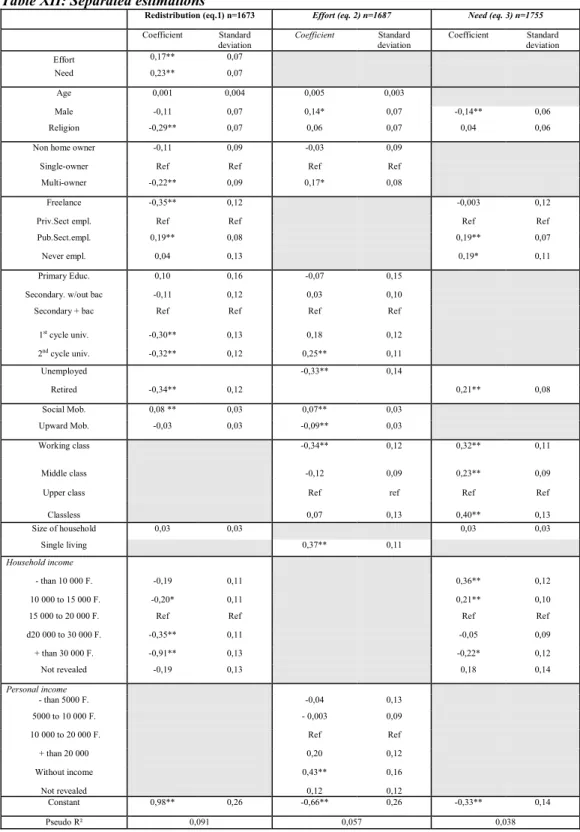
“Personal income” does not appear to be significant in PFR equation in separated estimations (eq. 1 table XII) as in simultaneous estimations (eq. 1 table XI). On the contrary, “personal income” determines beliefs on the role of effort: in the simultaneous estimations (eq. 2, table XI), people with high personal income (more than 20 000 F)27 are more likely to believe in effort which is in accordance with a
pharisian normative rationality. Hence, we use “personal income” to strongly identify the effect of “belief on effort” on PFR. Furthermore, we note that “social classes” do not influence PFR in separated estimations even though social class belonging is significantly correlated with “effort” and “need” in an expected way: respective to upper class, people declaring to belong to lower classes are less likely to believe in effort and more likely to give importance to satisfaction of need. Exclusion of “social classes” variables in equation 1 of simultaneous estimations allows us to strongly identify the role of “need” on PFR.
3.4.3 Comparison of results obtained in the different estimations
Following the previous theoretical analysis we here present the results of three estimations (tables XI, XII, XIII) which permit to indicate the extent to which 1/ the normative variables have a causal impact on the preferences for redistribution and 2/ the normative variables mask a part of self interested objectives of the individuals. The comparison between the simultaneous estimation and the separated estimations permit us to answer the first question and to note the existence (if any) of unobserved factors which can bias the value of the coefficients relative to normative variables in the separated estimations.
The simultaneous estimations of preferences for redistribution and normative judgments also permit to identify variables (reflecting, for some of them, self interest) for which the influence on the preferences for redistribution is not direct but occurs through the normative judgments. Finally, a comparison of the results of the simultaneous estimation and of the direct estimation (which does not include normative variables) of the preferences for the redistribution reveal how the inclusion of the normative rationality in the model permit to precise the understanding of the formation process of preferences for redistribution. As a matter of fact, the simultaneous estimations underline the influence of explicative variables the effect of which is masked in the direct estimations.
Separate estimations and simultaneous estimations:
The results of these estimations are presented in tables XI and XII. Estimations from the effort (eq. 2) and need (eq. 3) equations are extremely close in both phases. On the other hand, the redistribution (eq. 1) equation is considerably different notably with regard to the impact of ‘normative variables’. In parallel, we note that the covariance of residuals between equation 1 on the one side and equations 2 and 3 on the other, are important and significant which reveals that latent variables
27
The significant and positive impact of “no income” item on the role of effort is not easy to interpret knowing that one finds a majority of full time employed persons among people who choose this item. A way to understand this result is to see “no income” response as an “active” way to respond which is highly correlated with belief on the role of effort.
(unobservable) simultaneously explain the ‘preferences for redistribution on the one hand and the normative judgements on the other28; in the separate estimations (table
XII), the existence of the latent variables bias the coefficients attached to the
normative variables.
In the simultaneous estimation, the ‘normative variables’ are significant with the expected result: the more importance an individual attaches to the satisfaction of needs, the greater the likelihood of being favourable to redistributive policies, and the more an individual agrees with the statement that the French are rewarded for their efforts, the less likely she is to be favourable. It should be noted that the value of the coefficient attached to the variable need is four times lower in the separated estimations than in the simultaneous estimation.
It should also be noted that in the separate estimation of the effort equation (eq. 2 in
table XII), the sign of the coefficient is reversed which underlines the importance of
taking endogenous bias into account if one does not want to make a serious error in the interpretation and on the reality of a normative rationality.
Direct estimation (without normative variables) and simultaneous estimations: Obviously, we observe that the preferences for redistribution are slightly better explained if the variables effort and need are integrated (eq. 1 in table XI) rather than if they are not (table XIII). In addition, we note that the upward mobility variable appears as non-significant in the estimation without normative variables whereas it is significant in the simultaneous estimation. This shows that the normative rationality model that we propose allows us to reveal the relevance of certain variables concerning individual paths whereas this influence is masked by a direct estimation of preferences for redistribution. Conversely, it is worth noting that education, home ownership status, gender and public sector employment variables are not significant in the simultaneous estimations. This is in line with the theoretical model which conjectures that PFR can be explained solely by normative variables.
Using the simultaneous model, we will now specify the main determinants of preferences for redistribution and normative judgments. We distinguish the traditional socio-economic variables and the paths and membership (belonging to a social class or to a religion) variables. We consider below that the individuals benefiting from a high income have an objective interest to vote for low taxes and then to be less in favour of redistributive policies.
The influence of socio-economic variables in the simultaneous estimation (table XI) We note that the traditional economic variables have an expected influence on the ‘normative variables’ and especially on the need variable for which income clearly plays a decreasing role: the higher the household income, the less likely need is deemed an essential factor in deciding what an individual should earn. For the effort variable, individuals with the highest incomes believe more in effort than those with mid-range incomes. Knowing that the need variable has a positive influence on PFR and conversely for the effort variable, one can thus conclude, in a certain manner, that normative values hide objective interests.
The direct effect of income (household income) on preferences for redistribution (eq. 1) is not monotonous since, in relation to the 15000-20000 euros income bracket, the individuals situated in the lower income brackets are less likely to be in favour of a redistributive tax system in the same way as individuals in the higher income brackets. This result suggests that the model exaggerates the effect of the need variable on the PFR for the individual situated in the lower income brackets. In other words, it reveals that the normative variables used in the estimations are not
28
We must specify the significance of the covariance between equations 1 and 3 is robust whereas between the equations 1 and 2 it is more fragile, more dependent on the choice of independent variables.
sufficiently judicious to remove the direct influence of income on PFR. We have to note, nevertheless, that the ambiguous effect of income on PFR is not necessary an unexpected result on French data29.
Without surprise, we observe that the freelance workers are more frequently unfavourable to a redistributive tax system but that curiously, they ‘do not believe in effort’ any more than private sector employees. This result is no doubt related to the previously mentioned ambiguity of the effort variable. In parallel, the public sector employees more frequently consider need as an important remuneration criterion which makes them indirectly more favourable to a redistributive tax system than private sector employees.
The effect of status regarding property ownership on the preferences for redistribution is indirect and for the multiple property owners only; it is related to the “belief in effort”. Here again, objective interest is covered by normative justifications.
We equally note with surprise that educational level has little influence other than the more highly qualified individuals’ effect on “belief in effort”. Finally, age and gender have little significant effect other than women more frequently consider need as an important criterion than men. This is in conformity with the results of the literature (Miller 1992).
The individual path and belonging variables
The most immediate and perhaps the most surprising result is the clear influence of the feeling of belonging to a social class, independently of income level and status variables. Social class appears as far more relevant in our estimations than the socio-professional variables that we relegated to explicative variables. This influence is certainly not direct as it is working through normative variables, but it is nonetheless real. The effects of this ‘belonging’ variable is far less ambiguous than the income effects: the working and middle classes more frequently consider need as being an important criterion than the upper class, and the working class ‘believes less in effort’ than the upper class. A good knowledge of these feelings of belonging also means a better knowledge of the preferences for redistribution.
At this stage, it should be noted that the variables characterising respondents’ parents never appear as significant; their influence is entirely captured by the other explicative variables and more particularly, belonging to a social class.
Belonging to a religion has an indisputable effect on preferences for redistribution and fairly surprisingly, no effect on normative variables. This absence of effect may be explained in the French case by the importance of catholicism. Catholicism is not either a religion which insists directly on needs. The needs satisfaction may rather be an individual charitable act towards poor people. The “need question” in the survey may then be interpreted in a particular manner by the catholic believers. Another explanation may also be that mentioned by Dejeiha et al. (2007) according to which the religious individuals consider that their faith is a kind of psychological insurance that may be opposed to state public insurance. It is so probable that believers more frequently disagree with State intervention in the form of redistribution via the tax system and prefer a ‘spontaneous’ redistribution. In all cases, belonging to a religion is clearly a reliable ‘defiance’ marker regarding a progressive fiscal system which is also clearly defiance vis-à-vis the government.
The direct influence of social mobility on PFR is positive: the probability for an individual to be in favour of a redistributive policy is higher if they have benefitted from ascending social mobility. Nevertheless the global effect is ambiguous since its indirect effect through belief on effort is negative: as we can expect it, ascending
29See Boarini, Le Clainche (2009) who underline the ambiguous effect of incomes. The results are
social mobility favours belief in effort30. The effect of upward mobility is also
ambiguous. It has a negative influence on the beliefs on effort31 and then in fine a
positive influence on preferences for redistribution. Its direct effect is, however, negative in opposition with the direct effect of social mobility. Such a result could be connected to an extended interpretation of Benabou and Ok (2001) Poum hypothesis. Indeed we can interpret this result as reflecting the frustration of the individuals who, having recently benefitted from an improvement in their situation, do not want see their well-being diminished by increased tax levels. Whatever the case may be, the career path and belonging variables undeniably play an important role in explaining preferences for redistribution which supports the idea of carrying out research in greater depth in order to better understand normative judgements. Again the results we obtain could be put in face of results obtained in the lab where social identification to particular groups is considered as shaping preferences for redistribution beyond mere self-interested goals (e. g. Klor, Shayo, 2010). Although social class belonging go beyond a particular social identification process to a group, we can consider such a belonging as a kind of generalization in a given society of social identification processes.
CONCLUSION
The model presented in section 2 adopts as a starting point the idea according to which the preferences for redistribution are the expression of a same normative rationality based on the principle of equalization of opportunities. But the preferences for redistribution diverge for two reasons: the dispersion of beliefs on the origins of inequality and of public values as resulting from more general aversion to inequality. The estimations run in section 3 partially validate such reasoning since the normative variables used partially explain the preferences for redistribution. These estimations also show that it is necessary to simultaneously explain the formation of preferences for redistribution and the normative judgments (beliefs on origins of inequality as resulting from more general aversion to inequality) to avoid confounding factors biasing the estimations.
These normative judgements illustrate how individuals use rational ethics to justify partisan preferences: indeed these judgments are in part determined by economic variables reflecting self-interest. They are also in part explained by an individual’s social mobility and class which notably tends to confirm the idea that ‘beliefs regarding effort’ are determined by individual experiences. This allows us to reveal why it is so difficult to satisfactorily explain ‘normative variables’ that are undoubtedly extremely idiosyncratic.
These results militate in favour of deepening the normative foundations of preferences on redistribution especially to better understand the interactions between normative variables, individual path, social identification process, beliefs and personality traits.
Reference list
30
In comparisons with results of section 3.2 (descriptive data) the link between belief in effort and social mobility is reversed. It underlines the importance of controlling by socio-economic variables.
31In comparisons with results of section 3.2 (descriptive data) the link between belief in effort and