HAL Id: tel-01297462
https://pastel.archives-ouvertes.fr/tel-01297462
Submitted on 4 Apr 2016HAL is a multi-disciplinary open access archive for the deposit and dissemination of sci-entific research documents, whether they are pub-lished or not. The documents may come from teaching and research institutions in France or abroad, or from public or private research centers.
L’archive ouverte pluridisciplinaire HAL, est destinée au dépôt et à la diffusion de documents scientifiques de niveau recherche, publiés ou non, émanant des établissements d’enseignement et de recherche français ou étrangers, des laboratoires publics ou privés.
Sylvain Colombero
To cite this version:
Sylvain Colombero. Instantiating through collective bricolage : the case of the Listed-Buildings In-stitution. Business administration. Ecole Nationale Supérieure des Mines de Paris, 2015. English. �NNT : 2015ENMP0033�. �tel-01297462�
École doctorale n° 396 : Économie, Organisations & Société
présentée et soutenue publiquement par
Sylvain COLOMBERO
le 14 décembre 2015
Instancier grâce au bricolage collectif: le cas de l’Institution des Bâtiments Protégés
Instantiating through collective bricolage: the case of the Listed-Buildings Institution
Doctorat ParisTech
T H È S E
pour obtenir le grade de docteur
préparée dans le cadre d’une cotutelle entre
l’École nationale supérieure des mines de Paris
et la Copenhagen Business School
Spécialité “Sciences de Gestion”
Directrice de thèse : Eva BOXENBAUM
T
H
È
S
E
Jury
M. Franck AGGERI, Professeur, CGS, MINES ParisTech Président
Mme Eva BOXENBAUM, Professeur, CGS, MINES ParisTech Examinatrice
M. Kristian KREINER, Professeur, IOA, Copenhagen Business School Rapporteur
M. Gerardo PATRIOTTA, Professeur, Nottingham University Business School Rapporteur
Instantiating through collective bricolage:
the case of the Listed-Buildings Institution
Ph.D. Thesis
of
Sylvain COLOMBERO
Supervisor
Eva BOXENBAUM
Assessment Committee
M. Franck AGGERI, Professor, CGS, MINES ParisTech
M. Kristian KREINER, Professor, IOA, Copenhagen Business School
M. Gerardo PATRIOTTA, Professor, Nottingham University Business School
M. Charles-Clemens RÜLING, Professor, HOS, Grenoble École de Management
CGS – MINES ParisTech / PSL Research University (i3 – UMR CNRS 9217) – FranceIOA – Doctoral School of Organisation and Management Studies – Copenhagen Business School, Denmark
MINES ParisTech et Copenhagen Business School n’entendent donner aucune approbation ni improbation aux opinions émises dans cette thèse. Ces opinions doivent être considérées comme propres à l’auteur.
À Laura, mon frère, mes parents et à l’appel de Max Brisson
ACKNOWLEDGEMENTS
“I can’t do without you” – Caribou (2014)
The last three years and almost a half are really difficult to explain and I guess acknowledgements are necessary to make the Ph.D. fellow, i.e. me, understand that without the following people, this phase should have been more difficult than I feel it was.
Above all, I would like to thank my supervisor Eva Boxenbaum. Beyond all the help she gave to me – and I know she dislikes such a word – she was my mentor as she allowed me to understand the academic field and outdo myself to get my place in it. Either on a professional or on a personal level, she encouraged me to push my boundaries forward while interacting with me in a very instructive and always kindly way.
Then, my sincere thanks go to my assessment committee, who accepted to evaluate my work: Pr. Franck Aggeri, Pr. Kristian Kreiner, Pr. Gerardo Patriotta and Pr. Charles-Clemens Rüling.
In a similar vein, I wanted to thank the people who believed in my ability to succeed in doing a Ph.D. : from the BETA in Strasbourg Laurent Bach and Gilles Lambert, and from the CGS, Emmanuel Coblence, Jean-Claude Sardas, Blanche Segrestin and especially Frédéric Kletz.
During my thesis, I was lucky enough to learn near a lot of inspiring people. First of all, thank you Peter Kjær and Signe Vikkelsø to welcome me within the IOA family, both formally and informally and thank you Candace Jones to accept me at Boston College. Then, thank you: Frans Bevort, Lærke Højgaard Christiansen, Thibault Daudigeos, Raffi Duymedjian, Sébastien Gand, Anne-Françoise Garçon, Armand Hatchuel, Lise Justesen, Philippe Lefebvre, Frédérique Pallez, Jesper Strandgaard Pedersen, Christophe Tuffery and Jean-Michel Wahart.
journey, and the associated visitings, would have been impossible: Céline Bourdon, Tina Brun, Stéphanie Brunet, Ane Lingren Hassing, Martine Jouanon, Daria Le Bozec, Lene Lillebro, Michael Smith, Pamela Vaulot and the people from the MINES ParisTech Foundation and the Région Île de France.
My sincere thanks also go to the people who have enabled and allowed this study but whom I promised anonymity.
I had the rare chance to meet wonderful people all around the world who supported me either professionally or personally or, most of the time, both. So I would like to thank, in disorder of “appearance”: Benjamin Cabanes, Mélodie Cartel, Catherine Casler, Frédéric Garcias, Maud Guy-Coquille, Ben Hawbaker, Sophie Hooge, Fabien Jean, Rasmus Ploug Jenle, Maya Christiane Flensborg Jensen, Olga Kokshagina, Shenle Pen, Elvira Périac, Rebecca Pinheiro-Croisel, Rocky Rockwell, Yohann Sitruk, Virginie Svenningsen and Germain Tesnière.
I would like to express my gratitude to my “P12” friends, Kenza El Quaoumi and Lucie Noury. We remained strong and helpful, we had good laughs and even though it was often hard and painful, sometimes even impossible to stay around each other, we were here for one another, at least you were here for me.
Personally, I would like to thank all my likely lads I was not able to see as much as I wanted during this period but who never abandoned me even though they did not well understand what I did and why: Jérôme Bagyoni, Roxane Chafei-Garnier, Jean-Baptiste Grossetti, Thibault Hartmann and Vincent Rossetto.
Even more personally, my thoughts are for my entire, and now extended family: my parents, Corinne and Jean-Michel and brother, Anthony Colombero, who kept believing in me and stood next to me as they always did despite my (very) bad temper and my
doubts; my parents-in-law, Corinne and Éric, sister-in-law Chloé and nephew Sasha Pappalardo, who made everything they could to entertain and take care of me during the writing exercise.
Last but not least, I would like to thank Pr. Pierre Burbaud who provided me, every three-months, with the medical help I needed to keep working. And in parallel, a big cheers to my friends from Total Heaven Records, Bordeaux, who supplied the soundtrack of my reflection on the same time-basis.
To Laura who went into that long journey alongside me with an aide that I am convinced I was the only one ever to get. She gave me everyday the reason and the strength to succeed even when I was bloody far away.
“I was born very far from where I'm supposed to be, and so, I'm on my way home, you know?“
Bob Dylan, No Direction Home (2005)
“In Architecture, we do not invent, we can only submit to the analysis already known elements, combine them, appropriate them, but not create; our art is so compelling in the means of production that we must necessarily use the past to build in the current times“ Eugène Viollet-le-Duc, Entretiens sur l’Architecture (Entretien n°6, Volume 1, 1863)
TABLE OF CONTENTS
ACKNOWLEDGEMENTS ... 9
TABLE OF CONTENTS ... 17
INTRODUCTION ... 21
1.
The theoretical context: instantiating through collective bricolage ... 24
1.1.
An alternative study on instantiation ... 24
1.2.
The interest of intertwining Scandinavian Institutionalism & Collective Bricolage .... 27
2.
The empirical challenge: the question of a third way to respect the embodied Heritage of listed buildings ... 29
2.1.
The original debate ... 30
2.2.
The current context of listed buildings ... 32
2.3.
Intervening on listed buildings ... 36
2.3.1.
Abandoning the building’s function ... 36
2.3.1.1.
The museumization ... 36
2.3.1.2.
The adaptive re-use ... 37
2.3.2.
Keeping the building’s function: the set aside solution ... 39
3.
The dissertation’s aim & anatomy ... 41
3.1.
The “so what?”: findings and contributions ... 41
3.2.
The thesis’ anatomy ... 42
PART 1 – THEORETICAL FRAMEWORK ... 45
Chapter 1: The Institution and the Artifact ... 47
1.
The Institution ... 47
1.1.
What is an institution? ... 47
1.2.
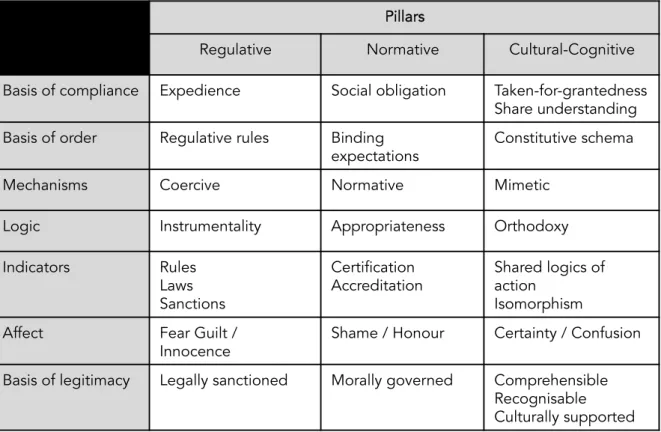
The definitions of the three pillars ... 49
1.2.1.
The regulative pillar ... 50
1.2.2.
The normative pillar ... 51
1.2.3.
The cultural-cognitive pillar ... 53
1.2.5.
Building the legitimacy with the three pillars ... 55
1.3.
The institutional carriers ... 56
2.
The Artifact ... 59
2.1.
The introduction of materiality within Neo-Institutionalism (NI) ... 59
2.2.
What is an artifact? ... 60
2.
The Scandinavian Institutionalism (SCI) ... 68
2.1.
Framing the institutional elements: a preliminary step ... 69
2.2.
From the frame to the artifact: the translation ... 70
2.3.
Beyond the translation of meaning: the question of the material construction ... 71
3.
The Bricolage ... 73
3.1.
The Bricolage in Organisational Studies (OS) ... 73
3.2.
Intertwining the bricolage roots and its contemporary views ... 75
3.2.1.
The resource and the repertoire ... 75
3.2.2.
The dialogue ... 77
3.2.3.
The outcome ... 78
3.3.
The collective bricolage ... 79
3.4.
The bricolage in a neo-institutionalist context ... 81
3.5.
The question of the bricolage process ... 82
PART 2 – RESEARCH DESIGN ... 85
Chapter 3: My Research Paradigm ... 87
1.
The constructivist paradigm ... 88
2.
The grounded-theory methodology (GTM) ... 90
2.1.
The origins and main characteristics ... 90
2.2.
The constructivist grounded-theory ... 92
3.
So why do I choose to use a constructivist GTM? ... 93
Chapter 4: The Empirical Context ... 97
1.
The choice of the empirical field ... 97
2.
The Listed-Buildings Institution (LBI) ... 98
3.
The LBI in Denmark and France ... 102
4.
The case selection and the six cases ... 103
4.1.
Nyboder ... 105
4.2.
Sølvgade Skole ... 106
4.3.
Munkegård Skole ... 108
4.4.
The French Pantheon ... 110
4.5.
The École des Mines – The Vendôme Hotel ... 112
4.6.
The Molitor swimming pool ... 113
Chapter 5: Data Collection and Analysis ... 117
1.
Type of data collected ... 117
1.1.
The interviews ... 118
1.2.
The documents: the archives or texts ... 121
1.3.
The photographs ... 122
1.4.
The observation: the participant-as-observer ... 123
PART 3 – FINDINGS & ANALYSIS ... 129
Outline of Part 3 ... 131
Avant-propos: The building work’s steps and actors ... 135
1.
Initiating the works: the preproject ... 135
1.1.
The client and the desire of works ... 135
1.2.
The competition (or not) and the selection committee ... 137
2.
The project: the client and the chosen architecture firm ... 140
3.
The construction phase ... 143
Chapter 6: Designing the interpretative frame “building’s authenticity”: the symbolic construction of the instantiation ... 147
1.
The question of the building’s authenticity ... 147
1.1.
An overall definition of authenticity ... 148
1.2.
The authenticity in listed building’ construction works ... 149
1.3.
The challenge of defining authenticity ... 153
2.
The interpretative frame ... 154
2.1.
The cultural-cognitive tool ... 154
2.2.
The regulative tool ... 158
2.3.
The normative tool ... 164
2.4.
An a posteriori construction ... 170
3.
Discussion of Chapter 6 ... 174
3.1.
A frame built using the three pillars ... 174
3.2.
The extended role of the interpretative frame ... 176
Chapter 7: The collective bricolage of the building: the material construction of the instantiation ... 179
1.
Balancing the artifact construction: intertwining the “old” and the “new” ... 179
1.1.
An addition of two approaches ... 179
1.1.1.
The enactment of Heritage ... 181
1.1.2.
The adaptation of New ... 187
1.2.
Testing the solution: a dialogue with the frame ... 196
2.
Selecting the resources ... 199
2.1.
A blurred decision-making process ... 199
2.2.
The six selection criteria ... 201
2.2.1.
The individual preference ... 201
2.2.2.
The collective and field alignment ... 204
2.2.3.
The economics ... 207
2.2.4.
The technical features ... 210
2.2.5.
The time ... 213
2.2.6.
The space ... 215
2.3.
A simultaneous dialogue between actors’ repertoires ... 218
3.
Discussion of Chapter 7 ... 222
3.1.
The dialogue’s first level: between the actors and the interpretative frame ... 222
3.1.1.
To test and balance the outcome ... 222
3.1.2.
To enhance creativity and innovative solutions (in a limited scope) ... 225
CONCLUSION ... 235
1.
The main contribution of the instantiation construction process ... 237
1.1.
Overview of the main findings ... 237
1.2.
A first theoretical contribution: bridging Scandinavian Institutionalism and Bricolage through the interpretative frame design: the preliminary step of collective bricolage ... 239
1.3.
A second theoretical contribution: collective bricolage as a structured process is not improvisation ... 242
2.
Limits and further research perspectives ... 244
3.
Relevance for practitioners ... 246
REFERENCES ... 249
LIST OF ACRONYMS ... 273
LIST OF FIGURES, TABLES & PICTURES ... 275
INTRODUCTION
The current introduction presents to the reader the overall topic while highlighting the research question and the associated key findings. After focusing on the theoretical context that emphasises the overlooked concept of “instantiation”, I explain the empirical and societal challenge related to the modernisation of listed buildings versus their embodied Heritage respect. The introduction ends with a dissection of the different parts of the dissertation.
All along my Ph.D. journey, the tale of the famous temple named Ise Grand Shrine, or Ise Jingū, came repeatedly in my exchanges with my informants. However they had never seen this sanctuary because its entry is forbidden for commoners in regards to the Imperial “mirror” relic it has been sheltering forever. In the city of Ise, Japan, this Shinto temple has been destroyed and rebuilt in the exact same manner every 20 twenty years since 660 A.D. following an ancestral tradition (Hladik, 2008). For the Japanese, the “new” temple is identical to the “old” one – in both materials and embodied Heritage values – because they do not distinguish such concepts as the word “authenticity” simply does not exist in the Japanese language (Ito, 1994).
In Europe, such a perception is inconceivable, especially in regards to listed buildings,
i.e. protected monuments that highlight national pride or memory. Why? Because even
though such a building has to convey one single message at the end of a construction works process, both “old” and “new” elements exist per se and led to the never-ending question of what defines its patrimonial properties. Indeed, when a listed building experiences – or undergoes for certain people – intervention works, they inevitably modify its “authenticity”, which is nonetheless the core concept that actors have to respect in order to apprehend the embodied Heritage of the listed building and maintain its legitimacy.
When such an embodied Heritage remains saved and defended by an institution, which was the case in both Denmark and France, how is then it possible to implement such works without disrupting its? To what extent does this institution allow some “gray zones” – i.e. areas where the official rules could be legitimately overpassed (Anteby, 2008)? Or put differently what is the degree of freedom the stakeholders of a project benefit from to preserve patrimonial features while adding new elements to old ones? Beyond the challenge to respect and emphasise its symbolical aspect, what constitutes a contemporary problematic is consequently the question of the materiality of the building, and how such material elements are manipulated and selected. Indeed the symbolic and material parts of the building seem to be linked as one affecting the other and vice-versa. So how the “old” and the “new” are intertwining, without jeopardising the embodied Heritage of a listed building, is the main phenomenon I am going to investigate in this
dissertation both theoretically and empirically through the empirical context of the Listed-Buildings Institution.
1. The theoretical context: instantiating through collective bricolage
In regards to the empirical study, I decide to discuss such phenomenon with the help of the neo-institutional theory as the thesis comes to study the tangible modification of a material object by actors, whose aim is nevertheless to maintain its institutional legitimacy. More specifically, I try in the dissertation to explain one of the dynamic links that may exist between actors, artifact and an institution through collective bricolage and what I refer to as the instantiation construction process. The purpose of my research is thus to understand how actors modify an instantiation while continuing to convey the institution that circumscribes it.1.1.
An alternative study on instantiation
In a general manner, artifacts can convey institutions (Blanc & Huault, 2014). Or stated differently, actors can transform and manipulate material objects so they reflect and shape “cultural-cognitive, normative and regulative elements that provide stability and meaning to social life” (Scott, 2008: 222). Because it operates by representing the culture, values and symbols associated with a particular institution and/or by being infused with new institutional content, an artifact is named instantiation (Hilpinen, 2011). Studies on instantiation increased during the last few years (cf. Dover & Lawrence, 2010; Carlile, Nicolini, Langley, & Tsoukas, 2013; Jones, Boxenbaum & Anthony, 2013). However these studies tend to emphasise the institutional consequences of modifying an instantiation. Scholars try to fill the gap that existed “between the studies of material and ideational aspects of institutionalisation” (Zilber, 2008: 164) and “to tackle the role of materiality and its relationship with agency” (Wijen & Ansari, 2007 in Jones & Massa, 2013: 1126).
Regarding its growing academic consideration, the neo-institutional theory highlights the various essential roles an instantiation can have on institutional processes (Jones & Massa, 2013) and to what extent actors can use artifacts “that instantiate established institutions to facilitate the transition between past habits and the elaboration of new habits for the future” (Gawer & Philipps, 2013 quoted in Lawrence, Leca & Zilber, 2013: 1028).
Beyond its essential institutional role as a way to vehicle and diffuse the institution (Scott, 2003), an instantiation has other institutional purposes. One additional role is to carry tacit knowledge or collective memory and to materially mirror the product of human actions (Gagliardi, 1990). Instantiations enable agency but also embody cultural values that actors want to communicate in order to make other people understand the conveyed institution (Rafaeli & Pratt, 2006): e.g. the use of buildings in Berg and Kreiner (1990). Moreover instantiations are actually used to respond to novel practices or jolts that can destabilise the existing institutional order, such as when actors failed “to reproduce legitimated or taken-for-granted actions” (Lawrence & Suddaby, 2006: 217). Reciprocally, as an instantiation is composed of various physical objects (Jones et al., 2013), the addition of a new material element can alter the meaning of the instantiation (McDonnell, 2010) and thus jeopardises its institutional legitimacy. Along the vein of Pinch (2008) who already explores the role of materials in the durability of institution and in the anchoring of its legitimacy, recent studies argue that the modification or modernisation of an instantiation by means of material resources can, under certain circumstances, lead to institutional change (Patriotta, Gond & Schultz, 2012; Currie, Lockett, Finn, Martin & Waring, 2013; Raviola & Norbäck, 2013).
Moreover, actions performed on an instantiation impact the institution (Jones & Massa, 2013). For this reason, they can entail the integration or the removal of symbolic institutional dimensions (Suchman, 2003) and thus undermine the legitimacy of an instantiation because it echoes an institution. Indeed, regarding the instantiation, the cognitive and symbolic construction attached to it is de facto as important as the material one, because they “together cohere and endure over time” the institution (ibid, 2013: 1127). Therefore, an instantiation plays nowadays various roles in neo-institutionalism.
However, in regards to the modification of an instantiation, the closest scholars who studied this phenomenon are only focusing on a bottom-up approach, i.e. from the material use by actors to its impact on the institution. Or put differently, they study how and to what extent certain actors radically modify the meaning of the instantiation, the practices to build it, and finally its institutionalisation (Jones, Maoret, Massa & Svejenova, 2012). The actors in questions are those who manipulate materials that themselves convey institutional ideas, symbols and inherent properties.
Previous studies analyse the premeditated institutional consequences of actions performed on the artifact; however they are not concentrated their analysis on the transformation of the artifact itself. More interestingly, missing from the literature is a multi-level approach – including actors, institution and artifact – that can shed light on the instantiation and its material and symbolical constitution (cf. ibid, 2013). Scholars have in fact overlooked the question of the construction, or modification, of an instantiation in a context where the institution is established and does not change. More precisely, no previous studies have looked at instantiations, where the actors do not have any institutional purpose aside from, at best, respecting the institution in place. Yet, the interest in doing so stems from the importance of understanding where the meaning of the material resources is coming from and how is it possible to tangibly blend them while ensuring institutional stability.
Consequently in the current manuscript, I will focus on that overlooked issue while aiming to extend the works of Gieryn’s (2002) and Jones and Massa’s (2013) who argued previously that such instantiation can be apprehended as a both collective symbolic and material construction through an institutional context where actors, who evolve in it, do not want or intend to change. Regarding what missed and has never been studied, my contribution consists in outlining how such material resources and their associated meaning are collectively selected and then intertwined during the act of construct an instantiation.
1.2.
The interest of intertwining Scandinavian Institutionalism
& Collective Bricolage
The doctoral research project explores, through a constructivist Grounded-Theory methodology (Charmaz, 2014) what an organisation – here a project-team associated with specific construction works – needs to construct, both symbolically and materially, an instantiation while preserving its institutional legitimacy. The dissertation provides thus an analysis of how actors (re)build an instantiation through a two-step dynamic in which they take into account both the present institution and the existing artifact, i.e. the listed building.
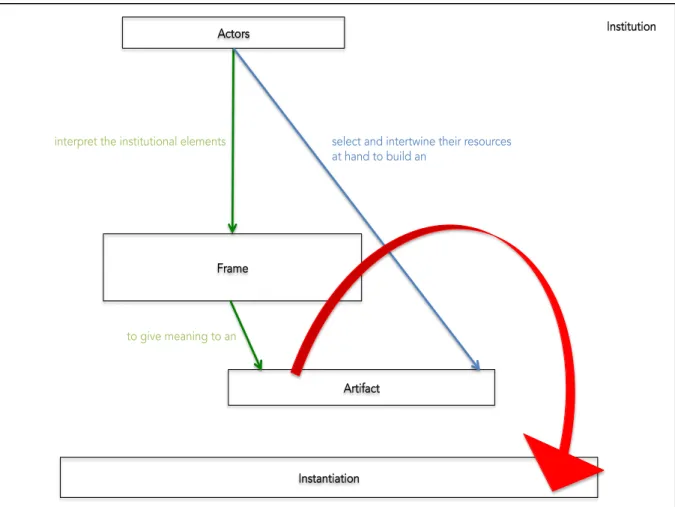
To better understand and explain the mix between both cognitive and tangible dimensions, I propose an alternative perspective on the instantiation construction process through a focus on the agency. To handle that alternative, I root the current study in the Scandinavian Institutionalism school as it highlights the dynamics of translation, i.e. the conceptual transformation from institutional ideas into practices and/or into objects (Czarniawska & Joerges, 1996). More specifically, it is the mobilisation of the “frame” notion that appears as interesting because this cognitive interpretation scheme helps actors to interpret institutional elements from a given institutional context (Goffman, 1974). This literature underlines the different uses of the institutional elements to shape a collective interpretation, and by extension, associated practices (Boxenbaum, 2006). Nevertheless, the design itself of such a symbolic construction that has to be translated into an artifact is less clear – but necessary. Indeed, understanding what actors need to unfold a “framing” action will complete and link prior knowledge of scholars relating to the translation process from ideas to materials (Czarniawska & Sevón, 2005), the consequences of the materialisation of such ideas (Beasmish & Biggart, 2012) and the role that such artifacts have as institutional carriers (Yanow, 2006; Jones et al., 2012; Monteiro & Nicolini, 2014).
I propose that the symbolic part of the instantiation construction can better be apprehended and studied through the framing design and an exploration of its institutional constituents. What is still unknown and completely overlooked, however, is
artifact which will materialise the institutional frame, are selected and intertwined in a context where the institutional legitimacy needs to be respected and thus where the institution does not change despite the integration of new materials.
De facto, I emphasise the combination of symbolic and material elements through the
existence of an existing cognitive structure. I thus extend the Scandinavian Institutionalism (SCI) by integrating the dynamics of bricolage as implemented by actors to both conceptualise and materially build an object by mixing resources and their associated meanings, which can thus in combination convey institutional meaning (Dover & Lawrence, 2010). Coming from Lévi-Strauss’ The Savage Mind (1962/1966), bricolage is defined as “making do by applying combinations of the resources at hand to new problems and opportunities” (Baker & Nelson, 2005: 333). By extension, collective bricolage consists in the sharing of all the actors’ repertoires of resources, via the dialogue they implement with their personal resources. Consequently, actors collectively achieve a shared objective by crafting a unique outcome that differs according to which resources actors decide to use and succeed in intertwining (Duymedjian & Rüling, 2010). The empirical context, and the obligation of actors to deal with the existing building and a limited number of material resources to restrict an embodied Heritage disruption, also participates in the reason of the choice of the Lévi-Strauss’ notion. Indeed, it could illustrate the mechanisms of dialogue and decision-making in case of collective bricolage in regards to resources at hand selection. Both the dialogue and the decision-making processes currently remain poorly studied by scholars (cf. ibid, 2010; Boxenbaum & Rouleau, 2011; Perkmann & Spicer, 2014).
Through the study of action and agency, my main intention is thus to link SCI and Collective Bricolage approaches to initiate the shaping of a robust instantiation construction process. The interest lies in the analysis of the symbolic and material crafting of an instantiation while focusing on what are the constituents of the frame; how is this frame mobilised to enable collective bricolage, and how are the relevant material resources selected?
De facto, the research question guiding this dissertation is:
How do actors, through collective bricolage, modify
the instantiation of an established institution?
2. The empirical challenge: the question of a third way to respect
the embodied Heritage of listed buildings
To answer my research question, I present thus my results in the patrimonial architecture field through the case of the Listed-Buildings Institution (LBI), which includes concrete listed buildings, dedicated practices, regulations, etc. More especially, I focus on the case of listed buildings’ intervention works named contemporary adjustments (Rouillard, 2006), such as renovation or extension, where the stakeholders who work on the project have to simultaneously rescue the authenticity of a building and to transform it into a modern installation while keeping intact the function for which the building was built with or protected for. More specifically, I analyse six different listed buildings located in either Denmark or France1, where the approaches of Heritage protection are
quite similar (Jokilehto, 1986). I study how actors intertwine the “old” and the “new” both symbolically and materially, i.e. respect the embodied Heritage while integrating new materials or requirements. Both the survival and the legitimacy of the building depend on its intervention works (Diez, 2012).
In regards to the theoretical context, the aim of the dissertation is thus to understand how an artifact “listed building” is modified while respected the established institution that rules it, i.e. without being “unlisted” and transformed into a mundane artifact. And if the challenge matters, it is mainly because the embodied Heritage of listed buildings, which is evaluated by actors through their interpretation of the building’s authenticity, can be jeopardised during such intervention works. To fully understand how actors can
respect listed buildings’ embodied Heritage despite those works, I firstly have to introduce to the reader to what extent it can be jeopardised.
2.1.
The original debate
If the Listed-Buildings Institution (LBI) that protects such building is not reconsidered or challenged per se, the current concern regarding the embodied Heritage of listed buildings is actually associated with the question of which buildings deserve to be or not to be listed. Comprehended through a philosophical motivation and approach, this question emerged historically in 1903 into Aloïs Riegl’s book The modern
cult of monuments: its character and origin, which is still considered as a “fundamental reading” for everyone who wants to understand, or work on listed buildings Heritage. For
Riegl2, a monument is “a work created by the hand of man and built for the specific
purpose to keep always present and alive in the consciousness of future generations the memory of such action or such a purpose (or combinations of one and the other)” (1903/2013: 43). Following that essential definition, the monument is a deliberated construction whose destiny was a priori defined. Its purpose is “intentional” and it is consequently built to last and survive over time. On the contrary, what he named the “historical monument” is not originally intended and designed for such a purpose, which is here “unintentional”. This purpose is made a posteriori by the convergent looks and opinions of both historians and amateurs who select it from the mass of existing buildings: building not monument! Indeed all buildings can be converted into an historical artifact without originally having a memorial destination (Choay, 2007). Such historical feature is associated with the fact that nothing can replace what matters, as such thing is no longer and will never happen again. The reason why such historical value can be linked to an artistic or aesthetic one is that such a characteristic is judged ex post
by common people3 who do not need any scientific of historical knowledge to appreciate
visual qualities (ibid, 1903).
Indeed, such building gains the “monument” designation in a subjective manner and it is in fact modern actors who give to the building the meaning that deserves to be remembered and protected through a listing, as the original builders sought to satisfy their own ideal or practical needs or requirements without thinking on bequeathing to future generations the testimony of their artistic and cultural activity. In the case of such an unintentional monument, the value is therefore not attached to the work in its original state, but in the representation of it since its inception. This underlined and relative value can in fact be associated with its age as well as its initial use (Arrhenius, 2004).
Beyond that opposition, both “intentional” and “unintentional” buildings are nevertheless characterised by a commemorative or a memory value and if there is a debate, it is because these two kinds of monuments are inclusively considered while talking about listed buildings. And because such value constitutes the main reason why actors thought they originally deserve to be listed, the debate is continuing, as they de
facto both need maintenance so they could be transmitted to the next generations.
Basically, to maintain an intentional commemorative value, the monument must simply be maintained in a pristine state, i.e. as close as possible to its original state to avoid jeopardising the monument’s authenticity (ibid, 2004: 77).
However, for the unintentional monument, the approach of works is complicated for numerous reasons. An initial reason is that the embedded value that matters evolves over time and people change; but also because some present-day values, such as the use-value or the art-use-value which can rule the consideration of the other use-values involved – for instance materially –, deserve a dedicated and careful treatment in case of construction works as they could deny or disrupt the commemorative side of the object in regards to the quest of its modernisation, i.e. its best functional performance or its relevant restoration (Choay, 2009). Indeed, the past acquired here a contemporary value in terms of modern creation (ibid, 1903). For another reason, the maintenance of such a building
is besides much more complicated as it has been built without any concern for its lasting. As one French Professor of Art History explained4:
“Today we have of course protected and listed buildings that did not have this intentional message. Among all these listed buildings, there are obviously ones that were built to last, but other ones were not. Honestly, some buildings could last 100 or 150 years but after that ... here we support things that would have been disappeared otherwise a long time ago."
By “here”, the Professor meant the Western countries where the protection of unintentional monuments remains specific but also quantitatively extremely important
(ibid, 2004).
2.2.
The current context of listed buildings
Since the 18th century, the Heritage of listed buildings has been highlighted and
accepted, with a boost during the end of the sixties in regards to worldwide societal change (Bercé, 2000). In contemporary times, it experiences an important exposure as well. The multiplication of seminal books (cf. Babelon & Chastel, 1994) or press releases publications and broadcasted Telly-shows focusing on such topic remain ones of the best examples of its popular consideration – e.g. the overall media coverage of the last 2015 European Heritage Days named Kulturnatten in Denmark or the Journées du Patrimoine in France.
But what best demonstrates the interest of Heritage in those two Western countries is the phenomenon that simultaneously sees the cessation of the destruction of old buildings to their – sometimes irrationally – listing, which leads to an increasing, and perhaps too numerous, number of listed buildings whose owners or operators do not know what to
do with them, e.g. churches whose destruction always leads to controversies (De Montclos, 2014a). As one former ICOMOS5 member explained to me:
“a long time ago, we did not hesitate to destroy buildings but now it is more difficult … maybe because of the crisis context which makes people nostalgic about the past … I do not know …”
Such phenomenon is even stronger because regarding the original debate on what building deserved to be or not to be listed, there are currently too many listed “unintentional” monuments that were not originally supposed to be protected. As a French State Architect pointed out:
“At one point, I tried to give an opinion that makes sense regarding the current issues. So I started systematically to give unfavourable recommendation for the listing requests I received while saying “we have already too many listed buildings, so let us take care of what we already have unless it is an outstanding monument”. We already have many difficulties carrying out our job correctly, so please stop listing like this. Such an inflation of listed buildings depreciates the quality of the listing process while listing should be considered as uncommon and exceptional. The practice of listed building is much too prominent … so its interest is becoming weaker. People who decide to list need to shape up their perception on what should be listed.”
By extension, despite the collective growing awareness on Heritage protection, the question of the maintenance of all these buildings nowadays constitutes a big issue. Indeed, the Heritage protection is struck by the context of both political and economic crises that appeal to modulated solutions in order to save such protected buildings despite such solutions have been push into the background in regards to other current and different priorities (Goven, 2011).
Indeed, beyond the reduction of State subventions started during the seventies (ibid, 2011) and the present difficulties of State architects to control the listing process and check all the building modifications (Montclos, 2014b), political decisions on which listed building can be taken into account to experience intervention works to let it survive are sometimes harmful. The best examples remain the cases when the main motivation of the intervention work relies far away from any honest Heritage protection concern and answer various others personal6 or fashionable considerations – such as sustainable
development elements integration (Gady, 2014). As a director of a Heritage Protection Society explained to me, such phenomenon of slackness is also implicitly fostered by:
“… common people who think that nothing could be done on a listed building. In their mind, it is out of danger. But it is definitely not obvious, because when you know and see how things are done, the postulate saying that a building is secured as soon as it is listed is not true.”
Paradoxically, this is this maintenance question itself in response to the impossible destruction versus the compulsory modernisation – and the troublesome due to the link between the “old” and the “new” – that may be problematic in terms of the protection of the listed building’s embodied Heritage. Indeed, one the most delicate subjects in the contemporary times within the architectural context is the relative importance of the embedded Heritage preservation versus the integration of modernity, or at least the addition of modern elements that enable its repair. Why? First because such “unintentional” listed building is the most represented type of the overall panel of listed buildings. Then, because it was not built to last regarding a defined life cycle (Brand, 1995), it represents the building that the most needs modernisation which is however fundamentally problematic regarding the building’s authenticity and its truthfully evolutions over time (Riegl, 1903 in Arrhenius, 2004).
6 For instance, despite the unfavourable recommendation of all the involved Heritage actors, the
De facto, there is here an ideological question that jeopardises listed buildings’ Heritage
as it relies on an epistemological ambiguity. Indeed, the debate persists as actors involved in the institution of Listed-Buildings keep simultaneously asking questions that picture such a struggle; namely “what are we going to do with the all – and sometimes empty – listed buildings?” and “should such listed buildings be rebuilt exactly as they were before their deterioration?” Besides, in regards to the problem with the derogations that enable actors to do whatever they want to do, the situation seems deadlocked as the number of debates explodes regarding what should be done in terms of listed buildings protection. Indeed, the leitmotiv “Listed-Buildings’ Heritage has to be modern as the intervention is not implemented to restore a building as it was originally” (Chatillon, 2015) is not taken-for-granted and is thus apprehended in different ways. For instance, associated arguments between actors increase and sometimes are difficult to rule and settle like the on-going question of the arrow of the Saint-Denis Basilica, France. Despite the fact that its stones are currently stored and labelled to facilitate its reconstruction, a violent struggle takes place between French Academician Erick Orsenna and a French Heritage curator Olivier Poisson. As the first is pro-reconstruction, he advances that it could be “an incredible manner to teach French History and introduce
the discussion of the national pride and identity”, while the latter, thus
con-reconstruction, argues that “the past is dead and we do not have to redo what our
predecessors decide to dismantle, the disappearance of the arrow being part of the Basilica history” (quoted in Leblanc, 2015).
Beyond the historical and aesthetics talks, such debate cannot be resolve without introducing the overlooked question of what to do with the building’s function during an intervention (Walker & Elbé, 2011). Because interventions do not have to destroy “le jus”
or “original essence” of the building (Olin, 1992), considering or not the use-value marks
the beginning of the emergence of various possibilities to respect and maintain the embodied Heritage of both these intentional and unintentional buildings, as listed buildings are not only churches and historical monuments per se. More interestingly, it also highlights the ambiguity that exists among actors regarding listed building’s authenticity, whose respect is thus essential to maintain its institutional legitimacy and consequently the “listing” protection.
2.3.
Intervening on listed buildings
2.3.1. Abandoning the building’s function
When the function of a listed building can no longer be pursued and thus is given up during construction works, its survival depends on which remaining building values the overall stakeholders of an intervention project decided or not to preserve or highlight, i.e. the historical- or the art-value.
Basically two types of solutions exist when the original function has disappeared or when its maintenance no longer carries any sense in the contemporary times, e.g. the Ottoman baths (Büyükdigan, 2003). De facto, the building may undergo a museumization and be transformed into a museum, becoming therefore an intentional-but-contemporary monument if that was not the case previously. Alternatively, a brand-new function may be given to the listed building – a phenomenon known as adaptive re-use. Dividing the change of function into two different categories makes sense because, “all buildings, except monument [i.e. intentional buildings], adapt anyway because the usages in and around them are changing constantly” (Brand, 1995: 2).
2.3.1.1. The museumization
Despite the controversies associated with such a building transformation that may ultimately transform the city into giant archaeological sites that rejects progress and innovation (Giovannoni, 1931) and underlines the societal uncertainty to feel able to reproduce spiritually or aesthetically such monuments (Lévi-Strauss, 1971), the museumization of listed buildings still constitutes the best way to preserve intentional and historical monuments. As a French State Architect explained to me, the most concerned buildings are castles or churches “which are already museums that are not
named as such because people enter such building to enjoy beauty and specific atmosphere”.
Closely associated with tourism and Heritage commercialisation promulgated by UNESCO (Marcotte & Bourdeau, 2010; Benhamou & Thesmar, 2011), this practice remains the most common trend used by authorities to roughly transmit such a type of ancient Heritage which is nevertheless considered as already dead or sclerotic. Indeed, museumization avoids the current generations to think outside the past box and to develop new building skills leading to the ability to edify a contemporary societal identity differing from the previous ones – a new identity that will be materially represented by the intertwining between the “old” and the “new” (Choay, 2009). In that sense, museumization relies on a conservative paradigm where the past is frozen as it only spreads an ideal commemorative but authentic message.
However, in a long-term perspective, such practice is perilous as the transformation initiated by stakeholders brings about and breaks the link to the past. Why? Because what is stored inside the structural shell may belong to an imaginary realm far from what the building represented at the time of its construction and of its museumization. For instance, if the Orsay Museum’s building as a train station well illustrated the technical revolution of the early 20th century, it is only seen today as the beautiful building that
welcomes an art museum, introduced after its decommissioning and mummification, but before its listing in 1978 (Aulenti quoted in Loriers, 1986). Because the focal point is only put on what materially and aesthetically offers the building, the monument loses its symbolic part, i.e. its initial history and thus a part of its patrimonial interest (Herzog, 2000) while still being institutionally listed.
2.3.1.2. The adaptive re-use
To avoid the precocious death and unexpected oblivion due to museumization, and as Viollet-le-Duc said, “the best way to maintain a building is to find a dedicated program [i.e. function] for it” (quoted in Jeanelle, 2009). And that is what the supporters
of the adaptive re-use decide to do in most of the listed buildings that undergo maintenance (Rouillard, 2006).
As “a special form of refurbishment” (Langston & Shen, 2007: 194), the adaptive re-use highlights the extent into which the function renewal of listed buildings, and its associated survival, is successfully implemented despite the challenge it represents to preserve its protected and listed building’s features while modifying it (Newman, 2001). As Brand described, working with the existing building “opens minds to formerly unthinkable possibilities” (1995: 105).
Such transformation is facilitated for actors who work on listed buildings in as much as most of them are initially unintentional monuments. Indeed, there are the buildings that do “not fit only one set of functions and are strong enough to retain their character [authenticity?] as they accommodate different functions over time” (Campbell & Vanderwarker, 1992: 160-161).
Along that vein, the integration of a new function inside an existing structure can be either pretty close to the original one or far from it. The Saorge monastery in the countryside of Nice, France is an interesting example of the first solution to stick closer to the original essence of the building while not fundamentally changing the original building materially. As the architect in charge of the project explained to me:
“Originally, it was a Franciscan monastery. But between the 1960s and the 1980s, fewer and fewer monks went there so at some point, the State – who owned it and listed it in 1961 – is left with an empty building […] and I think it was during the 1990s that finally the State decided with the help of the monastery manager to transform it into a retreat for writing.”
On the contrary, some listed buildings integrate a totally different function after their renewal. This is the case for the majority of former industrial facilities. For instance the Meunier Chocolate factory at Noisiel, France, underwent an important modernisation works that respected original aesthetics and removed every unused production tools before it became the administrative headquarters of Nestlé-France (Hubert, 2011).
2.3.2. Keeping the building’s function: the set aside solution
As I have just detailed, the function, i.e. the use-value, is the most difficult building feature to respect in case of intervention works and thus the easiest thing to pull out and change as it sometimes does not fit with contemporary requirements or has already vanished (Dethier, 1978). As a State architect told me:
“Keeping the initial function is pretty rare for a simple reason: to keep existing while being modern, i.e. in order to be able to adapt the current society, a listed building cannot be maintained in its entirely and thus with its original function.”
However, as Heritage followers since the 18th century noted, the legitimacy of listed
buildings relies on their function (Rouillard, 2006). When the function is part of the building identity and plays an essential role in the reason that led to the listing, a third-but-uncommon way exists and therefore deserves attention. Indeed, the risk in getting rid off such use-value is to die out one raison d’être of the monument and jeopardise the overall embodied Heritage of the listed building that should better be totally destroyed than acquire a new function (Proust, 1904).
Such solution is nowadays set aside, mainly because the perpetuation of the original function does not fit the current postulate that any listed building, and thus its associated program, has to be “economically viable” to survive (Bélaval, 2012: 5; Goven, 2006: 13). Consequently, it is interesting to focus on such an alternative intervention path for three reasons.
First, some interventions on listed buildings indeed keep following the line drawn by the postulate of the father of functionalism Louis Sullivan who argues, “Form follows function” (1896). As the same State architect kept detailing:
“… an existing building is part of a program which is materialised and which must itself underline the idea. But the object is degraded over time and at
have to intervene to restore this idea - the difficulty being that everyone has to agree on the same idea, right? And the role of actors is thus to project into the future the remaining building by defining how this initial program will take shape through the material transformation”
Then, focusing on such a rare practice constitutes a good way to study at its climax how the “old” is truly intertwined with the “new” both symbolically and materially. By analysing for instance how a listed building can integrate modern or “green” features that enable its use without disrupting its authenticity, the analysis emphasises the paradoxical treatment of the embodied Heritage maintenance and how not to jeopardise the building’s Heritage feature. Namely, if actors have to modify the function of the listed building to easily enable its survival and help maintain it through the institutional protection, then what happens to the protected building that is subject to intervention works and whose institutional legitimacy as a listed building cannot be fully grounded without taking into account its use-value?
Finally, a last interest is associated with the fact that a radical modification can lead to the “unlisting” of the building, i.e. the loss of its instantiational character. Besides, even through a use-value has to be treated carefully, this must not however put the building’s users at risk while allowing them to enjoy the novelty – that shall not be thwarted by the ancient part (Riegl, 1903). Such an obligation to find the balance between the old and the new, i.e. the respect of the embodied Heritage versus the integration of contemporary adjustments, is thus one of the most important emergencies to deal with in regards to listed buildings maintenance (Donnedieu de Vabres, 2006). And as numerous architects expressed during my interviews, such a situation:
3. The dissertation’s aim & anatomy
3.1.
The “so what?”: findings and contributions
The main results of the dissertation pertain to how actors, who handled construction works, such as intervention works, modify an instantiation of an established institution they do not want to change. Such a process, accomplished through collective bricolage, is referred to as the instantiation construction process and divided in two steps.
Indeed, before proceeding, actors need to define what embodied Heritage they have to respect regarding the institutional requirements associated with the “listing” protection. They can then begin combining their resources at hand, namely the material resources coming directly from the existing listed building and from the new materials or solutions they used to implement in new buildings – and de facto they already have in their individual resources’ stocks.
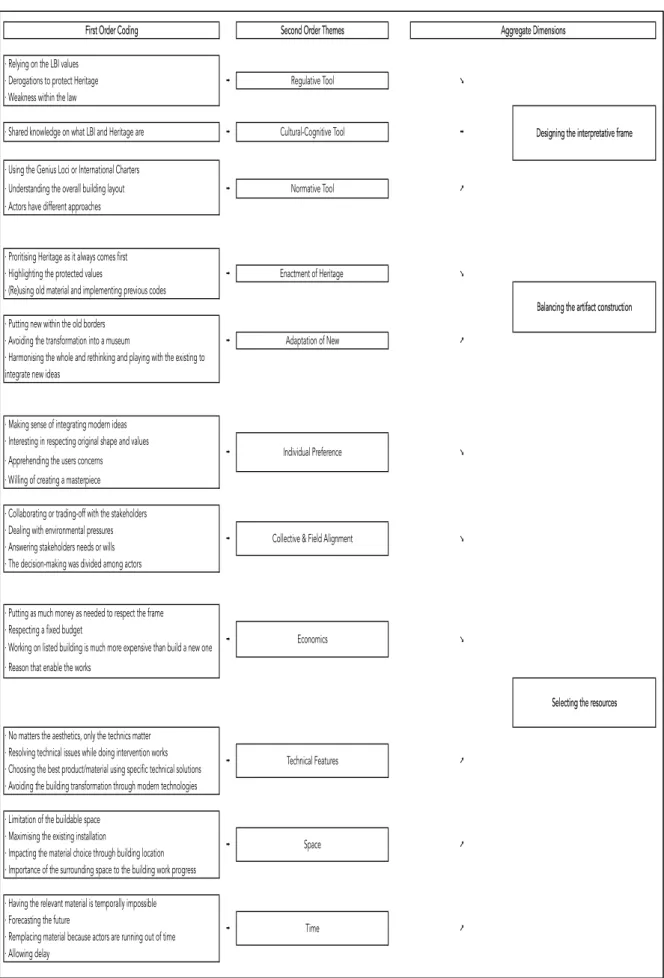
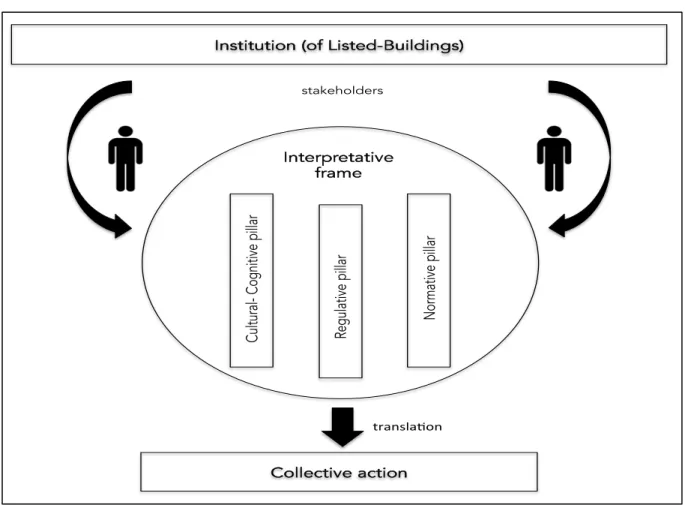
Because the institutional legitimacy is anchored in the actors’ interpretation of “building’s authenticity”, they collectively define it through an interpretative frame that they design with the help of the three institutional pillars: cultural-cognitive, regulative and normative ones. This frame therefore guides collective – and material – action, because this a posteriori institutional construction facilitates collective decision-making. Indeed, it helps actors to delimit the scope inside which they can modify/modernise the instantiation while maintaining the features that justify its listing. Once the frame is designed and shared among actors, I highlight how they materially construct the instantiation to reflect the symbolic construction they have just made. To do so, they engage in a collective bricolage process involving a two-level dialogue. The first level focuses on the dialogue taking place between actors and the interpretative frame. I describe and analyse here how actors practice different types of trial-error tests and consider tangible compromises to balance the material construction and position the artifact in regards to the symbolic frame. The latter is mobilised to ensure that the listed building remains an instantiation of the Listed-Buildings Institution.
The second and simultaneous dialogue involves six selection criteria that enable actors to reach a consensus on how to build the instantiation, i.e. materialise the symbolic construction – both symbolic and material constructions being approved by all the stakeholders. These selection criteria are: the individual preference, the collective and field alignment, the economics, the technical features, the time and the space. These criteria help actors to select resources from each other’s repertoires and to use and intertwine them.
Consequently, through these analytical findings, I propose to extend prior neo-institutional and bricolage literatures. One extension consists in linking Scandinavian Institutionalism with Collective Bricolage through the practice of framing and its main constituents in the form of the three pillars. Another extension develops the understanding of the collective bricolage process as a not-improvised activity by underlining a two-level dialogue that leads and facilitates resources at hand selection among actors with the help of the interpretative frame and the six selection criteria.
3.2.
The thesis’ anatomy
According to the Figure 1, this manuscript is organised into the present introduction, three distinctive parts, and an overall conclusion. It is structured as follow: The introduction presents the topic of study, both empirically and theoretically, including my research question, key findings, and expected contributions.
The theoretical framework constitutes the Part 1. Regarding the research question, this first part details what neo-institutional literature says on the link it exists between the institution and the instantiation. To do so, I divide the theoretical framework into Chapter 1 “The Institution and the Artifact” and Chapter 2 “The Actors and the Instantiation”. These chapters are associated through the increasing role of agency and materiality in institutional studies (Boxenbaum, Huault & Leca, in press). Part 1 also underlines the remaining gaps that need to be filled to theorise a robust instantiation construction process with the help of Scandinavian Institutionalism and Bricolage.
The Part 2 focuses entirely on the research design of my doctoral research and establishes the link between Parts 1 & 3. My methodology enables iterations between the empirical context and the theory and illustrates my reflexion process, starting from the empirical challenge and proceeding to find the best possible way to explain how actors protect the embodied Heritage of listed buildings while undertaking building works that modify them. After the introduction of my research paradigm, which is based on a constructivist grounded-theory methodology outlined in Chapter 3, I examine and motivate the choice of the empirical context and the six buildings in Chapter 4. In Chapter 5, I detail how I collect and analyse my data by means of qualitative research tools.
Part 3 presents the findings and analysis, after an Outline and an Avant-Propos that details the steps and actors involved in building works. The following chapters include a “results” section and another on “discussion”. In Chapter 6, I focus on the symbolic construction of the instantiation, detailing the constituents of the interpretative frame and why actors need to define the “building’s authenticity” to unfold the material modification of the listed building without disrupting its embodied Heritage. Chapter 7 explains the material construction of the instantiation through collective bricolage. This chapter illustrates the trial-error tests in which actors engage to balance the sometimes innovative use of material resources and their intertwining with the cognitive frame, which constitutes the first level of dialogue. This chapter further explains how actors select material resources at hand across each other’s repertoires using six selection criteria to facilitate their collective decision-making process. This process represents the second level of dialogue.
Finally in a general conclusion, I sum up and discuss the instantiation construction process while underlining the two main academic contributions of the dissertation. I also include future research directions and suggestions, as well as current limitations. The dissertation ends with some reflections on how the study could be relevant for practitioners, mainly in relation to the two debates – economical and theological - that emerge within the last few years.
Figure 1. The thesis' anatomy
Conclusion
Chapter 3: My research paradigm Chapter 4: The empirical context
Chapter 5: Data collection & analysis
Chapter 1: The Institution and the Artifact Chapter 2: The Actors and
the Instantiation
Introduction
Part 1: Theoretical
Framework
Chapter 6: Designing the interpretative frame “building’s
authenticity”: the symbolic construction of the instantiation
Chapter 7: The collective bricolage of the building: the
material construction of the instantiation
PART 1 – THEORETICAL
FRAMEWORK
Regarding the research question, this first part highlights what neo-institutional literature says on the link that exists between the institution and the instantiation. Divided into two chapters in order to better shape the role of agency and artifact in such an institution/instantiation relationship, the theoretical framework underlines the remaining gaps that need to be filled to theorise a robust instantiation construction process with the help of Scandinavian Institutionalism and Bricolage.