A D A P T A T I O N D E S I M A G E S E T D E S V I D E O S P O U R D E S
U T I L I S A T E U R S M U L T I P L E S D A N S D E S
E N V I R O N N E M E N T S H E T E R O G E N E S
par
Lotfi Aouissi
Memoire presente au Departement d'infer mat ique
en vue de l'obtention du grade de maitre es sciences (M.Sc.)
F A C U L T E D E S S C I E N C E S
U N I V E R S I T E D E S H E R B R O O K E
Sherbrooke, Quebec, Canada, Janvier 2008
1*1
Library and
Archives Canada
Published Heritage
Branch
395 Wellington Street Ottawa ON K1A0N4 CanadaBibliotheque et
Archives Canada
Direction du
Patrimoine de I'edition
395, rue Wellington Ottawa ON K1A0N4 CanadaYour file Votre reference ISBN: 978-0-494-49446-2 Our file Notre reference ISBN: 978-0-494-49446-2
NOTICE:
The author has granted a
non-exclusive license allowing Library
and Archives Canada to reproduce,
publish, archive, preserve, conserve,
communicate to the public by
telecommunication or on the Internet,
loan, distribute and sell theses
worldwide, for commercial or
non-commercial purposes, in microform,
paper, electronic and/or any other
formats.
AVIS:
L'auteur a accorde une licence non exclusive
permettant a la Bibliotheque et Archives
Canada de reproduire, publier, archiver,
sauvegarder, conserver, transmettre au public
par telecommunication ou par Plntemet, prefer,
distribuer et vendre des theses partout dans
le monde, a des fins commerciales ou autres,
sur support microforme, papier, electronique
et/ou autres formats.
The author retains copyright
ownership and moral rights in
this thesis. Neither the thesis
nor substantial extracts from it
may be printed or otherwise
reproduced without the author's
permission.
L'auteur conserve la propriete du droit d'auteur
et des droits moraux qui protege cette these.
Ni la these ni des extraits substantiels de
celle-ci ne doivent etre imprimes ou autrement
reproduits sans son autorisation.
In compliance with the Canadian
Privacy Act some supporting
forms may have been removed
from this thesis.
Conformement a la loi canadienne
sur la protection de la vie privee,
quelques formulaires secondaires
ont ete enleves de cette these.
While these forms may be included
in the document page count,
their removal does not represent
any loss of content from the
thesis.
Canada
Bien que ces formulaires
aient inclus dans la pagination,
il n'y aura aucun contenu manquant.
Le 7 octobre 2008
lejury a accepte le memoire de M. Lotfi Aouissi dans sa version finale.
Membres dujury
M. Djemel Ziou
Directeur
Departement d'informatique
M. Abdelhamid Benchakroun
Membre
Departement d'informatique
M. Francois Dubeau
President-rapporteur
Departement de mathematiques
A mon cher pere et ma chere mere.
A mes freres.
SOMMAIRE
La derniere dccennie a connu l'emergence de l'utilisation des equipements mobiles comme les assistants personnels et les telephones, ainsi que la proliferation des reseaux person-nels favorisee par le developpement considerable dans les technologies de communications. D'autre part, l'information vehiculee a travers le World Wide Web devient de plus en plus visuelle (images et videos) grace a la numerisation. Afin de permettre a tous les usagers un acces universel a cette information visuelle dans un environnement caracterise par la diversite des equipements et l'heterogeneite des reseaux, il devient necessaire d'adapter les documents multimedia. L'adaptation consiste a appliquer une ou plusieurs transfor-mations sur un document multimedia. Dans ce cadre, plusieurs travaux ont ete elabores en partant de differentes formulations. Nous pensons qu'un systeme d'adaptation efficace doit choisir les traitements necessaires a appliquer sur un document visuel afin de maxi-miser la satisfaction de l'usager. II doit considerer conjointement les caracteristiques de cet usager ainsi que les performances de son equipement, la qualite de sa connexion et les conditions de son environnement. La majorite des travaux realises dans ce domaine n'ont traite que des cas limites, par exemple ajuster une video pour la capacite d'un reseau donne. Dans la presente recherche, nous proposons une solution globale obtenue a l'aide d'un modele probabiliste qui utilise les traitements des images et des videos et l'extraction des caracteristiques des contenus.
R E M E R C I E M E N T S
Je tiens premierement a remercier mon directeur de recherche, le Professeur Djemel Ziou pour sa grande disponibilite, ses precieux conseils et la confiance qui m'a accordee. Je remercie egalement mes collegues du laboratoire MOIVRE (MOdelisation en Imagerie, Vision et REseaux de neurones) Zahir, Ali, Touati, Nizar, Mohand, Sabri, Samy et Ouael pour leur soutien et l'agreable ambiance de travail. Je tiens a remercier aussi mes collegues
Ahmed et Sidali pour leur soutien.
Je tiens a remercier les laboratoires universitaires Bell et le Conseil de Recherchcs en Sciences Naturelles et en Genie du Canada (CRSNG) pour leur soutien.
Mes remerciements s'adressent a tous les membres du Departement d'informatique de l'Universite de Sherbrooke pour leur disponibilite et leur contribution a ma formation. Enfin, j'adresse un remerciement particulier pour toute ma famille ainsi que toutes les personnes qui me sont proches pour leur soutien.
Table des matieres
SOMMAIRE
REMERCIEMENTS
Table des matieres
Introduction
Adaptation des images et des videos pour des
des environnements heterogenes
Conclusion
Bibliographie
Image and Video Adaptation for Multiple Users in
Heterogeneous Environments
Lotfi Aouissi, Djemel Ziou.
January 12, 2008
A b s t r a c t
In this paper, we introduce a new framework to achieve universal multimedia access by adapting image and video content. To give a global formulation able to deal simultaneously with the different factors that influence the adaptation process, the description of these factors and their mutual relationships is inspired by part 7 of the MPEG-21 standard, entitled Digital Item Adaptation (DIA). The selection of the optimal adaptation operation is based on the prediction of utility value. The utility value reflects the goodness of the adaptation with respect to the nature of the content, user preferences, and system constraints. We use the history of pre-vious adaptation operations to process new user requests on the assumption that an adaptation operator process different contents with similar features for the same user and the same system constraints will yield similar associated utility values. To achieve prediction, we therefore classify the adaptation situations using Bayesian multinomial logistic regression, allowing the system to select the adaptation oper-ator with the maximal predicted utility value. Results obtained from experiments with real users demonstrate the validity of our model.
Introduction
Nous assistons presentement a une proliferation de dispositifs portables munis de camera, d'ecran, et de capacite de communication a travers des reseaux sans fil. II en resulte une utilisation massive de ces equipements pour fabriquer, gerer et exploiter des documents visuels telles que les images et les videos. Par exemple, la quantite des documents non-textuels constitue 96% du World Wide Web [1].
En consequence, une nouvelle problematique commence a paraitre, en effet comment peut on permettre a tous les usagers un acces aux documents visuels de fagon transparente a la diversite des equipements et a l'heterogeneite des reseaux, ce concept connu sous le nom d'acces universel aux documents multimedia [2] [3] constitue l'objectif principal de l'adaptation des documents visuels. L'adaptation est necessaire a cause de la diversite des equipements, des specificites perceptibles des usagers, et des limites des reseaux de communications. Par exemple comment permettre a un usager ayant une acuite visuelle limitee de visionner une sequence video sur un assistant personnel qui est connecte par le biais d'une connexion telephonique a faible bande passante ? La necessite d'assurer cet acces universel est primordiale dans plusieurs applications comme la medecine, la coordi-nation operationnelle lors d'une crise, la video conference et l'industrie de l'audiovisuel.
L'objectif principal de notre travail concerne la conception d'un systeme d'adaptation de documents visuels capable de repondre aux besoins des usagers selon leurs specificites et leurs environnements d'usage.
L'adaptation souleve plusieurs problemes. D'abord, l'identification des differents fac-teurs qui peuvent influencer le processus d'adaptation comme les caracteristiques de l'usager, la nature du contenu visuel, la bande passante disponible dans le reseau et les caracteristiques du dispositif utilise par cet usager. Aussi, il faut determiner la meilleure
facon de considerer conjointement ces facteurs. En general, la plupart des systemes d'adaptation existants se focalisent sur des cas particuliers d'adaptation comme controler le "bit rate" d'une video en fonction des fluctuations de la connexion reseau disponible. La plupart des travaux precedents ne prennent pas en consideration les besoins et les ca-racteristiques de l'usager [6], [7], [9]. Pour elaborer une formulation generale qui englobe tous les facteurs relatifs a l'adaptation ainsi que leurs descriptions, nous nous sommes inspires de la partie 7 du standard MPEG21, intitulee Digital Item Adaptation [4], [5].
Dans le processus de l'adaptation, le contenu visuel subit plusieurs transformations par l'application des operateurs d'adaptation. Un operateur est une sequence de plu-sieurs algorithmes de traitement d'images et de videos numeriques, comme la reduction de la resolution spatiale et la compression. Ces operateurs modiflent l'image ou la video afin que les usagers puissent utiliser le contenu visuel dans des conditions satisfaisantes et en respectant les contraintes imposees par les caracteristiques de leurs equipements et leurs connexions respectives. La performance d'un systeme d'adaptation reside dans sa capacite a selectionner l'operateur adequat a appliquer sur le contenu visuel pour chaque requete. Ann de prendre cette decision pour chaque situation d'adaptation, nous devons comparer les performances des differents operateurs disponibles. Pour cela, nous reformulons le concept de fonction d'utilite [8] qui combine les criteres suivants : la sa-tisfaction des preferences et besoins visuels de l'usager, la fidelite au document original, le temps et le cout necessaires pour que l'usager exploite le contenu visuel. Cette fonc-tion decrit pour chaque operateur d'adaptafonc-tion la relafonc-tion entre les caracteristiques de l'usager, les contraintes existantes et la valeur d'utilite resultante lorsqu'on applique cet operateur. Nous impliquons les usagers dans le processus de l'adaptation durant une phase initiale. Ceci en collectant des notes refletant leurs degres de satisfaction pour chaque operation d'adaptation qu'on effectue. Pour la prediction de la valeur d'utilite, nous definissons un modele probabiliste qui utilise l'information presente dans l'historique des operations d'adaptation precedentes pour repondre aux nouvelles requetes des usa-gers. L'idee consiste a separer les variables influengant l'adaptation en classes. A chaque classe sont associes les operateurs qui s'executent avec succes. Pour valider ce modele, nous avons effectue des experimentations avec des utilisateurs reels. Dans le reste de ce memoire nous detaillons le modele propose pour la selection automatique des operateurs
d'adaptation des images et des videos.
A d a p t a t i o n des images et des videos
pour des utilisateurs multiples dans
des environnements heterogenes
Dans ce chapitre, nous presentons le travail " Image and Video Adaptation for Multiple
Users in Heterogeneous Environments'1''. Ce travail concerne la selection automatique
des traitements necessaires pour l'adaptation d'une image ou une video. Cette selection depend de plusieurs facteurs que sont la nature et les caracteristiques du document visuel a adapter, les besoins de l'usager, les caracteristiques de son equipement, les performances de sa connexion et les conditions de son environnement naturel. La majorite des travaux existants out aborde ce probleme d'une facon partielle, c'est-a-dire ils se focalisent sur une tache specifique dans l'adaptation en considerant un sous ensemble des facteurs cites. Dans ce chapitre, nous donnons une formulation globale qui prend en consideration les differents facteurs d'adaptation en se referant au standard MPEG21. Afin qu'on puisse selectionner les operations adequates, nous utilisons le concept de la fonction d'utilite qui nous permet de comparer entre les performances des differentes operations dans chaque situation d'adaptation. Nous definissons la fonction d'utilite par une formulation qui va permettre d'inclure plusieurs criteres de qualite envisageables. Notre approche se base sur l'usager, ses besoins et ses preferences, parce que revaluation des documents adaptes est effectuee par des utilisateurs durant une phase initiale. Afin d'eviter de calculer cette fonc-tion d'une fagon analytique qui risque de ne pas refleter la satisfacfonc-tion de l'usager a cause de la nature subjective de son jugement, nous proposons un modele probabiliste base sur la classification par regression bayesienne multinomiale logistique pour la prediction de la
valeur d'utilite. Ainsi, le modele repond aux nouvelles requetes des usagers en exploitant l'historique des operations d'adaptation effectuees et revaluation fournie par les usagers. L'idee de base du probleme a ete proposee par le Professeur Djemel Ziou et les re-cherches necessaires a la modelisation ainsi qu'a la resolution des equations mathematiques et la validation des algorithmes ont ete realisees sous sa direction.
Digital item adaptation engine Resource adaptation engine Descration adaptation engine Descrjttors DIA tools
Figure 1: General architecture of MPEG21-DIA. Tools: Usage Environment Description (UED), Bitstream Syntax Description Language (BSDL), Adaptation QoS, Universal Constraints Description (UCD).
In [10], Vetro, one of the founding members of the MPEG21 standard, proposes a uni-fied conceptual framework and technology taxonomy to handle the adaptation process while fitting with the general architecture of MPEG21-DIA. A set of definitions is intro-duced, beginning with the entity which is the atomic unit of media that can be subjected to modification or transformation and can be processed by an adaptation operator. Sev-eral entities exist on different levels, e.g., pixel, region, image, frame, or group of frames
(GOF) in a compressed bitstream. The second definition establishes the adaptation op-erators formed by the set of image and video processing and coding algorithms such as spatial resolution modification in an image. Each operator can be executed using a single
algorithm or a sequence of algorithms. We can define two operators with identical sets of algorithms but with different parameters. The set of operators form the adaptation space. The third definition concerns resources. Image or video is processed by adaptation operators with the goal of rendering it on a specific device and/or transmitting it over a network. These elements (device capabilities, network conditions and natural usage environment) constitute the resource space. Finally, we have the utility value, which is a target function that reflects all QoS related information such as video quality, user satisfaction and cost. The goal of the adaptation process is to optimize the value of this function with respect to constraints expressed in the resource space.
Let us now examine more thoroughly some existing work that has influenced us. In order to describe and analyze this work according to specific criteria, we will consider the usage environment descriptors put forward by digital item adaptation and the proposed conceptual framework as references.
Approaches Processed media Utility function Content features Results Adaptation operators User characteristics Device capabilities Network conditions Natural usage environment Processing Wang and al [11] MPEG-4 video-clips extracted from movies.
Learns from training pool and makes pre-dictions by using clas-sification and regres-sion.
DCT coefficients and motion vector are extracted from com-pressed bitstream. Accuracy prediction of UF: 89%. Frame dropping (FD) and, DCT coefficient dropping (CD). No No Available bandwidth No Real-time Mohan and al [7] Web document im-age, video, and text items obtained by parsing TV news programs.
Calculates the distor-tion of each version by mean square error
(MSE) and solves resource allocation problem.
Content size, display size, color depth, streaming bitrate, and compression format.
Not available.
Resolution reduction, color depth reduc-tion, compression, transmoding of video to key-frames image.
No
Screen size, im-age/video display capabilities. Available bandwidth No Static Hsiao and al [9] Video content MPEG7 test dataset.
Instead of evaluating utility function, bit-stream allocation is performed according to the importance of each region of interest
(ROI) identified by the attention model. Brightness, location, texture complex-ity, and motion are extracted from compressed video. 72% satisfaction in subjective tests. Spatial size reduction and bitstream alloca-tion.
No
Screen size and color depth.
Available bandwidth
No
Real- time
A quick look at Table 1 reveals that none of the three solutions consider user charac-teristics, especially preferences and visual impairments, as a criterion in calculating the utility function, either because user evaluation was simulated and thus limited [11] [9], or because an objective quality measure was used instead [7]. Moreover, the natural usage environment which describes the ambient user conditions at the moment of visualizing the adapted content, such as local luminosity and user mobility, was not considered in the three models. In [11], only video coding-related algorithms (frame dropping and co-efficient dropping) were used, while the other two approaches used transmoding, which consists in changing the content from one mode to another, e.g., replacing a video se-quence by a set of representative key frames. In [11] and [9], only videos were processed, while images adaptation was addressed in [7]. In [7], adaptation was performed in a static manner by preparing several versions of the content, which implies considerable storage space. On the other hand, the space of adaptation operators in [11] and [9] was limited because only online-feasible algorithms, e.g., frame dropping, were selected to satisfy the real-time constraint. In this paper, we attempt to design a general adaptation solution able to address the different challenges involved in prediction and improving user satisfac-tion, while handling all of the usage environment descriptors specified in MPEG21-DIA, and processing both video and images.
3 Problem Formulation
A variety of essential tools from different fields like image processing, human visual per-ception measurements, and decision theory frameworks such as machine learning are needed to guide the adaptation process. Content adaptation is a decision-making prob-lem, so the most important segment in the analysis of the adaptation framework is quantitatively denning a target utility function to be optimized. We use this function to represent all quality of service related information and to compare the performances of different adaptation operators. Utility value can be formulated as a multidimensional functional over all parameters to be optimized, such as objective image/video quality assessment using signal level measurement algorithms like the PSNR or the mean square error (MSE). These methods have been extensively exploited because they are simple to
calculate and easy to plug into mathematical optimization problems. However, they are not adequate to interpret human perception, because the distortion calculated by an ob-jective quality metric may not match the perception of a human being and doesn't take into consideration human vision system features including foveal vision, light adaptation, and contrast sensitivity function [15]. More recent algorithms have been proposed like the structural similarity index (SSIM) algorithm [14] which can be used in its full-reference version to measure the similarity between the original content (image or video) in the input and the distorted content after applying an adaptation operator. This measure will be denoted by Q. The objective quality depends on the input document (I) and the adaptation operator (O). The second parameter is the subjective evaluation. This mea-surement is expensive and cannot be performed in realtime but reflects the real opinion of the end viewer (visual preference satisfaction, comprehension) expressed by the indices such as the mean opinion score, and user rating. We denote the user satisfaction by S. This quantity depends on the nature of the input content (I), user characteristics (U), device capabilities (D), and the user's natural usage environment characteristics (C). For instance, colors are not rendered in the same way on cathode-ray tube (CRT) and liquid crystal display (LCD) monitors, so the sensations are not similar; further, satisfaction will be different for a user with a color deficiency and another user with normal color vision. Most visual information is delivered over a network with a specific bandwidth, which imposes a waiting time on the user to upload a video or for initial buffer loading, in addition to the time needed to play the content in the case of streaming. We denote waiting time by T. The time consumed is a function of the input document (I), the adaptation operator (O), and network conditions (N); e.g., consistently available band-width will reduce the waiting time needed to upload a video. The final parameter is communication cost, because most mobile devices are connected over paying networks, so the size and the duration of a video is crucial in the adaptation process. We denote the cost by C. This amount varies depending on user location, which belongs to user characteristics (U), the size of the input document (I), and the adaptation operator (O). Adaptation may be intended to achieve one of two goals. 1) Improving reproduction fidelity: in this situation the signal-level evaluation, which means objective quality will be prioritized, e.g., by performing a gamut mapping in order to match the range of colors
available in a destination device. 2) Content customization to meet subjective user needs: user satisfaction will be the heavy criterion for utility value; e.g., hue modulation to satisfy the presentation preferences of a given user.
We can formulate the utility value as a function for each adaptation operation by several combinations of these criteria. We adopt the following formulation:
max Q(I:0) (1)
max S(I, O, U, D, C) (2)
under:
T(I,0,N)<Tmax (3)
C(I,0,U)<Cmax (4)
Thus, we can write:
max Q{I,0)S{I,0,U,D,C) (5)
under:
T{I,0,N)<Tmax (6)
C(I,0,U)<Cmax (7)
The adapted content is the result of transformations performed by adaptation oper-ators on the input document. So, to make predictions on the utility value, we will need some knowledge on the nature of the input content, different properties of the adapta-tion operators, and the existence of a correlaadapta-tion between these elements and the utility function components Q, S, T, and C. Adaptation operators modify image/video attributes in order to satisfy user preferences such as hue modulation, while matching
resource limits, for instance by resizing the image to fit the display area of a PDA or adjusting video bitstream to a narrow connection bandwidth. These modifications of content are at different levels. The first level is the signal level, e.g., spatial resolu-tion reducresolu-tion of an image. The second is the structural level, e.g., bidirecresolu-tional frame dropping in a video sequence. The last is the semantic level which uses the high-level semantic content layer to improve the user's comprehension, e.g., extracting an object in an image or a video. Many operations belong to two categories simultaneously; e.g., video summarization (semantic I structural).
For video, the principal constraint that has been extensively addressed is transmission of videos over networks by reducing the bit rate to fit a specific channel capacity. The set of these techniques is defined as video transcoding [20] which consists in converting an input signal to another in order to realize bitstream reduction and get a new spatial and/or temporal resolution.
Further, we can divide the adaptation space into two categories. First there are the obligatory operations, like converting the format of a video clip from AVI to WMV with the goal of playing this media on a device which supports only the latter format. The second category comprises enhancement operations like modulating the brightness or the hue of an image to satisfy a given user's preference.
In general, adapting media content will include many tasks like color requantization and brightness modulation. For each task there are many candidate algorithms that differ in complexity and performance, and thus, in results. This makes defining an adaptation space without ambiguity a difficult task. Adaptation task scheduling must be defined by the author, using prior knowledge in the image processing field to generate appropriate sequences for specific tasks: e.g., the compression operation must be executed after contrast enhancement and not before.
Like many applications in the imaging domain, such as image retrieval and video indexing, most adaptation solutions are content-based processes. To make decisions, we need input content features which will form the discriminant information between various contents. In our problem, the necessary features to extract will depend strongly on the adaptation space, which contains the set of image and video processing algorithms and their level; e.g., image size is needed to process a spatial resolution modification and edge
magnitude is essential to a contrast enhancement algorithm, while high-level semantic features like regions of interest (R.OI) or event-based features are required to perform video summarization. Previous work adopted the extraction of low level features from compressed data, such as spatial and texture information embedded in DCT coefficients, in order to meet real-time requirements. However, this was done by making a compro-mise between calculation simplicity and information accuracy; e.g., the motion vector in MPEG2 gives less texture information than optical flow. More details in compressed domain feature extraction are given in [19]. Further, this process remains dependent on the codec (e.g., MPEG, AVI). In practice, feature extraction from an image with a different format, like JPEG, or from a video, entails decoding the compressed bitstream, extracting the desired features and/or re-encoding the content. This process is infeasible in real-time applications because of the time required and the calculation complexity. To overcome this obstacle, the process can be significantly accelerated by extracting the de-sired characteristics of the content offline, and preparing them in the form of descriptive metadata which will accompany the visual document. Content features include several types of information, such as color, texture, shape, and regions or points of interest, and differ in their scope: global or local. These features can be represented by vari-ous forms including histograms, matrices, probability distribution functions (PDFs), and statistics such as mean and moments. These descriptors can be easily integrated into the MPEG21-DIA content descriptor structure.
The adaptation process must respond to user requests in real time. In addition to content feature extraction, which demands considerable time and calculation power, adaptation operators use algorithms with different performance and complexity. Some algorithms are too highly complex to calculate in real time, e.g., calculation of edge orientation and magnitude in an image or decoding of a video sequence. As a first solution to tackle this problem, we can run these algorithms offline and store the generated version of the input content, to be delivered for later requests [7] [27]. This requires consistent storage space. Another thing which, can help us to overcome the real-time constraint and improve process speed is the increasing programmability and computational power of programmable hardware modules. Some examples are the Field-Programmable Gate Array (FPGA) used in real-time face detection [30], and video feature tracking and
matching using the Graphic Processing Unit (GPU) [29].
Among the components of the utility functional, the subjective evaluation reflects user satisfaction, which depends on user presentation preferences. The MPEG21-DIA therefore defines a set of descriptors to identify and quantify these preferences; for ex-ample, preferred brightness is defined as the mean of the Y-values in the YCbCr* color space, for all pixels in the image or the frame, uniformly quantified on the range [0,1] [3]. But in the real world, getting such information in an exact and explicit way is a very hard task. For this reason, we try to make inferences and group users who have similar preferences and profiles.
To make an adaptation decision engine capable of choosing the optimal adaptation operator that optimizes the utility functional, the three arguments Q, S, and T must be calculated for each combination of specific content, adaptation operator, user preferences and resource constraints. Most of the existing approaches perform offline calculation of the utility functional on a training pool and define the target functional by an analytical method [7] or by fitting curves on points formed in the adaptation space [22] .
4 Model
Our objective in this work is to perform adaptation for one or more users according to their needs and preferences. Given a set of visual documents, processing operators, and the associated utility value for each of them, the main idea is to select the optimal operator given a user request.
Based on the definition of the utility value and the different factors influencing this functional described in Section 3, we will give more details about data related to adaptation. The input content (I) is a representation of an image or video. So, / is a vector that contains all features related to spatio-temporal and radiometric res-olution, color, shape, and texture. Each such feature can be described by integer or real values, e.g. the spatial resolution is widthXheight, and the color is described by a 3D RGB histogram. The user provides a subjective evaluation which depends on
the specifities enumerated in MPEG21-DIA such as presentation preferences, and vi-sual impairments as well as facts about the user such as: age, profession, and socio-cultural profile. The vector U includes all of these user attributes. For example, U =
[age, sex, profession, visual impairment,...), where age is an ordinal variable,
sex can be represented by a 0/1-valued variable, visual impairment is an ordinal vari-able indicating the absence of visual anomaly or the degree of severity of the deficiency otherwise. For instance, for a user who has a severe color deficiency, the value of the associated variable is equal to 0.9, while for another user with normal color vision, the value will be 0. The user displays the adapted content on a device D defined by spe-cific device capabilities such as display area, color depth, and available codecs. The user's device is connected over network N, defined by available bandwidth and latency. Other features can be added, such as connection reliability. The environment surround-ing the user and the device is described by a vector C which includes luminosity and location. By organizing all adaptation elements in this way, each user's request will be described by a situation vector denoted by Xi and formed by the conjunction of the different factors: Xi = (Ui,Ii,Di,Ni,Ci). Then, the adaptation engine will apply an adaptation operator that transforms the content I in order to meet the specific needs of user Ui who is in natural environment d, matching the constraints imposed by de-vice capabilities £)j and network conditions Nt. For adaptation of a visual document I,
one or more image processing or video processing algorithms are used, generating the new document: Inew = Oi(I) = Tn(...T2(Ti(7))). Adaptation operators are formed from
different combinations of available algorithms. If we have N algorithms available, the number of different combinations, i.e. the number of possible adaptation operators will
N N
be Yl PN = X} IN'-IY. • F °r example, if N=3, the number of possible operators will be
N
15. Fortunately, the actual number of adaptation operators is less than ^ PlN because
algorithms must be run on well-defined order. For example, contrast enhancement of a video sequence that will be summarized in key frames is pointless. We will define a set of sequences of algorithms that are scheduled to perform a specific high-level task. For example, reduction of an image resolution sequence for a PDA connected to a pay-ing network with narrow bandwidth is carried out by spatial resolution reduction, color
depth reduction, and compression into format available on the destination device. Sev-eral algorithms and sevSev-eral parameters can be used. For example, bilinear interpolation, bicubic interpolation, and partial differential equation (PDE) interpolation can be all used. The performance of each of these algorithms is different and depends on visual document properties such as signal to noise Ratio (SNR) and on the parameter values used. We can make variations in the version of each algorithm using a limited subset of the algorithm's parameters, e.g., we can resize a given image by the same algorithm, such as bilinear interpolation, with different scales: 2x2, 4x4. Consequently, a sequence of algorithms for a specific task with specific values of parameters is considered as an adaptation operator. In other words, two adaptation operators can be formed by the same sequence of algorithms, but with different parameter values. The new visual doc-ument produced by applying an operator Oi for the situation Xt = (Ui,Ii,Di,Ni,Ci),
is rated by the user to reflect his subjective satisfaction S. Additionally, the objective quality Q of the generated document is measured by using an algorithm such as SSIM. In order to calculate the waiting time T, we use the network bandwidth, the number of frames and the frame rate for a video sequence, and the file size for an image. The utility value UVi(Xi,Oi), which reflects the "goodness" of the selected adaptation operator Oi, can then be calculated according to equation (5).
In this way, the triplet (Xi,Oi,UV(Xi,Oi)) will be considered as an adaptation re-alization. The basic assumption behind the model is that, for a given user [/», adap-tation realizations that have similar situation vectors and are processed by the same operator will generate similar or close utility values; i.e., for two situation vectors Xi = (Ui, h, Di, JVi, C1),X2 = (Ui, I2, D2, N2, C2), if Xx ~ X2, then, for a given
adapta-tion operator Oi we have UV(Xi, Oi) — UV{X2) Oi). So, to select the optimal operator
for a new request described by the situation vector Xrequest, we will retrieve in the
his-tory of the past of adaptation realizations, the one that has a similar situation vector:
Xprevious ~ Xrequest. Then, we choose the operator O* that gives the maximal utility
value O* = argmax UV(Xprevims, Oi). However, this process will not be able to handle
a new document which has never been adapted or a request from a new user. For that, we adopt collaboration, which involves dividing the history of previous adaptation real-izations into different classes, each class containing observations with similar situation
vectors. The clustering has the advantage that available data about previous adaptation realizations can be used to process future requests. For example, a historic adaptation of user U\ can be used to processing a request from a new user U^ who has similar profile, allowing us to avoid calculating the respective utility values for all adaptation operators for the same situation.
So, adaptation realizations that have similar situation vectors will belong to the same class. For a new request from a user U, the vector Xnequest is formed , and its appropriate
class Cfc is estimated. We denote by Rui,Oj the set of realizations processed by a given operator Oj for the user U and X; € Ck- To estimate the utility value associated with the operator Oj, we take the mean of the utility values associated with the elements of
Ruito • Figure 2 illustrates the classification of adaptation realizations based on situation
vectors and the subsets Rui,Oj • Further, in order to take into consideration a possible modification in the user's preferences, we will take a mobile average of the utility values of the L last adaptation realizations in the history of U. Thus, the estimated utility value is given by:
_ _£ uvux^Oj)
UV(XReguest,Oj) = m=N~L~1 where X> E Ck , N = \RUit0j\ (8)
Utility value.
A cluster of adaptation realizations that haw similar situation vectors
Subset R(Ui,Oj) of adaptation realizations processed by operator Oj
for a user Ui
Ditli rent .«en oi'.ulaptaffem; ikvies. charactcrtatics, HI rw>rk
coiidifiotK, c< intuit features .uid natural uivimnmaif conditions
Figure 2: Classification of previous adaptation realizations
As initial approach, we put adaptation realizations in several spaces. Each space contains all adaptation realizations that were processed by the same operator which, means that each space is associated with an adaptation operator. This approach is very useful to study the conditions for application and feasibility of each operator individually. However, the number of operators will grow rapidly with variations in the parameters of available algorithms in the adaptation engine, and this will lead to a considerable number of spaces. In this case, the situation vectors must be clustered separately for every space in order to achieve prediction of the utility value, so, when the number of spaces is considerable, the model will be very complex and require more calculation power
and time. We therefore choose to adopt one global adaptation space which groups all adaptation realizations regardless of the operator.
We will now deal with the clustering. Let us assume that there are K clusters. A K-dimensional Boolean vector Yt = (yn,yi2, • • •, V%K) is associated with the vector X^ If
K
Xi belongs to a given cluster /, then, y^ = 1 if j = I and 0 otherwise, and £ yu = 1.
i=i
The decision to assign a vector Xt to cluster j is given by:
_ f 1 */ j = argmax P(Xi,/3\yj)
[ 0 otherwise
Where /? denotes the parameters of interest in the model adopted to perform the clus-tering. These models are of two types: generative and discriminative models. Their ad-vantages and drawbacks are discussed in [23]. For our problem, the adaptation situation vectors are not labeled, so we propose to use a generative model that can estimate the missing data and a discriminative model to carry out the decision. To assign an obser-vation to the appropriate cluster, we estimate the conditional probability that a vector belongs to class p(y\x) using multinomial logistic regression, and benefit from the robust-ness in accuracy of this discriminative approach [13]. Multinomial logistic regression can be considered as a generalization of logistic regression, which describes the relationship between a set of explanatory variables in the input and a response variable (the outcome). In the case of logistic regression, the outcome is binary, e.g. success and failure, and its conditional distribution follows a Bernoulli distribution, while in the multinomial case, the conditional distribution of the output, which has more than two categories, follows a multinomial distribution. The goal of multinomial logistic regression is to separate
m classes on the basis of an input vector X of the observed features of dimension d: X — [xi, • • • ,Xd\T. This vector includes explanatory variables which can be ordinal or
nominal. The set of training data will be D = {(Xi,yi),..., (Xn,yn)}. The conditional
probability that an example Xi will belong to a class j is:
P(y] = l\Xh(3)= m P^ l) (10)
£ exviffXi)
fe=iWhere (3T is a (d+1) dimensional vector of weighting parameters be estimated. In
the Bayesian framework, j3 is viewed as a random variable that has a prior distribution
P((3). Using Baye's rule, the posterior distribution over (3 is:
Pd3,Xi\yi) oc PfalfrXjPifrXi) (11)
In general, the unknown parameters /? and observations X are assumed to be inde-pendent, so:
P(Xi, (3) = P(J3)P(Xi\P) = P(j3)P(Xt) (12)
Assuming that observations are independent and contribute equally in the model, we can consider P(Xi) as a uniform distribution.
When the prior on [3 is uniform or "flat", estimation of the parameters is achieved by maximizing the log-likelihood function using an optimization algorithm like Newton-Raphson or Fisher scoring [12]. However, with real data, the convergence of these al-gorithms to an optimal estimate is not guaranteed for the following reasons: (1) entire separability of classes which will give an infinite set of possible values of estimates /?*; (2) the presence of local maxima on the likelihood function doesn't allow us to obtain absolute optimal estimates [24]. To solve this problem, we adopt a univariate Gaussian prior P{(3) which has a unique mode. This will reshape the likelihood function and save us having to search outside of the parameter space or find local optima. The hyper-parameters are (0,<r), where a is the variance vector formed by individual variances erfcj
-of the parameters f3kj- Assuming that all components -of (3 are independent, we have:
PiPkjWkj) ~ N(0, a
kj) = — L — e x p ( ^ ) (13)
Now, we estimate the maximum a posteriori (MAP) to find the mode of the posterior distribution:
n
To estimate the number of clusters, many existing information criteria for selecting a model in cluster analysis, such as the Akaike Information Criterion (AIC), the Minimum Description Length (MDL), and Schwartz's Bayesian Inference Criterion (BIC) [31] can be used. These criteria associate the estimated maximum likelihood Ln(k) of a given
model with a sample of observations of size n and the number of parameters k, e.g., the AIC [32] is formulated as follows:
argmin cn(K) = _2ln{Ln{K)) + 2 - (15)
n n
n
where ln(Ln(K)) = J2 log{P{yi\xh /?))
i = l
As mentioned before, initially the data are incomplete. In order to group similar situa-tion vectors in the same classes according to a specific measure, we perform unsupervised clustering using the fuzzy C means [25].
To conclude, the adaptation algorithm is summarized as follows:
L E A R N I N G :
Run fuzzy C mean to assign data to components. Estimate the MAP using equation (12).
Calculate AIC to estimate K using equation (13).
Calculate utility value for each realization using equation (5).
DECISION:
For a new request R from a user Ui, we form the input situation vector XR =
(Ui,IR,DR,NR,ER)
Calculate conditional probabilities P(yRj\XR)forj = 1,K using equation (8).
Assign Xi to the appropriate class
Ck-Find the utility value associated with each operator using equation (6). Select the optimal operator that gives the maximal predicted utility value.
5 Experimental Results and Performance
This section illustrates the validation of our model with real data. In our experiment, we focalized on subjective user satisfaction. We designed a server able to deliver images for four users and videos for two users. During the learning stage, the adapted document is rated by the user using the score S that describes his subjective satisfaction. The score is expressed by the five choices: bad (1), average (2), good (3), very good (4), and excellent (5).
The content is selected from a training pool that contains 1000 images with different attributes in order to represent maximal variety in terms of content (size, color depth, texture, indoor images, natural scenes) and 400 video clips at the original bitrate of 1.5 Mbps, extracted from different movies. For images, the following features were extracted: color histogram in the CIE-L*a*b color space, which is perceptually uniform; image width and height; color depth; and texture, described by correlogram features of the pixel neighborhood with a displacement equal to 1 in the four orientations {0, f, | , ^ } . The correlogram features were mean, variance, entropy, contrast, energy, and homogeneity
[26]. For video, we used the histogram of optical flow, to get texture characteristics [33]; frame width and height; and number of frames. These features were calculated offline from the decompressed video. For the adaptation operators, we defined four operators by organizing a set of operations in sequence to accomplish specific tasks; e.g., reduction of spatial resolution and modification of color depth of an image in order to fit on a PDA screen. For images, these individual operations were size modification, contrast enhancement, brightness modification, color quantification, and conversion to the JPEG format. The operators were as follows: operator 1 consisted of resizing the image to 800X600, and contrast enhancement. Operator 2 was resizing the image to 800X600, contrast enhancement, and brightness modulation. Operator 3 was resizing the image to 300X200, reduction of color depth to 16 bpp, contrast enhancement, and conversion to JPEG format. Finally, operator 4 was resizing the image to 300X200, reduction of color depth to 16 bpp, brightness modulation ,and conversion to JPEG format. These operators were executed using the Magick++ library. For video, the four adaptation operators were formed by combination of spatial resolution modification and bitrate
reduction, with variation in the target bit rate: 1 Mbps, 500 Kbps, and 240 Kbps. These tasks were achieved using the Windows Media Encoder Software Development Kit (SDK). All adaptation operations are performed in real time. We used four devices with different characteristics: the Dell precision 380 work station, the HP Compaq nx6110 laptop, the HP iPAQ hw6940 PDA, and the Palm treo 700wx smart phone. Users received images and video clips on their devices over three networks: Universite de Sherbrooke Local Area Network, AERIUS wireless network, and Internet. We began performing adaptation by applying operators. For each adaptation realization, we formed the situation vector Xi using content features /, user's device characteristics Df screen resolution, screen size, color depth, and refresh rate, and for network Nf the available bandwidth. When about 10000 situation vectors had been collected from users over 8 weeks, we collected the scores Si assigned by users after receiving and displaying the processed content. This allowed us to collect the triplets ( X ; , 0 ; , S(Xi,Oi)). The regression algorithm was run to estimate the parameters (3 of the multinomial regression, and we found the number of clusters for images and videos: Kimages = 8 and Kvi<ieo = 10. We checked the accuracy
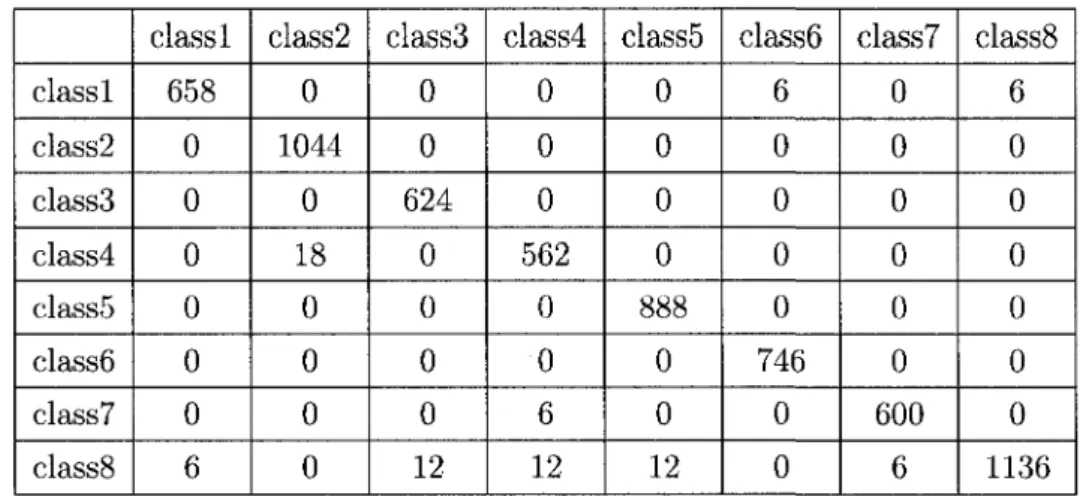
of the classifier using Bayesian multinomial logistic regression on the data labeled by the fuzzy-C means algorithm. The accuracy of classification is shown by the confusion matrices in tables 2 and 3. In these confusion matrices, the cell (classi, classj) represents the number of situations from classi that were classified as classj.
class1 class2 class3 class4 class5 class6 class7 class8 class1 658 0 0 0 0 0 0 6 class2 0 1044 0 18 0 0 0 0 class3 0 0 624 0 0 0 0 12 class4 0 0 0 562 0 0 6 12 class5 0 0 0 0 888 0 0 12 class6 6 0 0 0 0 746 0 0 class7 0 0 0 0 0 0 600 6 class8 6 0 0 0 0 0 0 1136
Table 2: Confusion matrix for images. Global accuracy rate: 98.68%
class1 class2 class3 class4 class5 class6 class7 class8 class9 class 10 class1 150 0 0 0 0 0 0 0 0 0 class2 0 230 24 0 0 0 0 0 0 0 class3 0 0 904 0 0 0 0 12 0 0 class4 0 0 0 920 0 0 18 0 0 0 classS 0 20 0 0 766 12 0 0 0 0 class6 0 0 0 0 0 304 0 0 0 0 class7 0 0 0 0 0 0 60 0 0 0 classS 0 0 0 0 0 0 0 152 0 0 class9 0 0 0 0 0 0 0 6 304 0 class 10 0 0 0 0 0 0 0 0 0 754
Table 3: Confusion matrix for videos. Global accuracy rate: 98.02%
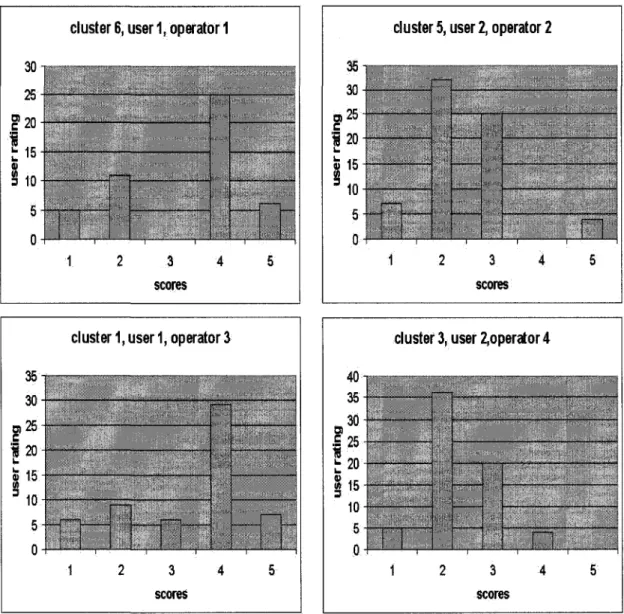
After the training data set was clustered, we examined the distribution of user scores in each subset Rui,o of adaptation realizations inside each cluster. To illustrate these results, histograms of scores relative to each subset Rvi,Oj in a given cluster are presented
80 -I 70-a6 0
I
50
"
t 40-| 30- 20-10-
o-cluster 6, user 1, operator 1
• , '• 1 • i ' — 1 2 3 4 5 scores 25- 20-01
S 10
5-0--Icluster 6, user 1, operator 2
i — [ —'— — : j • T ' — i 1 r 1 2 3 4 scores -— i 5 60i 50g 4 0 -t 30-V 3 AJ
10-
o-cluster 6, user 1, operator 4
— i • —; • 1 i , ! 1 .__ i i i i 1 2 3 4 5 scores
Figure 3: Score histograms for images
30-Z5 " g5 20
-1
t 15- §10- 5-0-cluster 6, user 1, operator 1
i
i • i i — • • - - r : ;— • i i • i i 1 2 3 4 5 scores 3 5 i 30ra 25 -c 1 20-a! 15- 10-5o
-cluster 1, user 1, operator 3
• i • ' i 1 2
-p—
3 scores i -i -i 4 5 35-30 H 02 5 I 20iu - 5-0-cluster 5, user 2, operator 2
• : i t • • | i i f < i , : i • i i i 1 2 3 4 scores ; ' " i 1 5 40-i 00 "
30-I
2 5
-= 20-« 15-3 iu • 5y
-cluster 3, user 2,operator 4
j , f • ' i i i 1 2 3 4 scores 5
Figure 4: Score histograms for videos
These histograms show t h a t most scores inside each subset of a d a p t a t i o n realizations
for each user-operator pair (Ui,Oj) fall into one or two adjacent levels of satisfaction, e.g., "very good (4)", and "excellent (5)", or "bad (1)", and "average (2)". These results confirmed the consistency of the assumption underlying the classification approach behind our model. However, we observed the presence of some irrelevant or "noisy" values; e.g.,
in the score histogram for cluster 6, user 1, and operator 4 in Figure 4. Further, in some subsets the scores are concentrated in more than two levels; e.g., the histogram of scores in cluster 6, user 1, and operator 3 in Figure 3. This fact can be explained by the inconsistency in the subjective judgement given by the user, and misclassification cases. The next step in our experiment sought to predict user scores for new requests. From a new test pool containing 200 images and 100 video clips, we processed the user's request by executing adaptation operators. Then, we assigned each situation vector to the appropriate class using our classifier. After that, we calculated the predicted score using equation (6) with L = 10 (recalling that L is the number of the last adaptation realizations in the subset RuuOj)- As this stage of the experiment, the time needed to
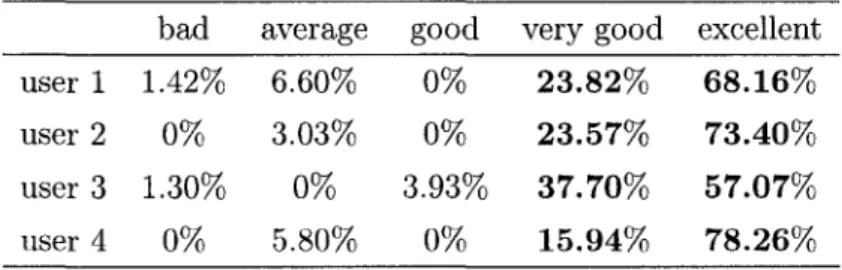
answer each user request is the total of: 1) the negotiation phase to identify user, device characteristics, and available bandwidth in the network; 2) decision making including prediction of the utility value and selection of the optimal operator; 3) time to execute the selected operator. Comparing the predicted and actual scores, we obtained the following prediction accuracy rates for the individual users: 87.67%, 93.71%, 85.76%, 90.60 % for images; and 87%, 89.32% for videos. We concluded that the prediction model is effective, and can be used to select optimal adaptation operators. At this stage, we performed operator selection by applying the operator that gave the highest predicted score for each request. Tables 4 and 5 show the scores given by users.
bad average good very good excellent user 1 1.42% 6.60% 0% 23.82% 68.16% user 2 0% 3.03% 0% 23.57% 73.40% user 3 1.30% 0% 3.93% 37.70% 57.07% user 4 0% 5.80% 0% 15.94% 78.26%
Table 4: User scores for images
bad average good very good excellent user 1 0% 4.86% 3.62% 41.39% 50.13% user 2 2.15% 0% 4.92 38.14% 54.79%
Table 5: User scores for videos
From these tables, if we consider that scores "very good" and "excellent" reflects an acceptable threshold of user's satisfaction, the global performance of our model in selection of the optimal adaptation operator is described by the following rates for indi-vidual users: 91.98%, 96.97%, 94.77%, and 94.20% for images; and: 91.52 %, 92.93% for videos at reasonable delays. The results confirmed the robustness of our model which uses Bayesian multinomial logistic regression to predict user satisfaction, and selection of the optimal operator online in order to achieve content adaptation automatically.
6 Conclusion
In this work, we devised a new adaptation framework that can handle both images and videos. The framework can be seen as an implementation that fit with the general archi-tecture of MPEG21-DIA. Our formulation proved its capability to take into consideration all of the factors known to influence the adaptation process. Further, the system is open to all of the existing digital image and video processing algorithms. In order to take users's needs and characteristics into consideration, end users were involved at the learn-ing stage. The probabilistic model uslearn-ing classification by Bayesian multinomial logistic regression proved its effectiveness in predicting utility value. We meet the real-time con-straint in prediction of the utility value and selection of the optimal adaptation operator. By using the history of previous adaptation operations, the system is able to deal with new situations including device variety, multiple user profiles, and new image and video content. We validated the proposed model by experiments performed with real users in different environments. The results obtained were promising. However, several aspects remain to be explored, such as assignment of new users to existing profiles, features se-lection to improve the performance of the classifier, and extending the solution to more
adaptation operators.
References
[1] A. Perkis, Y. Abdeljaoued, C. Christopoulos, T. Ebrahimi, and J.F. Chicharo. "Uni-versal multimedia access from wired and wireless systems". Birkhauser Boston Trans, on Circuits, Systems and Signal Processing, vol. 10, no. 3, pp. 387-402, 2001.
[2] A. Vetro, T. Christopoulos, and T. Ebrahimi. "Special issue on universal multimedia access". In IEEE Signal Processing Magazine, vol. 20, no. 2, March 2003.
[3] MPEG MDS Group, MPEG-21 Multimedia Framework, Part 7: Digital Item Adap-tation (Final Committee Draft), ISO/MPEG N5845. July 2003.
[4] A. Vetro and C. Timmerer. "Digital item adaptation: Overview of standardization and research activities". IEEE Transactions on Multimedia, vol. 7, no. 3, pp. 418-426, June 2005.
[5] G.M Schuster and A.K. Katsaggelos. Rate-distortion based video compression. Kluwer Academic Publishers. 1997.
[6] A. Vetro, Y. Wangz, and H. Sun. "Rate-distortion optimized video coding con-sidering frameskip". Proceedings in International Conference on Image Processing (ICIP2001), vol. 3, pp. 534-537. 2001
[7] R. Mohan, J. R. Smith, and C. Sheng. "Adapting multimedia internet content for universal access". IEEE Transactions on Multimedia, vol. 1, no. 1, pp. 104-114. March 1999.
[8] D. Mukherjee, E. Delfosse, and Y. Wang. "Optimal adaptation decision-taking for terminal and network quality of service". IEEE Transactions on Multimedia, vol. 7, no. 3, pp. 454-462. June 2005.
[9] M. H. Hsiao, Y. W. Chen, K. H. Chou, and S. Y. Lee. "Content-Aware video adap-tation under low-bitrate constraint". EURASIP Journal on Advances in Signal Pro-cessing vol. 2007. 2007.
[10] S. F. Chang and A. Vetro. "Video adaptation: concepts, technologies, and open issues". Proceedings of IEEE, vol. 93, no. 1, pp. 148-158, January 2005.
[11] Y. Wang, J. G. Kim, S. F. Chang, and H. M. Kim. "Utility based video adaptation for universal multimedia access (UMA) and content based utility function for real-time transcoding". IEEE Transactions on Mulreal-timedia, vol. 9, no. 2, pp. 213-220, February 2007.
[12] A. Schworer and P. Hovey. "Newton-Raphson Versus Fisher Scoring Algorithms in Calculating Maximum Likelihood Estimates". Electronic Proceedings of Undergrad-uate Mathematics Day, no. 1, pp. 1-11, University of Dayton, OH, USA. 2004.
[13] D. W. Hosmer and S. Lemeshow. Applied logistic regression. Wiley Series in Proba-bility and Mathematical Statistics. 1989.
[14] Z. Wang, A. C. Bovik, H. R. Seikh, and E. P. Simoncelli. "Image Quality Asses-ment: from error visibility to structural similarity". IEEE Transactions on Image Processing, vol. 13, no.4, pp. 600-612, April 2004
[15] Z. Wang. "Objective image /video quality measurement: A literature survey". For EE381K: Multidimensional Digital Signal Processing. University of Texas at Austin. October 1998.
[16] N. Bjork and C. Christopoulos. "Video transcoding for universal multimedia access". Proceedings of the 2000 ACM Workshops on Multimedia, pp. 75-79, Los Angeles, California, United States, 2000.
[17] Y. Wang, J. G. Kim, and S. F. Chang. "Content-based utility function prediction for real-time MPEG-4 video transcoding". Proceedings of International Conference on Image Processing (ICIP2003), vol. 1, pp. 14-17, September 2003.
[18] B. Shen and I. K. Sethi. "Direct feature extraction from compressed images". SPIE, vol. 2670, Storage & Retreival for Image and Video Databases IV, 1996.
[19] H. Wang, A. Divakaran, A. Vetro, S. F. Chang, and H. Sun. "Survey of Compressed-Domain Features used in Audio- Visual Indexing and Analysis. Journal of Visual Communication and Image Representation, vol. 14, no. 2, pp. 150-183, June 2003
[20] A. Vetro, C. Christopoulos, and H. Sun. "Video transcoding architectures and tech-niques: An overview". IEEE Signal Processing Magazine, vol. 20, no. 2, pp 18-29, March 2003.
[21] W. Lai, X. D. Gu, R.H. Wang, W. Y. Ma, and H. J. Zhang. "A content based bit al-location model for video streaming". IEEE International Conference on Multimedia, vol. 2, pp. 1315-1318, June 2004.
[22] E. C. Reed and J. S. Lim. "Optimal multidimensional bit-rate control for video communication". IEEE Transactions on Image Processing, vol. 11, no. 8, pp. 873-885, August 2002.
[23] Y. Ng. Andrew and M. I. Jordan. "On discriminative vs. generative classifiers: A comparaison of logistic regression and naive Bayes". Advances in Neural Information Processing Systems, vol. 14, 2002.
[24] K. Riadh, D. Ziou, B. Colin, and F. Dubeau. "Weighted Pseudo-Metric Discrimi-natory Power Improvement Using a Bayesian Logistic Regression Model Based on a Variational Method". IEEE Transaction on Pattern Analysis and Machine Learning, In press. March 2007.
[25] R. O. Duda, P. E. Hart, and D. G. Stork. Pattern classification. Second edition. Wiley Interscience. 2001.
[26] M. S. Allili and D. Ziou. "Automatic color-texture image segmentation by using active contours". In Proceedings of Internatianl Workshop on Intelligent Computing in Pattern Analysis and Synthesis, pp. 495-504. 2006.
[27] S, Kopf and W. Effelsberg. "Color adaptation of videos for mobile devices". Proceed-ings of ACM International Conference on Multimedia, pp 963-964. Santa Barbara, CA, USA. 2006.
[28] H. S. Neoh and A. Hazanchuk. "Adaptive Edge Detection for Real-Time Video Processing using FPGAs". Global Signal Processing Conference, 2004.
[29] S. N. Sinha, J. M. Frahm, M. Pollefeys, and Y. Gene. "GPU-based Video Feature Tracking And Matching". Technical Report (TR) 06-012. Department of Computer Science, UNC Chapel Hill. May 2006.
[30] D. Nguyen, D. Halupka, P. Aarabi, and A. Sheikholeslami. "Real-Time Face De-tection and Lip Feature Extraction Using Field-Programmable Gate Arrays". IEEE Transactions on Systems, Man, and Cybernetics - Part B: Cybernetics, vol. 36, no. 4, pp. 902-912. August 2006.
[31] N. Bouguila and D. Ziou. "Unsupervised learning of a finite mixture model based on the Dirichlet distribution and its application. IEEE Transactions on Image Pro-cessing, vol. 13, no. 11, pp. 1533-1543. November 2004
[32] H. Akaike: "A New Look at the Statistical Model Identification". IEEE Transactions on Automatic Control, vol. 19, no. 6, pp. 716-723. 1974.
[33] B. K. P. Horn and B. G. Shunk. "Determining optical flow". Artificial Intelligence, vol. 17, pp. 185-203. 1981
Conclusion
Dans ce travail, nous avons propose une solution pour l'adaptation des images et des videos pour differents utilisateurs dans des environnements heterogenes. La concep-tion de cette soluconcep-tion souleve plusieurs problemes tels que la formulaconcep-tion necessaire pour considerer conjointement tous les elements lies au processus de l'adaptation, la selection des algorithmes de traitement d'images et des videos numeriques qu'on doit appliquer sur le document visuel afin de satisfaire l'usager en respectant les contraintes imposees par sa configuration materielle et sa connexion reseau. L'etude des travaux existants nous a permis de degager les points primordiaux pour un systeme d'adaptation efficace. En premier, l'exploitation d'un schema general pour representer et decrire tous les facteurs relatifs a l'adaptation et leurs relations mutuelles. Pour cela nous nous sommes inspires de la partie 7 intitulee Digital Item Adaptation du standard MPEG21. Ensuite, nous avons utilise le concept d'utilite qui mesure la performance et l'efficacite de chaque operation d'adaptation. Nous avons donne une nouvelle formulation a la fonction d'utilite en com-binant tous les criteres relatifs a la qualite du document adapte qui sont la satisfaction des besoins de l'usager et ses preferences, la fidelite au document visuel original, le temps et le cout consequent necessaires pour consommer le contenu visuel par l'usager. Afin de prendre en consideration les besoins et les preferences qui different d'un usager a un autre, nous avons implique les usagers dans revaluation des operations d'adaptation, e'est-a- dire chaque reponse a une requete est notee avec un degre de satisfaction. Cette formulation du probleme nous a permis de definir un modele probabiliste base sur la classification par la regression bayesienne multinomiale logistique afin que nous puissions selectionner les traitements adequats a appliquer pour une nouvelle requete. Le modele propose a ete valide par la realisation d'une plate-forme d'adaptation avec des usagers
reels. Les resultats de cette experimentation etaient concluants. Cependant, plusieurs as-pects restent a explorer comme la gestion des profils des usagers, par exemple l'affectation des nouveaux usagers a des profils existants, la selection des caracteristiques pertinentes pour augmenter le taux de precision de la prediction et enrichir la solution en incluant d'autres operateurs d'adaptation.
Bibliographie
[1] P. Lyman, and H. R. Varian : How much information. Http :www.sims.berkeley.edu/
research/ projects/ how-much-info-2003/. University of California at Berkeley. 2003 [2] A. Perkis, Y. Abdeljaoued, C. Christopoulos, T. Ebrahimi, and J.F. Chicharo : Universal multimedia access from wired and wireless systems. Birkhauser Boston trans, on Circuits, Systems and Signal Processing, vol. 10, no. 3, pp. 387 to 402, 2001.
[3] A. Vetro, T. Christopoulos, and T. Ebrahimi : Special issue on universal multimedia access. In IEEE Signal Processing Magazine, vol. 20, no. 2, March 2003.
[4] MPEG MDS Group, MPEG-21 Multimedia Framework, Part 7 : Digital Item Adap-tation (Final Committee Draft), ISO/MPEG N5845. July 2003.
[5] A. Vetro, and C. Timmerer : Digital item adaptation : Overview of standardization and research activities. IEEE transactions on multimedia, vol. 7, no. 3, pp. 418 to 426, June 2005.
[6] R. Mohan, J. R. Smith, and C. Sheng : Adapting multimedia internet content for universal access. IEEE transaction on multimedia, vol. 1, no. 1, pp. 104 to 114. March 1999.
[7] M. H. Hsiao, Y. W. Chen, K. H. Chou, and S. Y. Lee : Content-Aware video adap-tation under low-bitrate constraint. EURASIP Journal on Advances in Signal Pro-cessing vol. 2007. 2007.
[8] S. F. Chang, and A. Vetro : Video adaptation : concepts, technologies , and open issues. Proceedings of IEEE, vol. 93, no. 1, pp. 148-158, January 2005.
[9] Y. Wang, J. G. Kim, S. F. Chang, and H. M. Kim : Utility based Video adaptation for universal multimedia access (UMA) and content based utility function for real-time transcoding. IEEE transactions on mulreal-timedia, vol. 9, no. 2, pp. 213 to 220, February 2007.