To cite this version :
Furiga, Aurélie
and Roques, Christine
and Badet, Marie-Christine
Preventive effects of an original combination of grape seed polyphenols
with amine fluoride on dental biofilm formation and oxidative damage by
oral bacteria. (2014) Journal of Applied Microbiology, 116 (4). 761-771.
ISSN 1364-5072
O
pen
A
rchive
T
OULOUSE
A
rchive
O
uverte (
OATAO
)
OATAO is an open access repository that collects the work of some Toulouse researchers
and makes it freely available over the web where possible.
This is an author’s version published in :
http://oatao.univ-toulouse.fr/20321
Official URL :
https://doi.org/10.1111/jam.12395
Any correspondence concerning this service should be sent to the repository administrator :
[email protected]
Preventive
effects of an original combination of grape seed
polyphenols
with amine fluoride on dental biofilm
formation
and oxidative damage by oral bacteria
A. Furiga1, C. Roques1 and C. Badet2
1 Laboratoire de G!enie Chimique (UMR 5503), D!epartement Bioproc!ed!es et Syst"emes Microbiens, Universit!e de Toulouse, Universit!e Paul Sabatier, Toulouse, France
2 EA 4577, Unit!e de recherche Œnologie, Villenave d’Ornon, France
Abstract
Aims: To investigate the preventive effects of an original combination of a grape seed extract (GSE) with an amine fluoride (Fluorinol!
) on dental plaque formation and oxidative damage caused by oral bacteria.
Methods and Results: The antibacterial activity of the compounds was assessed using the broth macrodilution method, and their antiplaque activity was evaluated on a multispecies biofilm grown on saliva-coated hydroxyapatite discs. The effect on glucosyltransferases activity was analysed through reductions in the overall reaction and the quantity of insoluble glucan synthesized. The combination of 2000 lg ml!1 of GSE with 10"2 mg ml!1 of Fluorinol! significantly decreased the biofilm formation (up to 4"76 log10 of reduction) and inhibited by 97"4% the insoluble glucan synthesis by glucosyltransferases. The antioxidant activity of this combination, alone or incorporated into a formulated mouthwash (Eludril daily!
), was determined using the Trolox equivalent antioxidant capacity assay (TEAC), and both showed significantly greater antioxidant capacity than vitamin C.
Conclusions: The GSE/Fluorinol!
combination showed both a significant antiplaque activity and an important antioxidant capacity in vitro, without any bactericidal effects.
Significance and Impact of the Study: This is, to our knowledge, the first report on the properties of an original combination of a polyphenolic extract with amine fluoride that could be used for the prevention of oral diseases and oxidative damage associated.
Keywords
adherence, amine fluoride, antioxidant, glucosyltransferases, Oral biofilm, polyphenols.
Correspondence
Aurelie Furiga, Laboratoire de G!enie Chimi-que, Universit!e de Toulouse, Universit!e Paul Sabatier, 35 chemin des Mara^ıchers, 31062 Toulouse Cedex 9, France.
E-mail: [email protected]
doi:10.1111/jam.12395
Introduction
Oral diseases, such as dental caries, periodontitis and oral mucosal lesions, are major public health problems world-wide, and their effects on general health and quality of life are substantial (Petersen et al. 2005). According to the World Health Organization Report 2012 worldwide, 60–90% of school children and nearly 100% of adults have dental cavities. Moreover, severe periodontal disease, which may result in tooth loss, is found in 15–20% of middle-aged (35–44 years) adults (Petersen 2003; WHO 2012). The major aetiological agent for these diseases is
the dental plaque, a biofilm within micro-organisms that are closely associated and embedded in a matrix of bacte-rial and salivary exo-polymers (Listgarten 1999). In the healthy state, both dental biofilm and adjacent host tis-sues maintain a delicate balance, establishing a harmoni-ous relationship between the two, and some oral pathologies may arise when this equilibrium is compro-mised and when an imbalance occurs among the indige-nous bacteria (Liljemark and Bloomquist 1996).
Although tooth brushing is an effective method to mechanically remove the dental biofilm, it is not always sufficient and antiplaque chemicals are needed (Marsh
interest strategy to control the periodontal diseases devel-opment, and polyphenols are likely candidates (Bagchi et al. 1998; Houde et al. 2006).
In a previous work, we showed the antiplaque and anti-oxidant activities of a grape seed extract (GSE), a rich source of polyphenolic compounds, and tested for the first time for oral hygiene purposes (Furiga et al. 2009). GSE inhibited the biofilm formation in a dose-dependent man-ner until the concentration of 2000 lg ml!1 (sub-MBC levels), to which GSE showed its optimal antibiofilm activ-ity. Indeed, experiments performed with higher concentra-tions (4000–10000 lg ml!1) in this extract led to a fall of its effectiveness on the biofilm formation. GSE presented a high Trolox equivalent antioxidant capacity (TEAC) value, proving its capacity to scavenge free radicals.
To improve these first results, we investigated in this study the combination of GSE with an amine fluoride (Fluorinol!, Pierre Fabre Laboratories, Castres, France), known for its protective properties on the development of caries (Griffin et al. 2007). For this, we examined the capacity of the combination, versus each compound tested alone, to inhibit multispecies biofilm formation and glucosyltransferases activity, and its antioxidant activ-ity. Moreover, given that many compounds may be inef-fective when incorporated into mouthrinse formulations and that polyphenols are generally unstable in oxidative conditions (Herrera et al. 2003), we finally checked the stability of the combination by analysing its antioxidant capacity in a formulated mouthwash (Eludril Daily!
, Pierre Fabre Laboratories, Castres, France).
Materials and methods Chemicals and mouthwash
Grape seed extract, 3-pyridinemethanol hydrofluoride (Fluorinol!
) and Eludril Daily!
mouthwash were pro-vided from the Pierre Fabre Laboratories (Castres, France). GSE was extracted from the vine Vitis vinifera by Societe Franc!aise de distillerie (Vallon Pont d’Arc, France). It contains 97% (w/v) polyphenols, mainly cate-chin and epicatecate-chin (polyphenolic contents determined by the supplier). Eludril Daily! mouthwash is composed of water, 2000 lg ml!1 of GSE, 10"2 mg ml!1 of Fluori-nol!, xylitol, PEG-40, hydrogenated castor oil, citral, aroma (flavour), limonene, sodium hydroxide, sodium methylparaben, sodium propylparaben and sodium sac-charin.
Bacterial strains and growth conditions
The micro-organisms tested in this study were Streptococ-cus mutans ATCC 25175, StreptococStreptococ-cus sobrinus ATCC and Bradshaw 1993). Several classes of compounds are
used as antiplaque agents in dentistry. These molecules mainly include chlorhexidine gluconate, bis-biguanides, quaternary ammonium salts and iodine derivatives (Marechal 1991). Unfortunately, most of these therapeu-tic agents are not without long-term side effects whose primary is the imbalance of oral ecosystem, caused mainly by their bactericidal properties. It is for this rea-son that antiplaque agents with little or no direct bacteri-cidal activity are sought. Numerous in vitro and in vivo studies have been conducted and have shown that polyphenols possess interesting antiplaque properties, without bactericidal activity (Daglia et al. 2002; Weiss et al. 2004; Petti and Scully 2009). In the same line of thought, it has been reported that fluoride exerts its antiplaque activity through an indirect antimicrobial activity, primarily by reducing overall acid production and by inhibiting the enamel demineralization (Shellis and Duckworth 1994; Bradshaw et al. 2002).
In addition, as microbial adherence is considered as an essential first step in dental plaque formation, it seems worthwhile to search for molecules having antiadhesive effects. The synthesis of insoluble glucans by glucos-yltransferases (GTFs) from Streptococcus sp. contributes significantly to the bacterial colonization (Yamashita et al. 1993). Thus, a primary means of controlling bacte-rial adhesion and oral biofilm formation would be to inhibit the functions of these enzymes, and precisely, these inhibitory effects on GTFs activity have been dem-onstrated for some polyphenolic extracts (Ooshima et al. 1994; Osawa et al. 2001; Xiao et al. 2007).
On the other hand, the deposit of dental plaque is not the only mechanism involved in the development of oral diseases. Indeed, many studies have shown that the exces-sive production of reactive oxygen species (ROS) by oral bacteria could lead to oxidative damages and inflamma-tion of gingival tissues, periodontal ligament and alveolar bone (Canakci et al. 2005). ROS present in periodontal pockets can come from a direct production by some den-tal plaque bacteria as the generation of hydrogen perox-ide by viridans streptococci (Okahashi et al. 2013). However, most of ROS might be produced by polymor-phonuclear leucocytes (PMN) activated by the host inflammatory cells in response to the overgrowth of oral pathogens (Canakci et al. 2005). This abnormal host response leading to oxidative stress damages and peri-odontal diseases development is probably due to an imbalance between ROS and antioxidants due to the both an increase in free radical production and a defect in the total antioxidant activity of saliva (Sculley and Langley-Evans 2002). Thus, the intake of molecules limiting the production of ROS by their antiplaque activity and also with significant antioxidant properties seems to be an
For the six bacterial strains, an overnight culture of 5 9 105CFU ml!1 was inoculated into tubes containing twofold dilutions of the test compounds or ultrapure water (control). The MIC was determined as the lowest concentration of test compound that will inhibit the visi-ble growth of bacteria after 24-h incubation at 37°C. For MBC determination, an aliquot (50 ll) from tubes con-taining no visible growth was diluted 100-fold in ultra-pure water and then subcultured onto specific media. The plates were incubated anaerobically at 37°C for 48–72 h. The MBC was defined as the lowest concentra-tion of test compound that did not permit any visible growth on the appropriate agar plate after the incubation period (99"9% killed). Each concentration of the test compounds was tested in triplicate.
Inhibitory effect on multispecies biofilm
Saliva collection
Whole unstimulated saliva was collected into a sterile chilled tube, via a spitting method, from 15 healthy adult volunteers, nonsmoking and not taking antibiotic treat-ment for at least 3 months. The volunteers had refrained from eating, drinking and brushing teeth for at least 1"5 h prior to collection. Saliva samples were pooled in sterile tubes and centrifuged at 12 000 g for 30 min at 4°C to remove cellular debris. The resulting supernatant
was then pasteurized at 65°C for 30 min and re-centri-fuged in sterile tubes. The resulting supernatant was immediately dispensed into sterile 50-ml polypropylene tubes and stored at !20°C. The efficacy of pasteurization was assessed by plating 100 ll of processed saliva samples onto Columbia Blood agar plates and no CFU (i.e. detec-tion limit of 10 CFU ml!1) observed after 72 h at 37°C on either aerobically or anaerobically incubated plates. Biofilm assay
The biofilm was assayed according to the model devel-oped by Guggenheim et al. (2001) with few modifications as previously described (Furiga et al. 2008b).
Briefly, hydroxyapatite (HA) discs (Clarkson Chroma-tography Products Inc., Williamson, PA, USA) were placed in a well of a sterile 24-well cell culture plate and incubated with pasteurized saliva (800 ll) for 4 h at room temperature with gently shaken to allow for forma-tion of a salivary pellicle. Then, saliva was aspired from each well and replaced with a mixture of 800 ll of pas-teurized saliva, 800 ll of fluid universal medium (FUM) containing 0"15% (w/v) glucose and 0"15% (w/v) sucrose and 200 ll of bacterial inoculum prepared by combining 1 ml of overnight precultures (OD550nm= 1"0 # 0"02) of each of the six strains previously cited. The inoculum contained reproducibly between 107and 108CFU of each species per ml. After anaerobic incubation for 16 h at 37°C, HA discs were 1 min exposed to GSE (2000 lg ml!1), or Fluorinol! (6"8 and 10"2 mg ml!1), or the combination of the two compounds at these same concentrations, or ultrapure water (control), rinsed and then replaced in their wells. This treatment was repeated after four and 8 h. Between each exposition, plate was incubated anaerobically at 37°C. After 16-h incubation, discs were again threefold exposed to test compounds at 4-h intervals. Incubation media were replaced following the first and fourth 1-min exposure.
Harvesting the biofilm
At the end of the experiment (age of biofilm of 64 h), HA discs were washed with physiological saline and placed in a sterile plastic Petri dish, and their surface was scraped with a sterile dental root curette. The surface of the scraped disc and the Petri plate were then rinsed with 1 ml of physiological saline. Aliquots of harvested biofilm were diluted and spiral-plated onto Mitis Salivarius agar + tellurite (Difco, Sparks, MD, USA) for Streptococ-cus, MRS agar (Difco) for Lactobacillus, Trypticase Soy agar (Difco) for Actinomyces or Wilkins and Chalgren Anaerobe agar supplemented with blood and GN supple-ment (Oxoid, Dardilly, France) for Fusobacterium and Porphyromonas. After 48–72 h of incubation at 37°C, Gram staining was performed to confirm the identity of 33478, Lactobacillus rhamnosus ATCC 7469, Actinomyces
viscosus ATCC 15987, Porphyromonas gingivalis ATCC 33277 and Fusobacterium nucleatum ATCC 10953. All strains were obtained from the Institut Pasteur collection (Paris, France) and were cryo-preserved at !80°C. Before each experiment, two subcultures were prepared in Tryp-tic Soy broth (Difco, Sparks, MD, USA) for Actinomyces and Streptococcus, in MRS medium (Merck, Darmstadt, Germany) for the lactobacilli and in Wilkins Chalgren Anaerobe broth (Oxoid, Dardilly, France) for the anaer-obes and incubated at 37°C for 24 h. Streptococcus mutans, Strep. sobrinus, Act. viscosus and Lactobacillus rhamnosus are closely associated with the caries diseases, and P. gingivalis and Fus. nucleatum are major putative pathogenic bacteria that occur in moderate to severe chronic or aggressive periodontitis.
Antimicrobial susceptibility testing
The antibacterial activity of GSE (250–8000 lg ml!1) and Fluorinol!
(2"55–10"2 mg ml!1) for the six reference strains was examined by determining the minimal inhibi-tory concentration (MIC) and minimal bactericidal con-centration (MBC) using the broth macrodilution method according to the guidelines of the Clinical and Laboratory Standards Institute (CLSI 2009).
2,5,7,8-tetramethychroman-2-carboxylic acid]. All chemi-cal reagents were purchased from Sigma-Aldrich (Saint-Quentin Fallavier, France).
ABTS●+ solution was generated from ABTS as previ-ously described (Re et al. 1999). GSE, Fluorinol!, ascorbic acid (as control) and Trolox (as standard) were dissolved in phosphate-buffered saline (PBS). Then, 20 ll of each test compound solution, or Eludril Daily! mouthwash, was added to the ABTS●+ solution (1980 ll). The absor-bance at 734 nm was read exactly 6 min after initial mix-ing. Appropriate solvent blanks were run in each assay.
Three different dilutions of the compound under investigation were selected, which produced absorbance values in the most linear region of the Trolox–response curve (20–80% inhibition of the blank value). All deter-minations were carried out at least three times, and the three dilutions were analysed in triplicate. The dose– response curves obtained with the test compound and Trolox were plotted as the percentage of absorbance decrease against the amount of antioxidants expressed as lg ml!1 (samples) or in micromolar units (Trolox). The TEAC of the test compound was calculated as the ratio between the slopes of the dose–response curves of the test compound and Trolox.
Statistical analysis
Student’s t-test was used to calculate the significance of the difference between the mean effects of a given com-pound compared with the control group. For each assay, all determinations were carried out in triplicate, from three independent experiments. Statistically significant values were defined as P < 0"05, P < 0"01 or P < 0"001. Results
Effects on planktonic cells
The antibacterial activity of GSE against the six oral bac-terial strains tested showed high MIC and MBC values (Table 1). The MBC was always found to be two- to fourfold higher than MIC value. No bactericidal activity was obtained for Fluorinol! at the highest tested concen-tration of 10"2 mg ml!1(data not shown).
Antibiofilm activity
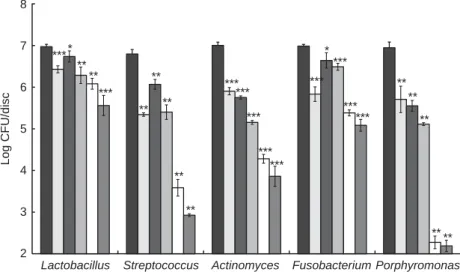
Grape seed extract (2000 lg ml!1), Fluorinol! (6"8–10"2 mg ml!1) and the combination of both were tested at sub-MBC levels for their ability to impair the multispe-cies biofilm formation (Fig. 1).
Each compound tested alone showed a significant inhi-bition of the biofilm formation. For each bacterium of species on each medium. The CFU per population for
triplicate discs were averaged and subjected to logarith-mic transformation.
Confocal laser scanning microscopy
Noninvasive confocal imaging of the biofilms (t = 64 h) was accomplished with a Confocal Visible Leica DMR TCS SP2 AOBS fitted with water-immersion dipping lenses (963). Specimens were stained with LIVE/DEAD! BacLightTM bacterial viability kit (Invitrogen, Cergy-Pontoise, France) for microscopy according to the manu-facturer’s instructions. An excitation wavelength of 488 nm was used, and all light rays emitted above 500 nm were collected. Biofilm structure was analysed in duplicate by taking a series of horizontal sections, each with a 1-lm thickness. Digital images were processed using Leica Con-focal Software Lite (Leica Microsystems, Wetzlar, Germany). Effect on glucosyltransferases activity
Crude cell-free GTF preparation was obtained from a cul-ture of Strep. sobrinus ATCC 33478 by ammonium sulfate precipitation as previously described (Furiga et al. 2008a).
For inhibition assays, test compounds, dissolved in ultrapure water, were added to the reaction mixture com-posed of the crude GTF preparation (0"1 U ml!1), 65 mmol l!1 K
2HPO4 buffer (pH 6"5), 50 g l!1 sucrose, 0"1 g l!1 NaN
3 and 2 g l!1 dextran T10. Incubation was carried out at 37°C, and the reaction was stopped by heating the samples at 100°C for 10 min.
The initial reaction rate was determined by measuring the reducing sugar concentration increase over the three first hours of reaction by dinitrosalicylic acid assay, with fructose as a standard (Sumner and Howell 1935). One unit of total GTF activity (U) was defined as the amount of enzyme that catalysed the release of reducing sugars equivalent to 1 lmol of fructose per min under standard conditions. Appropriate substrate and enzyme blanks were included to correct for any free reducing group not emanating from sucrose transformation.
To determine the amount of insoluble glucan synthe-sized, the heated samples were centrifuged (17 600 g, 30 min, 4°C) after 24-h incubation. The insoluble glucan was recovered from the pellet, washed three times with ultrapure water, dried at 65°C for 24 h and then weighed. Trolox equivalent antioxidant capacity assay
The method is based on the capacity of a sample to scav-enge the ABTS [2,2′-azinobis(3-ethybenzothiazoline-6-sul-fonic acid) diammonium salt] radical cation (ABTS●+), as compared to standard antioxidant Trolox
[6-hydroxy-the biofilm, [6-hydroxy-the antibiofilm activity of [6-hydroxy-the combination of 2000 lg ml!1 of GSE with 10"2 mg ml!1 of Fluorinol! was greater than that of each compound tested alone, resulted in a significant inhibition of 1"37 log10for Lacto-bacillus to 4"76 log10 for Porphyromonas. In addition, the inhibitory effect on biofilm formation of the combination was higher when the concentration of Fluorinol! increased.
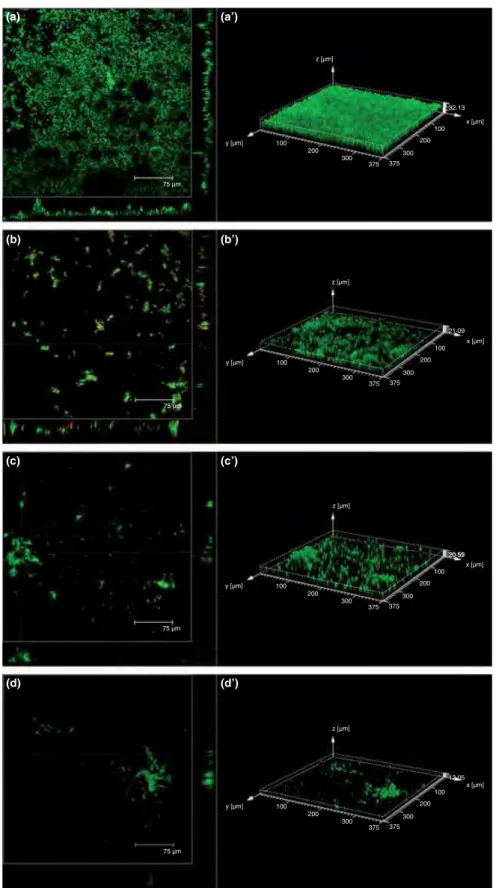
After 64 h of incubation, the control biofilm observa-tion by CLSM (Fig. 2a) showed a densely populated bio-film containing a large number of microcolonies, within which the occasional small lacuna was seen. Three-dimensional (3D) image of the control biofilm (Fig. 2a’) shows the presence of a uniformly spread biofilm with a thickness of 33"6 # 2"1 lm. CLSM observations of biofilms incubated with 10"2 mg ml!1 of Fluorinol!
(Fig. 2b,b’) or 2000 lg ml!1 of GSE (Fig. 2c,c’) revealed that a decrease in the number of microcolonies and thickness of these biofilms of 21"6 # 0"8 and 17"9 # 3"2 lm, respectively, were significantly (P < 0"05) smaller compared with the control biofilm. For the bio-film incubated with GSE (2000 lg ml!1) and Fluorinol! (10"2 mg ml!1), a very few low-density aggregates having a thickness of 10"3 # 2"5 lm with many unstained regions between them, and some single cells were observed on the surface of the HA discs (Fig. 2d,d’). Thickness of biofilm treated with the combination was significantly (P < 0"01) thinner than that of control bio-film. Moreover, the LIVE/DEAD!
staining indicated a very low level of cell damage, less than one per cent, both for control and for biofilm treated with the combination. Glucosyltransferases inhibition
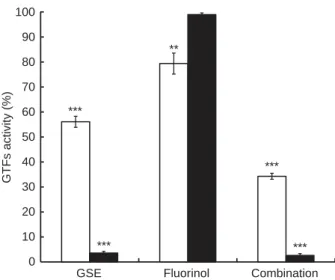
The effects on GTFs activity of GSE (2000 lg ml!1), Fluorinol! (10"2 mg ml!1) and their combination were analysed through the initial overall reaction rate deter-mined by measuring the amount of reducing sugars released and through the quantity of insoluble glucan (IG) synthesized (Fig. 3). GSE and the combination sig-nificantly inhibited both the initial overall reaction rate and the IG synthesis. The combination led to an increased inhibitory activity of GSE, visible on the amount of reducing sugars released, with an inhibition of 43"9% for GSE and 65"7% for the combination. Concern-ing the reduction in the quantity of IG synthesized after 24 h, the increase in inhibitory activity was not visible
Table 1 Antimicrobial activity (MIC and MBC in lg ml!1) of grape
seed extract (GSE) against oral bacteria
MIC* (lg ml!1) MBC† (lg ml!1) Streptococcus mutans 1000 4000 Streptococcus sobrinus 2000 4000 Actinomyces viscosus 1000 4000 Lactobacillus rhamnosus 4000 8000 Porphyromonas gingivalis 4000 8000 Fusobacterium nucleatum 2000 8000
*Minimal inhibitory concentration: concentration at which no bacte-rial growth was visible after 24-h incubation at 37°C.
†Minimal bactericidal concentration: concentration at which the CFU number was reduced by 99"9%.
2 3 4 5 6 7 8
Lactobacillus Streptococcus Actinomyces Fusobacterium Porphyromonas
Log CFU/disc *** ** *** *** ** ** *** *** *** ** ** *** ** *** ** ** *** ** *** ** * ** * *** **
Figure 1 Effect of grape seed extract (GSE), Fluorinol!
and the combination of both on multispecies biofilm formation. Results are expressed as means and standard deviations of triplicate experiments. Statistical differences (*P < 0"05, **P < 0"01 and ***P < 0"001) between test com-pound and control (n = 3). (&), Control; ( ), GSE 2000 lg ml!1; ( ) Fluorinol!
6"8 mg ml!1; ( ) Fluorinol!
10"2 mg ml!1; (h) GSE
2000 lg ml!1and Fluorinol!
6"8 mg ml!1; ( ) GSE 2000 lg ml!1and Fluorinol!
y [µm] 75 µm 75 µm 75 µm 75 µm z [µm] x [µm] 100 100 32·13 200 200 300 300 375 375 y [µm] z [µm] x [µm] 100 100 21·09 200 200 300 300 375 375 y [µm] z [µm] x [µm] 100 100 20·59 200 200 300 300 375 375 y [µm] z [µm] x [µm] 100 100 12·05 200 200 300 300 375 375 (a) (a’) (b) (b’) (c) (c’) (d) (d’)
Figure 2 Scanning confocal laser microscopy images of biofilms (t = 64 h) stained with the LIVE/DEAD!
BacLightTM
bacterial viability kit. Biofilm treated with (a) ultrapure water (control), (b) Fluorinol!
10"2 mg ml!1, (c) GSE 2000 lg ml!1, (d) GSE 2000 lg ml!1 and Fluorinol!
because GSE alone resulted already to the maximum inhibition. Fluorinol!
showed a significant inhibition of 20"6% of the amount of reducing sugars released, while no effect was observed on the IG synthesis.
Antioxidant capacity
The antioxidant capacity of test compounds is shown in Table 2. As TEAC is a quantification of the effective anti-oxidant activity of the compound versus Trolox, a higher TEAC would imply greater antioxidant activity of the
samples. Fluorinol!
showed no antioxidant effect. There-fore, the TEAC for the combination and for Eludril Daily!
was determined relative to the concentration of the active agent (i.e. GSE) present in these solutions. GSE and Eludril Daily! presented a high TEAC value, signifi-cantly (P < 0"001) greater than those of ascorbic acid, proving their capacity to scavenge the ABTS●+ radical cation. No statistical difference (P < 0"001) was obtained between the TEAC values of GSE, the combination and Eludril daily!
. Discussion
Dental plaque control is a key factor in the prevention of dental caries and periodontal diseases. Many antiplaque agents exist, the gold standard being chlorhexidine. To overcome the long-term side effects of such antiseptics, such as teeth staining and the assignment of the biologi-cal equilibrium in the oral cavity, previous studies have investigated the effects of polyphenols for oral hygiene purposes (Song et al. 2006; Xiao et al. 2007). In this con-text, we focused on the study of biological capacities of the combination of a grape seed extract, known for its antiplaque and antioxidant activities (Furiga et al. 2009), with an amine fluoride limiting the enamel demineraliza-tion (Griffin et al. 2007).
In a first step, we analysed the antimicrobial activity of GSE and Fluorinol!
to check the absence of bactericidal effects that may have an adverse impact on the oral eco-system. Unlike previous studies which showed that amine fluoride had bactericidal activity (Rosin-Grget and Lincir 1995), Fluorinol! exhibited no effect against the six bac-terial strains at the highest tested concentration of 10"2 mg ml!1, corresponding to 1500 ppm of fluoride, that is, the maximum concentration permissible in an over-the-counter product in the European Union. Per-haps, this difference between our results can be explained by the fact that most previous studies are clinical studies, and thus, the anticaries effects observed, related to a direct antibacterial activity against oral bacteria, would be actually consequence of many other mechanisms.
Concerning GSE, there is no restrictive concentration in the use of these polyphenolic extracts because they are natural raw materials used in food industry, beverage, health food and cosmetics and their lack of toxicity has been reported (Yamakoshi et al. 2002). The MIC values obtained for GSE were high (1000–4000 lg ml!1) com-pared with those of chlorhexidine (<0"5–15"6 lg ml!1) against the same oral bacteria (Furiga et al. 2008b). Com-pared with other polyphenolic extracts, these MIC values were similar to those previously obtained with Polygonum cuspidatum extract (Song et al. 2006) and Nidus vespae extract (Xiao et al. 2007), and much higher than those
0 10 20 30 40 50 60 70 80 90 100
GSE Fluorinol Combination
GTFs activity (%)
***
*** **
*** ***
Figure 3 Effect of grape seed extract (GSE, 2000 lg ml!1),
Fluori-nol!
(10"2 mg ml!1) and the combination of GSE (2000 lg ml!1)
and Fluorinol!
(10"2 mg ml!1) on glucosyltransferases (GTFs) activity.
Enzymatic activity (U ml!1) was analysed through the initial overall
reaction rate determined by measuring the amount of reducing sug-ars released, and through the quantity of insoluble glucan (IG) synthe-sized. Results are presented as percentage of enzymatic activity with respect to control (without any compound). Results are expressed as means and standard deviations of triplicate experiments. Statistical differences (**P < 0"01 and ***P < 0"001) between test compound and control (n = 3). (□), Reducing sugars; (■), IG.
Table 2 Antioxidant activity of test compounds
Compounds TEAC† Ascorbic acid 5"70 # 0"04 GSE 6"99 # 0"06*** Fluorinol! 0"01 # 0"01*** Combination 6"98 # 0"01*** Eludril Daily! 6"95 # 0"05*** †The Trolox equivalent antioxidant capacity (TEAC) corresponds to the micromolar concentration of Trolox equivalent to a 1 lg ml!1
solu-tion of sample (the higher the more efficient). Each value corresponds to the mean and standard deviation of the triplicate of three separate concentrations within the linear interval (n = 3). Statistical differences (***P < 0"001) between test compound and ascorbic acid (control).
substrata help establish the early biofilm community (Kolenbrander 2000). These observations and the strong decrease of 4"8 log10 of Porphyromonas observed within the treated biofilm indicate that our combination achieved the expected benefits of such therapy, which is to control the biofilm development, especially with pre-ventive effect on bacterial adhesion and the early stages of the biofilm formation leading to inhibition of the binding and proliferation of secondary colonizers involved in the pathogenicity of oral diseases, and not to a total biofilm removal. Finally, CLSM observations showed a much higher density of recovery of the surface for the control biofilm compared with treated biofilms, which indicate the presence of a large amount of exo-polysaccharides in the control and the fact that the anti-biofilm activity of the tested compounds corresponds to a significant decrease in the number of CFUs, but could also include destruction or reduction in the production of these polymers.
The inhibition of adhesion is an attractive concept for the development of new therapies in the prevention of bac-terial dental infections. The adhesion of bacteria on the teeth is strongly influenced by the synthesis of glucans by glucosyltransferases. Therefore, we next examined the inhibitory activity of the compounds on these enzymes. The inhibition of insoluble glucan synthesis >90% obtained with GSE was in agreement with results described for another grape seed extract (Toukairin et al. 1991) and for other polyphenolic extracts (Otake et al. 1991; Nakahara et al. 1993). Numerous studies have identified oligomeric proanthocyanidins (or condensed tannins) as most active in the GTFs inhibition, and one characteristic of the grape seeds is to be rich in these molecules, which could explain the observed results (Nakahara et al. 1993).
On the other hand, the adhesive insoluble glucan syn-thesis and the formation of dental plaque are due to the cooperative action of GTF-S (soluble glucans synthesis), GTF-I (insoluble glucans synthesis) and/or GTF-SI (solu-ble and insolu(solu-ble glucans synthesis, Strep. mutans spe-cific). Without this cooperative action, it would not be possible for micro-organisms to have any degree of adhe-sion. Indeed, it has been shown that the synthetic prod-uct of each purified enzyme alone is unable to adhere to the glass of a test tube (Koga et al. 1983). It is thus inter-esting to search for compounds inhibiting this combined action of GTFs. However, enzymatic inhibitors have often been studied on highly purified and poorly representative GTF preparations (Wunder and Bowen 1999). Therefore, test compounds have been evaluated in this study on a crude GTF preparation previously characterized contain-ing a mixture of at least four different glucosyltransferases (GTF-S1, GTF-S2, GTF-S3 and GTF-I), highly representa-tive of the Strep. sobrinus GTF complex, and leading to obtained with seeds and skin of wine grape extracts
(Toukairin et al. 1991).
The antiplaque effect of GSE and Fluorinol!, and their combination, was then tested on a multispecies biofilm. This step is needed to evaluate potential antiplaque mole-cules because bacteria within a biofilm possess different properties than planktonic bacteria, including an increased protection against antimicrobial agents (Leung et al. 2005). The two compounds tested alone showed a significant inhibition of the biofilm formation. As previ-ously described, the most successful concentration for GSE is 2000 lg ml!1 and higher concentrations in this extract led to a fall of its effectiveness, principally caused by its poor dissolution in water (Furiga et al. 2009). The inhibitory effects of Fluorinol!
on biofilm formation were dose-dependent, and the optimum antibiofilm activ-ity was obtained at the permissible concentration of 10"2 mg ml!1. In addition, CLSM observation of biofilm treated with Fluorinol! showed a low level of cell dam-ages with only a few visible dead cells, confirming that this compound exerts its antibiofilm activity by other mechanisms than just a direct antibacterial effect. The combination of these two compounds led to a synergistic effect on biofilm formation with an inhibition >3 log10 on streptococci, Actinomyces and Porphyromonas, for the most effective combination of 2000 lg ml!1 of GSE and 10"2 mg ml!1 of Fluorinol!
.
Our results can be related to those of Shapiro et al. (2002), who studied the effectiveness of twelve mouth-washes using the same biofilm system with few modifica-tions, mainly changes in bacterial composition. As mouthrinses containing plant extracts tested in their study, our combination showed an antibiofilm activity lower than that of mouthwashes containing chlorhexi-dine, which led to a total biofilm eradication linked to its bactericidal effects. In addition, the level of bacteria cells was high even after treatment with our combination although values were clearly statistically significant. Same observations and a median reduction in CFU (>3 log10) equivalent to those of our combination were noted with Listerine!, the most active mouthrinse containing plant extracts. However, numerous clinical studies have con-firmed the significant plaque inhibitory properties of List-erine! that suppressed de novo plaque formation after four (Riep et al. 1999) and 21 days (Brecx et al. 1990) in the absence of mechanical toothcleaning. Thus, it seems that a significant reduction of cells using this in vitro model, even if the number of CFU still high, lead to a significant biological effectiveness in relevant clinical tri-als. Moreover, our combination showed high inhibition on streptococci and Actinomyces. These species have been identified as the major initial colonizers of the tooth surface, and the interactions between them and their
were similar to that obtained for GSE tested alone, while Fluorinol!
had no antioxidant activity. This demonstrates firstly that GSE is solely responsible for the antioxidant effect observed and secondly that the other components present in the formulated mouthwash have no impact on its antioxidant capacity. Therapeutic agents used cur-rently as adjuvants in the treatment for periodontal dis-eases are chlorhexidine, cetylpyridinium chloride or fluoride, but, unlike Eludril Daily!, none has antioxidant activity and the inflammation decrease observed in clini-cal studies is mainly due to their antiplaque activity.
In conclusion, the combination of GSE with Fluorinol! showed both significant antiplaque activities and antioxi-dant properties, without any bactericidal effects, and thus could be helpful in the fight against oral diseases and oxi-dative damage associated. However, the biofilm system used in this study was limited compared with the natural oral biofilm and the mouth ecosystem (e.g. artificial media use, biofilm composed only by reference bacteria, static model) and so, additional experiments such as tests in a flowing system and on human samples of dental pla-que should be performed to confirm the results. More-over, given that various in vivo dynamic factors such as systemic conditions, salivary flow, diet and dental anat-omy could interact with the test compound effectiveness, these promising in vitro effects should be confirmed in a clinical study conducted with Eludril Daily!
mouthwash. Acknowledgements
The authors would like to thank Pierre Fabre Medica-ment Laboratories (Oral Care DepartMedica-ment, Castres, France) for support and advice with this project.
Conflict of interest
A part of the financial support to conduct this study was provided by Pierre Fabre Medicament Laboratories (Oral Care Department, Castres, France).
References
Bagchi, D., Garg, A., Krohn, R.L., Bagchi, M., Bagchi, D.J., Balmoori, J. and Stohs, S.J. (1998) Protective effects of grape seed proanthocyanidins and selected antioxidants against TPA-induced hepatic and brain lipid peroxidation and DNA fragmentation, and peritoneal macrophage activation in mice. Gen Pharmacol 30, 771–776. Banas, J.A. and Vickerman, M.M. (2003) Glucan-binding
proteins of the oral streptococci. Crit Rev Oral Biol Med 14, 89–99.
Bradshaw, D.J., Marsh, P.D., Hodgson, R.J. and Visser, J.M. (2002) Effects of glucose and fluoride on competition and
the synthesis of a strongly adhesive insoluble glucan (Furiga et al. 2008a). Thus, the inhibition observed by GSE of both the initial overall reaction rate and the IG synthesis by this GTF preparation is representative of the inhibition of the cooperative action of GTFs. Indeed, the inhibition by GSE of the release of reducing sugars indi-cated that this compound prevents cleavage of the sucrose into fructose and glucose and therefore the bind-ing of the enzyme glucosyl residue and the synthesis of soluble glucan by GTF-S, the latter serving as a primer for the GTF-I for the insoluble glucan synthesis (Gilmore et al. 1993). This dual inhibition has also been shown for a grape juice containing 3"1 mg ml!1 of polyphenols (Kashket et al. 1985).
As Shani et al. (2000), we obtained a low inhibitory activity of amine fluoride on GTFs activity. The same experiment was performed with sodium fluoride at the concentration of 0"33%, corresponding to 1500 ppm of fluoride, and an inhibitory activity of 3"0 # 1"3% of the amount of reducing sugars released was obtained, sug-gesting that it is the amine component of the amine fluo-ride that is responsible for the observed effect on GTFs (data not shown). However, this low inhibitory activity was sufficient to explain the observed increase in the inhibitory effect of GSE by the addition of Fluorinol!
. Furthermore, these enzymes are very important in the process of biofilm formation (Banas and Vickerman 2003); therefore, this potentiation of the inhibitory effect could certainly explain some of the increase in antibio-film activity observed with the combination on multispe-cies biofilm.
Periodontal diseases are in part caused by an over-growth of pathogenic bacteria, gram-negative anaerobes such as P. gingivalis and Fus. nucleatum. The accumula-tion and persistence of these bacteria initiate periodontal tissue destruction either directly by the release of specific products such as bacterial lipopolysaccharide (LPS) or indirectly through the activation of immune defence sys-tems of the host, resulting in the excessive production of reactive oxygen species (Ozmeric 2004) leading to oxida-tive damage of gingival tissues, periodontal ligament and alveolar bone (Canakci et al. 2005). Thus, it seems inter-esting to search for molecules that inhibit the free radi-cals production.
As previously demonstrated, GSE had antioxidant activity greater than of ascorbic acid (Furiga et al. 2009). This result agrees with the study of Houde et al. (2006) who measured the TEAC of a grape seed extract to 1"54 mmol l!1. As well, Bagchi et al. (1998) showed that among several antioxidant molecules tested in mice for their ability to decrease free radicals production, the grape seed extract was the most effective. The TEAC val-ues obtained for the combination and for Eludril Daily!
metabolism within in vitro dental bacterial communities and biofilms. Caries Res 36, 81–86.
Brecx, M., Netuschil, L., Reichert, B. and Schreil, G. (1990) Efficacy of listerine, meridol and chlorhexidine mouthrinses on plaque, gingivitis and plaque bacteria vitality. J Clin Periodontol 17, 292–297.
Canakci, C.F., Cicek, Y. and Canakci, V. (2005) Reactive oxygen species and human inflammatory periodontal diseases. Biochemistry (Mosc) 70, 619–628.
CLSI (2009) Methods for Dilution Antimicrobial Susceptibility Tests for Bacteria that Grow Aerobically; Approved Standard, 8th edn. Wayne, PA: Clinical Laboratory Standards Institute document M07-A8 Vol.29, No. 2. Daglia, M., Tarsi, R., Papetti, A., Grisoli, P., Dacarro, C.,
Pruzzo, C. and Gazzani, G. (2002) Antiadhesive effect of green and roasted coffee on Streptococcus mutans’ adhesive properties on saliva-coated hydroxyapatite beads. J Agric Food Chem 50, 1225–1229.
Furiga, A., Dols-Lafargue, M., Heyraud, A., Chambat, G., Lonvaud-Funel, A. and Badet, C. (2008a) Effect of antiplaque compounds and mouthrinses on the activity of glucosyltransferases from Streptococcus sobrinus and insoluble glucan production. Oral Microbiol Immunol 23, 391–400.
Furiga, A., Lonvaud-Funel, A., Dorignac, G. and Badet, C. (2008b) In vitro anti-bacterial and anti-adherence effects of natural polyphenolic compounds on oral bacteria. J Appl Microbiol 105, 1470–1476.
Furiga, A., Lonvaud-Funel, A. and Badet, C. (2009) In vitro study of antioxidant capacity and antibacterial activity on oral anaerobes of a grape seed extract. Food Chem 113, 1037–1040.
Gilmore, K.S., Russell, R.R. and Ferretti, J.J. (1993)
Expression of gtfS is essential for normal insoluble glucan synthesis by Streptococcus downei. Infect Immun 61, 1246–1250.
Griffin, S.O., Regnier, E., Griffin, P.M. and Huntley, V. (2007) Effectiveness of fluoride in preventing caries in adults. J Dent Res 86, 410–415.
Guggenheim, B., Giertsen, E., Schupbach, P. and Shapiro, S. (2001) Validation of an in vitro biofilm model of supragingival plaque. J Dent Res 80, 363–370.
Herrera, D., Roldan, S., Santacruz, I., Santos, S., Masdevall, M. and Sanz, M. (2003) Differences in antimicrobial activity of four commercial 0.12% chlorhexidine mouthrinse formulations: an in vitro contact test and salivary bacterial counts study. J Clin Periodontol 30, 307–314.
Houde, V., Grenier, D. and Chandad, F. (2006) Protective effects of grape seed proanthocyanidins against oxidative stress induced by lipopolysaccharides of
periodontopathogens. J Periodontol 77, 1371–1379. Kashket, S., Paolino, V.J., Lewis, D.A. and van Houte, J.
(1985) In-vitro inhibition of glucosyltransferase from the dental plaque bacterium Streptococcus mutans by common beverages and food extracts. Arch Oral Biol 30, 821–826.
Koga, T., Sato, S., Yakushiji, T. and Inoue, M. (1983) Separation of insoluble and soluble glucan-synthesizing glucosyltransferases of Streptococcus mutans OMZ176 (serotype d). FEMS Microbiol Lett 16, 127–130. Kolenbrander, P.E. (2000) Oral microbial communities:
biofilms, interactions, and genetic systems. Annu Rev Microbiol 54, 413–437.
Leung, K.P., Crowe, T.D., Abercrombie, J.J., Molina, C.M., Bradshaw, C.J., Jensen, C.L., Luo, Q. and Thompson, G.A. (2005) Control of oral biofilm formation by an
antimicrobial decapeptide. J Dent Res 84, 1172–1177. Liljemark, W.F. and Bloomquist, C. (1996) Human oral
microbial ecology and dental caries and periodontal diseases. Crit Rev Oral Biol Med 7, 180–198.
Listgarten, M.A. (1999) Microorganisms and dental implants. J Periodontol 70, 220–222.
Marechal, M. (1991) Chemical control of plaque: comparative review. Rev Belge Med Dent 46, 51–58.
Marsh, P.D. and Bradshaw, D.J. (1993) Microbiological effects of new agents in dentifrices for plaque control. Int Dent J 43, 399–406.
Nakahara, K., Kawabata, S., Ono, H., Ogura, K., Tanaka, T., Ooshima, T. and Hamada, S. (1993) Inhibitory effect of oolong tea polyphenols on glycosyltransferases of mutans Streptococci. Appl Environ Microbiol 59, 968–973. Okahashi, N., Nakata, M., Sumitomo, T., Terao, Y. and
Kawabata, S. (2013) Hydrogen peroxide produced by oral Streptococci induces macrophage cell death. PLoS One 8, e62563.
Ooshima, T., Minami, T., Aono, W., Tamura, Y. and Hamada, S. (1994) Reduction of dental plaque deposition in humans by oolong tea extract. Caries Res 28, 146–149. Osawa, K., Miyazaki, K., Shimura, S., Okuda, J., Matsumoto,
M. and Ooshima, T. (2001) Identification of cariostatic substances in the cacao bean husk: their
anti-glucosyltransferase and antibacterial activities. J Dent Res 80, 2000–2004.
Otake, S., Makimura, M., Kuroki, T., Nishihara, Y. and Hirasawa, M. (1991) Anticaries effects of polyphenolic compounds from Japanese green tea. Caries Res 25, 438–443. Ozmeric, N. (2004) Advances in periodontal disease markers.
Clin Chim Acta 343, 1–16.
Petersen, P.E. (2003) The World Oral Health Report 2003: continuous improvement of oral health in the 21st century–the approach of the WHO Global Oral Health Programme. Community Dent Oral Epidemiol 31, 3–23. Petersen, P.E., Bourgeois, D., Ogawa, H., Estupinan-Day, S. and
Ndiaye, C. (2005) The global burden of oral diseases and risks to oral health. Bull World Health Organ 83, 661–669. Petti, S. and Scully, C. (2009) Polyphenols, oral health and
disease: a review. J Dent 37, 413–423.
Re, R., Pellegrini, N., Proteggente, A., Pannala, A., Yang, M. and Rice-Evans, C. (1999) Antioxidant activity applying an improved ABTS radical cation decolorization assay. Free Radic Biol Med 26, 1231–1237.
Riep, B.G., Bernimoulin, J.P. and Barnett, M.L. (1999) Comparative antiplaque effectiveness of an essential oil and an amine fluoride/stannous fluoride mouthrinse. J Clin Periodontol 26, 164–168.
Rosin-Grget, K. and Lincir, I. (1995) Anticaries effect of different amine fluoride concentrations in schoolchildren. Caries Res 29, 168–171.
Sculley, D.V. and Langley-Evans, S.C. (2002) Salivary antioxidants and periodontal disease status. Proc Nutr Soc 61, 137–143.
Shani, S., Friedman, M. and Steinberg, D. (2000) The anticariogenic effect of amine fluorides on Streptococcus sobrinus and glucosyltransferase in biofilms. Caries Res 34, 260–267.
Shapiro, S., Giertsen, E. and Guggenheim, B. (2002) An in vitro oral biofilm model for comparing the efficacy of antimicrobial mouthrinses. Caries Res 36, 93–100. Shellis, R.P. and Duckworth, R.M. (1994) Studies on the
cariostatic mechanisms of fluoride. Int Dent J 44, 263–273. Song, J.H., Kim, S.K., Chang, K.W., Han, S.K., Yi, H.K. and
Jeon, J.G. (2006) In vitro inhibitory effects of Polygonum cuspidatum on bacterial viability and virulence factors of Streptococcus mutans and Streptococcus sobrinus. Arch Oral Biol 51, 1131–1140.
Sumner, J.B. and Howell, S.F. (1935) A method for
determination of saccharase activity. J Biol Chem 108, 51–54. Toukairin, T., Uchino, K., Iwamoto, M., Murakami, S.,
Tatebayashi, T., Ogawara, H. and Tonosaki, Y. (1991)
New polyphenolic 5′-nucleotidase inhibitors isolated from the wine grape “Koshu” and their biological effects. Chem Pharm Bull (Tokyo) 39, 1480–1483.
Weiss, E.I., Kozlovsky, A., Steinberg, D., Lev-Dor, R., Bar Ness Greenstein, R., Feldman, M., Sharon, N. and Ofek, I. (2004) A high molecular mass cranberry constituent reduces mutans streptococci level in saliva and inhibits in vitro adhesion to hydroxyapatite. FEMS Microbiol Lett 232, 89–92.
WHO (2012) World Health Organization - Oral health. Fact sheet n°318. URL http://www.who.int/mediacentre/ factsheets/fs318/en/. accessed 18/10/2013.
Wunder, D. and Bowen, W.H. (1999) Action of agents on glucosyltransferases from Streptococcus mutans in solution and adsorbed to experimental pellicle. Arch Oral Biol 44, 203–214.
Xiao, J., Zuo, Y., Liu, Y., Li, J., Hao, Y. and Zhou, X. (2007) Effects of Nidus Vespae extract and chemical fractions on glucosyltransferases, adherence and biofilm formation of Streptococcus mutans. Arch Oral Biol 52, 869–875.
Yamakoshi, J., Saito, M., Kataoka, S. and Kikuchi, M. (2002) Safety evaluation of proanthocyanidin-rich extract from grape seeds. Food Chem Toxicol 40, 599–607.
Yamashita, Y., Bowen, W.H., Burne, R.A. and Kuramitsu, H.K. (1993) Role of the Streptococcus mutans gtf genes in caries induction in the specific-pathogen-free rat model. Infect Immun 61, 3811–3817.