ASPECTUALLy -CONDITIONED MORPHOLOGICAL ERGATIVITY:
THE HINDI PARTICLE N-E
THÈSE PRÉSENTÉE
COMME EXIGENCE PARTIELLE DU DOCTORAT EN LINGUISTIQUE
PAR JOËL FINLEY
À Service des bibliothèques
Avertissement
La diffusion de cette thèse se fait dans le respect des droits de son auteur, qui a signé le formulaire Autorisation de reproduire et de diffuser un travail de recherche de cycles
supérieurs (SDU-522 - Rév.ü1-2üü6). Cette autorisation stipule que «conformément
à
l'article 11 du Règlement no 8 des études de cycles supérieurs, [l'auteur] concèdeà
l'Université du Québecà
Montréal une licence non exclusive d'utilisation et de publication de la totalité ou d'une partie importante de [son] travail de recherche pour des fins pédagogiques et non commerciales. Plus précisément, [l'auteur] autorise l'Université du Québecà
Montréalà
reproduire, diffuser, prêter, distribuer ou vendre des copies de [son] travail de rechercheà
des fins non commerciales sur quelque support que ce soit, y compris l'Internet. Cette licence et cette autorisation n'entraînent pas une renonciation de [la] part [de l'auteur]à
[ses] droits moraux nià
[ses] droits de propriété intellectuelle. Sauf entente contraire, [l'auteur] conserve la liberté de diffuser et de commercialiser ou non ce travail dont [il] possède un exemplaire.»The Hindi speakers behind the present work are in no wise responsible for what has been do ne with the redolent fruits of their vigorous imaginations. Nonetheless, they and a few others must be credited for the very existence of this thesis.
To collect the information needed for this study without overwhelming the consultants, a few special courtesies were adopted, e.g., calling after six a.m., 1imiting personal and telephone interviews to three hours, and adhering to topics which are at worst merely distasteful -sedulously avoiding the egregious and disrespectful. Even so, if the corpus were likened to an omelette, it would have to be admitted that a few eggs were smashed in the making. A dash or two of shell fragments got mixed in, and are bound to tum up with the fines herbes. The reader will want to look out for both.
Dr. Murlidhar Gupta, a Kanpur speaker, contributed data in countless interviews over a period of ten years, even while in the midst of preparing his own thesis and marriage.
Contributing with the same unabated intensity, a priceless collaborator has been Dr. Ashish Sharma of Delhi, who even when safely married off in Europe did not escape long distance persecution.
Mr. Mohan Ghai Singh provided precious grammaticality judgements as a speaker of Punjabi and Urdu familiar with the momentous changes in South Asian language and culture.
Mr. Ilyas Kayani, a Rawalpindi Urdu speaker with a life-time in journalism and humanitarian work, over-flowed with vivid examples, usually discussed long-distance, often under duress such as no doctoral project can create.
Dr. P. Joshi, a globe-trotting Jaipur speaker, has broken the record, providing over two hundred hours of intensive interviews with priceless cultural and linguistic insights, III spite of many responsibilities and challenging pursuits.
Mrs. B. Sood, formerly of Delhi, provided insights regarding the Hindi she spoke over forty years ago in a rapidly evolving language setting.
Dr. M. Chaubey of Varanasi related examples of grammatical form to context with striking experimental precision.
Madam Rashmi Shah, hailing from Pune, provided sorne essential points of comparison of Hindi with Marathi.
Madam Param, a Delhi speaker of Hindi and Punjabi, supplied COPlOUS written examples, i11ustrating the meanings with ease and wit.
Madam Meenakshi, a Hindi speaker from the Western Uttar Pradesh, solved head cracking puzzles which, for shame, the writer did not bring up with the other consultants.
Miss Tusha Bhatia, an ardent Mumbaikar, in restless pursuit of ail sorts of knowledge -Hindi, Marathi, and Derawali Punjabi babbling freely from her tongue- found time to debate this document at length, and to staff an around~the-clock emergency think-tank.
Mr. Saurabh Goenka, fluent in the Hindi spoken by Marwari residents of Kolkata, provided clinching evidence for the essential unity across dialects of the phenomenon discussed in this thesis.
Miss Iffat Sumia Khader, a Madrasi Urdu speaker in ChelU1ai, provided compelling evidence that Tamil and HindilUrdu can get along fine in the same brain, sans état d'àme. Her generation has also shown that English is filling a need in today's multilingual societies it is not replacing anything.
Miss Sufia Saliha Khader, also of ChelU1ai, provided semantic insights of great quality that owe little to conventional academic influences. Although she speaks of taking her numerous talents to outer space, someone should tell her -she's already stellar.
The sorely-missed Professor Ven Murthy, rewarded as a youngster by Gandhi-ji for his accomplislunents in Hindi, discussed closely parallel KalU1ada and Hindi constructions, and made many thought-provoking observations.
A few nuggets were picked up at the odd Hindu festival or funeral, and from the much-maligned Hindi movie repertoire, such that it can be truly said that this thesis has been shaped by the near, the departed, the rightly and the unjustly forgotten.
DrJohn Lumsden tutored this writer in linguistics, unravelling novel confirmations and unexpected dimensions of belief. The university does not realize what it has got.
Dr. Mrnal Ray, Dr. German Arellano , Mr. Raymond Wiggins, Mr. Paul Cummins, Madam Trinh ThUy Hanh, Miss Nguyen Quang Hông Ân, and Miss Dinorah Jimenez
provided unstinting spiritual support and indispensable camaraderie. As often as no t, there was also life-saving music and food.
Diethild Starkmeth is eamestly thanked for timely reminders about the researcher's first duty, to contribute to The Debate.
The writer must also note that this project has affected his every relationship. It has led him back to his family, to his sisters Shirin and Narin, to his son, Reuben, to Julie, and to his grandson, Raoûl. It has caused there to be formed a new link with Mrs.Vivian Çhoi and Ms. Susan Choi. It has brought him closer to his parents, Lorol Finley and Professor Marion Finley, jr. Without their vigilant care, this hint in the dark would have flickered out, and without their guidance, the purpose of all travail, petty or great, forgotten: to catch another glimpse of the Divine Features locked inside ail men and women, the Truth behind the inevitable unit y of the world and its beleaguered peoples.
Joël Finley Montréal
CONTENTS
vTABLES ...•...viii
FIGURES ix
RÉSUMÉ
x
SUMMARY
x
ABBREVIATIüNS USED IN THE GLüSSES xi
CHAPTER 1
1
THE DISTRIBUTION OF N-E
1
1.1 THE PROBLEM OF THE DISTRIBUTION OF THE PARTICLE N-E 1
1.1 TRANSITIVISATION AND THE N-E-SUBJECT 5
1.1.1 EXCEPTIONS TO THE GENERAL DISTRIBUTION OF N-E 9 1.1.1.1 SUBJECTS OF TRANSITIVES, APPEARING WITH OR WITHOUT N-E 9 1.1.1.2 SUBJECTS OF INTRANSITIVES, APPEARING WITH OR WITHOUT N-E II 1.1.1.3 SUBJECTS WITH N-E AND NON-SENTIENT REFERENTS 12 1.1.1.4 OBJECT SEMANTICS AND THE USE OF N-E 13 1.1.1.5 TRANSITIVES WITH SUBJECTS AND OBJECTS IN THE DIRECT CASE.. 14 1.1.1.6 THE SUBJECT WITH N-E OF GERUNDIVE PARTICIPLES OF OBLIGATION 14 1.1.1.7 SUMMARY OF CASES OF EXCEPTIONAL DISTRIBUTION OF N-E 15 1.2.0 PREVIOUS ACCOUNTS OF THE USAGE OF N-E 16
1.2.1 CLASSICAL CASE SYSTEMS AND HrNDI 16
1.2.2 MAGIER (1987) AND THE TRANSITIVITY PROTOTYFE 17
1.2.3 ANAND & NEVINS (2006) 24
1.2.4 DA VISON (2003) 25
1.2.5 T. MOHANAN (1994) 27
1.2.6 MAHAJAN (1997) 30
1.2.7 CONCLUDING REMARKS 32
1.3.0 SEMANTIC REPRESENTATIONS 34
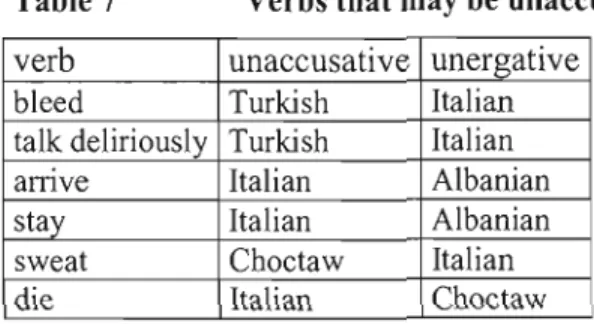
1.3.1 THE FOUR KINDS OF INTRANSITIVE EXPRESSION 34
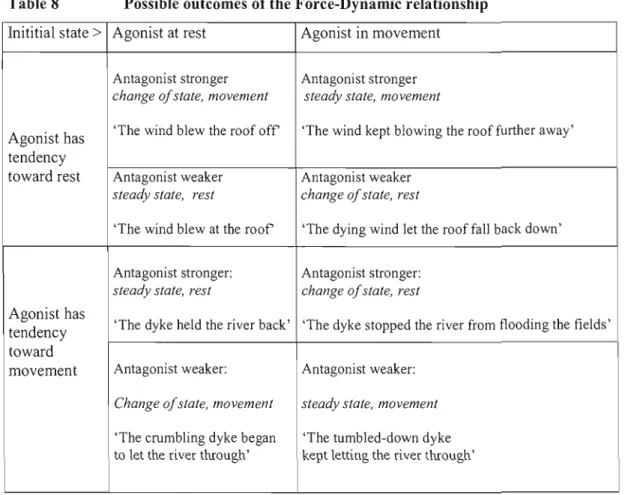
1.3.2 FORCE DYNAMICS 38
1.3.3 THETHEMATICTIER 41
vu
1.3.5 COMPLEX ACTIONS 48
1.3.6 INDIVIDUAL-LEVEL STATIVES VS. STAGE-LEVEL STATIVES 50
1.3.7 COMPLEX EVENT NOMINALS (GRIMSHAW 1990) 53
CHAPTER II 57
THE STRUCTURES OF HINDI 57
2.0 INTRODUCTION 57
2.1 THE HINDI 'SUBJECT' 58
2.2 THE STATIVE MATRIX VERB OF HINDI CLAUSES 62
2.2.1 FIGURE, GROUND, AND CASE IN HINDI 63
2.2.2 HINDI CLAUSES WITHOUT H-'BE' 66
2.3 THE NOMINAL STATUS OF HINDI PARTICIPLES 73
2.3.1 THE HINDI PARTICIPLE AS A SIMPLE NOUN OR ADJECTIVE 73
2.3.2 HINDI PARTICIPLES AS COMPLEX EVENT NOMINALS 76
233 THE INTERNAL STRUCTURE OF HINDI PARTICIPIAL CONSTRUCTIONS 78
2.4 THE COMPOUNDED PARTICIPLE 82
2.5 THE EXPRESSION OF EVENTS IN HINDI CLAUSES 90
CHAPTER III 102
THE USES OF N-E IN HINDI 102
3.0 INTRODUCTION 102
3.1 THE COMPOSITION AND THE MEANING OF N-E 103
3.2 THREE QUESTIONS ON THE DISTRIBUTION OF N-E 107
3.3 ANALYSES OF SOME SIMPLE CLAUSES 113
CONCLUSION 121
BIBLIOGRAPHY
125Table 1 Intransitive-transitive pairs 6
Table 2 Doing vs. having someone do 7
Table 3 Undergoing vs. doing vs. getting someone to undergo Il
Table 4 Intransitives with variable subject forms 12
Table 5 Initiation vs. delimitation languages 19
Table 6 Levels of structure in LFG 27
Table 7 Verbs that may be unaccusative or unergative in different languages 37 Table 8 Possible outcomes of the Force-Dynamic relationship 39
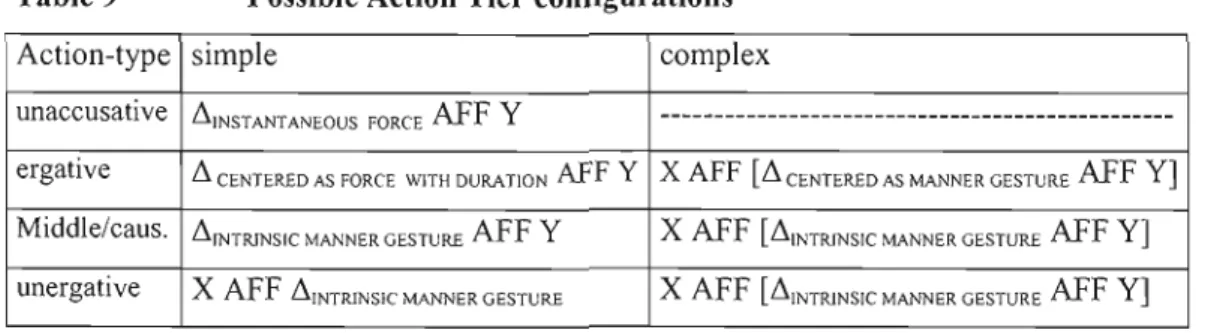
Table 9 Possible Action Tier configurations 50
Table 10 Singular direct case and oblique 63
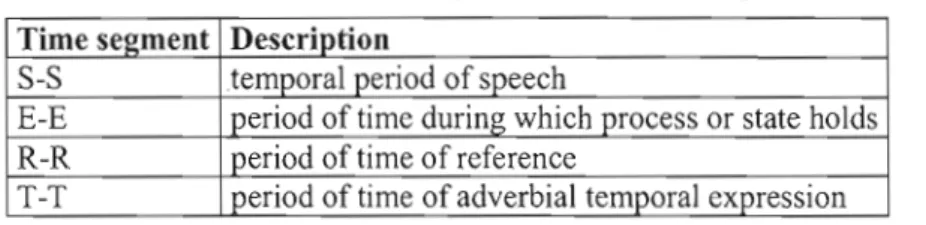
Table Il The four time-segments for describing sentential aspect 66
Table 12 The four sentential aspects 67
Table 13 Infiected perfective, imperfective, and gerundive participles 74
Table 14 Re1ated intransitive and transitive compounders 86
Table 15 Centering of intransitive vs. transitive compounders 87 Table 16 Types of particip1es that appear in the compound form 90
Table 17 (=Table 9) Possible Action Tier configurations 108
1 2 3 4 5 6 7 8 9 10 11 Figure Figure Figure Figure Figure Figure Figure Figure Figure Figure Figure
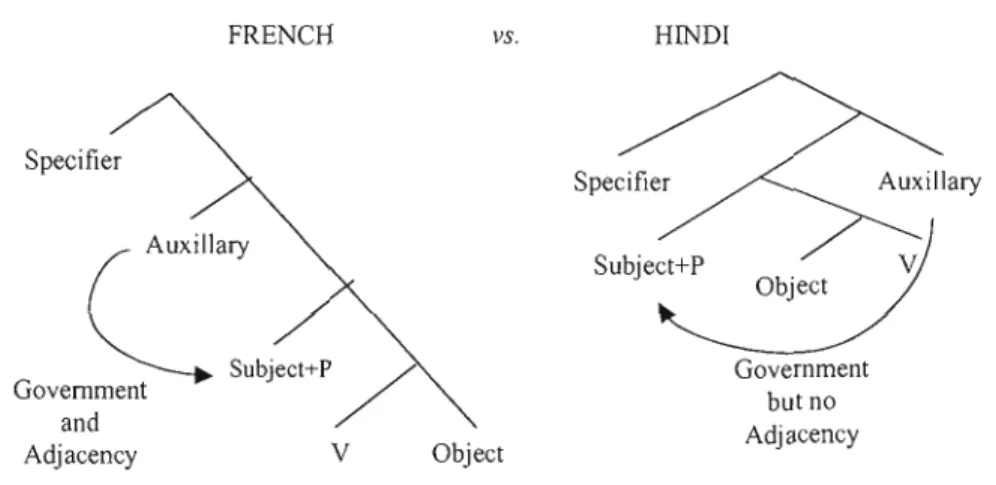
'P' in the French vs. the Hindi clause 31
The movement of speakers and events in time 66
Event, Reference, and Speech time-segments 67
El = «nous avons mangé» (salient participial) 68
= «nous avons mangé» (salient auxiliary) 69
E2
Semantic structure of the Hindi clause 73
The Hindi complex event nominal. 79
The Hindi complex event nominaL 89
The Accusative clause-pattern 93
The Unconditioned Ergative Pattern 95
Il est proposé que le hindi ne possède que des verbes statifs, et que seul le verbe «être» du hindi possède de véritables caractéristiques verbales, notamment l'accord en personne. En effet, toute proposition en hindi est constituée par deux arguments, le Site et la Cible.
Les expressions dynamiques en hindi dépendent donc de syntagmes nominaux complexes événementiels (Grimshaw 1990), des participes ne pouvant exprimer que des actions simples. L'expression des actions complexes ou «causatives» requiert des moyens supplémentaires, d'où le rôle de la particule-sujet n-e dans certaines utilisations des participes perfectif et gérondif, en raison de leur aptitude présumée à
évoquer la partie «causée» des actions complexes. Il est proposé en outre que le sujet
n-e en fournit le sens de la partie «causative».
SUMMARY
lt is proposed that Hindi has only stative verbs, and that the only item in the language to show fully verbal traits, person agreement in particular, is the verb for 'be'. Every clause of Hindi is composed of two arguments, namely the Figure and the Ground. The expression of dynamic meanings in Hindi therefore requires the use of Complex event Nominals (Grimshaw 1990). These are participles which can only express simple Actions. The expression of complex or 'causative' Actions requires supplementary means, which is why the particle n-e is required with the subjects of certain clauses based on perfective and gerundive participles. lt is proposed that these participles express the 'caused' portion of a complex Action, while the
n-e
subject expresses the 'causative' portion.ms. fem. sg. pl. dist. prox. prf. imprf. pres.
De
oc
'xyz' neg. neg.(+'
be') foc. masculine feminine singular plural distal (deictic) proximate (deictic) perfective imperfective presentdirect case, i.e., noun with no case inflection (and usually no post-position) oblique case, i.e., inflected form, usual1y followed by a post-position
'approximate meaning in context', e.g., the meaning of post-positions ln context, rendered as 'in', 'into', 'from', 'out of, 'with', 'by', 'by means of,
'through', and so on
negation marker used with indicative and non-indicative modes
negation marker used with indicative modes, a compounded form of the basic negation marker and the verb of existence
refers to the locative meaning of suppletive pronominal forms traditionally considered allophones for oblique pronoun
+
post-position ko1.1
The distribution of n-e
The problem of the distribution of the particle n-e
This thesis proposes an account of the composition, meaning, and distribution of the Hindi particle n-e, which plays a central role in the Hindi clause. Hindi is said to be an aspectually-conditioned morphologically ergative language (cf, Trask 1979). ln clauses in the perfective aspect, the subject of an intransitive expression and the direct object of a transitive expression are typically realized with the same morphology, i.e., in the direct case (or 'nominative'). ln contrast, the subject ofa transitive expression in the perfective generally appears in the oblique case with the particle n-e, often called the 'ergative' case. The subject of the intransitive expression in 1-1 is in direct case. The verb agrees with this argument in the direct case in number and in persan, and the participle agrees in number and gender:
intransitive, perfective Example 11
billaa daR-<j>-aa h-ai
tomcat-ms.sg.direct case fear-prf.ms.sg. be-3sg.pres. 'The torncat was afraid (specifie incident).'
However, in the related transitive in 1-2, it is the direct object billii 'she-cat' that is in the direct case. The subject bille 'tomcat' is in the oblique case, followed by the particle n-e. The verb and the participle agree with the object, when it is in the direct case:
2
transitive, perfective
Example 12
bille n-e billii Dar-aa-y-ii h-ai
tomcat-ms.sg. Action-oblique case 1 she-cat-fem.sg. fear-cause-prf. fem.sg. be-3sg.pres.
oblique
direct case
'The tomcat frightened a/the she-cat.'
In this example, the object may receive a specifie or a non-specifie interpretation. However, the object can also appear in the oblique case with the partie le ko. The reading is then unambiguously definite, as in 1 3. In clauses like this one that contain no argument in the direct case, there is masculine singular agreement:
transitive, perfective Example 13
bille n-e billii ko Dar-aa-y-aa h-ai
tomcat-ms.sg.OC Action-OC she-cat-fem.sg. End fear-cause-prf.ms.sg. be-3sg.pres.
oblique case
Point'The tomcat frightened the/*a she-cat.'
In general, the particle n-e appears with the subjects of clauses based on the perfective of transitive participles. The n-e-subject never appears in clauses based on participles in the imperfective, progressive, or frequentative aspects, nor in the passive construction. In these clauses, most Hindi expressions follow the morphologically accusative pattern, as in 1 4:
transitive, progressive
Example 14
billaa billii Dar-aa-t-aa h-ai
tomcat-ms.sg.DC she-cat-fem.sg.DC fear-cause-imprf.ms.sg. be-3sg. pres.
'The tomcat frightens a/the she-cat (habitually).'
The subject of the transitive imperfective expression in 1-4 has the same morphology as the subject of the related intransitive expression in 1-5:
intransitive, imperfective
Example 15
billaa Dar-t-aa h-ai
tomcat-ms.sg.DC fear-imprf.ms.sg. be-3sg.pres.
'The tomcat is afraid (habitua/ly).'
Note, however, that there are several other 'non-nominative' subjects in Hindi. The distribution of these subject types has no relation to the aspectual type of the participle. For example, the subject may appear with the particle ko:
Example 16
raamdaas ko juukaam aa-y-aa h-ai
name-ms.OC End-Point cold-ms.sg.DC come-prf.ms.sg. be-3sg.pres.
'To Ramdas a cold has come.' (i.e., Ramdas has caughta co/d.)
Post-positions with basically spatial meanings can also appear with subjects, as in 1 7:
Example 1 7
raamdaas k-e jaise aadmiyoN meN himmat ho-t-ii hai
'men like Ramdas'-ms.pl.OC 'in' courage-fem.sg.DC become-imprffem.sg. be-3sg.pres.
'In men like Ramdas is courage.' (i.e., Men like Ramdas have courage.)
There are thus more than one 'morphologically ergative' pattern in Hindi. However, only the first of these patterns is aspectually conditioned (i.e., when the participle is transitive and perfective, and the subject requires n-e) while the other patterns do not depend on the choice of paIiiciple (as when the subject appears with ko or one of the spatial post-positions).
Note that in clauses like 1-3 (supra) in which the subject appears with n-e and the object appears with ko, the clause has no argument in the direct case. This is only possible in clauses with n-e-subjects. Ali other clauses with non-nominative subjects must include an argument in the direct case with which the verb of existence and the participle agree. Furthermore, if a clause has just one argument, that argument must be in the direct case -or it must be a n-e-subject. Here too the clause with the n-e-subject stands apart (infra).
4
It is often claimed (cf, Mohanan 1994) that the referent of the n-e-subject must have volition. Thus, in the examples above, the tomcat is understood to have deliberately acted in sorne way to frighten the she-cat. If the tom-cat actually did nothing deliberate, it couId not appear as a subject with n-e, but only as a topicalised adjunct with the post-position se 'with; of; from':
Example 18
bille se billii Dar-~-ii h-ai
tomcat-ms.OC 'with; from; of she-cat-fem.sg.DC fear-prf.fem.sg. be-3sg.pres.
'The she-cat is frightened of the tomcat (specifie incident).'
On the basis of data like these, it is generally assumed in the literature that aspectually conditioned morphological ergativity in Hindi (i.e., the use of the n-e-subject) depends on three contextual factors: perfective aspect, syntactic transitivity, and volition of the referent of the subject. Various explanations have been set forth as to why n-e should appear in these contexts. It has been suggested, for example, that the transitivity requirement was originally entirely semantic in nature, but tbat it has evolved into a 'blind rule of grammar' (Montaut 2006), i.e., that the distribution of n-e is now largely mechanical2. The association of n-e with volition has long been claimed to reflect an etymological connection of this particie with an old instrumental suffix (MacGregor 1996). Attempts have also been made to relate the distribution of n-e to strong agentivity (cf, the 'transitivity prototype' of Magier 1987), thereby dispensing for the need to refer to an overt object in the description of the distribution of n-e. However, ail previous accounts have had to acknowledge counter-examples to each ofthese three assumed requirements.
The data that support these assumptions are reviewed below, along with sorne of the exceptional data that contradict them.
5
1.1 Transitivisation and the n-e-subject
The traditional association of n-e with a volitional subject and an overt object
responds to two types of evidence: 1) the highly agentive nature of subjects with n-e, and 2) the many examples of Hindi intransitives that can be 'transitivized' using n-e. The semantic and morphological patterns of these intransitive-transitive pairs have been discussed since Beames (1872) and Kellog (1893). While the subject of the intransitive expression is non volitional, and requires the direct case, the subject of the related transitive is volitional, requiring a subject in the oblique case with n-e. The subject of the intransitive form is semantically sirnilar to the object of the transitive form, as can be seen in the following examples, where the subject of mar 'die' and the object of maar 'kill' both end up dead:
Example 19
rukhrnini mar-~-ii h-ai
name-fem.DC die-prf.fem. be-3sg.pres.
'Rukhmini has died.'
Example 110
raamdaas n-e rukhmini ko maar-~-aa h-ai
name-ms.DC Action-OC name-fem.OC End-Point kill-prf.ms.sg. be-3sg.pres.
'Ramdas has killed Rukhmini.'
•
•
•
•
•
•
•
•
•
•
•
•
•
•
6
Table 1 Intransitive-transitive pairs
roots meanmg
De subject
n-e-subject
volitional subjectmar 'wither; die'
•
maar 'beat; kill'
daR 'fear'
•
daRaa 'frighten'
gir 'fall'
•
giraa 'knock over'
sikh 'leam'
•
siikh 'teach'
TlIuT 'break'
•
toR 'break'
Mar 'become full (ofsomething)'
•
bhar 'fill (something)'jiit 'be victorious'
•
jiit 'conquer'
The morphological signais of these correspondences are not fully predictable, and the semantics is even less so. The intransitive member of such pairs often has a short vowel, while the causative member has the cOlTesponding long vowel. However, the variety of morphological signais and the various shades of 'causativisation' noted in the glosses suggest that these pairs are not related through a productive derivation.
A second group of intransitive-transitive pairs also altemates between subjects in the direct case and in the oblique case with
n-e,
respectively. The subject of the transitive member of each pair is at the origin of the event denoted by the expression, but a 'second subject' or 'causee' actually perfonns it:Example 111
raamdaas (rukhmini ke saath) naac-~-aa h-ai
name-ms.De name-fern.Oe 'with' dance-prf.ms.sg. be-3sg.pres.
'Ramdas has danced (with Rukhmini). '
Example 112
rukhmini n-e raamdaas ko nac-vaa-y-aa h-ai
name-fem.OC Action-OC name-ms.OC End-Point dance-cause-prf.ms.sg. be-3sg.pres.
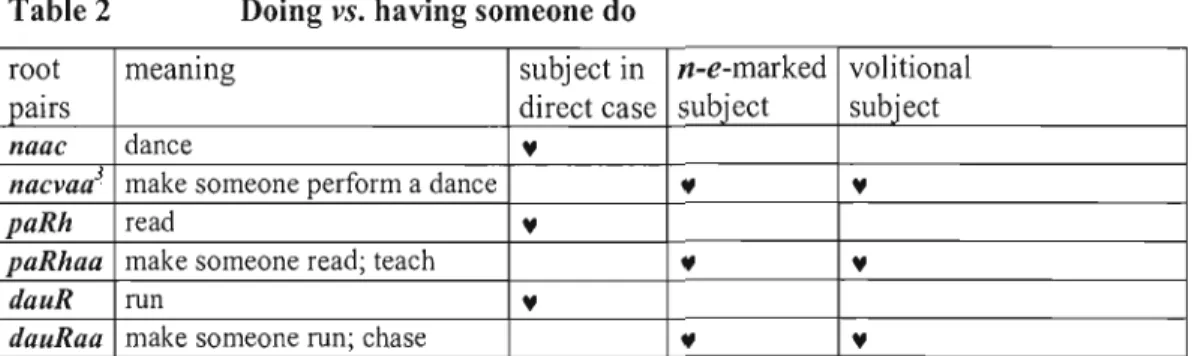
'Rukhmini has made Ramdas dance (has made her perform a dance).'
Table 2 Doing
vs.
having someone doroot rneanmg subject in n-e-rnarked volitional
pairs direct case subject subject
naac dance '1
nacvaa3 make someone perform a dance '1 '1
paRh read '1
paRhaa make someone read; teach '1 '1
da uR run '1
dauRaa make someone run; chase '1 '1
The rnorphological signal of the relationship between the subject and the causee is either the suffi x -aa or -v-aa (Saksena 1982). The relationship between the intransitive and transitive forms is sernantically and rnorphologically more regular than in the previous group, but not perfectly so. The choice of 'causative' suffix is generally related to whether or not there is a third party or intermediary between the 'causer' and the 'causee'. In this area, there is sorne divergence arnong speakers in choice of suffix and interpretation. Like the first group discussed above, this kind of causitivization is not a very productive process.
The intransitive forms of both groups always appear with subjects in the direct case, m perfective and non-perfective clauses alike. Their transitive counterparts also require subjects in the direct case in non-perfective clauses. ln perfective clauses, however, the transitives of both groups require subjects with n-e. Within these regular groups, there are restrictions on the sernantic types of subjects and objects permitted in a clause with n-e: the subjects are volitional, and the objects are expressed by nouns. These restrictions appear to support the standard view that the distribution of n-e is tied to agentivity and transitivity.
Expressions requiring n-e-marked subjects generally appear with overt objects, even when these are little more than syntactic place-holders. For exarnple, a person cannot sirnply 'eat' in Hindi: he is either 'eating a rneal', 'eating food', or 'eating sorne specifie food'. The equivalent of English '1 ate' is disallowed in Hindi:
Example 113
raamdaas n-e *(khaanaa) khaa-y-aa h-ai / *(roTii) khaa-y-ii h-ai
name Action-OC meal eat be bread eat
be-ms.OC ms.sg.DC prfms.sg. 3sg.pres. fem.sg.DC prffem. 3sg.pres.
'Rarndas has eaten his rneal / has eaten sorne roti.'
The expression khaanaa khaa- '(lit.) food/rneal-eat' thus appears to support the traditional perspective relating transitivity to the requirernent for n-e. However, there is no intransitive
• . • 4
transItive paIr.
Another expression that fails to fit the intransitive-transitive pattern is muskaraa 'smile'. While khaa- 'eat' lacks an intransitive counterpart, muskaraa- 'smile' lacks a transitive counterpart. There is no lexical causative (neither 'make a smile', nor 'make someone smile'), Even though muskaraa- has the form of a causative like dauRaa-. The expected intransitive forrn *muskar- is missing. Nevertheless, thanks to the use of the cognate object, an intransitive-transitive pair does exist, with a variation in meaning and required subject. The intransitive form appears with a subject in the direct case; the transitive counterpart has a n-e-rnarked subject and a cognate object:
Example 114
laRkaa rnuskaraa-y-aa
boy-ms.sg.DC smile-prf.ms.sg.
'The boy smiled.' Example 115
laRke n-e vIJay k-ii rnuskaraahaT rnuskaraa-y-ii
boy-ms.sg.OC Action-OC triumph poss.-fem. smile-fem.DC smile-prffem.
'The boy smiled a triurnphant srnile.'
Other idiosyncratic expressions of physiological events with intrinsically identifiable products include khans- 'cough', muut- 'defecate', and thuuk- 'spit'. For some speakers, these alternate regularly between intransitive forrns with subjects in the direct case and transitive forms with cognate objects and subjects in the oblique case and n-e.
However, for many speakers, sorne of these expressions always appear with subjects in the direct case, while others always appear with subjects with n-e, whether there is a cognate object or not. The contrast in the meanings of these forms is sometimes clear-cut, and sometimes claimed to be nil. Moreover, there are genera11y accepted expressions that do not follow the semantic patterns of these groups: non-volitional subjects are sometimes possible with n-e, and objects are sometimes impossible when the subject appears with n-e. Lastly, with gerundive participles of obligation, ther"e is no transitivity requirement at a11: it is enough for the obligation to originate in the subject referent for the particle n-e to appear.
1.1.1 Exceptions to the general distribution of n-e
The standard assumption is that if a perfective expression is transitive, it must have a n-e-subject, and that if it has a n-e-subject, it must be a transitive in the perfective. However, this strong generalization is inaccurate.
1.1.1.1 Subjects of transitives, appearing with or without n-e
Sorne expreSSIOns have no intransitive form, but have two transitives -one that requires a subject in the direct case, and anot~er requiring a n-e-subject. For example, bol 'utter, speak' appears in the perfective with a subject in the direct case when speech is merely reported, or when the utterance is spontaneous:
Example 116
raamdaas bol-~-aa, paaNv Thak ga-y-e h-ai-N
name-ms.DC speak-prf.ms.sg. foot tired go-prf.m.pl. be-3pl.pres.
'Ramdas said (perhaps, muttered to self), 'My feet are tired."
When the utterance is an assertion (as opposed to aimless grumbling) the subject may appear with or without n-e:
Example 117
raamdaas (n-e) bol-<j>-aa, bacce Thak ga-y-e h-ai-N
name-ms. Action-OC ·speak-prf.ms.sg. child-ms.pI.D.C. tired go-prf.m.pl. be-3pl.pres. 'Ramdaas said, 'The children are tired.'
However, when the addressee is inc1uded with the assertion, the partic1e n-e must be used:
Example 118
raamdaas *(n-e) patnii se bol-~-aa, bacce Thak ga-y-e h-ai-N
name-ms.DC Action- wife fem.DC 'with' speak- child- ti red go-
be-OC prf.ms.sg. ms.pl. DC prf.m.pl. 3pl.pres.
'Ramdaas said to his wife, 'The children are tired.'
With bo/-"utter, speak', there is no 'object agreement', as there is no object in the direct case.
A similar example is samajh- 'understand'. When used to refer to understanding that cornes of itself, samajh- requires a subject in the direct case:
Example 119
vah kahaanii samajh-<j>-aa distal sg.DC parable-fem.DC understand-prf.ms.sg.
'He understood the parable (it came to him, perhaps suddenly).'
However, with the n-e-subject, samajh- refers to understanding that cornes after deliberation5 :
Example 120
us n-e kahaanii samajh-<j>-ii
distal sg.OC Action-OC parable-fem.DC understand-prf.fem. 'He understood the parable (jigured if out).'
This particular example is sometimes given as support for the view that transitivity and volition are bath necessary conditions for the use of n-e (MacGregor 1996). The subject of samajh- can only appear with the partic1e n-e when the referent is volitional, suggesting that transitivity is not a sufficient condition to require its use.
1.1.1.2 Subjects of intransitives, appearing with or without n-e
A second group of exceptional expressions are intransitives that can appear with subjects in the direct case, or in the oblique case with n-e. The variants have distinct meanings. When the subject is in the direct case, it undergoes the event; when it is in the oblique with n-e, it perforrns it:
Example 121
laRkii gam k-e maare roy-~-ii
giri-fem.sg.DC 'for grief weep-prf.fem.sg.
'The girl wept for grief.'
Example 122
laRkii n-e gussaa dikhaakar roy-~-aa giri-fem.sg.OC Action-OC 'showing anger' weep-prf.ms.sg.
'The girl weptin rage.'
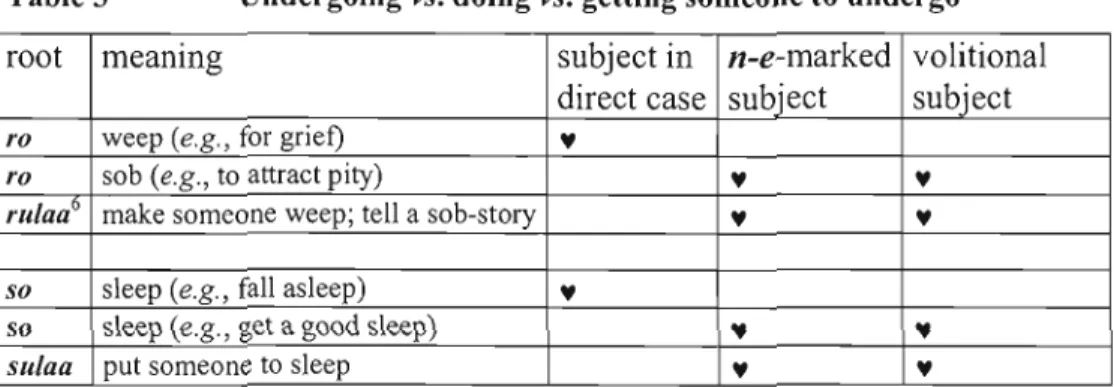
These expressions also have derived causatives in which a second party undergoes the event, (an alternation in meaning that recalls alternations like mar 'die' > maar 'kill'):
Table 3 Undergoing vs. doing vs. getting someone to undergo
root meanmg subject in n-e-marked volitional
direct case subject subject
ro weep (e.g., for grief)
.,
ro sob (e.g., to attract pity)
.,
.,
rulaao make someone weep; tell a sob-story
.,
.,
so sleep (e.g., fall asleep)
.,
so sleep (e.g., get a good sleep)
.,
.,
sulaa put someone to sleep
.,
.,
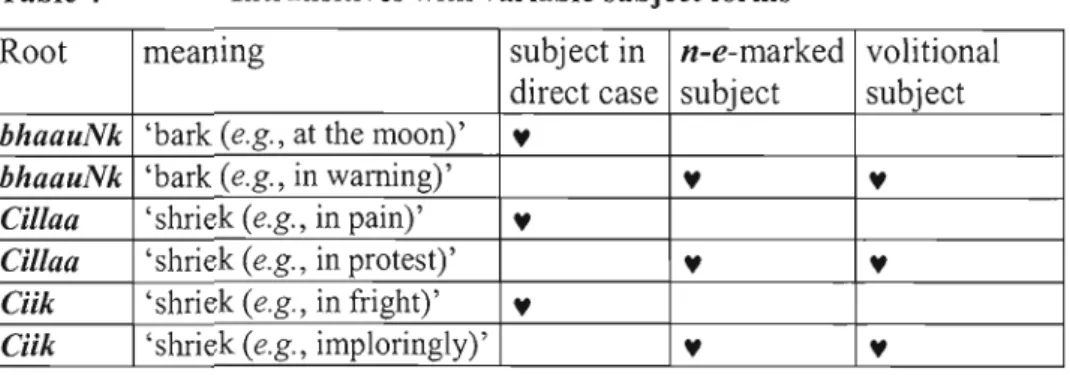
Other intransitive expressions vary in this way, but have no derived causative form. When the subject is in the direct case, its referent is understood to have acted involuntarily. When the subject is in the oblique case followed by n-e, the referent has acted voluntarily:
Example 123
laRkaa cillaa-y-aa boy-ms.sg.DC shriek-prf.ms.sg. 'The boy shrieked (involuntarily).'
Example 124
laRke n-e cillaa-y-aa
boy-ms.sg.OC Action-OC shriek-prf.ms.sg. 'The boy shrieked (voluntarily).'
The following list of such expressions is probably exhaustive:
Table 4 Intransitives with variable subject forms
Root meanmg subject in n-e-marked volitional
direct case subject subject
bhaauNk 'bark (e.g, at the moon)' '1
bhaauNk 'bark (e.g, in waming)' '1 '1
Cil/aa 'shriek (e.g, in pain)' '1
Cil/aa 'shriek (e.g, in protest)' '1 '1
Ciik 'shriek (e.g, in fright)' '1
Ciik 'shriek (e.g, imploringly)' '1 '1
1.1.1.3 Subjects with n-e and non-sentient referents
Under the view that the distribution of n-e is related to agentivity, it is unexpected that non-sentient forces should appear as subjects with n-e, since these lack the volitional features observed in the subjects of the two kinds of causative transitives discussed above:
Example 1 25
kal raat k-ii andhii n-e mandir k-ii diivaar toR di-<j>-i
'yesterday' night poss. storm-fem. Action- temple poss. wall-fem. tear give
fem. OC fem. root prfJem.
'Last night's storm tore down the temple wall.'
Nevertheless, such sentences are cornrnon (see also example 1 36). Thus, it is indeed possible for subjects with n-e to have inanimate, non-sentient referents.
1.1.1.4 Object semantics and the use of n-e
Sorne transitive expressions allow either the subject in the direct case, or in the oblique case with n-e, depending on the meaning. For example, paRh can mean 'read' or 'study'. One 'reads' books (n-e-marked subject), but he 'studies'a study program (subject in direct case). It is notable that both of these may be voluntary Actions.
Example 126
raamdaas n-e phraaNc k-ii kitaab paRh-<j>-ii h-ai name-ms.OC Action-OC French poss.fem. book-fem. read-prf.fem. be-3sg.pres. 'Ramdas has read a French book.'
Example 127
raamdaas phraaNc paRh-<j>-aa h-ai name-ms.DC French read-ms.sg. be-3sg.pres. 'Ramdas has studied French.'
An expression may have different kinds of objects, and require a subject in the direct case when it has one kind of object, and a subject with n-e when the other kind is used. When the object of paa-'to obtain ' is expressed by a nominal, the subject requires n-e:
Example 128
us n-e acchii naukRii paa-y-ll h-ai
distal sg.OC Action-OC good-fem. job-fem. obtain-prffem. be-3sg.pres. 'He got himself a good job.'
However, when the object ofpaa-is a participial root, the meaning is 'manage to do X'. The subject must appear in the direct case, never with n-e:
Example 129
vah acchii nauk.Rii le paa-y-aa h-ai
distal sg.DC good-fem. job-fem.sg.(D.C.) take-root obtain-prf.ms.sg. be-3sg.pres. 'He managed to get a good job.'
14 1.1.1.5 Transitives with subjects and objects in the direct case
Exceptions to the transitivity requirement include a handful of transitive expressions in the perfective that always appear with a subject and an object in the direct case:
Example 130
vah paniir (ko) laa-y-aa
3sg.DC cheese Enà-Point bring-prf.ms.sg.
'He brought sorne (the) cheese.'
Example 131
vah caabbii (ko) bhuul-~-aa h-ai
3sg.DC key-fem.De End-Point forget-prf.ms.sg. be-3sg.pres.
'He forgot a / the key.'
These examples vary with respect to the possibility of using the definite object-marking particle ko, but whether or not the object can be made explicitly definite does not correlate with the use of n-e. 'Bringing' and 'forgetting', although transitive, cannot be done by a n-e subjec{ This is in spite of the fact that 'bringing' is typical1y a voluntary Action.
1.1.1.6 The subject with n-e of gerundive participles of obligation
Although this fact is generally ignored by purists, the particle n-e does not only appear with perfective participles, but is also possible with the subjects of both transitive and intransitive gerundive participles of obligation. In one formulation of this construction, however, the subject appears in the oblique case and is fol1owed by the particle ko. The source of obligation is external:
Example 132
raamdaas ko jaldii Jaa-n-aa h-ai
name-ms.OC End-Point quickly go-N-ms.sg.DC be-3sg.pres.
'Ramdas has to leave quickly (involuntary).'
However, when the source of obligation is internai, the subject appears in the oblique case with the particle n-e:
15
Example 1 33
raamdaas n-e jaldii Jaa-n-aa h-ai
name-ms.OC Action-OC quickly go-N-ms.sg.DC be-3sg.pres.
'Ramdas has to leave quick1y (voluntary).'
Transitive gerundives can be used in exactly the same way. When the subject is followed by the particle ko, he has been given no choice but to take the medecine:
Example 134
raamdaas ko davaa le-n-ii h-ai
name-ms.DC End-Point medecine-fem.DC take-N-fem.DC be-3sg.pres.
'Ramdas has to take medecine (involuntary).'
When the subject is followed by the particle n-e, he feels impelled to take the medecine:
Example 135
raamdaas n-e davaa le-n-ii h-ai
name-ms.DC Action-OC medecine-fem.DC take-N-fem.DC be-3sg.pres.
'Ramdas has to take medecine (voluntary).'
This use of n-e with gerundive participies of obligation thus goes against the alleged requirements for perfectivity and transitivity, but follows the requirement of volition.
1.1.1.7 Summary of cases of exceptional distribution of n-e
The n-e-subject is limited to the perfective and obligative gerundive aspects. It is always the subject of the clause. Transitivity and volition as such do not determine the distribution of n-e, although the distribution of n-e is strongly correlated with these notions. Strikingly, many clauses, transitive and intransitive, may appear with or without n-e, depending on the intended meaning, not necessarily involving volition. The nature of these exceptions suggests that the distribution of the particle n-e is governed by semantic structure, of which transitivity, perfectivity, the obligative mood, and volition of the subject are signs rather than causes. The presence ofthese features when n-e is used is epiphenomenal.
1.2.0 Previous accounts of the usage of n-e
The following sections examme the various accounts of aspectually-conditioned morphological ergativity in Hindi that have appeared to date in the literature.
1.2.1 Classical case systems and Hindi
The first European grammars of Hindi (e.g., Beames 1872; Kellogg 1893) were modelled on descriptions of classical European languages. The post-positions of Hindi were assumed to parallel the case declensions of Sanskrit, Greek, and Latin, an approach that persists in the CUITent literature (e.g., Kachru 1980; McGregor 1995; T.Mohanan 1994). The nominative or direct case is opposed to the oblique case, which is required when the noun appears with a post-position. The noun in direct case 'governs' agreement relations in the clause, whi1e the oblique case is understood to be a high1y general locative that requires specification through the use of post-positions (Masica 1991). Thus, post-positions signal dative, accusative, instrumental, locative, and genitive case. However, the classicallanguages have no case cOITesponding to the Hindi particle n-e. The case inventory of Hindi was therefore enriched with an 'agentive' or ergative case. With this label, the particle n-e was expected to appcar whenever an agent performs an Action. Exceptions to this, when acknowledged, were treated as idiomatic expressions. Clearly, the traditional grammars of classica11anguages are not suitable mode1s for an account of Hindi grammar.
In classica1 case systems, nominative case and agreement are typically associated with the 'grammatical function' of subject. ln Hindi, however, nouns in the direct case are not al ways subjects, even when they govem verbal agreement. As it has been noted above, Hindi has several non-nominative subjects, i.e., nouns in the oblique case (with post positions) that do not govern agreement. It is thus common to refer to nominative, ergative, and dative subjects in Hindi (cf, McGregor 1995, Butt 2001). CUITent treatments also argue for instrumental, locative, and genitive subjects (T.Mohanan 1994; Narasirnham 1997).
17 1.2.2 Magier (1987) and the Transitivity Prototype
The notion of transitivity has often been linked to the distribution of n-e, but sorne authors have argued that a broader notion than surface transitivity may allow for a more satisfactory generalization. Magier (1987), building on Hopper and Thompson (1980), tries to distinguish 'notional' transitivity from syntactic transitivity in Hindi. Notional transitivity is c1aimed to be determined by the number of participants in the 'cognitive scene' inherent to the meaning of the expression. Furthermore, certain semantic features of the clements in a clause are considered to vary in degree of 'salience', and these features are added up to yield 'high' vs. 'low transitivity' (cf, Hopper and Thompson 1980). Certain feature c1usters are said to place an argument c10ser to one end or the other of an Agent / Subject vs. Patient / Object continuum. Under Magier's view, for example, 'eat' in ail languages is bivalent (i.e., transitive), whether the object is overt or not, as the object in the cognitive scene is part of the meaning of the verb 'eat', while 'sleep' is monovalent, (i.e., intransitive, since this verbal meaning comprises no relationship with any other entity than the 'sleeper').
Notional transitivity is useful for describing the use of n-e with the subjects of certain intransitive expressions of physiological events with intrinsically identifiable products, e.g., khans- 'cough', muut- 'defecate', and thuuk- 'spit', because that product figures in the cognitive scene. However, there are problematic cases. Why are overt, cognate objects required by expressions Iike khaanaa khaa- 'eat'? Why are optional cognate objects accompanied by volitional meanings, e.g., khans khans- 'cough (deliberately)'? How is the obligatory participant in the cognitive scene expressed by intransitive samajh- 'understand' (a non-volitional subject in the direct case) notionally distinct from the ergative counterpart (volitional subject with n-e)? Notional transitivity also fails to explain the use of n-e when the subject has 'low agentivity', as in the following example:
Example 136
baraph n-e paanll ko ThanNDaa kar di-y-aa
snow-OC Action-OC water End-Point coJd make-root give-prf.ms.sg. 'The snow made the water cold.'
1.2.3 Ritter and Rosen (2000), Event Structure and Ergativity
Trask (1979) claims to identify two types of morphologically ergative language. In type A, the ergative pattern is only possible with subjects that are animate or highly specifie. In type B, the ergative pattern can only occur with the past tense or the perfective aspect. Ritter and Rosen (2000) attempt to explain this typological observation by stipulating a parameter in the link between Aktionsarten and syntactic structure. They propose that States, Achievements, Activities, and Accomplishments are grouped differently in different languages. The aspectual classes in one group are 'syntactically eventive', i.e., they are associated with a specifie functional category projected in the syntax, while the aspectual classes in the other group are not eventive. Grammatical processes like morphological ergativity only occur with the aspectual classes that are found in the syntactically eventive group of the language in question.
The proposed functional category is either AgrS and AgrO, cOITesponding to 'event initiation' and 'event delimitation', respectively. A given language is said to have only one of these functional categories. The four verbal aspectual classes are claimed to be grouped differently in 'Initiation' or 'beginning-point' languages, vs. 'Delimitation' or 'end-point' languages. Depending on whether the language is an 'Initiation' language or a 'Delimitation' language, a functional category with eventive content is associated with either the beginning point or the end-point that is part of the intrinsic meaning of the event. States have neither intrinsic beginning nor intrinsic end-points, and thus are never syntactic events. Accomplishments have both intrinsic beginning and intrinsic end-points, and are thus syntactic events in both types of language. Activities have only intrinsic beginning points, while Achievements are said to have only intrinsic end-points. Thus, only Activities and Achievements change groupings, according to the event-orientation of the language.
19
Table 5 Initiation vs. delimitation languages
EVENTUALITIES IN 'INITIATION' -LANGUAGES
syntactically non-eventive syntactically eventive, through AgrS
States 1 Achievements Activities 1 Accomplishments
vs.:
EVENTUALITIES IN 'DELIMITATION'-LANGUAGES
syntactically non-eventive syntactically eventive, through AgrO
States 1Activities Achievements 1Accomplishments
In a language with an AgrS - 'Initiation Phrase', Activities form a natural class with Accomplishments, in contrast with States and Achievements (which have no intrinsic beginning point). The grammar of an 'Initiation Language' is said to be sensitive to the semantics of the subject (e.g., there may be non-nominative subjects). Morphological ergativity can occur in a language only when the subject has the functional projection associated with 'syntactic eventiveness'.
On the other hand, a language having an AgrO-Delimitation Phrase groups Achievements with Accomplishments. ln contrast with States and Activities, these include an intrinsic end-point. Many grammatical processes are associated with the verb phrase, which is sensitive to the specificity and definiteness of the object. Should morphological ergativity exist in such a language, it occurs only in the past tense or in the perfective aspect, since the functional projection associated with 'syntactic eventiveness' dominates the VP.
Morphological ergativity is thus predicted to be tied to perfectivity, as in Hindi and other Type B languages. Hindi is therefore a 'Delimitation' language. Since the functional category making the morphologically ergative clause possible is linked to the terminal point of a predicate, n-e is expected to appear with the subjects of Achievements and Accomplishments. The perfective aspect is required, as it indicates that the event has reached the end-point defining these classes (in opposition to the arbitrary end-points of Activities).
20
More general SUPPOlt for the model cornes from the observation that syntactically non-eventive Hindi expressions can be re-interpreted as syntactically eventive ones, thereby requiring subjects with n-e. For example, Activities with subjects in the direct case alternate with Achievements, which require subjects in the oblique case with n-e. The following is said to be an Activity, because the meaning does not include explicit reference to a transition between states:
Example 137
laRkii ro-y-II
girl-fem. DC cry-prf.fem.
'The girl cried (involuntarily).'
The voluntary reading of 1 38, however, is said to include a punctual transition from 'not crying' to 'crying'. 1 38 is therefore said to be an Achievement:
Example 1 38
laRkii u-e ro-y-aa
girl-fem. OC Action-OC cry-prf. fem.
'The girl cried (voluntarily).'
Sirnilarly in transitive examples like 1 39 where the subject is in direct case, jaan- 'know' seems to be stative:
Example 139
raamdaas yah baat jaan-~-aa
name-ms.DC prox.sg.DC matter-fem.DC know-prf.ms.sg.
'Ramdas knew of the matter (perhaps accidently).'
When the subject has n-e, however, the clause has the reading of an Accomplishment:
Example 140
raamdaas n-e yah baat jaan-~-ii
name-ms.OC Action-OC prox.sg.DC matter-fem.DC know-prf.fem.
'Ramdas found out about the matter (through his own effort).'
The model thus predicts that the distribution of n-e depends on the presence of an aspectually defined terminal point. ln other words, when the subject is in the direct case, the clause
speaks of an Activity or aState; when it is with n-e, it expresses an Achievement or an Accomplishment. However, this generalization does not always hold (infra).
The authors do concede that Hindi does not match the 'Delimitation' type in every respect, as it also has various non-nominative subjects, a feature expected only in an 'Initiation' language. Moreover, in the Hindi pronominal system, the distribution of subject forms shows a split between first and second person pronouns (realized with direct case and n-e) and third person pronouns (realized with oblique case, with n-e). Morphological ergativity that is influenced by subject semantics is unexpected in a 'Delimitation' language.
The fact is, however, only a few Achievements can appear with a subject with n-e. Most Achievements require subjects in the direct case, or in the oblique case with a post position:
Example 141
maiN aaj aa-y-aa huuN
1sg.DC today come-prf.ms.sg. be-3sg.pres.
'1 came, have just come, today.'
Example 142
mujh ko coT lag-~-ii
1sg.OC End-Point injury-fem.DC cling-prffem.
'1 got hurt.'
ln addition, n-e is not possible with ail telic clauses. For example, the subject of an expression ofmovement to a destination requires a subject in the direct case:
Example 143
aakhir meN raamdaas dillii pahuNc-~-aa 'at last' name-ms.DC Delhi-ms.OC reach-prf.ms.sg.
'At last, Ramdas reached Delhi.'
If the direct object is the 'grammaticalised' end-point of an Accomplishment, why isn't a destination also suited for this? The authors refer to the 'eventive content' of the functional category associated with the delimiter. It might then be argued that 'Delhi' is not involved in
22
the event of 'going' in the way 'cake' is affected by the event of eating. On the other hand, it appears that when one leaves 'Delhi', somehow there is the eventive content necessary for there to be the functional category required for the subject with n-e to occur:
Example 144
laRkoN n-e dillii coR-<j>-aa
boy-ms.pl.OC Action-OC Delhi-ms.DC leave-prf.ms.sg.
'The boys left Delhi (e.g., to settle in Kampur.')
This model is an attempt to explain morphological ergativity III terrns of broad typological factors, and has nothing to say about exceptions. The account correctly limits n-e to Achievements and Accomplishments, but it fails to mention that most Achievements do not have n-e-subjects, and that not every Accomplishment has one either. It does not account for the distribution of n-e reliably in terrns of aspectual classes, nor even in terms of language types. In reality, even the perfectivity constraint is too strong, as it wou Id exclude the use of n-e with obligative gerundives.
The inadequacies of this model suggestthat it cannot be the aspectual classes that determine the distribution of n-e, nor the beginning or end-points of the event. The natural end-point is neither necessary nor sufficient for the subject to appear with n-e. This point is made clearly by the following minimal pair. Whether or not the natural end-point is reached, the subject must appear with n-e:
Example 1 45
raamdaas n-e Dibbaa dillii bhej -<j>-aa
name-ms.OC Action-OC box-ms.sg.DC Delhi-OC send-prf.ms.sg.
'Ramdas sent the box to Delhi (jocus on sending: the box may not have arrived).'
Example 146
raamdaas n-e Dibbaa dillii pahuuNc-v-aa-y-aa
name-ms.OC Action-OC box-ms.sg.DC Delhi-OC make-arrive-prf.ms.sg.
The difficulty of refeITing to end-points, Achievements, and Accomplishments to predict morphological ergativity in Hindi8 is further underscored by instances of 'semi perfectivity', (cf, Koenig 2000) as in the following apparently self-contradictory sentence:
Example 147
raamdaas n-e kek khaa-y-aa
name-ms.OC Action-OC cake-ms. OC eat-prf.ms.sg.
##par kek nahiiN khaa-y-aa ga-y-aa
but cake-ms.DC neg.(+ 'BE') eat- prf.ms. go-prf.ms.sg.
'Ramdas ate the cake, but the cake was not eaten (it was not edible).'
The perfective khaa-y-aa 'eat-prf.ms.sg.' does not in itself refer to any specific end-point.
Nevertheless, the subject must appear with n-e. The Hindi perfective only indicates that an Action has reached sorne arbitrary end-point (M. Singh 1991). Even the expression maar
'kill' does not necessarily denote an Accomplishment. It can also mean 'beat (severely)'. Contextual cues and grammatical devi ces like compounding are often used to place the emphasis on end-points of Actions. For example, when khaa-y-aa 'eat-prf.ms.sg.' is replaced
by khaa li-y-aa 'eat-take-prf.ms.sg.', the clauses of the sentence contradict each other:
Example 148
raamdaas n-e kek khaa li-y-aa
name-ms.OC Action-OC cake-ros.DC eat-root take-prf.ms.sg.
(##par kek nahiiN khaa-y-aa ga-y-aa)
but cake-ms. neg.(+ 'BE') eat- prf.ms.sg. go-prf.ms.sg.
'Ramdas ate the cake, (##but the cake was not eaten).'
In conclusion, Rosen and Ritter (2000) have shown that the semantic phenomenon underlying the distribution of n-e involves only certain aspectual types. However, it turns out that this account does not explain the phenomenon adequately.
1.2.3 Anand & Nevins (2006)
Anand & Nevins seek to detennine whether the subject in the direct case and the subject in the oblique case with n-e both receive structural case. The 'nominative' and
'ergative' subjects do have similar subject properties, viz., binding of anaphors, obviation of pronouns, and control into participial adjuncts (Mohanan 1994, Narasirnham 1997, Kachru
1980). This, the authors claim, suggests in turn that the nominative and the ergative subject both receive structural case from the same functional head9.
The authors observe that the subject in the direct case shows two possible scope readings, while the ergative subject allows just one of these, the surface scope reading. On this basis, they seek to show that the Hindi subject in the direct case has structural case, and that the ergative or n-e-marked subject has inherent case. They observe that the subject in the direct case is in a formaI AGR relation with TENSE, whilc thc ergative subject is not. They claim that this AGR relation permits the Reconstruction necessary for the construal of the inverse-scope reading observed in clauses in the perfective aspect with nominative subjects. The ergative case blocks any AGR relation with TENSE, thereby, they claim, making unavailable the particular configuration of Reconstruction that would allow for the inverse scope reading. However, it can be shown that the examples on which these arguments are based are not in fact rninimally-paired, as the verb of existence or 'copula' is absent in their examples of clauses with frozen scope, and is present in those with both surface and inverse scope readings (it has been found in the course of this study that scopal flexibility occurs whenever the 'copula' is present, and is lost when it is absent, irrespective of subject type and type of participle). While Anand & Nevins (2006) do uncover data that are valuable to the analysis of the Hindi clause, they do not explain the distribution of n-e. In fact, ail subjects in Hindi show similar properties, in spite of the thematic diversity of subject types, because subjecthood in Hindi is a matter of syntactic position, and nothing more.
1.2.4 Davison (2003)
This is a detailed study of the distribution of Hindi subjects with n-e, subjects in the direct case, and subjects in the oblique case witb the post-position ko. Davison (2003) draws on the 'dependent structural case' model of Marantz (1984), a formalization of the relationships of complementarity and dependency between cases.
Davison (2003) reviews the different case types of subjects and objects that can co occur in Hindi transitive clauses, and puts them into classes. She proposes two kinds of case: lexical case, assigned within VP, and structural case, assigned in optional functional categories over VP. ln her account, the two structural cases are the ergative case (n-e) and the dative case (ko). As the direct case is generated within the VP, it is considered a lexical case. Davison claims that there are two broad classes of transitive clause in Hindi:
.... those with lexical case on either the subject or the abject, and those which may have dependent structural case on the subject and abject. (Davison 2003, p.2).
The VP may govem the dative lexical dative case on indirect objects marked by the post position ko, or lexical locative case, marked by other post-positions, like se. Ergative n-e is only assigned to subjects. The structural dative ko marks direct objects. The generalization is that to have the n-e-subject, dative ko must be possible -with a few exceptions. However, dative ko being possible does not mean that it must occur, nor that it occurs when the n-e subject occurs, nor that tbe n-e-subject must occur when ko occurs on the object.
Davison postulates that regular transitive expressIOns like dekh 'see' have three phrasai layers: a functional projection yP lexically specified for Ergative that is generated when certain properties of verbal aspect are present, a functional projection XP specified for Dative, and a VP. The XP bosting structural dative' ko' must be optional, since the direct object can be expressed in the nominative, whether or not the subject appears with n-e.
The dependency between the YP and the XP is stipulated. The yP bears an ergative feature, and a categorial feature for X that ensures that it embeds an XP if there is a direct
26
object. XP optionally hosts a structural dative ko, since the direct object may appear in the direct case. This is how Davison derives the general pattern that clauses with ergative subjects must be transitive. A yP may have a lexical feature preventing it from appearing
with an XP, as with the three or four intransitive expressions with n-e-subjects. However, it is odd that this aspect of the model is required to accommodate such a small group of exceptions, and puzzling that there are not more intransitives appearing with n-e subjects.
To the elass of regularly-behaved transitive expressions, she opposes a tiny class of exceptional transitives, possibly exhausted by laa 'bring', bhuul 'forget', and bol 'speak, utter', that have nominative, not ergative subjects. These expressions are transitive, and have a y projection, but they are lexically specified as lacking the Ergative feature. What motivates these lexical specifications, and why there are so few is unclear. Furthermore, these three examples do not constitute a homogeneous class: the object of laa 'bring' may appear with ko, the object of bhuul 'forget' may not, and it is considered rustic to use ko instead of se 'with' to mark the addressee of bol 'speak, utter' -and at any rate, when the addressee is mentioned, this expression requires a subject with n-e.
Similar syntactic feature-management devices are invoked to describe the behaviour of intransitives like 'weep', 'bark', and 'shriek', which may appear either with subjects in the direct case or ergative subjects. The meaning contrasts in these pairs are not discussed.
In order to provide semantic motivation for the apparently ad hoc distribution of n-e in these and related examples, Davison proposes that the +ERG feature occurs only when certain event structures are present. However, this approach has been shown to fail in other work (cf, Rosen and Ritter 2000), as the aspectual classes can only be indirectly related to the distribution of n-e. In the case of Davison's model, the conditional inclusion or exclusion of features like +ERG amounts to a restatement of the facts, with machinery that is at least as intricate as the data to be explained.
1.2.5 T. Mohanan (1994)
Drawing on LFG's multi-representational framework, Mohanan seeks to explain the distribution of the various possible case markers that appear with the Hindi subject. She claims that the distribution of n-e is semantically govemed, and attempts to demonstrate the regularity of the other non-nominative subjects of Hindi in similar terms. As she observes,
In Hindi, as in most other South Asian languages, there is no one-to-one correspondence between grammatical function and case. A nominative argument, for instance, may be the subject or the object of a clause. Conversely, the subject may be nominative, ergative, dative, instrumental, or locative; a primary object may be nominative or accusative. On the other hand, there is often a systematic correspondence between meaning and case marking.
(T. Mohanan 1994, p.55; emphasis added)
The distribution of the ergative marker n-e is thus claimed to be determined by both grammatical function and meaning.
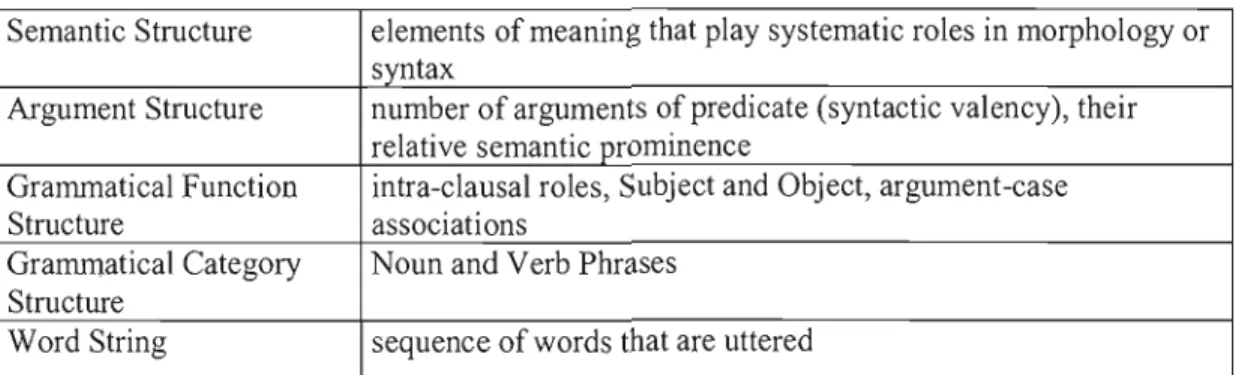
The levels of structure used in LFG to represent the links between verbal meaning and surface fonns are summarized below:
Table 6 Levels of structure in LFG
Semantic Structure elements of meaning that play systematic roles in morphology or syntax
Argument Structure number of arguments of predicate (syntactic valency), their relative semantic prominence
Grammatical Function intra-clausal roles, Subject and abject, argument-case
Structure associations
Grammatical Category Noun and Verb Phrases Structure
28
While the factoring out of these levels of structure may appear redundant, the elements in each are not necessarily associated with each other in a one-to-one fashion. Elements may be multiply associated, unassociated, or 'suppressed' 10.The arguments in Semantic Structure are 'logical arguments', e.g., the originator and the receiver of an Action. The originator of the Action in Semantic Structure is linked by default to the highest position in Argument Structure, a hierarchy of thematic roles. This position in Argument structure is ca lied the Logical Subject. In the default situation, the Logical subject is linked to the Grammatical Subject in Grammatical Function Structure.
The Logical Subject can be 'suppressed' in Argument Structure, yielding a passive like meaning. Altematively, the 'subjectless' construction can be produced in Hindi by suppressing instead the logical argument in Semantic Structure corresponding to the originator of the Action. In the 'subjectless' clause, the first argument appears with the accusative marker ko, since the most prominent argument is the object. This 'subjectless' 1
'accusative-ko' clause is thus clearly distinguished from the well-known dative-ko or experiencer-subject clause. In the 'accusative-ko' clause, the relatively most prominent logical argument in Semantic Structure (the originator of the Action) does not match up with the relatively most prominent argument in Argument Structure (the argument with a human referent). This mismatch carries over to Grammatical Function Structure. The most prominent argument in Argument Structure is linked with the Subject position in Grammatical Function Structure, where case markers are associated with arguments. In the experiencer-subject construction, the subject is associated with kO II .
There is thus no need in this framework to argue (cf, Nevins, Davison) that the subject is an argument in a purely syntactic or discursive position, and is unrelated to thematic or semantic considerations. On the contrary, under Mohanan's scheme, the thematic variety of post-positionally marked subjects can ail be accounted for in semantic terms. The hierarchies of relative argument prominence in the Semantic Structure and the Argument Structure are set up under distinct sets of semantic principles. A 'realigrunent' of the