To link to this article: DOI:10.1007/s10570-011-9530-2
http://dx.doi.org/10.1007/s10570-011-9530-2
This is an author-deposited version published in: http://oatao.univ-toulouse.fr/
Eprints ID: 4899
To cite this version:
Peydecastaing, J and Vaca-Garcia, Carlos and Borredon, Elisabeth Interactions
with water of mixed acetic-fatty cellulose esters. (2011) Cellulose, vol. 18 (n° 4).
pp. 1023-1031. ISSN 0969-0239
O
pen
A
rchive
T
oulouse
A
rchive
O
uverte (
OATAO
)
OATAO is an open access repository that collects the work of Toulouse researchers and makes it freely available over the web where possible.
Interactions with water of mixed acetic-fatty cellulose
esters.
J.PEYDECASTAING ,C.VACA-GARCIA ,E.BORREDON
INRA, UMR 1010, ENSIACET, 4 allée Emile Monso, F-31030, Toulouse Cedex 4, France Université de Toulouse, INPT, UMR 1010, F-Toulouse, France
Tel.: +33 5 34 32 35 46; Fax: +33 5 34 32 35 97 Email: [email protected]
Abstract
Cellulose powder was acylated with mixtures containing acetic, fatty and acetic-fatty anhydrides to form acetic-fatty cellulose esters. The total degree of substitution (DS) of the mixed cellulose esters (MCE) ranged from 2x10⁻² to 2.92. MCE were characterized by their
interactions with water. Static contact angles with water were measured on a regular smooth surface. The values found were dependent on the fatty acyl content and independent of the acetyl content. In the case of acetic-oleic cellulose esters, the minimum DS of the oleoyl moiety required to obtain permanent water repellency was 3x10⁻⁴. The microporosity of the samples may account for this exceptional hydrophobic character. Nevertheless, water vapor adsorption measurements on powder samples revealed only a limited increase in hydrophobicity of the MCE compared to cellulose acetate with the same acetyl content. It was thus demonstrated that water repellency and vapor water adsorption are not correlated.
Keywords: mixed cellulose esters, contact angle, differential vapor sorption, hydrophobicity, water repellency, low-substituted cellulose esters.
1. Introduction
Mixed cellulose esters (MCE), i.e. bearing at least two types of substituents, are renewable-based multifunctional polymers. The main representative examples of this family are the cellulose acetate-butyrates and acetate-propionates, industrially produced and used for their thermoplastic properties which can be modulated according to the type and number of side chains. For instance, long chain cellulose esters have better water barrier properties than cellophane (Bras et al. 2007).
Some properties change noticeably with the introduction of a small amount of substituents. It has been reported that long chain cellulose esters with a low degree of substitution (DS ≤ 0.15, i.e. acylation of only 5% of the hydroxyl groups) appear to present interesting properties such as water repellency for cotton yarns and fabrics, and an ability for selective adsorption of oily compounds, useful for the decontamination of polluted water (Deschamps et al. 2003). In addition, applied to chemical wood modification, these esters have recently achieved success industrially due to their excellent weathering properties (Magne et al. 2003).
The properties obtained in the works cited above are difficult to correlate with the extent of esterification, because the DS-values are low and their determination is subject to high standard deviation using present techniques. However, thanks to the TMSH (trimethyl sulfonium hydroxide) GC analytical technique recently developed (Peydecastaing et al. 2009), we are now able to precisely characterize cellulose esters with DS < 0.1.
In this article we report on the interactions of MCE with liquid water and water vapor, and establish correlations with the DS. Although the whole DS-range was explored, the main contribution of this paper is the study of very low DS-values (10-4 to 0.1). Static contact angles and equilibrium moisture contents were used as characterization tools.
2. Experimental 2.1. Chemicals
Pure water (18.2 MΩ.cm at 25°C) was obtained from a Milli-Q (A10) device from Millipore. Alpha-cellulose from Sigma-Aldrich France (degree of polymerization = 960, 4% pentosans and conditioned at 7% moisture content), was used here as reference for the water interactions study.
2.2. Mixed cellulose esters with DStotal < 0.1.
2.2.1. Synthesis
The synthesis of MCE has already been fully described (Peydecastaing et al. 2010). In short, cellulose was reacted with an acylation mixture obtained from reaction of acetic anhydride and fatty acids without external catalyst. MCE were thoroughly washed with ethanol then purified by Soxhlet extraction with ethanol for 8 hr. The absence of residual reagents was assessed by FT-IR (Jasco 460 device used with KBr pellet method, spectral width 4000-400 cm-1, 32 times accumulation, 4 cm-1 resolution). The
purification method was also validated by impregnating a sample of cellulose with the acylation mixture at 20°C, followed by the same purification steps. The DS of this sample was null. The purified product was then vacuum dried to constant weight at 70°C for at least 24 hr. The samples were manipulated in such a way as to avoid contact with contaminants that might modify the surface energy.
2.2.2. Determination of the degree of polymerization
Degree of polymerization (DP). The cellulose esters were saponified under ‘mild’ conditions to regenerate cellulose. 0.5 g of purified sample was stirred for 30 min in 40 ml of aqueous ethanol (70%). After the addition of 20 mL of a 0.5 N NaOH aqueous solution, the stirring was continued for 48 h at 50°C. The unreacted NaOH was back-titrated with 0.5 N aqueous HCl. The solid was recovered by filtration and thoroughly washed with deionized water and ethanol, and dried under vacuum at 50°C
spectroscopy. The intrinsic viscosity (η) of diluted solutions of cellulose in cupriethylendiamine, was measured at 25°C with a capillary viscometer, according to the French AFNOR standard NF T 12-005. The DP was calculated using the Mark-Houwink-Sakurada equation (Brandrup and Immergut, 1975) which correlates η and the viscosimetric molecular weight (Mv) of cellulose:
where 0.0133 and 0.905 are the coefficients corresponding to the cupriethylendiamine system and η is expressed in ml/g. Blanks were also run to evaluate the reduction in DP due to the saponification.
2.2.3. Contact angle measurements
Pellets (10 mm diam.) of the MCE were obtained using a laboratory press (ICL, 10 t) and a conventional pellet mold. Metal surfaces in contact with the sample were carefully cleaned to avoid contaminant sources. A drop of Milli-Q water (3 µL) was placed on the surface of the pellet and the static contact angle was measured with a goniometer DGD-R&D (GBX Instruments, France) equipped with an automatic camera recording still images every 0.1 seconds for the whole analysis period (around 5 min). Contact angles were measured automatically using the triple point calculation method. Three specimens were used for each sample. Two contact angle measurements were made per specimen.
2.2.4. Dynamic vapor sorption (DVS) analysis
All the experiments were performed on a DVS Advantage, automated gravimetric vapor sorption analyzer (Surface Measurement Systems Ltd., London, UK). DVS measures the uptake and loss of vapor gravimetrically using a Cahn D200 recording ultra-microbalance with a mass resolution of ±0.1 µg. The relative humidity around the sample, was controlled by mixing saturated and dry carrier gas streams using mass flow controllers. The temperature was maintained constant (±0.1°C) by enclosing the entire system in a temperature-controlled incubator. Samples were stored in a desiccator. For each experiment, cellulose ester was placed immediately into the DVS
analyzer under a continuous stream of dry (< 0.1% relative humidity, RH) air. A sample size between 5 and 10 mg was used. Prior to exposure to any water vapor, the samples were dried at 0% RH to remove superficial water present and establish a dry baseline mass. The samples were exposed to the following relative humidity profile: 0%, 10%, 20%, … 90%, decreasing to 80%, 70%, … 0% RH. At each stage, the sample mass was allowed to reach equilibrium before the relative humidity was increased or decreased. An isotherm was calculated from the complete moisture sorption and desorption profile, using the DVS Advanced Analysis Suite v3.6 software. All experiments were performed at 25.0°C.
2.3. Mixed cellulose esters with DStotal > 0.1.
These samples have been prepared and characterized (DS and contact angle) previously (Vaca-Garcia and Borredon 1999), however the contact angle measurements have never been published. The synthesis protocol was as follows: a mixture composed of octanoic acid (5.6 eq/cellulose OH), acetic anhydride (2 eq/OH) and H2SO4 catalyst (3‑7 meq/OH) was heated at 90°C for 1 h. Solvent-exchanged cellulose (2.0 g dry basis) was added to the reaction medium. The whole mixture was stirred at 110‑130°C for 1‑3 h. At the end of the reaction, 150 mL of ethanol was added to precipitate the soluble fraction. The solid was separated by filtration over fritted glass and purified by Soxhlet extraction with ethanol for 8 h. The purified product was then dried at 105°C to constant weight. Static contact angles were measured as described above.
3. Results and discussion
3.1. MCE with total DS values greater than 0.1
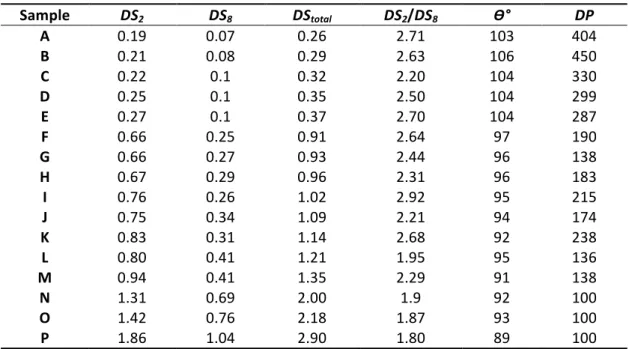
Mixed acetic-octanoic cellulose esters obtained with sulfuric acid as catalyst showed total DS-values comprised between 0.26 and 2.9 (Table 1).
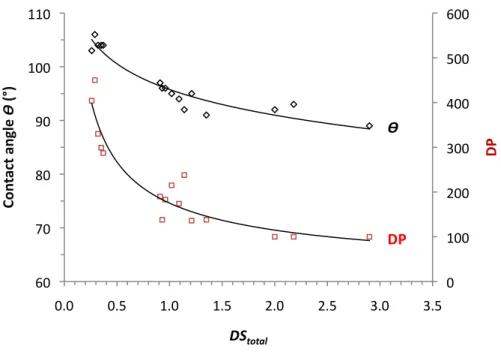
The water repellency of these MCE was evaluated by measuring the contact angle (Ѳ) for 60 seconds. In our case, all the samples showed significant water repellency with
contact angle-values of at least 89°. By convention, a material is qualified as hydrophobic if Ѳ is greater than 90°.
The upper line in Fig. 1 represents the plot of the contact angle values obtained at 60 s. The contact angle decreases with the total degree of substitution. This fact is surprising for three reasons:
i) an increase of the total DS means less hydrophilic hydroxyl groups;
ii) the OH groups are substituted by fatty moieties supposed to increase the hydrophobicity;
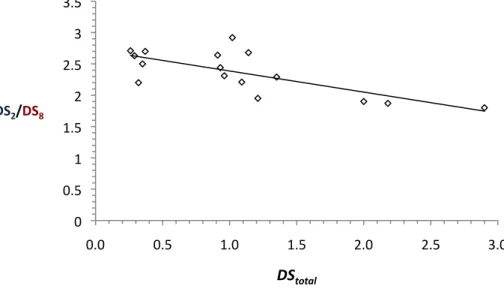
iii) the proportion of octanoyl groups increases with the total DS as shown by the plot of DS2/DS8 as a function of the total DS (Fig. 2). Where DS2 is the DS of
the acetyl groups and DS8 the DS of octanoyl groups.
This disagreement can be explained by the change in porosity of the samples. In the synthesis of MCE in heterogeneous medium (solid cellulose, liquid acylating agent), the samples with low DS retain their fibrous structure and chemical modification takes place on the external molecules of the microfibrils. Conversely, a highly substituted sample loses its fibrous aspect and has a “plastic like” appearance. Consequently, when making pellets at room temperature from all these powders, the ones with lower DS-values should have a higher porosity and a more irregular surface than highly substituted ones. According to Cassie’s law (eq.1), the apparent contact angle of a porous material is greater compared to a non porous version of the same material (Cassie and Baxter 1944).
cos Ѳ = x (cos Ѳ0 +1) – 1 (eq.1)
where Ѳ0 is the apparent contact angle of a perfect surface with no air absorbing pores
and x represents the contact surface fraction of the drop with the material. Super-hydrophobic materials are constructed on this principle, with nanoscale protuberances (nanopins) artificially created on the surface of a metal or other non-hydrophobic material, creating voids filled with air under the drop (Kim et al. 2008). Here, the x value in Cassie’s equation tends to zero and Ѳ to 180°.
In the case of MCE with low DS, isolated fatty chains protuberate when fixed on the cellulose surface because this state requires less energy than being forced to lie on the surface of a hydrophilic substrate. These protuberances reinforce the Cassie effect. Indeed, we observed a correlation between the degree of polymerization (DP) and the total DS (lower line of Fig. 1). The trend of this curve is quite similar to that of the contact angles. Indeed, the samples showing the highest DS were synthesized under more extreme conditions of temperature, catalyst and time (Vaca-Garcia and Borredon 1999) leading to lower DP values (Table 1). The decrease in DP must therefore diminish the entanglement of the cellulose chains leading to more compact configurations with less voids, and lower micro-porosity, all decreasing the contact angle values.
However, because MCE with DS values as low as 0.5 displayed water repellency with very high contact angles, we investigated their characteristics when prepared with limited chemical modification, i.e. synthesized without a strong acid catalyst (maximum preservation of the biopolymer). The fibrillar structure will thus be maintained and be closer to that of the original cellulose.
3.2. Low-substituted mixed cellulose esters
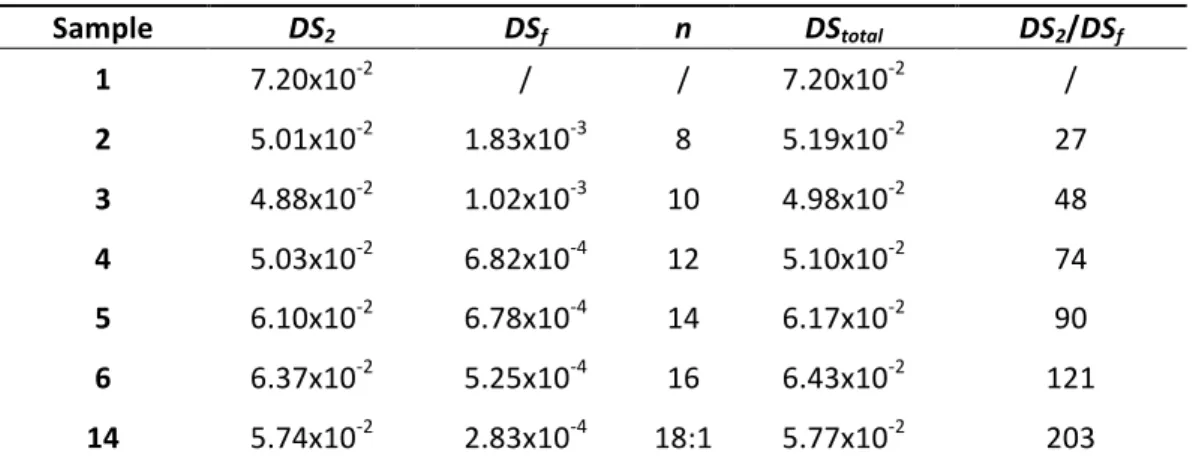
Acetic-fatty cellulose esters, with fatty chains from C8 to C18:1 (i.e. octanoyl to oleoyl), were prepared under protective conditions (i.e. treatment limiting degradation of cellulose: 1 h, 140°C, without catalyst). Their DS-values are shown in Table 2. A sample of cellulose acetate (Sample n°1) was also prepared by reacting cellulose with acetic anhydride under the same conditions.
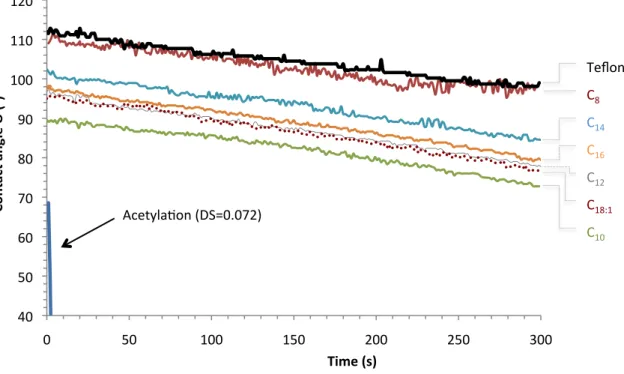
Contact angle measurements with water were measured for 5 min as previously. The MCE samples showed high contact angle values even after this period and remained fairly constant. However, from Fig. 3 we can see that there is a slight decrease of Ѳ, and because this could correspond to a slow absorption of the water drop by the porous material or a slight evaporation phenomenon occurring, we experimented with a non-porous tablet of Teflon. As the slope of this line was identical to those of cellulose esters, we concluded that this decrease was effectively induced by the
measurement conditions. All the MCE samples in Fig. 3 can be defined as exhibiting 5 min water repellency as their trends are parallel to the one observed for Teflon. Such a behavior will be qualified in this paper as “permanent”, to distinguish it from many other works in the literature reporting ‘instant’ contact angles. It should also be noted that the slope of the line for the contact angle vs. time of cellulose acetate octanoate closely parallels that of Teflon.
These interesting results demonstrate that mixed cellulose esters with low DS of acetyl groups (DS2 less than 0.1) and with extremely low DS of fatty acyl groups (DSf),
between 1.83x10‑3 and 6.82x10‑4 inclusive, nonetheless displayed marked water repellency (Samples 2 to 6 plus 14).
The total degree of substitution (DStotal) and DS2 of these samples is practically the
same, since DSf << DS2. Moreover, their values are almost constant whereas DSf varies
over one order of magnitude (Table 2). The ratio DS2/DSf ranges from 27 (Sample 2)
to 203 (Sample 14). Consequently, the lack of correlation between contact angle and length of the fatty chain shown in Fig. 4 is not surprising.
Contrary to MCE, cellulose acetate with a DS2 of 0.072 (Sample 1) showed high
hydrophilicity, with the drop of water absorbed into the pellet in less than 2 seconds, despite the fact that the cellulose acetate sample, and indeed any of the MCE samples, have practically the same DS2. This fact illustrates the decisive impact of the very few
fatty chains on the hydrophobicity of MCE, which, with the lowest DSf, corresponds to
about one fatty chain per 1500 anhydroglucose units.
The control cellulose sample and the cellulose acetate sample behaved similarly in terms of water repellency. The control had an initial/instant contact angle value (at t0,
just after the deposition of the drop) of 59.7° followed by complete absorption of the drop in less than 3 s, and the cellulose acetate sample a Ѳ of 68.6° with complete absorption in less than 5 s.
If we compare acetic-octanoic cellulose esters obtained with and without catalyst (Tables 1 and 2), we can see that they give contact angle values of the same order even if their DStotal values are very different. For example, sample 2 has Ѳ = 107° with
DS8 = 1.83x10⁻³ while sample A, prepared with a sulfuric acid catalyst, has Ѳ = 103°
with DS8 40 times higher (7x10⁻²).
In addition, all the MCE presented above exhibited the same behavior regardless of the type of fatty chain. The observations made on oleic MCE and on acetic-octanoic MCE can be generalized to include all acetic-fatty cellulose esters.
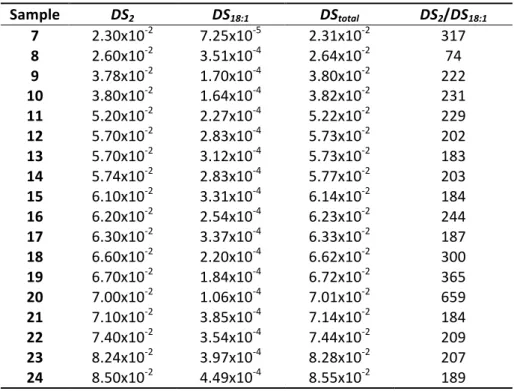
Table 3 shows the characteristics for synthesized acetic-oleic cellulose esters. The DS of the fatty acyl groups (DS18:1) are as low as 7.25x10⁻⁵ but DStotal were similar to
those of samples presented above (samples A to P in Table 1 and 1 to 6 in Table 2). The DP-values of the samples given in Tables 2 and 3 were practically constant at 745 ± 30.
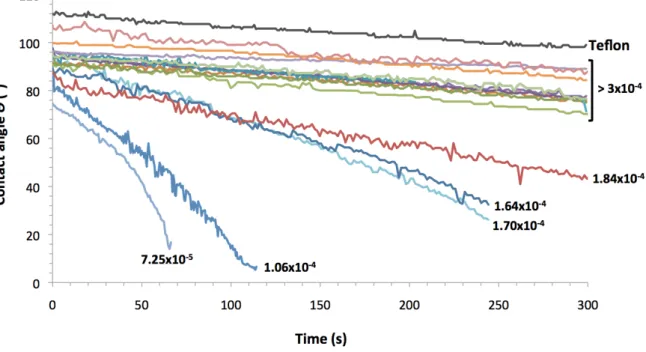
The contact angle values as a function of time for all the Table 3 powder samples, are given in Fig. 5. Even though all the samples show high contact angle values (> 75°) initially, we can see that some of these are not, “permanent”. Sample 19 can be considered as the crossover point between "permanent" and "temporary" water repellency. Conversely, the group of samples 8, 11-18, and 21-24 can be clearly defined as hydrophobic materials (same slope as Teflon and Ѳ > 90°).
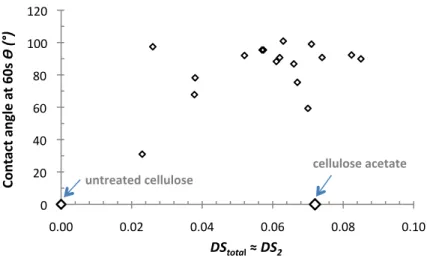
From these graphs, we identified the contact angle values obtained at 60 s and attempted to correlate them with the DStotal values (Fig. 6). No correlation was found
between these parameters. Furthermore, as was explained before, DS2 >> DS18:1 (i.e.
DStotal ≈ DS2), confirming that there is no correlation between Ѳ and DS2. In other
words, the acetate content has no influence on the water repellency of the samples considered.
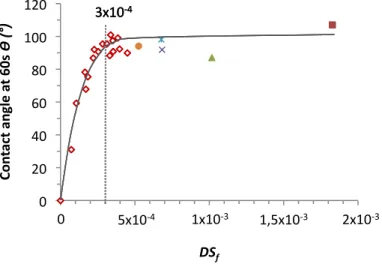
However, there was a significant correlation between Ѳ and DS18:1 (Fig. 7). Ѳ
increases regularly and levels off at the DS18:1 value of 3x10⁻⁴. The contact angle value
reached at the plateau is about 95°, which is generally considered as, “hydrophobic”. What is noteworthy is that this high hydrophobicity is reached, with a substitution, equivalent to one fatty chain per 3,000 anhydroglucose units.
However, we must keep in mind that the 3x10⁻⁴ DS threshold is for acetic-oleic cellulose esters and this value may vary with the length of the grafted fatty chain. Contact angle values of the other samples (regardless of the fatty chain) are also
plotted as a function of the fatty acyl content in Fig. 7. We can see that the contact angle depends only on the DSf for fatty chains with from 8 to 18 carbon atoms, and it
is possible that a relationship exists between the increased apolarity of the aliphatic chain and the hydrophobic character. The number of carbon atoms grafted on the biopolymer would therefore be more relevant than the number of hydroxyl functions substituted. This is the case for many properties such as water vapor permeability (Bras et al. 2007), glass transition (Sealey, Samaranayake et al. 1996) and wood dimensional stability (Hill and Jones 1996).
As a final point, we characterized four samples by dynamic vapor sorption with water: untreated cellulose (blank), cellulose acetate (sample 1), cellulose acetate-octanoate (sample 2) and cellulose acetate-oleate (sample 14). As the first two samples had not shown water repellency whereas samples 2 and 14 had shown 5 min water repellency, it was surprising therefore to find that the sorption isotherms of the cellulose derivatives showed practically the same trend regardless of the DS or the type of substituent (Fig. 8). Moreover, the reduction of the equilibrium moisture content with regard to cellulose was quite small; only one percentage point less than the blank. A sample of Teflon, a material recognized as being perfectly hydrophobic, has a water sorption of 0% over the whole range of relative humidity. Therefore, the MCE samples that had contact angles almost as high as Teflon now display water sorption behavior almost akin to hydrophilic cellulose.
These experiments demonstrate clearly that the hydrophobicity of a cellulosic material is shown in several ways that are not necessarily correlated. MCE with very low DS can be considered as hydrophobic (with regard to their water repellency). But from the standpoint of affinity to water vapor, they are only a little less hydrophilic than cellulose.
A possible explanation for these differences of behavior towards water vapor and liquid comes from their physical states. Vapor is constituted of individual molecules able to reach the numerous hydrophilic hydroxyl groups remaining in the cellulose esters. Conversely, liquid water is a cluster of hydrogen bonded molecules. A drop of water displays high surface energy and low wettability on hydrophobic surfaces, especially if the latter also have fatty nanopins.
4. Conclusions
Concerning the mixed acetic-fatty cellulose esters, formed into pellets, we have found that: • Water repellency is obtained at very low DStotal values (< 0.06). Contact angles are
comprised between 90° and 100°.
• Water repellency depends essentially on the fatty acyl content. The minimum value for 5 min water repellency in the case of acetic-oleic cellulose esters is DS18:1 = 3x10⁻⁴, which is
extremely low.
• The contact angle of cellulose acetate (without fatty acyl groups) with DS2 ≤ 0.072 is null.
Concerning the mixed acetic-fatty cellulose ester powders, we have found that:
• Equilibrium moisture content of MCE with very low DS is almost as high as cellulose acetate with very low DS.
• Neither of the samples can be considered as hydrophobic, Because of their affinity for water vapor they are just slightly less hydrophilic than cellulose.
As a general conclusion, the so-called hydrophobic cellulose esters can display completely different affinities for water depending on its physical state: liquid or vapor. Individual vapor molecules can reach the hydroxyl sites whereas a cluster of molecules making up a drop of water is confronted with a highly hydrophobic barrier, with the fatty chains probably protuberating on the surface of a porous material, and Cassie’s effect may reinforce this hydrophobicity.
Acknowledgments: We thank LAPEYRE for financial support and Mr. Michael Charton for his precious technical help.
Bras, J., C. Vaca-Garcia, et al. (2007). "Oxygen and water vapor permeability of fully substituted long chain cellulose esters (LCCE)." Cellulose 14(4): 367-374.
Cassie, A. B. D. and S. Baxter (1944). "Wettability of porous surfaces." Trans. Faraday Soc. 40: 546-551.
Deschamps, G., H. Caruel, et al. (2003). "Oil removal from water by selective sorption on hydrophobic cotton fibers. 1. Study of sorption properties and comparison with other cotton fiber-based sorbents." Environ. Sci. & Technol. 37(5): 1013-1015.
Eicher, T. and M. Wandel (2005). Cellulose esters. Ullmann's encyclopedia of industrial chemistry. Wiley. Weinheim: 29-30.
Hill, C. A. S. and D. Jones (1996). "The dimensional stabilisation of Corsican pine sapwood by reaction with carboxylic acid anhydrides - The effect of chain length."
Holzforschung 50(5): 457-462.
Kim, D., W. Hwang, et al. (2008). "Superhydrophobic nanostructures based on porous alumina." Curr. Appl. Phys. 8(6): 770-773.
Magne, M., S. El Kasmi, et al. (2003). Method for treating lignocellulosic materials, in particular wood and material obtained by said method. Lapeyre. World Patent WO 084 723.
Peydecastaing, J., C. Vaca-Garcia, et al. (2010). "Reactivity of mixed acetic-fatty anhydride mixtures toward cellulose." Cellulose Under review.
Peydecastaing, J., C. Vaca-Garcia, et al. (2009). "Accurate determination of the degree of substitution of long chain cellulose esters." Cellulose 16(2): 289-297.
Sealey, J. E., G. Samaranayake, et al. (1996). "Novel cellulose derivatives .4. Preparation and thermal analysis of waxy esters of cellulose." J. Polym. Sci., Part B: Polym. Phys. 34(9): 1613-1620.
Vaca-Garcia, C. and M. E. Borredon (1999). "Solvent-free fatty acylation of cellulose and lignocellulosic wastes. Part 2. Reactions with fatty acids." Bioresour. Technol. 70(2): 135-142.
Sample DS2 DS8 DStotal DS2/DS8 Ѳ° DP A 0.19 0.07 0.26 2.71 103 404 B 0.21 0.08 0.29 2.63 106 450 C 0.22 0.1 0.32 2.20 104 330 D 0.25 0.1 0.35 2.50 104 299 E 0.27 0.1 0.37 2.70 104 287 F 0.66 0.25 0.91 2.64 97 190 G 0.66 0.27 0.93 2.44 96 138 H 0.67 0.29 0.96 2.31 96 183 I 0.76 0.26 1.02 2.92 95 215 J 0.75 0.34 1.09 2.21 94 174 K 0.83 0.31 1.14 2.68 92 238 L 0.80 0.41 1.21 1.95 95 136 M 0.94 0.41 1.35 2.29 91 138 N 1.31 0.69 2.00 1.9 92 100 O 1.42 0.76 2.18 1.87 93 100 P 1.86 1.04 2.90 1.80 89 100
Sample DS2 DSf n DStotal DS2/DSf 1 7.20x10-‐2 / / 7.20x10-‐2 / 2 5.01x10-‐2 1.83x10-‐3 8 5.19x10-‐2 27 3 4.88x10-‐2 1.02x10-‐3 10 4.98x10-‐2 48 4 5.03x10-‐2 6.82x10-‐4 12 5.10x10-‐2 74 5 6.10x10-‐2 6.78x10-‐4 14 6.17x10-‐2 90 6 6.37x10-‐2 5.25x10-‐4 16 6.43x10-‐2 121 14 5.74x10-‐2 2.83x10-‐4 18:1 5.77x10-‐2 203
Sample DS2 DS18:1 DStotal DS2/DS18:1 7 2.30x10-‐2 7.25x10-‐5 2.31x10-‐2 317 8 2.60x10-‐2 3.51x10-‐4 2.64x10-‐2 74 9 3.78x10-‐2 1.70x10-‐4 3.80x10-‐2 222 10 3.80x10-‐2 1.64x10-‐4 3.82x10-‐2 231 11 5.20x10-‐2 2.27x10-‐4 5.22x10-‐2 229 12 5.70x10-‐2 2.83x10-‐4 5.73x10-‐2 202 13 5.70x10-‐2 3.12x10-‐4 5.73x10-‐2 183 14 5.74x10-‐2 2.83x10-‐4 5.77x10-‐2 203 15 6.10x10-‐2 3.31x10-‐4 6.14x10-‐2 184 16 6.20x10-‐2 2.54x10-‐4 6.23x10-‐2 244 17 6.30x10-‐2 3.37x10-‐4 6.33x10-‐2 187 18 6.60x10-‐2 2.20x10-‐4 6.62x10-‐2 300 19 6.70x10-‐2 1.84x10-‐4 6.72x10-‐2 365 20 7.00x10-‐2 1.06x10-‐4 7.01x10-‐2 659 21 7.10x10-‐2 3.85x10-‐4 7.14x10-‐2 184 22 7.40x10-‐2 3.54x10-‐4 7.44x10-‐2 209 23 8.24x10-‐2 3.97x10-‐4 8.28x10-‐2 207 24 8.50x10-‐2 4.49x10-‐4 8.55x10-‐2 189
Fig. 1 Water contact angles and degree of polymerization of mixed acetic-‐octanoic cellulose esters with DStotal > 0.1
0 100 200 300 400 500 600 60 70 80 90 100 110 0.0 0.5 1.0 1.5 2.0 2.5 3.0 3.5 DP Co nt act a ngl e Ѳ (° ) DStotal DP Ѳ
Fig. 2 Ratio DS2/DS8 of mixed acetic-‐octanoic cellulose esters with DStotal>0.1
0 0.5 1 1.5 2 2.5 3 3.5 0.0 0.5 1.0 1.5 2.0 2.5 3.0 DS2/DS8 DStotal
Fig. 3 Water contact angles of mixed acetic-‐fatty cellulose esters. n = number of carbon atoms of the saturated acyl chain. A cellulose acetate and a Teflon samples are also presented for comparison.
40 50 60 70 80 90 100 110 120 0 50 100 150 200 250 300 Co nt act a ngl e Ѳ (° ) Time (s) Acetyla8on (DS=0.072) Teflon C8 C14 C12 C18:1 C16 C10
Fig. 4 Water contact angles of mixed acetic-‐fatty cellulose esters and cellulose acetate measured after 60 seconds.
Ace ta te O ct an oa te D ec an oa te Lau ra te My ris ta te Pal m ita te Ole at e 0 20 40 60 80 100 120 2 8 10 12 14 16 18:1 Ѳ (° ) a`e r 60s
Fig. 5 Water contact angles of mixed acetic-‐oleic cellulose esters. Numbers next to the curves indicate the oleoyl content
Fig. 6 Water contact angles of mixed acetic-‐oleic cellulose esters with DStotal<0.1 as a function of DS2
0 20 40 60 80 100 120 0.00 0.02 0.04 0.06 0.08 0.10 Co nt act a ngl e a t 6 0s Ѳ (°) DStotal ≈ DS2
Fig. 7 Water contact angles of mixed acetic-‐fatty cellulose esters with DStotal<0.1 as a function of the fatty acyl content
1,5x10-‐3 2x10-‐3 0 5x10-‐4 1x10-‐3 0 20 40 60 80 100 120 Co nt act a ngl e a t 6 0s Ѳ (°) DSf 3x10-‐4 3x10-‐4 3x10-‐4
Fig. 8 Water vapor sorption isotherms for esterified and untreated cellulose at 25°C 0 2 4 6 8 10 12 14 16 0 10 20 30 40 50 60 70 80 90 100 So rp do n (%) Reladve humidity (%) Untreated cellulose
Cellulose acetate; sample 1
Cellulose acetate-‐octanoate; sample 2 Cellulose acetate-‐oleate; sample 14 Teflon