O
pen
A
rchive
T
OULOUSE
A
rchive
O
uverte (
OATAO
)
OATAO is an open access repository that collects the work of Toulouse researchers and
makes it freely available over the web where possible.
This is an author-deposited version published in :
http://oatao.univ-toulouse.fr/
Eprints ID : 12445
To link to this article : DOI :10.1007/s10723-013-9254-7
URL :
http://dx.doi.org/10.1007/s10723-013-9254-7
To cite this version : Astsatryan, Hrachya and Sahakyan, Vladimir and
Shoukouryan, Yuri and Daydé, Michel and Hurault, Aurélie and
Guivarch, Ronan andTerzyan, Harutyun and Hovhannisyan, Levon
On
the Easy Use of Scientific Computing Services for Large Scale Linear
Algebra and Parallel Decision Making with the P-Grade Portal
.
(2013) Journal of Grid Computing, vol. 11 (n° 2). pp. 239-248. ISSN
1570-7873
Any correspondance concerning this service should be sent to the repository
administrator:
[email protected]
On the Easy Use of Scientific Computing Services
for Large Scale Linear Algebra and Parallel Decision
Making with the P-Grade Portal
Hrachya Astsatryan · Vladimir Sahakyan · Yuri Shoukouryan · Michel Daydé · Aurelie Hurault · Ronan Guivarch · Harutyun Terzyan · Levon Hovhannisyan
Abstract Scientific research is becoming
increas-ingly dependent on the large-scale analysis of data using distributed computing infrastructures (Grid, cloud, GPU, etc.). Scientific computing (Petitet
H. Astsatryan (
B
) · V. Sahakyan · Y. Shoukouryan Institute for Informatics and Automation Problems of the National Academy of Sciences of the Republic of Armenia, 1, P. Sevak str., Yerevan 0014, Armenia e-mail: [email protected]V. Sahakyan e-mail: [email protected] Y. Shoukouryan e-mail: [email protected]
M. Daydé · A. Hurault · R. Guivarch
University of Toulouse, INPT (ENSEEIHT)-IRIT, 2, rue Charles Camichel, 31071, Toulouse, France M. Daydé e-mail: [email protected] A. Hurault e-mail: [email protected] R. Guivarch e-mail: [email protected] H. Terzyan · L. Hovhannisyan
State Engineering University of Armenia, 105, Teryan str., Yerevan 0009, Armenia H. Terzyan
e-mail: [email protected] L. Hovhannisyan e-mail: [email protected]
et al. 1999) aims at constructing mathematical models and numerical solution techniques for solving problems arising in science and engineer-ing. In this paper, we describe the services of an integrated portal based on the P-Grade (Parallel Grid Run-time and Application Development En-vironment) portal (http://www.p-grade.hu) that enables the solution of large-scale linear systems of equations using direct solvers, makes easier the use of parallel block iterative algorithm and provides an interface for parallel decision mak-ing algorithms. The ultimate goal is to develop a single sign on integrated multi-service environ-ment providing an easy access to different kind of mathematical calculations and algorithms to be performed on hybrid distributed computing infrastructures combining the benefits of large clusters, Grid or cloud, when needed.
Keywords Advanced trading ·
Sparse linear algebra solvers · P-grade portal · Parallel decision making
1 Introduction
Scientific computing aims at constructing mathe-matical models and numerical solution techniques for solving problems arising in science (including life and social sciences) and engineering. The solu-tion of linear system of equasolu-tions lies at the heart
of most calculations in scientific computing. For the past twenty years, there has been a great deal of activity in the area of algorithms and software for solving linear algebra problems. It is often difficult for non expert users to take advantage of nowadays computational infrastructures (Grids, clusters, GPU, ...) or even to use the available advanced libraries, because they often require to be familiar with middleware and tools, paral-lel programming techniques and packages (MPI, OpenMP, CUDA, etc.) and numerical libraries (ScaLAPACK, LAPACK, BLAS, etc.).
The purpose of this article is to describe the scientific computing services that are deployed within our Portal and how their access has been made straightforward. One of the main compo-nents is an environment enabling the solution of large-scale linear systems of equations and algo-rithms on hybrid HPC infrastructures (heteroge-neous Grids composed of clusters with and with-out GPUs), which is the extension of the previous work [3, 4]. The environment is responsible of scheduling the computing jobs to remote GPU and Grid computing facilities (workload man-agement service) by matching the complexity of the user-submitted expression, the parameters of algorithms and the resource status information collected from information services. The compu-tational resources of the Armenian National Grid (ArmGrid) infrastructure [5] has been used that unifies different architectures (multicore proces-sors, GPUs) and network topologies (Myrinet, Infiniband, Gigabit). Currently ArmGrid consists of seven Grid sites located in the leading research and educational organizations of Armenia [6].
2 Related Work
Several projects that can be related to the Prob-lem Solving Environments introduced in the 90’s provide advanced functionalities but are typically restricted to a certain application area. They pro-vide all the computational facilities needed to express and solve a target class of problems i.e. advanced solution methods enriched sometimes with an easy selection mechanism between
alter-natives. They often attempt to use the common language of the class of problems to simplify users life. Some examples are of course MATLAB, OC-TAVE, NETSOLVE/GRIDSOLVE [7], CAC-TUS [8], DECIDE [9], NEOS [10], GRID-TLSE [11], PETSc, etc.
Several projects based on web portals are providing advanced features (workflow manager, easy deployment of services, authentication and authorization procedures, information services, etc.) for building problem solving environments or deploying software and tools for scientific com-munities, such as P-GRADE [12–14] and DIET [15]. Both P-GRADE and DIET are providing a workflow manager that allows an easy com-position of services. They also supply facilities for deploying new services and provide APIs for generating web portals.
NetSolve/GridSolve aims at aggregating het-erogeneous computational resources intecon-nected by a network. It is a RPC based system that provides a seamless bridge between the standard programming interfaces and the use of the Grid. The library software deployed over the servers in-volved in the Grid is easily accessed from Fortran, MatLab, . . . . The NEOS server provides a large range of optimization software with a minimum input from users. Cactus is an open source prob-lem solving environment designed for scientists and engineers that runs on many architectures. The Cactus user community has created and is maintaining toolkits for several research fields for example the Einstein Toolkit in computational relativistic astrophysics. GRID-TLSE is an expert site available through a web portal located at
http://Gridtlse.orgthat provides an easy access to a large variety of direct solvers for sparse linear systems to enable comparative analysis on user-submitted problems, as well as on matrices from collections also available on the site. The site pro-vides user assistance in choosing the right solver for a given problem and in setting the appropriate values for the control parameters of the solver. It is also intended to be a testbed for experts in sparse linear algebra which provides tools to cre-ate working groups, and a bibliography database on sparse matrices.
Our work makes use of P-GRADE for de-veloping the web portal that allows users to en-ter their requests and recover the subsequent results.
Central to the work we describe in this paper, is the advanced trader we are using [16] and to our knowledge there is no generic approach capable of handling complex expression such as this tool available in a scientific computing environment. Our web portal mainly aims at simplifying the use of scientific libraries deployed as a set of compu-tational services (i.e. each procedure of the library is seen as a service).
The globalization of resources (hardware and software) on large scale distributed computing infrastructures requires advanced trading mecha-nisms to identify the service or the composition of services able to fulfill a user request. Our ad-vanced trader is using a sophisticated semantic-based service description similar to algebraic data type. The services (typically procedures of a li-brary) are described in terms of their algebraic and semantic properties. This is quite similar to proceed to a description of algorithms in a certain application area, in other words it is based on the ontology of an application area covered by a scientific library (including description of the solution techniques). It is then possible with such a description to automatically compute the service or the combination of services that satisfy a user request expressed and then generate the list of library calls to be performed. The corresponding workflow with call to the local or remote proce-dures involved (depending on the amount of data or calculations) is then built automatically without the need of the user assistance. As a major benefit, users are not required to explicit call Grid-services but instead manipulate high-level domain-specific expressions similar to MATLAB to describe their calculations.
Similar issues are available within MATLAB or SciLab where user requests may occasionally be translated into a sequence of calls to a libray (e.g. x = A \ b in MATLAB generates a workflow involving calls to LAPACK LU factorization fol-lowed by forward-backward substitutions for a dense square matrix).
Our approach is fully generic and can be used in almost all application areas. An experimental version of this approach has been implemented within GridSolve [17].
3 Grid Software Pool
Our software is structured into three main layers: • User interface: it allows users to manipulate
their data (initialization, uploading, suppres-sion, . . . .) and to enter their computational requests using a MATLAB type of syntax. • Analyzer/converter and advanced trader: the
analyzer / converter is in charge of analyz-ing and convertanalyz-ing the user expression into a XML format used as an input by the advanced trader in charge of computing the service or the list of services that fulfill the user request • Job preparation modules: it converts the
workflow generated by the advanced trader into a list of local or remote calls (depending on the location of services and on the size of the computations if services are available on several computers of different capacities), launches the calculations and recovers the re-sults to be sent back to the user interface. As a consequence, all the difficulties inherent to the use of the gLite middleware, MPI program-ming or construction of the library calls are then totally hidden to the user which is the main goal of our generic approach.
3.1 Overall Organization of the Grid Portal
The Web portal of our scientific computing envi-ronment is based on the P-GRADE Grid Portal. It is a web based, service rich environment for the development, execution and monitoring of workflows and workflow based parameter studies on various Grid platforms. It hides low-level Grid access mechanisms by high-level graphical inter-faces; making even non Grid expert users capable of defining and executing distributed applications on multi-institutional computing infrastructures. The P-GRADE Portal can access multiple Grids
simultaneously, which enables the easy distribu-tion of complex applicadistribu-tions on several platforms. Our scientific computing environment aims at providing a seamless bridge between the linear algebra calculations/algorithms and middlewares, tools, parallel programming techniques, linear al-gebra libraries, etc.
The Web portal is based on a module for man-aging the numerical objects, an analyzer and a converter, an advanced trader and the job prepa-ration modules. It provides services for solving large-scale linear systems (including a range of dense and sparse direct solvers and a parallel iter-ative methods) and services for parallel decision-making.
The essential software components of the Grid Software pool include the portal, the gLite [18] middleware, an advanced trader, compilers, the MPI communication library and basic linear al-gebra libraries implemented on CPU and GPU. The deployment and the efficient use of the soft-ware components over a heterogeneous distrib-uted computing infrastructure are quite challeng-ing. In this context, our main option is to set up the environment only on the base of open-source technologies and software components that sim-plify the use of new computational resources and infrastructures.
gLite is a well spread middleware for Grid computing that provides a framework for building applications executed over distributed computing and storage resources across the Internet. The LFC (LCG File Catalog) data management of gLite is used, where the Grid Unique IDentifier represents a given file. The data are stored on the storage element of the target Grid site, which has a fast interconnection with the worker nodes. The interconnection between target architectures, numerical objects types and libraries is given in Fig.1.
3.2 Services and High-Level User Interface
One of the main challenges in our work is to provide non-expert users a seamless access to the scientific computing services that are deployed within our Web portal. This is achieved by allow-ing users to express their requests usallow-ing mathe-matical expressions similar to MatLab or SciLab
Fig. 1 Interconnection between the target architectures
syntax. The identification and the management of the services is performed by the analyzer, the advanced trader and the job preparation modules. The analyzer module (PHP code) carried out syntactic and semantic analysis of the expression entered by the user by checking the main pa-rameters and analyzing the expressions and the numerical objects involved. If the expression is correct, the converter converts the expression into the corresponding XML format (required as an input for the advanced trader module) that fully defines the given expression including the para-meters and their properties.
The advanced service trading module (based on the work described in [16]) computes the ser-vices required to perform the user request i.e. converts the mathematical expressions given by the user into a list of procedures calls (functions of libraries) that answer to its request.
Our service trading approach consists in adding additional semantic information to the services in order to allow finding the service or combination of services that provide relevant answers to a user request using equational unification to identify all the possible choices. This approach allows to significantly reduce the ambiguities of the current trading technologies for domain specific use. The user does not need to know the exact name of the service he is looking for, he just has to describe the mathematical operation he wants to compute in a given applicative area (here linear algebra)
and to provide the data that the operation will use. The service trader finds an appropriate service or combination of services. It could also be possible to provide the user (through the portal) a list of possible choices and asks him to choose the best one according to his needs (this is not currently implemented). Depending on the problem size (typically if the order of the matrices involved into a matrix-matrix operation is over a certain size), we switch from BLAS to PBLAS in order to use the resources of Grid infrastructures. Practically, we switch to the Grid if the operation exceeds the memory of the server of the portal
Depending on the problem size, we switch from BLAS to PBLAS (if the operation does not fit into the memory of the server of the portal which is 8 GB) using the resources of Grid infrastructures. Practically for a matrix-matrix multiplication on the Armcluster we switch when the matrix size exceeds 8,192 (assuming they are all matrices are square of same size) [19].
The Job preparation module recovers the list of services computed by the advanced trader and selects the target infrastructure where the job will be executed taking into account the type, the com-plexity of the given expression (list of services) and the generated amount of calculation. Cur-rently, the complexity of the expression is defined only by the size of the matrix but there is obviously space for setting up better strategies. In the case of using the Grid infrastructure as a target resource, a JDL (Job Definition Language) [20] file is auto-matically created by the Job preparation module to specify the resources that a job requires, then the file is submitted to the Grid infrastructure within the P-Grade Portal.
The main benefit of such an approach is that the user has only to type a mathematical expres-sion and to provide the required data (matrices, vectors, and numbers) in order to get the results (see Fig. 2). All given expressions and results are saved into a centralized database. The real matrices are located in the storage element of the Grid infrastructure, which makes visible the data from the worker nodes of the Grid infrastructure. There is obviously space for further improvements in terms of scheduling considering issues such as machine load, energy saving, distributed storage of data, etc.
Fig. 2 Interconnections of modules
As an illustration of the interface, we consider a simple example. Assume that a user wants to solve the following algebraic expression C = A * ( B * C ), where A, B and C are general type 100,000-by-100,000 matrices. The user enters the mathe-matical expression to be evaluated that involves the numerical objects initialized as: A * ( B * C ) in the Web page for submitting user requests and then submits it for execution (see Fig.3).
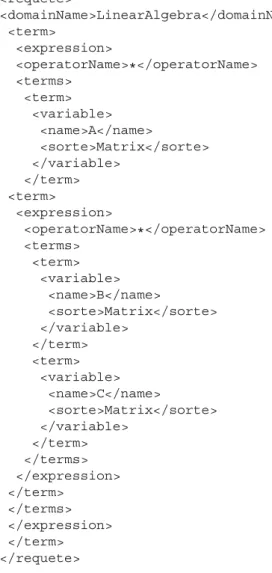
After the syntactic and semantic analyzes by the Analyzer, if the expression is correct, an XML file indicated below is created by the Converter that describes the expression.
The advanced trader module takes this XML file (fully defined expression) and computes the list of functions (or services) that can solve the requested expression. Since the matrices are quite large, the execution will be performed remotely using PBLAS (in case of smaller size matrixes it can be CPU or GPU realization of BLAS instead of PBLAS). The output of the service trader con-sists into two consecutive calls to PsGEMM (the
routine that performs generalized matrix-matrix multiplication in the PBLAS):
<requete> <domainName>LinearAlgebra</domainName> <term> <expression> <operatorName>*</operatorName> <terms> <term> <variable> <name>A</name> <sorte>Matrix</sorte> </variable> </term> <term> <expression> <operatorName>*</operatorName> <terms> <term> <variable> <name>B</name> <sorte>Matrix</sorte> </variable> </term> <term> <variable> <name>C</name> <sorte>Matrix</sorte> </variable> </term> </terms> </expression> </term> </terms> </expression> </term> </requete> PsGEMM (‘N’, ‘N’, 100000, 100000, 100000, 1., B, 1, 1, DESCB, C, 1, 1, DESCC, 0., p2, 1, 1, DESCp2) \\ p2 = B * C PsGEMM (‘N’, ‘N’, 100000, 100000, 100000, 1 A, 1 1 DESCA, p2, 1, 1, DESCp2, 0., p1, 1, 1, DESCp1) \\p1 = A * p2
p1
Considering the size of the matrices involved in the operation, the execution of these PBLAS procedures will be performed over the Grid, the Job preparation module will then generated an execution script launched over the Grid in order to recover the result of the user request that are sent back to the Web interface.
3.3 Data Management in the Portal
The users define and insert the new numerical objects (see Fig.4) that are required in their math-ematical calculations. Both uploading and gener-ation mechanisms are available for the cregener-ation of numerical objects by specifying their types and properties, such as triangular, identity, symmetric, . . . for matrices. The interface provides to users different options (download, delete or change pa-rameters) for the uploaded numerical objects. The parameters (types, properties, names, etc.) of the numerical objects are stored on the local mysql database of the portal and then the numerical objects are transferred to the storage element of the Grid infrastructure. Currently the portal uses the storage element of the ArmGrid infrastructure with the capacity of 8 TB.
4 Mathematical Services
The computational services currently deployed within our scientific computing environment in-clude libraries for dense and sparse linear alge-bra (including direct and iterative solvers) and a solver for decision making problems. These libraries cover the major types of architectures (serial and parallel computers using the OpenMP and MPI programming paradigms and GPUs) and allow to solve a wide range of problems.
The services deployed within our scientific en-vironment are procedures of the various scientific libraries. The C or Fortran codes of these
proce-Fig. 4 Scientific computing environment based on
dures are encapsulated within a shell script that al-lows to call them (input is the output of the trader module, output is the JDL file) from gLite when they are used remotely (which is not required when they are executed locally). Practically all ScaLAPACK procedures are encapsulated with that script and their functionalites, data input and output are described to the advanced trader.
4.1 Service for Large-Scale Linear Systems
Several libraries for dense linear algebra (ScaLA-PACK, MAGMA, PSBLAS) in addition to the MUMPS package that provides a range of sparse direct solvers are available:
• ScaLAPACK [21] is a library of high-performance linear algebra routines for dis-tributed memory message-passing MIMD (multiple instruction, multiple data) comput-ers and networks of workstations support-ing Parallel Virtual Machine and/or Message Passing Interface. With ScaLAPACK comes an additional library called the PBLAS, which can be seen as a parallel version of the BLAS (Basic Linear Algebra Subprograms) [22]. Using the PBLAS, simple matrix/vector and more complex operations can be performed in parallel.
• MAGMA (Matrix Algebra on GPU and Mul-ticore Architectures) [23] is a collection of next generation linear algebra libraries for heterogeneous architectures. MAGMA al-lows applications to fully exploit the power of current heterogeneous systems of multi/many-core CPUs and multi-GPUs to deliver the fastest possible time to accurate solution within given energy constraints.
• The PSBLAS (Parallel Sparse Basic Linear Algebra Subprograms) [24] provides a frame-work to enable easy, efficient and portable implementations of iterative solvers for lin-ear systems on parallel computers. It im-plements parallel versions of most of the Sparse BLAS computational kernels (sparse matrix by dense matrix multiplication, sparse block diagonal system solution, sparse matrix norms, vector norms, etc.), sparse matrix
man-agement functionalities and parallel imple-mentations of preconditioned Krylov solvers. • The MUMPS (MUltifrontal Massively
Paral-lel sparse direct Solver) library [25] is a pack-age for solving systems of linear equations of the form Ax = b, where A is a sparse matrix that can be either unsymmetric, symmetric positive definite, or general symmetric.
The matrix-matrix multiplication is one of the most important computational service for large-scale linear systems. Parallel matrix-matrix multi-plication has been investigated and benchmarked using the computational resources of the Arm-Grid infrastructure. Particularly, a series of exper-iments have been done on the high-performance computing Armcluster system, which consists of 128 3.06 GHz Intel Xeon processors and uses Myrinet 2000 network topology.
The PDGEMM double precision routine from the PBLAS in ScaLAPACK is used for bench-marking, as it is the one of most widely used computational kernel. Figure 5 reports the per-formance and scalability of PDGEMM for square matrices: the matrices ranks range from 600 to 12,000. The figure only includes the execution of the service, because the total execution time and the latency of the portal depends of the scheduling of jobs in the Grid environment which introduces strong variations depending on the overall load of the server (other jobs are running) and explain the superlinear speedup with the matrices of size 8,000 and the absence of gain when moving from 64 to 96 processors. The limits of the portal depends
Fig. 5 ScaLAPACK PDGEMM benchmarking on
on the capacities of the storage and on the com-putational resources of the virtual organization supported the portal. In our case 128 cores and 8 TB of storage (the resources of Armcluster) are available for the portal. Currently the storage ele-ment of the ArmNGI is used for the experiele-ments, which is interconnected with the Grid sites via 1 Gbps of dedicated bandwith.
4.2 Services for Parallel Iterative Methods to Solve Large Sparse Linear Systems
Iterative methods are, with direct methods, the other family of methods for solving general, large sparse linear systems Ax = b [26]. The principle is generally to construct a sequence of iterates con-verging towards the solution of the linear system. Among the large variety of iterative methods, we focus on Krylov methods [26, 27] and Cimmino methods [28, 29]. In the future it is planned to benchmark these iterative methods, as well as to deploy other iterative methods.
4.2.1 Services for Krylov Methods
The Krylov methods are based on a projec-tion processes onto Krylov subspaces, which are subspaces spanned by the vectors {b, Ab, A2
b, ..., Aib}. In short, these techniques approximate A−1b by p(A)b, where p is a polynomial. The
solution is constructed by many approaches that give rise to different methods [28]:
• The Ritz-Galerkin approach: full orthogonal-ization method (FOM), conjugate gradient (CG) methods,
• The minimum norm residual approach: GM-RES method and its variants,
• The Petrov-Galerkin approach: Bi-CG and QMR methods,
• The minimum norm error approach: SYMMLQ method, ...
We focus on the following two methods: GMRES method for unsymmetric matrices and Conjugate Gradient for symmetric definite matrices. The ser-vices implemented in the platform are based on these two methods. These methods can be par-allelized using some of the libraries we deployed over the platform such as PSBLAS.
4.2.2 Service for Block-Cimmino Method
The Cimmino method [28, 29] is a row projec-tion method in which the original linear system is divided into subsystems. At each iteration, it computes one projection per subsystem and uses these projections to construct an approximation to the solution of the linear system. The Block-Cimmino method, as all the block algorithms, can be efficiently parallelized, for example, by distrib-uting the different blocks on the available proces-sors. However, the IRIT Team develops another approach [30] where the block distribution onto the processors is not explicitly performed within the code: the MUMPS multi-frontal sparse solver is in charge of handling the data distribution and parallelism.
4.3 Service for Parallel Decision Making
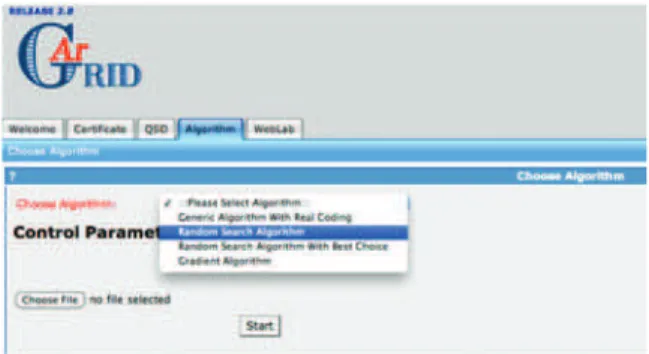
Searching algorithms for solving the non-linear multi-parametric experimental problems (opti-mization problems) contains series of control pa-rameters, which defines the effectiveness of the extremum computational meanings that usually define the success of the search of extremum. Besides, the extremal problems usually contain gully situations, which make the extremum search process significantly complicated. In practice the passage of gully situations is implemented as a rule through the search from various start points. The service deployed (see Fig. 6) allows for not only the parallelization of the solution of extreme problem itself, but also to simultaneously solve the problem by using some set of values of control parameters and then select the best solution.
As it will be shown, the development of men-tioned approach solves the problem of adaptation in some manner and allows for a significantly increment of the speed and quality of the solution of optimization problems.
Let’s consider a non-linear multi-parametric extreme problem [31,32].
F (x) = F (x1,x2, . . . ,xn) → min
x∈D ⇒x
∗
With the non linear limitations of inequality type
D : ϕ (x) = ϕi(x1,x2. . . ,xn) ≥ 0, i = 1, 2, . . . , l,
where F (x) is the goal function, xis the vector of variable variables, z is the dimension of the range of the extreme search, x∗is the vector of optimal
values of variables, D is the allowable range formed by technical requirements in the form of l limitations. The transfer to the acceptable range D will be implemented through minimization of the non-negative function.
Q (x) =X
ϕi<0
|ϕi|
|ϕi| + 1
The developed parallel algorithms have been benchmarked on the nonlinear problem of opti-mal projection of synchronic generator with obvi-ous poles [33] using the service of the portal. For example, in case of random-search algorithm the total number of experiments are 27 (33
), because three values of the following control variables are used: x0—vector of the start point coordinates,
ku—coefficient of the step division, µ—the count
of maximum tries inside of hypersphere. In our benchmarks we have achieved a 8.64 speedup when simulations are run using 27 cores of the Grid site located in the State Engineering Uni-versity of Armenia. The investigations of the de-veloped system show that using the Web portal is essential, because big differences in the goal function optimal value occur depending on the best and worst set of control parameters.
The random search with the best selection, the classic genetic and gradient algorithms have also been implemented and tested. The experiments show that the discussed approach is also effective for the mentioned algorithms.
5 Conclusion
The full implementation of our environment for scientific computing over the Grid and GPUs will allow users, who are not familiar with the parallel programming technologies and software tools (Grid and cluster middlewares, parallel and GPU programming, queue system, linear algebra libraries), to use the services over the portal while hidding all the details of the underlying distrib-uted computing infrastructure. The environment is a good tool for demonstrating how computa-tions can be transparently performed over the Grid or GPU from the user point of view.
Acknowledgements This joint work has been done within the framework of the “Development of a Sec-ond Generation Scientific Computing Infrastructure Based on P-Grade Portal” (Centre National de la Recherche Scientifique, France and State Committee of Science of Armenia) Project.
References
1. Petitet, A., Casanova, H., Dongarra, J., Robert, Y., Whaley, R.: Parallel and distributed scientific comput-ing: a numerical linear algebra problem solving envi-ronment designer’s perspective. Handbook on Parallel and Distributed Processing (1999)
2. Parallel Grid Run-time and Application Development Environment.http://www.p-grade.hu(2003)
3. Astsatryan, H., Sahakyan, V., Shoukourian, Yu., Srapyan, M., Daydé M., Hurault, A., Grigoras, R.: In-troduction of a Grid-aware portlet for numerical calcu-lations. In: IEEE 1st International Conference on Par-allel, Distributed and Grid Computing (PDGC’2010). Waknaghat, Solan (HP), India (2010)
4. Astsatryan, H., Sahakyan, V., Shoukouryan, Yu., Daydé, M., Hurault, A., Pantel, P., Caron, E.: A Grid-aware web interface with advanced service trading for linear algebra calculations. In: High Performance Com-puting for Computational Science—VECPAR2008, Lecture Notes in Computer Science 4395. Springer 2008, Toulouse, France (2008)
5. Astsatryan, H., Shoukouryan, Yu., Sahakyan, V.: Grid activities in Armenia. In: Proceedings of the Inter-national Conference Parallel Computing Technologies (PAVT’2009). Novgorod, Russia, March 30—April 3 (2009)
6. Armenian National Grid Infrastructure. http://www.
Grid.am(2009)
7. Hardt, M., Seymour, K., Dongarra, J., Zapf, M., Ruiter, N.V.: Interactive Grid-access using Gridsolve and gig-gle. J. Comput. Inf. 27(2), 233–248
8. Gabrielle, A., et al.: Cactus tools for Grid applications. Springer J. Clust. Comput. 4(3), 179–188 (2001) 9. Ardizzone, V., Barbera, R., Calanducci, A., Fargetta,
M., Ingrà, E., Porro, I., La Rocca, G., Monforte, S., Ricceri, R., Rotondo, R., Scardaci, D., Schenone, A.: The DECIDE science gateway. J. Grid Comput. 10(4), 689–707 (2012)
10. Czyzyk, J., Mesnier, M., Moré, J.: The NEOS server. IEEE J. Comput. Sci. Engineer. 5, 68–75 (1998) 11. Daydé, M., Desprez, F., Hurault, A., Pantel, M.:
On deploying scientific software within the GRID-TLSE project. Computing Letters, VSP/Brill Aca-demic Publisher, 1(3), 85–92 (2005). doi:10.1163/ 1574040054861267
12. Farkas, Z., Kacsuk, P.: P-GRADE portal: a generic workflow system to support user communities. Future Gener. Comput. Syst. J. 27(5), 454–465 (2011) 13. Kacsuk, P.: P-GRADE portal family for Grid
in-frastructures. Conc. Comput. Pract. Exper. J. 23(3), 235–245 (2011)
14. Kacsuk, P., Farkas, Z., Kozlovszky, M., Hermann, G., Balasko, A., Karoczkai, K., Istvan Marton, I.: WS-PGRADE/gUSE generic DCI gateway framework for a large variety of user communities. J. Grid Comput.
10(4), 601–630 (2012)
15. Caron, E., Desprez, F.: DIET: a scalable toolbox to build network enabled servers on the Grid. Int. J. High Perform. Comput. Appl. 20(3), 335–352 (2006) 16. Hurault, A., Daydé, M., Pantel, M.: Advanced service
trading for scientific computing over the Grid. J. Super-comput. Springer Netherlands, 49(1), 64–83 (2008) 17. Hurault, A., YarKhan, A.: Intelligent service trading
and brokering for distributed network services in Grid-Solve, VECPAR 2010. In: 9th International Meeting on High Performance Computing for Computational Science, Berkeley, CA (2010)
18. gLite.http://www.glite.org(2005)
19. Astsatryan, H., Sahakyan, V., Shoukourian, Y., Dayde, M., Hurault, A.: Enabling large-scale linear sys-tems of equations on Hybrid HPC infrastructures. ICT Innovations 2011. Springer Advances in In-telligent and Soft Computing 150, 239–245 (2012).
doi:10.1007/978-3-642-28664-3_22
20. Job Description Language HowTo—DataGrid-01-TEN-0102-02. http://www.infn.it/workload-Grid/docs/
DataGrid-01-TEN-0102-0_2.pdf(2002)
21. Blackford, L.S., Choi, J., Cleary, A., D’Azevedo, E., Demmel, J., Dhillon, I., Dongarra, J., Hammarling,
S., Henry, G., Petitet, A., Stanley, K., Walker, D., Whaley, R.C.: ScaLAPACK: a linear algebra library for message-passing computers. SIAM Conference on Parallel Processing (1997)
22. Blackford, S., Demmel, J., Dongarra, J., Duff, I., Hammarling, S., Henry, G., Heroux, M., Kaufman, L., Lumsdaine, A., Petitet, A., Pozo, R., Remington, K.: An updated set of basic linear algebra subprograms. ACM Trans. Math. Softw. 28(2), 135–151 (2002) 23. Tomov, S., Dongarra, J., Baboulin, M.: Towards
dense linear algebra for hybrid GPU accelerated manycore systems. Parallel Comput. 36(5–6), 232–240 (2010)
24. Filippone, S., Colajanni, M.: PSBLAS: a library for parallel linear algebra computation on sparse matrices. ACM Trans. Math. Softw. 26(4), 527–550 (2000) 25. MUMPS: A MUltifrontal Massively Parallel Sparse
Di-rect Solver.http://mumps.enseeiht.fr(2000)
26. Saad, Y.: Iterative methods for sparse linear systems, 2nd edn. SIAM (2003)
27. van der Vorst, H.A.: Iterative Krylov Methods for Large Linear Systems, Cambridge Monographs on Ap-plied and Computation Mathematics. Cambridge Uni-versity Press, Cambridge (2003)
28. Arioli, M., Duff, I.S., Noailles, J., Ruiz, D.: A block projection method for sparse matrices. SIAM J. Sci. Statist. Comput. 13, 47–70 (1992)
29. Arioli, M., Duff, I.S., Ruiz, D., Sadkane, M.: Block Lanczos techniques for accelerating the Block Cim-mino method. SIAM J. Sci. Statist. Comput. 16, 1478– 1511 (1995)
30. Balsa, C., Guivarch, R., Ruiz, D., Zenadi, M.: An hybrid approach for the parallelization of a block iterative algorithm. In: International Conference on Vector and Parallel Processing (VECPAR 2010), 22/06/2010–25/06/2010, pp. 116–128. Springer, Berkeley (2010)
31. Terzyan, H.: Decision Making Algorithms in mechanics, pp. 18–27. Izvestia Univer-sities, Electro-mechanics (2009)
32. Terzyan, H.: Simulation of electromechanical systems. In: Numerical Methods and Solutions, p. 280. VDM Verlag (2009)
33. Terzyan, H., Hovhannisyan, L.: On solution of decision-making problem in distributed computing en-vironment. In: Proceedings of the Conference Com-puter Science and Information Technologies, pp. 276– 280. Yerevan (2011)