START-UP VALUATION OF
BIOTECH COMPANIES
WITH REAL OPTIONS
A case study of the start-up Organovo Holdings, Inc.
Patrick Legland (Thesis Supervisor)
Affiliate Professor in Finance at HEC Paris
Master Thesis HEC Paris
Celine Göbel
June 2016
©2016 Celine Göbel. All rights reserved.
The author hereby grants to HEC Paris permission to reproduce and to distribute publicly paper and electronic copies of this thesis document in
Start-up Valuation of Biotech Companies with Real Options
A case study of the start-up Organovo Holdings, Inc.
written by Celine Göbel
Abstract: This master thesis examines several valuations methods for young companies. Start-ups are generally characterised by negative earnings, pure equity financing and binary business models. Traditional valuation methods, such as the Discounted Cash Flow, valuation multiples or comparable transactions, cannot be applied due to start ups’ high degree of uncertainty, short histories, volatile discount rates and little publicly available data on financials, comparable companies or comparable transactions. Consequently, new valuation methods, e.g. the Venture Capital method, the First Chicago method, the Damodaran approach and Real Option valuation, will be presented and directly applied to the 3D bioprinting start-up Organovo. The new valuation methods take the uncertainty of start-start-ups into account and allow more flexibility regarding timing and investment decisions. On top of this, the valuation of intangible assets is shortly discussed, as it is especially important for start-ups with a strong intellectual property portfolio. This master thesis also highlights non-financials factors in valuation, since the personal skills and experience of the founder and management team can have a large impact on the start-up’s value. The author concludes by proposing several areas of further research which will help to improve the current understanding of start-up valuation.
Key words: Start-up valuation, biotech ups, new valuation approaches, start-up value, start-start-up discount rate, Damodaran valuation, First Chicago Method, Venture Capital Method, Real Option valuation, 3D bioprinting, Organovo
Table of Contents
1. Introduction ... 5
2. Start-up characteristics and development stages ... 6
3. Limitations of traditional valuation techniques for start-ups ... 8
a) The discounted cash flow method ... 8
b) The multiples method ... 11
c) The transaction method ... 13
d) The discount rate ... 15
4. Introduction of the case study Organovo Holdings, Inc. ... 17
a) Company overview and strategy ... 18
b) Financial and market analysis ... 20
c) Valuation approach ... 25
5. Alternative valuation methods for start-ups applied to Organovo ... 26
a) The Venture Capital method ... 26
i. Principles of the Venture Capital method ... 26
ii. Limitations of this valuation method ... 29
b) The First Chicago method ... 31
i. Principles of the First Chicago method ... 32
ii. Limitations of this valuation method ... 35
c) The Damodaran approach ... 36
i. Estimation of future cash flows ... 36
ii. Estimation of the discount rate ... 43
iii. Estimation of the terminal value ... 48
d) The real option approach ... 50
i. Principles of the real option method ... 51
ii. Valuation of options ... 55
iii. Limitations of this valuation method ... 64
iv. Applicability for start-up valuation ... 65
e) Valuation of intangibles ... 66
i. Market based valuation method ... 67
ii. Cost based valuation method ... 68
iii. Income-based valuation method ... 68
iv. Challenges of valuing intangible assets ... 69
6. Verification of the valuation methods ... 70
a) Alternative approaches to consider ... 72
7. Conclusion and recommended research ... 73
8. Bibliography ... 75
1. Introduction
Everything that can be counted does not necessarily count; everything that counts cannot necessarily be counted.
- Albert Einstein Especially due to the skyrocketing valuations of young companies, such as Uber ($62.5bn), AirBnB ($25.5bn) and Palantir ($19.6bn), many start-ups have been chasing billion-dollar “unicorn” valuations. Venture capitalist are searching for innovative ideas, excellent management skills and great business models to make their investment the next huge success. Start-ups in the areas of financial technology, the Internet of Things and digital health are trending at the moment, as more and more graduates are inspired by the infamous growth stories of start-ups like Facebook, Dropbox and Snapchat. However, veterans, such as Bill Gates, warn to be cautious with unicorn valuations, because young companies, like payment provider Square and cloud storage company Box, just to name a few examples, have been disappointing investors with high stock market fluctuations.
Determining the financial value of the company becomes an inevitable question for founders and investors, when agreeing on giving away a specific percentage of the founders’ start-up for a specific amount of investment. Several websites, such as YouNoodle, claim to predict the start-up value through an algorism, which allocates a certain value after answering a number of questions online. But is start-up valuation that simple? Clearly, assessing the value of an early stage growth company is not easy, mainly due to the short financial history, uncertain growth potential and little comparability to listed companies or past transactions. Therefore, more and more investors as well as founders are wondering: How can a start-up actually be valued adequately? The aim of this research paper is to assess which methods are most applicable for start-up valuation and come up with a valuation method for biotech companies through a case study of the American 3D human tissue bioprinting start-up Organovo.
The first part of this thesis will highlight current research, existing literature and several valuation techniques. After first introducing general characteristics of start-ups, including life stages and financing, the traditional valuation methods will be discussed. Since these methods cannnot be used for start-ups, alternative methods for valuing young companies will be presented. These new methods will take the shortcomings and main characteristics of start-ups, i.e. no history, negative earnings and fully equity finance, into account. Different valuation methods, such as the venture capital method, the Damodaran approach and the real options approach, will be discussed and their limitations highlighted at the end of each section. To make this thesis as practical as possible, the new valuation methods will be directly applied to the case study of Organovo. After introducing the company, its strategy, financing and market, Organovo will be valued on the basis of the proposed methods. Other important non-financial factors will be discussed before concluding about start-up valuation and proposing future research for this field.
2. Start-up characteristics and development stages
Start-up companies are difficult to value for a number of reasons. A start-up is characterised by having little or no revenue, negative cash flows, being mostly loss making, having short histories, a binary business model and being dependent on equity financing (Damodaran, 2009). Generally, start-ups are facing extreme volatility of capital employed, as most of the economic model still has to be built (Vernimmen, 2014). This leads naturally to a lot of volatility and uncertainty regarding the valuation of a particular start-up, especially since most of the start-ups fail in the primary business phase and only a little percentage of start-ups survive.
Knaup and Piazza (2007) have published a study on the longevity of start-ups in different sectors that shows on average only 44% of start-ups survive through the fourth year and 31% through the seventh year. The rate of failure decreases at a decreasing rate, meaning that the longer a start-up survives, the better the chances of growth in sales and employment. The following table (Knaup & Piazza, 2007) gives an overview of the statistics of start-up survival as a proportion of firms that survived through the year with 1998 as a base year.
Table 1: Start-up survival probability per industry
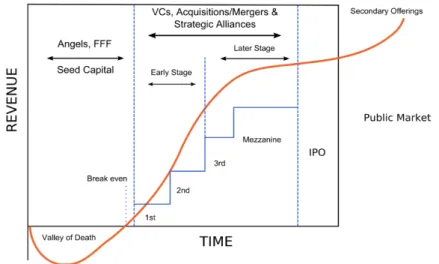
While it takes some time until start-up companies grow into established businesses, the young companies go through different stages. The early stages of the life cycle of start-ups can be illustrated as follows (Damodaran, 2010):
- Idea companies: During the first phase, the founders start working on their idea, which needs to be tested to see whether further investments are worthwhile. No revenues are generated, since the product first needs to be fully developed. The development and testing costs a lot of money, which is why the company incurs high operating losses. Without doubt, this is the riskiest investment period, since the product still needs to be fully developed, tested and launched on the market.
- Start-up companies: At this point the start-up is able to launch their product and have its first paying customers. Although some revenue is generated,
losses are increasing due to higher cost of development, marketing and growth. At this stage, start-ups have proven to be able to market their product, however, still need to become profitable in order to survive in the long term. - Second stage companies: In this stage the company is able to further increase
their revenues and finally reach the point of making profits. The company is characterized by an established operating history and business model, being able to further decrease their losses. Second stage companies tend to look for access to capital markets through an Initial Public Offering (IPO) in order to further expand their business.
Figure 1: Different stages of start-up development (Damodaran, 2010)
Investments in start-up are generally illiquid, because the investment are mostly privately held and during several rounds different terms negotiated. Depending on the risk profile, investors demand a different return. At each financing round, the start-up needs to be valued and dilution of existing investors carefully dealt with. From the founders’ perspective, the goal is to get as much funding from new investors to rapidly increase the growth, while giving away as little ownership as possible. From the investors’ perspective, the goal is to invest at a relatively low price for a relatively large stake in order to sell their stake at a higher price in future.
Damodaran (2012) identified several types of risk which can be associated with start-up companies. First, small companies have a lot less information available than large public companies, thus investors in start-ups face information risk. Furthermore, since most of the value will be generated in future, start-ups face a lot of uncertainty and the value is mostly determined on the expected growth potential. However, in most of the cases, the start-up faces problems during their initial phases and investors face unpredictable growth risk. Third, investors can mostly only invest or divest during financing rounds and cannot freely choose when to buy or sell part of their stake. Most of these investments are very illiquid, since they are privately held, which makes the investment process even more difficult. Therefore, start-ups often have to apply an illiquidity discount, since investor face liquidity risk. Because of information, growth and illiquidity risk, venture capitalists require a higher rate of
with uncertainty and the aforementioned risks are some of the key challenges in start-up valuation. Several traditional models might not be applicable, while new methods to value start-ups have to be discovered. In the following chapter the limitations of traditional valuation techniques will be discussed.
3. Limitations of traditional valuation techniques for start-ups
First of all, valuation of start-ups is difficult due to the uncertainty of the business model, which translates into uncertainty of future revenues, cost and earnings. In addition, since the ideas or technologies created within the start-up are relatively new, it is hard to estimate the future growth, cash flows and investment requirements. The value is captured in several intangible assets, which sometimes might not even appear on the balance sheet. Moreover, due to the loss making nature of start-ups, most of the value lies in the terminal value, which again the longer the time horizon, the more uncertain the forecasts. But even more important, due to negative earnings and negative cash flows, both enterprise as well as equity multiples cannot be applied, unless projected future values are used. The study of Black (2003) has shown that earnings do not provide significant information for valuation of start-ups, but become more important once the firm picks up growth. Eventually, information asymmetry exists between the company’s founder and the investors, because the investor is looking for information that allows him to pay as little as possible for a potential share, while the owner is aiming to convince the investor of his high growth prospects in order give as little ownership as possible away.
Thus, the characteristics of start-ups, e.g. loss making, short history, only equity financed and binary business model, make it especially difficult to use valuation methods, normally applied to value a company. The following section will quickly explain why certain methods, such as the discounted cash flow method (DCF), trading multiples and transaction multiples cannot be used and why the discount rate needs special attention for start-up valuation.
a) The discounted cash flow method
The Discounted Cash Flow (DCF) method values the company as a whole by discounting the free cash flows to the firm (FCFF) with the company’s weighted average cost of capital (WACC). The shareholders’ equity is calculated by deducting the net debt from the enterprise value of the DCF. The enterprise value can be calculated as follows: 𝐸𝑛𝑡𝑒𝑟𝑝𝑟𝑖𝑠𝑒 𝑉𝑎𝑙𝑢𝑒 𝐸𝑉 = 𝐹𝐶𝐹𝐹1 (1 + 𝑊𝐴𝐶𝐶)1 8 9:; 𝑊𝐴𝐶𝐶 = 𝑘= 𝑥 ?@ ?AB?@+ 𝑘C 𝑥 1 − 𝑡 𝑥 ?A ?AB?@
with 𝑘= being the cost of equity, 𝑘C the cost of debt, t the tax rate, 𝑉C the net debt
The cash flows are projected for a certain number of n years, depending on the industry. For the cash flows generated after the forecasted period, a terminal value (TV) will be calculated. The value of the company is the sum of the present values of after-tax cash flows for a specific amount of n years and the terminal value at the end of the forecasting period (Vernimmen, 2014). The free cash flows are calculated as follows (Beneda, 2003): 𝑭𝒓𝒆𝒆 𝑪𝒂𝒔𝒉 𝑭𝒍𝒐𝒘 𝒕𝒐 𝒕𝒉𝒆 𝑭𝒊𝒓𝒎 𝑭𝑪𝑭𝑭 = 𝑂𝑝𝑒𝑟𝑎𝑡𝑖𝑛𝑔 𝑖𝑛𝑐𝑜𝑚𝑒 (𝐸𝐵𝐼𝑇) 𝑥 1 − 𝑇𝑎𝑥 𝑟𝑎𝑡𝑒 − 𝐶𝑎𝑝𝑖𝑡𝑎𝑙 𝐸𝑥𝑝𝑒𝑛𝑑𝑖𝑡𝑢𝑟𝑒𝑠 +𝐷𝑒𝑝𝑟𝑒𝑐𝑖𝑎𝑡𝑖𝑜𝑛 𝑎𝑛𝑑 𝐴𝑚𝑜𝑟𝑡𝑖𝑧𝑎𝑡𝑖𝑜𝑛 −𝐶ℎ𝑎𝑛𝑔𝑒 𝑖𝑛 𝑁𝑒𝑡 𝑊𝑜𝑟𝑘𝑖𝑛𝑔 𝐶𝑎𝑝𝑖𝑡𝑎𝑙
The terminal value at the end of the forecasting period can either be calculated with the terminal multiple method or the perpetuity growth method. The terminal multiple method uses an average multiple from selected companies’ trading multiples and multiplies the multiple with the projected financials of the last forecasting period: 𝑇𝑉 = 𝑇𝑒𝑟𝑚𝑖𝑛𝑎𝑙 𝑀𝑢𝑙𝑡𝑖𝑝𝑙𝑒 𝑥 𝐶𝑜𝑟𝑟𝑒𝑠𝑝𝑜𝑛𝑑𝑖𝑛𝑔 𝐹𝑖𝑛𝑎𝑛𝑐𝑖𝑎𝑙𝑠 𝑓𝑜𝑟 𝑓𝑖𝑛𝑎𝑙 𝑓𝑜𝑟𝑒𝑐𝑎𝑠𝑡𝑖𝑛𝑔 𝑝𝑒𝑟𝑖𝑜𝑑 These are mostly enterprise value multiples, such as EV/Sales or EV/EBITDA, since the DCF method values the whole company and not only the equity, which will be the case for equity multiples, such as the Price-Earnings-Ratio (P/E).
The terminal value based on the free cash flow at the end of the forecasting period assumes that the company will growth continuously and generate FCFF for perpetuity. The perpetuity growth rate g is typically the historic inflation rate or the historic GDP growth (Vernimmen, 2014). In case the growth rate is bigger than one of the two values, the company is expected to outgrow the economy forever. The formula for the terminal value with free cash flows to the firm is calculated as follows:
𝑇𝑉 = 𝐹𝐶𝐹𝐹9 𝑥 (1 + 𝑔) 𝑊𝐴𝐶𝐶 − 𝑔
Especially in case most of the cash flows are generated after the forecasting period, the terminal value of the company makes up a big part of the valuation. A DCF valuation is based on the past company history, its weighted average cost of capital and future growth assumptions. For start-ups, however, the intrinsic valuation applied in the DCF method cannot be used due to several reasons:
- No history: Young companies with a limited history mostly only have one or two years of data available. The basis of a DCF is to forecast the growth, but with no information from the past, this growth forecast becomes very subjective (Damodaran, 2009). Especially with regards to existing and growth assets, start-up companies face problems coming up with an accurate and realistic reinvestment and growth rate.
- Little or no revenue: In the first years, most start-ups generate significant operating losses and negative cash flows, which are mainly associated with the cost of setting up the business. Establishing a useful operating pattern and thereby growth rate for the DCF is therefore impossible, especially since small changes in the input parameters can lead to significant changes in the overall values (Kotova, 2014).
- Binary business model: A lot of uncertainty regarding the future of the business exists, with up to 56% of businesses failing in the first three years (Knaup & Piazza, 2007). The DCF mostly only takes one scenario into account, which does not fit the binary business model of start-ups. Therefore, the valuation method used for start-ups has to be as flexible as possible, allowing the investor to take different scenarios into account.
- Timing: The DCF approach is very sensitive to the time to market of start-up companies. High-tech or pharmaceutical development projects have long time horizons of up to 30 years. With the valuation of the DCF approach none of these project would be started due to the high uncertainty and long period without positive cash flows (van Schootbrugge & Wong, 2013). The DCF approach fails to include value generate in far future and therefore is not suitable for start-up companies.
- Rigid model: Van Schootbrugge and Wong (2013) reveal that the DCF approach does not include enough flexibility for optional expansion strategies. In case a start-up learns from it initial mistakes, the market strategy can be significantly changed and investment reallocated to other products which have proven to be successful. The option to reallocate, expand, contract or delay investments has actually a large value, which will be discussed in detail during the later sections.
- Discount rate: The greatest challenge with the DCF model is to set one discount rate for the whole model, which is nearly impossible for start-ups with varying degrees of risk through the different development stages (van Schootbrugge & Wong, 2013). Furthermore, regarding the calculations of the discount rate, the beta of equity is usually estimated by regressing the returns of a stock against the market index and cost of debt by comparing market prices of the publicly traded bonds (Damodaran, 2009). Since start-ups are mostly not publicly traded and have not publicly traded bonds outstanding, it becomes difficult to estimate a discount rate. In addition, most start-up companies are only equity financed, with equity coming from several source with different terms leading to several cost of equity depending on the investors. Because estimating the discount rate poses several challenges, this issue will be investigated into detail at a later stage.
- Terminal value: For well established companies the terminal value accounts already for a large proportion of the overall value, thus for a start-up it can happen that the terminal value accounts up to 90% or 100% of the value (Mills, 1998). The assumptions of the timing of stable growth and the growth rate itself have a substantial impact on the terminal value of the start-up. It remains, however, questionable whether the start-up will reach a stable growth rate, when the start-up will reach a stable growth rate and how the start-up will look like in stable growth. Due to the high failure rate of start-ups, estimating the probability of survival is more vital than the stable growth rate it may reach. Furthermore, depending on competition, the timing of reaching the stable growth rate can vary significantly. It is therefore important to make the right assumptions for their stable growth rate, which will be very subjective, taking into account that start-ups lack historical data (Beneda, 2003).
- Allocation of equity value: For public companies, with one or very few classes of shares, the equity can be easy divided on a proportionate basis. Start-up companies, however, face several issues when allocating the equity claims: Multiple rounds of financing from private investors, contrary to the public market, can result in different terms and priority agreements for later financing rounds. Equity claims on cash flow and control of the start-up may differ with regards to preferential rights for primary investors. Eventually, the investors mostly demand rights protecting their interest in new financing round or investment decision, making it hard for the management of a start-up to maintain flexibility regarding the future of the company. Eventually, the illiquidity of equity in start-ups impact the difficulty of measuring the right value of equity attached.
b) The multiples method
Next to the direct valuation methods, such as the DCF method, several relative valuation methods exist. Relative valuation methods rely on multiples, which are financial ratios that have been calculated through a sample of comparable companies. Two basic categories of multiples exist (Vernimmen, 2014):
- Price multiples: These multiples are used to calculate the market capitalisation of a company directly. The most common multiples are the price-to-earnings ratio (Equity value/PER) or the price-to-book ratio (Equity value/PBR). - Enterprise multiples: These multiples don’t consider the capital structure of a
company and are used to calculate the entire value of the company, the enterprise value (EV). The most popular multiples are the EBIT multiple (EV/EBIT), Sales multiple (EV/Sales) or EBITDA multiple (EV/EBITDA).
It is important that the sample of comparable companies to calculate the multiple is carefully selected and matches the company that needs to be valued. Since the intrinsic valuation methods, such as the DCF, cannot be used for start-up valuation due to reasons mentioned above, the following passage will investigate whether comparable methods are more helpful. The following factors explain why the valuation of start-up companies using multiples will be equally difficult:
- Comparable companies: Relative valuation techniques are used to value a company with publicly traded comparable companies of equal size in a similar industry. Start-up companies should therefore be compared with other small companies, which are usually not publicly traded. The computation of multiples will be difficult, partially due to very limited access to financial information and non existent market prices. As an alternative, start-ups can be compared with publicly traded companies in the same sector, but for this it is important to take into account that these firms have different risk, growth and cash flows compared to the start-ups.
- Common measure: The multiples computed from a set of comparable companies need to be scaled to a common measure in order to value a target company. For larger companies this does not pose a large problem, for start-ups, however, common measure such as EBITDA, EBIT or P/E ratio are mostly negative. In addition, the book value is very small compared to the capital invested, cash flows negative and revenues very small, thus, multiples for negative measures will not result in a meaningful valuation.
- Risk adjustment: In relative valuation market based risk, e.g. beta or standard deviation of equity returns, are used as a proxy for risk (Damodaran, 2009). For start-up companies the risk measurement is difficult. Standard deviation of financials could be used, but due to the short histories an objective risk adjustment is hard to estimate.
- Probability of survival: Start-up companies have a high probability of failure, adding more risk to the transaction. When comparing large public companies with start-ups for a multiple valuation, this risk needs to be taken into account. Start-up companies should therefore be valued substantially lower, since they have a smaller chance of surviving compared to bigger companies with an established product portfolio. An idea would be to lower the multiple by a certain threshold, but depending on the likelihood of the start-up this needs to be assessed on an individual basis.
- Timing: The development of a start-up to a comparable listed company will take time. By the time the start-up reaches that stage, the market may have completely changed and so may the multiples have changed (van Schootbrugge & Wong, 2013). Therefore, the start-up should be valued on
forward looking multiples, but since the start-up might need approximately ten years to fully develop, these forward looking multiples might not exist. - Illiquidity and equity claims: Difference in cash flow and control claims can
have an effect on the value of the equity claims each investor is entitled to. When valuing a start-up with a relative valuation method, the illiquidity issue and equity claims based on different term from various financing rounds still need to be taken into account.
The arguments above show that the multiples method not appropriate for start-up valuation. In order to overcome the challenges mentioned, venture capitalists should use forward revenues or earnings when valuing start-ups. For this, however, multiples for same time period as the forward revenues or earnings need to be considered. This leads to even more complexity and uncertainty when forecasting both financials as well as multiples for the start-up valuation. To conclude, despite the ease of the comparable method, this valuation technique does not seem very applicable for start-ups, mainly due to the difficulty in comparison with regards to comparable companies, common measures, risk adjustment and equity claims (Damodaran, 2011).
c) The transaction method
The transaction method uses a sample of recent transactions to calculate the average multiple which can be used to attain the enterprise or equity value of the target. Contrary to the methods mentioned before, the multiples calculated through the transaction method include the control premium the acquirer had to pay to obtain control of the target (Vernimmen, 2014). Therefore, the price paid includes the anticipated synergies and premium paid for the company. Although both conventional methods above have proven to be hard to use for start-ups, the following paragraphs will investigate the usefulness of the transaction method for start-up valuation:
- Private transaction multiples: Before going public, start-ups are valued and shares purchased through private instead of public transactions. In theory, Damodaran (2009) emphasises that start-ups need to be valued on the basis of private transaction multiples of private companies similar to the company in question. The following challenge about data availability will highlight why this is nearly impossible.
- Availability of data: Start-ups are mostly financed by private investors, such as private equity, family, friends or founders. During the financing rounds, the data is only available for the investors and not to the general public. Well-known databases consequentially do not have access to this sensitive information. Therefore, getting access to comparable private transactions is very difficult. Furthermore, financing is very subjective and depends on the
financing round, as for various rounds, different terms are attached to the investments. The lack of organised databases makes it impossible to use private transactions to value start-ups.
- Transaction specific information: Especially transaction multiples often contain very specific information, which is not at arm’s length. Consequentially it will be hard to compare the private transaction multiples and establish a meaningful multiple for valuation from it. For instance, an acquirer might pay more because the key person decides to stay for a transition period instead of leaving the company. Thus, this company sensitive information is hard to compare when taking the private transaction multiples into account.
- Time lag: Private transactions do not take place very often. It is hard to find several transactions taking place in the same time frame. Establishing meaningful multiples which can be applied to other start-up companies is therefore difficult.
- Geography: Most comparable private transactions in big databases only cover transactions taking place in the United States. This could be due to an absence of data in other places or due to a transaction concentration in the US. When a start-up from an emerging market needs to be valued, this data base is of little value. Unfortunately, the geographic concentration of private transactions taking place in the United States further limits the transaction method.
- Comparable measures: For publicly traded companies comparing transaction on basis of EV/Revenues, EV/EBITDA or PE ratio is relatively easy since the multiples simply reflect the value of a comparable transaction. For start-ups, however, these measures are not meaningful, since revenues are non existent, EBITDA mostly negative and PE ratios do not exist. The current financials are simply not a good indication for the future potential of a company, consequentially using multiples on the current financials will not provide powerful results. Furthermore, for start-up companies the accounting principles might not be as comparable as for bigger companies. Thus, the bottom line will show different results, depending on which accounting standard is used, leading to greater difficulty in comparing the results.
- Equity proportion: For start-up companies the equity claims are depend on the cash flow, control claims and illiquidity (Damodaran, 2009). Consequently, the equity price of one start-up may not be compared to the equity of another start-up. Thus, for the reason for the premium or discount paid needs to be considered when valuing a start-up with comparable transactions.
Private transaction multiples have proven to be very difficult to use for an objective valuation of a start-up company. There are several remedies and other valuation methods, which will be described in the subsequent section. Before that, however, the author will take a closer look at the difficulty of estimating the discount rate for start-ups.
d) The discount rate
A crucial part of the valuation process is discounting the future cash flows with the discount rate. For mature companies, the discount rate corresponds to the weighted average costs of capital, which consists of two parts, the cost of equity 𝑘=, which is calculated with the capital asset pricing model (CAPM) and the cost of debt 𝑘C:
𝑊𝐴𝐶𝐶 = 𝑘= 𝑥
𝑉=
𝑉C+ 𝑉=+ 𝑘C 𝑥 1 − 𝑡 𝑥
𝑉C 𝑉C + 𝑉=
with 𝑡 being the tax rate, 𝑉C the net debt value and 𝑉= the equity value.
𝐶𝑎𝑝𝑖𝑡𝑎𝑙 𝐴𝑠𝑠𝑒𝑡 𝑃𝑟𝑖𝑐𝑖𝑛𝑔 𝑀𝑜𝑑𝑒𝑙 𝐶𝐴𝑃𝑀 = 𝑘= = 𝑟b+ 𝛽defghi9j 𝑟k− 𝑟b
with 𝑟b being the risk free rate, 𝑟k the expected return of the market.
𝑘= = 𝑟b+ 𝛽defghi9j𝑥𝑀𝑅𝑃 = 𝑟b+ 𝐸𝑅𝑃
with 𝑀𝑅𝑃 being the market risk premium and 𝐸𝑅𝑃 the equity risk premium.
When the debt to equity ratio of the company is expected to change over time, the levered beta 𝛽m will also change. The beta will, therefore, first need to be unlevered
𝛽n and then re-levered with the appropriate debt to equity ratio: 𝛽n = op
qB qr9 sA@ and 𝛽m = 𝛽n𝑥 1 + 1 − 𝑡 𝑥 C =
The traditional approach of calculating the discount rate, however, cannot be used due to several reasons:
- Cost of equity: First of all, most start-ups are not publicly traded companies, therefore estimating the start-up’s beta through stock prices will not work. Moreover, young companies are often held by undiversified owners. Thus, the cost of equity should include both the market risk and the firm specific risk. - Cost of debt: Most start-up companies are fully equity financed, because they
will not have the possibility to take out a loan or issue bonds to the public. Therefore, no bond ranking will be available, which measures the default risk of a start-up. Furthermore, banks will probably charge a premium on any synthetic ranking a start-up can gain, simply because the young companies are mostly loss making, have no guarantees and no proven business model. - Debt-Equity ratio: Young start-ups which are not traded do not have market
data on debt and equity available that can be used to calculate the debt equity ratio. Even more important van de Schootbrugge and Wong (2013) is
cost of capital during the different the development stages. Due to permanent risk shifting the discount rate needs to be adjusted over the years contrary to the DCF method (Sahlman, 1987).
For venture capitalists, discount rate should correspond to the rate of return that is required. Since higher risk requires higher return, this rate is different for start-ups compared to mature companies. The following paragraphs about financing will give an overview of the required rate of return demanded by investors at the different stages. Furthermore, throughout the different stages of start-up development, there are different sources of financing used. Generally, start-ups are dependent on private equity, since no banks will be willing to offer loans due to the low probability of being paid back, when no revenues are generated. Therefore, in the initial phase, most start-up companies are privately owned or funded, usually by their founder, family or friends and business angles. In the seed stage, the company is conducting market research, developing their idea into a product and spending their funds on R&D. Generally, only small investments of between €25,000 and €300,000 are made in order to support the entrepreneurs explore their ideas, write a business plan and recruit key management (Sahlman, 1987). However, investors apply discount rates of over 80%, mainly due to the high risk and little development. Seed investors, however, provide basics business advice to ensure their money is not completely lost. During the next stage, the start-up starts generating first revenues, but increasing losses. Since high expenses are incurred and the business model has not been fully developed yet, the start-up is entering in the valley of death, where survival is very unlikely. During the start-up stage the company has been able to enter the market with their product and generate the first revenues, even though it has not been profitable yet. Careful market research, detailed business plan and all necessary documentation will allow the start-up to break even at the end of this phase. Start-up financing includes more significant funds in order to finance operations and properly bring the product on the market. Discount rates of investors range between 50% and 70% (Sahlman, 1987).
To continue, during the early growth stage the start-up will need more external funds to finance their growth. This is mostly supported by venture capitalists, who will invest during one of the financing rounds. First-stage investors are often more involved, by monitoring closely the start-up’s sales levels and headcount ratio, filling key management positions and searching for new staff. Discount rates are between 40% and 60% (Sahlman, 1987). Moreover, second-stage investors are more involved in expansion. Their capital is needed to improve products, tap new markets, establish new operations and finance working capital requirements. Due to higher amount of assets and lower risk, the required rate of return decreases slowly to 30% to 50% for second-stage investments (Sahlman, 1987).
At a later stage, the start-up is growing further, even though at a lower rate than before. Debt and mezzanine financing becomes available, as the start-up is
generating stable revenues and has developed a history of increasing financials. Venture capitalists exit the company at the stage where the start-up is taken public through an IPO. Usually, this takes between five to ten years from their initial investment. Bridge financing will help the start-up to overcome the phase until the IPO, which is generally only suitable at the right market timing with regards to the performance and size of the start-up. Bridge investors are generally passive investors with a discount rate of 25% to 30% (Sahlman, 1987).
Figure 2: The start-up financing cycle
The DCF approach has shown not to be flexible enough for varying discount rates and venture capitalists are using too high discount rates through their required rate of return. Since finding the discount rate of a start-up is a crucial point in the present value calculation, the exact approaches for start-up valuation will be discussed in the next valuation part in detail. These new approaches suggested for start-up valuation need to take the flexibility, uncertainty and varying level of risk of start-ups into account.
To conclude traditional valuation techniques cannot be directly used to value start-up companies. Often times, traditional methods do not consider the value of intangible assets, unrecorded assets or self-created assets, which are key to start-ups. The start-up valuation will therefore focus on the estimation of future earnings instead of relying on historical financial statements. Furthermore, other non-financial parameters will also be considered, as the management team can add substantial value to the start-up, with most venture capitalists being very concerned about the power of the founders to succeed with their ideas (Goldman, 2008). The following paragraph will therefore first introduce the start-up that will be valued before going into depth regarding new valuation methods suitable for start-ups.
4. Introduction of the case study Organovo Holdings, Inc.
In order to put theory into practice, the methods used for start-up valuation will be directly applied to a case study. Due to limited data availability of unlisted companies
before the IPO, a listed company with the characteristics of a start-up, e.g. loss making, short history, solely equity finance and uncertain business model, was selected. Due to the authors sincere interest in ground-breaking biotechnology, Organovo Holding, Inc., a start-up from the US that designs and creates functional human tissues using proprietary three dimensional bioprinting technology, will be studied in the next paragraphs. To begin with, a quick overview of the company and its strategy will be presented. Afterwards, the author will analyse Organovo’s financials and market before introducing several valuation techniques that can be used for start-ups.
a) Company overview and strategy
The following part will first describe Organovo’s business activities, afterwards the different products, the company’s milestones and its strategy for the future. To start with, Organovo has developed a 3D bioprinting technique for human tissue that can be used in drug discovery, development, biological research and regenerative medicine. The main aim is to reproduce living human that that accurately functions like native tissue. Organovo holds a lot exclusive commercial rights to patented 3D bioprinting technology, which was derived from research led by Dr. Gabor Forgacs, a professor of biophysics at the University of Missouri. As part of their business strategy, the start-up intends to pursue collaboration agreements with drug development companies to further develop their 3D bioprinting technology. The patented printing process can be described according to the company’s website as follows:
Figure 3: Organovo’s bioprinting process
These milestones highlight the development of Organovo:
- 2007: Foundation: Organovo, Inc. is officially incorporated intending to use the patent of Professor Gabor Forgacs for their 3D bioprinting
- 2008: Funding: The start-up manages to raise $3m in angle financing
- 2009: Bioprinter: Organovo opens its first laboratory in San Diego, United Staes and completes together with Invetech their first bioprinter
- 2010: Blood vessels: The start-up manages to create their first blood vessel, by only using primary human cells
- 2011: Partnerships: Organovo starts first partnerships on drug discovery - 2012: Public: The start-up goes public through a $15m financing round and
issues two new patents
- 2013: NYSE: Organovo is listed on the New York Stock Exchange and closes a $47m secondary public offering
- 2014: Liver: The start-up successfully launches the the exVive3D™ Human Liver Tissue and collaborates with Yale University to develop 3D organ tissues for transplantation research
- 2015: Skin: L’Oreal partners with Organovo to create 3D bioprinted skin tissue for their R&D, at the same time Organovo closes a $40m secondary public offering
- 2016: Kidney: Organovo is looking to bring its 3D bioprinted kidney tissues to market in September 2016
Organovo operates in an attractive and growing market, where they managed to gain the first mover advantage with their innovative technology and strong portfolio of intellectual property (IP). Customers include major pharmaceutical companies and academic institutions, such as Merck, L’Oreal or Harvard Medical School. With Organovo’s products, these companies will be able to validate more predictive tissues for disease modelling, test drugs on functional human tissues without administering the drug on a living human and implant three dimensional tissue into the human body in order to replace damaged or diseased tissue. Clinical tests have revealed that drugs failed mostly due toxicity, i.e. unknown adverse effects of chemicals on living
organisms and lack of efficacy. Organovo’s products will therefore address the gaps
in pharmaceutical in vitro - tested in a laboratory - and in vivo - tested in living organisms - preclinical research, lower the development costs for drugs significantly and provide new ground-breaking techniques which can fill the high demand for human implants.
Organovo’s core business is focused on recreating 100% cellular native tissue architecture for in vitro and in vivo applications. Their business established from the need for more predictive preclinical tissue models, for tissue that replaces or repairs organ functions and the need for lowering the high R&D cost of pharmaceutical companies. The focus areas are skin, liver and kidney with efficacy models leading to decreased cost, increased predictability and quicker drug discovery through partnerships and revolutionizing “tissue-on-demand” 3D printing of implants for clinical and educational use. These three 3D bioprinted tissues have been brought to the market and the preclinical human tissue system successfully launched. So far the products have been excellently matching the human tissue by correctly revealing the toxicity of a drug. According to Pfizer’s annual report, this is very critical for huge pharmaceutical companies, as Pfizer itself had to pay $750m in legal cost and $136m in market withdrawal cost for their toxic Troglitazone drug, known for prevalence of adverse liver effects. Therefore, several opportunities arise for Organovo, which will be discussed in the market analysis.
The strategy of the young start-up is to use their unique 3D bioprinting technologies to print first, 3D human tissue for preclinical assessment of drugs in a commercial approach, second, print highly customized disease models of human tissues for drug discovery through partnerships and third, print on demand tissue for clinical application and implants. Their strong intellectual property portfolio is key to the company’s success. Organovo owns or exclusively licenses over 25 patens world wide, with more than 80 patent applications pending. These patent filings relate mainly to bioprinting technology and its various uses in tissue creation, use in drug discovery and specific tissue construct. Organovo’s key objectives is therefore to strengthen its position in its core business activities and further expand by developing new human tissues, contracting new partnerships for cost saving efficacy models and creating successful collaborations with research institutions for 3D bioprinted implants.
Although Organovo unique technology for 3D bioprinting has disrupted the market, several competitors are trying to recreate their technology. On the one hand, large pharmaceutical companies, such as Eli Lilly, Abbott Laboratories, Sanofi and Pfizer, are main competitors, not necessarily specialized in 3D bioprinting, however, with bigger financial and technical resources than Organovo. On the other hand, innovative start-ups focused on 3D bioprinting exist across the world, with Japanese Cyfuse Biomedical, American BioBots and Russian 3D Bioprinting Solutions being direct competitors of Organovo.
b) Financial and market analysis Financial analysis
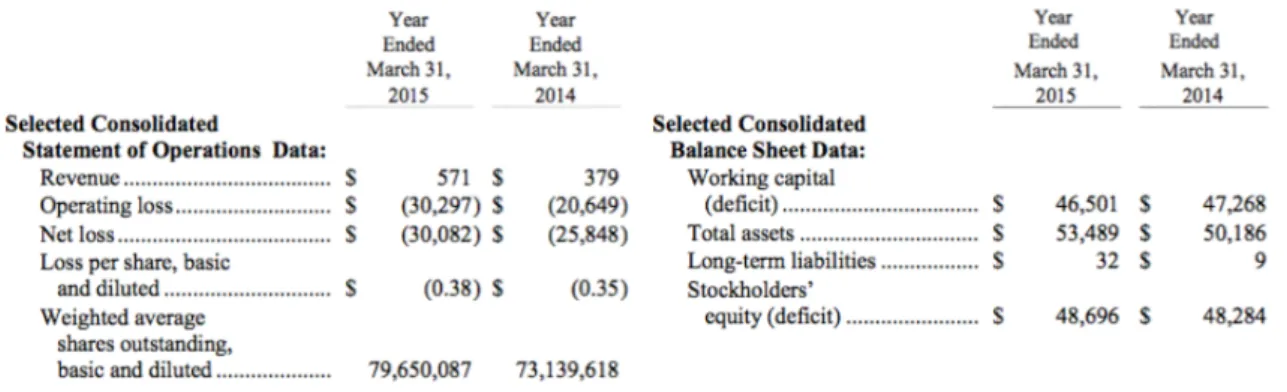
Revenues increases almost 50% from 2014, mainly due to the increase of $0.3m in commercial revenues since the product launch in 2014 offset by the $0.1m decrease in revenues after the company’s completion of one of the research agreements. Operating expenses increases by $9.9m or 47% from 2014 to 2015, which can be split in a $5.0m increase in selling, general and administrative (SG&A) expenses and $4.9m increase in investment in R&D expenses. The increase in R&D expenses is mostly attributed to the increase in research staff from 32 full time employees (FTE) in 2014 to 54 FTS in 2015. SG&A expenses increased mainly due to additional staff to support the infrastructure collaborative relationship and preparation for commercialization of products and services. As most other start-ups, Organovo has large operating losses, i.e. $25.8m in 2014 and $30.1m in 2015.
Figure 4: Organovo’s revenue and net loss for 2014 and 2015 in $k
Since its inception the company has been loss making, with losses per share of $0.35 in 2014 and $0.38 in 2015. Organovo’s ROE has been slightly increasing from -78% in 2014 to -62% in 2015. This is typical for a start-up company, where investors invest not in order to make short term returns, but hope that their investment will gain substantial value over the long term.
Figure 5: Organovo’s EPS and ROE for 2014 and 2015 in $ and %
Organovo’s assets are made up of largely cash and only a small proportion of fixes assets, e.g. $0.9m fixed assets (1.7%) of $50.2m total assets in 2015 and $2.0m fixed assets (3.8%) of $53.5m total assets in 2015. The detailed overview of fixed assets is depicted in Appendix 4. At the end of 2015, Organovo has a cash balance of $50.1m compared to $48.2m in 2014. Through several financing rounds as mentioned above Organovo has been seeking new cash to finance their operations. Working capital is largely positive, showing that customers have huge bargaining power over Organovo. So far the start-up has largely financed its operating losses and working capital requirements through the sales of convertible notes, private placements of equity securities, common stock, revenues from products and services, grants and collaborative research agreements. The cash balance of $50.2m at the end of 2015 will allow Organovo to finance their operations at least for another one year before significant investments are required again.
379 -25848 571 -30082 -35000 -30000 -25000 -20000 -15000 -10000 -5000 0 5000
Revenue Net loss
2014 2015 -0,38 -0,35 -62,02% -78,42% -90,00% -80,00% -70,00% -60,00% -50,00% -40,00% -30,00% -20,00% -10,00% 0,00% -0,4 -0,35 -0,3 -0,25 -0,2 -0,15 -0,1 -0,05 0 2015 2014 EPS ROE
Table 2: Selected financial data of Organovo in 2014 and 2015
Market analysis and growth opportunities
The market of Organovo can be divided into the following segments. The data has been collected through the Pharmaceutical Industry Profile of Pharmaceutical Research and Manufacturers of and Organovo’s website.
Table 3: Organovo’s market and competitive dynamics according to Organovo’s website
Growth opportunities exist in various human tissues, as the 3D bioprinting technology can ideally be expanded to any type of organ. So far, the three main tissues developed by Organovo are skin, liver and kidney, with many more opportunities for other tissues, e.g. lung, bone, blood vessels and heart. Furthermore, Organovo sees strong royalty opportunities from partnerships for early cancer discovery. For breast cancer, an initial model has already been bioprinted with defined multi-cellular composition and architecture. The valuation of diseased tissue will be dealt with in detail in the real options approach.
Risk analysis
However, especially, since Organovo is still a start-up several risks exist. First of all, with its limited operating history and high operating losses, Organovo is expected to incur additional operating losses in future. The strategy has not been proven so far and as a start-up Organovo may never achieve profitability. Furthermore, wrong
expectations and additional R&D requirements may force the start-up to raise more capital in another round of financing. Although the technology developed by Organovo has been successful so far, the long term effect and potential challenges have not been fully discovered yet. In addition, the success may largely depend on market demand, successful strategic relationships and competitors, who mostly have larger financial and technical resources than this start-up. Lastly, regulations and restrictions from the government can severely harm Organovo’s business, as they largely depend on regulatory approval to bring their product on the market.
Stock price analysis and ownership overview
The following chart will give an overview of Organovo’s stock price performance since its listing on the stock exchange on February 15, 2012. The highest stock price has been $12.50, while the lowest has been $1.24. After the highest peak in November 2013, Organovo’s stock has been decreasing to $1.88 in January 2016 and recently grew to $2.55. The chart has been recorded from Yahoo! Finance on May 23, 2016.
Figure 6: Organovo’s stock price development in $
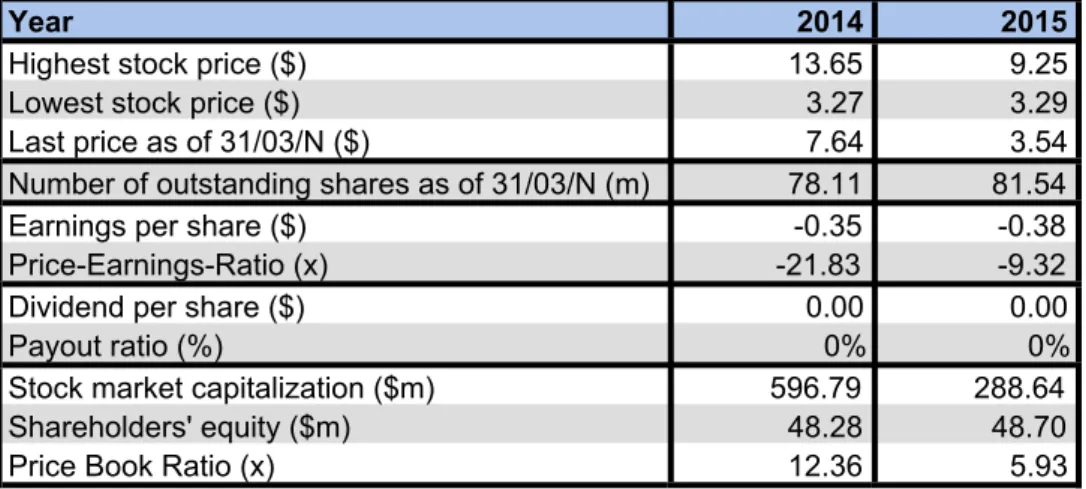
The stock price has been largely fluctuating over the past. Due to the negative earnings no dividends have been declared. The P/E Ratio is negative and therefore, as discusses above, is not meaningful for multiples valuation. The number of shares is increasing as Organovo is issuing new common to finance their loss making operations. The stock market capitalisation of Organovo has almost halved since 2014, because of the large fluctuations in the stock price.
Table 4: Stock price data analysis for Organovo in 2014 and 2015
The second chart compares the performance of a $100 investment in Organovo with the performance of the NASDAQ Composite Index and the NASDAQ Biotechnology Index, assuming all dividends are reinvested. Although Organovo outperforms both indexes until mid 2015, the stock price largely fluctuates and eventually underperforms the NASDAQ Biotechnology Index. Although this graph has no indication for the future performance of the stock, Organovo reveals typical start-up behaviour with its highly fluctuating stock price history. The chart has been generated on May 23, 2016.
Figure 7: Organovo compared to the NASDAQ Composite and the NASDAQ Biotechnology Index
In Appendix V, the consolidated statements of stockholders’ equity or deficit highlights the issuance of common stock and the net loss from year 2011 until 2015. The net losses of $16.1m, $25.8m and $30.1m in 2012, 2013 and 2014 respectively, need to be financed by issuance of common stock. Since the company is still loss making, Organovo is fully equity financed, which means that the shareholders fund
Year 2014 2015
Highest stock price ($) 13.65 9.25
Lowest stock price ($) 3.27 3.29
Last price as of 31/03/N ($) 7.64 3.54
Number of outstanding shares as of 31/03/N (m) 78.11 81.54
Earnings per share ($) -0.35 -0.38
Price-Earnings-Ratio (x) -21.83 -9.32
Dividend per share ($) 0.00 0.00
Payout ratio (%) 0% 0%
Stock market capitalization ($m) 596.79 288.64
Shareholders' equity ($m) 48.28 48.70
the operations of the company. Despite the loss-making nature of the business, investors seem very confident in Organovo, as the CEO Keith Murphy announced that the $46m capital increase was two times oversubscribed and the full green shoe exercised.
According to Thompson One data dated May 23, 2016, Organovo has 92,413,951 shares outstanding and a free float of 84,710,011 (92%). The following table will give an overview of the top five current shareholders of Organovo, which currently has a market capitalization of $235.6m:
Table 5: Top five % ownership of Organovo’s investors
c) Valuation approach
Disclaimer: The aim of this case study is not to reach the IPO or fair value of Organovo, but apply different approaches used for start-up valuation. Due to limited publically available financial information, the listed 3D bioprinting start-up Organovo has been selected. Any of the forward looking estimations and calculations are based on the current financials and authors assumptions, which are subject to a number of risks and uncertainties. Therefore, the valuation of the start-up should not be viewed as an investment recommendation, but merely as putting theory into practice when applying different start-up valuation approaches directly to the case study of Organovo.
In the next chapter alternative valuation methods for start-up valuation will be discussed. These will be applied directly to the case of Organovo. First of all, the Venture Capital method will be presented. Due to its limitations, the First Chicago method will be described and applied to the case of Organovo. Moreover, in the next step, the Damodaran approach will illustrate how to forecast future cash flows, discount rates and terminal value for start-ups. Since this approach does not include the flexibility and uncertainty a start-up has to deal with on an everyday basis, the real option approach will value Organovo’s potential with the Cox-Rubinstein and Black-Scholes formula. This approach will focus on the valuation of diseased human tissue, since the DCF approach only takes Organovo’s current developments and growth opportunities in healthy human tissue into account. Eventually, the author will present different methods for valuation of intangible assets, especially interesting for start-ups with strong IP portfolios, before verifying the valuation methods presented for start-ups in particular.
5. Alternative valuation methods for start-ups applied to Organovo
The study of Black (2003) has proven that instead of using earnings, a better measure for start-up valuation are cash flows in the pre-growth start-up stage. However, analyst need to be careful, since the value relevance of earnings, cash flow and book value of equity is likely to change over the life cycle of a start-up (Black, 2003). As a result, most valuation methods used for start-ups try to circumvent the issues described above and therefore focus on the following:
- Little financial information: Since it is difficult to estimate the exact items of a start-up, mainly due to the short history and the high reinvestment rate, most venture capital valuations only include revenues, the top line or earnings, the bottom line (Damodaran, 2009).
- Short time horizon: Due to the uncertainty of future development of the start-up company, setting start-up a long term business plan has been proven difficult, e.g. DCF valuation. Therefore, most start-up valuation methods focus on the short term, taking only three to five years into account.
- Mix of relative and intrinsic valuation: As mentioned before, estimating cash flows for long time periods can be very arbitrary. That is why the exit multiple of a start-up is often estimated using multiples of publicly traded companies. Therefore, next to the intrinsic business plan valuation for a short term period, the terminal value is determined by relative valuation methods.
- Risk and discount rate: Most start-ups have a low probability of surviving the initial stages of their business (Knaup & Piazza, 2007). This risk needs to be taken into account when choosing the discount rate. Therefore, start-ups face not only earnings volatility, sensitivity to the macroeconomic environment or pressure through a lack of economies of scales, but also risk of running out of funds, bankruptcy or even death. The higher risk will lead to a higher discount rate, which will be very important when investing into the business.
a) The Venture Capital method
i. Principles of the Venture Capital method
The venture capital method is an alternative method used to value start-up companies. As seen before, traditional valuation techniques are hard to apply, which is why many private investors use the venture capital method. Sahlman (1987) describes the venture capital approach, which is based on the idea that at a certain point an investor wants to exit the investment. The method combines the DCF and multiples approach and depending on the projected cash flows, the value is calculated using multiples of comparable companies. This method is based on the following principles:
- Expected earnings or revenues: The first step consists of estimating the expected earning and revenues in the future year, with a time range between two and five years. The forecast period is set to the time when the investor plans to sell the start-up company in the future. The scenario chosen is the success scenario, in which the company attains its sales and margin projections (Sahlman, 1987).
- Terminal value: The second step consists of estimating the terminal value by multiplying the future earnings with the price earnings ratio of other comparable publicly traded companies in the same industry. The PER has to match the success of the company, e.g. it should correspond to the economic characteristics of the target company (size, profitability, growth, capital intensity and risk). Alternatively, in case other companies have been sold recently, the multiple of these transactions can be used. In case earnings are not available, revenue multiples can be used in an equal approach. This is mostly used for companies that are not profitable in the short term, but will only have positive earnings in the long term. The chosen multiple will be applied to the projected earnings or cash flow in order to arrive at the terminal value (Goldman, 2008).
- Discount rate: In the next step, the discount rate is calculated. For this several risks need to be considered, e.g. riskiness of the business, probability of survival and the macroeconomic environment. The terminal value calculated in the previous steps is then discounted with the rate capturing all risks in order to arrive at the present value of the target. Generally, the required rate of return of venture capitalist is much higher than for publicly traded companies, mainly due to the high risk perceived for start-ups. According to Sahlman (1987) this rate can be typically between 35% and 80% depending on the development stage.
- Equity share: In the final step, the equity share based on the money brought into the company will be estimated. The post money valuation will amount to the valuation calculated during the third step plus the new capital the venture capitalists will inject. The proportion of equity investors think they will be entitled to is simply their capital injected divided by the post money valuation. According to Damodaran (2009), the venture capitalists’ target rates of return depending on the stage in the life cycle are as follows:
As an example, a venture capitalist thinks about investing $2m into Organovo that expects to require no additional capital in the next five years with -$5m of earnings in the fifth year of the investment. Comparable companies have a forward looking PER multiples of around 15x (Appendix VI). However, since the author assumes that Organovo will still have negative earnings in year five, the venture capital method will be calculated through the EV/Sales multiple as suggested above. The revenue in year five is expected to be $15m and the EV/Sales multiple of comparable companies 4.1x (Appendix VII). The venture capitalist expects to sell his stake to the acquiring company at the end of year five. Furthermore, the venture capitalist requires a 30% rate of return due to the risk of Organovo. Normally the venture capitalist would require a higher rate, but since Organovo has already proven their business by launching products and going public, the discount rate is significantly lower.
Table 7: Assumptions Venture Capital method
After estimating the future earnings at the end of year five and the average of the PER of several comparable companies, the venture capitalist can estimate the terminal value of Organovo by calculating:
Terminal value (Year 5) = 𝐸𝑎𝑟𝑛𝑖𝑛𝑔𝑠 𝑌𝑒𝑎𝑟 5 𝑥 𝑃𝐸𝑅 𝑀𝑢𝑙𝑡𝑖𝑝𝑙𝑒 𝑌𝑒𝑎𝑟 5 Terminal value (Year 5) = 𝑅𝑒𝑣𝑒𝑛𝑢𝑒 𝑌𝑒𝑎𝑟 5 𝑥 𝐸𝑉/𝑆𝑎𝑙𝑒𝑠 𝑀𝑢𝑙𝑡𝑖𝑝𝑙𝑒 𝑌𝑒𝑎𝑟 5 In the following step the TV needs to be discounted to todays value, which will be:
Present Value of Terminal Value = =d9iky9ez 9ehki1y{ |y{ge (}eyh ~)(qB•€€)•‚ƒ„…
Assuming that the capital invested will be in addition to the current value of Organovo, which is the present value of the terminal value, the proportional share of equity is:
Share of equity = †herk‡1ej |y{geB•1|ed9ke19•1|ed9ke19
Assumptions
Investment (in $m) 2.0
Duration (in years) 5.0
Dilution None
Earnings (Year 5) (in $m) -5.0
PER Multiple (Year 5) 15.0x
Revenue (Year 5) (in $m) 15.0
EV/Sales Multiple (Year 5) 4.1x
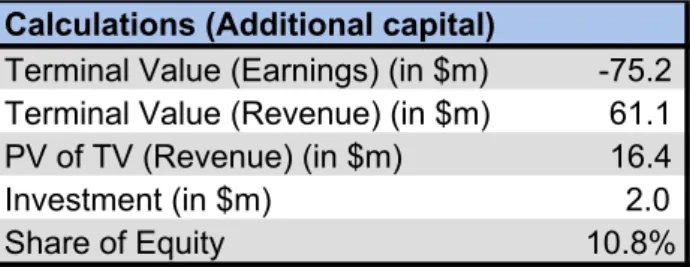
Table 8: Calculations Venture Capital method with investment as additional capital
Assuming that the money invested will be used to for R&D expenses, the final ownership will be 10.8%. Alternatively, in order to guarantee 30% return, the investor can calculate the required future value of his investment and terminal value as follows:
Required future value (Investment) = 1 + 𝐼𝑅𝑅 jeyhd 𝑥 𝐼𝑛𝑣𝑒𝑠𝑡𝑚𝑒𝑛𝑡 Terminal value (Year 5) = 𝐸𝑎𝑟𝑛𝑖𝑛𝑔𝑠 𝑌𝑒𝑎𝑟 5 𝑥 𝑃𝐸𝑅 𝑀𝑢𝑙𝑡𝑖𝑝𝑙𝑒 𝑌𝑒𝑎𝑟 5 Terminal value (Year 5) = 𝑅𝑒𝑣𝑒𝑛𝑢𝑒 𝑌𝑒𝑎𝑟 5 𝑥 𝐸𝑉/𝑆𝑎𝑙𝑒𝑠 𝑀𝑢𝑙𝑡𝑖𝑝𝑙𝑒 𝑌𝑒𝑎𝑟 5 In order to arrive at the required return at the end of year five, the venture capitalist has to own at that point the following percentage:
Final ownership required = €eˆgihez bg9ghe |y{ge ‡b 9‰e i1|ed9ke19Š‡9y{ 9ehki1y{ |y{ge =
(qB•€€)•‚ƒ„…s •1|ed9ke19 †=€ s (Šehki1y{ eyh1i1‹d)=
•1|ed9ke19
Š=hki1y{ ?y{ge / (qB•€€)•‚ƒ„…
Table 9: Calculations Venture Capital method with invest capital paid out to current investors
Assuming that the money invested will be used to pay out current owners, the final ownership will be 12.2%, so the $2m will not be in addition, but part of the total value.
ii. Limitations of this valuation method
Although the venture capital method is taking the weaknesses of traditional approaches into account, there is hardly a perfect method to value high risk investments. Critics may argue that the method is overly simplistic, not taking the company’s business plan and strategy into account, however, due to the high degree of uncertainty, anyone could argue that a model for start-up valuation is either too complex or too simply. The following arguments are the most relevant limitations of the venture capital method:
Calculations (Additional capital)
Terminal Value (Earnings) (in $m) -75.2 Terminal Value (Revenue) (in $m) 61.1
PV of TV (Revenue) (in $m) 16.4
Investment (in $m) 2.0
Share of Equity 10.8%
Calculations (No additional capital)
IRR 30.0% Required future value 7.4 Terminal Value (Earnings) -75.2 Terminal Value (Revenue) 61.1 Required ownership 12.2%
- Focus on revenues and earnings: Since the venture capital method solely focuses on revenues or earnings, start-ups will do everything possible to push up the forecasted revenues or earnings. Therefore, they will lower items, such as capital investment, to make sure the earnings are high enough to reach their valuation goal. This will have a substantial impact on the future of the business. Venture capitalists, however, will try all possible to push down the estimates. Due to the short history, the venture capital method becomes more of a bargaining method than an objective valuation tool.
- Uncertainty and multiples: The multiple used to calculate the terminal value is based on comparable companies trading today. Firstly, using a multiple of trading companies without applying a discount to that multiple assumes that the start-up has successfully reached the stage where it is worth as much as a traded company. Furthermore, the multiples of a current period might be especially high due to investor preferences to invest in a specific sector. Therefore, the multiple may be more of an indication of investment tendencies than the intrinsic value of the traded company. In order to correctly estimate the multiple, the valuation should be based on the cash flows at the point where the multiple is used. Since cash flows are still uncertain for that period, the level of uncertainty is not decreased by the venture capital method (van Schootbrugge & Wong, 2013).
- Discount rate: In the venture capital method, the target rate is based on the required rate of return demanded by the investors. Their required rate of return will include the likelihood that the business will fail, which is why the discount rate demanded by venture capitalists is a lot higher than what the discount rate should normally be (Damoradan, 2009). The discount rate needs to be based on the cost of capital, not on the rate demanded by equity investors. When discounting the future value of equity, venture capitalists could use their required rate, not however, when discounting the value calculated through revenue or enterprise value multiples. Furthermore, having a discount rate that includes the probability of failure, venture capitalists assume that the rate will not change within the business cycle, which is not correct (Damodaran, 2009).
- Calculation of equity share: The new capital is added to the value in order to calculate the amount of equity for the investors as a proportion of the post money value. Depending on what the money is used for, the calculation needs to be adjusted. In case part of the freshly invested capital is used to pay other investors, the part needs to be removed from the post money value. This has been illustrated in the second example of the calculations (Damodaran, 2009).