5-HT2a Receptor Polymorphism Gene in Bipolar
Disorder and Harm Avoidance
Personality Trait
S. Blairy,1* I. Massat,1L. Staner,2O. Le Bon,3S. Van Gestel,4C. Van Broeckhoven,4C. Hilger,5 F. Hentges,6D. Souery,1and J. Mendlewicz1
1Department of Psychiatry, Free University of Brussels, Erasme Hospital, Belgium 2Department of Psychiatry, FORENAP–Hospital of Rouffach, France
3Department of Psychiatry, Free University of Brussels, Brugmann Hospital, Belgium
4Molecular Genetics, Flanders Interuniversity Institute for Biotechnology (VIB), University of Antwerp (UI), Department of Biochemistry, Antwerpen, Belgium
5CRP-Sante´, Luxembourg, Grand Duchy of Luxembourg
6Laboratory of Immuno–Allergology, Centre Hospitalier de Luxembourg, Grand Duchy of Luxembourg
The pupose of this study was to investigate the relationship between bipolar disorder and the harm avoidance personality trait (HA), and the genetic contribution of the polymorphic DNA variation T102C in exon 1 of 5-HTR2a (chromosome 13q14–21) in bipo-lar disorder and HA personality trait. Forty bipolar patients and 89 normal subjects completed the TPQ questionnaire and were genotyped for 5-HT2a. Bipolar patients scored higher than normal subjects on the HA dimension. However, no contribution of the 5-HTR2a polymorphism on the bipolar disorder or on the HA personality trait emerged. Despite the limited sample size, these results exclude a major effect of the 5-HTR2a polymorphism on bipolar disorder and HA personality trait but not a minor ef-fect. Am. J. Med. Genet. (Neuropsychiatr. Genet.) 96:360–364, 2000.© 2000 Wiley-Liss, Inc.
KEY WORDS: personality; 5-HT2A; associa-tion study; harm avoidance; bipolar disorder
INTRODUCTION
Cloninger and collaborators [Cloninger, 1986, 1987a, 1988, 1997; Cloninger et al., 1993] have brought
to-gether neurobiology, genetics, psychophysiology, cogni-tive processes, and clinical syndromes in an original model of personality. According to this model, person-ality is the result of specific combinations of heritable and stable dimensions, associated with basic emotional dispositions and learning processes, and related to neu-roanatomic and neurochemical processes in the brain. Three distinct personality dimensions have been de-fined: novelty seeking (NS), harm avoidance (HA), and reward dependence (RD). These dimensions are pro-posed to reflect activity in the three major brain sys-tems underlying activation, inhibition, and mainte-nance behaviors. Dopaminergic, serotoninergic, and noradrenergic circuits are the neurochemical sub-strates of these brain systems, respectively. Cloninger hypothesized positive correlations between serotonin-ergic activity and HA, dopaminserotonin-ergic activity and NS, and noradrenergic activity and RD.
The involvement of the serotoninergic system in HA has already been suggested [Hansenne et al., 1997; Le-sch et al., 1996; Ricketts et al., 1998; Sander et al., 1998] whereas negative results also have been reported in healthy subjects [Ebstein et al., 1997a,b; Gelertner et al., 1998] and depressed patients [Staner et al., 1998]. To our knowledge, the specific contribution of the 5-HT2a receptor polymorphism in HA personality trait has never been investigated. However, negative associations between 5-HT2a receptor polymorphism and bipolar depression were reported [Gutierrez et al., 1995; Mahieu et al., 1997].
Because previous research showed that bipolar pa-tients score higher on the HA dimension compared to normal controls [Osheret et al., 1996; Strakowski et al., 1993; Young et al., 1995], the aims of the present study were to replicate this finding, to investigate the contri-bution of the 5-HT2a receptor polymorphism in bipolar depression, and to compare the contribution of the
*Correspondence to: Sylvie Blairy, Department of Psychiatry, Free University of Brussels, Erasme Hospital, Route de Lennik, 808, 1070 Brussels, Belgium. E-mail: [email protected]
Received 19 July 1999; Accepted 13 December 1999 © 2000 Wiley-Liss, Inc.
5-HT2a receptor polymorphism in HA personality traits in bipolar patients and normal subjects.
MATERIALS AND METHODS
Tridimensional Personality Questionnaire
The Tridimensional Personality Questionnaire (TPQ) by Cloninger [1987b], a 100-item, true–false test, assesses three higher order dimensions of person-ality, NS, HA, and RD and 12 lower order traits (see Table I).
Description of the Sample
Fourteen male and 26 female bipolar patients, aged 43.15 years (SD⳱ 13.87), were recruited at the Centre Hospitalier de Luxembourg (Grand Duchy of Luxem-bourg). Caucasian origin was confirmed before com-pleting the TPQ self-questionnaire. Bipolar disorder was diagnosed according to the Research Diagnosis Criteria (RDC) [Spitzer et al., 1978], using the Sched-ule for Affective Disorders and Schizophrenia-Lifetime Version [Spitzer and Endicott, 1979]. Patients were considered as being in at least a 2-month euthymic period by the clinician in charge. In addition, euthymia was confirmed with SADS part-1 items assessing the mood of the current state and the mood for the 2 pre-vious months (instead of prepre-vious week) by an indepen-dent rater. This procedure provided material to rule out an RDC affective disorder diagnosis such as hypo-mania and hypo-mania, and major, minor, or intermittent depression in the 2 preceding months. Further, 54 fe-male and 35 fe-male Caucasian control subjects without personal or family history of psychiatric disorder were recruited among medical personnel at Erasme Hospital (Brussels, Belgium). Mean age was 40.82 years (SD⳱ 12.74). No significant age difference emerged between patients and controls, F(1, 127) ⳱ .873, P > .05. The procedure and aims of the study were fully explained to the participants, and written, informed consent was
obtained before drawing venous blood for 5-HTR2a genotyping.
DNA Analysis
The 5-HT2a receptor gene has been located on chro-mosome 13 (13q14–21), spans over 20 kb, and consists of three exons interrupted by two introns [Chen et al., 1992]. A 5-HT2a receptor DNA polymorphism (T/C, substitution of C for T at position 102) has been iden-tified within the coding exonic 1 region [Warren et al., 1993]. The T/C substitution does not alter the amino-acid sequence (serine, at position 34) and is unlikely to produce functional effects (silent mutation).
Genomic DNA was isolated from peripheral blood leukocytes using standard salting out procedures. The polymorphism in 5-HT2a was identified by the poly-merase chain reaction (PCR) followed by restriction en-zyme digestion. Standard PCR was carried out in a 25 l volume containing 100 ng genomic DNA, 200 M of each dNTP, 1.25 mM MgCl2, 50 pmol of each primer
and 0.2 units Goldstar DNA polymerase (Eurogentec, Seraing, Belgium). Published primer sequences were used [Warren et al., 1993]. After an initial denatur-ation step at 94°C for 2 min, 30 cycles were performed: denaturation at 94°C for 1 min, annealing at 60°C for 1.5 min, and extension at 72°C for 2 min. An additional final extension step was performed at 72°C for 5 min. Twentyl of the PCR product was digested overnight at 37°C with 0.1 units/l of MspI in a total volume of 25 l. Digestion products were visualized by ethidium bro-mide staining after electrophoresis in a 3% agarose gel.
RESULTS
Personality Differences Between Bipolar Patients and Controls
A MANOVA with scores on the TPQ scales (HA, NS, and RD) as a within subject factor, and group (patients vs. controls) and sex as between subjects factors was conducted. The results revealed significant main ef-fects of TPQ scales, F(2, 126) ⳱ 8.50, P < .001, and group, F(2, 127)⳱ 7.38, P ⳱ .008. These main effects were qualified by a significant TPQ Scales × Group interaction, F(2, 126)⳱ 11.40, P < .001. No significant main effect or interaction involving sex emerged. Post hoc analyses showed that bipolar patients scored higher than normal subjects on the HA scales, F(1, 127) ⳱ 23.73, P ⳱ .001. No other significant differences emerged for TPQ scores between bipolar patients and normal subjects. Means for bipolar patients and nor-mal subjects are shown in Table II. Thus, the results support the notion that personality differences, in terms of HA, are observed between euthymic bipolar patients and normal subjects.
Finally, ANOVAs were conducted on the scores of the four subscales (HA1, HA2, HA3, and HA4) that com-pose the HA dimension (see Table I). Means for this analysis are shown in Table III. The results revealed a significant main effect of group for the HA1, HA2, and HA4 subscales, F(1, 127)⳱ 10.45, P ⳱ .002; F(1, 127)
TABLE I. TPQ Scales and Subscales Novelty seeking (NS)
NS1: exploratory excitability versus stoic rigidity (9 items) NS2: impulsiveness versus reflection (8 items)
NS3: extravagance versus reserve (7 items) NS4: disorderliness versus regimentation (10 items) NS⳱ NS1 + NS2 + NS3 + NS4 (24 items)
Harm avoidance (HA)
HA1: anticipatory worry versus uninhibited optimism (10 items)
HA2: fear of uncertainty versus confidence (7 items) HA3: shyness with strangers versus gregariousness
(7 items)
HA4: fatigability and asthenia versus vigor (10 items) HA⳱ HA1 + HA2 + HA3 + HA4 (34 items)
Reward dependence (RD)
RD1: sentimentality versus insensitiveness (5 items) RD2: persistence versus irresoluteness (9 items) RD3: attachment versus detachment (11 items) RD4: dependence versus independence (5 items) RD⳱ RD1 + RD2 + RD3 + RD4 (30 items)
⳱ 15.57, P < .001; and F(1, 127) ⳱ 32.65, P < .001, respectively. Inspection of the means showed that bi-polar patients scored higher than normal subjects. Fur-thermore, inspection of the effect size (2) revealed that
HA4 subscales explained more variance than the HA1 and HA2 (2⳱ .205, 2⳱ .076, and 2⳱ .109,
respec-tively). Thus, the difference between bipolar patients and normal subjects on HA score is essentially ex-plained by the fatigability–asthenia versus vigor sub-scales.
Contribution of 5-HTR2a Receptor
Polymorphysm in Bipolar Depression and Harm Avoidance Personality Trait1
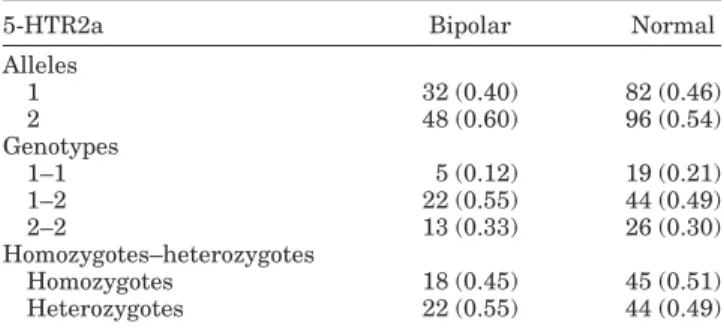
To investigate the contribution of the 5-HTR2a re-ceptor polymorphism in bipolar depression, allele fre-quencies, genotype count, and homozygotes–hetero-zygotes distributions of bipolar patients were compared to those of normal subjects by chi-square. The results yielded no significant differences for allele frequencies, genotype count, or homozygotes–heterozygotes distri-bution,2(1)⳱ .824, P > .05; 2(2)⳱ 1.43, P > .05, and
2(1) ⳱ .342, P > .05, respectively. Frequencies for
these analyses are shown in Table IV, and power to detect associations given the sample size is shown in
Table V. These analyses suggested no association be-tween bipolar depression and 5-HTR2a receptor poly-morphism.
To investigate the contribution of the 5-HTR2a re-ceptor polymorphism on HA in bipolar patients and normal subjects, a MANOVA with group (patient vs. controls) and allele 1 (carriers vs. noncarrriers) as be-tween subject factors and a MANOVA with group (pa-tient vs. controls) and allele 2 (carriers vs. noncarrri-ers) as between subject factors were conducted on the general score as well as on subscale scores of the HA dimension. The analyses did not reveal any significant main effect or interaction involving allele 1 or allele 2. Further, to investigate the contribution of the 5-HTR2a genotype, a MANOVA with group (patient vs. controls) and 5-HTR2a genotype (1–1, 1–2 vs. 2–2) as between subject factors was conducted on the general score of the HA dimension as well as on the subscales scores of HA. The results did not reveal any significant main effect or interaction involving genotype. Power to de-tect a main effect of genotype and a Genotype × Diag-nosis interaction on the HA dimension given the sample size is shown in Table VI.
DISCUSSION
Higher scores on the HA dimension were found for bipolar patients compared to normal subjects. This finding is consistent with those of other investigators [Osheret et al., 1996; Strakowski et al., 1993; Young, 1995]. Moreover, the difference on HA score is essen-tially due to a higher fatigability and asthenia for bi-polar patients. Although our patients were in
remis-1The sample has been tested for Hardy and Weinberg
equilib-rium. The analyses did not reveal significant differences between the expected values and the observed values. Thus, the sample (patients and controls) can be considered as homogenous. TABLE II. Means and Standard Deviations of Harm Avoidance
(HA), Novelty Seeking (NS), and Reward Dependence (RD) Scores in Function of Group
TPQ Group Means SD HAa Bipolar 17.27 7.43 Controls 11.44 5.72 Total 13.29 6.82 NSb Bipolar 14.78 4.88 Controls 16.09 4.44 Total 13.29 6.82 RDb Bipolar 17.05 4.36 Controls 17.03 4.00 Total 17.04 4.10 a
Significant difference between bipolar patients and control subjects.
b
No significant difference between bipolar patients and control subjects.
TABLE III. Means and Standard Deviations of the Four Subscale Scores of Harm Avoidance (HA) in Function of Group
Group Subscales Means SD
Bipolar HA1a 4.68 2.74 HA2a 4.95 1.54 HA3a 2.80 2.29 HA4b 4.85 3.04 Control HA1a 3.20 2.22 HA2a 3.63 1.85 HA3a 2.42 1.76 HA4b 2.19 2.13
aSignificant difference between bipolar patients and control subjects. b
No significant difference between bipolar patients and control subjects.
TABLE IV. Allele Frequencies, Genotype Counts, and Homozygote–Heterozygote Distribution for 5-HTR2a in Bipolar
Patients and Normal Subjects
5-HTR2a Bipolar Normal
Alleles 1 32 (0.40) 82 (0.46) 2 48 (0.60) 96 (0.54) Genotypes 1–1 5 (0.12) 19 (0.21) 1–2 22 (0.55) 44 (0.49) 2–2 13 (0.33) 26 (0.30) Homozygotes–heterozygotes Homozygotes 18 (0.45) 45 (0.51) Heterozygotes 22 (0.55) 44 (0.49)
TABLE V. Power to Detect Associations Between Allele Frequencies, Genotype Count, Homozygote–Heterozygote Distribution, and the Bipolar Disorder Given the Sample Size*
Small effect Medium effect Large effect
Allelesa 0.20 0.92 0.99
Genotypesb 0.15 0.87 0.99
Homozygotes
Heterozygotesa 0.20 0.92 0.99
*n⳱ 129. Effect size conventions according to Faul and Erdfelder [1992]: small effect size⳱ 0.10, medium effect size ⳱ 0.30, and large effect size ⳱ 0.5.
aChi-square, df⳱ 1. bChi-square, df⳱ 2.
sion, one cannot exclude the possibility that higher HA scores could also be due to residual symptoms and/or concomitant treatment. No further personality differ-ences were found using the TPQ.
From these results, no genetic contribution of 5-HT2a receptor polymorphism to bipolar disorder or to HA personality trait in normal and bipolar subjects emerged. Our results have to be interpreted with cau-tion, however. First, it must be mentioned that the sample had an adequate statistical power to detect a medium and major effect gene whereas for a minor effect gene the power is small (see Tables V and VI). Thus, although one can exclude medium and major ef-fects of the 5-HTR2a receptor polymorphism in bipolar disorder and HA personality, our sample was too small to detect a minor gene effect [Owen, 1997]. Conse-quently, one cannot exclude the possibility of a small effect of the 5-HTR2a receptor polymorphism; such an effect could be investigated with a larger sample. Sec-ond, complex behavior is most likely the result of the interaction between various neurotransmitter systems. The present study has investigated only the 5-HTR2a receptor polymorphism, and it could be argued that this polymorphism might contribute to personality dif-ferences only in the context of interactions with other mediators. In order to interpret personality differences, future research should investigate polygenic models. Third, because the 102-T/C variant does not cause an amino acid substitution in the receptor protein, it is unlikely to affect receptor function or expression, which may be directly related to differences in the HA dimension. On the other hand, it has been shown that this 102-C/T polymorphism is in almost complete link-age disequilibrium with a −1438-G/A promotor poly-morphism [Arranz et al., 1998], which might have an effect on receptor expression level. Due to the high link-age disequilibrium between these two markers, it does not seem likely that the −1438-G/A polymorphism largely influences the variance in HA. Furthermore, other known functional polymorphisms seem to be rare in the general population [Gutierrez et al., 1997], mak-ing them unlikely candidates for HA variation in the general population.
In conclusion, a relationship between the HA dimen-sion and bipolar disorders was observed in our study. We did not find evidence for any relationship between the bipolar phenotype or HA and a nonfunctional varia-tion in the 5-HTR2A gene. Addivaria-tional data are needed with other candidate genes to further clarify the
rela-tionships between the serotoninergic system and vari-ous personality dimensions in mood disorders.
ACKNOWLEDGMENTS
This project was supported by the National Fund for Scientific Research (NFSR); Grant No: 3.4504.97), Bel-gium; the Fund for Scientific Research Flanders, Belgium (FWO), S. Van Gestel is a Ph.D. fellow of the FWO; the European Community Biomed1 and Biomed2 Grants (No CT 92-1217 and No BMH4-97-2307); the Association for Mental Health Research (AMHR, Belgium).
REFERENCES
Arranz MJ, Munro J, Owen MJ, Spurlock G, Sham PC, Zhao J, Kirov G, Collier DA, Kerwin RW. 1998. Evidence for association between poly-morphisms in the promotor and coding regions of the 5-HT2A receptor gene and response to clozapine. Mol Psychiatry 3:61–66
Chen K, Yang W, Grimsby J, Shih JC. 1992. The human 5-HT2A receptor is encoded by multiple intron–exon gene. Mol Brain Res 14:20–26. Cloninger CR. 1986. A unified biosocial theory of personality and its role in
the development of anxiety states. Psychiatr Dev 3:167–226. Cloninger CR. 1987a. A systematic method of clinical description and
clas-sification of personality variants. Arch Gen Psychiatry 44:573–588. Cloninger CR. 1987b. The tridimentional personality questionnaire,
ver-sion IV. St. Louis, MO: Washington University School of Medicine. Cloninger CR. 1988. A unified biosocial theory of personality and its role in
the development of anxiety states: a reply to commentaries. Psychiatric Dev 2:83–120.
Cloninger CR. 1997. Integrative psychobiological approach to psychiatric assessment and treatment. Psychiatry 60:120–141.
Cloninger CR, Svrakic DM, Przybeck TR. 1993. A psychobiological model of temperament and character. Arch Gen Psychiatry 50:975–999. Ebstein RP, Gritsenko I, Nemanov L, Frisch A, Osher Y, Belmaker RH.
1997a. No association between the serotonin transporter gene regula-tory region polymorphism and the tridimensional personality question-naire (TPQ) temperament of harm avoidance. Mol Psychiatry 2:224– 226.
Ebstein RP, Segman R, Benjamin J, Osher Y, Nemanov L, Belmaker RH. 1997b. 5-HT2c (HTR2C) serotonin receptor gene polymorphism associ-ated with the human personality trait of reward dependence. Am J Med Genet 74:65–72.
Faul F, Erdfelder, E. 1992. GPOWER: a priori, post-hoc, and compromise power analyses for MS-DOS [computer program]. Bonn, Germany: Bonn University.
Gelernter J, Kranzler H, Coccaro EF, Siever LJ, New AS. 1998. Serotonin transporter protein gene polymorphism and personality measures in African American and European American subjects. Am J Psychiatry 155:1332–1338.
Gutierrez B, Arranz M, Fananas L, Valle`s V, Guillamat R, Van Os L, Collier D. 1995. 5HT2A receptor gene and bipolar affective disorder. Lancet 346:969.
Gutierrez B, Bertranpetit J, Collier D, Arranz MJ, Valles V, Guillamat R,Van Os J, Fananas L. 1997. Genetic varaition of the 5-HT2A receptor gene and bipolar affective disorder. Hum. Genet 100:582–584. Hansenne M, Pitchot W, Moreno AG, Reggers J, Machurot PY, Ansseau M.
1997. Harm avoidance dimension of the tridimensional personality questionnaire and serotonin-1A activity in depressed patients. Biol Psychiatry 42:959–961.
Lesch KP, Bengel D, Heils A, Sabol SZ, Greenberg BD, Petri S, Benjamin J, Muller CR, Hamer DH, Murphy DL. 1996. Association of anxiety-related traits with a polymorphism in the serotonin transporter gene regulatory region. Science 274:1527–1531.
Mahieu B, Souery D, Lipp O, Mendelbaum K, Verheyen G, De Maertelaer V, Van Broeckhoven C, Mendlewicz J. 1997. No association between bipolar affective disorder and a serotonin receptor (5-HT2A) polymor-phism. Psychiatry Res 70:65–69.
Osheret Y, Cloninger CR, Belmaker RH. 1996. TPQ in euthymic manic-depressive patients. J Psychiatr Res 30:353–357.
TABLE VI. Power to Detect a Main Effect of Genotype, and a Genotype–Diagnosis Interaction on the HA Dimension Given
the Sample Size* Small effect Medium effect Large effect
Main effect of genotypea 0.35 0.99 1.00
Genotype by diagnosis interactionb 0.23 0.96 1.00
*n⳱ 129. Effect size conventions according to Faul and Erdfelder [1992]: small effect size⳱ 0.02, medium effect size ⳱ 0.15, and large effect size ⳱ 0.35.
aMANOVA, df⳱ 1, 127. b
Owen MJ. 1997. Association studies in psychiatric genetics. Mol Psychiatry 2:270–273.
Ricketts MH, Hamer RM, Sage JI, Manowitz P, Feng F, Menza MA. 1998. Association of a serotonin transporter gene promoter polymorphism with harm avoidance behavior in an elderly population. Psychiatr Genet 8:41–44.
Sander T, Harms H, Dufeu P, Kuhn S, Hoehe M, Lesch KP, Rommels-pacher H, Schmidt LG. 1998. Serotonin transporter gene variants in alcohol-dependent subjects with dissocial personality disorder. Biol Psychiatry 43:908–912.
Spitzer RL, Endicott J, Robins E. 1978. Research diagnostic criteria: ra-tionale and reliability. Arch Gen Psychiatry 35:773–782.
Spitzer RL, Endicott J. 1979. Schedule for affective disorders and schizo-phrenia: lifetime version (3rd ed.). New York: New York State Psychi-atric Institute.
Staner L, Hilger C, Hentges F, Monreal J, Hoffmann A, Couturier M, Le Bon O, Stefos G, Souery D, Mendlewicz J. 1998. Association between novelty-seeking and the dopamine D3 receptor gene in bipolar patients: a preliminary report. Am J Med Genet 81:192–194.
Strakowski SM, Stoll AL, Tohen M, Faedda GL, Goodwin DC. 1993. The tridimensional personality questionnaire as a predictor of 6-month out-come in first episode mania. Psychiatry Res 48:1–8.
Warren JT, Peacock ML, Rodriguez LC, Fink JK. 1993. An Msp I polymor-phism in the human serotonin receptor gene (HTR2): detection by DGGE and RFLP analysis. Hum Mol Genet 3:338.
Young LT, Bagby RM, Cooke RG, Parker JD, Levitt AJ, Jaffe RT. 1995. A comparison of Tridimensional Personality Questionnaire dimensions in bipolar disorder and unipolar depression. Psychiatry Res 58:139– 143.