Using UDP for Internet Transport Evolution
Korian Edeline
1, Mirja Kühlewind
2, Brian Trammell
2, Emile Aben
3and Benoit Donnet
2 1Montefiore Institure, Université de Liége, Belgium
2
Networked Systems Group, ETH Zürich, Switzerland
3RIPE NCC, Amsterdam, Netherlands
ETH TIK Technical Report 366, 22 December 2016
Abstract
The increasing use of middleboxes (e.g., NATs, fire-walls) in the Internet has made it harder and harder to deploy new transport or higher layer protocols, or even extensions to existing ones. Current work to address this Internet transport ossification has led to renewed interest in UDP as an encapsulation for mak-ing novel transport protocols deployable in the Inter-net. Examples include Google’s QUIC and the We-bRTC data channel. The common assumption made by these approaches is that encapsulation over UDP works in the present Internet. This paper presents a measurement study to examine this assumption, and provides guidance for protocol design based on our measurements.
The key question is “can we run new transport protocols for the Internet over UDP?” We find that the answer is largely “yes”: UDP works on most net-works, and impairments are generally confined to ac-cess networks. This allows relatively simple fallback strategies to work around it. Our answer is based on a twofold methodology. First, we use the RIPE Atlas platform to basically check UDP connectivity and first-packet latency. Second, we deploy copycat, a new tool for comparing TCP loss, latency, and throughput with UDP by generating TCP-shaped traffic with UDP headers.
1
Introduction
Most Internet applications today are built on top of the Transport Control Protocol (TCP), or some session-layer protocol that uses TCP, such as the Hy-pertext Transfer Protocol (HTTP) or WebSockets. Indeed, the ubiquity and stability of TCP as a com-mon facility that handles the hard problems of relia-bility and congestion control is a key factor that has led to the massive growth of the Internet.
However, not every application benefits from the single-stream, fully-reliable service provided by TCP. In addition, the ubiquitous deployment of network address translators (NATs) and firewalls that only understand a limited set of protocols make new pro-tocols difficult to deploy. Previous attempts to deploy new protocols such as the Stream Control Transmis-sion Protocol (SCTP) [26] were hindered by this os-sification [13], as well as by the difficulty of rapid deployment of new kernel code across multiple plat-forms. The deployment of middleboxes that “under-stand” TCP also limit the ability to deploy new TCP options and features [14]. Much of the design work in Multipath TCP [9, 10], for example, addressed mid-dlebox detection and avoidance.
This has led to a current trend in transport pro-tocol design to use UDP encapsulation to solve this problem. Google’s Quick UDP Internet Connections (QUIC) [11] and the WebRTC data channel [15] both use UDP as an “outer” transport protocol. In
both cases the transport protocol dynamics (con-nection establishment, reliability, congestion control, and transmission scheduling) are handled by the “in-ner” protocol. In the case of the WebRTC data chan-nel, this is SCTP over Datagram Transport Layer Security (DTLS) [32]; in the case of QUIC, it is the QUIC transport protocol itself. This is a new kind of encapsulation. In contrast to traditional tun-neling, this approach borrows the “wire image” of UDP for two key benefits: userspace deployability of new transports, due to the ubiquitous availability of UDP sockets for unprivileged, userspace programs; and NAT/firewall traversal, as most such devices rec-ognize UDP ports. The Path Layer UDP Substrate (PLUS) effort within the IETF [30, 17]1 generalizes
this approach for new transport protocols.
This work presents a measurement study aimed at evaluating the correctness of the assumption underly-ing these approaches: that such UDP encapsulation will work in the present Internet, and that connectiv-ity and performance of UDP traffic are not disadvan-taged with respect to TCP based only on the presence of a UDP header. We do so in two ways. First, we measure UDP connectivity and first-packet latency with the RIPE Atlas measurement platform from a wide variety of vantage points, to get information about basic UDP blocking on access networks. Sec-ond, we use a novel measurement tool called copycat to create TCP traffic with UDP’s wire image, and perform full-mesh measurements on a wide variety of test networks: PlanetLab, Ark [7], and cloud ser-vice provider Digital Ocean [8], in order to determine if differential treatment of UDP and TCP packets might disadvantage congestion-controlled traffic with UDP headers.
These measurements are important because we know of several ways in which these assumptions may not hold. UDP is blocked by firewall rules on some restrictive access networks, especially within enter-prises [23]. In addition to complete blocking, other impairments to traffic with UDP headers may exist, such as throttling or fast NAT timeouts. There are 1Note that PLUS is an evolution and change in scope from
the previous Substrate Protocol for User Datagrams (SPUD) effort within the IETF; PLUS shares most of its require-ments [31] with SPUD.
also implicit first-party claims by at least one major mobile operator that it rate-limits UDP traffic as a preemptive defense against distributed denial of ser-vice attacks [4].
In summary, we see evidence of complete blocking of UDP in between about 2% and 4% of terrestrial access networks, and find that blocking is primarily linked to access network; these results are in line with reported QUIC performance [28]. We note these net-works are not uniformly distributed throughout the Internet: UDP impairment is especially concentrated in enterprise networks and networks in geographic re-gions with otherwise- challenged connectivity. Where UDP does work on these terrestrial access networks, we see no evidence of systematic impairment of traf-fic with UDP headers. The strategy taken by cur-rent efforts to encapsulate new transports over UDP is therefore fundamentally sound, though we do give some guidance for protocol design that can be taken from our measurements in Sec. 5.
2
Related Work
We present the first attempt to directly evaluate performance differences of congestion-controlled, re-liable traffic based solely on the wire image (i.e., whether a TCP or UDP header is seen on the traf-fic by the network). This measurement study com-plements a variety of measurement works past and present.
Google’s deployment of its QUIC protocol, of course, represents a much larger scale experiment than that presented here, but it is limited to a sin-gle content provider’s network. Goosin-gle has reported results from this experiment, but only in highly ag-gregated form [27]: of users of Chromium selected for QUIC experimentation connecting to Google web properties on UDP port 443, 93% of connections use QUIC. 2% use TCP because TCP has lower initial latency. In 5% of cases, UDP is impaired: either rate-limited (0.3%), blocked at the access network border (0.2%), or blocked on the access network close to the user (4.5%). Google reports a downward trend in UDP rate limiting during the course of the experi-ment. QUIC has been measured in controlled
envi-ronments outside Google, as well: Carlucci et al [5] compare HTTP/2 performance over QUIC with TCP, presuming an unimpaired network.
Related to differential treatment is differential NAT and firewall state timeout. Hätönen et al [12] looked at NAT timeouts on a variety of 34 home gate-way devices available in 2010, and found a median idle timeout for bidirectional UDP traffic of about 3 minutes, with a minimum timeout of 30 seconds. In contrast, median idle timeout for TCP was 60 min-utes, with a minimum of 5 minutes.
Network- and transport-layer performance in gen-eral is a well-studied field: Qian et al. look at the characteristics of measured TCP traffic [22]. Pax-son et al. [21] focuses on packet dynamics of TCP bulk transfers between a limited set of Internet sides. Pahdye et al. [20] investigates TCP behavior of web server, assuming no interference in the network. Xu at al. [34] uses UDP-based traffic to evaluate char-acteristics of cellular networks. They also test TCP throughput to ensure that no UDP throttling was performed in the tested network that would tamper their results. Melia et al. evaluate TCP and UDP per-formance in an IPv6-based mobile environment [19]. Sarma evaluates TCP and UDP performance through simulation in a particular context (QoS) considering two queuing mechanisms: RED and Drop Tail [25]. Bruno et al develop models for analyzing and mea-suring UDP/TCP throughput in WiFI networks [3]. While some of these results provide insights and back-ground knowledge on aspects of UDP as well as TCP performance, they can not be used to answer the question of differential treatment in the Internet (cov-ering different access network technologies) that we ask in this paper.
Network measurement tools have been proposed to evaluate reachability (e.g., Netalyzr [16] deter-mines whether a particular service, identified by its port number and transport protocol, is reachable) or transport protocol performance and analysis (e.g., iPerf [29], tbit [18]). These tools, however, are not designed to measure differential treatment between UDP and TCP. Packet encapsulation for network measurements as employed by copycat is a common technique, as well, particularly for middlebox identi-fication. For instance, the TCPExposure [14] client
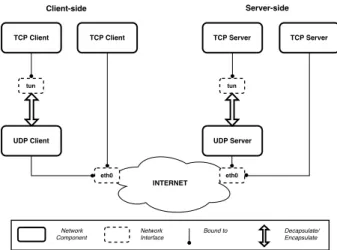
Figure 1: copycat measurement methodology.
sends TCP packets over raw IP sockets toward a user-controlled server. The server sends back received and to-be-sent headers as payload so that the client can compare what was sent to what was received.
3
Measurement Methodology
This study uses two separate methodologies to reach its conclusions: differential treatment measure-ment using copycat (Sec. 3.1) and connectivity and latency comparison using RIPE Atlas (Sec. 3.2).3.1
Copycat
copycat2 simultaneously runs pairs of flows be-tween two endpoints. One is a normal TCP flow and one a TCP flow using UDP as an “outer” transport. This allows us to evaluate differences in connectiv-ity and qualconnectiv-ity of service due to differential network treatment based solely on transport protocol header. This TCP flow is used to simulate a new transport running over UDP, by providing traffic with TCP-friendly congestion control. The two flows run in parallel with the exact same 4-tuples, to obtain flows 2Sources are freely available at https://github.com/
with the most similar possible treatment from the network, but with different transport headers. By comparing performance of these flows to each other, we are able to isolate differences that can be at-tributed to differential treatment by the path.
As shown in Fig. 1, the UDP flow is obtained by tunneling a TCP flow over UDP. To achieve this, copycat first creates a tun virtual network inter-face that simulates a network layer device and op-erates at Layer 3. In our measurement setup, each node runs both the copycat client and the server. On the client side, the TCP client connects to its peer via the Internet-facing interface and receives data from it, writing it to disk. The UDP client consists of the TCP client bound to the tun inter-face, which is in turn bound by copycat to a UDP socket on the Internet-facing interface. copycat thus works as a tunnel endpoint, encapsulating TCP pack-ets from tun in UDP headers, and decapsulating re-ceived UDP packets back to TCP packets to tun. The server-side consists of a similar arrangement, listen-ing for connections from clients and sendlisten-ing data to them. The client waits for both transfers, via TCP and TCP- controlled UDP, to be completed before connecting to the next destination.
Each flow consists of a unidirectional data trans-fer. The smallest flow is calibrated not to exceed the TCP initial window size, which range from 2-4 to 10 Maximum Segment Size (MSS) depending on the kernel version used by the different measurement platforms [1, 6]. This ensures that in the smallest flow, we send all data segments at once. Then, we increase the size of the flows by arbitrary factors of 3, 30, 300, and 1500 to observe the impact of differ-ential treatment for congestion-controlled traffic with larger flows.
To avoid unwanted fragmentation of UDP data-grams and ICMP message-too-long errors, and to ensure that packets from both tunneled and non-tunneled flows are equally sized, we decrease the MSS of the tunneled TCP flow by the size of the tunnel headers (IP header + UDP header = 28 Bytes).
copycat is coded in C to minimize overhead. I/O multiplexing is handled using select(). All network traces are captured at eth0 using libpcap.
We deployed copycat on the PlanetLab
dis-tributed testbed on the entire pool (153) of available nodes between March 6th and April 23rd, 2016. Con-sidering PlanetLab port binding restrictions (e.g., 80, 8000, and 53, 443 on certain nodes), we chose seven ports-53, 443, 8008, 12345, 33435, 34567, and 54321-respectively DNS, HTTPS, HTTP alternate, a com-mon backdoor, the Atlas UDP traceroute default, an unused and an unassigned port, to maximize routers policy diversity. For each port and pair of nodes, we generated 20 pairs of flows of 1, 3, and 30 TCP initial windows, and 10 pairs of flows of 300 and 1, 500 TCP initial windows, for a total of 4,908,650 flows.3
Then, we selected 93 nodes (one per subnetwork) from the entire pool to maximize path diversity. The selected nodes are located in 26 countries across North America (44), Europe (29), Asia (13), Oceania (4), and South America (3). The filtered PlanetLab dataset then consists in 1,634,518 flows.
We also deployed copycat on 6 Digital Ocean nodes, located in 6 countries across North America (2), Europe (3), and Asia (1). Given the less re-strictive port binding policies and the more restric-tive bandwidth occupation policies, we tested ports 80 and 8000 in addition of the PlanetLab ports. For each port, we generated 20 pairs of flows of 1, 3, and 30 TCP initial windows size between May 2nd and
12th, 2016. We repeated the same methodology for
both IPv4 and IPv6. This dataset consists in 32,400 IPv4 and 31,366 IPv6 flows.
3.2
RIPE Atlas
We used the RIPE Atlas [24] measurement network to provide another view on connectivity and first-packet latency differences between UDP and TCP, as well as to investigate UDP blockage on access net-works and possible MTU effects on such UDP block-age.
First, we compared latency to last hop from Atlas UDP traceroute and TCP traceroute measure-ments from a set of 115 Atlas probes in 110 net-works (identified by BGP AS number) to 32 At-las anchors (i.e., AtAt-las nodes having higher mea-surement capacities than standard Atlas probes), 3The complete dataset is freely available at http://queen.
Dataset Results # Probes No UDP Connectivity total failed RIPE Atlas Latency, 2015 110 0 0.00% All UDP, 2015 2,240 82 3.66%
all MTU, March 2016 9,262 296 3.20%
72 bytes 9,111 244 2.68% 572 bytes 9,073 210 2.31% 1,454 bytes 8,952 137 1.53% copycat PlanetLab 30,778 825 2.66% Digital Ocean v4 135 0 0.00% Digital Ocean v6 135 0 0.00%
Table 1: Overview of our results on UDP connectivity. The upper part of the table shows the percentage of probes with UDP being blocked, as measured by RIPE Atlas in 2015 and 2016 (Sec. 4.1 for details). The lower part shows UDP blocking as measured by copycat.
and used this as a proxy metric for first-packet la-tency for UDP or TCP. To review, TCP traceroute sends SYNs with successively increasing TTL values and observes the ICMP time-exceeded responses from routers along the path and the SYN+ACK or RST from the target. UDP traceroute sends pack-ets to a UDP port on which presumably nobody is listening, and waits for ICMP time-exceeded or destination-unreachable responses from the path and target respectively. We set the initial TTL to 199, which is sufficient to reach the destination in one run without generating any time-exceeded messages from the path, i.e., treating traceroute as a simple ping. The measurements ran between September 23rd
and 26th, 2015, with all probes testing each anchor
sequentially, sending three packets in a row once ev-ery twenty minutes, for up to 17 connection attempts (51 packets) each for UDP/33435, TCP/33435, and TCP/80.
Second, while “common knowledge” holds that some networks severely limit or completely block UDP traffic, this is not the case on any of the se-lected probes in the first measurement. To get a handle on the prevalence of such UDP-blocking net-works, we looked at 1.1 million RIPE Atlas UDP traceroute measurements run in 2015, including those from our first campaign. Here, we assume that
probes which perform measurements against targets which are reachable by other probes using UDP trace-routes, but which never successfully complete a UDP traceroute themselves, are on UDP blocked access networks.
Third, we used a single campaign of about 2.5 mil-lion UDP and ICMP traceroutes from about 10,000 probes with different packet sizes in March 2016, to compare protocol-dependent path MTU to a specific RIPE Atlas anchor. We compared success rates with UDP at different packet sizes to ICMP.
4
Results
Tables 1 and 2 provide an overview on our main results. In summary, we show that, aside from block-ing of UDP on certain ports, as well as relatively rare blocking of all UDP traffic on about one in thirty ac-cess networks, UDP is relatively unimpaired in the Internet. We explore the details of both tables and additional measurement results in the subsections be-low.
4.1
Incidence of UDP Blocking
Of the 2,240 RIPE Atlas probes which per-formed UDP traceroute measurements against
tar-gets which were reachable via UDP traceroute in 2015, 82 (3.66%) never successfully completed a UDP traceroute. We take this to be an indication that these probes are on UDP-blocking networks. The lo-cation of the blockage, determined by the maximum path length seen in a UDP traceroute, is variable, with the median probe seeing at least one response from the first five hops. These UDP-blocked probes are more likely than the population of all examined probes to be on networks in sub-saharan African and east Asian countries.
Our investigation of MTU issues showed no sig-nificant relationship between packet size and probe reachability up to 1,420 bytes per packet, as com-pared to ICMP. In this shorter study in March 2016 using more probes, 296 of 9,262 probes (3.20%) did not receive a response from the target from the UDP traceroute for any packet size. For 72, 572, and 1,454 byte packets, respectively, 2.68%, 2.31%, and 1.53% of probes received no response to a UDP traceroute attempt when receiving a response from an ICMP traceroute of the same size. These re-sults are summarized in Table 1 (upper part of the table). Note that the relative UDP blocking numbers go down as the packet size goes up; this is because large ICMP packets are more often blocked than large UDP packets. From these results, we conclude that differential treatment between UDP and TCP should not pose a challenge to using UDP as an outer trans-port.
Fig. 2 shows a heatmap describing connection bias per path in the copycat results. A bias of +1.0 (blue) means all UDP connections between a given re-ceiver (X-Axis) and sender (Y-Axis) succeeded while all TCP connections failed, and a bias of -1.0 (red) means all TCP connections succeeded while all UDP connections failed. The axes are arranged into geo-graphic regions: North America (NA), Europe (EU), Asia (AS), Oceania and South America (O). The con-nectivity matrix of PlanetLab nodes shown in Fig. 2 confirms our findings from Atlas, i.e., impairment is access-network linked. One node blocks all inbound and outbound UDP traffic, and has TCP connectivity problems to some servers as well. Otherwise, tran-sient connectivity impairment shows a clear depen-dency on node, as opposed to path.
NA EU AS O
clients (by continents and countries) NA
EU AS O
servers (by continents and countries) 1.00.8 0.6 0.4 0.2 0.0 0.2 0.4 0.6 0.8 1.0 connectivity bias
Figure 2: Connectivity bias among PlanetLab nodes, excluding ports 53 and 443. Positive (blue) values mean UDP is better-connected than TCP. Black dots mean “no connectivity” (for both UDP and TCP).
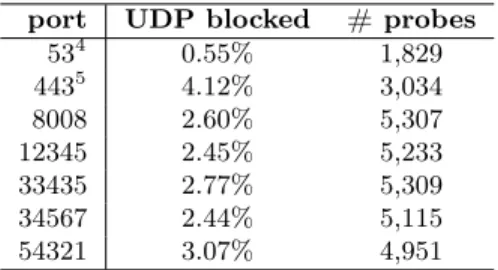
port UDP blocked # probes
534 0.55% 1,829 4435 4.12% 3,034 8008 2.60% 5,307 12345 2.45% 5,233 33435 2.77% 5,309 34567 2.44% 5,115 54321 3.07% 4,951
Table 3: Percentage of probes (identified as 3-tuples (IPsrc, IPdst, Portdst)) on PlanetLab, that have never seen a UDP connection but at least one TCP connection.
Table 3 shows the proportion of probes that have never seen a UDP connection, but at least one TCP connection. Statistics are provided by port, as mea-sured by copycat on PlanetLab. As shown, UDP is more blocked than TCP but to a small extend. UDP is blocked in, roughly, between 1% and and 5% of the probes. We observed two China-based nodes blocking all UDP traffic from one node also based in China. This advocates for a fall-back mechanism 4Node pool reduced to 41 because of PlanetLab port 53
usage policies
5Node pool reduced to 55 because of PlanetLab port 443
Dataset Throughput (kB/s) Latency (ms)
< 200 > 200 < 50 > 50
# flows median # flows median # flows median # flows median
PlanetLab 740,721 0.05 34,896 0.16 745,947 0.00 29,370 -1.65
RIPE Atlas - - - - 2,669 0.00 48 -4.75
DO v4 12,563 0.03 3,637 -0.37 9,381 -0.02 6,819 -0.44
DO v6 15,459 0.07 224 -0.16 15,656 0.00 27 3.63
Table 2: Raw number of bias measurements (throughput and initial latency) per sub dataset (“DO” stands for Digital Ocean). The 50ms cut-off roughly corresponds to inter-continental versus intra-continental latency
when running the Internet over UDP (i.e., switching back from UDP-based encapsulation to native TCP packets). The absence of UDP connections for port 443 (QUIC) is mainly due to PlanetLab port binding restrictions on nodes without any connectivity prob-lem. Anecdotally, we found one New Zealand node blocking both UDP and TCP traffic from all China-based nodes.
4.2
Throughput
To evaluate the impact of transport-based differen-tial treatment on throughput, we introduce the rela-tive tp_bias metric for each pairs of concurrent flows. This is computed as follows:
tp_bias = (tpudp− tptcp) min(tptcp, tpudp)
× 100. (1)
A positive value for tp_bias means that UDP has a higher throughput. A null value means that both UDP and TCP flows share the same throughput. As no tool able to compute throughput is available on RIPE Atlas, we only evaluate the tp_bias on Plan-etLab and Digital Ocean with copycat.
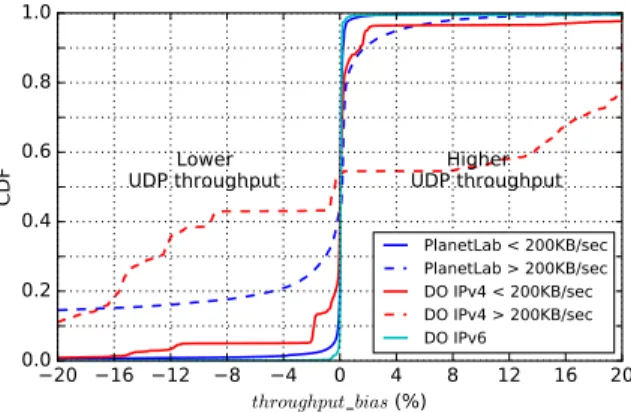
Fig. 3 provides a global view of the
throughput_bias. Dataset has been split be-tween flows < 200 KB/sec and flows > 200KB/sec, except for Digital Ocean IPv6, as the number of measurements is too small to be representative. Table 2 gives the size of each sub dataset and the relative median bias for throughput and latency.
As observed, in general, there is no bias between UDP and TCP. For both Digital Ocean dataset, the non-null biases are mostly evenly distributed in favor
20 16 12 8 4 0 4 8 12 16 20 throughput_bias (%) 0.0 0.2 0.4 0.6 0.8 1.0 CDF Lower
UDP throughput HigherUDP throughput
PlanetLab < 200KB/sec PlanetLab > 200KB/sec DO IPv4 < 200KB/sec DO IPv4 > 200KB/sec DO IPv6
Figure 3: Relative throughput bias, as measured by copycat (“DO” stands for Digital Ocean). Positive values mean UDP has higher throughput. DO IPv6 has not been split in two due to lack of enough values (see Table 2).
and disfavor of UDP. In PlanetLab, we observe an extreme case where TCP performs better than UDP, the 4% and 2% highest throughput_bias in absolute value are respectively higher than 1% and 10%. As shown in Fig. 4, those extreme cases, represented as dark red lines, are endpoint-dependent. We also no-tice a single probe where the UDP throughput is bet-ter than TCP (see Fig. 4). Consistently with UDP connectivity bias (see Fig. 2), we do not see evidence on path dependency for throughput.
The loss rate of congestion controlled traffic in steady state, where the link is fully utilized, is mostly determined by the congestion control algorithm itself.
NA EU AS O clients (by continents and countries) NA
EU AS O
servers (by continents and countries) 54 3 2 1 0 1 2 3 4 5 throughput bias (%)
Figure 4: Relative throughput bias among PlanetLab nodes as measured by copycat. Positive (blue) values mean UDP has higher throughput.
Therefore, there is a direct relation between through-put and loss. However, as TCP congestion control re-acts only once per RTT to loss as an input signal, the actual loss rate could still be different even if similar throughput is achieved.
Here, we understand loss as the percentage of flow payload lost, computed from sequence numbers. A value, for instance, of 10% of losses means thus that 10% of the flow payload has been lost.
Generally speaking, the loss encountered is quite low, given that small flows often are not large enough to fully utilize the measured bottleneck link. As ex-pected based on he throughput observed, we see no significant loss difference in both PlanetLab and Dig-ital Ocean when comparing TCP and UDP, except of 3.5% in favor of UDP for the largest flow size (6MB). However, this is inline with a slightly lower through-put caused by a slightly larger initial RTT, as dis-cussed in the next section.
4.3
Initial Latency
Since all copycat traffic is congestion controlled, throughput is influenced by the end-to-end latency. We use initial RTT measured during the TCP hand-shake as a proxy for this metric.
30 20 10 0 10 20 30 RTT_bias (%) 0.0 0.2 0.4 0.6 0.8 1.0
CDF Higher UDP RTT Smaller UDP RTT
PlanetLab < 50ms PlanetLab > 50ms Atlas DO IPv4 < 50ms DO IPv4 > 50ms DO IPv6
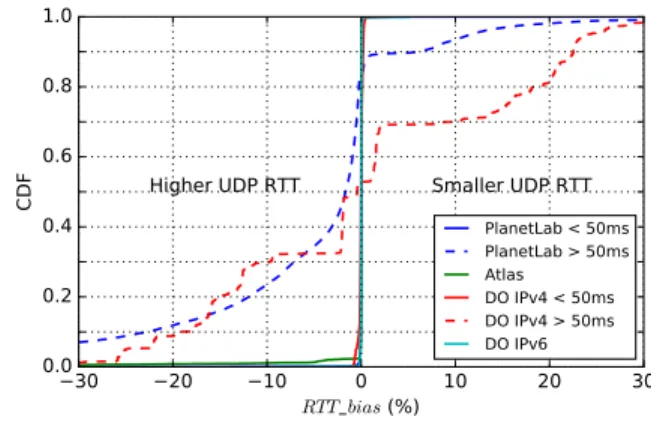
Figure 5: UDP/TCP initial RT T _bias for Planetlab, RIPE Atlas (September 2015), and Digital Ocean. Positive values mean UDP is faster. DO IPv6 and Atlas have not been split in two due to lack of enough values (see Table 2).
In the fashion of tp_bias (see Eqn. 1), we intro-duce the relative RT T _bias metric for each pair of concurrent flows. This is computed as follows:
RT T _bias = (RT Ttcp− RT Tudp) min(RT Ttcp, RT Tudp)
× 100. (2) A positive value for RT T _bias means that UDP has a smaller initial latency (i.e., performs better than TCP). A null value means that both UDP and TCP flows share the same initial latency.
The median latency bias is also listed in in Table 2 (right part). For PlanetLab, there is no latency bias for flows with an initial RTT of 50ms or less, and a slight bias towards higher latency for UDP for flows with larger initial RTTs. For Digital Ocean we also observed a slight bias towards higher latency for UDP for IPv4 and no bias for IPv6 (considering 27 flows with a larger RTT than 50ms as not representative). This is confirmed by the CDF shown in Fig. 5.
The 2% and 1% most biased flow pairs have an RT T _bias respectively lower than -1% and -10%. For the Digital Ocean IPv4 campaign, 40% of the generated flows have an RT T _bias between 1% and 30% in absolute value. The difference between IPv4
NA SA EMEA AS O probe (by longitude)
NA EMEA AS
anchor (by longitude) 1008060
40 20 0 20 40 60 80 100
relative median UDP RTT bias (%)
Figure 6: Relative Median RT T _bias, traceroute TCP/33435 vs UDP/33435, 110 Atlas probes to 32 Atlas anchors, September 2015. Positive values (blue) mean UDP is faster.
and IPv6 on Digital Ocean appears to be due to the presence of a middlebox interfering with all IPv4 traf-fic, both TCP and UDP.
This difference in latency also explains the slight throughput disadvantage as seen in the previous sec-tion given latency results follow nearly the same shape as the initial RTT (see Fig. 5).
We do not see any evidence of path dependency for initial latency in our RIPE Atlas UDP/TCP traceroute campaign from September 2015, either. Two probes are on networks with a high initial la-tency bias toward UDP (see Fig. 6), but the median over all measurements is zero (see Fig. 5).
On PlanetLab, we see that 95% of the flows have a latency difference of 25ms or less, and 98% and 100% respectively on RIPE Atlas and for IPv6 on Digital Ocean. 86% of the flows have a difference of 10ms or less on PlanetLab, and 94% and 87% respectively for RIPE Atlas and for IPv6 on Digital Ocean. We con-sider variations of up to 10ms as usual variations in Internet measurements. Only for IPv4 we see higher variations with 87% of flows that have a latency dif-ference of more than 10ms and 49% of flows that have a latency difference of more than 25ms with -255ms for the 1% percentile and 258ms for the 99% per-centile of the latency bias. However the median bias is still only -0.02% which indicates that both TCP and UDP IPv4 traffic on Digital Ocean is impaired by additional in-network processing of middleboxes.
5
Guidance and Outlook
In this paper, we ask the question “is UDP a viable basis and/or encapsulation for deploying new trans-ports in the Internet?”. We focus on two aspects of the answer: connectivity and differential treatment of TCP and TCP-congestion-controlled UDP packets to see if simply placing such traffic in UDP headers dis-advantages it. Combining these measurements with other publicly available data leads to the following guidance for future transport protocol evolution ef-forts:
First, UDP provides a viable common ba-sis for new transport protocols, but only in cases where alternatives exist on access networks where UDP connectivity is unavailable or severely compro-mised. QUIC provides a good illustration here. It was developed together with SPDY, which has been defined over TCP and TLS as HTTP/2[2], and its first target application is HTTP/2. Since HTTP/2 has a natural fallback to TLS over TCP, this alter-native can be used on the 1 − 5% of networks where QUIC packets over UDP are blocked or limited. How-ever, this fallback approach limits QUIC’s applicabil-ity to application layer protocols that can be made run acceptably over TCP.
Second, our study provides evidence that the vast majority of UDP impairments are access-network linked, and that subtle impairment is rare. This means that accurate fallback decisions are easy to arrive at – a connection racing design similar to Happy Eyeballs [33] as used by QUIC is sufficient – and can often be cached based on client access net-work as opposed on access-netnet-work/server pair.
However, there is still work to do. Though the study of Hätönen et al [12] is six years old, the relatively mature market for consumer-grade access points and NAT devices means that its insights are still valid. Transports over UDP must therefore avoid NAT timeout ten to twenty times more frequently than TCP. UDP timeout avoidance is particularly problematic on wireless and mobile devices, since it limits the ability to shut down the radio to reduce power consumption. Adding a generalized mecha-nism for state exposure in UDP-encapsulated trans-port protocols is therefore an imtrans-portant priority for
transport evolution efforts, so that future NAT and firewall devices can reduce the need for this additional unproductive traffic.
We make no attempt to confirm claims of defen-sive rate-limiting of UDP traffic with this work, as doing so would in essence require UDP-based denial of service attacks on the networks under measument. However, we note that Google reports a re-duction in the amount of UDP rate limiting they have observed since the beginning of the QUIC exper-iment [28]. This makes sense: rate limitation must necessarily adapt to baseline UDP traffic volumes, and as such poses no limitation to the gradually in-creasing deployment of UDP-based transport proto-cols. However, it also indicates the need for work on mechanisms in these UDP protocols to augment the denial-of-service protection afforded by rate-limiting approaches.
The authors, together with others, are working to address these issues within the PLUS effort within the IETF [30, 17], which proposes common behavior for new UDP-encapsulated transport protocols for man-aging state on devices in the network. This effort and others are helping to overcome ossification, and will make new transport protocols deployable within the Internet, restoring innovation in Internet services and applications requiring transport semantics other than those provided by TCP.
Acknowledgments
Thanks to Robert Kisteleki and Philip Homburg for assistance in applying the RIPE Atlas network in this measurement study.
This project has received funding from the European Union’s Horizon 2020 research and innovation program under grant agreement No 688421, and was supported by the Swiss State Secretariat for Education, Research and Innovation (SERI) under contract number 15.0268. The opinions expressed and arguments employed reflect only the authors’ views. The European Commission is not re-sponsible for any use that may be made of that informa-tion. Further, the opinions expressed and arguments em-ployed herein do not necessarily reflect the official views of the Swiss Government.
References
[1] Allman, M., Floyd, s., and Partridge, C. Increasing TCP’s initial window. RFC 3390, In-ternet Engineering Task Force, October 2002. [2] Belshe, M., Peon, R., and Thomson, M.
Hypertext transfer protocol version 2 (http/2). RFC 7540, Internet Engineering Task Force, May 2015.
[3] Bruno, R., Conti, M., and Gregori, E. Throughput analysis and measurements in IEEE 802.11 WLANs with TCP and UDP traffic flows. IEEE Transactions on Mobile Computing 7, 2 (February 2008), 171–186.
[4] Byrne, C., and Kleberg, J. Advisory guide-lines for UDP deployment. Internet Draft (Work in Progress) draft-byrne-opsec-udp-advisory-00, Internet Engineering Task Force, July 2015. [5] Carlucci, G., De Cicco, L., and Mascolo,
S. Http over udp: An experimental investigation of quic. In Proceedings of the 30th Annual ACM Symposium on Applied Computing (New York, NY, USA, 2015), SAC ’15, ACM, pp. 609–614. [6] Chu, J., Dukkipati, N., Cheng, Y., and
Mathis, M. Increasing TCP’s initial window. RFC 6928, Internet Engineering Task Force, April 2013.
[7] claffy, k., Hyun, Y., Keys, K., Fomenkov, M., and Krioukov, D. Internet mapping: from art to science. In Proc. IEEE Cyberse-curity Applications and Technologies Conference for Homeland Security (CATCH) (March 2009). see http://www.caida.org/projects/ark/. [8] DigitalOcean. Simple cloud computing,
built for developers. See https://www. digitalocean.com.
[9] Ford, A., Raiciu, C., Handley, M., Barre, S., and Iyengar, J. Architectural guidelines for multipath tcp development. RFC 6182, In-ternet Engineering Task Force, March 2011.
[10] Ford, A., Raiciu, C., Handley, M., and Bonaventure, O. Tcp extensions for multi-path operation with multiple addresse. RFC 6824, Internet Engineering Task Force, Jan 2013.
[11] Hamilton, R., Iyengar, J., Swett, I., and
Wilk, A. Quic: A udp-based secure and
reliable transport for http/2. Internet-draft draft-hamilton-early-deployment-quic-00, Inter-net Engineering Task Force, July 2016.
[12] Hätönen, S., Nyrhinen, A., Eggert, L., Strowes, S., Sarolahti, P., and Kojo, M. An experimental study of home gateway charac-teristics. In Proceedings of the 10th ACM SIG-COMM Conference on Internet Measurement (New York, NY, USA, 2010), IMC ’10, ACM, pp. 260–266.
[13] Hayes, D. A., But, J., and Armitage, G. Issues with network address translation for SCTP. ACM SIGCOMM Computer Communi-cation Review 39, 1 (January 2009), 23–33.
[14] Honda, M., Nishida, Y., Raiciu, C.,
Greenhalgh, A., Handley, M., and
Tokuda, H. Is it still possible to extend TCP. In Proc. ACM Internet Measurement Conference (IMC) (November 2011).
[15] Jesup, R., Loreto, S., and Tuexen, M. We-bRTC data channels. Internet Draft (Work in Progress) draft-ietf-rtcweb-data-channel-13, In-ternet Engineering Task Force, January 2015. [16] Kreibich, C., Weaver, N., Nechaev, B.,
and Paxson, V. Netalyzr: Illuminating the edge network. In Proc. ACM Internet Measure-ment Conference (IMC) (November 2010).
[17] Kuehlewind, M., Trammell, B., and
Hildebrand, J. Transport-independent path layer state management. Internet Draft (Work in Progress) draft-trammell-plus-statefulness-02, Internet Engineering Task Force, December 2016.
[18] Medina, A., Allman, M., and Floyd, S. Measuring interactions between transport pro-tocols and middleboxes. In Proc. ACM Inter-net Measurement Conference (IMC) (November 2004).
[19] Melia, T., Schmitz, R., and Bohnert, T. TCP and UDP performance measurements in presence of fast handovers in an IPv6-based mo-bility environment. In Proc. World Telecommu-nications Congress (WTC) (September 2004). [20] Pahdye, J., and Floyd, S. On inferring tcp
behavior. SIGCOMM Comput. Commun. Rev. 31, 4 (Aug. 2001), 287–298.
[21] Paxson, V. End-to-end internet packet dynam-ics. SIGCOMM Comput. Commun. Rev. 27, 4 (Oct. 1997), 139–152.
[22] Qian, F., Gerber, A., Mao, Z. M., Sen, S., Spatscheck, O., and Willinger, W. TCP revisited: a fresh look at TCP in the wild. In Proc. ACM Internet Measurement Conference (IMC) (November 2009).
[23] Reddy, T., Patil, P., Wing, D., and Ver Steeg, B. Webrtc udp firewall traversal. In Proc. IAB Workshop on Stack Evolution in a Middlebox Internet (SEMI) (February 2015). [24] RIPE NCC. Atlas, 2010. See https://atlas.
ripe.net/.
[25] Sarma, M. P. Performance measurement of TCP and UDP using different queing algorithm in high speed local area network. International Journal of Future Computer and Communica-tion 2, 6 (December 2013), 682–686.
[26] Stewart, R. Stream control transmission pro-tocol. RFC 4960, Internet Engineering Task Force, September 2007.
[27] Swett, I. QUIC
Deploy-ment Experience @Google.
https://www.ietf.org/proceedings/96/slides/slides-96-quic-3.pdf, July 2016.
[28] Swett, I. QUIC deployment
experi-ment @ Google, July 2016. IETF 96?
See https://www.ietf.org/proceedings/96/ slides/slides-96-quic-3.pdf.
[29] Tirumala, A., Qin, F., Duagn, J., Fergu-son, J., and Gibbs, K. Iperf: The TCP/UDP bandwidth measurement tool, 2005.
[30] Trammell, B. Transport-independent path layer state management. Internet Draft (Work in Progress) draft-trammell-plus-abstract-mech-00, Internet Engineering Task Force, September 2016.
[31] Trammell, B., and Kuehlewind, M. Re-quirements for the design of a substrate proto-col for user datagrams (SPUD). Internet Draft (Work in Progress) draft-trammell-spud-req-03, Internet Engineering Task Force, April 2016.
[32] Tuexen, M., Seggelmann, R., and
Rescorla, E. Datagram transport layer
security (DTLS) for stream control transmis-sion protocol (SCTP). RFC 6083, Internet Engineering Task Force, January 2011.
[33] Wing, D., and Yourtchenko, A. Happy eye-balls: Success with dual-stack hosts. RFC 6555, Internet Engineering Task Force, April 2012. [34] Xu, Y., Wang, Z., Leong, W. K., and
Leong, B. An end-to-end measurement study of modern cellular data networks. In Proceedings
of the 15th International Conference on Passive and Active Measurement - Volume 8362 (New York, NY, USA, 2014), PAM 2014, Springer-Verlag New York, Inc., pp. 34–45.
Appendix: Repeatability
The measurements and results discussed in this pa-per are intended to be repeatable by others in the In-ternet measurement and transport protocol research community. This appendix discusses how.
Copycat
copycat, as presented in Section 3.1 is freely available at https://github.com/mami-project/ udptun. The git repository contains a README.md file that fully explains how to compile, deploy, and use copycat.
Data and Analysis
The dataset collected and analyzed (PlanetLab, RIPE Atlas, and Digital Ocean) in this paper is freely available at https://github.com/mami-project/ udpdiff.
Data analysis was performed using Python and Pandas; Jupyter notebooks for performing analy-sis done in this paper are available along with the datasets at https://github.com/mami-project/ udpdiff.