HAL Id: dumas-01821577
https://dumas.ccsd.cnrs.fr/dumas-01821577
Submitted on 22 Jun 2018HAL is a multi-disciplinary open access archive for the deposit and dissemination of sci-entific research documents, whether they are pub-lished or not. The documents may come from teaching and research institutions in France or abroad, or from public or private research centers.
L’archive ouverte pluridisciplinaire HAL, est destinée au dépôt et à la diffusion de documents scientifiques de niveau recherche, publiés ou non, émanant des établissements d’enseignement et de recherche français ou étrangers, des laboratoires publics ou privés.
Distributed under a Creative Commons Attribution - NonCommercial - NoDerivatives| 4.0 International License
What pain assessment scales are usable in general
population ? A systematic literature review of Cochrane
library according to the PRISMA statement
Laurent Cochet
To cite this version:
Laurent Cochet. What pain assessment scales are usable in general population ? A systematic liter-ature review of Cochrane library according to the PRISMA statement. Life Sciences [q-bio]. 2018. �dumas-01821577�
1
UNIVERSITÉ de BRETAGNE OCCIDENTALE
FACULTÉ DE MÉDECINE
ANNÉE 2018 N°THÈSE DE
DOCTORAT en MEDECINE
DIPLOME D’ETAT
ParMonsieur COCHET Laurent Né le 17 Mars 1989, à Landerneau (29)
Présentée et soutenue publiquement le 14 Juin 2018
What pain assessment scales are usable in general population ? A systematic
literature review of Cochrane library according to the PRISMA statement
Président : M. Le Professeur Jean-Yves Le Reste Membres du Jury : M. le Dr Patrice Nabbe
M. le Dr Chiron Benoît M. le Dr Elouan Péron
2
UNIVERSITÉ DE BRETAGNE OCCIDENTALE
---
FACULTÉ DE MÉDECINE ET
DES SCIENCES DE LA SANTÉ DE BREST
PROFESSEURS ÉMÉRITES
CENAC Arnaud Médecine interne
LEHN Pierre Biologie Cellulaire
YOUINOU Pierre Immunologie
PROFESSEURSDES UNIVERSITÉSEN SURNOMBRE
MOTTIER Dominique Thérapeutique
RICHE Christian Pharmacologie fondamentale
LEFEVRE Christian Anatomie
SENECAIL Bernard Anatomie
PROFESSEURSDES UNIVERSITÉS - PRATICIENS HOSPITALIERSDE CLASSE
EXCEPTIONNELLE
BOLES Jean-Michel Réanimation Médicale COCHENER – LAMARD Béatrice Ophtalmologie
DEWITTE Jean-Dominique Médecine & Santé au Travail
FEREC Claude Génétique
GILARD Martine Cardiologie
JOUQUAN Jean Médecine Interne
OZIER Yves Anesthésiologie et Réanimation
ROBASZKIEWICZ Michel Gastroentérologie - Hépatologie
DOYENS HONORAIRES : Professeur H. FLOCH
Professeur G. LE MENN (†) Professeur B. SENECAIL Professeur J. M. BOLES Professeur Y. BIZAIS (†)
Professeur M. DE BRAEKELEER (†)
3
PROFESSEURSDES UNIVERSITÉS - PRATICIENS HOSPITALIERSDE 1ère CLASSE BAIL Jean-Pierre Chirurgie Digestive
BERTHOU Christian Hématologie - Transfusion
BLONDEL Marc Biologie cellulaire
BRESSOLLETTE Luc Médecine Vasculaire
DE PARSCAU DU PLESSIX Loïc Pédiatrie
DELARUE Jacques Nutrition
DUBRANA Frédéric Chirurgie Orthopédique et Traumatologique
FENOLL Bertrand Chirurgie Infantile
FOURNIER Georges Urologie
GENTRIC Armelle Gériatrie et biologie du vieillissement
GOUNY Pierre Chirurgie Vasculaire
HU Weiguo Chirurgie plastique, reconstructrice & esthétique ; brûlologie KERLAN Véronique Endocrinologie, Diabète & maladies métaboliques
LACUT Karine Thérapeutique
LEROYER Christophe Pneumologie
LE MEUR Yannick Néphrologie
LE NEN Dominique Chirurgie Orthopédique et Traumatologique
LOZAC’H Patrick Chirurgie Digestive
MANSOURATI Jacques Cardiologie
MARIANOWSKI Rémi Oto. Rhino. Laryngologie
MISERY Laurent Dermatologie – Vénérologie
MERVIEL Philippe Gynécologie Médicale : option gynécologie obstétrique
NEVEZ Gilles Parasitologie et Mycologie
NONENT Michel Radiologie & Imagerie médicale PAYAN Christopher Bactériologie – Virologie ; Hygiène REMY-NERIS Olivier Médecine Physique et Réadaptation SALAUN Pierre-Yves Biophysique et Médecine nucléaire
SARAUX Alain Rhumatologie
SIZUN Jacques Pédiatrie
STINDEL Eric Biostatistiques, informatique médicale et technologie de communication
TIMSIT Serge Neurologie
VALERI Antoine Urologie
4
PROFESSEURSDES UNIVERSITÉS - PRATICIENS HOSPITALIERSDE 2ème CLASSE
ANSART Séverine Maladies infectieuses, maladies tropicales
AUBRON Cécile Réanimation ; médecine d’urgence
BEN SALEM Douraied Radiologie & Imagerie médicale BERNARD–MARCORELLES Pascale Anatomie et cytologie pathologiques
BEZON Eric Chirurgie thoracique et cardiovasculaire
BOTBOL Michel Psychiatrie Infantile
BROCHARD Sylvain Médecine Physique et de Réadaptation CARRE Jean-Luc Biochimie et Biologie moléculaire
COUTURAUD Francis Pneumologie
DAM HIEU Phong Neurochirurgie
DELLUC Aurélien Médecine Interne
DEVAUCHELLE-PENSEC Valérie Rhumatologie GIROUX-METGES Marie-Agnès Physiologie
HUET Olivier Anesthésiologie – Réanimation Chirugicale/Médecine d’urgence
LIPPERT Eric Hématologie ; Transfusion : option hématologie
LE MARECHAL Cédric Génétique
L’HER Erwan Réanimation Médicale
MONTIER Tristan Biologie Cellulaire
NOUSBAUM Jean-Baptiste Gastroentérologie - Hépatologie
PRADIER Olivier Cancérologie - Radiothérapie
RENAUDINEAU Yves Immunologie
SEIZEUR Romuald Anatomie - Neurochirurgie
PROFESSEURS des Universités – Praticien Libéral
LE RESTE Jean Yves Médecine Générale
LE FLOC'H Bernard Médecine Générale
PROFESSEURS DES UNIVERSITE ASSOCIÉS A MI-TEMPS
5
PROFESSEURS DES UNIVERSITE - LRU
BODRON Anne Biochimie et Biologie moléculaire
MAITRES DE CONFERENCESDES UNIVERSITÉS - PRATICIENS HOSPITALIERS HORS
CLASSE
PERSON Hervé Anatomie
MAITRES DE CONFERENCESDES UNIVERSITÉS - PRATICIENS HOSPITALIERSDE 1ère CLASSE
ABGRAL Ronan Biophysique et Médecine nucléaire
CORNEC Divi Rhumatologie
DE VRIES Philine Chirurgie infantile DOUET-GUILBERT Nathalie Génétique
HERY – ARNAUD Geneviève Bactériologie – Virologie ; Hygiène
HILLION Sophie Immunologie
JAMIN Christophe Immunologie
LE BERRE Rozenn Maladie infectieuses – Maladies tropicales
LE GAC Gérald Génétique
LE ROUX Pierre-Yves Biophysique et Médecine nucléaire
LODDE Brice Médecine et santé au travail
MIALON Philippe Physiologie
MOREL Frédéric MOREL Frédéric Médecine & biologie du développement et de la reproduction PLEE-GAUTIER Emmanuelle Biochimie et Biologie Moléculaire
QUERELLOU Sophie Biophysique et Médecine nucléaire VALLET Sophie Bactériologie – Virologie ; Hygiène
MAITRES DE CONFERENCESDES UNIVERSITÉS - PRATICIENS HOSPITALIERSDE 2ère CLASSE
LE GAL Solène Parasitologie et Mycologie
LE VEN Florent Cardiologie
PERRIN Aurore Biologie et médecine du développement & de la reproduction TALAGAS Matthieu Cytologie et histologie
6
MAITRES DE CONFERENCES –PRATICIEN LIBERAL
NABBE Patrice Médecine Générale
MAITRESDE CONFERENCES ASSOCIESDES UNIVERSITE MI-TEMPS
BARAIS Marie Médecine Générale
CHIRON Benoît Médecine Générale
MAITRESDE CONFERENCESDES UNIVERSITES
BERNARD Delphine Biochimie et biologie moléculaire
FAYAD Hadi Génie Informatique, automatique et traitement du signal HAXAIRE Claudie Sociologie - Démographie
KARCHER Brigitte Psychologie clinique
LANCIEN Frédéric Physiologie
LE CORRE Rozenn Biologie cellulaire
MIGNEN Olivier Physiologie
MORIN Vincent Electronique et Informatique
MAITRESDE CONFERENCES ASSOCIESDES UNIVERSITES A TEMPS COMPLET
MERCADIE Lolita Rhumatologie
AGREGES /CERTIFIES DU SECOND DEGRE
MONOT Alain Français
7
Faculté de Médecine
*****AUTORISATION D’IMPRIMER
****Présentée par Monsieur le Professeur Jean-Yves LE RESTE
Titre de la thèse:
What pain assessment scales are usable in general population ? A
systematic literature review of Cochrane library according to the
PRISMA statement
ACCORD DU PRESIDENT DU JURY DE THESE SUR L’IMPRESSION DE LA THESE :
OUI… NON…
En foi de quoi la présente autorisation d’imprimer sa thèse est délivrée à Monsieur COCHET Laurent
Fait à BREST, le
VISA du Doyen de la faculté Le Président du Jury de Thèse, A BREST, le
Le Doyen,
8
S
ERMENT D’H
IPPOCRATE« Au moment d'être admis à exercer la médecine, je promets et je jure d'être fidèle aux lois de l'honneur et de la probité.
Mon premier souci sera de rétablir, de préserver ou de promouvoir la santé dans tous ses éléments, physiques et mentaux, individuels et sociaux.
Je respecterai toutes les personnes, leur autonomie et leur volonté, sans aucune discrimination selon leur état ou leurs convictions. J'interviendrai pour les protéger si elles sont affaiblies, vulnérables ou menacées dans leur intégrité ou leur dignité. Même sous la contrainte, je ne ferai pas usage de mes connaissances contre les lois de l'humanité.
J'informerai les patients des décisions envisagées, de leurs raisons et de leurs conséquences. Je ne tromperai jamais leur confiance et n'exploiterai pas le pouvoir hérité des circonstances pour forcer les consciences.
Je donnerai mes soins à l'indigent et à quiconque me le demandera. Je ne me laisserai pas influencer par la soif du gain ou la recherche de la gloire.
Admis dans l'intimité des personnes, je tairai les secrets qui me seront confiés. Reçu à l'intérieur des maisons, je respecterai les secrets des foyers et ma conduite ne servira pas à corrompre les moeurs.
Je ferai tout pour soulager les souffrances. Je ne prolongerai pas abusivement les agonies. Je ne provoquerai jamais la mort délibérément.
Je préserverai l'indépendance nécessaire à l'accomplissement de ma mission. Je n'entreprendrai rien qui dépasse mes compétences. Je les entretiendrai et les perfectionnerai pour assurer au mieux les services qui me seront demandés.
J'apporterai mon aide à mes consoeurs et confrères ainsi qu'à leurs familles dans l'adversité. Que les hommes et mes confrères m'accordent leur estime si je suis fidèle à mes promesses ; que je sois déshonorée et méprisée si j'y manque. »
9
R
EMERCIEMENTSAu Professeur Jean-Yves LE RESTE, merci de me faire l’honneur de présider ce jury de
thèse, de m’avoir confié ce sujet qui, j’en suis sûr, m’aidera au quotidien dans l’approche globale de ma prise en charge. Merci de tes conseils avisés, de ta réactivité et de ta gentillesse dans tes explications. Sois assuré de toute ma gratitude et de toute mon admiration, tant pour ta pratique universitaire au sein du DUMG que pour ton exercice libéral. Immense merci.
Au Docteur Patrice NABBE, merci de me faire l’honneur de participer à l’évaluation de ce
travail au sein de ce jury. Merci pour les formations que vous apportez aux étudiants brestois, qui nous servent au quotidien. Soyez assuré de mon profond respect et de ma sincère gratitude.
Au Docteur Benoit CHIRON, merci de me faire l’honneur de votre présence au sein de ce
jury. Je garde un particulièrement bon souvenir de vos interventions en cours lors de mon Internat, avec tout le sérieux et la décontraction nécessaires pour un bon apprentissage. Veuillez croire en mon profond respect et ma sincère estime.
Au Docteur Elouan PERON, merci de me faire l’honneur d’être dans mon jury et de
pouvoir évaluer ce travail. Connaissant ton aversion pour tout ce qui touche de près ou de loin à la langue de Shakespeare, je ne pouvais que te le proposer. Mais aussi, sache que tu fais un merveilleux médecin, un ami extraordinaire et un expert dans les problèmes articulaires les plus divers.
A tous mes maîtres et chefs de stage, avec qui j’ai eu l’honneur d’apprendre mon métier.
Je ne serais jamais assez reconnaissant pour vos conseils et les bons moments passés. Amitiés sincères pour Dr Bazire, Dr Etienne, Dr Muller, Dr Bourillet et les membres du centre médical Laennec de Saint Pol.
A tous les soignants que j’ai pu croiser. Quel plaisir d’avoir partager ces temps de travail à
vos côtés, mêlés de partage de connaissance et de bonne humeur. Pensée nostalgique à tout le service d’hépato-gastro-entérologie du CHU de Saint Pierre à la Réunion, de Dermatologie de Brest et les paramédicaux de Gynéco-obstétrique de Morlaix.
A Myriam et Elise, merci infiniment de m’avoir aidé au début de ce travail. Vos conseils
ont été forts précieux. Bonne continuation à vous deux.
A Monsieur Georges Beuzet, merci pour votre aide précieuse dans la recherche
bibliographique.
A mes parents, Maman, Papa, merci de tout l’amour que vous m’apportez, d’avoir cru en
moi, de votre éducation. Le soutien indéfectible en première année et le rythme « militaire » ont surement était une des clés de l’obtention du précieux sésame. Vous êtes des modèles au quotidien. Je vous aime.
A mes frères. Guillaume, j’aimerai, tout simplement, que tu deviennes le fer de lance de la
scène artistique brestoise et que tu fasses bouger cette ville qui en a bien besoin. Ton parcours mérite tout mon respect. Jean-Marie, la ville de Lille possède surement le directeur chargé d’éducation le plus humain et le plus incroyable. Je vous aime les frangins !
10
A Papy et Elisabeth, merci de votre soutien dans ce long cursus. Merci pour vos discussions
si enrichissantes autour d’un bon repas. Papy, merci de m’avoir transmis ta passion pour la cuisine et pour la randonnée. Je vous aime.
Au quarté gagnant, Elou, Ben, Maxime. Messieurs, je ne saurais assez vous remercier pour
tout ce que vous m’apportez. On a pu en faire des tonnes de choses intelligentes en votre compagnie ! En espérant que cela continue ! La vie avec vous : c’est bieng.
Aux rennais, Franwad, Tienou et Bastouche, trop heureux de vous retrouver. Le slip de
Francois, le batman d’Etienne et le jogging de Bastien me manquaient.
A tous les copains brestois de la fac, Toto, Nico (enfin Rouennais), Tang, Xa, Migou,
Seser, Scho, Po, Cha et Cha, Nico et Marie, Victor et Mathilde, Mam’s, Elise et Marie, Milou, Audrey, Bapt, Ju, Ju Rondy ; merci pour toutes ces années passées en votre compagnie. #SMC#malins#dubliners#GDB
A tous les copains du rugby, Vince, Vinzi, Nico, Mickick, Mémé, Momo, Malo, Augustin
va marquer, Antoine et tous les autres, j’aime à penser à cette finesse qui vous sied bien, à cette délicatesse que vous respirez. Vous êtes tous extraordinnaires. Je vous aime. Allez Plab
A mes colocataires rennais, Lena, Marina, Antonio et Stephane, merci de m’avoir intégré
11
T
ABLE OF CONTENT ABSTRACT ... 12 RESUME ... 13 INTRODUCTION ... 14 METHOD ... 15 General framework ... 15Inclusion and exclusion Criteria ... 15
a. Inclusion Criteria ... 15
b. Exclusion criteria ... 16
Information sources ... 17
Search ... 17
Study selection ... 18
Data collection process and data item ... 18
Risk of bias in individual studies ... 19
RESULTS ... 19
Study selection ... 19
Synthesis of results ... 29
a. One-dimensional pain scales ... 29
b. Summary of one-dimensionnal scales ... 34
c. Multidimensional scales ... 34
d. Summary of multidimensional scales ... 39
DISCUSSION ... 39
CONCLUSION ... 42
ABBREVIATIONS LIST ... 44
BIBLIOGRAPHY ... 45
APPENDIX 1:SEARCH EQUATIONS ... 52
APPENDIX 2:OFF TOPICS ... 54
APPENDIX 3:INCLUSION GRID ... 56
APPENDIX 4:“EXERCER” QUALITY GRID ... 57
12
A
BSTRACTBackground: Pain is one of the most common symptom reported in general practice. For
this purpose, one-dimensional and multidimensional pain scales have been developed to assess acute or chronic pain. There is no gold standard in pain assessment in general practice. This study aimed to list all pain scales studied for the general population.
Method: A systematic review questioning Cochrane database, according to the PRISMA
protocol, was conducted until February 2018. Only English articles assessing pain scales in general population were included. The bibliography of selected studies and recent systematic reviewshad been examined to include additional articles in a second search.
Results: On 1431 results found on Cochrane, 4 relevant articles were included. With the
second search, 203 additional articles were detected and 84 were added. Finally, 88 articles were selected and 35 pain scales were found: 6 unidimensional-scales with 13 variants and 12 multidimensional scales with 4 variants.
Discussion: Pain scales were different by explored dimensions and the number of item.
Some of them are not studied in this current review by a lack of articles available on the database responding to eligibility criteria. Reliability data of available pain assessment scales were recently collected in a systematic review. It will be necessary to consider external validity data in further studies and to choose which pain scale is the most appropriate for daily practice.
13
R
ESUMEIntroduction : La douleur est un des symptômes les plus courants signalé en médecine
générale. Dans ce but, des échelles uni et multidimensionnelles de douleurs ont été développées pour évaluer la douleur aigüe ou chronique. Il n’y a pas de gold standard dans l’évaluation de la douleur en médecine générale. Cette étude avait pour but de lister toutes les échelles d’évaluation de la douleur étudiées en population générale.
Méthode : Une revue de littérature questionnant la base de données Cochrane a été réalisée
jusqu’en février 2018, basée sur le protocole PRISMA. Seuls les articles anglais évaluant les échelles de douleurs en population générale étaient inclus. La bibliographie des articles sélectionnés et de récentes revues de littératures ont été examinées pour inclure des articles supplémentaires dans une seconde recherche.
Résultats : Sur 1431 résultats trouvés sur Cochrane, 4 articles pertinents étaient inclus. Avec
la deuxième recherche, 203 articles supplémentaires étaient détectés et 84 ont été ajoutés. Finalement, 88 articles ont été sélectionnés et 35 échelles de douleurs étaient trouvées : 6 échelles unidimensionnelles avec 13 variantes et 12 multidimensionnelles avec 4 variantes.
Discussion : Les échelles d’évaluation de douleur étaient différentes par les dimensions
explorées et le nombre d’items. Certaines d’entre elles n’ont pas été étudiées dans cette revue par un manque d’articles répondant aux critères d’éligibilité, disponibles sur la base de données. Les données de validité des échelles d’évaluation de douleur disponibles ont récemment été collectées dans une revue systématique. Il sera nécessaire de tenir compte des données de validité externe dans d’autres études et de choisir quelle échelle d’évaluation de douleurs est la plus appropriée pour une pratique quotidienne.
14
INTRODUCTION
Pain is one of the most common symptom reported in the general population(1). It is recognized as “a major global healthcare problem”(2) by its repercussions on the quality of life, its cost for the society and its societal representation. The overall prevalence of pain complaints in primary care was 45,2% in a Malaysian study, (3), 40% in a Finnish study (4), 30% in Swedish study(5) and 43 % in a French study (6). Furthermore moderate‐severe chronic pain occurs in 19% of European adults, seriously affecting their daily, social and working lives(7).
Whether acute or chronic, pain has a warning role. Some describe it as the « Fifth vital sign »(8), as blood pressure, pulse, breathing or temperature. It holds a major place in any clinical examination and shows the importance of using the best assessment tool as possible.
Pain is a subjective, complex and multidimensional symptom. The measurement of pain intensity is complicated by its nature as a “personal, subjective experience influenced by cultural learning, the meaning of the situation, attention, and other psychological variables”(9). Its evaluation is the basis of pain management. There is no gold standard for pain assessment. Because of their ease of use, unidimensional scales have become popular tools to quantitate pain relief and pain intensity but tend to focus only on pain intensity with increased risk of oversimplification of the experience. So unidimensional pain scales are more appropriate in the setting of acute pain than chronic. The assessment of chronic pain often requires multidimensional scales or more complex evaluation tools(10) which explored disabilities, belief, quality of life, etc.
This study aimed to list all pain scales studies in the general population in a literature review using Cochrane database.
General population included subjects who have no particular disease, no particular pain and no age limit. This population underwent pain assessment to test pain scales. As there is no gold
15
standard, there is no pain scale comparator required. The study of pain scales in general population is the main outcome sought in this review.
A recent study examined the psychometric values of the pain scales selected in a first study from a different database. (11) (12) Then the best pain scales to use in a GP activity will be chosen. For the present review, no particular study design is needed to be included. This study is meant to be an update of the 2017 study which used Medline database.
METHOD
GENERAL FRAMEWORK
This study was a systematic review of literature according to the PRISMA (Preferred Reporting Items for Systematic Reviews and Meta-Analyses ) protocol (13). The purpose of this method was to obtain a reproducible systematic review from a 27 items list called “PRISMA 2009 Checklist”.
INCLUSION AND EXCLUSION CRITERIA
Eligibility criteria were the same as the literature review based on Medline database. They were chosen during a study group composed by training doctors, students and directed by senior researchers. Decisions were undertaken using everyone's knowledge and were validated during this study group.
a. Inclusion Criteria - About pain
Pain had to be non-focused on a site and non-specific to a particular disease. It could be an acute or a chronic pain. Musculoskeletal pain had been included because of this non-specific site.
16 - About scales
Only scales assessing pain were included, whether one-dimensional and multidimensional scales. Were included pain self-assessment scales and observational rating scales.
- About population
To be included, studies had to evaluate general population. General population meant that the studied population did not have a particular disease (were accepted studies which included 3 or more different diseases). Studied populations had not to be selected according to their age.
- About studies
Studies had to be written in English, in an IMRAD format, to have an abstract available, to deal with human. All types of studies were accepted but they had to study pain scales.
b. Exclusion criteria
- About pain
Pain caused by a particular disease or focused on a site were excluded. - About scales
Were excluded all scales which the principal purpose was not pain evaluation (quality of life scales, behavior scales, etc.) as well as scale for diagnosis (Ex: neuropathic pain scales).
- About population
Studies with specific population were excluded (for example: children, old people, pregnant women etc.).
- About studies
Studies about laboratory tests; experimental researches; therapeutic evaluations ; tests evaluations ; evaluation of health care providers’ knowledge ; studies about practices and pain belief, research strategies, algorithms, cost analyzes, statistics model evaluation, studies about pain risk factors, predictive factors of therapeutic efficacy or of diseases/diagnosis were excluded.
17 INFORMATION SOURCES
Studies were identified by questioning the Cochrane library database. A previous study questioned Medline database with the same purpose. Only English studies were included and there was no restriction with the writing date. The systematic review was conducted between December 2017 and February 2018. The bibliography of included studies and of recent systematic reviews had been screened to include additional articles. All the articles found were include in an excel file (Appendix 3).
SEARCH
The first step was to create a search equation. This study is meant to be an update of the previous study based on the Medline literature review. A librarian from university of Brest in collaboration with a librarian from university of Paris Descartes helped to create the final search equation. The keyword “general population” was not included because of its lack of use at international.
First, the « pain measurement » [MeSH] (Medical Subject Headings) term restricted to « Instrumentation, Methods, statistics and numerical data » gave 2243 results.
To have a finest selection, an association of psychometrics keywords was added: (MeSH descriptor: [Reproducibility of Results] or MeSH descriptor: [Sensitivity and Specificity] or MeSH descriptor: [Predictive Value of Tests] or MeSH descriptor: [Psychometrics] or Youden or Cronbach or Cohen ).
A new keywords combination was obtained using the « Constructeur de Requête Bibliographiques Médicales du Cismef » which corresponds to the whole words included in the [MeSH] term “Pain measurement”.
By adding these different combination, it gave 1121 results with the EQUATION 1 (APPENDIX 1). After a quick screening, only 4 articles could be included.
18
By simplifying the equation constructed with the « Constructeur de Requête Bibliographiques Médicales du Cismef », 675 articles were found, giving EQUATION N°2. An other quick reading showed that only 4 articles could be included.
In front of too many off topics, the search equation (EQUATION N°3) was reworked with a librarian of the university of Paris Descartes. It gave finally 1431 results with only 4 articles which could be included.
STUDY SELECTION
All articles obtained from the search equation were included in an excel spreadsheet (Appendix 3). Collected informations helped to create this spreadsheet: title; author; year of publication, abstract available or not. For each article, only titles and abstracts were read. Off Topics, thereby selected, were classified into different categories (Appendix 2). Articles which was not written in English, and in IMRAD format, were excluded. From there; if the subject answered the question research; inclusion and exclusion criteria were applied.
DATA COLLECTION PROCESS AND DATA ITEM
All included articles were fully read. Scales were divided in two categories: one-dimensional scales and multidimensional scales. For each one-dimensional scale, following parameters were exposed: number of time quote in an article, number of time used as a reference, number of derived scales, the explored dimension, is a graphic support needed and the type of evaluation used. Concerning multi-dimensional scales, parameters were a little different: number of time quote in an article, number of time used as a reference, number of item, did it derived from another scale, the explored dimension and the type of evaluation used.
19
RISK OF BIAS IN INDIVIDUAL STUDIES
A quality assessment was applied on included articles to reduce the risks of bias. It followed the “Exercer” quality grid (Appendix 4) which is based on 18 points. The studies were included if the score of 9 was reached. Less, they were excluded.
RESULTS
STUDY SELECTION
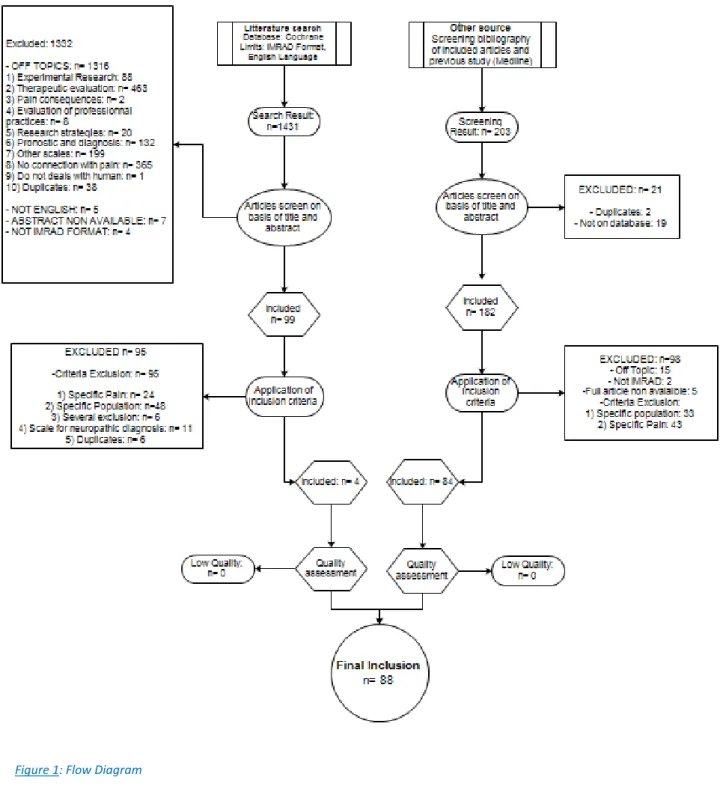
This systematic review was conducted between December 2017 and February 2018. The search returned 1431 results. Then, articles were screened on basis of titles and abstracts: 1332 studies were excluded. Among them, 1316 were off topics (with 38 duplicates), 5 were not written in English, 7 had not an available abstract and 4 were not written in an IMRAD format.
Next, the application of inclusion/exclusion criteria allowed to exclude 95 articles: 6 were duplicates and 89 met exclusion criteria. 4 studies were therefore included.
A quality assessment with the “Exercer” grid was applied (APPENDIX 4). This grid allows to limit the number of bias. Finally, the 4 articles were included with 6 different available scales. To use the studies cited by but unavailable in Cochrane database, a review of the bibliography of each included article was added. Another screening of the first study’s bibliography (based on Medline) was also realized. 203 studies were found. 21 were excluded because there were 2 duplicates and 19 not available on database. After application of inclusion criteria, 98 articles were excluded with 15 off topics, 2 which were not written in an IMRAD format, 5 because full articles were not available, 33 because of a specific population and 43 with a specific pain. After the same quality assessment as first part of the search, 84 articles were added to the 4 first. A total of 88 studies were included and 35 pain scales were found. See Figure 1.
20
In Table 1, are listed the 88 included studies. APPENDIX 2 exhibits different off topics.
21
Title Author Year Revue
Comparative Responsiveness of the PROMIS Pain Interference Short Forms, Brief Pain
Inventory, PEG, and SF-36 Bodily Pain Subscale(14)
Kean J, Monahan PO, Kroenke K, Wu J, Yu Z,
Stump TE, Krebs EE
2016 Medical care
Establishing a common metric for self-reported pain: linking BPI Pain Interference and SF-36 Bodily Pain Subscale scores to the PROMIS Pain
Interference metric(15)
Cook KF, Schalet BD, Kallen MA, Rutsohn JP,
Cella D.
2015 Qual Life Res
Associations between pain drawing and psychological characteristics of different body
region pains(16)
Hayashi K, Arai YC, Morimoto A, Aono S, Yoshimoto T, Nishihara
M, Osuga T, Inoue S, Ushida T.
2015 Pain Pract
Validity, reliability, and assessment sensitivity of the Japanese version of the short-form McGill pain questionnaire 2 in Japanese patients with neuropathic and non-neuropathic pain(17)
Maruo T, Nakae A, Maeda L, Shi K, Takahashi K, Morris S, Hosomi K, Kanatani H, Matsuzaki T, Saitoh Y. 2014 Pain Med
Using multiple daily pain ratings to improve reliability and assay sensitivity: how many is
enough?(18)
Heapy A, Dziura J, Buta E, Goulet J, Kulas JF,
Kerns RD.
2014 The Journal Of Pain
Psychometric properties and validation of the Italian version of the Mainz pain staging system as a tool for pain-patients referral selection.(19)
Samolsky Dekel BG, Gori A, Vasarri A, Adversi M, Di Nino G, Melotti RM. 2014 J Eval Clin Pract
Validation of the Japanese version of the pain self-efficacy questionnaire in Japanese patients
with chronic pain.(20)
Adachi T, Nakae A, Maruo T, Shi K, Shibata
M, Maeda L, Saitoh Y, Sasaki J.
2014 Pain Med
One, two, or three? Constructs of the brief pain inventory among patients with non-cancer pain
in the outpatient setting.(21)
Lapane KL, Quilliam BJ, Benson C, Chow W, Kim M. 2014 J Pain Symptom Manage
Depression and pain interference among patients with chronic pain after ED encounters.(22)
Wilson M, Roll J, Pritchard P, Masterson B, Howell D, Barbosa-Leiker C. 2014 J Emerg Nurs
Acute pain evaluation with Algoplus scale in Cambodian patients.(23)
Pickering ME, Bunna P, Rat P, Madeline G, Lebost C, Serrie A,
Pereira B.
22
The reliability of body pain diagrams in the quantitative measurement of pain distribution
and location in patients with musculoskeletal pain: a systematic review.(24)
Southerst D, Côté P, Stupar M, Stern P, Mior
S.
2013 J
Manipulative Physiol Ther
Characteristics of pain in hospitalized medical patients, surgical patients, and outpatients
attending a pain management centre.(25)
Rockett MP, Simpson G, Crossley R, Blowey S.
2013 Br J Anaesth
Cross-cultural adaptation and validation of the profile of chronic pain: screen for a Brazilian
population.(26)
Caumo W, Ruehlman LS, Karoly P, Sehn F, Vidor LP, Dall-Ágnol L,
Chassot M, Torres IL.
2013 Pain Med
Prevalence of chronic pain among Libyan adults in Derna City: a pilot study to assess the reliability, linguistic validity, and feasibility of
using an Arabic version of the structured telephone interviews questionnaire on chronic
pain.(27)
Elzahaf RA, Tashani OA, Johnson MI.
2013 Pain Pract
Pain questionnaire development focusing on cross-cultural equivalence to the original questionnaire: the Japanese version of the
Short-Form McGill Pain Questionnaire(28)
Arimura T, Hosoi M, Tsukiyama Y, Yoshida T, Fujiwara D, Tanaka M, Tamura R, Nakashima Y, Sudo N, Kubo C. 2012 Pain Med
Reliability, validity, and sensitivity measures of expanded and revised version of the short-form
McGill Pain Questionnaire (SF-MPQ-2) in Iranian patients with neuropathic and
non-neuropathic pain(29) Adelmanesh F, Jalali A, Attarian H, Farahani B, Ketabchi SM, Arvantaj A, Raissi GR. 2012 Pain Med
Reliability and validity of the Global Pain Scale with chronic pain sufferers.(30)
Gentile DA, Woodhouse J, Lynch P, Maier J,
McJunkin T.
2011 Pain
Physician
Turkish version of the Cornell Musculoskeletal Discomfort Questionnaire: cross-cultural
adaptation and validation.(31)
Erdinc O, Hot K, Ozkaya M.
2011 Work
Establishing the psychometric properties and preferences for the Northern Pain Scale.(32)
Ellis JA, Ootoova A, Blouin R, Rowley B, Taylor M, Decourtney C, Joyce M, Greenley W, Gaboury I. 2011 Int J Circumpolar Health
Computer-aided surface estimation of pain drawings - intra- and inter-rater reliability(33)
Persson AL, Garametsos S, Pedersen J.
23
Comparative responsiveness of pain outcome measures among primary care patients with
musculoskeletal pain.(34)
Krebs EE, Bair MJ, Damush TM, Tu W, Wu
J, Kroenke K.
2010 Med Care
Examining the cross-cultural validity of the english short-form McGill Pain Questionnaire
using the matched moderated regression methodology.(35)
Zinke JL, Lam CS, Harden RN, Fogg L.
2010 Clin J Pain
The end of the line? The Visual Analogue Scale and Verbal Numerical Rating Scale as pain
assessment tools in the emergency department.(36)
Mohan H, Ryan J, Whelan B, Wakai A.
2010 Emerg Med J
Cross-cultural adaptation and validation of a Brazilian Portuguese version of the chronic pain
grade.(37)
Bracher ES, Pietrobon R, Eluf-Neto J.
2010 Qual Life Res
Exploring alternative approaches to routine outpatient pain screening.(38)
Lorenz KA, Krebs EE, Bentley TG, Sherbourne CD, Goebel JR, Zubkoff L, Lanto AB, Asch SM.
2009 Pain Med
Systematic review of cross-cultural adaptations of McGill Pain Questionnaire reveals a paucity
of clinimetric testing.(39)
Menezes Costa Lda C, Maher CG, McAuley JH,
Costa LO.
2009 J Clin Epidemiol
How reliable is pain as the fifth vital sign?(8) Lorenz KA, Sherbourne CD, Shugarman LR, Rubenstein LV, Wen L, Cohen A, Goebel JR, Hagenmeier E, Simon B, Lanto A, Asch SM. 2009 J Am Board Fam Med
Development and test-retest reliability of an extended version of the Nordic Musculoskeletal Questionnaire (NMQ-E): a screening instrument
for musculoskeletal pain.(40)
Dawson AP, Steele EJ, Hodges PW, Stewart S.
2009 J Pain
Psychometric testing of the brief screening version of Multidimensional Pain Inventory
(Swedish version).(41)
Jakobsson U. 2009 Scand J Caring Sci
Development and initial validation of the PEG, a three-item scale assessing pain intensity and
interference(42)
Krebs EE, Lorenz KA, Bair MJ, Damush TM, Wu J, Sutherland JM, Asch SM, Kroenke K.
2009 J Gen Intern Med
French translation of the Multidimensional Pain Inventory: L'inventaire multidimensionnel de la
douleur.(43) Laliberté S, Lamoureux J, Sullivan MJ, Miller JM, Charron J, Bouthillier D. 2008 Pain Res Manag
24
Responsiveness of five condition-specific and generic outcome assessment instruments for
chronic pain.(44) Angst F, Verra ML, Lehmann S, Aeschlimann A. 2008 BMC Med Res Methodol
What do the numbers mean? Normative data in chronic pain measures(45)
Nicholas MK1, Asghari A, Blyth FM.
2008 Pain
Trial of a new pain assessment tool in patients with low education: the full cup test.(46)
Ergün U, Say B, Ozer G, Yildirim O, Kocatürk O, Konar D, Kudiaki C,
Inan L.
2007 Int J Clin Pract
Nonmalignant chronic pain evaluation in the Turkish population as measured by the McGill
Pain Questionnaire(47)
Oksuz E1, Mutlu ET, Malhan S.
2007 Pain Pract
Evaluating chronic pain impact among patients in primary care: further validation of a brief
assessment instrument.(48)
Karoly P, Ruehlman LS, Aiken LS, Todd M,
Newton C.
2006 Pain Med
Measurement of pain using the visual numeric scale.(49)
Ritter PL, González VM, Laurent DD, Lorig KR.
2006 J Rheumatol
Adapted version of the McGill Pain Questionnaire to Brazilian Portuguese.(50)
Varoli FK, Pedrazzi V. 2006 Braz Dent J
Thai Short-form McGill Pain Questionnaire (51) Kitisomprayoonkul W, Klaphajone J, Kovindha
A.
2006 J Med Assoc Thai
Lack of interchangeability between visual analogue and verbal rating pain scales: a cross sectional description of pain etiology groups.(52)
Lund I, Lundeberg T, Sandberg L, Budh CN, Kowalski J, Svensson E. 2005 BMC Med Res Methodol
Visual Analog Scale pain reporting was standardized.(53) Kane RL, Bershadsky B, Rockwood T, Saleh K, Islam NC. 2005 J Clin Epidemiol
Self-report and pain behavior among patients with chronic pain.(54)
McCahon S, Strong J, Sharry R, Cramond T.
2005 Clin J Pain
Pain: a review of three commonly used pain rating scales(55)
Williamson A1, Hoggart B.
25
The development and preliminary validation of a brief measure of chronic pain impact for use in
the general population(56)
Ruehlman LS, Karoly P, Newton C, Aiken LS
2005 Pain
Computerized dynamic assessment of pain: comparison of chronic pain patients and healthy
controls.(57)
Jamison RN, Fanciullo GJ, Baird JC.
2004 Pain Med
The evaluation of change in pain intensity: a comparison of the P4 and single-item numeric
pain rating scales.(58)
Spadoni GF, Stratford PW, Solomon PE, Wishart LR. 2004 J Orthop Sports Phys Ther
Development and validation of a brief, descriptive Danish pain questionnaire
(BDDPQ)(59)
Perkins FM1, Werner MU, Persson F, Holte K,
Jensen TS, Kehlet H.
2004 Acta
Anaesthesiol Scand
Validation of the Brief Pain Inventory for chronic nonmalignant pain(60)
Tan G, Jensen MP, Thornby JI, Shanti BF.
2004 J Pain
Minimum clinically significant VAS differences for simultaneous (paired) interval serial pain
assessments(61) Yamamoto LG, Nomura JT, Sato RL, Ahern RM, Snow JL, Kuwaye TT 2003 American journal of emergency medicine
Signaling does not adequately improve diary compliance.(62)
Broderick JE, Schwartz JE, Shiffman S, Hufford
MR, Stone AA.
2003 Ann Behav Med
Comparison of a verbal numeric rating scale with the visual analogue scale for the
measurement of acute pain(63)
Holdgate A1, Asha S, Craig J, Thompson J.
2003 Emerg Med (Fremantle)
Cross-cultural adaptation of the Nordic musculoskeletal questionnaire(64)
De Barros EN, Alexandre NM.
2003 Int Nurs Rev
Validation of a verbally administered numerical rating scale of acute pain for use in the
emergency department(65)
Bijur PE, Latimer CT, Gallagher EJ.
2003 Acad Emerg Med
Clinical importance of changes in chronic pain intensity measured on an 11-point numerical
pain rating scale(66)
Farrar JT, Young JP Jr, LaMoreaux L, Werth JL,
Poole RM.
2001 Pain
Reliability of the visual analog scale for measurement of acute pain.(67)
Bijur PE, Silver W, Gallagher EJ.
2001 Acad Emerg Med
26
Prospective validation of clinically important changes in pain severity measured on a visual
analog scale.(68)
Gallagher EJ, Liebman M, Bijur PE.
2001 Ann Emerg Med
An examination of the psychometric structure of the Multidimensional Pain Inventory(69)
Deisinger JA, Cassisi JE, Lofland KR, Cole P,
Bruehl S.
2001 J Clin Psychol.
Confirming the theoretical structure of the Japanese version of the McGill Pain
Questionnaire in chronic pain (70)
Hasegawa M, Mishima M, Matsumoto I, Sasaki T, Kimura T, Baba Y, Senami K, Kanemura K, Takano O, Shibata T. 2001 Pain Med
Psychometric properties of a Spanish version of the McGill Pain Questionnaire in several
Spanish-speaking countries(71) Lázaro C, Caseras X, Whizar-Lugo VM, Wenk R, Baldioceda F, Bernal R, Ovalle A, Torrubia R, Baños JE. 2001 Clin J Pain
The McGill Pain Questionnaire, Japanese version, reconsidered: confirming the theoretical
structure (72) Hasegawa M, Hattori S, Mishima M, Matsumoto I, Kimura T, Baba Y, Takano O, Sasaki T, Kanemura K, Senami K, Shibata T. 2001 Pain Res Manag
Changes in chronic pain severity over time: the Chronic Pain Grade as a valid measure (73)
Elliott AM1, Smith BH, Smith WC, Chambers
WA.
2000 Pain
Concordance between ratings using different scales for the same variable(74)
Svensson E1. 2000 Stat Med
Internal structure and validity of the multidimensional pain inventory, Italian
language version(75)
Ferrari R1, Novara C, Sanavio E, Zerbini F.
2000 Pain Med
Simple pain rating scales hide complex idiosyncratic meanings(76)
de C Williams AC1, Davies HT, Chadury Y.
2000 Pain
Some empirical evidence regarding the validity of the Spanish version of the McGill Pain
Questionnaire (MPQ-SV)(77)
Masedo AI, Esteve R. 2000 Apr Pain
Comparative reliability and validity of chronic pain intensity measures.(78)
Jensen MP, Turner JA, Romano JM, Fisher LD.
1999 Pain
Psychometric properties of the Multidimensional Pain Inventory, Dutch language version
(MPI-DLV)(79)
Lousberg R1, Van Breukelen GJ, Groenman NH, Schmidt AJ, Arntz A, Winter FA.
1999 Behav Res Ther
27
Comparative study of methods of measuring acute pain intensity in an ED.(80)
Berthier F, Potel G, Leconte P, Touze MD,
Baron D.
1998 Am J Emerg Med
Does the clinically significant difference in visual analog scale pain scores vary with gender, age,
or cause of pain? (81)
Kelly AM. 1998 Nov Acad
Emerg Med
Reliability and factor structure of the Multidimensional Pain Inventory--Swedish
Language Version (MPI-S)(82)
Bergström G1, Jensen IB, Bodin L, Linton SJ,
Nygren AL, Carlsson SG.
1998 Pain
The Chronic Pain Grade questionnaire: validation and reliability in postal research(83)
Smith BH, Penny KI, Purves AM, Munro C, Wilson B, Grimshaw J,
Chambers WA, Smith WC.
1997 Pain
The minimum clinically important difference in physician-assigned visual analog pain scores.(84)
Todd KH, Funk JP. 1996 Acad Emerg Med
Confirmatory factor analysis of a 4-factor model of chronic pain evaluation.(85)
De Gagné TA, Mikail SF, D'Eon JL.
1995 Pain
Increasing the reliability and validity of pain intensity measurement in chronic pain
patients(86)
Jensen MP, McFarland CA.
1993 Pain
Grading the severity of chronic pain(87) Von Korff M, Ormel J, Keefe FJ, Dworkin SF.
1992 Pain
Questionnaire development: an examination of the Nordic Musculoskeletal questionnaire(88)
Dickinson CE, Campion K, Foster AF, Newman
SJ, O'Rourke AM, Thomas PG.
1992 Appl Ergon
The development of a Norwegian pain questionnaire(89)
Strand LI, Wisnes AR. 1991 Pain
Self-monitored pain intensity: psychometric properties and clinical utility(90)
Kerns RD, Finn P, Haythornthwaite J.
1988 Behav Med
Test-retest reliability of the pain drawing instrument(91)
Margolis RB, Chibnall JT, Tait RC.
1988 Pain
The German counterpart to McGill Pain Questionnaire(92)
28
The McGill Pain Questionnaire constructed for the Dutch language (MPQ-DV). Preliminary
data concerning reliability and validity(93)
Vanderiet K, Adriaensen H, Carton H, Vertommen H.
1987 Pain
The measurement of clinical pain intensity: a comparison of six methods (94)
Jensen MP, Karoly P, Braver S.
1986 Pain
The West Haven-Yale Multidimensional Pain Inventory (WHYMPI)(95)
Kerns RD, Turk DC, Rudy TE.
1985 Pain
The McGill Pain Questionnaire: a replication of its construction.(96)
Reading AE, Everitt BS, Sledmere CM.
1982 Br J Clin Psychol
A pain vocabulary in Finnish-The Finnish pain questionnaire(97)
Ketovuori H, Pöntinen PJ.
1981 Pain
Reproducibility along a 10 cm vertical visual analogue scale(98)
Dixon JS, Bird HA. 1981 Ann Rheum Dis
Graphic representation of pain(99) Scott J, Huskisson EC. 1976 Pain
The McGill Pain Questionnaire: major properties and scoring methods(100)
Melzack R. 1975 Pain
Table 1: Included articles
Type of the 88 studies
Cross Sectional
Randomized placebo controlled
paired trial
Cohort Translation Systematic Review
Construction Meta-analysis
55 1 6 15 3 7 1
Aim of the 88 studies
Minimum clinically significant differences Clinical importance of changes
Reliability Comparison Daily Assessment Translation Translation + Reliability Construction Construction + Reliability 1 5 30 25 1 2 16 5 3
29
SYNTHESIS OF RESULTS
a. One-dimensional pain scales
One-dimensional pain scales are mostly used to assess acute pain. They evaluate only one parameter, which is commonly pain intensity.
Visual Analog Pain Scale
Visual Analog scale (VAS) is the most commonly used scale because of its ease of use and its simple construction. It was introduced in the first part of the 20th century. It’s a graduated 100-mm line with one-hand marked as “No pain” and the other hand marked as “worst possible pain”. Patients move the cursor themselves where it better corresponds to their current pain. Finally, the distance from “no pain” to the cursor is measured in millimeters. See figure 2.
This scale was studied in 16 articles in this current review. (36,52,53,55,61,63,67,68,74,76,80,81,84,94,98,99)
It was used 14 times as a reference (16,28,29,31,35,46,47,49,51,59,65,71,72,75).
Five variants (considered as variants of the Visual Analog Scale because they need graphic support and evaluate only pain intensity) were found in this current review: the full cup test(46) (developed to patients with low education), the Visual Numeric scale (49) (which combines strong visual cues with an 11-point numeric rating scale), the Horizontal Numerical Graphic Rating Scale (54), the Dynamic VAS (computerized version of VAS)(57) and the 11-points
Box Pain Scale (94) (a 11-item tool represented by boxes).
30
The Numerical Pain Rating Scale (or Verbal Numerical Rating Scale)
Numerical Pain Rating Scale (NPRS) is a unidimensional measure of acute or chronic pain intensity. The most commonly used is the 11-item NPRS. From 0 (“No pain”) to 10 (“Worst possible pain”), patients select the number that best reflects the intensity of their pain. The NPRS can be administered verbally or graphically. See figure 3.
This scale was studied in 14 articles(8,36,38,44,45,55,63,65,66,76,78,80,86,94). It was used as a reference in 5 articles(23,28,32,58,77).
Four variant scales were found: the composite scores (78), the electronic diary version(18) and the 4-Item Pain Intensity Measurement (P4) (58) and the NRS seven point version(74).
Concerning the composite scores, authors thought the combination of individual pain ratings could be a more valid and reliable measure of pain intensity than individual ratings. First, patients had to assess, with a 11-item NRS, their worst, least and average pain over the past 2 weeks. Then, 3 composite pain intensity scores were created by calculating the averages of different parameters over the past 2 weeks (a 2-item scale: least and average pain ratings, a 3-item scale: worst, current and average pain ratings and a 4-3-item scale: worst, current, least and average pain ratings of the last 2 weeks).
The P4 is a pain intensity tool consisting of 4 items that evaluate pain intensity in the morning, in the afternoon, in the evening, and with activity over the past 2 weeks. Each item is scored on a 0-10 NPRS. P4 scores vary from 0 (no pain) to 40 (highest possible pain level)
31
Visual Rating Scale (VRS)
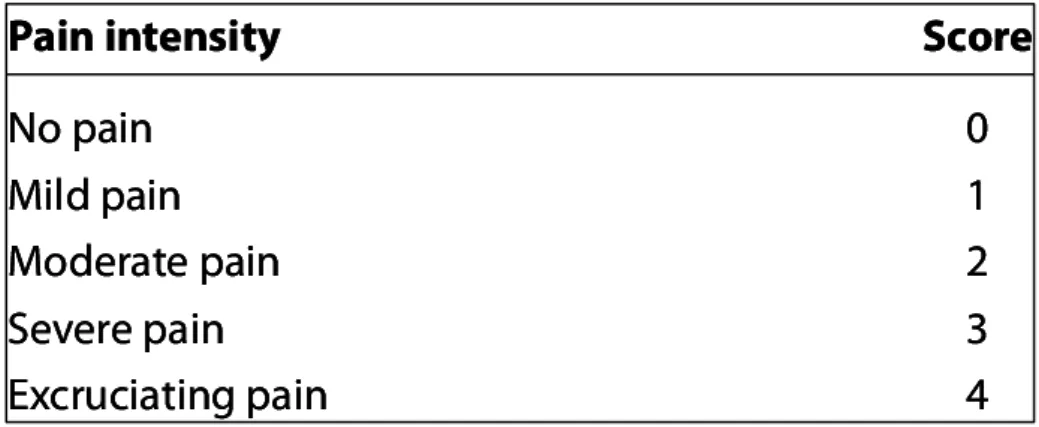
The Verbal rating Scale is a 5-item one-dimensional pain scale with eligible alternatives -no pain, mild, moderate, severe, worst possible pain. Patients must choose the best adjective that correspond to their current pain. See Figure 4.
This scale was studied in 4 articles in this current study(52,55,80,94). It was used as a reference in 3 articles (25,71,72)
Four variants were found: the Dynamic Verbal Ratings (computerized version)(57), the Self-Monitored Pain Intensity(90), the 4-points Verbal Rating Scale(94) and the 5-points Verbal Rating Scale(94).
The Self-Monitored Pain Intensity is a tool which allowed to patients to record their perceived pain intensity on an hourly basis for 2 weeks, with a 6-points verbal scale like Present Pain Intensity part of the McGill Pain Questionnaire (0 = No pain, 1 = mild, 2 = discomforting, 3 = distressing, 4 = horrible, 5 = excruciating).
32
Algoplus
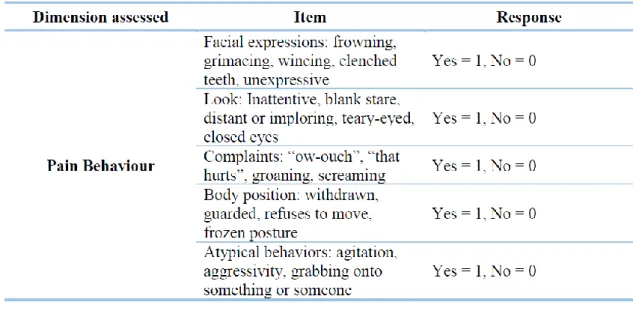
This 5-item hetero-evaluation pain scale had been initially developed in 2011 for detecting acute pain in elderly patients with the inability to communicate. But this behavior scale can also be used for strangers who don’t share a common language in order to assess pain severity. The 5 items studied are facial expression (frowning, grimacing etc.), complaints (“ouch-ow”, “that hurts” etc.), the look (inattentive, distant etc.), body position (refuses to move, withdrawn etc.) and atypical behavior (agitation, aggressivity etc.)
This scale was studied in one article in this current review(23). See Table 3.
Table 3: Algoplus (11)
Wong and Baker Faces Pain Scale
This scale was created in 1988(102). This auto evaluation pain scale represents 6 various facial expressions progressing from a smiling face at one end, correlating with no pain, to an extremely unhappy face at the other end, correlating with the worst pain. The patient chooses the one that best fits his current pain. See Figure 5.
33
This scale was studied in 1 article (32). It was not used as a reference.
Figure 5: Wong and Baker Faces Pain Scale (102)
Pain Drawing
In this pain scale, patients must mark on a human line drawing (anterior and posterior view) the localization of their pain. Different versions of pain drawing exist but they are not consensual (including pain intensity, organic pain or not etc.). Therefore, this scale is classified as a one-dimensional pain scale. See Figure 6.
This scale was studied in four articles in this current review(16,24,33,91). It was not used as a reference.
One variant was found: Dynamic Pain Drawings (computerized version) (57)
34 b. Summary of one-dimensionnal scales
Different parameters of one dimensional scales are provided in Table 4.
Number of time quote in an article Number of time used as a reference How many derived scales were found? The explored dimension Is a graphic support needed? The type of evaluation used Visual Analog
Pain Scale 16 14 5 Intensity Yes
Number given by a cursor on a
10cm line
Numeric Pain
Rating Scale 14 5 4 Intensity Yes or No Number from 0 to
10
Verbal Rating
Scale 4 3 4 Intensity No
Number given by a list of adjectives
Algoplus 1 0 0 Pain Behavior No Yes/No
Hetero-evaluation
Wong and Baker Faces
Pain Scale
1 0 0 Intensity Yes Number given by the chosen face
Pain
Drawings 4 0 0 Localization Yes
Mark on a pictorial body
Table 4: Summary of one dimensional scales parameters
c. Multidimensional scales
Multidimensional scales are useful to evaluate chronic pain severity. Composed by several items, they evaluate pain intensity but also pain interferences, disabilities etc.…
Short Form-36 Bodily Pain Subscale (SF-36 BPS)
The MOS 36-Item Short-Form Health Survey (SF-36) was created in 1993 as a physical, mental and psychosocial health assessment scale (103). This scale has been declined in eight different subscales. (15,34,44)
The 2-item Bodily pain subscale (SF-36 BPS) is studied in 4 articles in this current review(14,15,34,44). It was used as a reference in 3 articles (20,37,42).
35
This subscale assesses the pain during the 4 past weeks. One item evaluates pain interference on a 1-5 verbal rating scale. The other item assesses pain severity on a 1-6 verbal rating scale. See Table 5 on APPENDIX 5
Brief Pain Inventory (BPI)
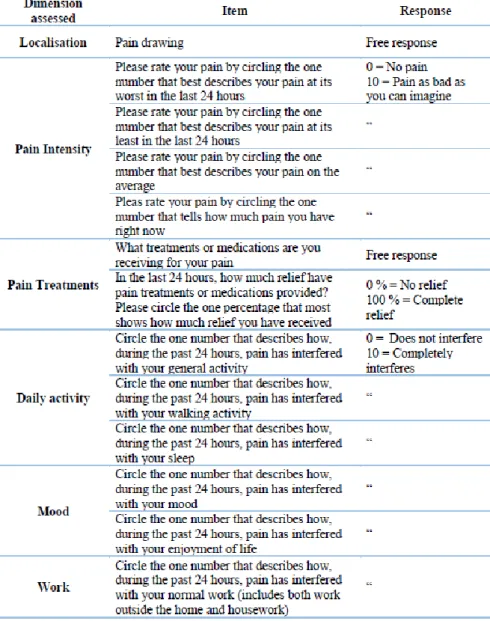
BPI was created in 1993 initially to estimate pain in a cancer population(104). This 11-item pain scale; using a 0-10 NRS, a pain drawing and questions about treatment; measures two domains of pain: a seven-item about interference dimension and a four-item about severity dimension.
This scale was studied in 5 articles in this current review (14,21,25,34,60). It was used as a reference in 6 articles (8,19,22,38,42,62). See table 6 on APPENDIX 5.
Ultra-Brief 3-item PEG (UB-3-PEG)
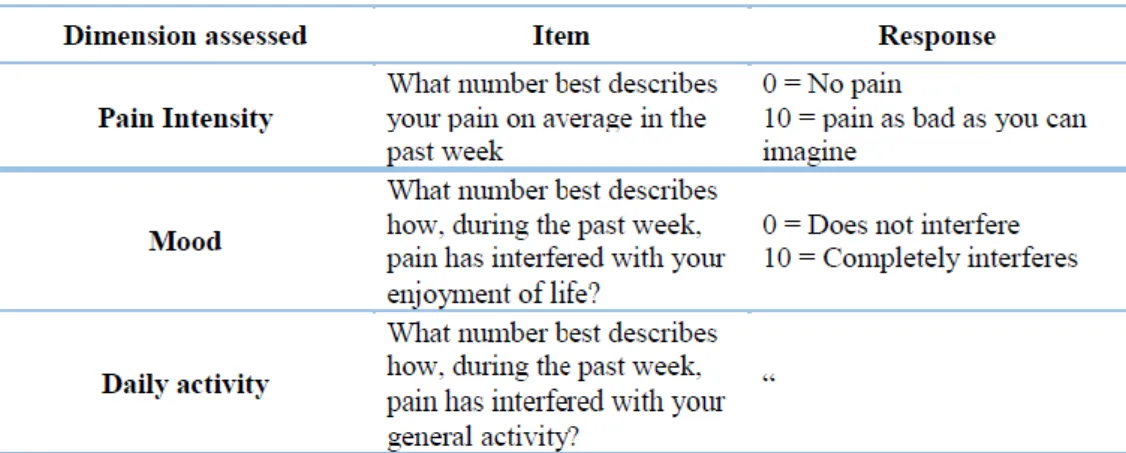
This scale, derived from the Brief Pain Inventory, was created in 2009. The PEG (“P” for pain intensity, “E” for enjoyment of life, “G” for interference with general activity) comprises 1 intensity item and 2 interference items using a 0-10 NRS.
This scale was studied in 3 articles in this current review (14,34,42). It was not used as reference. See table 7 on APPENDIX 5
Chronic Pain Grade (CPG)
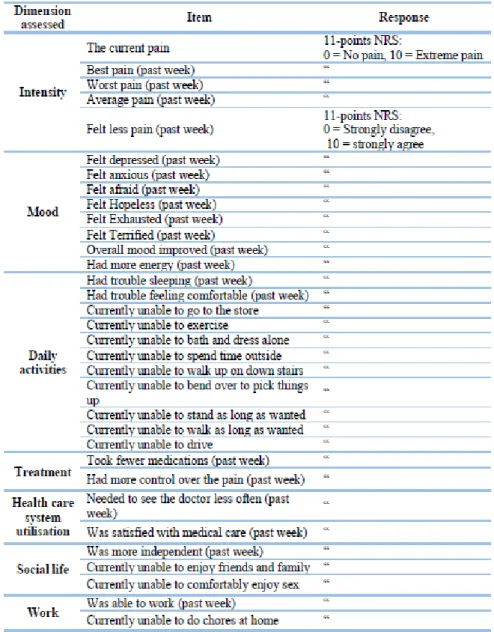
This pain scale was created in 1992. This is a seven-item instrument which provide a pain severity score distributed into 4 hierarchical classes: low disability--low intensity (Grade I); low disability--high intensity (Grade II); high disability--moderately limiting (Grade III); and high disability--severely limiting (Grade IV). Using NRS, sub-scale scores evaluate pain intensity, frequency of pain and limitation of activities due to pain.
36
This scale was studied in 5 articles (34,37,73,83,87) in this current review. It was used once as a reference (42). See Table 8 on APPENDIX 5.
Profile of Chronic Pain: Screen (PCP: S)
This 15-items multidimensional pain scale, created in 2005, comprised a 4-items severity scale, a 6-items interference scale and a 5-items emotional burden scale.
This scale was studied in 3 articles(26,48,56). It was not used as a reference. See Table 9 on APPENDIX 5.
Structured Telephone Interviews Questionnaire on Chronic Pain (STIQ on CP)
This multidimensional scale, created in England in 2006(105), is a telephone questionnaire, composed of two parts: a screening interview consisting of 12 questions to gather data on age and gender, duration of pain, frequency of pain during the previous week, intensity of pain during last pain episode, location of pain and cause of pain; and 44 questions to gather information about demographics, frequency, duration, intensity and impact of pain on work and quality of life. In Fact, it gathers 90 items divided into 5 groups: assessment of inclusion criteria, evaluation of the global pain context, pain evaluation, assessment about pain interference and, finally, demographic aspect. Verbal scales, numerical scales, yes/no answer, free answers and lists with multiple choices are used in this pain scale to assess many pain dimensions.
This scale was studied in only one article in this current review (27). It was not used as a reference. See Table 10 on APPENDIX 5.
Global Pain Scale (GPS)
This 33-items pain scale, created in 2005, assesses 4 pain dimensions with NRS: physical pain (pain intensity), affective effects of pain, specific clinical outcomes (effect of pain on
37
patients’ quality of sleep, comfort, medication consumption etc.) and the degree to which the pain interferes with activities of daily living. These 4 subscales provide a single number between 0 and 100 to describe overall pain and its effects.
This scale was studied in 1 article in this current review(30). It was not used as a reference. See Table 11 on APPENDIX 5.
Cornell Musculoskeletal Discomfort Questionnaire for standing worker (CMDQ fsw) This 4-item pain scale evaluates 4 pain dimensions with a VRS (the frequency in the past work week, the severity, work interferences and the localization) linked to a pictorial back body, different for male and female, composed by 20 body parts.
This scale was studied in 1 article in this current review (31). It was not used as a reference. See Table 12 on APPENDIX 5.
Nordic Musculoskeletal Questionnaire (NMQ)
This scale, created in 1987, assesses 4 pain dimensions using an illustration of the human body seen from behind: annual and weekly pain prevalence, functional incapacity and search for medical assistance in the last 12 months. Pictorial body is divided in nine parts linked to 4 questions, corresponding to pain dimensions. See Table 13 on APPENDIX 5.
This scale was studied twice in this current review (64,88). It was not used as a reference. One variant scale was found: the Extended Nordic Musculoskeletal Questionnaire (Ex NMQ) (40). Patients have to answered to 11 questions about their pain. This scale is more precise on pain prevalence and consequences of pain in the previous year.
38
West Haven Yale Multidimensional Pain Inventory (WHYMPI)
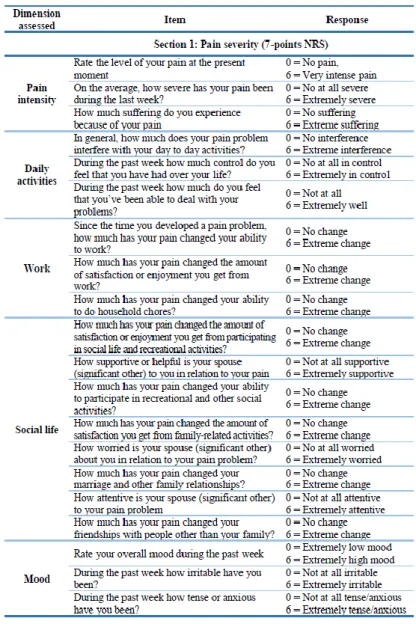
This 52-item scale was created in 1985. It’s composed by 3 sections evaluating pain intensity and pain interference with daily activities, work and social life; using a 7-points NRS for each question. This scale was studied in 9 articles (43–45,69,75,79,82,85,95). It was used as reference in 3 articles (30,56,90). See Table 14 on APPENDIX 5.
One variant of the WHYMPI was found in this current review: The Brief screening version of the Multidimensional Pain Inventory (BSv MPI)(41). It includes 34 of the 52 items and explores the same pain dimensions.
The Mainz Pain Staging System (MPSS)
Initially developed in the 2000s in Germany, the Mainz Pain Staging System is a 10-item multidimensional tool evaluating 4 axes: pain persistence (items 1-3), spatial aspects (item 4), drug intake and withdrawal treatments (items 5 and 6) and health care system utilization (items 7-10). The Resulting score classifies patients at three chronicity stages: I: Mild; II: Moderate; III: Severe Chronic Pain. See Table 15 on APPENDIX 5.
This scale was studied once in this current review (19). It was not used as a reference.
The McGill Pain Questionnaire (McGPQ)
The McGill Pain Questionnaire was created in 1975. Classically described as a 78-item tool , this multidimensional pain scale is separated into four parts: Pain Rating Index (PRI) containing 20 subclasses, each containing 2– 6 words finally grouped in 4 pain dimensions (sensory, affective, evaluative, and a miscellaneous category); a 5-point pain intensity scale (present pain intensity [PPI]); a pictoral body to locate the pain and a 3-point verbal rating scale where patients choose the word corresponding to the pattern of their pain. See Table 16 on APPENDIX 5.
39
This scale was studied in 15 articles in this current review (39,45,47,50,70– 72,77,85,89,92,93,96,97,100). It was used as a reference in 5 articles (51,59,75,90,95).
The Short-Form McGill Pain Questionnaire (SF-McGPQ) is the main variant of the McGPQ. It was created in 1987 as a rapid evaluation tool and includes 15 pain descriptors (11 sensory and 4 affective), a VAS and a present pale intensity scale. See Table 17 on APPENDIX 5.
This subscale was studied in 6 articles in this current review (17,31,38,41,68,73). It was used as a reference in 4 articles (8,30,50,63).
The Short-Form McGill Pain Questionnaire 2 (SF McGPQ 2) was created later, with 7 additional items to measure both neuropathic and non-neuropathic pain, so 22 items that patients rate on a 0-10 NRS.
This subscale was studied in 2 articles in this current review (17,32). It was not used as a reference.
d. Summary of multidimensional scales
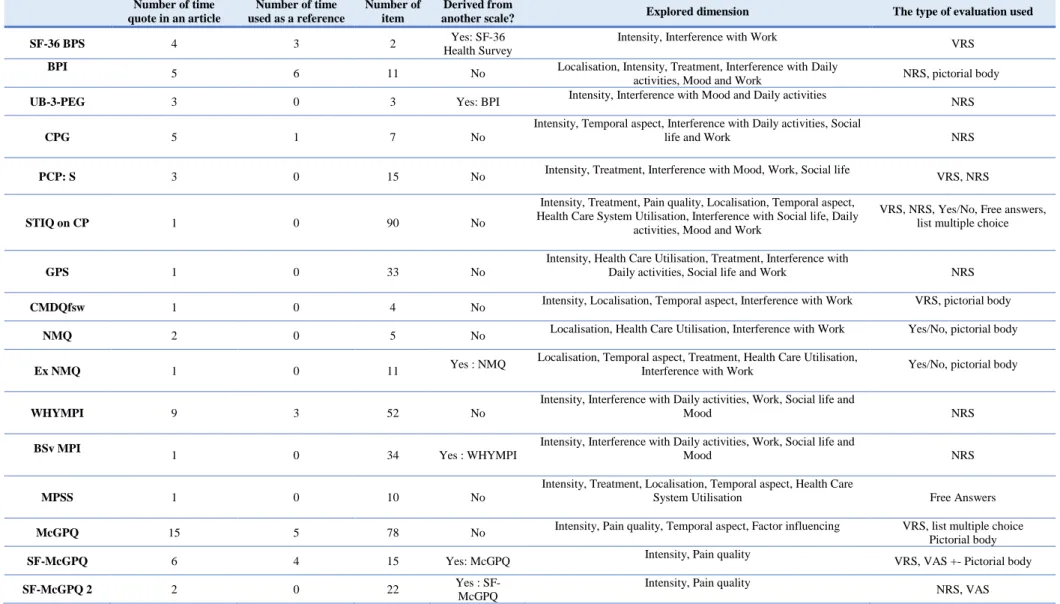
A summary of different parameters of multidimensional scales is available on table 4.
DISCUSSION
This study was prompted by the need of establish an inventory of different pain scales studied in general population, for the daily exercise of general practitioners. Indeed, very few literature reviews are available about this topic.
35 scales have been found in this current review. They have been classified in two different groups: one-dimensional scales, with 6 main scales and 13 derived scales, and multidimensional scales with 12 main scales and 4 derived scales.
40 Number of time quote in an article Number of time used as a reference Number of item Derived from
another scale? Explored dimension The type of evaluation used
SF-36 BPS 4 3 2 Yes: SF-36
Health Survey
Intensity, Interference with Work
VRS BPI
5 6 11 No Localisation, Intensity, Treatment, Interference with Daily
activities, Mood and Work NRS, pictorial body
UB-3-PEG 3 0 3 Yes: BPI Intensity, Interference with Mood and Daily activities NRS
CPG 5 1 7 No
Intensity, Temporal aspect, Interference with Daily activities, Social
life and Work NRS
PCP: S 3 0 15 No Intensity, Treatment, Interference with Mood, Work, Social life VRS, NRS
STIQ on CP 1 0 90 No
Intensity, Treatment, Pain quality, Localisation, Temporal aspect, Health Care System Utilisation, Interference with Social life, Daily
activities, Mood and Work
VRS, NRS, Yes/No, Free answers, list multiple choice
GPS 1 0 33 No
Intensity, Health Care Utilisation, Treatment, Interference with
Daily activities, Social life and Work NRS
CMDQfsw 1 0 4 No Intensity, Localisation, Temporal aspect, Interference with Work VRS, pictorial body
NMQ 2 0 5 No Localisation, Health Care Utilisation, Interference with Work Yes/No, pictorial body
Ex NMQ 1 0 11 Yes : NMQ
Localisation, Temporal aspect, Treatment, Health Care Utilisation,
Interference with Work Yes/No, pictorial body
WHYMPI 9 3 52 No
Intensity, Interference with Daily activities, Work, Social life and
Mood NRS
BSv MPI
1 0 34 Yes : WHYMPI
Intensity, Interference with Daily activities, Work, Social life and
Mood NRS
MPSS 1 0 10 No
Intensity, Treatment, Localisation, Temporal aspect, Health Care
System Utilisation Free Answers
McGPQ 15 5 78 No Intensity, Pain quality, Temporal aspect, Factor influencing VRS, list multiple choice Pictorial body
SF-McGPQ 6 4 15 Yes: McGPQ Intensity, Pain quality VRS, VAS +- Pictorial body
SF-McGPQ 2 2 0 22 Yes :
SF-McGPQ
Intensity, Pain quality
NRS, VAS
Table 4: Summary of Multidimensional scales parameters (BPI:Brief Pain Inventory, BSy MPI: Brief screening version of the Multidimensional Pain Inventory, CMDQ fsw: Cornell Musculoskeletal Discomfort Questionnaire for standing worker, CPG: Chronic Pain Grade, Ex NMQ: Extended version of the Nordic Musculoskeletal Questionnaire, GPS: Global Pain Scale, McGPQ: McGill Pain Questionnaire, MPSS: The Mainz Pain Staging System, NMQ: Nordic Musculoskeletal Questionnaire, NRS: Numerical Rating Scale, PCP: S: Profile of Chronic Pain: Screen, SF-36 BPS: Short-Form-36 Bodily Pain Subscale, SF-McGPQ: Short-Form McGill Pain Questionnaire, SF-McGPQ 2: Short-Forme McGill Pain Questionnaire 2, STIQ on CP: Structured Telephone Interviews Questionnaire on Chronic Pain, UB-3-PEG: Ultra-Brief 3-item PEG, VAS: Visual Analog Scale, VRS: Verbal Rating Scale, WHYMPI: West Haven Yale Multidimensional Pain Inventory.