Performance Assessment
Performance Evaluation of Adaptive
Facades: A case study with electrochromic
glazing
Senem Bilir a),b), Shady Attia a)
a) Sustainable Buildings Design Lab, Department UEE, Faculty of Applied Sciences, Univeristé de Liège, Belgium
b) Technical University of Istanbul, Department of Civil Engineering, Division of Construction Management, Ayazaga Campus, Maslak, 34469 Istanbul, Turkey
Adaptive facades are performance based envelopes that are able to respond dynamically to climatic conditions. One of the recognized adaptive façade technologies is electrochromic (EC) glazing. However, very few studies evaluated the performance of EC glazing on the building level. Therefore, we selected a case study of a certified educational building with a nearly zero energy building performance that includes an EC facade. The overall aim of the research is to understand the performance requirements of EC glazing and its overall contribution to energy saving s and thermal and visual comfort improvement. The performance of the Swiss International School in Dubai was analyzed based on interviews with the design and build team, monitored data and post occupancy evaluation. A systematic process mapping took place to review the performance indicators, simulation tools and team responsibilities during the design, construction and operation stages of the building. The paper identifies the key performance criteria of EC glazing in relation to energy and comfort. Finally, we assess the significance of using EC glazing from a technical point of view and share the learned lessons for architects and façade engineers.
Keywords: Dynamic façade, electrochromic glazing, post-occupancy evaluation, façade assessment, monitoring
1 Introduction
Nowadays, there are a great number of dynamic and adaptive façades and envelopes technologies that are easily available in the market (Loonen et al. 2013 and Attia et al. 2018a). The decision as to how they are designed, operated, maintained and evaluated remains a challenge. Our case study presented in this paper aims better understanding of its design process, modeling and real performance. It will help present the benefits as well as the challenges seen in specific solutions with respect to energy use, comfort, and user experience. Currently, only a limited number of case studies of adaptive facades have been evaluated and documented (Attia, 2016a). There are few studies that performed post-occupancy evaluation for dynamic facades includes Al Bahr Towers in Dubai (Karanouh & Kerber, 2015; Attia, 2016b), AGC Building in Louvain La Neuve (Samyn & De Coninck, 2014a), AGC Glass Building (Attia and Bashandy, 2015) and the BIQ house in Hamburg (Wurm, 2013). The decision as to how they are designed, operated, maintained and assessed remains undisclosed and this in turn affects the wide expansion and market penetration of adaptive façades. The paper is part of the research activities of Workgroup 3 of the European COST Action 1403 on Adaptive Facades, which is mainly concerned with the adaptive facades system design and assessment (Luible 2014). The work group is figuring out how adaptive facades were designed and assessed during the major project delivery phases.
Performance Assessment
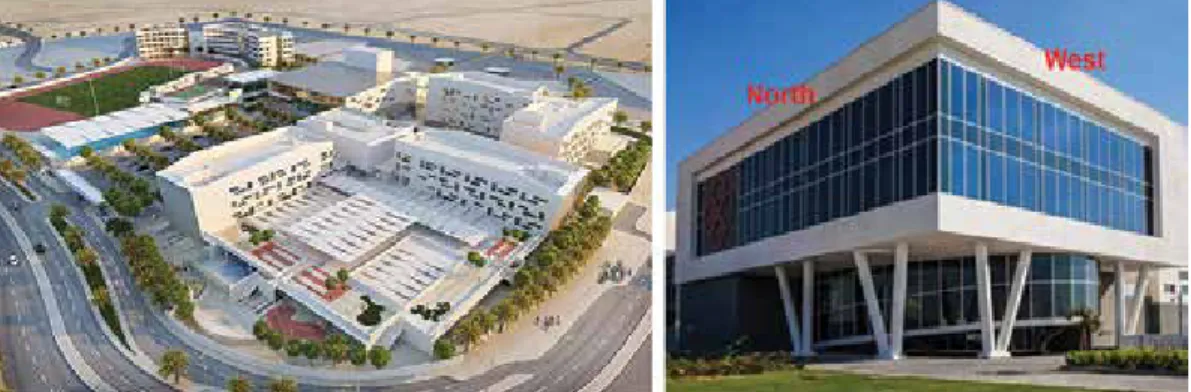
For this paper, different research methods were used for the case study documentation, thisinclude: literature review, interviews with the architect, façade engineer, glazing manufacturer, commissioning agents, reviews of standards and codes and systematic process mapping and post-occupancy evaluation (POE). In this context, we present a case study description and technical details for the Swiss International School of Dubai (SISD) project façade system (Figure 1ab). The case study provides significant insights of electrochromic (EC) glazing façade design process and explains the effect of EC glazing on the indoor environmental quality (IEQ) in such harsh climate conditions of Dubai.
2 Methodology and Objectives
The goal of this work is describe in detail the process of design, construction and use of an adaptive EC glazing façade – in this case Swiss International School of Dubai - and evaluate its performance. As well as to propose a generic performance process map that could be used as a visual guideline support by companies in the building industry.
First of all several existing documents were reviewed. The Minergie standards and some
applications have been reviewed (Beyeler et al., 2009; Hall et al. 2016) this includes: Planning and Project the Minergy-Standard for Buildings. Secondly, the project delivery process was mapped using the software MindMap to realize global and specific maps. This software allowed drawing clearly hierarchical scales, tasking charges suite and information flows. To limit the scope of the process map we focused on the identification and modeling of generic processes that was associated with the SISD project delivery. The generic process identification can generalize and used as a check-list to future designs of adaptive facades. Creating a process map involved systematic data-based interviews. Interviewees where asked to explain exactly what they did during the SISD project delivery, as well as share their technical challenges and express their expectations. For every interviewee, a scope was defined identifying the parameters he or she was dealing with during the project. A technical drawing software program was used to visualize the process. After completing a first round of interviews, interviewees were asked for feedback (reviews) and confirmation to validate the process maps.
Finally, a POE following ASHARE-55 survey (2013) was conducted for 43 person (39 responses) in relation to occupant comfort (visual and thermal) and façade operation. ASHRAE questionnaire focused on subjective responses of user’s experience with a focus on the clothing and activity levels and visual and thermal comfort perception. Due to the difficulty to assess the effectiveness of control strategy with respect to visual and thermal comfort and energy use the POE questionnaire was amended with questions based on a previous study conducted by Attia et al. (2018b and 2019).The POE was conducted between December 2016 and February 2017 and May and July 2017 to represent the summer and winter season. Also, we based our assessment on real measurements following the Fanger ISO 7730 model using the predictive mean vote (PMV) and predicted people dissatisfied (PPD) methods. Testo Kit for Indoor air quality and comfort level measurement was used. Also, we conducted several interviews with the architect, façade engineer as well as the technical control specialist.
Fig. 1a: SISD Campus general view (Rendering | ARCHILAB – Gabriele M. Rossi Sa), 1b: 110 square meters of electronically tintable glass installed in the façade of the offices at SISD, Architect: ArchiLab, DSA, UA, Source: dubaioursandbox.com
3 Case Study
SISD is an eco-friendly campus, meeting the sustainable standards and reflects a comfortable and healthy interior climate with highest standards of energy consumption. The school is located in a quiet part of Al Jaddaf, close to the Business Bay Bridge, adjacent to Dubai Creek. It has a capacity to host over 2000 students and received the Happy Healthy School award from the Knowledge and Human Development Authority recently.
3.1 Concept of the project
SISD is the Middle East’s first low-energy building in the education sector and campus includes more than 55.000 sq m teaching area and has eight main plants which are: primary school, secondary and high school, auditorium (700 seats), sport center and boarding house (3 residential blocks). The design submitted by Archilab - Gabriele M Rossi, with DSA Architects and engineering services including structural, building services, fire, infrastructure and traffic engineering, plus sustainability consultancy are provided by WME Consultants. The construction was completed in 2017.
3.2 The envelope
Although it is not formally needed, the client demanded that the primary and secondary school buildings meet the Minergie (a renowned international certificate for the pursuit of sustainable standards) use guidelines, together other intimate international and local standards. The primary school building, which has earned the Swiss MINERGIE certification, consumes one-third the energy of standard buildings. According to the client’s demands SISD energy concept was determined in brief: envelope optimization depending on day lighting and load minimization, HVAC by zone, building simulation and MINERGIE target. Thus, the design team of SORANE SA who took developing an energy concept for SISD project, also considered efficient protection from the sun, cooling demand reduction (optimization of the glazed surface), tight envelope, reducing outside air the strict minimum, using high efficient ventilation systems, controlling the ventilation schedules (only during occupations), avoiding the use of air cooling systems and increasing chilled water temperature (higher EER) within the energy strategy of the SISD campus project.
Performance Assessment
By using this energy strategy the performance of the envelope can be summarized as followings:•
Highly tight envelope with air well designed air locks;•
U value of opaque surface (including spandrel) is lower 0.3 W/(m2.K) (equivalent 10 cm of thermal insulation);•
U value of roof is 0.2 W/(m2.K) (equivalent of 15 cm of thermal insulation);•
U value of glazing is 1.0 W/(m2.K);•
g value of glazing is 0.16 (SHGC);•
Visible light transmittance is 0.3;•
U value of framing is 1.6 W/(m2.K). 3.3 Day lighting levelDuring the initial design of the building envelope the design team wanted to use EC glazing panels in all four orientations of the façade openings as the base case scenario. However, direct solar radiation duration (in hours) was found to be too long in Dubai with an increasing effect on cooling loads (Table 1). The daylight factor was above 1,5% and the 95% autonomy was ensured in most school classes. In order to ensure daylight and reduce cooling load, it was decided to use EC glazing in the office building in its North and West Façades of the secondary school (Figure 1b). 110 square meters of electronically tintable glass was installed in both façade with a Window-to-Wall Ratio (WWR) of 85%. Dynamic glass controls sunlight in order to optimize daylight and maintain outdoor views while simultaneously enhance occupant comfort by preventing glare and solar heat.
Table 1: Difference of solar radiation in Base Case and North lights (Bourdoukan, 2016)
3.4 Building Simulation
Three dimensional modeling and dynamic thermal simulation of the secondary school, auditorium and library were prepared in order to observe thermal comfort of the blocks according to the Dubai’s climatic data. Also, with the usage of the building simulation thermal coupling and integration of the detailed HVAC system were checked. Hourly dynamic thermal simulations of building parts including classrooms, kitchen, library and auditorium were gained. Depend on the simulation results it was obtained that FAHU are operational from 7 AM till 5-6 PM; lighting is 10W/m2 with dimming; plug loads are 4W/m2 during occupation (except the kitchen and labs). Furthermore, the
temperature is controlled in between 24-25°C and humidity ratio.
4 Results
Several interviews have been conducted to identify exactly the roles of the project’s main stakeholders in different stages. This included the architect, energy consultant, building’s users, adaptive façade designer, commissioning agent and the facility manager. The key steps of the adaptive facades delivery process are identified including decisions, checklists and teams engaged in each stage respectively.
4.1 Swiss International School of Dubai Project stakeholders and process map
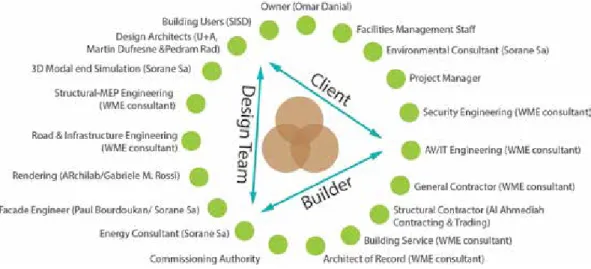
The process mapping was completed by interviewing seven project stakeholders representing, the façade designer, architect, general contractor, energy and building physics consultant, commissioning agency, and facility manager. Figure 2 shows the results of the interviews and represents the different stakeholders of the project. The process map, shown in Figure 3, indicates that there were seven major design stages in this project, named according to the AIA (AIA, 2007). The figure shows the process map after being validated, illustrating the design and construction stages of the adaptive façade as a whole. Based on this step we identified the key stakeholders to start the façade performance evaluation.
4.2 Façade design process description
The interviewees revealed that the SISD project delivery process went through a linear process with experimental validation approach. The linear approach did not allow a holistic integrated and iterative approach. For example, the EC glazing was selected to optimize day lighting, thermal comfort and energy consumption for the Minergie energy target prior to the aesthetical concerns. In order to optimize day lighting, thermal comfort and energy consumption, three-dimensional modeling was prepared and according to this model facades design was developed. Also, the energy consultant had to conduct several simulations models and experiment with a climate data of Dubai and test bed in the Switzerland, to optimize the DF factor and daylight autonomy. Firstly, the
Figure 2: General composition of SISD adaptive façade team
architects designed the auditorium and library facades entirely from EC glazing. Later on, the energy consultant had to optimize the EC glazing to avoid overheat due to the long solar radiation durations. For instance, EC glazing inclined to the north was preferred for reducing the solar heat and optimize day lighting at roof of the secondary school. Similarly, the glazed surfaces were optimized to reduce cooling demand at auditorium block and library. Thus, the façade design was detailed and validated in a late stage of the design process. This was until the façade subcontractor was invited, when the final façade system design decision was made. The involvement of the glass façade subcontractor at the end of the design process resulted into a complicated situation. Therefore, it is very important to engage the façade engineers from the beginning of the design to guarantee hands on feedback and follow the shortest and the most cost effective design path.
Performance Assessment
Figure 3: Process mapping of the integrated design process of the SISD’s adaptive façade
4.3 Façade assessment process description
The façade assessment and commissioning was mainly on the hand of façade subcontractor. Despite the expertise of the building commissioning firm, the façade testing remained in the hand of the adaptive façade supplier. Prior to commissioning and during the pre-assist phase the main contractor and subcontractor had to build a test bed for a façade module. The main contractor was responsible for the structural, MEP engineering, infrastructure, IT, Security and building services. The façade subcontractor was responsible for the design and testing of the façade and preparing the building simulations. Once the initial design is completed by U+A architects the façade subcontractor started to conduct the façade optimization measures.
The process includes using an EC insulating glass unit wired with a Pigtail cable that extends from one edge of each IGU and connects to the frame cable. It also stores an electronic serial number and glass unit specific data that can be used for system start-up, commissioning and troubleshooting.
4.4 Energy Performance and Façade Control
After the completion of the first phase of the SISD project, the facade subcontractor Sorane provided Minergie compliance data (see Table 2). According to the façade subcontractor, chilled water consumption was calculated as 126 kWh/m2, which is less than the Minergie requirements (140 kWh/m2). However, air cooling electricity must be compensated by PV, that’s why 300 m2 PV was taken out in the SISD project by façade engineer. As a result of Minergie application, the total electricity consumption was calculated as 22.8 kWh/m2. Half of the electricity consumption is due to the fans consumption of the FAHU and avoiding air cooling (FCU and AHU) reduces by 20% the electricity demand in the project. Initially, contractors were hesitant to work with these connecting cables, but with the help of a supervising team, they have been able to get comfortable with the process and install the glass panels with ease.
Regarding the energy consumption associated with EC glazing, a comparison was made with between conventional office spaces and our office case study. The conventional office space consumed 99.2 kWh/m2 for the year 2017 compared to 126 kWh/m2 for the EC glazing office space. As shown in Table 3, the façade with EC glazing resulted in a more consumption due to the high WWR that is 85%. Moreover, the North façade was exposed to significant solar radiation without solar protection as shown in Figure 4. The red and blue colored lines represent the summer and winter incident radiation on the North façade. On the other hand, the lighting loads were
decreased significantly to the presence of EC glazing. The presence of EC in our case resulted in effectively decrease the dependence on artificial lighting.
Table 2: Monitoring results
Table 3: Monitoring results
Figure 4a: the EC glazing control system depends on external sensors placed on the North and West facades, 4b: the monitored solar radiation expressed in wattage for the North façade of the office building (red=summer radiation; blue=winter radiation).
Table 4: Façade Performance and Sun Protection (Summer 2017)
Based on the monitoring results we performed an analysis to investigate the correlation between SHGC (g-value) and Vlt as shown in Table 4. Our analysis indicates a significant disparity between the nominal and real performance of EC glazing regarding SHGC. This is mainly caused by the high surface temperature of the glazing surface. Our analysis confirms that the EC glazing reduced the visible transmittance from 70% to around 10% and g-value from 0.60 SHGC to 0.25. However, the high WWR (85%) effect contradicted the whole purpose of installing EC glazing regarding energy efficiency. This resulted into an energy consumption increase of 27% more than the conventional façade (Table 3). Moreover, the EC glazing blocked the passive solar heating effect during winter. Since the building has no heating system, occupants complained from overcooling during winter.
Performance Assessment
4.4 Post-Occupancy EvaluationA total of 39 anonymous respondents filled in the POE questionnaire by employees of the SISD. The occupancy density in this building was 4.5m2.person compared to 10m2.person in Europe. For most respondents, the general IEQ conditions were evaluated as very good, except during the winter. As shown in Figure 5, there is a significant discomfort (36% of occupants) during the winter season. This can be explained by the low conductivity of the glazing and the low g-value that blocks the passive solar heating. In the same time, the lack of a heating system did not allow users to feel satisfied (Bourdoukan 2016).
Daylight availability was also assessed as very good; however the user control regarding sunlight control was assessed as a cause of problems. A conflict between maintaining the view and blocking the direct sunlight radiation occurred during winter. Our observation revealed a conflict between the user’s personal control and automatic control strategies.
Figure5: POE results
5 Discussion and Conclusion
The primary objective of this study was to improve our understanding of electrochromic glazing façades. From the POE results we evaluated the real performance of an EC glazing façade in relation to energy consumption, comfort and façade system control. One case study is statistically not representative; however, based on the best available data in literature we present significant and incremental contribution that can support the decision making of façade designers and owners. We summarize the study findings under the following objectives:
5.1 Understanding the performance requirements of EC glazing
•
The EC glazing did not block the solar radiation enough in the South. In a climate like the one of Dubai, the direct solar radiation and heat transfer cannot be blocked by using EC glazing. After several design and performance modeling iterations, the design team decided to place the EC glazing mainly in the North and avoid placing any EC glazing in the west, east or south facades.•
Installing EC glazing in a highly energy efficient envelope was counterproductive. The EC glazing blocked the passive solar heating effect during winter. Since the building has no heating system occupants complained from overcooling during winter. The EC glazing eliminated any chance of passive heating during the winter because it orientation (North). Designers should better estimate the effect of EC glazing on thermal comfort during winter.•
Energy consumption was increased by 27% due to the use of EC glazing. The high WWR (85%) effect contradicted the whole purpose of installing EC glazing regarding energy efficiency. The POE results indicate that the consumption would increase much more if the building had a heating system. Installing EC glazing should not be associated with increasing the WWR.5.2 Key performance criteria of EC glazing
•
The key performance criteria of EC glazing should be the energy use intensity and indoor environmental quality in the glazed spaces. The use of nominal values of SHGC or Vlt ismeaningless. In this project, TRNSYS failed to estimate the effect of EC glazing and did not allow modeling the dynamic variation of SHGC and Vlt, which is in line with literature.
•
There was an unexpected level of difficulty in assuring the POE in building with EC glazing. We need much more knowledge on EC glazing performance and user interaction with EC facades. We need independent studies on user’s well-being and dynamic visual comfort (incl. color rendering) for dynamic glazing. The nature and the effects of these mutual interrelationships between occupants and façades are yet to be completely defined.5.3 The significance of using EC glazing
•
The use of EC glazing in their current technological status is seriously questionable. Firstly, because there are no conclusion studies on their energy saving effects in relation to comfort improvement.•
Secondly, the automatic control of AF and users response caused in many cases conflicts. The overriding algorithm control settings and users need did not match during the early morning and end of the working days. Due to the multi-sensorial effects of façades and the highly-individual response of occupants, designing for user interaction with dynamic envelopes is a challenging task and conflicts and inconsistencies often arise.5.4 Learned lessons for architects and façade engineers
•
The window to wall ratio was 85% in the North façade and windows are not operable. We advise to reduce the WWR and include fixed shading even in the extreme heat and intense glare from the sun in the Middle East.•
The EC façade cost 7-8 times more than a curtain wall façade in Dubai including the controls.•
EC glazing remains an aesthetically-appealing technology. However, the WWR and solar shades and blinds remain the most influential regarding thermal comfort and energy savings for adaptive facades in hot climates. An efficient sun protection from the sun and an adequate glazing surface are required for the envelope.6 Acknowledgement
The author expresses their thanks to Paul Bourdoukan and all anonymous interviewees. The author appreciates their valuable comments and feedback. The author would like to gratefully acknowledge COST Action TU1403 “Adaptive Facades Network” for providing excellent research networking. The authors would like to acknowledge the support of Workgroup 3 members. Also we would like to acknowledge the Sustainable Building Design Lab for the use of monitoring equipment in this research and the valuable support during the experiments and the analysis of data.
Experimental T
ests
7 References
ASHRAE (2013). 55: Thermal Environmental Conditions for Human Occu-pancy, American Society of Heating Refrigeration and Air Conditioning Engineers. Inc., Atlanta.
Attia, S., Bilir, S., Safy, T., Garat, S (2019) Adaptive Facades performance assessment: Interviews with Façade Experts, SBD Lab, Liege University, Belgium. ISBN: 9782930909097.
Attia, S., Bilir, S., Safy, T., Struck, C., Loonen, R., Goia, F. (2018a) Current Trends and Future Challenges in the Performance Assessment of Adaptive Façade Systems, Energy and Building, in press.
Attia, S., Luna Navarro, A., Juaristi, M., Monge-Barrio, A., Gosztonyi, S., Al-Doughmi, Z., (2018b) Post-Occupancy Evaluation for Adaptive Facades, Journal of Façade Design and Engineering, in press.
Attia, S. (2016a) Evaluation of Adaptive Facades: The case study of a glass building in Belgium. Challenging Glass 5 - Confer-ence on Architectural and Structural Applications of Glass. 11.05.2017.
Attia, S. (2016b) Evaluation of Adaptive Facades: The case study of Al Bahr Towers in UAE. Qatar Green Building Conference 2016 – The Action. 11.05.2017.
Attia, S., Favoino, F., Loonen, R., Petrovski, A. & Monge-Barrio, A. (2015) Adaptive façades system assessment: An initial review. In Advanced Building Skins. Economic Forum. 1226–1233.
Attia, S. and Bashandy, H. (2015) Evaluation of Adaptive Facades: AGC Building a case study of an automated glass façade - Interviews and process mapping of the design team. 11.05.2017.
Beyeler F., Beglinger N., Roder U. (2009) Minergie: The Swiss Sustainable Building Standard. 11.05.2017. Retrieved from http://www.mitpressjournals.org/doi/pdf/10.1162/itgg.2009.4.4.241.
Bourdoukan, P., (2016) Swiss International School of Dubai Design and simulation of a Minergie building in Dubai. Qatar Green Building Conference 2016 –The action.
Hall, M., Geissler, A., Burger, B. (2016) Two years of experience with a net zero energy balance – analysis of the Swiss MINER-GIE-A® standard. Energy Procedia. 48, 1282 – 1291.
Loonen, R., Trčka, M., Cóstola, D. & Hensen, J. L. M., (2013) Climate adaptive building shells: State-of-the-art and future chal-lenges. Renew. Sustain. Energy Rev. 25, 483–493.
Luible, A. (2014) Memorandum of Understanding for the implementation of a European Concerted Research Action designated as COST Action TU1403: Adaptive Facades Network. 11.05.2017
Karanouh, A. & Kerber, E. (2015) Innovations in dynamic architecture. J. Facade Des. Eng. 3, 185–221. Samyn & De Coninck (2014). AGC Glass Building. Lannoo. 11.05.2017.
Wurm, J. (2013) Developing bio-responsive façades: BIQ House — the first pilot project. The Arup Journal 90–95.
An insight on possible classification and
metrics, experimental testing and numerical
modelling for adaptive facades - Activity
report from the ‘Structural’ Task Group
Chiara Bedon a), Dániel Honfi b), Marcin Kozłowski c,d), Martina Eliášová e), Klára
Vokáč Machalická f), Miroslav Vokáč f), Filipe Santos g), Thomas Wüest h)
a) University of Trieste, Italy, [email protected] b) RISE - Research Institutes of Sweden, Sweden c) Lund University, Sweden
d) Silesian University of Technology, Poland
e) Czech Technical University in Prague, Prague, Czech Republic
f) Klokner Institute, Czech Technical University in Prague, Prague, Czech Republic g) New University Lisbon, Lisbon, Portugal
h) Institute of Civil Engineering, Lucerne University of Applied Sciences and Arts, Lucerne, Switzerland
Adaptive facades are getting more and more widespread in modern buildings. These facade systems, among many others, need to fulfil the requirements of several structural considerations, such as structural safety, serviceability, durability, robustness and fire safety, being typically defined for standard facades and building enclosures in general. The paper discusses special structural characteristics that need to be taken into account when designing adaptive facades, and summarises some recent efforts of the activities carried out by the ‘Structural’ Task Group within the European COST Action TU1403 ‘Adaptive Facades Network’.
Keywords: Adaptive facades, structural performance, classification, metrics, experimental facilities and testing, numerical modelling
1 Introduction and motivation
Modern envelopes are high-tech components that must meet several requirements and constraints with regards to architecture / urban planning / aesthetics, energy efficiency, indoor environmental quality, buildability and value. In this regard, as far as a facade can respond to all the transient conditions in such a way that it maintains occupant satisfaction without imposing additional loads on the building services can be considered as ‘adaptive’. Within the requirements an adaptive facade needs to provide, however, a fundamental role is assigned to the structural performance (see (Bedon et al. 2018b)). Most of the systems representative of the next generation of facades in buildings, in fact, typically consists of highly adaptive envelopes, generally involving advanced use of smart materials, kinematic mechanisms, etc. (see for example Figure 1).
The current lack of standardised procedures and regulations for structurally related issues in adaptive facades represents a critical aspect for design. This is especially true in the case of facades of strategic buildings (i.e., governmental facilities, banks, terminals, landmark structures, hospitals, etc.), or buildings that could be exposed to exceptional loads (both accidental or man-made) during their whole life-time. In general terms, from a structural point of view, facades are often the most vulnerable components of a building, providing the physical separation between the interior and exterior spaces and conditions (Kassem & Mitchell 2015; Zhang & Bedon 2017; etc.).