HAL Id: tel-01347204
https://pastel.archives-ouvertes.fr/tel-01347204
Submitted on 20 Jul 2016HAL is a multi-disciplinary open access archive for the deposit and dissemination of sci-entific research documents, whether they are pub-lished or not. The documents may come from teaching and research institutions in France or abroad, or from public or private research centers.
L’archive ouverte pluridisciplinaire HAL, est destinée au dépôt et à la diffusion de documents scientifiques de niveau recherche, publiés ou non, émanant des établissements d’enseignement et de recherche français ou étrangers, des laboratoires publics ou privés.
Analysis and modeling of the radio channel for secret
key generation
Taghrid Mazloum
To cite this version:
Taghrid Mazloum. Analysis and modeling of the radio channel for secret key generation. Networking and Internet Architecture [cs.NI]. Télécom ParisTech, 2016. English. �NNT : 2016ENST0012�. �tel-01347204�
2016-ENST-0012
EDITE - ED 130
Doctorat ParisTech
T H È S E
pour obtenir le grade de docteur délivré par
TELECOM ParisTech
Spécialité « Communications et Électronique »
présentée et soutenue publiquement par
Taghrid Mazloum
le 12 Février 2016
Analyse et modélisation du canal radio pour la génération de
clés secrètes
Directeur de thèse : Professeur Alain Sibille
Jury
Mme Martine Liénard,Professeur, Université de Lille Rapporteur M. Claude Oestges,Professeur, Université Catholique de Louvain Rapporteur M. Bernard Uguen,Professeur, Université de Rennes1 Examinateur M. Benoit Denis,Ingénieur de recherche, CEA-Leti Examinateur M. Jean-Pierre Barbot,Maître de Conférence, ENS Cachan Examinateur M. Alain Sibille,Professeur, Télécom ParisTech Directeur de thèse
M. François Delaveau,Ingénieur expert, Thalès Invité
TELECOM ParisTech
2016-ENST-0012
EDITE - ED 130
ParisTech Doctorate
T H E S I S
To obtain the Doctor’s degree from
TELECOM ParisTech
Speciality « Communications and Electronics »
presented and defended publicly by
Taghrid Mazloum
12 February 2016
Analysis and Modeling of the Radio Channel for Secret Key
Generation
Supervisor : Professor Alain Sibille
Jury
Mrs Martine Liénard,Professor, Université de Lille Reviewer Mr Claude Oestges,Professor, Université Catholique de Louvain Reviewer Mr Bernard Uguen,Professor, Université de Rennes1 Examiner
Mr Benoit Denis,Research Engineer, CEA-Leti Examiner
Mr Jean-Pierre Barbot,Associate Professor, ENS Cachan Examiner Mr Alain Sibille,Professor, Télécom ParisTech Supervisor Mr François Delaveau,Expert Engineer, Thalès Invited member
TELECOM ParisTech
R´
esum´
e
La s´ecurisation des communications sans fil prend une importance croissante aussi bien pour les besoins des personnes priv´ees que les besoins professionnels et institu-tionnels. Bien que la cryptographie sym´etrique assure largement la confidentialit´e des donn´ees, elle est p´enalis´ee par la g´en´eration et la distribution de cl´es secr`etes. Des ´etudes r´ecentes indiquent que les caract´eristiques intrins`eques de la propagation peuvent ˆetre exploit´ees afin de renforcer la s´ecurit´e. En effet, le canal radio fournit une source d’al´ea partag´ee par l’´emetteur et le r´ecepteur, `a partir de laquelle des cl´es secr`etes peuvent ˆetre g´en´er´ees. Cette m´ethode de g´en´eration de cl´es secr`etes (“secret key generation”, SKG) repose sur la r´eciprocit´e du canal de transmission, sur la richesse de la propagation multi-trajets et sur la d´ecorr´elation spatiale des caract´eristiques du canal.
Dans ce manuscrit, nous nous int´eressons `a la SKG, avec comme objectif de relier les propri´et´es du canal radio `a la qualit´e des cl´es g´en´er´ees. Le travail men´e a permis d’analyser l’impact du canal sur la performance de la SKG en relation avec le nombre de degr´es de libert´e (DOF), dans diff´erentes conditions en particulier dans des envi-ronnements statiques. Nous avons d´evelopp´e un mod`ele statistique simplifi´e du canal qui montre une m´emoire spatiale r´esiduelle bien au-del`a d’une distance de quelques longueurs d’onde (sc´enarios spatialement non-stationnaires). Puis, nous avons ´etudi´e des canaux plus r´ealistes en environnements ext´erieur et int´erieur (respectivement grˆace `a des donn´ees d´eterministes simul´ees et `a des mesures) et mettant en ´evidence l’effet de la dispersion du canal dans des domaines d´elai et angulaire. Les r´esultats montrent que, mˆeme pour des bandes mod´er´ees (compatibles avec les normes IEEE 802.11a, g/n/ac), le seul DoF fr´equentiel ou son association avec le DoF spatial est souvent suffisant pour g´en´erer des cl´es longues, `a condition d’utiliser une m´ethode efficace de quantification des coefficients complexes du canal. La qualit´e de la cl´e est en outre ´evalu´ee apr`es les ´etapes post´erieures `a la SKG, i.e. la r´econciliation et l’amplification de confidentialit´e, qui jouent un rˆole tr`es important pour aboutir `a un sch´ema robuste et s´ecuris´e.
Abstract
Nowadays, the security of ubiquitous wireless communications becomes more and more a crucial requirement for private, professional and institutional needs. Even though data is widely protected via symmetric ciphering keys, a well-known difficulty is the management of such keys, both regarding their generation and their distribu-tion. In the recent years, a set of works have addressed the exploitation of inherent characteristics of the fading propagation channel towards security. In particular, se-cret keys could be generated from the wireless channel, considered as a shared source of randomness, available merely to a pair of communicating entities. This approach of secret key generation (SKG) relies on the reciprocity property of the transmission channel, on the richness of the multipath propagation and on the spatial decorrelation of channel characteristics.
In the present dissertation, we are interested in relating the radio channel proper-ties to the quality of the generated keys obtained from SKG. Accordingly, we analyzed the channel degrees of freedom (DoF) and their impact on the SKG performance in different channel conditions, especially in static environments. We first developed a simple stochastic channel model, focusing on the security with respect to the eaves-dropper side, which appears to be impacted by a residual channel memory well beyond a few wavelengths distance (in spatially non-stationary scenarios). Then, we investi-gated more realistic channels in both outdoor and indoor environments (respectively from simulated ray tracing data and through measurements) and highlighted the ef-fect of channel dispersion in the delay and angular domains. The results show that, even for moderately wide band (such as standardized in IEEE 802.11a, g/n/ac), the sole frequency DOF or its association with the spatial DOF is often enough for gen-erating long keys, provided an efficient quantization method of the complex channel coefficients is used. The key quality is further assessed after the subsequent steps of the SKG scheme, i.e. information reconciliation and privacy amplification, which turn out to play an essential role in achieving a robust and secured scheme.
Acknowledgments
If I have seen further it is by standing on the shoulders of giants.
Isaac Newton This work would not have been possible without the help and support of many people to whom I am really grateful.
First and foremost, I am deeply grateful to my advisor, Prof. Alain Sibille, for his time, support, guidance and encouragement. Throughout my PhD journey, I have always been inspired by his invaluable advice, immense knowledge, rigor and motivation. He taught me to never give up and to attack the problem from different sides. It has been, simply, a true privilege to be his student.
I would also like to sincerely thank the Thales engineering team, Renaud Moli`ere, Christiane Kameni Ngassa, Claude Lemenager, and in particular Fran¸cois Delaveau, for their collaboration and meaningful discussions.
I extend my gratitude to honorable Prof. Martine Li´enard and Prof. Claude Oestges for their review of my thesis manuscript and valuable comments. Moreover, my thanks go to Prof. Bernard Uguen, Dr. Benoit Denis and Dr. Jean-Pierre Barbot, for agreeing to be part of my thesis evaluation committee.
I would like to thank all members of the Comelec department at Telecom Paris-Tech for the excellent scientific environment they provide. Special thanks go to Dr. Christophe Roblin for his advice, especially when preparing to my PhD defense.
To my colleagues and friends, thank you for listening and supporting me especially during the stressful moments. Special thanks go to Amal Abdul-Razzak for her friendship as well as for every single moment we have shared in Paris and elsewhere. Last, but not the least, I owe my tremendous gratitude to my parents for their love, moral support and constant encouragement. All my loving thanks to my mother
and my father who believed in me. I am eternally grateful to you, my parents, to my sisters and my brothers. Special thanks to my brother Youssef for sharing all the sad and happy moments in Paris.
Contents
1 Introduction 1
1.1 General motivations . . . 1
1.2 Brief history of physical layer security . . . 2
1.3 Thesis Context . . . 3
1.4 Thesis objectives . . . 4
1.5 New contributions . . . 5
1.6 Organization of the dissertation . . . 6
2 State of the art on secret key generation from random channels 9 2.1 Fundamentals of wireless propagation channels . . . 9
2.1.1 Channel reciprocity . . . 11
2.1.2 Path loss, shadowing and small scale fading . . . 12
2.1.3 Channel degrees of freedom . . . 14
2.1.4 Propagation channel models . . . 16
2.2 Wireless channel-based secret key generation . . . 18
2.2.1 SKG basics . . . 19
2.2.2 Security versus an eavesdropper . . . 21
2.2.3 Review of SKG . . . 22
2.3 Conclusion . . . 24
3.1 Metrics for SKG assessment . . . 28
3.1.1 Information theoretic bounds on key length . . . 29
3.1.2 Channel correlations . . . 34
3.1.3 Channel quantization performance . . . 35
3.1.4 NIST tests . . . 36
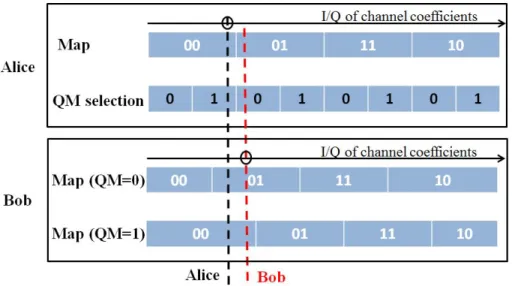
3.2 Channel quantization alternating (CQA) algorithm for SKG . . . 38
3.2.1 State of the art . . . 38
3.2.2 CQA description . . . 39
3.3 Exploiting channel variability in SKG . . . 41
3.3.1 Space variability . . . 42
3.3.2 Frequency variability . . . 43
3.3.3 Joint space-frequency variability . . . 47
3.4 Conclusion . . . 48
4 Performance of secret key generation in non-stationary channels 51 4.1 Shadowing . . . 52
4.2 Disc of scatterers based channel model details . . . 54
4.3 SKG performance evaluation . . . 57
4.3.1 Channel correlations . . . 58
4.3.2 Vulnerable key rate . . . 59
4.3.3 CQA performance . . . 62
4.4 Conclusion . . . 63
5 Security behavior through ray tracing channel models 65 5.1 Environments and characteristics of the simulations . . . 66
5.2 Propagation channel characteristics . . . 68
5.2.1 Channel model . . . 68
5.2.3 Delay and angular spreads . . . 70
5.3 SKG from frequency variability . . . 74
5.3.1 Available key bits . . . 75
5.3.2 Evaluation of the degree of secrecy . . . 79
5.4 SKG from space variability . . . 81
5.4.1 Available key bits . . . 81
5.5 Conclusion . . . 82
6 Security performance in measured channels 85 6.1 Measuring systems and scenarios . . . 85
6.2 Evaluation of errors between Alice, Bob and Eve keys . . . 88
6.2.1 Dependence on the mapping . . . 89
6.2.2 Alice-Bob disagreement vs. a simple channel model . . . 90
6.2.3 Security performance with respect to Eve . . . 92
6.3 Channel degrees of freedom for SKG . . . 92
6.3.1 Space vs. time variability . . . 93
6.3.2 Frequency variability . . . 94
6.3.3 Joint space-frequency variability . . . 95
6.3.4 Results . . . 95
6.4 Information theoretic bounds on key length . . . 103
6.4.1 SKG from frequency variability . . . 103
6.4.2 SKG from space variability . . . 104
6.4.3 Relative vulnerable key rate . . . 105
6.5 Conclusion . . . 106
7 Complete Secret Key Generation Scheme 109 7.1 Quantization . . . 110
7.3 Privacy amplification . . . 111 7.4 Results . . . 113 7.4.1 Alice-Bob disagreement . . . 113 7.4.2 Bob-Eve disagreement . . . 115 7.4.3 Key randomness . . . 115 7.5 Conclusion . . . 122
8 Conclusion and perspectives 125 8.1 Conclusion . . . 125
8.2 Perspectives . . . 126
R´esum´e en fran¸cais 129
List of Publications 149
References 151
Appendices 164
A Information theoretic bounds 165
List of Figures
2-1 Communication system. . . 10
2-2 Transmission vs. propagation channel. . . 10
2-3 Location-specific multipath propagation. . . 11
2-4 Path loss, shadowing and small scale fading. . . 13
2-5 Wireless communication scenario. . . 19
2-6 The four steps of SKG to agree on the same key. . . 20
2-7 SKG in the presence of an eavesdropper. . . 21
3-1 The terminals’ propagation channels involved in the SKG scheme. . . 28
3-2 The impact of the SNR on IK. . . 31
3-3 IK as a function of the Rician K factor. . . 33
3-4 IV K/IK as a function of the separation distance d for Clarke’s model. 34 3-5 Illustration of the quantization intervals of the CQA scheme on one dimension I or Q with M = 16. . . 40
3-6 Correspondence between symbols and QR. . . 41
3-7 Some examples of PDP with different RMS delay spreads. . . 43
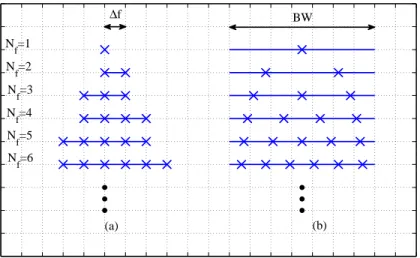
3-8 Frequency variability schemes with an increasing number of sub-carriers Nf: (a) an increasing BW and a fixed ∆f , (b) a fixed BW and a de-creasing ∆f . . . 45
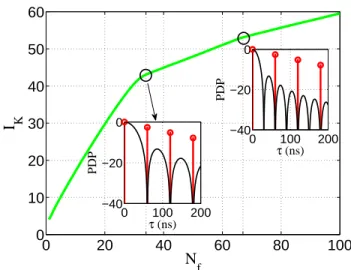
3-9 Evolution of IK with respect to Nf and to the time resolution ∆τ, for στ = 100 ns. . . 46
3-10 Equivalent time domain when perfectly resolved paths, for ∆τ = 60 ns
and στ = 100 ns. . . 47
3-11 Evolution of IK with respect to Nf and to RMS delay spread στ, for ∆τ = 20 ns. . . 48
3-12 Variation of IK with the RMS delay spread for ∆τ = 20 ns. . . 48
3-13 IK as a function of Nf for BW = 50 MHz. . . 49
4-1 Shadow fading auto-correlation (right) and shadow fading cross-correlation (left) [1]. . . 53
4-2 Geometrical representation of the communication scenario. . . 55
4-3 CDF of complex channel correlations. . . 58
4-4 Log-normal shadowing per path for both σ = 3 dB and σ = 10 dB. . 59
4-5 CDFs of the power envelope correlations. . . 60
4-6 CDF of relative vulnerable key bits. . . 60
4-7 Averaged BER and vulnerable key bits as function of the separation distance d between Bob and Eve. . . 61
4-8 The statistical variance of IV K/IK as a function of d. . . 62
4-9 CDF of BER between Bob and Eve. . . 63
4-10 The statistical variance of BER as a function of d. . . 63
5-1 Example of an (indoor) deterministic simulation without (up) and with (down) diffuse scattering. . . 67
5-2 The digital 2D maps highlighting the simulated area. . . 68
5-3 The measured receiver locations in 2D maps. . . 71
5-4 RMS delay spread statistics. . . 72
5-5 Some examples of PDPs corresponding to Louvre48 (right: στ = 15 ns, middle: στ = 360 ns, left: στ = 728 ns). . . 73
5-6 Angular spread statistics. . . 73
5-7 Some examples of APS corresponding to Louvre48 (right: σφ = 5.3 degree, middle: σφ= 71.3 degree, left: σφ= 115 degree). . . 74
5-8 Evolution of IK with respect to the number of frequencies Nf. . . 75
5-9 IK as a function of the RMS delay spread (στ) for the scenario Louvre48. 76 5-10 IK as a function of Nf for the scenario Louvre48-WDS. . . 78
5-11 The impact of BW on IK for Nf = 64 and for the scenario Louvre48. 78 5-12 CDF of IV K/IK depending on Nf and on Bob/Eve distance (Louvre48). 80 5-13 IV K/IK as a function of the angular spread, for Nf = 1 and d = 0.1λ. 80 5-14 Space variability: IK as a function of the angular spread. . . 81
5-15 Space vs. frequency variability. . . 82
6-1 TPT measurement floor plans: (left) classrooms and (right) auditorium. 87 6-2 A sketch of measurement run in TPT classrooms scenario. . . 87
6-3 A sketch of measurement run in TPT auditorium scenario. . . 88
6-4 Alice-Bob BER vs. SNR and M . . . 89
6-5 Secret key rate η for both NB and WB (Nf = 3) channels. . . 90
6-6 Comparison of the BER A-B computed over both the measurements and the model, for SNR=10, 15 and 20 dB. . . 91
6-7 BER of Eve key bits for M = 4 and for NB channels. . . 93
6-8 BER of Eve key bits from hea, for LOS B-E and for NB channels. . . 93
6-9 Mean pass rate exploiting spatial variability for both N = 128 and N = 242. . . 97
6-10 Mean pass rate exploiting spatial variability with respect to LOS/NLOS and for N = 128. . . 98
6-11 Examples of PDPs and channel transfer functions. . . 99
6-12 The variation of the RMS delay spread with the distance. . . 99
6-13 Mean pass rate as a function of the distance for 5.4 GHz and for fre-quency variability. . . 100
6-14 Mean pass rate exploiting frequency variability for BW = 40 MHz and M = 16. . . 100
6-16 Comparison of key randomness in different channel variability at 5.4
GHz. . . 102
6-17 IK as a function of Nf and the BW. . . 104
6-18 IK vs. Nant from space variability. . . 105
6-19 IV K/IK vs. Bob-Eve separation distance. . . 106
7-1 Disagreement between Alice and Bob keys. . . 114
7-2 Disagreement between Bob and Eve keys for SKSM. . . 115
7-3 Eve key BER after privacy amplification vs. the BER for keys following B(127,0.5). . . 116
7-4 Mean pass rates before and after privacy amplification, for SKSM. . . 117
7-5 Keys from spatial DoFs, for different Bob positions and for SKSM. . 118
7-6 Keys from frequency DoFs, for different Bob positions and for SKSM. 118 7-7 Keys from joint space-frequency DoFs (Nant = 2), for different Bob positions and for SKSM. . . 119
7-8 Keys from joint space-frequency DoFs (Nant = 4), for different Bob positions and for SKSM. . . 119
7-9 Keys from frequency DoFs, over Alice positions and for SKSM. . . 120
7-10 Mean pass rates before and after privacy amplification, for MKSM. . 121
7-11 Keys from spatial DoFs, over Bob positions and for MKSM. . . 122
7-12 Keys from frequency DoFs, over Bob positions and for MKSM. . . 122
List of Tables
3.1 NIST tests limitations. . . 36
4.1 Simulation parameters. . . 57
5.1 Statistics of the computed channels. . . 70
6.1 VNA setup parameters. . . 86
6.2 Frequency channel characteristics for each BW. . . 94
6.3 Size of key set vs. the variability type. . . 96
List of abbreviations
AoA Angle of arrival AoD Angle of departure ApEnt Approximate entropy APS Angular power spectrum BER Bit error rate
BS Base station
BST Base station transmitter
BW Bandwidth
CDF Cumulative distribution function CIR Channel impulse response
CQA Channel quantization alternating CSI Channel state information
DoF Degree of freedom DS Diffuse scattering EM Electromagnetic
FDD Frequency division duplex FFT Fast Fourier transform
GSCM Geometry-based stochastic channel model i.i.d. independently and identically distributed KDC Key distribution center
K-S Kolmogorov-Smirnov LOS Line of sight
MIMO Multiple-input multiple output MKSM Multiple key single map
MPC Multipath component MS Mobile station
NB Narrow band
NIST National Institute of Standards and Technology NLOS Non line of sight
PDP Power delay profile
PHYLAWS Physical layer wireless security PhySec Physical security
PSD Power spectral density
QM Quantization map
QR Quantization region
QuaDRiGa Quasi deterministic radio channel generator
RL Ray launching
RMS Root mean square
RMS-DS Root mean square delay spread RSS Received signal strength
RT Ray tracing
SIMO Single-input multiple-output SKG Secret key generation
SKSM Single key single map SNR Signal to noise ratio SSF Small scale fading TDD Time division duplex TPT Telecom ParisTech UWB Ultra wide band
VNA Vector network analyzer
WB Wide band
WDS Without diffuse scattering
Chapter 1
Introduction
1.1
General motivations
Given the growing prevalence of wireless communications, their security becomes a major concern for various applications such as broadband internet, e-commerce, bank services, health monitoring, terrorism and military operations. Indeed, the broadcast nature of the wireless medium makes it vulnerable to various attacks, e.g. eaves-dropping, man-in-the-middle attack, etc. Although classical security mechanisms are widely used to protect data transmission, they present many challenges showing a lack of confidentiality. This lack is proved by e.g. the monitoring of Angela Merkel’s smartphone during years [2]. Therefore, trends to strengthen security are going to-wards new security paradigm acting at the physical layer [3, 4].
Traditionally, a set of protocols provides security (e.g. confidentiality, authentica-tion, integrity) by encrypting data using cryptographic keys. In symmetric encryption methods, the main drawback is the key management, which includes key generation and distribution, since the same secret key is used for both data encryption and data decryption [5]. More clearly, challenges stem from, on one hand, the need to share a prior key between each legitimate user and a key distribution center (KDC) which is responsible for delivering secret keys. On the other hand, the KDC may not be easily accessible in scenarios such as dynamic mobile networks and wireless sensor networks. However, these symmetric key management issues are alleviated by asymmetric techniques where a pair of public and private keys, generated by each user, is used to secure communications [5]. Nevertheless, the usage of these public-key cryptosystems is restricted for covert key exchange through the Diffie-Hellman algorithm [6] since
they suffer from high computational cost. Moreover, the robustness of conventional cryptography relies on computational constraint on the attacker. However, with the continuous progress of high power computing, unconditionally secured systems are more and more required [4].
Recently, several researches investigate information-theoretic security techniques where the illegitimate user (let us call here Eve) of a wireless communication is as-sumed to be enabled with unlimited computing power and only her information about the propagation scenario may help her to break the data privacy [4, 7]. In this re-spect, a special approach to physical layer security (PhySec) field [4] intends to achieve wireless communications and data protection by exploiting the inherent properties of the wireless propagation channel such as reciprocity, multipath fading and noise. On one hand, security over the radio channel may be achieved through secrecy coding schemes (e.g. LDPC, Lattice and polar codes [8, 9, 10]) that require advantages at the legitimate part over the eavesdropper part, such as the signal to noise ratio (SNR). On the other hand, for cryptographic purposes, PhySec enables legitimate parties to generate independently identical secure key bits from the reciprocal radio channel. Both of these approaches, often combined with beamforming techniques and artificial noise [11, 12, 13, 14], are targeted in the European project PHYLAWS (i.e. physical layer wireless security) [15], which supports the present PhD thesis work.
1.2
Brief history of physical layer security
Information-theoretic security was firstly introduced by Shannon in 1949 [16], where a secrecy system had been defined in relation with Shannon’s previous work in in-formation theory. Shannon proposed to use the one-time pad, where messages are encrypted using the binary addition (XOR), in order to achieve perfect secrecy, where the codeword conveys strictly no information about the initial message. Although no restriction on the computational power of Eve was adopted, she was assumed to have no useful information to break the data confidentiality. We note that this perfect secrecy is impractical since it relies on unrealistic assumption where Eve can obtain the codeword (i.e. the encrypted message) without any error [4], while in contrast, the radio channel is corrupted by intrinsic noise.
In 1975, Wyner [3] revisited Shannon’s information theoretic secrecy by consider-ing a realistic assumption, i.e. Eve obtains noisy observations owconsider-ing to the intrinsic noise of the wireless propagation. This implied the definition of the secrecy coding
concept through a proposed channel model called the “wiretap channel”. Accordingly, the protection of data entails that the channel seen by Eve should be degraded with respect to legitimate entities channel, in other words, the Alice/Bob channel capacity should be greater than that of Eve. Otherwise, wireless communication cannot be secure.
Alternatively, in 1993, Ahlswede, Csiszar and Maurer [17, 18] proposed to distil a shared secret key from a shared source of randomness, even if Alice ad Bob do not have an advantage over Eve. This may be achieved through public discussions over an error-free authenticated channel. The channel advantage may be provided by exploiting the reciprocity law and the spatial decorrelation (intrinsic properties of the electromagnetic channel, other than the SNR) in order to distil a shared secret key from the channel randomness instead of using secrecy codes. The resulted secret key may provide data confidentiality through e.g. conventional symmetric encryption methods.
1.3
Thesis Context
In this work, we are mainly interested in wireless channel-based secret key genera-tion (SKG), which seems to be an efficient alternative to convengenera-tional key distribu-tion. Authorized users jointly generate a common secret key from a shared source of randomness, which is not directly accessible to an eavesdropper. This theoretical foundation goes back to Ahlswede, Csiszar and Maurer in 1993 [17, 18]. While the first implementations of SKG concern quantum physics [19, 20], their application is limited owing to many challenges, e.g. high cost. Hence, nowadays much attention goes towards the ubiquitous wireless channel as a shared source of random secret keys. Practical implementations have early been introduced by Hassan et al. [21, 22] by establishing secret keys from the information phase of a frequency-selective fading channel. Fundamentally, when channel reciprocity applies, typically when legitimate parties use the same frequency at the same time instant, they share the same prop-agation channel. Randomness is ensured through multipath fading, which results in decorrelation properties in the spatial, temporal and frequency domains. Conse-quently, an eavesdropper is probably not able to efficiently exploit her own measured channel in order to crack the key.
While channel reciprocity is a crucial requirement for key reliability, i.e. ensuring the same key for both legitimate users (typically referred to as Alice and Bob), it
does not hold perfectly in practical scenarios owing to electronic hardware differences between transceivers. Moreover, even in time-division duplex (TDD) systems where the same frequency is used, the forward and reverse channels may differ from each other when the environment changes between the two channel estimation instances, in other words when the channel estimation is not occurring within the same coherence time. All these issues, including noise, limit in practice the number of shared bits that may be reliably extracted from a single channel observation. Therefore, a secret key of a sufficient length generally results from the concatenation of several sub-keys, obtained from multiple channel observations. Subsequently, especially in time-varying channels, an issue related to the latency in the key generation process appears, which requires further investigations in order to harvest more randomness from a single channel estimation.
Furthermore, the random character of the key is essential in making eavesdropping extremely difficult or, on the other hand, which requires a small correlation between the channel samples seen by Alice/Bob and by the eavesdropper. This also entails statistical independent channel samples. Indeed, key randomness may be achieved through random channel variations, which occur inherently in small scale fading (SSF) owing to constructive/destructive combination of dispersive multipaths. This may be heavily accomplished by user movement, e.g. when using a smartphone or a connected watch emerging from the internet of things. Obviously, if we consider the case of a fixed laptop in an office, some channel variability may be provided if people are moving around, but experiment shows that the degree of channel variation incurred by such changing environment is quite weak, unless of dense crowds. So, a general questions is: is the randomness of the key sufficiently guaranteed? If not, how may the security performance be improved in static environments? Moreover, how much correlated information can Eve obtain about the legitimate channel and subsequently about the key?
1.4
Thesis objectives
The work reported in this PhD thesis takes place in the context of the European project PHYLAWS [15], which aims to improve the protection and confidentiality of wireless communications through approaches operating at the physical layer level, mainly. PHYLAWS intends to identify and test security approaches in both theo-retical and experimental manners in order to elaborate efficient techniques that are simple to implement and consume few resources. The project outputs will thus benefit
a variety of existing and future standards for a large set of needs.
PHYLAWS intends to investigate several techniques able to enhance the level of security. Among them, the secrecy coding scheme assumes a message to be protected by exploiting the channel noise instead of using encryption keys. Hence, the “secrecy capacity” can be defined by the number of message bits that could be transmitted securely and reliably, per channel use, between legitimate users while Eve is unable to decode it. This approach requires an advantage on the legitimate link over the eavesdropper link, otherwise, the secrecy capacity is null. Along this line, artificial noise and jamming techniques are targeted within PHYLAWS project, in order to confuse the attacker and sustain legitimate users.
Alternatively, PHYLAWS considers another aspect of PhySec, which is SKG from common randomness provided by reciprocal radio channels, as introduced above. Since the implementation of PhySec techniques, especially SKG, will be deeply im-pacted by the radio channel characteristics, it is crucial to assess the main limitations of this technology in realistic scenarios. Therefore, the main objective of this PhD thesis is to study the fundamental role of multipath fading channels in security and, subsequently, to relate the characteristics of the radio channel to the security of the SKG process. Moreover, we intend within PHYLAWS to devise adequate channel models, which imply specified measurements or simulations, where SKG behavior is assessed either using information-theory or through the practical implementation of a key agreement scheme.
1.5
New contributions
To summarize, the general aforementioned limitations in SKG concern the quality of the key (i.e. reliability, randomness, size and secrecy), especially when SKG is distilled from time-variant channels and in static environments. Accordingly, this dissertation targets the strategy of generating shared keys from a reciprocal radio channel that is seen as a shared source of randomness available at legitimate parties. The main objective is to assess SKG performance with respect to realistic propagation channel features. This is achieved through the usage of several channel models, e.g. stochastic or deterministic, accounting for Alice/Bob/Eve locations and features. In this context, the contributions of the present dissertation are:
1. Investigate the channel degrees of freedom (DoF) existing in either the space or the frequency/delay domain, even in the joint space-frequency domain, in
the generation of shared secure keys [23, 24]. Intuitively, such an investigation intends to harvest more randomness from a single channel observation, and thereby, to alleviate the issue of the lack of time-variability in static environ-ments.
2. Analyze the quality of the generated keys in relation with the channel prop-erties (delay spread, angular spread, shadow fading, LOS/NLOS, etc.) in dif-ferent propagation environments including both indoor and outdoor. The key robustness is assessed either in terms of size of the generated keys or of diffi-culty/impossibility for Eve to reconstruct Alice/Bob’s key.
3. Define and “play” with a parameter based stochastic channel model, in order to gain deep insight on the relation between SKG performance and physical characteristics of the propagation and of the environments. Specifically, we develop a multi-link channel model to account for the spatial correlation between channels seen by Bob and Eve, covering both stationary and non-stationary regions.
4. Use deterministic channel models “close to reality” for sets of outdoor environ-ments of main interest, and see how much the channel characteristics investi-gated impact SKG performance.
5. Carry out indoor channel measurement campaigns, which will allow to imple-ment SKG in different environimple-ments and settings, considering varying separa-tion distances between users on one hand and LOS/NLOS propagasepara-tion condi-tions on the other.
6. Analyze and compare the robustness of the generated key after each phase of SKG (i.e. quantization, information reconciliation and privacy amplification), while considering different approaches to compute the quantization maps.
1.6
Organization of the dissertation
Following the brief above introduction designed to motivate the main topic of the dissertation, Chapter 2 provides in a first part an overview of the radio propagation channel since it heavily impacts the security level bring by PhySec approaches. In the second part, we describe the principle of wireless channel-based secret key generation and review the prior works in the relevant area of SKG.
We explain in Chapter 3 both the metrics and the methods used in the the present work, to assess the robustness of the generated keys. In particular, we describe the quantization algorithm, which maps the complex channel coefficients into a stream of key bits. Moreover, we explain how to investigate the channel variability in either the space or the frequency domain in order to increase the key rate per single channel observation, with a specific emphasis on the delay dispersion through an exponential decaying power delay profile (PDP).
A simple channel model is then developed in Chapter 4 and focuses on the amount of information disclosed to Eve, which may cover several scenarios, including stationary and non-stationary ones with respect to Bob-Eve distance. To adequately model the spatial correlation between Bob and Eve, the proposed geometry-based stochastic channel model employs a per path shadow fading correlation [25].
SKG, in relation with the exploitation of different types of channel degrees of freedom, is investigated for deterministic outdoor channel models in Chapter 5 and for measured indoor propagation in Chapter 6. The security is addressed from Alice/Bob point of view, as well as from Eve point of view.
While we emphasis, in the aforementioned chapters, on the SKG performance right after the channel quantization phase, we subsequently dedicate Chapter 7 to the full implementation of the SKG scheme, including reconciliation and privacy amplification, and analyze the performance gain with respect to the sole quantization. In addition, we investigate the impact of the way the quantization map is computed. Finally, in Chapter 8, we summarize the work of the thesis and we draw some conclusions after the comparison of the SKG behavior in different environments.
Chapter 2
State of the art on secret key
generation from random channels
In the context of wireless communications, the propagation channel plays an impor-tant role towards the improvement of security services at the physical layer level. A deep understanding of this communication medium is thus crucial. Hence, the first section of this chapter is dedicated to a brief overview of the main notions re-garding the propagation channel, especially those relevant to PhySec. The second section subsequently provides a state of the art about the propagation-based secret key generation, including a description of the different steps of the SKG strategy.
2.1
Fundamentals of wireless propagation channels
A radio communication system, as depicted in Fig. 2-1, aims to convey a message between two remote users through a propagation channel. At the transmitter side, the message is encoded into an electrical signal which is suited to efficient transmission and radiated into space by the antenna, in the form of an electromagnetic (EM) wave. On the other side, at the receiver, the original information is reproduced from the received EM waves, assuming it can be decoded without errors. The medium through which these signals propagate between the transmit and the receive antenna is called the wireless propagation channel. The wireless transmission channel is defined as the combination of the propagation channel and of the antennas. Fig. 2-2 depicts the difference between the transmission and the propagation channels.
trans-Figure 2-1: Communication system.
Figure 2-2: Transmission vs. propagation channel.
mission channel response h(t, τ ) and the emitted signal x(t), expressed as follows:
y(t) = (h ∗ x)(t) + n(t) (2.1)
where ∗ denotes for convolution. τ is the time delay. The received signal is affected by an additive noise n(t), which may be generated inside the receiver itself or caused by some radio interferences. n(t) is often approximated as a white Gaussian random variable.
Before reaching the receiver antenna, the emitted signal undergoes several physical interactions with the environment such as specular reflection, edge diffraction and diffuse scattering, as shown in Fig. 2-3. Hence, the received signal is the superposition of several replicas of the transmitted signal where each partial wave is attenuated, delayed and phase shifted according to the traveled distance as well as to the type of the physical interaction. This wave propagation phenomenon is referred to as multipath propagation. Accordingly, the propagation channel impulse response may be approximately described as:
h(t, τ ) = Np
X
n=1
βnδ(τ − τn) (2.2)
wave. Np is the total number of paths occurring in the channel. This discrete multi-path channel model neglects the frequency dependence of the interactions mentioned above and is specially valid for narrow or moderate bands.
Figure 2-3: Location-specific multipath propagation.
2.1.1
Channel reciprocity
The channel impulse response measured between two transceivers is the same re-gardless of the direction of transmission, since EM waves undergo the same physical interactions in both directions and there are usually no magnetic (non reciprocal) interactions. This is known by the channel “reciprocity” property, which holds in TDD systems where the same frequency band is used for both uplink and downlink [26, 27]. One benefit of such a property in wireless communications is, e.g., intended to enhance transmission efficiency such as throughput by providing channel state in-formation (CSI) at the transmitter side without additional feedback [28]. Recently, the reciprocity has been exploited in PhySec in such a manner that the shared CSI between two entities is exploited to protect exchanged data against an eavesdropper [22], in particular by extracting identical encryption keys.
However, establishing radio reciprocity may be limited by some practical issues. In fact, in TDD systems, the channel is required to remain invariable during the channel estimation phase in both directions. In other words, the channel should be estimated during the coherence time in order to reduce channel discrepancies.
Moreover, the asymmetric radio-frequency electronic hardware in the transmit and receive communication chains may break the reciprocity property [29, 30], owing to the unidirectional characteristics of certain components. This challenge is mostly addressed by performing calibration [31, 32, 33] and has been tested for SKG purposes in [34]. Nevertheless, although reciprocity is not valid in frequency-division duplex (FDD) systems, there have been attempts to mitigate its lack in such systems through alternative approaches, for example by using a frequency correction algorithm [35]. However, for instance, the reciprocity in FDD systems is not sufficiently resolved to sustain SKG algorithms.
All over the thesis, we concentrate on a communication scheme appropriate for perfect reciprocity or nearly so, such as TDD. Then, any two entities (who may be legitimate terminals) may privately share common information extracted from the reciprocal channel, from which secure key bits may be established in order to encrypt data and thereby protect wireless communications. More clearly, because of the absence of an explicit feedback from receiver to transmitter, a third party (who may be a malicious attacker) has no access to the shared information considered as a source of secret keys, unless she exploits different methods, e.g. her own measurements.
2.1.2
Path loss, shadowing and small scale fading
Fig. 2-4 visually depicts the spatial variation of a propagation channel, which is often expressed in terms of three physically identified phenomena according to the spatial scale, i.e. the long distance path loss, the shadow fading and the small scale fading [36].
Path loss is explained by the average attenuation of the power of the EM wave with the transmitter-receiver separation distance d as the wave propagates through space. If we consider propagation between two isotropic antennas in free space, the signal experiences the following path loss (commonly known as the Friis transmission equation) in dB:
P Lf s = 20 log10 4πd
λ (2.3)
where λ is the wavelength. Besides the distance, the path loss depends also on the environment, the propagation medium and on the antenna location. Indeed, it is largely impacted by interaction effects such as reflection, refraction and diffraction, in addition to the minimal free-space loss. Accordingly, all these elements contribute to define, based on measurements and theoretical analysis, an empirical model for the
Figure 2-4: Path loss, shadowing and small scale fading.
average large scale path loss as follows:
P L(d) = P L(d0) + 10γ log10 d d0
(2.4) where d0 is a reference distance. γ is the path loss exponent that expresses how fast the path loss increases with distance. This parameter strongly depends on the propagation environment. According to measurements, the value of γ is in the range of 2 to 6. While γ = 2 characterizes free space, we can found γ ≤ 2 for scenarios presenting waveguide effects such as corridors. Moreover γ can reach the value 6 in scenarios where there is a severe attenuation, e.g. terminals separated by multiple floors/walls in an indoor environment.
Although the path loss changes mainly with the distance, two terminals at a fixed distance from a base station do not receive the same power since they may not receive the same dominant paths. In fact, according to the local surrounding media, some paths may be blocked by obstacles such as building or hills for only one receiver while they still reach the other. This phenomenon is known as shadowing where random slow power variation occurs around the mean path loss. Shadowing is often modeled by a log-normal random variable with zero-mean and a local standard deviation, usually in the range of 3-10 dB [37]. Shadowing is also known as medium-scale fading
since the changes in the received power occur for distances in the range of tens of wavelengths or more.
Furthermore, the received power still changes randomly for smaller distances (on the order of the signal wavelength) owing to the multipath propagation where the combination of all partial waves may interfere constructively or destructively. The changes in the interfering combination over a short distance is explained by the phase shift experienced by the different paths when the receiver moves. This multipath propagation effect is called either small-scale fading or fast fading. It is noteworthy that the amplitude fluctuation is rapid and is often modeled either by a Rayleigh distribution or by a Rician distribution. The first distribution describes environments where interference is caused by a large number of paths uniformly distributed in space and having almost the same average power. However, in the case where a path (generally, but not necessarily, the line of sight (LOS)) dominates the propagation channel, the amplitude variation is better described by the Rician distribution.
While the path loss variation is deterministic owing to the dependence with the distance, the multipath fast fading is a random process. Therefore, the fading chan-nel and the related differing physical mechanisms will make it very difficult for an eavesdropper to reconstruct Alice-Bob’s channel accurately, especially for rich scat-tering environments, if she is located at some distance from the legitimate terminals (Fig. 2-3).
2.1.3
Channel degrees of freedom
In conventional communication system, the small scale fading is detrimental because the receiver is unable to correctly reproduce the original transmitted message when the channel is in a deep fade resulting from destructive multipath interference. In order to mitigate this effect, the transmitter sends several time the same message over the time-varying channel, until the fading turns toward constructive interference where the message is correctly received. This means that the message should be retransmitted after the channel coherence time, which is a statistical measure of the time duration over which the channel response is considered invariant. In other words, the coherence time is typically the time interval within which two channels measured over two different time instances are highly correlated. The coherence time is inversely proportional to the Doppler frequency, which is related to the rapidity of channel variations.
freedom (DoF) existing either over the frequency domain or in the space domain. The idea consists of providing statistically independent multiple parallel fading channels, which depends mainly on the richness on multipaths and their dispersion. Equiva-lently, multiple DoF may bring improvements to the performance of a communication, such as the channel capacity through multiplexing gain in multiple input/multiple output - MIMO - techniques. In the frequency domain case, the channel correlations are related to the dispersion of the propagation paths in the time domain. This can be described by the root mean square (RMS) delay spread, computed as follows:
στ = s Rτmax 0 (τ − ¯τ )2P (τ )dτ Rτmax 0 P (τ )dτ (2.5)
and the mean delay ¯τ is defined as follows:
¯ τ = Rτmax 0 τ P (τ )dτ Rτmax 0 P (τ )dτ (2.6)
where τmax is the maximum excess delay and P (τ ) is the average power delay profile (PDP) computed over a set of time-varying CIRs as follows:
P (τ ) = E{|h(t, τ )|2} (2.7)
The equivalent of the RMS delay spread in the frequency domain is the channel coherence bandwidth, which provides a statistical measure of the range of frequencies over which the channel undergoes a similar fading. In other words, the coherence bandwidth is the frequency interval within which two sub-carriers are highly corre-lated. We note that the coherence bandwidth is inversely proportional to the RMS delay spread, although there is no unique relation between both.
Equivalently, the space diversity is investigated through the use of multiple an-tennas, where the parallel channel correlations rely on the angular dispersion of the multipaths. The higher the angular spread, the smaller the channel spatial corre-lations. The RMS angular spread and the mean angle ¯φ are given respectively in Eq. 2.8 and Eq. 2.9, where φ is the azimuth angle and P (φ) is the average power angular spectrum. We note that this definition for σφis specifically valid for small or moderate angular spreads [38]. More general formulas could be found in [38, 39].
σφ= v u u t R2π 0 (φ − ¯φ)2P (φ)dφ R2π 0 P (φ)dφ (2.8)
¯ φ = R2π 0 φP (φ)dφ R2π 0 P (φ)dφ (2.9)
2.1.4
Propagation channel models
For a long time, a multitude of propagation channel models has been widely proposed and developed in the literature in order to express the EM propagation characteristics that are involved in the functioning of wireless communication systems, and which can support their evolution (e.g. from 2G to 4G and beyond). Channel models are generally developed in order to be suited to specific applications, and the model is required to be as simple as possible and with a limited number of parameters. Until now, PhySec has not been considered as a scheme of interest for wireless communica-tions. The main peculiar aspect resides in being a three terminal scenario, where the presence of Alice, Bob and Eve has to be modeled in the same propagation environ-ment. Although multi-link channel models have been investigated in the context of relaying [40], a model that is able to address scenarios for three terminals with two in proximity of each other is needed. Additionally, this model must have sufficient accuracy in modeling the spatial correlation between the neighboring terminals.
Many classifications are possible to define channel models. An effective one is presented in [41] and relies on the type of modeling approach. On one side, physical models rely on the EM wave propagation by describing the double-directional multi-path structure of the channel. These models are typically antenna independent, i.e. the antenna can be embedded in post-processing. On the other side, non physical analytical models characterize the channel in a mathematical/analytical way without explicitly considering wave propagation.
Physical models
Ray-Tracing (RT) and related techniques such as ray-launching is a deterministic site-specific method that is able to reproduce any channel characteristic and is therefore suitable to be used in PhySec scenarios. Nevertheless, only very few contributions in this context are found in the literature [42, 43]. The main drawback of RT resides in its computational needs, especially when the environment becomes complex. It also requests a very precise database of the geometrical environment, as regards the EM aspects. The model is inherently usable in a multi-user scenario, although the amount of computing need may accordingly increase. A great advantage of RT is its capability to describe long distance channel variations, since it is able to compute the multipath
structure at any Rx-Tx positions. However, there are two major drawbacks: i) Long simulation times are required in the case of a massive computation, especially for covering large areas and for many frequencies. ii) Pure specular path propagation does not fully render the complexity of real channels, e.g. through “diffuse scatter-ing”, which stems from the roughness of reflecting surfaces [44]. Conversely, diffuse scattering may be included in RT tools, although this incurs even more computation requirements and very long simulation times.
As opposed to RT, in geometry-based stochastic channel models (GSCM) the loca-tions of scatterers and their characteristics are defined in a statistical way, according to certain probability distributions. GSCMs are less computationally greedy than RT and they can generate a variety of scenarios instead of a specific one. They are able to simulate all channel characteristics, but only in the environment where they have been parametrized. Moreover, only a subset of GSCM is multi-user/multi-link oriented, e.g. Winner II [1] and COST 2100 [45].
The last and simplest, from the computational point of view, category of models that relies on the physical wave propagation are the stochastic models that originate from the Saleh-Valenzuela model [46]. This model relies on a cluster assumption where clusters are defined in a purely statistical way, via cluster delay and intra-cluster ray delay distributions. The amplitude of channel coefficients is Rayleigh distributed and the phase uniformly distributed over [0, 2π]. This has been extended including angular behavior for MIMO scenarios [47].
Analytical models
Among analytical models, we mention the correlation-based models that characterize the MIMO channel matrix statistically in terms of the correlations between the matrix entries. Popular models are the Kronecker model and the Weichselberger model. The Kronecker model describes the propagation channels by separate transmit and receive correlation matrices [48]. However, the Weichselberger model [49] aims at overcoming the restriction of the Kronecker approximation in separating transmit and receive sides and at modeling the correlation properties at the receiver and transmitter jointly.
Non stationary channel models
Non stationary channel models pose another challenge, since there is extra complexity with respect to small scale channel modeling. In addition to modeling the
charac-teristics of interest of the radio channel at a given Tx/Rx location (e.g. multipath structure and parameters), which should typically be done for the variety of environ-ments concerned by the targeted applications, it is needed to model the macroscopic changes experienced by the channel when the device moves (e.g. along a route). This may be useful within a given type of environment (e.g. indoor) or from one type to another (e.g. outdoor to indoor). The channel changes thus need to express the channel variations of the medium scale fading (typically: shadowing), as well as the slower changes (typically: variation in the long distance average attenuation).
The literature is still scarce, although it is a recognized relevant issue, especially now that more and more nomadic wireless devices of all sorts will be used in the coming years (by walking people, in vehicles, etc.). One possible approach is to use a GSCM in order to recover the spatial variability from the placement of scatterers seen from the mobile over its route [50, 51, 52, 53]. A simple manner to model shadowing is to use the lognormal model for the attenuation (i.e. a normal distribution in dB), which allows to generate channel coefficients stochastically from correlation coefficients in a well-known manner for a Gaussian stochastic process [54].
2.2
Wireless channel-based secret key generation
In the recent years, a set of works have addressed inherent characteristics of the fading propagation channel in an information-theoretic framework oriented towards security. In fact, a well-known problem in classical cryptography is the management of ciphering keys, both regarding the generation and distribution of these keys. A way to alleviate such difficulties is to use a common source of randomness for the legitimate terminals, not accessible to an eavesdropper [17, 18]. This is the case of the fading propagation channel, when exact or approximate reciprocity applies [21]. Fig. 2-5 depicts a communication scenario where Alice and Bob wish to communicate securely in the presence of an eavesdropper (Eve). SKG seems to be efficient for several systems, such as local area networks [55], mobile networks, wireless sensor networks [29, 56] including both body area network and emerging internet of things in which the energy consumption is of major importance.
Figure 2-5: Wireless communication scenario.
2.2.1
SKG basics
Establishing secure keys from reciprocal radio channel may be achieved through four consecutive steps: i) channel estimation, ii) channel quantization, iii) key reconcilia-tion, and iv) privacy amplification. An illustrative scheme is depicted in Fig. 2-6.
In a TDD system, such as IEEE 802.11, Alice and Bob estimate their CSI by successively sending each other a known training signal, using the same frequency band. According to Section 2.1.1 and owing to the EM reciprocity law, the CSIs at both Alice and Bob sides are very similar. Therefore, assuming they use a common quantization algorithm, they are able to jointly translate their measured channel in-formation into a shared string of cryptographic key bits, which may be used by the upper-layer protocols in order to consolidate security. We note that the channel esti-mation phase and the key quantization phase, together provide shared randomness to Alice and Bob. This is equivalent to the “randomness sharing” step of the “sequential key distillation” strategy presented in [4].
Despite that radio channels may not be reciprocal especially when estimated with ordinary commercial devices, we assume in this thesis that the reverse and forward channels are reciprocal and that the slight channel estimation inaccuracies owing to TDD are lumped into channel noise. Therefore, the time-varying channel is estimated as follows:
ˆ
h(t) = h(t) + n(t) (2.10)
Figure 2-6: The four steps of SKG to agree on the same key.
random process. We also assume that the noise signals of differing terminals are independent.
Clearly, channel noise may lead to mismatches between Alice-Bob keys, subject to the SNR and the quantization scheme. Fortunately, such a key disagreement may be diminished, as a simple first step, through an efficient quantization technique (see Section 3.2.1) employing suitable censoring schemes [57, 58, 59, 60]. These algorithms may need to exchange appropriate public information, without revealing any useful information about the bit value to Eve. Since key disagreement may still occur, a reconciliation step [7] is required where Alice and Bob publicly exchange messages, termed syndromes, in order to agree on the same shared key bits with vanishing error probability. The correction of mismatched bits may involve linear error correcting codes [7, 60, 61, 62, 63, 64, 65], e.g. Hamming code [64], LDPC codes [7, 61, 62, 65] and polar codes [66], as examples. Moreover, key agreement is targeted through the use of cyclic error correcting codes such as BCH code [55].
During the reconciliation phase, Eve attempts to exploit the shared public syn-drome in order to guess as many key bits as she can. However, this information may not be relevant, especially when the amount of the public information is small, which in turn means that a small bit disagreement probability results after the quantization phase. Nevertheless, a last step, called privacy amplification [67], seems essential in
Figure 2-7: SKG in the presence of an eavesdropper.
rendering the key more random through e.g. hash functions, at the cost of a reduced key length. However, indirectly, the key length reduction by privacy amplification means that one of the first success criteria in SKG is the key length, so to have a sufficient length margin. This part of the whole SKG mechanism, i.e. information reconciliation and privacy amplification, is addressed in Chapter 7.
2.2.2
Security versus an eavesdropper
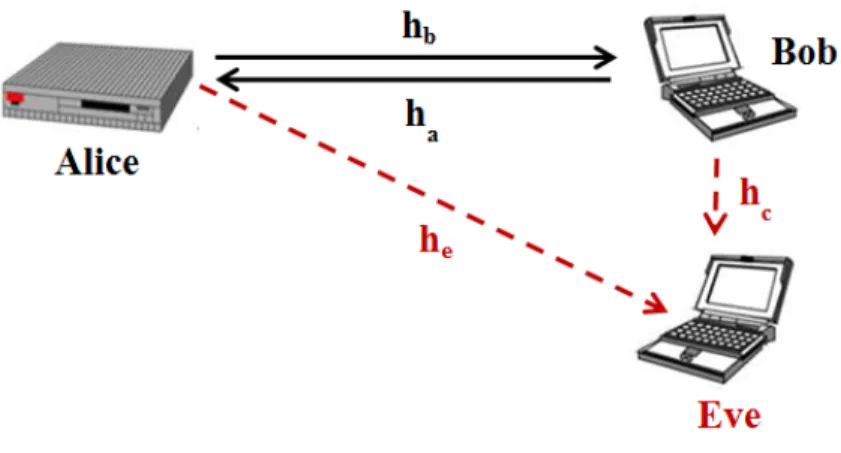
In the present work, we focus mainly on passive attacks where the eavesdropper is able to measure the channel when either Alice or Bob transmits training signals. She is also assumed to know the quantization algorithm used to establish a sequence of key bits. Moreover, Eve is supposed to intercept all the public communications. Therefore, Eve’s goal is mainly to exploit all this knowledge in order to collapse the key space and make its search of the exact key easier. The idea underneath SKG from random channels is that Eve’s gain of information about the key will be negligible in a typical scenario, rich in dispersive multipaths. In such a scenario, the location-specific propagation channel is expected to rapidly decorrelate in the space or frequency domains, owing to rapid signal fluctuations (Fig. 2-3). Thus, a passive eavesdropper who intercepts the communication between Alice and Bob, experiences a channel significantly decorrelated from that experienced by legitimate users. As a consequence, when Eve attempts to derive a key from the radio channel, the key has few common features with that extracted by both Alice and Bob, making hacking in practice unachievable. Fig. 2-7 depicts such a typical scenario.
propagation environment (e.g. multipath richness) as well as on the relative distance between Eve and Alice/Bob. Furthermore, Eve might resort to some techniques in order to gain insight about the wireless transmission between Alice and Bob and therefore degrade the level of security. In [68], the degree of security is discussed according to the statistical knowledge acquired by Eve, for example how Eve may use her knowledge about the multipath structure in order to reconstruct the channel coefficients and subsequently attempt to guess a portion of the secret key. In [42], Eve uses ray tracing methods in order to predict the channel response, which depends on side information such as the environment map and EM characteristics and on her localization accuracy of the legitimate terminals.
Nevertheless, when considering active attacks, Eve may impersonate a legitimate user since the channel over which Alice and Bob communicate is not authenticated. This problem, also known as “man in the middle”, is extremely serious since difficult to counter. In this respect, the authors in [60] proposed an authentication scheme based on a level crossing algorithm. This kind of attacks is taken into account in the PHYLAWS project where a technique based on furtive and adaptive radio signals aims to protect the earliest stage of PhySec, in particular SKG [69]. Discussions about different attacks and countermeasure may be found in [70]. Accordingly, we do not consider active attacks in the present work.
2.2.3
Review of SKG
Prior works address issues encountered in the SKG process from either information-theoretic perspective or from a practical view. In the former, bounds on secret key rate are computed where simple analytical expressions are just found for perfect fad-ing Gaussian channels, for either NB system [25, 58, 61, 62, 71, 72] or for WB/UWB technology [63, 65, 73]. However, real measured channels may deviate from Gaus-sian statistics, for example when a path dominates the propagation channel or when limited interfering paths exist. Although secret key capacity is computed numer-ically for both Nakagami and Suzuki fading channels in [74], this does not seem efficient since a large amount of statistical data is required and more complications appear for complex valued channel coefficients. Therefore, assessing security from the information-theoretic side is not always suitable.
On the other hand, practical assessments consist of quantizing the channel infor-mation (e.g. the received signal strength (RSS), the phase inforinfor-mation, the CIR, etc.) into a sequence of secret bits (Section 3.2.1), where security may be assessed through
bit error rates and through achieved secret key rates. In this respect, most prior works proposed quantization protocols, often combined with a reconciliation scheme, in order to enhance the security [29, 59, 60, 75, 76, 77, 78]. In particular, they intend to deliver key rates approaching the secret key capacity, after applying the four key generation steps shown in Fig. 2-6. The authors in [71] target the key extraction from the complex channel coefficients of a complex Gaussian channel model. They show that the secret key rate may be within 1 bit from the secret key capacity, by adapting the number of extracted bits according to the SNR, using gray codes and LDPC codes with soft decision for error corrections.
Therefore, it is clear that most prior works focus on the role played by the quanti-zation algorithm in retaining security, while few papers address the relation between SKG and the propagation channel features. In [58], the authors emphasize the role of multipath richness in 1) increasing the amount of randomness of MIMO technologies and 2) keeping the key safe from Eve. SKG was also discussed with respect to the Doppler frequency [60], to the LOS/NLOS character [58, 79] and to the coherence time [63]. Premnath et al. [29] applied practical SKG algorithms to the RSS of real channels, measured in different environment settings, including indoor and outdoor conditions and stationary and mobile terminals/intermediate objects. The measure-ments using 802.11-based laptops exhibited the weakness of SKG behavior in nearly static environments, where the entropy of extracted key bits is very low, whereas it turns out to be higher in mobile environments.
Hence, channel variability is a crucial requirement to establish long random se-cret key bits. The quality of the key in part depends on the statistical independence between key bits, which to some extent can be reduced to the lack of correlation between channel samples. Such an independence stems from sufficiently separated samples, in whatever domain sampling might be, which involves the physical propa-gation mechanisms and characteristics of the radio environment. On the other hand, several authors indeed emphasize the benefit of decorrelating channel observations, especially highlighting MIMO systems [59, 62].
Security in static environments was targeted by creating channel fluctuations through beamforming techniques provided by steerable array antennas [55, 80, 81]. Moreover, fast SKG in such environments was achieved by using opportunistic beam-forming (without the need of a specific antenna design) and the frequency diversity [82]. Furthermore, terminals/scatterers mobility can be compensated through the investigation of the channel degrees of freedom (DoF), covering both the spatial do-main and the frequency/delay dodo-main, which express the channel richness and its
expected impact on randomness [24, 58, 83, 84, 85]: the richer the channel, the better the chance to exploit this richness usefully towards security. The spatial diversity existing in MIMO systems is investigated theoretically and experimentally in indoor channels [58]. In [65], the frequency diversity in orthogonal frequency division multi-plexing (OFDM) systems is investigated theoretically in SKG techniques by assuming independent and identically distributed (i.i.d.) channel transfer functions. However, no validation of this approach was performed in well specified measurement campaigns and no quantitative information about the achieved key length was provided.
From the eavesdropper point of view, several works assume that Eve is not able to access correlated channel information when she is located more than a half or at most a few wavelengths away from both legitimate terminals [55, 61]. This assumption is valid in the case of rich omnidirectional multipaths, where the channel decorrelates rapidly over the specified domain. Nevertheless, SKG performance has been inves-tigated statistically and empirically for a simple scenario where Eve is very close to Bob1 [58, 86]. Moreover, a simple correlation model, which relies on a low-pass filter, is investigated equivalently in [84, 87]. However, the authors in [64] proved by mea-surements that spatial correlation can be found even for larger separation distances. In particular, shadow fading seems to be critical in PhySec, while shadow fading correlations [37] between Bob and Eve are likely to affect the information accessible to the eavesdropper and thus to impact the confidentiality. In this context, we have presented in [72] a very simple version of a GSCM, relying on the presence of scat-terers between Alice and Bob/Eve in order to capture the common characteristics between Alice/Bob and Eve’s channels without a restriction to stationary region. An extension of this model will be presented in Chapter 4.
2.3
Conclusion
This chapter presented an overview on the state of the art of both the wireless prop-agation channel and the secret key generation. In the first section, a definition of the wireless propagation was given, with special emphasis on features relevant to SKG, such as the multipath propagation, the channel reciprocity and the three types of channel fading. Moreover, an overview on existing channel models was given. These models can not be directly exploited in the context of PhySec, in particular the SKG scheme which seems to be very exigent. Indeed, on one hand, the SKG performance analysis requires a multi-user channel model that accounts for the intrinsic spatial
channel variability between two users in proximity of each others, i.e. Bob and Eve. Such a requirement is targeted in Chapter 4, by elaborating on a GSCM. On the other hand, the quality of the key extracted from the radio channel heavily relies on the multi-path channel richness, which should be modeled with a sufficient accuracy (e.g. taking into account the diffuse components of the radio channel in RT simulations, ref. to Chapter 5).
Furthermore, in the second section, the strategy of deriving keys from the prop-agation channel was described, by discussing some scenarios for the eavesdropper. Related works in the area of SKG were also cited, with particular emphasis on SKG limitations.
In order to evaluate the quality of an on-the-fly generated key with respect to dif-ferent propagation settings, we describe, in the following chapter, appropriate metrics and performance methods. Specifically, we emphasize the relation between key qual-ity and channel features when investigating delay-dispersive channels.