UNIVERSITÉ DE SHERBROOKE
Faculté d’éducation
Developing Multiliteracies with Digital Games and Digital Literature in a College-level English Course with First Language and Second Language Learners
Par
Nolan Bazinet
Thèse présenté à la Faculté d’éducation en vue de l’obtention du grade de
Philosophiae Doctor (Ph.D.)
Mai 2019 © Nolan Bazinet
UNIVERSITÉ DE SHERBROOKE Faculté d’éducation
Developing Multiliteracies with Digital Games and Digital Literature in a College-level English Course with First Language and Second Language Learners
Par Nolan Bazinet
a été évalué par un jury composé des personnes suivantes : Professeure Claudia Gagnon Présidente du jury Professeure Lynn Thomas Directrice de recherche Professeure Nathalie Lacelle Codirectrice de recherche Professeur Florian Meyer Membre interne du jury Professeure Jennifer Rowsell Membre externe du jury Professeur David Leahy Membre interne du jury
ABSTRACT
Digital technology has had an increasing presence in the lives of children and young adults over the last 20 years. The American, non-profit organization Common Sense Media claims that 89% of teens now own a cellphone while 70% use social media multiple times a day (Rideout & Robb, 2018). Similarly, in Canada, Statistics Canada reports that 96% of young people use the Internet on a daily basis or own their own smartphone (Statistics Canada, 2018, p.13). As a result of this, recent calls for critical education in regards to social and digital media argue for the importance of 21st century media and literacy skills (Butler, 2017; Storksdieck,
2016). These calls join a chorus of academics who have long been calling for the importance of multiliteracy development in education (Cope & Kalantzis, 2000; Gee & Hayes, 2011; Lankshear & Knobel, 2011; New London Group, 1996). In searching for texts that may facilitate multiliteracy development, digital games has emerged as an option in formal education, given the complex critical thinking, learning, and literacy practices they can afford (Beavis, O'Mara, & McNeice, 2012; Gee, 2007; Salen & Zimmerman, 2004; Squire, 2008; Steinkhueler, 2010). Similarly, recent scholarship has discussed using digital games in language and literature courses, particularly L2 environments, demonstrating how digital games can increase motivation, vocabulary attainment, and provide other linguistic benefits (Guerrero, 2011; Vahdat & Behbahani, 2013; Yang & Chen, 2012). Despite these claims, little research, has demonstrated the ways in which such texts can engender multiliteracies in both L1 and L2 environments. The study presented here sought to explore the multitliterate affordances when using digital literature and digital games for L1 and L2 learners at an English first language college in Quebec. 23 students participated in the qualitative, exploratory, design-based research study conducted in an English literature class. Results show that the implications of using digital games to engender multiliteracy development are substantive. Moreover, the study’s findings indicate that students were able to apply literary concepts through playing these games, as well as interrogate terms such as empathy, multimodality, and procedural rhetoric. Therefore, digital games can be understood as convergent texts (Jenkins, 2006) in that they afford a multitude of literacies, engagement, reflexivity, and lend themselves to critical, literary analysis. However, more research is needed, particularly on the specific ways these texts might be integrated into the classroom so that teachers are provided with detailed information on how to teach with them.
Keywords: multiliteracies; digital games; digital literature; second language acquisition;
Résumé
Au cours des 20 dernières années, une présence accrue de la technologie numérique s’est manifestée dans la vie des enfants et des jeunes adultes. L'organisation à but non lucratif américaine Common Sense Media affirme que 89 % des adolescents possèdent désormais un téléphone portable, tandis que 70 % utilisent les médias sociaux plusieurs fois par jour (Rideout et Robb, 2018, p. 8). De même, au Canada, Statistique Canada rapporte que 96 % des jeunes utilisent Internet quotidiennement ou possèdent leur propre téléphone intelligent (Statistique Canada, 2018, p. 13). En conséquence, les récents appels au bénéfice d'une éducation critique en matière de médias sociaux et numériques plaident en faveur de l'importance des compétences en matière de médias et de littératies du XXIe siècle (Butler, 2017; Storksdieck, 2016). Ces appels rejoignent un groupe de chercheurs qui revendiquent depuis longtemps l'importance du développement des multilittératies en éducation (Cope et Kalantzis, 2000; Gee et Hayes, 2011; Lankshear et Knobel, 2011; New London Group, 1996). Parmi les textes qui peuvent faciliter le développement des multilittératies, les jeux numériques représentent une option possible en éducation, compte tenu de leurs possibilités de susciter la pensée critique ainsi que d’autres pratiques multilittéraires complexes (Beavis, O'Mara et McNeice, 2012; Gee, 2007; Salen & Zimmerman, 2004; Squire, 2008; Steinkhueler, 2010). De même, des travaux récents ont porté sur l'utilisation de jeux numériques dans les cours de langue et de littérature, en particulier dans des situations d’apprentissages de L2, démontrant ainsi comment les jeux numériques peuvent augmenter la motivation, l'acquisition du vocabulaire et d'autres avantages linguistiques (Guerrero, 2011; Vahdat & Behbahani, 2013; Yang et Chen, 2007, 2012). En dépit de ces affirmations, peu de recherches ont démontré la manière dont de tels textes peuvent engendrer les multilittératies dans les environnements de L1 et L2. L'étude présentée ici cherchait à explorer les avantages des multilittératies, lors de l'utilisation de la littérature numérique et des jeux numériques dans un collège anglophone au Québec. Vingt-trois étudiants ont participé à une étude qualitative, exploratoire, basée sur une recherche orientée sur la conception (design-based
research) en éducation, dans un cours de littérature anglaise. Les résultats montrent que les conséquences de l’utilisation des jeux numériques pour générer un développement en multilittératie sont considérables. De plus, les conclusions des recherches indiquent que les étudiants parviennent à appliquer les concepts de littératie dans leurs jeux numériques en revisitant certains termes tels que : empathie, multimodalité et rhétorique procédurale, tout en les questionnant. Par conséquent, les jeux numériques peuvent être appréhendés comme des textes convergents (Jenkins, 2006) dans la mesure où ils permettent une multitude de littératies de même qu’un engagement et une réflexivité accrus en se prêtant à une analyse littéraire critique. Cependant, des recherches supplémentaires s’avèrent nécessaires, en particulier sur les moyens précis d’intégrer ces textes dans la classe afin que les enseignants disposent d’informations détaillées sur la manière de les utiliser dans leur enseignement.
.
Mots-clés : multilittératies, jeux numériques, littérature numérique, acquisition d’une langue seconde;
TABLE OF CONTENTS
INTRODUCTION ... 16
CHAPTER ONE: STATEMENT OF THE PROBLEM ... 23
1. NEW LITERACY STUDIES AND MULTILITERACIES ... 23
1.1. Multiliteracies in First Language (L1) Learning Environments ... 27
1.2. Multiliteracies in Second Language (L2) Learning Environments ... 30
2. THE DIGITAL TURN IN FIRST LANGUAGE LEARNING ENVIRONMENTS ... 34
2.1. Digital Games in First Language Learning Environments ... 39
2.2. Digital Literature in First Language Learning Environments ... 43
3. THE DIGITAL TURN IN SECOND LANGUAGE LEARNING ENVIRONMENTS .... 48
3.1. Digital Games in Second Language Learning Environments ... 49
3.2 Narrative in Second Language Learning Environments ... 53
3.3. Digital Literature in Second Language Learning Environments ... 56
4. ENGLISH TEACHING CONTEXT IN CÉGEP ... 57
5. CONCLUSION ... 60
6. RESEARCH QUESTIONS ... 61
CHAPTER TWO: CONCEPTUAL FRAMEWORK ... 62
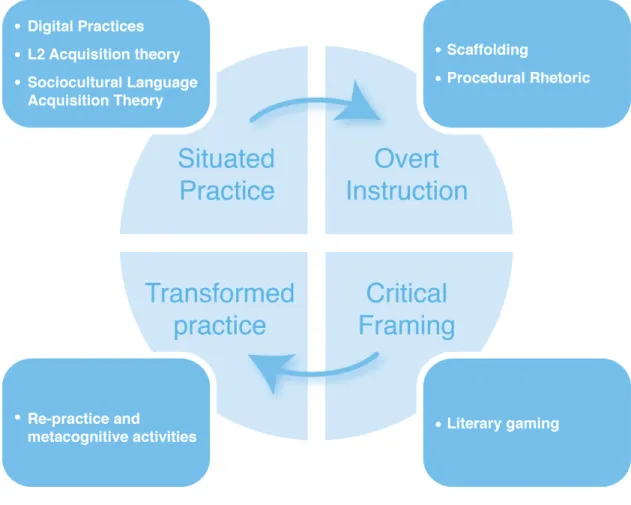
1. NEW LONDON GROUP’S PEDAGOGICAL FRAMEWORK ... 63
1.1. Situated Practice ... 63
1.1.1 Digital Practices ... 64
1.1.2. L2 Acquisition Theory ... 66
1.1.2.1 Sociocultural Language Acquisition Theory ... 66
1.1.3.1. Communicative Language Teaching ... 69
1.2. Overt Instruction ... 69
1.2.1. Procedural Rhetoric ... 72
1.3. Critical Framing ... 76
1.3.1. Literary Gaming ... 77
1.4. Transformed Practice ... 79
2. CONCEPTUAL AND PEDAGOGICAL FRAMEWORK ... 81
3. DEFINITION OF MULTIPLE LITERACIES ... 83
3.2. Media Literacy ... 85 3.3. Digital Literacy ... 87 3.4. Technological Literacy ... 88 3.5. Information Literacy ... 90 3.6. Cultural Literacy ... 92 3.7. Critical Literacy ... 93 4. RESEARCH OBJECTIVES ... 98
CHAPTER THREE: METHODOLOGY ... 101
1. RESEARCH DESIGN ... 101
1.1. DBR and Action Research ... 106
1.2. Concerns and Limitations of DBR ... 107
2. RESEARCH PARADIGM: QUALIATIVE AND QUANTITATIVE METHODS ... 109
2.1. ETHNOGRAPHY ... 111
3. THE RESEARCHER’S ROLE AND COURSE CONTEXT ... 114
3.1. Weekly Plan of Study ... 116
3.1.1. Week 1, Iteration 1: Interactive Fiction ... 116
3.2.1. Week 2, Iteration 2: Hypertext Fiction ... 117
3.3.1. Week 3, Iteration 3: Hypermedia Fiction and Digital Games ... 117
3.4.1. Week 4, Iteration 4: Study Conclusion ... 118
4. POPULATION AND SAMPLE ... 118
5. DATA COLLECTION TECHNIQUES ... 119
5.1. Think-Aloud Protocols ... 120 5.2. Screencasts ... 122 5.3. Classroom Artefacts ... 123 5.4. Focus Groups ... 125 5.5. Field Notes ... 126 5.6. Surveys ... 127 6. ANALYSIS OF DATA ... 127 7. TRIANGULATION ... 129 8. ETHICS ... 130 9. CONCLUSION ... 132
CHAPTER FOUR: DATA ANALYSIS ... 133
1. SUMMARY OF DATA COLLECTED ... 133
2. PRE-STUDY SURVEY ... 134
2.1. Linguistic self-identification ... 135
2.2. Frequency of Digital Game Play ... 136
2.3. Familiarity with Digital Literature ... 137
2.4. Level of interest to play/read ... 138
2.5. Analysis of Pre-Study Survey ... 139
3. PRESENTATION OF WEEKLY FINDINGS ... 140
3.1: First Iteration: Week 1 - Interactive Fiction ... 141
3.1.1. Day 1: Observation/Field Notes ... 141
3.2.1. Day 2: Observation/Field Notes ... 146
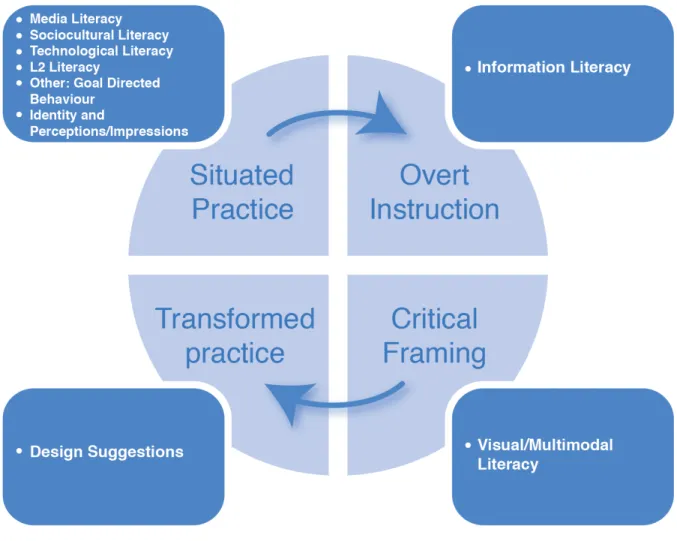
3.3.1 Week 1 – Summary of Literacies, Concepts, Themes That Emerged During the Week ... 151
3.4.1. Situated Practice ... 152
3.4.1.1 Identity and Perceptions/Impressions ... 153
3.4.2.1. Media Literacy ... 154
3.4.3.1 Sociocultural Literacy ... 155
3.4.4.1 Technological Literacy ... 156
3.4.5.1 L2 Literacy ... 157
3.4.6.1 Other themes/categories that emerged: Goal-Directed Behaviour ... 158
3.5.1. Overt Instruction ... 159
3.5.1.1 Information Literacy ... 160
3.5.2.1 Sociocultural Meaning Making ... 162
3.6.1 Critical Framing ... 163
3.6.1.1 Visual/Multimodal Literacy ... 164
3.7.1 Transformed Practice ... 166
3.7.1.1. Design Suggestions ... 167
3.8.1 Data Triangulation ... 168
3.9.1 Modifications to Future Iteration ... 169
4.1. Second Iteration: Week 2 - Hypertext Fiction ... 171
4.1.1. Day 1: Observation/Field Notes ... 172
4.2.1 Day 2: Observation/Field Notes ... 175
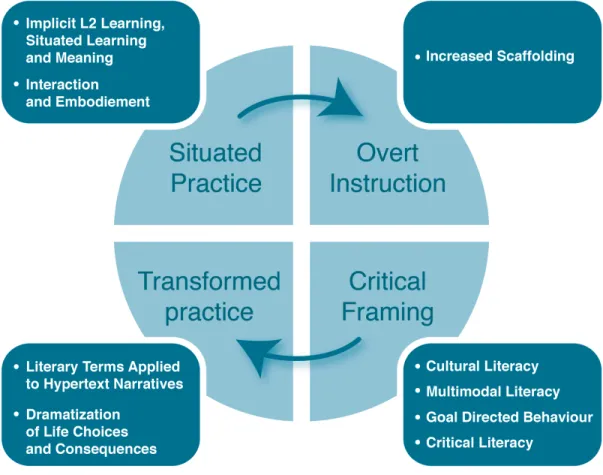
4.3.1 Week 2– Summary of Literacies, Concepts, Themes That Emerged During the Week ... 176
4.4.1. Situated Practice ... 177
4.4.1.1. L2 Learning and Motivation ... 178
4.4.2.1. Implicit L2 Learning, Situated Learning and Meaning ... 179
4.4.3.1 Interaction and Embodiment ... 180
4.5.1 Overt Instruction ... 182 4.6.1 Critical Framing ... 183 4.6.1.1 (Socio)Cultural Literacy ... 183 4.6.2.1 Multimodal Literacy ... 185 4.6.3.1 Goal-Directed Behaviour ... 185 4.6.4.1 Critical Literacy ... 187 4.7.1 Transformed Practice ... 188 4.8.1 Data Triangulation ... 190
4.9.1 Modifications to Future Iteration ... 191
4.10.1. Second Iteration: Week 2 Conclusion ... 193
5.1 Third Iteration: Week 3 - Hypermedia Fiction/Digital Game Theory Introduction ... 194
5.2.1. Day 1: Observation/Field Notes ... 194
5.3.1. Day 2: Observation/Field Notes ... 195
5.4.1. Week 3– Literacies, Concepts, Themes That Emerged During the Week ... 197
5.5.1 Situated Practice ... 197
5.6.1 Overt Instruction ... 198
5.7.1 Critical Framing ... 200
5.7.1.1 Media literacy ... 200
5.7.2.1 Critical literacy ... 202
5.7.3.1 Other themes/categories that emerged: Moral Choice and Empathy ... 202
5.7.4.1 Goal-Directed Behaviour ... 205
5.8.1 Transformed Practice ... 206
5.8.2.1. Critical literacy ... 207
5.9.1. Data Triangulation ... 209
5.10.1. Modifications to Future Iteration ... 210
5.11.1. Third Iteration: Week 3 Conclusion ... 211
6.1. Fourth Iteration: Week 4 - Digital Game Conclusion/Preparation for Final Evaluation ... 212
6.1.1. Day 1: Observation/Field Notes ... 212
6.2.1. Week 4 - Summary of Literacies, Concepts, Themes That Emerged During the Week ... 213
6.3.1. Situated Practice ... 214
6.3.1.1. Interactive fiction in relation to their practices ... 214
6.3.2.1. Hypertext fiction in relation to their practices ... 215
6.3.3.1. Hypermedia fiction in relation to digital practices ... 216
6.3.4.1. Using different technologies in class / relation to their practices ... 217
6.3.5.1. Digital games in relation to life ... 219
6.4.1. Overt Instruction ... 220
6.5.1. Critical Framing ... 221
6.5.1.1. Empathy, embodying characters, and the complexity of moral decisions/ethics ... 221
6.5.2.1 Multimodality as factor for embodiment/empathy ... 223
6.5.3.1 Goal-Directed Behaviour ... 225
6.5.4.1. Information Literacy ... 226
6.5.5.1. L2 Literacy ... 226
6.6.1 Transformed Practice ... 227
6.7.1 Data Triangulation ... 227
6.8.1 Modifications to Future Iteration ... 228
6.9.1. Week 4 Conclusion ... 229
4.1. POST-STUDY SURVEY ... 230 4.1.1. Question 1: The most difficult aspect about the digital literature we played was… . 230
4.2.1. Question 2: The most interesting aspect about the digital literature we played was…
... 230
4.3.1. Question 3: The most interesting aspect about the digital game I chose was… ... 231
4.4.1. The most difficult aspect about the digital game I played was… ... 231
4.5.1. By learning about digital literature and digital games, I realized…. ... 232
4.6.1. ANALYSIS OF POST-STUDY SURVEY ... 232
5. CONCLUSION ... 233
CHAPTER FIVE: FINDINGS AND DISCUSSION ... 236
1. GENERAL OBJECTIVE ONE ... 236
1.1. Implementation and modification ... 237
2.1. Situated Practice ... 239
2.2. Conclusion to Situated Practice ... 250
3.1. Overt Instruction ... 252
3.2. Conclusion to Overt Instruction ... 260
4.1. Critical Framing ... 261
4.2. Conclusion of Critical Framing ... 266
5.1. Transformed Practice ... 267
5.2. Conclusion to Transformed Practice ... 269
2. GENERAL OBJECTIVE TWO ... 271
2.1. Sociocultural context of English language learning ... 271
1. SUMMARY OF FINDINGS AND DISCUSSION ... 277
CONCLUSION ... 280
1. LIMITATIONS ... 280
1.1. Sociocultural Underpinnings ... 280
1.2. Quantitative Limitations ... 281
1.3. Qualitative Limitations ... 283
1.4. Struggling with the Conventions of DBR. ... 286
1.5. The Binaries of Identity ... 288
1.6. The Binaries of Inside versus Outside School Practice ... 290
1.7. The Binaries of Digital Games and the Classroom Context ... 291
2.1. Recommendations ... 292
2.2. Teacher Training Programs ... 293
2.3. Digital Games in Contemporary Teaching ... 294
2.4. Digital Games and Second Language Teaching ... 294
2.5. Literacy and the Post-human ... 295
REFERENCES ... 298 APPENDIX A ... 336 APPENDIX B ... 338 APPENDIX C ... 344 APPENDIX D ... 347 APPENDIX E ... 351 APPENDIX F ... 352 APPENDIX G ... 354 APPENDIX H ... 355
LIST OF TABLES
Table 1. How do you self-identify (in terms of language)?...p.108 Table 2. How often do you play digital games?... p.109 Table 3. Before this course, had you ever heard of digital literature?...p.110 Table 4. Please indicate your level of interest to play/read the following...p.111
LIST OF FIGURES
Figure 1. Conceptual and Pedagogical Framework...p.66 Figure 2. Week 1 – Summary of Literacies, Concepts, Themes That Emerged During the
Week... p.121 Figure 3. Week 1 – Pedagogical Considerations...p.135 Figure 4. Week 2 – Summary of Literacies, Concepts, Themes That Emerged During the
Week...p.141 Figure 5. Week 2 – Pedagogical Considerations….………...p.153 Figure 6. Week 3 – Summary of Literacies, Concepts, Themes That Emerged During the
Week...p.156 Figure 7. Week 3 – Pedagogical Considerations...………...p.166 Figure 8. Week 4 – Summary of Literacies, Concepts, Themes That Emerged During the
Week...p.168 Figure 9. Week 4 – Pedagogical Considerations...p.179 Figure 10. Comprehensive Pedagogical Considerations of All Four Weeks... p.184 Figure 11. Summary of Situated Practice...p.197 Figure 12. Summary of Overt Instruction...p.204 Figure 13. Summary of Critical Framing...p.209 Figure 14. Summary of Transformed Practice...p.212 Figure 15. Summary of Findings and Discussion...p.218
LIST OF ACRONYMS AND ABBREVIATIONS
L1 First language
L2 Second language
CALL Computer assisted language learning CLT Communicative language teaching COTS Computer off the shelf games
CÉGEP Collège d'enseignement général et professionnel DBR Design based research
DGBL Digital game based learning
DGBLL Digital game based language learning EFL English foreign language
ESL English second language
ICT Information and communication technology NLG New London Group
SLA Second language acquisition LMM Littératie médiatique multimodale MELS Ministère d’éducation et de sports
MEES Ministère d’éducation et d’études supérieures MMORPG Massively multiplayer online role playing game NAMLE National associating of media literacy education NLS New literacy studies
RPG Role playing games
ZPD Zone of proximal development
ACKNOWLEDGEMENTS
I would first like to thank my advisor Professor Lynn Thomas for her continuous support during my Ph.D. studies. Her generosity, patience, and helpful feedback kept me motivated throughout this process. Without her help, I do not believe it would have been possible to complete this project.
I would also like to thank my co-advisor, Professor Nathalie Lacelle. Her encouragement and breadth of knowledge in multiliteracies was crucial for me to complete this dissertation. She continues to point me towards interesting new avenues of research and theory related to multiliteracies as well as a number of related fields. It has been a true pleasure working with her.
I thank my peers David Neville, Paul Darvasi, and Matthew Farber for exchanges and discussion related to this project and its various topics. I would also like to thank my friends Alan Shapiro, Nick Walker, and Pete Webb for stimulating discussions that helped me with my personal, professional, and academic growth. Thank you to Marc-Antoine Turcotte for help in assisting me with the figure drawings, and for discussions about our shared interest of teaching with games.
Last but not least, I would like to thank my family: my mother, my father, my sister, and especially my partner, Josiane Pellerin, for her support during this project. And thanks to Louis for bringing my attention back, every now and then, to the birds.
INTRODUCTION
Since the end of the 20th century, it has been a challenge for teachers and educators in English literacy classrooms to continually adapt with the rapid changes of media and communication used to deliver the language they are teaching. Notwithstanding the commitment put forward by formal education’s goals to assure all are able to read and write in the language or languages prescribed within its country’s borders, the challenge to keep up with current modes of communication has become increasingly difficult. Unsurprisingly, this has also been the case for the teaching of English as a second language. Over the last 20 years, scholars in both L1 and L21 teaching and learning have noted the importance of expanding notions of the types of texts instructors should introduce into the classroom, favouring more contemporary forms of media and communication that relate to the ways of reading, writing, speaking - and thus being - outside of the classroom. Similarly (and perhaps because of the rapid change brought on by technology), the fundamental differences between what distinguishes an L1 classroom from an L2 classroom are becoming blurred. For instance, when we look at the contemporary L1 classroom, we quickly realize that many learners speak one language with varying degrees of fluency, which problematizes the ways teachers conceive of – and teach – in both first and second language classrooms. Furthermore, the definition of an L1 or L2 class is also blurred today, as many so-called L1 classes are in fact full of L2 learners. Thus, in both L1 and L2 classrooms academics have had to reconsider not only the fundamental ways these classes are constituted, but also how one becomes literate with contemporary texts in a given language.
1 L2 will be used throughout this study to signify English as a second (or other) language of instruction, unless
otherwise noted. Similarly, the acronym ESL (English as a second language), will be used, though minimally, and only in reference to studies that employ the term given its problematic term via the implication that English is
Indeed, English language arts teaching2 has mostly relied on an understanding and analysis of a certain type of ‘text’3. Often, the text used has been in the form of linguistic
material, predominantly in its linguistic, printed form. As the discipline has been taught in later grades (from high school to college and/or university), these texts, particularly in the case of English first language teaching, have been of the ‘literary’ sort, as this had been the most effective, material object of analysis and has thus justified its existence as an academic discipline in higher education4. However, it is clear, particularly in the 21st century, that the word ‘text’ no
longer connotes the same thing as it may have two centuries, not to mention, 20 years ago. The word text today is much more ambiguous than it perhaps once was, best exemplified by the word’s contemporary connotation of ‘a text’, as in a text message. And indeed, this is an especially germane example, as it points to how the form used to present the linguistic material has affected the language and our socio-culturally dependent ways of communicating, underscoring what Marshall McLuhan famously claimed, “the medium is the message” (McLuhan, 1964, p. 7).
Thus, moving from books, to newspapers, to text messages, the 20th and subsequent early 21st century saw a significant evolution in how people communicated. As society changed in how
it communicated in the mid to late 20th century, it was thinkers such as Robert Scholes (1985), who presented an early argument for the necessity of English teachers and scholars to shift their
2 Clearly, English first language teaching, understood as literacy and/or literature teaching, is different than English
as a second (or other) language teaching and learning. However, for the context of this study, which will be justified below, these two disciplines will be slightly conflated.
3 Here I am using ‘text’ in its broadest form: the material outcome of a form of communication whether it is via a
linguistic, visual, audio, or gestural mode.
4 The implication here is that ‘literary works’ were those texts that were considered to be in the realm of higher
concern from a curriculum focused on literary canon, to one that focuses on ‘textual studies’5. For Scholes, textual studies calls for a reconsideration of the necessity to only analyze the page and/or book and rather, calls attention to the institutional practices and social structures, which can be studied as codes and texts whether they be visual, verbal, or polemical (p. 16-17). Scholes’ claim reflects a shift not only in literature teaching, but one in standard literacy development. In other words, Scholes’ argument, along with other scholars as will be discussed below, was representative of a contemporary change in understanding how readers engage in a variety of different texts, which problematized the foundations of how literacy was conceptualised. This reconceptualization can be defined as a shift from the focus of simply the reader and text, to the interrelation between the reader, the text, and the world (Cook-Gumperz, 1986; Eco, 1984; 8y, 1977).
As in first language teaching situations, second language teaching also encountered similar calls to properly address the need for students, even in a second language, to go beyond a functional understanding of the text (Kress, 2000). Granted, these calls were stronger in more advanced levels of second language teaching (for instance, a beginner level course would not necessarily demand that students develop a broader sociocultural understanding of the way the language of instruction functions). Nevertheless, a comparable shift occurred in second language teaching, as will be discussed below, to expand upon the meaning making and meaning creation that traditionally occurred in these environments.
5 There were of course, as will be discussed below, contemporary theorists in New Literacy Studies who argued for
an expansion of what it means to be literate or read and write in contemporary society. However, Scholes is somewhat unique in his early argument for a broader analysis of textual studies in the English literature classroom.
The manner in which one interprets texts through their relation with the world, and more specifically, their sociocultural associations, is a key element implicated in schools of thought within New Literacy Studies including teachers and theorists concerned with multiliteracy development. New Literacy Studies and/or multiliteracy development has been principally concerned with the variety of literacies – be they media, cultural, or digital literacy – people need to acquire, in order to competently communicate in today’s society. As will be discussed in the first chapter, these developments in how people ‘read’6 and make meaning via language – and
here the focus is principally concerned with the English language – grew out of the mid-to-late 20th century, paralleling the expansion of the various modes of communication and media within an increasingly globalized economy.
Whether learning English as a first or second language, there have been a variety of modes of communication to justify the importance of multiliteracy teaching. Indeed, media ranging from advertisements, television shows, graphic novels, and podcasts have been the subject of multiliterate analysis in English first language and second language classrooms7. However, it has been the recent development of digital games, and similarly, digital literature, that has provided some interesting multiliterate possibilities. As will be presented in this dissertation, digital games and digital literature can be considered ‘convergence texts’ that offer the ability for students to interactively engage with language, themes, and cultural values, but more importantly, allow them to engender various literacies resembling the competencies
6 The word in single quotes here is to signify a slight difference in the word read which is apart from its usual
connotation of interpreting linguistic words, to one that is broader yet closer to the origin of the word which is raden: to guess or advise.
7 However, as will be discussed below in chapter one, there was a concern (Kress, 2000) that second language
required by ministry curricula and furthermore, align with the literacies many are, or will be, engaging in outside of school communities.
To begin outlining multiliteracy development with digital games and digital literature, chapter one will begin by exploring particular issues in both L1 and L2 multiliteracy development, in so far as they relate to the stated project, including specific examples of how L1 and L2 multiliteracy development have been affected by digital technology. Furthermore, the emergence of digital literature and digital games in L1 and L2 contexts will also be discussed in chapter one, as well as a brief discussion of English teaching at the college level in Quebec to situate the study’s context via current literature. The chapter will then conclude with the research questions that were considered for this project. All of this will attempt to situate the project towards filling the lack, at both the practical level (i.e. in the classroom) and on the theoretical level, of multiliterate development using digital games and digital literature in college-level English courses.
Chapter two will present the conceptual framework that was developed to best analyse, and teach, digital games and digital literature with the objective of engendering multiliteracies using these texts. Such a framework, as will be argued below, has largely been inspired by the New London Group’s pedagogy8 of multiliteracies, given its simplicity and ease of use with digital, interactive texts. Evidently, the term multiliteracies implies multiple literacies being enacted. However, and as will be discussed below, rarely are specific literacies mentioned when
8 The term pedagogy will be used throughout this dissertation; therefore it would be worthwhile to define its usage in
how it will be used throughout this document. Pedagogy is defined as: “The method and practice of teaching, especially as an academic subject or theoretical concept” (Pedagogy, n.d.). Thus, in keeping with this definition, pedagogy will be used to highlight the method and practice of teaching, especially in how particular material, concepts, or ideas are transmitted to students through teaching practices.
this term is employed in research studies using digital games and digital literature, not to mention what context they have been articulated in. Thus, an explanation of which particular literacies, as well as their theoretical underpinning will be discussed, including relevant game studies concepts that were anticipated to be engendered, or discussed, throughout the study. Finally, chapter two will conclude with the research objectives considered for the study.
In the third chapter, an account of the methodological considerations for this study will be presented. The chapter will begin with a discussion of the research design used for the present study, which is a design based research design. Next, the research methods will be discussed followed by an explanation of the researcher’s role and the course context given the unique nature of the context of the study being an Anglophone college in majority Francophone Quebec, where a large number of the student population are Francophones. Subsequent to this, the population and sample will be discussed followed by the data collection techniques used in the study, as well as the analysis methods, and finally, the ethical considerations of the study.
With the completion of all methodological considerations, chapter four will demonstrate the pertinent data that was collected during the study. An analysis of the data will be done using the New London Group’s pedagogical framework, as discussed in chapter two, and will highlight the particular literacies, concepts, and game studies terms relevant to the study and its design. Also detailed in this study, where appropriate, are the results of the data in relation to previous studies, scholarship, and academic writing. The chapter will then conclude with a synthesis of the data that was presented.
The fifth chapter will explicitly relate the data to the objectives sought in the study. An explanation of how the data responds to the objectives, including pertinent research published on such data, will be presented. And finally, the study will conclude by presenting its limitations, as well as the interrelation between research, teacher education and practice, as well as recommendations for future research.
CHAPTER ONE: STATEMENT OF THE PROBLEM
1. NEW LITERACY STUDIES AND MULTILITERACIES
Over the last century, the concept of literacy, particularly in formal education, has changed dramatically. Originally defined as the ability to read and write, literacy was introduced into the educational system, mostly in North America, but also in Europe, by the end of the 18th century (Olson, 1977). More precisely, in the case of Canada, literacy development was implemented along with state-wide mandatory education in the latter half of the 19th century. As Willinsky (1992) points out, the push for literacy in Canada had a largely ideologically-laden agenda. English Canadian educators leaned heavily on a British colonial curriculum that remained in place into the 1950s (Graham 1989), particularly in places like Ontario where Protestant texts were largely used to develop reading and writing skills (Willinsky, 1992, p.272). In Quebec, all education, up until the Quiet Revolution of the early 1960s, remained in the hands of the Jesuits inspired by the Roman Catholic Church (Willinsky, 1992, p.273). Thus, up until the mid-20th century, the country’s literacy teaching relied heavily on colonial, or religious, interests - and in most cases, both.
The irony here is that, as literacy development was first instilled into education, it was promoted as a contributor to individual power and status (Heath & Street, 2008, p. 18); yet, evidently, it was also promulgated by those with particular positions of power and status and thus reflected their ideologies9. However, an understanding of the complex, sociopolitical and cultural dynamics behind literacy learning did not gain ground until the 1980s. Early pioneers in this development were scholars such as Heath (1983), Scollon and Scollon (1981), and Street (1984),
9 Of course, any particular ideology is always the impetus behind formulations of education. This is particularly
who began interrogating the conventional, or in the case of Street, ‘autonomous model10’ of literacy as independent from its sociocultural surroundings. These scholars, rather, underlined the extensive ways literacy is a social, cultural, and ideologically dependent process. This reconceptualization also represents a shift from what Gee later (2015) identified as the traditional approach of literacy, which had viewed it as an internal, cognitive phenomenon, to what New Literacy Studies (hereafter NLS) scholars argue as an external one, constituted by social and/or cultural practices, which were heretofore ignored in literacy scholarship11 (Gee, 2015, p. 35).
As literacy scholars began looking towards the social and cultural implications of literacy, it became difficult to ignore the increased role of communication technology. Throughout the 1990s, personal computers became more prominent in households, rather than mostly present in offices, and the Internet began to expand by leaps and bounds during the latter half of the decade. Noticing this, a number of NLS scholars met in New London, New Hampshire to compile what was soon to become an influential text within the field of literacy education. Thus, it was in 1996 that the self-designated New London Group published “A Pedagogy of Multiliteracies: Designing Social Futures”. This article built upon contemporary NLS scholarship which had already argued for a more sociocultural understanding of literacy, and included the belief that an emerging cultural, institutional, and global order was being confronted by a variety of forms of, mostly, digital communication and media which challenged “formalized, monolingual, monocultural, and rule-governed forms of language” (p. 60). This new theoretical framework was inspired by linguistic theories such as Fairclough’s (1995) order of discourse (i.e. the various relationships
10 The autonomous model refers to the notion that literacy occurs independently from the sociocultural context in
which it is used.
11 It is also worthwhile to note the contemporary ‘post-humanist’ turn in literacy education scholarship, one that, as
Kuby & Rowsell (2017) have claimed “is thinking about ways humans, nonhumans and more-than-humans are already always entangled in producing truths, realities, knowledges and relationships, and […] literacies” (p.285).
within discursive practices) and the numerous conventions that can be articulated through semiotic activity (including, but not exclusively, the use of language) present in social situations (New London Group, 1996, p. 74). This perspective was also informed by Halliday’s (1978) important work in systemic functional linguistics, which focused on the ideational, interpersonal, and textual macro functions of language. Such a macro perspective of the structure, and underlying facets of language use, was examined through a critical literacy lens (Freire, 1968; Janks, 1993; Lankshear, 1993) and thus demanded a more complex, integrative conceptualization of multiple literacies12 (thus, the term multiliteracies), seeking to include a variety of literacies (e.g. critical literacy, media literacy, information literacy) along with their concomitant meaning making practices.
Given this, language as the principal mode of meaning needed to be reassessed. Once traditional conventions of literacy development were put aside, an equal or greater emphasis on multimodality, defined as the dynamic relationship between various modes of meaning, became apparent, particularly in the media saturated age of late 20th century society. Thus, the New London Group (1996) argued that a metalanguage needed to be developed to address “the textual and the visual, as well as the multimodal relations between different meaning-making processes that are now so critical in media texts and the texts of electronic multimedia” (p. 77). Such a metalanguage, they argued, would assist learners in not only the consumption of various multimodal texts, but also prepare them to be active producers of such texts.
Multimodality thus became a cornerstone of multiliteracy development, most frequently
12 Gee (2015) has referred to this as also being represented in the shift in term from New Literacy Studies, to New
discussed by NLS collaborator Gunther Kress (2002, 2003, 2010) whose work, along with theorists such as Van Leeuwen (2002) and Cope and Kalantzis (2000), discuss the term’s importance in relation to contemporary meaning making. For Kress (2010), multimodality refers to the mixture of modes and the meaning accorded to them when combined in a message (p. 3). Moreover, discussions of multimodality are inextricably tied to the sociocultural aspects of various modes and the ways in which they afford meaning for a particular culture or society at a given time. Thus, Kress (2010) contends that multimodality is one aspect that leads to social semiotics which provides a framework to apply theories of meaning and how such meaning is decoded regardless of the social situation or cultural site (p. 3). Moreover, discussions of such invariably reveal the power dynamics behind them, for as Kress states: “Whereas social is marked by power (difference) the cultural is marked by values, evaluation – itself the effect of social power” (p. 13). Therefore, multimodality invariably opens up questions of critical literacy, which is ever more important in light of the profusion of multimodal messages over the late 20th and early 21st century, specifically media images, via print or digital (Lacelle, Lebrun, Boutin, Richard & Martel, 2015; Rowsell & Pahl, 2015). Thus, a pedagogical imperative emerges in being able to decode not only the message, but also the underlying power structures behind them.
An emphasis on the ways in which power structures are implicitly produced and reflected through texts is a point that scholars such as Scholes’ (1985) had also been cognizant of. Indeed, he expressed similar concerns with the ways in which texts are places where underlying power dynamics can become apparent and palpable (Scholes, 1985, xi). Moreover, publishing a decade before the NLG’s manifesto, Scholes was prescient in his view that multimodality – though he never explicitly used the term – needed to be integrated into the literature classroom: “All kinds of texts, visual as well as verbal, polemical as well as seductive, must be taken as the occasions
for further textuality” (p.16). Since Scholes’ claims, there has been a gradual interest over the last two decades in multiliteracies teaching and learning which has highlighted the role of technology in contemporary meaning making practices.
1.1. Multiliteracies in First Language (L1) Learning Environments
Even though multiliteracy development through non-traditional texts has been a slowly developing field in the late 20th and early 21st century, there has been some research done in
Canada that have produced some compelling studies within English first language (L1) environments. For instance, Gouthro and Halloway (2013) report on a number of teachers whose use of fiction writing for diverse learners provided effective examples of how multimodal texts were able to engender learning connected to critical thinking as well as multiliteracies. Others, such as Rowsell, McLean, and Hamilton (2012) present a study of grade nine students’ articulation of multiliteracies, developed through various visual literacy practices, such as the ones tattoos afford. Such pedagogy, the authors claim, led to discussions of the historical evolution of body art with its connection to cultural encounters, questions of identity, even the medical ramifications of tattooing (p. 446). Indeed, multiliteracies can challenge dominant, normative schooling practices, such as Marshall and Toohey’s (2011) study of Punjabi-Sikh children who created dual language picture books in an L1, monolingual school. These books presented historical events in India and the religious conflicts therein, from the point of view of the family elders. Similarly, Taylor, Bernhard, Garg and Cummins (2008) demonstrate that challenging the monolingual, and by extension, monocultural practices of a school’s reliance on traditional print-based literacy, can allow students to affirm literacies associated with their own complex transnational and transgenerational communities of practice. Their study invited students to produce multimodal identity texts, which documented evolving family literacy
practices and the concomitant change of relationships and values that were made possible by the project’s ‘extra-curricular’ notions of literacy (p. 281). More importantly, allowing students to enact such literacies subsequently allowed for their inclusion within the school curriculum (p. 269). Likewise, Giampapa’s (2010) study of students’ identity texts created learning opportunities for students to access the English mainstream curriculum and, moreover, allowed for the co-construction of knowledge and a variety of discursive encounters between differing interest groups such as teacher-student, student-student, and student-parent-teachers (p. 425). What these studies have in common is their challenge to the standard forms of education, particularly highlighting the multicultural and multi-ethnic realities of contemporary classrooms.
Incorporating non-traditional texts such as those in the popular culture genre has also proved to be fertile ground for multiliteracy development. Scholars like Stevens (2001) in the United States engaged teachers at a middle school to integrate a number of television shows and films into their classrooms. Her fellow science colleague elected to use parts of films like Jumanji and Raiders of the Lost Ark to interrogate the fictional representation of physics in films. Despite the fact that students were immensely engaged in the exercises and were able to discuss the scientific elements of the special effects they viewed, the teacher did not have the opportunity to interrogate the power structures and agenda behind the filmmakers making these films that is necessary for critical literacy (p. 551). Stevens’ also reports on a colleague who featured a unit on popular culture social science studies. After analyzing a number of popular culture texts ranging from music (The Beatles), television shows (The Partridge Family) and films (ET The Extra Terrestrial) students were put into groups and allowed to choose a popular culture text to analyze. One group in the course used the popular television show South Park, that apparently fostered a dynamic discussion on political correctness and its backlash. Overall, the teacher of the
course was impressed by the level of critical thought engendered by these group members’ presentations. Stevens concludes her study by noting that the students in all of the classroom scenarios above proved that “given the opportunity to concretely relate school-based concepts to their popular culture affinities, they can move well beyond any view of students as passive consumers” (p.554).
Certainly, analysis of television programming has strong potential links to multiliteracy development, particularly in the English literature classroom. For instance, Mackey (2003) argues that television shows like Felicity13 can engage in a number of literacies, both present in the text and exterior to it. For instance, Mackey suggests that a show like Felicity is ripe for analysis that “explores the literate practices of the characters within the world of the story; the narrative devices used to frame the storytelling of the series; and the external but connected texts arising from three sources: those created by the publicity industry associated with the show; those created by the creators of the series; those created by the fans” (p. 391). Mackey then proceeds to provide a detailed analysis of each, providing useful examples to be used in the classroom. She then concludes by effectively claiming that teachers will be more equipped to extends students’ literacy needs “if we first acknowledge and respect the vast textual world that many of them inhabit in their own time and for fun” (p. 408).
Similarly, a group of researchers here in Quebec known as le Groupe de recherche en Littératie Médiatique Multimodale (LMM) have recently begun investigating the ways in which the development of multimodal literacies can be integrated into the Quebec education system
13 Felicity is a television programme that aired from 1998 to 2002. The show revolves around a young college
(Lebrun, Lacelle & Boutin, 2012, 2017). Like the New London Group before them, members of the LMM group believe that the development of media and multimodal literacies responds to a pressing need for students to be not only literate in the traditional sense, but that students need to become conscience of multimodal texts’ production and hence, mastery, which may allow them not only to interpret and analyse the content critically, but also manipulate the codes as needed, allowing the students to become producers, as opposed to passive consumers (2012, p. 224). Thus, the LMM group have been establishing a framework that builds on a conception of the purpose of literacy from epistemological foundations common to various disciplines (multimodality, social semiotics, cybernetics, and connected learning) and knowledge of current social, cultural and educational issues. The group’s research has focused on a wide range of multimodal texts ranging from graphic novels (Lacelle, 2012) to films (Lacelle, 2011), integrating, as the theorists above have done, traditionally out-of-school literacy practices into the primary and secondary school curriculum. As will be discussed below, much of their recent work interrogates the role of digital texts and their implications for multimodal literacy in formal learning environments. However, before discussing the implications of the digital turn in L1 learning environments, the development of multiliteracies in L2 learning environments needs to be elucidated.
1.2. Multiliteracies in Second Language (L2) Learning Environments
Using non-traditional texts to emphasize multiliterate learning within formal education environments over the last 20 years has not only been emerging within L1 education, but also within second language (L2) learning environments. Indeed, theorists such as Kress (2000) have cautioned against the lack of L2 instructors’ concern regarding the importance of multimodality
within their pedagogy. Kress asserts that many applied linguists, particularly teachers of English as a second or other language, would claim that their main concern was “language, after all, and these other things were someone else's to look after” (p. 337). Despite the resistance, L2 pedagogy has in some way been concerned with multimodality, through the approach of sight word recognition (Beechler & Williams, 2012; Bliss, Skinner & Adams, 2006). However, though sight word recognition has long been used in both L1 and L2 literacy development (Bridge, Winograd & Haley, 1983), it does not formally focus on the critical analysis of how particular modes, when combined together, assist in engendering multiliteracy development, specifically media literacy (critical reading of media messages) and critical literacy (a reflexivity on the ways in which messages are created and how certain messages may be constitutive of power dynamics).
Since Kress’ criticism 15 years ago, some theorists and teachers have indeed begun to look at the ways non-traditional forms of multimodality can be implemented into L2 learning situations. For example Chun (2009) used multimodality in an ESL classroom to demonstrate how graphic novels such as Art Spiegelman’s Maus can engender a ‘critical literacy tool kit’ fostered through the narratives’ use of personal stories to connect the personal with power relations in society. Chun poignantly uses the example of how his students identified with the smuggling scene in Maus, many relating it to their own experiences of illegally crossing the border (p. 151). Using other non-traditional forms of texts, Huang (2009) performed a study by using films as a popular type of mass media, inviting students to produce counter-narratives that could address the dominant discourses and their underlying ideologies in regards to race, class, and gender, which are omnipresent in contemporary forms of mass media (p. 24). Huang highlights the fact that the students were able to identify power relations between characters and
the ways in which specific characters were being marginalized (p. 34). Others, like Early and Marshall (2008), performed a study of secondary students’ experience with multimodality and how it enabled students to acquire a better understanding of literary texts. The authors claim that the study was successful in assisting students despite the presence of the difficult aspects of figurative language and cultural norms, which frequently cause difficulties for L2 learners, underscoring the effective complement multimodality instruction brings about in L2 courses, particularly when introduced to literary texts.
Some theorists believe cultural norms and power relations should always be present in L2 learning and teaching situations, particularly ESL and English foreign language (EFL) teaching14. L2 scholars, particularly when discussing EFL teaching, have been sensitive to such issues such as the ‘linguistic imperialism’ (Phillipson, 1992) of the English language and the effect of ESL teaching on linguistic and cultural minorities (Kubota & Lin, 2009; Pennycook, 1999). Furthermore, L2 scholars have begun to discuss how language within certain texts can represent and affect social power, inequality, agency and identity (Luke & Dooley, 2011), providing new and innovative avenues for multiliteracy L2 scholarship. More broadly, some English as a foreign language scholars have been quick to consider multiliteracy pedagogy within the classroom, seeing it as an opportunity to address curriculum demands that call for a shift from strictly linguistic centered learning, to a more language, literature, and culture approach (Willis Allen & Paesani, 2010). All of the above scholarship in ESL and EFL environments reflects the similar shift from cognitive and psycholinguistic theories of literacy learning to sociological, sociocultural, and critical linguistic aspects as discussed by NLS scholars. These concerns have
14 English foreign language teaching refers to teaching English in a country where English is not the native language,
implications not only for the learning of language itself, but as the New London Group has argued, for the adoption of a critical stance in regards to the profusion of media and technological communication that carries such language.
Appeals to educate L2 students on the ways in which media affect and distribute information and language have indeed increased over the last 15 years. Authors, such as Quinlisk (2003) and Arikan (2002), have noted how contemporary media convey large amounts of information, particularly linguistic, that demonstrate various grammatical and pragmatic structures, not to mention discourse patterns. All of these elements could - and according to the authors - should be discussed in the L2 classroom given that certain media present subtle messages regarding various social interactions, habits, rules of participation relative to a society or culture and thus what a given society values or not (Quinlisk, 2003, p.35). Quinlisk effectively points out that language instructors often use media images, film and TV excerpts to represent the target language being taught, particularly if the learning contexts are geographically far removed from the target language. The use of such texts provides a resource for examining the various linguistic aspects (socio-pragmatic, grammatical, lexical) of the language. However, Quinlisk also demonstrates the ways in which such images also tacitly include ideologies and representations of societies, languages, and cultures that should be interrogated even in L2 environments. This is especially important given that these types of media function as a form of cultivation, in that they consistently and implicitly cultivate beliefs or perspectives about the real world (p. 36). Given the concerns by the above authors that multimodal texts are used uncritically in L2 environments, the case for multiliterate teaching in these situations is compelling.
2. THE DIGITAL TURN IN FIRST LANGUAGE LEARNING ENVIRONMENTS
Evidently, digital means of communication had been in practice when the New London Group published their manifesto in 1996. However, with the massive expansion of computer technology in homes and businesses across the Western world in the last 20 years, scholarly interest has also grown exponentially in regards to these new methods of communication. Thus, despite the New London Group’s measured scepticism towards the “the sci-fi visions of information superhighways and an impending future where we are all virtual shoppers” (p. 64), the extent to which digital technology would affect our everyday lives was not in their - and many other people’s - purview. Moreover, as Leander and Boldt (2013) claim, the New London Group’s design has been used to frame, and thus constrain, the possibilities of emergence and indeterminacy that may youths’ out-of-school practices are engaged in. However, such short-sightedness on the NLG’s part, particularly in regards to the digital realm did change, however, in the subsequent years when New London Group members such as Cope and Kalantzis (2000), Gee (2007; 2011) and Lankshear and Knobel (2006) began discussing the potential for digital communication technologies within literacy learning. As digital forms of communication such as databases, blogs, wikis, and online news sites began proliferating cyberspace, along with their various literacy demands, multiliteracy pedagogy became even more crucial to ensure that learners are able to interpret such media critically.
Thus, in recent years, scholars have begun to study how multiple literacies are needed to communicate effectively with digital technology. One significant contribution in the field is the Handbook of Research on New Literacies (Coiro, Knobel, Lankshear & Leu, 2008). In this text, a large number of scholars in NLS turned their attention to the fascinating ways students are able to
develop multiliteracies with digital technology. Indeed, the plethora of research documented in this hefty volume outlines numerous ways various forms of digital media (internet, text messaging, digital games) may develop multiliteracies. Of particular note is Snyder and Bulfin’s (2008) investigation into the use of new media in English courses at the secondary level. In their chapter, Snyder and Bulfin highlight the theoretical underpinnings of integrating new media, and particularly ICTs in the English classroom, including new cultural forms such as digital, popular culture texts (i.e. video games) (p.822). The implications these have in the classroom, the authors argue, are significant in that they have the potential to integrate out of school practices and literacies within the school environment, and that “when teachers recognize young people as active participants in a range of textual cultures who bring expertise and skills to the learning context, they can encourage the students to remix, play around and engage critically with these textual practices (p.823).
The ability to remix a variety of different texts using different digital and non-digital modes may indeed allow students to expand upon traditionally restraining literacy practices. An excellent example of this occurs in Walsh’s (2008) study in which she created a two-part project, where, in the first part, students created a podcast and had to storyboard a number of elements that would be accompanied with the audio podcast, allowing them to work with a variety of modalities. The second project consisted of teachers reading and discussing both traditional and more modern versions of fairy tales, allowing students to respond and create their own, using a variety of different creative modes such as cooking, drama, visual arts, and digital technology through the use of digital photography, filming, PowerPoint and even claymation (p. 104). Walsh claims that her study allowed students, and even teachers, to appreciate “multimodal
environments that were appropriate for our multimedia age but within the realities of their schools’ resources and students’ development” (p. 108).
Like Walsh above, Rowsell and Decoste (2012) conducted a study in a Grade 11 English class in which students were invited to expand upon notions of composition via a variety of different modes, such as visual, aural, and interactive. For instance, students were invited to interrogate the implicit and explicit messages in popular fashion and Hollywood magazines. Rowsell and Decoste claim this approach allowed the students to take part in “an active and iterative process of remix in that they remixed the content with annotations to insert their own voice into the popular culture text” (p. 253). Other examples throughout the study include students remodelling different technologies (such as double sided flat screens televisions so that parents may watch one side, children the other; a holographic wearable device; an Ipad on a stand), and students video recording a three minute monologue or rant in which students may express themselves with wit and humour (p. 255). Overall, the study demonstrated a variety of ways students might break out of the constraining “five paragraph essay on a canonical text” (p. 258) and employ a variety of multimodal digital and non-digital technologies.
Moreover, digital, multimodal analysis that permits students to play within a variety of modes can also allow them to articulate attitudes and perceptions around complex social and gender norms. In 2012, LMM members Lacelle and Lebrun (2012a) interrogated multimodal media competencies in a 5th grade classroom. Students using PowerPoint were allowed to integrate text, video, and images into their presentations to analyse the representation of people in the media. The students were allowed to select a stereotype from within the following list: ethnic minorities, hypersexuality towards women, blonde women, the idealized male, teenagers, and
generational stereotypes in the films of Denys Arcand. The study demonstrated that students were more comfortable describing stereotypes via image rather than written examples. More specifically, the authors argue that students sometimes succeeded in conveying their critical view of the representation or stereotype, but had difficulty in the articulation of iconic and written modes to express their arguments. The authors conclude that, via a media literacy pedagogy, students should be taught to: “1) équilibrer l’attention qu’ils portent aux images par rapport aux énoncés verbaux dans les textes multimodaux et 2) créer des relais de sens entre énoncé verbal, image fixe / mobile et éléments sonores” (p.50). In addition, the skills that they will develop in ‘semiotic competence” should be leveraged to engender critical thinking in students, particularly as they move from awareness of a given attitude or stereotype to its construction via multimodal texts (p. 50).
Furthermore, digital multimodal technology has also provided a window into a variety of sociocultural issues among adolescent students in Quebec. In a 2012 study, Lebrun and Lacelle (2012b) demonstrate the diverse ways young people use French on social media in their everyday lives. The study looked at how French mother tongue language speakers, English mother tongue language speakers, allophones (Canadian residents whose first language is neither French nor English), and French and English second language speakers who use social media. Survey results demonstrate that French mother tongue language speakers and French second language speakers almost always use French in school, with their family and friends, as well as significantly in traditional media (television, radio, books, and magazines) use. Whereas the three other groups use it sporadically, preferring English. What is of particular interest is that, the predominance of French in the two mostly French speaking groups (French first and second language speakers) disappears on the internet among Québec adolescents, faced with the predominance of English.
More recently, members of the LMM have published two reviews on the skills specific to reading and writing in a digital context and on the characteristics of new digital genres (Lacelle, Beaudry, Brehm and Lebrun, 2017) which made it possible to explore and create a competency grid for multimodal media literacy in digital contexts. For example, multimodal competencies, such as the ability to understand, analyze, and apply the simultaneous use of modes (text, image, and sound) are added to the dimensions related to the specific digital medium or tool (e.g.: extracting the information from a web documentary, creating an online fanfiction, writing in hypertextuality). The synthesis of knowledge documented in these reviews serve as theoretical foundations for the understanding of new literary practices in a digital context as well as for the design of digital learning activities and exercises.
As discussed above, the LMM’s investigations into digital media consumption interrogate the emergence of multimedia technology and the accompanying literacies around them within formal learning environments. Similarly, Koltay (2011) has interrogated the convergence of literacy practices, specifically media, digital and information literacy, yet draws important attention to the increasingly fuzzy distinctions between media consumers and producers (p. 211). Koltay, rather, argues for the importance of active producers of texts, as opposed to just passive consumers. Indeed, some studies have demonstrated interesting pedagogical initiatives that demonstrate aspects of this, such as the one conducted by Cooper, Lockyer, and Brown (2013). In their study they show how a digital, multiliterate pedagogy can provide meaningful learning experiences based on multiliteracies development. In their study, the authors introduced a multiliterate pedagogy where students had to create a ‘Making News Today’ project, which allowed them to analyze the way news media functions and produce their own news stories. This
project allowed students to enact digital, information, and media literacy. Students within the study found the project motivating and engaging, and were successful in the attainment of basic levels of technology, information and media literacy.
2.1. Digital Games in First Language Learning Environments
As the importance of digital literacy within multiliteracy development has risen in the last 20 years, given the predominance of digital communication via computer technology, one of the most intriguing developments regarding multiliteracy development has been in regards to digital games15. Digital game based learning (DGBL) has been a developing phenomenon within, and
outside16, academia, and it first began gaining prominence through the works of authors such as Pensky (2001). DGBL has since been appropriated for the complex critical thinking, learning and literacy practices they can afford in L1 learning environments (Ferdig & Pytash 2014; Gee, 2007, 2011; Salen & Zimmerman, 2004; Squire, 2008, 2012; Steinkuehler, 2007; 2011; Steinkuehler, Squire, & Barab, 2012). Indeed, a meta-analysis conducted by Qian and Clark (2016), shows that a digital game-based learning approach could enact students’ 21st century skills, defined as critical thinking, communication, collaboration, and creativity. Moreover, the recent trend to use games in L1 environments have inspired scholars to champion games and their ability to enact a “constellation of literacy practices” (Steinkuehler, 2007, p. 301-302) in which youth in particular are often involved in, while others state that digital games allow for meaning-making that can offer “multiple trajectories and directionalities” (Abrams, 2015, p. 354).
15 Digital games will be used as an inclusive term throughout this study referring to both physical games (i.e.
CD-ROMS and video game cartridges that are used in consoles, computer, or gaming devices) as well as games that can be downloaded from the Internet and played on a computer and/or console.
16 Outside academia is referring to games created for learning in ‘out of school’ contexts such as for NGO’s,