Science Arts & Métiers (SAM)
is an open access repository that collects the work of Arts et Métiers Institute of Technology researchers and makes it freely available over the web where possible.
This is an author-deposited version published in: https://sam.ensam.eu Handle ID: .http://hdl.handle.net/10985/10167
To cite this version :
Marc PALLOT, Celine LE MARC, Simon RICHIR, Colin SCHMIDT, JeanPierre MATHIEU -Innovation Gaming: An Immersive Experience Environment Enabling Co-creation - 2012
Any correspondence concerning this service should be sent to the repository Administrator : [email protected]
See discussions, stats, and author profiles for this publication at: http://www.researchgate.net/publication/260174948
Creative Gaming: An Immersive Experience
Environment for Enabling User Co-creation
CHAPTER · JANUARY 2012 CITATION1
5 AUTHORS, INCLUDING: Marc Pallot University of Nottingham 57 PUBLICATIONS 251 CITATIONS SEE PROFILE Céline Le Marc MINES ParisTech 2 PUBLICATIONS 2 CITATIONS SEE PROFILE Colin T. Schmidt Ecole Nationale Supérieure d'Arts et Métiers 34 PUBLICATIONS 60 CITATIONS SEE PROFILE Simon Richir Ecole Nationale Supérieure d'Arts et Métiers 62 PUBLICATIONS 207 CITATIONS SEE PROFILE Available from: Marc Pallot Retrieved on: 31 August 2015Innovation Gaming: An Immersive
Experience Environment Enabling
Co-creation
Marc Pallot
Centre for Concurrent Enterprise, Nottingham University Business School, UK; [email protected]
Céline Le Marc
Arts et Metiers ParisTech, LAMPA, Angers, France; [email protected]
Simon Richir
Arts et Metiers ParisTech, LAMPA, Angers, France; [email protected]
Colin Schmidt
Le Mans University, France; [email protected]
Jean-Pierre Mathieu
AUDENCIA Nantes, France; [email protected]
ABSTRACT
A number of existing innovation paradigms and design approaches such as Open Innovation (Chesbrough, 2003), User Experience (Hassenzahl & Tractinsky, 2006) and User-Centred Design (Von Hippel, 2005), as well as User-Centred Open Innovation Ecosystems (Pallot, 2009a) are promoting distributed collaboration among organisations and user communities. However, project stakeholders are mainly trained for improving their individual skills through learning experience (i.e. practical exercises, role playing game) rather than getting a live user experience through immersive environments (e.g. Virtual Reality, Serious Games) that could unleash their creativity potential. This chapter introduces the findings of a study on serious gaming, which discusses various aspects of games and explores a number of issues related to the use of innovation games for enabling user co-creation in the context of collaborative innovation and experiential Living Labs.
INTRODUCTION
Traditionally, people learn their job in mimicking their more experienced colleagues and in being confronted with various unforeseen challenging situations bringing about risky decisions. This approach often leads people to learn by making mistakes. Interestingly, serious gaming provides an invaluable approach for learning by making real mistakes that have a real impact only in the virtual world. Hence, there is absolutely no risk of any dramatic impact in the real world, meaning that users are even encouraged to do mistakes for getting an appropriate experiential learning about all possible situations. Today, due to various trends and new paradigms such as Open Innovation (Chesbrough, 2003), businesses are collaborating more and more for designing innovative products and services. However, people are trained for enhancing their individual skills and improving their productivity rather than for enhancing their collaboration skills and improving their interpersonal productivity. Other approaches promote the earlier involvement of user communities, namely: User-Centred Design (UCD) (Von Hippel, 2005), User Experience (UX) (Hassenzahl & Tractinsky, 2006) and Living Lab or User Co-Creation (UCC) (Pallot, 2009a). This is a context where on the one hand users or citizens have to experience something new while sharing feedback, meaning and understanding within the community. On the other hand, researchers collect data for better understanding emerging behaviours and usage patterns as well as embedded adoption mechanisms.
This chapter explores the way in which serious gaming could be used in the context of UCD and UCC. It also considers whether serious gaming, through the use of innovation games, could be a relevant tool to support user co-creation in a way that games could be included into a living lab service platform (Pallot et al., 2010b). The role of distributed cognition and collective intelligence, including both social intelligence
and emotional intelligence in the decision making process, is investigated through the application of serious games. And in a reverse manner to this, the application of the living lab approach for supporting UCC in creating new serious gaming tools may also be explored.
RELATED WORK AND THEORIES
Living Labs for engaging Users in R&D
As demonstrated by the Web 2.0 in empowering users, new R&D approaches are emerging where users are not considered anymore as observed subjects in functional tests but rather as entities able to contribute in creating value. William Mitchell1 argued that a Living Lab represents a user-centric research methodology for sensing, prototyping, validating and refining complex solutions in multiple and evolving real life contexts. He identified several impact and benefits. The noticeable impacts are: the integration of the users into the development process for ensuring highly reliable market evaluation; the reduction of technology and business risks; a Living Lab is beneficial to SME, micro-organizations and start-ups, since they can share resources without so much venture capital; large companies have access to a broader base of ideas.
Today, 212 Living Labs are members of the European Network of Living Labs (ENoLL). They are geographically located within the enlarged European Union and in other regions such as South Africa, Asia and South America. All of them have the goal to involve users at the earlier stage of the R&D process not only as observed subjects but rather as a participative force for co-creating value. A living Lab is an open research and innovation ecosystem involving user communities (application pull), solution developers (technology push), research labs, local authorities and policy makers as well as investors in real life situations. A Living Lab is currently considered as a user-centred open innovation ecosystem integrating research and innovation within a Public-Private-People Partnership. Pallot (2009a) provided the following definition:
“The Living Lab approach is intended to engage all stakeholders, especially user communities, at the earlier stage of research and innovation to: co-create in discovering emerging ideas, scenarios, usages and behaviours; bring together technology push and market pull (i.e. crowdsourcing, crowdcasting) into a diversity of views, constraints and Knowledge Sharing; explore, experiment, and evaluate (including socio-ergonomic, socio-cognitive and socio-economic aspects) new ideas and innovative concepts as well as related artefacts in real life situations; observe the potential of a viral adoption of new artefacts through a confrontation with user’s value models.”
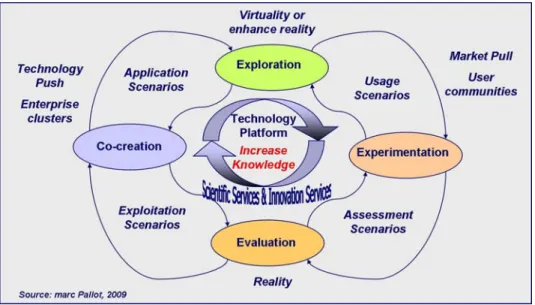
Figure 1: The Living Lab process (Pallot 2009a)
Specific Living Lab process and technology platforms (shown in Figure 1) allow the sharing of knowledge and crystallising the collective work of multidisciplinary teams and user communities. Technology platforms offer science and innovation services for co-creating, exploring, experimenting
1
and evaluating innovative ideas, scenarios, technological artefacts and solutions. Hence, new concepts, artefacts and solutions emerge from the resulting increase of knowledge acquired through accumulated experiences in different areas.
While the Living Lab ecosystem, through openness, multicultural and multidisciplinary aspects, conveys the necessary level of diversity, it enables the emergence of breakthrough ideas, concepts and scenarios leading to adoptable innovative solutions. A Living Lab Empowers user communities like it is done with Web 2.0 (Frappaolo & Keldsen, 2008; O’Reilly & Battelle, 2009) applications such as YouTube, Flickr, Delicious, or Twitter where users are creating content and value. There are even examples of stigmergic or mass collaboration where citizens collectively create content (e.g. Wikipedia) for the benefit of the society at large.
A Living Lab is an Open Innovation ecosystem frequently operating in the context of competitiveness clusters and public development agencies within social innovation environments engaging local authorities in territories such as cities, agglomerations, regions. A Living Lab can operate with a research and innovation platform for providing access to science and innovation services allowing enterprises and users/citizens either as entrepreneurs or communities. The main objectives consist to explore new ideas and concepts, experiment new artefacts and evaluate breakthrough scenario that could be turned into successful innovations. There are different application examples such as eHealth, Ambient Assisted Living, eInclusion, eTransportation, eGovernment, Smart City, ICT for Energy, and ICT for Environment. The Social dynamics of the Living Lab approach ensures a wide and rapid spread (viral adoption phenomenon) of innovative solutions through the socio-emotional intelligence mechanism (Goleman, 2006). A Living Lab environment needs to have one or several specific technology platforms (eHealth, eParticipation, eInclusion and so on), science & innovation services and user/citizen communities enabling the exploration of innovative scenarios including new concepts turned into technological artefacts. The experimentation and evaluation of the resulting scenarios and technological artefacts are driven by users within a real life context through a socio-economic (societal, environmental, health and energy cost/value), socio-ergonomic (user friendliness) and socio-cognitive (intuitive level) as well as adoptability perspectives (potential level of viral adoption).
Living Labs are standing at the crossroads of different society trends like citizens engaged into a more participative approach for solving societal issues, businesses and local authorities as well as user communities are gathering within public-private–people partnership initiatives. They are also at the crossroads of different paradigms and technological streams such as Future Internet, Open Innovation, User co-Creation, User Content Creation and Social Interaction (Web2.0), Mass Collaboration (i.e. Wikipedia), and Cloud Computing where the Internet is the cloud, also named “the disappearing IT infrastructure”.
However, there are still open questions such as articulating the various relevant research areas, methods and tools within the Living Lab research domain and identifying appropriate concepts for supporting user co-creation. Immersive virtual environments, such as serious games, Virtual and Augmented Reality or even a combination of both are foreseen as potential solutions.
User Involvement through Research and Design Methods
Currently, enterprises have to heavily invest in their innovation process and open it to external resources in order to remain competitive. Innovation can be defined as “an innovative collective conception.” (Valette, 2005) “In our technological and complex society, people could not anymore control all required knowledge for the conception like Renaissance genius. From now on, we can trust on group knowledge” (Rosell, 1994) quoted by Valette (2005). Recently, we entered into the information society due to the rapid progress with the Internet and new ICT (Information and Communication Technologies). Digitized information and networks allowed distributed teams to easily communicate and share data. “Internal and external resources are based on virtual enterprises thanks to the information system in order to create competitive advantage.”
During the last decades the role of users in the R&D process has gradually evolved from lead user (Von Hippel, 1986) towards user co-creation (Prahalad & Ramaswamy, 2000; Sanders, 2008; Sanders & Stappers, 2008; Mulder & Stappers, 2009; Pallot, 2009a; Ramaswamy & Gouillart, 2010). Pallot and colleagues (2010c) created a landscape of research and design methods involving users in R&D for getting a better understanding of the Living Lab research domain. This domain landscape was experimented as an evaluation tool for assessing the maturity level, in terms of user involvement in R&D, of 14 visited Living Labs (Salminen et al., 2011).
While Sanders and Stappers (2008) drafted a domain landscape of design research, Mulder and Stappers (2009) argued that the notions of co-creation and co-design have been growing within the participatory design landscape. They proposes to involve active users by making use of generative techniques in order to practice more the concept of engaging users as co-creation contributors as re-enforcing the living side of the Living Lab environment. They also state that co-creation necessitates sharing and collaboration, hence an open mindset that it not trivial to put in place.
Figure 2: Living Lab Research Domain Landscape (Pallot et al., 2010c)
Based on this idea of drafting a domain landscape, Pallot and colleagues (2010c) created a specific Living Labs research domain landscape (see Figure 2). They use four dimensions, namely “interaction mode”, “research type”, “evaluation focus”, and “collaboration style” which would allow Living Lab stakeholders to self assess the degree of user involvement and methods in use. The four dimensions are described as follow:
• Interaction Mode illustrates the way interaction with users is perceived. This dimension scales from Human-Computer Interaction (HCI), which addresses individual users, to Interpersonal Interaction that embeds social interaction within a group of people, especially the large ones like online communities.
• Research type splits the domain landscape into Observation Research where a user is considered as a subject and Participative Research where users actively contribute in co-creating value. This dimension resemble to the dimension on mind-set of Sander’s map.
• Evaluation focus starts with reliability, as a first stage, where a functional test is applied in order to check if a feature works properly but without necessarily considering whether this feature could really be useful to the users. The second stage consists to carry on usability analysis for the obvious motivation of evaluating the user friendliness (degree of intiutivity) and ergonomic design. While the third stage “adaptability” brings the evaluation of personalisation capacities (degree of look and feel recomposing), the fourth one “adoptability allows users to create new features (composing their own services).
• Collaboration style scales from structure collaboration with for example Symbiotic collaboration style (physical collocation) up to unstructured collaboration (Dorigo & Stützle, 2004; Elliott, 2006) with for example Mass collaboration style (virtual or online collocation).
Technological innovation is included in the figure as corresponding to the HCI of the interaction dimension. Social innovation is also included in the figure as corresponding to the Interpersonal Interaction. While in the first case the focus is on developing a product (hardware), in the second case the priority is much more on developing specific services for people.
The domain landscape map is then populated by existing research streams, such as Web 2.0 User Created Content (Web 2.0 UCC) (Garrett, 2002), User Centred Design (UCD), User Experience (UX) (ISTAG EAR report, 2004; Aarts & Marzano, 2003; de Ruyter et al., 2007), User Group Experience (UGX) (Fleming, 1998), Contextual Design (Beyer & Holtzblatt, 1998), User Cocreation (UC), User Centric-Innovation (UCI) and Driven-Centric-Innovation (UDI). Like in Sander’s landscape of design research, it makes sense to include participatory design.
The enterprise knowledge management aspect
Today, people argue about knowledge society explaining that the important thing is to share and collaborate rather than just communicate. With collaboration and sharing people can efficiently construct knowledge: “Fullness is in acquaintance and knowledge” (Cornu, 2004). To provide innovation project stakeholders also have to think about multidisciplinary issues in a project team and this multidisciplinary is “incontrovertible” (Valette, 2005). A project team is efficient if their members are coming from different disciplines. Furthermore, users are often not considered when forming a multidisciplinary team while UCD recommends putting users at the centre of the design process. When an enterprise is innovating, it simultaneously feeds its organisation with new knowledge and acquaintances, and constructs a solid basis for remaining competitive.
The human resources aspect
Cornu (2004) explains that today it is still difficult to manage human resources (that is to say interpersonal relationships) in a company. It is also difficult to introduce new tools for facilitating collaborative work without taking the risk of limiting and conditioning project team creativity. There is still a gap in terms of interpersonal relationship management because cooperation is not a natural human being capacity as people tend to give priority to personal interest before collective interest. There are even more difficulties when the team is heterogeneously composed of people with different disciplines due to differences in terms of used methods and tools, vision and goals. Each new project faces the team cohesion issue because people have to work with new persons: “When we frequently change the project team, we lost partly the development of collective competences” (Linhart, 2004). Hence, there is a need to find a way for conciliating personal interests with collective interests. This might be possible in focusing on the environment where the team must collaborate.
Collective Cleverness Management
A new kind of management called collective cleverness management is currently being introduced into enterprises. This kind of management can be linked to Knowledge Management and try to answer to the following problem presented by Levy (Levy, 1997) “Bureaucratic hierarchies (based on static writing), media-related monarchies (surfing the television and media system) and the international economic networks (using the phone and real time technologies) mobilize and coordinate partially the human beings cleverness, experiences, know-how, wisdom and imagination. That’s why we need with a particular urgency to invent new ways of thinking and negotiating which could lead to the emergence of real collective intelligences”.
In collaborative work, the project team constructs together the knowledge through socialisation (Nonaka, 1994). Creating a collective cleverness is possible if the enterprise integrates ICT and propose-efficient tools to allow distributed cooperation. Cooperation affects several parts in the enterprise. The cooperation can be interpersonal, between teams and other enterprise units. Cooperation can also be external and include the enterprise network and could even include competitors. It becomes competitive and clever to cooperate with competitors and exchange some information insofar as this information for example does not directly concern the company’s core business. Unfortunately, there are still difficulties to develop collective cleverness management in the enterprises notably in France due to cultural reasons and wrong interpretation of the words “communication”, “cooperation” and “collaboration” (cf. C. Schmidt’s writings for sound definitions).
Another often faced difficulty is to create a frame to stimulate innovation and creativity because this process cannot be really planned in advance. Therefore, there is a risk to constrain innovation and creativity when establishing new work methods (Von Krogh et al., 2000). Based on game mechanisms, it is possible to create a frame facilitating and enhancing interpersonal relationships and socialisation, thus resulting into a more productive collaboration.
Game is a regular frame with constraints
Each game allows freedom for the players and one advantage of games is to allow freedom in a regular frame. In contrast with a work plan, constraints in a game allow freedom and creativity. Games induce players to express themselves and to invent from the rules. Even in a game with a lot of rules and constraints, players still have the pleasure to play until they get frustrated. Rules and constraints are a constitutive part of the game. So a game without any rules and constraints could not be considered as a game: “A player having total freedom in his actions, without any rules will feel lost because he does not know what the goals he has to reach and what the means he has for achieving his goals. And to the contrary, too many rules can frustrate the player. He will feel overflowed by an overly large number of parameters to take into account whilst playing, the framework would not let the player express himself in the game” (Genvo, 2006).
Games can be considered like alternative realities with their own models, organizations and rules in which the player can compound (Caillois, 1992). It seems easier for players to immerge themselves in the virtual reality proposed by a game than doing it cognitively from outside the context of a game.
Game cognitive properties
There are a lot of benefits to use games in the context of a cognitive process. Games have cognitive properties and allow accessing little-known parts of the psychic life. Games represent a new way of thinking, getting and transmitting knowledge. Video games “are today real cognitive tools and can be linked harmoniously to the intuitive mechanism mind” (Virole, 2003). Games can fit everyone’s cognitive mechanism.
In games, mistakes are allowed and are considered as a good way to increase the level of knowledge. Players can make mistakes without being judged and without any serious consequences (except to lose the game). In these conditions, players become more confidents especially in their own actions, decisions and appreciations. In a real work experience, mistakes are negatively perceived and sometimes considered as inadmissible. In this case, games offer another kind of training and are more stimulating. Players are self-working and their own actors of their knowledge. The knowledge is reinforced and also within the group because a new team spirit is naturally created inside the game and the competition is perceived less stressful and becomes a real collective emulation.
Can we consider games as being serious?
The advantages of games are numerous. They give a new impulse for training and are an efficient way to transmit knowledge and a good way to socialise. However there are still difficulties in integrating game methods in organisations because of some misconceptions about games.
To illustrate this misconception issue, let’s have a look on game and work definition. A game is often perceived as an entertaining activity and work a serious and restrictive activity. To overcome this misconception Thiagi (Hourst, 2007), a game specialist, prefers to use another designation like “alternative educational activity” in order to conciliate games with serious objectives and to apply it to work and so propose games for training or learning. Thiagi created the “framegame” concept. Framegames are games with an empty structure which can fit various kinds of contents, contexts or learning situations. It includes work experiences and so people working in organisations.
Innovation is a way of thinking “a product or a concept which doesn’t already exist, the principal difficulty is that the designers face up to a something new to explore, this can be unsettling because we could know where we begin but we could not know where we will arrive” (Valette, 2005). In that case games represent an efficient way to give markers without constraint on creativity and innovation.
The Serious game approach
The recent appearance of serious game shows us that the perception of games is about to evolve. The advent of the serious game begins in 2002 with the release of “America Army” game. This game is promoting the American army recruitment policy and is available to everyone as a free download. The use of “Serious Game” designation shows the need to legitimate the serious aspects of game-playing (i.e. not just for having fun). Serious Game is a branch of video game. Serious games include an educational
scenario with educational objectives for the players. This kind of game aims to allow the player to learn during the game. This is what Zyda (2005) explains “However Serious Games are more than history, art or software […] they include pedagogy, educational and instructive activities, they carry knowledge and skills. This addition makes these games serious” (Alvarez, 2007).
Though, in Serious Games educational objectives cannot be fully reliable. This is due to how players can understand and learn from the educational scenario. There is the risk that they learn something else than expected. Therefore, researchers prefer to speak about “educational intentions” rather than “educational objectives” Julian Alvarez (2007) explains this phenomenon when he quotes Frasca “Designer can suggest a set of rules but it is always the players who have the last word” (Frasca, 2001). It becomes obvious that interpersonal relationship is a decisive factor to ensure a proper collaboration level leading to successful innovations. Teamwork is efficient when there is already a good level of team cohesion. The strategy that consists to include a project game experience would be an excellent opportunity to reinforce the team cohesion and group productivity. There are plenty of other distance factors and distance types impeding collaboration effectiveness and efficiency (Pallot et al., 2010a) that serious gaming could provide an experience to team members on how to overcome collaboration barriers (Pallot, 2009b)
The notion of team is a common element between a collaborative game and a professional context (i.e. project team). The dynamic related to the functioning of a team in a collective game could create a new dynamic in the team and simultaneously ensure good project success. Unfortunately, team cohesion is at the very best a measurable factor and difficult to check because each person behaves differently so each team also has a different way of reacting. However, gaming is an interesting frame to make team members play together and provides individuals numerous opportunities to interact with one another. The objective is to allow the team to stand back in relation to game tactics and propose an adjustable game in order to answer to the needs of different kind of teams and situations.
The importance of the game modularity
Framegames allow modularity. There are games with no specific contents in which it is possible to choose contents and as a result fit to each player, each team or context. In that case games can be compared to guides. The “Framegame” concept was created by Sivasailam Thiagarajan as cited by Hourst (Hourst, 2007). “Framegame” are often used by teachers or trainers. The aim is to allow the trainers to quickly appropriate the game and fit it to the selected context. As we explained before with the Serious Game, players are regarded as learners with a learning process. Serious Games are most often made for specific customers and so it concerns specific professional contexts. Serious Game conception follows a custom built logic. This selling logic is a way to ensure good incomes to the serious games’ designers. With a “Framegame”, designers ensure incomes differently for example with revolving license logic (like software licenses) or with a subscription fee. It could also be possible to sell this kind of “Framegame” like video games are sold for the general public. Modularity allows designers to lower game price and sell games to numerous organisations in order to render game production cost beneficial to them. A game can evolve with game extensions and designers can think about generic games and so improve the game quality. It becomes possible to small and medium sized enterprises (SMEs) to buy these kinds of less expensive Framegames. Currently, only large firms can integrate serious games in their training strategy as they remains too expensive for SMEs. Our aim is to propose something different than traditional games in designing a three stage service while effectively measuring the repercussions of the experience of a game on project lifecycle.
Are serious games facilitating User Experience and mutual understanding?
In order to prepare a project plan, team members elaborate and regularly review project requirements and specifications. The project manager or leader guarantees the statement of work and represents a guide for the team. In order to check and complete the project statement of work, the project manager organizes meetings to review with the team members all project requirements. However, during meetings, participants are in a passive mode and it is almost impossible to ensure that everyone does understand, memorises and appropriates all the project specifications. Game integration provides a way to move from a traditional passive mode towards an active mode where it becomes possible to collect direct feedback on what team members do really understand.Serious gaming allows, for example, project stakeholders to experience both physically collocated and virtual multidisciplinary teams. In a previous empirical study conducted through the use of a serious game called Cosiga, it was demonstrated that all product lifecycle roles were engaged in the case of the
physically collocated team, which resulted into a mutual understanding of project tasks. In contrast, the virtual team faced difficulties with isolated roles due to a lack of cohesion of the multidisciplinary team, which leaded to a lack of mutual understanding (Riedel et al., 2007). It means that, for example, role playing games provide a live user experience to individuals that stimulate their learning attitude and simultaneously offer an excellent opportunity to evaluate different scenarios and strategies such as the above case of physically collocated team and virtual team.
RESEARCH APPROACH
Including a game experience in a project timetable represents an opportunity to reinforce team cohesion and a way for project teams to become more productive. This is also an opportunity to have a user-centred approach on the functional model of their project process. In this context, games are considered as a collaboration experience for team members where they can step back and analyze the way they operate together. The aim is to gather all the team members and the project leader, to let them play and, after the game, analyze their game activity and debrief together in order to better know every one and so adjust the functioning of the team.
Hence, it is proposed to use a three stages service to a project team. The first stage of the service is a collaborative game which allows for example four players with a split screen to play together with a Wiimote during shorts games and simple missions (i.e. to feed a monster, answer questions, find a specific colour in the game universe, to conduct craft). The game environment could also be made of Virtual Reality, or even Augmented or Mixed Reality. These kinds of collaborative games are designed with several levels in which team members are immersed. Team members have to collectively create, explore, experiment and evaluate scenarios, almost like in a Living Lab approach (Pallot, 2009a), in order to build-up the proper level of experience and succeed in the mission and move on to the next level of the game. During the game, every action is recorded as log data. After the game, the project leader and his team members gather for a debriefing session in order to share their view about the game activity and the team functioning. This second stage could be considered as a Focus Group Interview. The third stage consists in using an analysis tool which allows rewinding and reviewing all the game moments and actions that are compared with the results of the debriefing stage. The project leader can add some comments during the game session and recover his comments in order to lead the debriefing session.
Before launching the game, there is an initial audit in which a game coordinator helps in providing advices to the project leader about the content implementation in the game session and also in animating the debriefing session.
This service is a way for the project leader to check and improve his management methods and for team members to experience various distance factors impeding collaboration effectiveness and efficiency (Pallot et al., 2010a), thereby learning how to overcome collaboration barriers (Pallot, 2009b). This is also a way to improve the team collaboration within a kind of living lab approach in which the team members are considered as users. The project leader and the team members can together build, thanks to the game, their own report for improving their collaboration effectiveness and efficiency.
COMPARATIVE FINDINGS
The aim of the table below (see Table 1) is to synthesise the findings in presenting a number of issues to be explored in the context of collective serious gaming, collaborative innovation and Living Lab experiential platforms. It describes valuable aspects of serious gaming compared to encountered problems in the real life of innovation projects.
The purpose of this findings table is to show the advantages of using serious game elements in a context of user-centred design and co-creation, especially in observing the way serious games could be used in a living lab experiential platform. Furthermore, it explores the complementarity of Serious Game with the Living Lab approach. It shows clear advantages of including Serious Game components as services within a living lab experiential platform.
Issues Serious Game Real life in an innovation project
Sociability (capacity to interact with other people)
Team functioning: Like in a project, a game gathers a team. The team has to evolve following rules. Players can cooperate or on to the contrary be enemies. Competition (Caillois, 1992) is a part of emulation in a game.
Interpersonal communication and relationship (Luft and Ingham, 1955): Players in a game have to share different access to information in order to distribute the roles of each player. A game is divided in different information spaces. A public space (reachable by all players), a blind space (reachable by the opponents), a hidden space (hidden to the opponents), an unknown space (unknown by all the players).
Importance of a social network to construct the knowledge: A video game sensitises players to share information thanks to a network of people (Veillon, 2001).
Sociability and collaboration :
“Face-to-face collaboration could be formal and planned, such as several users playing together on one computer, but could also be informal social interaction with peers. The social context that surrounds the learner in the learning situation influences the learning effectiveness. The program could also facilitate collaboration within the network, through chat-groups, communities and multi-player options.” (Ahdell & Andresen, 2001)
Team functioning: In a project people have to work together and sometimes by their own. Members of a team work together to cope with adversary represent by the competitiveness of the market.
Interpersonal communication and relationship (Luft and Ingham, 1955): To work as a team also means to learn from each other in order to access all information. Interpersonal communication helps to discover hidden space, blind space and unknown space. Interpersonal communication is an important part of social interaction, hence knowledge creation (Nonaka, 1994).
Importance of a social network to construct knowledge: To increase the number of participants within a project means to maximise improvements. The size of the community is related to the number of opportunities (Cornu, 2004).
“The number of opportunities develops faster when the number of community members is higher. For this reason, collaborative projects do not separate anymore contributors’ community and the largest community of users. Having a larger number of participants maximise corrections and improvements by the group.”
Eric S. Raymond [1] talk about the law of Linus Torvald in saying (translated from French): “the largest the crowd of participants, the more mistakes become obvious.”
Decision making Players cope with different kinds of decisions: democratic (altogether), hierarchical (considering decisions made by other members) and shared decision-making (Susi et al., 2007).
Decision making is a part of gameplay “Gameplay is all the doing, thinking and decision making that makes a game either fun, or not.” (Prensky, 2002)
In a project where the team has to create something new, each team member has to propose new things and takes initiative either democratically or hierarchically. (Nonaka, 1994)
Risk taking It can be part of the creative process. The exit or the outcome of a game is not necessary predictable (Caillois, 1992). Caillois also refers to the pleasure of feeling dizziness and dread in a game. “The structure must ensure the appearing incertitude of action result to be a game.”(Genvo, 2006)
Risks can be a part of the innovation process. To innovate means to think about a product which do not exist yet. Designers have to take the risk to think about something unknown (Valette, 2005).
“Often workers enter into processes that they don’t master sufficiently. As a player, he adventures in ways he doesn’t know; hence he uses methods and tools that involve risks” (Henriot, 1989).
Exploration Players discover an unknown world and experiment it in order to understand its rules and limits. Exploring is an important part of the pleasure related to the game.
Innovation is a way of thinking “a product or a
concept which doesn’t already exist, the principal difficulty is that the designers face up to a something new to explore, this can be
Issues Serious Game Real life in an innovation project
Each game has an exploratory part. Winnicot speak about “an intermediate space of experience” (Winnicot, 1975)
unsettling because we could know where we begin but we could not know where we will arrive” (Valette, 2005).
Experimentation Games make players to transcend themselves and try again. This is trial and mistake logic. (Frété, 2002) “To play means acting so this is necessary to understand that playing induce taking a decision and experiment what is possible” (Genvo, 2006).
Best practices go through experimentations. “For learning to take place there has to be expectation failure” (Frété, 2002)
Adaptation To play means to fit a new frame with new rules with conventions specific to each game (Caillois, 1992).
Innovation and cooperation means to be able to adjust to new concepts including new rules and new constraints.
Freedom and autonomy
There are no consequences in a game expect to start again the game “To be noted that in video game it is always possible to restart until the necessary experience and knowledge is acquired to achieve the proper expected performance” (Genvo, 2006). Mistakes are allowed in order to make progress.
In order to innovate and be creative, it could be important to feel free to explore new concepts and innovative solutions (Pallot, 2009a; 2010c).
Absorptive capacity There are levels to characterize the difficulty of a game (beginner level, intermediate level and expert level).This is important to find an equilibrium in the part of challenge including in a game in order to avoid boredom and discouragement.
To innovate on a concept means to go back and review the concept and improve it with the add of new constraints like new rules in a game. Conception is an iterative process with readjustments.
Self-evaluation The game allows step back and review. The main advantage is that players can see their own progression and make their own summary and debriefing.
Each member of a team has to know what the other members are doing and what kind of problems they are facing in order to adjust his own work and anticipate in which tasks to put priorities. Erickson, in a previous empirical study, called it “Social Translucence” (Erickson & Kellogg., 2000).
Auto-critique The game allows step back and review. The main advantage is that players can see their own progression and make their own summary and debriefing.
Each member of a team has to know what the other members are doing in order to distribute or distribute again the tasks in the project. Immersion
Mimicry
Games allow players to immerse themselves in alternate reality and a specific context. There is a need in game to become someone else. (Caillois, 1992). Genvo refers to Caillois “A third category of games is based on player’s role which consists to be someone else than himself. This category is close to the mimetic activity.” (Genvo, 2006)
In order to think of a new concept or a new product and being creative, it is important to be able to be in the skin of the user.
Negotiation
Susi argue that Serious Game increase social skills such as negotiation (Susi et al., 2007).
Serious gaming such as the Cosiga example (Riedel et al, 2007) would allow individuals to experience emotional behaviour in the context of negotiation activities (Pallot et al, 2010a). It would also provide an opportunity to build-up an experiential Living Lab for exploring the
Emotional distance represents the way an individual or a group can perceive one another feelings or emotional state or socio-emotional exchange which could be disturbing, slowing-down or even impeding a specific collaboration process such as arguments confrontation or requirements negotiation (Pallot et al., 2010a). A case study about distant negotiation has revealed that requirements negotiation meetings within computer-mediated distributed settings did
Issues Serious Game Real life in an innovation project
role of emotional intelligence (Norman, 2004), social intelligence, as well as collective intelligence in the negotiation process (Pallot et al., 2010a).
not result in a decrease of performance while the ability to better sense emotional states within face-to-face meetings brings the risk of impeding the negotiation process (Damian, 2001). A recent field study on the use of shared workspace and group blogging has revealed that emotional and social distances are providing a chance to remotely start a relationship with someone who is too shy or emotional for interacting lively (Pallot et al., 2008).
Multi-disciplinary working
Refer to game as a multi-disciplinary subject. “Examination of a selection of gaming genre and titles reveal features of relevance to several academic subjects. For example, geography and urban planning are associated with in-game landscape, building and community recreation; engineering and physics are essential to the realistic simulation of vehicles; history is useful for accurate re-creations of events, characters and societies; the arts for character development; and music for sound effects” (Kirriermuir, 2002)
Serious gaming allows, for example, project stakeholders to experience both physically collocated and virtual multidisciplinary teams. In a previous empirical study conducted through the use of a serious game called Cosiga, it was demonstrated that all product lifecycle roles were engaged in the case of the physically collocated team, which resulted into a mutual understanding of project tasks. In contrast, the virtual team faced difficulties with isolated roles due to a lack of cohesion of the multidisciplinary team, which leaded to a lack of mutual understanding (Riedel et al., 2007).
Virtual Team is defined by Lipnack & Stamps as a group of people interacting through interdependent tasks guided by common purpose. They argue that virtual teams operate across space, time and organizational boundaries, exactly like distributed teams and unlike collocated teams, through the use of links augmented by webs of communication technologies (Lipnack & Stamps, 1997).
Overcoming distance
Synchronous and asynchronous operations are naturally appropriated by players (Frété, 2002) (Online Multiplayer Games propose both modes to players). Avatars are used to give virtual identities to players and can be a solution to overcome the lack of presence due to physical distance (Bonfils and Dumas, 2007).
There are many distance factors creating various collaborative distance types that lead to collaboration barriers. All these distance factors and their related collaboration barriers impede the performance of collaboration (Pallot et al., 2009b, 2010a).
Table 1: Serious Game elements in the context of User-Centred Design (UCD) and User Co-Creation (UCC) (Le Marc et al., 2010)
All in all, subjectivity in Science and Technological feat accomplishment has lead scientists and private companies to seek to use somewhat ‘artificial means’ of overcoming the drawbacks of individualism discussed above. Live team experience is desired after many decades of rendering experiences singular, particularly in the western world. Using Serious Games is a way of re-creating the all-encompassing social experience necessary to sound evolution.
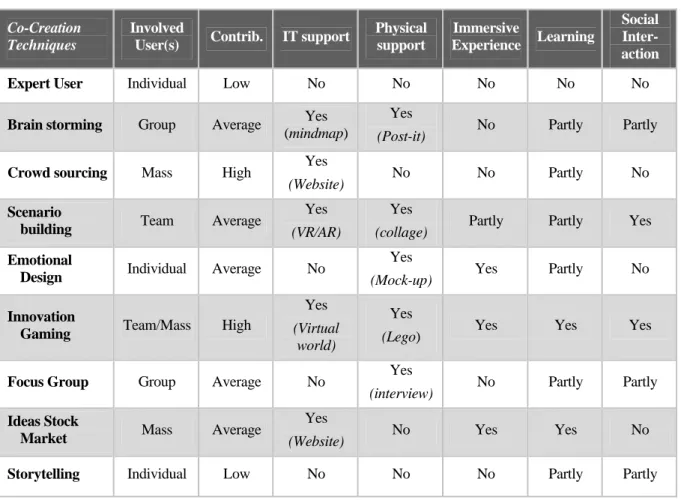
The following table (see Table 2) presents a comparative analysis of different co-creation techniques that were reviewed during the study:
Table 2 – Comparison of co-creation techniques (Pallot, 2011)
Each Co-creation technique is characterised according to different criteria (see Table 2) such as the number of users that could be involved, the degree to which users can contribute, whether an IT support and/or physical support exist, whether it brings an immersive experience to users as well as the degree of experiential learning and finally the level of social interaction enabled by the technique. All Co-creation techniques are briefly introduced in the following list:
• Expert User: A term corresponding to ‘Lead User’ that was coined by Eric von Hippel in 1986 (Von Hippel 1986). His definition for lead user is: “Lead users face needs that will be general in a marketplace – but face them months or years before the bulk of that marketplace encounters them, and Lead users are positioned to benefit significantly by obtaining a solution to those needs.”
• Brainstorming: It is a popular method of group interaction in both educational and business settings. Although it does not provide a measurable advantage in creative output, conventional brainstorming is an enjoyable exercise that is typically well received by participants. It is a group creativity technique designed to generate a large number of ideas for the solution of a problem. Although brainstorming has become a popular group technique, when applied in a traditional group setting, researchers have not found evidence of its effectiveness for enhancing either quantity or quality of ideas generated. Team idea mapping method: This method of brainstorming works by the method of association. It may improve collaboration and increase the quantity of ideas, and is designed so that all attendees participate and no ideas are rejected. The process begins with a well-defined topic. Each participant brainstorms individually, then all the ideas are merged onto one large idea map. During this consolidation phase, participants may discover a common understanding of the issues as they share the meanings behind their ideas. During this sharing, new ideas may arise by the association, and they are added to the map as well. Once all the ideas are captured, the group can prioritize and/or take action.
Co-Creation Techniques
Involved
User(s) Contrib. IT support
Physical support Immersive Experience Learning Social Inter-action
Expert User Individual Low No No No No No
Brain storming Group Average Yes (mindmap)
Yes
(Post-it) No Partly Partly
Crowd sourcing Mass High Yes
(Website) No No Partly No
Scenario
building Team Average
Yes
(VR/AR)
Yes
(collage) Partly Partly Yes
Emotional
Design Individual Average No
Yes
(Mock-up) Yes Partly No
Innovation
Gaming Team/Mass High
Yes
(Virtual world)
Yes
(Lego) Yes Yes Yes
Focus Group Group Average No Yes
(interview) No Partly Partly
Ideas Stock
Market Mass Average
Yes
(Website) No Yes Yes No
• Crowdsourcing: It is organised through the use of specific websites calling for problem solving. Local authorities, for example cities or regions, could use this participative technique for getting environmental data and inputs from citizens about decision making in a living area.
• Scenario Building: It helps specify how users carry out their tasks in a specified context. Scenarios provide examples of usage as an input to designing but can also be used as input for evaluating. Scenarios are user and task oriented use cases. Scenarios can be stories in text describing a user operating a product or service in a defined context but they can also be visualised stories in a storyboard or short video.
• Emotional Design: It is both the title of a book by Donald Norman (2004) and of the concept it represents. The main issue is that emotions have a crucial role in the human ability to understand the world, and how they learn new things. For example, aesthetically pleasing objects appear to the user to be more effective, by virtue of their sensual appeal. This is due to the affinity the user feels for an object that appeals to him, due to the formation of an emotional connection. Norman uses an approach based on classical ABC model of attitudes. However, he changed the concept to be suitable for application in design. The three dimensions have new names: visceral, behavioral and reflective level, and partially new content. In his book, Norman shows that design of most objects are perceived on all three levels or dimensions. Therefore a good design should consider all dimensions.
• Innovation Gaming/Collaborative Gaming: Serious games are designed for the purpose of solving a problem. Although serious games can be entertaining, their main purpose is to train, investigate, or advertise. Sometimes a game will deliberately sacrifice fun and entertainment in order to make a serious point. Whereas video game genres are classified by gameplay, serious games are not a game genre but a category of games with different purposes. This category includes educational games and advergames, political games, or evangelical games. The category of serious games for training is also known as "game-learning". The wording “innovation game” refers to a form of primary market research where customers play a set of directed games as a means of generating feedback about a product or service. The research is primary because the data collected is gathered directly from customers or prospects and is intended to answer a specific research question. Customers who play innovation games are commonly direct recipients or consumers of a specific product or service. In some cases, though, game players may be any person or system who is or would be affected by a product or service. The successful operation of an innovation game relies on collaborative play among the participants and a set of observers drawn from disparate functional groups within an organization. For example, a typical game setting for a word processing software might include participants drawn from two or three corporate customers along with observers comprising the product’s quality assurance manager, technical architect, product manager, developer, sales executive, or any one else on the product team. Arguably, the most important observer is the product manager because that person is responsible for acting on the data generated by the game. However, a single observer cannot possible capture all of the nonverbal and nuanced communication that players exhibit, so all observers play a significant and irreplaceable role in the effective utility of the game. (Hohmann, 2007)
• Focus Group: A form of investigation involving a group of people for open-ended questions about their perceptions, opinions, beliefs and attitudes towards an innovative idea, concept that could be turned into a specific product and/or service creation.
• Idea Stock Market: It is a form of prediction or predictive markets also named information markets, decision markets, idea futures, event derivatives, or virtual markets. It is a kind of speculative market created for the purpose of making predictions on eventual successes. The Hollywood Stock Exchange, a virtual market game created in 1996 where players buy and sell prediction shares of movies, actors, directors, and film-related options. According to Wikipedia, it correctly predicted 32 of 2006's 39 big-category Oscar nominees and 7 out of 8 top category winners. Prediction markets are championed by Surowiecki (2004), Sunstein (2006) and Hubbard (2007). A good example is the IDEM tool designed by Bothos and colleagues (2008) that is based on a web application where users can freely post ideas. Others can provide comments and rating on posted ideas in order to highlight the most favourite ones. Participants can buy or sell shares of ideas as in any stock market. However, this kind of tool can be considered as an innovation game if more social interaction could be put in place for discussing posted ideas.
• Generative prototyping: Users are asked to together with designers built low-tech prototypes or products using a large set of materials during a workshop. For example, in creating ideas for a new playground, children were asked to build their favourite playground element using ice lolly sticks, foam balls, etcetera. The related term “tinkering” is sometimes used to describe a workshop in which hardware elements and software elements (physical computing elements) are used as building blocks to create fast prototypes. The basic idea is that by building, you start thinking and new ideas are generated. This is a type of generative prototyping for which certain skills in dealing with software and hardware are needed.
• Storytelling: It concerns eliciting vivid descriptions of past events from stakeholders in the design process. Stories can help to discover user needs and to help stakeholders get a clear picture of the end user's interests and needs.
Looking at the above presented co-creation techniques, “innovation gaming” appears to be the more promising as it supports both immersive experience, experiential learning and social interactions that enable the creation of new knowledge. Innovation gaming also fits whatever is the user group size from a small team up to mass collaboration and allows dealing with user communities and crowdsourcing principles. Finally, through the connection of virtual environments (Virtual and Augmented Reality technologies) and physical supports, it allows a higher level of contribution. However, a co-creation technique like “scenario building” could be tuned as an innovation game for exploring new ideas of innovative services that could be evaluated by the technique of “ideas stock market”. It further means that it is possible to combine several co-creation techniques with the “innovation gaming” technique in order to enhance the creativity and innovation capacity.
Immersive virtual environments (i.e. virtual world, virtual reality, augmented reality, mixed reality) help users to behave like in a learning environment where they can empathise with a product or a service and its features. However, a number of questions remain, such as how the immersive/learning environment support user concentration and what are the factors that disrupt users’ concentration. There are also factors that affect the way users empathise with the immersive/learning environment and factors that hinder the empathising process. The product or service should enable new practices and adapt to users needs. Realistic features appearing in the learning environment affect the skills to be learned (Salakari, 2007). Others, Le Marc et al (2010) discuss the link between learning experience and user experience as well as the role of immersive environments such as live environments or Living Labs where users simultaneously co-create innovative scenarios and learn how to innovate.
Empathising is impacted by the user profile and does not necessarily emerge through causal relationships. Dourish (2004) and Forlizzi & Ford (2000) argue that designers can affect the context but users are the ones who will ultimately experience it. Social interactions and social practices emerge when a product is in use as explained by Battarbee social user experience (2004) that he named “co-experience”, meaning collective experience. For years, User Centred Design (UCD) or Human-Centred Design (ISO FDIS 9241-210, 1999) methods have underlined the importance of user experience (Battarbee, 2004; Garret, 2002; Hassenzahl, 2003). User experience could be considered as either product centred or person centred or even interaction centred (Battarbee, 2004). Forlizzi (2007) developed the product ecology framework (people, adaptation, and place) to accumulate the experience of use in order to enhance user experience design. These above co-creation techniques could also be used for designing game scenarios.
CREATING INNOVATION GAMES
While ar variety of innovation games may be invented, combined, or adapted from other game environments, all games have strengths and weaknesses that constrain their applicability to specific kinds of issues. These strengths and weaknesses are formulated below in six different aspects:
1. Open-ended exploration: The degree to which participants are constrained in their interactions; 2. Scalability: The number of participants that could play the game simultaneously;
3. Physical preparation: Necessary supplies or materials for playing the game;
4. Market preparation: Necessary background effort for providing data or content for the game; 5. Participants preparation: Required activities for participants before they start gaming;
6. Time frame of action: How long after the game is completed participant expects the improvement of the related product or service according to the outcomes of the game.
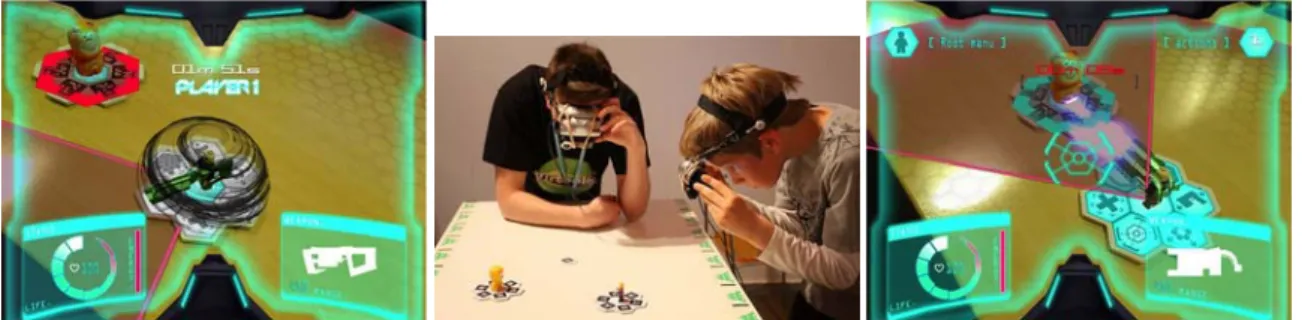
For example, the Scope project (Guellerin et al., 2010), presented at Laval Virtual 2009 by Frantz Lasorne, revives old-school games and toys via augmented reality (see Figure 3). Users enhance tangible toys (Legos, figurines, robots) with special functions, such as energy, lives magic powers, experience, attack and virtual accessories, such as weapons, tools, and protection devices, borrowed from the video-game world. Using a head-mounted display, they can play in a real place with accessories pulled out of their toy boxes. Ultimately this project is meant to create a thrilling virtual environment that kindles children’s imagination and sustains the value of old-school toys and games in the meantime.
Figure 3: Lasorne’s Scope Project on Co-creating Virtual and Physical Environments for Games The Scope project merges the basic characteristics of video games and real-life toys to improve existing games or create new ones. By attributing various virtual parameters commonly used in video games (power, life, magic, experience, attack, weapons, etc.) to tangible toys, it brings the toys to life. With this approach, it is possible to create all sorts of collaborative game concepts mixed with the real world. For example, a child’s bedroom could become a natural battleground to play with friends. The success of this project proves the attractiveness of immersive environments through virtual worlds supported by Virtual and Augmented Reality technologies. It demonstrates also the capacities of these technologies to motivate users to collaborate via a “mixed media”, merging real and virtual environments. It is believed that innovation games built on these kinds of immersive environments combining virtual and physical worlds are the most appropriate co-creation technique to enhance experiential learning and users’ collaboration skills for creating new knowledge that leads to breakthrough innovation.
CONCLUSION
Fundamentally all games are based on player’s actions and decisions. In a game, the players are not passive and don’t undergo a situation. Players act and are at the centre of the game. The game exists thanks to the players. The players are creating their own values based on their choices; their actions and this context allow them to trust in their own appreciations and to construct their own experience and knowledge by themselves.
In contrast to what most people think, the use of games for stimulating a learning and creative attitude is not something new. It is common to find the use of games in some existing educational methods like the “active pedagogy” of the “open and interactive pedagogy”. This kind of pedagogy reconsiders or even questions the classical pedagogy used in schools in France. Concerning the active pedagogy, a reference could be made with Montessori and Claparède. They state the importance of games in education; Montessori wonders about “The difference between a kid playing and a kid manipulating objects in order to stimulate sense” (Missant, 2009). This quote shows video games possibilities in which the sense can be stimulated by the program (the visual sense, the sound sense, the motions etc.). Freinet also mentions the importance to consider the learner rhythm while the educator helps and just gives new obstacles with a progression when the learner is ready (Peyronie, 1999). There is a progress and we can relate this method with the game in which there are difficulty levels to characterize a same game (beginner level, intermediate level and expert level).
In a game there is already a serious side and so a game doesn’t mandatorily need the addition of an educational scenario with educational objectives to ensure an appropriate training. The use of educational scenarios in game conception can be interesting but becomes useless and superficial without a reflection on the gameplay. It is widely recommended, before creating an educational scenario, to think through the priorities of which gameplay would best benefit the game and the training context.
Based on the above findings tables, it seems quite obvious to conclude that serious gaming, and especially innovative games, would considerably enrich individuals’ skills for team collaboration through live team experiences in the context of collective activities such as collaborative innovation in a Living Lab environment. Reversely, it would be valuable to include serious gaming components as specific services in a Living Lab experiential platform in order to enrich the gained user experience and enhance the potentiality of user co-creation.
Furthermore, innovation games allow both individuals and teams to co-create different scenarios and strategies that could be explored, through the immersion of all project stakeholders in a subtle combination of virtual world and physical world for a continuously evaluated live experience. Finally, the integration of serious gaming components, such as innovation games, within Living Lab experiential platforms looks promising and would deserve to receive further dedicated studies.
REFERENCES
Aarts, E. H. L.; Marzano S. (2003). The New Everyday: Views on Ambient Intelligence. 010 Publishers. p. 46. ISBN 9789064505027.
Adams, E. (2009). Sorting Out the Genre Muddle. Gamasutra. Retrieved April, 30, 2011 from http://www.gamasutra.com/view/feature/4074/the_designers_notebook_sorting_.php?page=2. Ahdell, R. & Andresen, G. (2001). Games and simulations in workplace eLearning: How to align
eLearning content with learner needs. Master of Science Thesis, Norwegian University of Science and Technology. pp. 1 - 158.
Alvarez, J. (2007). Du jeu vidéo au Serious game, Approches culturelles, pragmatiques et formelle. Spécialité science de la communication et de l’information, Université TOULOUSE II - Toulouse le Mirail / Université TOULOUSE III - Paul Sabatier: 445.
Battarbee, K. (2004). Co-experience: Understanding user experiences in social interaction. Publication series of the University of Art and Design. Helsinki A 51. Academic dissertation. Helsinki: Yleisjäljennös –Painopörssi.
Beyer, H. & Holtzblatt, K. (1998). Contextual Design: Defining Customer-Centered Systems. San Francisco: Morgan Kaufmann. ISBN: 1-55860-411-1
Bonfils, P. & Dumas, P. (2007) Mondes persistants et enseignement à distance: de nouvelles perspectives. In La problématique du changement, Marseille, colloque TICE Méditerranée. Bothos, E., Apostolou, D., Mentzas, G. (2008). Idea Selection and Information Aggregation Markets,
In Proceedings of the IEEE International Engineering Management Conference , June 28-30, 2008, Estoril, Portugal.
Caillois, R., Ed. (1992). Les jeux et les hommes. Folio Essais. ISBN : 9782070326723
Chesbrough, H. W. (2003), Open Innovation: The New Imperative for Creating and Profiting from Technology, Boston, Harvard Business School Press.
Cornu, J. M., Ed. (2004). La coopération, nouvelles approches. Retrieved February 2011 from http://www.cornu.eu.org/texts/cooperation
Damian, D. (2001). An empirical study of requirements engineering in distributed software projects: is distance negotiation more effective? In the Proceedings of the Asia Pacific Software Engineering Conference (APSEC), Macau, December 2001.
de Ruyter, B., van Loenen E. & Teeven, V. (2007). User Centered Research in ExperienceLab, European Conference, AmI 2007, Darmstadt, Germany, November 7-10, 2007. LNCS Volume 4794/2007, Springer.
Dourish, P. (2004). What We Talk About When We Talk About Context. Personal and Ubiquitous Computing, 8(1), 19-30.
Erickson, T.; Kellogg, W. A. (2000), "Social translucence: an approach to designing systems that support social processes", ACM Transactions on Computer-Human Interaction (TOCHI): 59– 83
Fleming, J. 1998, Web Navigation: Designing the User Experience. O’Reilly & Associates, Inc, USA. Forlizzi, J. (2007). Product Ecologies: Understanding the Context of Use Surrounding Products. Ph.D.
Dissertation. Retrieved November 2010, from http://goodgestreet.com/docs/ForlizziMay07.pdf Forlizzi, J., Ford, S. (2000). The Building Blocks of Experience: An Early Framework for Interaction
Designers. Designing Interactive Systems 2000 Conference Proceedings, New York, NY, 419-423.
Frappaolo, C., Keldsen, D. (2008). What is Web 2.0?. Association for Information and Image Management. Retrieved January 2009 from http://www.aiim.org/What-is-Web-2.0.aspx. Frasca (2001). Videogames of the oppressed : Videogames as a means for critical thinking and debate.
Master Thesis of Information Design and Technology. , Georgia Institute of Technology. Frété, C. (2002) Le Potentiel Du Jeu Video Pour L’Education, Mémoire pour l’obtention du DESS
STAF, University of Geneva.
Garrett, J. 2002, Elements of User Experience: User-Centered Design for the Web. New Riders Press, USA.
Genvo, S (2006). Le game design de jeux vidéo : Approches de l’expression vidéoludique. L’Harmattan. ISBN-13: 978-2747591034
Goleman. D. (2006). Social intelligence: the new science of human relationships. Publisher: Bantam Books. Publication Date: September 2006. ISBN-13: 9780553803525
Guellerin C., Degouzon F., Saysana M., (2010). Yearbook 2008-2010. Ecole de Design Nantes Atlantique.
Hassenzahl, M. (2003). The Thing and I: Understanding the Relationship Between User and Product. In: Blythe, M., Overbeeke, K., Monk, A., Wright, P. (Eds.), Funology: From Usability to Enjoyment. Kluwer Academic Publishers, pp. 31-42.
Hassenzahl, M. ,Tractinsky, N. (2006), User Experience – a Research Agenda. Behaviour and Information Technology, Vol. 25, No. 2, March-April 2006, pp. 91-97
Henriot, J. (1989). Sous couleur de jouer, Paris : José Corti.
Hohmann, L. (2007). Innovation Games: Creating Breakthrough Products through Collaborative Play. Boston: Addison-Wesley, 47-124.
Hourst, B, Thiagarajan, S (2007). Modèles de jeux de formation, Les jeux cadres de Thiagi. Editions d'Organisation. ISBN13 : 978-2-212-53937-0 Isaac, H (2001). L’entreprise numérique : quelle réalité en France. Université Paris Dauphine. Observatoire e-management Dauphine-Cegos. Hubbard, D. W. (2007). How to Measure Anything: Finding the Value of Intangibles in Business,
John Wiley & Sons, July 2007
ISO FDIS 9241-210 (2009). Ergonomics of human system interaction - Part 210: Human-centered design for interactive systems (formerly known as 13407). International Organization for Standardization (ISO). Switzerland. International Organization for Standardization.
ISTAG Report on Experience Application Research (EAR) (2004). “Involving Users in the Development of Ambient Intelligence”. European Commission – IST 2004 – Retrieved February 2011 from http://www.cordis.lu/ist/istag.htm