HAL Id: pastel-00001947
https://pastel.archives-ouvertes.fr/pastel-00001947
Submitted on 12 Oct 2006
HAL is a multi-disciplinary open access archive for the deposit and dissemination of sci-entific research documents, whether they are pub-lished or not. The documents may come from teaching and research institutions in France or abroad, or from public or private research centers.
L’archive ouverte pluridisciplinaire HAL, est destinée au dépôt et à la diffusion de documents scientifiques de niveau recherche, publiés ou non, émanant des établissements d’enseignement et de recherche français ou étrangers, des laboratoires publics ou privés.
All-Optical Networks
Mohamed Koubàa
To cite this version:
Mohamed Koubàa. Routing, Protection and Traffic Engineering in WDM All-Optical Networks. do-main_other. Télécom ParisTech, 2005. English. �pastel-00001947�
pr´esent´ee `a
l’´
Ecole Nationale Sup´
erieure des T´
el´
ecommunications
pour obtenir le grade de
Docteur de l’´
Ecole Nationale Sup´
erieure des T´
el´
ecommunications
Sp´
ecialit´
e : Informatique et R´
eseaux
par
Mohamed Koub`
aa
Routage, protection et ing´
enierie de trafic dans
les r´
eseaux WDM tout-optiques
Soutenue `a l’ENST Paris le 2 d´ecembre 2005 devant le jury compos´e de:
Pr´esident
Professeur Dominique Seret Universit´e Ren´e Descartes de Paris V, France Rapporteurs
Professeur Piet Demeester Universit´e de Gent, Belgique
Professeur G´erard H´ebuterne Institut National des T´el´ecommunications, France Examinateurs
Professeur Marco Ajmone Marsan Ecole Polytechnique de Turin, Italie´
Professeur Samir Thom´e Universit´e de Versailles Saint-Quentin, France Directeurs de th`ese
Professeur Maurice Gagnaire Ecole Nationale Sup´´ erieure des T´el´ecommunications, France Docteur Nicolas Puech Ecole Nationale Sup´´ erieure des T´el´ecommunications, France
WDM All-Optical Networks
by
Mohamed Koub`
aa
A thesis submitted to the
´
Ecole Nationale Sup´
erieure des T´
el´
ecommunications
in partial fulfillment of the requirements for the degree of
Doctor of Philosophy
Examining committee:
Professeur Dominique Seret Universit´e Ren´e Descartes de Paris V, France
Professeur Piet Demeester Ghent University - IBBT - IMEC, Belgium
Professeur G´erard H´ebuterne Institut National des T´el´ecommunications, France
Professeur Marco Ajmone Marsan Politecnico di Torino, Italy
Professeur Samir Tohm´e Universit´e de Versailles Saint-Quentin, France Professeur Maurice Gagnaire Ecole Nationale Sup´´ erieure des T´el´ecommunications, France Docteur Nicolas Puech Ecole Nationale Sup´´ erieure des T´el´ecommunications, France
´
Ecole Nationale Sup´erieure des T´el´ecommunications, Paris, France December 2, 2005.
Mes premiers remerciements iront `a mon directeur de th`ese, Maurice Gagnaire, Professeur au d´ eparte-ment Informatique et R´eseaux de l’ENST, pour avoir encadr´e mon travail depuis mon projet de fin d’´etudes d’Ing´enieur en T´el´ecommunications de l’´Ecole Sup´erieure des Communications de Tunis, en passant pas le DEA et pendant les trois ann´ees de th`ese. Il m’a permis de toucher `a plusieurs sujets de recherche tous passionnants. Outre ses conseils avis´es, j’ai appr´eci´e sa sympathie, sa rigueur, son esprit critique et sa grande p´edagogie, dont, j’esp`ere, j’ai su profiter.
Ma profonde reconnaissance va aussi `a Nicolas Puech, Docteur au d´epartement Informatique et R´eseaux de l’ENST, pour avoir co-encadr´e cette th`ese. J’ai pu appr´ecier ses qualit´es techniques et humaines pendant ces trois ann´ees et profiter de ses remarques et conseils. Je le remercie ´egalement pour la relecture du pr´esent document.
Je d´esire exprimer ma profonde gratitude au gouvernement fran¸cais qui, `a travers le Centre National de Recherche Scientifique (CNRS), a financ´e mes travaux de recherche en th`ese grˆace `a une bourse de docteur ing´enieur (BDI).
Je souhaite ´egalement exprimer ma profonde gratitude au gouvernement tunisien qui, `a travers le Minist`ere de l’Enseignement Sup´erieur, a financ´e mes ´etudes de troisi`eme cycle en France.
Je tiens `a remercier tr`es sinc`erement Madame Dominique Seret, Professeur `a l’Universit´e Ren´e Descartes et Vice-pr´esidente de l’Universit´e de Paris V, Monsieur Piet Demeester, Professeur `a l’Universit´e de Gent (Belgique), Monsieur G´erard H´ebuterne, Professeur `a l’Institut National des T´el´ ecommunica-tions, Monsieur Marco Ajmone Marsan, Professeur au Politecnico di Torino (Italie), et Monsieur Samir Tohm´e, Professeur `a l’Universit´e de Versailles Saint-Quentin, pour m’avoir fait l’honneur de participer au jury de th`ese et pour les questions tr`es constructives qu’ils m’ont pos´ees. J’ai ´et´e particuli`erement touch´e par l’honneur que Madame Dominique Seret m’a fait de pr´esider le jury de cette th`ese.
Je tiens aussi `a remercier chaleureusement Messieurs Piet Demeester et G´erard H´ebuterne pour la lecture tr`es attentive de mon rapport de th`ese. Je leur suis particuli`erement reconnaissant pour les remarques et suggestions qu’ils m’ont faites.
Je voudrais ´egalement remercier Madame Isabelle Demeure puis Monsieur Michel Riguidel pour m’avoir accept´e dans le d´epartement Informatique et R´eseaux de l’ENST. Ils m’ont permis de mener mes travaux de th`ese dans d’excellentes conditions et de participer `a plusieurs congr`es internationaux. J’ai une pens´ee toute particuli`ere pour toute l’´equipe du d´epartement, les doctorants et stagiaires avec qui j’ai partag´e ces trois ann´ees avec beaucoup de bonheur et parmi lesquels je compte `a pr´esent certains de mes meilleurs amis.
Un grand merci `a Monsieur Bernard Robinet, Directeur de l’´Ecole Doctorale, pour sa g´en´erosit´e et ses conseils avis´es.
Enfin, j’ai une pens´ee ´emue `a mes parents et toute ma famille, sans qui je n’aurais jamais pu arriver ici. Je suis heureux de leur avoir apport´e ce r´esultat.
Introduction
La croissance du trafic, la complexit´e des syst`emes et l’arriv´ee de nouveaux acteurs dans le domaine des t´el´ecommunications donnent `a la planification des grands r´eseaux de transport une importance toute particuli`ere. L’introduction du multiplexage en longueurs d’onde dans le but d’augmenter les capacit´es de transmission et d’acheminement mais ´egalement la flexibilit´e et la rentabilit´e des syst`emes, conduit de plus en plus `a une optimisation des syst`emes existants et `a une meilleure int´egration des syst`emes de nouvelle g´en´eration. Nous nous int´eressons essentiellement `a la partie longue distance des r´eseaux d’op´erateurs. Dans cette th`ese nous traitons de la planification de r´eseaux WDM compl`etement transparents. Nous avons recours `a l’optimisation pour r´esoudre les mod`eles math´ematiques d´ecrivant ces probl`emes. Pour des r´eseaux comportant un nombre limit´e de nœuds et pour des matrices de trafic avec un nombre r´eduit de demandes, il est possible d’obtenir des solutions exactes `a l’aide de solveurs. Pour des situations plus complexes, la combinatoire ne permet pas d’obtenir des solutions exactes, on est contraint de recourir `a des m´ethodes approch´ees utilisant des m´eta-heuristiques ou simplement des heuristiques.
Les r´esultats obtenus dans le cadre de la th`ese portent principalement sur l’´etude des communications transparentes par multiplexage en longueur d’onde. Ils s’inscrivent dans une th´ematique d’allocation des ressources en vue de r´ealiser des communications dans un r´eseau. La probl´ematique g´en´erale que nous avons consid´er´ee peut se r´esumer de la mani`ere suivante. Il s’agit de satisfaire dans un r´eseau tout-optique dont la capacit´e est finie (le nombre de longueur d’onde disponibles sur chaque lien du r´eseau ´etant limit´e) un ensemble de demandes de trafic, appel´e instance de communication, l’objectif ´etant de minimiser le nombre de demandes de trafic rejet´ees. La satisfaction d’une requˆete passe par l’attribution d’un ou plusieurs chemins dans le r´eseau et d’une ou plusieurs longueurs d’onde pour chaque chemin en fonction du nombre de circuits optiques requis pas la demande.
Un circuit optique (lightpath) est suppos´e utiliser la mˆeme longueur d’onde sur tous les liens qu’il traverse pour relier la source `a la destination du circuit consid´er´e. Cette contrainte est connue sous le
nom de contrainte de continuit´e en longueur d’onde. On supposera aussi que deux circuits optiques partageant un ou plusieurs liens en commun ne peuvent en aucun cas utiliser la mˆeme longueur d’onde. Le mod`ele de trafic consid´er´e est constitu´e pas la combinaison de trois types de demandes de trafic `
a savoir les demandes de trafic permanentes (Permanent Lightpath Demands, (PLDs)), les demandes de trafic pr´e-planifi´ees (Scheduled Lightpath Demands, (SLDs)) et les demandes de trafic al´eatoires (Random Lightpath Demands, (RLDs)).
Une PLD est une demande de trafic connue `a l’avance caract´eris´ee par un triplet (s,d,π), o`u s et d sont respectivement les nœuds source et destination de la demande de trafic. π est un nombre entier repr´esentant le nombre de circuits optiques `a ´etablir entre s et d (π ≥ 1). Une fois accept´ee, une PLD demeure dans le r´eseau ind´efiniment. Une SLD est une demande de connexion repr´esent´ee par un quintuplet (s, d, π, α, β) o`u s et d repr´esentent les nœuds source et destination de la demande, π repr´esente le nombre de connexions requises et α et β les dates d’´etablissement (set-up) et de fin (tear-down) des connexions demand´ees. Le mod`ele de trafic SLD est d´eterministe car les demandes de trafic SLD sont connues `a l’avance et est dynamique puisqu’il prend en compte l’´evolution de la charge de trafic au cours du temps. Contrairement `a une SLD, une RLD est une demande de trafic al´eatoire (dynamique) caract´eris´ee par un temps de d´ebut al´eatoire et une dur´ee elle aussi al´eatoire. Une RLD est repr´esent´ee de la mˆeme mani`ere qu’une SLD.
La th`ese est organis´ee en trois parties. La premi`ere partie traite du probl`eme de routage et affectation de longueurs d’onde dans les r´eseaux WDM tout-optiques. La deuxi`eme partie s’int´eresse au probl`eme de routage et affectation de longueurs d’onde avec protection. Dans la troisi`eme partie on ´etudie les moyens d’am´eliorer le taux de rejet dans les r´eseaux WDM tout-optiques affect´e par la contrainte de continuit´e en longueur d’onde.
Routage et affectation de longueurs d’onde
Le probl`eme de routage et affectation de longueurs d’onde peut ˆetre d´efini comme suit: ´
etant donn´e une topologie physique du r´eseau, un nombre de longueurs d’onde disponibles sur chaque lien du r´eseau et un ensemble de demandes de trafic `a satisfaire, il s’agit de calculer pour chaque demande de trafic le ou les chemins et la ou les longueurs d’onde n´ecessaires pour ´etablir la demande, l’objectif ´etant de minimiser le nombre de demandes de trafic rejet´ees. Nous supposons ici qu’une demande de trafic est rejet´ee lorsqu’il est impossible de satisfaire tous les circuits optiques requis par la demande.
Nous traitons d’abord du probl`eme de routage et affectation de longueurs d’onde pour des demandes de trafic de type PLD. Nous ´etudions ensuite le probl`eme de routage et affectation de longueurs d’onde en consid´erant simultan´ement des demandes de trafic SLD et RLD. Les demandes de trafic PLD n’ayant
pas ´et´e consid´er´ees pour la simple raison qu’une PLD, lorsqu’elle est accept´ee, s´ejourne dans le r´eseau ind´efiniment, ce qui se traduit simplement par une diminution du nombre de longueurs d’onde disponibles sur certains liens du r´eseau.
Routage et affectation de longueurs d’onde pour les demandes PLD
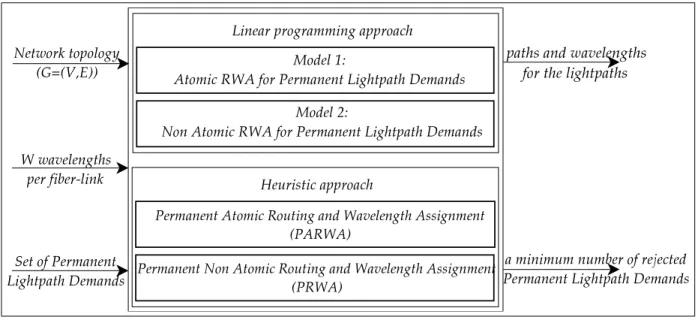
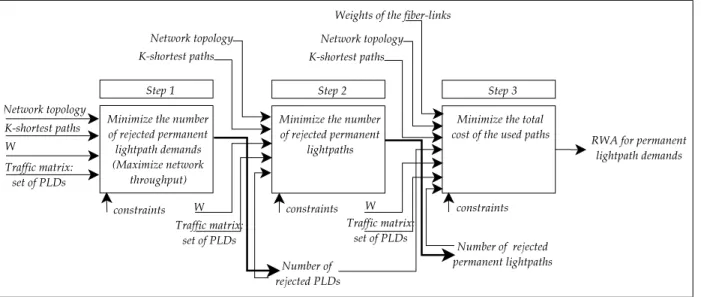
Dans cette partie, nous proposons des approches `a la fois exactes et approch´ees pour r´esoudre le probl`eme. Nous commen¸cons par ´etablir des mod`eles lin´eaires `a nombre entiers multi-objectifs. Nous r´esolvons les probl`emes de routage et d’allocation de longueurs d’onde simultan´ement. Le premier mod`ele impose `a tous les circuits optiques requis par une demande de trafic PLD le passage par la mˆeme route physique connectant la source `a la destination. Le routage est dans ce cas dit atomique. Le deuxi`eme mod`ele permet ´eventuellement `a une demande de trafic d’emprunter plusieurs chemins entre sa source et sa destination. On parle dans ce cas de routage non atomique. Chaque mod`ele op`ere en trois ´etapes. La premi`ere ´etape cherche `a minimiser le nombre de demandes de trafic PLD rejet´ees ´etant donn´e une topologie physique du r´eseau, un nombre fixe de longueurs d’onde par fibre et un ensemble fini de demandes PLD `a satisfaire. La deuxi`eme ´etape cherche `a d´eterminer dans l’ensemble des solutions possibles calcul´ees par la premi`ere ´etape, celles qui minimisent en plus le nombre de circuits optiques rejet´es ´etant donn´e le nombre minimal de demandes de trafic PLD rejet´e calcul´e par la premi`ere ´etape. La troisi`eme ´etape s´electionne parmi les solutions obtenues celle qui minimise le coˆut total des chemins physiques emprunt´es.
Les mod`eles lin´eaires `a nombre entiers propos´es sont NP-difficiles et leur r´esolution reste limit´ee `a des tailles de r´eseaux r´eduites (r´eseaux de moins de 30 nœuds) et des matrices de trafic de quelques dizaines de demandes. Pour r´esoudre des probl`emes de tailles r´ealistes, on a eu recours `a des heuristiques pour calculer le routage et l’allocation des longueurs d’onde. Nous proposons une heuristique (recherche al´eatoire, (random search)) qui ´etablit un ordre de calcul du routage et des longueurs d’onde pour les demandes de trafic PLD et s´electionne la solution qui minimise le nombre de demandes de trafic PLD rejet´ees. Deux heuristiques ont ´et´e propos´ees selon que l’on autorise le routage non atomique ou non.
Les r´esultats exp´erimentaux obtenus en consid´erant diff´erentes topologies de r´eseaux et diff´erentes matrices de trafic montrent que les heuristiques propos´ees calculent dans la majorit´e des cas le mˆeme taux de rejet que celui calcul´e par les mod`eles exacts.
Routage et affectation de longueurs d’onde pour les demandes SLD et RLD
Dans cette partie seules des approches heuristiques ont ´et´e adopt´ees. Nous proposons deux heuristiques. La premi`ere calcule `a la vol´ee le routage et l’affectation des longueurs d’onde des demandes de trafic SLD et RLD indistinctement en fonction des dates d’arriv´ee de ces demandes de trafic au r´eseau.
La deuxi`eme heuristique calcule le routage et l’affectation des longueurs d’onde pour les demandes de trafic SLD et RLD s´epar´ement en deux ´etapes. La premi`ere ´etape calcule le routage et l’affectation des longueurs pour les demandes de trafic SLD a priori cherchant `a minimiser le nombre de demandes SLD rejet´ees. Les demandes de trafic SLD sont connues `a l’avance, on utilise une heuristique `a base de recherche al´eatoire pour calculer le routage et l’affectation des longueurs d’onde pour les SLDs. La deuxi`eme ´etape calcule `a la vol´ee le routage et l’affectation des longueurs d’onde pour les demandes de trafic RLD s´equentiellement en fonction de leurs dates d’arriv´ee au r´eseau et en tenant compte du routage des demandes de trafic SLD d´ej`a calcul´e par le biais de la premi`ere ´etape.
L’apport du routage non atomique par rapport au routage atomique a ´et´e aussi ´etudi´e dans cette partie.
Les r´esultats exp´erimentaux men´es dans le cadre de cette ´etude montrent qu’`a faible charge, la deuxi`eme heuristique calcule le meilleur taux de rejet global (SLD et RLD confondues). On montre ´
egalement qu’`a forte charge la premi`ere heuristique calcule le meilleur taux de rejet global cependant le nombre de SLDs rejet´ees dans ce cas est beaucoup plus important que dans le cas de la deuxi`eme heuristique. On montre ´egalement que la deuxi`eme heuristique requiert des temps de calcul plus importants que ceux de la premi`ere heuristique principalement `a cause du temps n´ecessaire au calcul du routage et de l’affectation des longueurs pour les demandes de trafic SLD.
Routage et affectation de longueurs d’onde avec protection
Dans cette partie de la th`ese nous nous int´eressons `a la protection des circuits optiques. Il s’agit de d´efinir pour chaque demande de trafic autant de circuits optiques primaires que de circuits de protection. Les circuits optiques primaires sont utilis´es au cours du fonctionnement normal du r´eseau, les circuits optiques de protection (backups) sont emprunt´es en cas de panne de conduit. Les circuits optiques primaires et de backups doivent ˆetre disjoints (c-`a-d ne partagent aucun conduit commun) afin d’assurer le r´etablissement du fonctionnement du r´eseau en cas de panne. On s’int´eresse aux pannes simples de conduit et on suppose qu’en cas de panne, tous les circuits optiques qui traversent le conduit d´efaillant dans les deux directions, sont affect´es et doivent ainsi ˆetre rerout´es sur leurs chemins de protection respectifs. Cette approche bi-directionnelle du probl`eme est `a notre connaissance originale.
Les ressources d´edi´ees `a la protection sont calcul´ees et r´eserv´ees au moment du calcul du routage des canaux optiques primaires et ne peuvent ainsi ˆetre r´eutilis´ees par aucune demande de trafic. Ces ressources ´etant rarement sollicit´ees, nous cherchons `a en minimiser le nombre grˆace au multiplexage des circuits optiques de protection (backup multiplexing). Le backup multiplexing autorise deux ou plusieurs canaux optiques de protection `a utiliser la mˆeme longueur d’onde sur un ou plusieurs liens
communs `a la condition que les canaux optiques primaires ne partageant aucun conduit en commun. Le probl`eme peut ˆetre d´ecrit comme suit:
´etant donn´e une topologie physique du r´eseau, un nombre de longueurs d’onde disponibles sur chaque lien du r´eseau et un ensemble de demandes de trafic `a satisfaire, il s’agit de d´efinir pour chaque demande de trafic le ou les chemins et la ou les longueurs d’onde n´ecessaires pour ´etablir les circuits optiques primaires et de protection, l’objectif ´etant de minimiser le nombre de demandes de trafic rejet´ees. Nous supposons ici qu’une demande de trafic est rejet´ee lorsqu’il est impossible de satisfaire tous les circuits optiques requis par la demande. La minimisation du nombre de demandes de trafic rejet´ees passe par la minimisation des resources n´ecessaires pour assurer la protection des circuits optiques primaires.
L’´etude men´ee se d´ecompose en deux parties. La premi`ere partie traite du probl`eme de routage et affectation de longueurs d’onde avec protection consid´erant des demandes de trafic de type PLD. La seconde partie ´etudie le probl`eme de routage et affectation de longueurs d’onde avec protection en consid´erant simultan´ement les demandes de trafic SLD et RLD.
Routage et affectation de longueurs d’onde avec protection pour les demandes PLD Dans cette premi`ere partie des approaches exactes et approch´ees ont ´et´e propos´ees. En ce qui concerne les approches exactes, nous proposons de r´esoudre les probl`emes de routage et d’affectation de longueurs d’onde s´epar´ement afin de r´eduire la complexit´e des mod`eles propos´es. Deux mod`eles lin´eaires multi-objectifs `a nombre entiers ont ´et´e d´evelopp´es. Le premier mod`ele calcule les routes pour les circuits primaires et de protection s´epar´ement, le deuxi`eme calcule les routes simultan´ement. L’objectif est de minimiser le nombre de routes primaires passant par un lien donn´e du r´eseau (il s’agit de distribuer le trafic sur tous les liens du r´eseau) afin de minimiser l’impact d’une panne de conduit sur le nombre de circuits optiques primaires devant ˆetre rerout´es. Nous nous int´eressons ensuite `a la minimisation du nombre de liens du r´eseau travers´es par les routes de protection afin d’attribuer la mˆeme longueur d’onde `a plusieurs routes de backups lorsque les routes primaires correspondantes ne partagent aucun conduit en commun. Nous cherchons ´egalement `a minimiser le coˆut total des routes primaires et de protection lorsque plusieurs solutions sont possibles.
Une fois les routes calcul´ees, on propose d’utiliser un mod`ele lin´eaire `a nombre entiers pour affecter les longueurs d’ondes aux routes ou bien une heuristique qui attribue selon un algorithme de coloration de graphe (degr´e de saturation, (DSATUR)) un nombre minimal de couleurs aux nœuds d’un graphe de conflit g´en´eralis´e constitu´e de nœuds primaires (correspondant aux chemins primaires) et de nœuds de protection (correspondant aux chemins de protection).
Les mod`eles lin´eaires `a nombre entiers propos´es sont NP-difficiles, nous proposons de d´evelopper une heuristique pour r´esoudre le probl`eme de routage et affectation de longueurs d’onde avec protection
pour des probl`emes de tailles r´ealistes. L’heuristique ´etablit un ordre de routage des demandes et calcule les circuits primaires et de protection en trois ´etapes:
• La premi`ere ´etape calcule les circuits optiques primaires. Les ´etapes 2 et 3 sont abandonn´ees s’il n’est pas possible de satisfaire les circuits optiques primaires requis par la demande de trafic.
• La deuxi`eme ´etape construit autant de graphes auxiliaires que de longueurs d’ondes disponibles sur chaque lien du r´eseau et affecte un coˆut `a chaque arc du graphe auxiliaire en fonction de l’´etat de la longueur d’onde sur le lien consid´er´e.
• La troisi`eme ´etape s´electionne les canaux optiques de protection les moins coˆuteux (ceux qui partagent un maximum de liens avec les canaux de protection d´ej`a ´etablis). Si la troisi`eme ´etape ´
echoue, la demande de trafic est rejet´ee et les circuits optiques primaires ´etablis sont lib´er´es.
Les r´esultats exp´erimentaux montrent que bien que le premier mod`ele lin´eaire calcule les routes primaires et de protection s´epar´ement, il fournit de meilleures performances en termes de nombre de longueurs d’onde requises. On montre aussi que le deuxi`eme mod`ele pr´esente de meilleures performances en termes de congestion des routes primaires et des routes de protection. Cependant le fait de concentrer le passage des routes de protection par un nombre minimal de liens dans le r´eseau ne contribue pas `a une utilisation minimale des ressources, essentiellement parce que les routes primaires correspondantes partagent de nombreux conduits en commun et qu’il est ainsi impossible d’attribuer la mˆeme longueurs d’onde aux backups.
Nous montrons aussi que l’heuristique propos´ee pour calculer le routage et l’affectation des longueurs d’onde avec protection pour les demandes PLD calcule des taux de rejet ´egaux `a ceux calcul´es par approches exactes.
Routage et affectation de longueurs d’onde avec protection pour les demandes SLD et RLD
Dans cette partie nous nous int´eressons au routage et affectation de longueurs d’onde avec protection en consid´erant conjointement les SLDs et les RLDs. Nous proposons deux heuristiques analogues `a celles propos´ees dans la partie routage et affectation de longueurs d’onde et nous ´etudions l’apport du routage non atomique par rapport au routage atomique.
Les r´esultats exp´erimentaux obtenus confortent les r´esultats obtenus dans la partie routage et affec-tation de longueurs d’onde.
Reroutage
Dans cette partie nous proposons un algorithme de reroutage de canaux optiques afin d’am´eliorer le taux de rejet lorsque la contrainte de continuit´e en longueur d’onde est impos´ee. Nous consid´erons deux classes de trafic correspondant aux demandes de trafic SLD et aux demandes de trafic RLD. Nous supposons ici que le trafic SLD est un trafic de haute priorit´e et qu’il est impossible de rerouter une demande de trafic SLD.
L’id´ee consiste en cas de rejet d’une nouvelle demande de traffic arrivant au r´eseau de rerouter un nombre minimal de demandes de trafic RLD d´ej`a ´etablies afin de lib´erer les ressources n´ecessaires `a l’´etablissement de la nouvelle demande de trafic. Si le reroutage est possible, la demande de trafic est satisfaite, dans le cas contraire, la demande de trafic est d´efinitivement rejet´ee.
Deux algorithmes ont ´et´e propos´es. Le premier calcule `a la vol´ee s´equentiellement le routage et l’affectation des longueurs d’onde pour les demandes de trafic `a leurs instants d’arriv´ee au r´eseau. Le deuxi`eme calcule le routage et l’affectation de longueurs d’onde pour les demandes de trafic SLD a priori (l’objectif ´etant de minimiser le nombre de SLDs rejet´ees) avant de consid´erer le routage et l’affectation de longueurs d’onde des RLDs `a la vol´ee en tenant compte du routage des demandes SLD. L’objectif des deux algorithmes est de minimiser le nombre de demandes de trafic rejet´ees ´etant donn´e un nombre limit´e de longueurs d’onde par fibre.
Deux m´etriques ont ´et´e consid´er´ees lors de l’´etape de reroutage. La premi`ere cherche `a minimiser le nombre de canaux WDM `a rerouter au moment de l’´etablissement d’une nouvelle demande de trafic. La deuxi`eme m´etrique cherche `a minimiser le nombre de demandes de trafic RLD `a rerouter.
Grˆace aux r´esultats de simulations nous observons que les r´esultats obtenus montrent un gain non n´egligeable en terme de taux de rejet. Nous montrons aussi que l’algorithme propos´e requiert un temps de calcul inf´erieur compar´e aux ´etudes d´ej`a pr´esent´ees dans la litt´erature.
Mots cl´
es
fibre optique, longueur d’onde, multiplexage en longueurs d’onde, ’Time Division Multiplexing, TDM’, ’Wavelength Division Multiplexing, WDM’, canal optique (’lightpath’), circuit, commutation de circuits, r´eseaux optiques, r´eseaux tout-optiques, transparence, r´eseaux opaques, conversion de longueur d’onde, r´eseaux hybrides, planification, dimensionnement, routage et affectation de longueurs d’onde, protection, protection de chemin (’path protection’), protection de lien (’link protection’), panne de lien (’link fail-ure’), panne de conduit (’span failfail-ure’), multiplexage de chemins de protection (’backup multiplexing’), reroutage, optimisation, mod`eles lin´eaires `a nombres entiers, coloration de graphe, meta-heuristique, heuristique, ing´enierie de trafic, diff´erenciation de service, ’Quality of Service, QoS’, ’Synchronous
Dig-ital Hierarchy, SDH’, ’Asynchronous Transfer Mode, ATM’, ’Multiprotocol Label Switching, MPLS’, ’Generalized Multiprotocol Label Switching, GMPLS’, ’Optical Virtual Private Network, OVPN’, ’Per-manent Lightpath Demands, PLDs’, ’Scheduled Lightpath Demands, SLDs’, ’Random Lightpath De-mands, RLDs’, routage atomique, routage non atomique, congestion, ’Optical Add/Drop Multiplexer, OADM’, ’Optical Cross-Connect, OXC’.
As traffic on telecommunication networks continues to grow driven by increasing demand for voice and data communication services, the optical layer needs to provide functionalities such as lightpaths set-up and tear-down, protection and rerouting.
This thesis mainly focuses on all-optical lightpaths establishment. We consider all along the thesis single fiber optical networks with finite resources, that is with a given amount of wavelengths per fiber-links. We present a suite of methods for optimizing design and for analyzing rejection ratios in all-optical WDM networks. Both exact and approximate optimization techniques are considered. The methods are assessed through various experiments and are shown to produce good results and to be able to scale up to networks of realistic sizes.
In a first step, we investigate the problem of Routing and Wavelength Assignment (RWA) for Perma-nent Lightpath Demands (PLDs). PLDs are pre-known connection requests which remain indefinitely in the network once accepted. We first develop multi-objective integer linear programming (MOILP) mod-els. The models being intractable for realistic RWA problems, we then propose heuristic methods based on combinatorial optimization models to compute approximate solutions for the considered problem. This work is then extended to consider a realistic traffic model obtained by the combination of three types of traffic demands referred to as Permanent Lightpath Demands, Scheduled Lightpath Demands (SLDs) and Random Lightpath Demands (RLDs). SLDs are characterized by pre-known dates of arrival and life durations. They may correspond for instance to a set of long term lightpath establishments in order to provide Optical Virtual Private Network services. Conversely RLDs are characterized by random arrival and life duration processes. The benefits of load balancing through traffic bifurcation are studied.
In a second step, we deal with the Routing and Spare Capacity Assignment (RSCA) problem. We first consider PLDs and develop integer linear programming models and heuristic methods for both the routing and the wavelength assignment sub-problems. This work is then extended to deal with the RSCA of SLDs and RLDs.
Due to the wavelength continuity constraint, a new lightpath demand may be rejected. In a third
step, we focus on the improvement of the lightpath demand rejection ratio by means of lightpath rerouting strategies. We have developed such strategies in order to minimize traffic disruption on already routed demands. As SLDs correspond to high priority traffic, we assume that they cannot be rerouted. At the opposite, a new lightpath establishment may require the rerouting of one or several RLDs.
For each of these steps, we have developed multiple optimization tools which have been applied to a wide range of network sizes, topologies and traffic scenarios. Our conclusions are then drawn based on these results.
The work in this thesis is based on research carried out at the ”Acc`es et Mobilit´e Group”, the Department of Computer Science and Networks, Telecom Paris, France. No part of this thesis has been submitted elsewhere for any other degree or qualification and it is all my own work unless referenced to the contrary in the text.
Copyright c 2005 by Mohamed Koub`aa.
All right reserved. No part of this thesis may be reproduced, in any form or by any means, without the author’s prior written consent and information.
Table of Contents
Declaration xix
1 Introduction 1
1.1 Research motivation . . . 1 1.2 Contribution of this thesis . . . 5 1.3 Organization of the dissertation . . . 7
2 Optical Fiber Communication: From Transmission to Networking 9
2.1 Introduction . . . 9 2.2 Optical network drivers . . . 9 2.2.1 Fiber capacity . . . 10 2.2.2 Traffic growth . . . 10 2.2.3 Reduced cost . . . 10 2.2.4 Traffic type change . . . 11 2.2.5 Restoration capability . . . 11 2.3 Optical transmission: technology and devices . . . 11 2.3.1 Multiplexing techniques . . . 11 2.3.2 Fiber types . . . 12 2.3.2.1 Multi-mode fiber . . . 12 2.3.2.2 Single-mode fiber . . . 13 2.3.3 Light sources . . . 14 2.3.4 Line rates . . . 15 2.3.5 LH and ULH transmission . . . 15 2.3.5.1 Long haul (LH) . . . 15 2.3.5.2 Ultra long haul (ULH) . . . 16 2.4 From optical transmission to optical networking . . . 16 2.4.1 Optical network elements . . . 17 2.4.1.1 Optical amplifiers . . . 17
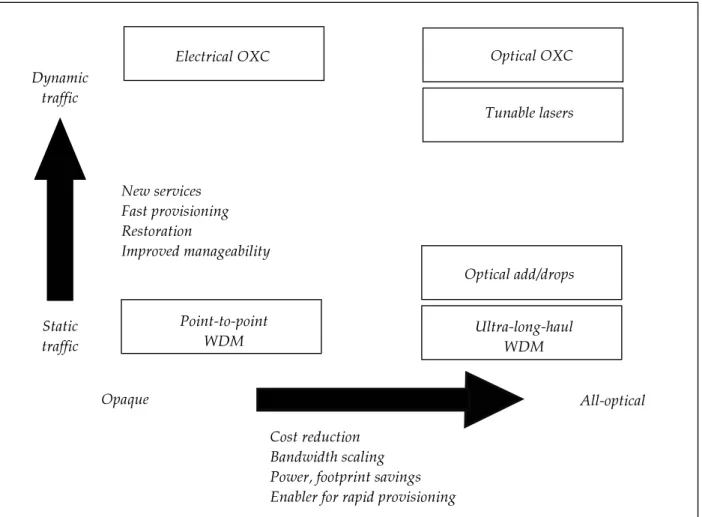
2.4.1.1.1 Semiconductor optical amplifiers . . . 17 2.4.1.1.2 Optical doped fiber amplifiers . . . 18 2.4.1.1.3 Raman optical amplifiers . . . 18 2.4.1.2 Optical line terminals . . . 18 2.4.1.3 Optical add/drop multiplexers . . . 19 2.4.1.4 Optical cross-connects . . . 20 2.4.2 Optical switching techniques . . . 23 2.4.3 Evolution of optical networks: challenges and requirements . . . 24 2.4.4 Taxonomy used in this thesis . . . 27
3 Literature Survey 29
3.1 Introduction . . . 29 3.2 Routing and wavelength assignment . . . 29 3.2.1 Separate wavelength-route selection . . . 31 3.2.1.1 Path selection algorithms . . . 31 3.2.1.1.1 Fixed routing . . . 31 3.2.1.1.2 Fixed alternate routing . . . 31 3.2.1.1.3 Adaptive routing . . . 32 3.2.1.1.4 Least congested path routing . . . 33 3.2.1.2 Wavelength selection algorithms . . . 33 3.2.2 Simultaneous wavelength-path selection . . . 34 3.3 Routing and spare capacity assignment . . . 34 3.4 Lightpath rerouting . . . 38 3.5 Thesis overview . . . 39
4 Routing and Wavelength Assignment for Permanent Lightpath Demands 43
4.1 Introduction . . . 43 4.2 Description of the problem . . . 44 4.3 The linear programming approach . . . 46 4.3.1 Notations . . . 46 4.3.2 Model 1: Atomic RWA for PLDs model formulation . . . 48 4.3.3 Model 2: Non Atomic RWA for PLDs model formulation . . . 54 4.3.4 Problem size reduction . . . 59 4.4 The heuristic approach . . . 59 4.4.1 Mathematical formulation . . . 59 4.4.2 The sequential Permanent Atomic RWA algorithm . . . 61
4.4.3 The sequential Permanent non atomic RWA algorithm . . . 61 4.4.4 Description of the Random Search algorithm . . . 63 4.4.5 Illustrative example . . . 64 4.5 Experimental results . . . 66
5 Routing and Wavelength Assignment for Scheduled and Random Lightpath Demands 73 5.1 Introduction . . . 73 5.2 Description of the problem . . . 74 5.3 Notations . . . 75 5.4 Atomic routing algorithms . . . 77
5.4.1 Sequential RWA for scheduled and random lightpath demands: sequential Atomic RWA algorithm . . . 77 5.4.2 Separate RWA for scheduled and random lightpath demands: separate Atomic
RWA algorithm . . . 80 5.4.2.1 PHASE1: RWA for scheduled lightpath demands . . . 80 5.4.2.1.1 Mathematical formulation . . . 80 5.4.2.1.2 The Random Search algorithm . . . 81 5.4.2.2 PHASE2: RWA for random lightpath demands . . . 83 5.5 Non atomic routing algorithms . . . 84
5.5.1 Sequential RWA for scheduled and random lightpath demands: sequential non atomic RWA algorithm . . . 85 5.5.2 Separate RWA for scheduled and random lightpath demands: separate non atomic
RWA algorithm . . . 86 5.5.2.1 PHASE1: RWA for scheduled lightpath demands . . . 86 5.5.2.1.1 Mathematical formulation . . . 86 5.5.2.1.2 The Random Search algorithm . . . 87 5.5.2.2 PHASE2: RWA for random lightpath demands . . . 88 5.6 Experimental results . . . 90
6 Routing and Spare Capacity Assignment for Permanent Lightpath Demands 99
6.1 Introduction . . . 99 6.2 Description of the problem . . . 100 6.3 The linear programming approach . . . 102 6.3.1 Notations . . . 102 6.3.2 Lightpath routing . . . 104 6.3.2.1 Model 1: Separate computation of primary and backup routes . . . 104
6.3.2.1.1 PHASE 1: primary paths computation . . . 105 6.3.2.1.2 PHASE 2: backup paths computation . . . 106 6.3.2.2 Model 2: Simultaneous computation of primary and backup routes . . . 109 6.3.2.3 Problem size reduction . . . 114 6.3.3 Wavelength assignment . . . 114 6.3.3.1 The linear programming approach . . . 115 6.3.3.1.1 Notations . . . 115 6.3.3.1.2 Mathematical model . . . 116 6.3.3.2 The heuristic approach . . . 118 6.3.3.2.1 The graph coloring problem . . . 118 6.3.3.2.2 The heuristic . . . 119 6.4 The heuristic approach . . . 119 6.4.1 Mathematical formulation . . . 119 6.4.2 Description of the RS algorithm . . . 120 6.4.2.1 STAGE 1: primary lightpath computation . . . 120 6.4.2.2 STAGE 2: auxiliary graphs (AG) construction . . . 121 6.4.2.3 STAGE 3: backup lightpath computation . . . 122 6.4.3 Illustrative example . . . 122 6.5 Experimental results . . . 127
7 Routing and Spare Capacity Assignment for Scheduled and Random Lightpath Demands 133 7.1 Introduction . . . 133 7.2 Description of the problem . . . 134 7.3 Notations . . . 134 7.4 Sequential RSCA for scheduled and random lightpath demands . . . 137 7.4.1 STAGE 1: primary lightpath computation . . . 137 7.4.2 STAGE 2: auxiliary graphs construction . . . 138 7.4.3 STAGE 3: backup lightpath computation . . . 138 7.4.4 Illustrative example . . . 138 7.5 Separate RSCA for scheduled and random lightpath demands . . . 142 7.5.1 PHASE 1: RSCA of scheduled lightpath demands . . . 142 7.5.2 PHASE 2: RSCA for random lightpath demands . . . 144 7.5.3 Illustrative example . . . 144 7.6 Experimental results . . . 147
8 Lightpath Rerouting for Scheduled and Random Lightpath Demands for Traffic Engi-neering in WDM Networks 150 8.1 Introduction . . . 150 8.1.1 Traffic model . . . 151 8.1.2 Rerouting dynamics . . . 151 8.1.3 Type of lightpaths . . . 151 8.2 Description of the problem . . . 152 8.3 Notations . . . 153 8.4 The routing and rerouting algorithms . . . 155 8.4.1 Sequential RWA with rerouting for scheduled and random lightpath demands . . 155 8.4.1.1 PHASE 1: routing phase . . . 155 8.4.1.2 PHASE 2: rerouting phase . . . 157 8.4.1.3 Illustrative example . . . 158 8.4.2 Separate RWA with rerouting for scheduled and random lightpath demands . . . 163 8.4.2.1 RWA for scheduled lightpath demands . . . 163 8.4.2.2 RWA with rerouting for random lightpath demands . . . 163 8.4.2.3 Illustrative example . . . 163 8.5 Experimental results . . . 166
9 Conclusions and Future Work 173
9.1 Conclusions . . . 173 9.2 Future tracks . . . 175
List of Figures
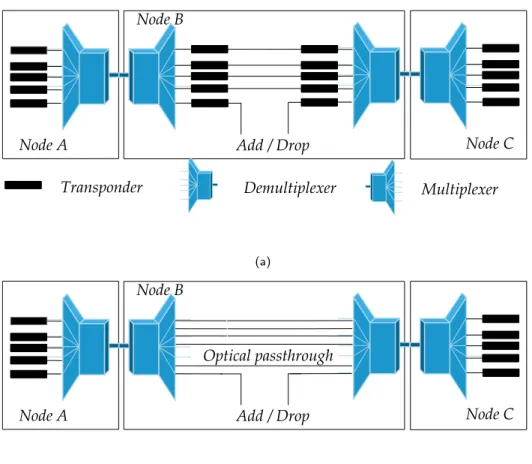
2.1 A three-node network example to illustrate the role of OADMs . . . 20 2.2 Three OXC architectures . . . 22 2.3 Evolution of optical networks . . . 25
3.1 Classification of proactive methods . . . 36 3.2 Traffic on the New York - Washington link of the Abilene backbone network in a typical
week. . . 40
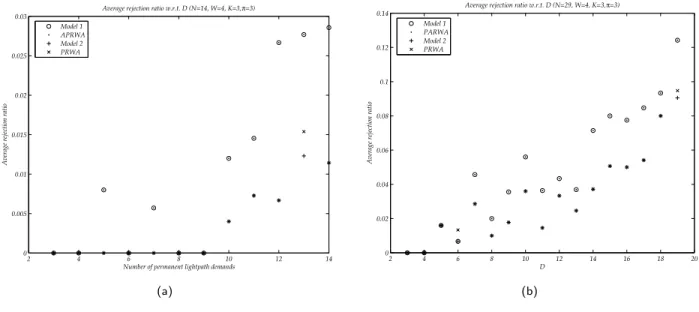
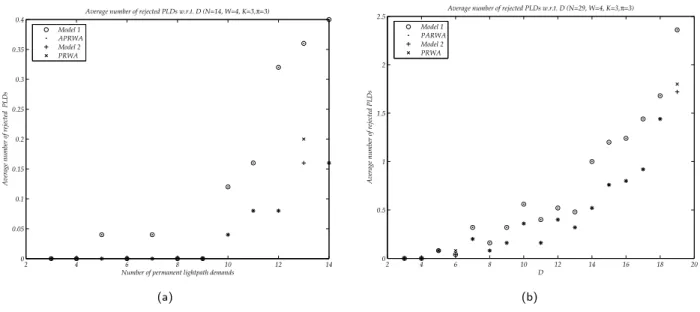
4.1 Routing and wavelength assignment for permanent lightpath demands . . . 45 4.2 The three steps required for the RWA for PLDs . . . 46 4.3 The 14-node network topology . . . 67 4.4 The 29-node network topology . . . 67 4.5 Average PLDs’ rejection ration w.r.t. D . . . 68 4.6 Average number of rejected PLDs w.r.t. D . . . 69 4.7 Average permanent lightpath rejection ratio w.r.t. D . . . 69 4.8 Average number of rejected permanent lightpaths w.r.t. D . . . 70 4.9 Average number of required WDM channels w.r.t. D . . . 70 4.10 Average number of required variables w.r.t. D . . . 71 4.11 Average number of required constraints w.r.t. D . . . 71 4.12 Average required CPU execution time w.r.t. D . . . 72
5.1 RWA for scheduled and random lightpath demands . . . 75 5.2 average rejection ratio . . . 91 5.3 average number of rejected LDs . . . 91 5.4 average SLDs’ rejection ratio . . . 92 5.5 average RLDs’ rejection ratio . . . 92 5.6 average lightpath rejection ratio . . . 92 5.7 average SLPs’ rejection ratio . . . 92 5.8 average RLPs’ rejection ratio . . . 93
5.9 average CPU execution time . . . 93 5.10 average lightpath overall length . . . 94 5.11 average number of required WDM channels . . . 94 5.12 average rejection ratio w.r.t. W . . . 95 5.13 average number of rejected LDs . . . 96 5.14 average number of rejected lightpaths . . . 96 5.15 average rejection ratio w.r.t. ν . . . 97 5.16 average number of rejected LDs . . . 97 5.17 average number of rejected lightpaths . . . 97 5.18 average rejection ratio w.r.t. µ . . . 98
6.1 Routing and spare capacity assignment for permanent lightpath demands . . . 101 6.2 Model 1 schematic representation . . . 104 6.3 Model 2 schematic representation . . . 110 6.4 average number of variables . . . 127 6.5 average number of constraints . . . 127 6.6 average number of required wavelengths . . . 128 6.7 average number of required WDM channels . . . 128 6.8 average primary lightpath congestion . . . 129 6.9 average backup lightpath congestion . . . 129 6.10 average length of primary paths . . . 129 6.11 average length of backup paths . . . 129 6.12 average lightpath overall length . . . 130 6.13 average CPU execution time . . . 130 6.14 average number of required wavelengths (dedicated protection) . . . 130 6.15 average number of required WDM channels (dedicated protection) . . . 130
7.1 Routing and spare capacity assignment for Scheduled and Random Lightpath Demands 135 7.2 average rejection ratio . . . 148 7.3 average number of rejected LDs . . . 148 7.4 average rejected lightpaths . . . 148 7.5 average number of rejected lightpaths . . . 148 7.6 average lightpath overall length . . . 149 7.7 average CPU execution time . . . 149
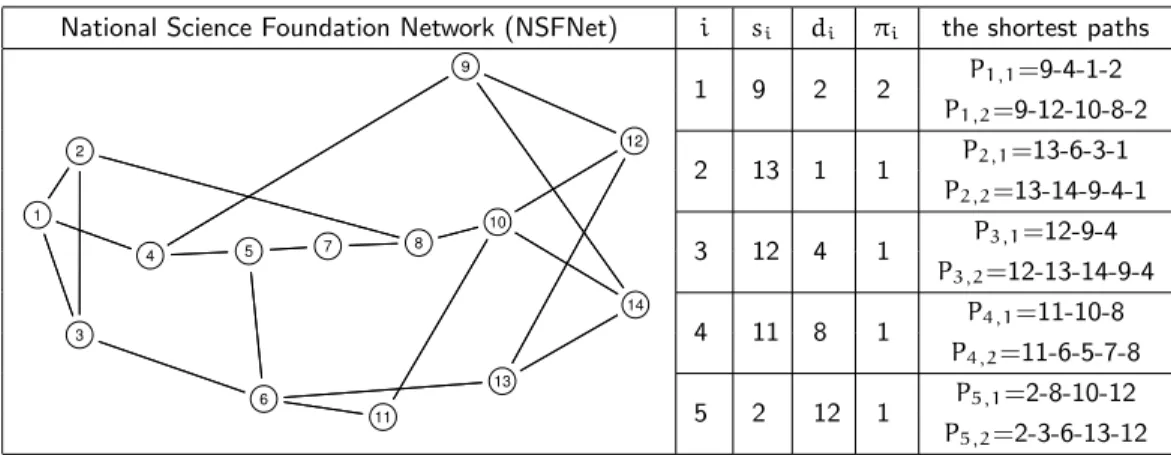
8.2 Schematic representation of the seqRWAwR algorithm . . . 156 8.3 National Science Foundation Network (NSFNet) . . . 158 8.4 Schematic representation of the sepRWAwR algorithm . . . 164 8.5 Average rejection ratio gain. . . 169 8.6 Average rejection ratio. . . 169 8.7 Average number of rerouted RLDs. . . 170 8.8 Average number of rerouted WDM channels. . . 170 8.9 average lightpath overall length . . . 170 8.10 Average CPU execution time. . . 170
List of Tables
2.1 Taxonomy used in this thesis . . . 28
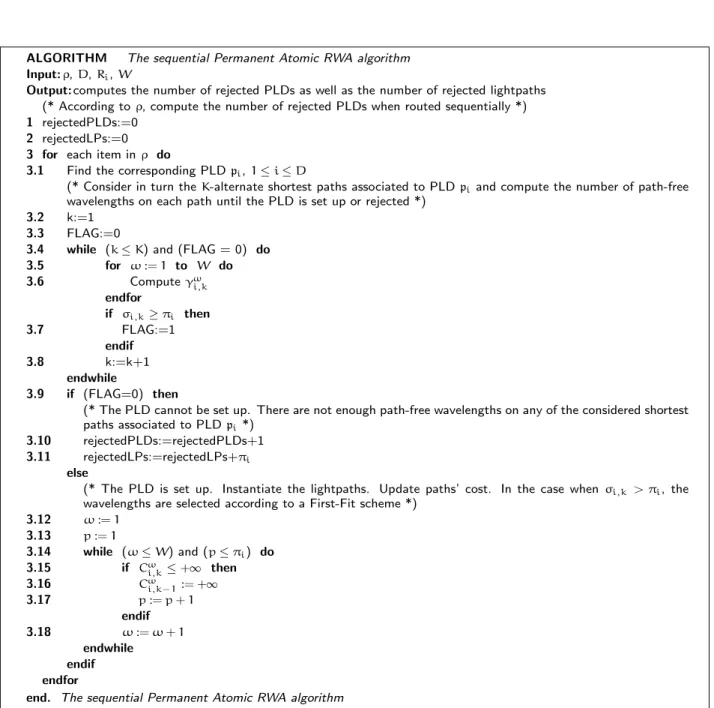
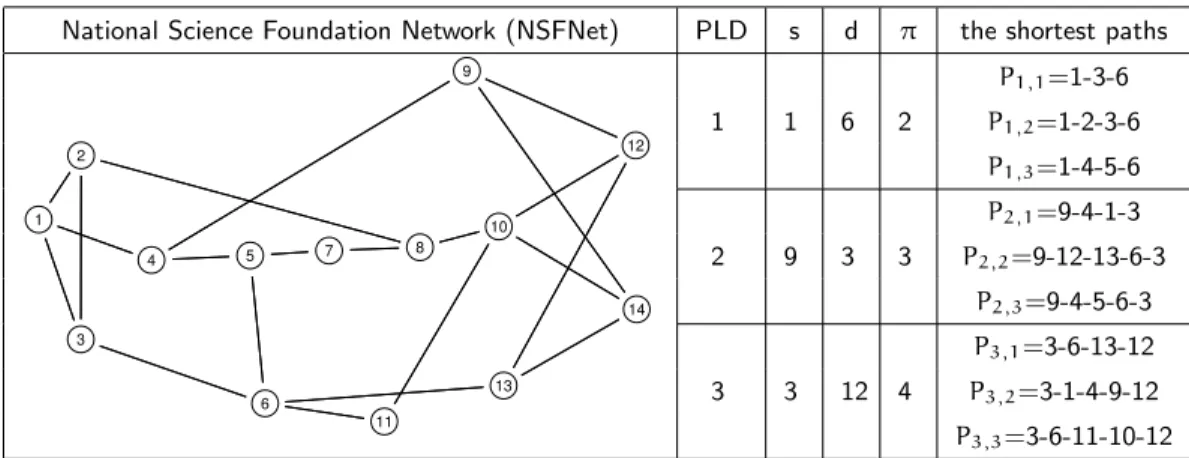
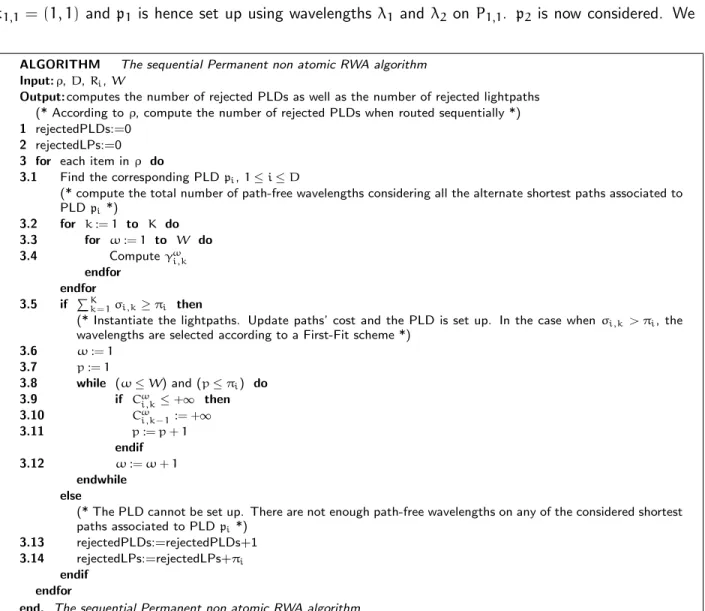
4.1 Pseudo-code of the sequential Permanent Atomic RWA algorithm . . . 62 4.2 The 14-node NSFNet network topology and the set of PLDs to be set up . . . 63 4.3 Pseudo-code of the sequential Permanent non atomic RWA algorithm . . . 64 4.4 Pseudo-code of the Random Search (RS) algorithm . . . 65 4.5 The 14-node NSFNet network topology and the PLDs to be set up . . . 66 4.6 RWA according to the RS algorithm for the PLDs shown in Table 4.5 . . . 66 4.7 Results for Model 1 and Model 2 under different simulation scenarios . . . 68
5.1 Pseudo code for the sequential Atomic RWA algorithm . . . 78 5.2 The set of SLDs to be set up . . . 79 5.3 The RLDs to be set up . . . 79 5.4 RS algorithm for the atomic RWA of SLDs . . . 82 5.5 Non bifurcated RWA for the SLDs . . . 83 5.6 The RLDs to be set up . . . 84 5.7 Pseudo code for the sequential non atomic RWA algorithm . . . 86 5.8 The set of SLDs to be set up . . . 88 5.9 RWA for the SLDs . . . 88 5.10 RS algorithm for the (non atomic) RWA of SLDs . . . 89 5.11 The RLDs to be set up . . . 90
6.1 Pseudo-code for primary lightpath selection . . . 121 6.2 Pseudo-code of the Random Search (RS) algorithm . . . 123 6.3 The 14-node NSFNet network topology and the PLDs to be set up . . . 124 6.4 Weight of the arcs for each AG at the date of computing the backup for PLD p3 . . . 125 6.5 Weight of the arcs for each AG at the date of computing the backup for PLD p1 . . . 126
7.2 The RLDs to be set up . . . 139 7.3 Weight of the arcs for each AG, Gω, once the primaries of SLD δ1 are set up . . . 140 7.4 Weight of the arcs for each AG, Gω, once the primary of SLD δ2 is set up . . . 140 7.5 Weight of the arcs for each AG, Gω, once the primaries of SLD δ3 are set up . . . 141 7.6 Weight of the arcs for each AG, Gω, once the primaries of RLD τ2 are set up . . . 141 7.7 RS algorithm for the atomic RSCA for SLDs . . . 143 7.8 The set of SLDs to be set up . . . 144 7.9 The RLDs to be set up . . . 145 7.10 RSCA for the SLDs: description of A406 at the arrival time of τ
1 . . . 146 8.1 Comparison of the rerouting algorithms. . . 152 8.2 Path computation and wavelength selection for LD i with starting time t . . . 157 8.3 Rerouting algorithm used for PHASE 2 . . . 159 8.4 The set of LDs to be set up . . . 160 8.5 The network state at the starting time of SLD δ5 (t = 309) . . . 161 8.6 The network state at the starting time of SLD δ8 (t = 506) . . . 161 8.7 The number of RLDs and RLDs to reroute in order to set up SLD δ8 (t = 506) . . . . 162 8.8 The network state according to the seqRWAwR algorithm once SLD δ8 is set up . . . . 162 8.9 The set of LDs to be set up . . . 165 8.10 RWA for the SLDs . . . 165 8.11 The network state according to the sepRWAwR algorithm once SLD δ8 is set up . . . . 166 8.12 Average rejection ratio (N = 14, W = 32, K = 5, µ−1 = 500, ν−1= 1, π = 1). . . 168 8.13 Average number of rejected SLDs (N = 14,W = 32,K = 5,µ−1= 500,ν−1= 1,π = 1). 168
Introduction
1.1
Research motivation
The rapid evolution of telecommunications networks is always driven by the ever-increasing demands of the Internet as well as continuous advances in communications systems. Over the last years, we have witnessed the explosive growth of the Internet due in part to the proliferation of applications such as data and call centers, as well as by the bootstrapping effect of increased consumption resulting from lower rates. Furthermore, the emergence of time critical applications such as Internet telephony, video conferencing, television channel distribution, and multimedia graphics heightened the need for increasing bandwidth capacity on the underlying telecommunications infrastructure. This unprecedented demand for bandwidth capacity has witnessed a wide deployment of point-to-point Wavelength Division Multiplexing (WDM) transmission systems which have emerged as a viable and future-proof solution, in the Internet infrastructure.
At the same time, there has been increasing effort to enhance routing schemes to support higher data rates, traffic engineering functions and Quality of Service issues. Relevant efforts have been spent on the Internet Protocol (IP) to support the high data rates provided by the optical fiber as well as traffic engineering functions [1] [2] [3] and different Quality of Service (QoS) levels [4]. Multi-Protocol Label Switching (MPLS) [5] [6] allows, on one hand, faster switching at the Label Switching Routers (LSRs) as well as QoS and traffic engineering support. MPLS, on the other hand, makes the Internet architecture, built upon the connectionless paradigm, connection-oriented.
WDM technology has first been deployed mainly for point-to-point transmission. Routing and switching functions are hence performed electronically at each network node. Optical signals must go through opto-electronic (O/E) and electro-optical (E/O) conversions at each intermediate node. Consequently, a network node may not be able to process all the traffic carried by all its input signals,
including the traffic intended for the node as well as the traffic that is just passing through the node to other destinations, causing an electronic bottleneck . To overcome these electronic bottlenecks and thanks to recent advances in optical technologies, WDM systems are moving beyond point-to-point transmission systems to all-optical systems incorporating optical routing and switching, circuit set-up and tear-down, protection and rerouting functions at the optical layer.
This thesis mainly focuses on all-optical lightpath establishment. A lightpath is an optical commu-nication channel established between a node pair in the network. In the absence of any wavelength-conversion device, a lightpath is required to be on the same wavelength throughout the path it uses to connect the node pair in the network. A lightpath may hence span multiple fiber links, e.g., to provide a circuit-switched interconnection between two nodes which may have a heavy traffic flow between them and which may be located far from each other in the physical fiber network topology. Each intermediate node on the lightpath essentially provides an all-optical bypass facility to support the lightpath. In an N-node optical network, if each node is equipped with N − 1 transceivers (transmitters (lasers) and receivers (filters)) and if there are enough wavelengths on all fiber-links, then every node pair could be connected by an all-optical lightpath, and there is no networking problem to solve. However, it should be noted that the network size (N) should be scalable, transceivers are expensive devices so that each node may be equipped with only a few of them, and technological constraints dictate that the number of WDM channels that can be supported in a fiber be limited to W (whose value is a few tens today, but is expected to improve with time and technological breakthroughs). Thus, only a limited number of lightpaths should be set up on the network. Under such a network setting, a challenging networking problem is, given a set of lightpath demands each requesting an integral number of lightpaths that need to be established on the network, and given a constraint on the number of wavelengths, to select the physical paths and assign the wavelengths over which these lightpaths should be set up so that the number of established lightpath demands is maximized. While shortest-path routes may be most preferable from the individual point of view of each lightpath, note that this choice may have to be sometimes sacrificed, in order to allow more lightpaths to be set up. Thus, one may allow several alternate paths for lightpaths to be established. Lightpaths that cannot be set up due to constraints on paths and wavelengths are said to be rejected (blocked), so that the corresponding lightpath demands are rejected. The network optimization problem that must be addressed is to minimize the rejection ratio in all-optical WDM networks defined as the ratio of the number of rejected lightpaths demands to the total number of lightpaths demands arriving at the network. This particular problem, referred to as the Routing and Wavelength Assignment (RWA) problem, has been examined in detail in Chapters 4 and 5.
PLDs (known as static lightpath demands in literature) are pre-known connection requests. A PLD is represented by a tri-triple (si, di, πi) where si, di are respectively the source node and destination node of the demand, πiis the number of requested lightpaths to be established from sito di. Two methods are proposed to deal with the RWA problem for PLDs referred to as the Permanent Routing and Wave-length Assignment (PRWA) problem. The former formulates the PRWA problem as multi-objective path-based integer linear programming (MOILPs) models which, when solved, compute optimal solu-tions. We solve the models exactly for small size networks (few nodes and a limited number of PLDs). For moderately large PRWA problem instances (tens of nodes and tens of PLDs) the models turn out to have an extremely large number of variables and constraints, and hence become intractable. This motivated a second method based on heuristic algorithms which compute approximate sub-optimal solutions hopefully close to the optimal solutions. The proposed methods are studied and compared through rejection ratios. The benefits of using non atomic (bifurcated) routing w.r.t. atomic (non bifurcated) routing are also studied.
In Chapter 5, we extend the work presented in Chapter 4 to consider a realistic traffic model made of three types of lightpath demands namely Permanent Lightpath Demands, Scheduled Lightpath Demands (SLDs), and Random Lightpath Demands (RLDs). SLDs are characterized by pre-known dates of arrival and life spans. An SLD is a connection demand represented by a tuple (si, di, πi, αi, βi) where si, di are the source and the destination nodes of the demand, πi is the number of requested lightpaths to be set up between siand di, and αiand βiare respectively the set-up and tear-down dates of the demand. The SLD model is deterministic because it is known in advance and is dynamic because it takes into account the evolution of the traffic load in the network over time. SLDs may correspond for instance to a set of long term lightpath establishments in order to provide Optical Virtual Private Network (OVPN) services. Conversely, an RLD corresponds to a connection request that arrives randomly and is dealt with on the fly. RLDs (known as dynamic lightpath demands in literature) are characterized by random arrivals and unknown life spans. The aim of this study is to model a realistic situation where an operator wishes to employ its optical network initially designed for PLDs and SLDs to offer on the fly lightpath provisioning service. As we are going to explain later, in such a scenario RLDs have to use resources that are sparse in the network. This is much different from the typical situation considered so far. Indeed, in most of the papers on dynamic traffic, RLDs occupy an initially empty network with the same number of available wavelengths on all the fiber-links. Here, available capacity varies from fiber-link to another because PLDs and SLDs are already set up.
In a wavelength-routed WDM network (as well as in other networks), the failure of a network element (e.g., fiber link, cross-connect, etc.) may cause the failure of several lightpaths, thereby leading to large data (and revenue) losses. Within the framework of this thesis we focus on the Routing and
Spare Capacity Assignment (RSCA) problem in all-optical WDM transparent networks. A shared path protection scheme to protect from single span failures is adopted. Resources sharing should minimize the spare resources required to ensure protection and hence allows more lightpaths to be set up (see Chapters 6 and 7).
In Chapter 6 we study the RSCA for PLDs. The RSCA problem for PLDs referred to as the Permanent Routing and Spare Capacity Assignment (PRSCA ) problem consists in choosing two diverse span-disjoint routes between the source node and the destination node of any PLD. One route is used for the primary path elected to be the working path for the PLD under normal working conditions, and the other route for the backup path which is activated when a failure related to the physical route of the primary path occurs. We study single span failures instead of single link failures as considered so far in most of the papers dealing with path protection in all-optical networks. Indeed, here we assume that a span is bidirectional and that when a span failure occurs, all disrupted primary lightpaths traversing the failed span in any direction have to be rerouted on their backup paths. The number of available wavelengths per fiber-link being limited, the objective is to maximize the number of PLDs that are successfully routed (i.e. to minimize the number of blocked PLDs due to lack of resources). For this purpose, we propose to use shared path protection by allowing several backup paths to use the same network resources for protection when their respective primary paths may not fail at the same time. We expect that extra resources required to ensure protection are minimized and hence more PLDs are accepted.
Two methods are proposed to deal with the RSCA problem for PLDs. The first method proposes, to deal with the routing and the Wavelength Assignment (WA) subproblems separately on account of their complexity. We formulate the routing subproblem as multi-objective path-based integer linear programming models. For the WA subproblem, two approaches are considered. The first approach formulates the WA subproblem as an integer linear programming model. The second relies on the construction of an auxiliary graph referred to as the Generalized Conflict Graph and makes use of a graph coloring heuristic to assign wavelengths for primary and backup paths.
The multi-objective integer linear programming models turn out to be intractable for realistic size optimization problems. A second method based on heuristic algorithms is proposed. The proposed heuristics are studied and compared through rejection ratios.
In Chapter 7 we extend the protection methods presented in Chapter 6 to deal with the RSCA of PLDs, SLDs and RLDs. Several RSCA methods are proposed, studied and compared through rejection ratios. The benefits of using non atomic routing w.r.t. atomic routing are once again demonstrated.
The characteristics of IP based traffic require the network infrastructure to be able to utilize its resources in a more flexible and dynamic way. So, a key issue for new generation optical networks is
to achieve traffic engineering strategies so as to better support traffic loads. Criteria and strategies for rerouting data flows in the network, because of a network change or due to a variation of the traffic demand, is another important topic we address in Chapter 8.
Due to the wavelength continuity constraint, an incoming lightpath demand may be rejected due to the non availability of a path-free wavelength. In Chapter 8, we focus on how to improve the lightpath demand rejection ratio by means of lightpath rerouting strategies. We develop such strategies with the aim of minimizing traffic disruption on already routed demands. As SLDs correspond to high priority traffic, we assume that they cannot be rerouted. As the opposed to that, the establishment of an incoming lightpath demand (be it an SLD or an RLD) may require the rerouting of one or several RLDs. PLDs have not been considered as, once established, PLDs hold the network resources for long times which can be seen as a reduction of the number of available wavelengths in the network.
1.2
Contribution of this thesis
The specific contributions of this thesis are the following:
• Multi-Objective Integer Linear Programming (MOILPs) models to tackle the RWA and the RSCA problems for PLDs (see Chapters 4 and 6).
• Approximate heuristics formulated as combinatorial optimization problems of the following network optimization problems:
– RWA for PLDs in a wavelength routed network (Chapter 4). – RWA for SLDs in a wavelength routed network (Chapter 5). – RSCA for PLDs in a wavelength routed network (Chapter 6). – RSCA for SLDs in a wavelength routed network (Chapter 7).
• A realistic traffic model obtained by the combination of permanent lightpath demands, scheduled lightpath demands and random lightpath demands.
• Lightpath rerouting methods are proposed to improve the network throughput in all-optical WDM networks affected by the wavelength continuity constraint (Chapter 8).
The proposed models and algorithms have potential applications for both network operators and equip-ment manufacturers. They may be used by the former as a part of their dimensioning and engineering tools and by the latter for the design of flexible network equipment architectures of equipment manu-facturers. Furthermore, the models and algorithms are, to some extent, technology independent in the
sense that they may be used in other connection oriented networks such as SDH/SONET, ATM, and MPLS.
The following have been published during the course of this research:
1. M. Koub`aa, N. Puech, and M. Gagnaire, ”Lightpath Rerouting for Differentiated Services in WDM All-Optical Networks”, Proceedings, IEEE International Workshop on Design of Reliable Communication Networks (DRCN), Naples, pp. 15-22, Oct. 16-19, 2005.
2. M. Koub`aa, N. Puech, and M. Gagnaire, ”Traffic Engineering for Differentiated Services in Trans-parent Networks”, Proceedings, 19th International Teletraffic Congress (ITC), Beijing, pp. 375-384, Aug. 29-2, 2005.
3. M. Koub`aa, N. Puech, and M. Gagnaire, ”Routing, Protection and Wavelength Assignment for Scheduled and Random Lightpath Demands in WDM All-Optical Networks”, invited paper, Inter-networking, Paris, Jul. 28-29, 2005.
4. E.A. Doumith, M. Koub`aa, N. Puech, and M. Gagnaire, ”Gain and Cost brought in by Wavelength Conversion for the Routing and Wavelength Assignment for Scheduled and Random Lightpath Demands in WDM All-Optical Networks”, Proceedings, 10th European Conference on Networks & Optical Communications (NOC), London, pp. 147-154, Jul. 5-7, 2005.
5. M. Koub`aa, N. Puech, and M. Gagnaire, ”Routing and Spare Capacity Assignment for Scheduled and Random Lightpath Demands in All Optical Transport Networks”, Proceedings, IEEE Next Generation Internet Networks Conference (NGI), pp. 39-46, Rome, Apr. 18-20, 2005.
6. M. Koub`aa, N. Puech, and M. Gagnaire, ”Bifurcated versus Non-bifurcated Routing and Wave-length Assignment for Scheduled and Random Lightpath Demands in WDM Networks”, Proceed-ings, First IFIP Optical Networks & Technologies Conference (OpNeTec), pp. 137-144, Pisa, Oct. 18-20, 2004.
7. M. Koub`aa, N. Puech, and M. Gagnaire, ”Strategies for the Routing and Wavelength Assignment of Scheduled and Random Lightpath Demands”, Proceedings, 3rd IEEE European Conference on Universal Multiservice Networks (ECUMN), pp. 91-103, Porto, Oct. 25-27, 2004.
8. M. Koub`aa, N. Puech, and M. Gagnaire, ”Routing and Wavelength Assignment of Scheduled and Random Lightpath Demands”, Proceedings, IEEE and IFIP International Conference on Wireless and Optical Communications Networks (WOCN), pp. 16-19, Oman, Jun. 7-9, 2004.
9. N. Puech, M. Koub`aa, M. Gagnaire, and J. Kuri, ”Models for Path Protection in WDM Optical Mesh Networks”, Proceedings, International Network Optimization Conference (INOC), pp. 472-477, Paris, Oct. 2003.
10. M. Koub`aa, N. Puech, M. Gagnaire, and J. Kuri, ”Shared Path Protection Routing for Single Span Failures in WDM Optical Mesh Networks”, Proceedings, Photonics In Switching (PS), pp. 177-179, Paris, Sep. 2003.
1.3
Organization of the dissertation
This thesis is organized as follows. Chapter 2 gives a brief introduction to optical WDM networks. In Chapter 3 we describe some of the important issues in all-optical WDM networks including routing and wavelength assignment, survivability, and bandwidth loss due to the wavelength continuity constraint. In Chapter 4 we investigate the RWA problem for PLDs. Chapter 5 focuses on the RWA problem considering SLDs and RLDs. In Chapter 6 we deal with the RSCA problem for PLDs. Chapter 7 studies the RSCA problem considering PLDs, SLDs and RLDs simultaneously. In Chapter 8 we present the methods we proposed to improve rejection ratios in all-optical WDM networks using lightpath rerouting. Chapter 9 present the conclusions of the thesis and some future tracks.
Optical Fiber Communication: From
Transmission to Networking
2.1
Introduction
As telecommunication networks face increasing bandwidth demand and diminishing fiber availability, network providers are moving towards a crucial milestone in the network evolution: the optical layer. Optical networks provide higher capacity than existing networks and reduced costs for new applications such as the Internet, video and multimedia interaction, and advanced digital services [7] [8] [9]. Optical networks based on optical technologies and components provide routing, grooming, and restoration mechanisms.
This chapter aims at introducing the essential concepts related to optical networking. In Section 2.2 we first discuss the factors that have driven the deployment of optical networks. Optical transmission technologies history and advances are then presented in Section 2.3. A brief description of the key transmission systems and elements that build up optical networks follows in Subsection 2.4.1. The main switching techniques in optical networks are described in Subsection 2.4.2. Finally, Subsection 2.4.3 presents the issues and requirements that must be addressed to fully exploit the potential benefits of next generation optical networks.
2.2
Optical network drivers
Several factors are driving the need for optical networks. The most important reasons for migrating to the optical layer are described below.
2.2.1 Fiber capacity
The first implementation of what has emerged as the optical network began on routes that were fiber limited. Providers needed more capacity between two sites, but higher bit rates or fibers were not available. The only options in these kind of situations were to install more fiber, which is an expensive and labor-intensive chore, or place more Time Division Multiplexed (TDM) signals on the same fiber. Wavelength Division Multiplexing (WDM) provided many virtual fibers on a single physical fiber. By transmitting each signal at a different frequency (wavelength), network providers could send many signals on one fiber just as through they were each traveling on their own fiber.
2.2.2 Traffic growth
With the rapid growth of the Internet and the World-Wide-Web, we are seeing a relentless demand for higher capacities networks [10] [11] [12]. Corporate intranets and Virtual Private Networks (VPN), consumer home PCs with modems, and the rise of the World-Wide-Web has pushed aggregate band-width demand to the terabit level. This trend seems to continue for a while by the ongoing deployment of new broadband access technologies such as Digital Subscriber Lines (DSL ) and cable modems. The global voice traffic continue increasing significantly by approximately 10 to 20% per year [13]. Moreover many new applications are foreseen and expected that will increase demands from both business and private customers for scalable, flexible, transparent, terabit speed, customized bandwidth services.
2.2.3 Reduced cost
In WDM systems, each location that demultiplexes signals will need an electrical network element for each channel, even if no traffic is dropping at that site. By implementing an optical network, only those wavelengths that add or drop traffic at a site need corresponding electrical nodes. Other channels can simply pass through optically, which provides tremendous cost saving in equipment and network management.
Despite the network cost saving in equipment and management thanks to the penetration of optical networks, deregulation, privatization and intense competition have forced down the per-bit price of band-width. Deregulation and privatization have had a huge impact on the structure of the telecommunication industry, resulting in a process of business transformation for network providers. The liberalization of the market led to the entrance of new network operators and therefore competition between them [14]. In addition, technological advances have succeeded in continuously reducing the cost of bandwidth. This reduced cost of bandwidth in turn spurs the development of a new set of applications that make use of more bandwidth and affects behavioral patterns. These applications are placing increasing
demands from both business and private customers for ultra-scalable, flexible, transparent, terabit speed, customized bandwidth services.
2.2.4 Traffic type change
There is also a significant change in the type of traffic that is increasingly dominating the network. Much of the new demand is being spurred by data, as opposed to traditional voice traffic. However, much of the network today is architected to efficiently support voice traffic, not data traffic. This change in traffic mix is causing service providers to reexamine the way they build their networks, the type of services they deliver, and even their entire business model.
2.2.5 Restoration capability
In optical networks, a fiber provides a number of wavelengths to carry data traffic, each operating at a very high rate of several gigabits per second, a fiber cut can have massive implications. In current electrical architecture, each network element performs its own restoration. For a WDM system with many channels on a single fiber, a fiber cut would initiate multiple failures, causing many independent systems to fail. By performing restoration in the optical layer, rather than the electrical layer, optical networks can perform protection switching faster and more economically. Additionally, the optical layer can provide restoration in networks that currently do not have a protection scheme. By implementing optical networks, provides can add restoration capabilities to embedded asynchronous systems without upgrading to an electrical-protection scheme.
These factors have driven the development and deployment of high capacity optical networks. Op-tical fiber communication is now firmly established as the preferred means of communication from a network core technology towards the metropolitan and access networks areas. Compared to transmis-sion over electrical cables, optical fiber offers an almost perfect transmistransmis-sion medium: low loss over a very high bandwidth, low levels of undesirable transmission impairments, immunity to electromag-netic interference, and long life-spans. Measurements of fiber plants over 20 years have indicated little degradation.
2.3
Optical transmission: technology and devices
2.3.1 Multiplexing techniques
The need for multiplexing is driven by the fact that it is much more economical to transmit data at higher rates over a single fiber than it is to transmit at lower rates over multiple fibers, in most
applications. There are fundamentally two ways of increasing the transmission capacity on a fiber. The first is to increase the bit rate. This requires higher-speed electronics. Many lower-speed data streams are multiplexed into a higher-speed stream at the transmission bit rate by means of electronic time division multiplexing (TDM). The multiplexer typically interleaves the lower-speed streams to obtain the higher-speed stream. Today, the highest transmission rate in commercially available systems is around 10 Gbps; 40 Gbps TDM technology will be available soon. To push TDM technology beyond these rates, researchers are working on methods to perform the multiplexing and demultiplexing functions optically. This approach is called Optical Time Division Multiplexing (OTDM ). Laboratory experiments have demonstrated the multiplexing/demultiplexing of several 10 Gbps streams into/from a 250 Gbps stream, although commercial implementation of OTDM is still several years away [15] [16] [17] [18].
Another way to increase the capacity is by a using wavelength division multiplexing. WDM is essentially the same as Frequency Division Multiplexing (FDM). For some reason, the term FDM is used widely in radio communication, but WDM is used in the context of optical communication, perhaps because FDM was studied first by communications engineers and WDM by physicists. The idea is to transmit data simultaneously at multiple carrier wavelengths (or, equivalently, frequencies or colors) over a fiber. To first order, these wavelengths do not interfere with each other provided they are kept sufficiently far apart. Thus WDM provides virtual fibers, in that it makes a single fiber look like multiple ”virtual” fibers, with each virtual fiber carrying a single data stream. WDM systems are widely deployed today in long-haul and undersea networks and are being deployed in metro networks as well. The key advantage of using WDM for long-haul transmission (see Subsection 2.3.5.1) is the reduced fiber and amplifier requirement. Only one fiber needs to be installed and lit, and all installed channels can be amplified simultaneously using optical amplifiers (see Subsection 2.4.1.1).
WDM and TDM both provide ways to increase the transmission capacity and are complementary to each other. Therefore networks today use a combination of TDM and WDM. Indeed, with WDM multiple TDM channels can be sent simultaneously along a fiber. Each TDM channel occupies a wavelength on the ITU-specified grid, separated at a channel spacing of 100 GHz [19]. Some commercial systems propose 50 GHz or even 25 GHz spacing [20]. With these narrow spacings the transmission is termed Dense WDM (DWDM). DWDM systems allow a limited number of channels (to around 4 to 6 channels) to be transmitted simultaneously and are well suited to shorter reach applications.
2.3.2 Fiber types
2.3.2.1 Multi-mode fiber
Early experiments in the mid 1960s by Kao and Hockham [21] demonstrated that information encoded in light signals could be transmitted over a glass fiber waveguide. These early experiments proved that